ARTICLE
Twelve-Month Effectiveness of a Parent-led,
Family-Focused Weight-Management Program
for Prepubertal Children: A Randomized,
Controlled Trial
Rebecca K. Golley, BSc, BNutrDiet, PhDa, Anthea M. Magarey, BSc, DipNutrDiet, PhDa, Louise A. Baur, BSc, MBBS, PhDb, Katharine S. Steinbeck, MBBS, PhDc,d, Lynne A. Daniels, BSc, DipNutrDiet, MSc, PhDa
aDepartment of Nutrition and Dietetics, Flinders University, Adelaide, Australia;bDiscipline of Paediatrics and Child Health, Children’s Hospital at Westmead, and dDiscipline of Medicine, University of Sydney, Sydney, Australia;cDepartment of Endocrinology, Royal Prince Alfred Hospital, Camperdown, New South Wales, Australia
The authors have indicated they have no financial relationships relevant to this article to disclose.
ABSTRACT
BACKGROUND.Parenting-skills training may be an effective age-appropriate child
be-havior-modification strategy to assist parents in addressing childhood overweight.
OBJECTIVE.Our goal was to evaluate the relative effectiveness of parenting-skills
training as a key strategy for the treatment of overweight children.
DESIGN.The design consisted of an assessor-blinded, randomized, controlled trial
involving 111 (64% female) overweight, prepubertal children 6 to 9 years of age randomly assigned to parenting-skills training plus intensive lifestyle education, parenting-skills training alone, or a 12-month wait-listed control. Height, BMI, and waist-circumference z score and metabolic profile were assessed at baseline, 6 months, and 12 months (intention to treat).
RESULTS.After 12 months, the BMI z score was reduced by⬃10% with
parenting-skills training plus intensive lifestyle education versus⬃5% with parenting-skills training alone or wait-listing for intervention. Waist-circumference z score fell over 12 months in both intervention groups but not in the control group. There was a significant gender effect, with greater reduction in BMI and waist-circum-ferencezscores in boys compared with girls.
CONCLUSION.Parenting-skills training combined with promoting a healthy family
lifestyle may be an effective approach to weight management in prepubertal children, particularly boys. Future studies should be powered to allow gender subanalysis.
www.pediatrics.org/cgi/doi/10.1542/ peds.2006-1746
doi:10.1542/peds.2006-1746
Drs Daniels and Magarey conceived the study concept and design and were involved in preparation of the manuscript; they also supervised Dr Golley, a doctoral student who was responsible for intervention develop-ment and impledevelop-mentation, data analysis, and writing of the manuscript. Dr Magarey collected the data. Drs Baur and Steinbeck provided significant consultation and advice around study design and implementation and were involved in manuscript preparation.
Key Words
child, obesity, treatment, parenting, body mass index, waist circumference
Abbreviations
P⫹DA—parenting-skills training with intensive lifestyle education P—parenting-skills training alone WLC—wait-listed for intervention for 12 months
SEIFA— Socioeconomic Index for Areas
Accepted for publication Oct 27, 2006
Address correspondence to Anthea M. Magarey, BSc, DipNutrDiet, PhD, Flinders University, Department of Nutrition and Dietetics, GPO Box 2100, Adelaide 5001, South Australia. E-mail: anthea.magarey@flinders. edu.au
T
REATMENT OF CHILDHOOD overweight is an impor-tant part of the multilevel response to the obesity epidemic.1,2Energy intake moderation, increasedphysi-cal activity, reduced sedentary activity, behavior modi-fication, and family involvement are the assumed cor-nerstones of child weight management.3–5However, the
most effective and age-appropriate ways to implement these interventions remain unclear.
Familial clustering of overweight,6the shared family
environment,7and the influence of parents on children’s
lifestyle patterns and food choice8highlight the vital role
of family in the management of childhood overweight.5
The developmental stage of children is also an important consideration in developing family-based involvement and behavior-modification strategies.5,9–13 Results from
an Israeli study of 50 6- to 11-year-olds suggest that when parents take sole responsibility for managing child overweight, the prevalence of overweight at 8 years’ follow-up is approximately half that found when the child is required to implement lifestyle changes as part of the treatment program.12
The evidence supporting parent-led family lifestyle management for treatment of overweight in young chil-dren has not been replicated in other populations. In addition, effective strategies to facilitate parents initiat-ing and maintaininitiat-ing recommended eatinitiat-ing and activity behaviors have not been explored. Although parents play a significant part in shaping and influencing child behavior, they rarely receive support or training for this role.14 Parents perceive they possess appropriate
nutri-tion knowledge and are able to assess the dietary ade-quacy of their child’s diets,15,16If this is so, then a focus
on behavior modification rather than on nutrition edu-cation may be appropriate. Parenting-skills training may be an effective age-appropriate child behavior-modifica-tion strategy applicable to the management of over-weight in young children.
The aim of this study was to evaluate the relative effectiveness of parenting-skills training as a key strategy for the treatment of overweight children. It tests the hypothesis that prepubertal children whose parents par-ticipate in a family-focused child weight-management program, comprising parenting-skills training and inten-sive lifestyle education, will have BMI and waist-circum-ference zscores and metabolic profiles after 12 months that are (1) improved when compared with children who are wait-listed for intervention for 12 months and (2) no different from children whose parents participate in a program that focused on parenting-skills training alone (ie, without intensive lifestyle education).
METHODS
Participants
Families were recruited between July 2002 and August 2003 predominantly via media publicity and school
newsletters. Inclusion criteria were child age 6 to 9 years, overweight (according to the International Obe-sity Task Force definition17,18), and Tanner stage 119with
a caregiver willing to attend sessions and able to read and understand English. Exclusion criteria were BMIz
score⬎3.5, diagnosed with a syndromal cause of obesity, using medications that influence weight gain or loss, a diagnosis of physical or developmental disability or chronic illness, and a sibling enrolled in the study. Eli-gibility was initially assessed via telephone interview and confirmed by a medical practitioner. Parent informed written consent and child assent were obtained.
Study Design
A single-blinded, randomized, controlled trial (Austra-lian Clinical Trial Register 00001103 [www.actr.org.au]) was used to determine the effectiveness of 2 child weight-management interventions, namely parenting-skills training with intensive lifestyle education (P⫹DA) and parenting-skills training alone (P). These interven-tions were compared with each other and with a control group wait-listed for intervention for 12 months (WLC). Parents in the P and WLC groups both received a general “healthy-lifestyle” pamphlet. The study was conducted at 2 metropolitan teaching hospitals in Adelaide, South Australia, and was approved by the Flinders Clinical Research Ethics and the Women’s and Children’s Hos-pital’s ethics committees. The design, conduct, and re-porting of this study followed the guidance outlined in the Consolidated Standards of Reporting Trials (CON-SORT) statement.20
Randomization schedules were computer generated using a 3-block design stratified for gender and site of recruitment. Individual group allocations were sealed in opaque envelopes, with the next envelope opened on a child’s completion of baseline measurements. Research-ers involved in recruitment, participant allocation and intervention delivery (Dr Golley) or data collection (Dr Magarey) were not involved in the randomization pro-cess.
All intervention sessions were conducted by the same dietitian (Dr Golley) who had developed the lifestyle education component and undertaken accredited train-ing for the parenttrain-ing component. The mode of both interventions was “parent only,” with parents having sole responsibility for attending program sessions and implementing family lifestyle change. Children did not attend any education sessions, and families were en-couraged to implement change at the family, not child, level.
Intervention Descriptions
P Group
Par-ents participated in the Positive, Parenting Program (Tri-ple P, Families International, University of Queensland/ Health Department Western Australia, 2000, www. triplep.net), a standardized and evaluated general parenting program.21Triple P is based on child
develop-ment theory and social learning principles and aims to promote parental competence to manage their child’s behavior.14 The program consisted of 4 weekly 2-hour
group sessions followed by 4 weekly, then 3 monthly 15- to 20-minute individual telephone sessions. Stan-dard Triple P resource materials were used with program examples adapted to reflect dietary and activity behav-iors.22 Application of Triple P to eating and activity
be-haviors was supported by provision of a general healthy-lifestyle pamphlet.
P⫹DA Group
Parents in the P⫹DA arm completed the Triple P pro-gram as described for the P group above. Parents in the P⫹DA group participated in an additional 7 intensive lifestyle support group sessions.22 These sessions
com-menced after completion of the 4 weekly parenting sions, every 2 weeks at first, then monthly. These ses-sions focused on lifestyle knowledge and skills including the following: family-focused healthy eating with spe-cific core food serve recommendations,23,24 monitoring,
label reading, snacks, modifying recipes, being active in a variety of ways, roles and responsibilities around eat-ing, managing appetite, self-esteem, and teasing.22
While parents attended the lifestyle sessions, children in the P⫹DA group attended structured, supervised ac-tivity sessions developed by physical acac-tivity experts. The sessions consisted of fun, noncompetitive games de-signed around aerobic activity and development of fun-damental motor skills. Sessions were designed as play rather than exercise and were diversional rather than interventional. The activities required minimal equip-ment and were deliverable by nonexpert staff and easily replicated at home.
WLC Group
At the time of group allocation, the WLC group received the same general healthy-lifestyle pamphlet as the par-enting alone group. During the 12-month wait-listed period, the WLC group was contacted by telephone 3 to 4 times for 5 minutes as a retention strategy. Researcher contact with the WLC families was minimized to avoid the potential placebo effect of therapist contact.
Measurements
Baseline measurements occurred before randomization with outcome measures assessed at program completion (6 months) for participants in intervention groups and at 12 months after baseline for all participants. Data collec-tion was performed by the same trained assessor who was blinded to participant group allocation.
At baseline an 18-item demographic questionnaire was completed and included parent characteristics (gen-der, age, ethnicity, relationship to child), family struc-ture (marital status, number of children in the family), and postcode.25 Socioeconomic status was assessed by
using the Australian Socio Economic Index for Areas (SEIFA) postcode index of relative advantage. The index is standardized to have a mean of 1000⫾100, with 95% of index scores falling between 800 and 1200 (high scores indicate high income, skilled labor).26
Anthropometry
The primary study outcome was BMIzscore. Height and weight were measured with participants lightly clothed and without shoes. Height to the nearest 1.0 mm was measured with a Trumeter stadiometer (Trumeter, Manchester, United Kingdom), and weight was mea-sured to the nearest 0.1 kg with SECA electronic scales (SECA, Hamburg, Germany). In the absence of national Australian data, BMI was calculated and converted to a BMI z score by using United Kingdom reference data provided as a computer program (Child Growth Foun-dation, London, United Kingdom).17
Waist-circumfer-ence measurement was recorded to the nearest millime-ter, midway between the tenth rib and the iliac crest, with participants in a standing position, using a nonelas-tic flexible tape, and converted to a z score by using United Kingdom reference data.27,28For categorical
anal-ysis, participants were classified as nonoverweight, over-weight, or obese using the International Obesity Task Force definition.18 Parental height and weight were
ei-ther assessor-measured or self-measured (5%–13% of mothers and 71%–78% of fathers self-measured at base-line and follow-up measurements), and BMI was calcu-lated. Parents’ weight status was classified using the World Health Organization definition, with BMI
ⱖ25kg/m2overweight andⱖ30kg/m2obese.1
Metabolic Health Outcomes
Blood pressure was measured on the right arm by using a Dinamap automated blood pressure monitor (GE Healthcare, Giles, Buckinghamshire, United Kingdom). A variety of cuff sizes were used to ensure appropriate fit for arm circumference.29 A single measurement was
taken after supine rest for 10 minutes after collection of the blood sample and anthropometric measures.29
se-rum was drawn off and stored at ⫺70°C until fasting serum insulin was measured in batched samples in the Endocrine Diagnostic Laboratory, Royal Prince Alfred Hospital, Sydney, Australia by radio-immunoassay using the Linco human insulin-specific assay kit (Linco Re-search Inc, St Charles, MO).
Program Evaluation
Parent satisfaction with the intervention programs was assessed by using a validated, anonymous 16-item ques-tionnaire adapted from the one usually used as part of the Triple P program.21 Adaptations included tailoring
questions to a child weight rather than a general child behavior management program. Additional questions about perceived barriers to program attendance and im-plementation were included. Parent attendance at ses-sions was recorded.
Data Analysis
Sample size calculation was based on a fall in BMIzscore reflecting a weight gain of only 50% of that expected over 12 months with normal growth. A sample size of 28 per group was estimated to have 80% power to detect a 12-month fall in mean BMI zscore from a baseline of 0.26⫾0.49, assuming no change in the control group, at a 2-sided significance level of .05. To account for a dropout rate of up to one third (commonly 20%–50% in child weight-management studies), 42 children per study group were sought (N⫽126).
Analyses were performed using SPSS for Windows version 11.5 (SPSS Inc, Chicago, IL). Where the distri-bution of variables is normal, data are expressed as mean
⫾ SD and proportions. Potential covariates were mea-sured at baseline (weight status, growth potential, gen-der, parental weight status, ethnicity, age, and socioeco-nomic status), and differences by study group and/or gender were explored by using 1- or 2-way analysis of variance or2. Baseline differences between those who
did and did not attend follow-up measurements were explored by using separate variancettests.
Intention-to-treat analysis was performed, with all participants included in the analysis according to original group allocation, and follow-up was maximized regard-less of program attendance.31Where variables were
nor-mally distributed and had equality of variance of resid-uals, a linear mixed model (SPSS MIXED) including time (as repeated factor), group, and their interaction, with Bonferroni correction for posthoc multiple comparison, was used to determine whether there was a significant time by group effect between baseline, 6, and 12 months.32,33Where group by time interactions were
non-significant, average intervention effects of the follow-up period were estimated and tested by using the Bonfer-roni method for posthoc analysis. Secondary analyses were undertaken (1) with gender as a factor and (2) by “per-protocol analysis” including families who attended
ⱖ75% of the program sessions.
RESULTS
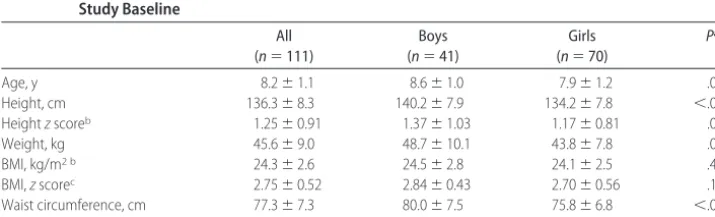
Participant characteristics at baseline are shown in Table 1. Sixty-four percent were female, and a majority were 8 years of age or older (75 of 111) and obese (82 of 111). Seventy-two percent of children came from dual-parent families, with 98% of the parents who completed the baseline demographic information being of white ances-try. The mean ⫾ SD for the SEIFA index of relative advantage was 997⫾73 (South Australian mean: 960). Thirty-four percent of parents were classified as over-weight and 44% as obese. At baseline, there were no significant differences for any child or family character-istics by study group.
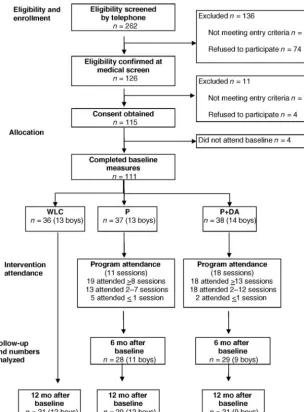
Figure 1 shows the flow of participants through the study from recruitment to 12-month measurements. There were no significant differences in socioeconomic status (SEIFA indices) between children who enrolled in the study and the 151 who were screened but did not
TABLE 1 Anthropometric Measurements (MeanⴞSD) for 6- to 9-Year-Old Prepubertal Children at Study Baseline
All (n⫽111)
Boys (n⫽41)
Girls (n⫽70)
Pa
Age, y 8.2⫾1.1 8.6⫾1.0 7.9⫾1.2 .001
Height, cm 136.3⫾8.3 140.2⫾7.9 134.2⫾7.8 ⬍.001
Heightzscoreb 1.25⫾0.91 1.37⫾1.03 1.17⫾0.81 .01
Weight, kg 45.6⫾9.0 48.7⫾10.1 43.8⫾7.8 .01
BMI, kg/m2 b 24.3⫾2.6 24.5⫾2.8 24.1⫾2.5 .41
BMI,zscorec 2.75⫾0.52 2.84⫾0.43 2.70⫾0.56 .19
Waist circumference, cm 77.3⫾7.3 80.0⫾7.5 75.8⫾6.8 ⬍.01 Waist circumference,zscorec 3.20⫾0.65 3.53⫾0.67 3.02⫾0.57 ⬍.001
aIndependentttest for differences by gender.
bValues were calculated by comparing participant heights against the Centers for Disease Control and Prevention 2000 reference population
(Centers for Disease Control and Prevention. Hyattsville, MD: National Center for Health; 2000).42
cValues were calculated by comparing participant values against United Kingdom reference population data (Cole TJ, Freeman JV, Preece MA.
enroll (P ⬎.05). Those who did not attend 12-month measurements were older (8.7⫾0.9 vs 8.2⫾1.2 years;
P⫽.04) and had a higher BMIzscore (2.96⫾0.44 vs 2.71⫾ 0.53;P⫽.04) and waist-circumference zscore (3.54 ⫾0.64 vs 3.14⫾0.64;P⫽.04) at baseline than those who did attend.
Growth, Overall, and Truncal Adiposity
Height increased in study participants by 6.5 ⫾1.3 cm between baseline and 12 months. Height zscore for all study participants was 1.2 ⫾0.9 at baseline and 1.3⫾ 0.9 at 12 months (linear mixed model group by time:P
⫽.39), indicating that the growth of intervention chil-dren was similar to that of chilchil-dren wait-listed for inter-vention for 12 months. Over 12 months, the primary study outcome, BMI z score, reduced by 9% (range:
⫺85% to 18%) in the P⫹DA group, 6% (range:⫺48% to 49%) in the P group, and 5% (range:⫺78% to 16%) in the WLC group (linear mixed model, group by time,P
⫽ .76; Table 2). Forty-five percent of children in the WLC group increased their BMIzscore over 12 months, compared with 19% and 24% in the P⫹DA and P groups, respectively (P⫽.03).
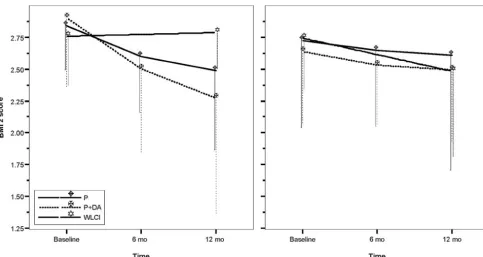
There was a significant group by time (with gender) interaction for the primary outcome, BMI zscore (P⫽
.04; Fig 2). Posthoc analysis showed no significant dif-ferences between study groups at any time point for boys or girls (allP⬎.05). However, boys in both intervention groups had significantly lower BMIzscores at 6 and 12 months compared with baseline (no change for boys in the WLC group; Fig 2). For girls, the only significant time change was a reduction in BMIzscore in the WLC group (P⫽.02). There was no association between change in BMIzscore from baseline to 12 months and indicators of socioeconomic status (all SEIFA indices,P⬎.05).
There was a significant group by time interaction for waist-circumference zscore (P⫽.03; Table 2). Posthoc analysis showed no significant differences between
FIGURE 1
study groups at any time point. However, waist-circum-ference z score was significantly lower at 12 months compared with baseline in the P⫹DA and P intervention groups but not the WLC group (Table 2) and was also significantly lower at 12 vs 6 months for the P⫹DA group (Table 2). The pattern of change by gender mir-rored that described for BMIzscore. For both BMI and waist-circumference z score, results did not change when analysis was conducted per protocol by using only participants with complete data.
Metabolic Health Outcomes
Table 3 shows the metabolic variables for all participants at baseline and 12 months. There were no differences
FIGURE 2
Mean (SD) BMIzscore for study participants at baseline (40 boys, 71 girls) and 6 months (20 boys, 37 girls) and 12 months (33 boys, 59 girls) after intervention or wait-listing for intervention. BMIzscore linear mixed model:P⫽.04 group by time with gender; posthoc analysis (Bonferroni method):P⫽.004 boys in P group at 6 months versus baseline,P⫽.01 boys in P group at 12 months versus baseline,P⫽.02 boys in P⫹DA group at 6 months versus baseline, andP⫽.01 boys in P⫹DA group at 12 months versus baseline; all other comparisons:P⬎.05.
TABLE 2 Anthropometric Outcomes (MeanⴞSD) for Study Participants According to Study Group
BMIzScorea Waist CircumferencezScoreb
Baseline (n⫽111)
6 mo (n⫽57)
12 mo (n⫽91)
Difference (n⫽91)c
Baseline (n⫽111)
6 mo (n⫽57)
12 mo (n⫽91)
Difference (n⫽91)c
P⫹DA 2.74⫾0.58 2.52⫾0.53 2.43⫾0.68 ⫺0.24⫾0.43 3.27⫾0.73 3.00⫾0.67 2.85⫾0.78 ⫺0.31⫾0.53 P 2.76⫾0.58 2.63⫾0.53 2.56⫾0.79 ⫺0.15⫾0.47 3.20⫾0.67 3.08⫾0.52 2.93⫾0.69 ⫺0.17⫾0.50 WLC 2.75⫾0.39 — 2.60⫾0.57 ⫺0.13⫾0.40 3.14⫾0.56 — 3.14⫾0.75 ⫺0.02⫾0.58
— indicates no data collected.
aLinear mixed model:P⫽.76 group by time.
bLinear mixed model:P⫽.03 group by time; posthoc analysis (Bonferroni method):P⬍.01 for P⫹DA at 12 months versus baseline,P⫽.01 for P⫹DA at 12 vs 6 months, andP⫽.05 for 12 months
versus baseline; for all other comparisons,P⬎.05.
cMean differences between 12 months and baseline.
TABLE 3 Total Cholesterol and Fractions, Triacylglycerol, Blood Pressure, Glucose, and Insulin (MeanⴞSD) for 6- to 9-Year-Old Prepubertal Children at Baseline and 12 Months
Baseline (n⫽11)
12 mo (n⫽71)
Pa
Total cholesterol 4.9⫾0.9 4.5⫾0.7 .47 Low-density lipoprotein cholesterolb 2.8⫾0.8 2.9⫾0.7 .42
High-density lipoprotein cholesterolb 1.3⫾0.2 1.2⫾0.3 .96
Triacyglycerol 0.7⫾0.6 0.7⫾0.5 .98
Systolic blood pressure 116⫾11 117⫾8 .49 Diastolic blood pressure 58⫾7 57⫾7 .82
Glucose 4.4⫾0.8 4.5⫾0.4 .88
Insulin 79⫾37 89⫾59 .84
between study groups at baseline or 12 months. Diastolic blood pressure was significantly reduced at 6 months but not at 12 months when compared with baseline.
Program Evaluation
Program attendance did not differ between the 2 inter-vention groups with 18 of 38 and 19 of 37 parents from the P⫹DA and P groups, respectively, attending more than three quarters of the program sessions. As part of the anonymous satisfaction questionnaire (71% re-sponse rate: 26 P⫹DA, 10 P), parents were asked to circle factors that prevented them attending intervention sessions. Family or work commitments, family illness, and perceived lack of time were more frequently indi-cated as barriers to intervention attendance (21 of 36), rather than program-related barriers (eg, session timing or frequency, transport difficulty, program not meeting needs, 9 of 36). Seven parents in both intervention programs sought other assistance elsewhere regarding child weight management during the study.
All 36 respondents in both intervention groups rated the quality of the service provided during the interven-tions as good to excellent. Thirteen of 26 P⫹DA parents and 8 of 10 P parents reported they “generally to defi-nitely” received the type of help they wanted in manag-ing their child’s weight. All parents in the P group and 22 of 26 in the P⫹DA group were “satisfied to very satis-fied” with the amount of help received during the study. All parents in the P group and 24 of 26 in the P⫹DA group responded that the study had “helped somewhat to helped a great deal” to make changes to family life-style. Twenty of 26 P⫹DA respondents and 6 of 10 P group respondents said they would repeat the program if they were seeking assistance in managing child over-weight again. The parenting-skills training resources (group parenting sessions: 14 P⫹DA, 7 P; parenting tele-phone sessions: 12 P⫹DA, 7 P; parenting manual: 10 P⫹DA, 6 P) were more commonly reported as being useful than the lifestyle education resources (lifestyle sessions: 5 P⫹DA, not applicable for P; lifestyle written material: 5 P⫹DA, 1 P).
DISCUSSION
This study examined the effectiveness of parenting-skills training, with or without intensive lifestyle education, as part of parent-led, family-focused weight management of 6- to 9-year-olds. The key study finding was that all 3 groups had a significant reduction in BMIzscore over 12 months. Although there was no statistical significance between groups BMIzscore decreased over 12 months in double the number of children in the P⫹DA group (45%) compared with the P intervention or intervention wait-listing (24% and 19%, respectively). Waist-circum-ferencezscore fell significantly over 12 months in both intervention groups but not in the control group. Impor-tantly, when time and group analysis was adjusted for
gender boys in the intervention groups had significant reductions in both BMI and waist-circumference z
scores, which were not observed for girls or the wait-listed controls. Because a gender effect was unexpected, the study was not powered to allow gender subanalysis. In terms of broader health outcomes, there was no significant change in metabolic profile in any study group. The average values for metabolic indicators at baseline were within the reference range for children, thus limiting the need for improvement over time.30,34
The interventions had no adverse impact on linear growth.
Only 1 previous study examined differences in inter-vention response by gender.35 As was found in our
study, boys showed better reductions in percent over-weight than girls in a family behavioral program that focused on increasing activity and decreasing sedentary activity.35 In that study, gender did not independently
predict reductions in percent overweight, and the au-thors proposed that the effect of gender was mediated by the higher motivation and intervention compliance ob-served with families of boys.35In our study, the higher
degree of truncal adiposity in boys versus girls at baseline may be a factor in the gender differences in intervention response.36
Recent data suggesting that truncal adiposity in Aus-tralian children is increasing more rapidly for girls than boys may provide an additional explanation for the gen-der differences.37There may be gender-based differences
in the environmental influences promoting overweight, making it harder in girls to reverse this trend. Our results highlight the need to always stratify for gender when allocating participants and to ensure that sample size calculations allow gender subanalyses.
The weight status changes from this study, although clinically relevant, were modest compared with previous studies. Child-focused studies using the same outcomes as the present study have achieved between 0.6 and 1.3 unit reductions in BMIzscore compared with⬃0.25 in this study.38–40 However, analysis in these studies were
not performed by intention to treat and may have over-estimated intervention effectiveness.33 The only other
study that evaluated parent-led child weight manage-ment had a 15-point reduction in percent overweight (using percent above the 50th centile for weight) com-pared with an 8-point reduction with a child-focused intervention.41 Comparison of these results to the
present study is limited by the difference in outcome expression and the length of intervention (12 vs 6 months in our study). This is the first time that waist-circumference z scores have been reported in a child weight loss study.
management. Although it seems that intensive lifestyle education may enhance parents’ ability to implement parent-led child behavior modification, an intensive life-style education alone group would be required to fully evaluate the relative role of parenting-skills training and lifestyle education or synergy between these treatment components. The potential resource savings of parent-ing-skills training alone, if effective, also has important health cost implications.
Our study addressed 5 of the major design limitations of child weight-management studies highlighted in a recent Cochrane review5including (1) using recruitment
and retention strategies to achieve the calculated sample size and ⬍20% drop out at 12 months, (2) blinded allocation and outcome assessment to minimize mea-surement bias, (3) intervention delivery using standard protocols and a single, trained facilitator to limit site bias and enhance internal study validity, (4) health outcome assessment inclusive of adiposity and obesity-related health consequences at 12 months which included a follow-up period after treatment had ceased, and (5) primary analysis performed by intention to treat to prop-erly assess intervention effectiveness. Furthermore, the narrow age range ensured age-appropriate interven-tion.41
Compared with previous studies, considerable atten-tion was paid to defining effectiveness and based on broad criteria, the results suggest potential for overall intervention effectiveness. However, study power, inter-vention adherence, and dilution of effect size with in-tention-to-treat analysis may be factors in the failure of these trends to convert to statistical significance and the moderate results compared with previous studies.39,41
Sample size based on the primary outcome assumed there would be no change in adiposity in the control group. Hence, the unanticipated reduction in BMI z
score in the control group produces the potential for type II error. The apparent motivation of the control group limits generalizability; however, in the current obesity epidemic environment and associated media coverage, such bias may be difficult to avoid.
CONCLUSIONS
A family-focused intervention using parenting-skills training and promoting a healthy family lifestyle may be an effective approach to weight management in prepu-bertal children but with a clear gender effect. Both pa-renting-skills training and lifestyle education are poten-tially important components. This approach addresses family and parental factors influencing children’s eating and activity behaviors and achieves a moderate reduc-tion in adiposity after 12 months. Future studies should be powered for adiposity reductions in control groups, primary and secondary outcome analysis and gender subanalysis. Finally longer-term follow-up to assess
ef-fectiveness through to early adolescent development is essential in the context of global obesity.
ACKNOWLEDGMENTS
This research was funded by the Australian Health Man-agement Group Assistance to Health and Medical Re-search Fund. Dr Golley was supported by Australian National Health and Medical Research Council Postgrad-uate Research Scholarship 229978.
We thank the children and families for participating in the study, including blood sample collection. Many thanks go to the following for assistance: Professor Kevin Norton (School of Health, University of Adelaide) for developing the physical activity component; staff from the paediatric unit at Flinders Medical Centre for provi-sion of space and screening participants; Ms Sarah Gar-nett (Institute of Endocrinology, Children’s Hospital at Westmead) and Ms Margie Gruca (laboratory manager, James Fairfax Institute Pediatric Nutrition, Children’s Hospital at Westmead) for calculation of waist-circum-ferencezscores; Ms M. Howard, Dr D. Thomas, and the Division of Laboratory Medicine (Women’s and Chil-dren’s Hospital, Adelaide); Diagnostic Laboratory, De-partment of Endocrinology Royal Prince Alfred Hospital, Sydney; and Ms Kylie Lange and Ms Fiona Curnow for statistical advice and support.
REFERENCES
1. World Health Organization.Obesity: Preventing and Managing the Global Epidemic. Geneva, Switzerland: World Health Organization; 1998
2. Lobstein T, Baur L, Uauy R. Obesity in children and young people: a crisis in public health.Obes Rev.2004;5:4 –104 3. National Health and Medical Research Council.Clinical Practice
Guidelines for the Management of Overweight and Obesity in Chil-dren and Adolescents. Canberra, Australia: Commonwealth of Australia; 2003
4. National Guideline Clearinghouse. Guideline Synthesis: Over-weight and Obesity in Children and Adolescents—Assessment, Pre-vention and Management. Rockville, MD: Agency for Healthcare Research and Quality, US Department of Health and Human Services; 2005
5. Summerbell CD, Ashton V, Campbell KJ, Edmunds L, Kelly S, Waters E. Interventions for treating obesity in children. Co-chrane Database Syst Rev.2003;(3):CD001872
6. Reilly JJ, Armstrong J, Sherriff A, et al. Early life risk factors for childhood obesity: a cohort study.BMJ.2005;330:1357 7. Campbell K, Crawford D. Family food environments as
deter-minants of preschool-aged children’s eating behaviors: impli-cations for obesity prevention policy.Aust J Nutr Diet.2001;58: 19 –24
8. Birch LL, Fisher JO. Development of eating behaviors among children and adolescents.Pediatrics.1998;101(3 pt 2):539 –549 9. Nader PR. The role of the family in obesity prevention and
treatment.Ann N Y Acad Sci. 1993;699:147–153
10. Westenhoefer J. Establishing dietary habits during childhood for long-term weight control.Ann Nutr Metab.2004;46:18 –23 11. Kieckhefer GM, Trahms CM. Supporting development of chil-dren with chronic conditions: from compliance toward shared management.Pediatr Nurs.2000;26:354 –363
treat-ment of childhood obesity: long-term results.Obes Res.2004; 12:357–361
13. Golan M, Weizman A. Familial approach to the treatment of childhood obesity: conceptual model. J Nutr Educ.2001;33: 102–107
14. Sanders MR. The Triple P-Positive parenting program: towards an empirically validated multilevel parenting and family sup-port strategy for the prevention of behavior and emotional problems in children.Clin Child Psychol Rev.1999;2:71–90 15. Campbell KJ, Crawford DA, Ball K. Family food environment
and dietary behaviors likely to promote fatness in 5– 6 year-old children.Int J Obes (Lond).2006;30:1272–1280
16. Variyam JN, Shim Y, Blaylock J. Consumer misperceptions of diet quality.J Nutr Educ.2001;33:314 –321
17. Cole TJ, Freeman JV, Preece MA. Body mass index reference curves for the UK, 1990.Arch Dis Child.1995;73:25–29 18. Cole TJ, Bellizzi MC, Flegal KM, Dietz WH. Establishing a
standard definition for child overweight and obesity worldwide: international survey.BMJ.2000;320:1– 6 19. Tanner J.Growth at Adolescence: With a General Consideration of
the Effects of Hereditary and Environmental Factors Upon Growth and Maturation From Birth to Maturity. 2nd ed. Oxford, United Kingdom: Blackwell Scientific Publications; 1962
20. Moher D, Schulz KF, Altman DG. The CONSORT statement: revised recommendations for improving the quality of reports of parallel-group randomised trials. Lancet. 2001;357: 1191–1194
21. Turner KM, Markie-Dadds C. Facilitator’s Manual for Group Triple P. 2nd ed. Brisbane, Australia: Families International Publishing Party Ltd; 2000
22. Golley RK, Haigh RA, Magarey AM, Daniels LA. A family-focused child weight management program incorporating par-enting skills with healthy lifestyle information to support be-haviour modification.Nutr Diet.2007;64: In press
23. Smith A, Kellett E, Schmerlaib Y.The Australian Guide to Healthy Eating. Canberra, Australia: Commonwealth Department of Health and Family Services; 1998
24. Gehling-Golley RK, Magarey AM, Daniels LA. Food-based rec-ommendations to reduce fat intake: an evidence-based ap-proach to the development of a family-focused child weight management programme. J Paediatr Child Health. 2005;41: 112–118
25. Waters E, Salmon J, Wake M, Wright M, Hesketh K.Australian Authorised Adaptation of the Child Health Questionnaire: The Inter-pretation Guide.Melbourne, Australia: Centre for Community Health, Royal Children’s Hospital; 1999. Parent/proxy form CHQ PF50&PF28
26. Trewin D. Socio-Economic Indexes for Areas (SEIFA). Canberra, Australia: Australian Bureau of Statistics; 2001
27. Norton KI, Whittingham N, Carter JEL, Ker D, Gore C, Marfell-Jones MJ. Measurement techniques in anthropometry. In: Norton KI, Olds TS, eds. Anthropometrica. Sydney, Australia: University of New South Wales Press; 1996:25–75
28. McCarthy HD, Jarrett KV, Crawley HF. The development of waist circumference percentiles in British children aged 5.0 –16.9 y.Eur J Clin Nutr.2001;55:902–907
29. Jureidini KF, Baghurst PA, Hogg RJ, et al. Blood pressure in schoolchildren measured under standardized conditions.Med J Aust.1988;149:132–134
30. National Cholesterol Education Program (NCEP): highlights of the report of the Expert Panel on Blood Cholesterol Levels in Children and Adolescents.Pediatrics.1992;89:495–501 31. Hollis S, Campbell F. What is meant by intention to treat
analysis? Survey of published randomised controlled trials.
BMJ.1999;319:670 – 674
32. Gueorguieva RG, Krystal JH. Move over ANOVA. Arch Gen Psychiatry.2004;61:317–317
33. Chaan A, Laird N, Slasor P. Using the general linear mixed model to analyse unbalanced repeated measures and longitu-dinal data.Stat Med.1997;16:2349 –2380
34. Update on the 1987 Task Force Report on High Blood Pressure in Children and Adolescents: a working group report from the National High Blood Pressure Education Program. Pediatrics.
1996;98:649 – 658
35. Epstein LH, Paluch RA, Raynor HA. Sex differences in obese children and siblings in family-based obesity treatment.Obes Res.2001;9:746 –753
36. Lonnqvist F, Thorne A, Large V, Arner P. Sex differences in visceral fat lipolysis and metabolic complications of obesity.
Arterioscler Thromb Vasc Biol.1997;17:1472–1480
37. Garnett SP, Cowell CT, Baur L, et al. Increasing central adiposity: the Nepean longitudinal study of young people aged 7– 8 to 12–13y.Int J Obes (London).2005;29:1353–1360 38. Epstein LH, Valoski A, Wing RR, McCurley J. Ten-year
out-comes of behavioral family-based treatment for childhood obe-sity.Health Psychol.1994;13:373–383
39. Epstein LH, Paluch RA, Gory CC, Sealers BE, Ernst MM. Prob-lem solving in the treatment of childhood obesity.J Consult Clin Psychol.2000;68:717–721
40. Goldfield GS, Epstein LH, Kilanowski CK, Paluch RA, Kogut-Bossler B. Cost-effectiveness of group and mixed family-based treatment for childhood obesity.Int J Obes Relat Metab Disord.
2001;25:1843–1849
41. Golan M, Weizman A, Apter A, Fainaru M. Parents as the exclusive agents of change in the treatment of childhood obe-sity.Am J Clin Nutr.1998;67:1130 –1135
DOI: 10.1542/peds.2006-1746
2007;119;517
Pediatrics
Lynne A. Daniels
Rebecca K. Golley, Anthea M. Magarey, Louise A. Baur, Katharine S. Steinbeck and
Controlled Trial
Weight-Management Program for Prepubertal Children: A Randomized,
Twelve-Month Effectiveness of a Parent-led, Family-Focused
Services
Updated Information &
http://pediatrics.aappublications.org/content/119/3/517 including high resolution figures, can be found at:
References
http://pediatrics.aappublications.org/content/119/3/517#BIBL This article cites 31 articles, 8 of which you can access for free at:
Subspecialty Collections
http://www.aappublications.org/cgi/collection/puberty_sub
Puberty
http://www.aappublications.org/cgi/collection/endocrinology_sub
Endocrinology
following collection(s):
This article, along with others on similar topics, appears in the
Permissions & Licensing
http://www.aappublications.org/site/misc/Permissions.xhtml in its entirety can be found online at:
Information about reproducing this article in parts (figures, tables) or
Reprints
DOI: 10.1542/peds.2006-1746
2007;119;517
Pediatrics
Lynne A. Daniels
Rebecca K. Golley, Anthea M. Magarey, Louise A. Baur, Katharine S. Steinbeck and
Controlled Trial
Weight-Management Program for Prepubertal Children: A Randomized,
Twelve-Month Effectiveness of a Parent-led, Family-Focused
http://pediatrics.aappublications.org/content/119/3/517
located on the World Wide Web at:
The online version of this article, along with updated information and services, is
by the American Academy of Pediatrics. All rights reserved. Print ISSN: 1073-0397.