A FAULT NODE RECOVERY ALGORITHM TO
REINFORCES THE LIFETIME AND ROUTING IN
WIRELESS SENSOR NETWORK
Divyashree S
1, Sanjay Kumar N.V
2,
Dr. Y. P. Gowramma
31
PG Student, Dept. of CS&E,
2Assistant Professor, Dept. of CS&E,
3Professor and HOD of CS&E
Kalpataru Institute of Technology, Tiptur, Karnataka, (India)
ABSTRACT
Wireless sensor networks have seen tremendous advances and utilization in the past two decades. Ranging from
fossil oil exploration, mining, weather and even battle operations, all of those need detector applications. In the
WSN, reduction of energy consumption is incredibly necessary for every each sensor node as a result of it will
extend WSN period. The Wireless sensor network may be an assortment of sensors that are meet giant
geographical region. Since sensors are wide unfold and enormous in range, the occurrences of faults within the
network are additional. Therefore to detect the fault node and to replace the fault node an efficient algorithm is
proposed. In this paper proposes a fault node recovery (FNR) to reinforce the period of a wireless sensor
network (WSN) once a number of the sensor nodes stop working, either as a result of they now not have battery
energy or they need reached their operational threshold. Using the FNR algorithm may end up in replacements
of sensor nodes and more reused routing paths. Thus, the algorithm not solely enhances the WSN period
however additionally reduces the cost of replacing the sensor nodes.
Keywords: Genetic Algorithm, Grade Diffusion (GD) Algorithm, Gradient Diffusion Algorithm,
and Wireless Sensor Networks (WSN)
I. INTRODUCTION
RECENT advances in small process, wireless and battery technology and good sensors have enhanced
information processing [5], wireless communication, and detection capability. In sensor networks, every sensor
node has restricted wireless computational power to process and transfer the live data to the base station or data
collection center. Therefore, to extend the sensor area and also the transmission area the wireless sensor network
typically contains several sensor nodes. Generally, every sensor node features a low level of battery power that
can't be replenished. Once the energy of a sensor node is exhausted, wireless sensor network leaks can seem,
and also the unsuccessful nodes won't relay information to the opposite nodes throughout transmission process.
Thus, the other sensor nodes are going to be burdened with exaggerated transmission process.
In the WSN, reduction of energy consumption is incredibly necessary for every each sensor node as a result of it
will extend WSN period. The Wireless sensor network may be an assortment of sensors that are meet giant
geographical region. Since sensors are wide unfold and enormous in range, the occurrences of faults within the
network are additional. Therefore to detect the fault node and to replace the fault node an efficient algorithm is
proposed. This work proposes a fault node recovery (FNR) to reinforce the period of a wireless sensor network
or they need reached their operational threshold. Using the FNR algorithm may end up in replacements of
sensor nodes and more reused routing paths. Thus, the algorithm not solely enhances the WSN period however
additionally reduces the cost of replacing the sensor nodes.
1.1 Wireless Sensor Networks
Wireless sensor networks have seen tremendous advances and utilization in the past two decades. Ranging from
fossil oil exploration, mining, weather and even battle operations, all of those need detector applications. One
reason behind the growing quality of wireless sensors is that they'll add remote areas while not manual
intervention. All the user needs to do is to collect the data sent by the sensors, and with bound analysis extract
important information from them. Typically sensor applications involve several sensors deployed along. These
sensors form a network and collaborate with one another to collect data and send it to the base station. These
nodes combine with routers and gateways to form a WSN system. The WSN is formed of nodes from a couple
of too many hundred, wherever every node is connected to at least one or many sensors as shown in figure 1.
II. RELATED WORK
Failures are unavoidable in Wireless Sensor Networks due to the lack of observation and unattended
deployment. There is a unit several problems associated with energy, memory and process ability of a sensor
node. The occurrences of faults are a unit largely due the presence of faulty sensor nodes [1]. To identify a fault
node and to interchange it, several techniques are proposed.
C. Intanagonwiwat et al. [1] explored the directed-diffusion paradigm for such coordination. Directed diffusion
is data-centric there in all communication is for named data. All nodes in an exceedingly
directed-diffusion-based network are a unit application aware. This permits diffusion to realize energy savings by choosing through
empirical observation smart ways and by caching and process knowledge in-network (e.g., data aggregation).
They explore and evaluated the employment of directed diffusion for a straightforward remote-surveillance
device network analytically and by experimentation.
Fault management for WSNs [2] is totally different from traditional networks. Recent analysis has developed
many schemes and techniques that affect differing kinds of faults at totally different layers of the network. All
these techniques consider only few issues of WSNs. An efficient Fault Management system or model should
J. A. Carballido et al. [3] mentioned the foundations and implementation of a genetic algorithm (GA) for
instrumentation functions. The GA constitutes a format module of a call network for sensor network style. The
tactic development entailed the definition of the individual’s illustration additionally because the design of a
graph-based fitness operates, alongside the formulation of many alternative impromptu enforced options. The
performance and effectiveness of the GA were assessed by initializing the instrumentation design of an
ammonia synthesis plant. The format provided by the GA succeeded in fast the sensor network design
procedures. It conjointly accomplished a great improvement within the overall quality of the ensuing instrument
configuration. The GA will constitute a valuable tool for the treatment of real industrial issues.
H. C. Shih et al. had given the Grade Diffusion (GD) [4] algorithm in 2012 to enhance the ladder diffusion
algorithm using ant colony optimization (LD-ACO) for wireless sensor networks. The GD algorithm not solely
creates the routing for every sensor node however additionally identifies a collection of neighbor nodes to scale
back the transmission loading. Every sensor node can choose a sensor node from the set of neighbor nodes once
its grade table lacks a node able to perform the relay.
Hong-Chi Shih et al. proposed a fault node recovery (FNR) algorithm[6] to boost the life of a wireless sensor
network (WSN) once a number of the sensor nodes pack up, either as a result of they not have battery energy or
they need reached their operational threshold. Mistreatment the FNR algorithmic rule may end up in fewer
replacements of device nodes and additional reused routing paths. Thus, the algorithm not solely enhances the
WSN lifespan but also reduces the cost of exchange the sensor nodes. The normal approaches to sensor network
routing embrace the directed diffusion (DD) [1] algorithm and the grade diffusion (GD) algorithm [4]. The
algorithm proposed in this paper relies on the GD algorithm, with the goal of exchange fewer sensor nodes that
are a unit inoperative or have depleted batteries, and of reusing the most variety of routing paths. These
optimizations can ultimately enhance the WSN lifespan and reduce sensor node replacement cost.
III. EXISTING SYSTEM
3.1 Directed Diffusion Algorithm
A series of routing algorithms for wireless sensor networks have been proposed in recent years. C.
Intanagonwiwat et al. given the Directed Diffusion (DD) algorithm [1] in 2003. The goal of the DD algorithm is
to scale back the data relay transmission counts for power management. The DD algorithm may be a
query-driven transmission protocol. The collected data is transmitted providing it matches the query from the sink
node. Within the DD algorithm, the sink node provides the queries within the type of attribute-value pairs to the
opposite sensor nodes by broadcasting the query packets to the total network. After, the sensor nodes send the
data back to the sink node only when it fits the queries.
3.2 Grade Diffusion Algorithm
H. C. Shih et al. had given the Grade Diffusion (GD) [4] algorithm in 2012 to enhance the ladder diffusion
algorithm using ant colony optimization (LD-ACO) for wireless sensor networks. The GD algorithm not solely
creates the routing for every sensor node however additionally identifies a collection of neighbor nodes to scale
back the transmission loading. Every sensor node can choose a sensor node from the set of neighbor nodes once
its grade table lacks a node able to perform the relay.
The GD algorithm may also record some information relating to the data relay. Then, a sensor node will choose
operation. That is, the GD formula updates the routing path in real time, and also the event data is so sent to the
sink node quickly and properly and shown in Figure 3.
Whether the DD or the GD algorithmic rule is applied, the grade making packages or interested query packets
should first be broadcast. Then, the sensing element nodes transfer the event data to the sink node, in step with
the algorithmic rule, once appropriate events occur. The sensor routing paths are shown in Figure 4.
The WSN could fail due to a spread of causes, together with the following: the routing path would possibly
expertise a break; the WSN sensing space would possibly expertise a leak; the batteries of some sensor nodes
could be depleted, requiring additional relay nodes; or the nodes wear out when the WSN has been in use an
extended amount of your time. In Figure 5, the situation in which the outside nodes transfer event data to the
sink node via the inside nodes (the sensor nodes near the sink node) in a WSN illustrate the accommodation
measures for non-working nodes. The inside nodes therefore have most important data transmission loading,
intense energy at a quicker rate. If all the inside nodes spend their energy or otherwise stop to operate, the event
data will now not be sent to the sink node, and therefore the WSN can now not operate.
The power consumption of the sensor nodes in WSNs is inevitable. However, proposes an algorithm to search
for and replace fewer sensor nodes and to utilize the foremost routing ways. Typical search techniques are often
incapable of optimizing nonlinear functions with multiple variables. One scheme, the genetic algorithm (GA),
may be a directed random search technique developed in 1975, supported the conception of natural biology. The
present work proposes a fault node recovery (FNR) algorithmic rule supported the GD algorithm combined with
the GA. The FNR algorithm creates a routing table using the GD algorithm and replaces sensor nodes using the
GA once the amount of sensor nodes that are not functioning exceeds the brink. This algorithmic rule not solely
IV. PROPOSED SYSTEM
This work proposes a fault node recovery (FNR) [6] algorithm to boost the period of time of a wireless sensor
network (WSN) once a number of the sensor nodes pack up, either as a result of they not have battery energy or
they need reached their operational threshold. Victimization the FNR algorithm may end up in fewer
replacements of sensor nodes and additional reused routing paths. Thus, the rule not solely enhances the WSN
period of time however additionally reduces the value of replacement the sensor nodes. The standard approaches
to sensor network routing embrace the directed diffusion (DD) [1] algorithm and also the grade diffusion (GD)
[4] algorithm. The rule projected during this work relies on the GD algorithm, with the goal of replacement
fewer sensor nodes that square measure inoperative or have depleted batteries, and of reusing the utmost variety
of routing paths. These optimizations can ultimately enhance the WSN lifetime and reduce sensor node
replacement cost.
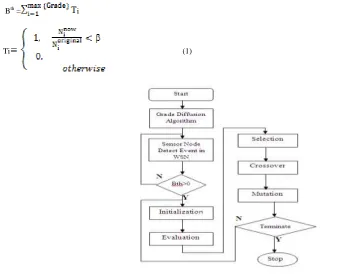
This work proposes a fault node recovery (FNR) algorithm for WSNs supported the grade diffusion algorithm
[6] combined with the genetic rule. The Block diagram and flow chart is shown in Figure 6. The FNR algorithm
creates the routing table, grade value, neighbor nodes, and payload value for every sensor node using the grade
diffusion algorithm. In the FNR algorithm, the amount of nonfunctioning sensor nodes is calculated throughout
the wireless sensor network operation, and also the parameter Bth is calculated consistent with (1).
In Figure 6, the FNR algorithm creates the grade value, routing table, a group of neighbor nodes, and payload
value for every sensor node, victimization the grade diffusion rule. The sensor nodes transfer the event data to
the sink node consistent with the GD rule once events seem. Then, Bth is calculated consistent with (1) within
the FNR algorithm [2]. If Bth is larger than zero, the rules are going to be invoked and replace nonfunctioning
device nodes by purposeful nodes selected by the genetic rule. Then the wireless device network will still work
as long because the operators square measure willing to switch sensors
In (1), Grade is the sensor node’s grade value. The variable is the number of sensor nodes with the
grade value i. The variable is the number of sensor nodes still functioning at the current time with grade
value i. The parameter is about by the user and should have a worth between 0 and 1. If the amount of sensor
nodes that operate for every grade is a smaller amount than β, Ti can become 1, and Bth are going to be larger
than zero. Then, the algorithm can calculate the sensor nodes to replace using the genetic algorithm. The
parameters square measure encoded in binary string and function the chromosomes for the GA. The elements
(or bits), i.e., the genes, within the binary strings square measure adjusted to reduce or maximize the fitness
value. The fitness operate generates its fitness value that consists of multiple variables to be optimized by the
GA. Within every, iterations of the GA a pre-determined number of individuals will produce fitness values
related to the chromosomes. There are five steps within the genetic algorithm: Initialization of data format,
Evaluation, Selection, Crossover, and Mutation of corresponding data.
In initialization chromosome are generated. Every Chromosome is associate degree expected. The quantity of
chromosomes depends on number of sensors to be replaced. Next is the evaluation method the quantity of
routing path on the market if some non functioning sensors square measure replaced is evaluated supported
fitness value. This fitness value is calculated with variety of sensor nodes grade values, number of reusable
routing methods, total number of sensor nodes in original WSN, and total number of routing methods in original
chromosomes are chosen and compared and a part of it is replaced with the other to produce new offspring are
obtained by crossover process. At last a single gene is replaced after comparison happened in mutation process.
Bth = i
Ti (1)
Fig. 6: Fault Node Recovery Algorithm Flow Chart
V. CONCLUSION
In real wireless sensor networks, the sensor nodes use battery power provides and so have restricted energy
resources. Additionally to the routing, it's vital to analysis the improvement of sensor node replacement,
reducing the replacement cost, and reducing the cost, and reusing the foremost routing ways once some sensor
nodes are a unit nonfunctional. This work proposes a fault node recovery algorithm for WSN supported the
grade diffusion algorithm combined with a genetic algorithm. The FNR algorithm needs replacement fewer
sensor nodes and reuses the foremost routing paths, increasing the WSN lifespan and reducing the cost.
REFERENCES
[1] C. Intanagonwiwat, R. Govindan, D. Estrin, J. Heidemann, and F. Silva, “Directed diffusion for wireless sensor networking,” IEEE/ACM Trans.Netw., vol. 11, no. 1, pp. 2–16, Feb. 2003.
[2] Lilia Paradis and Qi Han,“A Survey of Fault Management in Wireless Sensor Networks” Journal of
Network and Systems Management,2007.
[3] Carballido, I. Ponzoni, and N. B. Brignole, “CGD-GA: A graph based genetic algorithm for sensor network design,” Inf. Sci., vol. 177, no. 22, pp. 5091–5102, 2007.
[4] J. H. Ho, H. C. Shih, B. Y. Liao, and J. S. Pan, “Grade diffusion algorithm,” in Proc. 2nd Int. Conf. Eng.
Technol. Innov., 2012, pp. 2064–2068.
[5] T. H. Liu, S. C. Yi, and X. W. Wang, “A Fault Management Protocol for Low-Energy and Efficient Wireless Sensor Networks,” Journal of Information Hiding and Multimedia Signal Processing, vol. 4, No. 1, pp. 34-45, 2013.