A SURVEY – MODELS IN CLOUD COMPUTING
ABSTRACT
cloud computing plays a Major role in internet because of many successive enterpriseapplications on web and mobile. Cloud computing becomes more important and it is the excellent solution for enterprise applications and Mobile application. Cloud computing opens a new trend for computation. Presently there are various Internet services through the different clouds available some of the services are, Amazon web services, elastic compute cloud, Google cloud. The cloud computing offers variety of opportunities to the internet users and mobile users. Though there are many issues still to be covered. In this paper we presented survey of various cloud computing models.
Keywords: Cloud, Service models, Deployment models.
I. INTRODUCTION
The idea of providing a centralized computing service is to allow the remote users to utilize the resources over the network. In 1960s Mainframes timesharing systems provided these services to many remote users over the network. There were some problems in Mainframe timesharing like scaling, Hardware costs. Then a new challenge was introduced on how to share data effectively.
Client server model has been Introduced as a solution for the data sharing using centralized data management and processing servers. But client server Architecture is transformed into complex structure as numbers of enterprise applications are increased. As a result the hardware and software costs are increased. So to concentrate on business issues instead on costs companies are looking at cloud computing.
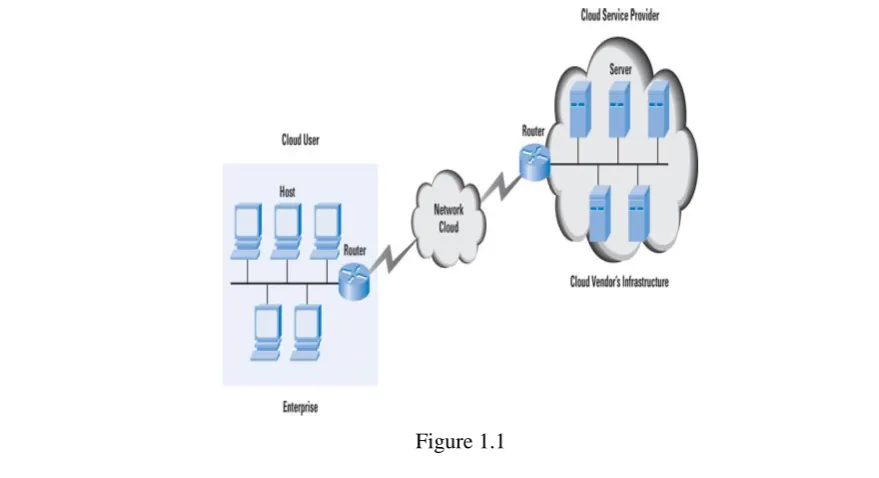
Cloud computing is a internet service which provides computing services on demand from remote machine to subscribed users over the network
Moving to the cloud service. Running in the cloud service. Stored in the cloud service. Accessed from the cloud point these days is seems like everything is happening “in the cloud”. The answer is that it's somewhere at the other end of internet connection – a place where you can access applications and services, and where your data can be stored securely. The cloud is a big deal for three reasons: It doesn't need any effort on our part to maintain it. It's effectively infinite in size, so we don't need to worry about it running out of capacity. We can access cloud-based applications and services from anywhere – all we need is a device with an Internet connection.
II. SERVICE MODELS
Cloud computing providers provide services according to different models, of which the three standard models per s a Service (IaaS), Platform as a Service (PaaS), and Software as a Service (SaaS).These models offer increasing abstraction; they are thus often portrayed as a layers in a stack infrastructure- platform- and software-as-a-service but these need not be related. For example, one can provide SaaS implemented on physical machines, without using PaaS or IaaS layers, and conversely one can run a program on IaaS and access it directly, without wrapping it as SaaS.
Software as a Service: The facility provided to the user is to use the applications running on a cloud infrastructure. The applications are accessible from various client devices through either a web browser or a program interface. The user does not manage or control the cloud infrastructure including network, servers, operating systems,.
Platform as a Service (PaaS). The facility provided to the user is to deploy onto the cloud infrastructure user created applications created using programming languages, libraries, services, and tools . The user does not manage cloud infrastructure including network, servers, operating systems.
Infrastructure as a Service (IaaS). The facility provided to the user is to provision processing, storage, networks, and other fundamental computing resources where the user is able to deploy and run arbitrary software, which can include operating systems and applications.
III. DEPLOYMENT MODELS
Private cloud:
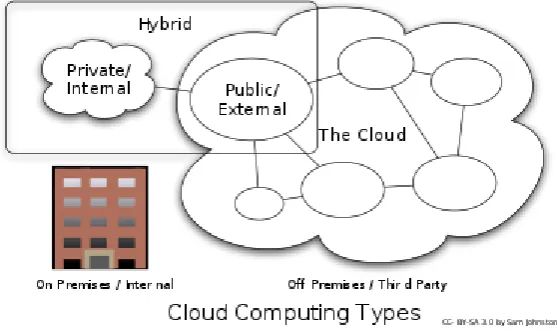
Private cloud is cloud infrastructure operated for a single organization. A private cloud requires a significant level and degree of engagement to virtualize the business environment, and requires the organization to reevaluate decisions about existing services. It can improve IT business. But every step in the project raises security issues that must be addressed to prevent them. Self run data centers are generally capital intensive. They have a significant physical footprint, space, enough hardware, and environmental controls. These assets have to be refreshed periodically, resulting in additional capital expenditures. They have attracted because users still have to buy, build, and manage them and thus do not benefit from less hands-on management, essentially the model that makes cloud computing such an intriguing concept
Public cloud
A cloud is called a public cloud when the services are open for public for free. Technically there may be little difference between public and private cloud architecture, however, security consideration may be different for services that are made available by a service provider for a public when communication is effected over a non-trustable network. Generally, public cloud service providers like Amazon Web Services , Microsoft and Google own and operate the infrastructure at their data center and access is generally via the network. AWS and Microsoft also offering direct connect services called AWS Direct Connect and Azure Express Route respectively; such connections require customers to get private connection to a peering point facilitated by the cloud provider
Figure 3.1
Hybrid cloud
IV. CONCLUSION
Cloud Computing doesn’t describe a single thing rather it is a general term that sits over many services from Infrastructure as a Service at the base, through Platform as a Service as a development tool and through to Software as a Services.
For organizations looking to move to Cloud Computing, it is important to understand the different aspects of Cloud Computing and to assess their own situation and decide types of solutions are suitable for their needs. Cloud Computing is a rapidly accelerating revolution within Information Technology and will become the default method of IT delivery moving into the future organizations would be recommended to consider their approach towards beginning a move to the clouds sooner, rather than later.
REFERENCES
[1.] Harshita. K. Raj, “A Survey on Cloud Computing”, Internal Journal of Advanced Research in Computer Science and Software Engineering, Volume 4, Issues 9, July 2014.
[2.] May Roomi, Shaikha Ebrahim, Sabika Buqrais and Imtiaz Ahmad, [3.] “Cloud Computing Pricing Models: A Survey”, International [4.] Journal of Grid Distributed Computing, Vol.6, No.5(2013).
[5.] Chakradhara Rao, Mogasala Leelarani, Y Ramesh Kumar, “Cloud: Computing Services and Deployment Models”, International Journal of Engineering and Computer Science, Volume 2 Issue 12, Dec.2013. [6.] Vikas Kumar, Survey Paper on Cloud Computing, “International Journal of Engineering and Advanced
Technology (IJEAT), Volume-2, Issue-6, August2013.
[7.] Suruchee V. Nandgaonkar, Prof. A. B. Raut, “A Comprehensive Study on Cloud Computing”, International Journal of Computer
[8.] Science and Mobile Computing, IJCSMC, Vol. 3, Issue. 4, April 2014.
[9.] R. Bala Chandar, M. S. Kavitha and K. Seenivasan, “A Proficient Model For High End Security In Cloud Computing”, ICTACT
[10.] Journal On Soft Computing, January 2014, Volume:04, Issue:02.
[11.] Mohiuddin Ahmed, Abu Sina Md. Raju Chowdhury, Mustaq Ahmed, Md. Mahmudul Hasan Rafee, “An Advanced Survey on
[12.] Cloud Computing and State-of the-art Research Issues”, IJCSI International Journal of Computer Science Issues, Vol. 9, Issue 1, No 1, January 2012.
[13.] Bhaswati Hazarika, Thoudam Johnson Singh, “Survey Paper on Cloud Computing & Cloud Monitoring: Basics”, SSRG
[14.] International Journal of Computer Science and Engineering (SSRG-IJCSE) – volume 2 issue 1 January 2015.
[15.] P S Yoganandani, Rahul Johari, Kunal Krishna, Rahul Kumar,
Volume No.-1, Issue No.-1, July 2014). Kaleem Ullah and M. N. A. Khan, “Security and Privacy Issues inCloud Computing Environment: A Survey Paper”, International Journal of Grid and Ditributed Computing Vol. 7, No. 2 (2014).
[17.] Chetan M Bulla, Satish S Bhojannavar and Vishal M Danawade, [18.] “Cloud Computing: Research Activities and Challenges”,
[19.] International Journal of Emerging Trends & Technology in Computer Science (IJETTCS) Volume 2, Issue 5, September – October 2013.
[20.] P. E. Ajmire, R. V. Dharaskar and V. M. Thakare, " Digital Forensic: An Annalistic Challenge", Proceeding, National Conference on Advances in Computing & Networking (NCAICN), March 2013. [21.] S. M. Nirkhi, Rajiv V Dharaskar, V. M. Thakre, "Analysis of online messages for identity tracing in
cybercrime investigation", IEEE Proceeding, International Conference on Cyber Security, Cyber Warfare and Digital Forensic (Cyber.Sec), June 2012.