University of Pennsylvania
ScholarlyCommons
Publicly Accessible Penn Dissertations
1979
An Algebraic Approach to Symmetry With
Applications to Knot Theory
David Edward Joyce
University of Pennsylvania
Follow this and additional works at:http://repository.upenn.edu/edissertations Part of theMathematics Commons
This edition of my dissertation differs little from the original 1979 version. This edition is typeset in LATEX, whereas the original was typed on typewriter and the figures were hand drawn. The page numbers and figure numbers are changed, the table of contents is expanded to include sections, a list of figures is included, and the index appears at the end instead of the front. I've corrected a few typos (and probably added others), and I added figure 4.5 that was missing from the original.
David Joyce June, 2009
Recommended Citation
Joyce, David Edward, "An Algebraic Approach to Symmetry With Applications to Knot Theory" (1979).Publicly Accessible Penn Dissertations. 952.
An Algebraic Approach to Symmetry With Applications to Knot Theory
Abstract
The usual algebraic construction used to study the symmetries of an object is the group of automorphisms of that object. In many geometric settings, however, one may interpret the symmetries in a more intimate manner by an algebraic structure on the object itself. Define aquandleto be a set equipped with two binary operations, (x,y) ↦x▷yand (x,y) ↦x▷-1y, which satisfies the axioms
Q1.x▷x=x.
Q2.(x▷y) ▷-1y=x= (x▷-1y) ▷y.
Q3.(x▷y) ▷z= (x▷z) ▷ (y▷z).
Call the mapS(y) sending x tox▷ythesymmetryaty.
To each pointyof a symmetric space there is a symmetryS(y), the symmetric space becomes a quandle. Call a quandle satisfyingx▷y=x▷-1yaninvolutoryquandle. Loos [1] has defined a symmetric space as a manifold with an involutory quandle structure such that each pointyis an isolated fixed point ofS(y).
The underlying set of a groupGalong with the operations of conjugation,x▷y=y-1xyandx▷-1y=yxy-1form a quandle ConjG. Moreover, the theory of conjugation may be regarded as the theory of quandles in the sense that any equation in ▷ and ▷-1holding in ConjGfor all the groupsGalso holds in any quandle. If the center of
Gis trivial, then ConjGdeterminesG.
LetGbe a group andn≥ 2. Then-coreofGis the set {(x1,x2,...,xn) ∈Gn|x1x2...xn= 1}
along with the operation
(x1,x2,...,xn) ▷(y1,y2,...,yn) = (yn-1xny1-1xM1y2,...,yn-1-1xn-1yn).
Then-core is ann-quandle, that is, each symmetry has order dividingn. The groupGis simple if and only if its
n-core is a simple quandle.
LetGbe a noncyclic simple group andQa nontrivial conjugacy class inHviewed as a subquandle of ConjG. ThenQis a simple quandle.
LetQbe a quandle. Thetransvection groupofQ, TransQ, is the automorphism group ofQgenerated by automorphisms of the formS(x)S(y)-1forx, yinQ. SupposeQis a simplep-quandle wherepis prime. Then either TransQis a simple group, or elseQis thep-core of a simple groupGand TransQ=Gp.
Consider the category of pairs of topological spaces (X,K),K⊆X, where a mapf: (X,K) → (Y,L) is a
continuous mapf:X→Ysuch thatf-1(L) =K. Let (D,O) be the closed unit disk paired with the originO. Call a map from (D,O) to (X,K) anooseinXaboutK. The homotopy classes of nooses inXaboutKform the
transfromation fromQ(X,K) to the fundamental groupπ1(X - K). A statement analogous to the Seifert-Van Kampen theorem for the fundamental group holds for the fundamental quandle.
LetKbe an oriented knot in the 3-sphereX. Define theknot quandle Q(K) to be the subquandle ofQ(X,K) consisting of nooses linking once withK. ThenQ(K) is a classifying invariant of tame knots, that is, ifQ(K) =
Q(K′), thenKis equivalent toK′. The knot group and the Alexander invariant can be computed fromQ(K). [1] Loos, O.,Symmetric Spaces, Benjamin, New York, 1969.
Degree Type Dissertation
Degree Name
Doctor of Philosophy (PhD)
Graduate Group Mathematics
First Advisor Peter J. Freyd
Subject Categories Mathematics
Comments
This edition of my dissertation differs little from the original 1979 version. This edition is typeset in LATEX, whereas the original was typed on typewriter and the figures were hand drawn. The page numbers and figure numbers are changed, the table of contents is expanded to include sections, a list of figures is included, and the index appears at the end instead of the front. I've corrected a few typos (and probably added others), and I added figure 4.5 that was missing from the original.
An Algebraic Approach to Symmetry
with Applications to Knot Theory
by
David Edward Joyce
A dissertation in mathematics
Presented to the Graduate Faculty of the University of Pennsylvania in partial fulfillment of the requirements for the degree of Doctor of Philosophy
1979
[signed]
Peter J. Freyd
Supervisor of Dissertation
Preface
This edition of my dissertation differs little from the original 1979 version. This edition is typeset in LATEX, whereas the original was typed on a typewriter and the figures were
hand drawn. The page numbers and figure numbers are changed, the table of contents is expanded to include sections, a list of figures is included, and the index appears at the end instead of the front. I’ve corrected a few typos (and probably added others), and I added figure 4.5 that was missing from the original.
Acknowledgments
I thank my friends for their tolerance, nay, for their encouragement, of the inves-tigation of the mathematics herein presented. I owe much to Julian Cole for many encouraging discussions and for some suggestions concerning nomenclature. I owe much more to my adviser, Peter Freyd, for his continued guidance of my mathematical matu-rity and for many discussions in many fields, mathematical and otherwise. I give special thanks to Janet Burns for the fine job of typing this dissertation.
Abstract
The usual algebraic construction used to study the symmetries of an object is the group of automorphisms of that object. In many geometric settings, however, one may interpret the symmetries in a more intimate manner by an algebraic structure on the object itself. Define aquandleto be a set equipped with two binary operations, (x, y)7→
x . y and (x, y)7→x .-1y, which satisfies the axioms
Q1. x . x=x.
Q2. (x . y).-1y=x= (x .-1y). y.
Q3. (x . y). z = (x . z).(y . z).
Call the map S(y) sending x tox . y the symmetry aty.
To each point y of a symmetric space there is a symmetry S(y) of the space. By defining x . y =x .-1y to be the image of x under S(y), the symmetric space becomes a
quandle. Call a quandle satisfying x . y = x .-1y an involutory quandle. Loos [1] has defined a symmetric space as a manifold with an involutory quandle structure such that each pointy is an isolated fixed point of S(y).
The underlying set of a group G along with the operations of conjugation, x . y =
y−1xy and x .-1y =yxy−1 form a quandle ConjG. Moreover, the theory of conjugation
may be regarded as the theory of quandles in the sense that any equation in . and .-1
holding in ConjGfor all groupsGalso holds in any quandle. If the center ofG is trivial, then ConjG determines G.
Let Gbe a group and n≥2. The n-core of G is the set
{(x1, x2, . . . , xn)∈Gn|x1x2. . . xn= 1}
along with the operation
(x1, x2, . . . , xn).(y1, y2, . . . , yn) = (y−n1xny1, y1−1x1y2, . . . , yn−−11xn−1yn).
The n-core is an n-quandle, that is, each symmetry has order dividing n. The group G
is simple if and only if its n-core is a simple quandle.
Let Q be a quandle. The transvection group of Q, TransQ, is the automorphism group of Q generated by automorphisms of the form S(x)S(y)−1 for x, y in Q. Suppose Qis a simple p-quandle where p is prime. Then either TransQ is a simple group, or else
Q is thep-core of a simple group G and TransQ=Gp.
Consider the category of pairs of topological spaces (X, K), K ⊆ X, where a map
f : (X, K) → (Y, L) is a continuous map f : X → Y such that f−1(L) = K. Let
(D, O) be the closed unit disk paired with the origin O. Call a map from (D, O) to (X, K) a noose in X about K. The homotopy classes of nooses in X about K form the fundamental quandle Q(X, K). The inclusion of the unit circle to the boundary of
D gives a natural transfromation from Q(X, K) to the fundamental group π1(X−K).
A statement analogous to the Seifert-Van Kampen theorem for the fundamental group holds for the fundamental quandle.
Let K be an oriented knot in the 3-sphere X. Define the knot quandle Q(K) to be the subquandle of Q(X, K) consisting of nooses linking once with K. Then Q(K) is a classifying invariant of tame knots, that is, if Q(K) = Q(K0), then K is equivalent to
K0. The knot group and the Alexander invariant can be computed from Q(K).
Contents
1 Definitions and Examples 1
1.1 Quandles . . . 1
1.2 Involutory quandles . . . 3
2 Representations and the general algebraic theory of quandles 6 2.1 The algebraic theory of conjugation . . . 6
2.2 Automorphism groups of quandles . . . 7
2.3 Representation of quandles as conjugacy classes . . . 7
2.4 Representation of quandles as cosets . . . 8
2.5 Algebraic connectivity . . . 9
2.6 The transvection group . . . 10
2.7 n-Cores . . . 11
2.8 Examples of simple quandles . . . 11
2.9 Classification of simple p-quandles . . . 14
2.10 Augmented quandles . . . 16
2.11 Quotients of augmented quandles described by normal subgroups of the augmentation group . . . 21
3 Involutory quandles 23 3.1 Involutory quandles and geodesics . . . 23
3.2 Involutory quandles generated by two points . . . 25
3.3 Group cores . . . 26
3.4 Distributive quandles . . . 27
3.5 Involutions . . . 31
3.6 Moufang loop cores . . . 31
3.7 Distributive 2-quandles with midpoints . . . 34
4 Algebraic topology and knots 36 4.1 The fundamental quandle of a pair of spaces. . . 36
4.2 The fundamental quandle of a disk . . . 41
4.3 The Seifert-Van Kampen theorem . . . 42
4.4 Applications of the Seifert-Van Kampen theorem . . . 44
4.6 A presentation of the knot quandle . . . 47
4.7 The invariance of the knot quandle . . . 48
4.8 A presentation of the knot quandle (continued) . . . 50
4.9 A representation of the knot quandle . . . 52
4.10 The Alexander invariant of a knot . . . 53
4.11 The cyclic invariants of a knot . . . 56
4.12 The involutory knot quandle . . . 56
Bibliography 59
List of Figures
1.1 The trefoil knot . . . 4
2.1 A singular 2-quandle . . . 8
3.1 QG3 . . . 24
3.2 Geodesics . . . 24
3.3 Singular quandles Cs(4) andCS(8) . . . 25
3.4 Distributivity . . . 28
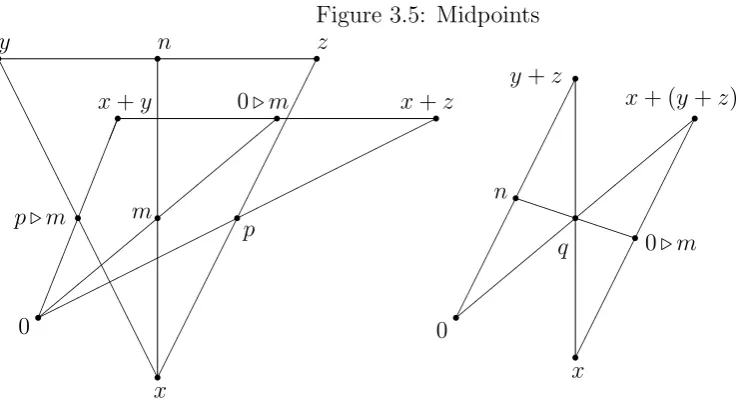
3.5 Midpoints . . . 35
4.1 The nooseN . . . 37
4.2 A noose homotopy . . . 39
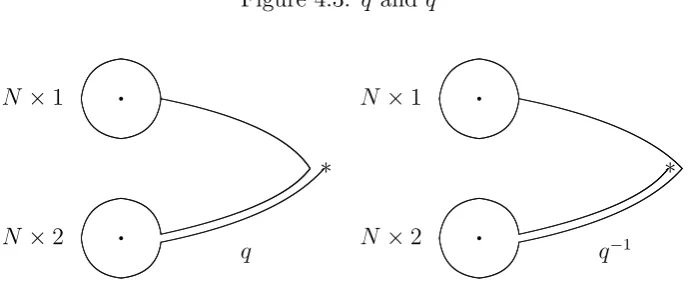
4.3 q and q−1 . . . 40
4.4 Seifert-Van Kampen noose homotopy . . . 43
4.5 Noose boundary loops . . . 46
4.6 The figure-8 knot . . . 47
4.7 A knot crossing . . . 47
4.8 Basic knot deformations . . . 49
4.9 Invariance under Ω1 . . . 49
4.10 Invariance under Ω2 . . . 49
4.11 Invariance under Ω3 . . . 50
4.12 The loop γi . . . 51
4.13 The trefoil knot 31 . . . 56
4.14 The figure-8 knot 41 . . . 57
4.15 The knot 10124 . . . 57
4.16 Q2(10124) . . . 58
Chapter 1
Definitions and Examples
1.1
Quandles
LetQ be a set equipped with a binary operation, and denote this operation by (x, y)7→
x . y. We use the nonsymmetric symbol.here since the two variables will play different roles in the following discussion. Also, it will distinguish this binary operation from others that Qmay have, in particular, addition and multiplication.
For z in Q, let S(z) be the function on Q whose value at x is x . z. It will be more convenient for us to use the notationxS(z) = x . z rather thanS(z)(x) = x . z. ForS(z) to be a homomorphism, we require
(x . y)S(z) =xS(z). yS(z),
that is,
(1) (x . y). z= (x . z).(y . z).
When (1) holds for all x, y, z inQ,S is a function fromQto EndQ, the set of endomor-phisms of Q. If S(z) is also a bijection for allz, then S maps Q to AutQ, the group of automorphisms of Q. Any group, in particular AutQ, has the operation of conjugation,
f . g = g−1f g, which satisfies (1). Then S : Q → AutQ is itself a homomorphism.
That is S(y . z) = S(z)−1S(y)S(z), equivalently, S(z)S(y . z) = S(y)S(z), which is a restatement of (1). The requirement that S(z) be a bijection for all z is equivalent to the existence of another binary operation
(x, y)7→x .-1y
that satisfies
(2) x . y =z ⇐⇒ x=z .-1y.
An equational identity equivalent to (2) is
(3) (x . y).-1y =x= (x .-1y). y.
(x . y).-1z = (x .-1z).(y .-1z),
(x .-1y). z = (x . z).-1(y . z),
(x .-1y).-1z = (x .-1z).-1(y .-1z).
In all the applications that follow,S(z) will not only be an automorphism, but one which fixesz.
Definition. A quandleis a set Q equipped with two binary operations (x, y)7→x . y and (x, y)7→x .-1y which satisfies three axioms
Q1. x . x=x.
Q2. (x . y).-1y=x= (x .-1y). y.
Q3. (x . y). z = (x . z).(y . z).
The mapS(z) is calledthe symmetry at z, andx . z may be read as “xthrough z”. The axioms taken together say that the symmetry at any point of Q is an automorphism of
Q fixing that point. Theorder of a quandle is the cardinality of its underlying set. The elements of a quandle will be frequently referred to as points.
Example 1. A groupGis a quandle, denoted ConjG, with conjugation as the operation.
x . y =y−1xy,x .-1y=yxy−1. Any conjugacy class of Gis a subquandle of ConjG as is
any subset closed under conjugation. WhenGis Abelian, the operation becomes simply the first projection operation, x . y =x.
Definition. A quandle Q is said to be Abelian if it satisfies
QAb. (w . x).(y . z) = (w . y).(x . z).
It follows from the definition that an Abelian quandle also satisfies the identities
(w .-1x).(y .-1z) = (w . y).-1(x . z) (w .-1x).-1(y .-1z) = (w .-1y).-1(x .-1z)
Example 2. Let T be a nonsingular linear transformation on a vector space V. Then V
becomes a quandle with the operationsx . y =T(x−y) +y andx .-1y=T−1(x−y) +y.
Moreover, V is an Abelian quandle.
It should be noted that quandles are seldom associative. In fact, the identity (x . y). z = x .(y . z) is equivalent to the identity x . y = x. One associativity equa-tion which does hold for any quandle is (x . y). x=x .(y . x). To reduce the number of parentheses we use the notation x . y . z for (x . y). z.
By far the most interesting axiom for quandles is the distributivity axiom Q3. The first study of self-distributivity is that of Burstin and Mayer [5]. They define “distributive groups”, or in modern terminology, distributive quasigroups. A quasigroup is a set G
unique solutions x, y to the equations xa=b and ay =b. A quasigroup is distributive if it satisfies the two identities
(xy)z = (xz)(yz), and
x(yz) = (xy)(xz).
It follows that a distributive quasigroup is idempotent, xx = x. Hence, quandles are a generalization of distributive quasigroups. Burstin and Mayer define an “Abelian dis-tributive group” to be one satisfying
(wx)(yz) = (wy)(xz).
This axiom goes by the names “entropy”, “mediality”, “surcommutativity”, and “sym-metry”.
1.2
Involutory quandles
An important class of quandles are those in which the symmetriesS(z) are all involutions,
S(z)2 is the identity. In this case x . z = x .-1z, which allows us to dispense with the
second quandle operation. An equivalent condition is the identity
QInv. x . y . y =x.
Definition. A quandle satisfying QInv is called an involutory quandle or 2-quandle. Alternatively, an involutory quandle may be defined as a set equipped with a binary operation (x, y)7→x . y which satisfiesQ1,Qinv, andQ3. Analogously ann-quandleis a quandle such that for all x, y, xS(y)n=x. In any quandle let x .ny denotexS(y)n.
Example 1. Let G be a group. The set of involutions in G, InvG = {x ∈ G|x2 = 1}, forms an involutory quandle with conjugation as the operation.
Example 2. Any groupGhas an involutory quandle structure given byx . y =yx−1y. The
underlying set ofGalong with this operation is called thecoreofGand is denoted CoreG. Note that CoreG, ConjG, and InvGare all distinct unlessGconsists of involutions only.
Example 3. LetM be a Riemannian symmetric space, that is, a connected Riemannian manifoldM in which each pointyis an isolated fixed point of an involutive isometryS(y). In a neighborhood of y, S(y) is given in terms of the exponential map exp : Ty → M
(Ty = tangent space at y) as
xS(y) = exp(−exp−1(x)).
S(y . z) =S(z)S(y)S(z). But S(z)S(y)S(z) is an involutive isometry having y . z as an isolated fixed point, and S(y . z) is described by this property.
A more descriptive construction of x . y is the following. If x = y, let x . y = x. Otherwise, pass a geodesic through x and y, and let d be the length along the geodesic from x to y. Let x . y be the point on the geodesic extended through y by the same lengthd.
Symmetric spaces give examples of 2-quandles which are not cores of groups. Three basic two-dimensional symmetric spaces are the sphere, Euclidean plane, and hyperbolic plane. The Euclidean plane is the core of the Abelian group R2, but neither the sphere
nor the hyperbolic plane are cores of toplogical groups.
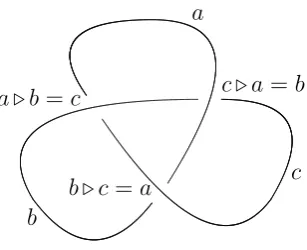
Example 4. The involutory quandle of a knot. Consider a regular projection of a knot
K, such as the trefoil knot in figure 1.1, and label the arcs a, b, c, . . ., where by “arc” is meant a segment from one underpass, over whatever overpasses there may be, to the next underpass. At each underpass, read a relation on the arcs, as “a under b gives c”
a . b = c. Let Q(K) be the quandle generated by the arcs with relations given by the underpasses. For instance,
Q(trefoil) = (a, b, c:a . b =c, b . c=a, c . a=b)
which is isomorphic to Core(Z/3Z). The order ofQ(K) need not be equal to the number of arcs in the projection; it need not even be finite. A different regular projection of
K will give the same Q(K) up to isomorphism. Moreover, if K and K0 are equivalent knots, then Q(K) is isomorphic to Q(K). Proofs and precise definitions will be supplied in Chapter 4.
Figure 1.1: The trefoil knot
b a . b=c
a
c . a=b
c b . c=a
M. Takasaki [16] defined involutory quandles under the name “kei”. Takasaki’s mo-tivation derives form the net (web) theory of Thomsen [17,18]. This theory is described in the book of Blaschke and Bol [2]. A similar geometric basis underlies Moufang’s [9] study of loops. Bruck [3] defined the coreof a Moufang loop as the underlying set of the loop along with the operation (x, y) 7→ yx−1y (example 2 above). See Chapter 3 more
more on loop cores.
Chapter 2
Representations and the general
algebraic theory of quandles
There are various ways that groups may be used to represent quandles. First of all, ConjG, forGa group, is a quandle. Many quandles may be represented as subquandles of ConjG for appropriate G. Free quandles, for example, may be so represented. Secondly, homogeneous quandles may be represented as cosets H\Gfor H a subgroup ofG where an automorphism of G fixing H is needed to describe the quandle operations on H\G. Non-homogeneous quandles are representable as a union H1\G ∪ H2\G ∪ · · · where
several automorphisms are used to describe the quandle operations. Finally, a quandle may be given by a set Q along with an action of a group G and a function : Q → G
that describes the symmetries of the points of Q. Such a construction will be called an augmented quandle. We will be able to study some varieties of quandles by means of augmented quandles.
2.1
The algebraic theory of conjugation
In this section we show that the theory of quandles may be regarded as the theory of conjugation. Consider the two binary operations of conjugation, (x, y) 7→y−1xy =x . y
and (x, y) 7→ yxy−1 = x .-1y, on a group. We ask whether there are any equations involving only these two operations which hold uniformly for all groups other than those which hold in all quandles. To this end we show that free quandles may be faithfully represented as unions of conjugacy classes in free groups.
Proposition. LetA be a set and F be the free group on A. Then the free quandle on A
appears as the subquandleQ of ConjF consisting of the conjugates of the generators of
F.
Proof. We use the notation of quandles in ConjF. Each element of Qis named as
a .e1b
where a, b1, . . . , bn ∈ A and e1, . . . , en ∈ {1,−1}. That is to say, the conjugates of a are
of the form
b−en
n · · ·b
−e1
1 ab
e1
1 · · ·b
en
n .
The equivalence on names is generated by two cases.
1. If a=b1, thena .e1b1.e2· · ·.enbn names the same element as a .e2b2.e3· · ·.enbn.
2. If bi =bi+1 and ei+ei+1 = 0, then a .e1b1.e2· · ·.enbn names the same element as
a .e1· · ·.ei−1b
i−1.ei+2bi+2.· · ·.enbn.
Now let eacha inA be assigned to a pointf(a) in a quandleP. If f extends to Q, then we must have
f(a .e1b
1.e2· · ·.enbn) =f(a).e1f(b1).e2· · ·.enf(bn).
We must only show that this extension is well-defined. But this follows directly from the fact that in P the analogues of 1) and 2) hold for f(a).e1f(b
1).e2· · ·.enf(bn).
Corollary. any equation holding in ConjGfor all groups G holds in all quandles.
Proof. Let E be an equation holding in ConjG for all groups G. In particular E holds in ConjF for free groups F, hence, E holds in free quandles. Whence, E holds in all
quandles.
2.2
Automorphism groups of quandles
Let Q be a quandle. We define three automorphism groups for A. First, there is the group consisting of all automorphisms, thefull automorphism group ofQ, AutQ. Second, there is the subgroup of AutQ, generated by all the symmetries of Q, called the inner automorphism group of Q, InnQ. Third, there is the subgroup of InnQ generated by automorphisms of the form S(x)S(y)−1 for x, y ∈Q, called the transvection group of Q, TransQ. InnQis a normal subgroup of AutQ, and TransQis normal in both InnQ and AutQ. The quotient group InnQ/TransQ is a cyclic group. The elements of TransQ
are the automorphisms of the form S(x1)e1· · ·S(xn)en such thate1+· · ·+en= 0.
To illustrate these groups letQbeR2 withx . y = 2y−z consered as a quandle in the
category of topological spaces. Then AutQ consists of the continuous automorphisms of R2, that is, the affine transformations. InnQ includes symmetries at points and translations. TransQ includes only translations.
2.3
Representation of quandles as conjugacy classes
image S(Q) as a subquandle of Conj InnQ. The elements of Q are behaviorally distinct if and only if S is an injection, in which case Q is isomorphic to a union of conjugacy classes in InnQ.
Even if the points of a quandle are not all behaviorally distinct, the quandle may be isomorphic to a union of conjugacy classes of some group. For instance, any quandle satisfying x . y = x may be embedded in Conj(Q
IZ2) for sufficiently large I. There is
a universal group in which to represent a quandle as a subset closed under conjugation. As noted in example 1 of Chapter 1, every group G may be considered to be a quandle ConjG, with conjugation as the quandle operation. Adjointly, every quandleQgives rise to a group AdconjQ, generated by the elements ofQmodulo the relations of conjugation. Precisely, AdconjQ has the presentation
(x,for x∈Q:x . y =y−1x y,for x, y ∈Q}.
The map η : Q → Conj AdconjQ sending x to x is a quandle homomorphism whose image is a union of conjugacy classes of AdconjQ. The mapηhas the following universal property: for any quandle homomorphism h : Q → ConjG, G a group, there exists a unique group homomorphism H : AdconjQ → G such that h = H ◦η. Thus, if any
h:Q→ConjG is monic, then η is monic.
Butηneed not be injective in general. Consider the 2-quandle of three elements given in the table in figure 2.1. Sinceb . a=b, acommutes with b. But a . b=c, so b−1ab=c. Therefore,a=c, andη is not injective.
Figure 2.1: A singular 2-quandle
. a b c a a c a b b b b c c a c
Later, when we consider the quandle associated to a knot, the non-injectivity of η
will be important. For example, the quandles associated to the square and granny knots are distinct, but the Adconj groups of these quandles (which are the knot groups) are isomorphic, and for each, η is not injective.
2.4
Representation of quandles as cosets
Let s be an automorphism on a group G. We may define a quandle operation on G
by x . y = s(xy−1)y. Verification is straightforward. Let H be a subgroup of G whose
elements are fixed by s. ThenH\G inherits this quandle structure
Denote this quandle as (H\G;s). Gacts on the right on (H\G;s) by (Hx, y)7→Hxy, and the action is by quandle automorphisms. SinceGacts transitively onH\G, it follows that (H\G;s) is a homogeneous quandle, that is, there is a quandle automorphism sending any point to any other point of the quandle.
We are mainly interested in the case when s is an inner automorphism of G, s(x) =
z−1xz for some fixed elementz of G. Then x . y =z−1xy−1zy. When H contains z, the
operation of (H\G;z) = (H\g;s) is
Hx . Hy =Hxy−1zy.
Proposition. Every homogeneous quandle is representable as (H\G;z).
Proof. Let Q be a homogeneous quandle and G = AutQ. Fix p ∈ Q. Let z = S(p), symmetry at p, and let s be conjugation by z in G. Then e : (G;s) → Q, evaluation at p, defined by sending the element x to its value at p, is a quandle homomorphism. Indeed, e(x . y) =e(z−1xy−1zy) = p xy−1zy= (p xy−1. p)y =p xy−1y . py =e(x). e(y).
SinceQ is homogeneous,e is surjective. Let H be the stability subgroup ofp,H ={x∈
G|px=p}. Thene factors through (H\g;z) sincep=pH. Moreover, (H\G;z)→Q is injective, for if pHx = pHy, then pxy−1 =p, xy−1 ∈ H, and so Hx = Hy. Thus, Q is
isomorphic to (H\G;z).
Some adjustments are needed to represent non-homogeneous quandles. Given a group
G, elementsz1, z2, . . .of G, and subgroupsH1, H2, . . . ofGsuch that for each index i,Hi
is contained in the centralizer of zi, we form a quandle (H1, H2, . . .\G;z1, z1, . . .) as the
disjoint union of H1\G, H2\G, . . . with the quandle operation
Hix . Hjy =Hixy−1zjy.
Proposition. Every quandle is representable as (H1, H2, . . .\G;z1, z1, . . .).
Proof. LetQbe a quandle andG= AutQ. LetQ1, Q2, . . .be the orbits of the action ofG
onQ. For each indexichoosepi ∈Qi, letzi =S(pI), and letHi be the stability subgroup
of pi. Then for each i,Hi is contained in the centralizer of zi, and so we have a quandle
P = (H1, H2, . . .\G;z1, z1, . . .) as described above. Define e: P →Q byHix7→ pix. As
in the proof of the previous propsition,e may be shown to be an isomorphism.
In the case of involutory quandles, the automorphism s of G must be an involution onG while the elements z, z1, z2, . . . of g must be involutions in G.
2.5
Algebraic connectivity
transitively on Q. In other words, Q is connected if and only if for each pair a, b in Q
there are a1, a2, . . . , an in Q and e1, e2, . . . , en ∈ {1,−1} such that
a .e1a
1.e2· · ·.enan =b.
Let Q be a quandle and q a point of Q. The q-fibre of a map g : Q → Q00 is the subquandle Q0 = {p ∈ Q|g(p) =g(q)} of Q. Suppose that Q00 is a quotient of Q, that is,Q00 is given by a congruence onQ. In general the q-fibre does not determine Q00; just consider quandles whose operation is the first projection.
Proposition. Let Q be an algebraically connected quandle and q a point of Q. Then every quotient ofQ is determined by itsq-fibre. Consequently, every congruence on Qis determined by any one of its congruence classes.
Proof. Let Q00 be a quotent of Q with q-fibre Q0. Let a, b∈ Q. By the connectivity of
Q there is an inner automorphism x such that ax = q. Since homomorphisms respect inner automorphisms, it follows that g(a) = g(b) if and only if g(ax) = g(bx). Hence,
g(a) =g(b) if and only if∃x∈InnQsuch that ax=q and bx∈Q0. Thus,Q0 determines
Q00.
2.6
The transvection group
As defined above, the transvection group TransQof a quandleQis the subgroup of InnQ
generated by automorphisms of the form S(x)S(y)−1. TransQ is a normal subgroup of InnQ with cyclic quotient. Alternatively, we may define a transvection on Q as an automorphism of Q of the form S(x1)e1· · ·S(xn)en with xi ∈ Q, ei ∈ Z, i = 1, . . . , n,
such thate1+· · ·+en= 0. Then TransQ is the group of transvections onQ.
Some the the properties of Q are reflected in TransQ.
Proposition. A quandle is Abelian if and only if its transvection group is Abelian.
Proof. LetQbe a quandle with transvection group T. By definition, Qis Abelian if and only if
(w . x).(y . z) = (w . y).(x . z).
Equivalently,
S(x)S(z)−1S(y) = S(y)S(z)−1S(x).
On the other hand, T is Abelian if and only if
S(x)S(z)−1S(y)S(t)−1 =S(y)S(t)−1S(x)S(z)−1.
By settingt =z we find that if T is Abelian then Qis Abelian. FromQ Abelian follows
S(x)S(z)−1S(y)S(t)−1 = S(y)S(z)−1S(x)S(t)−1 = S(y)S(t)−1S(x)S(z)−1.
2.7
n
-Cores
The core of a group has the property that all its symmetries are involutions. In this section we define an n-core of a group wherein the n-th power of each symmetry is the identity. This agrees with the usual core in the case n = 2.
Let G be a group and n a positive integer. The wreath product GoZn consists of
n+ 1-tuples (x0, . . . , xn−1, k) with xi ∈ G, k ∈ Zn. The index i is to take values in Zn.
Multiplication in GoZn is given by
(x0, . . . , xn−1, k)·(y0, . . . , yn−1, l) = (x0yk, x1yk+1, . . . , xn−1yk−1, k+l).
LetQ be the conjugacy class of (1, . . . ,1,1) in GoZn. Then
Q={x0, . . . , xn−1,1)|x0· · ·xn−1 = 1}
and the quandle operation on Q is given by
(x0, . . . , xn−1,1).(y0, . . . , yn−1,1) = (y−n−11xn−1y0, y)−1x0y1, . . . ,1).
This quandle is called then-core of G. The 2-core ofG is isomorphic to the core of G.
2.8
Examples of simple quandles
A quandle is said to be simple if its only quotients are itself and the one-point quandle. We will show in this section that n-cores of noncyclic simple groups are simple. In fact, a noncyclic group is simple if and only if its n-core is simple. Also, nontrivial conjugacy classes of simple groups are simple. We proceed with some lemmas.
Lemma 1. Let H be a group with commutator H0. An element x in H lies in H0 if and only if there exist x1, x2, . . . , xk inH such that x=x1x2. . . xk and xk. . . x2x1 = 1.
Lemma 2. Let H be a perfect group, H = H0. Then the n-core Q of H as a subset of
G=HoZn generates G.
Proof. Let b = (1,1) = (1, . . . ,1,1) ∈ Q. Let x ∈ H. By lemma 1, x =
x1. . . xk, xk. . . x1 = 1. Then
(x1, x−11,1, . . . ,1)b
−1(x
2, x−211, . . . ,1)b
−1. . .(x
k, x−k1,1, . . . ,1)b
−1
= (x1x2· · ·xk, x−11x
−1 2 · · ·x
−1
k ,1, . . . ,1,0)
= (x,1, . . . ,1,0).
Sinceband each (xi, x−i 1,1, . . . ,1) lie inQ, so (x,1, . . . ,1,0) is a member of the subgroup
generated byQ. The rest follows easily.
Lemma 3. If the center of a nontrivial group H is trivial, then the center of H oZn is
Lemma 4. Let G be a group with trivial center, and let Q be a conjugacy class that generates G. ThenG∼= InnQ, and G0 ∼= TransQ.
Proof. For eachx∈GletS(x) be conjugation byx, and regardS(x) as an automorphism of Q. Then S is a group homomorphism S : G → AutQ. Note that S(x) = 1 if and only if for all q inQ,x−1qx =q. SinceQ generatesG, S(x) = 1 if and only if x∈Z(G).
Therefore,Sis injective. The image ofSis InnQ. Hence,Sis an isomorphismG∼= InnQ. We show next that S(G0) = TransQ. Let p, q ∈ Q. Then [S(p), S(q)] =
S(p)−1S(p . q)∈TransQ. TransQis a normal subgroup of InnQ, soS(G0) = (InnQ)0 ⊆ TransQ. Since Q is a conjugacy class in G, there is an x in G such that x−1px = q.
Therefore,S(p)−1S(q) = [x, S(q)]∈(InnQ)0. Thus, TransQ⊆S(G0).
Lemma5. Under the hypotheses of lemma 4 the following statements are equivalent. (1) Q is a simple quandle.
(2) G0 is the smallest nontrivial normal subgroup of G. (3) G0 is a minimal nontrivial normal subgroup of G.
Proof. (1) =⇒(2). Let N be a normal subgroup of InnQ. Define an equivalence relation onQ by
p≡q ⇐⇒ ∃n ∈N such that pn=q.
We show that ≡ is an congruence. Assume p ≡ q, pn = q. For r in Q we have
q . r = pn . r = (p . r)m where m = S(r)−1nS(r) ∈ N. Hence, q . r ≡ p . r. Also r . q = r . pn = (r . p)m−1n where m−1n ∈ N. Hence, r . q = r . p. Therefore, ≡ is a
congruence. By the simplicity ofQ we have only two cases.
Case 1. ≡ is equality. Let n∈N. For all q in Q, qn=q, son−1S(q)n=S(q). From
the hypotheses of the lemma it follows that n= 1. Thus,N = 1.
Case 2. ≡ relates all points of Q. Forp, q inQ there is an n inN such that pn =q. Then n−1S(p)n =S(q). Therefore, S(p)S(q)−1 ∈N. Hence, TransQ⊆N.
Now (2) follows from the conclusions of lemma 4. (2) =⇒(3). Clear.
(3) =⇒ (1). Assume (3). Let ≡ be a congruence on Q. Conjugation by elements of
Q respects ≡, that is, p≡ q implies p . r ≡ q . r. Since Q generates G, conjugation by elements of Grespects ≡. Let
N ={x∈G0|ps(x)≡p for all p∈Q}.
Then N is a normal subgroup of G contained in G0. By (3), either N = 1 or N = G0. Assume ≡ is not equality. Then ∃q, r ∈ Q such that q ≡ r but q 6= r. It follows that 1 6= qr−1 ∈ N. Hence, N = G0. Now let q, r be arbitrary in Q. ∃x ∈ G0 such that
x−1qx=r. Therefore, q ≡qS(x) =p. Thus, if ≡is not equality, then ≡ relates any two
elements.
Proof. Let (x0, . . . , xn−1,0) be a nontrivial element of K. We will show the smallest
normal subgroup N containing this element is K. For some i, xi 6= 1, say i = 0. There
is an element w of G such that [x0, w] = z 6= 1. Then [(x0, . . . , xn−1,0),(w,1, . . . ,1)] =
(z,1, . . . ,1,0) lies in N. Asz = 1 and6 H is simple, it follows that (y,1, . . . ,1,0)∈N for ally in H. Now
(y,1, . . . ,1,0).(1, . . . ,1, k) = (1, . . . , y, . . . ,1,0)
also lies in N for all y inH and k inZn. Hence N =K.
Theorem 1. Let H be a noncyclic group and Q be the n-core of H (n ≥ 2). Then Q is simple if and only ifH is simple, in which case InnQ∼=G=HoZn and
TransQ∼=G0 ={(x0, . . . , xn,0)∈G} ∼=Hn.
Proof. Assume H is simple. According to lemma 2, Q generates G, and by lemma 3
z(G) = 1. Since the hypotheses of lemma 4 hold, we have G∼= InnQ, andG0 ∼= TransQ. Lemma 6 says K ={(x0, . . . , xn−1, Q)∈ T} is a minimal nontrivial normal subgroup of G. Hence,G0 =K. Finally, we conclude from lemma 5 that Q is simple.
Any normal subgroup N of H gives a quandle congruence on Qdefined by
(x,1)≡(y,1) ⇐⇒ xiy−i 1 ∈N for i= 0, . . . n−1.
Moreover, if N 6= 1, then ≡ is not equality. Hence, the simplicity of Q assures that of
H.
Then-core of a noncyclic simple group retains, therefore, more information about the group than just its simplicity. It can, in fact, be reconstructed from itsn-core.
Remark. The 4-core of the cyclic simple groupZ2 is not a simple quandle.
Corollary. The core (2-core) of a group is simple if and only if the group is simple.
Proof. The only groups not covered by the theorem are cyclic groups for which the
statement is easily verified.
There are two other ways that simple quandles derive from simple groups besides
n-cores. We will show that any nontrivial conjugacy class in a simple group is a simple quandle. The following lemma is a direct consequence of lemmas 4 and 5.
Lemma 7. Under the hypotheses of lemma 4, ifG0 is a simple group, then Q is a simple
quandle.
Theorem2. LetH be a noncyclic simple group and Qa nontrivial conjugacy class in H. Then Qis a simple quandle. Also, InnQ= TransQ∼=H.
Proof. Q generates H, andz(H) = 1. So by lemma 4, InnQ= TransQ∼=H. By lemma
Theorem 3. Let H be a noncyclic simple group, p a prime integer, and s an outer automorphism of G of order p. Let G be the semidirect product HnZp, (x, y)·(y, l) =
(xs−k(y), k+l). Then Qis a simple quandle, InnQ∼=G, and TransQ∼=H.
Proof. First we show that Q generates G. Let (Q) be the subgroup generated by Q. (Q) is normal in G. (1,1) ∈ (Q), so (1, k) ∈ (Q) for all k in Zp. Also, (1,1).(y,0) =
(y−1s−1(y),1) ∈ (Q). Since s 6= 1, ∃y ∈ H such that 1 6= (y−1s−1(y),1) ∈ (Q). Also (y−1s−1(y),0) ∈ (Q). Hence (Q)∩H 6= 1. Therefore, (Q)∩H = H. It follows that
(Q) =G.
Next we show Z(G) = 1. Suppose (a, k)∈Z(G). Then zs−k(y) =yz for all y in H. Thus, sk = S(z−1). If p divides k, then 1 = sk = S(z−1), which gives (z, k) = (1,0).
Otherwise, (p, k) = 1. Then for some m, km ≡ 1 mod p, so s = skm = S(z−m). in
contradiction to the hypothesis that s is not an inner automorphism. This, Z(G) is trivial.
We have shown that Qand G satisfy the hypotheses of lemma 4. Hence,G∼= InnQ, and G0 ∼= TransQ.
Clearly, G0 =Hn0∼=H, so by lemma 7,Q is simple.
2.9
Classification of simple
p
-quandles
In this section we examine the problem of classifying simple quandles. In the case of p -quandles,pa prime integer, we solve the problem in terms of simple groups. Throughout this section let Q be a simple quandle and G= InnQ.
Lemma1. Either S :Q→G is injective or the order of Q is less than three.
Proof. The behavioral equivalence onQis either equality or else relates any two elements ofQ. In the former caseSis injective. In the latter caseQsatisfies the identityx . y =x. But the only simple quandles satisfyingx . y =x have fewer than three elements. Assume for the rest of this section that the order of Qis greater than two. Since the set of connected components of Q is a quotient of Q, it follows that Q is algebraically connected. Also, S(Q) is a conjugacy class in G since it is closed under conjugation and generates G.
Lemma2. The center of G is trivial.
Proof.
z ∈Z(G) ⇐⇒ ∀q∈Q, zS(q) =S(q)z
⇐⇒ ∀q∈Q, S(qz) =S(q)
⇐⇒ ∀q∈Q, qz =q.
a simple quandle, by lemma 5 of section 2.9 it follows that G0 is the smallest nontrivial normal subgroup ofG.
At this point we must break the classification into cases. If G0 = G, then G is a simple group, and Q is isomorphic to the nontrivial conjugacy class S(Q) in the simple group G. For the rest of this section we assume G0 6=G. We will also assume that Q is ap-quandle, pa prime integer. Then G/G0 ∼=Zp.
Fixq0 inQ. Let x0 =S(q0)∈G, and lets be conjugation byx0 as an automorphism
of G0. Then x0 6= 1, xop = 1, s 6= 1, sp = 1. Let K be the semidirect product G
0
nZp
where
(x, k)(y, l) = (xs−k(y), k+l).
There is an isomorphism f : K → G, f(x, k) = xxk
0. In particular, f(1,1) = x0, and f−1(S(Q)) is the conjugacy class in K of (1,1).
Suppose G0 is a simple group. From the fact that Z(G0) = 1 it follows that s is not an inner automorphism of G0. Thus, Q is isomorphic to the conjugacy class of (1, y) in k = G0 nZp where G0 is a simple group and G0 nZp is constructed from an outer
automorphism ofG0 of order p. This is the situation encountered in theorem 3 of section 2.8.
We have yet to consider the case where G0 is not simple.
Lemma 3. Let H be a group with a smallest nontrivial normal subgroup T such that [H : T] = p is prime. Assume T is not simple. Then T is isomorphic to Np for some simple groupN.
Proof. Let N be a nontrivial proper normal subgroup of T. Fix x in H − T. Let s
be conjugation by x as an automorphism of T. Then sp(N) = N since xp ∈ T. More
generally, sp+i(N) =si(N) for any integeri. Sincepis prime and N is not normal in N, we have p distinct conjugates of N, namely,
N, s(N), . . . , sp−1(N).
Claim. For k = 0,1, . . . , p−2, there exist nontrivial proper normal subgroups Nk of
T such that 0 6=|i−j| ≤k implies si(Nk)∩sj(Nk) = 1.
DefineN0 =N. Inductively defineNk+1(k+ 1≤p−1) as follows. The group
Nk∩sk+1(Nk)∩ · · · ∩s(k+1)(p−1)(Nk)
is normal inGsincek+1 is relatively prime top, and, being strictly contained inT, is, therefore, trivial. Let l be least such that
Nk∩sk+1(Nk)∩ · · · ∩s(k+1)l(Nk) = 1.
Then
Nk+1 =Nk∩sk+1(Nk)∩ · · · ∩s(k+1)(l−1)(Nk)
We may assume N =Np−1. That is, thep conjugates ofN,
N, s(N), . . . , sp−1(N),
have pairwise trivial intersection and generateT. Hence
T =N ×s(N)× · · · ×sp−1(N)∼=Np.
Also, N is simple. Indeed, if M is a proper normal subgroup of N, then M ×s(M)× · · · ×sp−1(M) is normal in H and strictly contained in T and, therefore, is trivial as is
M.
Theorem1. LetQbe a simplep-quandle,pa prime, and let G= InnQ. As noted above,
G0 = TransQ. AssumeG0 is not a simple group. ThenGis a wreath product of a simple group N with Zp, G0 =∼Np, andQ is isomorphic to the p-core of N.
Proof. By lemma 3,G0 ∼=Np whereN is a simple group. As noted aboveGis isomorphic
to G0nZp. Therefore, G = G0nZp = N oZp. Also, Q is isomorphic to the conjugacy
class of (1,1) in G0nZp and, therefore, to the p-core of N.
Scholium. simple p-quandles of order greater than two arise in three ways: 1. a nontrivial conjugacy class in a simple group,
2. the conjugacy class of (1,1) in HnZp where H is a simple group and H nZp is
constructed from an outer automorphism ofH,
3. the p-core of a simple group.
The three cases are distinguished by the structure of the inner automorphism group of the quandle.
2.10
Augmented quandles
LetGbe a group acting on a quandleQby quandle automorphisms. That is, forx, y ∈G
and p, q ∈Q we have
q(xy) = (qx)y, and (p . q)x = px . py.
Assume thatGcontains representatives of the symmetries ofQ, that is, there is a function
:Q→Gsatisfying
p(q) = p . q.
In particular, we have
Assume further that satisfies the coherency condition
AQ2. (px) =x−1(p)x, forp∈Q, x∈G.
Then we have a group action onQ, Q×G→Q, and a function:Q→Gwhich satisfy
AQ1 and AQ2.
Conversely, given a group action ofGon a setQ,Q×G→Q, and a function:Q→G
satisfying AQ1 and AQ2, we can define quandle operations on Q as x . y =x(y) and
x .-1y=x(y)−1 so that the action of G onQ is by quandle automorphisms.
Definition. An augmented quandle (Q, G) consists of a set Q and a group G equipped with a right action on the set Qand a function :Q→G called the augmentation map
which satisfy AQ1 and AQ2.
With the operations mentioned above Q is a quandle, and the augmentation map is a quandle homomorphism:Q→ConjG.
A morphism of augmented quandles from (Q, G) to P, H) consists of a group homo-morphism g :G→H and a function f :Q→P such that the diagram
Q×G −−−→ Q −−−→ G
f×g
y f
y
g
y
P ×H −−−→ P −−−→ H
commutes. It follows that f is a quandle homomorphism.
Examples. Fix a quandle Q. Two examples of augmented quandles with underlying quandle Qare (Q,AutQ) and (Q,InnQ). the augmentation in each case is the function that has been denotedS. The action is the natural one. In the category of augmentations of Q, (Q,AutQ) is the terminator. That is, for each augmentation (Q, G), there is a unique homomorphism f :G→AutQ such that
Q×G −−−→ Q −−−→ G
1×f
y 1
y f
y
Q×AutQ −−−→ Q −−−→S AutQ
commutes. The mapf is readily defined fromQ×G→Q.
Another example of an augmentation of Q is (Q,AdconjQ), (see section 2.3). The function representing symmetries of Q is η : Q → AdconjQ, while the group action is defined by
z(ye1
1 · · ·yenn) = z .e1y1.e2· · ·.enyn,
wherez ∈Q and ye1
1 · · ·yenn is an arbitrary element of AdconjQ, yi ∈Q, ei ∈ {−1,1} for
i= 1, . . . n. To show that this is a well-defined group action, it suffices to note that
z(x . y) = x .(x . y) = z .−1y . x . y
The axiomAQ1 clearly holds. Since η(Q) generates AdconjQ, AQ2reduces to the fact that η:Q→Conj AdconjQ is a quandle homomorphism as noted in section 2.3.
In the category of augmentations of Q, (Q,AdconjQ) is the coterminator. That is, for each (Q, G) there is a unique group homomorphismf : AdconjQ→G such that
Q×AdconjQ −−−→ Q −−−→η AdconjG
1×f
y 1
y f
y
Q×G −−−→ Q −−−→ G
commutes. According to the right square, f must be the map H : AdconjQ → G
described in section 2.3. To show the commutativity of the left square it suffices to show
zy=zf(y) fory, zinQ, since suchygenerate AdconjQ. Butzy=z . y =z(y) = zf(y). We consider now constructions in the categoryAQof augmented quandles. Products, equalizers, and limits in general are of the usual sort. For instance, the product of (Q, G) and (P, H) has as its augmentation groupG×H and has as its underlying quandleQ×P. However, it will take more work to describe colimits.
Let U be the forgetful functor from AQ to the category of groups, U(Q, G) = G. U
has both a left adjointT and a right adjointV. ThatU has a left adjoint T is automatic and uninteresting. T(G) = (∅, G). On the other hand, the existence of a right adjoint V
is unexpected. Let Gbe a group. ThenV(G) = (ConjG, G) where Gacts on ConjGby conjugation and the function : ConjG →G is the identity. We show that (ConjG, G) satisfies the appropriate universal property. Let (G, H) be an augmented quandle and
f : H → G a group homomorphism. We must show there exists a unique function
g :Q→ConjG such that
Q×H −−−→ Q −−−→ H
g×f
y
g
y f
y ConjG×G −−−→ ConjG −−−→ G
commutes. Since ConjG→G is the identity, the functiong must be f◦. The commu-tativity of the left square states
(∗) g(qx) =g(q)·f(x)
for q ∈ Q, x ∈ H. Here, g(q)·f(x) denotes conjugation of g(q) by f(x), so equals
f(x)−1g(q)f(x) where the multiplication occurs in G. Then (∗) is equivalent to
f ◦(qx) = f(x)−1(f◦)(q)f(x) = f(x−1(q)x),
and this follows from axiomAQ2 for (Q, H).
Unfortunately, the forgetful functor from AQ to the category of quandles has no right adjoint. We need another construction of augmented quandles to describe their colimits. Let (Q, G) be an augmented quandle and f :G→H a group homomorphism. Then
Q×H is a right H-set with action (q, x)y= (q, xy) for q in Q and x, y in H. Define an
H-set congruence on Q×H by (q, y)≡(p, z) if and only ifyz−1 =f(x) and p=qx for
some x ∈ G. Let q⊗y denote the congruence class of (q, y), and let Q⊗GH, or more
simply Q⊗H, denote the set of congruence classes. We have
(q⊗y)z = q⊗yz, and
q⊗f(x) = qx⊗1.
Define :Q⊗H →H by (q⊗x) = x−1(f ◦)(q)x. is well-defined since axiom AQ2
holds for (Q, G). Then (Q⊗H, H) is an augmented quandle, as can be directly verified. We also have a function i:Q→Q⊗H given by q7→ q⊗1, which along with f gives a map (i, f) : (Q, G)→(Q⊗H, H) of augmented quandles.
Proposition. Let (Q, G) be an augmented quandle and f : G → H a group homomor-phism. Then (i, f) : (Q, G)→(Q⊗H, H) satisfies the following universal property. For each map of the form (g, h◦f) : (Q, G)→(P, K), there exists a unique map of the form (k, h) : (Q⊗H, H)→(P, K) such that (g, h◦f) = (k, h)◦(i, f). Otherwise said, in the category of augmented quandles
(∅, G) −−−→ (Q, G)
(1,f)
y
y(i,f) (∅, H) −−−→ (Q⊗H, H)
is a pushout diagram.
Proof. Let (g, h◦f) : (Q, G)→(P, K) be given. Denote the required functionQ⊗H →P
byk. There are four requirements on k. In order thatk be well-defined we need 1) k(q⊗f(x)y) = k(qx⊗y), for q∈Q, x∈G, y ∈H.
In order that (k, h) be a map in AQ we need
2) (◦k)(q⊗y) = (h◦)(q⊗y), for q∈Q, y ∈H,
and
3) k(q⊗yz) =k(q⊗y)h(z), for q ∈Q, y, z∈H.
And so that (q, h◦f) = (k, h)◦(i, f) we need
4) g(q) = k(q⊗1), for q∈Q.
Together, 3) and 4) show that k must be defined as k(q⊗y) = g(q)h(y), giving the uniqueness ofk. With this definition of k, 1) states
This reduces to
g(q)(h◦f)(x) =g(qx),
which holds since (g, h◦f) is a map in AQ. Finally, 2) states that
(g(q)h(y)) = (h◦)(q⊗y).
But
(g(q)h(y) = h(y)−1(◦g)(q)h(y) = h(y)−1(h◦f◦)(q)h(y) = h(y−1(f◦)(q)y) = (h◦)(q⊗y).
We will denote the function k in the proposition byg in spite of the confusion it may cause. In this notation (g, h◦f) = (g, h)◦(i, f). In the case that H = K and h is the identity function, 1 :H →H, we have (g, f) = (g,1)◦(i, f). Note also that whenH =G
andf is the identity, 1 :G→G, then the augmented quandle (Q⊗GG, G) is the original
augmented quandle (Q, G). Hence, Q⊗GG=Q.
We now consider an arbitrary colimit (Q, G) = lim←−(Qj, Gj) in the category AQ.
As noted above G is the colimit, lim←−Gj, in the category of groups. By the preceding
proposition, for each j, (Qj, Gj) → (Q, G) factors uniquely through (Qj, Gj) → (Pj, G)
where Pj denotes Qj ⊗Gj G. Consequently, (Q, G) ∼= lim←−(Pj, G). This reduces the
construction of colimits to the case where a single group G acts on all the sets Pj, and
all maps (Pj, G)→(Pk, G) are of the form (f,1).
In this case let P = lim←−Pj in the category of sets. Then P has a unique right
G-action determined by the G-actions on the Pj, so we might just as well have taken
this colimit in the category of G-sets. There is also a function : P → G determined by the functions : Pj → G. It may be directly verified that with this action and
that (P, G) is an augmented quandle. By the definition of P there is a unique function (f,1) : (P, G) → (Q, G) determined by the maps (Pj, G) → (Q, G). Also the function
(f,1) satisfies the commutativity conditions to be a map in AQ since all the maps (Pj, G) → (Q, G) satisfy these conditions. Furthermore, all the maps (Pj, G) → (P, G)
lie in AQ, so (P, G) = lim←−(Pj, G).
We summarize these results.
Theorem. A colimit, lim←−(Qj, Gj) in AQ is isomorphic to lim←−(Qj ⊗Gj G, G) where G =
lim
←−Gj in the category of groups. It is also isomorphic to (lim←−Qj⊗GjG, G) with lim←−Qj⊗Gj
2.11
Quotients of augmented quandles described by
normal subgroups of the augmentation group
Let (Q, G) be an augmented quandle and N be a normal subgroup of G. Let G denote the quotient groupG/N with elements denoted byx forx inG. Let Qand Q/N denote the quandleQ⊗GG. The elements of Qare equivalence classesq of elements ofQwhere
q={qn∈Q|n∈N}. The actionQ×G→Qis given byq x =qx and the augmentation
:Q→Qis given by (q) =(q).
Let (Q, G) be an augmented quandle. In order that the quandle Q be Abelian we need
(p . q).(r . s) = (p . r).(q . s).
Equivalently, (q)(r(s)) =(r)((p)(s)). That is, every element inG of the form
(∗) (q)(s)−1(r)(q)−1(s)(r)−1
equal 1. Let N be the normal subgroup of G generated by such elements. Then the quotient (Q, G) of (Q, G) is assured to be Abelian. It is evident that (Q, G) has the universal property that each map (Q, G) → (P, H) factors uniquely through (Q, G) →
(Q, G) whenever p is an Abelian quandle.
Proposition 1. Let (Q, G) be an augmented quandle such that (Q) generates G. Let N
and (Q, G) be defined as above. Then Q is the Abelianization of the quandle Q.
Proof. Let P be an Abelian quandle andf :Q → P be a quandle homomorphism. We must show that f : Q → P given by f(q) = f(q) is well defined, that is, f(qn) = f(q) for n ∈ N. If n is of the form (∗), then f(qn) = f(q) since P is Abelian. Since G is generated by(Q) we may assume nis of the form (p)−1n0(p) wheref(q0n0) = f(q0) for allq0 inQ. Then
f(qn) = f((q .-1p)n0. p) = f((q .-1p)n0). f(p) = f(q .-1p). f(p) = f(q).
Thus,f is well-defined on Q.
Corollary 1. Let A be a set and G the group generated by A modulo relations ab−1c= cb−1a for conjugates a, b, c of the generators of G. Then the free Abelian quandle on A
consists of the conjugates of the generators ofG.
What has been done here for Abelian quandles can be done for many other varieties of quandles. The method works for any variety defined by equations of the form
p .e1ϕ
where the ϕi and ψj are expressions not involving p. For example, the identity for
n-quandles, p .nq=p, is of this form.
Proposition 2. Let (Q, G) be an augmented quandle such that (Q) generates G, and N
be a positive integer. Let Nn be the normal subgroup of G generated by (q)n for q in
Q. ThenQ/Nn is the largest quotient of Q which is an n-quandle
Corollary 2. Let A be a set and G = (a, a ∈A : an = 1, a ∈A). The free n-quandle on
A consists of the conjugates of the generators ofG.
Corollary 3. The free involutory quandle on two points is isomorphic to CoreZ with generators 0 and 1.
Proof. Let A= {a, b} and G= (a, b:a2 =b2 = 1). Let Q be the quandle of conjugates of a and b in G. Let x = ab. Then G = (a, x : a2 = 1, axa = x−1). Each element
of G is uniquely represented as aexk with k ∈ Z and e ∈ {0,1}. The conjugates of a
and b are those elements of the form axk, k ∈ Z. Q = {axk|k ∈ Z}. Verification that
axn. axm = ax2n−m yields an isomorphism of quandles f : Q → CoreZ, f(axn) = n.
Also,f(a) = 0, f(b) = 1.
Proposition 3. The free Abelian involutory quandle onn+ 1 generators appears as
A={(k1, . . . , kn)∈Zn|at most one ki is odd}
as a subquandle of CoreZn with generators e0 = (0, . . . ,0), e1 = (1,0, . . . ,0), e2 =
(0,1,0, . . . ,0), . . . , en= (0, . . . ,0,1).
Proof. Let Gbe the group presented as
(ao, ..., an:a2i = 1, aiajak=akajai, alli, j, k),
and let Q include the conjugates of the generators of G. Then Q is the free Abelian involutory quandle on a0, . . . , an. As A is an Abelian quandle, there is a unique map
h : Q → A such that h(ai) = ei, i = 0, . . . , n. We will show h is an isomorphism.
Let tj = aoaj, j = 0, . . . , n. Then tjtk = tktj. The conjugates of ai are of the form
ai. aj1.· · ·. ajr = ai. aj1· · ·ajr, and r may be taken to be even since ai. ai = ai.
Then ai. aj1· · ·ajr = ai. t
−1
j1 tj2· · ·t
−1
jr−1tjr. Thus, Q consists of elements of the form
ai. tk11· · ·tknn withki ∈Z,i= 1, . . . , n. Now h(ai. t1k1· · ·tknn =ei+ 2k1(e1−e0) + 2k2(e2− e0) +· · ·+ 2kn(en−e0) =ei+ (2k1, . . . ,2kn). Clearly, h is surjective and injective.
Alternatively, we may describe the free Abelian involutory quandle onn+1 generators as
B ={(k0, . . . , kn)∈Zn+1|exactly one ki is odd}
Chapter 3
Involutory quandles
3.1
Involutory quandles and geodesics
The fact that symmetric spaces are involutory quandles and that their structure is de-termined by distance along geodesics suggests that involutory quandles in general be determined by some kind of geodesic. Consider, for example, the integral line quandle,
L = CoreZ. Interpret L as the integral points on a line. Then for m, n ∈ L, m . n is found by moving along the line from m through n the same distance beyond n as m is beyond n.
The suggestion may be formalized as follows. Define an involutory quandle with geodesics as a set Q of points with a collection of functions, called geodesics, g :L→Q, where Lis the integral line quandle CoreZ, satisfying three axioms
QG1. Every pair of points lies in the image of some geodesic.
QG2. Whenever a pair of pointsx, ylie in the image of two geodesics,f(m) =
x, f(n) = y, g(m0) =x, g(n0) =y, it is the case that f(m . n) =g(m0. n0). We denote this point f(m . n) as x . y.
QG3. A geodesic reflected through a point is a geodesic; precisely, if x is a point and f a geodesic, then there exists a geodesic g such that for all
m, n∈L, there exist p, q ∈L such thatf(m). x=g(p),f(n). x=g(q), and
f(m . n). x=g(p . q). See figure 3.
It is easily seen that an “involutory quandle with geodesics” is an “involutory quandle”. The operation. is as defined in QG2.
Proposition. Every involutory quandle is representable as an involutory quandle with geodesics.
Figure 3.1: QG3
f q
f(m)
q f(n)
q f(m . n)
g q
g(p . q ) g(qq) gq(p)
@
@ @
@ @
@ @
@
q x
as geodesics. Clearly,QG1 holds. For points x, y, if f is a geodesic such that f(m) = x
and f(n) = y, then f(m . n) = x . y, hence, QG2 holds. Finally, given a geodesic f
and a point x, the geodesic g required for QG3 is that such that g(0) = f(0). x and
g(1) =f(1). x.
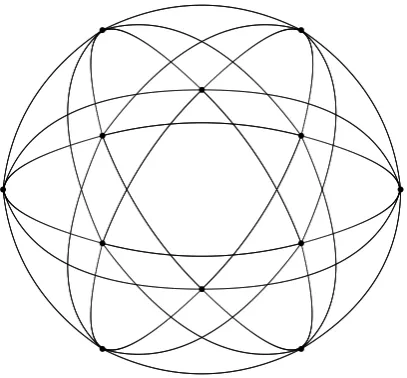
Example. Figure 3.2 displays a 2-quandle by means of geodesics. Note that some pairs of points of the quandle lie on distinct geodesics. This particular example is algebraically connected but does not have behaviorally distinct elements.
Figure 3.2: Geodesics
r r
r
r
r r
r r
r r
3.2
Involutory quandles generated by two points
At this point it is appropriate to classify the involutory quandles generated by two points. They will all be quotients of the free involutory quandle on two points, L= CoreZ.
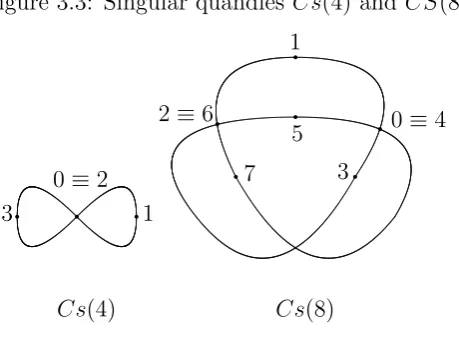
Figure 3.3: Singular quandlesCs(4) and CS(8)
q
3q
0≡2
q1
Cs(4)
q0≡4
q
1
q
3
q
2≡6 q
5
q7
Cs(8)
Proposition. Any involutory quandle generated by two points is isomorphic to one of the following
i). L= CoreZ.
ii). C(n) = CoreZn, the (nonsingular) cyclic quandle of order n.
iii). Cs(4n), the quotient of C(4n) given by the congruence 2k≡2k+ 2n for allk ∈Zn, thesingular cyclic quandle of order 3n.
Remark. Figure 3.3 illustratesCs(4) and Cs(8).
Proof. It is straightforwad to check that the list induces only quotient quandles of L. Assume now that Qis the proper quotient of L,Q=L/≡. Let d be the least difference between any two distinct equivalent points of L. d = |m −n| 6= 0, m ≡ n. By using a translation by −m on L, which is an isomorphism of L, we may assume m = 0.
d = |n| 6= 0. Now −n = n .0 ≡ 0.0 = 0, so 0 ≡ d. For all k, k = −k .0 ≡ −k . d = k + 2d. Therefore, Q is a quotient of C(2d) = CoreZ2d. Note that for all k,
2k= 0. k≡d . k = 2k−d. Similarly,
(∗) 2k−d≡2k ≡2k+d.
We consider two cases depending on the parity ofd.
Case 1. d is odd. We show p ≡p+d for all p. If pis even, p = 2k, then (∗) implies
Case2. dis even. Letd= 2c. We see from (∗) thatQis a quotient ofCs(4c). Assume that Q is a proper quotient of Cs(4c). Let p be the least nonnegative integer congruent to an element in Q from which it is distinct in Cs(4c). Reflection through p−1 shows that p−2 has the same property unless p= 0 or p= 1. However, pcannot be 0, as the elements equivalent to 0 inCs(4c) are already the minimal distancedapart. Thus,p= 1. Then there is someq, 1 < q ≤2nsuch that 1 ≡q. We have 1≡2d+1 inCs(4c), so by the minimality ofd,q =d+1, and 1 ≡d+1. For allk, 2k−1 = 1. k ≡(d+1). k= 2k−1−d.
Coupled with (∗) we now haveQ=C(d) = CoreZd.
It may be asked why other axioms were not included in the definition of “quandle” in order to eliminate the singular cyclic quandles as examples of quandles. There are two responses to this question. One is that the axioms could not remain equational without adding more operations. The other is these singular examples occur as the involutory quandles associated to certain links (as defined in chapter 4).
3.3
Group cores
In this section we will examine some more properties of the core of a group. We have already demonstrated (in section 2.8) the equisimplicity of a group and its core. In fact, if the core is simple, then the core determines the group. Bruck in [3] has shown, however, that different groups may have isomorphic cores. In particular, a nilpotent group of class two all of whose elements have odd finite order h has a core isomorphic to that of an Abelian group. Nonetheless, we have the following proposition.
Proposition1. If the cores of two finitely generated Abelian groups are isomorphic, then the groups themselves are isomorphic.
Proof. Let f : CoreG → CoreH be an isomorphism between the cores of the finitely generated Abelian groups G and H. By composing f with the translation by −f(0) in
H (translation,y7→y−f(0), is a quandle isomorphism of CoreH), we may assume that
f(0) = 0. Then f(−x) = −f(x) and f(2x) = 2f(x). Moreover, (∗) f(x+ 2y) =f(x) + 2f(y).
The bijectionf restricts to an isomorphism from 2G={2x|x∈G} onto 2H. Using the structure theorem for finitely generated Abelian groups, we conclude that
G∼=Zr⊕(Z2m1 ⊕ · · · ⊕Z2mk)⊕OddG
where 1 ≤ m1 ≤ · · · ≤ mk, and OddG is the subgroup of G of elements of odd order.
Similarly,
H ∼=Zs⊕(Z2n1 ⊕ · · · ⊕Z2nl)⊕OddH.
Now, 2G∼= 2Zr⊕(2Z2m1 ⊕ · · · ⊕2Z2mk)⊕OddG, and we have a similar isomorphism for
2H. Since 2G∼= 2H, we have OddG∼= OddH,r =s, and beginning at the first mi >1
have to show there are the same number of ones occurring in the sequence m1, . . . , mk
as in the sequence n1, . . . , nl. Using (∗) we see f induces a bijection form G/2G onto
H/2H. But G/2G ∼= Zr
2 ⊕Zk2 and H/2H ∼= Z2s⊕Zl2. Since r = s and G/2G has the
same cardinality as H/2H, we have k=l. Hence G∼=H.
The next proposition interprets the Abelianness of a group core. Distributivity will be considered in section 3.4.
Proposition 2. A group G is nilpotent of class at most 2, that is, its commutator G0 is contained in its centerZ, if and only if its core is Abelian.
Proof. First note that for group cores, x . y = z if and only if xw . yw = zw. CoreG
is Abelian when the identity (w . x).(y . z) = (w . y).(x . z). Multiplying this equation byz−1 on the right yields
(wz−1. xz−1).(yz−1.1) = (wz−1. yz−1).(xz−1.1).
Thus, the group core is Abelian if and only if it satisfies
(w . x). y−1 = (w . y). x−1.
that is,y−1w−1wx−1y−1 =x−1y−1wy−1x−1, which may be rewritten as
(∗) w[x, y] = [x−1, y−1]w.
Assume CoreG is Abelian. then for w= 1, [x, y] = [x−1, y−1], and so, generally
w[x, y] = [x, y]w.
Hence, G0 ⊆Z.
Now assume G0 ⊆Z. In order to show (∗), it suffices to show [x, y] = [x−1, y−1]. But
[x−1, y−1] =xyx−1y−1 =yx[x, y]x−1y−1 = [x, y]yxx−1y−1 = [x, y].
Proposition 2 generalizes Soublin’s result [15] page 101, which, in the nomenclature of quandles, states that for any group G of exponent 3, CoreG is Abelian if and only if
G is nilpotent of class at most 2.
3.4
Distributive quandles
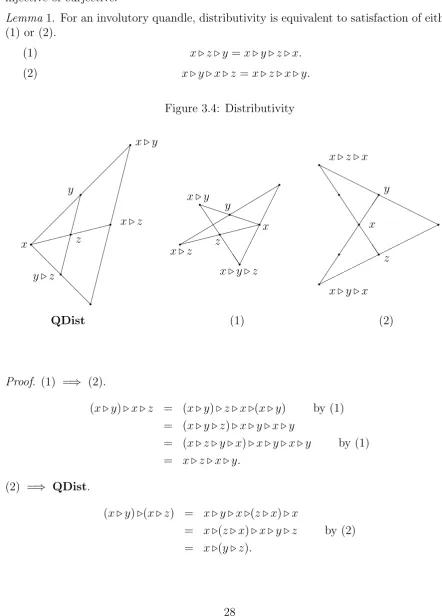
A property of quandles which is weaker than Abelianness is distributivity, satisfaction of
QDist. x .(y . z) = (x . y).(x . z).
For each x in a distributive quandle, the map