Dynamic Evolution of Practice Guidelines: Analysis of
Deviations From Assessment and Management Plans
WHAT’S KNOWN ON THIS SUBJECT: Adherence to guidelines has generally been shown to improve patient care and reduce the cost of care. Current understanding of the varying reasons why clinicians deviate from guidelines is based on surveys and retrospective reviews.
WHAT THIS STUDY ADDS: We examined clinician deviations from guidelines in a prospective fashion and attempted to categorize those deviations. Better elucidation of clinician reasoning behind deviations may inform care improvement and help define strategies to eliminate unjustifiable deviations.
abstract
OBJECTIVE:A Standardized Clinical Assessment and Management Plan (SCAMP) standardizes the care of patients with a predefined diagnosis while actively inviting and collecting data on clinician deviations (DEVs) from its recommendations. For 3 different pediatric cardiac diagnoses managed by SCAMPs, we determined the frequency of, types of, and reasons for DEVs, which are considered to be a valuable source of information and innovation.
METHODS:DEVs were collected as part of SCAMP implementation. DEVs were reviewed by the SCAMP committee chairperson and by a separate protocol deviation committee; they were characterized as either justifi -able (J), possibly justifiable (PJ), or not justifiable (NJ).
RESULTS:We analyzed 415 patients, 484 clinic encounters, and 216 DEVs. Eighty-six (39.8%) of the DEVs were J, 21 (9.7%) were PJ, and 109 (50.4%) were NJ. The percentage of NJ DEVs relative to the number of opportunities for DEV was 4.1%. J and PJ DEVs were mostly due to management of unrelated conditions (11% overall) or special circumstances (22% overall). NJ DEVs primarily involved follow-up intervals (66%) and deleted tests (24%). The reason for deviating from SCAMP recommendations was not given for 31% of DEVs, even though such information was requested.
CONCLUSIONS: The overall low rate of NJ DEV suggests that practi-tioners generally accept SCAMP recommendations, but improved cap-ture of practitioners’reasons for deviating from those recommendations is needed. This analysis revealed multiple opportunities for improving patient care, suggesting that this process can be useful in both prom-ulgating sound practice and evolving improved approaches to patient management.Pediatrics2012;130:93–98
AUTHORS:Michael Farias, MD, MBA,aKevin G. Friedman, MD,bAndrew J. Powell, MD,bSarah D. de Ferranti, MD,b Audrey C. Marshall, MD,bDavid W. Brown, MD,band Thomas J. Kulik, MDb
Departments ofaMedicine andbCardiology, Children’s Hospital
Boston, Harvard Medical School, Boston, Massachusetts
KEY WORDS
Adherence, guidelines, quality improvement, congenital heart disease, health policy
ABBREVIATIONS
AS—aortic valve stenosis ASO—arterial switch operation CPG—clinical practice guideline DEV—clinician deviation
HCM—hypertrophic cardiomyopathy J—justifiable
NJ—not justifiable PJ—possibly justifiable
SCAMP—Standardized Clinical Assessment and Management Plan
www.pediatrics.org/cgi/doi/10.1542/peds.2011-3811
doi:10.1542/peds.2011-3811
Accepted for publication Mar 1, 2012
Address correspondence to Thomas J. Kulik, MD, Department of Cardiology, 300 Longwood Ave, Boston, MA 02115. E-mail: thomas. [email protected]
PEDIATRICS (ISSN Numbers: Print, 0031-4005; Online, 1098-4275).
Copyright © 2012 by the American Academy of Pediatrics
FINANCIAL DISCLOSURE:The authors have indicated they have nofinancial relationships relevant to this article to disclose.
FUNDING:This work was supported by grants from the Boston Children’s Heart Foundation, the Program for Patient Safety and Quality at Children’s Hospital Boston, and the Children’s Hospital Provider–Payer Quality Initiative of Massachusetts.
care by standardizing care and pro-moting evidence-based medicine.1–4
In-deed, a variety of studies show that clinician adherence to guidelines cannot only improve patient outcomes5–7
but also reduce the cost of care.8–10
Un-derstanding the reasons why clinicians deviate from guidelines could be useful to both learn from deviations and pre-vent future unjustified ones; however, we are unaware of any prospective studies that examine this reasoning at the point of clinical decision-making.
A Standardized Clinical Assessment and Management Plan (SCAMP) is a quality improvement initiative that guides clini-cal decision-making and gathers relevant clinical data to inform future improve-ment of the SCAMP.11–13Each SCAMP is
developed by a multidisciplinary com-mittee of physician and nursing experts for a particular medical condition. Sim-ilar in some ways to a CPG, a SCAMP provides a guideline that standardizes the assessment and management of patients with a specific disorder.
Unlike a CPG, however, SCAMP guide-lines areflexible and are accompanied by a targeted data collection process that focuses attention on those parts of the SCAMP where the greatest uncer-tainty about care is likely to reside. Ac-knowledging this uncertainty inherent in its management recommendations, a SCAMP also actively invites and collects data on knowledge and experience-based clinician deviations (DEVs), which are recognized as a rich source of informa-tion and innovainforma-tion.14 Patterns of DEVs
and, in some cases, an individual DEV can reveal areas in which the SCAMP is de-ficient and therefore amenable to re-vision. A SCAMP thus permits learning from DEVs and values the preeminence of clinical acumen, which is hypothesized to improve acceptance relative to other forms of guidelines.15Based on periodic
review of DEVs, collected data, and
progressive modification of its care-delivery algorithm through a process of continuous improvement.
A fundamental component of the SCAMP improvement process is therefore a review of actual clinician practice relative to SCAMP protocol recommendations. We reviewed clinician management of patients with 3 different diagnoses cov-ered by SCAMPs (hypertrophic cardio-myopathy [HCM], aortic valve stenosis [AS], and patients with D-loop trans-position of the great arteries status-post arterial switch operation [ASO]) to de-termine (1) the frequency with which practitioners deviated from SCAMP rec-ommendations, (2) the types of DEVs, and (3) the reasons that practitioners deviated. This analysis was undertaken to assess practitioner adherence to SCAMPs and to uncover opportunities to learn from deviations to improve the SCAMPs themselves.
METHODS
Based on consultation with the Child-ren’s Hospital Boston Committee on Clinical Investigation, a SCAMP is con-sidered a quality improvement initiative and therefore is exempt from human studies research regulations. The re-view of DEVs was undertaken as an in-tegral part of the SCAMP process of quality improvement.
Opportunities for DEVs in SCAMPs As previously mentioned, a SCAMP re-lies on knowledge-based DEVs from its ; recommendations to inform and imp-rove the SCAMP care plan. Supplemen-tal Information provides an example of a SCAMP data form, which is used by the clinician at the point of care to collect targeted information, provide manage-ment recommendations, and capture reasons for DEVs. All cardiology pro-viders in our department were expected to use SCAMPs in the management of all
To place the number of DEVs into con-text, we determined the number of op-portunities for DEV. SCAMP evaluation and management recommendations vary not only with the primary diagnosis but also in relation to the patient’s age and other factors (eg, recommended testing at age 1–3 weeks after ASO dif-fers from that for a 12-year-old); hence, 18 different age/follow-up period– specific SCAMP encounter forms were used for the 3 diagnoses noted. The number of opportunities for DEV for each SCAMP were calculated as 1 op-portunity (each) for follow-up interval, added testing, assessment of severity, and exercise restrictions + 1 opportu-nity for each recommended test deleted (from 1 to 8, depending on the SCAMP). The number of opportunities for DEV ranged from 2 to 11 among SCAMP encounters. The total number of op-portunities for DEV =S(the number of opportunities for DEV for each SCAMP3 the number of clinic visits for that SCAMP) for all 18 SCAMP encounters.
Overview of DEV Analysis
The process used to analyze SCAMP DEVs is summarized in Fig 1.
obtained from the medical record in an effort to deduce the reason for the DEV. Information collected on DEVs was intentionally not linked to individual providers to avoid con-cern that such information could be used for monitoring or criticism of patient care.
2. DEVs were reviewed by the chair-person of the committee (the SCAMP Protocol Committee) that formu-lated the SCAMP in question. Each DEV was characterized as justified (J), possibly justified (PJ), or not justified (NJ). A DEV was determined to be J or PJ if it was thought to be generally consistent with sound clin-ical practice; J and PJ DEVs occurred for 1 of 4 reasons: (1) a testing or clinic follow-up DEV was done to at-tend to an unrelated condition (eg, prolonged QTc in an ASO patient); (2) special circumstances required DEV (eg, a patient withfindings atypical for the condition or when clinic visits occurred at nonspecified intervals due to developments not anticipated in the SCAMP protocol); (3) constr-aints due to insurance coverage; or (4) what we termed “expert expia-tion” (ie, when, in the judgment of the chairperson, the underlying ra-tionale for the specific SCAMP pre-scription was not so robust that it
would preclude a reasonable person from pursing the DEV. In some cases the DEV brought to light an issue that required SCAMP modification and the chairperson concluded that the needed modification was consis-tent with the DEV.
NJ DEVs were categorized as follows: (1) provider disagreement with an arguably arbitrary SCAMP specifi -cation (eg, follow-up interval); (2) provider disagreement with a SCAMP specification with strong medical justification (“gold standard” speci-fications [eg, obtaining an echocar-diogram to evaluate possible HCM]); or (3) when family preference drove the decision to deviate from the protocol. DEVs were also considered to be NJ when the reason for DEV was not given by the clinician.
3. The DEV, assignment of justifiability, and reasons for same as determined by the SCAMP Protocol Committee chairperson were subsequently re-viewed by the SCAMP Protocol Devia-tion Committee, which was composed of 5 experienced and clinically ac-tive cardiologists from our Depart-ment of Cardiology. This committee reviewed the assignment by the chairperson and, using the same criteria, confirmed that assignment by general consensus or provided
an alternative one. The Protocol De-viation Committee’s assignment was final.
Types of DEVs Analyzed
The following types of DEVs were ana-lyzed: clinic follow-up intervals (too long or too short), tests added, tests deleted (depending on the SCAMP: chest radio-graph, electrocardiogram, echocardio-gram, graded exercise test, stress echocardiogram, Holter electrocardio-gram, cardiac MRI, lipid panel, cardiac catheterization, or genetic testing), prac-titioner assessment of AS, and recom-mendations for exercise restriction.
RESULTS
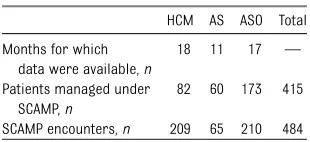
SCAMP encounters during the interval from March 2009 to December 2010 were used for analysis and are sum-marized in Table 1. Among all encounters there were a total of 2644 opportunities for DEV. For all 3 diagnoses combined, there were 216 DEVs; of these, 86 (39.8%) were J, 21 (9.7%) were PJ, and 109 (50.4%) were NJ. The total number of DEVs and the number of NJ DEVs ex-pressed as a percentage of the total opportunities for DEV were 8.2% and 4.1%, respectively.
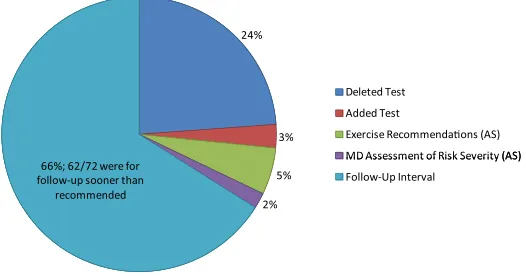
Figure 2 summarizes the reasons that J and PJ were categorized as such. Figure 3 summarizes the nature of the NJ DEVs; only 4 were DEVs from“gold standard”recommendations. Note, the relatively high percentage of DEVs for which the practitioner did not provide an explanation (31% overall). Figure 4 summarizes the types of NJ DEVs for the 3 conditions combined. Most (66%) were for follow-up interval deviations,
FIGURE 1
Summary of the SCAMP DEV analysis process.
TABLE 1 Encounters Used in SCAMP DEV Analysis
HCM AS ASO Total
Months for which data were available,n
18 11 17 —
Patients managed under SCAMP,n
82 60 173 415
SCAMP encounters,n 209 65 210 484
the vast majority of which (62 of 72, or 86%) were for earlier than recom-mended follow-up.
DISCUSSION
CPGs often meet resistance from clini-cians for multiple reasons.16–19
Guide-lines often fail tofit within the culture of medicine insofar as clinicians mayfind them to be unnecessarily rigid, espe-cially when idiosyncratic patient care is required. Clinicians may fear that CPGs represent a means of cost containment rather than quality improvement.20
Some even believe that guidelines
inhibit both training and innovation in medical care. Lastly, it has been pur-ported that CPGs are causing a shift in the professional focus of clinicians from autonomy to accountability,21which can
be a source of clinician dissatisfac-tion.22,23 By permitting and learning
from knowledge-based DEVs, SCAMPs were designed to value clinical acumen and overcome many of these barriers to adoption and adherence.
Our analysis suggests simultaneously that while practitioners appear to gen-erally accept the SCAMPs approach to management, they do not uniformly
Widespread adoption of SCAMPs is in-dicated by the low rate of NJ DEVs relative to the opportunities for DEV (4.1%). Be-cause some DEVs judged as NJ might have been J or PJ had the rationale for the DEV been provided by the clinician, 4.1% actually represents the upper bound for NJ DEVs. Whether this reflects a respect for the “authority” of the SCAMP or that the protocols mirror the existing local management appro-ach cannot be ascertained from our analysis. This very good level of ac-ceptance, as demonstrated by actual practice, is consistent with a survey indicating a generally positive view of SCAMPs among clinicians at our in-stitution.15
On the other hand, the fact that clini-cians inconsistently provided a reason for why they intentionally deviated from the SCAMP (Fig 3) indicates a deficiency in the SCAMP process, which aims to evolve better care by learning from variability in practice. Indeed, some of the DEVs represented learning oppor-tunities to revise and improve the SCAMP. It is not known why providers were inconsistent in reporting their rationale for DEVs; insufficient em-phasis on the utility of this infor-mation by the SCAMP organizers and the time burden involved may have been contributing factors. Emphasiz-ing the importance of this information and making it faster and easier to provide it (eg, through prepopulated checklists) may yield greater provider input.
There was considerable variability in the reasons for J or PJ DEVs among the 3 diagnoses (Fig 2); no pattern is ascer-tainable except that J DEVs occurred most commonly for conditions requiring evaluation unrelated to the SCAMP dis-ease and for DEVs related to special circumstances. Interestingly, distinction
FIGURE 2
The reasons why a DEV was judged to be J or PJ. The percentages refer to the percentage of all DEVs in that disease type accounted for by the particular reason (eg, Unrelated Condition). ALL indicates all 3 disease types combined (AS, ASO, and HCM).
FIGURE 3
can be made as to whether a DEV, re-gardless of being J, was or was not necessary. Necessary DEVs could be considered those related to unrelated conditions, special circumstances, or insurance constraints, which together comprised ∼84% of J DEVs. The re-mainder fell under the category of“ ex-pert expiation” and, although J, were potentially not necessary. Thus, the vast majority of J DEVs were mandated by circumstances not anticipatable by the SCAMP.
NJ DEVs, when a reason for them was identified, were almost always related to provider disagreement with an ar-guably somewhat arbitrary SCAMP provision or to family preferences. We decided to regard the latter as NJ DEVs, considering that parental preference can often be strongly influenced by an informed discussion with the clinician, and because a strong case can be made for providers sometimes resisting pa-tient requests, especially if they are medically unhelpful.24 We recognize,
however, that a cogent case could be made to consider such DEVs as J or PJ. There were few“gold standard”DEVs; in no case did it seem to the committee that a patient’s welfare was endangered due to such a DEV.
DEV analysis has revealed multiple opportunities for SCAMP and patient care improvements thus far. First, the
substantial majority of NJ DEVs were for clinic follow-up intervals, with patients usually seen sooner than specified. This high rate of early follow-up was not apparent before the DEV analysis. Given that clinic visits entail expense and patient inconvenience, this discovery suggests that additional ex-ploration of the reasons for these DEVs may yield strategies for providing more efficient follow-up of these patients. Second, we discovered that clinicians often omitted certain SCAMP-suggested tests (eg, lipid panels in ASO), indicating that either retention of these tests in the SCAMP needs to be reconsidered or practitioners need to be better in-formed of their usefulness. On the other hand, our DEV analysis also revealed the need to consider adding other tests and to reconsider exercise recomm-endations for some conditions (AS). These and other items were communi-cated to the chairperson of the com-mittee responsible for development and review of the SCAMP protocol, and will be considered when revision of the SCAMP is undertaken. Last, as inferred earlier, ways should be sought to crease provider feedback regarding in-tentional noncompliance, perhaps by making the provider–SCAMP interface more efficient and by better informing providers of the utility of providing such information.
STUDY LIMITATIONS
There were limitations and potential biases resulting from having the SCAMP Protocol Committee chairperson be thefirst person to adjudicate whether a DEV was J; however, we thought that these were outweighed by the benefit of having the DEVs reviewed by the in-dividual most experienced with the disease and the SCAMP itself. Deciding whether a DEV was J, PJ, or NJ was also necessarily somewhat subjective. To maximize consistency, we developed rules that guided the determination of justifiability. Also, multiple experienced and clinically active physicians ana-lyzed the DEVs and a general (although not always unanimous) consensus was sought when considering each DEV. The process evolved somewhat over the course of analyzing the 3 diagnoses, but committee members thought that a reasonable degree of consistency and interoperator reliability was achieved across DEVs from all 3 diagnoses.
One of the principles underpinning SCAMPs is that the recommendations should be followed, absent a reason given by the clinician for the DEV. Using“expert expiation” as a reason for considering some DEVs J or PJ is inconsistent with this, since it is the reviewer, not the cli-nician, who supplied the rationale for the DEV. We took this approach as it draws attention to, and loosely quantifies, ele-ments in the SCAMP protocol that require revision. We acknowledge, however, that fewer DEVs (15%) were assigned NJ status than would have been the case without such“expiation.”
Because decisions to deviate within a SCAMP encounter for a single patient are not necessarily independent events, using the ratio of DEVs to opportunities for DEV is an imprecise way to think about how often practitioners deviate. However, we think it is important to put the number of DEVs into this context. We also note that because a DEV can lead to additional DEVs (eg, when one nonindicated test leads to
FIGURE 4
The percentage distribution of the kinds of NJ DEVs for all 3 diagnoses combined (AS, ASO, and HCM;N= 109).
upper bound of possible independent DEVs relative to opportunities for DEV.
Finally, we demonstrate here how DEV analysis can reveal opportunities for pro-tocol refinement, but it is too early to know the ultimate utility of such knowledge.
CONCLUSIONS
Our analysis of how, how often, and why clinicians deviate from SCAMPs revealed
needs a better way of capturing prac-titioners’ reasons for deviating from SCAMP recommendations, practitioners appear to be generally accepting of SCAMPs. Furthermore, we believe that this effort represents thefirst attempt to prospectively and systematically gather the rationale behind clinician deviation from standardized care path-ways. This yields important information that is more relevant and less biased
portunities to improve SCAMPs indi-cates that approaches like this may be quite useful in both promulgating sound practice and evolving improved appro-aches to patient care.
ACKNOWLEDGMENTS
We would like to acknowledge the crit-ical assistance of Steven D. Colan, MD, Rahul H. Rathod, MD, Ashley Renaud, RN, and Lynne S. Patkin, MBA.
REFERENCES
1. Woolf SH. Practice guidelines: a new reality in medicine. I. Recent developments.Arch Intern Med. 1990;150(9):1811–1818
2. Agency for Health Care Policy and Research, ed. Using Clinical Practice Guidelines to Evaluate Quality of Care: Vol. 1, Issue. Rock-ville, MD: Agency for Health Care Policy and Research; 1995. Publication No. 95-0045; No. 1
3. Merritt TA, Palmer D, Bergman DA, Shiono PH. Clinical practice guidelines in pediatric and newborn medicine: implications for their use in practice.Pediatrics. 1997;99(1): 100–114
4. Carnett WG. Clinical practice guidelines: a tool to improve care.Qual Manag Health Care. 1999;8(1):13–21
5. Turley K, Tyndall M, Roge C, et al. Critical pathway methodology: effectiveness in con-genital heart surgery. Ann Thorac Surg. 1994;58(1):57–63, discussion 63–65
6. Menéndez R, Ferrando D, Vallés JM, Vallterra J. Influence of deviation from guidelines on the outcome of community-acquired pneu-monia.Chest. 2002;122(2):612–617
7. Rice TW, Morris S, Tortella BJ, Wheeler AP, Christensen MC. Deviations from evidence-based clinical management guidelines in-crease mortality in critically injured trauma patients.Crit Care Med. 2012;40(3):778–786
8. Guterman SJ, VanRooyan MJ. Cost-effective medicine: thefinancial impact that practice guidelines have on outpatient hospital charges in the emergency department.
J Emerg Med. 1998;16(2):215–219
9. Marrie TJ, Lau CY, Wheeler SL, Wong CJ, Vandervoort MK, Feagan BG. A controlled trial of a critical pathway for treatment of community-acquired pneumonia. CAPITAL Study Investigators. Community-Acquired Pneumonia Intervention Trial Assessing Levofloxacin.JAMA. 2000;283(6):749–755
10. Fischer MA, Avorn J. Economic implications of evidence-based prescribing for hyper-tension: can better care cost less?JAMA. 2004;291(15):1850–1856
11. Rathod RH, Farias M, Friedman KG, et al. A novel approach to gathering and acting on relevant clinical information: SCAMPs.
Congenit Heart Dis. 2010;5(4):343–353
12. Friedman KG, Rathod RH, Farias M, et al. Resource utilization after introduction of a standardized clinical assessment and management plan. Congenit Heart Dis. 2010;5(4):374–381
13. Friedman KG, Kane DA, Rathod RH, et al. Management of pediatric chest pain using a standardized assessment and manage-ment plan.Pediatrics. 2011;128(2):239–245
14. Bohmer RMJ.Designing Care: Aligning the Nature and Management of Health Care. Boston, MA: Harvard Business Press; 2009: 261
15. Farias M, Ziniel S, Rathod RH, et al. Provider attitudes toward standardized clinical as-sessment and management plans (SCAMPs).
Congenit Heart Dis. 2011;6(6):558–565
16. Cabana MD, Rand CS, Powe NR, et al. Why don’t physicians follow clinical practice
guidelines? A framework for improvement.
JAMA. 1999;282(15):1458–1465
17. Flores G, Lee M, Bauchner H, Kastner B. Pediatricians’attitudes, beliefs, and practi-ces regarding clinical practice guidelines: a national survey.Pediatrics. 2000;105(3 pt 1):496–501
18. Finkelstein JA, Lozano P, Shulruff R, et al. Self-reported physician practices for chil-dren with asthma: are national guidelines followed? Pediatrics. 2000;106(4 suppl): 886–896
19. Cabana MD, Rand CS, Becher OJ, Rubin HR. Reasons for pediatrician nonadherence to asthma guidelines. Arch Pediatr Adolesc Med. 2001;155(9):1057–1062
20. Bergman DA. Evidence-based guidelines and critical pathways for quality improve-ment.Pediatrics. 1999;103(1 suppl E):225– 232
21. Timmermans S. From autonomy to ac-countability: the role of clinical practice guidelines in professional power.Perspect Biol Med. 2005;48(4):490–501
22. Edwards N, Kornacki MJ, Silversin J. Un-happy doctors: what are the causes and what can be done? BMJ. 2002;324(7341): 835–838
23. Mechanic D. Physician discontent: chal-lenges and opportunities. JAMA. 2003;290 (7):941–946
24. Brett AS, McCullough LB. Addressing requests by patients for nonbeneficial interventions.
DOI: 10.1542/peds.2011-3811 originally published online June 4, 2012;
2012;130;93
Pediatrics
C. Marshall, David W. Brown and Thomas J. Kulik
Michael Farias, Kevin G. Friedman, Andrew J. Powell, Sarah D. de Ferranti, Audrey
Assessment and Management Plans
Dynamic Evolution of Practice Guidelines: Analysis of Deviations From
Services
Updated Information &
http://pediatrics.aappublications.org/content/130/1/93
including high resolution figures, can be found at:
References
http://pediatrics.aappublications.org/content/130/1/93#BIBL
This article cites 22 articles, 5 of which you can access for free at:
Subspecialty Collections
http://www.aappublications.org/cgi/collection/cardiology_sub Cardiology
http://www.aappublications.org/cgi/collection/surgery_sub Surgery
sub
http://www.aappublications.org/cgi/collection/quality_improvement_ Quality Improvement
e_management_sub
http://www.aappublications.org/cgi/collection/administration:practic Administration/Practice Management
following collection(s):
This article, along with others on similar topics, appears in the
Permissions & Licensing
http://www.aappublications.org/site/misc/Permissions.xhtml
in its entirety can be found online at:
Information about reproducing this article in parts (figures, tables) or
Reprints
http://www.aappublications.org/site/misc/reprints.xhtml
DOI: 10.1542/peds.2011-3811 originally published online June 4, 2012;
2012;130;93
Pediatrics
C. Marshall, David W. Brown and Thomas J. Kulik
http://pediatrics.aappublications.org/content/130/1/93
located on the World Wide Web at:
The online version of this article, along with updated information and services, is
http://pediatrics.aappublications.org/content/suppl/2012/05/29/peds.2011-3811.DCSupplemental
Data Supplement at:
by the American Academy of Pediatrics. All rights reserved. Print ISSN: 1073-0397.