Performance Metrics After Changes in Screening
Protocol for Congenital Hypothyroidism
WHAT’S KNOWN ON THIS SUBJECT: Significant variation in congenital hypothyroidism screening operations/performance has been observed in the United States. The origin of this variation remains unknown, in part because of a lack of evaluation. Accordingly, debates persist about optimal screening operations including laboratory testing methods.
WHAT THIS STUDY ADDS: Four distinct screening protocols applied to Michigan resident infants are compared in detecting congenital hypothyroidism overall and specific to cases
characterized by high initial thyrotropin concentrations thought to have a more severe form of the disease.
abstract
OBJECTIVE: To evaluate Michigan newborn screening for congenital hypothyroidism (CH) protocol changes.
METHODS: This population-based study includes infants born and screened in Michigan (January 1, 1994–June 30, 2010). Screening performance is compared across 4 periods defined by the dried blood spot testing method: (1) thyroxine (T4) with backup thyrotropin, (2) tandem T4 and thyrotropin, (3) primary thyrotropin testing without serial testing, and (4) primary thyrotropin plus serial testing for births weighing ,1800 g. Logistic regression is used to test for differences across periods.
RESULTS:Thyrotropin testing exhibited greater specificity overall and greater likelihood of detection with serial testing relative to primary T4 testing. Tandem T4 and thyrotropin testing appeared more sensitive relative to other protocols, yet it produced significantly more false-positives, and detection may have been affected by overdiagnosis and misclassification. Central CH was no longer detected once T4 testing ceased.
CONCLUSIONS:Primary thyrotropin plus serial testing for infants at risk for later rising thyrotropin outperformed other newborn screening strategies for classic CH, although 2 false-negatives occurred among normal birth weight infants admitted to the NICU during this testing period. Tandem T4 and thyrotropin screening outperformed other strategies for detection of both classic and central CH combined, although it is associated with increased operating costs. Additional research is necessary to weigh the benefits of increased sensitivity against additional program operating costs. Pediatrics 2012;130: e1252–e1260
AUTHORS:Steven J. Korzeniewski, PhD,a,bViolanda
Grigorescu, MD, MSPH,cMary Kleyn, MS,cWilliam
Young, PhD,cGretchen L. Birbeck, MD,dDavid Todem, PhD,d
Roberto Romero, MD, DMedSci,aTinnakorn
Chaiworapongsa, MD,a,band Nigel Paneth, MD, MPHd
aPerinatology Research Branch, National Institute of Child Health and Human Development, National Institutes of Health, Department of Health and Human Services, Detroit, Michigan; bDepartment of Obstetrics and Gynecology, Wayne State University, Detroit, Michigan;cMichigan Department of Community Health, Lansing, Michigan; anddDepartment of Epidemiology, Michigan State University, East Lansing, Michigan
KEY WORDS
newborn screening, performance evaluation, congenital hypothyroidism
ABBREVIATIONS
CH—congenital hypothyroidism DOB—date of birth
FPR—false-positive rate NBS—newborn screening PPV—positive predictive value T4—thyroxine
Each author made substantial contributions to conception and design, acquisition of data, or analysis and interpretation of data; participated in drafting the article or revising it critically for important intellectual content; and providedfinal approval of the version to be published.
www.pediatrics.org/cgi/doi/10.1542/peds.2011-3340 doi:10.1542/peds.2011-3340
Accepted for publication Jun 20, 2012
Address correspondence to Steven J. Korzeniewski, PhD, Department of Obstetrics and Gynecology, Wayne State University School of Medicine, Hutzel Women’s Hospital, 4 Brush—Office 4817, 3990 John R St, Detroit, MI 48201. E-mail: sKorzeni@med. wayne.edu
PEDIATRICS (ISSN Numbers: Print, 0031-4005; Online, 1098-4275). Copyright © 2012 by the American Academy of Pediatrics
FINANCIAL DISCLOSURE:The authors have indicated they have nofinancial relationships relevant to this article to disclose.
FUNDING:This research was supported in part by the Perinatology Research Branch, Division of Intramural Research,
Newborn screening (NBS) for congen-ital hypothyroidism (CH), a clinically defined group of thyroid disorders observed at birth, began in the mid-1970s after the development of a ra-dioimmunoassay capable of measuring thyroxine (T4) in dried blood spotted on filter paper.1–5 Based on findings
from thefirst million infants screened, the NBS Committee of the American Thyroid Association recommended broad establishment and expansion of NBS programs for CH in 1977.6By
1992, it was estimated that 50 million infants were screened annually for CH worldwide.7NBS programs around the
world initially reported detection rates ranging from 1:3000 to 1:4000 infants screened and a typical 2:1 ratio of female to male cases.8–11 More
re-cently, US NBS programs have report-ed an increase in the birth prevalence of CH from 1:3985 in 1987 to 1:2274 in 2002 not fully explained by changes in laboratory methods or potential mis-classification of transient disease; sig-nificant interstate variation has also been observed.12–16The origin of this
variation remains largely unknown, perhaps because there has been a lack of emphasis on evaluating screen-ing system components.17
According-ly, debates persist about optimal CH screening operations, particularly dried blood spot testing methods.
Previous evidence of the comparative effectiveness of dried blood spot testing protocols for CH NBS is heterogeneous. Greater sensitivity and specificity have been reported among primary thyro-tropin relative to T4 testing programs and vice versa.15,18–24 Several studies
estimated that 4% to 10% of cases missed by primary T4 testing are ap-propriately detected by primary thyro-tropin testing20–23; others conclude that
primary thyrotropin testing fails to de-tect cases of central CH and those exhibiting a later rise in thyrotropin.18,19
Serial thyrotropin testing protocols that
rescreen selected infants generally during the first month of life have emerged to address later rising thy-rotropin25–27; however, detection of
central CH remains an issue. Estimates of the birth prevalence of central CH range widely (∼1:20 000–1:125 000 live births), and some believe it is adequately detected clinically amid di-agnosis of concomitant pituitary hor-mone deficiencies. Others note that although it is true that most (∼75%) cases of central hypothyroidism also have pituitary hormone deficiencies,28
diagnosis of either condition can often be delayed beyond 3 months of age and may result in severe hypoglycemia, neonatal hepatitis, or death.29–31
Heterogeneity of previous evidence is difficult to interpret in the context of interprogram variation in screen-ing protocols, performance, and pop-ulation characteristics.32In an attempt
to investigate the impact of changes in NBS for CH among a fixed population, we assessed NBS for CH performance metrics in Michigan during 4 succes-sive periods in which different dried blood spot testing protocols were used. This study adds to previous literature by (1) comparing the effectiveness of 4 distinct screening protocols in a rea-sonably stable and homogenous pop-ulation of infants, (2) reportingfindings generated in a program that collects virtually all initial bloodspot specimens between 24 and 36 hours of life, and (3) comparing NBS protocols based on their ability to detect cases character-ized by high initial thyrotropin con-centrations (100 uIU/mL) who are thought to have a more severe form of CH in addition to overall CH.
METHODS
Study Design and Participants
This population-based retrospective cohort study was approved by the Michigan Department of Community
Health Institutional Review Board and includes Michigan resident infants born and screened in Michigan from January 1, 1994, through June 30, 2010. The primary exposure of interest is the method of dried blood spot testing defined based on infant date of birth (DOB) as follows: (1) T4 backup thyro-tropin testing (DOB: 1/1/1994–12/31/ 1997); (2) tandem T4 and thyrotropin testing for all infants, no serial testing (DOB: 1/1/1998–9/30/2003); (3) pri-mary thyrotropin testing, no serial testing (DOB: 10/1/2003–2/28/2007); and (4) primary thyrotropin testing, serial testing for infants weighing
,1800 g at birth (DOB: 3/1/2007–6/30/ 2010). T4 backup thyrotropin testing involves making referrals for confi r-matory testing based on thyrotropin determinations obtained from dried blood spots only in newborns whose T4 concentrations are below the 10th centile. Tandem T4 and thyrotropin testing involves making referrals for confirmatory testing based on either low T4 or elevated thyrotropin con-centration measured in newborn dried blood. Primary thyrotropin testing involves making referrals for confi r-matory testing based only on thyro-tropin concentration; the addition of serial testing involves rescreening among infants at elevated risk of later rising thyrotropin.
Confirmatory testing is usually based on serum tests of venipuncture blood samples combined with some measure of binding proteins (ie, T3 resin uptake) used to differentiate free (active) from total T4.24,64 Blood samples for confi
r-matory testing are ideally obtained∼2 to 3 weeks of life when the upper range of thyrotropin falls to∼10 mU/L. Ref-erence ranges for free T4, total T4, and thyrotropin concentrations measured in serum at 2 to 4 weeks of life are∼10 to 26 pmol/L, 90 to 206 nmol/L, and,10 mU/L, respectively.22Infants having$2
mU/L are expected to have permanent primary CH.13 If a defect in thyroid
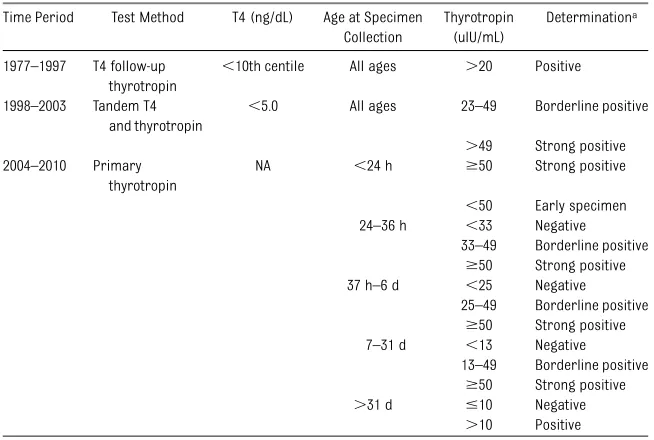
hormone synthesis is suspected, per-chlorate washout testing is sometimes performed to test the ability of the thyroid to transform iodine into or-ganically bound iodine.65 Other tests including scintigraphy and ultrasound are also useful during the process of diagnosing CH. Table 1 reports cutoff values used in referring infants for confirmatory testing over time. Out-comes of interest include screening performance metrics: detection rate, false-positive rate (FPR), positive pre-dictive value (PPV), sensitivity, and specificity.
Data
Demographic and perinatal informa-tion collected on the NBS, laboratory screening results, and medical man-agement data were used to identify and characterize infants screened from January 1, 1994 through June 30, 2010. Aside from rescreens because of early
specimen collection, infants identified by newborn dried blood spot screen for additional testing are considered screen positive; those who are
classi-fied as CH and are treated at the con-clusion of confirmatory testing are considered diagnosed cases. Reports actively and passively ascertained from pediatric endocrinologists by the NBS Follow-up Program are used in this study to identify false-negative screening results.
Analysis
Descriptive and analytical techniques include tabulation and trending of newborn characteristics by NBS out-comes of interest during 4 exposure periods. Logistic regression analysis is used to investigate whether the over-all likelihood of detection, likelihood of severe CH detection, and likelihood of false-positive determination changed significantly across periods after ad-justing for differences in the distribution of selected newborn demographic and
perinatal characteristics. Cases are cat-egorized as severe CH if their initial thyrotropin concentration reached or exceeded 100 uIU/mL based on the work of Mitchell et al.33 Adjusted models
in-clude covariates that are both signifi -cantly associated with the dependent variable (overall detection or severe case detection) and varied significantly during the 4 exposure periods. We were unable to assess area under the receiver operating characteristic curve associ-ated with each protocol because of the lack of analyte concentration data among normal screens during T4 testing periods.
RESULTS
More than 2 million infants are included; Table 2 reports the distributions of de-mographic and perinatal characteristics across the 4 exposure periods. Pop-ulation characteristics did not meaning-fully differ over time, although, due to the large sample size, observed differences were statistically significant.
Table 3 reports screening performance metrics by dried blood spot testing protocol. During the T4 backup thyro-tropin testing period, the detection rate, positive predictive value, and specificity were each less than ob-served during primary thyrotropin testing periods, both with and without serial testing. Alternatively, the FPR was more than twofold greater during the primary T4 relative to primary thyrotropin testing periods. The great-est rate of overall detection was ob-served during the tandem T4 and thyrotropin testing period (1:1271); however, the FPR (4.45%) was far greater than during other periods of observation. Accordingly, the PPV and specificity were significantly less dur-ing the tandem T4 and thyrotropin testing period compared with others observed in this study. Of note, the expected gender dimorphism of more female than male cases was reversed
TABLE 1 Dried Blood Spot Testing Protocols, Cutoff Values, and Associated Determinations Applied by Michigan NBS for Congenital Hypothyroidism, 1977–2010
Time Period Test Method T4 (ng/dL) Age at Specimen Collection
Thyrotropin (uIU/mL)
Determinationa
1977–1997 T4 follow-up thyrotropin
,10th centile All ages .20 Positive 1998–2003 Tandem T4
and thyrotropin
,5.0 All ages 23–49 Borderline positive
.49 Strong positive 2004–2010 Primary
thyrotropin
NA ,24 h $50 Strong positive
,50 Early specimen 24–36 h ,33 Negative
33–49 Borderline positive
$50 Strong positive 37 h–6 d ,25 Negative
25–49 Borderline positive
$50 Strong positive 7–31 d ,13 Negative
13–49 Borderline positive
$50 Strong positive
.31 d #10 Negative
.10 Positive
NA, not applicable.
aPositive or strong positive determination results in referral for confirmatory testing. Early specimen and borderline
only during the tandem T4 and thyro-tropin testing period, suggesting po-tential misclassification; otherwise, more female than male infants were diagnosed as expected.
Primary thyrotropin testing protocols were more specific than primary T4 testing protocols, yielding greater PPVs; however, the detection rate observed during primary thyrotropin testing periods is less than was observed during the tandem T4 and thyrotropin
testing period. Overall, primary thyro-tropin testing with serial testing for infants born weighing,1800 g yielded fewer false-positive results, a greater PPV, and greater overall detection than either primary thyrotropin testing without serial testing or primary T4 backup thyrotropin testing protocols. However, the 2 false-negative results observed during this study occurred during the primary thyrotropin plus serial testing period among infants
admitted to the NICU who had later rising thyrotropin but were not in-cluded in the serial testing protocol due to their normal birth weights. A single case of central hypothyroidism was detected during the T4 backup thyrotropin testing period (1:542 945), 6 of such cases were detected during the tandem T4 and thyrotropin testing period (1:125 787), and none were detected during either primary thyro-tropin testing periods.
TABLE 2 Newborns Screened by Selected Demographic and Perinatal Characteristics and by Dried Blood Spot Testing Method, Michigan NBS, January 1, 1994 through June 30, 2010
Population Segment T4 Backup Thyrotropin
Tandem T4 and Thyrotropin
Thyrotropin, No Serial Testing
Thyrotropin, Plus Serial Testing (1/1994–12/1997) (1/1998-9/2003) (10/2003–2/2007) (3/2007–6/2010)
N % N % N % N %
Race
White 386459 73.37 511212 72.23 281854 71.90 253137 70.59 Black 103361 19.62 129240 18.26 73688 18.80 70611 19.69 Other 36929 7.01 67327 9.51 36474 9.30 34845 9.72 Gender
Female 260569 48.79 364919 48.75 211349 48.85 193165 48.85 Male 273445 51.21 383625 51.25 221266 51.15 202298 51.15 Multiple Birth
No 526879 97.04 729276 96.63 417431 96.49 381470 96.46 Yes 16066 2.96 25446 3.37 15184 3.51 13993 3.54 Birth Weight
,750 g 2249 0.43 4410 0.58 1199 0.28 144 0.29 750–1499 g 643.7 1.23 8293 1.10 4690 1.10 4352 1.12 1500–2499 g 35301 6.73 47864 6.35 28308 6.65 25778 6.62
.2500 g 480752 91.62 693477 91.97 391351 91.96 358355 91.97 Length of gestation
,28 wk — — — — 2327 0.57 2184 0.57 28–37 wk — — — — 40212 9.85 36115 9.42
.37 wk — — — — 365499 89.57 344903 90.01 Small for gestational age
No — — — — 318936 90.44 295320 90.23
Yes — — — — 33698 9.56 31964 9.77
NICU
No — — — — 387543 89.58 353966 89.51 Yes — — — — 45072 10.42 41497 10.49 Total 542945 100 754722 100 432615 100 395463 100
Missing data are as follows: race,n= 140 620; gender,n= 22 140; birth weight,n= 31 786; gestational age,n= 36 843.—, NICU admission and gestational age data were not recorded on the NBS card before October 1, 2003. Percentages reported are column based.
TABLE 3 NBS Results and Performance Metrics, Michigan, January 1, 1994–June 30, 2010
Protocol Screened,N Screened Positive,n
Diagnosed,n False-Negative,n Detection Rate
PPV, % FPR, % Se, % Sp, % T4 backup thyrotropin 542 945 10 454 241 0 1:2253 2.31 1.88 100 98.12 Tandem T4 and thyrotropin 754 722 34 172 594 0 1:1271 1.74 4.45 100 95.55 Thyrotropin, no serial testing 432 615 3601 225 0 1:1923 6.25 0.78 100 99.22 Thyrotropin, plus serial testing 395 463 2375 259 2 1:1527 10.90 0.54 99.2 99.46
Although the overall rate of CH detection and subsequent screening perfor-mance metrics varied considerably by screening protocol period, the birth prevalence of severe CH, characterized by having an initial thyrotropin con-centration.100 uIU/mL, was far more stable (Fig 1). The number of severe CH cases detected per 100 000 live births screened increased after the in-troduction of thyrotropin into the dried blood spot testing protocol relative to the T4 backup thyrotropin testing pe-riod and remained relatively stable across the tandem T4 and thyrotropin and primary thyrotropin testing peri-ods (with and without serial testing).
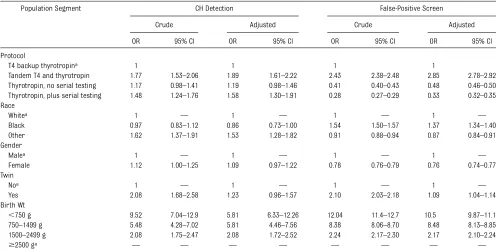
Overall, after adjusting for potential confounding factors (race, gender, twin status, birth weight), tandem T4 and thyrotropin testing and primary thyro-tropin plus serial testing for infants born weighing,1800 g are associated with a 89% and 58% increase in the odds of detection respectively com-pared with primary T4 backup thyro-tropin testing. Primary thyrothyro-tropin testing was more specific than primary T4 testing, yet was associated with a greater likelihood of detection only after introduction of serial testing.
Although tandem T4 and thyrotropin testing was associated with a near twofold increase in overall detection compared with primary T4 testing, it
was also associated with a near threefold increase in the rate of false-positives, as shown in Table 4. Al-ternatively, the FPR was significantly reduced during both primary thyro-tropin testing periods relative to the primary T4 backup thyrotropin and tandem testing periods in both crude (unadjusted) and adjusted models. To compare the trade-offs of tandem thy-rotropin and T4 testing verse primary thyrotropin plus serial testing for infants born weighing ,1800 g, we applied the detection rates and FPRs to a hypothetical birth population of 125 000 infants and estimated that an additional 297 false-positive determi-nations would be incurred for each additional case detected if Michigan were to switch from primary thyrotro-pin plus serial testing back to tandem T4 and thyrotropin testing for all births.
As indicated in Table 5, the crude like-lihood of severe CH detection was greatest during the thyrotropin plus serial testing period and was signifi -cantly elevated in each screening pro-tocol period relative to the T4 backup thyrotropin testing strategy. After ad-justment for race and gender dis-tributions, the difference in likelihood of severe CH detection between T4 backup thyrotropin and primary thy-rotropin without serial testing proto-cols was not statistically significant.
Severe CH cases were 38% and 35% more likely to be detected during tan-dem T4 and thyrotropin and primary thyrotropin plus serial testing periods respectively relative to the T4 back-up thyrotropin testing period after adjusting for race and gender dis-tributions.
DISCUSSION
Although the overall detection rate was greatest during the tandem T4 and thyrotropin testing period in this study, this finding is likely affected by mis-classification and overdiagnosis based on the elevated birth prevalence, re-versal of the expected gender di-morphism, and stable rate of severe CH observed in this period relative to pri-mary thyrotropin testing periods. Fur-thermore, a surprising 72% of cases detected by primary thyrotropin ex-hibited normal T4 concentrations, far greater than the expected 4% to 10%,20–23
suggesting that cases of hyperthy-rotropinemia may have been
classi-fied and treated as CH during this period. Primary thyrotropin testing plus serial testing among infants born
,1800 g yielded fewer false-positives and accordingly had lesser operating costs than either tandem T4 and thy-rotropin or primary T4 backup thyro-tropin protocols. Primary thyrothyro-tropin plus serial testing was also associated with a greater likelihood of detection relative to primary T4 testing and was equally able to detect severe CH rela-tive to the tandem testing approach, although no cases of central CH were detected during this period.
On average, 1 case of central CH was detected per year in Michigan before removing T4 from the NBS protocol; none were detected after. It is possi-ble that $1 cases of central CH was missed by primary thyrotropin testing strategies and perhaps not identified because of mortality or migration be-fore clinical detection or not reported
FIGURE 1
because of our reliance on passive surveillance of false-negatives. It re-mains unclear how the additional op-erating costs associated with tandem thyrotropin and T4 testing compare with the benefit of early central CH detection, although additional re-search is necessary to quantify this benefit.
Additional investigation is also necessary to determine whether there is benefit to increased detection of marginal cases including hyperthyrotropinemia/subclini-cal CH, and hypothyroxinemia, partic-ularly in the context of significant increases in the number of diagnoses in the United States over past 20 years. Currently, little evidence exists about the cognitive outcomes of permanent or transient forms of hyperthyrotropinemia and subclinical hypothyroidism.34–37Two
small studies reported an average dec-rement of 7 to 8 IQ points among children having hyperthyrotropinemia compared with euthyroid children;38,39 another
reported subclinical hypothyroidism af-ter age 5 years among such cases.40
Al-ternatively, other small studies have reported normal mental and physical development among untreated hyper-thyrotropinemia and subclinical CH cases.41–44 Several investigators have
also reported potential harm including iatrogenic hyperthyroidism associated with treatment of hyperthyrotropinemia patients.45,46
It is similarly unclear whether cases of hypothyroxinemia, a condition common among preterm infants and charac-terized by low T4 concentrations and normal thyrotropin concentrations not associated with CH, should be treated. Although NBS programs have tradi-tionally considered positive screening results associated with hypothy-roxinemia as being false, evidence suggests that these children are at el-evated risk for neurodevelopmental disorders47and developmental delay48;
trials are underway to determine
whether there is a benefit from treat-ment, results may have implications for future NBS operations.49,50
Future research efforts would be greatly advanced by application of a standardized operational case defi ni-tion for CH across NBS programs, similar to efforts made in surveillance for ce-rebral palsy in Europe.51Absent a
stan-dardized operational case definition, it is difficult to make meaningful compar-isons between and within screening programs over time. This definition should lay out the criteria for diagnosing CH in terms of necessary tests and how to interpret them and should attempt to differentiate classic CH from other congenital thyroid abnormalities using operational terms. Standardized age-adjusted analyte thresholds are recom-mended for both dried blood and serum measurements. It is also recommended that all suspected cases of CH undergo thyroid imaging to facilitate differentia-tion of likely transient from permanent
TABLE 4 Magnitude of Association Between Congenital Hypothyroidism Detection, False-Positive Screening Determination, and Dried Blood Spot Testing Protocol, Michigan NBS, January 1, 1994–June 30, 2010
Population Segment CH Detection False-Positive Screen Crude Adjusted Crude Adjusted OR 95% CI OR 95% CI OR 95% CI OR 95% CI Protocol
T4 backup thyrotropina 1 1 1 1
Tandem T4 and thyrotropin 1.77 1.53–2.06 1.89 1.61–2.22 2.43 2.38–2.48 2.85 2.78–2.92 Thyrotropin, no serial testing 1.17 0.98–1.41 1.19 0.98–1.46 0.41 0.40–0.43 0.48 0.46–0.50 Thyrotropin, plus serial testing 1.48 1.24–1.76 1.58 1.30–1.91 0.28 0.27–0.29 0.33 0.32–0.35 Race
Whitea 1 — 1 — 1 — 1 —
Black 0.97 0.83–1.12 0.86 0.73–1.00 1.54 1.50–1.57 1.37 1.34–1.40 Other 1.62 1.37–1.91 1.53 1.28–1.82 0.91 0.88–0.94 0.87 0.84–0.91 Gender
Malea 1 — 1 — 1 — 1 —
Female 1.12 1.00–1.25 1.09 0.97–1.22 0.78 0.76–0.79 0.76 0.74–0.77 Twin
Noa 1 — 1 — 1 — 1 —
Yes 2.08 1.68–2.58 1.23 0.96–1.57 2.10 2.03–2.18 1.09 1.04–1.14 Birth Wt
,750 g 9.52 7.04–12.9 5.81 6.33–12.26 12.04 11.4–12.7 10.5 9.87–11.1 750–1499 g 5.48 4.28–7.02 5.81 4.46–7.56 8.38 8.06–8.70 8.48 8.13–8.85 1500–2499 g 2.08 1.75–2.47 2.08 1.72–2.52 2.24 2.17–2.30 2.17 2.10–2.24
$2500 ga — — — — — — — —
Table reports the likelihood of CH detection and separately false-positive screening determination among population segments compared with referents expressed as an odds ratio (OR). Odds ratio confidence intervals (CIs) that do not encompass 1 are indicative of a significant difference compared with the referent category. Adjusted models include all covariates listed in the table. Missing data are as follows: race,n= 140 620; gender,n= 22 140; birth wt,n= 31 786.
cases. Finally, expansion of long term follow-up and data collection activities including neurodevelopmental assess-ment would also facilitate future in-vestigation of cost-benefit.
This study is limited by missing data, although it appeared to occur at random based on similar distributions among tabulations by overall CH detection, se-vere CH detection, and false-positive screening determination. The small proportion of cases that underwent thyroid imaging (15%) hindered our ability to investigate further whether transient or milder forms of CH were more likely to be detected during any
of the observed exposure periods. Our definition of severe CH is also imprecise; 56% of infants included in this study who exhibited an initial thyrotropin concentration $100 uIU/mL were not diagnosed as CH. However, use of Mitchell et al.’s definition of severe CH revealed an interesting trend in de-tection across protocols and led us to similarly believe it is unlikely that the true birth prevalence of classic CH has increased over time. Ourfindings are also negatively affected by reliance on passive reporting to identify false-negative screening results; accord-ingly, our results per false-negative
determinations should be interpreted as a minimum. Finally, this study is limited by the lack of universal long-term follow-up beyond age 3 years, meaning we are unable to differenti-ate permanent from transient CH.
CONCLUSIONS
Overall, ourfindings suggest that pri-mary thyrotropin plus serial testing for infants at risk for later rising thyro-tropin is an effective NBS strategy for classic CH (characterized by elevated thyrotropin and low T4), although the 2 false-negatives observed in this study occurred among normal birth weight infants admitted to the NICU during this period due to later rising thyrotropin. Michigan now rescreens all children admitted to the NICU at 30 days of life or discharge in lieu of retesting at 14 days and again at 28 days of life only among children born weighing,1800 g. Additional evaluations are underway to determine if the revised serial test-ing protocol adequately addressed the false-negatives observed in this study. Tandem T4 and thyrotropin screening outperformed other strategies for de-tection of both classic and central CH combined, although it is associated with increased operating costs per additional laboratory infrastructure and increased false-positive determi-nations primarily among preterm infants. Additional research is neces-sary to weigh the benefits of increased sensitivity against additional program operating costs; this research should support future guidelines directly addressing whether central CH should be included in the recommended panel of NBS conditions.
REFERENCES
1. Alm J, Larsson A, Zetterström R. Congenital hypothyroidism in Sweden. Incidence and age at diagnosis. Acta Paediatr Scand. 1978;67(1):1–3
2. Klein AH, Agustin AV, Foley TP Jr. Suc-cessful laboratory screening for congeni-tal hypothyroidism. Lancet. 1974;2(7872): 77–79
3. Dussault JH, Coulombe P, Laberge C, Letarte J, Guyda H, Khoury K. Preliminary report on a mass screening program for neonatal hy-pothyroidism.J Pediatr. 1975;86(5):670–674
TABLE 5 Magnitude of Association Between Severe Congenital Hypothyroidism Detection and Dried Blood Spot Testing Protocol, Michigan NBS, January 1, 1994–June 30, 2010
Population Segment Detection of Severe CHa
Crude Adjusted OR 95% CI OR 95% CI Serial Testing
T4 backup thyrotropinb 1 1
Tandem T4 and thyrotropin 1.35 1.07–1.70 1.38 1.09–1.75 Thyrotropin, no serial testing 1.35 1.05–1.75 1.25 0.95–1.65 Thyrotropin, plus serial testing 1.51 1.17–1.94 1.35 1.02–1.77 Race
Whiteb 1 — 1 —
Black 0.34 0.24–0.47 0.35 0.25–0.49 Other 1.35 1.04–1.74 1.34 1.03–1.74 Sex
Maleb 1 — 1 —
Female 1.91 1.60–2.27 1.88 1.56–2.25 Multiple Birth
Nob 1 — — —
Yes 1.17 0.76–1.78 — — Birth Weight
,750 g 1.73 0.65–4.64 — — 750–1499 g 1.15 0.55–2.42 — — 1500–2499 g 1.31 0.97–1.77 — —
$2500 gb — — — —
Table reports the likelihood of CH detection and separately false-positive screening determination among population seg-ments compared with referents expressed as an odds ratio (OR). Odds ratio confidence intervals (CIs) that do not encompass 1 are indicative of a significant difference compared with the referent category. The adjusted model includes only race and gender as covariates because multiple birth and birth weight were not significantly associated with detection of severe CH and their inclusion did not alter the point estimate (OR) of the primary exposure variable by.10%. Missing data are as follows: race,n= 140 620; gender,n= 22 140; birth wt,n= 31 786.
4. Klein AG, Foley TP Jr. Letter: Screening for hypothyroidism.J Pediatr. 1975;87(4):668–8 5. LaFranchi SH, Murphey WH, Foley TP Jr, Larsen PR, Buist NR. Neonatal hypothy-roidism detected by the Northwest Re-gional Screening Program. Pediatrics. 1979;63(2):180–191
6. Fisher DA, Burrow GN, Dussault JH, et al. Recommendations for screening programs for congenital hypothyroidism. Report of a committee of the American Thyroid As-sociation.Am J Med. 1976;61(6):932–934 7. Delange F. Neonatal screening for
congen-ital hypothyroidism: results and per-spectives.Horm Res. 1997;48(2):51–61 8. Fisher DA. Second International Conference
on Neonatal Thyroid Screening: progress report.J Pediatr. 1983;102(5):653–654 9. Lafranchi S. Congenital hypothyroidism—
a newborn screening success story? En-docrinologist. 1994;4(6):477–486
10. Klett M. Epidemiology of congenital hypo-thyroidism. Exp Clin Endocrinol Diabetes. 1997;105(suppl 4):19–23
11. LaFranchi S. Congenital hypothyroidism: etiologies, diagnosis, and management.
Thyroid. 1999;9(7):735–740
12. Shapira SK, Lloyd-Puryear MA, Boyle C. Fu-ture research directions to identify causes of the increasing incidence rate of con-genital hypothyroidism in the United States.
Pediatrics. 2010;125(suppl 2):S64–S68 13. Parks JS, Lin M, Grosse SD, et al. The
im-pact of transient hypothyroidism on the increasing rate of congenital hypothyroid-ism in the United States.Pediatrics. 2010; 125(suppl 2):S54–S63
14. Olney RS, Grosse SD, Vogt RF Jr. Prevalence of congenital hypothyroidism—current trends and future directions: workshop summary. Pediatrics. 2010;125(suppl 2): S31–S36
15. Hertzberg V, Mei J, Therrell BL. Effect of laboratory practices on the incidence rate of congenital hypothyroidism. Pediatrics. 2010;125(suppl 2):S48–S53
16. Hinton CF, Harris KB, Borgfeld L, et al. Trends in incidence rates of congenital hypothyroidism related to select de-mographic factors: data from the United States, California, Massachusetts, New York, and Texas.Pediatrics. 2010;125(suppl 2):S37–S47
17. Therrell BL Jr, Schwartz M, Southard C, Williams D, Hannon WH, Mann MY; PEAS Organizing and Working Groups. Newborn Screening System Performance Evaluation Assessment Scheme (PEAS). Semin Peri-natol. 2010;34(2):105–120
18. Mandel SJ, Hermos RJ, Larson CA, Prigozhin AB, Rojas DA, Mitchell ML. Atypical
hypothyroidism and the very low birth-weight infant.Thyroid. 2000;10(8):693–695 19. Zamboni G, Zaffanello M, Rigon F, Radetti G,
Gaudino R, Tatò L. Diagnostic effectiveness of simultaneous thyroxine and thyroid-stimulating hormone screening measure-ments. Thirteen years’experience in the Northeast Italian Screening Programme.
J Med Screen. 2004;11(1):8–10
20. Wang ST, Pizzolato S, Demshar HP. Di-agnostic effectiveness of TSH screening and of T4 with secondary TSH screening for newborn congenital hypothyroidism. Clin Chim Acta. 1998;274(2):151–158
21. Tuerck JM, Miyahira R, Skeels M, Rien L, Sesser D, Buist NR. Newborn screening strategies: routine second tests—Oregon. In: Pass KA, Levy HL, eds. Early Hospital Discharge: Impact on Newborn Screening. Atlanta, GA: CORN; 1995:201–212
22. Therrell B. Second testing in newborn screening program in the US. In: Pass KA, Levy HL, eds.Early Hospital Discharge: Im-pact on Newborn Screening. Atlanta, GA: CORN; 1995:75–86
23. Baumgartner JH. Screening for primary hypothyroidism in Missouri, using a thy-roxine and TSH assay for all specimens: afive year experience. In: Therrell B, Aldis BG, editors. Proceedings of the 11th Na-tional Neonatal Screening Symposium; September 12-16, 1995; Corpus Christi, TX. pp. 39–42
24. Madison LD, LaFranchi S. Screening for congenital hypothyroidism: current con-troversies.Curr Opin Endocrinol Diabetes Obes. 2005;12(1):36–41
25. Larson C, Hermos R, Delaney A, Daley D, Mitchell M. Risk factors associated with delayed thyrotropin elevations in congeni-tal hypothyroidism.J Pediatr. 2003;143(5): 587–591
26. Silva SAB, Chagas AJ, Goulart EMA, et al. Screening for congenital hypothyroidism in extreme premature and/or very low birth weight newborns: the importance of a spe-cific protocol.J Pediatr Endocrinol Metab. 2010;23(1-2):45–52
27. Tylek-Lemanska D, Kumorowicz-Kopiec M, Starzyk J. Screening for congenital hypo-thyroidism: the value of retesting after four weeks in neonates with low and very low birth weight. J Med Screen. 2005;12(4): 166–169
28. van Tijn DA, de Vijlder JJM, Verbeeten B Jr, Verkerk PH, Vulsma T. Neonatal detection of congenital hypothyroidism of central ori-gin. J Clin Endocrinol Metab. 2005;90(6): 3350–3359
29. Doeker B, Andler W. Congenital hypothy-roidism: causes for delayed initiation of
treatment [in German].Klin Padiatr. 1999; 211(3):161–164
30. Vlusma T, Delemarre HA, de Muinck Keizer SMPF, et al. Detection and classification of congenital thyrotropin deficiency in the Netherlands. In: The Thyroid Gland, Envi-ronment and Autoimmunity (International Congress Series). Amsterdam: Excerpta Medica; 1989:343–346
31. Hintz RL. Eternal vigilance—mortality in children with growth hormone deficiency.
J Clin Endocrinol Metab. 1996;81(5):1691–1692 32. Pass KA, Neto EC. Update: newborn screening for endocrinopathies.Endocrinol Metab Clin North Am. 2009;38(4):827–837 33. Mitchell ML, Hsu H-W, Sahai I, and the
Massachusetts Pediatric Endocrine Work G. The increased incidence of congenital hy-pothyroidism: fact or fancy?Clin Endocrinol (Oxf). 2011;75(6):806–810
34. Rose SR, Brown RS, Foley T, et al; American Academy of Pediatrics; Section on Endo-crinology and Committee on Genetics, American Thyroid Association; Public Health Committee, Lawson Wilkins Pediatric Endocrine Society. Update of newborn screening and therapy for congenital hy-pothyroidism.Pediatrics. 2006;117(6):2290– 2303
35. Krude H, Blankenstein O. Treating patients not numbers: the benefit and burden of lowering TSH newborn screening cut-offs.
Arch Dis Child. 2011;96(2):121–122 36. Rapaport R. Thyroid function in the very
low birth weight newborn: rescreen or reevaluate?J Pediatr. 2002;140(3):287–289 37. O’Grady MJ, Cody D. Subclinical hypothy-roidism in childhood.Arch Dis Child. 2011; 96(3):280–284
38. Alm J, Hagenfeldt L, Larsson A, Lundberg K. Incidence of congenital hypothyroidism: retrospective study of neonatal laboratory screening versus clinical symptoms as indicators leading to diagnosis.Br Med J (Clin Res Ed). 1984;289(6453):1171–1175 39. Azizi F, Afkhami M, Sarshar A, Nafarabadi M.
Effects of transient neonatal hyper-thyrotropinemia on intellectual quotient and psychomotor performance.Int J Vitam Nutr Res. 2001;71(1):70–73
40. Leonardi D, Polizzotti N, Carta A, et al. Longitudinal study of thyroid function in children with mild hyperthyrotropinemia at neonatal screening for congenital hypo-thyroidism.J Clin Endocrinol Metab. 2008; 93(7):2679–2685
42. Miki K, Nose O, Miyai K, Yabuuchi H, Harada T. Transient infantile hyperthyrotrophinaemia.
Arch Dis Child. 1989;64(8):1177–1182 43. Cody D, Kumar Y, Ng SM, Didi M, Smith C. The
differing outcomes of hyperthyrotropinaemia.
J Pediatr Endocrinol Metab. 2003;16(3):375– 378
44. Köhler B, Schnabel D, Biebermann H, Gruters A. Transient congenital hypothyroidism and hyperthyrotropinemia: normal thyroid fun-ction and physical development at the ages of 6–14 years. J Clin Endocrinol Metab. 1996;81(4):1563–1567
45. Zung A, Tenenbaum-Rakover Y, Barkan S, et al. Neonatal hyperthyrotropinemia: population characteristics, diagnosis, management and
outcome after cessation of therapy. Clin Endocrinol (Oxf). 2010;72(2):264–271 46. Demirel F, Bideci A, Çamurdan MO, Cinaz P.
L-thyroxin treatment in infants with hyper-thyrotropinaemia: 4-year experience.Int J Clin Pract. 2007;61(8):1333–1336
47. Reuss ML, Paneth N, Pinto-Martin JA, Lorenz JM, Susser M. The relation of transient hypothyroxinemia in preterm infants to neurologic development at two years of age.N Engl J Med. 1996;334(13):821–827 48. Meijer WJ, Verloove-Vanhorick SP, Brand R,
van den Brande JL. Transient hypothy-roxinaemia associated with developmental delay in very preterm infants.Arch Dis Child. 1992;67(7):944–947
49. La Gamma EF, van Wassenaer AG, Ares S, et al. Phase 1 trial of 4 thyroid hormone regimens for transient hypothyroxinemia in neonates of,28 weeks’ gestation. Pe-diatrics. 2009;124(2):e258–e268
50. Ng SM, Turner MA, Gamble C, Didi M, Victor S, Weindling AM. TIPIT: A randomised controlled trial of thyroxine in preterm infants under 28 weeks’gestation.Trials. 2008;9:17
51. McManus V, Guillem P, Surman G, Cans C. SCPE work, standardization and definition —an overview of the activities of SCPE: a collaboration of European CP Registers.
DOI: 10.1542/peds.2011-3340 originally published online October 8, 2012;
2012;130;e1252
Pediatrics
Paneth
L. Birbeck, David Todem, Roberto Romero, Tinnakorn Chaiworapongsa and Nigel
Steven J. Korzeniewski, Violanda Grigorescu, Mary Kleyn, William Young, Gretchen
Services
Updated Information &
http://pediatrics.aappublications.org/content/130/5/e1252
including high resolution figures, can be found at:
References
http://pediatrics.aappublications.org/content/130/5/e1252#BIBL
This article cites 44 articles, 13 of which you can access for free at:
Subspecialty Collections
sub
http://www.aappublications.org/cgi/collection/fetus:newborn_infant_
Fetus/Newborn Infant
http://www.aappublications.org/cgi/collection/endocrinology_sub
Endocrinology
following collection(s):
This article, along with others on similar topics, appears in the
Permissions & Licensing
http://www.aappublications.org/site/misc/Permissions.xhtml
in its entirety can be found online at:
Information about reproducing this article in parts (figures, tables) or
Reprints
http://www.aappublications.org/site/misc/reprints.xhtml
DOI: 10.1542/peds.2011-3340 originally published online October 8, 2012;
2012;130;e1252
Pediatrics
Paneth
L. Birbeck, David Todem, Roberto Romero, Tinnakorn Chaiworapongsa and Nigel
Steven J. Korzeniewski, Violanda Grigorescu, Mary Kleyn, William Young, Gretchen
Hypothyroidism
Performance Metrics After Changes in Screening Protocol for Congenital
http://pediatrics.aappublications.org/content/130/5/e1252
located on the World Wide Web at:
The online version of this article, along with updated information and services, is
by the American Academy of Pediatrics. All rights reserved. Print ISSN: 1073-0397.