INTELLIGENT BUS QUERY SYSTEM
Premarsha .B
1, A.T.Madhavi
21
Embedded System Technologies, Easwari Engineering College, Chennai, (India)
2
Dept. of Electronics and Communication Engineering, Easwari Engineering College, Chennai (India)
ABSTRACT
Now a day’s with the rapid growth of automobiles in metropolises, the residents travel demand has been a problem. To solve the traffic problems the effective approach is to change the travel mode choice of travellers by travelling in buses but bus routes are becoming increasingly dense. So, it is very difficult for us to query and choose the right bus routes. Aiming at this problem, this paper discusses a kind of public transport inquiry system. The system adopts the
AT89s52 Atmel as the main controller, at the same time, it uses the GPS receiver for data collection, using Bluetooth technology for wireless transmission network. It uses RFID reader and the LCD at the bus stop to know the information of next arriving bus. At last, the business application of system based on mobile phone. The system helps users to choose travel path and transfer line quickly, improving the efficiency of the user's travel.
Keywords: LCD, Radio frequency identification reader, Bluetooth, microcontroller, GPS.
I. INTRODUCTION
Now a day’s people are using the community public transportation system which plays an increasingly important role. It is a cost effective mode of transport and due to cause of heavy traffic buses are delayed in time. At the bus stops people will be waiting for the bus without even knowing the arrival time of bus. Our main aim is to reduce the waiting time of the bus and to provide the details regarding arrival time of the bus, waiting time and location of the bus. In each bus, devices are been connected to collect information based on GPS and bus information is provided through voice inside the buses and also at the bus stops to the people waiting for the bus.
Some applications provide only the arrival and departure time of the buses at the main bus stops but did not consider the delay due to heavy traffic or road works and so on. Due to these conditions waiting time of the buses are increased. So this paper introduces a technology to know the next arrival of the bus and to know the information about the bus like bus number, destination of the bus at the bus stop a LCD is fixed with a microcontroller and a RFID reader. The RFID reader has an antenna which emits radio waves and at a certain distance the tags placed inside the bus responds back by sending its data. The LCD displays the arrival of the next bus information so that travellers can know which is the next bus to arrive to the bus stop.
II. EXISTING METHOD
In the existing method the bus transport systems used GSM and GPS based passenger tracking systems inside the buses are introduced. The system used GSM technology for wireless transmission network and GPS for data collection. It tracks the passengers by using ticket number and displays location on Google map. These are implemented in school buses for transportation safety. And other transport system used GPRS and Google maps which is web based. Therefore the exact location of the vehicle is not traceable. The movement of the bus is not known due to traffic congestions and unexpected delays at particular times. Therefore exact bus location cannot be known from anywhere.
III. PROPOSED METHOD
In proposed method, the mobile app will provide the user to find the exact location of the bus from where they are. The bus locations are displayed in the user interface so that they can know the location of the bus in which they want to travel. The distance between the bus and the user is also displayed. So we are using Bluetooth as a transmission protocol and in real time we can use IOT as a transmission protocol. And also in bus stops the LCD screens are fixed to know the arrival of the next coming bus using the RFID.
IV. SYSTEM ARCHITECTURE
1) Bus Section
The bus section consists of microcontroller with LCD and GPS , where the Bluetooth is used as main communication technology between the user and the bus. The block diagram of bus section is given below
Fig1 . Block diagram of bus Section
This section is connected inside the bus which has the microcontroller , LCD , RFID tags , GPS and the Bluetooth module. When the user types a desired bus number in the app the nearby buses are connected to the user’s phone. It shows the location of the bus by connecting with the Bluetooth module inserted in the bus. The information of the bus like bus number , bus name will be developed as a code using embedded c, keil software and µVision3.
LCD
RFID TAG
MICROCONTR OLLER
GPS
The Bluetooth connects and the location of the bus by GPS which collects data will be given to the user. The user can board the bus according to the nearest buses available from anywhere. The distance between the user and the bus will be shorter. The buses at the shortest distance to the user will be connected by Bluetooth.
2) Bus Stop Section
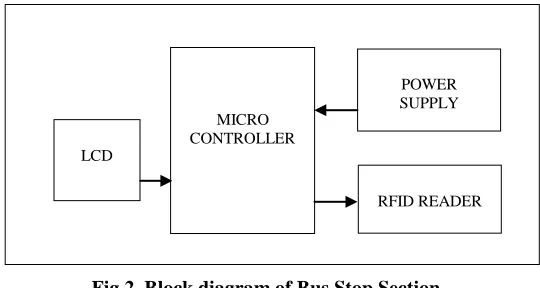
In the bus stop section the module is connected with microcontroller and LCD. The RFID reader is placed in this section, where it shows the details of the next bus arriving to the stop and the RFID tags are placed inside the bus. The block diagram is given below.
Fig 2. Block diagram of Bus Stop Section
When the bus is arriving to the bus stop , the RFID reader sends an electromagnetic wave which carries a signal to the bus. Then at a certain distance the reader receives the information returned back by the tags placed inside the bus.
V. SOFTWARE MODULES
A. Keil Software :
Keil Software makes C compilers, macro assemblers, real-time kernels, debuggers, simulators, integrated environments, and evaluation boards for the 8051, 251, ARM, and XC16x/C16x/ST10 microcontroller families.Keil Software is pleased to announce simulation support for the Atmel AT91 ARM family of microcontrollers. The Keil µVision Debugger simulates the complete ARM instruction-set as well as the on-chip peripherals for each device in the AT91 ARM/Thumb microcontroller family. The integrated simulator provides complete peripheral simulation.
B. µVision3:
The µVision3 IDE is a Windows-based software development platform that combines a robust editor, project manager, and makes facility. µVision3 integrates all tools including the C compiler, macro assembler, linker/locator, and HEX file generator. µVision3 helps expedite the development process of your embedded applications by providingFull-featured source code editor , Device database for configuring the development tool setting, Project manager for creating and maintaining your projects and Dialogs for all development tool settings.
LCD
MICRO CONTROLLER
POWER SUPPLY
C. Embedded C
Embedded C is designed to bridge the performance mismatch between Standard C and the embedded hardware and application architecture. It extends the C language with the primitives that are needed by signal-processing applications and that are commonly provided by DSP processors. The design of the support for fixed-point data types and named address spaces in Embedded C is based on DSP-C.Embedded C allows direct access to processor registers that are not addressable in any of the machine's address spaces. The processor registers are defined by the compiler-specific, named-register, storage class for each supported processor. The I/O hardware access primitives aim to create a layer that abstracts the system-specific access method from the device that is accessed. The ultimate goal is to allow source-code portability of device drivers between different systems.
VI. IMPLEMENTATION & RESULTS
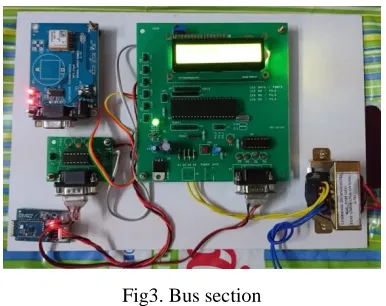
The bus section and the bus stop section is designed to perform the task. The bus section is fixed inside the bus. When the user types a desired bus number in the app in their mobile phone the nearby buses are connected to the user’s phone. It shows the location of the bus by connecting with the Bluetooth module inserted in the bus.
Fig3. Bus section
The user will type the desired bus number in the app. The location of the bus in the shortest distance to the user will be shown in the user’s display. It is shown below.
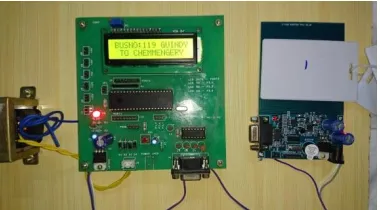
Fig 5. Bus Stop Section
When the bus is arriving to the bus stop , the RFID reader sends an electromagnetic wave which carries a signal to the bus. Then at a certain distance the reader receives the information returned back by the tags placed inside the bus.
Fig 6. RFID READER sensing the tags
VII. CONCLUSION
RFID reader integrated with wireless sensor networks will benefit from communications and sensing capabilities, to provide a smart solution managing the bus schedule in the bus stations and offering helpful information to passengers. It is believed that by the implementation of this system, problems such as underutilization of buses fleet and long waiting time at the bus station will be reduced. So, both passenger and bus station administrators will benefit from the system as real time information are provided. The system provides multiple user information query methods; BT technology is chosen as the bus location detection method. The results show a clear picture of the whole system, which is very valuable and practical to guide the public travel mode choice and improve urban traffic operation efficiency.
VIII. FUTURE WORK
REFERENCES
[1] Yasha Sardey, Pranoti Deshmukh, Pooja Mandlik, Saurabh Shelar, Minal Nerkar. “A Mobile Application for
Bus Information System and Location Tracking using Client-Server Technology” International Journal of Emerging Technology and Advanced Engineering Volume 4, Issue 4, April 2014
[2] S. Priya, B. Prabhavathi, P. Shanmuga Priya, B. Shanthini. “An Android Application for Tracking College Bus
Using Google Map” International Journal of Computer Science and Engineering Communications. Vol.3, Issue 3, 2015
[3] S.P. Manikandan and P. Balakrishnan “An Efficient Real Time Query System for Public Transportation Service
using Zigbee and RFID” Bonfring International Journal of Research in Communication Engineering, Vol. 2, No. 2, June 2012
[4] Manini Kumbhar, Pratibha Mastud, Meghana Survase, Avdhut Salunke, Shrinivas Sirdeshpande. “Real Time
Web Based Bus Tracking System” International Journal of Advanced Research in Computer Science and Software Engineering 5(10), October- 2015, pp. 266-268
[5] Karan Punjabi, Pooja Bolaj, Pratibha Mantur, Sneha Wali , Karan Punjabi et al, “Bus Locator via SMS Using
Android Application” / (IJCSIT) International Journal of Computer Science and Information Technologies, Vol. 5 (2) , 2014
[6] P.Ramya, V.Linga vignesh, I.Mahalakshmi, C.Tharani, “Bus Navigation System with Effective Data
Transmission Using GPS and Wireless Transmitter” International Journal Of Engineering And Computer Science Volume 3 Issue 3 March, 2014
[7] Shefali Agrawal, Neha Ahire, Prof. Samadhan Sonavane , “GPS Supported Android Application for City Bus
Scheduling and Tracking System” International Journal of Enhanced Research in Management & Computer ApplicationsVol. 3 Issue 12, December-2014, pp: (26-29)
[8] M. A. Hannan, A. M. Mustapha, A. Hussain And H. Basri “Intelligent Bus Monitoring and Management
System” World Congress on Engineering and Computer Science 2012 Vol II WCECS 2012, October 24-26, 2012
[9] Mr.Pavan Kumar M.V.N.R. , Vikram Sabal , Mangesh More ,Sandip Khandekar. “Flexible Bus System Using
ZIGBEE” International Journal of Research in Advent Technology, Vol.3, No.5, May 2015