DEPARTMENT OF INFORMATION ENGINEERING AND COMPUTER SCIENCE
ICT International Doctoral School
Secure Business Process
Engineering:
a socio-technical approach
Mattia Salnitri
Advisor
Prof. Paolo Giorgini
Universit`a degli Studi di Trento
Abstract
Dealing with security is a central activity for todays organizations. Security breaches impact on the activities executed in organizations, preventing them to execute their business processes and, therefore, causing millions of dollars of losses. Security by design principles underline the importance of considering security as early as during the design of organizations to avoid expensive fixes during later phases of their lifecycle. However, the design of secure business processes cannot take into account only security aspects on the sequences of activities. Security reports in the last years demonstrate that security breaches are more and more caused by attacks that take advantage of social vulnerabilities. Therefore, those aspects should be analyzed in order to design a business process robust to technical and social attacks. Still, the mere design of business processes does not guarantee that their correct execution, such business processes have to be correctly implemented and performed.
We propose SEcure Business process Engineering (SEBE), a method that considers social and organizational aspects for designing and imple-menting secure business processes. SEBE provides an iterative and incre-mental process and a set of verification of transformation rules, supported by a software tool, that integrate different modeling languages used to specify social security aspects, business processes and the implementation code. In particular, SEBE provides a new modeling language which permits to specify business processes with security concepts and complex security constraints.
Acknowledgements
This thesis would not have been possible without the help of several different people. I would like to thank Professor Paolo Giorgini, my advisor, for the continuous support of my PhD study, his precious comments and critics. I would like to thank you for encouraging my research and for allowing me to grow as a research scientist.
Thanks to the professors who served on my thesis committee: Professor Achim Brucker (University of Sheffield), Professor Haralambos Mouratidis (University of Brighton), Professor Luca Spalazzi (Universita politecnica delle Marche) and Professor Angelo Susi (Fondazione Bruno Kessler).
A special tank to my main co-authors Dr. Elda Paja and Professor Fabiano Dalpiaz. You played an essential role during my PhD, I would not have reached this achievement without your contributions and help.
Many thanks to Mauro Poggianella, the developer of SecBPMN2 and STS-Tool software tools, without your work my thesis would have been only a theoretical study.
I would like to thank Professor Achim Brucker, Professor Emil Lupu, and Professor Raian Ali for offering me internship opportunities in their groups and leading me working on diverse exciting projects.
I am very thankful to the software engineering research group of Trento. The stimulating discussions and the seminars were central for the develop-ment of the initial idea in my thesis. I apologize for not listing your names, but I am afraid to miss someone.
Thanks to my parents, Giuseppe and Sonia, and my sister Iris, for being always proud and for the unconditional support. I can’t thank you enough for encouraging me throughout this experience.
Last but not least thank you Elena, my love, for the great patient and unconditional love. Thank you for always believing in me and supporting me in the difficult parts of this experience.
Contents
1 Introduction 1
1.1 Security and business processes . . . 1
1.2 A method to engineer secure business processes . . . 7
1.3 Research questions and success criteria . . . 8
1.3.1 Research questions . . . 8
1.3.2 Success criteria . . . 10
1.3.3 Evaluation . . . 12
1.4 Research contribution . . . 13
1.5 Running example . . . 15
1.6 Organization of the thesis . . . 16
1.7 Published papers . . . 18
1.7.1 Book chapters . . . 18
1.7.2 International journals . . . 18
1.7.3 International conferences . . . 18
1.7.4 International workshops and forums . . . 19
1.7.5 Under preparation . . . 20
2 Related work 21 2.1 Approaches for business process engineering . . . 24
2.2 Social/organizational approaches . . . 27
2.3 Approaches for secure business processes . . . 30
2.3.1 Business process modeling languages with security concepts . . . 30
2.4.1 From social/organizational to business process models 36 2.4.2 From business process models to implementation . 37
2.5 Chapter summary . . . 39
3 Baseline 41 3.1 Representing social/organizational aspects with STS-ml . . 41
3.1.1 Multi views approach . . . 41
3.2 Querying business processes with BPMN-Q . . . 43
3.3 A reference model for security concepts . . . 46
3.4 Representing business artifacts with River Definition Lan-guage . . . 47
3.5 Chapter summary . . . 48
4 A process for secure business process engineering 49 4.1 Phases . . . 51
4.1.1 Phase 1 . . . 51
4.1.2 Phase 2 . . . 52
4.1.3 Phase 3 . . . 52
4.1.4 Phase 4 . . . 53
4.1.5 Phase 5 . . . 53
4.1.6 Phase 6 . . . 53
4.2 Chapter summary . . . 54
5 SecBPMN2 55 5.1 SecBPMN2: principles . . . 55
5.2 BPMN 2.0 . . . 56
5.3 Security annotations . . . 61
5.4 SecBPMN2-ml . . . 70
5.5 SecBPMN2-Q . . . 73
5.6 Verifying security policies . . . 75
6 Connecting multiple perspectives with SEBE 83
6.1 Designing secure business processes . . . 83
6.1.1 Mapping STS-ml concepts to SecBPMN2 concepts . 84 6.1.2 Transforming STS-ml models into SecBPMN2 models 85 6.1.3 Security policies generation . . . 90
6.2 Implementing secure business processes . . . 92
6.2.1 Mapping SecBPMN2 concepts to RDL concepts . . 94
6.2.2 Transforming SecBPMN2 models into RDL scripts 95 6.2.3 Enforcing SecBPMN2 security specifications . . . . 96
6.3 Chapter summary . . . 102
7 Software support for SEBE 103 7.1 Consistency verification . . . 105
7.2 Automated generation of secure business processes and se-curity policies . . . 106
7.3 Procedural security policy verification . . . 107
7.4 Generation of RDL code . . . 112
7.5 Architecture . . . 113
7.6 Chapter summary . . . 115
8 Empirical evaluations 117 8.1 Evaluation of SecBPMN . . . 117
8.1.1 Experimental design . . . 118
8.1.2 Participants . . . 120
8.1.3 Experiment results . . . 120
8.1.4 Threats to validity . . . 122
8.2 Evaluation of SEBE . . . 124
8.2.1 Interviews . . . 124
8.2.2 Empirical evaluation . . . 125
8.2.3 Experimental design . . . 126
8.2.4 Participants . . . 127
8.2.7 Threats to validity . . . 133
8.3 Chapter summary . . . 134
9 Case studies and application scenarios 137 9.1 Case study settings . . . 137
9.2 Ospedale Pediatrico Bambin Gesu’ . . . 139
9.2.1 Outcomes of the case study . . . 140
9.3 Ministero dello Sviluppo Economico . . . 141
9.3.1 Outcomes of the case study . . . 142
9.4 Athens municipality . . . 143
9.4.1 Outcomes of the case study . . . 144
9.5 Comparison of case study results . . . 145
9.6 Chapter Summary . . . 146
10 Conclusions and future work 149 10.1 Fulfillment of success criteria . . . 149
10.1.1 Success Criteria 1 . . . 149
10.1.2 Success Criteria 2 . . . 151
10.1.3 Success Criteria 3 . . . 151
10.1.4 Success Criteria 4 . . . 152
10.1.5 Success Criteria 5 . . . 152
10.1.6 Success Criteria 6 . . . 153
10.2 Conclusion and limitations . . . 153
10.2.1 Limitations . . . 155
10.3 Ongoing works . . . 156
10.4 Future research work . . . 157
Bibliography 159
List of Tables
1.1 Success criteria . . . 10
1.2 Evaluation of success criteria . . . 13
3.1 Security concepts covered by the RMIAS reference model [26] 46
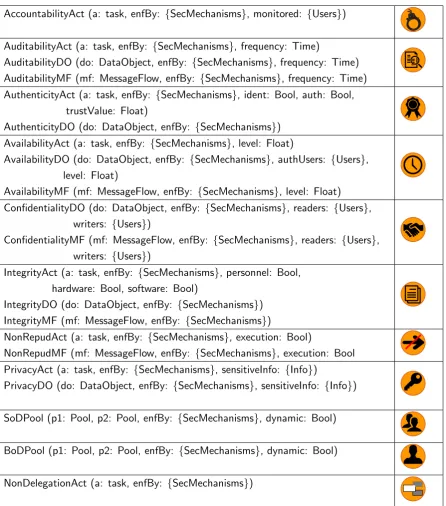
5.1 Security annotations in SecBPMN2: predicates and their
graphical syntax . . . 64
6.1 Default SecBPMN2-ml transformation rules provided in SEBE 90
6.2 Default SecBPMN2-Q transformation rules provided in SEBE 93
7.1 List of transformations of SecBPMN2 concepts inK predicates111
8.1 GQM template for our experiments . . . 118
8.2 Hypotheses of the experiments . . . 119
8.3 GQM template for our experiments . . . 125
8.4 Data about the operations executed by subjects during the
modeling . . . 130
8.5 Data about the usage of SEBE . . . 130
8.6 Research questions outcomes . . . 133
9.1 Elements of STS-ml and Secure BPMN 2.0 (SecBPMN2)
used to specified the case studies . . . 144
9.2 Case studies comparison . . . 146
form Socio-Technical Security - modeling language (STS-ml) into Secure BPMN 2.0 - modeling language (SecBPMN2-ml)
models . . . 179 A.2 Default transformation rules provided in SEBE to transform
STS-ml actors into SecBPMN2-ml models . . . 180 A.3 Default transformation rules provided in SEBE to transform
STS-ml goals and relation between goals and documents into
SecBPMN2-ml models . . . 181
B.1 Default transformation rules for security requirements on
delegations . . . 184 B.2 Default transformation rules for redundancy security
require-ments . . . 185 B.3 Default transformation rules for security requirements on
transmissions . . . 186 B.4 Default transformation rules for authorizations . . . 187 B.5 Default transformation rules for compatible and
List of Figures
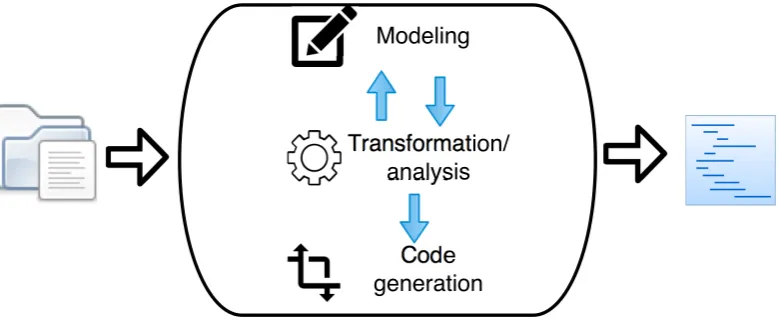
1.1 Components of SEBE. . . 15
3.1 STS-ml diagram representing social/organizational model of PE. . . 44
3.2 Example of BPMN-Q query . . . 45
3.3 The SAP RDL Platform . . . 47
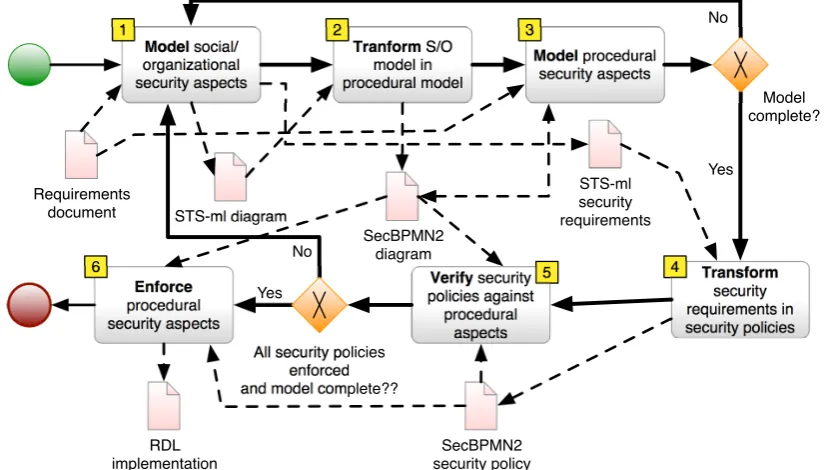
4.1 Overview of the SEBE process. . . 50
4.2 The process proposed with SEBE. . . 52
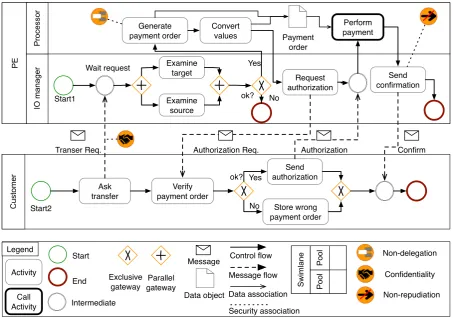
5.1 Example of SecBPMN2 model. . . 58
5.2 Examples of Secure BPMN 2.0 - Query (SecBPMN2-Q) se-curity policies . . . 75
6.1 Mapping of STS-ml, SecBPMN2 and River Definition Lan-guage (RDL) concepts. . . 86
6.2 Example of a transformation rule and its application. . . . 88
6.3 A SecBPMN2 model representing part of a PE business process 96 7.1 Screenshots of STS-Tool. . . 105
Chapter 1
Introduction
Dealing with security is an extremely important activity for today’s organi-zations [17]. Security breaches impact on the activities and on the business processes of such organizations and, consequently, they cause millions of dollars of losses. But an analysis of the business processes executed in or-ganizations is not enough for avoiding security issues. Security reports over the past decades demonstrate that more and more breaches occur because of trusted users, insiders [2, 77]. As such, dealing with security requires an analysis of the social and organizational aspects of organizations, along with a business process one. However, these analyses alone do not guar-antee organizations to be secure, the implementation of business processes should enforce security constraints in order to avoid security issues.
In this chapter we discuss the problem of engineering secure business processes. Specifically, we propose a method to design secure business processes, considering social and organizational security aspects of the or-ganizations, and to implement such processes.
1.1
Security and business processes
another 31% invested more than 1 million of dollars.
Such investments are justified by the impact of security breaches in the activities and the business processes, i.e., sequences of activities, executed by organizations to deliver their products or services. Although huge in-vestments are made to deal with security, still during 2014 40.73% of the organizations, which reported security issues, lost between 50.000 and 1 million dollars, with another 31.61% reporting losses of more than 1 mil-lion dollars.
The consequences of security leaks are not limited to monetary losses due to inability of organizations to execute their business processes. Other negative impacts include: (i) loss of customers: since the loss of money or sensitive data may convince customers to move to other systems; (ii) legal consequences: some organizations must guarantee a level of security prescribed by the local legislation; otherwise in case of a security breach, offended parties might sue the organizations; (iii) loss of reputation: when-ever there is a security leak the organization will lose the appealing for new users or customers.
For example, in 2008 Heartland Payment Systems (Heartland), a com-pany with over 250,000 clients that process more that $4.2 billion trans-actions annually, reported a security breach that was very costly for the company. It lost 50% of its market capitalization and it spent more than $32 million on legal fees and other related settlement costs [25].
Security by design principles strongly encourage to consider security as early as possible [36] during the design of organizations, to minimize the costs of modifications that, otherwise, would be order of magnitudes more expensive [80]. Therefore, security shall be taken into account as early as during the design of business processes, instead of during their implementation.
com-1.1. SECURITY AND BUSINESS PROCESSES
bination of execution of actions that violates one or more security require-ments, the overall organization may become vulnerable to attacks. For example, Heartland, as an organization who manages sensitive data of its customers, must protect the data stored and not disclose them. If a business process executes a routine that publishes all the sensitive data collected, then such single execution will lead to the infringement of laws, with penal consequences and monetary losses. These consequences will prevent the execution of other business processes of the company, causing additional monetary losses and other consequences.
Multiple research work considered the design of business processes com-pliant with security requirements an extremely relevant problem [81]. One of the most promising research directions consists of representing secu-rity concepts with modeling languages based on business process. How-ever, such modeling languages are focused on specific application areas since the interpretation of security concepts highly depends on the context where the business processes are executed. Examples of these languages are SecureBPMN [24] that extends Business Process Management and No-tation (BPMN) [86] with concepts that permit to specify access controls constraints; and UMLSec [57] that extends activity diagrams [38] to repre-sent security concepts. Unfortunately, no modeling language covers enough security concepts to be used as a general tool for designing secure business processes of organizations. Moreover, most of the languages have a complex syntax that generates diagrams difficult to understand when real scenar-ios, which are composed by tens of business processes with hundreds of activities, are modeled.
authentication process to be executed every time employees access cus-tomers’ information, would have been specified and verified.
The verification of security policies is a time consuming and error-prone operation because organizations’ security policies may be complex, with many interdependent constraints, that have to be verified against huge business processes with hundreds of elements. Therefore, the verification should be automated in order to avoid error, while checking very complex business processes.
Some approaches have been proposed for the representation and verifi-cation of security policies against business processes. For example, BPMN-Query (BPMN-Q) [9] is an intuitive modeling language for graphically ex-pressing policies, but it has a limited expressiveness and it is not focused on security. Other works use a formal approach to formulate policies using logical and/or formal languages, such as the approach proposed by Liu et al. [68] or FPSPARQL [16]. Those approaches permit to specify a wide range of policies, however, the complexity of the languages prevents their application in real scenarios. There is no modeling language which is ex-pressive enough to specify security policies of real scenarios that are easily understandable in such complex cases.
The design approaches we examined consider security concepts in busi-ness processes, such as confidentiality, availability and integrity, from a technical perspective, i.e., as security concepts related to security mecha-nisms, for example, the cryptographic protocol used to encrypt messages exchanged between two services of the organization, or the key length set for the hash calculated for a document. Those approaches do not consider the social context in which business processes are executed.
1.1. SECURITY AND BUSINESS PROCESSES
collaborate and exchange information, for the shared goal of transferring values.
In socio-technical systems part of business processes are executed by social actors, such as employees, or other organizational units. Therefore, a technical analysis is not enough to avoid security breaches: an analysis of the organization, which considers how executors of business processes relate with each other, and the social aspects, which takes into account why they interact with each other, plays a fundamental role in the design of business processes.
For what concerns security, the design of business processes compliant with social and organizational security requirements, from now on secure business processes, requires an analysis of the relations and objectives of actors within a organization. Referring to PWC report on Cybersecurity of 2015 [2], during last year 64% of all security risks are attributed to organizations employees (34% from current employees and 30% from former employees).
Most importantly the social and organizational (social/organizational from now on) analysis should be done as early as during the requirement engineering phase [37] to avoid expensive fixes and conflicts with existing business processes executed in the organization. In other words, first a social/organizational analysis should be conducted to identify stakeholders’ security requirements of the organization, then business processes shall be designed.
Only few, preliminary, research approaches face the transformation of social/organizational security concepts to business process concepts. Argy-ropoulos et al. [4,5] proposed a method for deriving business processes from social/organizational models, however the security concepts in the source and target languages missed precise definition of the abstract syntax of security concepts.
The social/organizational perspective can be used to design secure busi-ness processes, however, if such processes are not correctly implemented, the organization will not benefit of the security analysis conducted. This may happen for multiple reasons. Developers, who will implement the au-tomated part of business processes, might misunderstand the specifications or, in some cases, deliberately deviate from the blueprint. These deviations results in unexpected behaviors that may lead to security vulnerabilities.
For these reasons business process designers, i.e., the business process experts in charge of defining business processes of organizations, should guide the implementation of the business processes, and check if the be-havior of the implementation deviated from what is expected.
One promising research direction consists in generating the software code from business processes, as proposed by Kim et al. in [58]. Francesco-marino et al. [46] analyze the logs of the system, and check if they are consisted with the specified business processes. Brucker and Hang [23] proposed a framework to statically check source code of the implementa-tion against constraints defined in a procedural modeling language focused on security. However, all research work we analyzed are limited on the type of checks they verify against business processes or they are too complex to be used in real case scenarios.
Concluding, business process designers deal with many challenges when engineering secure business processes, the most relevant being:
• define business processes which take in consideration security con-cepts;
1.2. A METHOD TO ENGINEER SECURE BUSINESS PROCESSES
processes;
• verify that the business process fulfill security requirements;
• generate an unambiguous specification for the implementation of se-cure business processes.
No approach assists business process designers for the design of secure business process, using the outcome of social/organizational analysis, until their deployment.
1.2
A method to engineer secure business processes
In order to tackle the aforementioned problems, this thesis proposes SEBE (SEcure Business process Engineering), a method to engineer secure busi-ness processes that supports busibusi-ness processes designers in designing se-cure business processes and ensuring their correct development.
SEBE uses a social/organizational analysis to consider the organiza-tional structure of the organization, the raorganiza-tionale behind its actors and their interactions. Such analysis of the organization supports stakehold-ers to specify the security requirements a secure business process should enforce. For example, in a complex systems such as Heartland, with thou-sands of customers, that was created with the acquisition of smaller orga-nizations, hundreds of business processes are executed. This complexity caused an erroneous analysis of security requirements that led to monetary losses and penal consequences. A social/organizational analysis would have helped to specify relations between components, to highlight inconsisten-cies on security requirements and it would have led to a correct specifica-tion of the security requirements and, therefore, to a secure design of the Heartland system.
contexts, as many of the current approaches are. It is graphical, easy to use and scalable with the size of real case scenarios.
Moreover, the method is provided with a software tool, which permits an automated verification of the security policies against secure business processes. This allows business process designers to easily check whether business processes are compliant with procedural and security constraints specified in security policies.
In order to guarantee the enforcement of security requirements, SEBE generates specifications for the developers of the part of secure business processes that have to be implemented. Specifically, the method gener-ates part of the the implementation of the automated task of the business processes, which already enforces the security specification defined in the processes. The implementation will then be completed by the developers on the missing parts.
Concluding, the thesis proposes SEBE: a comprehensive method that supports business process engineers in engineering secure business process. The method exploit a social/organizational analysis to design secure busi-ness processes and it generates part of the implementation of the secure business processes.
1.3
Research questions and success criteria
In the following we specify the research questions of this thesis, the success criteria we consider for each of them and the evaluation method we used to check the achievement of success criteria.
1.3.1 Research questions
On the whole, our objective is that of helping business process designers in engineering secure business processes. We, therefore, define the following Research Questions (RQs).
1.3. RESEARCH QUESTIONS AND SUCCESS CRITERIA
RQ1 consists in finding an appropriate graphical modeling language for business processes with security concepts. This includes the specification of the sequences of actions and security concepts.
RQ2. How to represent security policies?
RQ2 consists in finding a representation of security policies which should be expressive enough to be used by business process designers to specify security constraints on secure business processes.
RQ3. How to verify security policies against secure business pro-cesses?
RQ3 requires an approach that permits to verify constraints specified in security policies against secure business processes. The verification should be automated to increase the scalability and to allow to analyze real, fre-quently complex, scenarios.
RQ4. How the social/organizational perspective can be used to design secure business processes?
RQ4 is about the connection between social/organizational perspective se-cure business processes. The answers of this research question covers: (i) how social/organizational concepts are mapped to business process con-cepts; (ii) how social/organizational security requirements are enforced in secure business process models.
RQ5. How to generate an implementation that enforces security concepts specified in secure business processes?
RQ5 covers the generation of implementation of secure business processes. Specifically, it covers how the business process concepts are mapped to implementation concepts, and how security concepts of secure business process are enforced in the implementation.
RQ6. How can we guide business process designers in the cre-ation of secure business processes and their implementcre-ation?
1.3.2 Success criteria
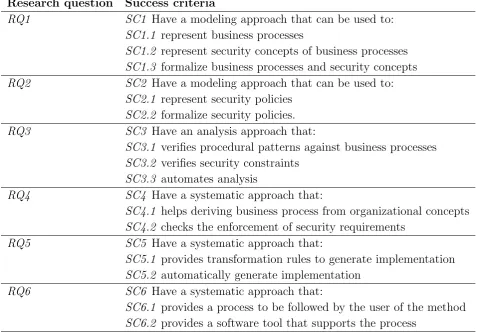
We defined Success Criteria (SC) to determine when a research question can be considered achieved. Table 1.1 lists the success criteria associated to each research question.
Research question Success criteria
RQ1 SC1 Have a modeling approach that can be used to:
SC1.1 represent business processes
SC1.2 represent security concepts of business processes
SC1.3 formalize business processes and security concepts
RQ2 SC2 Have a modeling approach that can be used to:
SC2.1 represent security policies
SC2.2 formalize security policies.
RQ3 SC3 Have an analysis approach that:
SC3.1 verifies procedural patterns against business processes
SC3.2 verifies security constraints
SC3.3 automates analysis
RQ4 SC4 Have a systematic approach that:
SC4.1 helps deriving business process from organizational concepts
SC4.2 checks the enforcement of security requirements
RQ5 SC5 Have a systematic approach that:
SC5.1 provides transformation rules to generate implementation
SC5.2 automatically generate implementation
RQ6 SC6 Have a systematic approach that:
SC6.1 provides a process to be followed by the user of the method
SC6.2 provides a software tool that supports the process Table 1.1: Success criteria
SC1specifies that SEBE should include a modeling approach which per-mits business process designers to graphically represent business processes (SC1.1) in order to specify secure business process models, represent secu-rity concepts of business processes (SC1.2) in order to specify such concepts in the graphical representation of secure business process models, and for-malize business processes and security concepts (SC1.3) in order to detect inconsistencies and conflicts in secure business process models.
1.3. RESEARCH QUESTIONS AND SUCCESS CRITERIA
represents security policies (SC2.1) in order to permit business process designers to specify constraints on the flow of activities and security aspects in terms of business process concepts. Moreover, the approach should permit to formalize security policies (SC2.1) in order to detect conflicts and inconsistencies.
SC3 indicates that SEBE should help business process designers to analyze various aspects of the business processes. Specifically, it should allow to verify procedural patterns agains business processes (SC3.1), i.e., it should help designers to check if the constraints on the flow of activities specified in the security policies are respected in the business processes analyzed. The method should permit toverify security constraints (SC3.2): it should help to verify that security constraints specified in the security policies are satisfied in the business processes analyzed. Moreover, it should automate analysis (SC3.3), which consist in providing a software tool which permits to execute the analysis and, therefore, permits to examine complex models as the one that can be frequently found in real scenarios.
SC4 points out that SEBE should include a systematic approach that uses social/organizational perspective for the design of secure business pro-cesses. Specifically it should help business process designers in deriving business process from organizational concepts (SC4.1), in order to facil-itate the creation of secure business processes and give business process designers a starting point, i.e., initial business process models, that can be enriched. Moreover, it should check the enforcement of security require-ments in business processes (SC4.2): SEBE should verify if the security requirements of stakeholders, specified at a social/organizational perspec-tive, are implemented in the secure business processes enriched by the business process designers.
toolset which implements those rules to automatically generate the imple-mentation (SC5.2).
SC6 specifies that the method should include a systematic approach that guides business process designers with rules and best practices to engineer secure business processes. Specifically, it should provide a process that help business process designers in using the theoretical and software tool provided for the research questions described above. Furthermore, the method should provide a comprehensive software tool that supports all the steps of the process in oder to facilitate the application of the methods.
1.3.3 Evaluation
In order to assess if the success criteria are met by SEBE, we examined the outcomes of two empirical studies, three case studies and the formal defi-nition of the abstract syntax of the modeling languages provided with the method. Table 1.2 lists the evaluations we used to decide the achievement of the success criteria.
We conducted two empirical experiments, one consisted in a controlled experiment, in which subjects used the method to perform exercises and then answered questionnaires, the other empirical experiment consisted in a online survey. In particular, we evaluated how secure business process and security policies are graphically represented (SC1.1, SC1.2 and SC2.1); the generation of business processes and the verification of security policies (SC4.1 and SC4.2); the process and the tool which support the process proposed in this thesis (SC6.1 and SC6.2).
The method we proposed, provides a modeling language for secure busi-ness process and security policies with the abstract syntax formally speci-fied. This provides answers to SC1.3 and SC2.2.
1.4. RESEARCH CONTRIBUTION
generated. In particular we evaluated how secure business process and se-curity policies are represented (SC1.1, SC1.2 and SC2.1). We use the case studies to check if security policies are correctly verified against business processes, this includes the verification of the control flow (SC3.1), the verification of security part (SC3.2) and the automated software support (SC3.3). The same type of evaluation was used for checking if the method helps business process designers in designing business process staring from social/organizational information and in verifying the enforcement of secu-rity requirements (SC4.2). Moreover, the evaluation was used to check if the transformation rules used for generating the implementation are correct (SC5.1) and if they are correctly implemented (SC5.2).
Empirical study Formal syntax Case study
SC 1.1 X X
SC 1.2 X X
SC 1.3 X
SC 2.1 X X
SC 2.2 X
SC 3.1 X
SC 3.2 X
SC 3.3 X
SC 4.1 X X
SC 4.2 X X
SC 5.1 X
SC 5.2 X
SC 6.1 X SC 6.2 X
Table 1.2: Evaluation of success criteria
1.4
Research contribution
in designing secure business processes, considering social and organiza-tional perspectives, and in generating an implementation of such processes.
Figure 1.1 shows the components of the method. The method builds on existing components highlighted in yellow, i.e., STS-ml and RDL, while it extends the STS-Toolwhich is marked in light yellow. STS-ml [89] is a goal-based modeling language we used to analyze social/organizational security aspects of organizations, whereas RDL [109] is a script language we chose as implementation language for secure business processes. STS-Tool [106] is a software toolset, written in Java, which supports the specification of STS-ml diagrams.
The first contribution of this thesis is SecBPMN2, a modeling language we propose to specify secure business processes and security policies. The modeling language extends Business Process Management and Notation 2.0 (BPMN 2.0), the standard for modeling business processes, and it is provided with a formal definition of its syntax.
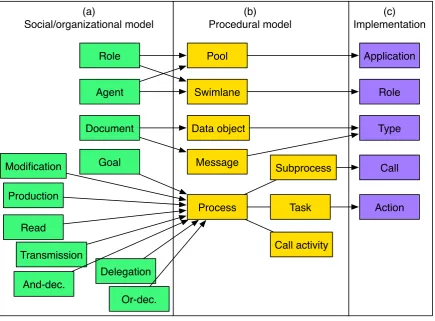
The second contribution consists in a set of transformation rules that permit to use the social/organizational perspective to design secure busi-ness processes and to generate part of the implementation of the socio-technical system of organizations from secure business processes.
The third contribution of this thesis is a process, which guides business process designers in engineering of secure business processes. The process is iterative and incremental and is used to direct method users from the social/organizational analysis of security, through the design of business processes, until their implementation.
The fourth contribution is an extension of STS-Tool that implements the transformation and verification rules, and verifies procedural security policies against business processes. The software extension provides full support to the method, including the process, the specification and analysis of SecBPMN2 and STS-ml diagrams and the coding of RDL applications.
1.5. RUNNING EXAMPLE
Process
STS-ml SecBPMN2 RDL
Transformation rules
Transformation rules Verification
rules
STS-Tool
Figure 1.1: Components of SEBE.
1.5
Running example
SAP Payment Engine (PE) [108] is a software system created to perform payments for e-commerce shops or, more in general, for services that allow users to pay with electronic methods. Usually, to support the electronic payments, the e-shops implement interfaces to communicate with all the banks they intend to use as source/destination of the payments. But each bank requires a different set of protocols and security measures. Therefore the e-shops are forced to put a noticeable amount of effort to implement different interfaces, and for medium/small organizations it is not acceptable investing large quantity of time and money just to allow people to pay the goods/services they offer.
The PE minimizes such effort: it contains a set of pre-built interfaces with the most known banks in the world that can be used out of the shelf. E-shop programmers only have to create one interface to transmit the required data to the PE system.
might be disclosed; moreover, the payment orders themselves might be modified. This will lead to catastrophic consequences for the PE system and the organization who runs it: customers will sue the organization, the organization will reimburse the modified transactions and the credibility of the system, and consequently of the organization, will drop.
We chose PE as a running example since is a real case study of a complex socio-technical system in which many autonomous actors interact, execut-ing business processes, to achieve common objectives. The engineerexecut-ing of such system calls for a socio-technical approach, where social/organiza-tional perspective is considered for the design and implementation of secure business processes executed to perform payment and handle sensitive data of customers and organizations.
1.6
Organization of the thesis
The thesis is organized as follows.
Chapter 2 describes the related work. We review the methodologies for business process engineering in Section 2.1, while we describe modeling lan-guages for social/organizational security aspects in Section 2.2. Section 2.3 describes the most known modeling languages for secure business processes and security policies, while Section 2.4 reports the research approaches used to transform social/organizational models to business process models and the latter in implementation.
Chapter 3 presents the research work and the technologies on which SEBE is built. Section 3.1 provides a description of STS-ml, a model-ing language for social/organizational security aspects. Section 3.2 intro-duces BPMN-Q, a query language for business processes, while Section 3.3 presents RMIAS: a reference model for security. Section 3.4 delineates RDL a script language for business artifacts and their business logic.
Chapter 4 presents the process provided with SEBE, specifically Sec-tion 4.1 describes all its phases.
busi-1.6. ORGANIZATION OF THE THESIS
ness processes and security policies, provided with SEBE. Section 5.1 delineates its principles. Section 5.2 presents BPMN 2.0 the standard for representing business processes on which SecBPMN2 is based, while Section 5.3 describes the security concepts that are used in SecBPMN2. We describe the part of the modeling language for business processes in Section 5.4 and the part for modeling security policies in Section 5.5. Sec-tion 5.6 formally specifies how a security policies is satisfied in SecBPMN2 business processes.
Chapter 6 presents the transformation rules which permit to design SecBPMN2 business processes starting from a social/organizational mod-eling language (Section 6.1), and to generate part of the implementation from SecBPMN2 business processes (Section 6.2).
Chapter 7 describes STS-Tool, the software we created to support the users of SEBE. In particular, the chapter describes how the consistency of models is verified automatically (Section 7.1), how SecBPMN2 business processes are generated (Section 7.2) and how security policies are verified (Section 7.3). Moreover, Section 7.4 describes how part of the implemen-tation is automatically generated, while Section 7.5 provides a description of the architecture of the software tool.
Chapter 8 provides a description of the empirical evaluations we con-ducted. Section 8.1 describes the empirical evaluation on SecBPMN while Section 8.2 reports the evaluation of the SEBE method as a whole.
Chapter 9 presents the application of SEBE to three case studies. Sec-tion 9.1 presents the settings of the case studies, while secSec-tions 9.2, 9.3 and 9.4 present the case studies and the results of the application of the method. Section 9.5 describes the results of the application of the three methods.
1.7
Published papers
1.7.1 Book chapters
1. Erkuden Rios, Francesco Malmignati, Eider Iturbe, Michela D’Errico and Mattia Salnitri From Consumer Requirements to Policies in Secure Services. In Secure and Trustworthy Service Composi-tion: The Aniketos approach. Pages 79 - 94, 2014.
1.7.2 International journals
2. Jennifer Horkoff, Tong Li, Feng-Lin Li, Mattia Salnitri, Evellin Car-doso, Paolo Giorgini and John Mylopoulos. Using goal models down- stream: A systematic roadmap and literature review. International Journal of Information System Modeling and Design. pages 1 - 42, 2015.
3. Mattia Salnitri, Fabiano Dalpiaz and Paolo Giorgini. Designing se-cure business processes with SecBPMN. Software & Systems Modeling, pages 1 - 21, 2015.
1.7.3 International conferences
4. Mohamad Gharib, Mattia Salnitri, Elda Paja, Paolo Giorgini, Har-alambos Mouratidis, Michalis Pavlidis, Jose F. Ruiz, Sandra Fernan-dez, Andrea Della Siria. Privacy Requirements: Findings and Lessons Learned in Developing a Privacy Platform. To appear in proceeding of Requirement Engineering (RE), 2016.
1.7. PUBLISHED PAPERS
6. Mattia Salnitri, Achim Brucker and Paolo Giorgini From Secure Business Process Models to Secure Artifact-Centric Specifi-cations. In proceeding of Business Process Modeling Development and Support (BPMDS) working conference. Pages 246 - 262, 2015.
7. Jennifer Horkoff, Tong Li, Feng-Lin Li, Mattia Salnitri, Evellin Car-doso, Jo¨ao Pimentel, Paolo Giorgini and John Mylopoulos Taking Goal Models Downstream: A Systematic Roadmap In pro-ceeding of Research Challenges. In proceedings of Information Science (RCIS) conference. Pages 1 - 12, 2014.
8. Mattia Salnitri, Fabiano Dalpiaz and Paolo Giorgini Modeling and Verifying Security Policies in Business Processes. In proceed-ing of Business Process Modelproceed-ing Development and Support (BPMDS) working conference. Pages 200 - 214, 2014
9. Mattia Salnitri, Fabiano Dalpiaz and Paolo GiorginiAligning Service-Oriented Architectures with Security Requirements. In pro-ceeding of On The Move (OTM) conference. Pages 232 - 249, 2012.
1.7.4 International workshops and forums
10. Mattia Salnitri, Elda Paja and Paolo Giorgini. Maintaining Se-cure Business Processes in Light of Socio-Technical Systems Evolution. To appear in proceeding of Model-Driven Requirement Engineering (MoDRE) workshop, 2016.
11. Mattia Salnitri, Elda Paja, Mauro Poggianella and Paolo Giorgini
STS-Tool 3.0: Maintaining Security in Socio-Technical Sys-tems In proceeding of Conference on Advanced Information System Engineering (CAiSE) Forum 2015 .
13. Mattia Salnitri, Paolo Giorgini Transforming Socio-Technical Se-curity Requirements in SecBPMN SeSe-curity Policies. In pro-ceeding of IStar workshop 2014.
14. Mattia Salnitri, Paolo GiorginiModeling and Verification of ATM Security Policies with SecBPMN. In proceeding of Security and High Performance Computing and Systems (SHCPS) workshop. Pages 588 - 591, 2014.
1.7.5 Under preparation
Chapter 2
Related work
The literature offers many approaches that share part of the objectives with this thesis. This chapter analyzes the most relevant and prominent works.
Criteria and methods
We used a simple but effective method for describing the related work of SEBE. Initially we defined inclusion criteria as list of questions which covers the main aspects of SEBE. Then we classified the included papers in areas of interest.
Inclusion criteria
1. Does the approach cover security?
2. Does the approach cover business process engineering?
3. Does the approach cover the modeling of social/organizational con-cepts?
4. Does the approach cover the modeling of business processes?
6. Does the approach cover the transformation of social/organizational concepts in business processes or the latter in the implementation code?
The first question allows to include approaches on security, we consider this question as a necessary but not sufficient condition, it applies with second, third, fourth and fifth questions. This means that it is not sufficient that an approach is about security to be considered a related work.
The second question includes approaches that propose methods to help the design, implementation and deployment of business processes.
The third question permits to include research work that propose or extend a modeling language which permits to specify social/organizational aspects.
The fourth question covers research work which proposed or extends a modeling language that permits to specify business processes.
The fifth question covers all research work which are focused on the implementation of requirements.
The sixth questions includes approaches that permit to transform mod-els containing social/organizational aspects in modmod-els that contains busi-ness processes, or they permit to create at least part of the implementation of the system to be.
Areas of interest
We classified the papers we considered in areas of interest that we defined taking in consideration the inclusion criteria specified before. The areas of interest are:
1. approaches for engineering business processes;
2. approaches for modeling security concepts in social/organizational models;
4. approaches for transforming social/organizational models in business process models or the latter in implementation code, and approaches for enforcing social/organizational security requirements or business process security specifications.
The first area of interest includes research work focused on providing methods and/or guidelines for helping the design, implementation and de-ployment of secure business processes. This area of interest is derived from inclusion criteria 1 and 2.
The second area of interest comprehends research work focused on mod-eling security concepts in social/organizational models, i.e., that match inclusion criteria 1 and 3.
The third area of interest includes all research work that are concerned about the modeling of security concepts in business process models, i.e., that match inclusion criteria 1 and 4.
The fourth area consists of approaches that transform social/organiza-tional models in business process models or that they transform business process models in the implementation code. Specifically, this area com-prehends research work focused on the realization of constraint of security concepts, i.e. research work that allow to actualize abstract security re-quirements. It includes approaches that enforce social/organizational secu-rity requirements in business process models, and business process secusecu-rity concepts in the implementation code. This area of interest is derived from inclusion criteria 5 and 6.
Selection criteria
process. The language would lead to errors in the specification of such complex models, moreover, the specifications would be too difficult to read in these complex scenarios.
The rest of the chapter describes the research works we examined, or-ganized by area of interest.
2.1
Approaches for business process engineering
In this section we describe the most known approaches for engineering business processes with a focus on research works on security.
The most know field is Business Process Management (BPM) [121]. This research area covers all the life cycle of a business process, which is split in four phases: design, implement/configure, run and adjust. The first phase consists in creating the business processes, the second phase in create a system which follow the specification of the business processes, the third phase consists in deploying the system and, therefore, executing the actions specified by the business process, the last phase consists in modifying the business processes to adapt in to new exigencies or changes in the environment.
perspec-2.1. APPROACHES FOR BUSINESS PROCESS ENGINEERING
tives. ARIS is similar to our approach but it miss the security part in all perspectives, moreover, it considers only the organization hierarchy of ac-tors leaving out the social part, i.e., the rationale behind acac-tors processes and their interactions.
Business process design is a phase of BPM and consists in the definition of business processes. Numerous research work focus in business process design.
Bleistein et al. [19], for example, proposed a method to design busi-ness process starting from goal models. Their idea is based on problem frames [55], which separates in two moods the design of a system: indica-tive, which indicates the status of the world as it is, and optative, which indicates how to change the world. Bleistein et al. used a goal-based model-ing language for the indicative mood and Role Activity Diagram (RDA), a business process language, for the optative mood. This approach is focused on the design of business process using social/organizational information (defined in the goal modeling language), but it is not focused on security and it miss the generation of a specification for the developers who will implement the defined business processes.
Backes at al. [11] present an approach for integrating security require-ments to the development of business processes. Their proposal is focused on the connection between the business processes and the cryptography so-lution that can be used in the implementation. Even if the propose guide-lines for the implementation of many security requirements, the approach is focused on cryptography. Moreover, it does not take into consideration the social/organizational information but only high-level of abstraction se-curity requirements.
when dealing with security policies, as it forces security experts to adopt an interpretation of security policies which may not fit the original policy.
Blanc et al. [18] propose an incremental inconsistency checker. Such framework is based on the hypothesis that the definition of a business process is an incremental task, and, thus, inconsistency checking shall be done incrementally. They offer a software tool, based on Prolog [27], which checks if a fixed set of well-formedness rules are satisfied by a business process model. The framework can be applied to any modeling language that can be translated in Prolog. The fixed set of queries is a major limitation, as it inhibits custom security policies.
BPM is an evolution of a research area called business process re-engineering, focused on the enhancement, and maintenance of already ex-isting business processes. In this filed few approaches of security where proposed but, mostly, they do not take into consideration social/organi-zational information, since their starting point is already existing business processes.
2.2. SOCIAL/ORGANIZATIONAL APPROACHES
2.2
Social/organizational approaches
In this section we describe the most prominent approaches for modeling social and organizational aspects of socio-technical systems. We analyze modeling languages that capture security along organizational aspects such as business objectives, business strategies, social dependencies and organi-zational structures.
This perspective hides most of the technical details of socio-technical systems but offers an executive dashboard which permits to immediately identify conceptual errors or misbehaviors. From the security point of view this perspective is central since permits to specify abstract security requirements that can be understood by not-technical people [118].
McDermott and Fox [75] extend use cases modeling language with abuse cases. Their modeling language, called Abuse Case, allows to specify in-teractions between one or more malicious actors and the system where the results of the interactions are harmful to the system, one or more actors or the stakeholders of the system. However, the interactions are not well defined and they are more oriented to describe a sequence of high-level malicious activities. Moreover, this language is not focused on security, therefore, is not possible to specify security requirements.
Similarly, Sindre and Opdahl [116] extend use cases with misuse case, i.e., use case whose execution threat a use case, and two relations, threats and mitigates. The relations connect a misuse case to a use case; the former specifies that the use case is hindered by the misuse case, while the latter relation specifies that a use case is a countermeasure to a misuse case. The approach proposed by the authors is systematic and permits to specify misuse cases graphically and then with a table, to define more details. However, the authors did not focus on security aspects and, therefore, is not possible to specify security concepts.
ver-ify if the security concepts are coherent with the UML design of the system. Security issues are analyzed by representing the behavior of potential at-tackers, and modeling specific types of attackers. While the expressiveness of UML permits to define a large amount of details of the system analyzed, the set of security requirements that can be expressed with UMLSec are limited to technical aspects of the systems and therefore, they cannot be used for security requirements on social/organizational aspects.
Goal-based modeling languages allow to specify the rationale behind the actions and interactions between actors of the systems, i.e., they permit to specify what are the objectives of the actors and why they interact. The expressiveness of these languages, focused of on the objectives of ac-tors, permits to easily specify social/organizational concepts of the systems analyzed.
Lamsweerde [122] proposes a method for elaborating security require-ments by building two models: (i) a goal model of the system-to-be, which covers both the software and its environment and inter-relates their goals, agents, and requirements; (ii) an anti-model, derived from the goal model, that that describe goals of attackers. Both models are specified using an ex-tension of Knowledge Acquisition in autOmated Specification (KAOS) [33], a goal based modeling language. However, this approach is not focused on the security requirements but rather on the objectives of a possible mali-cious person therefore, it uses a limited set of security requirements that are formally specified but too limited for a real case scenario.
2.2. SOCIAL/ORGANIZATIONAL APPROACHES
Elahi et al. [40] propose an extension of i* with with vulnerability, at-tacker and countermeasure concepts, for security tradeoff analysis. They based their approach on the idea that security requirement may not be fully satisfied but the can be partially satisfied and business process de-signers have to balance the satisfaction of such goal with other, contrasting goal, such as usability goal, costs, etc. The authors focused on creating a modeling language highly expressive, which can be used to specify many concepts. The resulting diagrams are very complex and difficult to read, therefore, the modeling language will be hardly usable in real scenarios. Moreover, security requirements are specified a set of goals with a textual description of few words for each goals, this may leads to misinterpretation and confusion.
Secure Tropos [79] is an extension of Tropos [22] method which enable to model security concerns throughout the whole development process. The modeling language used for Secure Tropos, which share the name with the method, extends i* with security constraints over goal dependencies and with security capabilities of actors of the system. The language permits to specify security aspects in social/organizational perspective using a tex-tual description; this choice prevent any limitation on the set of security requirements that can be detailed but, on the other hand, it may generate confusion and misunderstanding when the diagrams are read by different people.
2.3
Approaches for secure business processes
This section describes the most relevant approaches for modeling business processes with security concepts and for modeling security policies.
During last years a relevant number of modeling languages for secure business processes were proposed. But most of these languages are focused on only specific areas and so they fail to provide adequate coverage of the security domain [72].
As far as we known only few approaches were proposed in the last years for modeling security policies and none of them are graphical. The second part of this section analyzes query languages: graphical modeling languages for the specification of patterns (constraints) of business processes that are not focused on security.
2.3.1 Business process modeling languages with security con-cepts
A natural solution to represent the security concepts of business process is to create or extend a modeling language. Such languages are easy to learn and to use [78], thereby requiring a moderately low effort for security designers to specify a secure business process.
Menzel et al. [76] propose security extension of BPMN that enables generating security specifications for Service-oriented Architecture (SoA). The modeling language proposed by the authors specify security concepts as patterns defined in business process terms. However this approach limits the definition of security concepts in terms of business processes. Moreover, it is focused on a specific technical domain, i.e., SoA.
2.3. APPROACHES FOR SECURE BUSINESS PROCESSES
Saleem et al. [98] extend BPMN with security concepts for SoA appli-cations. They include a set of security concepts in BPMN: confidentiality, integrity, availability, traceability, and auditing. The language permits to model a limited set of security concepts, moreover, their work is specific for the SoA domain.
Wolter and Schaad [128] propose an extension of BPMN for specifying task-based authorization constraints. Their approach includes a graphical extension of BPMN as well as a formalization of task-based authorization constraints. Their approach permits to specify dynamic resource tion such as dynamic separation of duty and role-based resource alloca-tion. Their approach is focused on authorization constraints of executors of tasks, and it is not possible to use it to specify other security concepts, such as availability or integrity.
SecureBPMN [24] extends BPMN with access control and information flow constraints. It uses the hierarchic structure of the organization, in which the business process will be executed, to help security designers to define security properties such as, for example, binding of duty [67] and separation of duty [67, 115]. However, SecureBPMN is limited in that it is not possible to specify other central security concepts such as, for instance, confidentiality or availability.
UMLSec [57], as described above, is a security-oriented extension of the UML [85]. In particular, for want concerns business processes, the extensions of UML activity diagrams, sequence diagrams and communica-tion diagrams can be used to define business process with security choices. However, this part of UMLsec has a limited expressiveness in term of busi-ness process concepts that can be specified, moreover, the usage of three different modeling languages (diagrams) makes the specification of business process difficult since details are divided in three different diagrams.
Other research works [6, 92] use extensions of Petri nets to define busi-ness processes with security concepts. Petri net modeling language is sim-ple and easy to use but it does not include all the graphical constructs of BPMN. This influence negatively the understandability of models about medium-size or large business processes, limiting the applicability to only small-size business processes.
2.3.2 Query languages
Security policies can be seen as patterns, and the their verification against business processes corresponds to the problem of checking if a pattern holds in a business process. Query languages and their software tooling can be used to solve this type of problems, as they allow the creation of queries (patterns), and compliance verification against a business process model [100].
Dolman et al. [34] propose a pattern matching approach for concep-tual models. Such approach consists in algorithms for solving the relaxed graph isomorphism problem, i.e., verifying if the nodes of a labeled graph match with a given pattern (isomorphism problem), and the existence of a path among the graph nodes as indicated in the pattern (homeomorphism problem). They created a tool that implements their algorithms to verify the compliance of a graph with a pattern. The approach is not specific to any modeling language, being rooted in labeled graph theory. However, such approach has to be extended to support the verification of security concepts in a business process.
2.3. APPROACHES FOR SECURE BUSINESS PROCESSES
hundreds of elements.
A Process model Query Language (APQL), proposed by Hofstede at al. [51], is a textual query language, based on 20 predicates that can be composed to create complex queries. This approach suffers of scalability issues: the definition of complex queries is a challenging task that will lead to errors due to the complexity of the task. Moreover, as far as our knowledge goes, this approach is not supported by a software framework.
Visual Model Query Language (VMQL) [119] is a graphical query lan-guage based on UML activity diagrams [38]. It permits to define custom properties, which are evaluated when the compliance of a query is veri-fied against a business process. But VMQL was not created for security purposes: even if the custom properties can be used to represent security concepts, the VMQL software engine can not interpret them limiting their usage only as a representation of security concepts.
Business Process Query Language (BPQL) [35] permits to graphically define both queries and business process models using the same language. Unfortunately, BPQL is not based on BPMN, hence the learning process is likely to be slower than that with by BPMN-Q. Moreover, BPQL does not include security concepts.
Ribeiro and Guedes [93] presented an analyzer for automatically veri-fying the consistency between workflow specifications and organizational security policies. But the language they provided for expressing security policies can be used for expressing separation of duty, information flow and access control constraints. This limits considerably the expressiveness of the language that cannot be used to specify well-known security concepts such as confidentiality, availability or integrity.
se-curity goals, but it does not permit sese-curity experts to compose sese-curity goals and, therefore, to create complex security policies.
Schmidt et al. [113] propose two ontologies for defining quality con-straints and for defining service processes, respectively. Such ontologies are used to check if a service process complies with the imposed quality constraints. The main drawback of this approach consists in the fixed set of constraints that can be specified and checked.
Folder-Path Protocol and RDF Query Language (FPSPARQL) [16] is a query language which permits to define queries using a formal textual language. The proposal focuses on analyzing business process generated from action logs, hence is not possible to directly define a process, and moreover is not focused on security.
Sadiq et al. [97] propose to use a Formal Contract Language (FCL) to express normative specifications. Their approach includes a modeling language to visualize business processes as well as normative constraints. They also define a compliance distance, which denotes the extent to which the process model has to be changed to become compliant with the de-clared constraints. The limitation of this approach is the complexity of the language, despite the provision of a tool to graphical represent nor-mative requirements and business processes. In future work, it would be interesting to compare the usability of the SecBPMN2 framework with the FCL-based approach.
Liu et al. [68] propose a language and a framework which statically verifies a business process against a formally expressed regulatory require-ments. The framework accepts as input a business process specified in WS-BPEL [83] and a set of regulatory requirements, expressed with a temporal logic language called “Business Process Specification Language”. While powerful, this approach is hardly usable for large scenarios, due to the complexity of expressing regulatory requirements.
2.4. TRANSFORMATION APPROACHES
between processes with no consideration of security requirements.
2.4
Transformation approaches
This section describe the most known research approaches that permit to transform social/organizational approaches in business processes and business processes in part of the implementation.
The focus of this thesis is on business processes, but other research work focused on the generation of the implementation specification directly from a social/organizational perspective. Still, we believe that for nowadays’ organizations, where tasks are executed by both technical component and people, business processes are central and the specification of the code in not enough to avoid security breaches.
For example, Alexei et al. in [62] propose a systematic method to gen-erate executable business processes directly from a social/organizational model of the system, which is represented with a goal-based modeling language. Since their approach does not use any intermediate language between the social/organizational representation and the implementation, such as SecBPMN2 for our approach, the goal-base language they proposed is used to specify both social/organizational information and information on the execution of business processes. This syntax of this language is com-plex and we believe it will not scale well on real, huge, scenarios. Moreover, the approach does not take into account security concepts.
exe-cuted by software and not by people. This limit the scope of the method only to technical system or, however, systems where the human part is not central and cannot compromise the security of the system.
Brandozzi and Perry [21] proposed a method to transform goal models in architecture. They based the transformation on a formal framework which minimizes the number of revisions of the goal model and the architectural model. They used KAOS [33] as goal-based modeling language and APL (Architecture Prescription Language) [21] as modeling language for the architecture. Both modeling languages does not take into account security perspectives, therefore, the proposed approach misses the transformation of security concepts.
2.4.1 From social/organizational to business process models
We surveyed the most cited papers on transformation of goal-based mod-eling language [52, 53], and even if the research field is active, i.e., many papers are published on the topic, only few of them are centered in the transformation of such modeling language in business processes with a fo-cus on security aspects.
Lopez et al. [71] proposed a method to re-engineer business processes using SI*. Their proposal consists in creating an SI* diagram from an old, secure business process, create a new business process and verify if the new business process is compatible with what have been modeled in the SI* diagram. They used traces for the comparison: they create a trace from the two business model and a set of trace from the SI* model. If the two traces of the business process are compatible with the set of trace of the goal model, then the business process are goal-equivalent, i.e., the achieve the same goals. The approach is comparable to what is proposed in this thesis but the Lopez et al. used plain BPMN, i.e. without security concepts. This limit the approach since security concepts are limited to an a social/organizational perspective.
2.4. TRANSFORMATION APPROACHES
objectives in e-business processes, i.e., business processes which use infor-mation and communication technologies in support of all the activities of business. They focused on four main security objectives: confidentiality, availability integrity and accountability; but they claim their proposal can be easily extended to other security objectives. This proposal is focused to specific type of business processes, and offers solutions that are not eas-ily generalizable to other scenarios, for example they integrate four fixed phases each business process analyzed shall execute: information, negoti-ation, payment, delivery. Even if this approach does not include directly social/organizational aspects we included it in this section because it of-fer a method to enforce high-level of abstraction security objectives (i.e. security requirements) in business processes.
2.4.2 From business process models to implementation
In the area of mapping or translating business process specifications to implementation code the number of existing proposals is surprisingly small. Ouyang at al. [88] propose an approach to automatically transform BPMN 1.0 business processes in WS-BPEL [83] (Business Process Execu-tion Language) code. The algorithm, and the software which implements the algorithm, proved that is possible to generate BPEL code from BPMN models and that, under certain conditions, the generated code is readable. This powerful approach was tested against four collections of real busi-ness processes that prove its reliability. But this approach used BPMN 1.0 witch has a very limited expressiveness, if compared to BPMN 2.0, more-over, it is focused on a subset of BPMN elements they called core elements. Therefore, many concepts, such as the ones that represents the executors of the task, are excluded from the transformation.
provide concrete guidelines how a secure implementation can be achieved from secure specification. This approach does not use a model driven ap-proach and, therefore, it will not be easily usable in real scenarios, where, frequently, there are tens of business processes with hundreds of activities. Moreover, the approach does not propose a formalization of the business process model to use.
Menzel et al. [76] propose security extension of BPMN that enables generating security specifications for SoA. Their proposed transformation rules generate machine-readable specification of such security properties in Rampart [120].
Wolter et al. [127], as described in a previous section, propose a model-ing language for business processes and business security concepts. They also develop a framework which transforms security concepts in security policies specified in XACML [84] and Rampart [120]. The framework au-tomatically extracts specifications of security mechanisms which enforce the security concepts, but it does not permit security experts to compose security concepts and, therefore, to create complex and custom security policies.
Other approaches focus on integrating security mechanism (e.g., access control infrastructures) into business process execution engines [24, 128].
Lohmann et al. [69,70] discuss the integration of compliance aspects into artifact centric business processes. They integrate role-based access con-trol, separation of duty and binding of duty properties in artifact-centric business processes. Similarly, they propose to use a petri-net based for-malization to ensure the compliance to high-level separation of duty and binding of duty compliance requirements. This approach is related to other BPMN based process models, e.g., [29].
2.5. CHAPTER SUMMARY
any Role Based Access Control (RBAC) system. This proposal completely automate the generation of specifications, that can be implemented by the developer or directly in constraints for RBAC systems. But it is focused on a small part of security, which is the enforcement of authorizations, ignoring all other security concepts such as integrity or availability.
Damasceno et al. in [32] proposed SSC4Cloud, a framework which per-mits to model business processes in a shared environment, in order to allow the collaboration of different experts in the same model. The same frame-work provides an execution environment where the business processes cre-ated can be executed without waiting their implementations to be ready. The framework uses an ad-hoc language for the specification of business processes with security concepts that is used to generate the implementa-tion code (WS-BPEL [83]) and a set of configuraimplementa-tions, used for enforcing the security concepts. The implementation code generated can be executed only inside the execution environment provided with the framework, i.e., in a controlled environment where the security configuration are always applied correctly.
Other approaches focused on the verification of the implementation code. For example, Rushby [96] propos


![Table 3.1: Security concepts covered by the RMIAS reference model [26]](https://thumb-us.123doks.com/thumbv2/123dok_us/535514.2053287/60.595.64.498.386.729/table-security-concepts-covered-rmias-reference-model.webp)