and A p p lica tio n s o f G e n e tic
A lg o rith m s
Mauro Manela
T hesis su b m itted for th e d egree of D o c to r of P h ilosop h y
of th e U n iversity o f L ondon.
D ecem b er 1993
All rights reserved
INFORMATION TO ALL USERS
The quality of this reproduction is dependent upon the quality of the copy submitted.
In the unlikely event that the author did not send a complete manuscript and there are missing pages, these will be noted. Also, if material had to be removed,
a note will indicate the deletion.
uest.
ProQuest 10046114
Published by ProQuest LLC(2016). Copyright of the Dissertation is held by the Author.
All rights reserved.
This work is protected against unauthorized copying under Title 17, United States Code. Microform Edition © ProQuest LLC.
ProQuest LLC
789 East Eisenhower Parkway P.O. Box 1346
The thesis consists of a series of studies around the central them e of Genetic Algo rithms (GAs), with particular emphasis on its appHcation in the domain of distributed artificial intelligence (DAI).
The theoretical part of the thesis starts from results derived by A. D. Bethke for binary alphabets, and from the suggestion th at epistasis variance (borrowed from population genetics) is a reasonable measure to judge the suitabihty of a given rep resentation for exploration by genetic search. It is suggested th at these seemingly unrelated topics can be tied together with the help of abstract group theory. This provides a general framework within which further theoretical generahsations may be derived. W ithin this framework results derived for binary strings are extended to any non-binary alphabet. Also, issues of representation and different encodings are dis cussed and studied, and suggestions about how to modify simple genetic algorithms are reported. By means of a practical appHcation to fermentation-process data, it is illustrated th at a suitable change of representation can overcome the problem of deal ing with search spaces th at have non-simple boundaries determined by constraints. Also, it is demonstrated th at optimisation over parameters th at are not obviously suitable for “classical” treatm ents of optimisation can be conducted simultaneously with exploitation of the classical variables.
open sea a helmsman holds a ship on the right course though roughed by winds.
The Iliad
To the memory of my father, B e r n a r d o S a m u e l M a n e la ,
Contrary to a widely held view, a PhD work depends on a good deal of collab oration, consultation and support. The thesis presented here is no exception and I consider myself particularly fortunate to have had the privilege to interact with sev eral different individuals who contributed in one way or another to shape my current ideas on the subjects addressed in this work.
First and foremost I would Hke to thank my supervisor Professor J. A. Campbell for his encouragement and guidance received before and throughout the period under his supervision. His insights in several different areas of knowledge were invaluable and I am also thankful to him for having introduced me to the topic of distributed artificial intelligence and for being a continual source of encouragement as the work progressed.
Nina Thornhill of the Department of Electronic and Electrical Engineering de serves a special acknowledgment. I have learned a lot from her cooperation, con structive criticisms and her enthusiasm about using a novel technique to explore a well-defined problem which nonetheless has several im portant applications (and im plications) in biochemical engineering.
Dr. Charles Leedham-Green from the Department of Mathematics at Queen Mary and Westfield College was a source of m athem atical acumen in group theory and I gratefully acknowledge his timely comments, expert advice and inspiration. I was very honoured to meet Professor Cedric A. Smith from the Department of Genetics at University CoUege London and Professor Philip Holgate from the Mathematics and Statistics Department at Birkbeck College. They both pointed me towards in teresting topics in Genetics which I was completely unaware of. They also showed an enormous supply of patience and kindness in listening to my experiences and a t tem pts to be more systematic in an area where the empirical material still outweighs the theoretical substance by a large amount. Dr. Mark L. Roberts from the D epart ment of M athematics at University College London was always ready to help me with sound comments and remarks and I have learned much from our conversations.
I would like to express my gratitude to CAPES (Coordenaçâo de Aperfeiçoamento de Pessoal de Nivel Superior) - Brazil - for the financial support without which this thesis could not have been accomphshed.
A B S T R A C T 2
A C K N O W L E D G E M E N T S 4
1. O verview 11
1.1 Forew ord... 11
1.2 Thesis o v e rv ie w ... 13
1.3 O rganisation ... 16
1.4 Main c o n trib u tio n s ... 18
2. G en etic A lgorithm s 20 2.1 In tro d u c tio n ... 20
2.2 Random s e a r c h ... 22
2.3 Genetic A lg o rith m s... 23
2.4 Selection, schemata and u t i h t i e s ... 25
2.5 Genetic operators: crossover and m u t a t i o n ... 28
2.6 D iscu ssio n ... 30
2.6.1 Choice of fitness fu n c tio n ... 30
2.6.2 Prem ature convergence... 31
2.6.3 Codings and good param etrisation ... 31
2.6.4 Good analytical t o o l s ... 32
2.7 Summary ... 32
3. W alsh Series A n alysis 34 3.1 M o tiv a tio n s ... 34
3.2 Notation and representational issues ... 36
3.2.1 Schemata and subcubes ... 37
3.3 Summary of properties of Walsh-function a n a ly s is ... 41
3.4 Classical p r o p e rtie s ... 42
3.5 Convolution T h e o re m ... 42
3.6 Quotient Group Character T h e o rem ... 43
3.7 Poisson Summation Theorem ... 45
3.8 A ppH cations... 46
3.9 Deception and difficult problems for a G A ... 49
3.10 Summary ... 51
4. E p istasis and G en etic A lgorithm s 53 4.1 M o tiv a tio n s ... 53
4.2 E p is ta s is ... 54
4.3 Epistasis v a ria n c e ... 57
4.3.1 In te rp re ta tio n ... 60
4.4 High epistasis does not imply G A -D iffic u lt... 62
4.5 Nonlinear problems can be fully e a s y ... 63
4.6 D isc u ssio n ... 65
4.6.1 The Fundamental Theorem of Natural S e le c tio n ... 65
4.6.2 The Fundamental Theorem of Genetic Algorithms and static a n a l y s i s ... 66
5.1 In tro d u c tio n ... 70
5.2 M o tiv a tio n s ... 72
5.3 Historical background... 75
5.4 G ro u p s ... 77
5.4.1 P e r m u ta tio n s ... 80
5.4.2 Permutations on Hadamard m a t r i c e s ... 81
5.4.3 Gray codes ... 83
5.5 Linear tra n sfo rm a tio n s... 84
5.5.1 A set of generators for the General Linear group (GL{n,2)) . 87 5.6 From cosets to equivalence re la tio n s ... 88
5.7 Met Elle vel GA on the space of invertible transformations ... 89
5.8 Experiments with modifier genes ... 92
5.9 Summary ... 96
6. D istrib u ted A rtificial Intelligen ce 97 6.1 In tro d u c tio n ... 97
6.2 Issues of D A I ... 98
6.3 Theories of coordination: fiterature r e v i e w ... 99
6.4 The importance of suitable te s tb e d s ... 101
6.5 The Pursuit P r o b le m ...101
6.6 Aims of this r e s e a r c h ...104
6.7 Summary ... 104
7. U sin g a G en etic A lgorithm to D esign a M inim al D A I A rch itectu re 106 7.1 O b je c tiv e s ... 106
7.2 Working h y p o th e sis...109
7.3 Design p r in c ip le s ... 110
7.4 Design o b je c tiv e s ... 113
7.4.1 Minimal behef c a p a c ity ...113
7.4.2 Minimal capacity of c o o r d in a tio n ... 114
7.4.3 Minimal capacity for resolving c o n flic ts...114
7.5 An experimental fra m e w o r k ...115
7.6 Performance m e t r i c s ...117
7.6.1 Performance metrics for the Pursuit Problem; discussion . . . 117
7.6.2 Performance metrics for the Pursuit P ro b le m ...120
7.6.3 Pursuit o u tc o m e s ...121
7.6.4 Success ratio ... 122
7.6.5 Success efficien cy ...122
7.7 Design issues ...123
7.7.1 P re d ic tio n ...125
7.7.2 B o red o m ...126
7.7.3 Conflict resolution ... 128
7.8 Optimisation i s s u e s ...128
7.9 Experimental r e s u l t s ...131
7.10 C o m m u n icatio n ... 136
7.10.1 Issues of c o m m u n ic a tio n ...136
7.10.2 Agents’ communication m o d e l... 138
7.10.3 Attenuation l a w ... 138
8. A non-standard approach for som e standard o p tim isation s 146
8.1 M o tiv atio n... 146
8.2 Introductory remarks on the a p p H c a tio n ... 147
8.3 Theory and m e t h o d s ... 148
8.4 Previous so lu tio n s...150
8.5 A hybrid algorithm for fitting experimental noisy data with spHnes . 151 8.6 AppHcation to the peniciUin p ro c e ss... 152
8.7 Summary ...153
9. C onclusions and D irection s for Further R esearch 158 9.1 C o n c lu sio n s... 158
9.2 Directions of future r e s e a r c h ... 162
R E F E R E N C E S 165 A . Fourier Series A nalysis 172 A .l In tro d u c tio n ... 172
A.2 Notation and representational issues ... 173
A 3 Poisson Summation Theorem and schema average f i t n e s s ... 175
A.4 Deceptive p ro b le m s ... 178
A.5 Domain encodings...180
A.6 Possible e x te n s io n s ... 181
A.7 D isc u ssio n ...182
A.8 Summary of result from the Appendix ...183
B . A g e n t’s arch itectu re 184 B .l Agent’s d e s c rip tio n ...184
B.2 Restrictions on the agent’s d e s ig n ...186
B.3 Game c y c l e ... 186
B.4 Control s t r u c t u r e ...187
B.4.1 Threshold m o d u le ... 187
B.4.2 Decision m o d u le... 188
B.4.3 EstabHshing the next m ove...189
B.4.4 Boredom m o d u l e ... 189
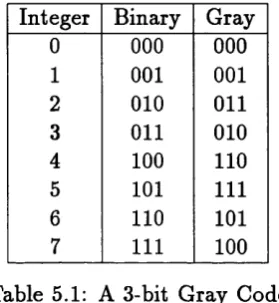
5.1 A 3-bit Gray C o d e ... 83 7.1 5 x 7 Pursuit o u t c o m e ... 128 7.2 Performance metrics of predictive architecture in a 4 x 1 game . . . . 132 7.3 Communication parameters and percentage of games where they were
2.1 A typical reproductive plan ... 25
2.2 A single point crossover shows the partial exchange of two chromo somes at a cross site chosen in a random way 28 5.1 An extended chromosome with a modifier gene for the representation 92 5.2 An extended chromosome with a modifier gene for m u t a t i o n ... 93
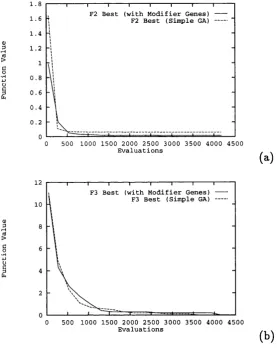
5.3 Best individual (average of 10 r u n s ) ... 95
7.1 Initial configuration of five red a g e n ts ... 116
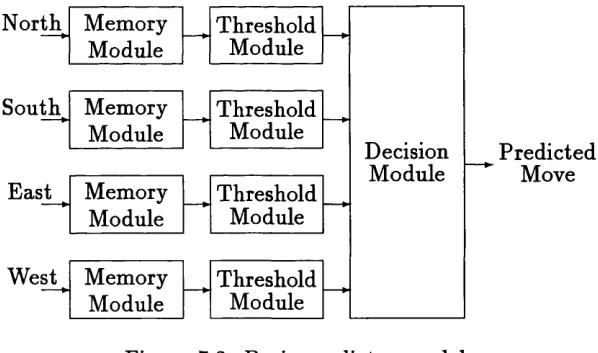
7.2 Basic predictor m o d e l... 125
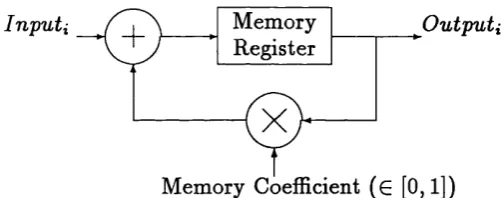
7.3 Memory model of past o b se rv a tio n s... 126
7.4 Basic correlation s c h e m e ... 126
7.5 Success-ratio performance of an optimised “4 x 1” architecture in com plex g a m e s 132 7.6 Success-ratio performance against ratio of red to blue a g e n t s ...133
7.7 UnnormaJised success-ratio...134
7.8 Conflicts per e x p e rim e n t... 135
7.9 Broadcast messages per e x p e rim e n t... 135
7.10 Unnormalised success-ratio...142
8.1 Sphne fits to dry weight ... 155
8.2 Spline fits to peniciUin c o n c e n tr a tio n ... 156
8.3 Comparison of quadratic and cubic spHnes f i t s ... 157
B .l Basic description of blue a g e n t s ... 184
B.2 Param eters subjected to genetic s e a r c h ... 185
B.3 Game ... 186
B.4 Basic control s t r u c t u r e ... 187
B.5 Predicting a prey’s future p o sitio n ...188
B.6 Agent’s pohcies for m o tio n ...189
Overview
1.1
F o r ew o rd
The work presented in this thesis consists of a series of studies around the central theme of Genetic Algorithms (GAs). The thesis can be divided into two distinct parts. The first one reviews and clarifies the theoretical tools often referred to in the GA Hterature, in terms of more fundamental concepts. This was motivated by the need to get further insights into the domains of apphcability of GAs and to extend the analysis often apphed to binary alphabets to other domains. A second motivation was to put the results in the GA Hterature in perspective with other results already known elsewhere, as a means of not only contributing new results unknown to the GA Hterature but also investigating a more fundamental and general formulation of the basic concepts. It was hoped th at the ensuing formulation would lead to further progress in the m athem atical treatm ent of the domains of appHcabihty of GAs. The basic questions th at this first part of the thesis investigates are:
• is there a simple index to gauge the difficulty a given problem poses for genetic search ?
• given a problem, can one find a suitable transformation (via a GA approach) on the param eter’s encoding such th at it makes the problem easy for a GA to explore?
My opinion of the achievements of this first part are mixed. On one hand it has succeeded in providing a general framework where several questions of interest in the Hterature can be addressed in an objective way. Among these are the extension of the known results of binary strings to any non-binary alphabet (the use of which is stiU being debated in the Hterature), the relation between epistasis variance and Walsh function analysis and some discussions of possible extensions of the basic algorithm and the difficulties of finding an adaptive approach for encoding the representation itself. On the other hand I could not provide any new fundamental insights beyond those already known in some way or another. (But the value of the work is in its
clarification of some existing issues th at needed clarification). As it stands, this first part looks somewhat pessimistic because most of the results stated here imply negative answers to the questions posed above. But they may also indicate the very nature of the difficulties one should encounter when trying to apply the techniques described to diverse problems - which is a contribution to improved understanding in an area in need of such understanding.
The second part of the thesis is more synthetic and tries to examine some ap plications which might profit from the power of genetic search. This was attem pted not only because of the limitation of the results in the first part, but also due to my recognition of the difficulties in extending th at analysis to address more fundamental questions related to the dynamical behaviour of GAs. However, the reason behind these attem pts is more general than a quick browse through them may reveal. One can distinguish a gradation of problems in terms of the effectiveness with which they might be treated by a genetic algorithm approach. The simplest problems are those th at require optimisation of a function given in “closed form” by combinations of simple expressions such as + 1, y/ÿ or ^ ^ • The most relevant fact here is th at param etrisation of the search space is immediate and hence, at least in principle, a GA used as a function optimiser may offer an alternative when no other approach proves to be effective. At the other extreme stand problems for which no param etri sation may exist and hence th at may be impossible to model via a GA approach. In between these extremes are those problems th at do not appear to be amenable to a GA treatm ent and yet through careful modeUing can harness at least some of the power of GAs as search algorithms. The work reported in this thesis concentrates on problems of this class. We focus on the use of GAs as experimental tools to assist
the design of different systems as part of an exploratory process. The interest is
the search for potential interesting design dimensions in domains for which no other approach can guarantee to make good design choices. I believe th at Distributed Ar tificial Intelligence is one area th at can profit significantly from this approach. But there is a problem, as one needs to face the traditional maladies associated with the use of GAs as function optimisers and at the same time build systems th at achieve reasonably robust behaviour so th at the conclusions from the experiments can be regarded consistent throughout a series of different scenarios.
Hence, the application of a GA becomes an optimisation exercise where discussions of convergence to the optimum, and modifications of the basic algorithms, are cen tral. In contrast, the problem considered here has no definite functional form to start with, nor is the param eter space specified from the outset. In fact, if it were so, much progress could have already been accomplished by traditional techniques. At the same time, the success of the experimental exploration conducted in this thesis may point to a new application area of GAs for which they can be used with reasonable performance. As ever more sophisticated systems are designed to deal with complex industrial needs, there is a real demand to examine their quality in providing good solutions in highly demanding appHcations. I beheve the techniques discussed in this thesis can be extended to deal with some of these domains.
The organisation of the chapters follows basically the chronological steps in which the work was undertaken, and in this way can serve as an indicator of how the ideas presented developed and the difficulties I faced in their exploration. Hierarchically speaking though, the DAI application should be regarded as the one with greater significance and the main focus of the thesis.
1.2
T h e s is o v e r v ie w
The central appHcation of this thesis deals with the problem of how to best ac- compHsh the design of autonomous agents using a genetic algorithm as a means of finding suitable testbeds for comparing alternative Distributed Artificial InteUigence (DAI) architectures. There are many motivations for attem pting to apply natural metaphors (and in particular GAs) as adaptive techniques in DAI. Perhaps the most obvious (and possibly the most difficult to achieve) is the generation of agents that can adapt to a changing environment and react accordingly in much the same way th at natural organisms seem to evolve. Understanding the phenomena th a t render this possible for natural organisms may provide im portant clues and directions of research in the design of more adaptive and powerful architectures. GAs have an appeal for their simpHcity and elegance as algorithms. They also draw inspiration from the mechanisms of genetic variation and natural selection. Hence, at this stage they offer an interesting alternative with which to explore the above issues.
better performance than competing ones. In general, the design of a particular ar chitecture depends on a large number of different and interacting factors (i.e. di
mensions). Therefore, searching for the best mix of factors can be regarded as a
search in a difficult high-dimensional space. Hence, the desirability for an algorithm th at is able to discover good solutions for difficult high-dimensional problems. At the same time, the complexity of a given architecture and the environment in which it is embedded may demand a large amount of computation to assess the performance of a particular set of factors. Exercising all the possible alternatives may be an infea sible task. Thus the necessity of an algorithm th at has the power to discover good solutions rapidly.
Thirdly, there is no established theoretical framework th at can explicate the many possible approaches in dealing with agents’ interactions. This has resulted in many distinct and sometimes competing theories of social interactions for which no clear winner has yet been estabhshed. A simple approach th at is able to generate inter esting experimental systems and results may offer theoreticians further insights for developing more refined theories of social interactions.
Additionally, it is not clear whether a DAI architectural idea developed and shown to be useful for a given project is g e n e ra lly good and useful, because of the difficulty of comparing results obtained in different environments. This may result in a “Tower of Babel” curse, in which different groups use different set of examples (which may be tailored to their particular architectures and devised solutions) to measure and compare the performance of their solutions. A common set of problems is therefore needed to assess and compare different approaches to the distribution of knowledge and information.
second drawback is related to the fact th at the problem by itself may not possess (con trary to the initial subjective expectations) enough complexity and th at the results obtained could have been accomplished using a much simpler approach.
One response to these drawbacks is to justify, probably by theoretical means, the properties th a t a given set of problems should have in order to be used as a good testbed. In principle this is a difficult task, as an answer to it would convey with itself im portant explanations about the architectural issues it was intended to explore and settle in the first place. Another alternative is to search for an accepted minimal architecture and use its performance on the suite of problems as a baseHne of comparison with more sophisticated solutions. A third alternative, bearing the previous idea in mind, is to find and parametrise a class of problems and search for a suitable subset within it th at has the intended characteristics.
GAs have been applied successfully to many different problems, but there have been equally many others where they have failed badly to yield the expected per formance levels for which they were devised in the first place. One reason for this effect, is related to the fact th at (despite their simpHcity and elegance) there is often Httle detailed understanding of why they have been successful or failed in a given problem. This has only been exacerbated by the fact th a t the GA Hterature seems to have embarked on its own independent path from other areas of knowledge. This may have obscured the relation between itself and other bodies of knowledge, and as a result may have hindered further progress in understanding the domains in which GAs can be appHed successfully. Bridging this gap is a desirable issue, as it may point to already-estabHshed results th at can be used in a straightforward way. As a consequence, further insights may be gained th at are Hkely to carry over to more general contexts. Also, the Hmitations faced by a proposed theoretical approach may be envisaged in a more effective way, by reference to the already-estabHshed results.
Given the above, it is also im portant to note th at even a Hmited theoretical exploration may be useful, as it may estabHsh some guideHnes for applying GAs to an ever wider range of problems for which their appHcation may not be apparent from the outset.
knowledge such an attem pt has never been tried, it is difficult to put it in perspective with other known methods. The results reported in this thesis, though, indicate in my opinion th at much progress can be gained by the combination of these two seemingly unrelated themes.
1.3
O r g a n isa tio n
Chapter 2 discusses genetic algorithms as usually formulated. The discussion is fairly general and is intended to bring out the most salient aspects which will be addressed in later chapters. In particular, the question of what are the conditions th at make a given problem most appropriate to genetic search.
Chapter 3 extends the discussion introduced in chapter 2 and puts the concepts developed in the GA literature in perspective with respect to already-established ones. In this way, it both “rediscovers” the results derived by Bethke [8] and presents them with respect to a more unified framework, namely of H a rm o n ic A n alysis. Several results unknown in the GA Hterature are presented here in a natural way, and alternative approaches explored elsewhere are criticised using this framework. In appendix A the results presented for binary alphabets are extended to any non-binary alphabet. In this way this appendix is intended to provide the theoretical tools with which to examine the still ongoing debate of which alphabet is more appropriate to a particular problem. It also furnishes a class of functions to test implementations of GAs th at are specifically tailored to deal with alphabets of high cardinality.
Chapter 4 examines the concept of epistasis, which is often referred to in the Hterature but is difficult to quantify for use in an objective way. Use is made of the framework developed in previous chapters to address the concept of epistasis variance as suggested by Davidor [16]. It is shown th at epistasis variance is not capable of complete discrimination between functions th at are easy and difficult for genetic optimisation.
experiments on an alternative approach based on ideas derived from genetics, which may point to future viable extensions of the basic algorithm.
Chapter 6 gives a fairly general introduction and discussion of distributed systems, with particular emphasis on the choice of meaningful testbeds for comparing alter native distributed architectures. The attention is focused on the P u r s u it P ro b le m , the currently most popular testbed for comparing alternative DAI systems. It also brings together the issues of designing a minimal DAI architecture and the application of genetic techniques for th at purpose.
Chapter 7 explores the ideas proposed in chapter 6 with respect to the Pursuit Problem. Using the GA as a search algorithm for suitable architectures, it comprises a series of studies around the them e of searching systematically the space of test problems for suitable testbeds. In addition, by focusing attention on this class of games the chapter explores some basic dimensions in agents’ architecture th at are potentially valid for many different DAI applications. W ithin this activity, the issues introduced through the concept of boredom are the most novel. The chapter also discusses experiments conducted on the concepts of “listening rate” , thresholds and attenuation of communication as additional simple mechanisms th at provide further insights into the architecture of problem-solver s.
Chapter 8 illustrates the benefits one can obtain from the discipline of looking at non-standard dimensions for genetic optimisation suggested in chapter 7 in a more traditional domain for which the issue of optimisation is central. The appHcation deals with the problem of fitting noisy data with spHne functions.
1 .4
M a in c o n tr ib u tio n s
The contributions of the thesis are distributed along several Hnes. First, it puts the analysis undertaken by Bethke within a more general framework th at seems to have passed unnoticed. In doing so, it serves as a critical appraisal and also shows for the first time how the Bethke-type analysis for binary alphabets can be extended systematically to any non-binary one.
Parts of the work reported in chapters 3 and 4 have already appeared in the Pro ceedings of the Second Conference on Parallel Problem Solving From Nature, Brussels 1991 [55]. The application treated in chapter 8 is discussed in the Proceedings of the Fifth International Conference on Genetic Algorithms, Urbana-Champaign 1993 [56]. It has several immediate industrial appHcations. Because it belongs to a more gen eral class of problems (i.e. ré g u la ris a tio n p ro b le m s) it may point to areas where the appHcation of GAs may be most appropriate in comparison to other existing alternatives.
The discussion of the Pursuit Problem and a systematic search for sets of good testbed problems has never been attem pted before. In fact, it examines and suggests problems with a complexity of at least an order of magnitude greater than the cur rently accepted testbed. It also shows by an experimental approach th at the latter is in fact not a suitable problem for use as a good testbed. Given the fact th at this problem has been used without critical assessment for the last six years, I beheve th at the contribution provided here wiU be of great interest to researchers of DAI. Some of the results reported in chapter 7 appeared in the Fifth European Workshop on ModeUing Autonomous Agents in a Multi-Agent World, Neuchâtel, 1993.
G enetic A lgorithm s
This chapter describes the main features of Genetic Algorithms, a class of heuristic search algorithms based on the mechanics of evolution and pop ulation genetics. The description is meant to introduce the basic concepts and to make apparent the most important topics that will be of interest fo r later chapters.
2.1
I n tr o d u c tio n
The problem of function optimisation can be stated as follows. Given a function
f : D R, find the global maximum (or minimum) of f . f is called the o b je c tiv e
fu n c tio n , D is the d o m a in or the se a rc h sp ace and R is the ra n g e which will be assumed to be a subset of the real numbers In general, the search space consists of n real scalar in d e p e n d e n t v a ria b le s denoted by z i, æ2, • • • , ®n, but it may also
be a vector space over a finite field, a cross-product of different subspaces, a non- numerical space [8] or even a cross-product of all the component spaces. In practice many values of the independent variables are not allowed (e.g. due to economic or physical considerations) and thus the problem formulation should include some re lations (usually in the form of inequalities) which must be satisfied by any member of the domain. Whenever this occurs the problem is known as a c o n s tra in e d o p ti m isa tio n problem and the points satisfying the given relations are said to form the problem’s feasib le reg io n . When this does not happen the problem is known as an u n c o n s tr a in e d o p tim is a tio n problem.
Function-optimisation problems arise in many different areas such as system iden tification, pattern recognition, design of logic circuits and on-fine control for industrial processes. In several circumstances the function to be optimised can be described ex plicitly in a form th at is amenable to m athem atical treatm ent, allowing an explicit solution for the problem to be formulated or the investigation of whether optimal solutions exist at all.
On the other hand, in several situations one is confronted with a system for which there is no complete detailed knowledge. In other cases no particular interest exists in obtaining all the information about the system itself. Nevertheless one may still
be interested to determine what settings of the independent variables will yield the optimal value of a given criterion.
It often happens th at the total number of experiments (either numerical or practi cal) to be performed on the system is hm ited and hence the planning of the placement of the experiments (and corresponding variable settings) should be considered care fully. Any set of prescriptions for the placement of the experiments is called a se arc h p la n and any investigation seeking the optimal value of an unknown function is called a se a rc h p ro b le m [95]. Given the restriction on the number of experiments to be conducted, it is of interest to find among all possible search plans, the one which looks for the optimum in an optimal manner or to use W ilde’s words ([95] (p.2)):
. . . we are not only trying to optimise the function] we are also optimising
the optimisation procedure.
The above discussion begs the question on how one should measure the effective ness of any search plan. It is also im portant to note th at finding the optimum of an arbitrary real-valued function is a difficult problem. Hence if any m athem atical tre a t ment is at all possible, some simpfifying assumption about the search space should be made, e.g. by the introduction of concepts such as unimodality, smoothness, con vexity and similarity [95] or by assuming th at the objective function is differentiable (or even twice differentiable) [8]. The latter motivates the introduction of gradient descent algorithms while the idea of unimodality in closed intervals of uni dimen sional real-valued spaces gives rise to very efficient search plans such as the minimax methods [95]. It turns out th at fortunately in this case an a priori criterion, which depends on the placement of the experiments, but not on their outcomes, can be defined precisely and then optimised^ [95].
Multivariable problems, however, have a structure entirely different from th at of a single-variable problem and the extension of acceptable assumptions th at may hold for single-variable methods may not be valid when carried over to multivariable problems [95]. For example, even if the idea of unimodality may be a plausible hypothesis for some unidimensional search spaces it is quite unlikely th at it should hold as the number of dimensions increases [95]. Moreover, as argued by Wilde, due to the multidimensionality of the search space one is unable to find a measure of
search effectiveness th at does not depend on the experim enter’s luck even when the assumption of unimodahty is accepted.
2 .2
R a n d o m se a r c h
The recognition of the hmitations of extending successful techniques from unidi mensional to multidimensional problems has led to proposals of using random-search techniques as viable alternatives to the traditional methods. For example, as early as 1958 Brooks [12] proposed the use of a random m ethod when the number of di mensions was large. Central to his analysis was the consideration of the two factors th at should be decided a priori by the experimenter, the first being the definition of what constituted a successful maximum-seeking experiment and the second related to the probabihty of conducting such a successful experiment.
His considerations led to the definition of success as the discovery of a combination of the independent variables (or factors) such th at not more than a predetermined proportion of the search space would contain combinations having associated higher values. This proportion was denoted by a. The other factor, namely the probabihty of success, was related to the probabihty of finding at least one combination in the best fraction a of the search space and was designated as 5. It is easy to see th at these quantities are related by the foUowing relation
5 = 1 — (1 — a)*
where t is the number of trials conducted and (1 — a) is the probabihty th at a single trial wiU fail to be made inside the desired region. Solving for t gives
_ log(l - 5)
log(l - a ) ( ^
cut down the region of uncertainty to a fixed fraction of the original search space, this percentage would have to be extremely small before the ranges of the individual independent variables would be reduced significantly.
Brooks’ ideas were more general, though. He argued th at the random method need not be apphed in a sequential manner but rather all the trials could be conducted simultaneously. He also suggested two different versions of the random method. The first one, which he called th e S tra tifie d R a n d o m M e th o d , was based on the idea of dividing the search space into n equal sub-regions. (Brooks also proposed rejecting points th at were within a prescribed distance of previously-selected points). The second one (and for the purposes of this work, the more noteworthy of the two) was referred to as th e C re e p in g R a n d o m M e th o d , This technique involved making an initial guess for a starting point and then conducting trials at random in the vicinity of the first estimate. The location of the best of these random trials was made the centre of a second random exploration. Brooks suggested the use of a normal distribution whose variance was diminished at each iteration. This was motivated by the desire to cluster the values around the best currently-available combination.
T hat he was anticipating major breakthroughs to come can only be attested by his final comments on [12] with which we end this section:
There are some rather intriguing analogies that can be made between the creeping random method and evolution.
2 .3
G e n e tic A lg o r ith m s
and a precise knowledge of the subspace being sampled at th at iteration (probably by using some special bookkeeping routines), a decision module would specify a more restricted subspace on which to sample the next n points in the next iteration.
Suppose also th at the function being searched has enough redundant information so th at the decision module reduces (with a high probability of being correct) the search space by say 30% at each iteration. Thus even with a huge initial search space of size 2®°, the algorithm would be able to converge to the global optimum after approximately 100 such iterations. For example, if n = 40 this would correspond to approximately 4000 trials, which is a minute fraction of the original space.
It is obvious th at the assumptions in the last example are somewhat over opti mistic and th a t in general the allocation of trials is a nontrivial and difficult prob lem. Fortunately, there is a class of relatively simple algorithms which allocate trials in a nearly optimal way^. These algorithms, generally known as G e n e tic A lgo r ith m s (GAs), were introduced by John Holland [37] and are inspired by the obser vation of how adaptation takes place in evolving natural systems. Holland proposed searching a general space using re p ro d u c tiv e p la n s which would selectively manip ulate and reproduce a collection (p o p u la tio n ) of candidate solutions (in d iv id u a ls) to generate new individuals on the most promising areas of the search space.
In the simplest form of the G A, candidate solutions to some problem are encoded in binary strings which play the role of artificial c h ro m o so m e s, while individual bits play the role of g en es and their respective positions are referred to as loci. The different values th at a gene can assume are known as its alleles.
Each in d iv id u a l therefore comprises a candidate solution to a specific problem and has associated to it a corresponding fitn e ss or u tility , i.e. a nonnegative figure of merit th at measures the adequacy of the related solution. As discussed above, one of the difficulties of any search plan working in a high-dimensional space is to decide where one should place the next set of trial experiments subject to the information provided by the current set of alternatives. In Holland’s reproductive plans, individu als with higher fitness values have a higher probability of being selected for producing multiple copies of higher-fitness individuals for the next g e n e ra tio n . This by itself would not produce any new individuals but merely change the number of copies of each chromosome. Hence, the se le c tio n of high-fitness individuals is combined
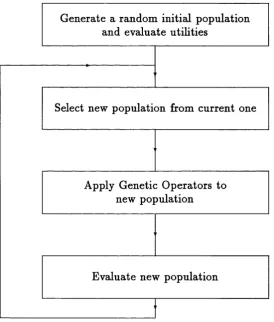
with g e n e tic o p e r a to rs such as m u ta tio n (flipping individual bits) and cro sso v er (exchanging substrings of two parents to obtain two offspring), all applied in a prob- abihstic way to produce a new generation of individuals. The G A is judged to be successful if it can evolve a population of highly fit individuals as a result of iter ating this procedure through successive generations. Figure 2.1 illustrates a typical reproductive plan.
Select new population from current one Generate a random initial population
and evaluate utilities
Apply Genetic Operators to new population
Evaluate new population
Figure 2.1: A typical reproductive plan
2 .4
S e le c tio n , s c h e m a ta a n d u tilitie s
should be assumed. A GA is no exception. The simplifying assumption made on the function domain, typically of high dimension, is th a t it should contain regions of good objective-function values and regions of poor values. Any useful search algorithm must decide concurrently which regions are potentially interesting to be explored while collecting information about the function itself. This trade off is a crucial point in any adaptive system and is usually referred to as the trade-off “between the exploration for knowledge and the exploitation of th at knowledge” [28].
In order to make a proper analysis of the class of functions th at should be searched efficiently using a G A, the notion of schema is necessary. A s c h e m a corresponds to a partition of the space of chromosomes with each partition (subspace) being characterised by the sharing of some specified genes by its elements [70].
More formally^, if we consider the space of chromosomes of length I a chromosome wiU be represented by a string s = 5i52 . •. 5/ where Si G {0,1} in the binary case. A schema will be represented by a string h = h-^h2. . .hn where hi G {0,1, # } and a string 8 win be said to instantiate ^ if h» = Si or h{ = ^ for i = 1 , 2 , . . . , / [8]. For example, if / = 3 then the schema 10^ corresponds to the set {100,101} and could be described as the set of binary strings of length 3 th at “begins with 10” .
It is easy to see th at every chromosome instantiates 2^ schemata. Following [70] let s denote a string whose corresponding utility is given by u(a). Let ( be a schema instantiated by s. The utiHty of ^ is defined as
( 2 ) I t I , E C
where | ( ^ i s the number of chromosomes instantiating the schema
Holland observed th at subject to the fact th at there are some correlations between the utihties of different instances of schemata, each evaluation of a chromosome pro vides statistical information about the utility of each of the 2^ schemata instantiated by th at chromosome. Hence, although the GA does not manipulate schemata di rectly, it does th at in an impHcit way, a phenomenon often referred to as implicit
parallelism. In doing so, the analysis is shifted from the individual chromosomes to
the schemata th at they instantiate.
Each evaluation of a chromosome can thus be regarded as a statistical samphng event th at yields information about the utiHty of the schemata th at it instantiates. In general, due to the restriction on the number of trials, one cannot sample enough points in the search space so as to provide completely accurate information about the utiHty of each schema. Hence each schema is assumed to be a random variable with an associated distribution of utiHties [8]. The more this sampHng reflects the utiHty of the schemata instantiated, the better this information wiU be used to guide the algorithm into more promising areas of the search space.
HoUand [37] suggested th at the G A behaviour could be understood in terms of optimising a sequential decision process where uncertainty was present in several different factors such as lack of a priori knowledge, noisy feedback and a time-varying pay-off function [41]. In terms of this interpretation, an optimal allocation of trials among competing alternatives would give exponentially increasing trials to the best observed alternative. As we shall point out in what foUows, this is nearly reahsed in a GA if one allows the selection of chromosomes to the next population to be based on a probabiHty th at is proportional to their corresponding utihties.
To see th at, first note that in an actual implementation one can only refer to the observed schemata utiHties which may be considered as a restriction of (2) to the actual population of chromosomes. However, it is immediate to see th at if the probabiHty of selecting a given chromosome is equal to the ratio of its utiHty to the average utiHty of the population at th at iteration then the number of examples of a particular schema ^ in a given population grows as the ratio of the average utiHty of th at schema to the average utiHty of the population [28] at th at iteration.
The ideas discussed above are usuaUy explored with the help of the foUowing concepts which wifi be used later on.
D e fin itio n 1 (Bethke 1981 [8]) The set o /d e fin in g p o s itio n s of a schema h is the set of indices of the ones and zeroes in h.
D e fin itio n 2 (Bethke 1981 [8]) Two distinct schemata, h and h! are said to be co m p e tin g s c h e m a ta if they have the same set of defining positions.
The d efin in g le n g th of a schema h, denoted as di{h), is the distance between the first and last defining positions in it. The o r d e r of a schema h, denoted as o{h),
Holland’s interpretation of the behaviour of a GA is to regard it as allocating (among a set of competing schemata) exponentially increasing trials to the best ob served one [28]. In terms of the discussion presented in section 2.2, this action cor responds to the decision module providing some guidance about the subspace th at should be sampled in the next iteration. W hat is remarkable about a GA is the simphcity with which this is done, as this subspace is only given imphcitly by the different number of individuals in the next population.
This simphcity is respected in the design of the mechanisms to generate new members from the current population (primarily the crossover operator), which are discussed in the next section.
2 .5
G e n e tic o p e r a to r s: c r o sso v e r a n d m u ta tio n
A simple crossover works in the following way (figure 2.2). Two individuals (par
ents) are chosen in the selection step. Then, an integer position k is chosen randomly
in the interval [1,/ — 1] and two new strings (offspring) are created by swapping all string elements between positions k 1 and I inclusively [28].
BEFORE CROSSOVER
Crossover point
Chromosome 1 —► O i l
Chromosome 2 —- 1 1 0
0 1 1 1
1 0 0 1
A FTER CROSSOVER
Chromosome 1 —► O i l Chromosome 2 —► 1 1 0
1 0 0 1
0 1 1 1
Figure 2.2: A single point crossover shows the partial exchange of two chromosomes at a cross site chosen in a random way.
Alternatively, a two-point crossover proceeds by selecting two integer points p and
parent chromosomes by swapping aJl string elements th at He between j> and q. Other extensions are also possible and are discussed in [28].
A simple crossover operator biases the search by disrupting those schemata with long defining length. This can be expressed by the crossover survival probabiHty which is bounded below by the expression 1 — where pc is the probabiHty of performing a crossover on two selected strings [28].
Crossover is often understood as the most im portant genetic recombinant operator and much of the power of GAs results from the interaction of the selection process and the crossover mechanism. In fact, the interplay of these mechanism is often considered the heart of the balance of exploring and exploiting information present in a given population of chromosomes.
M utation is often considered to play a secondary role in the simple GA and its ba sic action is to prevent prem ature loss of im portant information from the population^. This is due to the fact th at crossover never introduces new alleles in a given popula tion while the dynamics of the selection process allows deletion of particular alleles as the algorithm proceeds. Accordingly, the probabiHty of applying m utation is very small when compared to th at of crossover. In the same as above, one may calculate the probabiHty of a schema surviving m utation (appHed with a probabiHty Pm) is bounded below by the expression 1 —
The interaction of the selection and reproduction phases of a simple GA is often described by the foUowing fundamental theorem due to HoUand [37].
T h e o re m 2.1 The Fundamental Theorem of Genetic Algorithms. Let r}(t) denote the number o f instances of a schema h at iteration t. Let Uhif) denote the sample utility fo r the schema h at that iteration and U(t) denote the mean utility o f the population at that iteration. Then the expected number of instances o f h at iteration
t -f 1 is governed by the following expression:
1 - - ° W p’
(3)
The impHcations of theorem 2.1 are far reaching. Its most common interpretation states th at short, low-order, and highly fit schemata are sampled, recombined and
resampled to form strings of potentially higher fitness [28]. This interpretation is so vital th at it remains the cornerstone on which most implementations of GAs rely, and is often referred to as the B u ild in g B lo ck H y p o th e s is . It is remarkable how equation (3) can incorporate in a simple way the rather complex dynamics of a simple G A. In fact, many of the problems faced by many apphcations of GAs may have resulted from the deceptively simple behef th a t any implementation th at follows the guidehnes suggested by theorem 2.1 will perform in a successfully efficient way.
2 .6
D is c u s s io n
In the previous subsections we reviewed the basic formalism developed by Hol land [37]. The fundamental ideas there were the optimal allocation of trials among competing alternatives and the action of crossover to combine good building blocks in order to generate strings of potentially large fitness.
In what follows we shall review briefly several problems th at often occur in apph cations involving GAs and th at will be of interest for this work.
2 .6 .1
C h o ic e o f fitn e s s f u n c t io n
Although the formalism offered by Holland is elegant and aesthetically pleasing, it leaves the choice of the fitness function open. However, the rate at which trials are allocated to different individuals depends on their observed utiHty function. Rad- cHffe [70] observed that given any utiHty function, its composition with an arbitrary (monotone) increasing function wiU yield another valid utiHty function. He concluded th a t there was scope for slowing the rate of convergence of the algorithm by making a suitable choice of utiHty function. Note however, th at Holland’s formalism impHcitly requires th at the sampHng process should give reasonable statistical evidence about the utihties of the schemata instantiated by a given chromosome. This certainly restricts the number of possible choices.
2 .6 .2
P r e m a t u r e c o n v e r g e n c e
One of the problems most often cited in applications of GAs is related to the loss of diversity in the population before the global optimum is found. This may happen as a result of some individual (whose fitness is much larger than any other individuals of the population) being allocated a very large number of trials. Under this condition many of its genes can dominate the population and become fixed. This may be undesirable, particularly if this individual does not represent a point close to the global optimum. On the other hand, in some circumstances the fitness of individuals in a population does not differ significantly and the selection process becomes almost uniform among the population, thus losing its main advantage over random search [28].
Several mechanisms have been suggested to improve these problems, most notice ably the scaling of the fitness function (e.g. Hnear scaling) [28]. Other techniques are discussed in [70]. Unfortunately no specific mechanism has emerged as a winner. As a result, the decision on which one should be used may itself be a difficult one especially in problems where the search space is very large and where information about properties of the utiHty function is unavailable.
2 .6 .3
C o d in g s a n d g o o d p a r a m e t r is a t io n
Since GAs work with a coding of the param eter set rather than the parameters themselves, a natural question is how this encoding can take place. The success of earher experiments may have led researchers to place much hope in the adaptive capabihties of GAs as a very powerful mechanism th a t could perform well under very
difficult issues, and one is obliged to restrict the class of problems being explored to a set th at falls under some generally acceptable assumptions.
2 .6 .4
G o o d a n a ly t ic a l t o o ls
Even when restricted to the theory presented in this chapter one is often left with the question of trying to characterise the domains where a GA can be appUed successfully. The most used tool of analysis follows from Bethke’s explorations with Walsh functions [8] on binary representations. Other attem pts have been made (e.g. by Liepins and Vose [52]) but do not offer much insight beyond the one provided by Bethke.
Also, most studies of the behaviour of genetic algorithms (GAs) refer to schemata th at are expressed in a binary alphabet. In some instances where the efficiency of GAs is unsatisfactory, there is a view th at the problem should be overcome or reduced if an alphabet with more characters is used. This is still an ongoing debate (e.g. see [58, 75]). For the non-binary case, to the author’s knowledge the only reported analysis was conducted by Mason [58] following completely different lines from the one used by Bethke. It is difficult to see how the two can be put in correspondence with each other. It would therefore be interesting to find a unified framework in which questions of interest could be discussed in a more general way.
The difficulty in understanding the wider impHcations of Bethke’s approach has resulted in several different attem pts to characterise the domains of appHcabihty of GAs, and different measures to decide on the suitabiHty of a particular problem to genetic search has been suggested. It has often led researchers to focus attention on certain problems th at are difficult for a GA to explore but whose intrinsic nature is not completely understood (e.g. [29, 21]). Part of the contribution of this thesis is to put all these rather different approaches into a common framework where the above concepts can be discussed, criticised and extended objectively.
2 .7
S u m m a r y
Walsh Series A nalysis
This chapter examines schema analysis from the broader viewpoint pro vided by abstract harmonic analysis. This offers a more general and nat ural framework fo r characterising the domains o f applicability o f GAs and provides new insights and motivation fo r extending schemata and genetic algorithms through the use of more abstract concepts. Previous results obtained by Bethke are embedded in a more general framework, namely of group theory, where the concepts discussed above can be understood by reference to certain linear subspaces and their respective nullspaces.
3.1
M o tiv a tio n s
In chapter 2 a simple Genetic Algorithm, a non-standard technique for function optimisation, was described. The basic motivation for its introduction was the desire to explore problems for which conventional techniques such as gradient methods perform poorly. In general these problems are characterised by functions th at are not everywhere differentiable, not unimodal or such th at the dimension of the search space is large.
Given a certain algorithm it is im portant to know the class of problems for which it has a good chance of performing well. For GAs, some of the relevant conditions were estabhshed by Bethke [8] who introduced Walsh functions and the Walsh transform to analyse the behaviour of GAs when the search space is considered to consist of binary strings. It has remained the most often used technique for discussing issues of interest in genetic optimisation. His conditions are stated in the transform space of the Walsh coefficients, and are difficult and not intuitive to understand.
The idea th at a similar analysis could be extended to the non-binary case may have occurred to several authors (for example, through the obvious similarity of Walsh and Fourier functions [28, 21]). However to the author’s knowledge the only investigation on non-binary alphabets so far was conducted by Mason [58] along completely different Hnes.
Walsh and Fourier functions have long been exploited in other application areas (e.g. communication [31], switching theory [46], statistical analysis [67] and signal processing [57]).
In spite of the above, the GA Hterature seemed to have embarked on its own independent path, and many concepts and results already established elsewhere were defined or derived again in the context of GAs in ways th at are sometimes more diffi cult to understand and to use (e.g. the concept of n u llsp a c e s and their translations, which is helpful for clarity, as we shall see below, has nevertheless not been used previously in the GA field). This has only enlarged the gap between itself and the general available hterature, and in the opinion of the author this may have hindered further theoretical progress. Consider for example the Walsh-Schema transform th at is so central in many of the theoretical analysis of GAs. This is in fact fully equiva lent to a well-estabhshed result in group theory known as the P o isso n S u m m a tio n F o rm u la (see e.g. [88, 46]) and whose group-theoretic analogue plays a major role in the theory of group characters [46]^.
The main goal of this chapter is to review Bethke’s work and to embed it in the more general framework of group theory^, where the concepts discussed above can be understood by reference to certain linear subspaces and their respective nullspaces.
It is often the case th at (in such circumstances) ascribing originality of ideas is a difficult task, since what may appear to be original in one area may already have been known for a long time in another one. For example, the idea th at schemata and hyperplanes were intimately related was already estabhshed for a long time in the GA culture. However the fact th at these concepts could be expressed by reference to more fundamental entities, such as c o sets, was not appreciated until very recently (e.g. [6, 52, 93]), although they were already weU known in basic mathem atical Hterature (e.g. see [10] for a thorough discussion of these concepts) and also in the communication area. In fact, as long ago as in 1972, Harm uth [31] showed expHcitly how these concepts from group theory could be used in the design of multiplex systems while in 1971 Lechner [46] used the above ideas in exploring an algorithm to detect prime impHcants for logic functions. To the knowledge of the author, the results
^In the theory of data communication Shannon’s famous Sam pling T h eorem follows as a straightforward consequence of it [88].
derived in the GA literature were never put into a clear perspective with those from related work in other areas. One of the purposes of this chapter is to attem pt to correct this situation. In doing so, we shall follow Lechner [46] due to historical reasons and clarity of exposition. Most of the results presented in this chapter wiU be stated without proof, as the appendix provides complete proofs of their extension to any non-binary alphabets.
3 .2
N o t a tio n a n d r e p r e s e n ta tio n a l issu e s
Our main purpose in this section is to review the concepts introduced else where [28] in a more abstract way, and to provide the groundwork for future general isations th at may be useful with respect to genetic algorithms. We shaU try to avoid GA terminology, referring to it only if necessary.
TraditionaUy GAs operate on binary strings known as chromosomes. FormaUy we define Z as the 2-element field {0, 1} (or alternatively the additive group of integers modulo 2), and Z ” as the n-dimensional vector space over the field Z (or alternatively as the product group of Z). This corresponds to the domain of our search space.
The range of the function is usuaUy considered to be the set of real positive numbers, but occasionaUy one may also be interested in functions over Z . Therefore we place no restrictions on the space of functions, T^ which wiU be clear according to the context. X wiU denote the set Z ” of aU binary n-tuples when it is the domain for the space T . An element x Ç: X wiU be represented by the row vector [ x i ,. . . , æ„), and its transpose wiU be represented by a corresponding column vector. Elements of X are indexed in the natural ordering, defined by the correspondence between a number and its radix-two expansion on binary n-tuples.
3 .2 .1
S c h e m a ta a n d s u b c u b e s
is usually pictured geometrically as an n-dimensional unit cube (or n-cube) having the 2” binary n-tuples which represent elements of Z" as vertex coordinates. We next consider subsets of Z ^ as sets of n-tuples.
If in a given subset the i-th coordinate in the n-tuple x has a fixed value we call it a b o u n d v a ria b le , otherwise we shall call it a fre e v a ria b le [46]. Bounded variables are normally referred to in the GA Hterature as fix ed p o s itio n s [26]. A s u b c u b e of Z ” is a subset with bound and free variables. The d im e n sio n of a subcube is the number of free variables it contains. Therefore a sub cube of dimension k includes 2* points of Z ” , since each free variable can assume two possible values i.e., 0 or 1 . Following Lechner [46] we shall refer to a A;-dimensional subcube of Z ^ as a A;-cell or A;-cube.
A s c h e m a is a subcube denoted by a ternary n-tuple
h = (&1 ; fl'2) ' • • j ®n)) j E {O, 1, *}•
where the symbol stands for ‘don’t care’ and is assigned to the k components a{ for which X{ is a free variable. Whenever a, = *, it is understood th at the corresponding
Xi assumes both values 0 and 1.
In this way a schema is a subcube, but certain sub cubes cannot be expressed uniquely by a schema. For example, {(0,0), (1,1)} is a subcube of Z^ with two free variables, but there is no schema th at can describe it in a unique way. However, any subcube is always contained in some schema, since we can consider a schema whose %-th entry is if the i-th variable in the sub cube is free.
A schema with k free variables is often referred to as a A;-order schema, but for convenience and consistency with the above notation we shall refer to it as As-schema.
Since each a{ independently can assume one of 3 possible distinct values, it foUows th at there are 3” ternary n-tuples corresponding to 3” possible schemata. Also, since there are CJ^ = ^^7® fo select k free variables among the n coordinates of Z ” , and 2^"'“*^ ways to assign values to the (n — A;) bound variables, the total number of A;-schemata in Z ^ is 2^”“*^ x CJ^.