Demand
Report by the
Access to Justice Taskforce
Attorney-General’s Department
A Strategic Framework for Access to Justice
in the Federal Civil Justice System
Copyright Administration, Attorney General’s Department, National Circuit, Barton ACT 2600 or posted at <http://www.ag.gov.au/cca>.
Contents
Contents
iii
Foreword
ix
Chapter 1: Overview – the scope of the review
1
The federal civil justice system 1
Why is access to justice important? 1
What is access to justice? 3
The traditional view 3
Justice in society 3
Recent history of access to justice reviews 6
This report 7
Part I: Supply and demand – the empirical basis 8
Part II: Strategic Framework for Access to Justice 8
Part III: Supporting the Strategic Framework – specific discussion and recommendations 8
PART I – SuPPly And demAnd
9
Chapter 2: The Demand for Justice
11
Executive Summary 11
Overt demand in the federal civil justice system 11
What types of legal issues do people experience? 12
Factors influencing whether a person experiences legal issues 14
Who experiences legal issues? 14
Impact of particular legal events on the incidence of future events 15
What do people do when they experience a legal issue? 16
People who took no action 17
Reasons for inaction 17
The type of legal issue 18
Demographic indicators 20
People who handled legal events alone 20
People who sought assistance with their legal events 21
Who do people turn to for assistance, and why? 21
How useful is that assistance? 23
Demographic indicators 23
The outcome of legal events 26
Resolution 26
Small business – the demand for justice 27
Conclusion 28
Chapter 3: The Supply of Justice
29
Avenues to resolve disputes – the supply of justice 29
a. Advice, support and other personal pathways 30
b. Courts 30
c. Administrative law remedies 31
d. Internal dispute resolution 31
e. Ombudsmen and External Dispute Resolution (EDR) 31
f. Alternative Dispute Resolution 31
g. Family Dispute Resolution Services 32
Some types of dispute are better suited to certain methods of resolution 32 a. Disputes where there is a continuing relationship 32
b. Consumer disputes 32
c. Business disputes 33
d. Employment disputes 33
e. Administrative law disputes 33
f. Native title disputes 34
Costs of the Commonwealth Justice System 34
The entire federal civil justice system 34
Cost per sector 36
Cost to Commonwealth by type of service 36
The cost to the individual of accessing the justice system 40
Free services 40
Cost of legal representation 40
Legal aid and legal assistance 42
Cost recovery in the federal civil justice system 44
A snapshot of the present 45
Cost recovery policy considerations 46
Designing and funding a federal civil justice system 47
Cost recovery in the federal civil justice system 47
The overseas experience 51
Chapter 4: Conclusions about Access to Justice
55
The justice system is in good shape 55
key conclusions about areas for enhancement or reform 55
The need for a system‑wide perspective 56
major implications for the justice system 57
PART II – STRATegIc FRAmewoRk FoR AcceSS To JuSTIce
59
Chapter 5: An Access to Justice Framework
61
The Access to Justice Principles 62
Accessibility 62
Appropriateness 62
Equity 62
Efficiency 63
Effectiveness 63
The Access to Justice methodology 63
how does the triage system work? 66
how they work – the Access to Justice Recommendations 68
Case studies 69
Debt recovery 69
Improving Government decision making 69
Improved case management 70
The meritorious defendant 71
The way forward 71
Justice system statistics 72
Data requirements 73
The Federal dimension 73
PART III – SuPPoRTIng The STRATegIc FRAmewoRk
75
Chapter 6: Information about the law
77
No wrong number, no wrong door – improving access to information for people
with legal issues 79
Direct engagement 81
Collaboration between service providers 82
Chapter 7: Non‑court models of dispute resolution
87
Consumer Disputes 88
External Dispute Resolution 88
The Trade Practices Act as a foundation for resolving consumer disputes 90
Internal Complaint mechanisms 91
Alternative Dispute Resolution 92
Family Dispute Resolution Services 94
use of ADR by the Commonwealth 95
ADR and litigation 96
Chapter 8: Court based dispute resolution
98
The federal courts and access to justice 98
The role of the courts in the federal civil justice system 99
The current picture 100
General federal law (Federal Court of Australia and Federal Magistrates Court) 101 Family Law (Family Court of Australia and Federal Magistrates Court) 102
Resolving disputes better 103
Early and proportionate exchange of information and evidence 103
Pre‑action protocols and pre‑trial examinations 103
Discovery 105
Redesigning court procedures to ensure all steps in the process are aimed at resolution 106
Active case management 106
Encouraging active case appraisal 108
A case management approach – what we should expect from judges 109
Case management – fast track 110
Resolving disputes at the lowest appropriate level 110
Specific types of litigants and litigation 111
Self‑represented litigants 111
Case management pathways 111
Public interest litigation and class actions 112
Cost barriers in public interest and discrimination matters 112
Class actions 114
litigants imposing disproportionate costs 117
Vexatious litigants 117
Unmeritorious self‑represented litigants 118
Chapter 9: Costs
119
The current picture 119
The need for more comprehensive data on costs in the civil justice system 119 The apportionment of costs—costs to the Commonwealth Government 120
Cost to the individual 121
Cost recovery 122
Transparency – legal fees 124
Advertising 124
Consistent cost disclosure rules 124
Exchange of litigation budgets 125
Event billing: Commonwealth legal services 127
Chapter 10: Administrative Law
129
The role of administrative law in Australia’s civil justice system 129
Administrative law generally 129
The role of administrative law in promoting access to justice 130
Improved primary decision‑making 130
Charter of Good Administration 130
Agency cost incentives 134
Introducing robust feedback mechanisms – continuous improvement 135
Specific agency and jurisdictional issues 137
Improving external merits review processes 138
Chapter 11: Legal Assistance
139
National coordination of legal assistance service provision 140 Promoting early intervention by legal assistance services 141
ADR 144
Duty lawyers and advice services at courts 145
legal Assistance services in regional, rural and remote Australia 146
Funding 146
Chapter 12: Building Resilience
147
The current picture 147
Building resilience in the justice system 149
The legal Profession 149
Legal education 149
Regulating the legal profession 150
Post‑resolution support 151
Federal Justice Roundtable 152
Recognising diversity 153
meeting the justice needs of Indigenous Australians 155
Building resilience in the community 156
Conflict resolution 156
Civics 157
The 2008 melbourne Declaration 158
Social inclusion 158
Appendices
161
Appendix A – list of Recommendations 161
Appendix B – list of Acronyms 173
Appendix C – Service Descriptions relevant to Table 3.3, and Figures 3.3 & 3.6 175
Foreword
Access to justice is central to the rule of law and integral to the enjoyment of basic human rights. It is an essential precondition to social inclusion and a critical element of a well‑functioning democracy.
I am proud that an accessible and effective federal civil justice system is a key priority of the Rudd Government’s agenda for reform.
An effective justice system must be accessible in all its parts. Without this, the system risks losing its relevance to, and the respect of, the community it serves. Accessibility is about more than ease of access to sandstone buildings or getting legal advice. It involves an appreciation and understanding of the needs of those who require the assistance of the legal system.
While courts are an important aspect of the justice system, there are many situations where courts are the last place people will get the outcome they are looking for to resolve issues. Often a full blown court case will be completely disproportionate to the issues in dispute. I know from my experiences as a lawyer, member of Parliament and Attorney‑General that some people are intimidated by the justice system, and others feel they don’t have sufficient skills to navigate it. I have met many people who have been unable to address a small legal problem before it escalates. Often this is because they don’t know what to do or where to go for assistance.
The critical test is whether our justice system is fair, simple, affordable and accessible. It is also important that the system provides effective early intervention to help people resolve problems before they escalate and lead to entrenched disadvantage. People must be able to understand the law if it is to be effective.
In January 2009 I established an Access to Justice Taskforce in my Department to undertake a comprehensive examination of the federal civil justice system with a view to developing a more strategic approach to access to justice issues. This report is the result of their examination of access to justice from a system‑wide perspective.
I am releasing the Taskforce’s report for public discussion and input. Issues highlighted and the Taskforce’s recommendations will be considered by Government departments and agencies, and will assist the Government develop initiatives which appropriately address and improve access to justice for all Australians.
Robert McClelland
Chapter 1: Overview – the scope of the review
The federal civil justice system
Australia’s federal civil justice system encompasses the many institutions and services through which the Commonwealth helps people to resolve civil disputes, and prevent disputes from occurring. It includes:
the laws and legal frameworks applying in the federal context
•
services that provide information and advice in relation to legal problems and events that people
•
might experience, including informing them of their legal rights
providers of legal and related services, including legal advice, assistance, advocacy, dispute
•
resolution and representation
primary decision makers/public officials (including ministers) making decisions affecting rights
•
(for example eligibility for benefits, concessions or licenses to carry on a business) dispute resolution services that help people negotiate their own solutions such as Family
•
Relationship Services
complaint handling bodies, including Ombudsmen
•
administrative review tribunals, and
•
courts.
•
why is access to justice important?
The rule of law is a central feature of a modern democratic society. It is a precondition for a flourishing civil society for people to be able to plan and live their lives as they choose. The rule of law is the fundamental protection that gives people and organisations confidence that the society’s rules (laws) will be respected and upheld. This underpins economic and social cooperation.
“The rule of law is a central feature of a modern democratic society.”
maintenance of the rule of law is fundamental to Australia’s economy and prosperity. The rule of law frames the relationship between state and society, founded upon an accepted set of social, political and economic norms. A strong rule of law means that a country has less corruption, protected and enforceable legal rights, due process, good governance and accountable government.1 The WorldBank ranks Australia high on the quality of our rule of law,2 having remained in the 95th percentile
over the last decade.3
The link between the rule of law and economic prosperity is demonstrated by the World Economic Forum’s Global Competitiveness index, which uses elements of the rule of law as part of the basic institutional requirements for global competitiveness (elements including the efficiency of the 1 P Domingo, ‘Why the rule of law matters for development’, (may 2009) Overseas Development Institute 131. 2 The World Bank Group, Worldwide Governance Indicators 1996–2008, Washington, 2008, viewed 17 August 2009,
<http://info.worldbank.org/governance/wgi/index.asp>. 3 Ibid.
legal framework, judicial independence, and the protection of property rights). The ‘institutional framework has a strong bearing on competitiveness and growth. It plays a central role in the ways in which societies distribute the benefits and bear the costs of development strategies and policies, and it influences investment decisions and the organization of production’.4
There is also a correlation between a weak rule of law and poor socio‑economic performance.5
Difficulties in obtaining access to justice reinforce poverty and exclusion.6 maintaining a strong rule
of law is a precondition to protecting disadvantaged communities and helping people leave poverty behind. Research has found that improvements in governance that increase the rule of law in a country can be linked to increases in per capita GDP.7
“Maintaining a strong rule of law is a precondition to
protecting disadvantaged communities and helping people
leave poverty behind.”
Access to justice is an essential element of the rule of law and supports democracy. Justice institutions enable people to protect their rights against infringement by government or other people or bodies in society, and permits parties to bring actions against government to limit executive power and ensure government is accountable.8 Continuing improvements in access to
justice are important to maintaining a strong rule of law.
People have, and will continue to have, disputes. mostly these are resolved without resorting to the machinery of formal justice (such as lawyers, courts or dispute resolution services). Access to justice should include resilience: reinforcing and enhancing the capacity of people to resolve disputes themselves. however, the Government has a role in ensuring that there are mechanisms available to resolve disputes lawfully, peacefully and fairly, and to reinforce the fundamental principles that are embodied in laws. An accessible and effective way of resolving disputes is therefore central to the rule of law. Without it, disputes are either unresolved or dispute resolution is driven underground. In either case, the outcome is a loss of confidence in the rule of law and the expectation that society has the capacity to ensure cooperation is respected and rewarded. In this scenario, those with resources or other strengths would tend to prevail, regardless of the fairness of the outcome, depriving people of the enjoyment of legitimate rights and interests and encouraging lawlessness. That has impacts for individuals in respect of immediate disputes, but is more generally damaging on social cohesion and the fundamental basis of the economic cooperation that is the basis of social progress.
“Mostly disputes are resolved without resorting to the machinery of
formal justice (such as lawyers, courts or dispute resolution services).”
4 World Economic Forum, Global Competitiveness Report 2008–2009, Geneva, 2009, viewed 18 August 2009,<http://www.weforum.org/documents/gcr0809/index.html>, 4.
5 united Nations Development Programme, millennium Goals Report 2003, accessed 17 August 2009, <http://hdr.undp.org/en/media/hdr03_complete.pdf >.
6 united Nations Development Programme’s Commission on legal Empowerment of the Poor, ‘making the law work for everyone’ (2008) 1, 33.
7 D kaufmann and A kraay, Governance and Growth: Causality which way? – Evidence for the World, in brief, Washington, 2003, viewed 18 August 2009, <http://info.worldbank.org/etools/docs/library/18034/growthgov_synth.pdf>, 6.
8 As summarised by Brennan J, ‘judicial review is neither more nor less than the enforcement of the rule of law over executive action; it is the means by which executive action is prevented from exceeding the powers and functions assigned to the executive by law and the interests of the individual are protected accordingly.’ Church of Scientology v Woodward (1982) 154 ClR 24 [70].
what is access to justice?
The traditional view
A traditional view is that courts are the central ‘suppliers’ of justice. To some extent that remains true. Courts are ultimately the arbiters of legal issues, able to declare what the law is, what the rights and obligations of parties are and enforce those declarations. Previous waves of reform to access to justice have been based around the courts as the central supplier of justice. The ‘waves’ of justice reform have been described in academic literature as follows:9
Wave 1.
• Access to justice as equal access to legal services (that is, lawyers and legal aid) and courts. It should be achieved by providing financial assistance and other legal aid services.
Wave 2.
• Access to justice as correcting structural inequalities within the justice system; that is, changing the law, court procedures and legal practice to make access to justice more meaningful. This includes, for example, changing court procedure to make it less traumatic for victims. It also includes improving court processes for resolving disputes—streamlining the civil litigation system. Also ‘de‑mystifying’ the law through, for example, plain language drafting and community legal education.
Wave 3.
• Access to justice as an emphasis on informal justice and its importance in preventing disputes from occurring and escalating—including greater use of non‑adversarial alternatives to legal justice, such as alternative dispute resolution (ADR).
Wave 4.
• Improving access to justice by focusing on competition policy: implementing
competition policy in order to allocate access to justice resources, whether formal or informal, as efficiently as possible through market institutions, such as by reforming legal profession rules to lower the cost of legal services.
Justice in society
The approach taken in this report may be seen as moving forward from the first four waves of reform towards a broader concept of justice. Courts are not the primary means by which people resolve their disputes. They never have been. very few civil disputes reach formal justice mechanisms such as courts, and fewer reach final determination.
“Courts are not the primary means by which people resolve their
disputes. They never have been.”
most disputes are resolved without recourse to formal legal institutions or dispute resolution mechanisms. To improve the quality of dispute resolution, justice must be maintained in individuals’ daily activities, and dispute resolution mechanisms situated within a community and economic context. Reform should focus on everyday justice, not simply the mechanics of legal institutions which people may not understand or be able to afford:
Just as health is not found primarily in hospitals or knowledge in schools, so justice is not primarily to be found in official justice‑dispensing institutions. ultimately, access to justice is not just a matter of bringing cases to a font of official justice, but of enhancing the justice quality of the relations and transactions in which people are engaged.10
9 C Parker, Just Lawyers: regulation and access to justice, 1999, p 31.
10 marc Galanter, ‘Justice in many Rooms’ in m Cappelletti (ed.), Access to Justice and the Welfare State, 1981,Sijthoff, Alphen aan den Rijn, 147–81 pp 161–2.
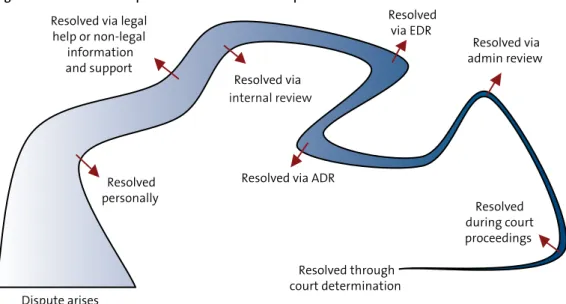
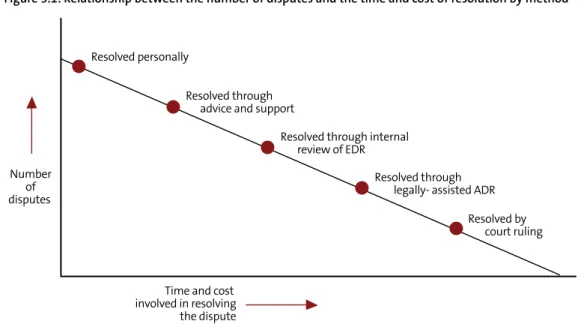
Figure 1.1: The relationship between the number of disputes and method of resolution
Access to justice is not only about accessing institutions to enforce rights or resolve disputes but also about having the means to improve ‘everyday justice’; the justice quality of people’s social, civic and economic relations. This means giving people choice and providing the appropriate forum for each dispute, but also facilitating a culture in which fewer disputes need to be resolved. Claims of justice are dealt with as quickly and simply as possible—whether that is personally (everyday justice) informally (such as ADR, internal review) or formally (through courts, industry dispute resolution, or tribunals).11
What happens in each of these spheres of justice influences the quality of justice in the others. Improving access to justice requires improving access to formal and informal justice mechanisms and improving the justice quality of daily life.12 A strategic approach highlights the link between the
demand for better information and the benefits of tailoring avenues that empower people to resolve disputes—or provide pathways that do not require a lawyer’s assistance. In addition to enhancing people’s capacity to understand their position and where possible, resolving matters themselves— providing a range of mechanisms to resolve disputes also increases access to justice.
This approach recognises that a focus on formal justice, while important, is by itself not enough. An example of how these lessons apply can be found in recent changes in the family law context. To address family disputes which cannot be resolved between the parties, government intervention is directed towards a number of avenues. These range from targeted and accessible information, through to informal services such as mediation and, for a small number of cases, the formal justice mechanism of court‑based dispute resolution. Each institution has its advantages and disadvantages. Courts tend to be more expensive for parties and government, but are well placed to resolve complex and/or violent family disputes. Family relationship services are potentially useful in minimising adversarial mind frames and helping parties that need to maintain ongoing family relationships. For minor disputes, useful and accessible information may be sufficient to guide them in their dispute. 11 C Parker, Just Lawyers: regulation and access to justice, 1999, p 64.
12 Ibid p 67. Dispute arises Resolved personally Resolved through court determination Resolved via ADR
Resolved via internal review Resolved during court proceedings Resolved via EDR Resolved via admin review Resolved via legal
help or non-legal information and support
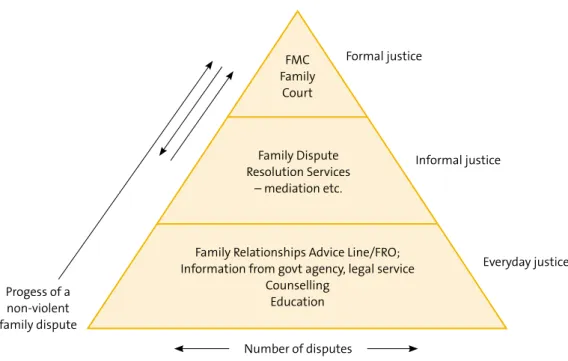
For example, Government intervention in a non‑violent family dispute focuses initially on improved access to information, to filter some disputes and assist all, then mandate the use of informal mechanisms to reserve the most entrenched disputes (and those involving violence) for the courts.
Figure 1.2 demonstrates how this operates.
Figure 1.2: The relationship between number of family disputes and method of resolution
Accordingly, the justice system is the totality of the institutions, agencies and services outlined at the start of this Chapter.
Access to justice has traditionally been seen as access to the courts or the availability of legal assistance, but this is a narrow view. Courts are not the primary mechanism through which people seek to resolve disputes or potential disputes. legal assistance programs are only one part of a complex system.
Improving access to justice requires a broad examination of how the system and its various institutions influence each other and work together to support or limit people’s capacity to address legal problems and resolve disputes. Reforming one or more of the individual institutions or programs might assist current clients or users, but will not provide sustainable access to justice benefits or increase the number or profile of beneficiaries. A whole of system examination is needed.
“Improving access to justice requires a broad examination of how
the system and its various institutions influence each other and
work together to support or limit people’s capacity to address legal
problems and resolve disputes.”
Progess of a non‑violent family dispute Number of disputes Formal justice Informal justice Everyday justice FmC Family Court Family Dispute Resolution Services – mediation etc.
Family Relationships Advice line/FRO; Information from govt agency, legal service
Counselling Education
Recent history of access to justice reviews
In the past 15 years there have been several important reviews about access to justice. Access to Justice: An action plan – The Access to Justice Advisory Committee Report (1994) In 1993, the then Attorney‑General michael lavarch and minister for Justice Duncan kerr commissioned an advisory committee led by Ronald Sackville QC, later a judge of the Federal Court of Australia, to consider ways in which the legal system could be reformed in order to enhance access to justice and make the legal system fairer, more efficient and more effective. The Committee took a broad view of access to justice and looked at a range of court based and non‑ court based issues, including regulation of the legal services market, legal aid, ADR, court fees, case management, legislation and provision of information.
Possibly as a result of the wide focus of the report, released in may 1994, the Committee’s recommendations in some areas were very broad. For example, recommendations on ADR were limited to:
that a range of ADR options should be available to courts
•
that ADR programs and issues should be the subject of further study.
•
Similarly, the Committee recommended that the reform of court procedures—including case management—be developed and further researched, but it made no recommendations on any particular case management techniques that could be adopted.
In response to the Report, the Government released a Justice Statement in may 1995. It noted that further improvements to the justice system—through the use of ADR and other mechanisms for resolving disputes—should be encouraged. The statement encompassed a wide‑ranging national strategy to create a simpler, cheaper and more accessible justice system, and specifically endorsed, among other things, court charters, active management of litigation by courts and tribunals, benchmarking as a means of enabling courts to measure their efficiency and effectiveness, and professional development programs for judges.
Access to Justice: Final Report (United Kingdom) (1996)
A major review of the rules and procedures of civil justice courts in England and Wales undertaken by then master of the Rolls, the Right honourable the lord Woolf (later lord Chief Justice of England and Wales). The Woolf Report (as it came to be known) was focused on access to justice issues in litigation and the court system. It made detailed recommendations on all aspects of case management and court rules and procedures.
Managing Justice: A review of the federal civil justice system – Australian Law Reform Commission Report No 89 (1999)
The managing Justice Report was the end product of a comprehensive inquiry by the Australian law Reform Commission (AlRC) into access to justice. Specifically, the AlRC was to make
recommendations with a view to developing a ‘simpler, cheaper and more accessible legal system’.13
The AlRC was charged under its terms of reference with focusing largely on court practices and procedures and case management in Commonwealth courts and tribunals, but the report also 13 Australian law Reform Commission, Managing Justice: A review of the federal civil justice system, Terms of Reference,
looked at legal assistance—including pro bono work and legal aid commissions (lACs), model professional practice rules for the legal profession, legal costs and legal education.
Federal Civil Justice System Strategy Paper (2003)
The Federal Civil Justice System Strategy Paper was prepared by the Attorney‑General’s Department as a response to the AlRC’s managing Justice Report. The Strategy Paper’s stated purpose was to make recommendations for short‑term improvements to the federal civil justice system and to raise some longer term issues for further consideration.14 The Strategy Paper looked at a broad range of
access to justice issues, primarily looking at keeping disputes out of court and ensuring that disputes that do reach court are resolved as efficiently and cheaply as possible.
Civil Justice Review – The Victorian Law Reform Commission Report (2008)
In may 2004, the victorian Government released a Justice Statement, which outlined directions for reform of victoria’s justice system. The Justice Statement set out broad directions for both the civil and criminal justice systems, including for the civil justice system that:
courts be made more accessible, especially for those in regional areas and those from
•
multicultural or Indigenous backgrounds
technology be used more to improve the efficiency of service delivery and information provision
•
civil disputes be able to be resolved earlier by increasing access to out‑of‑court dispute resolution
•
and more low level intervention, and
the legal profession be reformed to make it more efficient, accountable and responsive to
•
consumer needs.
Following the Justice Statement, the victorian Attorney‑General Rob hulls asked the victorian law Reform Commission (vlRC) to undertake a comprehensive review of access to justice in victoria. The vlRC was given broad terms of reference to, amongst other things, ‘identify the key factors that influence the operation of the civil justice system’, with a particular view to modernising and simplifying the rules of civil procedure, reducing the cost of litigation and increasing the timeliness, transparency, efficiency and accountability of the civil justice system. The vlRC report was released in 2008 and made a large number of recommendations, focusing on court‑based reforms with detailed recommendations on pre‑trial procedures, case management issues and evidence rules.
This report
The purpose of this report is to undertake a broad examination of the federal civil justice system. It has begun, in this introduction, with an examination of the importance and scope of access to justice. Part I sets up an empirical picture of access to justice through an analysis of supply and demand. This informs Part II, which outlines the report’s Central Recommendation, the adoption of a Strategic Framework for Access to Justice. Part III contains specific discussion and Recommendations drawing on the Strategic Framework.
“The purpose of this report is to undertake a broad examination
of the federal civil justice system.”
14 Attorney‑General’s Department, Federal Civil Justice System Strategy Paper, Executive Summary, <http://www.ag.gov.au/ www/agd/agd.nsf/Page/Publications_FederalCivilJusticeSystemStrategyPaper‑December2003>.
Part I: Supply and demand – the empirical basis
A framework for access to justice should begin with establishing an empirical base. People experience a multiplicity of legal issues and disputes throughout their lifetime, ranging from the simple to the highly complex. To improve the way Australia’s justice system functions and help people resolve their legal issues, governments need to understand:
what sorts of disputes there are; their nature and number (demand), and
•
the options for resolving those disputes and the costs and effectiveness of those options (supply).
•
This will help identify gaps in the justice system and inform and justify government intervention in the civil justice system.
Part I sets out an empirical basis; an assessment of the supply and demand aspects of the federal civil justice system—who uses the justice system and how; who is excluded from it; and what justice services, programs or institutions are ‘supplied’ to meet that demand. It identifies a mismatch in that demand and the available supply.
Part II: Strategic Framework for Access to Justice
Arising out of the demand and supply conclusions, the report proposes, as its central
Recommendation, a Strategic Framework to guide future reforms to the justice system and decisions relevant to access to justice (Chapter 5). The Strategic Framework is intended to be a tool for policy makers to ensure better and more integrated access to justice outcomes.
The Central Recommendation informs the specific recommendations contained in Part III but is also intended to encourage innovative policy initiatives, consistent with the Strategic Framework, to improve access to justice.
Part III: Supporting the Strategic Framework – specific discussion and recommendations
Finally, the report proposes a number of Recommendations that illustrate how the Strategic Framework could positively influence justice reform by Government, courts and service providers. Chapters 6–12 consider access to justice in the following specific contexts:information about the law (Chapter 6)
•
non‑court models of dispute resolution (Chapter 7)
•
the courts (Chapter 8)
•
costs (Chapter 9)
•
administrative law (Chapter 10)
•
legal assistance (Chapter 11), and
•
building resilience (Chapter 12).
•
Each Chapter examines an aspect of the justice system, and makes a number of Recommendations consistent with the Strategic Framework.
Chapter 2: The Demand for Justice
executive Summary
This Chapter establishes an empirical base for the ‘demand’ for justice—an analysis of the nature and extent of the disputes which arise in society. This includes identifying some of the factors that influence how and why people experience disputes or legal problems that need to be resolved; and an analysis of the usage of the current justice services, such as legal advisers, government and information providers.
The Chapter will begin with a brief examination of overt demand for justice—approaches to service providers. This will be followed by an examination of the following issues:
what types of legal issues people experience
•
factors influencing whether a person experiences legal issues—including the demographic
•
factors at play and the impact of particular legal events on the incidence of future events what people do in response to a legal issue—including people who do nothing, those who
•
handle the issue alone and those who seek assistance the outcomes of legal events, and
•
a brief consideration of demand issues in connection with small business.
•
In Chapter 4: Conclusions, the empirical data gathered in this Chapter in answer to these questions is compared with the material in Chapter 3 on supply to reach conclusions on the current state of access to justice in the federal civil justice system.
As will become clear, the scope of data available on access to justice is uneven, and where available is often difficult to compare effectively—Chapters 2 and 3 use the best available data, but further and better data collection is necessary to build a more complete picture.
overt demand in the federal civil justice system
Significant demand for federal civil justice services is shown by the numbers of justice services that are accessed. For example:
Family Relationship Centres (FRCs) see almost 5000 clients each month
•
Community legal Centres (ClCs) provide over 250,000 Commonwealth funded advice and
•
information services every year
Indigenous legal aid services provided over 170,000 services in 2007–08
•
in 2007–08, lACs provided, in relation to Commonwealth law matters, 579,000 legal information
•
services, over 200,000 advice and assistance services (including duty lawyer services), around 30,000 grants of aid for litigation and over 16,000 grants for representation in family dispute resolution (FDR)
29,941 applications for review of government decisions were lodged with the Social Security
•
Appeals Tribunal (SSAT), Refugee Review Tribunal (RRT)/migration Review Tribunal (mRT), veterans’ Review Board (vRB) and the Administrative Appeals Tribunal (AAT)
the Commonwealth Ombudsman received 19,621 approaches and complaints about agencies
•
within its jurisdiction in 2007–08
the Telecommunications Industry Ombudsman (TIO) received 149,742 complaints in 2007–08
•
4579 matters were commenced in the Federal Court, 20,337 in the Family Court and 77,169 in
•
the Federal magistrates Court (FmC) in 2007–08, and
the institutions that make up the justice system field millions of approaches and requests
•
for information and assistance each year—in 2007–2008, these approaches totalled over 55 million.15
The economic downturn is likely to mean that more people will be making some contact with the justice system, or an agency that provides information or services relating to legal issues for help. For example:
bankruptcies are up by 18 per cent
•
ClCs are reporting that demand for help in tenancy, welfare and credit matters is up by as much
•
as 25 per cent, and
lawAccess NSW reports a 30 per cent increase in information and advice sessions concerning
•
credit/debt matters in the last 12 months.16
“The institutions that make up the justice system field millions of
approaches and requests for information and assistance each year—
in 2007–2008, these approaches totalled over 55 million.”
what types of legal issues do people experience?
The law and Justice Foundation of NSW in its report Justice Made to Measure17 found that 62.4 per
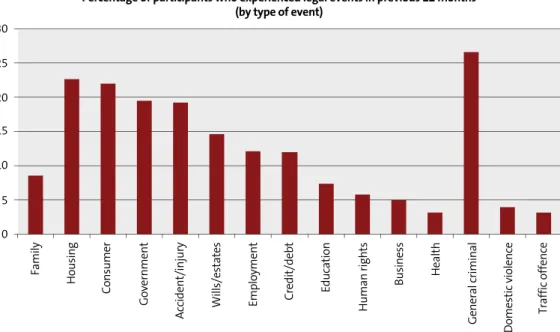
cent of the people it surveyed had experienced a civil legal issue in the 12 months prior to the survey, and 8.5 per cent experienced a family legal event. housing, consumer, government and accident/ injury issues were the most common civil law issues that arose.18 Over 45 per cent of the civil legal
events experienced by people related to matters which, in whole or part, were within an area of Commonwealth responsibility. Four of the seven most common civil legal issues reported are issues with an aspect falling within Commonwealth responsibility or arising under Commonwealth law. These were: consumer (22 per cent of all participants), government (19.5 per cent), employment (12.1 per cent) and credit/debt (12.0 per cent).19 A significant proportion of the family legal events
were also matters within Commonwealth responsibility.20
15 Compiled by the Access to Justice Taskforce from information provided by a range of service‑providers including legal assistance providers, government agencies, ombudsmen and EDR providers.
16 Submission by the NSW legal Assistance Forum to the house of Representatives Inquiry into the impact of the global financial crisis on regional Australia and the role of the Commonwealth Government in ensuring that Australia is equipped to respond, 11 may 2009, http://www.aph.gov.au/house/committee/itrdlg/financialcrisis/subs/sub148.pdf
17 law and Justice Foundation of New South Wales, Justice Made to Measure: NSW Legal Needs Survey in Disadvantaged Areas, 2006. People surveyed came from six local government areas in New South Wales, three metropolitan, one provincial and two rural/remote. Areas were selected having regard to geographic diversity, socioeconomic disadvantage, cultural and linguistic diversity and population size. While the survey was conducted in disadvantaged areas, it should not be assumed that individual participants were disadvantaged.
18 Ibid p 73.
19 law and Justice Foundation of New South Wales, Justice Made to Measure: NSW Legal Needs Survey in Disadvantaged Areas, 2006 p 47‑49. Including consumer, credit/debt, education, employment, government and human rights.
A dispute is a conflict or disagreement between two or more people or organisations, whereas a ‘legal issue’ does not require conflict or disagreement. The level of disputes experienced is lower than the level of legal issues more broadly. For example, some of the legal events reported in the NSW survey were relatively benign—in relation to housing, nine per cent of the events related to buying or selling a house.21 The 2007 Dispute Resolution in Victoria: Community Survey22 found that 35 per cent of victorians had at least one dispute in the previous 12 months, with 18 per cent of victorians having had one or more disputes with family, neighbourhood or associations, and 25 per cent with business or government.23 Significantly, 37 per cent of respondents to a united kingdom
(uk) study reported having problems with local authorities.24
Figure 2.1 presents a breakdown of the type of legal events participants in the NSW survey had
experienced in the previous twelve months. Figure 2.1: Types of legal events experienced
This graph shows the percentage of participants who experienced each type of legal event. As some participants experienced no events and others experience a number of events, the numbers do not amount to 100 per cent. Law and Justice Foundation, 2006.
21 Ibid p 74.
22 Ipsos Australia (prepared for the victorian Department of Justice), Dispute Resolution in Victoria: Community Survey 2007
Report, 2007.
23 Ibid p i.
24 Department for Constitutional Affairs (uk), R moorhead and m Robinson, A Trouble Shared – legal problems clusters in
solicitors’ and advice agencies, DCA Research Series 8/06, 2006, p 35.
30 25 20 15 10 5 0 Fa m ily H ou si ng C on su m er G ov er nm en t A cc id en t/ in ju ry W ill s/ es ta te s Em pl oy m en t C re di t/ de bt Ed uc at io n H um an ri gh ts Bu si ne ss H ea lt h G en er al c ri m in al D om es ti c vi ol en ce Tr af fic o ff en ce
Percentage of participants who experienced legal events in previous 12 months (by type of event)
Factors influencing whether a person experiences legal issues
Who experiences legal issues?
Research has identified that certain demographic factors become consistently observable and statistically significant in relation to the experience and reporting of legal events. Demographic factors may result in a generally higher or lower number of legal issues, but also may be indicative of the likelihood of specific types of legal issues arising.
The law and Justice Foundation study found that ‘age, country of birth, disability status, personal income and education level were statistically independent predictors of reporting legal events (of any type)’.25 Of these, there was a clear trend that disability was significant, with the finding that
people with a chronic illness or disability have increased vulnerability for experiencing nine out of the 10 most frequently occurring legal issues.26 Some demographic trends became important in
relation to vulnerability to experiencing particular types of events. Indigenous status was reported as significant in relation to consumer, employment, wills and family events.
“Age has been reliably linked to the incidence of legal events.”
In relation to other demographic factors, empirical research both in Australia and internationally shows some trends:Age has been reliably linked to the incidence of legal events.
• 27 Australian research shows that a
person’s age was relevant to their likelihood of experiencing consumer and credit/debt issues. For example, 15–24 year olds were 7.1 times more likely than over 65 year olds to report a consumer legal event, and vulnerability to a credit/debt legal issue was 8.5 times more likely for 25–34 year olds than over those over 65. Similar trends are apparent in relation to accident and injury, family, education, employment, government and housing legal issues.28 This is consistent
with research from the uk, united States of America (uS) and New Zealand which tends to show that younger people tend to experience legal issues at a higher rate than older people.
gender has not been reliably related to the overall incidence of legal events, but does occur in
•
relation to particular types of legal events—studies indicate that females experience higher rates of family law issues, domestic violence, housing and loan issues, issues concerning government departments, and clinical negligence issues29
As noted above, chronic illness or disability increased vulnerability for experiencing nine out
•
of the 10 most frequently occurring legal issues. People with disability were: 2.1 times more likely than people without a disability to experience a consumer related legal event, 1.7 times more likely to experience a credit/debt legal issue, and 1.5 times more likely to experience an employment related legal event than a person without a disability respectively.
25 law and Justice Foundation of New South Wales, Justice Made to Measure: NSW Legal Needs Survey in Disadvantaged Areas, 2006, p 79.
26 Ibid p 90; see also Table 3.6, p 91.
27 law and Justice Foundation of New South Wales, Justice Made to Measure: NSW Legal Needs Survey in Disadvantaged Areas, 2006 p 26.
28 Ibid pp 83–90.
Indigenous status, while not being a general indicator, was significant in relation to several
•
specific types of legal events.30 These include credit/debt and family and employment related
legal issues where Indigenous people were twice as likely report such issues than non‑ Indigenous people (2.1 times as likely in relation to family events).31
There is a complex relationship between a person’s socio‑economic position and the levels of reporting of legal issues. The data from the law and Justice Foundation report shows that the likelihood of reporting legal events tended to increase with income and education level.32 however,
there is general evidence that socially excluded or disadvantaged groups are more vulnerable to legal issues than others.33 Previous studies have shown that unemployed people and homeless
people appear to have a higher incidence of legal events. A study done in relation to a group known to be disadvantaged—defined as people living in temporary accommodation—found ‘a much higher incidence [of legal events] than the general population’ survey (84 per cent versus 36 per cent), supporting the argument that disadvantaged groups are particularly vulnerable to experiencing legal events.34
“There is a complex relationship between a person’s socio-economic
position and the levels of reporting of legal issues.”
Impact of particular legal events on the incidence of future events
legal issues do not arise in isolation. Nor are they experienced randomly or equally across society. Experiencing one legal issue may increase the likelihood of experiencing further issues because one triggers another, both arise out of the same circumstances or some individuals are vulnerable to experiencing more than one type of legal issue.35 Each time a person experiences a problem they
become increasingly likely to experience additional problems. many legal issues co‑occur, arising in clusters.
Studies have identified different clusters or co‑occurrences of types of legal events. The law and Justice Foundation identified a number of clusters (and sub‑clusters), including for example a cluster comprising family, domestic violence, human rights and education events tending to co‑occur, with family and domestic violence events forming one sub‑cluster, and human rights and education events forming a second sub‑cluster.36
30 Ibid pp 83–90.
31 Note that this relates to civil legal issues. Indigenous people continue to experience disproportionately higher levels of contact with the criminal justice system.
32 law and Justice Foundation of New South Wales, Justice Made to Measure: NSW Legal Needs Survey in Disadvantaged Areas, 2006, p 82.
33 P Pleasence, A Buck, N Balmer, A O’Grady, h Genn & m Smith, Causes of Action: Civil Law and Social Justice – the final report
of the first LSRC survey of justiciable problems, 2004, p 11. The report showed that 66 per cent of lone parents reported
problems, while just 33 per cent of married or co‑habiting respondents without children did so.
34 law and Justice Foundation of New South Wales, Justice Made to Measure: NSW Legal Needs Survey in Disadvantaged Areas, 2006, pp 27–29.
35 Ibid p 25.
36 Ibid p 77. Depending on the type of analysis undertaken the groupings included a broad range of legal event groups, comprising general crime, consumer, government, housing, accident/injury, employment and wills/estates events. A second grouping comprises family, domestic violence, human rights and education events, with family and domestic violence events forming one sub‑cluster, and human rights and education events forming a second sub‑cluster, and a third economic cluster comprising business, credit/debt and consumer events.
This is consistent with international studies, which have variously identified groupings of legal issues. A uk study in 2004 identified four main clusters of events: a family cluster (comprising domestic violence, divorce, relationship breakdown, children problems); a homelessness cluster (comprising rented housing, homelessness, unfair treatment by police, formal action against the respondent); a health and welfare cluster (comprising clinical negligence, mental health, immigration, welfare benefits); and an economic cluster (comprising consumer problems, money/ debt, neighbours and employment problems). An earlier study in 1999 reported correlations between the different pairs of economic problems: money and employment, money and rented accommodation, consumer and owning property, and employment and owning property.37
Similarly, some types of issues may be more likely to occur with other legal issues. For example, the law and Justice Foundation found that 34 per cent of people who reported an employment related legal issue also reported other legal issues. Similarly, 27.7 per cent of people who reported a human rights issue, and 23–24 per cent of people who reported a consumer, credit/debt or government related legal issue also reported another legal issue. In fact, the Foundation notes that a minority of participants accounts for a disproportionate number of the legal events reported:
…the third of participants who reported three or more legal events accounted for more than three‑quarters (79.0 per cent) of the 5776 legal events reported. less than one‑quarter of the sample (23.9 per cent) accounted for two‑thirds of the events (67.5 per cent) and about one‑sixth of the sample (16.4 per cent) accounted for over half the events (54.9 per cent).38
This pattern is consistent with international research. For example, of the 37 per cent of respondents to one uk survey who reported one or more justiciable problem, 46 per cent reported two or more, and of those 47 per cent reported three or more. This pattern continued as the number of problems increased, culminating in 88 per cent of respondents who reported eight or more problems reporting nine or more.39
what do people do when they experience a legal issue?
The law and Justice Foundation of NSW found that 67.2 per cent of people faced with a legal issue took some action to resolve it, either seeking some assistance (51.2 per cent) or handling the legal issue on their own (16 per cent). Just under a third of people took no action (32.8 per cent).40
In the Dispute Resolution in Victoria : Community Survey 2007, 65 per cent of disputes were resolved without the assistance of a third party legal or non‑legal service provider, while 15 per cent involved a third party and 25 per cent were not resolved.41
37 P Pleasence, A Buck, N Balmer, A O’Grady, h Genn & m Smith, Causes of Action: Civil Law and Social Justice – the final report of
the first LSRC survey of justiciable problems, 2004 and Genn (1999) in law and Justice Foundation of New South Wales, Justice
Made to Measure: NSW Legal Needs Survey in Disadvantaged Areas, 2006, p 25.
38 law and Justice Foundation of New South Wales, Justice Made to Measure: NSW Legal Needs Survey in Disadvantaged Areas, 2006, p 72.
39 P Pleasence, A Buck, N Balmer, A O’Grady, h Genn & m Smith, Causes of Action: Civil Law and Social Justice – the final report of
the first LSRC survey of justiciable problems, 2004, p 31.
40 law and Justice Foundation of New South Wales, Justice Made to Measure: NSW Legal Needs Survey in Disadvantaged Areas, 2006, p 93.
41 Ipsos Australia (prepared for the victorian Department of Justice), Dispute Resolution in Victoria: Community Survey 2007
Report, 2007. NB: ‘assistance’ was characterised as assistance from a third party legal or non‑legal service provider (and
Figure 2.2: Individuals’ response to legal issues42
In the specific area of credit/debt and other financial issues, the 2009 Wesley Report indicated that only about one in four respondents (26 per cent) to the Wesley mission Survey sought help after experiencing financial concerns, while 47 per cent sought no help at all.43 Of the 26 per cent who
did seek help, the majority turned to a family member (47 per cent) or spouse/partner (29 per cent) for guidance, and only 3 per cent of respondents turned to a professional financial counsellor for assistance.44 Differences between those that sought financial advice and those that did not was
most evident in the single‑parent households surveyed, who were 30 per cent more likely to avoid a counsellor in times of financial worry.45
People who took no action
A significant proportion (32.8 per cent) of people surveyed by the law and Justice Foundation took no action when faced with a legal event.
Reasons for inaction
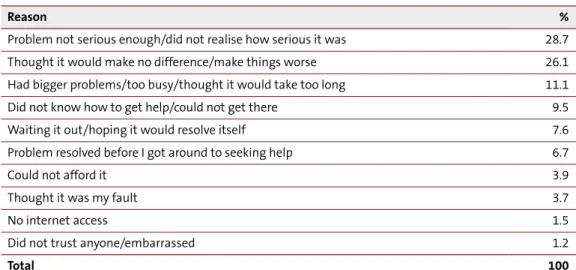
People cited a range of reasons for doing nothing in response to a legal issue—the most common reasons relate to lack of knowledge, lack of capacity, disempowerment or exclusion.46 For example,
26 per cent of people thought action would make no difference or make things worse.
42 Based on data from the law and Justice Foundation of NSW, 2006.
43 The Wesley mission, Financial Hardship, the Hidden Human Cost, The Wesley Report, 2009, p 26. 44 Ibid.
45 Ibid p 44.
46 law and Justice Foundation of New South Wales, Justice Made to Measure: NSW Legal Needs Survey in Disadvantaged Areas, 2006, p 94. Handled alone 16% Did nothing 32.8% Sought help 51.2%
Table 2.1: Individuals’ reason for doing nothing in response to legal events
Reason %
Problem not serious enough/did not realise how serious it was 28.7 Thought it would make no difference/make things worse 26.1 had bigger problems/too busy/thought it would take too long 11.1 Did not know how to get help/could not get there 9.5 Waiting it out/hoping it would resolve itself 7.6 Problem resolved before I got around to seeking help 6.7
Could not afford it 3.9
Thought it was my fault 3.7
No internet access 1.5
Did not trust anyone/embarrassed 1.2
Total 100
Interestingly, while cost influences people’s choice of where to seek assistance (see below), it does not appear to greatly influence the choice of whether or not to take action.
The high rate of inaction and pervasive belief that action was (in some form) either not an option or would make no difference suggests there is a need for interventions targeted to increasing the level of awareness and capacity to access information, advice and services.
Doing so could address up to 80 per cent of the stated reasons for not taking action in relation to legal issues.
Similar findings appear in international research. For example, of the respondents to the Continuous English and Welsh Civil and Social Justice Survey, 62 per cent reported that they did not know what their legal rights were relating to the problem when it arose. Further, 69 per cent of respondents stated that they did not know the types of formal processes—like court proceedings and
mediation—were sometimes used to deal with the sort of problem they were facing. Importantly, awareness of rights and options increased in line with education and income levels. For example, 49 per cent of those earning £50,000 or more per annum indicated an awareness of their rights, compared with only 24 per cent of those earning £10,000 and less per annum.47 Further, 50 per cent
of those who earn £50,000 and over reported they did not know about the processes for resolving their problem, compared with 79 per cent of those earning £10,000 and less.48
The type of legal issue
The research shows that the type of action, or inaction, varies by problem type. For example, people were more likely to do nothing in relation to human rights issues (63.6 per cent) and credit/debt issues (42.3 per cent) than they were in relation to issues surrounding wills or estates. The likelihood of seeking help was higher than average for employment issues (56.6 per cent), but lower than average for consumer (37.3 per cent) or credit/debt legal issues (42.3 per cent).49
47 A Buck, P Pleasence and N Balmer, Education Implications for the English and Welsh Civil and Social Justice Survey, 2007, pp 4, 22. 48 Ibid p 26.
Results of the law and Justice Foundation’s survey about action taken in relation to legal events are summarised in the following figure:
Figure 2.3: Action taken in response to legal events by legal event group, all six LGAs, 2003
Reproduced from law and Justice Foundation of New South Wales, Justice Made to Measure: NSW Legal Needs Survey in Disadvantaged Areas, 2006. Civil human rights (n=88) Consumer (n=432) Credit/debt (n=26) housing (n=250) Education (n=149) Government (n=324) Employment (n=297) Accident/injury (n=415) health (n=74) Business (n=99) Wills/estates (n=302) Criminal Traffic offences (n=24) General crime (n=198) Domestic violence (n=69) Family (n=168) 0 10 20 30 40 50 Percentage of events
Sought help handled alone Did nothing
60 70 80 90 100 27.3 9.1 63.6 37.3 28.2 34.5 42.3 15.4 42.3 47.6 17.2 35.2 51.0 21.5 27.5 55.2 12.7 32.1 56.6 8.4 35.0 57.8 11.3 30.8 59.5 12.2 28.4 59.6 18.2 22.2 60.3 22.5 17.2 25.0 25.0 50.0 48.5 7.1 44.4 49.3 13.0 37.7 55.4 12.5 32.1
The findings from a uk survey on justiciable problems suggest that respondents who did not act to resolve their legal issue were most likely to think nothing could be done to resolve their issue if it related to mental health (64 per cent) and discrimination (52 per cent) problems, and least likely to believe nothing could be done to resolve problems regarding personal injury (23 per cent).50
Demographic indicators
Indigenous Australians were the group most likely to take no action in response to legal events, doing so for 50.9 per cent of legal events, compared with 32 per cent for non‑Indigenous people.51
young people (15–24) were more likely to do nothing—taking no action in response to 41 per cent of legal issues, compared to 25 per cent for people 65 and over.52 In one uk study, 15 per cent of 18
to 24 year olds surveyed did nothing to resolve their legal problems, and 58 per cent faced their issue without seeking advice.53 When asked why they took no action, young respondents most commonly
said that they thought advice would not alter the outcome.
People who handled legal events alone
The law and Justice Foundation of NSW reported that 16 per cent of people who experienced a legal issue handled it alone.54 In the uk, 17.5 per cent of participants in one survey handled their
problems alone, without ever seeking advice. In handling problems alone, these respondents most often simply talked or wrote to ‘the other side’ involved in a dispute, and attempted to negotiate a solution.55 Such strategies are often the best way to proceed, and the most likely way to reach an
amicable solution.
however, a concern must be that unless people who handle matters themselves have sufficient information, they may be less able to negotiate an outcome that reflects their legal rights, or might be more willing to accept an unsatisfactory outcome. This is particularly true having regard to the high proportion of reasons given for doing nothing that reflect a lack of knowledge, disempowerment or fear.
In terms of demographic indicators, people over 65 were more likely to try and handle legal issues alone, handling 25 per cent of events alone compared with an average across other age groups of 15.5 per cent.56 People whose income was more than $1000 per week are slightly more inclined to
handle legal events on their own, doing so for 19.6 per cent of events, compared with an average of 15.4 per cent for lower income groups.57
50 P Pleasence, A Buck, N Balmer, A O’Grady, h Genn & m Smith, Causes of Action: Civil Law and Social Justice – the final report of
the first LSRC survey of justiciable problems, 2004, p 51.
51 law and Justice Foundation of New South Wales, Justice Made to Measure: NSW Legal Needs Survey in Disadvantaged Areas, 2006, p 97.
52 Ibid.
53 legal Services Research Centre (uk), Young People and Civil Justice: Findings from the 2004 English and Welsh Civil and Social
Justice Survey, 2004, p 10.
54 law and Justice Foundation of New South Wales, Justice Made to Measure: NSW Legal Needs Survey in Disadvantaged Areas, 2006, p 92.
55 P Pleasence, A Buck, N Balmer, A O’Grady, h Genn & m Smith, Causes of Action: Civil Law and Social Justice – the final report of
the first LSRC survey of justiciable problems, 2004, p 57.
56 law and Justice Foundation of New South Wales, Justice Made to Measure: NSW Legal Needs Survey in Disadvantaged Areas, 2006, p 97.
People who sought assistance with their legal events
Just over half the people surveyed by the law and Justice Foundation of NSW sought help in response to a legal issue.58 In the uk, when action was taken to resolve a legal issue, 51 per cent of
respondents reported that they sought advice to assist them in the resolution process.
In victoria, where the Ipsos survey characterised ‘assistance’ as assistance from a third party legal or non‑legal service provider (and therefore did not encompass assistance from people such as family and friends), 65 per cent of disputes were resolved without the assistance of a third party legal or non‑legal service provider, while 15 per cent involved a third party and 25 per cent were not resolved.59
Who do people turn to for assistance, and why?
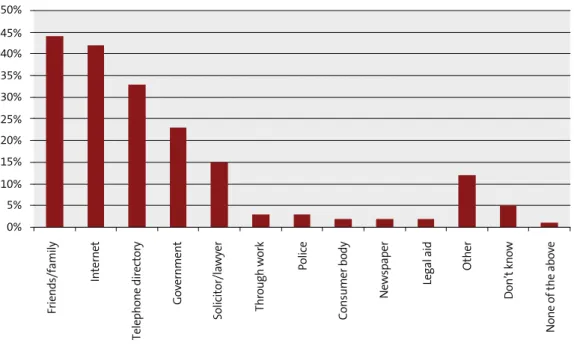
Demand for legal information is high. yet people do not seek information from legal sources for their legal problems. Non‑legal advisers are the primary providers of help for legal disputes. The law and Justice Foundation of NSW measured demand in NSW and found that, of the people who sought assistance, 74.4 per cent saw a non‑legal adviser.60 Non‑legal professionals were more likely to be
consulted first, which is significant given that 78.4 per cent of people only use one adviser. Of the people who saw a non‑legal adviser, 24.5 per cent saw a non‑legal professional, such as a doctor, accountant, psychologist or counsellor.61
“People do not seek information from legal sources for their
legal problems.”
Only 25.6 per cent used a legal adviser. Of these, 12 per cent used a ‘traditional’ legal adviser (most commonly a private solicitor or barrister) or a friend who happened to be a lawyer (7 per cent). One striking result is that 8 per cent used published sources such as the internet.62
This suggests that while there is demand for legal advice, information or assistance with legal issues—noting that 51 per cent of people sought some assistance—there seems to be a mismatch in the services supplied as the overwhelming majority of the relevant ‘supply’ was through non‑legal sources. Even in cases where legal assistance was sought and written information was provided, approximately 20 per cent of that written information was books or leaflets (10.6 per cent), websites (6.1 per cent) and kits (1.2 per cent).63 The quality of published legal information needs to be as high
as possible as it is used so often.
Of those surveyed by the law and Justice Foundation of NSW, 61.8 per cent encountered no barrier in accessing assistance when it was sought. however, 38.2 per cent of people encountered a barrier in seeking assistance, compromising their ability to access the justice system.64
58 Ibid p 99.
59 Ipsos Australia (prepared for the victorian Department of Justice), Dispute Resolution in Victoria: Community Survey 2007
Report, 2007, p i.
60 law and Justice Foundation of New South Wales, Justice Made to Measure: NSW Legal Needs Survey in Disadvantaged Areas, 2006, p 103.
61 Ibid 104.
62 Ibid. NB: the private legal advisers were most often approached in relation to legal issues arising from wills/estates – 33.5 per cent of cases (see p 110).
63 law and Justice Foundation of New South Wales, Justice Made to Measure: NSW Legal Needs Survey in Disadvantaged Areas, 2006 p 108.
Figure 2.4: Type of assistance sought
‘Non‑legal professional’ refers to professionals such as doctors, accountants, psychologists and counsellors. Data from the Law and Justice Foundation of NSW, 2006.
The 2007 victorian Dispute Resolution Survey explored the factors that influenced people’s choice of service, having regard to the factor that might encourage the use of an ADR service, and what might deter them from using such a service. The results showed that people were more likely to choose one pathway over another if it is cheaper (37 per cent), easier (24 per cent) and quicker (16 per cent).65
People were less likely to use a dispute resolution service based on the perceived cost (20 per cent) or the time involved in dealing with an outside agency (13 per cent).66 The disadvantages of courts
and tribunals that were most frequently cited were cost (52 per cent) and time (37 per cent).67
Interestingly, concerns about cost and time were greater among university qualified and higher income groups than those that had less education or were from lower income groups.68
Time also appears as a significant barrier in the results of the law and Justice Foundation of NSW survey. The primary barriers reported were the telephone line being engaged or being placed on hold for too long (18.4 per cent of events where help was sought), delays in getting a response (17 per cent), and difficulty in getting an appointment (11 per cent).69 The lack of local services/not being
65 Ipsos Australia (prepared for the victorian Department of Justice), Dispute Resolution in Victoria: Community Survey 2007
Report, p 19–20. Note that the results are in terms of being cheaper, easier etc than court, vCAT or Tribunal process or of
getting legal advice. 66 Ibid p 22. 67 Ibid p 24. 68 Ibid p 23.
69 law and Justice Foundation of New South Wales, Justice Made to Measure: NSW Legal Needs Survey in Disadvantaged Areas, 2006, p 116. 0% 5% 10% 15% 20% 25% 30% La w ye r o r l eg al as si st an ce Lo ca l c ou rt La w ye r f ri en d/ re la ti ve Pu bl is he d le ga l in fo rm at io n N on -la w ye r f ri en d/ re la ti ve G ov er nm en t Po lic e In du st ry c om pl ai nt ha nd lin g bo dy N on -le ga l pr of es si on al Sc ho ol /s ch oo l co un se llo r/ te ac he r N on -le ga l co m m un it y gr ou p Pr iv at e ag en cy / or ga ni sa ti on C om pa ny / bu si ne ss b an k In su ra nc e co m pa ny / br ok er Tr ad e un io n/ pr of es si on al b od y Em pl oy er O th er tr ib un al O th er Type of adviser