DOI: 10.5171/2013.311167
Copyright © 2013 Jawahitha Sarabdeen. This is an open access article distributed under the Creative Commons Attribution License unported 3.0, which permits unrestricted use, distribution, and reproduction in any medium, provided that original work is properly cited. Contact author: Jawahitha Sarabdeen E-mail: [email protected]
Learning Styles and Training Methods
Jawahitha Sarabdeen
Faculty of Business and Management, University of Wollongong in Dubai, Dubai, United Arab Emirates
_________________________________________________________________________________
Abstract
As the learners have their own preference in learning, trainers should customise their training programmes and training methods to maximize the outcome of the training. This paper analyses the major theories on learning styles and applies one of them to the students in Dubai to understand their various learning styles. The research applied Fleming’s VARK theory through survey conducted among 106 students and the result shows that there are variations in learning preference. Most of the students fall within reader or writer and kinaesthetic categories. The research also confirmed that the students could possibly have more than one learning styles. Thus the research in theory confirmed the earlier research findings that learning styles must be taken into consideration for better learning outcome. The practical implication is that the trainers should adopt various learning strategies to achieve the learning objective.
Keywords: Learning Styles, Training, Trainers, Trainees.
______________________________________________________________________________________________________________ Introduction
Learning style is basically one’s approaches or ways of learning. Every individual has his own preferred way of learning compared to others, therefore it is important to the trainers and educators to understand various styles of learning so that they will be able to effectively engage in transferring knowledge and skills. Learning Styles are researched
since 19th century. The early learning
research concentrated on the relationship between memory and oral/visual learning methods (Dunn et al, 1975 & 1989). Later, the focus shifted to different cognitive styles and strategies that determine a learner’s mode of receiving, remembering, thinking and problem solving (Messick, 1976). Students’ or trainees’ preference of learning style should be matched with instructional materials for better learning outcome (Gregoric, 1985). There were various studies undertaken among the college students and found that learning styles among the accounting and economic or finance students differ from marketing and management students (Dunn et al, 1975 & 1989). The European Commission’s memorandum of
lifelong learning urges the trainers and the training institution to recognise learning diversity and to individualise the approaches. It says that everyone should be able to follow the learning pathways of their own choice
rather than being obliged to follow
predetermined routes to specific destination (EU, 2006). Similarly, the OECD’s ‘Lifelong Learning for All’ suggests the same approach and encourage to use open-ended and interconnected learning targets within a system of personal learning plans and individualised assessment methods (Norman, 2004). This paper will discuss popular theories of learning styles, rationale for using the learning styles and the implication for HRD practitioner. In addition, it will elaborate on a survey conducted by the researcher on the VARK Learning style of learning.
Objective and Methodology
The main objective of this paper is to analyse various learning styles of the trainees and the need to customize the training programmes. In order to achieve the objective, the researcher analysed the existing theories on
learning styles and conducted a survey using VARK model learning style. The VARK questionnaire can serve as a stimulus for interpreting and reflecting on the ways that a learner prefers to learn. In 2011, about 118
questionnaires were distributed and
collected among the students in Dubai to learn their learning preferences; out of which 106 were considered as complete and usable. Literature Review on Learning Styles Learning style was developed by researchers to classify learners based on their approach to perceiving and processing information (Buch & Bartley, 2002). Learning style is defined as “specific behavioural pattern an individual displays in learning” (Campbell, et al, 1996). Dunn defines it as a new way how new information is acquired by individual to develop new skills (1975 & 1989). Kolb (1984) defined it as a process where an individual retain new information and skills. Kolb’s theory of learning styles states that knowledge is created through transformation of experiences. Technology-aided instruction has helped to develop customised learning tools to maximise the benefit. O’Conner (1998) states that it is necessary to examine learning styles and various delivery modes. There are various researchers who studied the learning styles and developed models of learning styles. The most used and researched models were developed by Kolb (1984), Honey and Mumford (1986), Gregorc (1985) and Fleming (1995). Kolb (1984) developed his model of Learning Style Inventory based on the Experiential Learning Theory where he outlined two related approaches toward grasping experience. They are Concrete Experience and Abstract Conceptualisation.
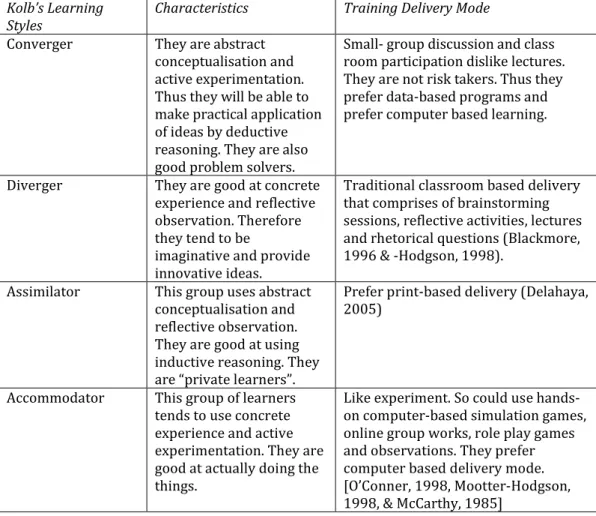
The other approach is related to transforming experience. They are Reflective Observation and Active Experimentation. All four approaches can be useful depending on the situations and the resulting learning styles are combinations of the individual’s preferred approaches. The four learning styles available in Kolb’s model are converger, diverger, assimilator and accommodator (Kolb,1984). The characteristics of the four learning styles and the best delivery method are shown in Table 1:
Buch and Bartely (2002)used Kolb model in his research where they conducted a survey in a large financial services institution in the
Southeast USA. 337 employees were
identified and questionnaire was distributed. 165 participated. The research questionnaire included 5 delivery modes: computer based, TV based, print based, audio based and classroom based. The result revealed that 25% were accommodators 29% were assimilators, 22% were convergers and 24% were divergers. This proved that there are various styles of learning represented in an adult population. The divergers preferred
traditional mode of delivery and
accommodators preferred computer based learning. The finding is one of the many research findings that support Kolb’s theory of Learning Style Inventory. Lum et al (2011) used Kolb in analyzing bridging professional education programmes in three institutions among the three difference professionals in Ontario, Canada. All three professionals found to be divergent. Thus they prefer to observe than participate or act. The authors suggest that the relevant authority should consider offering more courses by considering their learning style.
Table 1: Kolb’s Theory, Characteristics of Various Learners and Best Delivery Methods Kolb’s Learning
Styles
Characteristics Training Delivery Mode
Converger They are abstract
conceptualisation and active experimentation. Thus they will be able to make practical application of ideas by deductive reasoning. They are also good problem solvers.
Small- group discussion and class room participation dislike lectures. They are not risk takers. Thus they prefer data-based programs and prefer computer based learning.
Diverger They are good at concrete
experience and reflective observation. Therefore they tend to be
imaginative and provide innovative ideas.
Traditional classroom based delivery that comprises of brainstorming sessions, reflective activities, lectures and rhetorical questions (Blackmore, 1996 & -Hodgson, 1998).
Assimilator This group uses abstract
conceptualisation and reflective observation. They are good at using inductive reasoning. They are “private learners”.
Prefer print-based delivery (Delahaya, 2005)
Accommodator This group of learners
tends to use concrete experience and active experimentation. They are good at actually doing the things.
Like experiment. So could use hands-on computer-based simulatihands-on games, online group works, role play games and observations. They prefer computer based delivery mode. [O’Conner, 1998, Mootter-Hodgson, 1998, & McCarthy, 1985]
Honey and Mumford (1986) adopted Kolb’s model and created their own version to suit middle or senior managers in business. Two variations were created to the original model to address the business environment. Firstly, the authors renamed the stages as having an
experience, reviewing the experience,
concluding from the experience, planning the next steps.
Secondly, as per stages they have renamed the learning style as activist, reflector,
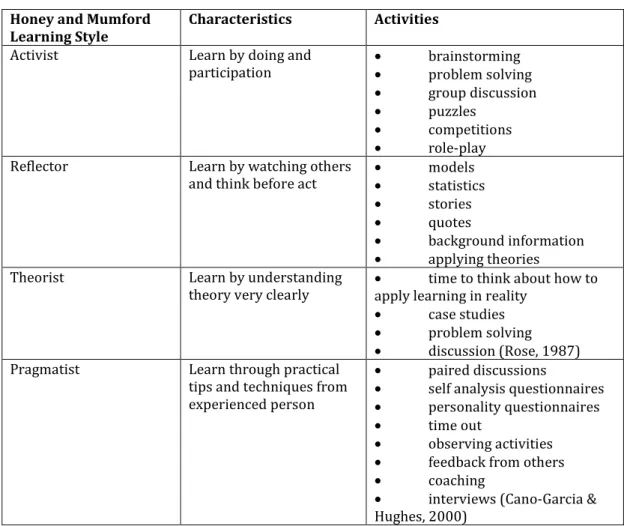
theorist and pragmatist. Based on the learning style they developed Learning Styles Questionnaire (LSQ) (Honey & Mumford 1986). This questionnaire was developed as self-development tool. The completion of the question will help the managers to focus on strengthening the under utilised styles so that everyday learning experience can be enhanced. The learners’ characteristics as per Learning Styles Questionnaire are shown in Table 2.
Table 2: Learning Styles Questionnaire
Honey and Mumford Learning Style
Characteristics Activities
Activist Learn by doing and
participation • brainstorming • problem solving • group discussion • puzzles • competitions • role-play
Reflector Learn by watching others
and think before act
• models • statistics • stories • quotes • background information • applying theories
Theorist Learn by understanding
theory very clearly
• time to think about how to
apply learning in reality
• case studies
• problem solving
• discussion (Rose, 1987)
Pragmatist Learn through practical
tips and techniques from experienced person
• paired discussions
• self analysis questionnaires
• personality questionnaires
• time out
• observing activities
• feedback from others
• coaching
• interviews (Cano-Garcia &
Hughes, 2000) Naturally, there will be some flexibility
between the four styles of learning since it is generally presumed that not every learner learns in the same way or that one style is preferable to another. There are those who try to see a word when spelling, while auditory learners might experience it as a sound and tactile learners would need to write it down to test how right it seems. Similarly, concentration and memory level differs, some sees faces but forgetting names, while others remember names but cannot visualise faces. Simon and Wai-ming (2010)
used Honey and Mumford's Learning Styles
Questionnaire (LSQ) to examine the learning style of students in Macao. The finding shows that students scored strong preferences in activist and reflector and attained moderate preferences in theorist and pragmatist. This
finding implies that Learning Styles
Questionnaire may help individual learners to identify their learning behaviors. So that it can be taken into consideration in planning
appropriate teaching strategies. In UK Kolb’s Learning Style Inventory and Honey and Mumford’s Learning Style Questionnaire are well known” (Campbell, et al, 1996).
Another most commonly and widely used learning style is Fleming’s VARK (1995). He categorised learning styles into four types. His questionnaire focuses on gaining more students attention because of better match between teaching and learning styles. He pointed out it is not necessary to restrict the learners and teachers to select one of the four styles. However, usually they show strong preference for one and make a strength and weakness on the others. The differences in students’ learning could be in relation to their skill, the way the information is processed and possible application of the information. He classified the learners according to their learning preferences. The four types of learners are visual, auditory, reading or writing and kinaesthetic. Visual
learners are those have preference for visual aids like diagrams and handouts and they prefer to think in pictures. Never get lost in finding direction. They love to draw and scribble and have good sense of colour matching. Auditory learners tend to learn through lectures and discussions. They love sounds and music (Flemimg,1995). This type of learners uses aural content in association
and visualisation. Reading/writing
preference learners prefers the collection of information from printed words. Lastly, kinaesthetic learners or tactile learners learn through experience. They like to experiment and projects to explore. They like physical exercise and generate ideas while doing exercises. They cannot sit for long and would like to move around and love to try it out. Flashcards will work better with them as they can touch and move them around (Campbell, et al, 1996).
Gregorc (1985) organised another model of learning styles that explains how the mind works. This model looked at perception. The perceptions are considered as the foundation of one’s learning strengths or learning styles. There are 2 perception qualities and two ordering abilities. They are concrete and
abstract and random and sequential
respectively. In concrete perception five senses play an important role. Information is collected from them while in abstract perception understanding of ideas, qualities and concepts. Sequential ability involves organisation of information in a linear and logical way whereas in random organisation of information is processed in chunks and there is no specific order. The perceptual qualities and ordering abilities are present in every one even if some might have dominant in certain ability or qualities (Gregorc,1985& Campbell, et al, 1996).).
Rationale for Understanding the Learning Styles
Learning style is basically behavioural approach to learning experience and they are influential in the learning and achievement of learners (O’Conner, 1998). Understanding learning styles mean:
1. The students will be able to diagnose the need of learning process.
2. The trainers will be able to consider as the foundation for better interaction.
3. It is possible to build strategies for accommodating learning styles.
4. It will allow to prepare student
involvement in learning process.
5. It will allow the students to group as per their learning preferences (Kolb, 1984). One may show preference to one or more styles of learning and if the learning environment is not consistent with the individual style of learning, the learning may be ignored and neglected. Understanding the learning styles of the students helps to create learning strategies. Learning strategies are the ways the student chooses to deal with the learning task. Learning strategies could
include listening, questioning, thinking,
writing and vision or combination of various strategies. By making the learner aware of the strategies that can be used for various tasks, they will be able to develop framework for meta-cognition. According to Bostrom and Lassen (2006), those who can identify their learning style will be able to define their own progress. Taking full control of learning will lead to self-efficacy. Self-efficacy can be achieved by understanding previous success and failure, observation of the learning behaviours of others, persuasion from others and emotional arousal.
Understanding the learning styles make the learner to control internal and external stimuli. Thereby could motivate the learners and can strengthen the meaningfulness of their investment (Bostrom & Lassen, 2006). The learning theories are practicable and easy to use and test it. For example, Yazici (2005) conducted a survey among 140 students of operationale management to assess team learning performance. Role play
assignment, discussion of important
operation management concept, computer assignment and comprehensive projects were used as learning style inventory to
determine learning style. The finding
suggests that students are collaborative
learners and collaborative orientation
encourages participation and increase team performance.
As per learning style, Yazici (2005) proposed that teachers should adopt various and suitable teaching style. Teaching style comprises of needs, beliefs and behaviours that are displayed in a classroom. They can be categorized into five types.
1. Expert - in this style the expert passes knowledge and skill to the students.
2. Formal authority - where the status
among the students due to knowledge and role as a faculty member sets rules and structure to students.
3. Personal model - in this model main
instructor normally oversees, guides and directs the students.
4. Facilitator - the instructor is working with the students on consulting basis asking
questions, exploring options and
providing alternatives.
5. Delegator - the instructor is only available as a resource person. This style will develop the students as autonomous learners (Yazici, 2005).
The research revealed that the
undergraduate students are
dependents/participants/collaborators thus
the best teaching style should be
personal/expert/formal authority style. The postgraduate students had the traits of participants/collaborates/independent style therefore the best style of teaching could be
of facilitator/personal/expert styles of
teaching. This kind of finding would not have been possible if learning style models were not developed by the earlier researchers (Yazici, 2005).
The learners are affected by their immediate environment, own emotionality, sociological needs and physical needs. By understanding the learning preferences, the students could score higher in the tests and have good motivation, attitude towards learning. It is also possible to maintain efficiency in the students’ work. According to personal preferences it is possible to make some changes in the class room setting or method of delivery. The team based approaches, discussion groups and debates could be
introduced to enhance learning appetite (Dunn et al, 1999).
The critics of learning styles tend to indicate that the learning styles have weaknesses. As per the critics, it may be difficult to assess learning styles of every participant and to match the instructional methods. The learning style has the tendency to label the participants and it could restrict learning rather than developing the their capability and ability. Some researchers analysed the theoretical origins, terms and instruments used in developing the model. They found that none of the learning style theories had
been adequately validated through
independent research. Thus the learning styles and the value of matching teaching are highly questionable. However, there are
other researchers who came to the
conclusion that matching students’ learning–
style preferences with appropriate
instruction materials and styles improved academic achievement (Coffield et al, 2004). Kolb study, for instance, did not reflect the process of reflection and based on very weak empirical experiences and therefore the finding may not necessarily match the reality
as the relationship between learning
processes and knowledge is more complex (Smith, 2001). It is also stated that preparing appropriate content involves lots of work and time.
Regardless of the weaknesses and criticism, the learning styles are widely researched and used in the government and private schools and educational institutions in UK, USA and many European countries as this helps to understand the needs and wants of the learner. Many studies were also carried out about using learning styles to personalise online learning.
Implication for Human Resource Trainer Learning styles have various implications to human resource development. Awareness of learning preferences, according to Robotham (1999) will help the trainers to design the
materials and arrange the training
environment to optimise effectiveness of training. Failure will cause the trainees to be
mentally opting out of the training
training session. Making trainees to adopt a particular style will make them intellectually short-sighted and they may tend to avoid learning environment (Buch & Bartely, 2002). As learning is life long process, workplace is an important place in learning process. Understanding the learning styles of employees will help to train them to be self-learners. A self-directed learner will be an
active information receiver and take
responsibility for the achievement and will set learning outcomes. Here the trainers’ role will be a facilitator. In traditional training session the trainers generally develop the training materials and programme according to their preference and fit the people into it.
This creates the status of “learned
helplessness” where the trainees rely on an outsider who has little knowledge of his needs to decide on his learning preferences (Buch & Bartely, 2002).
When the trainer is seen as an expert by the trainee, it may create a barrier to learning. Thus the trainee will depend on the trainer to provide resources for learning, identify suitable learning strategies. Because of this the trainee will stop learning once the training is ceased. This will defeat the purpose of training. Therefore, workplace training should make the employees to develop efficacy. Development of self-efficacy could be possible only when the trainer understand the learning needs and styles of learners (Zupalska & Brozik, 2006). Learning style implies that a rigid training structure should be avoided; the learning environment must not create a barrier. Delivery of content must be in multiple formats where it is possible to use various communication techniques. They will be able
to use audio and synchronise with
PowerPoint. It also can be transcripted and could create online chat rooms and discussion groups. Human resource training must give more emphasis to allowing the students to have greater locus of control so that they will be motivated to get full benefit of the training
they are participating (Yazici, 2005).
Keengore and Georgina (2011) stated that the educator should have the understanding of different learners and would be flexible to adapt the trainees’ need.
Corporate training department should be ready to accept new class room based method where the employees will be equipped with knowledge of knowing the way of learning. There will be a need to move away from traditional classroom method to other asynchronous delivery channels. The trainees in asynchronous design principles will deliver what is needed and should break down learning experience in modules that are quick, relevant and timely. Additional training to the trainers also needed and the organisation should consider investing more resources (Zupalska & Brozik, 2006).
Survey Analysis
A simple descriptive analysis of the collected
data shows that 40 students are
readers/writer, 30 are kinaesthetic, 23 are auditory and 13 are visual learners.
Among the students many of them have the preference for more than one learning style. 41 students have preference for 3 types of learning styles and they preferred reading or writing, kinaesthetic and auditor whereas 35 students stated that they were open for various types of learning styles but their most preferred learning styles were reading or writing and kinaesthetic. The research confirmed the finding of other literature on learning styles in establishing the necessity to understand various learning styles. It also confirmed that the delivery of the training or teaching materials should be done according to the students’ preference than the instructors’ preference to yield better result. Visual prefer to see, so the learning should be organized through power points, videos animations and websites whereas Aural who prefer to hear, the learning should comprise of videos, animations, audios, power points, stories, case studies and peer reviews. For read/write type trainees, the learning should include text book, online study guide, practical exams, critiques and review of exam. Kinaesthetic or tactile learners learn
through experience. learning strategies
should focus on introducing more activities like online quizzes, projects, demos, role-play and data analysis.
Conclusion
The learning styles have developed since 19th
century and were well received and adopted by many countries into their educational and business sectors. This is due to the fact that understanding learning styles helps the educators and the trainers to deliver relevant materials in a tailor made fashion. This created an enthusiasm and motivation among the learners to learn and practice what they have learned. Some researchers have developed teaching styles that could match various learners’ styles. The researches so far conducted supported various styles of learning and urged the trainers and educational institution to plan the delivery of teaching or training as per the trainees’ need than the trainers’ convenience. The survey carried out by the researcher also reiterates the fact that the learners are having different types of learning styles and there is a need to look into their various learning styles before preparing the training materials.
References
Blackmore, J. (1996). 'Pedagogy: Learning Styles,' [Online], [Retrieved May 29 ,2012], http://granite.cyg.net/~jblackmo/diglib/styl -a.html.
Bostrom, L. & Lassen, L. M. (2006).
“Unraveling Learning, Learning Styles,
Learning Strategies and Meta-Cognition,” Education and Training, 48( 2/3), 178-189. Buch, K. & Bartley, S. (2002). "Learning Style and Training Delivery Mode Preference," Journal of Workplace Learning, 14 (1), 5 – 10. Campbell, L., Campbell, B. & Dickinson, D.
(1996). Teaching & Learning through
Multiple Intelligences, Allyn & Bacon,
Needham Heights, MA.
Cano-Garcia, F. & Hughes, E. H.
(2000). “Learning and Thinking Styles Styles: An Analysis of Their Interrelationship and
Influence on Academic Achievement,”
Educational Psychology, 20(4), 413-430. Chan, S. C. H. & Mak, W.- M. (2010). “The Use of Learning Styles Questionnaire in Macao,” Industrial and Commercial Training, 42 (1), 41 – 46.
Coffield, F., Moseley, D., Hall, E. & Ecclestone, K. (2004). “Learning Styles and Pedagogy in Post-16 Learning: A Systematic and Critical
Review,” Learning and Skills Research Centre,
London.
Delahaya, B. L. (2005). Human Resource Development: Adult Learning and Knowledge Management, 2nded., Wiley, Australia. Dunn, R. & Dunn, K. (1999). 'The Complete Guide to the Learning Styles in Service System,' Allyn & Bacon.
Dunn, R. K., Dunn, K. & Price, G. E. (1975,
1989). 'Learning Styles Inventory,' Price
Systems, Lawrence, KS.
European Union (26 October 2006). A Lifelong Learning Programme, [Online],
[Retrieved May 29
,2012], http://ec.europa.eu/education/lifelo ng-learning-policy/policy-strategies_en.htm, Fleming, N. D. (1995). “I'm Different; Not Dumb. Modes of Presentation (VARK) in the Tertiary Classroom,” in Zelmer,A., (ed.) Research and Development in Higher Education, Proceedings of the1995 Annual Conference of the Higher Education and
Research Development Society of
Australasia(HERDSA),HERDSA, 18, 308 – 313.
regorc, A. F. (1985). Inside Styles: Beyond the Basics, Gregorc Associates, Columbia, CT. Honey, P. & Mumford, A. (1986). 'The Manual of Learning Styles,' Peter Honey, Berkshire. Keengore, J. & Georgina, D. (2011). 'The Digital Course Training Workshop for Online
Learning and Teaching,' Education and
Information Technology, 1-20.
Kolb, D. A. (1984). Experiential
Learning, Prentice Hall ,Englewood Cliffs, NJ. Lum, L., Bradley, P. & Rasheed, N. (2011).
“Accommodating Learning Styles in
International Bridging Education Programs,” Higher Education, Skills and Work-Based Learning, 1(2), 147-168.
(LTM),' Teaching Style Inventory, TSI, Rarrington, IL.
Messick, S. (1976). 'Personal Styles and
Educational Options,' Individuality in
Learning. Jossey Bass, San Francisco.
Motter-Hodgson, M. (1998). 'Meeting the Needs of Diverse Types of Learners,' CyberCorp Inc's newsletter, 1-3.
Norman, G. (2004). “Editorial--What’s the Active Ingredient in Active Learning?,” Advances in Health Sciences Education, 9, 1-3. O'Conner, T. (1998). 'Using Learning Style to Adapt Technology for Higher Education,'
[Online], [Retrieved May 29
,2012], http://www.indstate.edu/ctl/styles/ learning.html.
Robotham, D. (1999). “The Application of Learning Style Theory in Higher Education Teaching,” 1999, [Online], [Retrieved May 29 ,2012], http://www2.glos.ac.uk/gdn/discuss /kolb2.htm.
Rose, C. (1987). Accelerated Learning, Dell
Publishing Company, USA.
Smith. (2001). "David A. Kolb on Experiential Learning," [Online], [Retrieved May 29
,2012],
http://www.infed.org/biblio/b-explrn.htm.
Yazici, H. J. (2005). “A Study of Collaborative
Learning Style and Team Learning
Performance,” Education and Training, 47
(3), 216 – 229.
Zapalska, A. & Brozik, D. (2006). “Learning
Style and Online Education,” Campus-Wide