APPROVAL SHEET
TITLE
:
TCS Software Development PlanDOCUMENT NUMBER : 1700BP0009 ISSUE: C
SYNOPSIS : This document defines the development process and
schedule of the TCS software.
KEYWORDS : Telescope Control System, Software Quality, Telescope
Control
PREPARED BY : Gerhard Swart
APPROVED : Gerhard Swart
SALT Systems Engineer
Kobus Meiring
SALT Project Manager Engineer
This issue is only valid when the above signatures are present. Printed: 16/09/03 13:43
ACRONYMS AND ABBREVIATIONS
ATP Acceptance Test ProcedureATR Acceptance Test Report
BITE Built-in Test Equipment
BMS Building Management System (formally called the Environmental Control Computer)
CCD Charge-coupled Device (Camera) CDR Critical Design Rview
COTS Commercial off the shelf
HET Hobby-Eberly Telescope
I/O Input/Output (Device) ICD Interface Control Dossier
MMI Man-Machine Interface
MTBF Mean Time Between Failures MTTR Mean Time to Repair
OEM Original Equipment Manufacturer
PC Personal Computer
PDR Preliminary Design Review
PFIS Prime Focus Imaging Spectrograph PI Principal Investigator (Astronomer) PLC Programmable-Logic Controller
RT Real-time
SA SALT Astronomer
SALT Southern African Large Telescope
SDD Software Design Document
SDP Software Development Plan
SO SALT Operator
SPCT Single-point Communication Test SRS Software Requirement Specification
SW Software
TBC To Be Confirmed
TBD To Be Determined
TCS Telescope Control System
TABLE OF CONTENTS
1
Scope
...6
2
Referenced Documents
...6
3
Description of Software to be Developed
...6
4
Development Sequence and Schedule
...7
4.1 Requirements Analysis...10
4.2 Software Specification Review (PDR)...11
4.3 Software Design...11
4.4 Software Critical Design Review (CDR)...11
4.5 Software Coding and Debug...11
4.6 Software Code Reviews...12
4.7 Module Testing...12
4.8 Software Testing...12
4.9 Integrated HW and SW Testing...12
4.10 Subsystem Commissioning and Integration...12
4.11 Software handover...12
5
Software Safety
...14
5.1 Safety certificate...14
5.2 Communication Integrity...14
5.3 Initialisation...14
5.4 Start-up and Shut Down Procedure...14
6
Generic Software Requirements
...15
6.1 Naming and Tagging Conventions...15
6.2 Remote Initialisation...15
6.3 Data...15
6.4 Software cyclic execution...15
6.5 Data time stamping...15
6.6 Modular Design...15 6.7 Measuring Units...16 6.8 Data resolution...16 6.9 I/O Validation...16 6.10 Synchronisation...16 6.11 Unused Code...16 6.12 Software Comments...16 6.13 Self-changing code...17 6.14 Manual Operation...17 6.15 Communication methods...17
7
Specific TCS Software Requirements
...18
7.1 Operating Systems...18 7.2 Development Software...18 7.3 Application Software...18 7.4 Man-Machine Interfaces...18
8
Deliverables
...19
9
Configuration Control
...20
1 Scope
This document specifies the development process for all software that forms part the Telescope Control System (TCS) of the Southern African Large Telescope (SALT). It indicates the applicable specifications, development process and specific coding and documentation practices that are applicable, based on the SALT Software Standard.
The purpose of the TCS software is to co-ordinate the various subsystems to perform the required telescope functions, based on operator commands while providing feedback to the operator and
maintaining system safety. It integrates information and control so that the operator and astronomer can concentrate on the observations being performed rather the operation of the telescope.
The TCS software comprises several different applications running on various computers.
2 Referenced Documents
The following documents are referenced in this standard. 1700AS0001 TCS Specification
1000AA0030 SALT Safety Analysis
1000AB0044 SALT Labview Coding Standard 1000BS0010 SALT Software Standard 1000AS0040 SALT Operational Requirement
3 Description of Software to be Developed
The requirements of the TCS software are defined in the TCS Specification referenced in section 2. The TCS comprises the following computers and application software. Only the software in bold is new application software that is covered by the development plan.
a. SALT Operator Workstation
• SALT Operator MMI Software (designated SOMMI). This is the main operator interface
to SALT.
• Labview Data Socket (part of the standard Labview Application) • Internet Explorer or Netscape Web Browsers
• This machine also contains applications that are not strictly part of the TCS, as they are
developed by the suppliers of the various telescope subsystems. They are generically referred to as “Subsystem MMI’s”.
• Observation Planning tool (see next paragraph) b. SALT Astronomer Workstation
• SALT Astronomer MMI Software (designated SAMMI). This is the main astronomer
interface to SALT.
• Labview Data Socket (part of the standard Labview Application) • Internet Explorer or Netscape Web Browsers
• This machine also contains applications that are not strictly part of the TCS, as they are
developed by the suppliers of the various telescope instruments. They are generically referred to as “Instrument MMI’s”
• Observation Planning Tool (also used on the PI Computer). This software allows one
to simulate certain telescope operations to determine the feasibility of an observation and to interact with the Observation Planning and Star Catalogue Databases (see Data Processor).
c. TCS Server
• SALT TCS Server application
• Labview Data Socket (part of the standard Labview Application) d. Data Processor
• Observation Planning database and query engine. This database interacts with the
Observation Planning Tool, SOMMI and SAMMI, to exchange information regarding planned observations.
• Star catalogue query engine. This database provides information used by SOMMI and SAMMI to display fiducial overlays on the Acquisition and Guidance displays, to assist field identification by the users.
• Web Server. This provides the Astronomer, Operator and PI with an interface to
retrieve and organise science and telescope data. The observation planning tool interface to the databases may be routed through this server. All tools required by the PI’s also need to be downloadable from here.
• Science database. This is the organised storage and retrieval of all instrument
configuration, calibration, science and telescope data pertaining to science observations made.
• Data Parser and Unparser (also used on the PI Computer). This software compresses
data to/from the PI in order to minimise internet bandwidth requirements.
• Star catalogue information (from existing catalogues) e. Event Logger
• Event Logger application. This software is used to record, retrieve and display
user-defined events, based on data flowing between the TCS components and the telescope subsystems. A second function is to display telescope status and failure information that is vital to both the Astronomer and Operator.
• Weather display. This application receives telescope environmental information and
displays this to the operator and astronomer, with alarms where appropriate.
• Weather web server (standard Labview application) f. PI Computer(s) (located off-site)
• Observation Planning Tool (see SALT Operator Workstation for details) • Data unparser (see Data Processor for details)
• Data manipulation and reduction tools g. Data Reduction PC
• This will be very similar to the PI computer, but will be located at SALT.
4 Development Sequence and Schedule
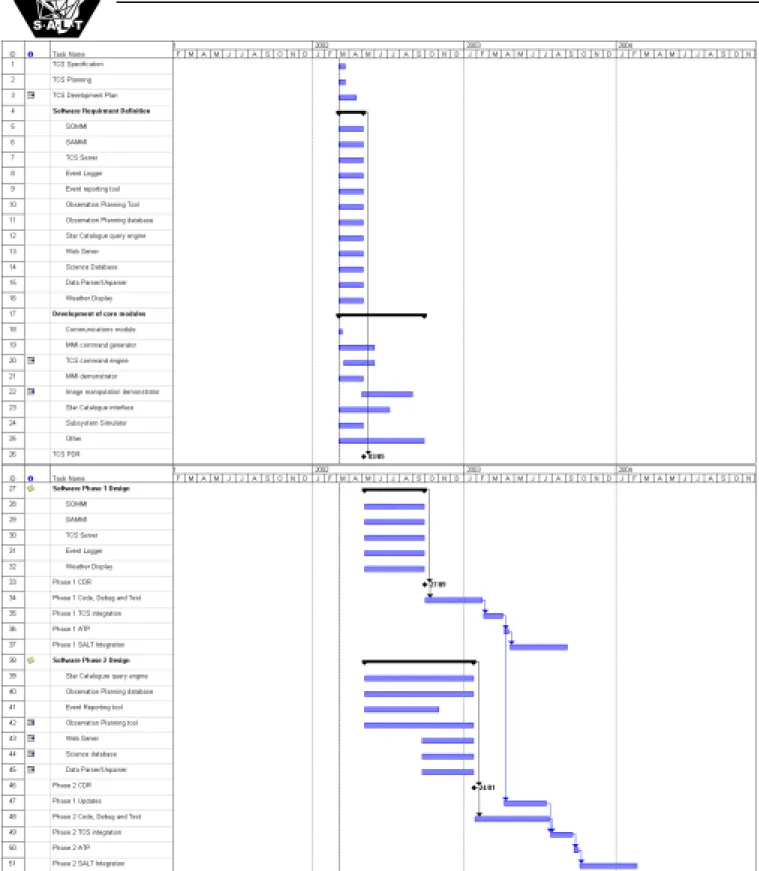
Figure 1 indicates the generic software development sequence contained in the Software Standard (please ignore. This has been tailored for the development of the TCS software and provisional dates have been added, as shown in Figure 2. A detailed schedule will be maintained by the TCS Subsystem Manager, as required.
The software development is shown in two phases, separating the critical software required to start telescope commissioning, from software that is required later, for operation.
4.1 Requirements Analysis
Determining the true requirements of the software is an important activity that must not be underestimated.
A software specification (SRS) shall be written for each of the following software items, using the document numbers shown (Data Parser requirement is TBC):
Doc No. Title Designation
1713AS0001 TCS SOMMI Software Specification SOMMI
1722AS0001 TCS SAMMI Software Specification SAMMI
1722AS0002 TCS SA Observation Scheduling Tool Software Specification OST
1741AS0001 TCS Server Software Specification TCSS
1762AS0001 TCS Event Logger Software Specification ELS
1732AS0001 TCS Star catalogue Software Specification STARCAT 1732AS0002 TCS PI Observation Planning Tool Software Specification OPT 1732AS0003 TCS Science Database Software Specification SDB
1732AS0004 TCS Web Server Software Specification WEB
1732AS0005 TCS Data Parser/Unparser Software Specification PARS 1762AS0002 TCS Weather Display Software Specification WDS
During this process the particular functions of the system that have to be controlled by software are identified, analysed and specified to sufficient detail to allow the software to be designed. The detailed requirements for computer hardware/firmware and other components of the system (e.g. mechanical and electrical parts) will also be identified in parallel with this process. The following specific requirements shall be identified and documented:
a. The software architecture showing the major software modules (building blocks) per developed software item and identifying the major data flowing between modules. b. A mode/state transition diagram is required for all developed software, showing
software mode upon initialisation and the conditions for transition to other modes. The distinct requirements of each mode shall be identified.
c. A resource allocation in which the timing, memory allocation, processing power and overall loop iteration frequency have been defined and the required spare capacity reserved.
d. A diagram or table showing the required software timing including aspects such as data latency, real-time requirements and synchronisation with the real-world.
e. An input and output allocation, identifying the major inputs and outputs between the software and hardware.
f. The detailed software requirements definition of each software item, according to the complexity and type of the software item.
o The required execution rate, input, output and processing (e.g. algorithms) must be defined per software module. Any other critical requirements pertaining to a
particular module must also be identified (e.g. timing, data format, security) o User-configurable features need to be defined in concept
o Calibration/adjustment/set-up procedures methods need to be defined in concept o Where software has direct interaction with the hardware (e.g. I/O), interfacing
details need to be specified (e.g. drivers)
o The allocation and use of interrupts need to be defined and their use motivated. The interaction between the operating system, synchronous, cyclic events and interrupt events need to be defined.
g. Verification and metrics methods for the measurement of software compliance to the requirements of the Software Requirements Specification shall be defined.
h. Software coding constraints that will enhance software maintainability, reliability and testability shall be defined (e.g. particular data structures, non-use of certain language features).
i. The operational Man-Machine-Interface (if applicable) shall be defined in a detailed fashion.
4.2 Software Specification Review (PDR)
Prior to starting the software design, the Software Requirement Specification shall be reviewed by the development team and the SALT Team. The purpose of the review is to verify that the software requirements have been correctly derived from the Subsystem Specification, check that adequate analysis has been performed in defining the software requirements and to co-ordinate the software requirements between TCS parts.
4.3 Software Design
Prior to coding the software, it is essential to structure and design the software to meet not only the functional requirements of the SRS, but also the maintainability, reliability and testability requirements. The output of the Software Design process will be in various forms, but the major design aspects shall documented in one or more Software Design Documents (SDD). At least the following shall be addressed:
a. A high-level design description, describing the overall integration and interaction of the modules how this relates to the software states and modes.
b. An updated copy of the software architecture diagram.
c. A detailed functional-flow and data-flow diagram, showing all the software modules and the precise data flowing between them. The implementation of specific timing, synchronisation and interrupts requirements shall be illustrated. For Labview software, the mechanism of data flow (i.e. wires or VI server calls) shall be identified.
d. The software design of each module must be provided. This shall indicate the specific data inputs, outputs, processing and timing requirements for that module and shall give specific formula’s and algorithms that are to be executed. Details of global variables, interrupt operation, timing implementation and shall be defined. The design shall be documented in pseudo-code, flow diagrams or English narrative.
4.4 Software Critical Design Review (CDR)
Prior to full-scale software coding, the software design shall be reviewed by the supplier
development team and the client. The purpose of the review is to verify that the requirements of the SRS and other implicit requirements have been adequately and efficiently addressed in the design. It is an opportunity for the development team to co-ordinate the hardware, software and equipment
designs and to ensure that non-functional requirements such as maintainability, testability and reliability are adequate.
The CDR shall address the overall software design (architecture, data flow, timing) and detailed design of each module.
4.5 Software Coding and Debug
During this process the software code for each module is generated according to the design defined in the SDD. Specific coding standards, metrics and conventions are applied (as defined elsewhere in this document) and software comments inserted.
4.6 Software Code Reviews
The source code of each completed module is reviewed by the development team to check the appropriateness of software style, efficiency and to co-ordinate interfacing modules. The appropriate method of testing each module shall be agreed. The client may at his discretion attend such reviews. A record shall be kept of each review and the comments recorded. The implementation of such comments shall be verified during module testing.
4.7 Module Testing
Software modules shall be individually tested prior to integration with the other modules, to an
appropriate level. Testing a module may use either a simple stub simulating interfaces to other modules or another module (or group of modules) that has already been tested. The results of each module test shall be recorded, albeit informally.
4.8 Software Testing
Tested modules are incrementally integrated together and progressively checked. When all the software has been integrated, the tests defined in the Software ATP shall be executed where possible. The precise hardware and software configuration tested shall be defined. From this point forward, all software changes shall be logged. A TCS Server simulator shall be used to verify the communications interface to each computer prior to delivery of that computer and its software by the developer. A communication test using the simulator shall be part of each computer item’s ATP. At this point the software shall be fully under Configuration Control (see section 9) and all software changes managed.
4.9 Integrated HW and SW Testing
Incorporated into 4.8.
4.10 Subsystem Commissioning and Integration
The next step of the process is to progressively integrate the software with other parts of the TCS. This Commissioning is complete when the TCS ATP, which verifies the performance of the TCS against its specification, has been passed.
The final step of the process, during which the final aspects of the software items performance is verified, is the System Integration, when all the subsystems are integrated to form an operating
Telescope. Only when the SALT System ATP has been successfully completed, can each SW item be said to be complete.
4.11 Software handover
During step 4.10, the responsibility for maintenance of the software is transferred from the original developer to the maintenance crew. At this point, a formal “Software Handover” shall occur, when a “snap-shot” of the software configuration is taken and a package compiled that contains the
“delivered software”. See section 8. This delivered software package shall contain a full definition of the latest software configuration, including the following:
a. A Version Definition – a table indicating the current revision numbers of each of the software modules of each software item
b. The Software Configuration Definition – an electronic copy of all configuration data for operating systems, firmware, set-up data, calibration constants, user-defined parameters
etc.
c. The Software Source Code of the present software version
d. Original legal copies of the operating systems, compilers, tools, utilities that are required to maintain the software
e. Final copies of Operating, Maintenance and Calibration procedures where applicable f. A final version of the Safety Certificate
5 Software Safety
5.1 Safety certificate
A Safety Certificate shall be issued for the TCS. The certificate shall identify all the software items that form part of the TCS. A pro-forma of the software certificate can be found in the SALT Safety Analysis listed in section 2.
5.2 Communication Integrity
Communication integrity between subsystems and all equipment items shall be monitored by all items receiving data. Failure to receive correct data or failure to receive any data from a particular device shall be reported the operator via the Event Logger or the SOMMI as appropriate.
Detection of communication failure shall be facilitated by using the “Validity Word” in the communicated Labview data, or a similar method for non-Labview Software.
Each software item shall fail in a safe fashion if it does not receive the required data. Gradual degradation of system performance should be allowed where possible.
5.3 Initialisation
All TCS commands shall be in a safe state when un-initialised or switched off. Similarly, un-initialised inputs (e.g. from other subsystems) shall not cause incorrect responses from the software.
The following initialisation sequence shall be followed by all software: a. Switch all outputs to a safe state (e.g. motors, OFF)
b. Indicate “Initialisation State” to the operator
c. Check the integrity of the processing hardware and memory using simple arithmetic checks d. Check communication with and correctness of peripheral devices (if applicable)
e. Verify the correctness of configuration data and then initialise variables accordingly f. Check communication with interfacing computers
g. If all operations are successful, report “System Okay” to the operator and enter into a “ready” state, where after the state will be determined by switches, commands, data etc. If operations a. to e. are not successful, report “System Start Failure” and indicate the type of failure
encountered. If communications with another computer cannot be established, this should be reported.
5.4 Start-up and Shut Down Procedure
During Start-up and Shut Down, preventative measures shall be taken to handle process conditions as well as Inputs and Outputs in a safe manner.
6 Generic Software Requirements
6.1 Naming and Tagging Conventions
Each SW component shall be uniquely identified with a sensible name. File extensions native to the programming language used, shall be adhered to (i.e. Labview files *.vi, *.glb, *.ctl and *.rtm) All variables, memory and block naming shall be clear, logical and understandable. A uniform convention shall be used throughout an item, preferably using whole English words. Where compilers/interpreters do not support long variable names, a consistent abbreviation may be used, with a clear definition in the appropriate documentation.
Naming conventions will be agreed during the Software PDR.
6.2 Remote Initialisation
It shall be possible to trigger the initialisation sequence described in 5.3 remotely via the normal communication to an item. (e.g. The operator must be able to send a “reset” command across the Ethernet to any computer to trigger initialisation). This is not applicable to MMI applications.
6.3 Data
A set of Critical Data, over and above data required for functional operation, shall be agreed with the client for each computer item. This data set shall be updated at a rate of at least 1Hz and be sent to the Event Llogger:
• Item Mode
• Item Health Status • Fault list
This Data Set will be finalised during the Critical Design Review.
Where internal variables may assist diagnostics, their values should also be transmitted to the Event Logger.
6.4 Software cyclic execution
After the completion of initialisation, the code of a SW item shall execute in a cyclic fashion, at a constant rate, commensurate with the control bandwidth/frequency/latency required.
6.5 Data time stamping
Time-critical data will be agreed with each supplier and identified as such in the ICD. All such data shall be time-stamped in an agreed fashion to facilitate synchronisation of subsystems.
6.6 Modular Design
Software shall be designed in a scalable and modular fashion. All software modules (i.e. Labview VI’s, procedure and functions – see SALT Labview Coding Standard) shall be designed to minimise their data interfaces and to group functions that belong together, keeping in mind future growth and hardware upgrades. Compliance to these requirements shall be demonstrated at the PDR, CDR and code reviews. In particular, the following types of functions shall be in independent modules:
• User configuration sequences • Equipment mode/state control • Mathematical/control algorithms • Data storage and retrieval • Data communication
• Fault monitoring and reporting
Identical software functions shall not be repeated in different areas but rather grouped together as a shared function or procedure.
6.7 Measuring Units
The SI metric system shall be used for all processing except for angles, which shall be in Radians. The units of information displayed on MMI displays shall be in “human-friendly” units and will be agreed during the CDR.
6.8 Data resolution
The selection of data types and resolution shall be commensurate with the data accuracy required to perform the desired functions.
6.9 I/O Validation
N/A.
6.10 Synchronisation
Two methods of synchronisation are allowed, the selection of which shall be commensurate with the time accuracy requirements and shall be subject to approval during the PDR.
a. Network synchronisation: An NTP server will provide accurate GPS time to all subsystems requesting this via Ethernet. The accuracy of this time should be better than 150ms and would be suitable for most applications.
b. Hardware synchronisation: A precision hardware time signal (e.g. 1 pulse-per-second and 10MHz) will be made available to all items requiring very accurate time (e.g., Tracker
Computer, Payload Computer and Instrument Computers). A computer input reads this signal and synchronises SW functions accordingly.
6.11 Unused Code
All unused code and variables shall be removed from the software.
6.12 Software Comments
Over and above the software development documentation, the following documentation shall form and integral part of the software code in the form of comments or function help:
• Each software module shall have a header or associated “help” definition describing the following:
o The name and purpose of the module
o The inputs and outputs of the module and their types
o A detailed description of the functions performed by the module. (This may be English narrative or pseudo-code).
• A definition/description of local and global variables used in the module
• English description of the actions performed by SW code. As a guideline give one line of comments per two lines of code for text-based software. For Labview software each VI shall have help information defined, as indicated in the first bullet.
6.13 Self-changing code
Self-changing code shall not be allowed.
6.14 Manual Operation
N/A.
6.15 Communication methods
Communication between computers on the Ethernet network, shall be TCP/IP-based Data socket communication or http://, as agreed.
A central database (ICD) shall identify the source, destination, type and update frequency of each parameter. Communications software for Labview items will be provided by SALT, according to the required data types.
7 Specific TCS Software Requirements
7.1 Operating Systems
The following Operating are proposed, but this needs to be agreed on a case-by-case basis: • SO Workstation : Windows 2000 Professional
• SA Workstation: Windows 2000 Professional • TCS Server: Windows 2000 Professional • Event Logger: Windows 2000 Professional • Data Processor: Linux (type TBD)
• PI Computer: SW must be portable to Windows 98, Windows 2000, Windows NT and Linux
7.2 Development Software
The following development environments are proposed but needs to be agreed on a case-by-case basis:
• SOMMI: Labview 6 • SAMMI: Labview 6 • TCS Server: Labview 6
• Event Logger and Event Reporter : Labview 6 • Star catalogue database engine: SQL, C
• Observation Planning Tool(s): Labview 6 and C • Science Database: SQL, C
• Web Server: ??
• Data Parser/Unparser: C • Weather Display: Labview 6
7.3 Application Software
The SALT Labview Coding Standard shall be applied to all Labview software. The Software Engineering Primer in “Labview Power Programming” and “Internet Applications in Labview” are recommended reading.
7.4 Man-Machine Interfaces
8 Deliverables
Unless agreed otherwise, at least the following items shall be delivered for each software item. a. Original documentation and electronic media of all the bought-out software installed on the
computer (including operating systems and device drivers).
b. Original documentation and electronic media of the software development environment in which the software was developed (e.g. compilers, version control tools etc.), unless agreed otherwise. c. Development environment and operating system configuration data (e.g. memory map set-ups,
compiler directives, copy of Linux configuration files, Windows INI files, registry files) on CD-ROM. d. Documentation as described in section 4 (if applicable according to Table 1), including the following:
• Software Requirement Specification • Software Design Document
• Software Code Review report/minutes • Software Acceptance Test Procedure • Software Acceptance Test Report
e. All application software source code, compiled software, installation software and configuration information on CD-ROM.
f. Calibration, Maintenance and operating procedures if applicable g. A Version Definition (See section 9)
The following will be available for the TCS as a whole: h. A final version of the Safety Certificate
i. A Software Development Plan (this document) j. Acceptance Test Procedure and Report
9 Configuration Control
Each SW Item shall be uniquely identified by the SALT configuration number and name defined in section 4.1. Each software module shall also be uniquely identified.
During the software coding, testing and integration process, maintain the Labview version control tool shall be used, whereby each software module has a revision number reflecting changes made. Changes after initial SW integration shall be controlled and documented. Every update to that module shall result in a change in the revision number of that module. Modules of previous revisions shall not be overwritten or destroyed but kept for recovery purposes.
The integrated software comprising many modules (i.e. the SW Item), shall also have a unique version
number at critical stages in the process (e.g. at Software Testing, delivery etc.). A document (the Version Definition) shall be maintained which records the included modules and their revision numbers making up each version of a SW Item.
The following numbering scheme is preferred for revisions and versions:
Example: Tracker Payload SW Version 2.32 comprises the following modules - Module A: Initialisation Revision 5
- Module B: Hardware set-up Revision 31 - Module C: Mode control Revision 29 - ………
Where the number before the dot is incremented with major changes to the software or to mark a significant event (e.g. software delivery) and the number after the digit changes with minor modifications.