AFPP – PALM PEST MEDITERRANEAN CONFERENCE NICE – 16, 17 AND 18 JANUARY 2013
USE OF ENTOMOPATHOGENIC NEMATODES IN A CHITOSAN FORMULATION AGAINST RHYNCHOPHORUS FERRUGINEUS IN DIFFERENT PALM SPECIES. FIELD
ASSAYS AND SPECIFIC CASES IN A CITY AND IN A BOTANICAL GARDEN
M.M. MARTÍNEZ DE ALTUBE (1) A.MARTÍNEZ DE ALTUBE (1) A. MARTÍNEZ PEÑA (1)
(1) IDEBIO S.L., POL. IND. EL MONTALVO. SALAMANCA. SPAIN. [email protected]
SUMMARY
The efficacy of the nematode Steinernema carpocapsae in a chitosan formulation against the red palm weevil, Rhynchophorus ferrugineus has been studied. This paper presents a literature review of the application of S. carpocapsae in combination with a chitosan formulation. Efficacies around 80% were obtained in curative assays, and up to 98% in preventive assays in different palm species. This combination has been used with positive results as a biological treatment to control the plague in numerous places and institutions including Botanical Gardens in, Lisbon, Valencia and Xativa, City Halls through Spain and Portugal such as Valencia, Espartinas, Silves and Setubal, and the national garden and Zapion’s Palace in Greece. In addition to the data from the publications previously mentioned, we will study the specific cases in Spain, Valencia’s Botanical Garden and the city of Ceuta, to observe the plague control and evolution in both places. Valencia has used this combination continuously for the last five years and Ceuta last two years.
Key words: Chitosan, Steinernema carpocapsae, control, Rhynchophorus ferrugineus, Efficacy.
RESUME
L'efficacité du nématode Steinernema carpocapsae dans une formulation à base de chitosane a été étudiée pour lutter contre le charançon rouge des palmiers, Rhynchophorus ferrugineus. Cette communication présente une revue de la littérature de l'application de S. carpocapsae en combinaison avec une formulation de chitosane. Des efficacités de l'ordre de 80 % ont été obtenues en applications curatives, et de plus de 98 % en applications préventives sur différentes espèces de palmiers. Cette combinaison a été utilisée et a donné des résultats positifs lors d'un traitement biologique pour contrôler le ravageur dans de nombreux sites, dont les jardins botaniques de Lisbonne, Valencia et Xativa, des mairies en Espagne et au Portugal telles que Valence, Espartinas, Silves et Setubal, et le jardin national du palsis Zapion en Grèce. En plus des données issues des publications précédemment mentionnées, nous aborderons les cas spécifiques du Jardin botanique de Valence et de la ville de Ceuta, en observant le contrôle du ravageur et son évolution dans ces deux sites. Valence a utilisé cette combinaison en continu pendant les 5 dernières années, et Ceuta pendant ces deux dernières années.
Mots clés : chitosane, Steinernema carpocapsae, contrôle, Rhynchophorus ferrugineus, efficacité
INTRODUCTION
The red palm weevil Rhynchophorus. ferrugineus (Olivier) is considered to be the main pest of palms in the Mediterranean Basin OEPP/EPPO (2008). In Spain, R. ferrugineus was detected in 1995, BARRANCO et al. (1995), but remained confined to a small area in southern Spain until 2004, when the pest appeared in different foci along the Spanish Mediterranean coast. The pest is currently widely distributed in Oceania, Asia, Africa and Europe, EPPO (2008) and has been recently found in the Caribbean, EPPO (2009).
Females deposit their eggs in separate holes or injuries at the base of the fronds. Eggs hatch into legless larvae which bore into the palm core. On completion of their development, the larvae move back to the base of the fronds to pupate, a new generation emerges, and these adults may remain within the same host and reproduce until the palm eventually dies. Subsequently, adults will move and look for a new palm host. R. ferrugineus has been reported on 19 palm species belonging to 15 different genera. EPPO (2008), DEMBILIO et al. (2009), KONTODIMAS et al. (2006)
Several control methods have been applied against this pest within an integrated pest management strategy. Its main components are phytosanitation, which involves cutting down and burning infested palms, use of insecticides and use of pheromone traps for adult monitoring and mass trapping. Insecticides are based on the repeated application of large quantities of synthetic insecticides, which are applied in a range of preventive and curative procedures designed to limit and contain the spread of infestation.
These procedures have been developed and refined since commencing in India in the 1970s MURPHY & BRISCOE (1999). Methods range from general dusting of the leaf axils, after pruning or spraying of the palm stipe, to localised direct injections of chemicals into the trunk FALEIRO (2006). Researchers have concluded that, because of the cryptic habitat of the boring stages of this weevil, chemical insecticides have to be applied frequently and over a long period of time for effective management of established populations, MURPHY & BRISCOE (1999); FERRY & GOMEZ (2002). However, there are deep concerns about the environmental pollution caused by these treatments, especially in public areas where ornamental palms are grown, FALEIRO (2006). Furthermore, many of the currently used insecticides, especially organophosphates and carbamates, are not effective enough, KAAKEH (2006).
The use of entomopathogenic nematodes (EPN) could offer an interesting alternative to the chemical control of R. ferrugineus, ABBAS et al. (2001a, b); ELAWAD et al. (2007); SALEH & ALHEJI (2003). EPNs are safe for non-target vertebrates and to the environment, and since they are mass-produced in liquid media, production costs have been significantly reduced in recent times, EHLERS (2003). The infective third juvenile stages (Dauer Juvenile, DJ) survive outside the insect and can actively search for hosts. DJs enter the insect host through any opening (mouth, anus, spiracles) and grow into the parasitic stage. The insect death due to nematode parasitism is caused by Gram-negative bacteria which are carried within the gut of the DJs (FORST & CLARKE (2002). S. carpocapsae (Weiser) (Nematoda: Steinernematidae) is the most studied, available, and versatile of all EPNs. It is also mutualistically associated with the bacterium Xenorhabdus nematophila (Enterobacteraceae).
Laboratory and semi-field assays using the combination of S. carpocapsae with chitosan showed efficacies from 80 to 98% in curative and preventive assays respectively in Phoenix canariensis Hort. Ex Chabaud LLÁCER et al. (2009) Other recent field trials of one year duration on P. canariensis showed that efficacies ranged from 83.8 to 99.7% and resulted in a significant increase in palm survival compared with the untreated control when using this mix of EPNs with chitosan DEMBILIO et al. (2010). Not only excellent results have been obtained in P. canariensis, such as curative applications with this combination, but it also managed to reduce insect activity and could help the palms to recover in early infested
Phoenix theophrasti Greuter palms DEMBILIO et al. (2011). An assay developed in Phoenix dactylifera L. showed also very good results, from 70 to 83% in curative and preventive assays respectively. GOMEZ et al. (2008).
The efficacies obtained are very high, especially when compared with chemical pesticides used against this pest, KAAKEH (2006); AZAM & RAZVI (2001) HERNANDEZ-MARANTE et al. (2003); EL- SEBAEY (2004). All these results contrast with the inconsistent results obtained by ABBAS et al. (2001) when using EPNs in date palms. One important difference between the experiments of ABBAS et al. (2001) and those reported here is the use of chitosan as an adjuvant. Chitosan is presumed to protect nematodes from environmental conditions and therefore increase and stabilise efficacy in comparison to formulations where nematodes are applied without it DEMBILIO et al. (2010). Also the product is included in the New Pest Response Guidelines, Red Palm Weevil, R. ferrugineus issued by the U. S. D. A. United States Department of Agriculture (2010).
The commercial product tested in all these assays was Biorend R® Palmeras that contains S. carpocapsae and a chitosan adjuvant. Chitosan is a biodegradable organic product with the active ingredient N-acetyl-glucosamine, which can activate defence mechanisms in the plant, HADWIGER & LOSCHKE (1981), increases defense response against fungal diseases in palms EL HASSNI et al. (2004), El HADRAMI et al. (1996), increase lignification and promote root development, AIT BARKA et al. (2004). The use of nematodes with chitosan is patented, MARTINEZ (2002) and nowadays a formulation of S. carpocapsae with chitosan is included in the list of authorised products against R. ferrugineus in Spain. The objective of this paper was to collect all information regarding the use of the S. carpocapsae mix with chitosan in palms, which has been proven to be highly effective against R. ferrugineus in the field. We will study the specific cases of Valencia’s Botanical Garden and Ceuta, located in Northern Africa, to observe the plague control and evolution. Valencia has used this combination continuously for four years and Ceuta two years.
MATERIAL AND METHODS
1. - EVALUATION OF THE EFFICACY OF STEINERNEMA CARPOCAPSAE IN A
CHITOSAN FORMULATION AGAINST RED PALM WEEVIL IN P. CANARIENSIS.
CURATIVE AND PREVENTIVE EFFECTS
The assays reported in that study by LLÁCER et al. (2009) were carried out at the Institut Valencià d’Investigacions Agraries (IVIA) in Spain during the months of June, July, and August 2007. Trials were performed in a double mesh security enclosure containing 24 independent cages (4 X 3 X 3 m) under natural light and temperature conditions. The mean temperature during the assays was 28.2 ºC (max: 34.2 ºC; min: 22.3 ºC). A plastic roof protected the enclosure from the rain. Curative and preventive efficacy of S. carpocapsae in a chitosan solution was tested. The product was applied with at a dose of 3.6 x 10⁶ DJs + 36 ml chitosan per palm. Trials were performed on 48 4-year-old potted P. canariensis. The stipe of these palms was 0.35–0.55 m high and 0.3–0.5 m wide.
Curative test: 24 palms were infested with larvae of R. ferrugineus. A hole 3 cm deep and 1 cm in diameter was drilled on one side of the palm. Subsequently, an open vial containing the insects’ artificial diet and four 7-day-old larvae was introduced into the hole. Two days later, the vial was removed and checked under the microscope for evidence of larval exit. Ten days later, a new hole was drilled on the other side of the palm trunk and five 15-day-old larvae were similarly introduced into each palm. One month after the first infestation, 12 palms were treated with S. carpocapsae and chitosan solution, and the remaining 12 were used as controls. Fourteen days after the treatment, four control and four treated palms
were carefully dissected and checked for the presence of R. ferrugineus. The remaining 16 plants were similarly dissected two weeks later.
Preventive test: Twelve uninfested palms were treated with S. carpocapsae and chitosan and 12 additional palms constituted the control treatment. Immediately after the treatment, four control palms and four treated palms were infested with R. ferrugineus by releasing four adult, presumably mated, females per plant. To evaluate product persistence, the same procedure was repeated 15 and 30 days after the treatment. One week after their release, when found, females were removed from the cage. One month after the release, palms were carefully dissected and checked for the presence of R. ferrugineus larvae.
2.- EVALUATION OF THE EFFICACY OF STEINERNEMA CARPOCAPSAE IN A
CHITOSAN FROMULATION AGAINST RED PALM WEEVIL ON DATE PALMS, P.
DACTILYFERA. RESISTANCE, CURATIVE AND PREVENTIVE EFFECTS
Preventive and curative assays were developed in Elche; Spain by GOMEZ et al. (2008).
Trials were performed in a security room with controlled conditions, Tª 26ºC, and 60% R.H. with a photoperiod of 18:6.
Preventive test: Six uninfested palms were treated with S. carpocapsae in a chitosan solution and 6 additional palms constituted the control treatment. The diameter palm stipe was ± 20 cm. The product was applied with a dose of 2.5 x 10⁶ DJs + 5 ml chitosan per palm. 3 adults of red palm weevil per palm were released 1 hour and 7 days after the product treatment. Adults were captured 48 hour after release.
Curative test: 5 palms with ± 20 cm diameter were used for the curative test. To begin the assay 2 females and 1 male per palm were released. After 2 days all the weevils were removed from the palms. 60 days later each palm was treated with a dose of 2.5 x 10⁶ DJs + 5 ml chitosan per palm. 7 days after the treatment palms were dissected and checked for the presence of R. ferrugineus.
S. carpocapsae persistence: S. carpocapsae in a chitosan formulation was applied in open field under natural conditions on date palms. The product was applied directly to the stipe of young shoots (3-5Kg) of P. dactilyfera. After 24 hours, 7, 22 and 29 days, young shoots were cut and evaluated in the laboratory. All the leaves of the young shoots were cut separated and classified in 3 different groups according to their location in relation to the stipe, outer zone, middle zone, inner zone. Leaves were washed under tap water and nematodes were retained with a 15 filter micron. Live and dead nematodes recovered were counted under microscope.
3. – ONE-YEAR FIELD EFFICACY OF S.CARPOCAPSAE IN A CHITOSAN FORMULATION AGAINST THE RED PALM WEEVIL IN P. CANARIENSIS
Field experiments developed by DEMBILIO et al. (2010) were conducted from December 2007 to January 2009 in a P. canariensis nursery located in a R. ferrugineus infested area near the town of Algemesí, Spain. P. canariensis palms were 6–8 years old. An area of 750 m2 within the nursery, containing 360 palms regularly planted and forming a grid, was selected. The grid was cross-divided into four rectangular sections of the same size containing 72 palms each by removing the two central rows and columns of palms. Palms exhibiting typical symptoms of infestation, such as bitten fronds, fallen central shoot, small holes in the leaf, scars and oozing out of a reddish-brown fluid and extrusion of fibres from these holes were removed, and only those that were presumed to be pest free were further considered.
S. carpocapsae + chitosan was applied monthly from December 2008 to December 2009, and directly sprayed on the top of the palm stipe. The product was applied with a dose of 5.0 x 10⁶ DJs + 50 ml chitosan per palm.
The nursery was inspected fortnightly. At each inspection, palms showing symptoms of infestation were removed and taken to the laboratory for dissection. All specimens of R. ferrugineus, dead or alive, were extracted and checked for presence of nematodes until the end of the experiment in January 2009, when efficacies were finally calculated.
4. - EVALUATION OF THE EFFICACY OF S. CARPOCAPSAE IN A CHITOSAN
FROMULATION AGAINST RED PALM WEEVIL ON P. THEOPHRASTI.
Assays were carried out by DEMBILIO et al. (2011) in Benaki Phytopathological Institute, Kifissia, Greece, during May-June 2010. Tests were conducted in a metallic mesh house within a glasshouse under natural light and temperature conditions (mean 22.3ºC, max: 40.3ºC, min 12.9ºC). Twenty-four P. theophrasti palms were artificially infested with 6 neonate larvae per palm. Twelve palms constituted the control group. The remaining 12 palms were treated with the commercial product Biorend-R® palmeras. The product was applied 14 days after the infestation at the dose of 20x106 IJs+ 200ml chitosan per palm. Twenty days later, the palms were dissected and the number of live larvae per palm was counted as well as the number of empty galleries and those with dead larvae remains.
5. - THE EVOLUTION OF R. FERRUGINEUS IN THE AUTONOMOUS CITY OF CEUTA. CURRENT ACTIONS TAKEN AND SUMMARY OF EFFORTS SINCE THE BEGINNING IN 2009. (in accordance with quarterly reports written by the Environmental Ministry and Ceuta’s Community and District Services, Consejería de Medio Ambiente, Servicios Comunitarios y Barriadas de la ciudad autónoma de Ceuta).
The present report summarizes the current status and evolution of the palm plague caused by R. ferrugineus in the autonomous city of Ceuta. The report focuses on affected palms (evolution of the infestation sites), curative treatments (mechanical sanitation) in infested palms that were detected early, preventive treatments given and other actions taken to control the plague.
The report outlines the control and elimination efforts taken against the red palm weevil in Ceuta since the very beginning in November 2009. The work began as soon as the harmful R. ferrugineus was declared a palm plague in the city of Ceuta and when it was in the public’s interest to fight it, (approved by the Minister of Environmental and Urban Services on October 29, 2010; B.O.C.CE. extraordinary nº 6, Friday, October 30, 2009), until 06/30/2012
All the data presented in this report has been obtained and provided in accordance with the official quarterly reports written by the Environmental Ministry and Ceuta’s Community and District Services (Consejería de Medio Ambiente, Servicios Comunitarios y Barriadas de la ciudad autónoma de Ceuta).The governmental bodies are responsible for developing and executing the actions taken in this fight against the red palm weevil, including private and public palms.
The inventory and geo-referencing of all palm trees in Ceuta was carried out in 2010 and then updated and corrected in 2011. This report counts a total of 2.986 registered palms in the city; 1.334 of these are Canary palms (P. canariensis, 44,6% of the total) and 498 date palms (P. dactilyfera, 16,7% of the total); the remaining palms correspond to Washingtonia sp. (1.067, 35,8%) and other species of various genus, mostly coconut palms (Cocos nucifera L.,87).
Action protocol:
In the 1st phase (Nov. 2009 – March 2011), all of the registered palms were treated, in total 2.986 palms. 6 annual treatments were given: 4 biological S. carpocapsae treatments and 2 chemical Imidacloprid 20% treatments.
The results showed that from November to December 2009, 53 palms were eradicated, in 2010 a total of 100 were eradicated, and in 2011 a total of 20 palms were eradicated. The majority of the 20 palms eradicated in 2011 were taken during the first quarter of the year bringing the total number of eradicated palms to 173. Once these results were finalized, a decision to change the protocol was made.
In the 2nd phase (March 2011- to date), It is important to note that after 30th of March 2011, a moment of inflection took place regarding to the city’s protocol and the following three important changes were made: 1st. The biological control treatments will be applied with EPNs in a chitosan formulation (commercially prepared: Biorend R® Palmeras) not just with EPNs as previously done. 2nd. The number of treated palms is reduced from 2.986 to 1.832 (for the Phoenix genus only). 3rd. The mechanical sanitation technique is adopted for newly detected infected palms, combined with an intensive curative treatment after it. This technique is only realized by specialized workers. It mainly consists in the mechanical elimination of infested leaves using manual cutting tools such as (corvelló and márcola). Specialized workers eliminate the infested leaves, the affected underlying plant tissue or any rotten tissue (eliminating larvae, pupas and adult weevils that appear) so that infested region is completely sanitized. The intensity of the mechanical sanitation is directly proportional to the extent of the infestation in each palm. In case of infestation in the meristem or growth area, the palm would be cut down and destroyed since its viability would be null. After mechanical sanitation, a intensive curative treatment is then applied weekly to the palm over four consecutive weeks. Such treatment is started immediately if surgery was performed. If a curative treatment is indicated, a Imidacloprid 20% chemical treatment combined with a methyl-thiophanate fungicide agent is applied during the first and third week and S. carpocapsae + chitosan is applied during the second and fourth week. If extreme surgery is indicated, (elimination of all leaves) the nematode is not applied since it would not find sufficient substrate to develop and live (affected by solar rays).
Only palm trees that correspond to the Phoenix genus were treated in the 2nd phase, a total of 1.832 palms. 8 annual treatments were carried out: 6 biological S. carpocapsae treatments in a chitosan solution and 2 chemical Imidacloprid 20% treatments. When cases of newly affected palms are detected, a mechanical sanitation is carried out as well as the intensive curative treatment explained previously.
The chemical treatments were carried out in April and September, coinciding with the adult red palm weevil’s highest activity level in Ceuta. A marked increase in flight was observed in August and September that later decreased substantially in October and November. Adult captures were null after December until the end of March. Fully developed adult flight activity picked up again slightly in May. The biological treatments are carried out approximately every 40 days.
24 black pheromone traps are placed in a centripetal form around the principal sources since the beginning of July 2011. One trap per every 1-4 ha, that are checked weekly.
6. - TREATMENT APPLICATIONS AT THE BOTANICAL GARDEN IN VALENCIA. EXPERIENCE AFTER FIVE YEARS.
The botanical garden of the Universidad de Valencia, known as El Botànic, was founded in 1567. For 200 years it was a cultivated plot used to grow medicinal plants, linked to studies in Medicine. Up until the 19th century it was located in a number of places within the city of
Valencia. The year 1802 marks the point at which the University permanently moved the gardens to el Huerto de Tramoyeres, outside the city walls.
The Garden carries out research on plant diversity, conservation of rare, endemic or endangered species of Mediterranean flora and the conservation of natural habitats. Furthermore, there is continuous educational and cultural activity carried out by the departments of education and cultural events and the press office. Currently, over 4.500 different species are grown and arranged in 20 collections. In the mid 19th century El Botànic started its palm-tree collection, which is currently one of the most comprehensive and interesting in Europe. Spread throughout the garden, 120 species grow in the open air: ranging from those that are native to tropical and subtropical countries to those that are grown in warm European lands. In general, they are all of great ornamental value; the most outstanding being those from which we can obtain products like palm oil, or those that are over two centuries old, rising up majestically to our surprise and delight. The most peculiar palm in the Garden is a date palm that has 24 branches and 7 trunks. This special characteristic reminds us of a fire-work display, which is why it is known as Carcassa.
The Garden has a total of 335 palms, 39 genus and 85 species. Biological treatments were applied to 130 palms. The biological treatments against Red Palm weevil began in March 2008. Of the 335 types of palms in the Garden, 77 palms belonging to the Phoenix genus were treated while the remaining 53 include various species. The biological treatment consists of applying nematode S. carpocapsae in a chitosan solution. The dates and frequency of these treatments are shown in Table I. In summary, a total of 5 biological treatments were carried out in 2008, 6 in 2009, 5 in 2010, 6 in 2011 and 6 treatments from January to September 15, 2012. Most of the treatments were applied from March to November and during most years the treatments were stopped in winter.
TABLE I. S. carpocapsae in a chitosan solution treatment dates in the Botanical Garden of Valencia from March 2008 until September 15, 2012.
Calendrier des traitements par S. carpocapsae dans une solution de chitosane dans le jardin botanique de Valence de mars 2008 à septembre 2012.
J F M A M J JL A S O N D TOTAL 2008 10 th 17 th 17 th 15 th 14 th 5 2009 25 th 29 th 2 nd 3 th 14 th 22 th 2 nd 6 2010 3 rd 28 th 19 th 7 th 18 th 5 2011 28 th 2 nd 8 th 17 th 29 th 3 rd 6 2012 27 th 9 th 18 th 28 th 23 th 23 th
After April 2011, the biological treatments are complemented with 2 Imidacloprid chemical treatments. These treatments are applied in spring and autumn to coincide with adult weevil’s most active flight periods. The manual sanitation techniques described previously in Ceuta’s case are carried out in case an infested palm is detected.
The Botanical Garden is physically situated in the city of Valencia and therefore it is necessary to understand and study the weevil plague evolution both in the Garden and the city itself. The data regarding the plague evolution within the city is provided the by the City park and garden department. The information regarding the plague evolution in the city will allow us to evaluate data obtained in the garden at a global level with respect to the its surroundings rather than just as an isolated source.
RESULTS
1. - EVALUATION OF THE EFFICACY OF S. CARPOCAPSAE IN A CHITOSAN
FORMULATION AGAINST RED PALM WEEVIL IN P. CANARIENSIS. CURATIVE AND
PREVENTIVE EFFECTS
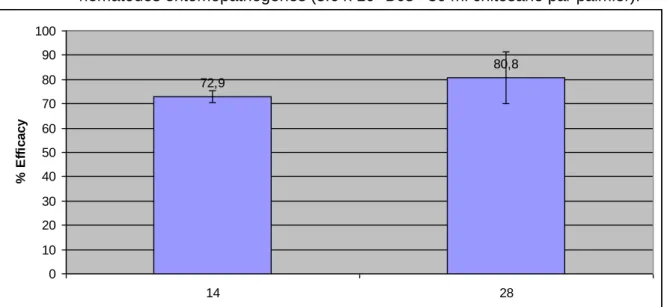
Curative test: When used as a curative treatment, both the treatment and the time until palm dissection significantly affected the mortality caused by S. carpocapsae in R. ferrugineus. The longer the time elapsed since EPN application, the higher the mortality observed and, hence, the efficacy of the treatment. Efficacies ranged from 72,9 to 80,8% in palms dissected 14 and 28 days after treatment respectively.
FIGURE 1: Results of the curative assay: Efficacy of S. carpocapsae in a chitosan formulation in P. canariensis, evaluations 14 and 28 days after EPN application (3.6 x 10⁶ DJs + 36 ml chitosan per palm).
Résultats du traitement curatif : efficacité de S. capocapsae dans une solution de chitosan sur P. canariensis, évaluations realisées 14 et 28 jours après l´application de nématodes entomopathogènes (3.6 x 10⁶ DJs+ 36 ml chitosane par palmier).
72,9 80,8 0 10 20 30 40 50 60 70 80 90 100 14 28 Days % E ff ic a c y
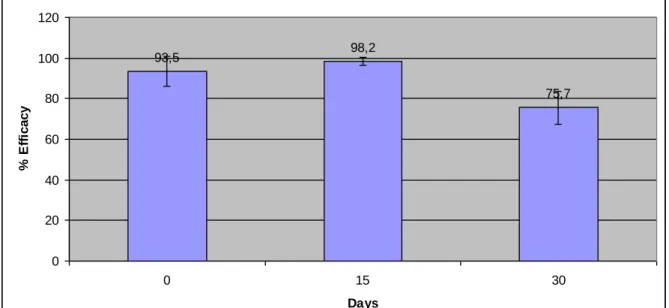
Preventive test: In the case of preventive treatment, both the application of S. carpocapsae with chitosan and the timing of this application in relation to infestation significantly affected the number of immature stages found alive in the palms. The interaction between these factors was significant and the number of living immature stages per palm remained low and did not significantly change from 0 to 15 days, but increased at 30 days. As a consequence, efficacy decreased at the end of the assay. Efficacies ranged from 93.5, 98.2, and 75.7% in palms where weevils were released 0, 15 and 30 days after treatment respectively.
FIGURE 2: Results of the preventative assay: Efficacy of S. carpocapsae in a chitosan formulation in P. canariensis as a function of the time elapsed since EPN application (0, 15, and 30 days; dose 3.6 x 10⁶ DJs + 36 ml chitosan per palm. Résultats en traitement préventif : efficacité de S. capocapsae dans une solution de
chitosane sur P. canariensis en fonction du temps écoulé à partir de l´application de nématodes entomopathogènes (0, 15 et 30 jours ; dose 3.6 x 10⁸ DJs + 36 ml chitosan par palmier).
93,5 98,2 75,7 0 20 40 60 80 100 120 0 15 30 Days % E ff ic a c y
2.- EVALUATION OF THE EFFICACY OF S. CARPOCAPSAE IN A CHITOSAN
FORMULATION AGAINST RED PALM WEEVIL ON DATE PALMS. PERSISTENCE,
CURATIVE AND PREVENTIVE EFFECTS
Preventive test: 100% of adults released one hour after treatment died. 17% of adults were dead within 48h of been released, and 83% died 5 days after release. It was possible to detect nematodes in all weevils under microscope evaluation. 66.70% of weevil released 7 days after the treatment died, half of this population died during the first week after been captured, and the other half died during the 3 following weeks. 100% of the weevils that died during the first week proved positive for the presence of nematodes, while only 25% of adults that died between the second and fourth week following their capture, were nematode positive under microscope. Adults removed from non-treated palms survive more than three months.
Curative test: After dissection it was possible to detect larvae and pupae inside the palms. 67.44% of the larvae found were dead when dissected. Of the remaining 32.56% of larvae found alive, 64.29% died within 20 days.
72.73% of pupae were found dead.
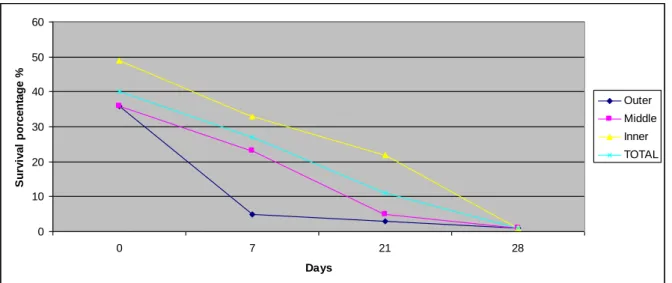
S. carpocapsae persistence: In spite of the fact that the method used is not very sensitive in detecting nematode populations, since, the method was only able to detect 50% of the population 24 hours after the application. Even so, the data collected shows that the nematode population decreases as days pass. The results, in corrected average percentages, (fig 3) show that the nematodes are able to survive the longest at the base of inner most leaves of young shoots. 33.63% of the nematodes survived 7 days while 21.14% remained alive 21 days after treatment. 21.40% survived 7 days in the average area which proves that the palm’s intricate tissue serves as a favourable environment for nematode survival.
FIGURE 3: Evolution of survey percentages of S. carpocapsae in a chitosan formulation under field conditions in the palm stipe.
Évolution des pourcentages de survie de S. carpocapsae dans une solution de chitosane appliquée sur le stipe des palmiers en conditions réelles sur le terrain.
0 10 20 30 40 50 60 0 7 21 28 Days S urv iv a l po rc e nt a ge % Outer Middle Inner TOTAL
3. – ONE-YEAR FIELD EFFICACY OF STEINERNEMA CARPOCAPSAE IN A CHITOSAN FORMULATION AGAINST THE RED PALM WEEVIL IN P. CANARIENSIS
Newly infested palms were not detected in the nursery until March. The first dead palms were observed in control. After March, dead palms were progressively detected in control and treated palms. In August, mortality suddenly increased in the control and significant differences in the percentage of surviving palms between the control and the treated palms appeared. These differences did not disappear until the end of the experiment in January 2009, when efficacies were finally calculated.
Treatments significantly reduced the mean number of immature stages of R. ferrugineus per palm and resulted in increased palm survival compared with the untreated control (Table II) Efficacy was 99.7% for the mean number of immature stages found per palm, and 73.8% for palm survival. Most of the grubs found dead in treated palms proved positive in the
laboratory for the presence of nematodes.
Table II: Mean number of immature stages of R. ferrugineus found in P. canariensis palms
and percentage palm survival of the treatment applied against R. ferrugineus on 6–8-year-old P. canariensis, and efficacies (%) based on both parameters. Biorend R® was applied monthly.
Nombre moyen de stades préimaginaux de R. ferrugineus trouvés dans les palmiers P. canariensis et pourcentage des palmiers survivants avec le traitement appliqué contre R. ferrugineus, pour des P. canariensis de 6-8 ans, et efficacités (%) sur la base des deux paramètres. Biorend R® était appliqué chaque mois.
No. of immature stages alive Percentage palm survival
Treatment N Mean(± SE) Efficacy N Mean ± SE Efficacy
Control 40 36.60 ± 3.96 4 16.5 ± 5.8
4. - EVALUATION OF THE EFFICACY OF S. CARPOCAPSAE IN A CHITOSAN
FROMULATION AGAINST RED PALM WEEVIL ON P. THEOPHRASTI.
Successful infestation percentage on P. theophrasti in EPN test was 17 and 0% for control and EPN treatment, respectively. Infestation percentage based on the presence of galleries was higher for the control at 92% and 50% EPN+ chitosan treatment. Thirty galleries were found in control palms while seven galleries were found treated palms. The mean number of galleries per palm was significantly higher in the control than in treated palms. The galleries found in control palms were longer (approximately 25 mm) than those in treated palms (less than 8 mm). When palms were dissected 40% and 14% of the galleries in control and EPN treatments respectively bore a gummy secretion. Live EPN were recovered in the secretion from EPN- treated palms.
5. - THE EVOLUTION OF R. FERRUGINEUS IN THE AUTONOMOUS CITY OF CEUTA. CURRENT ACTIONS TAKEN AND SUMMARY OF EFFORTS SINCE THE BEGINNING IN 2009. (in accordance with quarterly reports written by the Environmental Ministry and Ceuta’s Community and District Services, Consejería de Medio Ambiente, Servicios Comunitarios y Barriadas de la ciudad autónoma de Ceuta).
The number of palms affected by R. ferrugineus in Ceuta from the initial detection until 15th September 2012 reached a total of 200 palms. For the moment, all of these palms belong exclusively to the P. canariensis species, making up 15% of the current total of this species in the city and approximately 6.7% of all existing palms in Ceuta territory (data calculated according to the updated palm census taken in Ceuta in 2011).
A total of 173 palms were eradicated and destroyed in the 1st phase of the protocol, 53 palms in 2009, 100 in 2010 and 20 in 2011. As seen in Figure 4, no palms were eradicated during the year 2012 from January to September 15.
FIGURE 4: Number of palms eradicated from November 2009 until September 15, 2012. Nombre de palmiers éradiqués de novembre 2009 au 15 septembre 2012
53 100 20 0 0 20 40 60 80 100 120 2009 2010 2011 2012 YEAR N º E R A D IC A TE D P A LM S
Despite reducing the number of treated palms in Ceuta, only 26 new cases of affected palms, all P. canariensis, occurred once the modifications were made during the 2nd protocol. 20 palms were detected in 2011 and 6 since the start of 2012 to 15th September 2012. Mechanical sanitation combined with intensive curative treatments was applied to these cases. All palms are recuperating and progressing favourably with active growth in the crown with the exception on one case. Mechanical sanitation was applied to this case on 30th of August 2011 and it continually showed signs of rotting in growth areas at risk of dying
due to reoccurring fungus infections. After repeated treatments with fungicide, the palm did not recover and it was taken down and destroyed on 5th of September 2012. Strictly speaking, the death of this particular palm should not be linked to the red palm weevil. All 6 affected palms that were found during 2012 were detected early. They presented low infestation levels and therefore the intervention was very minor.
In summary, adult captures in traps from July 2011 until September 15, 2012 are represented in Fig.5. When comparing the months of July, August and September of 2011 with same months in 2012, the number of adults captured in traps decreased 95%.
FIGURE 5: Total number of R. ferrugineus adults captured in traps per month in 2011 and 2012
Nombre total d´adultes de R. ferrugineus capturés par mois pendant les années 2011 et 2012
With regard to the spatial distribution of the newly infested palms, it is important to point out that there were not any new sources of infestation. The newly affected palms were located near previously known sources. Most new cases were mostly palms growing in the proximity of previously affected palms that were either destroyed or subject to surgery.
6. - TREATMENT APPLICATIONS AT THE BOTANICAL GARDEN IN VALENCIA. EXPERIENCE AFTER FIVE YEARS.
From the beginning of treatment on February 25, 2008 until August 2012, there have not been any palm deaths or eradications in the Botanical Garden.
There were three incidents that occurred at the garden. All of these infestations happened in the P. canariensis species. The first was detected in April 2011, the second in November 2011 and the third in January 2012. The first affected palm also suffered a reinfestation in the spring of 2012. All three cases were treated with a mechanical sanitation technique and simultaneously sprayed with a chemical treatment (imidacloprid). The infestations were detected at relatively early stages due to continuous surveillance of the Garden’s highly specialized personnel. The cases presented low levels of infestation and therefore the interventions were not severe and the palms are recovering favorably.
The preventive efficacy of the applied product is 98.81% if all treated palms are taken into consideration, 94,81% taking into account all palms from the Phoenix genus, and 85.72% regarding the Canary palms. These results are similar to those obtained in LLACER (2009) and DEMBILIO (2011). 75 169 197 26 9 0 0 0 0 0 2 2 8 5 8 0 50 100 150 200 250 JL A S O N D J F M A M J JL A S DATE N º A D U LT S C A P TU R E D
2011
2012
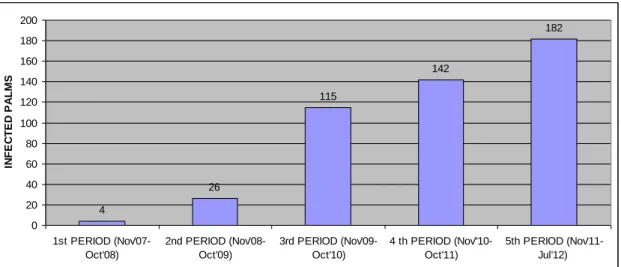
Figure 6 shows the plague’s evolution in the city of Valencia in reference to the number of municipal palms infested. Results provided by the Valencia City Hall Department of Parks and Gardens.
The number of affected palms increases each year with a very marked increase in 2010. Peak flight activity for adult weevils in Valencia occurs between the months of October – November and another slightly less active period in April-May according to the data provided by City Hall.
Figure 6: Red weevil plague’s evolution in the city of Valencia in reference to the number of municipal palms infested since November 2007 to July 2012. Each period is represented from November to October of the following year according to the data provided by the Valencia City Hall Department of Parks and Gardens. Évolution du charançon rouge dans la ville de Valence d’après le nombre de palmiers
municipaux infectés de novembre 2007 à juillet 2012. Chaque période va de novembre à octobre de l´année suivante, selon les données fournies par le Département des Parcs et Jardins de la municipalité de Valence.
4 26 115 142 182 0 20 40 60 80 100 120 140 160 180 200 1st PERIOD (Nov'07-Oct'08) 2nd PERIOD (Nov'08-Oct'09) 3rd PERIOD (Nov'09-Oct'10) 4 th PERIOD (Nov''10-Oct'11) 5th PERIOD (Nov'11-Jul'12) IN FE C TE D P A LM S DISCUSSION
We can conclude from the data in these 4 publications that all these results prove the potential of S. carpocapsae in a chitosan formulation to control R. ferrugineus infestations in palms. Efficacies around 80% were obtained in the curative assay, and up to 98% in the preventive treatment on P. canariensis, similarly in the case of P. dactylifera around 70% in the curative test, and 83% in the preventive treatment. The results in P. theophrasti are also comparable to the results obtained in P. canariensis and P. dactylifera. Equally important, the product’s high efficacy has been proven when evaluating its efficacy over a one year time period in the field. 99.7% efficacy was obtained based on the number of immature stages found in P. canariensis. These results coincide with the aforementioned data for different palm species when treated with S. carpocapsae in a chitosan formulation.
These efficacies are very high, especially when compared to chemical pesticides used against this pest AZAM & RAZVI (2001); HERNANDEZ MARANTE et al. (2003); EL-SEBAEY (2004); KAAKEH (2006). Furthermore, our results demonstrate the ability of S. carpocapsae mixed with chitosan to infect and kill not only larvae, but also more robust stages of this weevil, such as the pupa and the adult in field assays. The results from the curative assay in the P. canariensis, P. dactylifera and P. theophrasti are indicative that S. carpocapsae does not stay on the outside of the palm waiting for its host, but, rather, penetrates in the palm crown actively looking for and infecting R. ferrugineus larvae. These
results differ from the general consensus that this species is a classic ambusher GARCIA DEL PINO (2006); GAUGLER (2007), but are in agreement with results on similar cryptic systems DILON et al. (2006), MARTINEZ DE ALTUBE et al. (2007). These authors presented evidence that S. carpocapsae did not simply remain on the treated surface and behaved in the same way as other EPN with different foraging strategies. Similar to the results in the curative treatment on P. canariensis, DILON et al. (2006) also found that the percentage of insects parasitized by S. carpocapsae increased between two and four weeks and they attributed this fact to both the time taken by the nematodes to find the insects and that taken by the insects to die after EPN infection. The percentage of grubs found dead in treated palms which proved positive for the presence of both nematodes and the symbiotic bacterium decreased from 14 to 28 days. This result coincides with the hypothesis that EPN leave their hosts once they are dead and therefore contribute to the natural spread of the disease EHLERS (2001). The same hypothesis could explain why it was not possible to isolate S. carpocapsae from the females found dead when the palms from the preventive treatment were dissected at the end of the assay on P. canariensis.
The product’s preventive efficacy, around 93%, was very high in the semi-field assays carried out in P. canariensis and P. dactylifera as well the work carried out in an actual field study over the course of a year in P. canariensis. In the semi-field assays in P. canariensis, it is possible to observe a very high preventive efficacy at 0 and 15 days which then decreases the longer the nematodes are alone in the palms without any insects to parasitize. 93.5, 98,2 and 75.7% was the efficacy evolution when the adults were set free in the palms at 0, 15 and 30 days after treatment respectively. These results could be explained with the data obtained in the resistance assay carried out in P. datilyfera. This assay showed a decrease in nematode survival over time. The percentage of nematode survival 28 days after product application was detected at very low concentrations.
The population of live nematodes in the palm decreases with time and therefore the preventive efficacy also declines with time. The cause of this could be that as time passes, the nematode population decreases and at some point there isn’t a sufficient nematode population at the surface of the palm to avoid the Red palm weevil from parasitizing the palm. Due to this decrease in nematode survival over time, it is recommended to frequently apply product treatments to maintain a sufficient nematode population in the palm. This will guarantee a certain efficacy and protection over time since frequent application could protect the palms by affecting the following: (1) immature stages from the old generation within the palm, (2) adults before oviposition, and (3) young larvae and pupae from the new generation. In order to estimate the treatment application frequency, not only should the nematode survival in the palms be taken into consideration, but also the Red Palm weevil’s behaviour that varies in accordance to area and climate, the attack level of the palms and the degree of the plague. It is also important to consider sanitary condition of other palms located near the palms that are to be protected. The present results contrast with the inconsistent results obtained by ABBAS et al. (2001) when using EPNs in date palms. One important difference between the experiments of ABBAS et al. (2001) and those reported here is the use of chitosan as an adjuvant. Chitosan is presumed to protect nematodes from environmental conditions and therefore increase and stabilise efficacy in comparison to formulations where nematodes are applied without it DEMBILIO (2010)
It should be noted that these positive results were obtained in unfavourable conditions for the nematodes. S. carpocapsae survival and activity in a chitosan formulation was proven during periods of high temperatures. To be specific, the assay developed at the Institut Valencià d’Investigacions Agraries (IVIA) in Spain LLACER et al. (2009) was carried out during the summer months of June, July, and August. The other assay, developed in Greece by DEMBILIO et al. (2011), was also carried out in the summer months when temperatures reached above 40.3ºC The assay carried out in Elche by GOMEZ (2009) began in June and the last assay performed by DEMBLIO (2010) lasted one year and therefore the nematodes were subject to changing weather conditions.
Regarding the control efforts carried out in the city of Ceuta, from November 2009 until the first quarter of 2011, The total number of palms eradicated and destroyed due to the red palm weevil is 173 P. canariensis (not included is the treated palm that later died due to fungus attacks). This number accounts for 11.48% of this species in Ceuta and 5.48% of all palms in the city. To date there are no remaining palms to be eradicated that pose as a source of spreading of this harmful grub.
Since March 2011 and after making changes to the protocol, it has not been necessary to eradicate or destroy any palms. There were 26 cases of P.canariensis new infestations that constitute 1.94% of this species in Ceuta and 0.87% of all palm species. These affected palms are currently progressing favourably with active growth. Therefore, the current protocol’s preventive efficacy can be estimated at 98.06% if only P.canariensis palms are taken into account and 98.58% if all Phoenix type palms being treated are taken into account. The curative efficacy since March 2011 is currently 100%.
A noticeable decrease in the number of palm infestations can be observed in 2012 with respect to 2010 and 2011. In any case, the period in 2012 should be categorized as low-level infestation. However, it could be foreseeable that the summer months and early autumn will see an increase in the number of infestations coinciding with the adult insect’s maximum activity period. At least this increase was seen in the number of adult captures in pheromone traps during 2011. The summer of 2012 experienced this increase as well, but the data shows the increase with much lower numbers. The number of adults captured in traps decreased 95% with respect to 2011 due to the combined actions taken to fight the red palm weevil.
We can conclude that the treatments established in the second phase of the protocol give obvious benefits, most importantly saving the affected palms from destruction. The results show that treatment decreased the Canary palm destruction rate from 11.48% to 0%, which allows us to conserve and protect the plant material and patrimony. These results also brought about a cost savings in performing phytosanitary measures (no cutting down affected palms or elimination of debris which accounts for the most expensive tasks). Product costs are also reduced since the number of treatments is lower as there are fewer palms to treat. However, putting this protocol in practice requires continuous surveillance efforts and careful control of the phytosanitary condition of all Ceuta’s palms. The technique’s efficacy depends greatly on both its correct implementation by professionals, such as Ceuta’s trained team, and early infestation detection or at a relatively early stage. In order to facilitate and reduce the time and money cost of applying preventive treatments to larger palms and those with difficult access, tubes have been installed in the crown of certain palms as a complementary action. These tubes have been installed in 13 palms of larger dimensions and/or in compromising locations in the city facilitating their treatment. These installations also require surveillance since the wind can cause movements just as the natural growth of the palms.
It is important to highlight that in addition to saving Ceuta’s plant patrimony, the red weevil plague has been contained and controlled while also lowering its population. If these results are maintained in the future, we would have the case under control and possibly eradicated given that the source of reinfection or entrance is eliminated.
The established protocol and action plan demonstrate the ability to control the R. ferrugineus plague, which could be extrapolated to other municipalities or zones of the Mediterranean area
Lastly, regarding the work done at the Botanical Garden, we can conclude that the established protocol, in combination with the changes that have been made along the way according to the population’s progress and the severity of the weevil plague in Valencia, has successfully avoided the destruction and elimination of any palm in the Garden. This has allowed us to safeguard the plant patrimony.
Adjacent to the Botanical Garden is the Jesuit College and the nearby Jesus Mª School (Colegio del Socos). Coinciding with the first infestation case, various P. canariensis palms of considerable size ≤ 10 m were taken down in these locations in advance stages. These palms had visible flying adults that could have been the initial source of infestation for the Botanical Garden.
The first infestation occurred in April 2011 when the Garden had been without biological treatment for 160 days (from October 18 until March 28). The months prior to the last treatment coincide with the exponential spread of the plague that took place in Valencia in 2010. Although the preventive efficacy of the product is very high, it is not 100%. It is possible that the treatment carried out on October 18 was not capable of preventing the infestation. Frequent biological treatments were not applied after this possible infestation date, treatments that would have exercised the product’s curative function, and so the larvae phases could then evolve and infest the palm until the attack could be detected visually. Although the adult flight periods decrease in winter, the larvae activity inside the palm continues. For this reason, we do not consider appropriate to eliminate winter treatments. The treatments during these months could be spaced out while always taking into consideration climatic factors. In order to control the plague, it is necessary to combine the curative and preventive effects of the treatments to wipe away generations of red palm weevil.
The present data shows that the nematode population in a chitosan solution decreases over time, in agreement with the data obtained by LLACER (2009) and GOMEZ (2008). Even though the preventive efficacy at the Botanical Garden was very high, almost 93%, if the treatments are not frequently applied then a sufficient nematode population will not be maintained in the palm to guarantee total protection. 5 or 6 treatments a year constitute an average pattern of treatment every 73-60 days. This frequency is not enough to guarantee 100% palm protection, as indicated by these 4 infestation cases. Based on the present data and previous research, to have complete protection using biological treatments of EPNs in a chitosan solution, it is necessary to increase treatment frequency.
When evaluating product efficacy, it is important to consider the Botanical Garden’s collection of over 350 palms that are susceptible to weevil attack due to their concentration, plant variety, flowering periods, and kairomones which must powerfully attract the weevil. Of the 335 palms in the Garden, 130 were treated which constitutes 38.80% of all palms. 77 of these 130 palms are from the Phoenix genus which are the most susceptible to weevils. The remaining palms in the Garden are being successfully protected with the current strategy just as in Ceuta. This is an interesting strategy for municipal control programs since it lowers costs especially in difficult financial times such as the current crisis.
However, the strategy to treat only palms of the Phoenix genus is working with the current plague behaviour and levels. If the severity of the plague worsens and the weevil changes its behaviour to attack other species on a regular basis and not only periodically, it would be necessary to change the strategy and to treat these species as well.
CONCLUSION
The S. carpocapsae nematode effectively kills and prevents the plague. Thanks to the film formed by chitosan, the nematodes are covered with a protective layer that allows them to endure adverse conditions such as high temperatures and droughts better than other nematodes, DEMBILIO et al. (2010). Nematode’s normally live in the ground, so this film permits their use outside their normal habitat throughout the entire year in Mediterranean
climates, including summer. The chitosan regenerates and/or strengthens the plans by stimulating its defense mechanisms, HADWIGER & LOSCHKE (1981). It also increases defense responses against fungal diseases in palms EL HASSNI et al. (2004), EL HADRAMI et al. (1996), increases lignification and promotes root development, AIT BARKA et al. (2004). The chitosan composition also contains compounds that produce a chemical stimulation in the nematodes increasing their virulence and numbers.
These assays show that a correct protocol of preventive and curative treatments based on S. Carpocapsae with chitosan that also includes surveillance and personnel knowledgable of the plague can biologically control red palm weevil attacks in cities, parks, gardens…. In accordance with the European Union law, the EU Directive 2009/128/CE published 11/24/209 and Regulation 1107/2009 published 11/24/2009 that in article 12. Limits and/or prohibits the use of phystosanitary products in spaces used by people in cities, parks, gardens, sport fields, school areas, playgrounds, hospitals and residences.
ACKNOWLEDGEMENTS
The authors thank the following people: the personnel from the Environmental Ministry and Ceuta's Community and District Services (Consejería de Medio Ambiente, Servicios Comunitarios y Barriadas de la ciudad autónoma de Ceuta), the personnel from the Botanical Garden of Valencia and the Department of Parks and Gardens of Valencia, all of the authors whose work is summarized in the present paper and the Llopis and Llopis Ltd. company for their work, effort, collaboration and their professionalism shown over recent years.
REFERENCES
Abbas MST., Hanounik SB., Mousa SA., Mansour MI., 2001a - On the pathogenicity of Steinernema abbasi and Heterorhabditis indicus isolated from adult Rhynchophorus ferrugineus (Coleoptera). Int J Nematol 11:69–72.
Abbas MST., Saleh MME., Akil AM., 2001b - Laboratory and field evaluation of the pathogenicity of entomopathogenic nematodes to the red palm weevil, Rhynchophorus ferrugineus (Oliv.) (Col.: Curculionidae). J Pest Sci 74:167–168.
Ait Barka E., Eullaffroy P., Clément C and Vernet G., 2004 - Chitosan improves development, and protects Vitis vinifera L. against Botrytis cinerea. Plant Cell Rep 22:608– 614.
Azam KM. and Razvi SA., 2001- Control of red palm weevil, Rhynchophorus ferrugineus Oliver, using prophylactic spraying of date palms and trunk injection. Proc 2nd Internat Conf Date Palms, Al-Ain, UAE,March 2001, pp. 216–222.
Barranco P., De la Peña J., Cabello T., 1995 - Un nuevo curculiónido tropical para la fauna europea, Rhynchophorus ferrugineus (Olivier 1790) (Coleoptera, Curculionidae). Bol Asoc Esp Ent 20:257–258.
Data sheets on quarantine pests. Rhynchophorus ferrugineus. EPPO Bull 38:55–59 (2008). Dembilio O., Jacas JA. and Llácer E., 2009 - Are the palms Washingtonia filifera and Chamaerops humilis suitable hosts for the red palm weevil, Rhynchophorus ferrugineus (Coleoptera: Curculionidae)? J Appl Entomol 133:565–567.
Dembilio O., Llacer E., Martínez de Altube M.M Jacas JA., 2010 - Field efficacy of imidacloprid and Steinernema carpocapsae in a chitosan formulation against the red palm
weevil Rhynchophorus ferrugineus (Coleoptera: Curculionidae) in Phoenix canariensis. Pest Manag Sci 66, 365- 370
Dembilio O., Karamaouna F., Kontodimas D.C., Nomikou M., Jacas J.A., 2011 – Short
communication. Susceptibility of Phoenix theophrasti (Palmae: Coryphoideae) to
Rhynchophorus ferrugineus (Coleoptera: Curculionidae) ans its control using Steinernema carpocapsae in a chitosan formulation. Span J Agric Res 9 (2), 0-0
Dillon AB., Ward D., Downes MJ., Griffin CT., 2006 - Suppression of the large pine weevil Hylobius abietis (L.) (Coleoptera: Curculionidae) in pine stumps by entomopathogenic nematodes with different foraging strategies. Biol Control 38:217–226.
Ehlers RU., 2001 - Mass production of entomopathogenicnematodes for plant protection. Appl Microbiol Biotechnol56:623–633
Ehlers RU., 2003 - Entomopathogenic nematodes in the European biocontrol market. Commun Agric Appl Biol Sci 68:3–16.
Elawad SA., Mousa SA., Shahdad AS., Alawaash SA., Alamiri AMA., 2007 - Efficacy of entomopathogenic nematodes against red palm weevil in UAE. Acta Hortic 736: 415–420. El Hadrami I., Ramos T., Macheix J.J., 1996 – Caracterisation de nouveaxu derives hydroxycinnamiques amines chez Phoenix dactilyfera L. relation avec le brunissement des tssue et in resistance des cultivars au bayond. Poliphenols communications 2 :341- 342. El Hassni M., El Hdrami A., Daayf F., Ait Birla E., El Hadrami I., Chitosan, antifungal product against Fusarium oxysporum f.sp.albedinis and elicitor of defense reactions in date palm roots. Phytopathol. Mediterr. 43:195-204
El-Sebaey Y., 2004 - Field evaluation of certain insecticides against red palm weevil Rhynchophorus ferrugineus Oliv. (Coleoptera; Curculionidae) in Egypt. Egypt J Agric Res 82:1591–1598.
Faleiro JR., 2006 - A review on the issues and management of red palm weevil Rhynchophorus ferrugineus (Coleoptera: Rhynchophoridae) in coconut and date palm during the last one hundred years. Internat J Trop Insect Sci 26:135–154.
Ferry M., and Gómez S., 2002 - The red palm weevil in the Mediterranean area. Palms 46:172–178.
Forst S. and Clarke D., 2002 - Bacteria-nematode symbiosis. In: Gaugler R (ed) Entomopathogenic nematology. CABI, London, pp 57–77.
García del Pino F., 2006 - Los nematodos entomopatógenos agentes de control de plagas. In: Jacas J, Caballero P, Avilla J (eds) El control biológico de plagas y enfermedades. Publicacions de la Universitat Jaume I, Castellón de la Plana, pp 87–112
Gaugler R., 2007 - Nematodes (Rhabditida: Steinernematidae & Heterorhabditidae). Available online at: http://www.nysaes.cornell.edu/ent/biocontrol/pathogens/nematodes.html Gómez S., Muñoz C., Ferry M., Martínez MM., 2008 – Comunicación Primeros resultados sobre el uso de Steinernema carpocapsae (Rhabditida: Steinernematidae) asociado a quitosano para el control de Rhynchophorus ferrugineus, Olivier en palmeras datileras. Bol. San. Veg. Plagas, 34: 147-149.
Hadwiger LA. and Loschke DC. 1981 -, Molecular communication in host–parasite interactions: hexosamine polymers (chitosan) as regulator compounds in race-specific and other interactions. Phytopathology 71:756–762.
Hernández-Marante D., Folk F., Sánchez A., and Fernández-Escobar R., 2003 - Control del curculiónido ferruginoso de las palmeras (Rhynchophorus ferrugineus Olivier) mediante inyecciones al tronco y pulverización foliar. Bol. San. Veg. Plagas 29:563–574.
Kaakeh W., 2006 - Toxicity of imidacloprid to developmental stages of Rhynchophorus ferrugineus (Curculionidae: Coleoptera): laboratory and field tests. Crop Prot 25:432–439. Kontodimas DC., Milonas P., Vassiliou V., Thymakis N. and Economou D., 2006 - The occurrence of Rhynchophorus ferrugineus in Greece and Cyprus and the risk against the native greek palm tree Phoenix theophrasti. Entomol Hellen 16:11–15.
Llácer E., Martínez de Altube MM., and Jacas JA., 2009 - Evaluation of the efficacy of Steinernema carpocapsae in a chitosan formulation against the red palm weevil, Rhynchophorus ferrugineus, in Phoenixcanariensis. BioControl 54:559–565.
Martínez de Altube MM., Strauch O., Fernández De Castro G., Martínez Peña A., 2007 - Control of the flat-headed root borer Capnodis tenebrionis (Linné) (Coleoptera: Buprestidae) with the entomopathogenic nematode Steinernema carpocapsae (Weiser) (Nematoda: Steinernematidae) in a chitosan formulation in apricot orchards. BioControl 53:531–539
Martínez Peña A., 2002 Biological pesticide based on chitosan and entomopathoeic nematodes. WO Patent 037966.
Murphy ST. and Briscoe BR, 1999 - The red palm weevil as an alien invasive: biology and the prospects for biological control as a component of IPM. Biocontrol News Inf 20:35–46. New Pest Response Guidelines- 2010 Red Plam weevil Rhynchophorus ferrugineus
http://www.aphis.usda.gov/import_export/plants/manuals/emergency/downloads/nprg-redpalmweevil.pdf
OEPP/EPPO 2008 - Data sheets on quarantine pests Rhynchophorus ferrugineus. Bull OEPP/EPPO Bull 38:55–59.
OEPP/EPPO 2009 - First Record of Rhynchophorus ferrugineus in Curacao, Netherlands Antilles, 26 January 2009. [Online]. European and Mediterranean Plant Protection Organisation (EPPO). Available: http://archives.eppo.org/EppoReporting/2009/RSE-091.pdf
[22 July 2009].
Registro de Productos Fitosanitarios CONFIDOR 240 O-TEQ. [Online]. MARM (Ministerio
de Medio Ambiente y Medio Rural y Marino). Available:
http://www.mapa.es/agricultura/pags/fitos/registro/ productos/pdf/24580.pdf; BIOREND R
PALMERAS, OCB 0119. No. de Orden: 153. [Online].
Available:http://www.mapa.es/agricultura/pags/fitos/registros/fichas/pdf/RegistroOCBJulio20 09. pdf [22 July 2009].
Saleh MME., Alheji M., 2003 - Biological control of red palm weevil with entomopathogenic nematodes in the eastern province of Saudi Arabia. Egypt J Biol Pest Control 13:55–59.