American College of Rheumatology 2008
Recommendations for the Use of Nonbiologic and
Biologic Disease-Modifying Antirheumatic Drugs
in Rheumatoid Arthritis
KENNETH G. SAAG,
1GIM GEE TENG,
1NIVEDITA M. PATKAR,
1JEREMY ANUNTIYO,
2CATHERINE FINNEY,
2JEFFREY R. CURTIS,
1HAROLD E. PAULUS,
2AMY MUDANO,
1MARIA PISU,
1MARY ELKINS-MELTON,
1RYAN OUTMAN,
1JEROAN J. ALLISON,
1MARIA SUAREZ ALMAZOR,
3S. LOUIS BRIDGES, JR.,
1W. WINN CHATHAM,
1MARC HOCHBERG,
4CATHERINE MACLEAN,
5TED MIKULS,
6LARRY W. MORELAND,
7JAMES O’DELL,
5ANTHONY M. TURKIEWICZ,
1ANDDANIEL E. FURST
2Guidelines and recommendations developed and/or endorsed by the American College of Rheumatology (ACR) are intended to provide guidance for particular patterns of practice and not to dictate the care of a particular patient. The ACR considers adherence to these guidelines and recommendations to be voluntary, with the ultimate determination regarding their application to be made by the physician in light of each patient’s individual circumstances. Guidelines and recommendations are intended to promote beneficial or desirable outcomes but cannot guarantee any specific outcome. Guidelines and recommendations developed or endorsed by the ACR are subject to periodic revision as warranted by the evolution of medical knowledge, technology, and practice.
Introduction
The majority of patients with a confirmed diagnosis of rheumatoid arthritis (RA) use nonbiologic
disease-modify-ing antirheumatic drugs (DMARDs) and the rate of biologic DMARD use is rising rapidly (1,2). The American College of Rheumatology (ACR) has not updated its
recommenda-Dr. Saag’s work was supported by the Agency for Health-care Research and Quality (grant U18-H510389), the Uni-versity of Alabama, Birmingham Center for Education and Research on Therapeutics of Musculoskeletal Diseases, and a grant from the American College of Rheumatology. Drs. Pisu, Allison, and Moreland’s work was supported by a grant from the American College of Rheumatology. Dr. Furst’s work was supported by a grant from the American College of Rheumatology and the NIH.
1
Kenneth G. Saag, MD, MSc, Gim Gee Teng, MD, Nivedita M. Patkar, MD, MSPH, Jeffrey R. Curtis, MD, MPH, Amy Mudano, MPH (current address: Blue Cross and Blue Shield of Alabama, Birmingham), Maria Pisu, PhD, Mary Elkins-Melton, BA, Ryan Outman, MS, Jeroan J. Allison, MD, MS, S. Louis Bridges, Jr., MD, PhD, W. Winn Chatham, MD, Anthony M. Turkiewicz, MD: University of Alabama, Bir-mingham;2Jeremy Anuntiyo, MD, Catherine Finney, MD,
Harold E. Paulus, MD, Daniel E. Furst, MD: University of California, Los Angeles;3Maria Suarez Almazor, MD, MPH:
University of Texas, MD Anderson, Houston;4
Marc Hoch-berg, MD, MPH: University of Maryland, Baltimore;5
Cathe-rine MacLean, MD, PhD, James O’Dell, MD: University of California, Los Angeles, RAND Corporation, Santa Monica, and West Los Angeles VAMC; 6
Ted Mikuls, MD, MSPH:
University of Nebraska, Omaha;7
Larry W. Moreland, MD: University of Pittsburgh, Pittsburgh, Pennsylvania.
Dr. Saag has received consultant fees (less than $10,000 each) from Roche, UCB, Nitec, and Amgen and research support from Abbott, Amgen, Centecor, Roche, and Wyeth. Dr. Curtis has received consultant fees, speaking fees, and/or honoraria (less than $10,000 each) from Roche, Merck, Procter and Gamble, Eli Lilly, UCB, and Novartis and research support from Amgen, Eli Lilly, Merck, Novar-tis, Procter and Gamble, and Roche. Dr. Paulus has received consultant fees (less than $10,000 each) from Amgen, Roche and Mathematica. Dr. Chatham has received speaking fees and honoraria (less than $10,000 each) from Bristol-Myers Squibb and Amgen. Dr. Hochberg has received consultant fees (less than $10,000 each) from Amgen and Bristol-Myers Squibb. Dr. MacLean owns stock and/or holds stock options in WellPoint. Dr. Mikuls has received speaking fees (less than $10,000 each) from Genentech and Amgen and unre-stricted grants from Abbott, Amgen, and Bristol-Myers Squibb. Dr. Moreland has received consultant fees, speaking fees, and/or honoraria (less than $10,000 each) from Roche, Bristol-Myers Squibb, Centocor, Pfizer, Amgen, Incyte, and Genentech. Dr. O’Dell has received consultant fees and speak-ing fees (less than $10,000) from Abbott. Dr. Turkiewicz has received consultant fees and speaking fees (less than $10,000) DOI 10.1002/art.23721
© 2008, American College of Rheumatology
SPECIAL ARTICLE
tions for nonbiologic DMARDs since 2002 (3) and has not previously developed recommendations for biologic agents. Although past guidelines have been derived from an informal consensus approach, we used a formal group process to develop recommendations that were as evi-dence-based as possible.
To develop these new recommendations on behalf of the ACR, following the principles delineated by the Appraisal of Guidelines for Research and Evaluation (AGREE)
Col-laboration (4), we first conducted a systematic review of scientific evidence to create an evidence report and draft guidelines. We addressed each of the 5 domains prespeci-fied by the ACR, namely: 1) indications for use; 2) screen-ing for tuberculosis (TB; biologic DMARDs only); 3) mon-itoring for side effects; 4) assessing the clinical response; and 5) the roles of cost and patient preferences in decision-making (biologic DMARDs only). A Working Group and a Core Expert Panel (CEP) of clinicians and methodologists guided the development of these recommendations. We next convened a Task Force Panel (TFP) of internationally-recognized clinicians, methodologists, and patient repre-sentatives with broad expertise in the use of nonbiologic and biologic DMARD therapies, evidence-based medicine, patient preference, and health care economics. They were to critique and rate proposed recommendations using a well-accepted group process, the modified Research and Development/University of California at Los Angeles (RAND/UCLA) Appropriateness Method (5) (Figure 1). Al-though the TFP and CEP considered drug-specific indica-tions from the US Food and Drug Administration (FDA) and other regulatory authorities, in some cases the TFP extrapolated recommendations outside the present bounds of approved labeling. Although terminology used by reg-ulatory agencies varies, in this article we refer to biologic agents as drugs.
Disseminated under the aegis of the ACR, we recognize that recommendations surrounding certain issues (e.g., cost considerations and TB testing approaches) may not be generalizable outside North America; however, we hope that these recommendations will have relevance to arthri-tis practitioners throughout the world.
To better reflect the underlying purpose of the en-deavor, the output from this project is termed recommen-dations, rather than guidelines. These recommendations were developed for specialist clinicians familiar with as-sessing RA disease activity and disease severity. Applying these recommendations to clinical practice requires in-from Pfizer, honoraria (less than $10,000 each) in-from Amgen,
Wyeth, and Hoffman-LaRoche, and consultant fees, speak-ing fees, and honoraria (more than $10,000) from Abbott. Dr. Furst has received consultant fees, speaking fees, and/or honoraria (less than $10,000 each) from Abbott, Actelion, Amgen, Array, Biogenidec, Bristol-Myers Squibb, Centocor, Genentech, Gilead, GlaxoSmith-Kline, Encysive, Nitec, No-vartis, Roche, TAP, UCB, Wyeth, and Xoma and research support from Actelion, Bristol-Myers Squibb, Celgene, Ge-nentech, Gilead, Novartis, Roche, and UCB.
Members of the Core Expert Panel: Kenneth G. Saag, MD, MSc, Jeffrey R. Curtis, MD, MPH, Harold E. Paulus, MD, Jeroan J. Allison, MD, MS, Maria Suarez Almazor, MD, MPH, S. Louis Bridges, Jr., MD, PhD, W. Winn Chatham, MD, Marc Hochberg, MD, MPH, Catherine MacLean, MD, PhD, Ted Mikuls, MD, MSPH, Larry W. Moreland, MD, James O’Dell, MD, Anthony M. Turkiewicz, MD, Daniel E. Furst, MD.
Members of the Task Force Panel: Claire Bombardier, MD, MSc (University of Toronto, Toronto, Ontario, Canada), Robin K. Dore, MD (University of California, Los Angeles), Linda F. Golodner, BA (National Consumers League, Wash-ington, DC), Sean Hennessy, PharmD, PhD (University of Pennsylvania School of Medicine, Philadelphia), Arthur F. Kavanaugh, MD (University of California, San Diego), Dinesh Khanna, MD, MSC (University of Cincinnati, Cincin-nati, Ohio, current address: University of California, Los Angeles), Joel M. Kremer, MD (Albany Medical Center, Al-bany, NY), Amye L. Leong, MBA (US Bone and Joint Decade, North Wales, PA), Eric L. Matteson, MD, MPH (Mayo Clinic, Rochester, MN), John T. Schousboe, MD, MS (Park Nicollet Clinic, St. Louis Park, MN, and University of Minnesota, Minneapolis), Anna N. A. Tosteson, ScD (Dartmouth Medi-cal School, Lebanon, NH), Peter Tugwell, MD (University of Ottawa, Ottawa, Ontario, Canada), Yusuf Yazici, MD (New York University Hospital for Joint Diseases, New York).
Additional members of the University of Alabama, Bir-mingham (UAB) and University of California, Los Angeles (UCLA) Working Groups: Timothy Beukelman, MD, Maria I. Danila, MD, MS, Jeffrey Faggard, MD, Angelo Gaffo, MD, Allyson McDonough, MD, Raj Nair, MD, Bita Shakoory, MD, Martha Verchot, MS, MLS (UAB), Paul Maranian, MS, Shruti Scott, MPH (UCLA).
Content Specific Expert Advisors: Kevin L. Winthrop, MD, MPH (tuberculosis; Oregon Health and Science University, Portland), Gregory J. Gores, MD (hepatology; Mayo Clinic, Rochester, MN), Michael Saag, MD (human immunodefi-ciency virus; University of Alabama, Birmingham), Paul Shekelle, MD, PhD (RAND/UCLA Appropriateness Method; University of California, Los Angeles).
The American College of Rheumatology is an indepen-dent, professional, medical, and scientific society, which does not guarantee, warrant, or endorse any commercial product or service.
Address correspondence to Daniel E. Furst, MD, Univer-sity of California, Los Angeles Rehabilitation Institute, 1000 Veteran Avenue, Room 32-59, Los Angeles, CA 90025. E-mail: [email protected].
Submitted for publication December 10, 2007; accepted in revised form March 13, 2008.
Figure 1. Methodologic process for the American College of Rheumatology recommendations for the use of biologic and non-biologic disease-modifying antirheumatic drug therapies. RAND/ UCLA⫽Research and Development/University of California at Los Angeles.
dividualized patient assessment and clinical decision-making. The recommendations developed are not in-tended to be used in a “cookbook” or prescriptive manner or to limit a physician’s clinical judgment, but rather to provide guidance based on clinical evidence and expert panel input.
Methods for Development of ACR RA
Recommendations
Systematic literature review: sources and databases. Literature searches for both nonbiologic and biologic DMARDs relied predominantly on PubMed (from January 1, 1966 through January 31, 2007 and from January 1, 1998 through February 14, 2007, respectively). For biologic DMARDs, systematic searches were also conducted using EMBASE, SCOPUS, Web of Science, and the International Pharmaceutical Abstracts (IPA) computerized biblio-graphic databases (through June 20, 2006) by applying medical subject headings (MeSH) and relevant keywords (see Appendix A, available at theArthritis Care & Research Web site at http://www.interscience.wiley.com/jpages/ 0004-3591:1/suppmat/index.html). For both nonbiologic and biologic DMARDs, we supplemented searches by check-ing references cited in published systematic reviews and by reference to the bibliographies of the articles extracted from the literature reviews. To ensure as complete a listing as possible of available important literature, the CEP and TFP identified additional studies.
Data from the FDA Adverse Event Reporting System and unpublished data from product manufacturers or investi-gators were not solicited or included in the systematic review unless they were identified by the literature search and met the inclusion criteria.
Literature search domains. Literature on the following nonbiologic DMARDs was examined: azathioprine, hydroxy-chloroquine, leflunomide, methotrexate, minocycline, organic gold compounds, sulfasalazine, and, when appro-priate, combination therapy with methotrexate plus cyclo-sporine, methotrexate plus hydroxychloroquine, metho-trexate plus leflunomide, methometho-trexate plus sulfasalazine, sulfasalazine plus hydroxychloroquine, and methotrexate plus hydroxychloroquine plus sulfasalazine. Additionally, the medical literature was examined for 6 biologic agents: etanercept, infliximab, adalimumab, anakinra, abatacept, and rituximab.
The 2 principles of our maximally inclusive search ap-proach were to address indications and therapeutic re-sponse to nonbiologic DMARDs and biologic agents for RA, and to address the potential adverse events of non-biologic and non-biologic DMARDs including TB for non-biologic DMARDs. Cost and patient preference were addressed for biologic DMARDs but not nonbiologic DMARDs, based on the specific ACR mandate for cost recommendations.
Subheadings, MeSH terms, and synonyms for the 6 bio-logic DMARDs and the 6 nonbiobio-logic DMARDs (plus 5 nonbiologic DMARD combinations) were imputed as “sub-stance names” and as “text words” that were applied to the medical databases. Details of the search strategy are listed in Appendix A (available at theArthritis Care & Research
Web site at http://www.interscience.wiley.com/jpages/ 0004-3591:1/suppmat/index.html).
Literature search limits and article selection criteria. Appropriate studies addressing the use of nonbiologic DMARDs and biologic agents were identified within each of the 5 domains that were specified by the ACR. Our literature search was limited to original research in-volving human subjects, published in English, and having abstracts. The search identified 3,878 citations for non-biologic DMARDs and 6,818 citations of potential in-terest for biologic therapies (see Appendix B, available at the Arthritis Care & Research Web site at http://www. interscience.wiley.com/jpages/0004-3591:1/suppmat/index. html). Seven reviewers (3 for biologics, 4 for nonbiologics) screened each title and abstract for relevance to the do-mains.
Reviewers excluded articles based on abstract review if: 1) the report was a meeting abstract, case series, or case report with ⬍30 patients or the study duration was⬍6 months; 2) nonbiologic DMARDs were used for non-RA conditions (e.g., psoriatic arthritis, systemic lupus ery-thematosus); 3) biologic DMARDs were used in health conditions not included in the FDA label (e.g., Wegener’s granulomatosis); or 4) biologic DMARDs were used in conditions not relevant to the ACR domains of interest (e.g., the use of rituximab in the treatment of lymphoma). Review articles and meta-analyses were excluded from our systematic reviews. However, meta-analyses were exam-ined later to find other references, and they were refer-enced in supplementary qualitative reviews on selected adverse event domains (e.g., perioperative, vaccinations, pregnancy).
After exclusions based on abstract review, 801 full-text articles were retrieved and considered further for full review. This number included 515 articles that fo-cused on nonbiologic DMARDs, 226 that fofo-cused on bio-logic DMARDs, and 60 that focused on cost. For non-biologic DMARDs, a consensus of 2 reviewers determined articles not appropriate for full review. For biologic agents, the full text of all articles was reviewed by 2 independent reviewers by applying the same criteria as for nonbiologic DMARDs. If there was discordance on whether to include a study, it was resolved by a third reviewer. After addi-tional exclusion of reviews, non–English language articles, nondomain topics, unapproved disease indications, lack of clinical outcomes of interest, non–FDA-approved regi-mens, study duration⬍6 months, and case series (n⬍30), the final number of included articles for biologic agents was 125 (see Appendices B and C, available at theArthritis Care & ResearchWeb site at http://www.interscience.wiley.com/ jpages/0004-3591:1/suppmat/index.html). Twenty-eight ar-ticles that also addressed cost factors associated with bio-logic agents were included. For nonbiobio-logic DMARDs, the number of included articles was 142 (see Appendix B, available at the Arthritis Care & Research Web site at http://www.interscience.wiley.com/jpages/0004-3591:1/ suppmat/index.html).
Each article about nonbiologic DMARDs was reviewed and key article elements entered into a database by 1 of 4 reviewers. A random 5% of the articles were re-reviewed
by one reviewer; concordance on this re-review was ⬎80%. For biologic agents, the article review was per-formed by 1 reviewer and checked by a second reviewer. Discordance on the database entries was resolved by sensus between the 2 reviewers, and in the event of con-tinuing disagreement, the opinion of a third reviewer was considered final. For each included article, study charac-teristics were summarized in tabular and graphic format, and a synthesis of the systematic literature review was developed into a comprehensive evidence report and used to craft clinical scenarios (described below and in Appen-dix D, available at theArthritis Care & ResearchWeb site at http://www.interscience.wiley.com/jpages/0004-3591: 1/suppmat/index.html).
Quality assessment of articles included in the literature review. The quality of randomized controlled trials (RCTs) was assessed by 2 reviewers using the Jadad instrument (6). Higher scores on this 5-point scale indicate higher quality. Articles related to nonbiologic DMARDs had a median Jadad score of 3 (interquartile range [IQR] 2– 4). For biologic DMARDs, articles reviewed for these recom-mendations had a median Jadad score of 5 (IQR 3–5), reflecting the more modern study designs for the biologic DMARDs.
For observational studies (case– control and cohort), we used the Newcastle-Ottawa Scale (NOS) (range 0 –9) (7). Higher scores on this scale indicate higher quality. For nonbiologic DMARD articles reviewed, the median NOS score was 3 (IQR 2.25–3.75), while the median NOS score for the biologic DMARDs was 7 (IQR 5– 8), reflecting the newer literature and study designs for the biologic DMARDs. Defining important clinical factors necessary for thera-peutic decision-making. Modified Delphi process by the CEP to establish key parameters for decision scenarios. After establishing a diagnosis of RA, risk assessment is crucial for guiding optimal treatment. We used a modified Delphi process (8) to reach consensus and enrich response categories on questions related to key clinical thresholds and decision branch points of RA treatment strategies. This included definitions of what constituted DMARD fail-ure, definitions of poor prognosis, categories of potential contraindications to DMARD use, and reasons for discon-tinuation of DMARDs.
To apply results from research studies to clinical prac-tice, the CEP recommended that RA disease duration, dis-ease activity, and factors related to a poor prognosis in RA be explicitly defined and used to help formulate practical recommendations (see below).
RA disease duration. Based on RA disease duration in-tervals commonly used in published RA clinical trials, disease duration thresholds were chosen to help with clin-ical decision-making. There were 3 categories of disease duration:⬍6 months (considered to be equivalent to early disease), 6 –24 months (considered to be equivalent to intermediate disease duration), and⬎24 months (consid-ered to be long or longer disease duration). For biologic therapies, early disease was further subdivided by disease duration ofⱕ3 months or 3– 6 months, when disease ac-tivity was high.
RA disease activity assessment. Several indices to measure RA disease activity have been developed, each of which has advantages and disadvantages (9 –15). Recent composite and patient-reported disease activity measures, many of which do not require laboratory testing, are summarized in Table 1 and Appendix E (available at the Arthritis Care & Research Web site at http://www. interscience.wiley.com/jpages/0004-3591:1/suppmat/index. html). Evidence-based guidelines require clear definitions of disease activity to make rational therapeutic choices, but it is not possible or appropriate to mandate use of a single disease activity score for the individual physician, and different studies have used different definitions. There-fore, the TFP was asked to consider a combined estimation of disease activity, which allowed reference to many past definitions. With the instruments in Table 1 as a guide, we rated RA disease activity in an ordinal manner as low, moderate, or high, as previously requested by the CEP (Table 1). The TFP was then asked to make judgments based on these cut points.
Prognostic factors for RA. RA patients with features of a poor prognosis have active disease with high tender and swollen joint counts, often have evidence of radiographic erosions, elevated levels of rheumatoid factor (RF) and/or anti– cyclic citrullinated peptide (anti-CCP) antibodies (16 –20), an elevated erythrocyte sedimentation rate, and/or an elevated C-reactive protein level (21,22). Older age, female sex, genotype (HLA–DRB1 shared epitope), worse physical functioning based on the Health Assess-Table 1. Instruments used to measure rheumatoid arthritis disease activity*
Instrument (ref.) Score range
Thresholds of disease activity
Low Moderate High
Disease Activity Score in 28 joints (253) 0–9.4 ⱕ3.2 ⬎3.2 andⱕ5.1 ⬎5.1 Simplified Disease Activity Index (103) 0.1–86.0 ⱕ11 ⬎11 andⱕ26 ⬎26 Clinical Disease Activity Index (103) 0–76.0 ⱕ10 ⬎10 andⱕ22 ⬎22 Rheumatoid Arthritis Disease Activity Index (254) 0–10 ⬍2.2 ⱖ2.2 andⱕ4.9 ⬎4.9†
PAS or PASII (14) 0–10 ⬍1.9 ⱖ1.9 andⱕ5.3 ⬎5.3
Routine Assessment Patient Index Data (255) 0–30 ⬍6 ⱖ6 andⱕ12 ⬎12
* Methods for calculating various instrument scores are shown in Appendix E (available at theArthritis Care & ResearchWeb site at http:// www.interscience.wiley.com/jpages/0004-3591:1/suppmat/index.html). PAS⫽Patient Activity Scale.
ment Questionnaire (HAQ) score, and cigarette smoking are also important predictors for a worse RA outcome, radiographic progression, early disability, and morbidity (such as increased risk of the need for joint replacement) (23–31). Through a modified Delphi process, the CEP se-lected the following as the most clinically important mark-ers of poor prognosis: functional limitation (e.g., HAQ Disability Index), extraarticular disease (e.g., vasculitis, Sjo¨gren’s syndrome, RA lung disease, etc.), RF positivity and/or positive anti-CCP antibodies (both characterized dichotomously, per CEP recommendation), and/or bony erosions by radiography. For the purposes of selecting therapies, physicians should consider the presence of these prognostic factors at the time of the treatment deci-sion. Although these prognostic factors are not exclusive, they are commonly used and have good face validity. Including combinations of these factors to guide decision-making would have added untenable complexity to a pro-cess that involved deliberate consideration of every per-mutation in a separate clinical scenario.
RAND/UCLA appropriateness method using the TFP. The RAND/UCLA appropriateness process (32–34), which incorporates elements of the nominal and Delphi methods, was used to craft the final recommendations from clinical scenarios. These clinical scenarios, which described the potential key permutations of particular therapeutic considerations, were drafted by the investiga-tors and CEP, based on the evidence report (Figure 1 and Appendix D, available at the Arthritis Care & Research Web site at http://www.interscience.wiley.com/jpages/ 0004-3591:1/suppmat/index.html). Via e-mail, the TFP re-ceived these clinical scenarios, instructions for grading scenarios, and definitions of all variables. Using a 9-point Likert scale, panelists were asked to use the evidence report and their clinical judgment to rate the appropriate-ness of various clinical scenarios pertaining to key clinical parameters (e.g., “In a patient who has had an inadequate response to a nonbiologic DMARD, has RA of 6 months duration, poor RA prognostic features, and moderate RA disease activity, would it be appropriate to add or switch to an anti–tumor necrosis factor ␣ [anti-TNF␣] agent?”). An initial set of scenario ratings occurred before each TFP meeting, and a second set of ratings occurred after discus-sion of the evidence at each TFP meeting. Disagreement regarding a specific scenario (e.g., disagreement with the initiation of combination therapy with methotrexate and hydroxychloroquine in mild early RA) was defined when one-third or more of the panelists rated a scenario in the lowest 3 points of the appropriateness scale (ordinal scores 1, 2, or 3) and one-third or more of the panelists rated the same scenario in the highest 3 points (ordinal scores 7, 8, or 9). In the absence of disagreement, a median rating in the lowest 3 points classified a scenario permutation as “inappropriate,” and a median rating in the upper 3 points classified a scenario as “appropriate.” Those scenario per-mutations rating in the 4 – 6 range together with those with disagreement were classified as “uncertain.”
The dispersion of the scores and ranges plus each in-dividual’s own score was shown to each panelist. The
median score provided the degree of agreement. In most circumstances, the recommendations for indications, con-traindications, and safety monitoring for use of therapeutic agents include only positive statements. For example, it was agreed that methotrexate should be used in the setting of early RA without features of a poor prognosis. In con-trast, there was no agreement regarding the use of ritux-imab in that circumstance, so no statement or recommen-dation was made. As another example, the TFP believed that hydroxychloroquine was not contraindicated for pa-tients with acute serious bacterial infection. Since this was a negative statement (no contraindication), no recommen-dation was provided. For some particularly contentious areas (e.g., the use of biologic agents during pregnancy or the use of nonbiologic agents during the perioperative period), an absence of consensus is documented, and we directly state that no recommendation is provided. An absence of consensus and consequent lack of a positive statement should not be construed to indicate that the TFP did not consider these issues important, only that consen-sus was not reached, often due to absent or conflicting evidence. In these areas, therapeutic decisions are left to the careful consideration of risks/benefits by the patient and physician.
The anonymous ratings of the first round of ordinal voting were reviewed with the panelists at each meeting. The CEP were invited to participate during all the discus-sions with the TFP but were nonvoting participants. Through these discussions, the reasons for any uncertainty were identified, and resolution of discordance was at-tempted by modification of the clinical scenarios, clarifi-cation of definitions, or acknowledgment of discordance between clinical experience and the medical literature. In addition, the TFP identified important clinical situations that were not discussed during the face-to-face meeting or during the 4 subsequent Internet teleconferences. When identified and necessary, additional clinical questions were recommended by the panelists, formulated into de-cision scenarios, and evaluated using the same process. All clinical scenarios were subjected to at least 2 rounds of voting.
Conversion of clinical scenarios to ACR RA treatment recommendations. Following the second round of voting, recommendation statements were developed from a direct distillation of the scenario votes, and these statements were reviewed by the CEP. Although more than 2,000 clinical scenarios were graded by the TFP, there were very few areas of inconsistency or illogical results. When in-consistent or illogical findings were identified, the TFP was asked to reconsider and in some cases revote on these scenarios, using a new Delphi process.
Rating the strength of evidence for recommendations. For each final recommendation, the strength of evidence was assigned using the methods of the American College of Cardiology (35) as follows: 1) for level of evidence A, data were derived from multiple RCTs or meta-analyses; 2) for level of evidence B, data were derived from a single
randomized trial or nonrandomized studies; 3) for level of evidence C, data were derived from consensus opinion of experts, case studies, or standards of care. In many circum-stances, level C evidence denoted a circumstance in which medical literature (potentially including randomized tri-als, observational studies, or case series) might have ad-dressed the general topic under discussion, but the litera-ture did not address the specific clinical situations or scenarios reviewed by the TFP. For example, an RCT might have addressed only RF-positive patients, but the recommendation focused on patients without markers of a poor prognosis (i.e., those who were RF negative). This situation required a combination of judgment, extrapola-tion of the evidence, and group consensus. We have de-noted this particular circumstance as level C* evidence.
In studies with more than 1 treatment arm, if each arm was efficacious when compared with baseline, the study was considered appropriate to support all DMARDs stud-ied. The average disease duration of a study was consid-ered when choosing appropriate reports for a duration category:⬍6 months, 6 –24 months, and⬎24 months. Sur-rogates for poor prognosis (see above) were extracted and used when possible. For example, if⬎50% of patients in a nonbiologic DMARD arm were RF positive and the DMARD was shown to be efficacious, then the study was used to support a consensus statement for using that DMARD in RA patients who had a feature suggestive of a poor prognosis (Table 1).
ACR peer review of recommendations. Following con-struction of the recommendations, the ACR invited peer review by the ACR Guidelines Subcommittee members, ACR Quality of Care Committee members, and the ACR Board of Directors, and more than a dozen individuals from these groups responded with reviews and recommen-dations. In addition, ACR members were given an oppor-tunity to provide feedback at a session at the 2007 Annual Scientific Meeting held in Boston, MA. The recommenda-tions were ultimately subject to the regular journal review process.
Periodic re-review and updates of ACR recommenda-tions. Although we used the most up-to-date literature available through February 2007 for our systematic review, rapid changes are occurring in evidence regarding nonbio-logic and biononbio-logic therapeutics. Changing third-party cov-erage (e.g., through Medicare Part D) also may affect drug availability and patient preferences for therapies. These and other ongoing changes will inform decision-making about efficacious and safe use of biologic and nonbiologic DMARDs. In order to ensure that ACR guidelines and recommendations remain up to date, the ACR Quality of Care Committee will solicit periodic updates to these rec-ommendations depending on the availability of new ther-apies, new evidence on the benefits and harms of existing treatments, changing opinions on what patient outcomes are considered important, and changes in policies on the resources available for health care.
ACR Recommendations for the Use of Nonbiologic
and Biologic DMARDs in RA
Indications for starting or resuming a nonbiologic or biologic DMARD. These ACR recommendations focus on the use of nonbiologic and biologic therapies for the treat-ment of RA on the background of optimal and appropriate use of nonmedical therapies (e.g., physical and occupa-tional therapies) as well as antiinflammatory pharmaco-logic interventions (e.g., nonsteroidal antiinflammatory drugs [NSAIDs], intraarticular and oral glucocorticoids). Glucocorticoids, NSAIDs, and other analgesics, despite their frequent use in RA, were not part of the ACR charge or the purview of this endeavor and are not included in these recommendations.
The recommendations developed focus on the initiation of drug therapy or indications to resume drug therapy in RA. The recommendations made in the text for when to start or resume a therapy are discussed predominately “by drug” but are not mutually exclusive based on overlapping indications for different drugs. In contrast, the tables and figures as well as discussion of all the contraindications and safety considerations provide the recommendations from the “by patient” perspective. Further, when different drugs were similarly recommended for a particular clini-cal circumstance, their order of presentation was alphabet-ical and not listed in a specific order of preference. For patients currently receiving DMARDs (both nonbiologic and biologic), decisions about switching to or adding al-ternative DMARDs are not usually addressed by these current recommendations. The only exception is the rec-ommendation to use biologic DMARDs only after failure of nonbiologic DMARDs.
Recommendations to add or switch among nonbiologic DMARDs were considered by the panel, but the findings were not consistent, in large part due to a near total ab-sence of evidence to support these important clinical de-cisions. Thus, the CEP voted not to include these recom-mendations in this initial document. It is important that RA patients be seen regularly (i.e., at intervals more fre-quent than those that define disease duration) to assess disease activity, evaluate disease severity, and determine whether alternative therapies are warranted. Because there was no evidence to support a specific recommendation on the frequency of provider visits, the TFP did not recom-mend a specific and potentially arbitrary time frame.
Although there are other nonbiologic and biologic DMARDs that are either FDA approved or occasionally used for treating RA, only the nonbiologic agents hydroxy-chloroquine, leflunomide, methotrexate, minocycline, and sulfasalazine, and the biologics abatacept, adalimumab, etanercept, infliximab, and rituximab are included in these recommendations. The remaining DMARDs were not in-cluded because either: 1) they were not subjected to a systematic review of the literature due to their very infre-quent use (⬍5% of RA patients, e.g., anakinra) and/or the high incidence of adverse events when they are used (cy-clophosphamide, D-penicillamine, staphylococcal immu-noabsorption column, tacrolimus) (36,37), or 2) they were reviewed and evaluated by the TFP but not recommended for patients who were to start or resume treatment with
DMARDs (anakinra, azathioprine, cyclosporine, organic gold).
For each disease duration interval, the recommenda-tions are stratified by features of poor prognosis and are further divided into patients with low, moderate, or high disease activity (see definitions listed previously and Table 1). Levels of evidence supporting each of the agreed-upon recommendations are shown in Appendix F (avail-able at the Arthritis Care & Research Web site at http:// www.interscience.wiley.com/jpages/0004-3591:1/suppmat/ index.html).
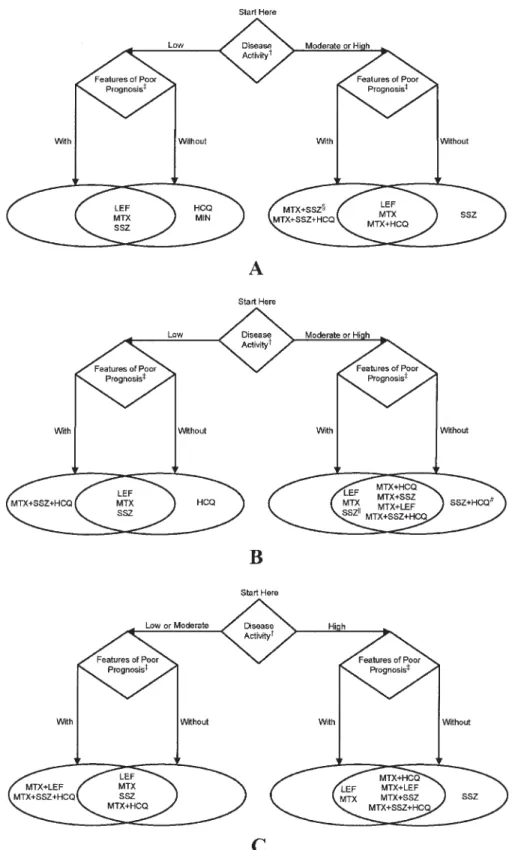
Nonbiologic DMARD therapy. To maintain simplicity in these recommendations, the TFP considered only pa-tients who had never received DMARDs. Recommenda-tions for nonbiologic therapy are divided into those for patients with RA of varying disease duration, as defined by duration of ⬍6 months, 6 –24 months, and⬎24 months (Figure 2).
There are more than 170 possible dual-DMARD or triple-DMARD combinations among the 5 nonbiologic drugs con-sidered in these recommendations. The TFP concon-sidered only combinations that were best supported by evidence and/or were used most commonly, including methotrexate plus hydroxychloroquine, methotrexate plus sulfasala-zine, methotrexate plus leflunomide, sulfasalazine plus hydroxychloroquine, and sulfasalazine plus hydroxychlo-roquine plus methotrexate. For patient-specific circum-stances, the reader is referred to the appropriate figures and tables.
Leflunomide or methotrexate. The TFP recommended the initiation of methotrexate or leflunomide monotherapy for patients with all disease durations and for all degrees of disease activity, irrespective of poor prognostic features (for methotrexate, level A/B evidence for a poor prognosis, high disease activity; level A evidence for a poor progno-sis, moderate disease activity, short duration [38 – 47]; for leflunomide, level A evidence for a poor prognosis, high disease activity, longer disease duration [48 –51]; for all other clinical scenarios in this circumstance, level C or level C* evidence).
Hydroxychloroquine or minocycline. Hydroxychloro-quine monotherapy was recommended for patients with-out poor prognostic features, with low disease activity, and with disease duration ⱕ24 months. Minocycline monotherapy was recommended for patients without poor prognostic features, with low disease activity, and with short disease duration (level C* evidence) (52–59).
Sulfasalazine. Sulfasalazine monotherapy was recom-mended for patients with all disease durations and with-out poor prognostic features and included those with all degrees of disease activity (43,44,51,56,60 – 64) (level B evidence for longer disease duration, without features of poor prognosis, and moderate disease activity [63]; level C* evidence for all other clinical scenarios in this circum-stance). Other circumstances in which sulfasalazine monotherapy is recommended for patients with poor prog-nostic features are shown in Figure 2 (level C* evidence) (51,56,60,61,64).
Dual-DMARD combinations. The two-drug combina-tion of methotrexate plus hydroxychloroquine was recom-mended for patients with moderate to high disease activity irrespective of disease duration or poor prognostic features
(level B evidence for high disease activity, longer disease duration, with poor prognostic features) (65,66). The com-bination of methotrexate plus hydroxychloroquine was also recommended for patients with longer disease dura-tion and low disease activity, independent of prognostic features (level C* evidence).
Methotrexate plus leflunomide was recommended for patients with intermediate or longer disease duration (ⱖ6 months), regardless of prognostic features as long as dis-ease activity was high (level B evidence for longer disdis-ease duration, with poor prognostic features) (48). Figures 2B and C list other circumstances in which this combination is recommended (level C* evidence).
Methotrexate plus sulfasalazine was recommended in patients with all disease durations if they had high disease activity and poor prognostic features (level A evidence for durations⬍6 months and⬎24 months, level C* evidence for intermediate disease duration [43,44,46,65,67]). See Figures 2B and C for other circumstances in which this combination was recommended (level C* evidence) (65).
The combination of hydroxychloroquine plus sulfasala-zine was recommended in only one situation: intermediate disease duration (6 –24 months) in patients with high dis-ease activity but without poor prognostic features (level C* evidence).
Triple-DMARD combinations. The 3-drug combination therapy of sulfasalazine plus hydroxychloroquine plus methotrexate was recommended for all patients with poor prognostic features and moderate or high levels of disease activity, regardless of disease duration (level A evidence for high disease activity and longer disease duration, level C* evidence for all other clinical scenarios in this circum-stance) (47,65). See Figures 2B and C for the circumstances in which this combination was recommended for patients with low disease activity or without poor prognostic fea-tures (level C* evidence) (65).
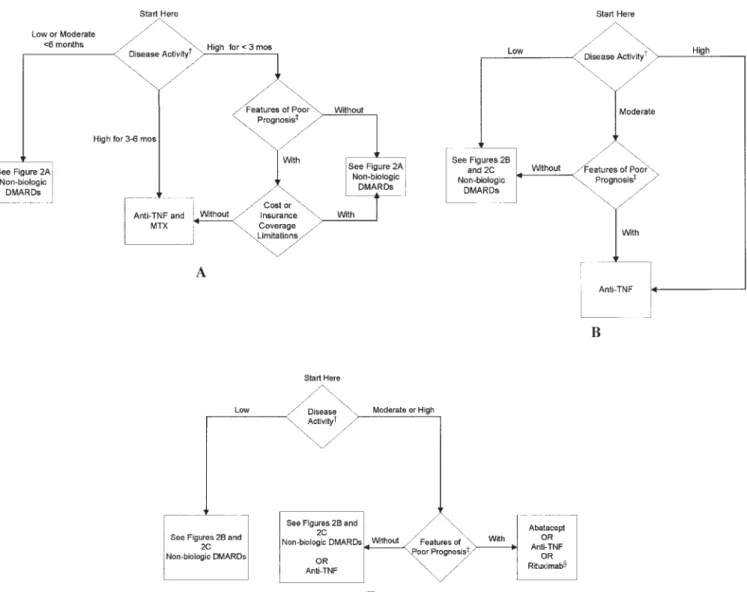
Biologic DMARDs. Recommendations for the use of bio-logic DMARDs are divided into those for patients with RA for ⬍6 months (Figure 3A) and those with RA for ⱖ6 months (Figures 3B and C). Figure 3A is divided differ-ently from the other figures. It is separated into low or moderate disease activity for⬍6 months and high disease activity for ⬍3 months and for 3– 6 months. The figure stratifies the use of anti-TNF␣agents for durations of⬍3 months to make the recommendations more consonant with the scientific evidence for anti-TNF␣agents (level C* evidence) (68 –76). Note that a duration of⬍3 months or a duration of 3– 6 months still refers to early disease in the context of these recommendations.
Anti-TNF␣agents in early RA. The TFP limited its rec-ommendation for the use of anti-TNF␣ agents (inter-changeably) with methotrexate in patients with early RA to those who had never received DMARDs and had high disease activity (level C* evidence). Patients with early RA and only low or moderate disease activity were not con-sidered candidates for biologic therapy (Figure 3A). The use of an anti-TNF agent in combination with methotrex-ate was recommended if high disease activity was present for⬍3 months with features of both a poor prognosis and an absence of either barriers related to treatment cost and no insurance restrictions to accessing medical care (68,70,72,74). This decision by the TFP and CEP was
sup-Figure 2. Recommendations on indications for the use of nonbiologic disease-modifying antirheumatic drugs (DMARDs) in rheuma-toid arthritis (RA) patients who have never received DMARDs. These recommendations do not specifically include the potential role of glucocorticoids or nonsteroidal antiinflammatory drugs in the management of patients with RA. Therapies are listed alphabetically.A,
disease duration⬍6 months. B, disease duration of 6 –24 months.C, disease duration of⬎24 months. †⫽definitions of disease ac-tivity are provided in Table 1; ‡⫽includes functional limitation (defined using standard measurement scales such as Health Assess-ment Questionnaire score or variations of this scale), extraarticular disease (e.g., presence of rheumatoid nodules, secondary Sjo¨gren’s syndrome, RA vasculitis, Felty’s syndrome, and RA lung disease), rheumatoid factor positivity, positive anti– cyclic citrullinated pep-tide antibodies, or bony erosions by radiography; § ⫽ only recommended for patients with high disease activity with features of poor prognosis; 㛳⫽ only recommended for patients with moderate disease activity irrespective of prognostic features and patients with high disease activity without features of poor prognosis; #⫽only recommended for patients with high disease activity without features of poor prognosis; HCQ ⫽ hydroxychloroquine; LEF ⫽ leflunomide; MTX ⫽ methotrexate; SSZ ⫽ sulfasalazine; MIN ⫽ minocycline.
ported by the results of pharmacoeconomic evaluations conducted on US populations (77–79).
Anti-TNF␣agents in intermediate- and longer-duration RA. In intermediate-duration and longer-duration RA, the TFP recommended the use of the anti-TNF␣agents (inter-changeably) in patients for whom prior methotrexate monotherapy led to an inadequate response, with moder-ate disease activity and features of a poor prognosis, and for patients with high disease activity, irrespective of prog-nostic features. The TFP also recommended use of anti-TNF␣agents (interchangeably) in patients for whom prior methotrexate therapy was used in combination, or if se-quential administration of other nonbiologic DMARDs led to an inadequate response with at least moderate residual
disease activity irrespective of prognostic features (level A evidence for high disease activity) (74,76,80 –101) (Figure 3C). The anti-TNF␣ agents (etanercept, infliximab, and adalimumab) are efficacious in improving disease activity, function, and quality of life and/or retarding radiographic progression when used alone (83,89), in combination with methotrexate (80,81,96 –99,102–108), or in patients for whom treatment with DMARDs other than methotrexate led to an inadequate response (93,109). Although the ma-jority of clinical trials have focused on adding biologic agents to methotrexate, no distinction was made by the panel regarding the decision to add biologic agents to methotrexate or to substitute for methotrexate with other nonbiologic DMARDs.
Figure 3. Recommendations on indications for the use of biologic disease-modifying antirheumatic drugs (DMARDs) in patients with rheumatoid arthritis (RA). These recommendations do not specifically include the potential role of glucocorticoids or nonsteroidal antiinflammatory drugs in the management of patients with RA. Therapies are listed alphabetically.A,patients with RA⬍6 months,B,
patients with RAⱖ6 months who failed prior MTX monotherapy,C, patients with RA disease duration ofⱖ6 months who failed prior MTX combination therapy or after sequential administration of other nonbiologic DMARDs. †⫽definitions of disease activity are provided in Table 1; ‡⫽includes functional limitation (defined using standard measurement scales such as Health Assessment Questionnaire score or variations of this scale), extraarticular disease (e.g., presence of rheumatoid nodules, secondary Sjo¨gren’s syndrome, RA vasculitis, Felty’s syndrome, and RA lung disease), rheumatoid factor positivity, positive anti– cyclic citrullinated peptide antibodies, or bony erosions by radiography; § ⫽ only recommended for patients with high disease activity with features of poor prognosis; MTX ⫽ methotrexate; TNF⫽tumor necrosis factor.
Abatacept. The TFP recommended the use of abatacept in patients for whom methotrexate in combination with DMARDs or sequential administration of other nonbio-logic DMARDs led to an inadequate response, and with at least moderate disease activity and features of a poor prog-nosis (level A evidence for high disease activity) (110 – 112) (Figure 3C).
Rituximab. The TFP recommended the use of rituximab in patients for whom methotrexate in combination with DMARDs or sequential administration of other nonbio-logic DMARDs led to an inadequate response, with high disease activity and features of a poor prognosis (level A evidence for high disease activity) (113–115) (Figure 3C). Biologic therapy combinations. The TFP did not recom-mend combinations of biologic agents, based in part on data suggesting a higher rate of adverse events with com-binations and/or lack of additive efficacy (108,116).
Contraindications to the use of nonbiologic and biologic DMARDs. The data supporting recommendations on ther-apeutic contraindications (Table 2) were derived primarily from observational studies, and to a lesser degree from evidence from RCTs. Many of these studies did not spe-cifically address the questions of relevance. Therefore, the recommendations could not be derived directly from the evidence but required synthesis of the data from studies plus extrapolation to the specific clinical scenarios under consideration. As a result, all of the contraindication rec-ommendations were graded as level C or level C* evi-dence, except where noted otherwise.
Infectious disease and/or pneumonitis contraindica-tions. The TFP recommended that neither leflunomide, methotrexate, nor biologic agents should be initiated or resumed in the presence of active bacterial infection (or a bacterial infection currently requiring antibiotic therapy), active TB (or latent TB infection prior to starting preven-tive therapy), acpreven-tive herpes zoster infection, or acpreven-tive life-threatening fungal infections. It was noted that DMARDs could be started shortly after a bacterial infection had been successfully treated or had resolved fully. In addition, the TFP recommended against the use of all biologic agents when severe upper respiratory tract infections (bacterial or viral) or nonhealed infected skin ulcers were present. Al-though the data were somewhat inconsistent, with some studies refuting an infectious disease association (76,81, 93,99,117–119), the preponderance of the evidence (70,96, 117,120 –129) suggested a higher rate of serious bacterial infections with the use of biologic agents compared with nonbiologic DMARDs. Although the panel considered contraindications for RA therapy in the setting of human immunodeficiency virus, no recommendations concerning contraindications were issued.
Although the relationship between methotrexate and interstitial lung disease is unclear, the TFP stated that methotrexate was contraindicated in the presence of clin-ically important RA-associated pneumonitis or interstitial lung disease of unknown cause (48,130 –140). The TFP made no recommendation regarding the need to obtain a baseline chest radiograph prior to the initiation of metho-trexate.
Hematologic and oncologic contraindications. The TFP recommended that, in general, neither leflunomide nor methotrexate should be resumed or started if the white blood cell count was ⬍3,000/mm3. Felty’s syndrome and large granular lymphocyte syndrome accompanying RA were possible exceptions to this contraindication (141–143). If the platelet count was ⬍50,000 per cubic milliliter, the TFP recommended that there were contra-indications to the initiation or resumption of therapy with leflunomide, methotrexate, and sulfasalazine. Both leflunomide and methotrexate were contraindicated if there was a history of myelodysplasia (e.g., preleukemia) or if lymphoproliferative disease had been diagnosed and/or treated within the last 5 years. For biologic therapy, the TFP recommended that anti-TNF␣agents were contra-indicated in patients with prior lymphoproliferative dis-ease that had been diagnosed and/or treated within the last 5 years (76,80,144 –149). The TFP votes did not endorse any specific recommendation regarding the association of nonbiologic or biologic DMARDs with malignancies other than those associated with lymphoproliferative disorders. Cardiac contraindications. The TFP endorsed moderate or severe heart failure (New York Heart Association class III–IV with reduced ejection fraction [150]) as a contra-indication for anti-TNF␣agents. Class III–IV heart failure is one of the few contraindication recommendations for which RCT data in non-RA patients provide direct evi-dence of a possible risk association with anti-TNF␣agents (level B evidence) (151,152).
Liver contraindications. Abnormal liver transaminases. When the levels of liver transaminases (aspartate amino-transferase or alanine aminoamino-transferase) were greater than 2-fold the upper limit of normal, the TFP recommended that the initiation or resumption of leflunomide, metho-trexate, and sulfasalazine was contraindicated (although recommendations on when to discontinue are not pro-vided). There are a large number of studies addressing leflunomide (48,50,61,132,153,154), methotrexate (41,43, 46,48,49,130 –132,134 –137,154 –179), and sulfasalazine (44,56,60,61,63,153,180,181).
Acute hepatitis B or C. In the presence of acute hepatitis B or C, treatment with methotrexate, leflunomide, sul-fasalazine, minocycline, and biologic agents was contra-indicated by the TFP.
Chronic hepatitis B or C. In the presence of chronic hepatitis B or C (treated or untreated), the severity of compromised liver function was considered by the TFP as a key factor in making therapeutic decisions. The Child-Pugh scoring system for chronic liver disease (182–184) was used based on the advice of our expert advisor in the field of hepatology. This system is a liver disease severity instrument used to determine the prognosis of chronic liver disease. It is based on the serum albumin and total bilirubin levels, the prothrombin time, the presence or absence of ascites, and the presence or absence of enceph-alopathy. Child-Pugh class C is associated with a 1-year survival rate of 50%, whereas patients with Child-Pugh classes A or B have a 5-year survival rate of 70 – 80%.
The recommendations for nonbiologic DMARDs in pa-tients with chronic hepatitis B or C were stratified based on the type of hepatitis, the Child-Pugh grade, and
whether or not antiviral agents to treat hepatitis had been initiated (Table 2). When treating patients with chronic hepatitis B or C, physicians need to consider the risks and
benefits for all DMARDs. For certain DMARDs, such as hydroxychloroquine, the TFP discussed uncommon but reported concerns about the use of these agents in the Table 2. Recommendations for contraindications to starting or resuming therapy with nonbiologic and biologic
disease-modifying antirheumatic drugs in RA patients*
Organ system and contraindication ABA Anti-TNF␣ HCQ LEF MTX MIN RIT SSZ
Infectious diseases and pneumonitis
Acute serious bacterial infection or infection, currently receiving antibiotics
X X – X X – X –
Upper respiratory tract infection (presumed viral) with fever (⬎101°F) X X – – – – X –
Nonhealed infected skin ulcer X X – – – – X –
Latent TB infection prior to initiation of latent TB initiation treatment, or active TB disease prior to completing a standard regimen of anti-TB therapy†
X X – X X – X –
Active life-threatening fungal infection X X – X X – X –
Active herpes-zoster viral infection X X – X X – X –
Interstitial pneumonitis (due to RA or unknown cause) or clinically significant pulmonary fibrosis
– – – – X – – –
Hematologic and oncologic
White blood cell count⬍3,000/mm3‡ – – – X X – – –
Platelet count⬍50,000/mm3 – – – X X – – X
Myelodysplasia – – – X X – – –
Treated lymphoproliferative disease ofⱕ5 years – X – X X – – – Cardiac
Moderate to severe heart failure (NYHA III or IV) and left ventricular ejection fraction⬍50%§
– X – – – – – –
Liver
Liver transaminase level 2 times the upper limit of normal – – – X X – – X Acute hepatitis B or C viral infection X X – X X X X X Chronic hepatitis B viral infection, receiving therapy¶
Child-Pugh class A# – – – X X – – –
Child-Pugh class B or C X X – X X X** X X**
Chronic hepatitis B viral infection, not receiving therapy
Child-Pugh class A – – – X X X – X
Child-Pugh class B or C X X X** X X X X X
Chronic hepatitis C viral infection, receiving therapy
Child-Pugh class A – – – X X – – –
Child-Pugh class B or C X X – X X X** X X
Chronic hepatitis C viral infection, not receiving therapy
Child-Pugh class A – – – X X X – –
Child-Pugh class B or C X X X** X X X X X
Renal
Creatinine clearance⬍30 ml/minute – – – – X – – –
Neurologic
Multiple sclerosis or other demyelinating disorder – X – – – – – – Pregnancy and breastfeeding
Planning for or current pregnancy – – – X X X – –
Breastfeeding – – – X X X – –
* The presence of a dash does not indicate an affirmative recommendation for the use of the drug in a particular clinical circumstance. Please see the section RAND/UCLA appropriateness method. Therapies are listed alphabetically. RA⫽rheumatoid arthritis; ABA ⫽abatacept; anti-TNF␣⫽
anti–tumor necrosis factor␣; HCQ⫽hydroxychloroquine; LEF⫽leflunomide; MTX⫽methotrexate; MIN⫽minocycline; RIT⫽rituximab; SSZ⫽
sulfasalazine; X⫽contraindication; TB⫽tuberculosis.
† TB treatment and full adherence as recommended by TB expert and considered successfully treated. ‡ Felty’s syndrome and large granular lymphocyte syndrome as causes of neutropenia are possible exceptions.
§ New York Heart Association (NYHA) class III⫽patients with cardiac disease resulting in marked limitation of physical activity. They are comfortable at rest. Less than ordinary physical activity causes fatigue, palpitation, dyspnea, or anginal pain. NYHA class IV⫽patient with cardiac disease resulting in inability to carry on any physical activity without discomfort. Symptoms of cardiac insufficiency or the anginal syndrome may be present even at rest. If any physical activity is undertaken, discomfort is increased.
¶ Therapy defined as antiviral regimen deemed appropriate by expert in liver diseases.
# The Child-Pugh classification liver disease scoring system is based on the presence of albumin, ascites, total bilirubin, prothrombin time, and encephalopathy. Patients with a scoreⱖ10 (in the class C category) have a prognosis with 1-year survival of⬃50%. Patients with class A or B have a better prognosis of 5 years, with a survival rate of 70 – 80% (182).
setting of severe underlying liver injury, defined as Child-Pugh class C (185,186).
In the setting of treated chronic hepatitis B, leflunomide and methotrexate were contraindicated by the TFP for all Child-Pugh classifications, and minocycline and sulfasala-zine were contraindicated for Child-Pugh class C.
In untreated chronic hepatitis B, leflunomide, metho-trexate, minocycline, and sulfasalazine were contraindi-cated by the TFP for all Child-Pugh classifications, and hydroxychloroquine was contraindicated for Child-Pugh class C.
In treated chronic hepatitis C, leflunomide and metho-trexate were contraindicated for all Child-Pugh classifica-tions, minocycline was contraindicated for Child-Pugh class C, and sulfasalazine was contraindicated for Child-Pugh classes B and C.
In untreated chronic hepatitis C, leflunomide, metho-trexate, and minocycline were contraindicated for all Child-Pugh classifications, sulfasalazine was contraindi-cated for Child-Pugh classes B and C, and hydroxychloro-quine was contraindicated for Child-Pugh class C.
The recommendations concerning biologic DMARDs in patients with chronic hepatitis B or C are as follows: although TNF␣ blockade occasionally has been used in patients with chronic hepatitis, particularly when antivi-ral therapy is used concomitantly (187,188), the TFP rec-ommended that biologic agents were contraindicated in both chronic hepatitis B and C, whether treated or un-treated for those with significant liver injury, defined as chronic Child-Pugh classes B or C (189,190).
Renal contraindications. The TFP recommended that starting or resuming methotrexate was contraindicated if the estimated creatinine clearance was ⬍30 ml/minute (167,191,192). One study addressed adverse renal events when using sulfasalazine (191) and this study found that sulfasalazine was not associated with adverse renal effects. Nevertheless, the TFP did not reach consensus on sul-fasalazine’s use in the face of renal impairment.
Neurologic contraindications. The TFP recommended against the use of anti-TNF␣agents in the setting of mul-tiple sclerosis or demyelinating disorders. There are lim-ited observations, from both RCTs and cohort studies, that patients exposed to anti-TNF␣ therapy developed demy-elinating disorders (level B evidence) (83,106).
Contraindications in pregnancy and breastfeeding. Le-flunomide, methotrexate, and minocycline were consid-ered by the TFP to be contraindicated in RA patients planning for pregnancy or during pregnancy, due to the potential teratogenicity of these drugs (193,194). The TFP recommended against the initiation or resumption of these drugs during breastfeeding (195–198). Because of conflict-ing evidence (199 –208), the TFP deliberations did not yield any specific recommendation regarding the use of biologic DMARDs in these clinical scenarios.
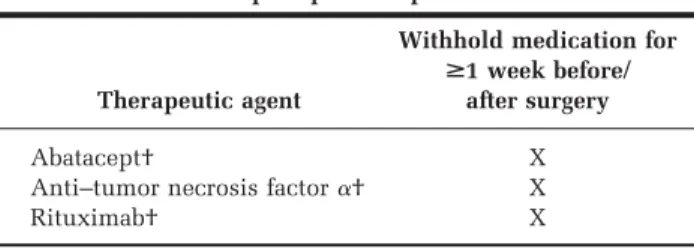
Perioperative infectious risk. The TFP recommended that biologic agents should not be used during the periop-erative period, for at least 1 week prior to and 1 week after surgery (level C* evidence) (Table 3) (117,209 –212). It was recommended that this decision should be further tem-pered by the pharmacokinetic properties of a given bio-logic agent (e.g., longer periods of time off therapy may be
appropriate when using agents with longer half-lives), and the type of surgery. The panel articulated less concern for withholding therapy for patients undergoing minor surger-ies with a low risk of infection (e.g., cataract operations). The TFP votes were influenced by an absence of consistent evidence and yielded no recommendation regarding the use of nonbiologic DMARDs during the perioperative pe-riod (213–224).
Safety monitoring, risk surveillance, and preventive immunizations. Nonbiologic DMARDs. The ACR has pre-viously published recommendations on safety monitoring for the use of nonbiologic DMARDs (225,226). These rec-ommendations were grounded in the recognition that there are safety concerns with several of the commonly used nonbiologic DMARDs that may be circumvented or attenuated by the early identification of toxicity. This in-cludes using routine laboratory testing such as complete blood counts, serum creatinine measurement, and peri-odic determination of liver transaminase levels. Despite strong association of certain DMARDs with specific toxic-ities (227–230), evidence supporting specific temporal monitoring recommendations remains elusive and is par-tially driven by practical issues such as a need to avoid overly frequent phlebotomies or physician visits. The rec-ommended frequency of testing and the relationship of testing intervals to both DMARDs and duration remain rather empiric and are largely based on expert consensus (level C and level C* evidence).
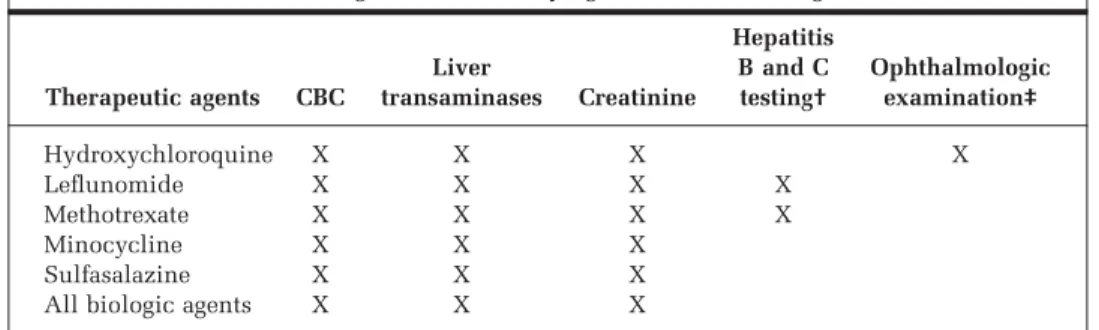
When starting or resuming therapy with a nonbiologic or biologic DMARD (baseline), obtaining a complete blood count, liver transaminase levels, and serum creatinine levels was recommended by the TFP for all therapies (Table 4). In addition, for both leflunomide and methotrex-ate, screening for hepatitis B and C was recommended for patients at higher risk (e.g., history of intravenous drug abuse) (231,232).
The TFP recommended influenza vaccinations for pa-tients prior to starting therapy with all nonbiologic DMARDs and pneumococcal vaccinations for patients starting leflunomide, methotrexate, or sulfsalazine (233– 235), if the patient’s vaccinations were not current. This recommendation was in accordance with the Centers for Disease Control and Prevention (CDC) general
recommen-Table 3. Recommendations for withholding biologic disease-modifying antirheumatic drugs in preoperative
and perioperative periods*
Therapeutic agent
Withhold medication for
>1 week before/ after surgery
Abatacept† X
Anti–tumor necrosis factor␣† X
Rituximab† X
* Therapies are listed alphabetically. X⫽contraindication. † When considering discontinuation, the pharmacokinetics of the drugs and the infectious risk of the surgery being performed should be considered.
dations for appropriate use of these vaccinations in per-sons with chronic illnesses (Table 5) (236,237). Hepatitis B vaccination was recommended if risk factors for this dis-ease existed (231,232) and if hepatitis B vaccination had not previously been administered (233,234,238).
It was recommended that all patients starting therapy with hydroxychloroquine should have a complete oph-thalmologic examination within the first year of treatment. This should include examination of the retina through a dilated pupil and testing of central visual field sensitivity by either a self-testing grid chart (Amsler grid) or auto-mated threshold central visual field testing (Humphrey 10-2 testing). If the patient is in the low-risk category (e.g., no liver disease, no concomitant retinal disease, and age
⬍60 years) and these examination results are normal, the American Academy of Ophthalmology recommendation is that no further special ophthalmologic testing is needed for the next 5 years. For patients in the higher-risk cate-gory, an annual eye examination is recommended by the American Academy of Ophthalmology (239).
Following initiation of leflunomide, methotrexate, and/or sulfasalazine or when the dose of these drugs is significantly increased, complete blood counts, liver func-tion tests, and determinafunc-tion of serum creatinine levels were recommended every 2– 4 weeks for the next 3 months (Table 6). The TFP did not recommend any surveillance blood testing for patients receiving hydroxychloroquine or minocycline.
Table 4. Recommendations on baseline evaluation for starting, resuming, or significant dose increase of a therapy in patients with rheumatoid arthritis receiving nonbiologic
and biologic disease-modifying antirheumatic drugs*
Therapeutic agents CBC Liver transaminases Creatinine Hepatitis B and C testing† Ophthalmologic examination‡ Hydroxychloroquine X X X X Leflunomide X X X X Methotrexate X X X X Minocycline X X X Sulfasalazine X X X
All biologic agents X X X
* Therapies are listed alphabetically. CBC⫽complete blood count; X⫽recommend test.
† If hepatitis risk factors are present (e.g., intravenous drug abuse, multiple sex partners in the previous 6 months, health care personnel). Evaluation might include tests for hepatitis B surface antigen, hepatitis B antibodies, hepatitis B core antibodies, and/or hepatitis C antibodies.
‡ Ophthalmologic examination is recommended within the first year of treatment. For patients in higher-risk categories (e.g., liver disease, concomitant retinal disease, and ageⱖ60 years), the American Academy of Ophthalmology recommends an annual followup eye examination (239).
Table 5. Recommendations for vaccinations in patients with rheumatoid arthritis receiving nonbiologic and biologic disease-modifying antirheumatic drugs* Therapeutic agents Pneumococcus† Influenza‡ Hepatitis B§
Avoid live vaccinations Hydroxychloroquine X Leflunomide X X X Methotrexate X X X Minocycline X Sulfasalazine X X
All biologic agents X X X X
* Therapies are listed alphabetically. X⫽recommended.
† Vaccination should be considered according to recommendations of the Centers for Disease Control and Prevention (CDC), which includes all patients with chronic illness, active malignancy, immunosuppression/ use of immunosuppressive drugs, diabetes mellitus, pregnancy, and chronic lung disease, independent of when rheumatoid arthritis drugs are initiated. The CDC also recommends a 1-time pneumococcal revaccination after 5 years for persons with the previously listed conditions. For persons ageⱖ65 years, 1-time revaccination is recommended if they were vaccinatedⱖ5 years previously and were age⬍65 years at the time of primary vaccination.
‡ Vaccination should be considered according to recommendations of the CDC, which includes all patients with chronic illness, active malignancy, immunosuppression/use of immunosuppressive drugs, diabetes mellitus, pregnancy, and chronic lung disease, independent of when rheumatoid arthritis drugs are initiated.
§ If hepatitis risk factors are present (e.g., intravenous drug abuse, multiple sex partners in the previous 6 months, health care personnel).
Beyond 3 months of therapy with leflunomide, metho-trexate, or sulfasalazine, monitoring with complete blood count, a chemistry panel, and determination of the serum creatinine levels was recommended every 8 –12 weeks. Be-yond 6 months of therapy, the longer time interval (e.g., 12 weeks) of the monitoring recommendation was suggested.
Biologic DMARDs. The TFP recommended periodic pneumococcal vaccinations and annual influenza vaccina-tions for all patients receiving biologic agents, in accor-dance with CDC recommendations for appropriate use and timing of these vaccinations (236,237). The panel also recommended completion of a hepatitis B vaccination se-Table 6. Recommendations for optimal followup laboratory monitoring intervals for
complete blood count, liver transaminase levels, and serum creatinine levels for rheumatoid arthritis patients receiving nonbiologic disease-modifying antirheumatic drugs*
Therapeutic agents†
Monitoring interval based on duration of therapy
<3 months 3–6 months >6 months
Hydroxychloroquine None after baseline None None Leflunomide 2–4 weeks 8–12 weeks 12 weeks Methotrexate 2–4 weeks 8–12 weeks 12 weeks Minocycline None after baseline None None Sulfasalazine 2–4 weeks 8–12 weeks 12 weeks
* More frequent monitoring is recommended within the first 3 months of therapy or after increasing the dose, and the outer bound of the monitoring interval is recommended beyond 6 months of therapy. † Listed alphabetically.
Figure 4. Recommendations for screening for tuberculosis (TB) among rheumatoid arthritis patients being considered for biologic disease-modifying antirheumatic drugs. * ⫽ risk factors for developing TB (adapted from the recommendations of the Centers for Disease Control and Prevention [CDC; 244,245]) include human immunodeficiency virus, fibrotic changes on chest radiography, organ transplantation, receiving the equivalent of⬎5 mg/day of prednisone forⱖ1 month, the use of other immunosuppressive drugs such as anti–tumor necrosis factor ␣ agents, recent immigrants (⬍5 years) from high prevalence countries, intravenous drug users, residents and employees of high-risk congregate settings (e.g., prisons and jails, nursing homes and other long-term care facilities for the elderly, hospitals and other health care facilities, residential facilities for patients with acquired immunode-ficiency syndrome, and homeless shelters), mycobacteriology laboratory personnel, silicosis, diabetes mellitus, chronic renal failure, severe hematologic disorders (e.g., leukemias and lymphomas), carcinoma of the head or neck or lung, weight loss⬎10% of ideal body weight, history of gastrectomy or jejunoileal bypass; †⫽LTBI is a positive tuberculin skin test result with no evidence of active tuberculosis disease (adapted from the CDC recommendations).