Park and Recreation
Comprehensive Plan
OCTOBER
F
OREWORD
Dear Reader,As you review Willamalane’s Park and Recreation Comprehensive Plan, there is one central question I would like you to think about:
What kind of community do you want to live in?
During the development of this 20-year plan for parks and recreation–with help from over 2,000 participants–I’ve stopped and asked myself that question many times. With the adoption of this plan, we will have a vehicle to help us achieve Willamalane’s vision of enhancing the quality of life in our community through people, parks and programs. The Park and Recreation Comprehensive Plan establishes the groundwork for achieving our vision. It provides the means by which progress can be measured over the next 20 years. The plan shows where we are today
and where we would like to go. More
importantly, it gives direction on how we can get there together.
And remember, this is your plan. It is not just Willamalane’s; it is a community plan where you and your neighbors have helped develop a vision for the future of parks and recreation in Springfield. Based on the input of your fellow citizens, our community desires a diverse park and recreation system with a priority toward connecting our citizens to nature, water, and trails.
It is Willamalane’s job to work with the people of Springfield to equitably provide parks and recreation programs and services that form a vital and healthy community–both today and in the future.
Look through this plan and it will become clear that what we want to achieve for Springfield is challenging. But with help from you and other community members we can make it happen. Please join me in making our dreams a reality.
Thank you,
Bob Keefer Superintendent
Willamalane Park and Recreation District October 2012
"This is a community plan where you and your neighbors have helped develop a vision for the future of parks
A
CKNOWLEDGEMENTS
B
OARD OFD
IRECTORSGary Ross, president Anne Ballew, vice president Denise Bean, director Lee Beyer, director Gregory James, director
P
ROJECTM
ANAGEMENTT
EAMBob Keefer, superintendent
Jason Genk, deputy superintendent
Pam Caples, Administrative Services Division director Joel Miller, Park Services Division director
Mike Moskovitz, Public Affairs manager Greg Hyde, program manager II
Nicole Ankeney, park planner/landscape architect Jake Risley, park planner/landscape architect
P
REPARED BYRebecca Gershow, senior planner/comprehensive plan project manager Willamalane Park and Recreation District
250 S. 32nd St. Springfield OR 97478 541.736.4544
willamalane.org
A
DDITIONAL SUPPORT FROMRonni Price, Planning and Development administrative assistant
Kristina Koenig, Planning and Development intern, through August 2011 Vanessa Nevers, Planning and Development intern, from September 2011
T
ABLE OF
C
ONTENTS
FOREWORD ACKNOWLEDGEMENTS TABLE OF CONTENTS EXECUTIVE SUMMARY 1. INTRODUCTION ... 1The Planning Area 1
The Planning Process 2
Report Organization 5 2. PLANNING FRAMEWORK ... 7 Core Values 9 Vision 9 Mission 10 Plan Goals 10
Strategies and Actions 12
Performance Measures 12
3. HIGHLIGHTS OF IMPROVEMENTS ... 13
Collaboration 14
Glenwood and Downtown 15
Thurston Hills Ridgeline 16
Connections to Waterways 17
Opportunities for Active Play 18
Reinvestment 19
Resource Conservation 20
Recreation Programs 21
4. STRATEGIES AND ACTIONS ... 23
Parks and Natural Areas 27
Community Recreation and Support Facilities 59
Rehabilitation 63
Park and Facility Operations 68
Recreation Programs and Services 70
Management and Communications 73
5. CAPITAL IMPROVEMENT PLAN ... 77
Financing Strategy 77
Phase 1 Capital Improvement Plan (Years 2012-2021) 79
Phase 2 Capital Improvement Plan (Years 2022-2031) 83
Unfunded Project List 88
CIP Funding Options 90
Operational Impacts 93
Capital Project Operational Costs 94
Phase I Operational Costs 95
Phase 2 Operational Costs 95
Options for Meeting the Additional Operational Requirements 96
COMMUNITY NEEDS ASSESSMENT... APPENDIX A
Introduction 5
Planning Area 6
Related Planning Efforts 8
Community Description 8
Demographic Profile 10
Public Involvement Activities 17
Park and Facility Analysis 23
Recreation Services Analysis 89
Management and Operations Analysis 101
Key Findings 111
Appendix A-1: Park and Facility Classifications and Definitions Appendix A-2: Public Input Results
Appendix A-3: Community Survey Written Responses Appendix A-4: Teen Workshops Written Responses Appendix A-5: Park and Facility Assessment
OPERATIONAL COSTS DETAIL ... APPENDIX B
MAPS:
Map 1: Planning Sub-Areas
Map 2: Proposed Park and Recreation Projects Map 2-1: Proposed Neighborhood Park Projects Map 2-2: Proposed Community Park Projects Map 2-3: Proposed Natural Area Park Projects Map 2-4: Proposed Multi-Use Path and Trail Projects Map 2-5: Proposed Special Use Park Projects Map 2-6: Proposed Sports Park Projects
Map 2-7: Proposed Community Recreation or Support Facility Projects Map A-3: Existing Park and Recreation Resources
Map A-4: Neighborhood Park Service Areas Map A-5: Community Park Service Areas Map A-6: Natural Opportunity Areas
Map A-7: Existing and Planned Multi-Use Paths and Bikeways
FIGURES:
Figure 1: Comprehensive Planning Process Figure 2: Plan Development
Figure 3: Comprehensive Plan Framework Figure A-1: Planning Process
Figure A-2 Planning Sub-Areas
Figure A-3: Population Forecasts Comparison
Figure A-4: Percent Population Change by Age Group Figure A-5: WPRD Pricing and Cost Recovery Pyramid Figure A-6: District Organization
TABLES:
Table 1: Neighborhood Parks Actions Table 2: Community Parks Actions Table 3: Natural-Area Parks Actions Table 4: Linear Parks and Trails Actions Table 5: Special-Use Parks Actions Table 6: Sports Parks Actions
Table 7: Community Recreation and Support Facilities Actions Table 8: Rehabilitation Actions
Table 9: Park and Facility Operations Actions Table 10: Recreation Programs and Services Actions Table 11: Management and Communications Actions
Table 12: Project Funding Sources, Phase 1 (Years 2012-2021) Table 13: Capital Improvement Plan, Phase 1 (Years 2012-2021) Table 14: Project Funding Sources, Phase 2 (Years 2022-2031) Table 15: Estimated Bond Repayment Schedule
Table 16: Capital Improvement Plan, Phase 2 (Years 2022-2031) Table 17: Capital Improvement Plan, Unfunded Project List Table 18: Willamalane Operational Costs for Developed Parkland
Table 19: Forecasted Additional Annual Operations Cost at the Completion of Phase 1 (Years 2012-2021)
Table 20: Forecasted Additional Annual Operations Cost at the Completion of Phase 2 (Years 2022-2031)
Table A-1: Actual Population Growth, 2000 – 2010 Table A-2: Population Forecast, 2010-2030
Table A-3: Population Forecast, 2000-2022 Table A-4: Park Inventory: District Resources
Table A-5: Parkland Standards and Anticipated Need
Table A-6: Parkland Standards for Comparable Communities Table A-7: Parkland Level of Service for Comparable Communities Table A-8: Facility Inventory: District Resources
Table A-9: Recreation Facility Standards and Anticipated Need
Table A-10: Recreation Facility Standards from Comparable Communities Table A-11: Program Participation FY 2010
Table A-12: Personnel Requirements by Cost Center, FY 2003 and FY 2011 Table A-13: Total Operating Budget, FY 1998-2011
Table A-14: Budget by Fund Category, FY 2011
Table A-15: General Fund Revenue Sources, FY 2011
Table A-16: Recreation Services Division Percent of Self-Support, 2010-2011 Table A-17: Expenditures and Subsidized Percentages, FY2011
Table B-1: Operations Costs, Phase 1 Table B-2: Operations Costs, Phase 2
Executive Summary
Willamalane Park and Recreation District Page i
Park and Recreation Comprehensive Plan
E
XECUTIVE
S
UMMARY
Willamalane Park and Recreation District is designated in the Eugene-Springfield
Metropolitan Area General Plan as the park and recreation service provider for Springfield and its urbanizable area, including Glenwood. Willamalane owns and operates
approximately 783 acres of land encompassing 37 parks, seven community recreation and support facilities, and three undeveloped properties in the greater Springfield area.
Willamalane’s parks, recreation facilities and services are important community resources. Recreation services include adult and youth programs, aquatics, community athletics, special events, adaptive recreation and senior programs.
The population within Willamalane’s planning area is expected to grow by almost 16,000 people in the next 20 years. More residents mean more demand for parks, facilities and services.
To more specifically identify future needs, and identify prioritized strategies and actions to help meet those needs, Willamalane began a comprehensive planning process in June 2010, with input from over 2,000 participants.
This comprehensive planning process includes three phases: Determining needs, plan development, and plan adoption, described further in Chapter 1. Throughout the planning process, a project management team has provided direction and oversight by identifying key issues, reviewing work products, and providing valuable input. The public has been involved extensively throughout the planning process.
This plan is an update to the 2004 Park and Recreation Comprehensive Plan adopted by the Willamalane Board of Directors, and by Springfield and Lane County as a refinement of the Eugene-Springfield Metropolitan Area General Plan. The same outline and general assumptions used in 2004 were used for development of the 2012 plan.
P
LANNINGF
RAMEWORKThe plan consists of six key elements, which are discussed in Chapter 2:
•
Core values or the values that all services are based upon;•
A vision for Willamalane that describes its preferred future;•
A mission that describes the business of Willamalane;•
Goals that describe the outcomes to be produced by implementing the Comprehensive Plan;•
Strategies and actions that describe how Willamalane will achieve its vision; and•
Performance measures that measure success at achieving this vision.The Plan also includes a Capital Improvement Plan, which prioritizes the proposed actions and makes cost and revenue assumptions, and a Community Needs
Executive Summary
Page ii Willamalane Park and Recreation District
. Park and Recreation Comprehensive Plan
The Park and Recreation Comprehensive Plan provides a specific, community-supported plan for the future of Willamalane’s parks, natural areas, recreation facilities, programs and services.
Core Values
Core values are the qualities most valued by Willamalane, and they will guide service delivery. The following core values are embodied in the Plan’s goals and strategies:
•
Affordability•
Accessibility•
Community•
Environment•
Excellence•
Healthy Lifestyles•
Inclusiveness•
Innovation•
Partnerships•
People•
Personal Growth•
Play•
Stewardship•
Teamwork VisionWillamalane’s values and aspirations for the future have been guiding forces for the development of the Comprehensive Plan. Willamalane’s vision is summarized as follows:
We enhance quality of life in our community through people, parks and programs.
Mission
The mission of Willamalane Park and Recreation District is:
Deliver exceptional parks and recreation to enrich the lives of everyone we serve.
Goals
Goals provide focus and direction to the Comprehensive Plan. They include:
•
Provide diverse park and recreation opportunities;•
Provide opportunities to enjoy nature;•
Support youth development;•
Support seniors and people with disabilities;•
Provide enriching family experiences;•
Promote well-being, health and wellness;Executive Summary
Willamalane Park and Recreation District Page iii
Park and Recreation Comprehensive Plan
•
Support community economic development;•
Strengthen and develop community partnerships;•
Preserve the natural environment; and•
Increase cultural understanding.H
IGHLIGHTS OFI
MPROVEMENTSChapter 3 highlights priority improvements in order to illustrate key strategies in the
Comprehensive Plan, many of which will take place in the first 10 years of plan
implementation. These improvements respond to Community Needs Assessment findings, and will make a substantial contribution to enhancing quality of life in Springfield through people, parks and programs. The following categories of improvements are described further in Chapter 3:
• Collaboration: Willamalane recognizes the importance of community partnerships and
collaborations in maximizing resources and delivering the greatest benefit to the community. Willamalane values its participation in TEAM Springfield, a cooperative effort with City of Springfield, Springfield Public Schools and Springfield Utility Board. The district also collaborates with other public agencies, nonprofit organizations and the private sector to reach all members of our community.
• Glenwood and Downtown: Another area where collaboration plays a key role is in the
redevelopment of Glenwood and downtown Springfield. Willamalane has been working with City of Springfield on planning efforts for these two neighborhoods separated by the Willamette River. When implemented, a number of actions in the Comprehensive Plan will help revitalization efforts.
• Thurston Hills Ridgeline: Willamalane proposes to develop additional natural area
parks and trails to meet the Comprehensive Plan goals of providing opportunities to enjoy nature and preserve the natural environment. Specifically, a focus of new parkland acquisition is along the south Thurston Hills ridgeline. Undeveloped forested hillsides that are a prominent community landmark, combined with nearby residential development and adjacent public land, make an area ideal for future natural area parks and trails.
• Connections to Waterways: Springfield residents love their rivers. When asked what
types of outdoor recreation features are most needed in Willamalane’s parks, riverfront access points tied for first. All of Willamalane’s existing natural area parks have
significant river frontage. In addition, rafting/drift boating and canoeing/kayaking ranked high among Spanish-language and teen survey respondents. A number of actions in Chapter 4 respond to the demand for increased connections to waterways.
• Opportunities for Active Play: Based on the results of the Community Needs
Assessment, 364 acres of additional parkland will be needed to serve district residents by 2032. These new parks will enable Willamalane to meet many of the Comprehensive Plan goals, including providing diverse park and recreation opportunities. In addition to passive recreation activities such as walking and bicycling, there is also a need for
Executive Summary
Page iv Willamalane Park and Recreation District
. Park and Recreation Comprehensive Plan
additional facilities for active play, such as sports fields and playgrounds. Projects that respond to this need are described further in this section and in Chapter 4.
• Reinvestment: Willamalane residents recognize the importance of maintaining existing
recreation resources. In the 2010 Recreation survey, respondents ranked
improve/maintain existing parks and facilities as the most important to their household, from a list of five potential Willamalane projects. Generally, it is more cost effective to rehabilitate existing park and recreation facilities than to replace them with new facilities. The Comprehensive Plan outlines many improvements to Willamalane’s existing parks and valued recreation facilities within the first 10 years of plan implementation, several of which are highlighted in this section.
• Resource Conservation: Our community looks to Willamalane to be stewards of our
natural resources. As stated in our plan goals, we will provide leadership in conserving these resources, and look for new and better ways to be environmentally responsible. One way is to upgrade our facilities and parks with resource-efficient operating systems. There are a number of actions in this plan that recommend upgrading old, inefficient operating systems with more efficient systems that reduce our use of non-renewable resources and cost less to operate.
• Recreation Programs: To achieve its vision of the future, Willamalane will strive to
offer recreation programs and services that respond to identified needs and meet plan goals. Community Needs Assessment results indicated a desire for increased park and recreation opportunities for teens, as well as additional nature-based programming for all ages. Willamalane’s special events and cultural programs are also well-attended and appreciated by survey respondents; therefore, identifying opportunities for new and innovative events and programs is a priority action in the plan.
S
TRATEGIES ANDA
CTIONSA number of priority strategies and actions have already been discussed above. Strategies and actions are the means to achieve Willamalane’s vision for parks, natural areas,
recreation facilities, programs and services. In Chapter 4, strategies and actions were developed in six categories:
Parks and Natural Areas
Provide parks, natural areas, connections to waterways, and walking and biking trails, while respecting private property rights.
Community Recreation and Support Facilities
Provide community recreation and support facilities that facilitate a wide variety of activities, create community gathering places and enhance community pride.
Rehabilitation
Upgrade and revitalize existing parks and recreation facilities to provide exceptional recreation opportunities, protect park and recreation resources, improve the
Executive Summary
Willamalane Park and Recreation District Page v
Park and Recreation Comprehensive Plan
Park and Facility Operations
Manage district parks and facilities to promote recreation, user safety and sustainable environmental practices; and to protect public investment.
Recreation Programs and Services
Offer recreation programs and services that respond to district needs, strengthen families and the community and encourage healthy lifestyles.
Management and Communication
Manage the district in a sound, responsible manner that emphasizes effective stewardship of public resources, partnerships and joint ventures, and staff and community involvement.
Each category includes a corresponding list of strategies, or policies, that work towards achieving the District's vision for the future. Tables listing actions for each strategy area are also included in Chapter 4. Together, they represent Willamalane's 20-year
Comprehensive Plan.
Willamalane’s Comprehensive Plan is illustrated in Map 2, Proposed Park and
Recreation Projects. Maps 2-1 through 2-7 split out the projects in Map 2 by park type.
C
APITALI
MPROVEMENTP
LANChapter 5 prioritizes the proposed capital improvement projects identified in Chapter 4,
Strategies and Actions, and recommends cost estimates and a financing strategy. Two 10-year funded phases and a third unfunded project list are proposed.
The total capital costs for the two funded phases of the proposed Capital Improvement Plan (CIP) are estimated at approximately $68 million. It is estimated that the overall cost of implementing all the capital projects identified in the 20-year Comprehensive Plan will exceed $102 million, excluding operational costs. This leaves a $34 million funding shortfall over the 20-year planning horizon, thus the need for the unfunded project list. The
unfunded list includes the projects that did not rank high enough to be funded with the projected revenue over the next 20 years.
To meet the funding shortfall, a variety of potential funding sources are considered in the plan, including general obligation bonds, revenue bonds, certificates of participation, and public and private grants, among others.
Chapter 5 also describes new operational costs resulting from the capital improvements in the CIP. These additional costs, averaged annually, are estimated at $247,200 at the end of Phase 1, and $235,900 at the end of Phase 2. Options for meeting these additional costs include securing additional grants and donations, improving operating efficiency and using more seasonal labor and volunteers, among others. Details are included in Appendix B.
Executive Summary
Page vi Willamalane Park and Recreation District
. Park and Recreation Comprehensive Plan
P
ERFORMANCEM
EASURESTo assess progress in plan implementation, performance measures were updated. Each performance measure is linked to one of the goals described in Chapter 2. In addition to providing feedback on the success of this plan, the collected data will guide future planning decisions. Performance measures are described in Chapter 6.
C
OMMUNITYN
EEDSA
SSESSMENTThe Community Needs Assessment was the basis for the development of the
Comprehensive Plan. It involved the identification of key issues, priorities and perceived needs for Willamalane Park and Recreation District over the next 20 years. Willamalane solicited feedback from a variety of stakeholder groups and the general public regarding their needs and preferences. Activities were planned to ensure the participation of a diverse cross-section of the district's population. A technical assessment of Willamalane’s parks and facilities, current programs, and finances and operations was also conducted.
The Community Needs Assessment process included community involvement activities, a community profile, a demographic analysis, a recreation services analysis, a park and facility analysis, and a management and operations analysis. More detailed information can be found in Appendix A.
Chapter
1
Introduction
Chapter One
Willamalane Park and Recreation District Page 1
Park and Recreation Comprehensive Plan
I
NTRODUCTION
Willamalane Park and Recreation District began a comprehensive planning process in June 2010 to identify future needs for parks, natural areas, recreation facilities, programs and services. This Comprehensive Plan responds to identified community needs and provides an action plan to ensure the most effective use of community resources. It is an update to Willamalane’s adopted 2004 Park and Recreation Comprehensive Plan.
This report describes the planning process, including the comprehensive assessment of community needs. It also presents Willamalane’s strategies for achieving the community's vision and a framework for action.
T
HEP
LANNINGA
REAWillamalane Park and Recreation District is designated in the Eugene-Springfield
Metropolitan Area General Plan as the park and recreation service provider for Springfield and its urbanizable area, including Glenwood. The current district boundary includes the area within Springfield’s city limits, as well as areas outside of the city limits and within the urban growth boundary (UGB). In addition, any newly developed areas annexed by City of Springfield are automatically annexed to the district.
The planning area for the Comprehensive Plan includes the area of potential development over the next 20 years, and therefore, it is broader than the current district boundary. The planning area generally covers the entire area within the Springfield UGB or the district boundary, whichever is greater. It is divided into six planning sub-areas: Central, East, South, Southwest, West and North. These smaller sub-areas allow distinctions in park and facility need and community preferences to emerge. See Map 1, Planning Sub-Areas.
Chapter One
Page 2 Willamalane Park and Recreation District
. Park and Recreation Comprehensive Plan
Willamalane owns and operates approximately 783 acres of land encompassing 37 parks, seven community recreation and support facilities and three undeveloped properties, and provides a wide range of recreational facilities and services. Recreation services include programs for all age groups, including aquatics, community athletics, special events, adaptive recreation, and environmental and history education programs.
Residents also have limited access to more than 300 acres of facilities and school grounds owned by Springfield Public Schools. Off-street multiuse paths owned by City of Springfield provide additional walking and bicycling opportunities. Other regional providers include Lane County, City of Eugene, and the Oregon Parks and Recreation Department, as well as natural resource opportunities provided by the U.S. Forest Service, Bureau of Land Management, and Oregon Department of Fish and Wildlife.
T
HEP
LANNINGP
ROCESSWillamalane’s Park and Recreation Comprehensive Plan was last updated in 2004. This plan update was managed by an in-house project manager and a project management team that oversaw the planning process.
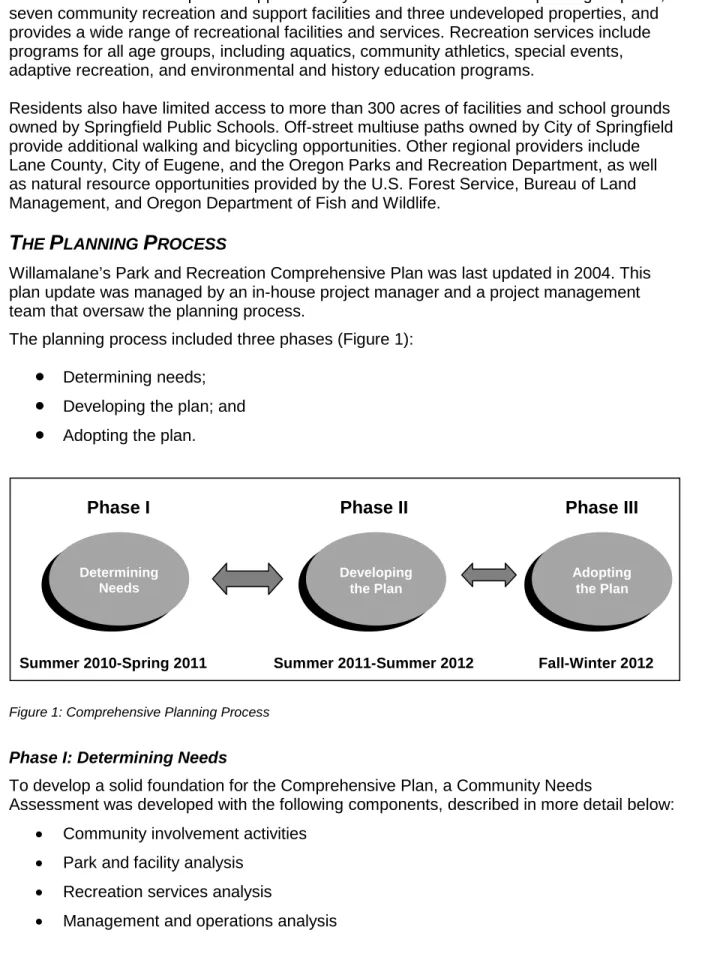
The planning process included three phases (Figure 1):
•
Determining needs;•
Developing the plan; and•
Adopting the plan.Figure 1: Comprehensive Planning Process
Phase I: Determining Needs
To develop a solid foundation for the Comprehensive Plan, a Community Needs
Assessment was developed with the following components, described in more detail below:
• Community involvement activities
• Park and facility analysis
• Recreation services analysis
• Management and operations analysis
Adopting the Plan Determining Needs Developing the Plan
Summer 2010-Spring 2011 Summer 2011-Summer 2012 Fall-Winter 2012
Chapter One
Willamalane Park and Recreation District Page 3
Park and Recreation Comprehensive Plan
Community Involvement Activities
Community involvement was a critical part of the Community Needs Assessment.
Feedback was solicited from district stakeholders and residents regarding their needs and preferences related to parks, natural areas, recreation facilities and programs over the next 20 years. Activities were planned to ensure the participation of a diverse cross-section of the population. Community involvement activities included the following:
• July 2010: A Comprehensive Plan booth at Springfield SummerFair (316 participants completed a questionnaire, and over 600 children voted for their favorite park
activity);
• September-October 2010: An on-line and print Community Survey (completed by approximately 1,060 people);
• October 2010: A Spanish-language version of the Community Survey (completed by approximately 31 people); and
• January 2011: Three Teen Workshops (with approximately 77 participants).
Over 2,000 participants were included in the planning process, including children and youth. In addition, the Spring 2010 Recreation Survey included input from 728 residents.
Park and Facility Analysis
To plan for future needs, it is important to understand the current system of parks, natural areas, and recreation facilities available to Willamalane residents. A park and facility analysis was conducted to document the type, number, and condition of parks and
recreation facilities available to District residents today, and to analyze the ratio of facilities to population (current level of service), assess current and future needs, and provide a basis for the development of strategies and actions.
Recreation Services Analysis
This section analyzed a variety of data, including current recreation programs and services offered by Willamalane and other service providers, Willamalane’s cost recovery model, findings from community involvement activities and state and national trends. Current and future recreation service needs were identified for the next 20 years, which provided a basis for the development of strategies and actions.
Management and Operations Analysis
This section looked at Willamalane’s organizational structure, total operating budget, general fund budget, debt service and assessed valuation to develop findings related to Willamalane’s management and operations.
The complete Community Needs Assessment Report can be found in Appendix A.
Phase II: Developing the Plan
In the second phase of the planning process, strategies and actions were developed for acquiring, developing, improving and managing parks, natural areas, walking and biking trails, recreation facilities, and program opportunities in Willamalane’s planning area over
Chapter One
Page 4 Willamalane Park and Recreation District
. Park and Recreation Comprehensive Plan
the next 20 years. Strategies and actions are based on Community Needs Assessment results, the 2004 Park and Recreation Comprehensive Plan implementation, and additional public input from a variety of stakeholders, including Willamalane staff and Board of
Directors, City of Springfield, Lane County and Springfield Public Schools.
A Capital Improvement Plan was then developed by prioritizing the proposed capital improvement projects. Two 10-year funded phases and a third unfunded project list are proposed, as well as cost estimates and a financing strategy. Staff then analyzed the potential operational costs of implementing the capital projects identified in the Capital Improvement Plan.
After a public open house to review draft recommendations and priorities, as well as additional input opportunities at Springfield SummerFair, the Draft Park and Recreation Comprehensive Plan was developed for committee, staff and community review.
Phase III: Adopting the Plan
In the final phase, the Park and Recreation Comprehensive Plan will be adopted by the Willamalane Board of Directors. It also will be adopted as a Refinement Plan to the
Chapter One
Willamalane Park and Recreation District Page 5
Park and Recreation Comprehensive Plan
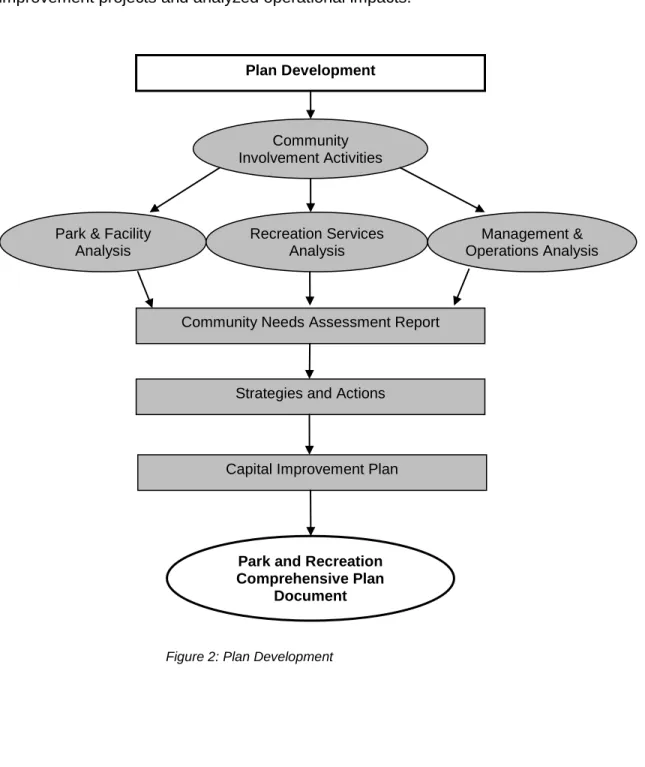
Figure 2 illustrates the different elements of plan development. The Community Needs Assessment Report included input from extensive community involvement activities as well as a technical analysis of facilities, programs and finances. These findings formed the basis of a community vision and the development of strategies and actions for parks, natural areas, recreation facilities, programs and services. The capital improvement plan prioritized strategies and actions into two 10-year funded phases, proposed a funding plan for capital improvement projects and analyzed operational impacts.
Community Needs Assessment Report
Strategies and Actions
Park and Recreation Comprehensive Plan
Document Plan Development
Community Involvement Activities
Park & Facility Analysis
Capital Improvement Plan Recreation Services
Analysis
Management & Operations Analysis
Chapter One
Page 6 Willamalane Park and Recreation District
. Park and Recreation Comprehensive Plan
R
EPORTO
RGANIZATIONThe Park and Recreation Comprehensive Plan is organized into six chapters. The Community Needs Assessment is included as Appendix A.
•
Chapter 1: Introduction describes the purpose of the plan, the planning area, theplan development process and the organization of this document.
•
Chapter 2: Planning Framework describes the core values, vision, mission, goals,strategies and actions, and performance measures that form the comprehensive planning framework for parks and recreation.
•
Chapter 3: Highlights of Improvements identifies key improvements that will bemade during plan implementation.
•
Chapter 4: Strategies and Actions describes the specifics of how the Willamalanewill achieve its vision and includes maps of proposed projects.
•
Chapter 5: Capital Improvement Plan describes a phased capital improvement andoperations plan and funding options for implementing plan improvements.
•
Chapter 6: Performance Measures describes measures linked to each of the goalsof the Comprehensive Plan. These measures will be used to evaluate successful Plan implementation.
•
Appendix A: Community Needs Assessment identifies what the community needsand wants in terms of parks, natural areas, recreation facilities and programs over the next 20 years. It is the basis for the development and prioritization of the plan’s strategies and actions.
Chapter
2
Planning
Framework
Chapter Two
Willamalane Park and Recreation District Page 7
Park and Recreation Comprehensive Plan
P
LANNING
F
RAMEWORK
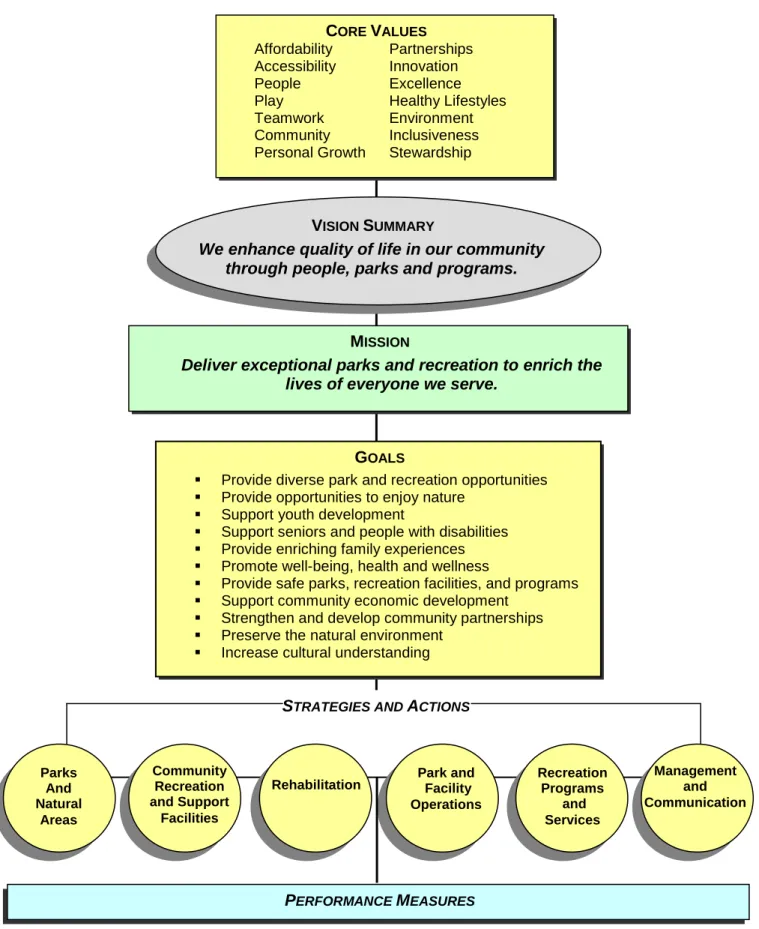
Willamalane Park and Recreation District’s values and aspirations for the future have been guiding forces for the development of the Comprehensive Plan. As illustrated in the
Comprehensive Plan Framework in Figure 3, there are six key elements of the plan:
•
Core values or the values that all services are based upon;•
A vision for Willamalane Park and Recreation District that describes its preferred future;•
A mission that describes the business of Willamalane Park and Recreation District;•
Goals that describe the outcomes to be produced by implementing the Comprehensive Plan;•
Strategies and actions that describe how Willamalane Park and Recreation District will achieve its vision; and•
Performance measures that measure success at achieving this vision. This chapter describes in more detail each of these key elements.Chapter Two
Page 8 Willamalane Park and Recreation District
Park and Recreation Comprehensive Plan
MISSION
Deliver exceptional parks and recreation to enrich the lives of everyone we serve.
GOALS
Provide diverse park and recreation opportunities
Provide opportunities to enjoy nature
Support youth development
Support seniors and people with disabilities
Provide enriching family experiences
Promote well-being, health and wellness
Provide safe parks, recreation facilities, and programs
Support community economic development
Strengthen and develop community partnerships
Preserve the natural environment
Increase cultural understanding
PERFORMANCE MEASURES
CORE VALUES
Affordability Partnerships Accessibility Innovation
People Excellence
Play Healthy Lifestyles
Teamwork Environment Community Inclusiveness Personal Growth Stewardship
VISION SUMMARY
We enhance quality of life in our community through people, parks and programs.
STRATEGIES AND ACTIONS
Rehabilitation Park and Facility Operations Recreation Programs and Services Management and Communication Community Recreation and Support Facilities Parks And Natural Areas
Chapter Two
Willamalane Park and Recreation District Page 9
Park and Recreation Comprehensive Plan
C
OREV
ALUESCore values are the qualities most valued by Willamalane Park and Recreation District. These qualities will guide all services provided by the Willamalane. The following values are embodied in the goals and strategies for Willamalane’s parks, natural areas, recreation facilities, programs and services.
V
ISIONThe vision creates a picture of success for the community served by the Willamalane’s parks and recreation opportunities. During the development of the 2004 Comprehensive Plan, the Project Management Team developed a vision summary:
We enhance quality of life in our community through people, parks and programs.
Willamalane’s complete vision was updated and adopted by the Board of Directors in December 2010. It is:
•
Willamalane actively listens and responds to the community, which in return trustsand supports Willamalane.
•
Willamalane’s excellence in developing and maintaining parks, facilities, open spaceand programs draws recognition locally and nationally.
•
Willamalane exemplifies outstanding leadership by effectively managing andleveraging resources; promoting innovative practices; creating and maintaining strong partnerships; and recruiting and retaining highly motivated professional staff.
•
Affordability•
Accessibility•
Community•
Environment•
Excellence•
Healthy Lifestyles•
Inclusiveness•
Innovation•
Partnerships•
Play•
People•
Personal Growth•
Stewardship•
TeamworkChapter Two
Page 10 Willamalane Park and Recreation District
Park and Recreation Comprehensive Plan
M
ISSIONA mission is a statement that describes “the business” of Willamalane Park and Recreation District. Willamalane’s mission is:
Deliver exceptional parks and recreation to enrich the lives of everyone we serve.
P
LANG
OALSGoals are the outcomes to be produced by implementing the Comprehensive Plan. Eleven goals emerged during the 2004 comprehensive planning process, reflecting key directions for Willamalane’s future. The project management team reviewed these goals and
determined to keep them the same, with minor editing, for the 2012 plan. They are not listed in priority order.
These goals are:
•
Provide diverse park and recreation opportunitiesCommunity health and well-being are strengthened through recreation experiences. Willamalane Park and Recreation District will provide diverse parks, facilities and programs that interest a wide variety of people at all levels of participation.
•
Provide opportunities to enjoy natureWillamalane's parks, programs and facilities offer unique opportunities to enjoy nature, view wildlife and develop a sense of well-being that grows from a deep relationship with nature and a connection to the natural world.
•
Support youth developmentYouth development is a critical concern of the Springfield community. Willamalane recognizes that youth are our future. Willamalane will continue to form partnerships and offer programs that help youth reach their fullest potential.
•
Support seniors and people with disabilitiesIncluding all people in the fabric of society strengthens community and individuals and enhances quality of life. Willamalane Park and Recreation District will promote inclusion and provide a variety of opportunities for residents, including seniors and people with disabilities.
•
Provide enriching family experiencesWillamalane is committed to improving the quality of life in our community by strengthening our families. Through its parks, programs and facilities, Willamalane Park and Recreation District will create opportunities for families of all configurations to play together, learn new skills and grow closer to one another.
Chapter Two
Willamalane Park and Recreation District Page 11
Park and Recreation Comprehensive Plan
•
Promote well-being, health and wellnessPersonal health and wellness require opportunities to be physically active, mentally and emotionally recharged, and socially engaged. Willamalane Park and Recreation District will provide parks, facilities, programs and services that promote health and wellness.
•
Provide safe parks, recreation facilities and programsParks, recreation facilities and programs should provide healthy, inviting environments for social interaction and enjoyment. Willamalane Park and Recreation District will provide such places that foster a sense of community and provide safe recreation opportunities for community members.
•
Support community economic developmentCommunity health and vitality are essential to attract and retain employees and businesses and to fuel the local economy. Diverse cultural and recreational
opportunities appeal to employers and employees. Willamalane Park and Recreation District will provide attractive parks, facilities and programs to enhance quality of life in Springfield.
•
Strengthen and develop community partnershipsAdditional resources are needed to expand and sustain attractive, high-quality parks and facilities, programs and services. Community partnerships and collaborations in service delivery maximize available resources, resulting in greater community benefit.
Willamalane Park and Recreation District will continue to seek out new partners to join its efforts in obtaining the resources needed to provide the quality of life our community deserves.
•
Preserve the natural environmentOur community looks to Willamalane to be stewards of our natural resources.
Willamalane will provide leadership in conserving these resources, and look for new and better ways to be environmentally responsible. Willamalane will provide parks and natural areas that offer close-to-home access to recreational opportunities, while preserving and enhancing important natural resources.
•
Increase cultural understandingWillamalane strives to foster an inclusive sense of community by honoring and celebrating people of all cultures, and preserving our local history. Willamalane is committed to hiring a diverse staff, highlighting diversity in staff training, and creating programs and facilities that raise awareness of diverse cultural traditions and history.
Chapter Two
Page 12 Willamalane Park and Recreation District
Park and Recreation Comprehensive Plan
S
TRATEGIES ANDA
CTIONSTo accomplish the district’s vision and goals, strategies and actions were developed in six categories. These are methods, resources, processes and systems Willamalane will deploy to achieve success.
The strategy and action categories are:
•
Parks and Natural AreasProvide parks, natural areas, connections to waterways, and walking and biking trails, while respecting private property rights.
•
Community Recreation and Support FacilitiesProvide community recreation and support facilities that facilitate a wide variety of activities, create community gathering places and enhance community pride.
•
RehabilitationUpgrade and revitalize existing parks and recreation facilities to provide exceptional recreation opportunities, protect park and recreation resources, improve the
environment, enhance user safety and improve accessibility for people with disabilities.
•
Park and Facility OperationsManage district parks and facilities to promote recreation, user safety and sustainable environmental practices; and to protect public investment.
•
Recreation Programs and ServicesOffer recreation programs and services that respond to district needs, strengthen families and the community and encourage healthy lifestyles.
•
Management and CommunicationManage the district in a sound, responsible manner that emphasizes effective stewardship of public resources, partnerships and joint ventures, and staff and community involvement.
P
ERFORMANCEM
EASURESTo evaluate plan implementation, performance measures tied to the goals presented in this chapter are proposed in Chapter 6.
Chapter
3
Highlights
of
Improvements
Chapter Three
Willamalane Park and Recreation District Page 13
Park and Recreation Comprehensive Plan
H
IGHLIGHTS OF
I
MPROVEMENTS
To illustrate key strategies in the Comprehensive Plan, this chapter highlights priority improvements, many of which will take place in the first 10 years of plan implementation. These improvements respond to Community Needs Assessment findings, and will make a substantial contribution to enhancing quality of life in Springfield through people, parks and programs. The following categories of improvements are described further in this chapter:
•
Collaboration•
Glenwood and Downtown•
Thurston Hills Ridgeline•
Connections to Waterways•
Opportunities for Active Play•
Reinvestment•
Resource ConservationChapter Three
Page 14 Willamalane Park and Recreation District
. Park and Recreation Comprehensive Plan
C
OLLABORATIONOne of the Comprehensive Plan’s goals is to strengthen and develop community partnerships. Willamalane recognizes the importance of collaboration in maximizing resources and delivering the greatest benefit to the community. In this plan, Willamalane will continue to rely on collaboration to meet community needs. Willamalane is an important partner in TEAM Springfield, a cooperative effort between City of Springfield, Springfield Public Schools (SPS), Willamalane, and Springfield Utility Board (SUB).
Willamalane relies on all TEAM Springfield partners to meet community park and recreation needs, but particularly with SPS. Elementary schools play a critical role in meeting day-to-day park needs in Springfield, especially in those areas underserved by neighborhood parks. Willamalane and SPS also have a history of collaborating to ensure that all
Springfield children have safe, supervised settings for play and learning after school and on no-school days.
Willamalane proposes to expand and strengthen this partnership through a number of strategies and actions. One strategy is to expand the number of school/park projects in order to help meet Springfield’s neighborhood park needs. This collaboration may vary widely, depending on mutual benefit and individual site constraints and opportunities. Possibilities range from joint use to shared maintenance and coordinated master planning, such as at Douglas Gardens school/park, Page school/park, and Maple Elementary. In addition to existing school sites, this plan proposes jointly developing and co-locating a school and neighborhood park to meet the educational needs of students and maximize recreational opportunities in the growing Jasper-Natron area (Action 1.18, Jasper-Natron
School/Park). By working collaboratively, SPS and Willamalane will expand the quality and
quantity of recreation opportunities available, while minimizing costly land acquisition. Willamalane also collaborates with City of Springfield on many projects, including new neighborhood parks proposed in this plan, such as on the city-owned 18th and H property in central Springfield and the neighborhood park blocks in Glenwood; path projects such as the Mill Race Path, Weyerhaeuser Haul Road Path and McKenzie Connector; and Action
3.2, Weyerhaeuser McKenzie Natural Area Park, which Weyerhaeuser donated to the city,
and the city will donate to Willamalane in exchange for Willamalane providing public access and long-term maintenance.
Other public sector partners include the Oregon Department of Transportation, Oregon Park and Recreation Department, Lane County, Lane Council of Governments, Lane Transit District, and City of Eugene. Non-profit partners include FOOD for Lane County, McKenzie River Trust, Centro Latino Americano and Friends of Willamalane. By working together, we can reach more members of our community than if working alone.
Willamalane also works with the private sector to promote community economic development and leverage public funds with private dollars. One key public/private
partnership project in this plan is Action 1.3, Pacific Park Subdivision Neighborhood Park. Willamalane proposes working with the city and property owners of the Pacific Park subdivision to acquire and develop a neighborhood park for area residents. The existing privately owned park is run-down and beyond repair. Willamalane pledges to continue partnerships with both public and private sectors to maximize the benefits delivered to residents for each dollar of public investment.
Chapter Three
Willamalane Park and Recreation District Page 15
Park and Recreation Comprehensive Plan
G
LENWOOD ANDD
OWNTOWNAnother area where collaboration plays a key role is in the redevelopment of Glenwood and downtown Springfield. Willamalane has been working with City of Springfield on planning efforts for these two neighborhoods separated by the Willamette River. If implemented, a number of actions in the Comprehensive Plan will help revitalization efforts. A few to note include:
•
Actions 4.13 and 4.14, Glenwood Riverfront Linear Park A and B: As the Glenwoodarea is redeveloped, Willamalane has an opportunity to work with public and private partners to develop a riverfront linear park and multiuse path, and expand the popular Willamette River path system. Section A (Action 4.13) would travel from the Viaduct Path underneath the I-5 bridge, east to the Springfield Bridge; Section B (Action 4.14) would travel from the Springfield Bridge south to Seavey Loop Road. The proposed linear park will include multiuse paths, picnic areas, and river
overlooks, and will be a significant regional recreation and alternative transportation resource. The park will also expand recreation opportunities for Glenwood area residents, who currently have limited access to close-to-home parks.
•
Action 2.3, Island Park Expansion/Connection to Downtown: Island Park is muchloved by the community, but as the home of a long list of festivals and events, it is separated from downtown by the backs of businesses, has poor public access, and is visually and physically separated from the surrounding neighborhood. This action would acquire property to connect the park more directly to downtown, consistent with the Island Park Master Plan and Downtown District Urban Design Plan. Better connecting Island Park to downtown would add to the vibrancy of both, aiding in community development and enhancing Springfield’s quality of life.
•
Action 1.26, Glenwood Neighborhood Park Blocks: Willamalane intends to work incollaboration with the city and private partners to pursue development of neighborhood park blocks in Glenwood. According to the Draft Glenwood Refinement Plan, neighborhood park blocks are conceptualized as long, narrow parks bordered by north-south streets, and providing a visual and physical
connection between Franklin Boulevard and the Willamette River. The park blocks are intended to make the benefits of neighborhood parks available for the residents and employees of the future planned mixed-use development, as well as the general public. The two neighborhood park blocks included in the Draft Glenwood
Refinement Plan will be a key component in the area’s revitalization. These projects support the comprehensive plan’s goal of community economic
development. Community health and vitality are essential to attract and retain employees and businesses and to fuel the local economy. Diverse cultural and recreational
opportunities appeal to both employers and employees. Projects like these will provide attractive parks, facilities and programs to enhance quality of life in Springfield.
Chapter Three
Page 16 Willamalane Park and Recreation District
. Park and Recreation Comprehensive Plan
T
HURSTONH
ILLSR
IDGELINENatural areas, linear parks and trails enhance the livability and character of a community by preserving habitat and open space. Natural areas also provide opportunities for passive outdoor recreation, such as hiking and wildlife viewing. Willamalane residents value their natural environment and outdoor recreation activities.
SummerFair questionnaire respondents and Spanish-language survey respondents identified natural area parks as their top priority. In addition, natural area parks often support recreation activities that are among survey respondents’ top 20 favorite recreation activities (out of 50), including: walking (1), bicycling (4), dog walking (10), hiking (12), wildlife watching (13), picnicking (15), and running (17).
To meet the Comprehensive Plan goals of providing opportunities to enjoy nature and preserving the natural environment, Willamalane proposes to develop additional natural area parks and trails. Specifically, a focus of new parkland acquisition is along the south Thurston Hills ridgeline. Undeveloped forested hillsides that are a prominent community landmark, combined with nearby residential development and adjacent public land, make this area ideal for future natural area parks and trails.
This idea isn’t new: The Thurston Hills ridgeline was identified as possible parkland in Willamalane’s 2004 Comprehensive Plan and in the Rivers to Ridges Metropolitan Regional Parks and Open Space Study. Projects identified in this plan include:
•
Action 3.8 and 3.9, Thurston Hills Ridgeline Park East and West: Willamalane isinterested in working with property owners to pursue acquisition and development of natural-area parks and trail systems along the Thurston Hills ridgeline. Two areas are identified for possible acquisition, one on the eastern edge of Springfield, and the other south of Potato Hill, towards the Jasper-Natron area.
•
Action 4.10, Thurston Hills Ridgeline Trail: Willamalane is interested in working with property owners to explore the feasibility of development of a ridgeline trail in the South Thurston Hills, connecting to parks and neighborhoods. A ridgeline trail would connect to nearby parks, other public land, such as BLM land just outside of the urban growth boundary, and neighborhoods.•
Action 3.10, MountainGate Ridgeline Park: Willamalane is interested in continuing towork with developers on the implementation of the MountainGate Master Plan, specifically the development of a natural area park and trail system on Potato Hill. The MountainGate Master Plan calls for an almost ninety acre park on the top of Potato Hill, one of Springfield’s most significant ridges. The park will be surrounded by residential development and neighbors will be able to easily access the trail system, providing easy access to nature and exceptional views.
A complete list of projects that will connect residents with their natural environment during the first 10 years of plan implementation is provided in Chapter 5.
Chapter Three
Willamalane Park and Recreation District Page 17
Park and Recreation Comprehensive Plan
C
ONNECTIONS TOW
ATERWAYSSpringfield residents love their rivers. When asked what types of outdoor recreation features are most needed in Willamalane’s parks, riverfront access points tied for first, at 19 percent. All of Willamalane’s existing natural area parks have significant river frontage. In addition, rafting/drift boating and canoeing/kayaking ranked high among Spanish-language and teen survey respondents.
A number of actions in the Comprehensive Plan respond to the demand for increased connections to waterways, including the following:
•
Action 5.4, Clearwater Park Master Plan Implementation: Over the planning period,Willamalane will implement the improvements identified in the Draft Clearwater Park Master Plan. Clearwater Park is located on the Middle Fork of the Willamette River, and has been undergoing significant changes in the last few years, including development of the new inlet for the Springfield Mill Race, and a new boat landing. Additional improvements identified in the master plan include an accessible fishing pier, archery range, disc golf course, nature play area, additional waterfront trails, and native plant demonstration garden. While most of the improvements are not directly water-related, they will improve the value and use of this large riverfront park.
•
Action 4.11, McKenzie River Connector: Willamalane will work with the city ondevelopment of a multiuse path from the existing McKenzie Levee Path to 52nd Street, between Hwy 126 and the McKenzie River. This project was previously identified in TransPlan and Willamalane’s 2004 Comprehensive Plan. It is a critical east-west connection north of Main Street for bicyclists, and would open up access to the McKenzie River—much of which is hidden behind fences, or only visible from speeding vehicles.
•
Actions 4.16, 4.17, 4.18, Mill Race Path: These three actions combined would buildthe Mill Race Path from the future Booth-Kelly Mill Pond Park in downtown Springfield, to its connection with the Middle Fork Path in Georgia-Pacific Park. Together with the Middle Fork Path and the on-street bikes lanes on South Second Street, Mill Race Path development would make an 8-mile loop, the majority along a waterway. The Mill Race Ecostystem Restoration Project has improved the habitat in and along the Mill Race, and the Mill Race Path will open up this resource to
Springfield residents and regional visitors alike, who until then will only have minimal access to this historic waterway.
Chapter Three
Page 18 Willamalane Park and Recreation District
. Park and Recreation Comprehensive Plan
O
PPORTUNITIES FORA
CTIVEP
LAYBased on the results of the Community Needs Assessment, 364 acres of additional parkland will be needed to serve district residents by 2032. Given this, park development will be a priority over the next 20 years. These new parks will enable the district to meet many of the Comprehensive Plan goals, including providing diverse park and recreation opportunities.
In addition to natural-area parks, linear parks and trails, where more passive recreation activities take place, such as walking, bird watching, and bike riding, there is also a need for additional opportunities for active play.
Teen focus group participants ranked parks with competitive sports fields first, and large,
multi-use community parks second (out of seven), when asked which major park and
recreation projects are most important for our community. They also picked large
destination playgrounds, riverfront access points, and outdoor water playgrounds, as the top three outdoor recreation features that are most needed in Willamalane’s parks. When asked what prevents them from visiting parks and recreation facilities in the Springfield area more frequently, their top response was that there are not enough activities.
Willamalane has responded to this need by proposing a variety of projects that will offer significant opportunities for active play. A few of the projects that will be implemented in the next 10 years are highlighted below:
•
Action 6.1, Complete the 32nd Street Community Sports Park: Willamalane begandevelopment of the sports park in 2004; it would not have happened without the collaboration of public, nonprofit, and private partners. Today, the sports park is part of the Willamalane Center for Sports and Recreation complex. Two additional outdoor multiuse turf fields, a covered picnic area, perimeter path, enhanced playground and additional parking are proposed, in order to maximize play value at the park.
•
Action 6.2, Guy Lee School/Park Improvements: Guy Lee Park sits adjacent to GuyLee Elementary School, yet they are separated by a fence and don’t fully take advantage of each other’s resources. This action proposes that Willamalane and SPS work together to develop and implement a master plan for the park and school grounds. Improvements to consider include field improvements, joint use playground improvements and improved connectivity to the surrounding neighborhood.
•
Action 8.22, Bob Artz Memorial Park Field Improvements: Bob Artz Park, on thecity’s eastern edge, is an underutilized resource. This action would complete master plan improvements, such as developing a perimeter trail, scorekeepers loft and additional paving between fields. More importantly, it would make improvements to the drainage and usability of the fields, so they could get more use, and have more play value, possibly by other sports in addition to softball.
Chapter Three
Willamalane Park and Recreation District Page 19
Park and Recreation Comprehensive Plan
R
EINVESTMENTWillamalane residents recognize the importance of maintaining existing recreation resources as well as developing new parks and recreation facilities.
In the 2010 Recreation survey, respondents ranked improve/maintain existing parks and facilities as the most important to their household, from a list of five potential Willamalane projects.
Generally, it is more cost effective to rehabilitate existing park and recreation facilities than to replace them with new facilities. With the goal of providing diverse and safe parks and recreation facilities, the Comprehensive Plan outlines many improvements to Willamalane’s existing parks and valued recreation facilities within the first 10 years of plan
implementation, including:
•
Actions 5.5, 5.6, and 8.21, Dorris Ranch Historic Preservation, Rehabilitation, andCommunity Garden: These three actions focus on Willamalane’s intent to implement
the 2008 Dorris Ranch Master Plan, and restore the Briggs House and Dorris House to their historically relevant periods so they can be better used, enjoyed and
interpreted. Rehabilitation work includes replacing the existing restrooms and improving the trail and signage system. New improvements include adding a community garden near the park entrance.
•
Action 8.4, Meadow Park Rehabilitation: There are a variety of improvementsneeded at this established neighborhood park between Mill Street and Pioneer Parkway in order to help it meet current standards, including repairing or replacing the restrooms, shelter and play area; making accessibility improvements to the ballfield and completing the pathway lighting system.
•
Action 8.24, Natural Area Restoration: Willamalane has just completed aDistrict-wide Natural Resource Areas Management Plan (NRAMP). Natural resource areas make up a significant percentage of Willamalane’s parkland inventory. There are currently 18 district-owned or -managed parks that contain significant amounts of natural resource areas, covering almost 500 acres. The purpose of the NRAMP is to define a clear and achievable approach for long-term management of the natural resources and specific ecological communities contained within Willamalane-owned properties.This Comprehensive Plan action recommends implementing the NRAMP, and ultimately restoring natural areas at identified priority sites throughout the
Chapter Three
Page 20 Willamalane Park and Recreation District
. Park and Recreation Comprehensive Plan
R
ESOURCEC
ONSERVATIONOur community looks to Willamalane to be stewards of our natural resources. As stated in our plan goals, we will provide leadership in conserving these resources, and look for new and better ways to be environmentally responsible. One way is to provide parks that offer close-to-home access to a variety of outdoor opportunities, while at the same time
preserving and enhancing important natural resources.
Another way, less obvious to the public, is to upgrade our facilities and parks with resource-efficient operating systems. There are a number of actions in this plan that recommend upgrading old, inefficient operating systems with more efficient systems that reduce our use of non-renewable resources, and cost less to operate, such as:
•
Action 8.30, Splash! at Lively Park: Among the improvements planned for thishighly-used aquatics facility is to modernize and upgrade the mechanical, electrical and plumbing systems for energy efficiency.
•
Action 8.26, Willamalane Park Swim Center: Willamalane’s first natatorium is also inneed of a variety of building repairs in the next ten years, including updating its building control systems.
•
Action 8.9, 8.10, 8.13, Jesse Maine Memorial Park, Bluebelle Park, WillametteHeights Park/Overlook (among others): We propose installing resource-efficient
irrigation systems as park improvements are implemented. Upgrading to new irrigation systems can save valuable energy, water, and labor resources.
•
Action 9.3, Energy-Efficiency Program: We plan to develop energy-efficiencyprograms at district facilities to minimize energy consumption and utility costs, including at Willamalane Center and Park Services Center.
Through the implementation of these actions, and other similar strategies in the plan, Willamalane is striving to reduce greenhouse gas emissions through improved energy efficiency, waste reduction and recycling, and increase the use of renewable energy resources. This also fits with our plan goal of promoting well-being, health and wellness, and supporting community economic development.