A. Merino1 , E. García‐Ortega1 , S. Fernández‐González2 , J. Díaz‐Fernández3 , L. Quitián‐Hernández3 , M. L. Martín4 , L. López1, J. L. Marcos1 , F. Valero3, and J. L. Sánchez1
1Atmospheric Physics Group, IMA, University of León, León, Spain,2State Meteorological Agency (AEMET), Santander,
Spain,3Department of Earth Physics, Astronomy and Astrophysics II, Faculty of Physics, Complutense University of Madrid, Madrid, Spain,4Department of Applied Mathematics, Faculty of Computer Engineering, University of Valladolid,
Valladolid, Spain
Abstract
The prediction of supercooled cloud drops in the atmosphere is a basic tool for aviation safety, owing to their contact with and instant freezing on sensitive locations of the aircraft. One of the main disadvantages for predicting atmospheric icing conditions is the acquisition of observational data. In this study, we used in‐cloud microphysics measurements taken during 10flights of a C‐212 research aircraft under winter conditions, during which we encountered 37 regions containing supercooled liquid water. To investigate the capability of the Weather Research and Forecasting model to detect regions containing supercooled cloud drops, we propose a multiphysics ensemble approach. We used four microphysics and two planetary boundary layer schemes. The Morrison parameterization yielded superior results, whereas the planetary boundary layer schemes were essential in evaluating the presence of liquid water content. The Goddard microphysics scheme best detected the presence of ice water content but tended to underestimate liquid water content.1. Introduction
Icing occurs when an unheated solid structure is exposed to liquid cloud droplets at temperatures below the freezing point. This can seriously damage power lines (Thorkildson et al., 2009), wind turbines (Frohboese & Anders, 2007), and telecommunication towers (Mulherin, 1998). Supercooled liquid water (SLW) in the atmosphere is the main cause of aircraft icing. SLW can persist in a physically metastable state until coming into contact with a solid object such as an aircraft, upon which it freezes instantly and seriously threatens aircraft safety (Kind et al., 1998; Ratvasky et al., 2005). Green (2006) identified 944 icing‐related aviation acci-dents between 1978 and 2005 in the United States.
Despite advances in aircraft anti‐icing systems, atmospheric icing prediction has garnered increased atten-tion in recent years (Thompson et al., 2017). Thefirst algorithms derived using numerical weather prediction (NWP) models were based solely on temperature and relative humidity (Schultz & Politovich, 1992). Subsequently, numerous icing forecast algorithms were developed that were based on the use of thermody-namic profiles (Forbes et al., 1993; Thompson et al., 1997) or cloud microphysics schemes to predict the exis-tence of SLW (Tremblay et al., 1995, 1996). However, examination of the characteristics of hydrometeors along theflight path can facilitate the construction of algorithms to evaluate risks to in‐flight icing (Cober et al., 2001).
The advent of high‐resolution mesoscale models produced substantial improvements in cloud microphysics schemes. It thus became possible to calculate total cloud water content for use in new prediction algorithms as an indicator of icing severity (Bernstein et al., 2005; Olofsson et al., 2003). The skill of NWP models has continued to increase in recent years because of advances in high‐performance computing. This has facili-tated smaller grid spacing, more advanced data assimilation techniques and improved physical parameteri-zations. Regmi et al. (2017) used the Weather Research and Forecasting (WRF) model to simulate weather patterns involved in a fatal aircraft accident in the foothills of western Nepal. Those authors concluded that supercooled cloud water and hail might have been the main factors leading to the deadly accident; however, a lack of weather observations prevented model validation. Nygaard et al. (2011) concluded that the spatial resolution (with grid spacing of 0.333 km) used in NWP models is a decisive factor in the correct prediction of ©2019. The Authors.
This is an open access article under the terms of the Creative Commons Attribution License, which permits use, distribution and reproduction in any medium, provided the original work is properly cited.
Key Points:
• In‐cloud microphysics measurements were taken using aircraft under winter conditions • The Weather Research and
Forecasting model was evaluating for icing forecast with multiphysics ensemble approach
• The Morrison microphysics scheme yielded superior results, and the PBL schemes were essential in evaluating the liquid water content
Supporting Information: •Data Set S1 •Data Set S2 •Data Set S3 Correspondence to: A. Merino, [email protected] Citation:
Merino, A., García‐Ortega, E., Fernández‐González, S., Díaz‐ Fernández, J., Quitián‐Hernández, L., Martín, M. L., et al. (2019). Aircraft Icing: In‐Cloud Measurements and Sensitivity to Physical Parameterizations.Geophysical Research Letters,46, https://doi.org/10.1029/2019GL084424 Received 4 JUL 2019 Accepted 5 OCT 2019
Accepted article online 16 OCT 2019 11,559–11,567.
icing at ground level. However, aircraft icing tends to occur far above the surface, precluding the need for suchfine grids to correctly identify this phenomenon. Davis et al. (2014) evaluated nine WRF physics para-meterization combinations for icing episodes at a wind park in Sweden. They tested three microphysics and three planetary boundary layer (PBL) schemes. Optimal results were obtained using a combination of the Thompson microphysics and version 2 of the Mellor‐Yamada‐Nakanishi‐Niino PBL schemes.
Several existing databases included the reports of pilots who were affected by icing duringflight (Bolgiani et al., 2018). However, the vast majority of aircraft are not equipped with icing sensors, so pilots must deter-mine ice accretion by visual inspection. Moreover, such accretion depends on technical characteristics of the aircraft and its anti‐icing mechanisms, making it difficult to ascertain SLW concentrations that produce icing. For this reason, data collectionfield campaigns using research aircraft to measure in situ SLW and fro-zen water content are very important to improve numerical model verification. Owing to the high cost of researchflights and the complexity offlight plans in icing conditions, limited data are available from only a few suchflight campaigns in North America and Europe (Cober & Isaac, 2012; Hauf & Schröder, 2006; Politovich, 1989). Thus, there are few available databases of in‐cloud measurements (Gultepe & Isaac, 2007; Herman & Heymsfield, 2003).
The aim of the present work was to evaluate the WRF mesoscale model in the detection and prediction of atmospheric regions containing SLW. Wefirst designed an eight‐member multiphysics ensemble, which was applied to 37 events in which SLW was detected. We subsequently validated this ensemble using a microphysics database. We thus determined the sensitivity of the physical parameterizations in detecting SLW and the ideal combination to identify and predict SLW.
2. Experimental Design and Methodology
2.1. Experimental Design
The in situ observations were collected during the TECOAGUA and METEORISKfield campaigns by instru-ments mounted on a C‐212‐200 aircraft belonging to the National Institute for Aerospace Technology. These projects took place over the Iberian Peninsula during the winters of 2011–2017 and were focused on micro-physical conditions that might generate icing in winter clouds. The vast majority of the clouds sampled were stratiform, and the aircraft collected data during at least one constant‐altitudeflight within cloud. In‐cloud measurements were made using the Cloud Aerosol and Precipitation Spectrometer (CAPS; Baumgardner et al., 2001). This probe is capable of measuring hydrometeor concentration and size (distinguishing their phase), aerosols, liquid water content (LWC), temperature, relative humidity, and vapor density, among other variables. Tenflights with aircraft icing conditions and SLW were examined. Using CAPS images in which hydrometers could be seen (Figure 1), we selected 37 sections containing observed SLW. In these 37 sections analyzed, the LWC was observed in regions with temperatures below the freezing level; therefore, under these conditions, the LWC is equivalent to icing risk.
2.2. Numerical Simulation: WRF Model
NWP models have been widely used to analyze in‐cloud icing conditions (Fernández‐González et al., 2014; Reisner et al., 1998). In the present study, we used version 3.9.1 of the WRF model (Skamarock & Klemp, 2008) to evaluate its sensitivity to microphysics and PBL parameterizations.
Initial and boundary conditions were from National Centers for Environmental Prediction Global Forecast System analyses, with 1° horizontal grid spacing. Three nested domains were designed, following a two‐way nesting strategy. Horizontal resolution of the domains was 27, 9, and 3 km, respectively. Vertical resolution was set to 54 sigma levels, using high resolution in lower layers where SLW is most common.
The selected parameterization schemes were as follows: Dudhia (1989) for shortwave radiation; the Rapid Radiative Transfer model (Mlawer et al., 1997) for longwave radiation; Eta surface layer described by Janjic (1996), and Noah Land Surface Model (Chen & Dudhia, 2001), which is a four‐layer soil temperature and moisture model with canopy moisture and snow cover estimation. This configuration was based on the results of studies treating winter situations (Fernández‐González et al., 2015; Evans et al., 2012; Yuan et al., 2012). The effectiveness of cumulus parameterizations has been demonstrated using low‐resolution models when resolutions better than 10–15 km were not needed (Arakawa, 2004). We thus used the Kain‐Fritsch cumulus scheme (Kain, 2004) for the outer domain only.
10.1029/2019GL084424
Geophysical Research Letters
Four microphysics schemes were tested: the single‐moment six‐class Goddard microphysics (Tao et al., 2009), Morrison six‐class double‐moment (Morrison et al., 2009), Thompson six‐class microphysics (Thompson et al., 2008), and WRF single‐moment six‐class (WSM6; Hong & Lim, 2006). PBL processes were described by the Mellor‐Yamada‐Janjic (MYJ; Janjic, 2001) and Yonsei University (YSU; Hong et al., 2006) parameterization schemes. These schemes have been used extensively in various sensitivity studies for win-ter phenomena (Evans et al., 2012; Fernández‐González et al., 2015; Yuan et al., 2012). However, the ability of these schemes in predicting SLW has not been tested using ground truth databases.
2.3. Model Verification
Owing to the strong spatial variability of LWC, wefirst conducted qualitative validation of the ensemble. For the 37 selected sections, we ascertained the presence or absence of LWC and ice water content (IWC) using each of the eight ensemble members. Using the obtained data, we constructed contingency tables and calcu-lated the following skill scores: False Alarm Ratio (FAR); Probability Of Hits (POH); Frequency Of Mistakes (FOM), and Probability Of Detection (POD).
The results allowed us to determine which model configuration could best predict the presence or absence of liquid water and water in solid form. However, icing risk is also influenced by LWC concentration, so we also performed a quantitative verification. In each section, maximum LWC, under freezing conditions, was extracted for both the observations obtained using CAPS and each of the eight ensembles. Validation was carried out individually for each of the 10flight days, and we calculated the bias, mean absolute error (MAE), and root‐mean‐square error (RMSE). Because the LWC varied substantially among the days, the indexes were standardized by dividing each by daily averages. In this way, we could compare the results among the 10 days. Icing risk is also temperature dependent, but temperature is usually accurately forecasted by the models.
3. Results
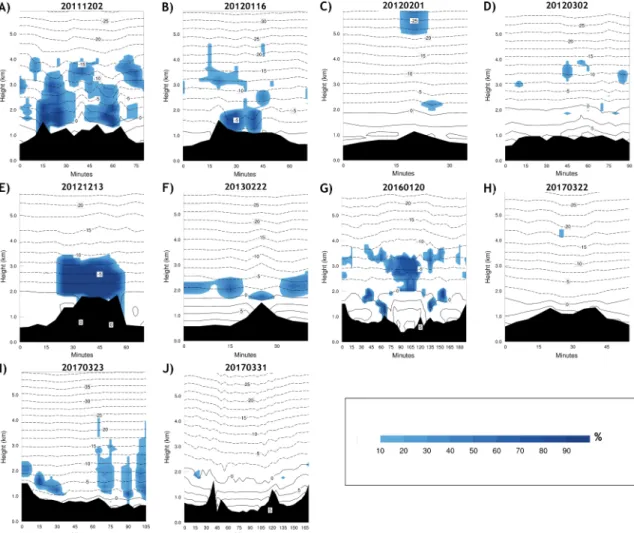
Wefirst determined the vertical distribution of LWC and IWC, together with isotherms, along the aircraft path for the 10fights (Figure 2). The representations correspond to average values of the eight ensemble members. As seen in thefigure, all 10flights were during winter conditions, with a freezing level between 1000 and 2000 msl. Temperature of the sampled regions was between−5 and−15 °C, where any liquid water can be considered SLW. In several of the events, large regions of SLW were evident, which predominated over the ice phase (Figures 2a, 2e, 2f, and 2g). Conditions for icing were very favorable in these events because the hydrometeors were in liquid phase; they can remain in this phase for long periods in the
absence of ice (Rosenfeld & Woodley, 2000). This situation is typical of clouds with low cloud tops and temperatures that are sufficiently cold to activate freezing nuclei. In other events, the ensemble average shows a predominance of solid phase for the hydrometeors (Figures 2b and 2i) in clouds with large vertical development; the liquid phase was only present as small pockets around the cloud bases. In these situations, the clouds indicate a mixed phase in which liquid droplets feed the growth of ice crystals via evaporation.
One of the main justifications for the development of an ensemble to predict icing is whether the presence of LWC or IWC is sensitive to the choice of physical parameterization scheme. As we have shown, it seems rea-sonable that physical schemes like microphysics and PBL are essential in forecasting various types of hydro-meteors. To investigate this sensitivity, we examined the standard deviation of the eight ensemble members with respect to the vertical profiles of LWC and IWC from the aircraft trajectories (not shown). In many of the events, we found standard deviations similar in orders of magnitude to the ensemble mean. These results are consistent with the demonstrated sensitivity of the two variables to PBL and microphysical parameteri-zations (Fernández‐González et al., 2015).
To determine conditions favorable for icing, the two most important atmospheric variables are temperature and LWC. Thus, in the 10 cases, we determined icing risk using a probability scale based on the number of ensemble members with SLW (Figure 3). It is seen that for mostflight paths, the model indicated a risk of icing. For events 2 November 2011, 16 January 2012, 13 December 2012, and 20 January 2016, all
Figure 2.Average vertical profiles of eight ensemble members for C‐212 tracks for 10 case studies (A‐J): Liquid water content (g/kg; cold color table); ice water con-tent (g/kg; warm color table); temperature (°C; black contours).
10.1029/2019GL084424
Geophysical Research Letters
ensemble members identified conditions favorable to icing. There were discrepancies among the members for the remaining events.
A novel aspect of our study is the use of a valuable database including 37 sections containing SLW. We could thus exhaustively validate the various ensemble members according to the methods described in section 2.
Table 1 shows skill scores for validation of LWC and IWC for each of the eight ensemble members. For LWC, the small FAR for all eight members is notable, with the smallest for the Morrison and Thompson microphy-sics parameterizations and the PBL of the YSU scheme, for which only 5% of cases predicted by the model were not observed. For the POD, the best LWC values were obtained using the Goddard and Thompson microphysics parameterizations, whereas WSM6 scheme obtained the lowest POD values, smaller than 50%. In this case, it appears that the effect of the PBL was stronger, with the YSU giving superior results to the MYJ scheme. Considering all skill scores, ensemble member 4 (Morrison microphysics and YSU PBL schemes) yielded the best results, with a FAR of 4%, POH of 96%, FOM of 33%, and POD of 67%. Combination 7 produced the poorest results, with a FAR of 22% and POD of 39%.
Although the risk of icing depends exclusively on the presence of SLW, the existence of ice crystals within a cloud reduces the LWC, because the saturation vapor pressure is lower over ice than over liquid water. For this reason, we decided to also validate IWC. Its detection is vitally important for cloud microphysics pro-cesses because it affects the balance of the remaining hydrometeors. The skill scores for IWC showed a very high FAR for all members except the Thompson microphysics and MYJ PBL schemes. However, these members had a very low POD and are therefore not effective options for predicting IWC. Combining all
resultant skill scores, the best member was 2 (Goddard microphysics and YSU PBL schemes) with a POD of 67%, although the FAR was as high as 43%.
In view of the qualitative validation results, the choices of microphysics parameterization and PBL are of utmost importance in predicting LWC and IWC. Although the results differ, the ensemble members tended to overestimate the presence of IWC to the detriment of LWC, as evidenced by the high FARs observed for IWC. For this reason, numerical prediction models can underestimate the presence of liquid water in mixed‐ phase clouds, thereby minimizing possible risks to aviation safety.
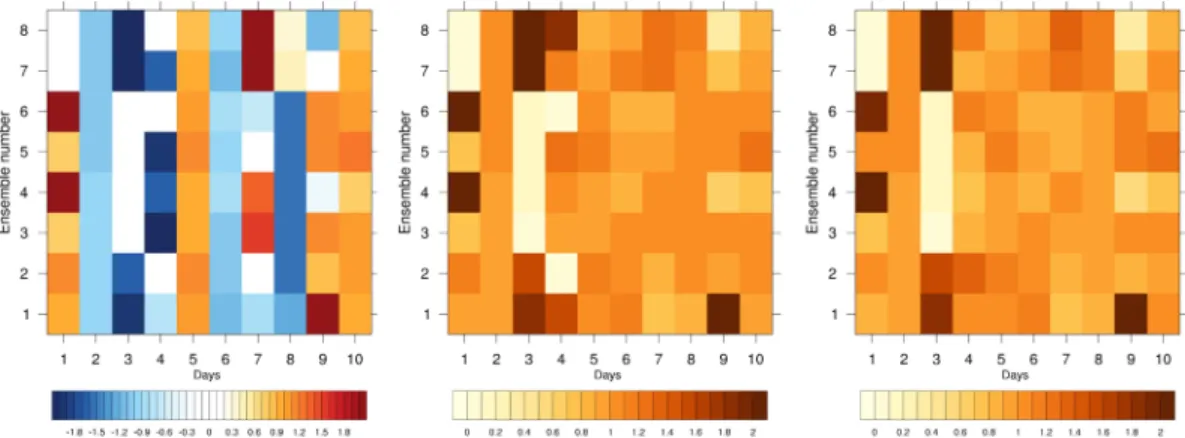
Figure 4 shows the qualitative validation results for LWC. The daily average bias shows near‐zero values for members 7 and 8 (WSM6 microphysics). However, these two members showed larger deviations, indicating that they tend to overestimate or underestimate depending on event. Members 3 and 4 (Morrison microphy-sics) had a mean closer to 0 along with smaller deviation, whereas member 1 yielded a value furthest from 0. For MAE and RMSE, member 3 (including the Morrison microphysics and MYJ PBL schemes) showed the best average performance, whereas member 1 (Goddard microphysics and MYJ PBL schemes) showed the poorest. Contrary to the qualitative validation described above, here, the microphysics parameterizations have greater importance than those of the PBL. By combining these results with those of the qualitative validation, the Morrison microphysics scheme produces superior results to the remaining parameterizations. PBL parameterizations are not of great importance in the quantitative validations, although they were deci-sive in evaluating the presence or absence of LWC. The Goddard microphysics scheme could best detect the presence of IWC, but LWC tends to be underestimated.
Few validation studies of LWC and IWC can be found in the literature, owing to the complexity and high cost of measurements in clouds. Thus, comparisons with the present study are difficult because of the use of dif-ferent models, parameterizations, and sampling methods. Many studies have used ground‐based observa-tions for validation of LWC at lower levels. Huang et al. (2015) investigated LWC in PBL clouds using
Table 1
Skill Scores for Qualitative Validation of LWC and IWC
Ensemble member 1 2 3 4 5 6 7 8
Microphysics Goddard Goddard Morrison Morrison Thompson Thompson WSM6 WSM6
PBL MYJ YSU MYJ YSU MYJ YSU MYJ YSU
LWC FAR 0.1 0.08 0.05 0.04 0.05 0.05 0.22 0.15 POH 0.9 0.92 0.95 0.96 0.95 0.95 0.78 0.85 FOM 0.47 0.36 0.47 0.33 0.5 0.44 0.61 0.53 POD 0.53 0.64 0.53 0.67 0.5 0.56 0.39 0.47 IWC FAR 0.45 0.43 0.5 0.5 0.38 0.46 0.53 0.6 POH 0.55 0.57 0.5 0.5 0.62 0.54 0.47 0.4 FOM 0.33 0.28 0.67 0.78 0.56 0.61 0.5 0.56 POD 0.67 0.72 0.33 0.22 0.44 0.39 0.5 0.44
Figure 4.Average bias (left), mean absolute error (middle), and root‐mean‐square error (right) for liquid water content by ensemble number and day.
10.1029/2019GL084424
Geophysical Research Letters
ground‐based lidar observations. Using a limited‐area model, they noted clear underestimation of LWC in PBL clouds. This was improved by introducing microphysical and PBL parameterization schemes. Naud et al. (2014) assessed several NWP models using a set of satellite observations,finding that these underesti-mated low‐level LWC. Those authors suggested that the parametrization schemes (i.e., PBL and cloud micro-physics) were most likely the source of model deficiencies. Many other studies have focused on investigating low‐level LWC associated with fog events (Katata et al., 2011; Rémy & Bergot, 2009). Nygaard et al. (2011) studied episodes of in‐cloud icing at ground level using WRF with a microphysics ensemble. With high hor-izontal resolution, the model was able to capture all icing events when the Thompson or Morrison cloud microphysics schemes were used together with the YSU PBL scheme.
On the other hand, Molthan and Colle (2012) validated WRF using aircraft measurements of hydrometeor content and size distribution in a snowfall event. They found that double‐moment schemes may improve the representation of ice crystals. Nevertheless, in the present study, the availability of a database including 37 SLW events, has allowed a model validation for in‐cloud icing forecast.
4. Conclusions
In the present work, we examined a set of aircraft icing events using in‐cloud microphysical measurements. We used data from 10 scientificflights conducted with an aviation research platform. Theflights were during winter conditions in the presence of SLW. We used the database acquired during theseflights to validate a multiphysics ensemble with the WRF mesoscale model. This ensemble was constructed using four micro-physics and two PBL parameterizations.
The ensemble of simulations showed large variation among results of the various members, suggesting dis-parate performance in predicting LWC. From the qualitative validation, the Morrison microphysics and YSU PBL schemes gave the best results for LWC, with FAR 4%, POH 96%, FOM 33%, and POD 67%. For IWC, the best combination was the Goddard microphysics and YSU PBL schemes, with POD 67% and FAR 43%. In the quantitative validation, the Morrison microphysics scheme yielded superior results to the remaining parameterizations. PBL parameterizations were less important in that validation but were essential in ascer-taining the presence of absence of LWC. The Goddard microphysics scheme best detected IWC but tended to underestimate LWC. Although these results varied, the prediction models tended to overpredict the presence of IWC to the detriment of LWC, as evidenced by high FARs for IWC, whereas LWC is underestimated. Consequently, the numerical prediction models may underestimate the presence of liquid water in mixed‐ phase clouds, thereby minimizing the risk to aviation safety.
Supported by in‐cloud measurements, the present results can improve the prediction of icing conditions in the atmosphere. Forecast systems using ensembles such as that proposed in the present work can be used operationally in planning air routes.
References
Arakawa, A. (2004). The cumulus parameterization problem: Past, present, and future.Journal of Climate,17(13), 2493–2525. https://doi. org/10.1175/1520‐0442(2004)017<2493:RATCPP>2.0.CO;2
Baumgardner, D., Jonsson, H., Dawson, W., O'Connor, D., & Newton, R. (2001). The cloud, aerosol and precipitation spectrometer: A new instrument for cloud investigations.Atmospheric Research,59‐60, 251–264. https://doi.org/10.1016/S0169‐8095(01)00119‐3
Bernstein, B. C., McDonough, F., Politovich, M. K., Brown, B. G., Ratvasky, T. P., Miller, D. R., et al. (2005). Current icing potential: algorithm description and comparison with aircraft observations.Journal of Applied Meteorology,44(7), 969–986. https://doi.org/ 10.1175/JAM2246.1
Bolgiani, P., Fernández‐González, S., Martin, M. L., Valero, F., Merino, A., García‐Ortega, E., & Sánchez, J. L. (2018). Analysis and numerical simulation of an aircraft icing episode near Adolfo Suárez Madrid‐Barajas International Airport.Atmospheric Research,200, 60–69. https://doi.org/10.1016/j.atmosres.2017.10.001
Chen, F., & Dudhia, J. (2001). Coupling and advanced land surface‐hydrology model with the Penn State‐NCAR MM5 modeling system. Part I: Model implementation and sensitivity.Monthly Weather Review,129(4), 569–585. https://doi.org/10.1175/1520‐0493(2001) 129<0569:CAALSH>2.0.CO;2
Cober, S. G., & Isaac, G. A. (2012). Characterization of aircraft icing environments with supercooled large drops for application to com-mercial aircraft certification.Journal of Applied Meteorology and Climatology,51(2), 265–284. https://doi.org/10.1175/JAMC‐D‐11‐022.1 Cober, S. G., Isaac, G. A., & Strapp, J. (2001). Characterization of aircraft icing environments that include supercooled large drops.Journal of
the Atmospheric Sciences,40, 1984–2002. https://doi.org/10.1175/1520‐0450(2001)040<1984:COAIET>2.0.CO;2
Davis, N., Hahmann, A. N., Clausen, N.‐E., &Žagar, M. (2014). Forecast of icing events at a wind farm in Sweden.Journal of Applied Meteorology and Climatology,53(2), 262–281. https://doi.org/10.1175/JAMC‐D‐13‐09.1
Dudhia, J. (1989). Numerical study of convection observed during the winter monsoon experiment using a mesoscale two‐dimensional model.Journal of the Atmospheric Sciences,46(20), 3077–3107. https://doi.org/10.1175/1520‐0469(1989)046<3077:NSOCOD>2.0.CO;2 Acknowledgments
Data support came from the Atmospheric Physics Group, IMA, University of León, Spain, and the National Institute of Aerospace Technology (INTA). This research was carried out in the framework of the SAFEFLIGHT project,financed by MINECO (CGL2016‐78702) and LE240P18 project (Junta de Castilla y León). We also thank R. Weigand for computer support to the research group, and thanks for Analisa and Steve Hunter for the translation to English language. The databases used in this study are under review in PANGAEA repository (https://doi.pangaea.de/ 10.1594/PANGAEA.907326).
Evans, J., Ekström, M., & Ji, F. (2012). Evaluating the performance of a WRF physics ensemble over South‐East Australia.Climate Dynamics,39(6), 1241–1258. https://doi.org/10.1007/s00382‐011‐1244‐5
Fernández‐González, S., Sánchez, J. L., Gascón, E., López, L., García‐Ortega, E., & Merino, A. (2014). Weather features associated with aircraft icing conditions: A case study.The Scientific World Journal,2014(279063), 1–18. https://doi.org/10.1155/2014/279063 Fernández‐González, S., Valero, F., Sánchez, J. L., Gascón, E., López, L., García‐Ortega, E., & Merino, A. (2015). Numerical simulations of
snowfall events: Sensitivity analysis of physical parameterizations.Journal of Geophysical Research: Atmospheres,120, 10130–10148. https://doi.org/10.1002/2015JD023793
Forbes, G. S., Hu, Y., Brown, B. G., Bernstein, B. C., & Politovich, M. K. (1993).Examination of conditions in the proximity of pilot reports of icing during STORM‐FEST. Paper presented at 5th international conference on aviation weather systems, Vienna, Virginia. Frohboese, P., & Anders, A. (2007). Effects of icing on wind turbine fatigue loads.Journal of Physics: Conference Series,75, 012061. https://
doi.org/10.1088/1742‐6596/75/1/012061
Green S.D., (2006).A study of U.S. inflight icing accidents, 1978 to 2002. Paper presented at 44th AIAA Aerospace Sciences Meeting and Exhibit, Reno, Nevada
Gultepe, I., & Isaac, G. A. (2007). Cloud fraction parameterization as a function of mean cloud water content and its variance using in‐situ observation.Geophysical Research Letters,34, L07801. https://doi.org/10.1029/2006GL028223
Hauf, T., & Schröder, F. (2006). Aircraft icing researchflights in embedded convection.Meteorology and Atmospheric Physics,91(1–4), 247–265. https://doi.org/10.1007/s00703‐004‐0082‐y
Herman, R. L., & Heymsfield, A. J. (2003). Aircraft icing at low temperatures in Tropical Storm Chantal (2011).Geophysical Research Letters, 30(18), 1955. https://doi.org/10.1029/2003GL017746
Hong, S. Y., & Lim, J. O. J. (2006). The WRF single‐moment 6‐class microphysics scheme (WSM6).Journal of the Korean Meteorological Society,42, 129–151.
Hong, S.‐Y., Noh, Y., & Dudhia, J. (2006). A new vertical diffusion package with an explicit treatment of entrainment processes.Monthly Weather Review,134(9), 2318–2341. https://doi.org/10.1175/MWR3199.1
Huang, Y., Franklin, C. N., Siems, S. T., Manton, M. J., Chubb, T., Lock, A., et al. (2015). Evaluation of boundary‐layer cloud forecasts over the Southern Ocean in a limited‐area numerical weather prediction system using in situ, space‐borne and ground‐based observations. Quarterly Journal of the Royal Meteorological Society,141(691), 2259–2276. https://doi.org/10.1002/qj.2519
Janjic, Z. (1996).The surface layer parameterization in the NCEP Eta Model, (p. 444). Geneva, Switzerland: World Meteorol. Organ. Janjic, Z. (2001). Nonsingular implementation of the Mellor‐Yamada level 2.5 scheme in the NCEP Meso model,in Note 437, p. 61, NCEP
Office. http://www.emc.ncep.noaa.gov/officenotes/FullTOC.html
Kain, J. (2004). The Kain‐Fritsch convective parameterization: An update.Journal of Applied Meteorology,43(1), 170–181. https://doi.org/ 10.1175/1520‐0450(2004)043<0170:TKCPAU>2.0.CO;2
Katata, G., Kajino, M., Hiraki, T., Aikawa, M., Kobayashi, T., & Nagai, H. (2011). A method for simple and accurate estimation of fog deposition in a mountain forest using a meteorological model.Journal of Geophysical Research Atmospheres,116(D20), D20102. https:// doi.org/10.1029/2010JD015552
Kind, R. J., Potapczuk, M. G., Feo, A., Golia, C., & Shah, A. D. (1998). Experimental and computational simulation of in‐flight icing phe-nomena.Progress in Aerospace Sciences,34(5‐6), 257–345. https://doi.org/10.1016/S0376‐0421(98)80001‐8
Mlawer, E., Taubman, S., Brown, P., Iacono, M., & Clough, S. (1997). Radiative transfer for inhomogeneous atmospheres: RRTM, a validated correlated‐k model for the longwave.Journal of Geophysical Research,102(D14), 16,663–16,682. https://doi.org/10.1029/ 97JD00237
Molthan, A. L., & Colle, B. A. (2012). Comparisons of single‐and double‐moment microphysics schemes in the simulation of a synoptic‐ scale snowfall event.Monthly Weather Review,140(9), 2982–3002. https://doi.org/10.1175/MWR‐D‐11‐00292.1
Morrison, H., Thompson, G., & Tatarskii, V. (2009). Impact of cloud microphysics on the development of trailing stratiform precipitation in a simulated squall line: Comparison of one‐and two‐moment schemes.Monthly Weather Review,137(3), 991–1007. https://doi.org/ 10.1175/2008MWR2556.1
Mulherin, N. (1998). Atmospheric icing and communication tower failure in the United States.Cold Regions Science and Technology,27(2), 91–104. https://doi.org/10.1016/S0165‐232X(97)00025‐6
Naud, C. M., Booth, J. F., & Del Genio, A. D. (2014). Evaluation of ERA‐Interim and MERRA cloudiness in the Southern Ocean.Journal of Climate,27(5), 2109–2124. https://doi.org/10.1175/JCLI‐D‐13‐00432.1
Nygaard, B. E. K., Kristjánsson, J. E., & Makkonen, L. (2011). Prediction of in‐cloud icing conditions at ground level using the WRF model. Journal of Applied Meteorology and Climatology,50(12), 2445–2459. https://doi.org/10.1175/JAMC‐D‐11‐054.1
Olofsson, B., Olsson, E., Andersson, S., Mårtensson, T., & Mårtensson, E. (2003). A new algorithm to estimate aircraft icing in the HIRLAM model.Meteorological Applications,10(2), 111–114. https://doi.org/10.1017/S1350482703002020
Politovich, M. K. (1989). Aircraft icing caused by large supercooled droplets.Journal of Applied Meteorology,28, 856–868. https://doi.org/ 10.1175/1520‐0450(1989)028<0856:AICBLS>2.0.CO;2
Ratvasky, T. P., Miller, D. R., & Wolff, C. A. (2005). Current icing potential: algorithm description and comparison with aircraft observa-tions.Journal of Applied Meteorology.,44(7), 969–986. https://doi.org/10.1175/JAM2246.1
Regmi, R. P., Kitada, T., Dudhia, J., & Maharjan, S. (2017). Large‐scale gravity current over the middle hills of the Nepal Himalaya: Implications for aircraft accidents.Journal of Applied Meteorology and Climatology,56(2), 371–390. https://doi.org/10.1175/JAMC‐D‐16‐ 0073.1
Reisner, J., Rasmussen, R. M., & Bruintjes, R. T. (1998). Explicit forecasting of supercooled liquid water in winter storms using the MM5 mesoscale model.Quarterly Journal of the Royal Meteorological Society,124(548), 1071–1107. https://doi.org/10.1002/ qj.49712454804
Rémy, S., & Bergot, T. (2009). Assessing the impact of observations on a local numerical fog prediction system.Quarterly Journal of the Royal Meteorological Society,135(642), 1248–1265. https://doi.org/10.1002/qj.448
Rosenfeld, D., & Woodley, W. L. (2000). Deep convective clouds with sustained supercooled liquid water down to‐37.5 °C.Nature, 405(6785), 440–442. https://doi.org/10.1038/35013030
Schultz, P., & Politovich, M. K. (1992). Toward the improvement of aircraft‐icing forecasts for the continental United States.Weather and Forecasting,7, 491–500. https://doi.org/10.1175/1520‐0434(1992)007<0491:TTIOAI>2.0.CO;2
Skamarock, W., & Klemp, J. (2008). A time‐split nonhydrostatic atmospheric model for weather research and forecasting applications. Journal of Computational Physics,227(7), 3465–3485. https://doi.org/10.1016/j.jcp.2007.01.037.P
Tao, W. K., Anderson, D., Chern, J., Entin, J., Hou, A., Houser, P., et al. (2009). The Goddard multi‐scale modeling system with unified physics.Annals of Geophysics,27(8), 3055–3064. https://doi.org/10.5194/angeo‐27‐3055‐2009
10.1029/2019GL084424
Geophysical Research Letters
Thompson, G., Bruintjes, R., Brown, B., & Hage, F. (1997). Intercomparison of in‐flight icing algorithms. Part I: WISP94 real‐time icing prediction and evaluation program.Weather and Forecasting,12, 878–889. https://doi.org/10.1175/1520‐0434(1997)012<0878: IOIFIA>2.0.CO;2
Thompson, G., Field, P., Rasmussen, R., & Hall, W. (2008). Explicit forecasts of winter precipitation using an improved bulk microphysics scheme. Part II: Implementation of a new snow parameterization.Monthly Weather Review,136(12), 5095–5115. https://doi.org/10.1175/ 2008MWR2387.1
Thompson, G., Politovich, M. K., & Rasmussen, R. M. (2017). A numerical weather model's ability to predict characteristics of aircraft icing environments.Weather and Forecasting,32(1), 207–221. https://doi.org/10.1175/WAF‐D‐16‐0125.1
Thorkildson, R., Jones, K., & Emery, M. (2009). In‐cloud icing in the Columbia basin.Monthly Weather Review,137(12), 4369–4381. https:// doi.org/10.1175/2009MWR2941.1
Tremblay, A., Glazer, A., Szyrmer, W., Isaac, G., & Zawadzki, I. (1995). Forecasting of supercooled clouds.Monthly Weather Review,123, 2098–2113. https://doi.org/10.1175/1520‐0493(1995)123<2098:FOSC>2.0.CO;2
Tremblay, A., Stewart, G. C., Glazer, A., Isaac, G., & Mailhot, J. (1996). An intercomparison of mesoscale forecasts of aircraft icing using SSM/I retrievals.Weather and Forecasting,11, 66–77. https://doi.org/10.1175/1520‐0434(1996)011<0066:AIOMFO>2.0.CO;2 Yuan, X., Liang, X.‐Z., & Wood, E. F. (2012). WRF ensemble downscaling seasonal forecasts of China winter precipitation during 1982–