EVALUATING THE EFFECTIVENESS OF THE PERFORMANCE MANAGEMENT AND DEVELOPMENT SYSTEM IN THE EASTERN CAPE LIQUOR BOARD
L. L. Tini 211148075
Submitted in complete fulfilment of the requirements for the degree of Masters in Business Administration (MBA) in the faculty of Business and Economic Sciences
at the Nelson Mandela Metropolitan University (NMMU).
PROMOTER: Professor G. Pelser
i
DECLARATION
“I, Linda Lindelwa Tini, hereby declare that:
• The work submitted in this treatise is my own, produced under the guidance of my supervisor, Professor Gert Pelser.
• Information obtained from other sources has been accredited to that source.
• This treatise has not been previously submitted for an equivalent qualification at any other recognised institution.
___________________ _________________ L. L. TINI DATE
iii ABSTRACT
Research studies have reported that many organisations implement a performance management and development system. However, it is often not as effective as it is intended. Against this background, the purpose of this study was to evaluate the effectiveness of the performance management and development in the Eastern Cape Liquor Board (ECLB).
The study emphasised the importance of an organisational culture that supports management of performance in order for the system to be effective. The study further highlighted that alignment between the performance of individuals and the organisation is critical as all efforts have to focus on the achievement of the organisational vision. The study also emphasised the importance of a process of determining key performance areas that is transparent and involves participation by all employees. The study further argued that the development and rewarding of employees for performance is crucial in ensuring an effective performance management system.
The target population for this study consisted of ECLB employees including the district offices. The findings suggested that when the performance management and development system is not implemented in its entirety it cannot be effective. Furthermore, the findings revealed that ECLB implements some of the elements of the system correctly whilst other areas still require more attention.
iv
ACKNOWLEDGEMENTS
• To God for granting me the strength and ability to pull through during difficult times. Thank you Lord for making me believe in myself and for surrounding me with friends who believe in my dream and encouraged me.
• My family – thank you for your unfailing love and support always. This dissertation is dedicated to you! I believe you will follow in my footsteps and carry the legacy of education for generations to come. I love you. • To my team mate, Kevin, and his wife, for their encouragement and
support, thank you. To my classmates who have been there during the trying times.
• My employer, Eastern Cape Liquor Board and all the respondents of this study - Thank you.
• Professor Gert Pelser, thank you for your guidance, passion and encouragement during this research. You gave me hope and made me believe “I can”!
v TABLE OF CONTENTS
CHAPTER ONE
INTRODUCTION AND BACKGROUND ... 1
1.1 Introduction ... 1
1.2 Problem Statement ... 2
1.3 Research Question and Sub-problems ... 4
1.4 Delimitation of the Research ... 6
1.5 Objectives of the Study ... 6
1.5.1 Primary objective ... 6
1.5.2 Secondary objectives ... 6
1.6 Research Design ... 7
1.7 Significance of the Research ... 7
1.8 Outline of the Study ... 8
CHAPTER 2 LITERATURE REVIEW ... 10
2.1 Introduction ... 10
2.2 Definition of Performance Management ... 10
2.3 Difference between Performance Appraisal and Performance Management ... 13
2.4 Guidelines for Effective Performance Management ... 15
2.4.1 Performance management practices ... 17
2.4.1.1 Performance management training ... 17
2.4.1.2 Multisource feedback ... 17
2.4.1.3 Employee recognition... 18
vi
2.4.2.1 Organisational culture ... 19
2.4.2.2 Employee relations climate ... 19
2.4.2.3 Integration of human resource management strategically ... 19
2.5 Alignment between the Performance of the Individuals and the Organisation ... 20
2.5.1 Alignment between policy mandate, management environment and strategies ... 20
2.5.2 Alignment between strategic and implementation of performance plans21 2.5.3 Alignment of the organisation’s visions with the performance of the individuals ... 23
2.5.4 Performance management process ... 24
2.5.4.1 Performance planning ... 25
2.5.4.2 Performance review ... 26
2.5.4.3 Performance monitoring ………...26
2.6 Determining Key Performance Areas ... 28
2.6.1 Methods of identifying KPAs ... 32
2.6.1.1 The participation and group discussion approach ... 33
2.6.2 Performance indicators ... 37
2.7 Employee Development ... 38
2.7.1 Performance measurement /rating ... 40
2.7.2 Reward and recognition ... 40
2.7.3 Dealing with unsatisfactory performance ... 41
2.7.4 Practical guide to conducting performance review ... 43
2.8 Conclusion ... 44
CHAPTER 3 METHODOLOGY ... 45
vii
3.2 Research Paradigm ... 46
3.3 Population and Sampling ... 46
3.3.1 Population ... 47
3.3.2 Sample ... 47
3.3.2.1 Sampling methods ... 47
3.3.2.2 Sample size ... 49
3.3.2.3 Sample selection for the study ... 49
3.4 Data collection, data analysis and presentation ... 50
3.5 Reliability, validity and objectivity ... 50
3.6 Administering the questionnaire ... 51
3.7 Conclusion ... 51
Chapter 4 THE FINDINGS ... 53
4.1 Introduction ... 53
4.2 Analysis and Interpretation of Biographical Information ... 53
4.2.1 Gender ... 53 4.2.2 Age group ... 54 4.2.3 Organisational level ... 55 4.2.4. Office location ... 57 4.2.5 Division ... 58 4.2.6 Years of experience ... 60 4.2.7 Performance Reviews ... 62 4.2.8 Summary of findings ... 62
4.3 Analysis and Interpretation of Research Questions ... 63
4.4 Evaluation of the Effectiveness of the Performance Management and Development System – Section B ... 66
viii
4.4.1: Benefits of performance management and development
system (Factor 1) ... 67
4.4.2 Understanding the process of performance management and development system (Factor 2) ... 71
4.4.3 Performance reviews (Factor 3) ... 75
4.4.4 Performance culture (Factor 4) ... 78
4.4.5 Summary of findings for research question one ... 80
4.5 Alignment between Performance of Individuals and the Organisation ... 80
4.5.1 Alignment of individual and organisational performance (Factor 5) ... 81
4.6 Determining Key Performance Areas (Factor 6) ... 84
4.7 Employee Development (Factor 7) ... 88
4.8 Reward for Performance and Best Reward (Factor 8 and 9) ... 92
4.10 Conclusion ... 97
CHAPTER 5 SUMMARY, CONCLUSION AND RECOMMENDATIONS ... 98
5.1 Introduction ... 98
5.2 Problems and Limitations ... 98
5.3 Conclusions of the Study ... 99
5.3.1 Conclusions: effectiveness of the performance management system ... 99
5.3.2 Conclusions: alignment between the performance of the individuals and the organisation ...100
5.3.3 Conclusions: the process of determining key performance areas (KPAs) ...101
5.3.4 Conclusions: the developmental needs of the employees are identified and addressed ...102
5.3.5 Conclusion ...103
ix
5.4.1 Recommendations: effectiveness of the performance
management system ...104
5.4.2 Recommendations: alignment between the performance of the individuals and the organisation ...104
5.4.3 Recommendations: the process of determining key performance areas (KPAs) ...104
5.4.4 Recommendation: the developmental needs of the employees are identified and addressed ...105
5.4.5 Overall recommendations ...105
5.5 Opportunities for Further Research ...106
5.6 Conclusion ...106
6. Reference List ...108
Appendix A - Questionnaire covering letter ...116
Appendix B - Questionnaire used ...117
Appendix C - Factor Items with associated questions ...124
Appendix D – Results for analysis of factors ...127
x LIST OF TABLES
Table 1: Responses according to gender………..45
Table 2: Responses according to age group……….46
Table 3: Responses according to organisational level………..47
Table 4: Responses according to office location ………..48
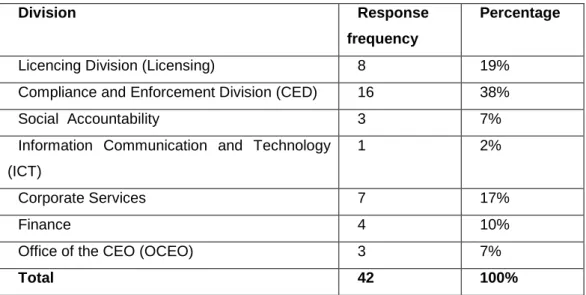
Table 5: Responses according to divisions………....49
Table 6: Responses according to years of experience……….50
Table 7: Responses according to performance reviews………...51
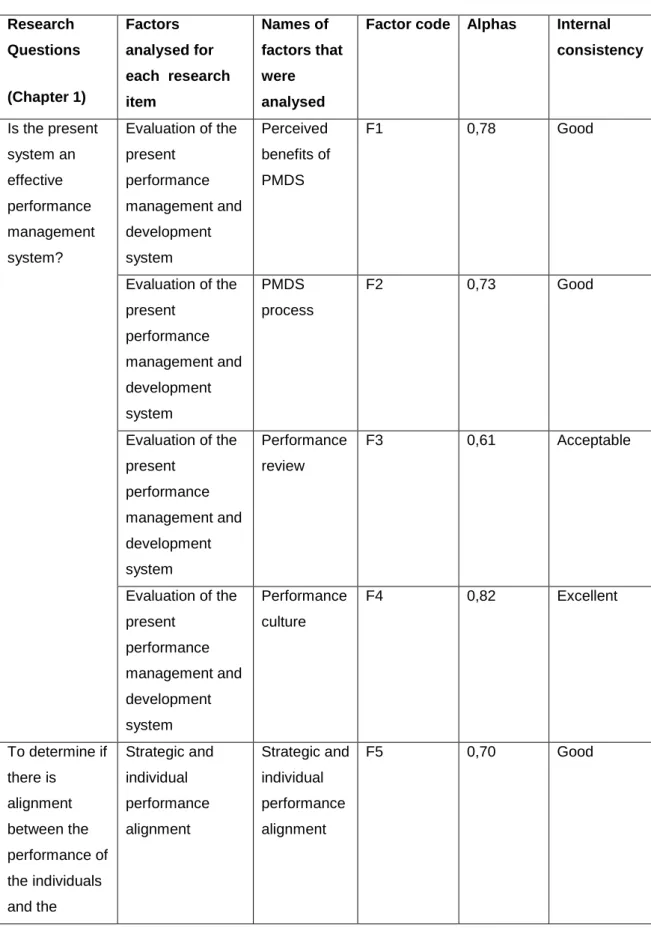
Table 8: Research questions and the factors used for analysis………..54
Table 9: Questions for benefits of Performance Management and Development System (Factor 1)………...56
Table 10: Analysis of results for benefits of the performance management and development system (Factor1)………..57
Table 11: Analysis of results for organisational support (question 8- 6)………..58
Table 12: Questions for understanding process of the performance management and development system (Factor 2)………60
xi
Table 13: Analysis of results for understanding the process of the
performance management and development
system (Factor 2)………....60
Table 14: Questions for performance reviews (Factor 3)………...62
Table15: Analysis of results for performance reviews (Factor 3)…………....63
Table 16: Questions for performance culture (Factor 4)………...64
Table 17: Analysis of results for performance culture (Factor 4)……….65
Table 18: Questions for alignment between performance of individuals and the organisation (Factor 5)……….67
Table 19: Analysis of results for alignment between performance of individual and the organisation (Factor 5)………...68
Table 20: Item and responses for determining the key performance areas responses (Factor 6)………...70
Table 21: Analysis of results for determining key performance areas (Factor 6)……….……….71
Table 22: Items and responses for employee development (Factor 7)……..73
Table 23: Analysis of results for employee development (Factor 7)………...74
Table 24: Items for reward (Factor 8 and 9)……….76
Table 25: Analysis of results for rewards (Factor 8 and 9)……….76
LIST OF FIGURES Figure 1: Policy, mandate and strategy………16
Figure 2: Public sector performance management system……….18
Figure 3: Strategic alignment versus strategic Drift………..19
Figure 4: Public sector performance management system………..21
Figure 5: Responses according to gender………..46
Figure 6: Responses according organisational level……….48
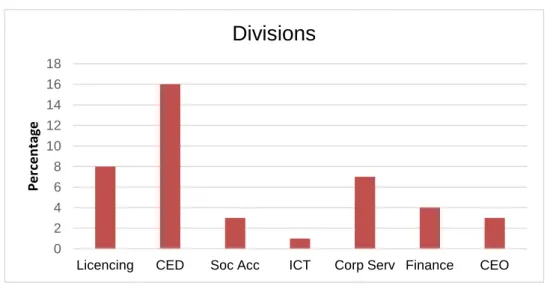
Figure 7: Responses according to division………..50
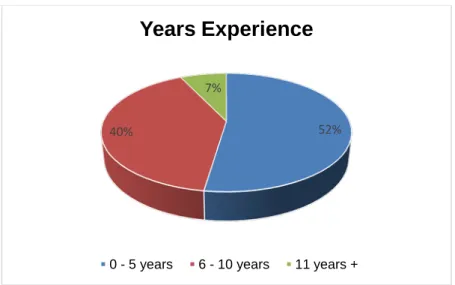
Figure 8: Responses according to years of experience………....51
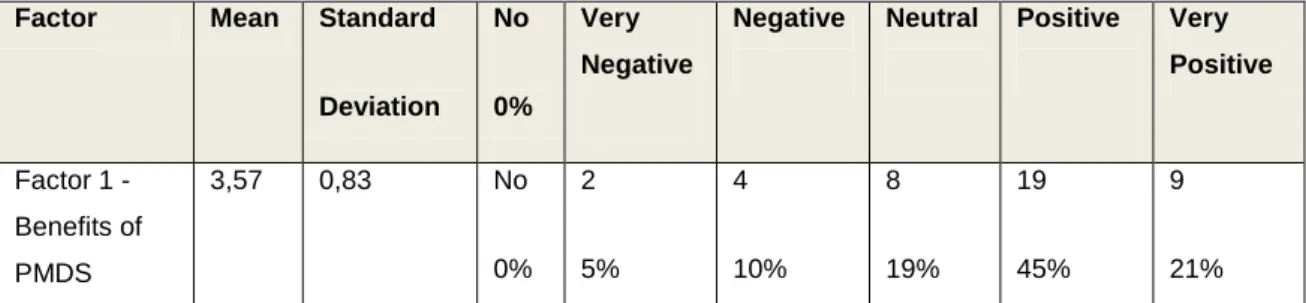
Figure 9: Percentage support for performance management and development system benefits (Factor 1)………….………....57
xii
Figure 11: Percentage support for understanding performance
management and development system (Factor 2)………..61 Figure 12: Percentage support for performance reviews (Factor 3)………63 Figure 13: Percentage support for performance culture (Factor 4)……….65 Figure 14: Percentage support for performance alignment (Factor 5)…...68 Figure 15: Percentage support for determining key performance areas (Factor 6)……….71 Figure 16: Percentage support for employee development (Factor 7)……74 Figure 17: Percentage support for reward for performance (Factor 8)...….76 Figure 18: Percentage support for best reward (Factor 9)………....78
1 CHAPTER ONE
INTRODUCTION AND BACKGROUND
1.1 Introduction
Performance management is an approach designed to achieve the strategic objectives of the organisation, helping each employee understand and recognise his or her contribution to the strategic objectives and thus manage and enhance the performance of the organisation (Thompson, Strickland and Gamble, 2011). This process is intended to direct the energy of all the employees in the organisation towards achieving the strategic goals and objectives.
However, in most organisations performance management is confused with performance appraisal. Performance appraisal is the practice of assessing the employee’s performance which is conducted once or twice a year. This session is intended to improve current performance, provide feedback, increase motivation, identify training needs, identify potential and let the employee know what is expected of him or her. It should also focus on career development, rewarding performance and solving problems. It is, therefore, a broad concept and is not only about the monetary reward which is the case in most organisations (Werner, 2012).
Based on the above background, it is imperative that a study be conducted, or existing research be expanded, on evaluating the effectiveness of the performance management and development system implemented.
2
The study will be conducted within the Eastern Cape Liquor Board (ECLB) in the Eastern Cape Province. ECLB is an entity of the Department of Economic Development Environmental Affairs and Tourism (DEDEAT). It is established in terms of the Eastern Cape Liquor Act No 10 of 2003 for regulating the retail and micro manufacturing of liquor in the province. The study will include management and employees based in the Head Office and the districts.
The results of the study will provide management with insight into whether employees view the current performance management and development system as adding value to their development and towards achieving the goals of the organisation. It will further provide them with recommendations on what can be implemented to solve any problems identified by the study and contribute to the existing literature on performance management.
1.2 Problem Statement
According to Werner (2012) performance management is defined as a system that consists of intertwined elements designed to achieve high performance. The overall aim of performance management is to improve results at the individual, team and organisational level. In order for this process to be successful the line managers and the leadership must be fully involved and a supportive organisational culture must exist.
Schultz (2001) is of the view that when performance management and development system are tied into the objectives of the organisation, the resulting performance is more likely to meet organisational needs. He suggests a more holistic view of performance. In order for performance
3
management to be effective, it must be line-driven rather than Human Resources Department-driven. The development of a performance management system should be a joint effort between line and human resources managers.
Although theory is clear on what performance management is and how it should be developed and implemented, it remains a challenge for most organisations and its objectives are barely attained. In the worst situations employees are left demotivated, with low morale and negative opinions about the process and its intentions and this is more so in the public sector. At the organisational level the development and implementation of this system has huge financial costs (human resources, money, time, etc.) whilst little, or no, return on investment is realised.
Some researchers are of the view that there is no clear agreement on the outcomes of performance management and appraisal processes and their contribution to overall organisational effectiveness (Bartram, Stanton, Leggat, Casimir and Fraser, 2007). Rao (2007) suggests that the system can be effective if certain antecedents and consequences are in place. His study established that when managers have good academic backgrounds and high profiles they become effective implementers of the system. He further suggests that personality characteristics and consequences such as system discipline, exposure to the system, effective interpersonal relations and team-work are essentially required for the effective implementation of the system. Karuhanga (2010) supports this view and highlights some challenges that can hinder the implementation of the performance management system. These include staffing, strategy implementation, lack of motivation and low morale, resistance to change, leadership problems, a highly bureaucratic system and limited employee commitment. It must be noted that challenges may vary from organisation to organisation.
4
The problem is that although the objectives of the performance management system are clear, when implemented it does not yield the desired results. Secondly, the system is not implemented in its entirety and as a result employees generally have negative perceptions about it, do not understand its whole aim and the link between individual and organisational performance.
It is against this background that it becomes important to assess the effectiveness of the performance management and development system implemented in the ECLB. Organisations invest money in developing and implementing the system, the training and development of employees and performance bonuses are paid out annually to employees who qualify for such bonuses. The question remains if there is an alignment between organisational performance and individual performance. Does the performance management system contribute to employee productivity and towards the realisation of organisational goals and objectives?
The system was developed and implemented in compliance with regulations and has never been evaluated. The results of the study will guide ECLB management on strategies to employ and ensure organisational success. It will also provide base information to other entities of the Department for assessing their systems as this will be the first study within the group.
1.3 Research Question and Sub-problems
5
Does the performance management and development system in the ECLB achieve its intended purpose, i.e. improve employee’s performance and achieve organisational goals and objectives?
In order to develop a research strategy to discuss and solve the main problem the following sub-problems have been identified:
Sub - problems
Effectiveness of performance management systems
Alignment between the performance of the individuals and the organisation.
Determining key performance areas (KPA’s). Developmental needs of the employees.
Research questions
Is the present system an effective performance management system? Is there alignment between the performance of individuals and the
organisation?
Is the process of determining key performance areas (KPA’s) correct and how are they assessed?
Are the developmental needs of the employees identified and addressed in order to improve the performance of the individual and the organisation?
6 1.4 Delimitation of the Research
The study will only be focusing on the sub-problems identified above.
1.5 Objectives of the Study
1.5.1 Primary objective
The primary objective of the study was to establish whether the performance management and development system in the ECLB achieves its intended purpose, which is to improve employees’ performance and achieve organisational goals and objectives.
1.5.2 Secondary objectives
In pursuit of the primary objective, the following secondary objectives were formulated:
To assess the effectiveness of the present performance management system.
To assess the process of determining the KPA’s and how they are measured.
To determine if there was alignment between the performance of the individuals and the organisation.
7
To determine if the developmental needs of employees were identified and addressed in order to enhance their performance.
1.6 Research Design
In order to attain the above-mentioned objectives, the following research design objectives were pursued:
- Conduct a secondary literature review on the variables being explored. - Construct a questionnaire for the collection of empirical data.
- Distribute the questionnaires to the selected sample of the population. - Capture the data in an Excel computer software programme.
- Analyse the data using the STATISTICA computer software programme. - Interprete the results and draw conclusions.
- Provide recommendations to management.
1.7 Significance of the Research
The results of the study will provide management with insight into whether employees view the current performance management and development system as adding value to their development and towards achieving the goals of the organisation. It will further provide them with recommendations on what can be implemented to solve any problems identified by the study and contribute to the existing literature on performance management. The results of the study will also guide ECLB management on strategies to
8
employ to ensure organisational success. The benefit for the group is that it will provide base information to other entities of the Department for assessing their systems as this will be the first study within the group.
1.8 Outline of the Study
The study comprises the following chapters:
Chapter 1 provides an introduction and the outline of the study. The chapter provides the problem statement, conceptual model, research objectives, sample, measuring instruments and the definitions of the concepts.
Chapter 2 focuses on the literature study that underpins the research problem.
Chapter 3, discusses the methodology of the study. This includes the research approach (paradigm), the sample, measuring instruments and data analysis procedures.
In Chapter 4, the empirical results are analysed and interpreted.
In Chapter 5, the empirical results are discussed and conclusions drawn. The chapter also includes recommendations to managers, limitations of the study and highlights areas for future research.
9 CHAPTER 2
10 LITERATURE REVIEW
2.1 Introduction
The first chapter presented the main problem and objectives of the study. This was followed by the demarcation and significance of the study. The discussion further described the organisation in which the study was undertaken.
Ideally organisations should have everyone pulling in the same direction and performance management is aimed at ensuring that organisational goals and objectives are aligned to individual performance such that ultimately the organisation is productive and achieves its desired goals. Performance management is intended to be beneficial to the individuals and the organisation by ensuring they both achieve their goals, objectives and desired performance.
The discussion in this chapter elaborates on the definition of performance management, how performance management differs from performance appraisal and guidelines for an effective performance management system. It further explains the importance of strategic planning as a basis for managing performance, determining key performance areas (KPA’s) as well as the importance of employee development in managing performance.
11
Dransfield (2000) states that performance management is a Human Resource Management process that has gained popularity since the 1980s and is concerned with maximising the potential of individuals in an organisation while also obtaining the best performance from teams and the overall organisation. In order for this process to be effective it is crucial that a shared understanding of expectations and objectives exists. Subsequently, people must be managed and developed such that individual and organisational objectives are attained.
According to Biron, Farndale and Paauwe (2011) performance management is a progression of activities that an organisation undertakes to continuously improve individual and team performance and thereby enhancing organisational effectiveness. Roberts (2001) postulates that this involves the setting of objectives for the departments, teams and individuals that are aligned to the organisational objectives. These should be followed by the formulation and use of appraisal systems, strategies for rewarding employees and training and development which include setting individual career paths. The ultimate aim of performance management is to create attunement between organisational goals and strategies, processes, units and employees of the organisation so that desired results are achieved by all (Castka, Bamber and Sharp, 2003).
Hartog, Boselie and Paauwe (2004) emphasise that a performance management system is designed to promote achievement standards and goals as it provides guidance on how to define, measure and monitor employee and organisational performance. When implemented in its entirety it should benefit organisations that have a challenge of managing performance.
12
The Department of Public Service and Administration Manual (2002) supports this view as it states that one of the aspects of performance management is to combine practices for people management more especially through learning and development. Performance management processes include the development and learning of employees. This results in the effective management of individuals and teams thereby improving organisational performance and development (DPSA Manual, 2002).
Performance management is intended to set a culture of responsible ownership by individuals and teams so that there is sustained improvement of service delivery and personal development. Thus it is a strategic process that is long-term focused and aimed at the development of a suitable culture that links organisational goals, service issues and people management. (DPSA Manual, 2002). Performance management is also seen as a tool for effective management which leads to individuals and teams achieving the following:
Obtaining clarity on organisational expectations from them.
Acquiring the skills and competencies necessary to deliver on expectations.
Enabling them to get organisational support and develop capacity to deliver as expected.
Providing feedback on their performance.
Providing opportunities to contribute and discuss individual and team aims and objectives.
Choong (2013) suggests that performance management systems serve two primary purposes for organisations. Firstly, assisting with decisions pertaining to employee issues (e.g. decisions relating to promotions, pay increases can be informed by appraisal information). Secondly, performance management provides more information and reasons for employee development programmes. It is also highlighted that the executive team has to model
13
effective performance management and ensure that distinct expectations of performance management are set for all employees.
Contrary to the above Boyne, James, John and Petrovsky (2011) suggest that although the aim of performance management is clear, sometimes it is deemed as an unwelcome system/activity by some managers or in certain organisations. This becomes evident when managers do not outline what is expected from employees, provide no candid feedback and coaching and discriminate during performance appraisals.
It is clear that performance management is essential for driving the success of the organisation. This system also assists management to stimulate employee behaviour to align with the goals and objectives of the organisation. The setting of clear job responsibilities and expectations for employees is the foundation for ensuring alignment of individual and organisational goals thus leading to increased productivity for all.
In some organisations performance is seen as a biased and punitive activity and does not motivate employees. That challenge can be overcome if top management demonstrates a commitment to performance management processes and embraces a culture of showing that feedback and development matter. It is also of importance that the executive team demonstrates effective performance management.
2.3 Difference between Performance Appraisal and Performance Management
14
Most times these two terms are used interchangeably and empirical studies do not support that. According to Claus and Briscoe (2009) a performance appraisal system is the antecedent of today’s Performance Management. They provide a contrast of performance management and performance appraisal where the – traditional system of appraisal is:
Focused on an assessment of whether someone accomplished allocated tasks for the period under review.
Conducted occasionally for a pay review or bonuses.
Conducted to ascertain whether an employee should be promoted. Seldom held, perhaps only annually.
Driven mostly by HR and is a paper-based exercise. Sometimes informal with no documentation kept.
Claus and Briscoe (2009) further describe the performance management system as:
A description of what is expected from an employee over a performance period (can be quarterly, half-yearly and the yearly). Specific objectives for the period are set and supported by a job description for the post.
Leading to a review of remuneration and/or entitlement to bonuses when objectives are achieved.
Assisting in establishing personal development plans and career paths.
Conducting periodical assessments, e.g. half yearly or yearly.
Usually automated with employees having access to the information as needed.
Storing content when the system is automated to include features that will be beneficial to the employees and their managers.
Werner (2012) states that performance appraisal is the process of evaluating the employee’s performance. It is just a part of performance management which deals with rating the employee’s performance against set criteria.
15
Various methods of appraisal can be used such as forced comparisons and rating scales, amongst others.
As indicated earlier, the process of managing performance includes a number of steps which are identifying, measuring and managing. These are followed by the development of the employees. Careful attention has to be paid to each step for the system to be effective in an organisation. Management /line managers have to assess how well employees perform their jobs and have a responsibility to improve that performance level. The communication of the assessment to the individual is an essential ingredient (DPSA Manual, 2002).
It is evident that performance management and performance appraisal cannot be used interchangeable as they have different meanings. Performance management is a process and the appraisal is an event in that process. It is therefore, incorrect for organisations to only focus on the appraisals and not to implement the whole performance management system in its entirety as great benefits can be reaped from implementing a holistic performance management system.
2.4 Guidelines for Effective Performance Management
Once performance management is effectively implemented it promotes a collaborative approach that influences attainment of organisational outcomes, individual performance and development. It inspires everyone to positively manage relationships and consider what must be done to improve individual, team and organisational performance.
16
The implementation of strategic initiatives and the managing of employee development require performance management as a useful tool. When this system is constructed and implemented properly it offers benefits for the individuals and the organisation. For example the operations in the organisation are optimised because goals and results are more closely aligned and helps ensure equitable treatment of employees as appraisals are based on results.
Haines and St- Onge (2012); and Hazard (2004) suggest that there is still criticism and concern regarding the functioning and effectiveness of performance management systems. Morgan (2006) further states that some organisations discover that their performance management system does not meet its intended purpose. Certain professionals in the field of Human Resources are of the view that organisational performance is not improved as a result of the performance management system. They argue that there is no clear agreement on the outcomes of performance management and appraisal processes and their contribution to overall organisational effectiveness. Levy and Williams (2004) suggest that the varied social contexts wherein performance management is implemented and a lack of understanding thereof may be the cause for performance management systems not meeting the expectations due.
Despite the above criticism, performance management systems can be effective if certain organisational facilitating practices are taken into consideration. Biron, et. al (2011) are of the view that such practices are fundamental in determining conducive conditions in which performance management systems are effective for achieving organisational goals. These practices include:
Use of performance management in a holistic manner as a strategic tool and rather than a tactical tool.
17
Involvement and commitment of senior management and alignment of the organisation’s strategy with the HR practices.
Ensuring that communication is clear during the process in order to make employees understand their role and what is expected of them. Formal rater training as an effort by the organisation to ensure that
performance assessments remain unbiased.
The research by Haines and St- Onge (2012) revealed that a combination of the right context and practices may improve the effectiveness of performance management. The following performance management practices and management contextual factors will be highlighted:
2.4.1 Performance management practices
2.4.1.1 Performance management training
Managers are involved, on an ongoing basis, in performance management which comprises planning, coaching, assessment and the review of subordinates. This requires that they are committed and competent for the system to be effective. Lawler and McDermott (2003) emphasises that a positive association exists between performance management effectiveness and the training of managers responsible for performance appraisals.
18
Multisource feedback, often known as the 360 degrees system, provides those involved with feedback that offers different perspectives. These are superiors, subordinates, peers, suppliers or external clients amongst others. Maylett and Riboldi (2007) associate this approach with improved performance for the employee. This can have a positive effect on the overall performance of the employees and generate positive perceptions about the performance management system’s effectiveness.
2.4.1.3 Employee recognition
The theories of motivation (Werner, 2012) have proven that recognition has an effect on one’s motivation. Most organisations have comprehensive reward management programmes so that the focus is not only on monetary rewards. Different people are motivated by different factors such as, the reward system, leadership style, the organizational climate, and the structure of the work. These programmes are used to reinforce behaviour the employer wants to encourage. Haines and St- Onge (2012) suggest that the practice of employee recognition has chances of improving a performance management system’s effectiveness.
2.4.2 Contextual factors for performance management
The contextual factors relate more to the environment in which the performance management system is implemented as this can spoil the effectiveness of the system. The following factors will be discussed amongst others.
19 2.4.2.1 Organisational culture
Haygroup (2011) highlights the fact that organisational culture is a critical factor for consideration due to its influence on the overall performance management effectiveness. Therefore, for organisations to deliver on their expectations, an approach to performance management that is linked to the strategy and the culture is imperative.
2.4.2.2 Employee relations climate
The climate for employee relations refers to how the social relations between management and the employees are known to be. They stem from the leader-member exchange relationships. In organisations where quality leader-member exchange relationships are developed, performance management has proved to be effective (Elicker, Levy and Hall, 2006).
2.4.2.3 Integration of human resource management strategically
In cases where human resources management (HRM) is strategically integrated into the organisation the result is the alignment of organisational goals and objectives with HR, teams and individual goals. This will translate into the work done by all in that organisation thus contributing towards positive performance management (Wood and Marshal, 2008).
20
It can be concluded that the effectiveness of performance management is a function of practices and programme implementation as well as of the execution of performance management in different organisational contexts.
2.5 Alignment between the Performance of the Individuals and the Organisation
2.5.1 Alignment between policy mandate, management environment and strategies
Figure 1: Policy, mandate and strategy
Source: Minnaar (2010)
Minnaar (2010) states that in the public sector it is important to ensure alignment between the organisation’s policy mandate, capacity to deliver, the demands from the external management environment and the strategies that are formulated. These are depicted in Figure 1, above. Failure to ensure that strategies address organisational needs results in a misalignment with the
Policy mandate
External management environment
21
needs of its environment. The policy mandate defines the fundamental function of the organisation. These must be related to a specific need in the external management environment. Thereafter, the need must be reconciled and aligned with the capacity of the internal management environment.
2.5.2 Alignment between strategic and implementation of performance plans
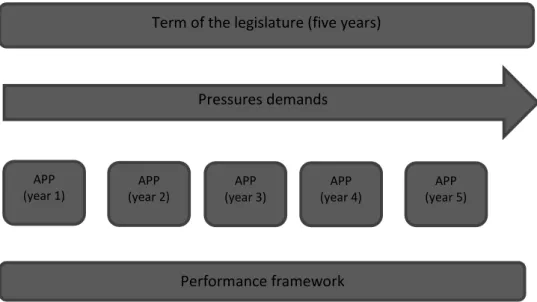
Organisational performance plans manifest on two basic levels; the strategic level and the implementation level. The strategic level provides strategic direction to the organisation and is concerned with setting strategies that will ensure success and competitiveness of the organisation. The second level is aimed at realising the strategic direction outlined in the strategic plan. There are fundamentally four types of performance plans in an organisation, two each at both the organisational level and at the implementation level (Minnaar, 2010). Figure 2, below depicts the public sector performance management system.
Strategic plan - performance plans which outline the strategies of the organisation (anticipated performance) over a long- term period (which is five years in the public sector) and which run concurrently with the term of office of government.
Annual Performance Plan (APP) - which focuses on planned performance of the organisation for a specific financial year within the five-year cycle of the strategic plan. The APP assists the organisation in setting up the performance management system, as it is in-year bound. These year plans
22
are further divided into quarterly performance plans which can also be monitored quarterly through the performance management system.
Figure 2: Public sector performance management system
Source: Minnaar (2010)
Tactical plans- this is at the implementation level and is developed for each of the departments/business units of the organisation. It is through these plans that implementation responsibility is shared. These plans are aligned with the responsibilities of the senior managers of the business units. They can be for a period of three year to be in line with the medium-term revenue and expenditure framework period or one year, depending on the organisational planning.
Operational business plan – these are for further enhancing
implementation within the organisation. They contain details of activities Term of the legislature (five years)
Pressures demands
APP
(year 1) (year 2) APP (year 3) APP (year 4) APP (year 5) APP
Performance framework APP
23
aligned to performance indicators and targets to be used within a particular year and for each business unit.
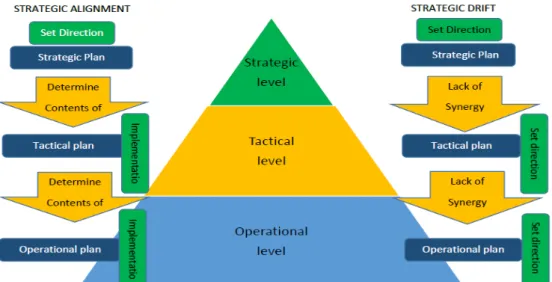
Strategic drift
Strategic drift occurs when the objectives and outputs of the implementation plans set their own direction and do not contribute to the realisation of the strategic plan. The same applies when the strategic goals of the organisation do not link to the policy mandate or needs from the management environment. It is, therefore, vital to establish the reference point when a specific plan is compiled. Figure 3, below demonstrates the difference between strategic alignment and strategic drift.
Figure 3: Strategic Alignment versus Strategic Drift
Source: Minnaar (2010)
2.5.3 Alignment of the organisation’s visions with the performance of the individuals
24
According to Guest (2011) organisational success is driven by a clear vision and strategy. The strategy adopted by the organisation fundamentally influences the performance measurement model to be implemented. Therefore, the strategy forms a central part of the performance management process. An integration of the entire organisation’s efforts is required for organisational success to be achieved. The key ingredient for success is the optimum synthesis of organisational, business unit and individual level as these work together towards attaining the same goal.
Dransfield (2000) further emphasises that in order to achieve the organisation’s vision it is crucial to manage performance of the individuals effectively. This is an obligation of management and those in supervisory positions. Performance management assists in ensuring that the strategic objectives are met or exceeded through working together, cooperatively and effectively, towards goals and imperatives. When implemented successfully the performance management system has the following benefits:
It enhances the organisation’s performance against the strategic plan. It improves individual performance against agreed KPAs.
Improves manager/subordinate relationships by facilitating communication on outputs and expectations.
Manages under- performance in a practical and constructive manner. Boosts employee development in terms of training, career objectives
and personal development.
Maintains a culture of continuous improvement within the organisation.
25
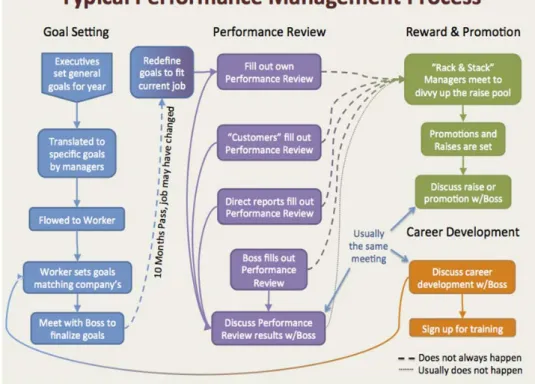
The Performance Management Process as depicted in Figure 4 below, according to McKouen (2012) entails:
Planning work and setting key performance areas expectations. Reviewing the KPAs.
Continually monitoring the performance of employees. Developing the capacity of employees to perform. Periodically measuring the employee performance. Rewarding and recognising good performance. Dealing with unsatisfactory performance.
Figure 4: Typical Performance Management Process
Source: Heathfield (2013)
26
The supervisor and the subordinate meet to create their performance plans. This involves setting, agreeing and clarifying the KPAs and goals with the subordinate by mutually discussing and agreeing on performance objectives that are aligned to the organisation’s strategic, tactical and operational plans. A balance must be maintained between the needs of the organisation and the individual needs. The KPAs have to be linked to the KPAs of the business unit, be measurable, understandable, verifiable, equitable and achievable. KPAs must be defined as part of the job description. During this planning stage the supervisor must ensure that the subordinates understand how their performance directly impacts on how the business unit and organisation will achieve their goals. The performance contract and the job description must be used to formalise this process and be signed by both parties (PMAS: Reference guide for System Implementation in Government Departments, 2006).
2.5.4.2 Performance review
This is a joint discussion between the supervisor and the subordinate during which the achievement of KPAs is discussed. The aim of the discussion is to specify how improvements can be achieved. The past performance must be used as a basis for learning and planning ahead. Critical to this process is self-assessment by the employee against the KPAs and any general criteria that were agreed upon. The supervisor must also do the assessment prior to the review session with the subordinate. The indication of ‘achieved’, ‘under-achieved’ or ‘over-‘under-achieved’ must be the starting point for discussion of each KPA. Undertaking that task allows for communication gaps and/or obstacles to be resolved.
27
The supervisor should monitor and provide feedback on employee progress on a continuous basis and not only when a progress review is due. Continuous monitoring provides the supervisor with an opportunity to review unrealistic goals, timelines or measurements. By monitoring continuously the supervisor can make the employees aware of their acceptable or unacceptable performance. In that way unacceptable performance is identified early and corrective action is taken before the formal review takes place.
Heathfield (2014) states that the key ingredient in the monitoring process is giving feedback as this may positively or negatively affect the employee. Managers should be trained on giving and receiving performance feedback as it is provides vital information about how effectiveness of one’s work is perceived. Feedback is also used to focus or refocus on the employees’ behaviour and assist them in achieving set goals and targets. For feedback to be effective it must be:
Clear and carefully thought out - avoid being vague as that can have an undesired effect on the employee.
Constructive -suggest ways to improve performance rather than just pointing the wrongs.
Descriptive and not judgemental – provide examples rather than unsubstantiated opinions as these make employee defensive.
Provide both positive and negative feedback and assist in resolving the negative feedback.
It is evident that a performance management system cannot operate in isolation. It has to be aligned to the vision, strategic plans, annual performance plans and performance agreements of the employees in order for it to achieve its intended purpose.
28 2.6 Determining Key Performance Areas
Parmenter (2010) argues that performance measures should help organisations align daily activities to strategic objectives. It is, therefore, imperative for organisations to develop, implement and use performance measures to ensure the success of the organisation. The balanced scorecard is the model that is mostly adopted by organisations. The introduction of performance measures such as key performance areas (KPAs) and key performance indicators (KPIs) in the organisation must be achieved in a way that supports and extends the idea of a cooperative partnership. The four principles required for success are:
Partnership with employees, key suppliers and customers. Transferring power to the frontline.
Focus on measuring and reporting only what happens.
Performance measures linked to strategy through identification of critical success factors.
According to Minnaar (2010) performance planning focuses on expressing indicators and targets that can be used to activate, measure and evaluate performance. The first step of the performance planning process involves clustering core functions to identify key performance areas (KPAs). These are specific areas in which the organisation and the individuals must perform well to ensure success regarding its policy mandate. The organisation manages and monitors performance through set KPAs so they are very important for setting up a balanced performance assessment scorecard. The KPAs are the basis for designing and selecting the strategies to be used by the organisation. A specific KPA may have a number of outcomes or objectives associated with it to ensure achievement of the organisational
29
mandate. After the KPAs have been identified, they must be converted into measurable terms.
Bussin (2013) also describes KPAs as short statements that describe the areas that are crucial for success in a particular role. The depth and breadth of the KPAs depend on the seniority of the role that is being described. KPAs do not describe the tasks to be performed within a role or outputs needed by the organisation. The relative importance of KPAs can be shown by weighting the KPA with a percentage for each KPA to indicate its importance. The percentages allocated to the KPAs should add up to one hundred per cent.
Schutte (1981) identifies two types of KPAs, the common and unique KPAs. The common KPAs are ‘cross cutting’ for all managers or supervisors, for example, the monitoring of performance of subordinates. The unique KPA refers to those KPAs specific to the manager’s line of responsibility for example a Marketing Manager’s unique KPAs relate to the marketing functions. Schutte (2000) further identifies the key characteristics of unique KPAs as the following:
o Uniqueness to a position and cannot be duplicated, meaning that the KPA cannot be repeated vertically in a management hierarchy or horizontally between functional divisions or between line and staff management positions.
o It is expressed as an end result and not as inputs or activities The KPA emphasises the end results to be achieved and not the activities to be performed. The activities are the means to an end, i.e. the KPAs. The KPAs direct the organisation towards the achievement of the organisational objectives. Therefore, they guide effort and serve as a measure of performance.
30 o It must objectively measured
The fact that KPAs must be measured objectively is of vital importance in order to establish how well they are being achieved. Subjective measurement of the KPAs should be avoided and only allowed in highly exceptional cases within organisations as it will distort the key performance area management and thus negatively affect the performance of the whole organisation.
o The number of identified KPAs and their importance
The process of clustering core functions in line with the mandate of the organisation should lead to the identification of three to five KPAs if properly managed. This should be done, taking into account the importance of applying Pareto’s Principle to managerial positions, the uniqueness, the end result and measurability characteristics mentioned above (Schutte, 2000). Where more than five KPA’s have been identified they must be assessed to establish if they are not job description areas. Secondly, they must be assessed in terms of the profit impact criterion and where the impact is zero or marginal the KPA must be removed.
o Is not the most time consuming activity
Careful consideration should be taken to avoid identifying activities that consume most of the manager’s time as KPAs. The distinguishing factor for KPAs is that they contribute towards the achievement of organisational objectives and the profitability. If a statement fails that test it does not meet the requirement to be a KPA.
31
Although a KPA is unique to a position, it is important that it supports KPAs of superiors, subordinates and peers as these all contribute towards achieving the organisational objectives and interdependency and interrelationships exist within the organisation. o Top management’s strategy
During the process of identifying KPAs it is important to take into account the style and strategy of top management as these have an effect on the culture, how the organisation is managed and what the priorities are at a certain point in time.
Sudarsan (2009) argues that the importance and weighting of the KPAs and KPIs are guided by the vision, mission, organisational objectives and the strategy as well as the plans of the business units. When KPAs are properly identified they give value to the organisation and employees, such as:
Assist employees in clarifying their roles and aligning their roles to the organisation’s strategic plan.
Provide focus on results and not activities.
Enable employees to communicate their role’s purpose to others. Assist in setting goals and objectives.
Help employees prioritise their activities and thus improve time or work management.
Make value-added decisions.
Some weaknesses of KPAs are that they can be highly selective and thereby result in some areas being neglected. They may tend to be too focused with lesser development in other areas and they normally constitute 80% of the total job and place less emphasis on process. Threats to setting KPAs are; poorly defined job descriptions, multi-role jobs, reporting to two bosses and role ambiguity.
32
Tracy (2013) also recommends not more than five to seven KPAs. He describes KPAs as what a person has to absolutely and positively do to fulfil his or her responsibilities in order to achieve the goals of the organisation. Plans must be developed on how KPAs will be completed and improved. He further highlights three qualities KPAs must meet. These are:
- Be clear, specific and measurable.
- Must be completely under one person’s control. Nobody else will do it, and it is either that person doing it and doing it well or it is not done at all. When done well it contributes positive value to the organisation and to the person’s growth.
- It is a vital activity of the organisation. The KPA is an important output that also becomes an input to the next KPA or to the next person.
2.6.1 Methods of identifying KPAs
Schutte (1981) proposes various approaches that can be implemented to identify KPAs and these include the top-down approach, the bottom-up approach, the superior/subordinate approach, the profit-plan approach, the information technologist approach and the participation and group discussion approach. The discussion will focus on the participation and group discussion approach as it is comprehensive. The other approaches lack the participation of managers and which is deemed crucial for successful and valid analysis.
33
2.6.1.1 The participation and group discussion approach
This approach is participative as it gathers contributions from the executive management and functional and operational level staff when identifying KPAs. The basis for this approach is that everyone’s relevant knowledge, regardless of the level, can add value to the analysis of KPAs of an individual managerial position. The employee, together with his and her peers and superiors, discusses the employee’s role in the organisation, key tasks relating to that role and key performance until a consensus is reached pertaining to the three stages of the analysis process. This approach also uses a bottom-up analysis of supervisory and managerial positions. It starts with identification of KPAs for the lowest level of supervisory management and then proceeds up the management hierarchy until it reaches the highest position. The KPAs of the highest manager in that line function therefore emanate from the KPAs identified for all his or her subordinates. The bottom-up filtering process also ensures that no dbottom-uplication of effort occurs between line and staff positions. Through participation of all management levels the strategy of the organisation is taken into consideration when the KPAs are developed (Schutte, 2000).
A KPA analysis is the first and most important step for an integrated management system. The analysis comprises a preparatory and an analytical phase.
34
The first step in this phase is to identify the managerial positions within the organisation. This involves the assessment of the managerial organisational structure. If a need arises, the structure must be reviewed to align it with the needs and strategy of the organisation. The structure should reflect both the formal chain of command and the dotted line interactions, up to the lowest level of management, with other functional areas. Thereafter the incumbent of the position and key relevant managers who can contribute meaningfully to the analysis of the activities and identification of KPAs for each position must form a team analysis. The selected managers should include top management, superiors and the peers with whom interaction happens. An appropriate size of the group should be considered in order to ensure full participation by all those involved. In essence this phase constitutes a plan for the sequence in which managerial positions will be analysed and the selection of the group members who will participate in the analysis. The presence of the top effective manager in the function hierarchy is very important for giving strategic direction and guidance to the whole team (Schutte, 1981).
Analytical phase
The analytical phase is facilitated by a catalyst in a neutral environment with the selected group for analysis. The catalyst guides the discussions and encourages participation by posing probing questions or statements to the group members. The process has to follow a sequential pattern comprising a number of steps.
Step 1: The catalyst starts with the analysis of the lowest position in the managerial hierarchy. All the incumbents of the position are asked questions about their role and, with the use of job descriptions and practical experience, they must describe what the job entails. Where positions are duplicated all staff members for that positions must contribute meaningfully in the process
35
and also raise areas of disagreement. The discussions are important as they result in addition, removal and amendment of activities. For unique positions the catalyst plays the role of the spokesperson and the group contributes. Ultimately, a consensus must be reached and the contributions of superiors, peers and managers of the different line functions are critical for decision-making. All the discussions must be noted in writing and, where consensus cannot be reached, the top management makes the final decision. The final products of this session are updated job descriptions for the positions of which all relevant superiors have an understanding and approve (Schutte, 1981).
Step 2: The second step builds on the job description developed in the prior analysis. The activities that were identified are then grouped and expressed as outputs. The catalyst has to ensure that no activities or inputs are ignored and no duplication of managerial effort occurs. The common KPAs are identified and included in the job descriptions of managers with the exception of lower management levels (Schutte, 2000).
Step 3: The above process is followed by the identification of KPAs of the position under analysis. The catalyst guides the group in selecting three to five managerial outputs that are vital for each manager to achieve and which are in line with the organisation’s objectives. The use of Parento’s principle is of importance for this process.
In the event of a dilemma regarding managerial responsibility and a KPA, the profit criteria test must be applied, i.e. will the activity in question affect or contribute to profitability of the organisation in the short and/or long-term. If the answer is “Yes” then it must be regarded as a KPA. If “No”, it is a managerial responsibility. The second question that can assist is assessing whether the non- performance in the area in question will negatively affect, or have no impact on the overall performance of the manager. If it will negatively affect the performance it is a KPA. If not, it is a managerial responsibility. Ultimately the catalyst must ensure that the group has KPAs that represent managerial output, are measurable, unique to each position
36
and agreed upon by all group members who participated in the process (Schutte, 2000).
Step 4: This step entails identification of yardsticks for measuring the performance of each KPA. The catalyst assists the group in setting yardsticks by which the KPAs have to be measured. The critical requirement for the measure is validity and objectivity. In cases where subjective measures cannot be avoided they should be supplemented by objective measures. The discussion should also specify how superiors will control the performance of the incumbent, reporting types, format, the expected detail of information pertaining to KPAs as well as acceptable deviations from the standard when reporting by exception (Schutte, 2000).
Schutte (1981) maintains that the analysis process applied during the participation and group discussion approach has the following positive spin-offs for the organisation:
Individual managerial roles are clarified to ensure effectiveness and efficiency.
Managerial effort is focused and not duplicated.
It leads to change agents and entrepreneurs being identified in the organisation.
Entrepreneurial roles at the higher levels of management are established.
The managerial organisational structure that supports the organisational strategy is confirmed.
Measurable performance yardsticks are created.
Information requirements to control the performance of subordinates are specified.
37
From the above discussion it is clear that in order to have an effective integrated management system, KPA analysis is of utmost importance. Other processes such as planning, control and the human resources system have to support that system. If the KPA analysis process is followed, it results in each managerial position having unique and common measurable KPAs, which should number between three to five. These KPAs should relate to end results. Some common KPAs should relate to management of KPAs of subordinates. Through monitoring and evaluation of KPAs, progress towards objectives and goals can be measured.
2.6.2 Performance indicators
Parmenter (2010) defines a key performance indicator (KPI) as a performance measurement instrument for evaluating an organisation’s, or a particular activity’s, success. At times success relates to progress towards strategic goal attainment. Success may also relate to the periodic or repeated achievement of some level of operational goal (examples are indicators of zero defects, 100% customer satisfaction).
Proper understanding of objectives and goals of the organisation is critical for choosing the right KPIs. Determining KPIs also depends on the business unit measuring the performance. For instance, KPIs for the Human Resources unit would differ from the KPIs assigned to the Finance unit. The balanced scorecard approach is normally used for choosing the KPIs.
According to Schutte (2000), key performance indicators express a number of values adopted to measure against and can be categorised into the
38
quantitative, qualitative, leading, lagging, process and output indicators amongst others.
Minnaar (2010) concludes that KPIs must comply with the SMART principle, meaning that the measure has to be specific, measurable, achievable, relevant and time bound. Minnaar (2010) further states that to enable evaluation, the KPIs must be assigned target values in order for the value of the measure to be considered as meeting or not meeting expectations. KPIs assist in the periodic assessment of employees, business units, departments and organisational performance. KPIs also assist the organisation to define and measure progress towards objectives and goals.
2.7 Employee Development
The employees are the most important asset of the organisation and organisations that have adopted that strategy are reaping enormous benefits. The success of the implementation of the performance management process needs good people-management practices. Managers must harness the knowledge, skills and ideas of all employees in order to ensure positive contributions to performance.
One of the objectives of implementing a performance management system is to assist with the identification of developmental needs. The organisation seeks continuous improvement through the development of employees. Developmental needs refer to the competencies the employee wishes to improve upon during a specific review period. Employees should be guided to select two to three competencies to develop, and together with the supervisor, should decide on methods that will be used to develop those
39
competencies. There are different interventions that can be applied including, but not limited to, formal qualifications, training courses internally or externally, self-study and job shadowing. The choice of the intervention will also depend on the need identified, the operational requirements and the availability of budget. Personal and professional development is in actual fact the responsibility of the employee. The organisation is responsible for creating an enabling environment for such development. The manager also has the responsibility to offer coaching or mentoring where necessary.
Heathfield (2014) argues that appraisal can serve individual and organisational development purposes. The individual purposes are served through:
Feedback on employee strengths and weaknesses and ways to ensure improvement of performance in future.
Support of career plans and development.
Contribution towards remedial interventions for employees.
The purpose of organisational development may comprise:
The enabling of diagnoses and development of the organisation by stipulating levels of performance and outlining training needs.
Giving vital information for job redesign efforts and multi-skilling programmes, etc.
McKouen (2012) supports the above view by stating that the performance management process provides a tremendous opportunity for identification of developmental needs by both superiors and employees. It can be decided from continuous monitoring whether a need exists for employee development. ‘Developing’ involves increasing the capacity of the employee to perform. Various methods can be applied. These include formal training,
40
assignments that introduce new skills and increased levels of responsibility, informal training and coaching or mentoring, amongst others.
2.7.1 Performance measurement /rating
Measurement of KPAs is valuable in summarising employee performance and assists with comparing (performances over time or) amongst a set of employees. The measurements are based on work performed during the review period and facilitate discussions between the supervisor and subordinate on achievement, over-achievement or under-achievement of the KPAs. The final rating is a culmination of the continuous monitoring discussions and feedback and therefore the final rating should not be a surprise to the employee (McKouen, 2012).
2.7.2 Reward and recognition
Rewarding comprises recognition of individual and team performance as well as acknowledgment of their contribution towards the goals of the organisation. Recognition should be ongoing and a natural part of the daily experience through gestures likes a pat on the shoulder for work well done. Recognition should not wait for the formal review process. It is important that meaningful distinctions are made when rewards are granted. The reward amounts should correspond with the different predetermined performance levels for success or above. Performance management should inform decisions pertaining to compensation in the organisation (Heathfield, 2014). Erasmus, Swanepoel, Schenk, van der Westhuizen and Wessels (2005) suggest two ways for recognition of good performance. These are:
41
(i) Financial (e.g. pay progression, performance bonuses) (ii) Non-financial rewards
Pay progression is defined progression in remuneration from a lower to a higher remuneration package. Leonard and Hilgert (2007) also argue that the performance of outstanding performers is inspired and sustained by tangible rewards.
Wright (2012) refers to a performance bonus as a once-off monetary reward as a result of good performance. When an employee attains certain points in line with the performance management policy of the organisation that employee is eligible for a performance incentive. This can be presented as a cash award, performance bonus, or profit sharing incentive, amongst others.
Non-financial rewards can be used to recognise performers and creative ways have to be used. Leonard and Hilgert (2007) suggest the use of varied non-financial rewards such as holidays, tuition-aid programmes, insurance and health programs, employee assistance programmes and retirement plans, amongst others.
2.7.3 Dealing with unsatisfactory performance
In cases where employees under perform despite the attempts made by the supervisor to help the employee improve performance, the necessary actions must be taken. These may ultimately leads to dismissal of the employee due to poor performance. Keeping non-performers can affect the moral of the performers and affect the culture of the organisation. In most cases, managers are reluctant to take this step although they understand that