Beyond Virtual Data Centers:
Toward an Open Resource Control Architecture
∗Jeff Chase, Laura Grit, David Irwin,
Varun Marupadi, Piyush Shivam and Aydan Yumerefendi
Department of Computer ScienceDuke University Durham, NC
ABSTRACT
This paper summarizes recent research on networked vir-tual computing in the NICL lab at Duke. Over the past few years, we have constructed a service-oriented substrate for networked sharing and adaptive middleware environments based on a virtual on-demand computing. The goal of the project is to develop protocols and tools that can link to-gether virtual computing clusters at different sites, and in-corporate other kinds of resources (network tunnels, storage, and high-end computing resources) into a unified resource control plane for virtual computing. A key focus is to do this in a way that integrates well with existing middleware systems, to enable dynamic control of advanced virtual com-puting environments.
Our approach is based on foundational abstractions for leas-ing resources and factorleas-ing control over leased resources across the infrastructure providers, application controllers, and brokering intermediaries, interacting through common leasing protocols in an Open Resource Control Architecture (Orca). The paper outlines the use of our resource leasing
prototype (called Shirako) in several systems: as a foun-dation for manageable grid computing systems (based on Globus), in an interactive Web-based laboratory for auto-nomic services research (called Automat), and as a basis for virtualized cluster computing environments.
1.
INTRODUCTION
Virtual computing offers a fundamentally new approach to sharing networked resources, enabled by advances in virtu-alizing server infrastructure. A notable example is the resur-gence of virtual machine (VM) technology (e.g., Xen [2, 8] and VMware [25]). A recent Forrester Research report [13] ∗This project is supported by the National Science Foun-dation through ANI-0330658, CNS-0509408, EIA-99-72879, and by IBM, HP Labs, and Network Appliance. Laura Grit is a National Physical Science Consortium Fellow.
states that 50% of global 2000 firms have server virtualiza-tion deployed or planned to deploy by mid-2007. More gen-erally, clusters, blade arrays, and other scalable computing systems enable controlled resource partitioning on a coarser physical basis.
It is common today to manage sharing of networked re-sources through “middleware” such as grid computing soft-ware and job managers for networked clusters. The archi-tectural choice to virtualize at the infrastructure level is a fundamentally new direction that is complementary to the wide range of existing middleware approaches. The value proposition is that it offers safe and effective sharing at a lower level of abstraction. For example, a user can obtain an on-demand private machine instance rather than the service of queuing their job to run on someone else’s machine. In this example, the “raw” machine abstraction offers users on-demand access and control over personal, customized com-puting environments. Virtual comcom-puting systems can also offer assurances of predictable behavior and isolation from other users, using virtualization technologies to control the binding of guest environments to physical hosting resources. Virtual computing depends on a new foundational layer of control software that instantiates and manipulates the con-texts in which the applications, middleware, and machine operating systems run. Since it controls the bottom of the software stack closest to the hardware, we refer to this new virtualization and control layer asunderwareto distinguish it from classical middleware. A key characteristic of under-ware is that it is not visible to users or applications at the top of the software stack, other than to provide a more sta-ble and controlled environment for them to run in. Its role is to protect and enhance the investments in higher-level soft-ware (including middlesoft-ware), simplify infrastructure man-agement, and facilitate access.
Virtual computing systems are already mature enough to offer tangible and compelling benefits in practical deploy-ments today. Even so, the technology is at an early stage. Virtual computing “underware” is a new market segment and also a rich area for computing systems research. It of-fers a rare opportunity to rethink the software architecture and leverage the new capabilities in a way that applies the benefits broadly to a full range of computing environments— including existing middleware systems for grid and cluster computing, Web services and systems not yet imagined.
Here is a partial list of functional demands that shape the key architectural choices:
• Managing thousands or millions of dynamic machine
instances. The leading VM systems support live mi-gration and checkpoint/restart, strong performance iso-lation, and fine-grained allocation of server resources as a measured and metered quantity. Machines are no longer bound to physical hardware; VMs may be cre-ated in seconds using techniques such as flash cloning of stored images, and then paused, saved, restored, or migrated at the push of a button. How should the underware control plane expose, leverage, and manage these new capabilities?
• Adaptive applications. The “guests” hosted on virtual computing utilities will include long-running applica-tions and services. Some of these will be mission-critical services that must maintain service quality 24x7 across flash crowds, faults, and other changes. The un-derware should export programmatic, service-oriented interfaces for self-managing guests to negotiate for re-sources and configure them on-the-fly.
• Autonomous infrastructure providers. Virtual comput-ing underware should offer a unified interface for guests to obtain resources from many infrastructure providers contributing resources to a shared pool. Because of the difficulty of managing federation, first-generation systems such as PlanetLab [3] have limited their ini-tial deployments to centrally controlled infrastructure. But we want to build resource sharing federations that grow organically, and any such system must protect the autonomy of infrastructure providers to control how their resources are used.
• Resource control policy. On-demand access is wonder-ful until the resource runs out. A key challenge to-day is to develop practical policies for adaptive and reliable allocation of networked computing resources from a common pool. Good arbitration policies would assign resources to their “highest and best use” while balancing the needs and interests of resource providers and resource consumers (guests). Independent policy control by each participant is the foundation for sus-tainable economic structures with contractual quality of service and accountability.
Virtual computing underware should meet these needs in a way that integrates well with existing middleware systems. For example, grid computing will not truly break out of the lab until we have a new generation of grid systems that of-fer reliable and predictable performance in a manageable package. We believe that the key is to combine job exe-cution middleware with virtual computing underware—but the “right” factoring of functions across the layers is still a research topic.
Finally, the software architecture for virtual computing should generalize to the full range of infrastructure assets. Vir-tual computing today is mostly about servers, but virVir-tual- virtual-ization techonologies are also advancing for wide-area net-works (lambda provisioning and virtual layer-2 links such as MPLS) and for network storage (e.g., [18, 15]).
visible allocation and revocation
distributed hardware resources
resource virtualization control plane distributed computing environments Internet-scale services resource multiplexing Underware P la n e tL a b G lo b u s G r id O th e r E n v ir o n m e n ts
Figure 1: Multiple software environments (guests) are hosted on a common pool of virtualized resources from infrastructure providers. The “underware” control plane exports protocols and interfaces for guest “controllers” to negotiate for resource lease contracts on the shared infrastructure.
Our research envisions an underware control plane linking providers and consumers of infrastructure resources, includ-ing virtual computinclud-ing clusters but also other on-demand re-sources such as storage, network channels, and even software licenses. Our approach is based on a common core of ser-vices for the foundational abstraction of resource leasing. Guests use open leasing protocols to acquire and coordinate underlying resources for efficient and reliable execution, op-tionally assisted by brokering intermediaries. The system is based on a service-oriented framework that reflects the dynamic trust relationships and factoring of policy control across the various stakeholders—an Open Resource Control Architecture (Orca).
This paper outlines the architecture and rationale for an
Orca control plane, describes our current prototype, and
summarizes ongoing work. We focus on our experiments in using lease-based resource management as a common foun-dation for different middleware systems and usage scenar-ios for programmable hosting centers. To illustrate our ap-proach to dynamic configuration and adaptive resource con-trol, we describe Automat, an interactive Web-based lab-oratory for autonomic services research using the common control plane. We also summarize how we have used the prototype as a substrate for a manageable grid hosting sys-tem (using Globus), a private PlanetLab deployment, and
JAWS (Job-Aware Workspace Service), a new approach to job execution for virtual cluster computing.
2.
OVERVIEW AND DESIGN
TheOrca vision may be viewed as a sort of “Internet
op-erating system” to multiplex diverse user environments on a common pool of hardware resources, which may be con-tributed by multiple providers. The hosted environments (guests) may range from simple personal computing systems to large-scale network services to programming platforms for distributed computing, such as grid middleware. The guest software systems are typically designed to run on dedicated hardware, but can just as easily run on virtualized resources. Virtual computing allows a given resource pool to host any of these diverse environments, possibly at different times, and with changing resource assignments to respond to changing demands. The control plane exposes programmatic leasing
Autonomous Systems other resource pools cluster sites
Underware control plane extensible policy for
resource allocation
autonomous resource providers
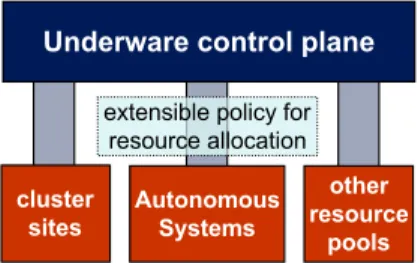
Figure 2: Policies for allocating hardware resources are outside the underware resource control plane. Resource providers control the policies by which resources are used.
interfaces to request, release, grant, and withdraw resources, as depicted in Figure 1.
The behavior of the guests is determined by the software stacks installed within their virtual execution contexts, which are customized for each guest. The underware layer ex-ports “raw” resource abstractions and concerns itself nar-rowly with managing physical resources and coordinating resource configuration steps. The means to specify, imple-ment, and harmonize policies for local resource management are left to the infrastructure providers. Figure 2 depicts re-source sharing and arbitration policies residing outside the control plane and within the providers.
To enable this structure, theOrca architecture embodies four key design principles:
• Sustainable structure and autonomy. All participants have the ability to quantify and control what they contribute to a system and what they obtain from it through time. The structure protects their autonomy to exercise this control according to local policies. • Negotiated contracts with varying degrees of assurance
including but not limited to strong isolation (reserva-tions). The control plane provides a means to form
contracts for specific resource allocations at specific times. For example, many mission-critical applica-tions depend on differential service quality assurances (e.g., Internet 911 and disaster response). Different providers and virtualization technologies may offer vary-ing degrees of isolation, but the contracts are explicit about the assurances they offer.
• Neutrality for applications and resources. The archi-tecture generalizes to a wide range of hosted applica-tions or services. It provides extensible programmatic interfaces to instantiate, configure, and control a wide range of software environments on a wide range of re-sources through an elemental leasing abstraction (the “narrow waist” of the architecture).
• Policy neutrality with a balance of local autonomy and
global coordination. Orca must be free of resource allocation policy: needs and capabilities evolve with time. Consumers determine their policies for request-ing resources, and providers determine arbitration pol-icy for the resource pools under their control. Providers
may delegate resources to groups or communities, who may subdivide their holdings via brokering intermedi-aries that represent their policies. The system has no central point of trust or control.
Cluster-on-Demand and Shirako. The starting point forOrcais a pair of integrated systems created in our pre-vious research: Cluster-on-Demand (COD) and the Shirako leasing core, described below. The COD project began as an outgrowth of work on dynamic feedback-controlled resource provisioning in hosting centers [6, 9]. COD exports a ser-vice to allocate and configurevirtual clustersfrom a shared server cluster. Each virtual cluster comprises a dynamic set of nodes and associated resources assigned to some guest at the site. COD provides basic services for booting and imag-ing, naming and addressimag-ing, and binding storage volumes and user accounts on a per-guest basis. Typically the leased virtual clusters have an assurance of performance isolation: the nodes are either physical servers or Xen [2] virtual ma-chines with assigned shares of node resources. The first COD protoype [7] was funded by IBM and the NSF Middleware Initiative.
CODv1 had anad hocleasing model with built-in resource dependencies, a weak separation of policy and mechanism, and no ability to delegate or extend provisioning policy or to coordinate resource usage across multiple sites. Our experi-ence with the COD prototype convinced us of the need for an automated and service-oriented approach to resource man-agement and configuration for virtual on-demand computing environments. In particular, these systems must incorporate sound control policies to assign and provision resources dy-namically, arbitrate contending requests, repair faults, and adapt to changing conditions. Much of our follow-on work to COD addresses these policy and control issues as a cor-nerstone of our research agenda in autonomic services and autonomic infrastructure, particularly in the context of in-frastructures with many owners, e.g., a federation of net-worked on-demand clusters.
Leases and Actors. In 2003 we began to rearchitect the COD system around a general leasing contract model that is resource-independent and policy-neutral (Sharp[12]). A
resource leaseis a signed contract granting the holder rights to exclusive control over some quantity of a resource over a specific period of time. Leases are dynamic and renew-able by mutual consent between the resource provider and holder. The leasing abstraction applies to any set of com-puting resources that is “virtualized” in the sense that it is partitionable as a measured quantity. For example, an al-located instance of a resource might comprise some amount of CPU power, memory, storage capability, and/or network capability, measured by some standard units, and with at-tributes to describe resources and the degree of isolation. The participants in the leasing protocols are services repre-senting different stakeholders in the system, and incorporat-ing their local policies. Actors can take any of three roles within the system:
• Each guest is represented by an actor that monitors application demands and resource status, and
negoti-ates to acquire leases for the mix of resources needed to host the guest. Each service managerrequests and maintains leases on behalf of one or more guests, driven by its own knowledge of application behavior and de-mand. The guest controlleris a policy module in the service manager that controls these choices.
• An authority controls resource allocation for an in-frastructure provider with direct control over a pool (aggregate) of resources in somesiteor administrative
domain. The authority is responsible for enforcing iso-lation among guests hosted on the resources under its control. COD runs as a site authority.
• Brokers maintain inventories of resources offered by domains, and match requests with their resource sup-ply. A domain may maintain its own broker to keep control of its resources, or delegate partial, temporary control to third-party brokers that aggregate resource inventories from multiple sites.
We built the second-generation COD system around an open leasing core called Shirako [17]. Shirako is a Java-based toolkit for building resource leasing services using Web ser-vices technologies. It is designed as a common core with lease state machines, and plugin interfaces for application-specific, resource-application-specific, or policy-specific components. Shi-rako is one technology for developingOrcaactors, butOrca
is “open” in the sense that any actor may join the network if it speaks the leasing protocols (SOAP with WS-Security, or XMLRPC) and common conventions for describing re-sources and their configuration. The protocols as imple-mented in Shirako are compatible with self-certifying secure tickets and accountable delegation developed inSharp[12].
Shirako actors may be deployed programmatically to a Web container, and a Web portal offers controls for authorized users to create and manipulate actors. These actors may represent different trust domains and identities, and may enter into various trust relationships or contracts with other actors. Actors establish trust in a decentralized fashion. Broker operators may establish trust pairings with sites or guests, to serve resources on behalf of a site, or to autho-rize a guest to access its resource holdings according to a broker arbitration policy. Where manual control is desired, operators may use the Web portal to register public keys of approved peers, grant or deny resource requests, and specify the types, quantities, and time periods of resources shared with peers.
Resources, handlers, and drivers.The leasing abstrac-tion can apply to a wide range of physical assets. Virtual-ized infrastructure exports control points to partition and configure the underlying physical resources. Some network and storage elements export control actions to the network via protocols such as SNMP, Web Services protocols, or (more frequently) by remote login to a command-line in-terface from a privileged IP address.
In Shirako, these underlying control operations are invoked byhandlerandresource driverplugins invoked from the core on lease state transitions. Many control actions are invoked through a standardnode agentthat runs on a node, e.g., in
a guest VM, a control VM (Xen dom0), or a control node for some other substrate component. Anode driver is a pack-aged set of actions that run under the node agent to perform resource-specific configuration on a node. The node agent accepts signed requests from an authorized actor on the net-work, e.g., using SOAP/WS-Security or XMLRPC, includ-ing requests to install, upgrade, and invoke driver packages.
Handlersare action scripts that run within an actor to con-figure or tear down a logical resource unit, which may in-volve multiple physical resources, possibly covered by sepa-rate leases. The core upcalls prologue/epilogue handler ac-tions on lease state transiac-tions to notify the actor of changes to the resource allotment; these map to a registered handler action for the given resource type. We script handlers us-ing ant, which can be invoked directly from the Java core and supports direct invocation of SNMP, LDAP, Web con-tainer management, and node driver actions on the node agents. The various actors control the behavior of handlers and drivers by means of property lists passed through the leasing protocols and core.
Cluster-on-Demand as a plugin. The rearchitected COD [7, 17] comprises a set of handlers, drivers, and other plug-ins specific to managing clusters of physical hosts and vir-tual machines. It handles imaging, booting, and node post-install, allocation of IP subnets and addresses, and DNS subdomains and names. COD includes drivers and han-dlers to coordinate with standard services for site adminis-tration (DHCP, DNS, and client-side PAM/NSS and NFS automount) patched to read configuration information from an LDAP-based Network Information Service (RFC 2307). It supports VM configuration through drivers that run un-der a node agent in the Xen control domains (dom0). At the Duke site we flash-clone images on a Network Appli-ance filer and export them to VMs over the network; with this technology COD can instantiate a Xen VM in about 20 seconds.
Controllers. Shirako provides interfaces to define and com-pose controller plugins for generic actors for the various roles. A controller is a clocked policy module that makes choices to meet its objectives under changing conditions: what resources to request (in the guest’s service manager) and what configuration options to use for them, which re-quests to grant and how to schedule them (in a broker), and how to map granted requests on to actual resources (in a site authority). Controllers specify the handlers they use for each type of resource.
A fundamental issue is the factoring of complex control func-tions across the actor roles. For example, Shirako/COD supports fine-grained sliver resizing on lease renewal bound-aries, and policy-driven suspend, resume, checkpoint, and migration [8] of VM instances. These capabilities enable rapid VM creation, more robust computing, and the flexi-bility to adapt to changing conditions while retaining conti-nuity and liveness. However, migration may be driven from a service manager, broker, or authority for different reasons. The factoring must reflect access to the underlying resource control points.
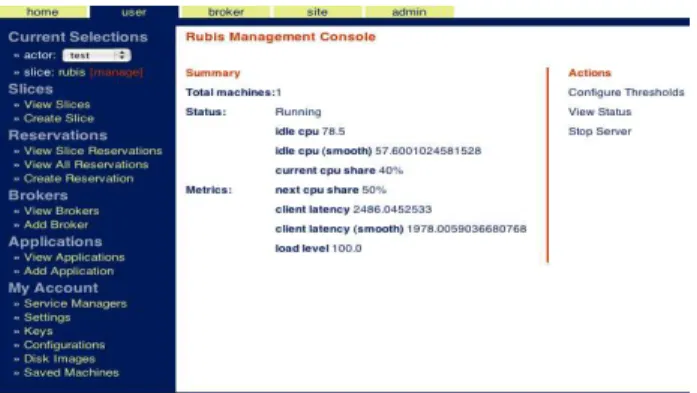
Figure 3: View for service controller of the Rubis e-commerce service in the Automat Web portal.
This section outlines several examples of uses of the proto-type as a substrate for advanced middleware environments. These systems are works-in-progress that illustrate the power and generality of flexible resource leasing as a foundation for a unified resource control plane.
3.1
Automat
We are using Shirako as a substrate for a web-based inter-active laboratory targeted for research into the mechanisms and policies for autonomic hosting centers that configure, monitor, optimize, diagnose, and repair themselves under closed-loop control (a collaboration with Shivnath Babu). The prototype, called Automat1, allows users to allocate
resources from an on-demand server cluster to explore the interactions of application services, workloads, faultloads, and controllers [26]. Users interact with a Web portal to upload and deploy guests and controllers, subject them to programmed test scenarios, and record and display selected measures as the experiment unfolds. Users can install their own services, and experiment with pluggable controller mod-ules for sense-and-respond monitoring and adaptation by hosted services and, crucially, by the hosting center itself. Users exploring self-management at the hosting center level can instantiate virtual data centers and define controllers that govern resource arbitration, resource selection, and dy-namic migration. To drive feedback control policies, Au-tomat provides a common, but replaceable, instrumentation plane based on Ganglia [21] to capture, propagate, and store streams of system-level and application-level metrics. One goal of Automat is to improve researcher productivity by enabling researchers to focus on the novel aspects of their work, rather than on the infrastructure needed to realize their objectives. Our premise is that a standard “harness” to package and share test applications, workloads, fault-loads [4], and system prototypes—and deploy them at the push of a button—will catalyze the growth of a repository of shared test cases and approaches within the community. A successful testbed can enable repeatable experiments,
pro-1An Automat is an automated vending facility introduced
in the 1930s, in which clients select from menus of precooked items and compose them to form a meal. In this case, the “meal” is a reproducible experiment drawn from a menu of packaged test scenarios and dynamic controllers instantiated on demand in a virtual data center. The Automat project is funded through CNS-0720829. 0 20 40 60 80 100 0 200 400 600 800 1000 1200 1400 1600 0 500 1000 1500 2000 2500 3000 3500 4000 CPU share (%) Client latency (ms) Time (seconds) latency (without controller)
latency (with controller) cpu share
Figure 4: Comparing behavior of controllers for the Rubis e-commerce service under dynamic load.
vide a common means to measure progress toward shared goals, facilitate sharing of research outputs, and establish paths for technology transfer.
Automat defines a common framework for developing, in-stalling, upgrading, and composing Shirako controllers writ-ten in Java. Controllers are driven by a clocking signal and may use Automat-provided classes for calendar scheduling, resource allocation, processing of instrumentation streams, and common heuristics for optimization and placement. In addition, each controller registers to receive upcalls as new resources join or leave its domain, and to notify it of changes in resource status. Guest controllers may also invoke driver actions in the guest, either directly from Java or using an XML scripting interface for Shirako handlers based on Ant. We have prototyped the basic mechanisms for an extensible Automat Web portal using Velocity and Java under Tom-cat, as a front end to site authorities, brokers, and service managers based on the Shirako leasing core. Automat con-trollers may includeview extensions as plugins to the portal interface, enabling users to monitor and interact with con-trollers during an experiment. Concon-trollers, views, and guests are packaged inextension packagescontaining Java archives, presentation templates (e.g., Velocity scripts), guest instal-lation files, etc. Extensions are uploadable through the Au-tomat portal, which offers menus to instantiate and config-ure the registered packages.
For example, Rubis [5] is a Web application that implements a simple auction website. We developed a guest controller for Rubis that acquires resources from a virtual data cen-ter, instantiates the Rubis service, subscribes to the service’s performance metrics, and uses feedback control to adapt re-source allocation under varying workload. The workload is driven by another guest controller that provisions, launches, and controls a workload generator for Rubis. The con-trollers interact to sequence the experiment. Figure 3 shows a screenshot of the view for a guest controller, showing the status of the server allocated to this guest, metrics sub-scribed to by the controller, and control actions that can be taken on the guest. The screenshot in Figure 3 was taken from an experiment on Automat in which we studied con-troller effectiveness under a varying workload.
dy-namically. Our design uses a custom classloader in a Java-based Web application server to introduce user-supplied con-troller code into the portal service. Views interact with the controller using a management proxy supplied as part of the controller implementation. The proxy always runs within the portal service, but the controller code itself and its actor may run under a separate JVM communicating using SOAP or XMLRPC. In our experiments, the portal and control do-main with all controllers run within a single JVM under a Tomcat instance.
3.2
Globus
One goal of our work is to instantiate complete middleware environments within isolated logical containers (workspaces) comprising sets of virtual machines, and show how add-on controllers for each hosted environment can invoke the leas-ing services to grow and shrink the computleas-ing resources assigned to their containers. In a collaboration with La-vanya Ramakrishnan at RENCI, we demonstrated adaptive hosting of multiple Globus grid instances on networked clus-ters using a Shirako resource control plane [23]. This work was demonstrated in the RENCI booth at Supercomput-ing/SC06.
Globus grids support familiar abstractions: they allow users to run their jobs and workflows on somebody else’s oper-ating system. Globus also provides services to establish a common notion of identity, a common distributed middle-ware for routing jobs and scheduling them on local resources. Globus provides a uniform sharing and execution model, but because it is middleware, and does not control oper-ating systems or hardware resources, it has limited control over resource management. QoS, reservations, and flexible site control are important for grid computing, but they have been elusive in practice. For example, Globus can only con-trol when to submit jobs to queues or operating systems; it cannot control what resources are allocated by the lower layer, unless the lower layer provides those hooks. In our approach, the underware control plane offers those hooks to a controller for the hosted grid environment.
We implemented a guest controller called a Grid Resource Oversight Controller (GROC) that invokes Globus
inter-faces to monitor and control a Globus grid, and issues leasing requests through the control plane to modulate the resources available to the grid. If a backlog of jobs accumulates in the job queues, theGROCleases additional server resources
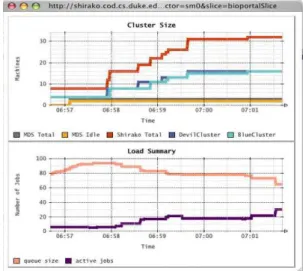
ac-cording to its policy, and integrates them into the batch job service instance at the grid’s point-of-presence at the hosting site. Figure 5 illustrates this dynamic resource recruitment in a typical scenario.
The underware layer makes it possible for a controller to sup-port dynamic provisioning, advance reservations, and site control over resource sharing without modifying Globus it-self. In the Globus experiment we found it is useful for each guest controller to pass supplementary information to the resource controller with their requests. For example, the lower-priority Globus guest controller indicates that it will accept fewer resource units if the resource controller cannot satisfy its full request. We use an extensible property list mechanism: the Globus guest controller sends a property, elastic, to indicate its willingness to accept fewer resources
Figure 5: Screenshot showing how a Globus guest controller leases additional server resources to clear a backlog of jobs.
to the resource controller. Other useful properties include deferrable to specify that the resource controller can de-fer the start time of the lease, anddeadline to indicate to the arbitration policy that a request must be filled by some deadline.
3.3
Jaws
The simple approach described for the Globus experiment above allows multiple user communities and middleware en-vironments to share computing resources with policy-based adaptive resource control. However, it is limited in that virtal machine control interfaces (e.g., checkpoint/, restore, migrate) do not apply to individual jobs, but only to com-plete middleware environments. The middleware controls job scheduling on its machines; the mapping of jobs to ma-chines is not known outside of the middleware, and the scheduler may place multiple jobs on a machine. Thus it is not possible for a controller to migrate a job by migrating the containing VM, or use VM control interfaces to sus-pend/resume, save/restore, or reserve resources for individ-ual jobs.
Virtual machines introduce new opportunities for flexible job management in batch computing systems. If VM instan-tiation is cheap, it becomes possible to run each job within a private virtual machine workspace [10, 20, 19, 11]. With this model, it becomes possible to customize the workspace for the needs of specific jobs, and essential checkpointing and migration features are supported in a general way at the VM level. For example, future systems must deal with more diverse software configurations, e.g., different library versions, operating systems, or middleware services. To har-ness computing resources for a given task, it is necessary to install and configure the correct software stack. A virtual workspace provides access to a collection of resources (phys-ical or virtual) and a software environment suitable for the execution of a job or a collection of jobs.
inte-Figure 6: A classic job execution service running on a cluster’s physical machines (a) compared to a job execu-tion service running on federated virtual machines above a generic resource control plane and sharing underlying resources with other cluster services (b).
grating support for virtual computing into Globus [19]. Con-dor middleware system are taking a similar approach [24]. Virtualization technology offers a rare opportunity to re-think the software architecture from the ground up. We are developing a streamlined job execution system calledJAWS
(Job-Aware Workspace Service) that uses the resource con-trol plane to obtain isolated virtual workspaces sized for each job. The key architectural principle is to separate con-trol over resource sharing from job execution and manage-ment. Although it manages job execution,JAWS is not a job scheduler: all functions to schedule and arbitrate shared resources migrate to the underware layer. In this way, a
JAWS job service can share a common pool of networked cluster resources with other cluster services, including other middleware environments such as grid software or applica-tions such as Web services, as depicted in Figure 6. De-coupling sharing control and job management simplifies the job execution service. The underware layer takes care of the underlying trust and authorization issues, and resource arbitration policy.
JAWS executes each job within the customized workspace instantiated by the site authority. Our JAWS prototype uses Plush [1] to execute a job on newly instantiated VMs. Job workflows are described in an XML specification lan-guage that details data staging, software installation, and process sequencing. Plush monitors the execution of the job and reports, via XML-RPC callbacks, job completion or failure.
EachJAWSjob executes in one or more virtual machines,
each bound to a “sliver” of resources provisioned for the job. A sliver is the partition of a physical machine’s resources; leases inJAWS are for a set of slivers which form a virtual
workspace. After the initial slivering, a virtual workspace may require resizing to accommodate for the changing re-quirements of a job or to meet client performance targets. Virtual machines may be resized along multiple dimensions to enlarge or shrink a job’s virtual workspace. Resizing may involve migration to a new host.
SinceJAWSjobs run within a leased performance-isolated workspace, they are protected from contention effects while their leases are valid. This predictability is important be-cause, increasingly, high-end computational science and en-gineering problems are solved on a complex hierarchy of re-source and software systems that consist of scientific codes, portals, workflow tools, web services, resource management middleware, and underlying cluster and HPC resources. In this setting, effective execution depends on a complex set of interactions between the end-user, different layers of soft-ware infrastructure, and the underlying resources. Con-tention in one part of a complex workflow can gate the progress of the entire workflow. In contrast, job-level and process-level resource control on mainstream cluster operat-ing systems offer limited predictability and isolation, makoperat-ing it difficult to orchestrate large composite applications effec-tively, particularly for deadlines or dynamic behavior. A Shirako broker acts as the resource scheduler forJAWS.
In our prototype the broker schedules leases for virtual ma-chines bound to varying amounts of CPU, memory, band-width, and local storage from an inventory of physical hosts. In many respects the broker behaves like a conventional job scheduler: we have implemented many commonly used scheduling algorithms as pluggable policies for Shirako bro-kers, including Earliest Deadline First, FCFS, and a new in-tegrated proportional share/backfill algorithm calledWinks. JAWS can leverage software environments packaged as
ap-pliances: complete bootable images containing both applica-tion and (custom) operating system components. The appli-ance model is well-suited to virtualized infrastructure, and has revolutionary potential to reduce integration costs for software producers and to simplify configuration manage-ment of software systems. For example, rPath2is packaging
appliances for key driving applications, including the STAR application from Brookhaven and the Community Climate System Model, and supporting infrastructure such as the Open Science Grid toolset.
3.4
PlanetLab and Plush
PlanetLab [3] is a widely used network testbed for large-scale network services (http://www.planet-lab.org). It controls a set of dedicated hardware resources, which it manages and images centrally. PlanetLab provides abstractions and sys-tem services (e.g., distributed virtualization, resource dis-covery, monitoring) to enable deployment of widely distributed applications that control their own communication patterns and overlay topology. Much of the common API is provided by a Linux kernel flavor mandated by PlanetLab. PlanetLab applications may run continously and adaptively on varying resource allotments. PlanetLab established a “best effort” resource management model as a fundamental architectural choice.
We adapted the PlanetLab platform to use Shirako inter-faces to a resource control plane to lease shared hardware resources. MyPLC is a downloadable PlanetLab software package for use in creating private PlanetLab instances. Each PlanetLab instance has a “PLC” central coordinator server that monitors and controls all participating nodes and
ordinates application deployment on the testbed. We com-pleted the integration to run PlanetLab kernels on Xen vir-tual machines; this required minor modifications to the Plan-etLab boot process along with a recent patch to enablekexec
in Xen-capable kernels. We wrote a small wrapper that leases resources from a Shirako broker and instantiates a MyPLC central server and one or more PL hosts, using the new PLC API to add and remove nodes from the MyPLC instance. With support from the PlanetLab organization, this system could also be used to add and remove local ma-chines from the public PlanetLab, enabling cluster sites to contribute resources to PlanetLab on a temporary basis. Because PlanetLab resource allocations are uncertain and unstable, PlanetLab applications must already be capable of adapting to changing resource availability. To provide ap-plication adaptivity we again use Plush [1], which was orig-inally developed to ease application and service deployment on PlanetLab. Plush allows unmodified applications under its control to adapt to PlanetLab’s volatile environment. It uses a resource discovery service (SWORD [22]) to match (and re-match) an application to a suitable set of resources, and abstract application deployment and execution using an XML descriptor for software installation, process execu-tion workflows (i.e., the process execuexecu-tion order), and failure modes (i.e., what should I do if something fails). Plush ex-ports an XML-RPC interface that allows control software to add or remove resource instances from a running application at any time; although, applications must include support for using resources once added. We have also extended Plush to obtain resources directly through Shirako, in a collabo-ration with Jeannie Albrecht. This step allows Plush-based PlanetLab applications to run directly on a Shirako system, which gives them assurances about the resources under their control.
4.
RESOURCE CONTROL POLICY
A key premise of our work is that resource control and strong resource contracts are essential to deliver on the promise of distributed virtual computing. For example, consider an on-demand system that instantiates best-effort virtual machines, with no assurance that they will make forward progress. The provisioning problem is trivial in this system: no admission control or resource arbitration is needed. The placement choice might be left to users, e.g., to seek out hosts that appear lightly loaded at any given time. Alterna-tively, the providers or brokers might coordinate placement to balance the load.
Now consider a system whose goal is to assure a predictable level of service quality for its guests. Best-effort contracts might be adequate if the system is sufficiently over-provisioned. The alternative is to make promises to each consumer about the resources it will receive—how much and/or when.Orca
represents such promises in the lease term and in the lease attributes.
The leading VM systems, including Xen, support the re-source control mechanisms necessary to back these stronger contracts. Performance-isolating schedulers permit fine-grained allocation of host server resources as a measured and me-tered quantity: each guest VM is bound to asliverof host resources sized along multiple dimensions (e.g., CPU
capac-ity, memory, and network bandwidth). Slivers are sized to meet performance targets in the guest while minimizing the “crosstalk” from competing VMs on the same host. Sup-port for VM migration [8] provides the flexibility to satisfy new and unforeseen resource demands while retaining the continuity, liveness, and sliver sizing of existing VMs. These technologies are reasonably mature, although refine-ment continues. They motivate a stronger focus on the pol-icy implications and the significant research challenges that they raise. Resource control features are essential mecha-nisms, but someone or something must control how they are used, e.g., how to size the slivers, where to place the VMs, and when and where to migrate. These capabilities create a rich policy space for system management infrastructures. It is straightforward to expose these choices to human op-erators through a control panel, but the grand challenge is a self-managing compute utility in which the control func-tions are automated and respond to changes in real time. Resource management policy is difficult for at least three reasons:
• It is heuristic. Resource management involves pro-jections under uncertainty and optimization problems that are NP-hard in their general form, forcing us to adopt heuristics tailored for specific needs and settings. There is no “one size fits all” solution.
• It is dynamic. Resource allocation policies must adapt to changing workload and demands in real time. • It is organic and emergent. Policy choices must
bal-ance the needs and interests of multiple independent stakeholders, e.g., resource providers and resource con-sumers or hosted guests. Infederatedsystems—in which independent providers contribute resources to a shared pool—brokering intermediaries may also play a role to supplant the need for pairwise peering arrangements and/or to implement community sharing policies. In general, the resource assignment emerges from choices taken by each of these actors, and the complex inter-actions of those choices.
In the Orca architecture, resource controller modules in brokers control resource provisioning(allocation of quanti-ties of resources over time), while site authoriquanti-ties control and
assignmentof specific resource units to approved leases, e.g.,
placement of active VM images within the server network. We recently extended Shirako/COD to support fine-grained sliver sizing along multiple dimensions (e.g., the amount of CPU cycles and network bandwidth bound to a sliver), sliver resizing on lease renewal, and policy-driven migration to adapt to changing demands [14]. This required minor changes to the Shirako policy interface, as well as new fea-tures to protect the accountability of contracts, which are beyond the scope of this paper. To support virtual machine migration and resizing we extended the event handler set for site authority resource drivers with a new event: modify. Themodifyevent handler for Xen virtual machines invokes Xen primitives to resize or migrate a target VM, guided by a property list passed from a policy module.
The basic structure of resource management policy is com-mon to a range of visions for networked virtual comput-ing, encompassing managed data centers, network testbeds, grid computing systems, and market-based utilities. With the right factoring of policy and mechanism, these systems can build on the same underlying resource management sub-strate. Most of the differences among competing approaches to distributed virtual computing boil down to matters of pol-icy, or questions of who the players are and how much power they have, or differing application assumptions that ulti-mately have little impact on the underlying resource man-agement requirements. These superficial differences leave open the opportunity for a common management “fabric”. In particular, as networked utilities increase in scale, market-based control becomes attractive as a basis for resource al-location that is fair, flexible, adaptive, and decentralized. Strong resource contracts enable negotiated, accountable ex-changes in a marketplace. We have used Shirako to exper-iment with market-based virtual machine hosting based on a self-recharging virtual currency [16].
It is an open question what range of resource contracts are practical with virtualization technologies, e.g., with existing and future VM schedulers. Like many of our colleagues, we are evaluating the fidelity of resource control schemes in the Xen hypervisor and interactions with guest OS kernels (e.g., for dynamic memory provisioning).
5.
CONCLUSIONS AND ONGOING WORK
Virtualization promises to change the way the server back-bone is managed at the lowest level. Orca has potential to
advance the foundations for networked resource sharing sys-tems that can support a wider range of resource types, man-agement policies and services, relationships among resource providers and consumers, and service models including but not limited to best-effort service.
Our premise is that a commonOrcasubstrate can meet the
evolving needs of several strains of systems for networked re-source sharing—whether the rere-sources are held in common by a community of shareholders, offered as a commercial hosting service to paying customers, or contributed in a re-ciprocal fashion by self-interested peers.
Orca can reduce barriers to sharing networked resources and services. Infrastructure providers may contribute resources in a controlled way, and potential users can harness those resources effectively for a wider range of activities by au-tomated install of suitable software stacks on a temporary basis. The resource owners may be isolated from the man-agement responsibilities for the guest services that they host, which devolve to the lease holder (e.g., endorsement and mapping of user identities). It also becomes possible to fac-tor many resource management and security concerns out of the middleware, and address them in a common founda-tional layer.
An important goal of the project is to develop new han-dlers, drivers, and controllers to broaden the range of re-source types beyond cluster nodes, VMs, and simple storage object. Examples include network name space management, repository space for storage objects and saved images, dy-namic configuration of storage systems (e.g., Lustre) on
col-lections of leased disk partitions or luns, constructing and managing virtual networks (overlays) consisting of multiple points of presence (virtual clusters at different sites) linked by tunnels. It may be possible to linking supercomputing resources into anOrcacontrol plane.
We are continuing to investigate fundamental architectural issues raised by our approach: sensitivity of the leasing model to a global notion of time; accountability for con-tracts; protection of guests from faulty hosts and vice versa; techniques and overheads for resource partitioning and vir-tualization; coordinated configuration of complex aggregate resource sets (e.g., network overlays) within the leasing frame-work; automatic control policies for resource arbitration and adaptation, and their interactions; attribute-based resource matching and locality; decentralized trust management; re-source ontologies; scalability to very large infrastructures (e.g., by emulation experiments); and policy control for com-plex choices enabled by virtual machine technology, e.g., migration and save/restore as a basis for robust, adaptive computing. Our development agenda in the core will focus on robust multi-actor state management and event track-ing, since failures may occur at many interacting points and levels.
6.
REFERENCES
[1] J. Albrecht, C. Tuttle, A. Snoeren, and A. Vahdat. PlanetLab Application Management Using Plush.ACM Operating Systems Review (SIGOPS-OSR), 40(1), January 2006.
[2] P. Barham, B. Dragovic, K. Faser, S. Hand, T. Harris, A. Ho, R. Neugebauer, I. Pratt, and A. Warfield. Xen and the Art of Virtualization. InProceedings of the Nineteenth ACM Symposium on Operating Systems Principles (SOSP), October 2003.
[3] A. Bavier, M. Bowman, B. Chun, D. Culler, S. Karlin, S. Muir, L. Peterson, T. Roscoe, T. Spalink, and M. Wawrzoniak. Operating System Support for Planetary-Scale Network Services. InProceedings of the First Symposium on Networked Systems Design and Implementation (NSDI), March 2004.
[4] G. Candea, M. Delgado, M. Chen, and A. Fox. Automatic Failure-Path Inference: A Generic Introspection Technique for Internet Applications. InProceedings of the Third Workshop on Internet Apllications (WIAPP), June 2003. [5] E. Cecchet, J. Marguerite, and W. Zwaenepoel.
Performance and Scalability of EJB Applications. In
Proceedings of the Seventeenth Conference on
Object-Oriented Programming, Systems, Languages, and Applications (OOPSLA), November 2002.
[6] J. S. Chase, D. C. Anderson, P. N. Thakar, A. M. Vahdat, and R. P. Doyle. Managing Energy and Server Resources in Hosting Centers. InProceedings of the Eighteenth ACM Symposium on Operating System Principles (SOSP), October 2001.
[7] J. S. Chase, D. E. Irwin, L. E. Grit, J. D. Moore, and S. E. Sprenkle. Dynamic Virtual Clusters in a Grid Site
Manager. InProceedings of the Twelfth International Symposium on High Performance Distributed Computing (HPDC), June 2003.
[8] C. Clark, K. Fraser, S. Hand, J. G. Hansen, E. Jul, C. Limpach, I. Pratt, and A. Warfield. Live Migration of Virtual Machines. InProceedings of the 2nd Symposium on Networked Systems Design and Implementation (NSDI), May 2005.
[9] R. P. Doyle, O. Asad, W. Jin, J. S. Chase, and A. Vahdat. Model-based resource provisioning in a Web service utility. InProceedings of the Fourth USENIX Symposium on
Internet Technologies and Systems (USITS), March 2003. [10] R. J. Figueiredo, P. A. Dinda, and J. A. B. Fortes. A Case
For Grid Computing On Virtual Machines. InProceedings of the Twenty-third International Conference on
Distributed Computing Systems (ICDCS), May 2003. [11] I. Foster, T. Freeman, K. Keahey, D. Scheftner,
B. Sotomayor, and X. Zhang. Virtual Clusters for Grid Communities. InCluster Computing and Grid (CCGRID), May 2006.
[12] Y. Fu, J. Chase, B. Chun, S. Schwab, and A. Vahdat. SHARP: An Architecture for Secure Resource Peering. In
Proceedings of the 19th ACM Symposium on Operating System Principles, October 2003.
[13] F. E. Gillett and G. Schreck. Server virtualization goes mainstream. Technical Report 2-22-06, Forrester Research Inc., February 2006.
[14] L. Grit, D. Irwin, A. Yumerefendi, and J. Chase. Virtual Machine Hosting for Networked Clusters: Building the Foundations for “Autonomic” Orchestration. In
Proceedings of the First International Workshop on Virtualization Technology in Distributed Computing (VTDC), November 2006.
[15] L. Huang, G. Peng, and T. Chiueh. Multi-Dimensional Storage Virtualization. InProceedings of Joint
International Conference on Measurement and Modeling of Computer Systems, June 2004.
[16] D. Irwin, J. Chase, L. Grit, and A. Yumerefendi. Self-Recharging Virtual Currency. InProceedings of the Third Workshop on Economics of Peer-to-Peer Systems (ECONP2P), August 2005.
[17] D. Irwin, J. S. Chase, L. Grit, A. Yumerefendi, D. Becker, and K. G. Yocum. Sharing Networked Resources with Brokered Leases. InProceedings of the USENIX Technical Conference, June 2006.
[18] W. Jin, J. S. Chase, and J. Kaur. Interposed proportional sharing for a storage service utility. InProceedings of the Joint International Conference on Measurement and Modeling of Computer Systems (ACM
SIGMETRICS/Performance), June 2004.
[19] K. Keahey, K. Doering, and I. Foster. From Sandbox to Playground: Dynamic Virtual Environments in the Grid. In
Proceedings of the Fifth International Workshop in Grid Computing (Grid), November 2004.
[20] B. Lin and P. A. Dinda. VSched: Mixing Batch and Interactive Virtual Machines Using Periodic Real-time Scheduling. InProceedings of the Eighteenth Annual Supercomputing Conference (SC), November 2005. [21] M. L. Massie, B. N. Chun, and D. E. Culler. The Ganglia
Distributed Monitoring System: Design, Implementation, and Experience.Parallel Computing, 30(7), July 2004. [22] D. Oppenheimer, J. Albrecht, D. Patterson, and A. Vahdat.
Design and Implementation Tradeoffs for Wide-Area Resource Discovery. InProceedings of the Fourteenth IEEE Symposium on High Performance Distributed Computing (HPDC), July 2005.
[23] L. Ramakrishnan, L. Grit, A. Iamnitchi, D. Irwin, A. Yumerefendi, and J. Chase. Toward a Doctrine of Containment: Grid Hosting with Adaptive Resource Control. InProceedings of the Nineteenth Annual Supercomputing Conference (SC), November 2006. [24] S. Santhanam, P. Elango, A. Arpaci-Dusseau, and
M. Livny. Deploying Virtual Machines as Sandboxes for the Grid. InProceedings of the Second Workshop on Real, Large Distributed Systems (WORLDS), December 2005. [25] C. A. Waldspurger. Memory Resource Management in
VMware ESX Server. InProceedings of the Fifth Symposium on Operating Systems Design and Implementation (OSDI), December 2002.
[26] A. Yumerefendi, P. Shivam, D. Irwin, P. Gunda, L. Grit, A. Demberel, J. Chase, and S. Babu. Towards an Autonomic Computing Testbed. InWorkshop on Hot Topics in Autonomic Computing (HotAC), June 2007.