Internet addiction: Meta-synthesis of qualitative research
for the decade 1996–2006
Alecia C. Douglas
a,1, Juline E. Mills
b,2, Mamadou Niang
c,
Svetlana Stepchenkova
a,*, Sookeun Byun
d, Celestino Ruffini
a, Seul Ki Lee
a,
Jihad Loutfi
a, Jung-Kook Lee
e, Mikhail Atallah
f, Marina Blanton
ga
Department of Hospitality and Tourism Management, Purdue University, United States b
College of Business, University of New Haven, United States c
Department of Industrial Technology, Purdue University, United States d
KwangWoon University, College of Business Administration, South Korea e
Division of Business, Indiana University, United States fCollege of Science, Purdue University, United States
gDepartment of Computer Science and Engineering, University of Notre Dame, United States
a r t i c l e
i n f o
Article history:Available online 25 June 2008
Keywords:
Internet addiction
Internet Addiction Disorder (IAD) Meta-synthesis
Qualitative research design
a b s t r a c t
Internet addiction is ‘‘an individual’s inability to control their Inter-net use, which in turn leads to feelings of distress and functional impairment of daily activities” [Shapira, N., Lessig, M., Goldsmith, T., Szabo, S., Lazoritz, M., Gold, M. et al. (2003). Problematic Inter-net use: Proposed classification and diagnostic criteria.Depression and Anxiety, 17(4), 207–216]. Previous research in this field has offered inconclusive data on whether Internet addiction can be classified as a disorder. This study provides an in-depth and com-prehensive analysis of internet addiction through a meta-synthesis of qualitative studies on excessive Internet use published during the period of 1996–2006. Several constructs pertaining to the domain of Internet addiction have been identified and a theoretical model of Internet addiction has been proposed.
Ó2008 Elsevier Ltd. All rights reserved.
0747-5632/$ - see front matterÓ2008 Elsevier Ltd. All rights reserved. doi:10.1016/j.chb.2008.05.009
*Corresponding author. Tel./fax: +1 765 413 5337.
E-mail addresses: [email protected] (A.C. Douglas), [email protected] (J.E. Mills), [email protected] (S. Stepchenkova).
1Tel.: +1 765 494 9811; fax: +1 765 494 0327. 2
Tel.: +1 765 430 1596; fax: +1 765 494 0327.
Contents lists available atScienceDirect
Computers in Human Behavior
j o u r n a l h o m e p a g e : w w w . e l s e v i e r . c o m / l o c a t e / c o m p h u m b e hThe Internet addict
Towards the end of his sophomore year at a prominent university, Tommy realized that his aca-demic performance over the last three semesters shows a continuous decline. After entering the col-lege as a scholarship recipient, Tommy now faces academic probation for failing to maintain the required grade point average. He spends less and less time on scholastic responsibilities and more on participating in an online community. In addition, he places more value on his online interactions with virtual friends than on developing relationships with fellow classmates and professors. An assessment of his time management strategy reveals that he spends several hours a day engaging in multiplayer online games or participating in online chat rooms. Concerned that his increased dependence on the Internet is directly related to his poor academic performance, Tommy decides to visit the campus counseling center. The campus counselor is able to help Tommy come to terms with the fact that his current psychological condition also shows signs of depression, anxiety, dysfunctional family relations and lack of sleep. The resulting diagnosis was that of Internet Addiction Disorder (IAD), an increasingly common and habitual behavior that is not only problematic for college students, but also for other individuals holding professional positions.
1. Introduction
Since the proliferation of computer networking systems, particularly that of the Internet, there has been a rapid emergence of online interactions between groups of people with very similar interests
who, although geographically dispersed, congregate in an absolute space (Wilson & Peterson, 2002).
Studies show that socialization is one of the magnets behind the addictive power of the Internet (
Pre-ece, 2000; Wellman & Gulia, 1999). The sociability of the Internet is responsible for the excessive amounts of time individuals spend having real-time interactions through e-mail, discussion forums,
chat, online games, etc. (Grohol, 2005). Individuals, who participate in these and other forms of online
interactions, do so to exchange information, to provide emotional support, or to merely converse with others of similar interests. In just under two decades, computer mediated communication has success-fully woven a web throughout the American society by providing an avenue for online social network-ing with diverse groups of people, in addition to unprecedented accessibility to information.
As the number of websites with dynamic contents increases, online communities can be built and sustained through the facilitation of one-to-one communication between the user and the site, and one-to-many communication among geographically dispersed users. Evidence of this trend can be seen particularly in the reports from agencies that monitor the growth of the Internet as a communi-cation tool and commercial media, as well as the activities of online users. For example, ComScore, an agency that provides continuous real-time measurement of the numerous uses of the Internet, reports that social networking sites experienced a dramatic growth over a one-year period from 2005 to 2006 (Walker, 2006). According to the report, user participation at sites such as Blogger.com, a personal publishing site, MySpace.com, a popular networking site among young persons, and Wikipedia.org, an open reference site with millions of online editors, increased by 525%, 318%, and 275%, respectively. A study conducted by Nielsen in May, 2006 reports lower but still impressive growth figures and pro-vides support for ComScore’s findings.
Alongside these figures, there has also been increasing criticism that the networking capabilities of
the Internet are just as socially isolating as they are socially enabling (Grohol, 2005), and have resulted
in a small percentage of the population being afflicted with the medium’s problematic use, now
rec-ognized as Internet Addiction Disorder (IAD). According toMitchell (2000), there has been much
cyn-icism surrounding Internet addiction, which refers to the ‘‘compulsive overuse of the Internet and irritable or moody behavior when deprived of it.” Parallel to the increase in online social interactions as well as the growth of e-commerce, there has also been a steady increase in the number of peer-re-viewed research articles that have focused on the online and offline behaviors of individuals who
ap-pear to have a dependency on the medium (Byun et al., 2008). After a decade or more of academic
research, the concept of Internet addiction has not fully developed, and is perhaps still in its infancy (Yang & Tung, 2007).
Nevertheless, considerable research emphasis is being placed on Internet addiction, and has
re-sulted in more anecdotal data and empirical studies (Yang & Tung, 2007). From an academic
stand-point, the fascination with Internet addiction research is due to the emotional, psychological and
social ramifications (DeAngelis, 2000) possible in the context of the everyday human lifestyle, where
home, school, and work life are subject to its influence (Yang & Tung, 2007). For example, researchers
have been able to profile the types of individuals who have a tendency to spend a significant portion of their time engaged online in sexual encounters to the extent where they have problems in their
mar-riages, family life, and work interactions (DeAngelis, 2000). Inferences have also been made that the
accessibility of the Internet, especially in the workplace, is a catalyst in transforming some employees
with a weakness toward addictive behavior into Internet addicts (Stanton, 2002). Additionally, the
scenario described earlier illustrates severity of the issue, should it occur in a college setting where the potential for withdrawal from school exists.
Therefore, the objective of this paper was to present an in-depth and comprehensive analysis of Internet addiction articles that are based on qualitative research. The rationale for focusing on empir-ical techniques in qualitative inquiry is due largely to the relative infancy of the concept of Internet addiction. A qualitative review is beneficial to the process of creating as holistic a picture as possible on Internet addiction. The results of this type of inquiry would be valuable to strengthening the emerging theory. Information on the concept will be presented in two main parts, the first of which is a literature review bridged by a discussion on the methodology employed (qualitative meta-synthe-sis). In brief, a qualitative meta-synthesis involves the integration or comparison of findings from re-sults of qualitative studies. The studies used in this research were not only exploratory in nature, but also incorporated primary data collection techniques. The second part of the paper presents a discus-sion on the results of the meta-synthesis, followed by a proposed theoretical model on Internet addic-tion. Several research questions were formulated to guide the direction of the research, which include: (1) what are the antecedents of Internet addiction? (2) What are the prevailing symptoms of the con-dition? (3) What are the negative effects of Internet addiction? (4) What recommendations have been formulated for the treatment of Internet addiction?
2. Study background
2.1. Defining Internet addiction
Over the brief academic history on Internet addiction, one of the most challenging tasks has been to arrive at a comprehensive definition of the concept. Researchers in the field have not been able to agree on a term to describe the concept of Internet overuse or abuse. One example of this difficulty lies in the basic terminology for Internet-related behaviors. There are as many as six different terms associated with the concept of Internet addiction, including ‘‘Internet Addiction Disorder (IAD),” ‘‘Pathological Internet Use,” ‘‘Problematic Internet Use,” ‘‘Excessive Internet Use,” and ‘‘Compulsive
Internet Use” (Widyanto & Griffiths, 2006). Other names for Internet addiction include cyberspace
addiction, online addiction, net addiction, Internet addicted disorder, and high Internet dependency (Davis, Flett, & Besser, 2002; Hur, 2006).
First introduced byGoldberg (1995)and made popular inYoung’s (1996)groundbreaking research,
the term Internet Addiction Disorder (IAD) is defined as ‘‘the compulsive overuse of the Internet and
the irritable or moody behavior when deprived of it” (Mitchell, 2000, p. 632).Beard (2005)preferred a
more holistic definition of the term that would suggest that an individual’s psychological state, which includes both mental and emotional states, as well as their scholastic, occupational and social inter-actions, is impaired by the overuse of the medium. Problematic Internet use is characterized by an individual’s inability to control their dependence on the Internet, leading to feelings of distress and
functional impairment of daily activities (Shapira, Goldsmith, Keck, Khosla, & McElroy, 2000). Rice
(2005)defines Internet addiction as a proclivity toward compulsive use of the Internet that interferes with one’s ability to lead a normal life.
Problematic Internet use is conceptualized as an ‘‘impulse control disorder in which an individual
completion of the behavior” (Shapira et al., 2003, p. 212). These authors proposed broad diagnostic cri-teria based on the symptoms of impulse control disorders as stated in the diagnostic and statistical
manual of mental disorders, fourth edition, text revised (DSM-IV-TR) (American Psychiatric
Associa-tion, 1994), and the impulse control disorders of compulsive buying proposed byMcElroy, Keck, Pope, Smith, and Strakowski (1994). Shapira and colleagues stated that, in order to diagnose the presence of the condition, the individual would be one who exhibits the following three criteria for IAD: (1) the excessive use of the Internet beyond the time allotted and/or an irresistible urge to be preoccupied with the Internet; (2) an impairment, distress or poor functioning in social settings caused from a pre-occupation with the Internet; and (3) the excessive use of the Internet is not associate exclusively with periods of hypomania or mania and cannot be entirely accounted for by Axis 1 clinical disorders. Axis I clinical disorders refer to major syndromes of a mental, developmental, and learning impairment such as depression, anxiety disorders, bipolar disorder, attention deficit hyperactive disorder, schizophrenia
and social phobia (Shapira et al., 2003, p. 213).
One common thread existing in these definitions and conceptualizations is that Internet addiction
is a form of behavioral addiction. According toTomer (2001), there are five characteristics of this
dis-position: (1) a habit resulting from a long series of choices; (2) dependence on something essential to functioning; (3) compulsion toward destructive behavior; (4) deprivation causing withdrawal; and (5) harmful negative effects (e.g. psychological, social, physical) resulting from enacting the behavior over time. Perhaps the most profound implication of the definitions stated here is that the disposition re-flects negatively on the attitudes and behaviors of individuals subjected to it to the extent where nor-mal everyday functionality is significantly impaired. This in turn puts a strain on managing family and work-related relationships, as well as other forms of social interactions.
The question then becomes ‘‘Is the Internet a delivery medium or is it a causal factor?”Griffiths
(2000)believes that technological addictions, including the Internet, are a branch of behavioral addic-tions satisfying the six criteria for addiction: salience, mood modification, tolerance, withdrawal, con-flict, and relapse. Salience refers to the importance and dominance that a particular activity has in one’s life. Mood modification is the subjective experience one has when engaging in a particular activ-ity, and is synonymous with a coping strategy. Tolerance and withdrawal are, respectively, the process of increasing amounts of an activity for the purpose of remaining satisfied and the unpleasant feelings that occur when the activity is discontinued. Finally, conflict refers to interpersonal and intrapsychic issues an individual may experience, whereas relapse is the repeated reversions that may occur after one has discontinued an activity. As with most forms of behavioral addiction, Internet addiction has a psycho-physiological affect on those afflicted with the condition. That is, disturbances in both mental processes, particularly thoughts, emotions, and behaviors, and bodily actions especially in relation to withdrawal symptoms from the vice (for example, tremors) can be experienced.
2.2. Why is Internet addiction important?
With the increasing attention being placed on Internet addiction, it can no longer be denied that the problem exists. While the disorder does not cause the same type of physical problems as other addictions such as alcohol or drug abuse, the ramifications on social interactions are similar and in-clude loss of control, cravings and withdrawal, social isolation, marital discord, academic failure, job
termination, and excessive financial debt (O’Reilly, 1996). Individuals classified as having IAD live lives
that are severely influenced by the Internet in a negative way (Simkova & Cincera, 2004). The Internet
is particularly influential on their attitude towards the world in general, with serious implications
such as decreased productivity, job and educational performance, and quality of family life (Soule,
Shell, & Kleen, 2003; Young, 1996). These negative repercussions can be classified into five categories
that are academic, social, financial, occupational, or physical in nature (Young, 1996). In the academic
context, students will exhibit excessive use of the Internet by browsing non-academic websites, engaging in online discussions, and playing online games rather than studying. Relationships are af-fected to the extent where interactions with family members and close friends deteriorate and actual time spent with real people gradually decreases, while relationships with online friends grow stron-ger. Life at home may also be affected by a lack of motivation to do normal household chores. Financial
being offered by Internet service providers. As a result, users who were addicted to the Internet often over-extended their monthly budgets to spend time online, increasing their financial debt. Although the Internet has its benefits in increasing efficiency and productivity in the working environment, it can also be distracting for employees with a predilection towards addictive behavior. In this instance, misuse of the tool provided for improving work productivity becomes a concern, and could potentially
lead to job termination. The fifth factor identified byYoung (1996)relates to the physical signs of IAD,
which can range from lack of sleep and fatigue to poor eating and exercise patterns.
The social impact of IAD is perhaps the most devastating of all the negative consequences of the behavior. Similar to other addictions, persons with IAD go through denial and withdrawal. Under-standing IAD is important because of its association with other psychiatric illnesses such as
patholog-ical gambling, sexual deviations, and compulsive shopping (Shapira et al., 2003). The distinction
between IAD and other psychiatric illnesses is at best tenuous. It is unknown whether IAD is a distinct
behavior, or a subset of another psychiatric illness, as suggested by some studies (Shapira et al., 2003).
Beard (2005)proposes a model for problematic Internet use that is based on the biopsychological model of addiction that encompasses biochemical, genetic, psychological, familial, environmental, and cultural dynamics. The biological view acknowledges that a combination of genes may exist and may make an individual develop addictive behaviors. The psychological view highlights the use of classical conditioning to initiate, maintain, or change addictive behavior. The social view recognizes familial, social, or cultural dynamics that may promote Internet use, for example, to escape familial conflict.
Ridings and Gefen (2004)determined that although sharing information was the prime reason or motivation for participating in online communities, secondary reasons such as social support, friend-ship, and recreation were also important. This finding is consistent with social psychology literature, which recognizes the human need to belong or be affiliated with others in a group where knowledge is shared, goals are achieved, good deeds are acknowledged, and where values attitudes, and behavioral
intentions are formed (Ridings & Gefen, 2004). Participating in communities eventually leads to one’s
discovery of self, and the need for social support (that is, the need to belong or be affiliated with oth-ers) carries a large emotional component to it that helps to shape one’s self image. It is fairly easy to form emotional attachments or bonds with members of a social network who have been in similar sit-uations or are going through similar experiences.
2.3. Who is more likely to be affected by Internet addiction?
Internet users are not a homogeneous group. As research shows, the profile of an Internet addict is
nuanced.Mafé and Blas (2006)constructed a profile of Internet-dependent users as young, highly
edu-cated individuals having a close connection with the medium. Depending on the motivation and
objective of the user,Mafé and Blas (2006)argue that he or she may also be placed in one of two
cat-egories, that of a ritualist or an instrumentalist. The ritualist is motivated to use the Internet for the purposes of enjoyment, especially when he or she may be bored or lonely. Thus, websites high in entertainment and play features are more likely to attract the ritualist. The instrumentalist, on the other hand, is more concerned with self gratifying acts that can be fulfilled by browsing websites,
and so he or she is more inclined to look for information in an effort to increase knowledge.Soule
et al. (2003)identified several groups of individuals that were vulnerable to IAD, such as singles, young males, college students, gays, middle-aged females, and the less educated; their study contradicts the stereotype that there is a correlation between gender and length of Internet use. Findings from the study suggest no statistical difference between the total number of online hours and recreational hours that males and females spent on the Internet. Also contradictory to previous assertions from the body of literature was the finding that experienced users spent more time online than less
expe-rienced users. In addition to these findings,Soule et al. (2003)concluded that there was no evidence to
suggest that the heaviest set of Internet users were middle aged women. Younger Internet users on the other hand (i.e., between 19 and 24 years old) were more at risk of becoming Internet addicts than
older users (Soule et al. 2003; Thatcher & Goolam, 2005).
Taking a clinical psychiatry perspective, a profile of heavy Internet users could include individuals who have one or more of the following: depression, bipolar disorder, sexual compulsion, and
loneliness (Morahan-Martin, 2005). Morahan-Martin argues that it is difficult to determine causality and that Internet abuse may be symptomatic of other disorders such as pathological gambling. Similar toYoung (1998), Morahan-Martin (2005)argues that Internet abusers use the Internet to modulate
negative moods. Alternatively,Thatcher and Goolam (2005)argue that high risk groups associate their
online time with excitement, friendship, freedom, and independence. The Internet allows one to
un-lock their personality and create a persona that may be very different from reality (Young, 1997). The
appeal of the medium can be attributed to the fact that real life constraints can be removed and that
experimentation with altered perceptions is possible (e.g., construction of ideal self).Armstrong,
Phil-lips, and Saling (2000)studied impulsivity and self-esteem as measures of addiction, and their re-search determined that self-esteem was a better but not absolute predictor of Internet addiction. Individuals with lower self-esteem were associated with increased hours of Internet usage, perhaps using it as an escape.
From the perspective of sociability and social interaction, individuals with a weakness for multi-user dungeons (MUDs), chat rooms, and newsgroups were more likely to develop a dependence on
the Internet (Young, 1996). Individuals who participated in MUDs enjoyed the sense of recognition
and power extended to them via their fantasy characters (Young, 1997). Dependents enjoyed the
Internet because it allowed them to socialize and exchange ideas. It also provided them with highly
intimate, confidential relationships that were less threatening than those in real life (Young, 1996).
Eighty-six percent of dependents reported anonymity, 63% accessibility, 58% security, and 37% ease
of use as the primary reason for their attraction to the Internet (Young, 1996,1997).
The attention towards identifying a profile of heavy Internet users has also found a niche in indus-try research. Data available on the 18 to 34-year old age group indicate that 72% are Internet users, the highest percentage of any age group, and that they account for 38% of the total time spent online, as
well as for 40% of the number of pages browsed (ComScore, 2004). Findings from a study conducted by
thePew Internet (2002)on college students’ use of the Internet revealed that this group heavily uses the Internet when compared to the general population, which is a result associated with early adop-tion of technology by this group and the seamless integraadop-tion of that technology into their daily lives. The study showed that 20% of college students today were familiarized with the computer from as early as ages five through eight, making the Internet a common fixture in the world in which they were brought up. Secondly, college students reported that the Internet is a good tool for enhancing or supporting their educational pursuits.
A third finding from the Pew study highlights the secondary agenda of the college experience as one where social skills are developed and novel social situations encountered. The Internet is critical to enhancing the social lives of today’s college students who use the medium to socialize and take advantage of the ubiquity and speed of broadband connections. The gratification in utilizing interac-tive, fun online environments may be too much for college students to resist. A media perception sur-vey of over 350 college students and recent graduates indicates that 43% spent at least ten hours per week on the Internet with 24% reporting that they were active participants in online bulletin boards,
groups or chat rooms (Lowe, 2006).Yang and Tung (2007)noted that students afflicted with
psycho-logical disorders such as dependence, extreme shyness, depression, and low self-esteem had a high tendency to become addicted to the Internet.
3. Research design and methodology
3.1. Qualitative meta-synthesis approach
The qualitative meta-synthesis approach is receiving increasing attention from researchers in diverse fields of inquiry. Whereas quantitative research has had a well-developed tradition of methods used to generate aggregate findings, qualitative research lacks sophistication in the techniques
available to synthesize findings, as they are often elementary in nature (Dixon-Woods & Fitzpatrick,
2001). Meta-synthesis can be used to address research concerns normally associated with other
qual-itative studies such as the limited practical connections made with prior literature or the isolated
meta-synthesis research designs were first used in policy research as an ‘evaluation of evaluations’
technique (Weed, 2006). Nevertheless, the technique is not limited to policy research, as literary
evi-dence exists of its use in the assessment of the nature and extent of knowledge in several disciplines (seeWeed, 2005).
As a qualitative technique, meta-synthesis has been depicted in a variety of ways throughout hu-man sciences research literature. For example, in the field of nursing, the method has been referred to as meta-synthesis, meta-study, meta-ethnography, grounded formal theory, qualitative
meta-analy-sis, aggregated analymeta-analy-sis, systematic review or as meta-evaluation in the field of policy research (Weed,
2006; Zimmer, 2006). The latter two, systematic review and meta-evaluation, are both forms of what
is increasingly becoming known as research synthesis (Weed, 2005). A noticeable difference between
systematic reviews and the traditional narrative reviews is that the former provides what Weed
(2006) describes as an ‘‘objective, replicable, systematic, and comprehensive coverage of a defined area” (p. 6).
Similarly,Zimmer (2006)describes meta-synthesis as an aggregation of the qualitative results of
individual research studies at ‘‘a more abstract level through a process of translation and synthesis; identification of consensus, hypothesis development, and investigation of contradictions in patterns of experience across studies makes theorizing at higher levels possible” (p. 1). The technique allows for a more informed presentation of qualitative research findings in a convenient practical format
sui-ted for any discipline (Estabrooks, Field, & Morse, 1994; Jensen & Allen 1996; Sandelowski 1997;
Sandelowski, Docherty, & Emden, 1997). There are three specific objectives identified bySchreiber, Crooks, and Stern (1997)when conducting a qualitative meta-synthesis: theory building, theory expli-cation, and theory development. During the theory building stage of meta-synthesis, aggregate results from various qualitative studies serve to extend the current level of knowledge on the phenomena of interest far beyond the contributions possible with the findings from one sample. With theory expli-cation, abstract concepts from one study are supported by synthesizing the results of findings from other qualitative studies examining the same phenomena. Finally, in theory development, a more illu-minating and holistic view of the phenomena results from the synthesis of qualitative findings from numerous studies.
In the most basic sense, a qualitative meta-synthesis is a technique that combines results from a variety of qualitative studies with a common theme. As such, the sample used in a meta-synthesis
is comprised of several individual studies that are linked to the main research questions posited (
Zim-mer, 2006). According toWeed (2006), one of the most important steps in conducting a systematic review or a meta-synthesis is the development of criteria for including and excluding studies in the analysis. Whilst there may be some criticism about what should constitute an inclusion or exclusion
criteria, the extensive review of the findings have clear delimitations (Weed, 2006). By and large, the
technique should not be considered as a review of literature or primary data, but as an aggregation of
the qualitative study results interpreted by the researchers (Zimmer, 2006). To that end, the purpose
of the current study is to provide a meta-synthesis of qualitative data of primary studies on Internet addiction conducted on human subjects. Specifically, the study seeks to answer the following research questions: (1) what are the antecedents of Internet addiction? (2) What are the prevailing symptoms of the condition? (3) What are the negative effects of Internet addiction? (4) What recommendations have been formulated for the treatment of Internet addiction?
3.2. Data sources and selection criteria
This research study involved collecting academic and peer reviewed articles that addressed the is-sue of Internet addiction. Forward and backward tracking of citations was used to further complement the research efforts. The articles used for this study were retrieved from the following academic and research databases: Academic Search Premier (EBSCO), Blackwell Synergy, Emerald, ProQuest, Sage Publications, and ScienceDirect. Google and Google Scholar search engines, and the Purdue University Inter-library Loan System were also used for search on relevant articles. The research team used sub-ject headings, author names, and keywords to search for relevant sources. The keywords used for the academic peer reviewed articles included Internet addiction, Internet addiction ‘‘+” college students, Internet addict, Internet abuse, addiction, web addiction, addicted behavior, problematic Internet
use, cyber disorder, Internet dependency, and Internet misuse. As there are several established author-ities on the topic of Internet addiction, the search terms also included the names of authors such as Mark Griffiths, Keith Beard, and Kimberly Young.
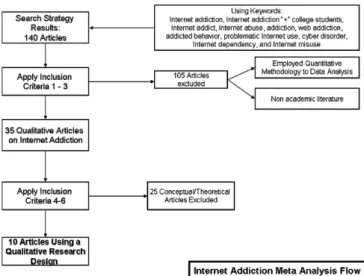
The searches on Internet addiction and related topics produced 140 articles. Following the guide-lines of the conventional systematic review methodology, inclusion and exclusion criteria were ap-plied to the 140 studies by two independent researchers. This was done to ensure that the sample of articles used for the analysis was appropriate for the meta-synthesis. The inclusion criteria for the qualitative component included the following: (1) publication was qualitative in research design; (2) publication was academic and peer reviewed in nature; (3) publication dealt with investigation of Internet addiction; (4) the study used primary data; (5) researchers had a defined sample; and (6) qualitative data collection was done through a focus group, interviews, observations, ethnographic re-view, or a narrative. The exclusion criteria were applied to: (1) papers with an entirely conceptual or theoretical background and no research design; (2) quantitative-based research analysis; and (3) stud-ies with close-ended survey questions as the data collection instrument. The application of the inclu-sion and excluinclu-sion criteria on the 140 articles yielded ten articles that were appropriate for the
qualitative meta-analysis (seeFig. 1). One hundred and thirty articles were excluded from the analysis
because they failed to meet the criteria stipulated given the design of the current research. 3.3. The issue of sample size in qualitative research
The use of small samples is not new to the field of qualitative inquiry (Lincoln & Cuba, 1985; Patton,
1990). It is widely accepted by researchers that qualitative research design and data analysis
tech-niques are inappropriate for estimating quantities. Most studies employing a qualitative methodology use purposeful sampling to unearth what one author calls ‘‘useful manifestations of the phenomenon of interest where sampling is aimed at insight about the phenomenon, not empirical generalization
from a sample to a population” (Patton, 2002, p. 40). The underlying premise then of qualitative
in-quiry is the discovery of rich information that, through subsequent quantitative research, estimations are made with statistical precision on the prevalence of the phenomenon under study in the larger society. Therefore, the criteria used to identify samples in quantitative studies are done so to achieve statistical representativeness. It is this nature of quantitative research that is perhaps the most distin-guishing feature particularly when compared to the research design employed in the current study as it is not the intention to generalize. The meta-analysis technique used here is a purposeful strategy or
inquiry approach with no definitive rules for a sufficient sample size (Patton, 2002, pp. 242–244); a comparatively different approach to the use of statistical formulas where larger sample sizes are most desirable.
Patton (2002)argues that in qualitative research, ‘‘sample size depends on what you want to know, the purpose of the inquiry, what is at stake, what will be useful, what will have credibility, and what
can be done with available time and resources” (p. 244). Similarly,Lincoln and Cuba (1985)suggests
that sample size in qualitative research should be determined by the informational considerations. These authors in their support of smaller samples note that it is not uncommon to find a sample size
of twelve or less that, ‘‘if properly selected, will exhaust most available information” (Lincoln & Cuba,
1985, p. 235). To that end, there have been several publications from different fields that have used
smaller samples as employed in the current study.Crane, Hamilton, and Wilson (2004)interviewed
a total of eleven individuals in a study on Scottish dress, ethnicity, and self-identity. Similarly,Kautz,
Hansen, and Jacobsen (2004)interviewed 12 participants in a semi-structured qualitative interview to
study individuals in a technology related organizational setting whileSiau and Long (2005)use six
qualitative studies to investigate e-government stage modeling.
Despite this evidence, qualitative researchers are advised to consider expanding the units of anal-ysis until themes derived become saturated or repetitive; that is, no new data can be extracted (see Douglas, 2003; Goulding, 2002; Lincoln & Cuba, 1985; Locke, 2001). Taking this into consideration, the authors of this current study recognize the immediate limitation as it relates to the debate of what
constitutes appropriate sample size in qualitative research (Patton, 2002). This limitation is as a result
of the lack of qualitative research studies exploring Internet addiction although there has been more than a decade’s worth of scholarly articles investigating the concept. The systematic process of locat-ing useful qualitative research articles followed by the evaluation of each article based on its merit and
relevance to the phenomena under examination is often problematic (Barroso et al., 2003; Campbell
et al., 2003; Dixon-Woods & Fitzpatrick, 2001; Hawker, Payne, Kerr, Hardey, & Powell, 2002). As the concept of Internet addiction is relatively new and one whose theory is developmental, peer-reviewed research studies investigating the concept are limited. Moreover, most of the articles available employ a quantitative analysis with the minority being qualitative in nature. Use of the meta-synthesis technique has been determined to be an appropriate method to closely examine Internet addiction from the perspectives of those who are affected by the disorder as well as the extrapolations of the authors who investigated the concept. Therefore the recommendation is being proposed that subsequent research employing quantitative techniques should investigate the degree to which the constructs derived here are in fact relevant/and or related to the phenomenon of Internet addiction.
4. Results: meta-synthesis of qualitative studies
4.1. Description of studies reviewed
The qualitative studies used in this meta-synthesis covered a 10-year period from 1996 to 2006.
After the first studies byYoung (1996),(1997)who set out to investigate whether or not the Internet
could be addictive, qualitative inquires sought to explore the concept of Internet addiction from
var-ious perspectives.Griffiths (1998) further advanced empirical research on addictive capabilities of
computers, conducting a case study of five individuals exhibiting excessive computer usage.Young,
Pistner, O’Mara and Buchanan (1999)surveyed 23 female and 12 male therapists online who had
trea-ted clients suffering from Internet-relatrea-ted problems.Chou (2001)set out to investigate the reasons for
heavy Internet use and the impact of the behavior on college students by conducting online interviews
with individual students and groups of students in a chat room setting. Quayle and Taylor (2003)
examined Internet addiction in individuals with an affinity for child pornography by interviewing
23 male offenders.Tsai and Lin (2003)looked at effects of IAD on Taiwanese teenagers by selecting
10 out of 700 adolescents for online and face-to-face interviews.Ng and Wiemer-Hastings (2005)
studied effects of Internet abuse on relationships and school performance with an online survey of
91 users and video game players.Chuang (2006)examined the effect of online role-playing games
psychological motivations of online game addicts using semi-structured in-depth interviews with 10 Taiwanese adolescents.
A review of the studies also showed that online surveys, both open- and close-ended, were mostly used by the authors to collect data, and were followed by semi-structured interviews. Incidentally,
none of the studies examined used focus groups as a data collection method, and only one study (
Chu-ang, 2006) used observational techniques for gathering data on participants. Although over 10 years of the literature is available on the Internet addiction phenomenon, there still seems to be an urgent
need for theory development, as only one study, i.e.,Quayle and Taylor (2003), used a theoretical
framework of Pathological Internet Use proposed byDavis (2001)to explore IAD (specifically, from
interviews with online sex offenders). The surveyed studies were deficient of a working theory of IAD, and, while they provided valuable contributions to the understanding of the concept by looking at its negative effects, implications, and symptoms, as well as provided suggestions for treatment, they were more in support of future research on the practical rather than theoretical implications and development of the concept. With respect to the demographic characteristics of the participants se-lected in the studies, a majority were students attending high school, community college or university. Four of the qualitative studies were conducted in Taiwan, possibly indicating the extent of the issue in this Asian culture. The 10 articles selected for the meta-synthesis were tabulated depending on their research objectives, theoretical background, data collection methods, sample characteristics, and
eth-nicity of subjects (seeTable 1).
4.2. Data analysis
Since the selected studies applied interviews, case studies, open-ended surveys, and observations as inquiry methods, they produced qualitative responses that were, in fact, the understandings, expla-nations, and experiences of the participants about Internet addiction phenomenon. The reported qual-itative reactions of participants in the individual studies were considered by the meta-synthesis as first-order themes in the Internet addiction domain. Two researchers independently examined 10 studies in order to identify similar experiences reported by participants regarding Internet use. By rec-onciling the findings, researchers identified 14 first-order themes, which are described and labeled in Table 2. These first-order themes were further aggregated into five constructs, which often surface when heavy Internet users relate their online experiences: antecedents, pull factors, push factors, neg-ative effects, and control strategies.
In the next stage of the meta-synthesis, each one of the 10 studies was independently examined by the two researchers in order to extract the authors’ inferences regarding the IAD phenomenon. These reflections, interpretations, and conclusions were thought to reflect hypotheses and theories of the authors based upon the results obtained in their studies, and were classified by meta-synthesis as
sec-ond-order themes in the Internet addiction domain (Feder, Hutson, Ramsay, & Taket, 2006). In the
dis-cussion process that followed, 16 second-order themes were identified, labeled, and then grouped into six constructs which reflected re-surfacing topics in the IAD domain: Internet addict profile, anteced-ents, pull factors, deviant behaviors, negative effects, and control strategies. For the sake of clarity, the constructs derived from the first and second-order themes will be referred to as first- and second-or-der constructs, respectively. It should be noted that while several first-and second-orsecond-or-der constructs are given the same name (for example, control strategies), the sets of themes comprising the construct are different, since the first-order construct reflects control and coping experiences as reported by the subjects, while the second-order construct include recommendations on what should be done to com-bat the addiction from the perspective of the author.
4.3. Discussion of first- and second-order constructs identified by meta-synthesis 4.3.1. Antecedents and Internet addict profile constructs
Themes of Internet experience and social factors were classified as the antecedents of Internet
addiction (seeTables 2 and 3). The Internet experience theme reflects years using the Internet as well
as how much time subjects spend online. The collected data indicate that addicts use the Internet up
Internet may be at a higher risk for developing addictive patterns than more experienced users. The social factors theme refers to an individual’s pre-existing social state, expressed feelings of loneliness, isolation and/or boredom, which can facilitate heavy Internet use, since individuals who feel misun-derstood and lonely may use virtual relationships to seek out feelings of comfort and community. Unfortunately, due to a small sample size of primary articles, the profile of a likely candidate to
devel-op Internet addiction offered by Griffiths (1998)was not validated through meta-analysis of other
studies. A likely candidate appears to have little or no social life and denies that there is a problem. A potential addict has low self-confidence and often considers him- or her-self non-interesting, unat-tractive, or overweight, and feels more comfortable in a text-based than in a face-to-face environment. Table 1
Qualitative Internet addiction studies: 1996–2006
Article (#) Objective Method Sample Ethnicity
Chou (2001)[1] To further investigate the reasons for Internet heavy use and addiction, and the impact of such behavior on college students in Taiwan
Online interviews conducted with individual students and groups of students in a chat room setting
83 college students (49 males, 34 females; 71 full time and 12 part-time)
The study was conducted on college campuses in Taiwan Chuang (2006)[2] To examine the effect of
massively multiplayer online role-playing games and video games on game induced seizures Observation; medical record review 10 patients w/ seizures playing MMORPGs (8 male, 2 female); ages 15– 30. Taiwanese
Griffiths (1998)[3] To advance empirical research on the addictive capabilities of computers
Case study of five individuals exhibiting excessive computer usage
4 males and 1 female; age 15–35. Three students, one unemployed 4 British, 1 Greek, Ng and Wiemer-Hastings,2005 [4]
To examine whether Internet use leads to addiction and negative consequences such as relationship problems and failure in school
Online surveys (online game users/video game users)
91 users (88% male, 12% female); 48 video game players (71% male, 29% female)
Not stated
Quayle and Taylor (2003)[5]
To examine the problematic use of the Internet for those with a sexual interest in children
Offender interviews 23 male online child pornography offenders
Not stated
Tsai and Lin (2003)[6]
To investigate the symptoms of Internet addiction among Taiwanese adolescents Semi-structured in-depth interviews 700 high school students reduced to 10 for interviews (6 online, 4 faceto-face) Taiwanese
Wan and Chiou (2006)[7]
To investigate the conscious and unconscious psychological motivations of online game addicts and to further discuss the relationship between surface and source motivations
Semi-structured in-depth interviews 10 Taiwanese adolescents (6 Internet cafes, 4 referred subjects); 7 male, 3 female Taiwanese
Young, 1997[8] To classify 396 cases of dependent Internet users based upon an adapted version of the criteria for Pathological Gambling defined by DSM-IV
Case study: open-ended and close-ended surveys administered by phone and electronically 496 responses (396 dependents, 100 nondependents); 157 males, 239 females Not stated
Young, 1998[9] To investigate if Internet usage could be considered addictive and to identify the extent of problems created by its misuse
Electronic and telephone surveys 496 Internet users; 157 males and 239 females Not stated Young, Pistner, O’Mara, and Buchanan (1999)[10]
To survey therapists who have treated clients suffering from cyber-related problems
Open-ended and close-ended electronic survey
23 female and 12 male therapists
4.3.2. Pull factors construct
First-order themes of sociability, addictive applications, Internet ubiquity, and compulsion activi-ties provide insights into factors which make participants use the Internet extensively. Those addicted are drawn to the Internet because it facilitates socialization and exchange of ideas, while those not addicted value the Internet mostly because it is a great resource for business and personal communi-cations. Information search, chat rooms, email and bulletin board systems (BBS) are among the most
popular activities of those engaged in extensive use of the medium (Chou, 2001; Griffiths, 1998; Ng &
Wiemer-Hastings, 2005; Young et al., 1999). Other activities are instant messaging, online games, news groups, email, online auctions, pornography, and MUDs. Participants repeatedly indicate that they have an appreciation for human-computer and interpersonal activity, ease of use, and availability
and breadth of information accessed online (Chou, 2001; Ng & Wiemer-Hastings, 2005; Quayle &
Tay-lor, 2003). Some participants report that they use the Internet to replace traditional communication media such as television, radio, printed newspapers, landline telephones, cellular phones, and snail
mail (Chou, 2001).
Themes in the second-order pull factors construct reflect inferences of the primary authors regard-ing factors provokregard-ing excessive Internet use. The authors posit that the Internet itself is not addictive; rather it is the prevalence of applications such as Internet relay chat (IRC), BBS, games, and gambling,
among others that increases an individual’s likelihood of being addictive (Tsai & Lin, 2003; Young,
1997). The second-order theme of Internet features suggests that the medium possesses five key
attri-butes with high potential to cause addiction. First is its low cost. Second, the Internet is used as a way to forget social isolation, counteract depression, or, sometimes, treat a medical condition. Third, fourth, and fifth, the medium provides communication efficacy, anonymity, and it is relatively easy
to use (Chou, 2001; Ng & Wiemer-Hastings, 2005; Quayle & Taylor, 2003). Participants in the surveyed
Table 2
First-order Internet addiction constructs
Construct Theme, article (#) Theme description
Antecedents Internet experience [1], [3] Years using the Internet, the length of time spent online. Environments where participants reported using the Internet: college labs, dormitories, work places Social factors [3] Being alone, loneliness
Pull factors Sociability [1], [4], [5], [7], [9]
Ease of social interaction, facilitation of exchange of ideas
Addictive applications [1], [3], [4], [10]
Applications available on the Internet that enhance the entertainment and social value: ICQ, news groups, MUD, others
Internet ubiquity [1] The Internet’s ubiquity combined with the ease of access and the availability of information. Use of the Internet in place of other media forms to communicate with the world
Compulsion activities [10] Cyber sex and porn, cyber-relationships, online gambling, shopping, trading, excessive surfing and database searching, obsessive game playing Push factors Interplay of virtual and
real self [7], [9]
Choosing an online identity completely different from reality, or compensating for shortcomings of reality
Escapism [3] Individuals who tend to suffer from an inferiority complex and lack of confidence
Psycological needs/ motivations [3], [7]
Diversions from loneliness and boredom, stress release, relaxation, discharging anger and frustration, satisfying interpersonal/social needs
Negative effects
Impacts [1], [2], [3] Five main areas with significant impact on individual’s lives are identified as: academic, relationship/interpersonal, financial, occupational, and physical. Positive impacts include self-identification, closer relationships with friends, bonding with the world
Symptoms [3], [6] Considers the various symptoms of Internet addiction: preference for computer over family and friends, thinking about being online, feeling moody when not using the Internet, other.
Pathological tendencies [3] Examples described: endless computer upgrades, changing sleeping patterns, other
Control strategies
Self-regulation [1] Attempts made by individuals to control the habitual use of the Internet, as well as any behavior resulting from this control: shopping, reading, doing laundry, visiting friends, other
studies reported such compulsive activities conducted online as obsessive online gambling, shopping,
online trading, making cyber-relationships, and viewing pornography (Ng & Wiemer-Hastings, 2005;
Quayle & Taylor, 2003; Wan & Chiou, 2006).
The first-order compulsion activities theme includes cyber-relationship addiction understood as an individual’s over-involvement in online relationship, compulsive use of adult websites for cybersex
and cyberporn, and such pursuits as online gambling, shopping, and trading (Young et al., 1999).
The second-order Compensatory/extensive satisfaction theme reflects that online gaming is a power-ful draw to the Internet, especially among college students. It is suggested that online gaming provides addicted persons with a channel for meeting their need for interpersonal relationships not easily
sat-isfied in real-life social settings (Wan & Chiou, 2006).
4.3.3. Deviant behaviors construct
The second-order construct of Deviant behaviors encompass the second-order themes of online offending behaviors, avoiding detection, and areas of Internet dysfunction. Online offending behaviors include such illegal activities as unauthorized downloading, production of child pornography,
com-mission of contact offense, Internet seduction of minors, among others. Quayle and Taylor (2003)
noted that the Internet facilitates deviant behavior and activities, offers opportunities for coaching users in skills needed to avoid detection, and allows offenders to justify their behavior. The interactive components of the Internet facilitate cyber-affairs or extramarital relationships formed online that negatively impact marital or family stability. Deceptive behaviors as a means to hide the amount of time spent online as well as activities conducted are also noted by the primary authors. The use of Table 3
Second-order Internet addiction constructs
Construct Theme, article (#) Theme description
Profile Internet addict profile [3] Candidate appears to have little or no social life and/or self confidence in addition to denying that there is a problem
Antecedents Internet experience [8] Relatively new users of the Internet may be at a higher risk for developing addictive patterns than others
Social factors [8] Individuals who feel misunderstood and lonely may use virtual relationships to seek out feelings of comfort and community Pull factors Internet as replacement for
other media [1]
An increase in the dependence on the Internet for communication
Addictive applications [6], [8] The Internet itself is not addictive; rather it is the prevalence of applications such as IRC chat, BBS, ftp, email, games, gambling, etc that increases an individual’s likelihood of being addictive
Internet features [1], [4], [5] Five key features of the Internet include: affordability, counteraction of depression or other medical conditions, communication efficacy, ease of use, and anonymity
Compensatory or extensive satisfaction [7]
Online gaming provides addicted persons another channel for meeting needs for interpersonal relationships
Deviant behaviors
Online offending behaviors [5] Downloading, trading, production of child pornography, commission of a contact offense, internet seduction of children among others.
Development of Internet community (porn) [5]
Facilitate behavior and activities; coach users in skills needed to engage with Internet and avoid detection; allow offenders to justify behavior Areas of Internet dysfunction
[10]
Four key areas identified for Internet dysfunction include deceptive behavior, cyber-affairs affecting real relationships, subjective escape, and sociability for extremely shy individuals
Negative effects
Impact of Internet use [1] Heavy Internet use may not result in negative effects if online friendship is a part of overall friendship patterns
Consequences of Internet abuse [1], [6]
Real life leisure time activities are replaced by maladaptive behavior towards the Internet
Control strategies
Self-regulation [1] Productive use of the Internet possibly involving self-regulating practices Coping activities [1] Coping activities appeared to be transitional, essentially only helping
participants to pass time until their next log in Internet addiction education
[1]
Getting students to become aware of appropriate and productive use of the Internet is important task
Treatment [8] There is a need for the development of effective treatment protocols to handle the increase of Internet addiction
the medium provides subjective escape from emotional difficulties or personal hardship, as well as a virtual context that allowed overly shy or self-conscious individuals to interact in a socially safe and
secure environment (Quayle & Taylor, 2003; Young et al., 1999).
4.3.4. Push factors construct
First-order themes of Interplay of virtual and real self, Escapism, and Psychological need/motiva-tions were grouped together under the Push factors construct because they reflect the inner needs of an individual, that, arguably, can be fulfilled by using the Internet. While online, individuals may choose a virtual identity completely different from their own real identity, or one that compensates
for its shortcomings (Wan & Chiou, 2006; Young, 1998). Conversely, individuals can create a persona
where they ‘‘unlock parts of themselves which have been submerged” (Young, 1997, citing an
anon-ymous respondent) in their real lives. Persons who have a negative self-image (e.g., who consider themselves as being overweight, disabled, or unattractive), and as a result lack self-confidence, are drawn to the Internet because of its facelessness and anonymity. Being online removes physical and interpersonal hindrances, thus allowing those with low self-esteem, socializing problems, and dif-ficulty making friends to engage in social interactions. Subjects often feel that without the Internet
they would not have a social life and would not try to use the time to meet people in real life (Griffiths,
1998). Participants also report excessive Internet use as a way to escape from scholastic pressure or
marital problems. On the whole, the Internet provides an entertaining and interactive environment where those susceptible to its allure can find escape by coping with negative emotions such as lone-liness, isolation and boredom, release stress, discharge anger and frustration, and feel a sense of belonging and recognition. In addition, they satisfy their need for achievement, excitement and
chal-lenge, and gain control over their own life (Griffiths, 1998; Wan & Chiou, 2006).
4.3.5. Negative effects construct
The first-order construct of Negative effects produced by IAD aggregated the impacts, symptoms, and pathological tendencies themes. In a college setting, subjects rated whether or not the Internet
was a positive rather than negative influence in their campus lives (Chou, 2001). Positive impacts
in-clude self-identification, closer relationships with friends, and forming a connection to the outside world. However, the negative impacts reported were more numerous. The Internet addict tends to ne-glect almost everything in their lives in an effort to satisfy their desire of being online. Problems asso-ciated with Internet misuse are academic, interpersonal, financial, occupational, and physical in nature (Chou, 2001; Chuang, 2006; Griffiths, 1998). Academic performance of Internet addicts is likely to suf-fer greatly. Students report difficulties completing school assignments, studying for exams, and stay-ing attentive durstay-ing classes because of sleep deprivation.
Neglect of daily chores, confrontational situations with family members, spending less time with real people, and becoming angry or resentful of those who question Internet activities are other com-monly reported negative effects associated with IAD. Some participants report feelings of moodiness and anxiety while offline and an intense desire to log in, others become angry or anxious when not
online (Griffiths, 1998; Tsai & Lin, 2003). Some individuals have a tendency to lie about the amount
of time spent on the Internet and conceal phone bills related to fees for Internet service. Perpetual computer upgrades were also reported. The severity of the disorder can also be felt in a business envi-ronment where the result could be termination of employment. Experienced physical effects include eyesight deterioration, disrupted sleep patterns, and seizures induced by excessive playing of video
games (Griffiths, 1998).
The second-order construct of negative effects tentatively indicates that heavy Internet use may not result in negative effects if online friendship is a part of overall friendship patterns. Addictive ten-dencies develop gradually, and problems related to Internet use arise when participants give up most
of their leisure activities to pursue online pleasures (Chou, 2001; Tsai & Lin, 2003).
4.3.6. Control strategies construct
This construct reflects any attempt made by the individual to control the habitual use of the Inter-net, as well as any behavior resulting from this control. For example, renewed interest in pursuing real-life day-to-day activities can be seen as a control strategy to help alleviate pathological
tenden-cies towards the Internet use (Chou, 2001). One of the greatest challenges for those trying to control their use of the Internet is the inability to limit or control the time they spend online. To curb their addictive tendencies, subjects engage in real-life activities such as shopping, reading printed novels, doing laundry, making phone calls, and visiting friends’ homes. As the meta-synthesis indicated, study participants were mostly not aware of Internet addiction as a new disorder, and, as such, did not know where or how to find help. Some participants in the studies examined did not consider getting outside
help for their addiction because they thought it was a personal or minor problem (Chou, 2001). The
second-order control strategies construct highlights the lack of awareness about the disorder, as well as the need for educational programs to increase knowledge about IAD among those afflicted and likely candidates. Activities to help counter the Internet withdrawal appeared to be transitional, essentially only helping participants to pass time until their next Internet log in. The selected studies posit that the goal of Internet addicts should not be to stop using the Internet altogether, but rather to use the medium in a productive, healthy, and controlled way, since self-determination and self-regu-lation were demonstrated by students to be a more effective strategy for curbing the addiction. Get-ting students to become aware of appropriate and productive use of the Internet is also an important task. There is also a need for the development of effective treatment protocols to handle the increase in registered cases of Internet addiction. Proper clinical assessment should include the extent of Inter-net use, specific online activities conducted, level of impairment, current social support, interpersonal
skills, and family dynamics, among other factors (Chou, 2001; Young, 1997).
4.4. Proposed model of Internet addiction
Based on the literature review and meta-synthesis of the selected articles, a conceptual model of
Internet addiction is proposed (seeFig. 1). It is posited that Internet overuse is mainly defined by the
inner needs and motivations of an individual (push factors); however, an individual’s predisposition (antecedents and Internet addict profile) is also important. The model states that the perceived attrac-tive features of the medium (pull factors) moderate the relationship between push factors and the
severity of negative effects of Internet overuse. According toBaron and Kenny (1986), a moderator
var-iable, whether qualitative or quantitative, affects the ‘‘direction and/or strength of the relation between an independent or predictor variable and a dependent or criterion variable” (p. 1174). Negative effects of IAD can include not only academic, social, financial, occupational, and physical impacts, but extend to various deviant behaviors. However, realization of the IAD problem by the individual may facilitate utilization of control strategies in order to curb the addiction a link between the deviant behaviors and control strategies constructs is also proposed, since the reviewed studies provide evidence that subjects struggle with the compulsion to engage online in criminal activities online. It is also proposed that some individuals are more likely to adopt deviant online behaviors than others; therefore, a direct link
is proposed between the antecedents and deviant behaviors constructs (seeFig. 2).
5. Conclusion
The meta-synthesis of 10 studies on Internet addiction for the period of 1996–2006 resulted in dee-per insights into questions formulated for this research. To recap, the main antecedents of Internet addiction are feelings of isolation and loneliness, low self-confidence and self-esteem. The symptoms of the condition are excessive time spent online, denial that the problem exists, as well as moodiness and irritation while offline. Negative effects of over-engagement with the Internet are multiple and include developing problems in any of the five areas: scholastic, occupational, interpersonal, financial, or physical. The authors of the 10 primary studies state the importance of self-regulating practices by the affected individuals, i.e., limiting time spent online and engaging in coping activities such as meet-ings with real people, reading, hobbies, etc. They also advocate Internet addiction education, since those addicted have troubles of recognizing the condition. Effective treatment protocols should be developed to handle the increase in diagnosed IAD cases.
The present research identified several constructs in the Internet addiction domain – antecedents, Internet addict profile, pull factors, push factors, negative effects, deviant behaviors, and control strat-egies – and pinpointed the first- and second-order themes that make these constructs. These con-structs and themes were obtained by analysis of the selected articles from the perspective of study subjects, as reported by the primary researchers, and from the perspective of the primary authors themselves, taking into account their reflections, interpretations, and explanations of the subject re-ports and behavior. The conducted analysis led to a proposition of a conceptual model of the IAD phe-nomenon. Moreover, themes that made each construct also suggest construct operationalization. For example, to measure the pull factors construct, the following items can be considered: whether an individual uses other media besides the Internet for communication purposes, how many applications he or she uses on a regular basis, what is the perceived attractiveness of certain Internet features, etc. Operationalization of the identified constructs and subsequent tests of the proposed conceptual model are necessary steps in further research on exploring the Internet addiction phenomenon.
There are two main limitations to this meta-synthesis study. First, the sample size of qualitative studies evaluated is small. Out of 140 articles initially sourced that explore the Internet addiction, only 10 articles employed a qualitative research design, which greatly reduced the sample. However, the qualitative nature of the studies was considered an important selection criterion, since the availability of detailed personal observations of the subjects was judged crucial to the nature of the research. Due to a small number of articles selected for the study, several identified constructs – for example, the second-order constructs of Internet addict profile, antecedents, and control strategies – were based on one, one, and two papers, respectively. The limited number of papers supporting certain constructs highlights the need for further consideration and possible revision of the identified themes and con-structs. The second point to bear in mind while interpreting the results of the study, is that only one
paper, namely the work ofQuayle and Taylor (2003), provided a theoretical background for the
re-search. The studies surveyed provided valuable contributions to the understanding of the IAD concept by looking at the negative effects, implications, and symptoms, as well as provided suggestions for treatment; however, they were more in support of future research on the practical rather than theo-retical implications and development of the concept. Thus, the conducted meta-synthesis clearly indi-cated an urgent need for the development of IAD theory.
Acknowledgement
This study was supported by National Science Foundation Grant No. 0627488 titled: ‘‘CT-ISG: Improving the privacy and security of online survey data collection, storage, and processing.”
References
American Psychiatric Association, Task Force on DSM-IV (1994).Diagnostic and statistical manual of mental disorders: DSM-IV: American Psychiatric Association.
Armstrong, L., Phillips, J., & Saling, L. (2000). Potential determinants of heavier internet usage.International Journal of Human-Computer Studies, 53(4), 537–550.