PERSISTENCE AND SUPERINTENDENTS: A PHENOMENOLOGICAL STUDY
by
Katherine Hamilton Howard Liberty University
A Dissertation Presented in Partial Fulfillment Of the Requirements for the Degree
Doctor of Education
Liberty University 2018
PERSISTENCE AND SUPERINTENDENTS: A PHENOMENOLOGICAL STUDY
by Katherine Hamilton Howard
A Dissertation Presented in Partial Fulfillment Of the Requirements for the Degree
Doctor of Education
Liberty University, Lynchburg, VA 2018
APPROVED BY: Gary Kuhne, Ed.D., Chair JoAnna Oster, Ed.D., Committee Member Clare Keiser, Ed.D., Committee Member
ABSTRACT
The purpose of this transcendental phenomenological research study was to describe the lived experiences of public school superintendents with the phenomenon of persistence. Self-Determination Theory was used to describe the experiences of superintendents who have held the superintendency in the same school district for at least 5 consecutive years (Deci & Ryan, 2000; Ryan & Deci, 2002). The central research question guiding the study is: What are the lived experiences of superintendents who persist in the public school superintendency? Subquestions addressed various aspects of Self-Determination Theory and persistence, including sources of motivation and goal attainment (Deci & Ryan, 2000; Ryan & Deci, 2002). Participants were recruited from among the 33 current superintendents in the Commonwealth of Virginia who have served in their positions for 5 or more years. Data was collected using a questionnaire, face-to-face interviews, and participant journals. Moustakas’ (1994) method for analyzing
phenomenological data was used to analyze the data collected in the research study. Themes from the analyzed data were used to craft the structural and textural descriptions of the participants’ lived experiences in an effort to arrive at the “essence” of their experiences with persistence.
Keywords: persistence, superintendents, Self-Determination Theory, goal attainment, intrinsic motivation, extrinsic motivation, leadership
Dedication To Eric
May there never be another student who feels the way you did before we could help you I will never forget you
Acknowledgments
When I consider all the support and encouragement I have received during this journey, thank you seems woefully inadequate, but for now, it’s all I have to offer.
To my husband, Jonathan – you are still my gift from God, a gift I never deserved, a gift I will treasure for the rest of my life. Thank you for being strong when I am weak, calm when I am frantic, and focused when I am scattered. I love you.
To my children, Kylie, Jackson, Zachary, Evangeline – when you were little, I thought I couldn’t love anything more than I loved your soft squishiness, sweet breath, and joyful laughter. Then you started to grow up and I fall more in love with the people you are each becoming with every day that passes. All of you are unique just the way God made you, but all of you are also brilliant, loving, hilarious, and capable. My prayer is that you will use your gifts to serve others and make the world better for those who haven’t been given the privileges you have received. Thank you for giving me up for so long so I could do this work. I love you all.
To my parents, Alan and Barbara – I know what unconditional love feels like because of you. You taught me that even though I’m a woman, I am no less capable or intelligent, and you started me on the path that led to this work. Thank you for always believing in me, no matter what I’ve done. I love you both.
To my brothers, Peter, Andrew, and Matthew – I still remember us climbing all over that huge mountain of red clay when we built the old house, playing down in the creek by the
interstate, and arguing intensely over holiday meals at the glass table. Thank you for tolerating the forgotten birthdays and never-returned texts. I really hope I can do better now that this is done. I love all of you and your families.
To my in-laws, John, Theresa, Lara, Dennis, Emma, and Wyatt – All of you have been way too good to me through all of my endeavors, especially since they usually mean me and my large crew descending on you and disrupting everything. Thank you for supporting me by loving my crew so well. I love all of you.
To my committee, Dr. Kuhne, Dr. Oster, and Dr. Keiser – Your patience is absolutely incredible. Thank you for all of your feedback and time. I hope I am able to pay it forward in some way.
To God – Most of the time I have absolutely no clue what You’re doing in my life. But You always love me. I hope to somehow, in some way, be a useful tool for You.
Table of Contents ABSTRACT ... 3 Copyright Page... 4 Dedication ... 5 Acknowledgments... 6 Table of Contents ... 8 List of Tables ... 14 List of Figures ... 15 List of Abbreviations ... 16
CHAPTER ONE: INTRODUCTION ... 17
Overview ... 17
Background ... 17
Historical Perspectives on the Superintendency ... 18
Current Perspectives on the Superintendency... 20
The Superintendency, Tenure, and Student Learning ... 22
Situation to Self... 25
Problem Statement ... 28
Purpose Statement ... 29
Significance of the Study ... 29
Research Questions ... 30
Central Question ... 31
Subquestion Two ... 32
Subquestion Three ... 32
Subquestion Four ... 33
Definitions... 33
Summary ... 34
CHAPTER TWO: LITERATURE REVIEW ... 35
Overview ... 35
Theoretical Framework ... 35
Self-Determination Theory ... 35
Self-Determination Theory and Superintendents... 39
Related Literature... 41
Superintendents and District Size and Location ... 41
African American Superintendents ... 47
Superintendents and Gender ... 53
Tenure and Turnover Rates ... 61
Superintendents and Student Learning ... 63
Pressures and Stressors on Superintendents ... 65
Why Superintendents Leave ... 66
Why Superintendents Stay ... 68
Summary ... 69
CHAPTER THREE: METHODS ... 70
Overview ... 70
Research Questions ... 73 Central Question ... 73 Subquestions ... 74 Setting ... 74 Participants ... 76 Procedures ... 76
The Researcher's Role ... 79
Data Collection ... 80 Questionnaire ... 80 Interviews ... 81 Participant Journals ... 84 Data Analysis ... 85 Trustworthiness ... 87 Credibility ... 88
Dependability and Confirmability ... 89
Transferability ... 89
Ethical Considerations ... 90
Summary ... 91
CHAPTER FOUR: FINDINGS ... 92
Overview ... 92
Participants ... 93
Group Portrait ... 93
Charlotte ... 95 Clark ... 95 Crosby ... 96 John J. ... 96 John R. ... 97 Monroe ... 97 Prince ... 98 Ricky ... 99 Steven ... 99 Wilson ... 100 Results ... 100 Theme Development ... 100
Theme One: They Choose ... 101
Theme Two: They are Chosen ... 123
Theme Three: They Have a Core Purpose ... 132
Research Question Responses... 145
Summary ... 165
CHAPTER FIVE: CONCLUSIONS ... 166
Overview ... 166
Summary of Findings ... 166
Discussion ... 169
Empirical Relationship... 170
Implications... 176
Empirical ... 176
Theoretical ... 177
Practical... 178
Delimitations and Limitations... 179
Recommendations for Future Research ... 180
Topics ... 181
Populations ... 181
Designs ... 181
Summary ... 182
REFERENCES ... 184
APPENDIX A IRB Approval Letter... 205
APPENDIX B Stamped Informed Consent Form ... 206
APPENDIX C Initial Recruitment Letter ... 209
APPENDIX D Initial Recruitment Email ... 210
APPENDIX E Electronic Questionnaire Email ... 211
APPENDIX F Electronic Questionnaire ... 212
APPENDIX G Follow-Up Recruitment Email ... 216
APPENDIX H – Interview Guide ... 217
APPENDIX I – Interview Protocol... 220
List of Tables
Table 1. District Characteristics………..…...……… 74
Table 2. Standardized Questionnaire ……….80
Table 3. Standardized Open-Ended Interview Questions ……….… 81
Table 4. Standardized Open-Ended Journal Prompts ………..………….… 84
List of Figures
Figure 1. Years in current Virginia superintendency as of October 2018 ………... 24 Figure 2. Years in current Virginia superintendency as of April 2017 ... 24 Figure 3. Years in current Virginia superintendency as of May 2016 ... 25
List of Abbreviations American Association of School Administrators (AASA)
Association for Supervision and Curriculum Development (ASCD) Council of Chief State School Officers (CCSSO)
Institutional Review Board (IRB)
Interstate School Leaders Licensure Consortium (ISLLC) Local Composite Index (LCI)
Self-Determination Theory (SDT) Virginia (VA)
Virginia Association for Supervision and Curriculum Development (VASCD) Virginia Association of School Superintendents (VASS)
CHAPTER ONE: INTRODUCTION Overview
The public school superintendency in the United States has been the subject of research since its inception, but current research has yet to explain why some superintendents stay in the same superintendency in the same school district for many years, while others serve for only a few short years. Although researchers have not reached agreement on the average length of tenure for American superintendents, most researchers report tenure lengths of between 3 (Council of Great City Schools, 2003, 2006, 2014) and 7 years (Natkin, Cooper, Alborano, Padilla, & Ghosh, 2003; Natkin, Cooper, & Fusarelli, 2002), depending on district size (Dlugosh, 1995) and location (Council of Great City Schools, 2003, 2006, 2014). The purpose of this study is to describe the persistence of public school superintendents in Virginia. Self-Determination Theory (SDT) was used to frame the inquiry, given that SDT can explain how and why some superintendents persist and provided a richer picture of the experiences of these superintendents while filling a gap in the current literature on the superintendency (Deci & Ryan, 2000; Ryan & Deci, 2002).
This chapter provides a background for the research study. There are several subsections that review my situation to the study, the problem and purpose statements, significance of the study, research questions, and operational definitions of any specific terms. The chapter concludes with a summary.
Background
In order to understand the problem addressed by this study and the purpose of the inquiry, several components of the superintendency should be explored, including the history of the job, the historical expectations for superintendents, and the current demands on superintendents. A
brief overview of the current state of superintendent tenure length and SDT concludes the background. This section provides a comprehensive background on the superintendency and thus, provides a foundation for the explorations undertaken in the study.
Historical Perspectives on the Superintendency
In many ways, the public school superintendency has been shaped by modern American history since the role first appeared in the mid-1800s (Griffiths, 1959). Local school boards controlled schools until the United States began to shift from a rural, agrarian society to an urban culture (Callahan, 1966). This influx of people into urban areas led to a dramatic increase in the number of public schools and many local school boards were overwhelmed with the task of supervising so many schools (Callahan, 1966). Thus, superintendents were hired to serve as master teachers, a role conceptualized by historian Raymond Callahan in his 1966 history of the superintendency as scholarly educational leader (Callahan, 1966) or teacher-scholar (Kowalski & Bjork, 2005). The first superintendents were expected to provide guidance to school boards, ensure unified curriculum across schools and grades, supervise instruction, and accept
responsibility for any failings of their schools (Kowalski, 2006). Although the role of teacher-scholar has never disappeared from the expectations for superintendents, its importance has diminished as other expectations have been added to the ever-changing role of the
superintendency (Kowalski, McCord, Young, Peterson, & Ellerson, 2011).
The success of the Industrial Revolution brought the principles of business management to public education. As such, superintendents were expected to adopt the role of business executive (Callahan, 1966) or organizational manager (Kowalski & Bjork, 2005). With the advent of this new role conceptualization, superintendents were responsible for operations and facilities management, human resources, and fiscal management (Callahan, 1966; Kowalski &
Bjork, 2005; Kowalski, 2006). During the Great Depression, the public and school boards became somewhat disillusioned with superintendents who acted like business executives, but the financial and operational skills of savvy superintendents were still valued once the resurgence of respect for business leaders appeared after World War II (Callahan, 1966). Over time, the shift of responsibility for managing the financial and operational side of schools from school boards to superintendents became permanent (Callahan, 1966).
The political turmoil of the 1950s and 1960s prompted the development of another role conceptualization for superintendents as they were expected to become educational statesmen in democratic schools (Callahan, 1966) or democratic leaders (Kowalski, 2006). Superintendents became responsible for enacting social justice and for explicitly connecting their actions with the stated aim of public schools to prepare all students to become functioning citizens in a
democratic society (Kowalski & Bjork, 2005). In order to achieve these ends, successful superintendents developed excellent political skills (Brunner, Grogan, & Bjork, 2002) as they competed with other social and governmental agencies for limited funds (Kowalski, 2006). With the advent of this role conceptualization, superintendents were expected to engage in political discourse at the local, state, and federal levels in order to ensure their schools and communities maintained access to funding and other forms of support for their goals (Brunner, Grogan, & Bjork, 2002; Kowalski & Bjork, 2005).
At the same time superintendents were learning to be excellent political strategists, they were also learning to adopt the practices of social scientists to the benefit of their schools and students (Kowalski, 2006). The social science role conceptualization (Callahan, 1966; Kowalski & Bjork, 2005) was developed in response to the awarding of grants for social science research by the Kellogg Foundation to several research universities in the 1950s (Kowalski & Bjork,
2005; Kowalski, 2006), the development of the social sciences as a respected field (Kowalski, 2006), and increasing criticisms of public schools (Kowalski, 2006). Superintendents applied new knowledge about teaching, learning, and children’s growth to the current practices in their schools (Kowalski, 2006). The application of research results was encouraged by large research universities, and eventually, by communities and school boards.
A fifth role conceptualization was proposed by Kowalski (2006) in response to the advent of the Information Age (Drucker, 1999). Superintendents must now be skilled communicators, a role conceptualization that is increasingly important in an era defined by the global exchange of ideas that depend entirely on appropriate communication for success (Kowalski, 2006). Although communication pervades all of the other role conceptualizations for superintendents, it is a subject unto itself since success with communication can have a tremendous impact on the success of a superintendency (Kowalski, 2006). In many ways, all five role conceptualizations guide and shape the explicit and implicit expectations for superintendents across America.
Current Perspectives on the Superintendency
Two main camps of education professors, practicing and retired superintendents, politicians, and business and community leaders influence current role conceptions of the superintendency. One group resists reforms to improve or change the role of or preparation for the superintendency, while the other works to improve the professionalism of the
superintendency (Kowalski & Bjork, 2005). This second group wields significant influence on the position, as evidenced by the requirement in most states that public school superintendents hold special licenses or certifications granted by the state, although some states provide for alternative processes to licensure for senior executives and military officers. For example, superintendents in Virginia must hold a Division Superintendent license, but Chief Executive
Officers and senior military officers who hold a master’s degree and are recommended for employment by their school board are eligible for this license (Virginia Administrative Code § 8VAC20-22-600). The professionalism of the superintendency is also enhanced by the existence of multiple sets of professional standards for educational leaders and specifically for
superintendents (AASA, 1993; CCSSO, 2015). These current interpretations of the five role conceptualizations are evidenced throughout these standards, which provide a clear picture of the expectations for superintendents in the mid-2010s.
Although the American Association of School Administrators (AASA) has not changed their standards for school superintendents since 1993, these standards remain one of the primary forms of guidance for the profession. The standards address areas such as vision creation, strategic planning, advocacy, board relations, internal and external communication, fiscal and human resources management, assessment and curriculum monitoring, instructional
management, and ethical behavior in a diverse community (AASA, 1993). All five of the role conceptualizations are reflected in these standards, which the AASA recognizes as lofty goals that not every superintendent can master (AASA, 1993). In the eyes of the AASA,
“superintendents are dream builders for America’s children” (AASA, 1993, p. 14), and as such, high standards are desirable.
The Council of Chief State School Officers (CCSSO) also publishes standards for educational leaders, although these standards apply to building and division-level leaders, not just superintendents. These standards, often known by their former name of the Interstate School Leaders Licensure Consortium (ISLLC), are frequently used to frame the preparation programs required for principals and other educational leaders in most states. As such, the practice of many superintendents is guided by these standards. The standards address areas such as vision creation,
instructional leadership for student learning, human resources and professional development management, creation of a caring and inclusive school community, resource coordination, family and community engagement, and operations management (CCSSO, 2015). Again, all five role conceptualizations are reflected in the CCSSO’s (2015) standards. Even though the public school superintendency is viewed by some to be a “quasi-profession”, or a job that laypeople with little to no public school teaching or leadership experience can fulfill adequately (Kowalski & Bjork, 2005, p. 90), there are significantly influential efforts to professionalize the practices and expectations for superintendents.
The Superintendency, Tenure, and Student Learning
Given the wide array of expectations placed on superintendents, it is reasonable to examine how long superintendents remain in their positions. In fact, one aspect of the
superintendency, turnover and tenure length, has been under investigation since the inception of the superintendency (Callahan, 1966). Even as early as 1892, the length of a superintendent’s tenure was recognized as a powerful variable affecting the success of the superintendent
(Callahan, 1966). There is an impression in the popular media that the most powerful executive position in public schools is experiencing a concerning level of churn (Brown, 2015; Golden, 2014; Hackett, 2015). There is some disagreement among researchers regarding whether the rates of superintendent turnover are problematic (Natkin, Cooper, & Fusarelli, 2002; Yee & Cuban, 1996), but it is clear that for most public school districts in the United States, the days of having the same superintendent for 20 or 30 years are drawing to a close (Natkin, et al., 2002).
Research suggests that the longer superintendents remain in their positions the more likely they are to achieve their goals (Fullan, 1992, 2002) and impact student achievement (Waters & Marzano, 2007). However, over the past 5 decades, tenure has been decreasing
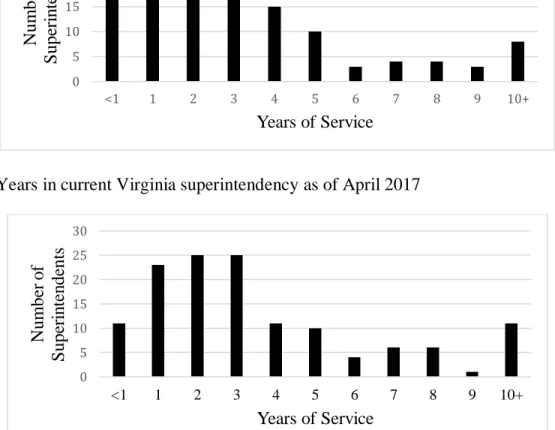
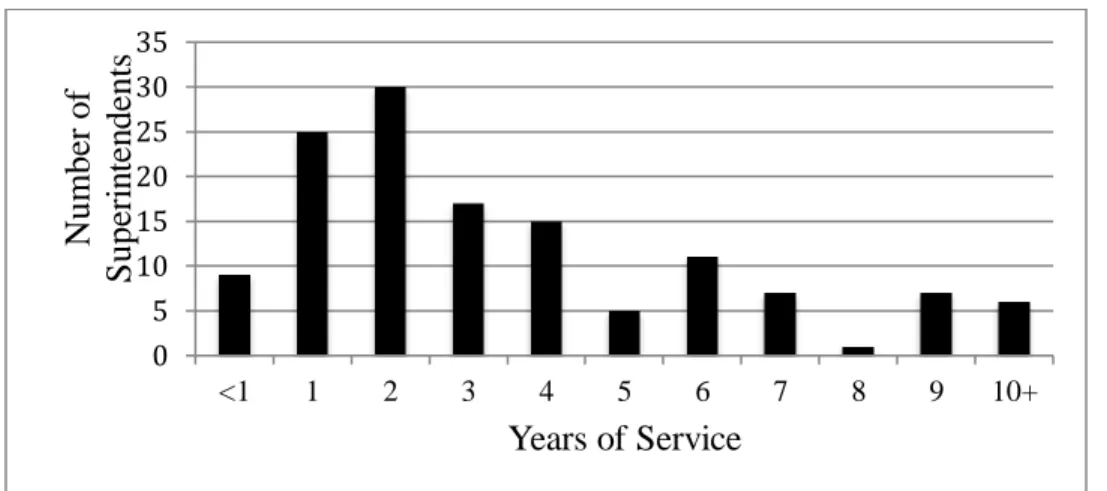
(Grissom & Anderson, 2012; Yee & Cuban, 1996). For example, as of October 2018, 76% of superintendents in Virginia had served in the same superintendency for 4 or fewer years (see Figure 1). In April 2017, 71% of superintendents in Virginia had served in the same
superintendency for 4 or fewer years (see Figure 2). In May 2016, 72% of Virginia
superintendents had been in their current role for fewer than 5 years (see Figure 3.) While this statistic could describe an aging population of superintendents (Grissom & Anderson, 2012; Kowalski, 2003; Meola, 2014), it is clear that tenure length for the average superintendent is slowly decreasing over time (Yee & Cuban, 1996).
Researchers have tried to explain why some superintendents stay in their jobs, or persist, for longer than a few years (Chen, 2014; Kovac, 2013; Hattar, 2013; Macaluso, 2012; Mouton, 2013; Remland, 2012; Reynolds, 2012; Talbert, 2011). The phenomenon of persistence in the superintendency and its accompanying phenomenon, the decision to leave, have been examined from several perspectives, including Callahan’s (1962) vulnerability theory (Mouton, 2013), Lutz and Iannaccone’s (1978) dissatisfaction theory (Alsbury, 2003, 2008; Mouton, 2013), Meyer and Allen’s (1997) Three Component Model of organizational commitment (Talbert, 2011), professional characteristics of long-term superintendents (Kovac, 2013; Remland, 2012) and apolitical district and superintendent factors (Hattar, 2013). Despite this research, very few people have asked sitting superintendents why they stay and no one has described this
phenomenon from a qualitative perspective, from a phenomenological perspective, through the eyes of a Virginia superintendent, or from the perspective of Self-Determination Theory (Deci & Ryan, 2000; Ryan & Deci, 2002). This study used each of these perspectives to arrive closer to an answer to the question, why do some superintendents stay in their jobs instead of leave?
and explaining how and why people behave in order to meet their psychological needs (Deci & Ryan, 2000; Ryan & Deci, 2002). Self-Determination Theory (SDT) provides an empirically sound basis for understanding motivation and goal achievement (Deci & Ryan, 2000).
Considering how valuable Self-Determination Theory has been in describing human behavior, especially in relation to motivation, needs fulfillment, and goal attainment, it is worthwhile to explore superintendent persistence through the lens of Self-Determination Theory (Deci & Ryan, 2000; Ryan & Deci, 2002). Superintendents are humans with psychological needs and this research study sought to explore the experiences of these participants as people first and leaders second.
Figure 1. Years in current Virginia superintendency as of October 2018
Figure 2. Years in current Virginia superintendency as of April 2017 0 5 10 15 20 25 30 <1 1 2 3 4 5 6 7 8 9 10+ N um be r o f S upe ri n te n de nt s Years of Service 0 5 10 15 20 25 30 <1 1 2 3 4 5 6 7 8 9 10+ N um be r of S upe ri n te n de nt s Years of Service
Figure 3. Years in current Virginia superintendency as of May 2016
Situation to Self
My interest in this research project stems from my own experiences as an aspiring administrator. I have always been fascinated by the lived experiences of female educational leaders. Specifically, I am curious about how successful female educational leaders balance their myriad personal and professional responsibilities as they advance through various career
positions. Once I began my doctoral coursework, I quickly learned that the literature is saturated with studies on the experiences of women, but I found only a few recent dissertations and peer-reviewed studies that have examined the persistence of superintendents, regardless of gender. I realized that persistence is a construct that captures my interest in how people balance
responsibilities while pursuing an executive educational leadership position. Through this study, I want to understand why some superintendents persist in their jobs when there is ample
evidence of the reasons why others leave.
Although 10 of my 15 years as an educator have been in Virginia, I have very few connections to the current public school superintendents in the Commonwealth, with the exception of the superintendent of my employing district. I have met a few female
superintendents at conferences over the past several years, but I have maintained no professional
0 5 10 15 20 25 30 35 <1 1 2 3 4 5 6 7 8 9 10+ N um be r o f S up eri n te n dent s Years of Service
or personal ties to them. I have connections within one district in which I am an employee and a parent of two public school students, thus I did not include the superintendent of this district for my study.
There were several philosophical assumptions that guided this study. Ontologically, I assumed that my participants had created and were creating their own realities based on their experiences and thoughts. Thus, I attempted to describe reality as perceived by my participants. I readily admit that my reality may not align with those of my participants, but my reality most likely expanded and changed as a result of my exposure to the realities of my participants. While the primary purpose of this study was to capture the essence of the lived experiences of the participants, as reflected in their descriptions of their realities, I acknowledge that my reality was challenged over the course of this study. Epistemologically, I assumed that knowledge was created as a result of my interactions with the participants through my research design, data collection techniques, and data analysis process. I assumed that the participants and I were involved in this knowledge creation, although not always to the same degree or in the same ways. Axiologically, I assumed this research topic was important and that others, including my participants, also placed value on this topic. My participants believe that their lived experiences are important and carry value and meaning, and part of my job as the researcher is to convey the value of my participants’ experiences. Methodologically, I interacted extensively with my participants in order to find the meaning in their experiences. Rhetorically, I assumed that the words of the person who had lived the experience were the most appropriate words to use. Thus, I attempted to allow the voices of my participants to come through in all of my work, including in the final description of the essence of the study phenomenon. I also allowed my voice to penetrate my work as appropriate and only when it did not prevent the sharing of my
participants’ experiences.
The foundational paradigm for this study was constructivism, as I believed my
participants constructed their realities over the course of their lifetimes as a result of their “lived experiences and interactions with others” (Creswell, 2013, p. 36). In many ways, the realities of my participants are still under construction since they experience new events and interactions daily. My job as a researcher was to use inductive research methods to tap into the meanings that my participants had assigned to their varied life experiences and find the common essence in those meaning-laden experiences related to the superintendency. I assumed that my participants might have revised the meaning they placed on certain experiences as they have had new experiences, so their version of reality was constantly under review and modification based on their construction of meaning in response to their experiences. The participants in this study were co-researchers (Moustakas, 1994) with me for a few reasons. First, they have direct experience with the phenomenon whereas I do not, so their impressions and thoughts formed the basis of data analysis. Their constructed realities contained the essence of the phenomenon among them, so the value of the participants and their experiences cannot be overstated. Second, the
participants were co-researchers because of the amount of time and the depth of self-reflection I asked from them. I made the depth and breadth of their involvement explicitly clear in my informed consent letter and all communication because I asked for a great deal of interaction and input from the participants. Finally, the participants were co-researchers with me due to the nature of their self-reflection that resulted from the data collection methods. The participants had multiple opportunities to present their thoughts and experiences and to interact with their own data, thus they were included not only in the data collection phase of the study, but also the data analysis phase. Considering the delicate and involved nature of phenomenological research, it
was respectful and honest to treat all participants as co-researchers in this inquiry.
Problem Statement
Research suggests a general composite of the stereotypical superintendent as a seasoned Caucasian man who serves as superintendent in a single district for almost 2 decades (Chance, Ligon, Butler, & Cole, 1991). Several points of this composite seem to no longer apply to the superintendents serving public school districts in the mid-2010s in America, primarily with regard to the length of any given superintendent’s tenure. The general problem addressed in this research study was that although some facets of persistence as a construct have been examined in public school superintendents who have served lengthy tenures, the current literature does not fully capture the multifaceted and deeply psychological nature of persistence as evidenced in the lives of current superintendents (Chen, 2014; Kovac, 2013; Hattar, 2013; Macaluso, 2012; Mouton, 2013; Remland, 2012; Reynolds, 2012; Talbert, 2011). Current research has not answered the question of why some superintendents in the mid-2010s stay when others leave. Several recent dissertations and a few recent peer-reviewed studies have addressed individual characteristics or factors of long-term superintendents, such as leadership abilities (Antonucci, 2012; Remland, 2012; Williams & Hatch, 2012), organizational commitment (Talbert, 2011; Williams, 2012), personal characteristics such as work ethic and courage (Freeley & Seinfeld, 2012; Hattar, 2012), and political connections (Mouton, 2013). However, there is a gap in the literature on superintendents who choose to stay in their positions (Grissom & Anderson, 2012; Tallerico, Poole, & Burstyn, 1994; Tekniepe, 2015) and there are no studies that examine or describe how superintendent behaviors contribute to psychological health, motivation, goal attainment, and persistence.
of superintendents, but this theory has never been applied to this participant group (Deci & Ryan, 2000; Ryan & Deci, 2002). This research project addressed the problem that existing research does not describe the experiences of long-term superintendents in the context of
Self-Determination Theory and thus, the experiences of these leaders have not been captured in a comprehensive manner (Deci & Ryan, 2000; Ryan & Deci, 2002).
Purpose Statement
The purpose of this transcendental phenomenological study was to describe the
persistence of public school superintendents in Virginia through the lens of Self-Determination Theory (Deci & Ryan, 2000; Ryan & Deci, 2002). Persistence in the superintendency is defined as maintaining the superintendency in one district for at least 5 consecutive years. The theory that guided this study is Self-Determination Theory as it explains the psychological need
fulfillment and sources of motivation that contribute to persistence (Deci & Ryan, 2000; Ryan & Deci, 2002).
Significance of the Study
This study has theoretical and practical implications for the current literature base on superintendents and Self-Determination Theory (Deci & Ryan, 2000; Ryan & Deci, 2002). The results of this study contribute deeper insights to the question of why some superintendents stay when others leave. The results of this study provide a more complete understanding of the nature of the superintendency and the experiences and characteristics of people who persist in this difficult job. The study also extends the literature on SDT. SDT is a well-established theory of human behavior that has never been applied to executive school leadership, so this study adds to the literature base on SDT and the understanding of how SDT works in a particular participant
group.
This research project also has practical applications for anyone involved in the
recruitment, retention, and support of superintendents, including school boards, superintendent preparation program leaders, and aspiring and current superintendents. School boards will benefit from understanding how they influence the motivation and needs fulfillment of current and future superintendents. They will be able to understand how their actions affect
superintendent tenure length and levels of superintendent job satisfaction. University leaders who plan and implement superintendent preparation programs will benefit from understanding the role of needs fulfillment and motivation in superintendent longevity. They can broach the topic of persistence and ensure their students explore their own self-determination, psychological needs requirements, and pathways to goal attainment before pursuing the superintendency. The research study is also significant to aspiring superintendents because it will help them understand the personal and professional implications of their career goals and allow them to fully investigate the sources of their motivation before moving into the superintendency. Finally, current superintendents who wish to remain in their positions for long periods of time will develop a greater understanding of the phenomenon of persistence and will be able to see themselves in the lived experiences of the study participants.
Research Questions
This inquiry was guided by one central question and four subquestions that aimed to capture the lived experiences of persistent superintendents while also addressing the main aspects of Self-Determination Theory (Deci & Ryan, 2000; Ryan & Deci, 2002).
Central Question
What are the lived experiences of superintendents who persist in the public school superintendency?
There is a gap in the literature on superintendent longevity, tenure, turnover, and persistence (Tekniepe, 2015). Existing research does not fully explain or describe the
characteristics of superintendents who persist beyond the current average tenure length of 5 to 7 years (Grissom & Anderson, 2012; Tallerico, Poole, & Burstyn, 1994). There is no sufficient answer to the question, why do some superintendents stay when so many others leave? The central research question of this inquiry sought to provide an answer to this question by
exploring the construct of persistence as evidenced through the experiences of current long-term superintendents. This question also guided the description the lived experiences of the
participants, which is the most critical element of phenomenology (Creswell, 2013; Moustakas, 1994). Since the participants have experienced the phenomenon of persistence, they were the best people to describe their experiences and by doing so, their experiences shed light on the phenomenon itself. The only way to gather this kind of intricate, detailed, rich data was by asking the participants about their experiences as they lived them, without interpretation or analysis from the researcher. Once the participants’ experiences were recorded, the data was analyzed through eidetic reduction to distill the unifying essence common to all of their experiences (Gill, 2014). This reductive process can only occur in the context of the central research question, which captured the purest expression of the participants’ experiences.
Subquestion One
needs of superintendents who persist in the public school superintendency?
The three basic psychological needs of autonomy, competence, and relatedness are foundational to Self-Determination Theory (Deci & Ryan, 2000; Ryan & Deci, 2002). When these needs are met, people are psychologically healthy and they strive to accomplish fulfilling goals (Deci & Ryan, 2000). It stands to reason that if the participants choose to enter into
(Boyland, 2013) and remain in a difficult job that has little guaranteed positional security (Byrd, Drews, & Johnson, 2006; Cooper, Fusarelli, & Carella, 2000; Eaton & Sharp, 1996; Grissom & Anderson, 2012; Yee & Cuban, 1996), then some or all of their needs must be met in that job. This question seeks to connect needs fulfillment with the participants’ decision to remain in the superintendency.
Subquestion Two
How do superintendents who persist in the public school superintendency describe their sources of motivation?
The various forms of motivation as explained in SDT can help explain the choices people make, just as their choices and their descriptions of those choices can shed light on the sources of their motivation (Ryan & Deci, 2002). By asking long-term superintendents to describe what motivates them, information about their needs fulfillment, goal attainment, and psychological well-being can be ascertained (Ryan & Deci, 2002). All of these aspects help describe and elucidate the construct of persistence as evidenced in the participants’ lives.
Subquestion Three
What supports do superintendents who persist in the public school superintendency cite as valuable?
Even if the participants cannot connect specific sources of support for specific decisions they have made over the course of their lives, the mere presence of any support structures can describe and explain their decisions. Self-Determination Theory insists that the basic
psychological needs are met in the context of an autonomy-supportive environment, which then influences a person’s sources of motivation and eventual goal attainment (Deci & Ryan, 2000; Ryan & Deci, 2002). This question seeks to connect specific sources of support with
participants’ decisions that have influenced their persistence in the superintendency.
Subquestion Four
What goals do persistent superintendents set, why do they set them, and how do they pursue them?
Research on SDT has determined that goal content and the processes by which goals are attained influence the outcome of goal pursuits (Deci & Ryan, 2000). This question seeks to describe the kinds of goals pursued by persistent superintendents and the actions or plans taken by the participants to achieve their goals. Research has also determined that motivation
influences goal attainment and well-being (Sheldon, Ryan, Deci, & Kasser, 2004). This question also seeks to connect the motives for goals set by persistent superintendents and their persistence in a difficult job. The basic psychological needs, all forms of motivation, and various support structures all inform goal content, goal motivation, and goal pursuits (Deci & Ryan, 2002); thus this question can elucidate the application of SDT in the lives of the participants.
Definitions
Definitions of specific terms used throughout this prospectus are listed below: 1. Autonomy – to voluntarily choose in a way that is reconciled with one’s self; “the
experience of integration and freedom” (Deci & Ryan, 2000, p. 231).
2. Competence – having a positive influence on one’s surroundings; “having an effect on the environment as well as to attain valued outcomes within it” (Deci & Ryan, 2000, p. 231).
3. Extrinsic motivation – completing an action in order to gain or avoid something; “doing something because it leads to a separable outcome” (Ryan & Deci, 2000a, p. 55). 4. Intrinsic motivation – completing an action for the sake of the action itself; “doing
something because it is inherently interesting or enjoyable” (Ryan & Deci, 2000a, p. 55). 5. Persistent superintendent – any superintendent who has maintained the superintendency
in the same public school district for at least 5 consecutive years. Interim superintendents, assistant superintendents, directors, and managers do not meet these criteria.
6. Relatedness – “the desire to feel connected to others” (Deci & Ryan, 2000),
7. Tenure – the number of consecutive years one person spends as superintendent in the same school district (Byrd, Drews, & Johnston, 2006).
Summary
There has been a tremendous amount of turnover among public school superintendents in Virginia in recent years, but not all superintendents have quickly left their positions. There are many reasons cited in the current literature to explain why superintendents leave their jobs, but fewer reasons to explain why some superintendents stay. The study used a transcendental
phenomenological research design and Self-Determination Theory to explore the phenomenon of superintendent persistence (Deci & Ryan, 2000; Ryan & Deci, 2002) and fill the gap in the literature.
CHAPTER TWO: LITERATURE REVIEW Overview
The problem addressed by this study was that there is a gap in the existing research on the experiences of superintendents who persist in the same superintendency beyond the average length of tenure (Grissom & Anderson, 2012; Tallerico, Poole, & Burstyn, 1994; Tekniepe, 2015). This study used Self-Determination Theory (SDT) to describe the lived experiences of superintendents who remain in the same position for 5 or more years (Deci & Ryan, 2000; Ryan & Deci, 2002). Chapter Two describes the theoretical framework and literature base that form the foundation for this study. The main tenets of SDT are described, including its explanation of psychological needs, how those needs are met, the various forms of motivation, and how people pursue goals. The current and historical literature related to this study is also presented to establish the context and support for the study. This study applied SDT to the experiences of current long-term superintendents in Virginia to expand and enrich the understanding of persistence in the superintendency in this participant group.
Theoretical Framework
The purpose of theoretical frameworks in qualitative inquiry is to justify this research study and to guide the research design, methodology, and research questions (Maxwell, 2013). The following section grounds the research study in a theory that provides a framework for the phenomenon under investigation: persistence in superintendents.
Self-Determination Theory
Self-Determination Theory is a macrotheory of human behavior and motivation that was proposed by Edward Deci and Richard Ryan in the mid-1980s (Deci & Ryan, 1985a; Deci &
Ryan, 2000; Ryan & Deci, 2002). It is comprised of several sub-theories (Ryan & Deci, 2002), including cognitive evaluation theory (Deci, 1975; Deci & Ryan, 1980), organismic integration theory (Deci & Ryan, 1985b; Ryan & Connell, 1989), causality orientations theory (Deci & Ryan, 1985a), and basic needs theory (Ryan & Deci, 2000b). At its core, Self-Determination Theory (SDT) seeks to explain human needs and how people strive to fulfill those needs. There are several components of SDT that pertain to this study of persistence in long-term
superintendents in Virginia, including the basic human needs, the several types of motivation, the causality orientations, and goal pursuit. All of these components impact a person’s sense of self and their overall well-being (Ryan & Deci, 2002), factors that can influence a superintendent’s decision to stay or leave a given position.
The overarching premise of SDT is that “all individuals have natural, innate, and constructive tendencies to develop an ever more elaborated and unified sense of self” (Ryan & Deci, 2002, p. 5). This sense of self is marked by “a sense of wholeness, vitality, and integrity” (Ryan & Deci, 2002, p. 3) which can be evidenced in both hedonic and eudaimonic ways (Ryan, Huta, & Deci, 2006). Hedonia focuses on the outcome of happiness, while eudaimonia focuses on the processes of “living well” (Ryan, Huta, & Deci, 2006, p. 139). For the purposes of the study, it was not necessary to parse out the minute differences between these two states, but it is helpful to keep them in mind as the job satisfaction, goal pursuits, and personal and professional decisions of long-term superintendents are examined.
SDT proposes that all humans, regardless of temporal, geographical, cultural or other contexts, share the same three basic psychological needs of autonomy, competence, and relatedness (Deci & Ryan, 2000; Ryan & Deci, 2002). Autonomy is acting freely in a way that matches one’s self-concept, so it encompasses the constructs of volition, freedom, and
integration (Deci & Ryan, 2000). Merely being able to choose to behave in a certain way is not sufficient for autonomous behavior according to SDT because there must be an element of choosing to behave in a way that is aligned with one’s sense of self (Deci & Ryan, 2000). Competence is an ability to affect one’s environment in a valuable way (Deci & Ryan, 2000). Competence includes an element of self-confidence in one’s ability to effect a “valued outcome” on one’s environment (Deci & Ryan, 2000, p. 231; Ryan & Deci, 2002). Relatedness is the desire to give and receive love, caring, and respect (Deci & Ryan, 2000; Ryan & Deci, 2002). Relatedness is not about being a member of a specific group, but instead involves “the
psychological sense of being with others in secure communion or unity” (Ryan & Deci, 2002, p. 7). According to SDT, all human behavior stems from the desire to fulfill all three of these basic needs.
In SDT, the construct of motivation arises from the basic psychological needs. SDT proposes a continuum of motivation consisting of 5 types, including amotivation, external regulation, introjected regulation, regulation through identification, integrated regulation, and intrinsic motivation (Ryan & Deci, 2002). Amotivation, the state of having no desire or intention to act, is at one end of the continuum (Ryan & Deci, 2002). Intrinsic motivation, the state of “doing an activity out of interest and inherent satisfaction” (Ryan & Deci, 2002, p. 17), is at the other end of the continuum. The other four types of motivation fall into the broader category of extrinsic motivation. External regulation is the form of extrinsic motivation that is closest to amotivation and is easily thought of as behavior that seeks to get some kind of reward or avoid a negative consequence (Ryan & Deci, 2002). Next on the continuum is introjected regulation, which is behavior that involves the ego, such as saving face or avoiding guilt or shame (Ryan & Deci, 2002). Regulation through identification moves along the continuum, closer to intrinsic
motivation, as evidenced by its definition as “an acceptance of the behavior as personally important” (Ryan & Deci, 2002, p. 17). People who are regulated through identification have come to see the value in behaving a certain way, but have not yet integrated the value of the behavior into their sense of self. Integrated regulation is the form of extrinsic motivation that is closest to intrinsic motivation and includes behavior that demonstrates the person has fully integrated the value of the specified behavior into his or her sense of self (Ryan & Deci, 2002). None of the forms of regulation are considered to be intrinsic motivation because the actions are engaged in to achieve an outcome, not for the sake of the actions themselves (Ryan & Deci, 2002). Intrinsically motivated people engage in certain behaviors simply because they enjoy the behaviors, regardless of the outcomes.
All forms of motivation in SDT inform what Deci and Ryan (1985a, 2000) call causality orientations (1985a, 2000; Ryan & Deci, 2002). Every person has each of the three causality orientations: autonomy orientation, controlled orientation, and impersonal orientation (Deci & Ryan, 1985a), but each person tends to lean towards one orientation over the others. The autonomy orientation is marked by a “high degree of experienced choice with respect to the initiation and regulation of one’s own behavior” (Deci & Ryan, 1985a, p. 111). People who lean towards this orientation evidence a high degree of self-determined behavior as marked by initiative and behaving “on the basis of interests and self-endorsed values” (Ryan & Deci, 2002, p. 21). The controlled orientation involves behaving as a result of extrinsic motivators, not intrinsic as with the autonomy orientation. People who lean towards this orientation often behave in response to external controls such as expectations, deadlines, and directives (Deci & Ryan, 1985a). Defiance and compliance fall into the controlled orientation (Deci & Ryan, 1985a). The impersonal orientation involves amotivation and a lack of intentional behavior (Ryan & Deci,
2002). People who lean towards this orientation tend to think their behavior is out of their control and that it is not possible for them to behave in such a way as to achieve desired outcomes (Deci & Ryan, 1985a). Deci and Ryan (1985a) have found that self-determined behavior is often promoted by the autonomy orientation. People who are intrinsically motivated to act and who view themselves as having volitional control over their behaviors and choices are more self-determined and demonstrate well-regulated psychological health and goal attainment (Ryan & Deci, 2002).
The final element of SDT that pertains to the research project is goals and how they are determined and accomplished. SDT proposes that the goals that people strive for, both in content and motive, affect their self-determination and are affected by their self-determination (Sheldon, Ryan, Deci, & Kasser, 2004). What people choose to pursue is important to their psychological well-being, since the “what” of the goal points to the source of the goal and whether it is intrinsically or extrinsically motivated (Deci & Ryan, 2000). How people go about achieving their goals is also important, since the degree of control over how the goal is reached and the origin of the goal attainment path also affect self-determination and well-being (Sheldon, et al, 2004). People who choose their goals solely for the sake of the goal itself and then are able to choose how they accomplish that goal tend to show more self-determined behavior, greater needs fulfillment, and overall psychological health (Deci & Ryan, 2000).
Self-Determination Theory and Superintendents
There is no research that explicitly examines superintendent persistence in light of SDT; however, the current research on SDT informs the research study in terms of leadership
constructs and persistence in other job fields. Much of the current literature on SDT examines employee satisfaction and performance when managers employ certain elements of SDT (Graves
& Luciano, 2013; Graves, Sarkis, & Zhu, 2013; Hardre & Reeve, 2009; Kovjanic, Schuh, Jonas, van Quaquebeke, & van Dick, 2012; Lian, Ferris, & Brown, 2012; Williams, Halvari, Niemiec, Sorebo, Olafsen, &Westbye, 2014), so although these studies might be useful for understanding SDT as a cohesive macrotheory, they do not offer much in terms of understanding persistence in the superintendency. There is also some research using SDT in an executive coaching context (Kinsler, 2014; Spence & Oades, 2011), but the focus is on enhancing coaching practices, which again does not add much to this study of long-term superintendents.
A few recent studies of SDT pertain to this study in terms of motivation, needs fulfillment, and goal attainment. There is evidence that extrinsic motivation is positively correlated with job burnout (Roche & Haar, 2013), and that pay becomes an increasingly important factor in work environments that are unsupportive of needs satisfaction (Olafsen, Halvari, Forest, & Deci, 2015). When people’s needs are met, especially for autonomy and competence, they are intrinsically motivated at work and pay becomes less of a concern
(Olafsen, et al, 2015). Although goals related to performance at work can meet one’s competence needs, they appear to do so only at the expense of one’s relatedness needs as met in the family context and in fact, has a negative impact on overall life satisfaction (Masuda & Sortheix, 2012). The life goals to which people aspire exert a great deal of influence on well-being at work (Roche & Haar, 2013). Extrinsic and negative goals can negatively impact one’s psychological health at work, just as intrinsic and positive goals can have a positive impact (Roche & Haar, 2013).
Not only did the participants choose to remain in their superintendencies, but they also exhibited sufficiently acceptable actions in order to maintain their employment and not fall prey to involuntary turnover. The research project posits that examining the persistence of these
superintendents through the lens of Self-Determination Theory not only provided needed information about the nature of the superintendency and those who occupy it, but also provided an increased understanding of SDT (Deci & Ryan, 2000; Ryan & Deci, 2002).
Related Literature
In order to ground this research study in the existing research on superintendents and their experiences with persistence, a comprehensive review of the literature is presented. Several subsections are included to explain the various facets of the superintendency that inform this research study and to describe the current knowledge base about persistent superintendents. This literature review sets the stage for the qualitative inquiry about the lived experiences of persistent superintendents in Virginia.
Superintendents and District Size and Location
Superintendents in Virginia serve all types of school districts, including large, medium, and small districts, as well as rural, suburban, and urban districts; thus, the impact of district size and location on the superintendency must be explored in order to understand the participants’ experiences. There are two points of clarification to be considered while reviewing the literature on this topic. First, most rural school districts in Virginia serve a comparatively smaller number of students, but the districts of at least one participant included large sections of rural land while also educating thousands of children. The experiences of superintendents in these districts can mirror those of superintendents in larger districts as a result of increased supports and
bureaucracy (Howley, Howley, Rhodes, & Yahn, 2014). However, the bulk of this section of the literature review discusses the superintendency as it has been studied in the traditional small rural district. Second, while there is at least one study that determined that district size and
Ghosh, 2003), the literature on the superintendency in various districts is put forth in order to describe the experiences of others in the superintendency, not necessarily to pinpoint the reasons why they leave. Other research into the reasons cited by superintendents for their decisions to leave their posts is examined in another section of the literature review. This section, and the sections on race and gender that follow, help to describe the rich, complex experience of being a superintendent, as described by people of various backgrounds that may be shared by the
participants of this study.
Rural superintendents share many of the same challenges faced by superintendents in other locations, such as law, policy, finance, personnel, and federal and state mandates (Lamkin, 2006). However, they also face challenges that are specific to their context. For example, rural superintendents sometimes feel that they are personally responsible for the financial health of their districts (Lamkin, 2006), which can face consolidation (Howley, et al, 2014) or school closure (Abshier, Harris, & Hopson, 2011) if the superintendent fails as a financial manager. Many rural communities do not have the industrial or business base enjoyed by urban school districts (Abshier, Harris, & Hopson, 2011) and what industry they have may be challenged or drying up in response to economic changes (Howley, et al, 2014). A changing economic picture can force a community to fund its schools at levels that do not allow the schools to meet their needs (Howley, et al, 2014), regardless of the increased demands on all school districts to improve student performance (Lamkin, 2006). In some states, these financial struggles can lead to the perception that rural schools are not equitably funded (Abshier, Harris, & Hopson, 2011; Tallerico & Burstyn, 1996). Although rural school districts are certainly not the only school districts that struggle with finances, the ramifications of financial troubles can be felt more acutely by the rural superintendent than those of more urban districts.
The rural community is also different from suburban and urban communities. As Howley, et al. (2014) point out, it is difficult to imagine large urban areas such as Philadelphia as a single, insular community. Most rural communities, however, are exactly that: tight-knit communities comprised of families who have lived in the same locations for generations (Lamkin, 2006) and who have long memories for negative experiences with superintendents (DeYoung, 1995). These communities can have expectations for their superintendents that differ from those for
superintendents in suburban or urban areas (Copeland, 2013), but those expectations usually include the superintendent displaying a great deal of pride and involvement in the community (Copeland, 2013; Copeland & Chance, 1996) and an accurate interpretation of the culture of the community (Copeland & Chance, 1996). Superintendents who do not correctly negotiate the cultural nuances of their rural communities can find themselves subject to delicate and difficult politics that can result in the dismissal or resignation of the superintendent (CASE, 2003; Tallerico & Burstyn, 1996). For example, some rural districts are experiencing dramatically increasing numbers of non-white students enrolling in schools situated in communities that have traditionally been comprised of primarily white residents (Howley, et al, 2014). These rural communities sometimes respond with biases, prejudices, and misunderstandings that can
negatively affect students (Rhodes, 2011). Rural superintendents in these situations must be able to adeptly navigate this and other delicate political situations while still advocating for all
students.
Oftentimes this delicate political dance occurs in the athletic field stands and church pews of small rural communities in which the superintendent is significantly more visible and
accessible to the community than superintendents in suburban and urban districts (Copeland, 2013; Jenkins, 2007; Kamrath, 2015; Lamkin, 2006). In small rural communities, people notice
when the superintendent does not attend school and community events (Jenkins, 2007; Kamrath, 2015). Community members even take note of which church the superintendent attends and how much he or she tithes (Copeland, 2013). This considerable lack of privacy means that the rural superintendency is a very public position (Lamkin, 2006) and as a result, community members come to expect a high level of visibility and transparency in their superintendents (Jenkins, 2007). In larger districts, the bureaucratic hierarchy of the central office can protect the
superintendent from such extreme visibility, but no such protection exists in small rural districts with no one in the central office but the superintendent (Lamkin, 2006).
Adding to the increased visibility of rural superintendents is the expanded job description created by a lack of bureaucratic hierarchy for division of labor. Rural school districts often do not have the financial resources to employ the large numbers of central office staff that suburban and urban districts can, so the duties that would be addressed by staff fall almost entirely on the superintendent (Kamrath, 2015; Kamrath & Brunner, 2014; Lamkin, 2006). Common analogies used by superintendent participants in some studies include “jack of all trades” (Lamkin, 2006) and having to “wear many hats” (Copeland, 2013; Kamrath, 2015). These analogies convey a sense of not only high levels of scrutiny of rural superintendents, but also a sometimes
overwhelming list of duties, including student performance, personnel, financial management, operations, communication, strategic planning, testing coordination, and professional
development. Essentially, everything that is accomplished by many directors and assistant superintendents in large districts must be accomplished by a single rural superintendent. This formidable workload can create tension between the various roles embodied by a single
superintendent, such as spouse, parent, and adult child caring for aging parents (Reecks-Rodgers, 2013; Tallerico & Burstyn, 1996). As bleak as this picture may be, there is at least one study that
provides some comparative hope for rural superintendents. Trevino, Braley, Brown, & Slate (2008) found that personnel and organizational challenges were less of a concern for rural
superintendents than superintendents in urban and suburban districts. As with many other jobs, if the right person is in the superintendency in a rural community, the stresses and scrutiny may be manageable and not detract from job satisfaction.
There are a few other points from the research to consider when examining the rural superintendency. The rural superintendency has been shown to be the only district size category that is staffed by nearly identical numbers of male and female superintendents (Kowalski, McCord, Peterson, Young, & Ellerson, 2011). Approximately 40% of rural superintendents hold a doctoral degree, which is significantly less than superintendents in other districts (Cooper, Fusarelli, & Carella, 2000). The lack of a doctorate can limit the marketability and appeal of superintendent candidates, which leads to less credentialed candidates aiming for rural
superintendencies (Cooper, Fusarelli, & Carella, 2000) and to rural districts struggling to hire superintendents with their doctorates (Grissom & Anderson, 2012). Rural districts can be viewed as “starter districts” (Tallerico & Burstyn, 1996, p. 659) that are not desirable placements except for new superintendents who need to gain experience before moving to larger, more prestigious districts (Lamkin, 2006). However, there are some superintendents who choose to work in rural districts, not as a stepping stone, but as an avenue for social justice, close community
relationships, and a slower, calmer way of life (Maxwell, Locke, & Scheurich, 2014). In contrast, urban districts are perceived as the most stressful locations for the
superintendency and principals express the least amount of interest in becoming superintendents in urban areas (Boyland, 2013; Cooper, Fusarelli, & Carella, 2000). Grissom and Anderson (2012) found that larger districts tend to have higher turnover rates among superintendents. They
also found that superintendents tend to move from districts that offer lower salaries to those that offer higher salaries and from districts with lower student enrollment to those with higher student enrollment (Grissom & Anderson, 2012). There does seem to be a relationship between district size and superintendent salaries, and since urban districts tend to serve a larger number of students, it is possible that they pay larger salaries (Council of Great City Schools, 2014).
Superintendents of larger districts are isolated from parents, teachers, and community members, whether they want to be isolated or not (Howley, et al., 2014). The bureaucracy necessary to ensure the efficient and effective operation of large districts prevents
superintendents from forming close relationships with most stakeholders and isolates the superintendent from the full effects of decision-making on constituents. Depending on the perspective of the superintendent, this isolation could be desirable or undesirable. Other reasons cited for moving between districts include moving to be closer to larger population centers for cultural and graduate study opportunities (Dlugosh, 1995), which are often fulfilled in urban areas. Considering that almost 80% of superintendents of large districts hold a doctorate (Cooper, Fusarelli, & Carella, 2000), larger districts can afford to be more selective in their hiring decisions and superintendents who want to move to larger urban areas for the myriad benefits know what credentials they need to possess.
In terms of research on suburban school districts, the results present a patchwork understanding of the superintendency in these districts. While 75% of superintendents in medium-sized districts hold their doctorate and most superintendents are attracted to leading suburban districts (Cooper, Fusarelli, & Carella, 2000), once they earn the credentials to obtain these coveted positions, they may find that their leadership practices do not completely match those conveyed in current research, which tends to more fully address urban leadership practices
(Thompson & France, 2015). In fact, there is a general dearth of research on the suburban superintendency itself. Since this study drew participants from some of the many suburban districts in Virginia, the research base was broadened simply because there is so little research on these districts.
African American Superintendents
There is a relative paucity of recent research on African American superintendents, but there has also been an increase in the number of dissertations seeking to explore and describe the experiences of African American superintendents in the past 5 to 10 years. This is somewhat understandable, but also perplexing when the current rate of minority superintendents is 6% (Kowalski, et al, 2011). On the one hand, this is such a small number of people that research into their experiences may not be rewarding. On the other hand, there are questions to be asked involving this low rate of minority superintendents. Many dissertations and studies of minority superintendents have focused on the experiences of African American female superintendents (Alston, 2005; Angel, Killacky, & Johnson, 2013; Beard, 2012; Brown, 2014; Davis-Jones, 2013; Goffney, 2011; Johnson, 2012; Jones, 2013; Katz, 2012; Loder, 2005; Martin-Ogburn, 2012; Pouncey, 2012), while only a few have included the experiences of African American male superintendents (Chalmers, 2012; George, 2011; Howard, 2014). Where possible, this section of the literature review aims to address elements of these studies that apply to both genders, while teasing out any gender-specific elements in the following section.
One of the most notable elements of the research on African American superintendents is a focus on the reasons cited by aspiring, current, and former superintendents for why they pursue and maintain the superintendency. Considering that many African American candidates for the superintendency are hired primarily in large urban school districts with low student performance
and a wide range of other problems (Kowalski, McCord, Peterson, Young, & Ellerson, 2011), exploring the motivations of these superintendents becomes an intriguing endeavor. It should be noted that although African American superintendents serve shorter tenures in large urban districts, they are often paid more than White superintendents (Council of Great City Schools, 2014). There is no evidence that African American superintendents serve in this role because of the higher salary, but there is also no evidence that superintendents of any other racial or ethnic background are choosing the superintendency for the money. The differences in both tenure and salary help describe the context in which some African Americans lead their school districts.
While money is not cited as a motivating reason to pursue the superintendency, research shows that African Americans are driven by four types of reasons. First, many African American superintendents want to make a difference in the lives of children and they feel they have
something to offer students and teachers (Alston, 2005; Brown, 2014; Escobedo, 2011; Johnson, 2012). Many African American superintendents believe in the transformative power of
educational leadership (Escobedo, 2011; Johnson, 2012), especially the power of African American educational leaders who embrace a style of leadership that differs from the traditional competitive styles used by other superintendents (Smith, 2013). The varied ways that African Americans lead cannot be recognized and embraced if they are not present in the places of power, so many African American superintendents pursue and stay in the superintendency in order to “be at the table” (Brown, 2014, p. 591). Especially in large urban districts and other places, such as the South, African Americans work to be present and to express themselves merely so their voices are heard and not discounted (Brown, 2014; Johnson, 2012).
A deep desire to ensure disenfranchised voices are heard is connected to the second reason for entering the superintendency cited by African American educational leaders. These