Trading Survey
Recognising excellence in the delivery of algorithmic trading solutions
hedge funds
Featuring
n
State of the market report
Market review: hedge funds
Illustration: iStock
T
he 2015 Algorithmic
Trading Survey results
from traders in hedge fund
and alternative managers
show a growing divergence
between them and their
long-only counterparts.
The question is whether
heightened levels of
satis-faction have caused usage to
grow or whether the
dependency on algorithmic
trading has resulted in
bet-ter service from providers.
Whatever the reason, the
first conclusion to be drawn
is that levels of satisfaction
among this group of clients
are higher than ever before
and well above both the
lev-els seen in 2014 and the
scores awarded by
long-only firms this year.
The overall weighted
average score across all 14
categories was 5.7 out of a
possible maximum of 7.
This was comfortably ahead
of the 2014 average of 5.56,
the gain in performance
contrasting with the slightly
lower scores seen among
long-only clients and
reported in the Spring issue.
Alternative fund managers’
satisfaction with algorithms
is increasing as their
dependency on them
grows
52
nthetrade n issue 44 napr-jun 2015 n www.thetradenews.comSystem
addicts
As a result of these different
movements, hedge fund
cli-ents recorded scores that
were 0.25 points higher
than their long-only
coun-terparts as opposed to being
marginally behind them last
year.
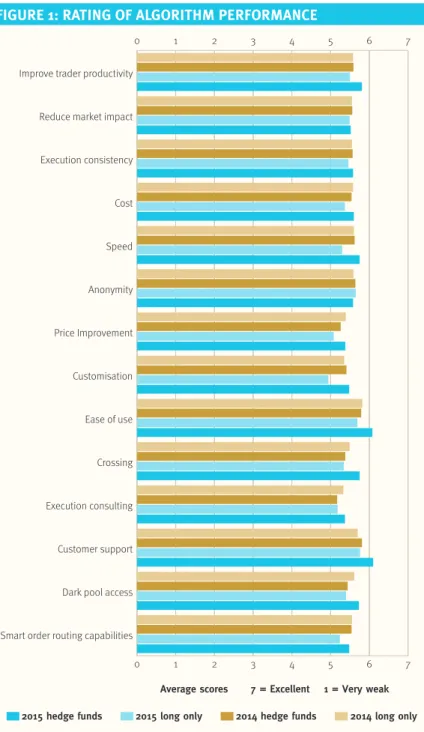
Figure 1 shows where the
gains in perceived
perfor-mance showed sharpest
improvement and it is
important to recognise that
the picture is not one of
across the board gains.
Rather particular areas
showed much improved
scores while some
catego-ries saw scores actually
decline.
Spotting improvements
Big gains in scores were
noted in four areas;
Customer Support,
Ease-of-Use, Internal crossing
capa-bilities and dark pool
access.
It is also worth noting
that while gains were not
large there was a very
sig-nificant difference in scores
between long-only traders
and those at hedge funds in
scores for Customisation. It
would therefore appear that
first and foremost providers
are doing more for their
hedge fund clients that
those clients believe helps
them use algorithms more
effectively and more easily.
0 1 2 3 4 5 6 7
Smart order routing capabilities Dark pool access Customer support Execution consulting Crossing Ease of use Customisation Price Improvement Anonymity Speed Cost Execution consistency Reduce market impact Improve trader productivity
Average scores 7 = Excellent 1 = Very weak 2015 long only
2015 hedge funds 2014 hedge funds 2014 long only
0 1 2 3 4 5 6 7
FIGURE 1: RATING OF ALGORITHM PERFORMANCE
54
nthetrade n issue 44 napr-jun 2015 n www.thetradenews.comareas among different client
types as well as possible
variations in the approach
of providers.
Concerns have been
expressed around the
effec-tiveness and toxicity of dark
pools generally. The
public-ity surrounding these kinds
of issues probably has a
opposed to traders in
long-only firms. Whether that
reflects attitudes to the
algorithmic business at
pro-viders or clients is not clear,
but the impact is.
Scores for Dark Pool
access and Internal Crossing
capabilities may also reflect
different attitudes to these
Providers are then offering
the levels of customer
sup-port necessary to make sure
that traders can benefit
from improvements being
made.
This virtuous circle of
progress seems to be much
more effectively established
with hedge funds as
0 1 2 3 4 5 6 7 Not answered More than $50 billion $10-50 billion $1-10 billion $0.5-1 billion $0.25-0.5 billion Up to $0.25 billion
Number of algorithm providers
Assets under management 2015 long only 2015 hedge funds
2014 hedge funds 2014 long only
FIGURE 3: AVERAGE NUMBER OF PROVIDERS USED BY AUM
Concerns have been
expressed around
the effectiveness and
toxicity of dark
pools generally.
FIGURE 2: REASONS FOR USING ALGORITHMS
2015 hedge funds
Trader productivity 10.4%
Reduced market impact 11.3%
Execution consistency 8.6% Commission rates 8.6% Speed 4.3% Anonymity 13.0% Price improvement 12.5% Customisation 4.7% Ease of use 16.3% Internal crossing 8.1%
56
nthetrade n issue 44 napr-jun 2015 n www.thetradenews.comMarket review: hedge funds
greater impact inside
long-only firms.
Hedge funds are more
likely to continue to focus
on services that work for
them worrying less about
reputation and more about
effectiveness.
Hedge fund traders may
also feel more comfortable
with their ability to achieve
the results they want
through effective use of
crossing and dark pools.
In contrast to these areas
of better scores, it is worth
noting that scores were
lower in three categories. In
each case the decline was
small, but nonetheless was
against the trend.
The three areas may also
be related from a trading
perspective being
Anonymity, Reducing
Market Impact and Smart
Order Routing capabilities.
Clearly anything that
compromises anonymity of
trades, whether the result of
the actions of smart order
routers or more generally, is
likely to compromise
mar-ket impact i.e. increase it.
While hedge fund traders
are generally less concerned
about this than long-only
traders, they are not
immune from concerns
about the effect that market
impact has on their overall
investment performance.
0 10 20 30 40 50 60 >12 8-12 5-7 3-4 1-2 % of respondents Number of providers 2015 long only 2015 hedge funds2014 hedge funds 2014 long only
FIGURE 4: NUMBER OF PROVIDERS USED
% of respondents
% of value traded using algorithms
0 10 20 30 40 50 60 70 80 Not answered 40% and over 30-40% 20-30% 10-20% 5-10% 0-5% 2015 long only 2015 hedge funds
2014 hedge funds 2014 long only
less than 25% among
long-only managers in the
Survey this year. Indeed
further analysis undertaken
by The Trade suggests that
for a significant proportion
of hedge funds the
percent-age of trading done
algo-rithmically now exceeds
75% of all trades by value.
Among these clients
algo-rithms are seen as providing
benefits across the
spec-trum in terms of
productiv-ity and performance
enhancement.
The trend among hedge
funds towards greater use of
A growing need
In periods when investment
gains are hard to find, the
sensitivity to costs of
trad-ing naturally increases. This
may have happened in 2014.
The growing level of
sat-isfaction has been matched
by growing use of
algorith-mic trading by hedge funds
that is illustrated in Figure 3.
This shows that nearly 70%
of hedge fund respondents
now use algorithms for more
than 40% of their trading.
This is up from just
under 50% a year ago and
compares with a figure of
0 20 40 60 80 100 0 20 40 60 80 100 VWAP TWAP Other Implementation shortfall (single stock) Implementation shortfall (basket) Dark liquidity seeking Participation
% of respondents
2015 long only 2015 hedge funds
2014 hedge funds 2014 long only
FIGURE 6: TYPES OF ALGORITHMS USED
and satisfaction with
algo-rithms may need further
reinforcement. If continued
however, it does suggest
that in the near future a
very high proportion of
market activity will be
con-ducted by machines rather
than humans. The question
will then be whether
long-only managers can afford
not to follow that trend,
and if not why not.
Ranking priorities
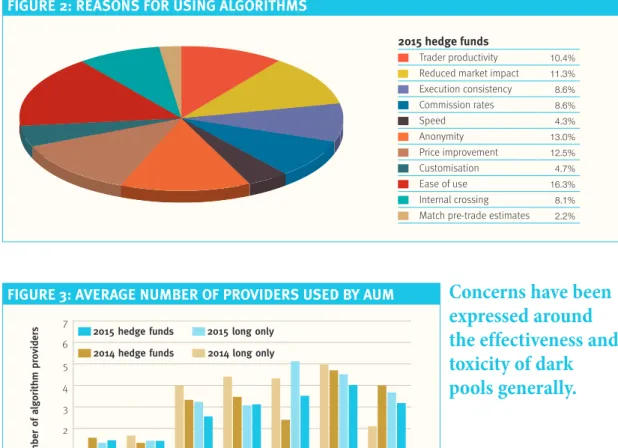
Figure 2 meanwhile shows
that client priorities remain
relatively consistent among
58
nthetrade n issue 44 napr-jun 2015 n www.thetradenews.comMarket review: hedge funds
are looking at the final
out-come – better prices –
rath-er than the means of
achieving them. Even so
traders understand the
importance of getting the
approach right and these
areas still attract nearly
25% of total mentions
between them.
Likewise Trader
Productivity continues to
rank in the top five
catego-ries with just over 10% of
all mentions, slightly down
from 2014 and perhaps
sur-prisingly less important for
this group than among
long-only firms.
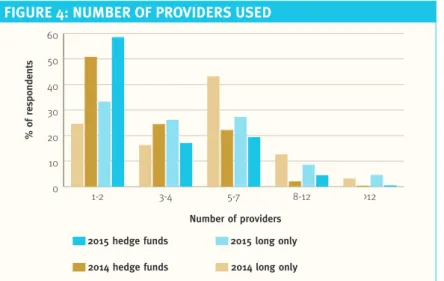
Less surprising is the
data shown in Figure 4
illustrating the number of
algorithmic providers used
by hedge funds. Given their
focus on prime brokers as
opposed to a long list, the
fact that 58% use only one
or two providers is not
unexpected. This
propor-tion has in fact increased in
2015, a trend towards
respondents compared with
2014. Once again, the
con-trast with the long-only
responses is more marked
in 2015 than it was a year
ago. Ease-of-Use has
become the single most
important aspect gaining
16.3% of all mentions by
respondents in terms of
their priorities.
This is well ahead of
2014 levels, when this
cate-gory ranked behind
Reducing Market Impact in
importance.
It is also markedly
differ-ent from long-only traders
where the category achieved
only 12.1% of all mentions.
Another area of growing
priority among hedge fund
respondents was Price
Improvement, which
ranked third overall this
year as opposed to sixth in
a year earlier. With Reduced
Market Impact and
Anonymity seeing declines
in the number of mentions,
it appears that hedge funds
Trader Productivity continues to rank
in the top five categories with just over
10% of all mentions, slightly down
from 2014.
appetite for adding new
algorithmic trading suites
seems very limited. Even
incumbents are under
pres-sure and certainly new
names seem likely to find it
tough to develop new
relationships.
It is also not especially
good news for EMS
provid-ers, for whom a major sales
point was the ability to add
new brokers’ trading suites
easily and cost effectively
once the initial
implemen-tation was complete.
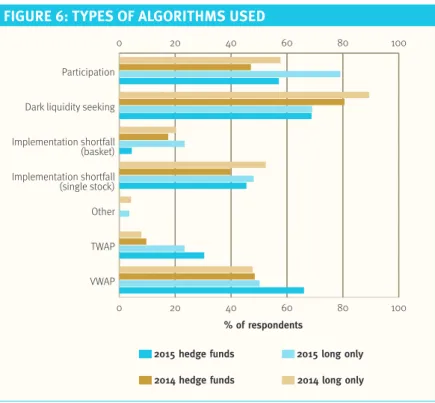
Finally Figure 6 shows
how different types of
algo-rithm are being deployed
by traders. Among hedge
fund traders there was
increased use of volume
and market driven
algo-rithms; in-line
participa-tion, TWAP and VWAP,
and less use of
liquidity-seeking and
implementa-tion shortfall algorithms.
This is somewhat
surpris-ing and it will be
interest-ing to see if the trend
con-tinues in the year ahead.
Overall, the message is a
very positive one for
pro-viders in place; clients are
more satisfied and making
greater use of algorithms.
For those without a major
market position however,
the challenge of gaining
market share seems to have
grown commensurately.
n
concentration seen more
generally within the prime
brokerage business.
Overall there does seem
to be a decline in the
num-ber of providers being
used. Based on work done
elsewhere by the magazine
it does seem that for many
clients differentiation
between providers is hard
to identify and this
encourages concentration
on the most familiar and
the most effective.
Figure 5 highlights a
similar trend from the
per-spective of number of
pro-viders based on assets under
management.
The figures show that for
funds with less than $500
million AUM one or two
brokers is the norm. This
group of managers is of
course a much higher
per-centage of hedge fund
respondents than long-only
managers.
Once over $500 million
AUM the number of
pro-viders increases quite
stead-ily. However, even when
AUM becomes very large,
the average number of
pro-viders is only four. This is
noticeably lower than the
average of five providers
among similarly sized long
only managers. Overall the
message for providers is far
from encouraging. The
Broker Roll of Honour: hedge funds
62
n thetrade n issue 44 napr-jun 2015 n www.thetradenews.comIllustration: iStock
Functional capabilities
The 2015 broker Roll of Honour
Survey respondents were asked to provide a rating for each algorithm provider on a numerical scale from 1.0 (very weak) to 7.0 (excellent), covering 14 functional criteria. In general 5.0 is the ‘default’ score of respondents. In total more than 20 providers received responses and the leading banks obtained dozens of evaluations, yielding thousands of data points for analysis.
Only the evaluations from clients who indicated that they were engaged in managing hedge funds have been used to compile the provider Rolls of Honour described below. Each evaluation was weighted according to three characteristics of each respondent; the value of assets under management; the proportion of business done using algorithms; and the number of different providers being used.
In this way the evaluations of the largest and broadest users of algorithms were weighted at up to three times the weight of the smallest and least experienced respondent.
In arriving at the overall Roll of Honour the scores received in respect of each of the 14 functional capabilities were further weighted according to the importance attached to them by respondents to the Survey.
The aim is to ensure that in assessing service provision the greatest impact results from the scores received from the most sophisticated users in the areas they regard as most important.
Finally, it should be noted that responses provided by affiliated entities are ignored and a few other responses where the respondent was not able to be properly verified were also excluded.
As in previous years, the 14 functional capabilities are grouped into three categories; those that impact on actual execution performance; those that effect direct and indirect costs of trading; and capabilities that are of a qualitative and more subjective nature.
relative lack of enthusiasm that contributed to the lacklustre overall result. In terms of the Roll of Honour names, both Deutsche Bank and Goldman Sachs have repeated their position from 2014 and are joined in 2015 by JP Morgan who performed generally strongly with a range of clients in various locations.
In terms of priority, the question ranked midway across all hedge fund respondents. Based on location the position was quite stable achieving mention from around one-third of respondents. Interestingly the position was slightly affected by size of respondent.
The very largest clients seem to consider this aspect of service as more important to them than the average would suggest. The implication would be that even with good scores, the ability to convert into new business is perhaps rather limited, with the best opportunities from the larger clients.
EXECUTION CONSISTENCY
ROLL OF HONOUR Deutsche Bank Goldman Sachs JP MorganWith hedge funds using algorithms for an ever increasing proportion of their trading, the ability to produce consistent performance across a range of different types of orders becomes more critical.
There is little benefit in terms of productivity or outcome if every trade has to be monitored closely to avoid an inconsistent outcome. 2015 scores from hedge funds were adequate rather than exceptional in this area.
The range of scores across all major providers was quite narrowly bound. The average of 5.58 ranked below the overall average score of 5.70, but among the 14 questions covered was 8th equal. Scores themselves incorporated a lower proportion of 7.0 (excellent) scores that other questions and it was this
REDUCING MARKET IMPACT
ROLL OF HONOUR Bloomberg ITG UBS
Reducing Market Impact remains an important priority for clients and a major way in which the performance of implementation shortfall algorithms is assessed. The level of mentions attached to this aspect was around one in eight of the total with nearly half of respondents naming it among their top four areas of interest. The level is generally consistent across respondents in all locations but is seen as being slightly more critical among the larger funds based on AUM, and slightly less important to clients doing more algorithmic trading based on value traded. The differences in each case are however not large. In terms of scores the position is a little disappointing. Overall the average score of 5.52 was somewhat disappointing, ranking 10th among the 14 aspects covered. The score was marginally lower than in 2014 and only 0.03 points ahead of the scores recorded by long-only traders.
Of the Roll of Honour names, Bloomberg and UBS repeated their strong showing of 2014. This year they were joined by ITG who received positive comments as well as strong scores in this as in some other areas.
1 Roll of Honour recipients are listed in alphabetical order throughout the survey.
64
n thetrade n issue 44 napr-jun 2015 n www.thetradenews.comBroker Roll of Honour: hedge funds
PRICE IMPROVEMENT
ROLL OF HONOUR
Bank of America Merrill Lynch ITG
JP Morgan
The importance of Price Improvement is something that varies significantly among different client groups.
Overall it saw a marked uptick in the proportion of mentions it gained, up from 9.5% of the total in 2014 to 12.5% in 2015. This implies that half of all respondents included it within their top four service considerations.
This was heavily influenced by clients in the UK, where it represented nearly 15% of mentions.
By contrast in North America the proportion of mentions was less than 10%. With the very largest clients ($10 billion AUM and over) it was less than 8% of mentions, implying less than one in three felt it important enough to include as a top four priority.
Whether the lack of interest reflects perceptions of whether it can actually be consistently delivered may be a factor. It may also have been affected by choice of algo provider. The question had a wider range of scores than many (nearly 1.20 points between best and worst) across major providers. Some providers saw a number of scores of 3 (weak) or below.
This suggests that some clients still see delivery failing to match expectations.
UK clients were among the most likely to be disappointed based on below average scores in this area
while those in North America were happiest. Larger clients gave lower scores, but that was in-line with their overall scoring pattern.
In terms of the Roll of Honour names, Credit Suisse and Morgan Stanley are two of the most experienced providers of algo services and their success in repeating their Roll of Honour positions of 2014 is not surprising. Equally JP Morgan performed well in this area, with a higher proportion of 7 (excellent) scores than others. In terms of priorities the level of interest has continued to grow, but in terms of mentions made the area is of less importance than might be expected.
Despite the issues and some negative publicity clients appear to believe that dark pools serve a valuable purpose.
They want their brokers to make effective use of the capabilities to deliver superior execution performance where possible.
DARK POOL ACCESS
ROLL OF HONOUR Credit Suisse JP Morgan Morgan Stanley
Dark Pool Access represents an area where there has been a
considerable shift between 2014 and 2015. Hedge fund clients in 2014 gave much lower scores than long-only managers, but this year the position was reversed.
The score from hedge funds was up by 0.29 points while that from long-only managers was down by 0.21 points, making a 0.50 point ‘swing’ overall.
It would seem that just as long-only funds realised some of the issues, hedge funds were getting more comfortable with the process of operating within dark pools, whether independent or broker operated.
Among different client groups, those from the UK gave somewhat
Scores were better among North American clients while larger clients also gave better scores.
EASE-OF-USE
ROLL OF HONOUR Bloomberg Tradebook JP Morgan
UBS
The importance of Ease-of-Use of systems is clear from the priorities.
The situation with North American clients is even starker. As in 2014 almost three-quarters of respondents considered it important enough to rank in their top four. UK based clients were not More hedge funds than long-only
firms are interested in how smart order routers actually work.
However, many simply rely on an analysis of the final outcomes in terms of execution prices.
Coupled with the statements from providers, this means that they do not choose to complete detailed analysis themselves. That in turn makes scoring difficult.
It may also explain the relatively narrow range of scores seen among leading providers and the relatively disappointing levels of scores recorded.
With an average of 5.48 the question ranked joint 11th out of 14 covered.
scores, which were well below the hedge fund average.
UK clients, who see this as an important area and are not fully satisfied with delivery, may represent a fruitful area for the Roll of Honour names to exploit a competitive opportunity.
Both JP Morgan and ITG achieved very solid scores with no
disappointments and repeated their Roll of Honour ranking from a year ago. Bank of America Merrill Lynch also earned high scores from a wide range of clients of different sizes and across various geographies.
SMART ORDER ROUTING
CAPABILITIES
ROLL OF HONOUR
Bank of America Merrill Lynch Bloomberg Tradebook JP Morgan
JP Morgan managed to repeat its Roll of Honour position again in 2015. The bank appears to be well regarded in terms of the transparency of its approach and elements of flexibility available to clients. This year it is joined in the Roll of Honour rankings by Bank of America Merrill Lynch and Bloomberg Tradebook.
The former along with JP Morgan also scored highly among long-only clients where both firms achieved Roll of Honour mention.
Bloomberg Tradebook appears to enjoy a strong reputation with its clients in a number of areas where technology and transparency may be important.
Overall this is not an area that ranks highly among clients in terms of importance.
Broker Roll of Honour: hedge funds
66
n thetrade n issue 44 napr-jun 2015 n www.thetradenews.comquite as convinced as to its relevance but even here almost half mentioned it, while European clients were somewhere between the two.
It was also the most important aspect among hedge funds doing more than 40% of the activity using algorithms, which is perhaps to be expected. If you are doing that much business the systems need to be easy to operate.
Part of success of Bloomberg Tradebook in this category is no doubt due to the close integration with the terminal.
However the performance is consistent from year to year, as well as across larger and smaller clients.
So the performance must be based on more than simply convenience.
JP Morgan and UBS also scored consistently well and merited a position in the Roll of Honour.
In terms of scoring, given the importance of the question, it is reassuring that scores were also excellent. With an average better than 6 (very good) it is clear that all providers have worked hard to develop their systems in response to this requirement. Among the major providers all average scores were better than 5.5. While the highest scoring providers clearly merit their position, the competitive opportunities are
limited by the fact that everyone is performing very strongly.
INTERNAL CROSSING
ROLL OF HONOUR
Bank of America Merrill Lynch ITG
UBS
Scores for Internal Crossing among hedge fund respondents were very strong. The average was 5.75 across all providers, placing this equal 4th among the 14 areas of service covered. Interestingly scores were well ahead of those seen in 2014 as well as being much higher than those from long-only clients.
As with dark pools it would appear that hedge funds were earlier in being nervous and now are earlier to regain their comfort with services. North American clients were less happy than those in the UK and Europe with the crossing capabilities. The average score of 5.33 from North American respondents was among the three lowest scoring areas of the Survey. However this was a function of a lack of excellent scores rather than an excess of weak scores. It appears as if clients see this as something that some firms do well, but perhaps none, even the Roll of Honour names does exceptionally.
In general crossing is seen as less important for hedge funds than long-only funds. However that overall trend, with around one-third of clients mentioning it as a top four item, hides some serious
differences in approach. Among UK based clients for example, crossing was mentioned by almost half of
COSTS AND COMMISSIONS
ROLL OF HONOUR Bloomberg Tradebook Instinet
ITG
As well as improving productivity of trading desks, clients certainly regard algorithmic trading as a way to reduce overall costs.
This may result from enhanced automation, fewer errors or better integration with other systems. It may also be achieved through paying lower commissions. The latter however is rarely the sole reason for algorithmic trading.
Costs taken as a whole are important, though not as important as some of the functional features offered by providers. Across all clients around one-third cite costs as a top four issue for them to consider.
This number is consistent by geography and type of manager. Interestingly for larger funds it appears slightly less important.
Of all 14 questions Costs ranked 7th in terms of scores achieved. The average of 5.6 was up 0.06 points on 2014 levels. It was however 0.23 points higher than the long-only score this year. Given respondents natural desire not to be too positive about costs, this score should be considered generally solid. Interestingly the scores across all leading players were very
comparable. One interesting feature was the difference between scores on this question and scores achieved overall by providers.
In some cases this was clearly the lowest scoring area of a client. This the respondents, and ranked 4th
out of all the categories considered. By contrast in North America less than 20% of respondents mentioned crossing. This lack of consideration could also be a factor in the generally weaker scores from those clients who are less engaged. Among the Roll of Honour names UBS matched its strong position among long-only firms and appears to have an excellent reputation for both structure and ability to deliver a strong performance. Bank of America Merrill Lynch and ITG also both scored strongly across a range of clients.
TRADER PRODUCTIVITY
ROLL OF HONOUR Bloomberg Tradebook Instinet JP MorganAchieving consistent improvements in Trader Productivity requires a combination of innovation, customer service and ease-of use, thereby bringing together a series of features in a consistent way.
It is not something that is realised quickly and hence a measure of consistency in the names appearing in the Roll of Honour is to be expected.
Instinet has achieved this consistency in two ways. First it has repeated its 2014 ranking in the Roll of Honour. Second it has been in the Roll of Honour in 2015 both for hedge fund and long-only clients. In the case of hedge funds it has been joined by Bloomberg Tradebook and JP Morgan this year.
In spite of being unglamorous, Trader Productivity has always been
regarded as important by most clients, across all types, geographies and sizes.
Indeed it remains one of the cornerstones of algorithmic trading take-up. Among the very largest respondents it accounts for one in seven of the total mentions and ranks highest of all aspects among funds with AUM in excess of $10 billion. It is also important to North American clients.
Scores remain very strong, which means that it is hard for providers to move clients. The average of 5.81 was the 3rd highest score of 14 and was well up on 2014. It was also well ahead of scores from long-only clients.
Broker Roll of Honour: hedge funds
68
n thetrade n issue 44 napr-jun 2015 n www.thetradenews.comall clients including hedge funds. What was noticeable was that North American clients were much more concerned about it than those in the UK and elsewhere. In North America Anonymity accounted for one-in-six mentions.
Scores from North American clients were slightly below the overall average and much closer to it than scores from UK clients in particular. Even so the overall level of scoring was somewhat weak for an area of relative client
importance.
The average was only 5.58 and this was equal 8th of the 14 questions.
This is perfectly acceptable but may leave open some opportunities for Roll of Honour names and others to gain market share.
In fact there was quite a wide spread of scores across the leading banks, though few were noticeably 2015. The excellent results were a
combination of all leading providers doing a good job and some doing well enough to achieve a high proportion of 7 (excellent) scores. The proportion of 7 scores was well ahead of that seen on any other question, including Ease-of-Use. Clients clearly appreciate the service that they are receiving. Competitively the difficulty is that among the major players no one is performing poorly.
As such even Credit Suisse the only Roll of Honour name to have repeated from 2014 will find it hard to turn their good scores into additional business.
The very best scores were seen among the smaller clients. This is consistent with other surveys but still may be a surprise given the efforts that providers make to satisfy their larger and more commercially significant customers. It is also the case that scores from continental European and Asian clients were higher than those from respondents in the UK and North America.
ANONYMITY
ROLL OF HONOUR
Bank of America Merrill Lynch Goldman Sachs
ITG
As was noted in the Market Review hedge fund traders appear to be more focused on the outcomes of trading rather than the techniques used to achieve them. Anonymity nonetheless account for some one-in-eight of mentions in terms of priority and remains a key factor for suggests that other scores may
have been negatively impacted by a feeling that clients were not getting as good value for money.
On the other hand the Roll of Honour names all saw this area as a solid performer in terms of scores achieved and as such merit the accolade they have received.
CUSTOMER SUPPORT
ROLL OF HONOUR Credit Suisse Instinet Morgan Stanley
Scores for Customer Service were once again excellent among hedge fund clients. The average of 6.1 was the highest seen in the survey of all 14 questions. As important scores were well ahead of 2014 levels and well ahead of long-only scores in
still not an across the board interest. Scores were also good. The average across all providers was 5.75, and this ranked 4th equal among all the areas covered. With very few leading providers scoring below 5.50 it would appear that clients are generally of the view that services are broadly very good from all providers.
A slight edge in these
circumstances is nice to have but does not appear to be critical.
CUSTOMISATION
ROLL OF HONOUR
Bank of America Merrill Lynch Bloomberg Tradebook Citi
Given that new product initiatives tend to go in waves, it is not surprising that scores for Customisation should vary from that something has gone well or
badly. It is to the credit of the Roll of Honour names that they are able to perform consistently well enough while at the same time generating a number of 7 (excellent) scores that imply a number of instances where performance has been particularly strong.
In the case of Morgan Stanley, who repeated their success of 2014 again this year, the level of performance is clearly very high. Turning it into more business is likely to prove harder however, given the generally solid scores seen by competitors and difficulties in measurement.
It is also the case that in terms of priority, it only attracts a small number of mentions, again among clients who have a specific trading based interest. While hedge funds may be generally more sensitive to speed than long-only traders, it is weak and all averaged better than
the default score of 5 (good). Goldman Sachs managed to repeat their Roll of Honour ranking from 2014 and were joined this year by ITG and Bank of America Merrill Lynch, both of whom received a number of excellent scores and positive comments from clients.
SPEED AND LATENCY
ROLL OF HONOUR Goldman Sachs JP Morgan Morgan Stanley
Latency is very hard for clients to assess unless they have a specialist interest that demands that they determine how to assess different brokers.
As a result much of the perception is based on anecdotal instances where it is very obvious
Broker Roll of Honour: hedge funds
70
n thetrade n issue 44 napr-jun 2015 n www.thetradenews.comeven though they rank last of the 14 categories with an average of 5.37. The scores were better than in 2014, gaining at a level consistent with the overall results. They were also better than those recorded by long-only clients. However for the most part client indifference is reflected in the scores. There are very few that move outside the range of 5 (good) and 6.0 (very good).
In such circumstances it would appear to be an error to expend too much human effort in explaining trading performance even though the nuances might require it.
Rather success seems to be going to those firms that have built the necessary reporting into their systems to allow clients to do whatever analysis they want for themselves.
That may deliver sustainable advantage without incurring too much cost. However it is unlikely to result in clients feeling there is value that can be added from providers in this area.
EXECUTION CONSULTING
AND ANALYTICS
ROLL OF HONOUR Bloomberg Tradebook Credit Suisse ITGExecution Consulting remains something of an enigma as far as hedge fund clients are concerned. Logically they should be best positioned to benefit from helpful analysis from brokers about how they are performing and what they can do to improve results. Unfortunately this is not something that they appear interested in, collectively as a group or as individual clients. While the level of mentions is higher than it was among long-only clients it is still extremely modest. Indeed among the very largest clients not one mention was made of it within the top four priorities.
Set against this apparent indifference the scores cannot be seen as especially good or bad year to year and the names of the
Roll of Honour change with them. This year saw Citi perform extremely well in this area, in contrast to less good scores in some other areas. Their average, like that of the other names included in 2014 reflected strong scores from a range of different sizes of clients across different regions.
Scores generally for
Customisation were not among the best. However they were up on 2014 levels and noticeably stronger than those received from long-only clients.
At an average of 5.48 they ranked 10th of the 14 questions covered. UK based clients appeared to be particularly disappointed with the level of customisation available to them and even respondents conducting a high proportion of business scored below average.
Overall then some progress but still work to be done to convince clients that investment in meeting specific needs will be forthcoming. At the same time Customisation is not an important factor for most clients.
Overall across all geographies, interest in it was not seen as a priority for many respondents; less than one in five overall. There was more interest among the larger respondents with the subject garnering 40% of mentions among the very largest respondents.
These more demanding clients would seem the most likely to get what they need from their existing providers.
RESPONSE NUMBERS
ROLL OF HONOUR BNP Paribas Jefferies ConvergEx
Some firms that have a very large long-only business are increasingly seeing business from asset managers that are extending from that traditional approach into the alternative asset space.
The growth of liquid alternative products such as US mutual funds or UCITS means that some individuals within long-only firms are now trading on behalf of what are in effect hedge funds. Whether that will result in a further extension into the hedge fund space directly
Ones to watch
In previous years the Survey has highlighted names to watch in
each category of service. With the greater number of questions
in this year’s Survey and the presentational split between
long-only respondents and hedge funds, continuing previous
practice would have risked dilution of the value of the Roll of
Honour mentions.
As a result, and following the example of the Awards
presented by The Trade magazine each year, Ones to watch
have been put into two simple categories. First are those firms
that seem, based on response numbers to be winning clients.
Second are those that, based on scores achieved, appear to be
highly regarded by the clients that they have.
Broker Roll of Honour: hedge funds
72
n thetrade n issue 44 napr-jun 2015 n www.thetradenews.comthe things that matter most to clients. To qualify for a Roll of Honour position providers must have a relatively high proportion of 7 (excellent) scores.
Without these, their performance would be interesting, but unlikely to be good enough to merit the accreditation as one to watch.
It is also worth noting that in the case of ConvergEx this is the second year in succession that they have received very good scores.
However, even in 2015 the level of responses had not grown sufficiently to enable them to qualify for consideration within the main rankings. That is testimony to just how hard the market is in 2015. n
CLIENT SCORES
ROLL OF HONOUR BNP Paribas ConvergEx Societe Generale As well as having a limited number of relevant responses, most of the smaller names have some areas that are definitely stronger than others.That makes an assessment of overall performance harder to standardise. Therefore the names mentioned in the Roll of Honour are those that have done best in the areas of greatest importance to clients. That is not to say they are good at everything, but it does mean that they are very good at is not necessarily clear but for some
names the possibility certainly exists. In other cases a hedge fund business built around prime brokerage offers scope for global expansion. So BNP Paribas, whose prime broker business has a very heavy US focus may have limited algorithmic trading responses currently but can grow further in the future.
What is worth noting is that there have been no new entries into the list of providers receiving responses this year from 2014.
That suggests that opportunities for growth are now seen as extremely limited within the space.
That will affect all market participants to some extent going forward.