Do Learners’ Characteristics Matter? An Exploration of Mobile-learning Adoption in Self-directed Learning
Sahar Karimi, PhD
Abstract
This paper aims to identify individual characteristics that motivate learners to use mobile-learning. It sheds light on our current knowledge by a) examining an m-learning adoption model which accounts for learners’ characteristics (learning style and personal innovativeness) in addition to previously studied mobile platform characteristics and b) considering the context in which learning occurs (formal and informal). A framework has been introduced and empirically tested. Results suggest that individuals’ learning style and perceived playfulness influence m-learning usage in both learning situations; while performance expectancy and personal innovativeness are only influential in specific learning contexts. This study highlights the role of learners’ characteristics in m-learning adoption and emphasizes the importance of distinguishing between various types of m-learning. This multi-disciplinary research enriches m-learning literature and offers practical implications for educators using mobile technologies as well as developers of virtual learning platforms.
Keywords: mobile-learning, e-learning, web-based learning, technology adoption, learning style
1. Introduction
In recent years, increase in the use of mobile technologies has affected various service sectors such as banking, tourism, and library research. Mobile devices, as a consequence of this growth, have entered into museums, workplaces and classrooms supporting learners inside or outside the formal education systems (Liu, Li, and Carlsson 2010). Higher education has also been influenced by the use of mobile devices for educational purposes. Advances of mobile technology facilitates moving from traditional learning which was limited with time and space to learning embedded into our everyday environment. Shift of focus from teaching to learning, where education involves learners’
engagement both within and outside the classroom (Taylor et al. 2006), also escalates the importance of mobile platform in education.
Mobile learning (m-learning) which is defined as e-learning using mobile devices (Ktoridou and Eteokleous 2005; Sad and Göktas 2014) such as smart phones, personal digital assistants (PDAs) and tablets, allows learners to learn anywhere and anytime. It is an effective component of learning as today’s learners are mobile and frequently utilize mobile devices to study on the move (El-Hussein and Cronje 2010; Sarrab, Elbasir, and Alnaeli 2016). This can clearly affect their learning experience by making ubiquitous learning possible (Sandberg, Maris, and Geus 2011) and turning them to active participants of learning process, rather than passive receivers of knowledge (Looi et al. 2010). M-learning enriches the learning process by offering an active learning tool (Ozdamli 2012), collaborative learning opportunities (Lipponen et al. 2003; Peck, Deans, and Stockhausen 2010), and flexible learning which is ‘just enough, just in time, just for me’ (Peters 2007; Abu-Al-Aish and Love 2013). It can supports blended-learning environments in which students become active and interactive learners (Dziuban, Hartman, and Moskal 2004) and facilitate self-directed and informal learning (Taylor et al. 2006). Students would be able to engage with learning when they are in their best cognitive ability (Bonnici et al. 2014). M-learning can also be individualized and adopted differently based on the needs of learners, making the learning process more efficient and effective (Sun, Joy, and Griffiths 2007). It has, therefore, the potential to help achieving educational goals (Sad & Goktas 2014). However, adoption of web-based applications in higher education is still encountered by challenges (Macharia and Pelser 2014). It is therefore crucial to understand what motivates or discourages learners and educators to use them.
There is a growing body of literature that explores the use of mobile platforms in higher education. However, our current understanding is mostly related to its technological characteristics (Sarrab, Elbasir, and Alnaeli 2016) or motivational factors that influence educators’ use of m-learning (Sad and Göktas 2014), with merely a handful of studies examining learners’ motivational factors. Educators and learners are both important components of m-learning adoption. Nevertheless, there is little known about students’ preferences for online learning activities (Bonnici et al. 2014). It is essential to explore the use of mobile devices for learning purposes from their perspective.
As Terras and Ramsay (2012, p827) have pointed out, “the individual can shape and be shaped by the context”. Ignoring the role of context and individuals is therefore deficient. M-learning research ought to examine the relationship between learners and their M-learning context. This paper attempts to explore factors that motivate learners to use mobile devices in both formal and informal learning contexts. Although mobile technology is utilized very differently in formal and informal learning (Laurillard 2007), previous research does not differentiate between learners' intention to use m-learning in these two settings. The focus of existing literature is mainly on formal learning (Looi et al. 2016) in which virtual learning platforms are used on mobile devices (see for example Wang, Wu, and Wang, 2009; Liu, Li and Carlsson 2010). However, learners not only use virtual learning platforms but also access online information to facilitate their learning. Despite being informal, this is an important aspect of learning process. There is insufficient empirical evidence for m-learning usage in informal learning (Jones, Scanlon and Clough 2013). This could be due to the difficulty of capturing use of technology in this context (Pachler 2007). As the design of mobile learning activities for informal contexts is scaling up (Looi et al. 2014), this environment needs further investigation (Kearney et al. 2012). Moreover, it is known that individual differences of learners affect self-directed learning (Kreber 1998). Extant research neglects the impact of individual characteristics (i.e. learning style) on m-learning usage which is highly dependent on self-direction. This study contributes to current literature by considering and examining the relationship between the context of learning and learners’ characteristics. Accordingly, it introduces and tests an m-learning adoption framework which:
• Distinguishes between two learning contexts in which m-learning occurs (informal and formal learning)
• Examines the impact of learners’ characteristics (learning style and personal innovativeness) on m-learning adoption, in addition to system characteristics
2. Theoretical framework 2.1. Learning context
The way mobile devices are used by learners in order to perform different types of learning activities is underexplored in previous research. Self-directed learning, which is the ability of learners to direct their own learning (Hartley and Bendixen 2001), is an important aspect of online
learning environments (Song and Hill 2007). Mobile learning facilitates self-directed learning as it embraces considerable amount of learning that happens outside classrooms and is structured by learners themselves (Sharples, Taylor, and Vavoula 2005). Such self-directed learning activities can be supported by teacher-supplied or learner self-identified resources (Wong 2012). Hence m-learning can occur in both formal and informal forms. Formal m-learning occurs when the learner is encouraged to manage his/her own learning process within the constraints of a designed curriculum and teacher-supplied resources (Marsick and Watkins 2001). It includes the use of virtual learning environments through mobile devices where learning objectives and resources are in the control of the institution. Informal learning involves any activity that occurs outside the curricula of educational institutions, or the courses or workshops offered by educational institutions (Livingstone 1999). It is related to the use of publically available online resources through mobile devices with the intention of learning. Mobile devices facilitate learning by offering learners the possibility to switch from one scenario or context (i.e. formal and informal learning) to another easily and quickly (Wong 2012). Although students may switch between them, it is important to separate these settings in order to understand their adoption behaviour. This study explores the use of mobile technology for two types of learning: formal and informal.
2.2. Models of m-learning adoption and their antecedents
In order to examine learners’ motivation to use m-learning, adoption models are utilized. Various models have been previously developed to examine users’ acceptance and intention to adopt a new technology. Recently, these models have found their way to studies of e-learning (Macharia and Pelser 2014; Renda dos Santos and Okazaki 2015) and m-learning. For example, technology acceptance model (TAM), introduced by Davis (1989), has been utilized to explore m-learning acceptance (Ju, Sriprapaipong, and Minh 2007; Liu, Li, and Carlsson 2010; Tan et al. 2014). The unified theory of acceptance and use of technology (UTAUT), proposed by Venkatesh, Morris, Davis and Davis (2003), has also been adopted in this line of studies (Wang, Wu, and Wang 2009). This comprehensive model integrates eight prominent models of technology adoption research, including: the theory of reasoned action (TRA) (Fishbein and Ajzen 1975), the technology acceptance model (TAM) (Davis 1989), the theory of planned behaviour (TPB) (Ajzen 1991), the combined TAM and TPB (C-TAM-TPB) (Taylor and Todd 1995a), the motivational model (MM)
(Davis, Bagozzi, and Warshaw 1992), the model of PC utilisation (MPCU) (Thompson, Higgins, and Howell 1991), the innovation diffusion theory (IDT) (Rogers 2003; Moore and Benbasat 1991) and the social cognitive theory (SCT) (Bandura 1986). UTAUT suggests that performance expectancy, effort expectancy, social influence, and facilitating conditions are direct determinants of behavioural intention. Studies of m-learning have incorporated new concepts of perceived playfulness and self-management of learning into this model. While playfulness was consistently found influential, results for self-management are contradictory. A study by Wang and colleagues (2009) reported a significant effect; whereas Lowenthal (2010) didn’t found a significant influence. Later, Abu-Al-Aish and Love (2013) added personal innovativeness to antecedents of intention to use m-learning. As suggested by Pedersen and Ling (2003) and Wang, Wu, and Wang (2009), the main constructs of UTAUT may not be fully relevant to m-learning adoption. It is, in fact, essential to test and verify this model by modifying and extending it with other determinant factors. This paper follows the above literature and introduces and empirically tests an m-learning adoption model for different learning contexts. The definition of UTAUT constructs included in the model and their relation to m-learning adoption are explained as follows.
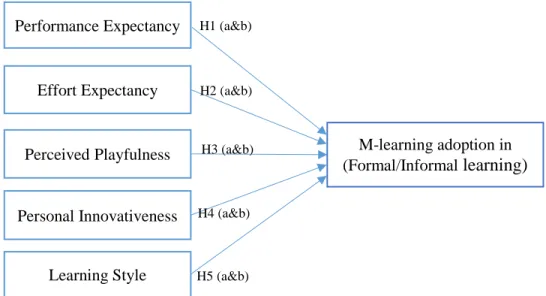
Performance expectancy defines the extent to which a person believes using m-learning would improve his/her learning performance and productivity. It reflects on the usefulness of m-learning by enabling faster and more flexible learning activities which can enhance learning effectiveness (Wang, Wu, and Wang 2009). Effort expectancy is the degree of ease of use that individuals associate with m-learning. Learners are more willing to use m-learning if they believe that the technology can be easily used (Liu, Li, and Carlsson 2010). This is particularly important due to the incompatibility of certain e-learning interfaces with mobile platform which may act as a barrier to m-learning adoption (Wang, Wu, and Wang 2009). It is therefore expected that performance expectancy and effort expectancy influence m-learning adoption (Fig 1).
In addition to extrinsic motivational factors of performance expectancy and effort expectancy which focus on the overall performance of an activity, literature suggests that perceived playfulness of a system can also predict its acceptance and usage (Moon and Kim 2001; Lin, Wu and Tsai 2005; Ahn, Ryu, and Han 2007). Playfulness, as an intrinsic belief, is concerned merely with the process of performing the activity (Moon and Kim 2001). Some researchers define playfulness as a motivational characteristic of individuals, being a stable trait (Webster and
Martocchio 1992). This research, however, follows a line of literature that refers to playfulness as a state. Unlike traits, states are not static and can change by the interactions between individuals and situations. Playfulness is therefore defined as “a situational characteristic of the interaction between an individual and a situation” (Lin, Wu and Tsai 2005). It is users’ subjective experience of human-system interaction and reflects their intrinsic belief in system adoption (Moon and Kim 2001). Playfulness as a user motivation factor was introduced to the Technology Acceptance Model by Moon and Kim (2001). It has been shown to influence intention to use virtual learning environments (Wang, Wu, and Wang 2009; Huang et al. 2012; Codish and Ravid 2015). This concept is built on intrinsic motivation theory (Deci and Ryan1975) and flow theory (Csikszentmihalyi’s 2000). Playfulness includes three dimensions: perceived degree of focused attention, curiosity, and enjoyment during interaction with m-learning environment (Moon and Kim 2001; Wang, Wu and Wang 2009; Codish and Ravid 2015). Focused attention is related to concentration on the task and being absorbed in the learning activity. It is centering of attention on a limited stimulus field (Csikszentmihalyi 2000). Curiosity dimension suggests arousal of individual's sensory or cognitive curiosity (Malone 1981). Finally, enjoyment reflects the sense of pleasure in undertaking a learning task (Huang et al. 2012). Although these dimensions are linked, on their own, they may not capture the total experience of users (Moon and Kim 2001). For example, involvement may occur in a stressful situation which is not enjoyable. Playfulness has been incorporated into the research model (Fig 1) due to its impact on m-learning adoption (Huang et al. 2012).
Accordingly, following hypotheses are tested:
H1a: Performance expectancy will positively influence intention to adopt m-learning for formal learning.
H2a: Effort expectancy will positively influence intention to adopt m-learning for formal learning.
H3a: Playfulness will positively influence intention to adopt m-learning for formal learning. H1b: Performance expectancy will positively influence intention to adopt m-learning for informal learning.
H2b: Effort expectancy will positively influence intention to adopt m-learning for informal learning.
H3b: Playfulness will positively influence intention to adopt m-learning for informal learning.
Fig. 1. Research model: antecedents of m-learning adoption in formal and informal learning contexts
2.3. Learners’characteristics
M-learning is largely self-directed and learners “find their own way to make a learning situation personalized and sensitized to them” (Park, Parsons, and Ryu 2010, p57). Learners are active and central participants in this process. Therefore, their individual characteristics may act as a facilitator or barrier to their motivation to use the m-learning environment. Understanding the role of individual differences in self-directed learning is essential (Kreber 1998). A number of recent studies has considered the role of learner characteristics such as age, gender and previous experience of using a mobile device in m-learning adoption (Park, Nam and Cha 2012; Liu, Li, and Carlsson 2010).
Personal innovativeness, as an individual characteristic, was found to be a determinant factor in m-learning adoption (Abu-Al-Aish and Love 2013). Personal innovativeness is defined as individual’s willingness to try new information technology (Agarwal and Prasad 1998). Individuals with higher level of innovativeness are more likely to develop positive beliefs and engage with a new technology compared to those with a lower level of innovativeness (Lu, Yao
Performance Expectancy Effort Expectancy PerceivedPlayfulness Personal Innovativeness Learning Style M-learning adoption in (Formal/Informal learning) H1 (a&b) H3 (a&b) H4 (a&b) H5 (a&b) H2 (a&b)
and Yu 2005). This has been previously examined in other contexts and more recently in m-learning adoption (Liu, Li, and Carlsson 2010; Wang, Wu, and Wang 2009; Abu-Al-Aish and Love 2013). Due to its significant effect, personal innovativeness has been included in the model (Fig 1).
H4a: Personal innovativeness will positively influence intention to adopt m-learning for formal learning.
H4b: Personal innovativeness will positively influence intention to adopt m-learning for informal learning.
Learners also differ in their learning style. Developing virtual learning environments that cater for the varied needs of different learners is challenging (Wang et al. 2006). New delivery mechanisms which focus on student-centred, interactive and asynchronous teaching methods are taking a prominent role in higher education (Sun, Joy, and Griffiths 2007). Therefore, it is increasingly more important to understand the needs of different learners with diverse learning abilities.
Despite its importance, there is little known about the influence of learning style on m-learning usage. The concept of m-learning style has emerged from education discipline. Various definitions have been suggested. According to Butler (1987), learning style indicates a natural method used by the learner to understand the self, the environment, and relation between self and environment. Honey and Mumford (2000, p6) have defined it as a “description of the attitudes and behaviours that determine our preferred way of learning”. Gregorc (1979) and Entwistle (2013) suggest that learning style is the learner preference for particular learning strategies in a specific learning condition. This unique way of learning includes strategies used for problem solving and decision making as well as restrictions encountered in a specific learning situation (McDermott and Beitman 1984; Wang et al. 2006).
The impact of learning style on e-learning adoption has been found in prior research (Lu 2012; Ford and Chen 2000). For example, Magoulas, Papanikolaou and Grigoriadou (2003) examined the influence of learning style on adaptation of web-based learning systems. Chou and Wang (2000) found that it also effects e-learning effectiveness. Learning style is a significant factor that determines student achievement in an e-learning environment (Wang et al. 2006). Sein and Robey (1991) reported that those with preference of thinking and acting learning styles
perform better in computer training methods. On the other hand, Gunawardena and Boverie (1993) found no connection between learning style and use of media. To date, there is limited empirical research on the use of mobile devices for different types of learners (Chen and Lee 2014). One of the only studies conducted (i.e. Lin, Lu and, Liu 2013) suggests a relationship between learning style and m-learning. This paper examines the impact of learning style on m-learning adoption.
There are various classifications of learning styles proposed in the literature. For instance, Felder and Silverman (1988) have classified learners based on four dimensions: active-reflective, sensing-intuitive, visual-verbal and sequential-global. Kolb’s experiential learning theory (ELT) is a holistic theory of learning that identifies learning style differences among individuals (Kolb 1984; Kolb and Kolb 2005). It defines a learning style in relation to the extent of being concrete experience, reflective observation, abstract conceptualization, and active experimentation. Kolb learning style is adopted in this research as it is a well-established model which has been widely used and validated (Baker, Jensen, and Kolb 1997; Herz and Merz 1998; Specht and Sandlin 1991; Chi-Ching and Noi 1994). It also has application across different disciplines such as business and management and Information Systems (Kolb and Kolb 2009) and is the most commonly used learning style tool in e-learning studies (Wang et al. 2006; Dringus and Terrell 1999; Federico 2000; Terrell 2002). Kolb’s learning style framework has important implications in studying learners’ ability and willingness to adopt self-directed learning (Kreber 1998), yet not being examined in m-learning context.
This classification examines two independent dimensions: Concrete Experience (CE)-Abstract Conceptualization (AC) and Active Experimentation (AE)-Reflective Observation (RO). Four learning styles are defined based on these dimensions, namely: Accommodator, Diverger, Assimilator, and Converger. Learners with an accommodating style have CE and AE as dominant learning methods. These individuals are more connected to their feelings rather than logical analysis. They get actively engaged in the learning process instead of being passive receivers of knowledge. In addition, they rely on information from people and environment to solve problems rather than their own analysis (Wang et al. 2006). Therefore, these individuals are more likely to get actively involved in the learning process and find answers by searching for information and opinion of others through various sources available on the Internet. Consequently, it is expected that they use m-learning in informal leaning context.
Assimilating learning style has AC and RO as dominant learning methods. These learners are more successful when they analyze a wide range of information and combine them in a concise and logical way. They are more involved with ideas and concepts and do not rely on people (Wang et al. 2006). They enjoy reading in an environment that provides them with a deeper understanding. These individuals perform the best in web-based learning environment as reported by Wang et al. (2006). They may be more inclined to get engaged in self-directed learning and particularly use of virtual learning environments as they value concept more than practice and their preferred learning method involves taking time to think and reflect. As suggested by Kolb and Kolb (2009, p319), “reflection requires space and time for it to take place”. Therefore, it is expected that these learners engage in m-learning by reading and reflecting on various resources in order to develop a deep understanding of topics. This, in fact, links closely to the formal context of m-learning where they can use provided learning materials in an interactive, self-selected manner and take their own pace to read and reflect.
Accordingly, it is expected that learning styles of accommodating and assimilating have an impact on m-learning adoption (Fig 1). As diverging style is associated with generation of ideas, listening and group work; and converging style is focused on practical application of theory, they have limited application in m-learning usage and are not considered in the proposed model. Following hypotheses are examined:
H5a: Assimilating learning style positively influences adoption of m-learning for formal learning.
H5b: Accommodating learning style positively influences adoption of m-learning for informal learning.
3. Method
3.1. Data collection and procedure
In order to test the research model, a questionnaire was designed. Data was collected from 130 undergraduate students enrolled in marketing and business management programs in a UK university, in 2015. Participants were in their first and third year of studies. There were 62 male and 68 female in the sample, with their age ranging from 18 to 25 (mean= 20.9 SD= 1.69).
A link to the online questionnaire was sent to students. In the introductory section of the questionnaire, students were introduced to the concept of m-learning. They were then familiarized with m-learning usage in formal learning (using virtual learning platforms, i.e. Blackboard, to access learning materials provided by tutors) and informal learning (using mobile platform to access resources that are available online to support their learning). Respondents self-administered the questionnaire.
3.2. Research design and measures
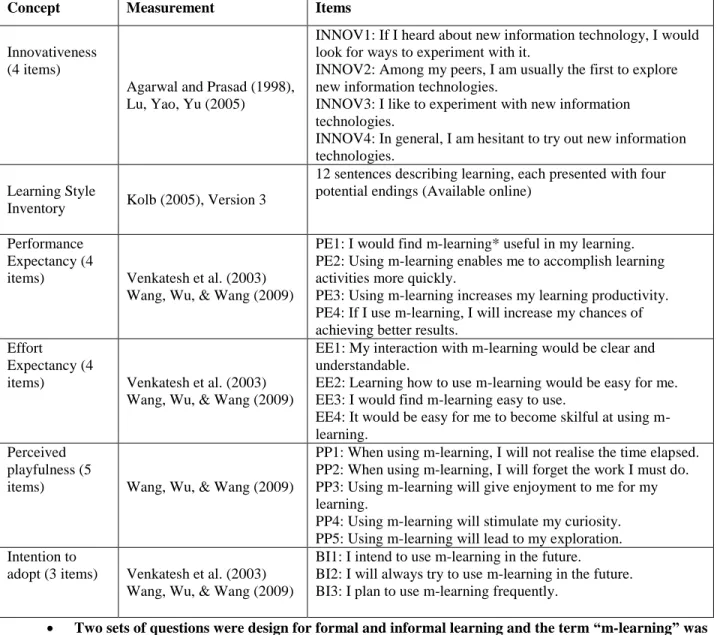
Questionnaire included questions on participants’ demographics, learning style, personal innovativeness, their perception of performance expectancy, effort expectancy, playfulness of m-learning as well as intention to adopt m-m-learning for formal and informal m-learning. Previously validated measurements were used in this study (see table 1). In order to distinguish between m-learning in formal and informal contexts, two sets of questions were designed and included in the questionnaire. Measurements related to perceived characteristics of the environment and intention to adopt (see table 1) were adapted for each of the two contexts; those associated with formal learning referred to m-learning as “use of mobile devices to access educational platforms (i.e. blackboard)”, while informal learning questions were framed as “use of mobile devices to access online materials that support my learning”. All participants answered to all questions. Items were presented in random order. Likert scale items (ranging from 1 = Strongly Disagree to 7 = Strongly Agree) were utilized. Kolb’s Learning Style Inventory has been designed to measure the degree to which individuals display different learning styles derived from experiential learning theory. Kolb’s learning style tool includes 12 sentences which describe learning. Each sentences is presented with four potential endings which participants rank based on which ending is most or least relevant to them, in the order of 4, 3, 2, and 1, without repeating or skipping any. Kolb’s learning style inventory has been widely used as a tool to identify individuals’ learning style (Herz and Merz 1998; Specht and Sandlin 1991; Chi-Ching and Noi 1994) and has been translated into many languages (Kolb 2005). It is the most commonly used instrument in e-learning studies (Wang et al. 2006; Dringus and Terrell 1999; Federico 2000; Terrell 2002). The updated version of this scale shows good internal consistency reliability across a number of different populations with Cronbach's alpha ranging from .78 to .84 (Kolb 2005, Kayes 2005; Wierstra and DeJong’s 2002). Similarly, the internal consistency of scales adopted for personal innovativeness, performance
expectancy, effort expectancy, playfulness and behavioural intention to adopt have been shown to be high in previous studies (see for example: Lu, Yao and Yu 2005; Wang, Wu and Wang 2009; Venkatesh et al. 2003). In this paper, all scales have a very good internal consistency with Cronbach's alpha coefficient ranging from .82 to .92.
Table 1. Measurements of the study
Concept Measurement Items
Innovativeness (4 items)
Agarwal and Prasad (1998), Lu, Yao, Yu (2005)
INNOV1: If I heard about new information technology, I would look for ways to experiment with it.
INNOV2: Among my peers, I am usually the first to explore new information technologies.
INNOV3: I like to experiment with new information technologies.
INNOV4: In general, I am hesitant to try out new information technologies.
Learning Style
Inventory Kolb (2005), Version 3
12 sentences describing learning, each presented with four potential endings (Available online)
Performance Expectancy (4
items) Venkatesh et al. (2003)
Wang, Wu, & Wang (2009)
PE1: I would find m-learning* useful in my learning. PE2: Using m-learning enables me to accomplish learning activities more quickly.
PE3: Using m-learning increases my learning productivity. PE4: If I use m-learning, I will increase my chances of achieving better results.
Effort
Expectancy (4
items) Venkatesh et al. (2003)
Wang, Wu, & Wang (2009)
EE1: My interaction with m-learning would be clear and understandable.
EE2: Learning how to use m-learning would be easy for me. EE3: I would find m-learning easy to use.
EE4: It would be easy for me to become skilful at using m-learning.
Perceived playfulness (5
items) Wang, Wu, & Wang (2009)
PP1: When using m-learning, I will not realise the time elapsed. PP2: When using m-learning, I will forget the work I must do. PP3: Using m-learning will give enjoyment to me for my learning.
PP4: Using m-learning will stimulate my curiosity. PP5: Using m-learning will lead to my exploration. Intention to
adopt (3 items) Venkatesh et al. (2003) Wang, Wu, & Wang (2009)
BI1: I intend to use m-learning in the future.
BI2: I will always try to use m-learning in the future. BI3: I plan to use m-learning frequently.
• Two sets of questions were design for formal and informal learning and the term “m-learning” was adapted for each leaning context
4. Analysis
In order to test the research hypotheses and examine the impacts of performance expectancy, effort expectancy, perceived playfulness, personal innovativeness and learning style on m-learning
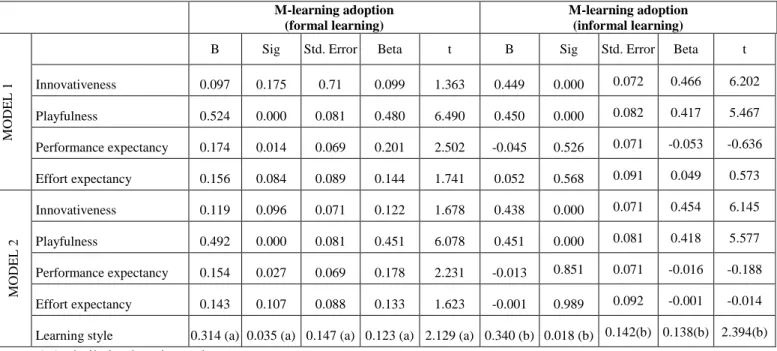
adoption, regression models were used. Two models were run for each of the learning contexts (formal/informal). Learning style is eliminated in the first model (Table 2). Results indicate that learning styles are important indicators of m-learning adoption. Inclusion of relevant learning style therefore enhances the model fit. Including the accommodating style into the second m-learning adoption model for informal learning has enhanced its model fit, with R square rising from .605 to .623. Same applies to the impact of assimilating learning style on m-learning adoption for formal learning, with R square rising from .629 to .642.
Table 2. Results of regression analysis
M-learning adoption (formal learning) M-learning adoption (informal learning) M OD EL 1
B Sig Std. Error Beta t B Sig Std. Error Beta t
Innovativeness 0.097 0.175 0.71 0.099 1.363 0.449 0.000 0.072 0.466 6.202 Playfulness 0.524 0.000 0.081 0.480 6.490 0.450 0.000 0.082 0.417 5.467 Performance expectancy 0.174 0.014 0.069 0.201 2.502 -0.045 0.526 0.071 -0.053 -0.636 Effort expectancy 0.156 0.084 0.089 0.144 1.741 0.052 0.568 0.091 0.049 0.573 M OD EL 2 Innovativeness 0.119 0.096 0.071 0.122 1.678 0.438 0.000 0.071 0.454 6.145 Playfulness 0.492 0.000 0.081 0.451 6.078 0.451 0.000 0.081 0.418 5.577 Performance expectancy 0.154 0.027 0.069 0.178 2.231 -0.013 0.851 0.071 -0.016 -0.188 Effort expectancy 0.143 0.107 0.088 0.133 1.623 -0.001 0.989 0.092 -0.001 -0.014
Learning style 0.314 (a) 0.035 (a) 0.147 (a) 0.123 (a) 2.129 (a) 0.340 (b) 0.018 (b) 0.142(b) 0.138(b) 2.394(b)
a) Assimilating learning style b) Accommodating learning style
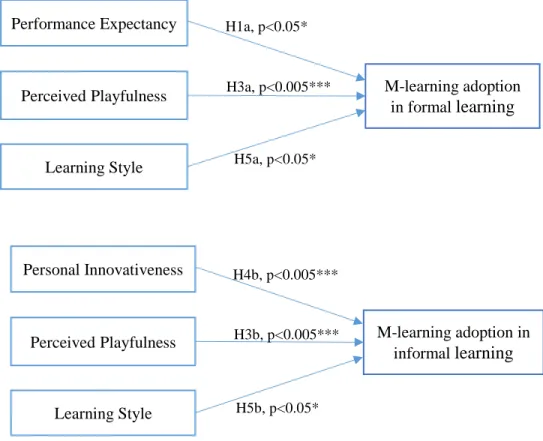
As it can be noticed from Table 2, m-learning adoption is determined by different factors in formal and informal learning. The impact of performance expectancy is limited to formal learning. In contrast to current literature, the effect of effort expectancy on m-learning adoption is not significant. Therefore, H1a is supported (p<0.05), but H1b, H2a, H2b are not supported. Findings also report a significant relationship between playfulness and adoption of m-learning in both contexts (p<0.005). H3a and H3b are supported. Innovativeness has a significant effect on informal learning (p<0.005). Therefore, H4b is supported while H4a cannot be confirmed. The impact of learning style is also confirmed. Findings show a significant effect (p<0.05) of assimilating learning style and accommodating learning style on m-learning adoption in formal
and informal learning, respectively. Therefore, considering learning style of students in m-learning adoption models is important; however, different learning styles are influential depending on the context of learning. It must be noted that we have tested the potential impact of all learning styles on m-learning adoption in the two settings. However, no other significant result was found. Fig (2) illustrates the refined model of mobile learning adoption in each learning context.
* p<0.05; *** p<0.005
Fig. 2. Factors influencing m-learning adoption in formal and informal learning contexts
5. Conclusion and future research direction
This paper identifies factors that motivate learners to use m-learning. It takes the current literature forward by a) considering informal learning in addition to formal learning and b) providing a link between learners’ individual characteristics (i.e. learning style) and other measures of m-learning
Performance Expectancy PerceivedPlayfulness Learning Style M-learning adoption in formal learning H3a, p<0.005*** H5a, p<0.05* Personal Innovativeness PerceivedPlayfulness Learning Style M-learning adoption in informal learning H3b, p<0.005*** H4b, p<0.005*** H5b, p<0.05* H1a, p<0.05*
adoption. A model of m-learning adoption is proposed and empirically tested. According to the findings, determinants of m-learning usage are different for formal and informal learning. For example, playfulness affects use of m-learning in both learning contexts, while performance expectancy and personal innovativeness are only influential in specific settings. In the light of this paper’s findings, researchers and practitioners should distinguish between uses of mobile platform for different learning purposes. Furthermore, m-learning adoption is influenced by both characteristics of the environment and individuals.
Among perceived characteristics of the platform, playfulness is a strong indicator of m-learning adoption. Learners use mobile platforms when the environment gains their focused attention and offers curiosity, and enjoyment. Use of mobile devices in formal learning is also affected by performance expectancy. Learners who believe these platforms improve their learning performance and productivity are more likely to use them. Therefore, both intrinsic (i.e. playfulness) and extrinsic (i.e. performance expectancy) motivational factors affect m-learning adoption for formal learning. This is in line with findings of Wang, Wu, and Wang (2009), Huang and colleagues (2012) and Liu, Li, and Carlsson (2010). However, no evidence for the impact of performance expectancy on m-learning adoption in informal learning was found. Learners do not associate informal learning with achievement goals. This can suggest that m-learning adoption in this context is only influenced by the intrinsic motivation (i.e. playfulness) which is related to the process of performing an activity rather than overall performance (Moon and Kim 2001). This study reports that effort expectancy has no influence on adoption of m-learning. This contradictory outcome may be due to the fact that students are becoming more and more familiar with and do not associate a high degree of effort with using mobile platforms; hence the reduced effect of this variable.
The paper also highlights the important of individual characteristics in m-learning adoption. Embracing self-directed learning processes, we report that learners’ differences affect this platform usage. Learners with higher willingness to try new information technology (higher level of personal innovativeness) and those who actively engage in the learning process and rely on information from others to solve a problem (accommodating learning style) are more likely to use m-learning in informal context. Instead, those learners who rely on their own logical analysis and reflection (assimilating learning style) are more inclined to use formal m-learning platforms. Not only assimilators perform better on web-based formal learning environment compared to other
learning styles (Wang et al. 2006), they are more likely to use m-learning platforms for formal learning. Results for personal innovativeness are partially in contrast to Abu-Al-Aish and Love (2013), as no evidence for its impact on m-learning adoption in formal learning was found. This could be the result of habitual usage and invariable nature of interactions with virtual learning platforms.
This research contributes to m-learning adoption literature by introducing the learning style as an indicator. It expands on Kreber’s (1998) study, showing that Kolb’s learning style framework has interesting implications for explaining individual differences in this self-directed learning environment. While certain types of learners might be more inclined to adopt this platform for formal learning, i.e. accessing Blackboard, others use the benefits of constant access to information available on the Internet to facilitate informal learning. Results of Federico (2000) regarding better attitudes of assimilating and accommodating learning styles towards e-learning also applies to learning. However, this research moves the literature forward by illustrating the differences in m-learning usage preferences that exists among these two groups.
The paper calls for further research on m-learning adoption and its antecedents. It shows interesting results for the impact of learners’ and mobile platform characteristics on m-learning adoption. However, due to its cross-sectional nature, causality should not be readily inferred. Future research may adopt a longitudinal approach in order to validate these cause-effect relations. Such studies can more precisely describe how the impact of these antecedents alters over time. For example, researchers may explore whether the role of personal innovativeness and playfulness changes over time as m-learning usage becomes habitual. Other motivational factors could also be included in the proposed model. For example, students’ “need for achievement” (Lowell 1952) and “learning goal orientation” (Phillips and Gully 1997) may have a direct impact on their intention to adopt or abandon m-learning. In addition, other usability factors could enhance or hinder m-learning adoption. Future research can investigate the combined effect of these motivational constructs and system design factors. Moreover, current study examined the behavioural intention to use m-learning. The relation between behavioural intention and actual use of m-learning in informal and formal context, including other antecedents, e.g. and perceived behavioural control (Taylor and Todd 1995b) and perceived value (Roostika 2012), should also be empirically tested. In addition, this study relies on students’ self-reported usage. Collecting actual behavioural data on m-learning usage in informal learning context is very challenging. However,
tracking methods can provide insightful information on learners’ informal learning activities. Innovative experiments could be designed to observe behavioural variations when learners interact with mobile platform. Data for this research is collected from a medium size university in the UK. Results should be verified using student samples in other types of HE institutions. While the focus of this research has been on m-learning adoption in different contexts, it is important to explore how this platform is used for different learning purposes. Future work can distinguish between m-learning adoption in knowledge transfer, assessment and feedback and examine the potential impact of learner characteristics for each purpose. Researchers can also investigate the use of m-learning within the classroom and synchronous to delivery of seminar/tutorial sessions. In addition, the nature of seamless learning where students switch between formal and informal contexts in a mobile device needs more attention from educational researchers. Finally, outcomes of this study can provide insight to other educational contexts such as organizational learning. For instance, the use of web-based organizational learning systems can be enhanced.
Findings also have implications for designing virtual learning systems that have a higher rate of adoption. For instance, increasing the playfulness of the environment can improve students’ use of m-learning. Developing systems which increase focused attention, curiosity, and enjoyment will therefore result in higher playfulness and greater adoption of m-learning. Likewise, recent literature illustrates that gamification of educational systems (Codish and Ravid 2015) and using elements of mystery and challenge (Arrasvuori et al. 2011) enhance playfulness. Researchers and practitioners ought to identify better ways of embedding such features in m-learning environment. Formal learning platforms, also require materials that allow learners to think and reflect while proving a strong link with module performance objectives.
References
Abu-Al-Aish, A., and S. Love. 2013. “Factors influencing students’ acceptance of m-learning: An investigation in higher education”. The International Review of Research in Open and Distributed Learning 14(5).
Agarwal, R., and J. Prasad. 1998. “A conceptual and operational definition of personal innovativeness in the domain of information technology”. Information systems research 9(2): 204-215.
Ahn, T., S. Ryu, and I. Han. 2007. ”The impact of Web quality and playfulness on user acceptance of online retailing”. Information & management 44(3): 263-275.
Ajzen, I. 1991. “The theory of planned behavior”. Organizational behavior and human decision processes 50(2): 179-211.
Arrasvuori, J., Boberg, M., Holopainen, J., Korhonen, H., Lucero, A., and Montola, M. 2011. “Applying the PLEX framework in designing for playfulness”. In Proceedings of the 2011 Conference on Designing Pleasurable Products and Interfaces (p. 24). ACM.
Baker, A. C., P. J. Jensen, and D. A. Kolb. 1997. “In conversation: Transforming experience into learning”. Simulation & gaming 28(1): 6-12.
Bandura, A. 1986. Social foundations of thought and action: A social cognitive theory: Prentice-Hall, Inc.
Bonnici, L. J., S. L. Maatta, M. K. Klose, H. Julien, and S. Bajjaly. 2014. “Instructional style and learner-centered approach: a cross-institutional examination of modality preference for online course delivery in a graduate professional program”. Studies in Higher Education 1-19.
Butler, K. A. 1987. Learning and teaching style: In theory and practice: Learner's Dimension Columbia, CT.
Chen, Y.-C., and Y.-j. Lee. 2014. Improving learning motivation in a learning style integrated mobile cooperative learning environment. Paper presented at the Management of Engineering & Technology (PICMET), 2014 Portland International Conference on. Chi-Ching, Y., and L. S. Noi. 1994. “Learning styles and their implications for cross-cultural
management in Singapore”. The Journal of social psychology 134(5): 593-600. Chou, H.-W., and T.-B. Wang. 2000. ”The influence of learning style and training method on
self-efficacy and learning performance in WWW homepage design training”. International Journal of Information Management 20(6): 455-472.
Codish, D., and Ravid, G. 2015. “Detecting playfulness in educational gamification through behavior patterns”. IBM Journal of Research and Development 59(6): 6-1.
Csikszentmihalyi, M. 2000. Beyond boredom and anxiety. Jossey-Bass.
Davis, F. D. 1989. “Perceived usefulness, perceived ease of use, and user acceptance of information technology”. MIS quarterly 319-340.
Davis, F. D., R. P. Bagozzi, and P. R. Warshaw.1992. “Extrinsic and intrinsic motivation to use computers in the workplace”. Journal of applied social psychology 22(14): 1111-1132. Deci, E. L., and Ryan, R. M. 1975. Intrinsic motivation. John Wiley & Sons, Inc..
Dringus, L. P., and S. Terrell. 1999. “The framework for DIRECTED online learning environments”. The Internet and Higher Education 2(1): 55-67.
Dziuban, C. D., J. L. Hartman, and P. D. Moskal. 2004. “Blended learning”. EDUCAUSE Center for Applied Research Bulletin 7(1):12.
El-Hussein, M. O. M., and J. C. Cronje. 2010. “Defining mobile learning in the higher education landscape”. Journal of Educational Technology & Society 13(3): 12-21.
Entwistle, N. J. 2013. Styles of learning and teaching: An integrated outline of educational psychology for students, teachers and lecturers: Routledge.
Federico, P.-A. 2000. “Learning styles and student attitudes toward various aspects of network-based instruction”. Computers in Human Behavior 16(4): 359-379.
Felder, R. M., and L. K. Silverman. 1988. “Learning and teaching styles in engineering education”. Engineering education 78(7): 674-681.
Fishbein, M., and I. Ajzen.1975. Belief, attitude, intention and behavior: An introduction to theory and research.
Ford, N., and S. Y. Chen. 2000. “Individual differences, hypermedia navigation, and learning: an empirical study”. Journal of educational multimedia and hypermedia 9(4): 281-311. Gregorc, A. F. 1979. Learning-Teaching Styles-potent Forces Behind Them. 22314-1453.
Gunawardena, C. N., and P. E. Boverie. 1993. Impact of Learning Styles on Instructional Design for Distance Education.
Hartley, K., and L. D. Bendixen. 2001. “Educational research in the Internet age: Examining the role of individual characteristics”. Educational researcher 30(9): 22-26.
Herz, B., and W. Merz.1998. “Experiential learning and the effectiveness of economic simulation games”. Simulation & gaming 29(2): 238-250.
Honey, P., and A. Mumford. 2000. “The Learning Styles Questionnaire: 80 Item Version”. Maidenhead, Berkshire UK.
Huang, R. T., S. J. Jang, Machtmes, and D. Deggs. 2012. “Investigating the roles of perceived playfulness, resistance to change and self‐ management of learning in mobile English learning outcome”. British journal of educational technology 43(6): 1004-1015.
Igbaria, M., S. Parasuraman, and J. J. Baroudi. 1996. “A motivational model of microcomputer usage”. Journal of management information systems 127-143.
Jones, A. C., Scanlon, E., and Clough, G. 2013. “Mobile learning: Two case studies of supporting inquiry learning in informal and semiformal settings”. Computers & Education 61: 21-32. Ju, T., W. Sriprapaipong, and D. Minh. 2007. On the success factors of mobile learning. Paper presented at the 5th International Conference on ICT and Higher Education, Bangkok. Retrieved from http://www. mendeley. com/research/success-factors-mobile-learning. Kayes, D. C. 2005. “Internal validity and reliability of Kolb’s learning style inventory version 3
(1999)”. Journal of Business and Psychology 20(2): 249-257.
Kearney, M., Schuck, S., Burden, K., and Aubusson, P. 2012. “Viewing mobile learning from a pedagogical perspective”. Research in learning technology 20.
Kolb, A. Y. 2005. “The Kolb learning style inventory-version 3.1 2005 technical specifications”. Boston, MA: Hay Resource Direct 200.
Kolb, A. Y., and D. A. Kolb. 2005. ‘‘Learning styles and learning spaces: Enhancing experiential learning in higher education”. Academy of management learning & education 4(2): 193-212.
Kolb, A. Y., and D. A. Kolb. 2009. “The learning way meta-cognitive aspects of experiential learning”. Simulation & gaming 40(3): 297-327.
Kolb, D. 1984. Experiential Learning: Experience as a source of learning and development. (Prentice Hall, New Jersey).
Kreber, Carolin. 1998. "The relationships between self-directed learning, critical thinking, and psychological type, and some implications for teaching in higher education." Studies in Higher Education 23(1): 71-86.
Ktoridou, D., and N. Eteokleous. 2005. “Adaptive m-learning: technological and pedagogical aspects to be considered in Cyprus tertiary education”. Recent Research Developments in Learning Technologies. Formatex, Badajoz, Spain, 676-683.
Laurillard, D. 2007. Pedagogical forms of mobile learning: framing research questions.
Lin, C. S., S. Wu, and R. J. Tsai. 2005. “Integrating perceived playfulness into expectation-confirmation model for web portal context”. Information & management 42(5): 683-693. Lin, P.-C., H. Lu, and C. Liu. 2013. “Towards an education behavioral intention model for
e-learning systems: An extension of UTAUT”. Journal of Theoretical and Applied Information Technology 47(3): 1120-1127.
Lipponen, L., M. Rahikainen, J. Lallimo, and K. Hakkarainen. 2003. “Patterns of participation and discourse in elementary students’ computer-supported collaborative learning”. Learning and instruction 13(5):487-509.
Liu, Y., H. Li, and C. Carlsson. 2010. “Factors driving the adoption of m-learning: An empirical study”. Computers & Education 55(3): 1211-1219.
Livingstone, D. W. 1999. Exploring the icebergs of adult learning: findings of the first Canadian survey of informal learning practices.
Looi, C. K., P. Seow, B. Zhang, H. J. So, W. Chen, and L. H. Wong. 2010. “Leveraging mobile technology for sustainable seamless learning: a research agenda”. British journal of educational technology 41(2): 154-169.
Looi, C. K., Sun, D., Wu, L., Seow, P., Chia, G., Wong, L. H., ... and Norris, C. 2014. “Implementing mobile learning curricula in a grade level: Empirical study of learning effectiveness at scale”. Computers & Education 77: 101-115.
Looi, C. K., Lim, K. F., Pang, J., Koh, A. L. H., Seow, P., Sun, D., ... and Soloway, E. 2016. “Bridging Formal and Informal Learning with the Use of Mobile Technology”. In Future Learning in Primary Schools (pp. 79-96). Springer Singapore.
Lowell, E. L. 1952. “The effect of need for achievement on learning and speed of performance”. The Journal of Psychology 33(1): 31-40.
Lowenthal, J. N. 2010. “Using mobile learning: Determinates impacting behavioral intention”. The Amer. Jrnl. of Distance Education 24(4): 195-206.
Lu, H.-K. 2012. “Learning styles and acceptance of e-learning management systems: an extension of behaviour intention model”. International Journal of Mobile Learning and Organisation 6(3-4): 246-259.
Lu, J., J. E. Yao, and C.-S. Yu. 2005. “Personal innovativeness, social influences and adoption of wireless Internet services via mobile technology”. The Journal of Strategic Information Systems 14(3): 245-268.
Macharia, J. K., and T. G. Pelser. 2014. “Key factors that influence the diffusion and infusion of information and communication technologies in Kenyan higher education”. Studies in Higher Education 39(4): 695-709.
Magoulas, G. D., Y. Papanikolaou, and M. Grigoriadou. 2003. “Adaptive web‐ based learning: accommodating individual differences through system's adaptation”. British journal of educational technology 34(4): 511-527.
Malone, T. W. 1981. “Toward a theory of intrinsically motivating instruction”. Cognitive science 5(4): 333-369.
Marsick, V. J., and K. E. Watkins. 2001. “Informal and incidental learning”. New directions for adult and continuing education 2001(89): 25-34.
McDermott, P. A., and B. S. Beitman. 1984. “Standardization of a scale for the study of children's learning styles: Structure, stability, and criterion validity”. Psychology in the Schools 21(1): 5-14.
Moon, J. W., and Kim, Y. G. 2001. “Extending the TAM for a World-Wide-Web context”. Information & management 38(4): 217-230.
Moore, G. C., and I. Benbasat. 1991. “Development of an instrument to measure the perceptions of adopting an information technology innovation”. Information systems research 2(3): 192-222.
Ozdamli, F. 2012. “Pedagogical framework of m-learning”. Procedia-Social and Behavioral Sciences 31: 927-931.
Pachler, N. 2007. Mobile learning: towards a research agenda.
Park, J., D. Parsons, and H. Ryu. 2010. “To flow and not to freeze: Applying flow experience to mobile learning”. Learning Technologies, IEEE Transactions on 3(1): 56-67.
Park, S. Y., M. W. Nam, and S. B. Cha. 2012. “University students' behavioral intention to use mobile learning: Evaluating the technology acceptance model”. British journal of educational technology 43(4): 592-605.
Peck, B., C. Deans, and L. Stockhausen. 2010. “The Tin-Man and the TAM: A Journey Into M-Learning in the Land of Aus”. World Journal on Educational Technology 2(1): 16-26. Pedersen, P. E., and R. Ling. 2003. Modifying adoption research for mobile Internet service
adoption: Cross-disciplinary interactions. Paper presented at the System Sciences, 2003. Proceedings of the 36th Annual Hawaii International Conference on.
Peters, K. 2007. “m-Learning: Positioning educators for a mobile, connected future”. The International Review of Research in Open and Distributed Learning 8(2).
Phillips, J. M., and Gully, S. M. 1997. “Role of goal orientation, ability, need for achievement, and locus of control in the self-efficacy and goal--setting process”. Journal of applied psychology 82(5): 792.
Renda dos Santos, L. M., and S. Okazaki. 2015. “Planned e-learning adoption and occupational socialisation in Brazilian higher education”. Studies in Higher Education 1-21.
Rogers, E. M. 2003. “Elements of diffusion”. Diffusion of innovations 5: 1-38.
Roostika, R. 2012. “Mobile internet acceptance among university students: a value-based adoption model”. Int J Res Manag Technol 2(1): 21-28
Şad, S. N., and Ö. Göktaş. 2014. “Preservice teachers' perceptions about using mobile phones and laptops in education as mobile learning tools”. British journal of educational technology 45(4): 606-618.
Sandberg, J., M. Maris, and K. de Geus. 2011. “Mobile English learning: An evidence-based study with fifth graders”. Computers & Education 57(1): 1334-1347.
Sarrab, M., Elbasir, M., and Alnaeli, S. 2016. ”Towards a quality model of technical aspects for mobile learning services: An empirical investigation”. Computers in Human Behavior, 55, 100-112.
Sein, M. K., and D. Robey. 1991. ”Learning style and the efficacy of computer training methods”. Perceptual and Motor skills 72(1): 243-248.
Sharples, M., J. Taylor, and G. Vavoula. 2005. “Towards a theory of mobile learning”. Proceedings of mLearn 2005 1(1), 1-9.
Song, L., and J. R. Hill. 2007. “A conceptual model for understanding self-directed learning in online environments”. Journal of Interactive Online Learning 6(1): 27-42.
Specht, L. B., and P. K. Sandlin. 1991. “The differential effects of experiential learning activities and traditional lecture classes in accounting”. Simulation & gaming 22(2): 196-210. Sun, S., M. Joy, and N. Griffiths. 2007. “The use of learning objects and learning styles in a
multi-agent education system”. Journal of Interactive Learning Research 18(3): 381-398. Tan, G. W. H., Ooi, K. B., Leong, L. Y., and Lin, B. 2014. “Predicting the drivers of behavioral
intention to use mobile learning: A hybrid SEM-Neural Networks approach”. Computers in Human Behavior, 36, 198-213.
Taylor, J., M. Sharples, C. O'Malley, G. Vavoula, and J. Waycott. 2006. “Towards a task model for mobile learning: a dialectical approach”. International Journal of Learning Technology 2(2-3): 138-158.
Taylor, S., and P. Todd. 1995a. “Assessing IT usage: The role of prior experience”. MIS quarterly 561-570.
Taylor, S., and Todd, P. A. 1995b. “Understanding information technology usage: A test of competing models”. Information systems research 6(2): 144-176.
Terras, M. M., and J. Ramsay. 2012. “The five central psychological challenges facing effective mobile learning”. British journal of educational technology 43(5): 820-832.
Terrell, S. R. 2002. “The effect of learning style on doctoral course completion in a Web-based learning environment”. The Internet and Higher Education 5(4): 345-352.
Thompson, R. L., C. A. Higgins, and J. M. Howell. 1991. “Personal computing: toward a conceptual model of utilization”. MIS quarterly 125-143.
Venkatesh, V., M. G. Morris, G. B. Davis, and F. D. Davis. 2003. “User acceptance of information technology: Toward a unified view”. MIS quarterly 425-478.
Wang, K. H., T. Wang, W.L. Wang, and S. Huang. 2006. “Learning styles and formative assessment strategy: enhancing student achievement in Web‐ based learning”. Journal of Computer Assisted Learning 22(3): 207-217.
Wang, Y. S., M. C. Wu, and H. Y. Wang. 2009. “Investigating the determinants and age and gender differences in the acceptance of mobile learning”. British journal of educational technology 40(1): 92-118.
Webster, J., and Martocchio, J. J. 1992. “Microcomputer playfulness: development of a measure with workplace implications”. MIS quarterly, 201-226.
Wierstra, R. F. A., and De Jong, J. A. 2002. “A scaling theoretical evaluation of Kolb’s Learning Style Inventory-2”. Learning styles: reliability and validity, 431-440.
Wong, L. H. 2012. “A learnercentric view of mobile seamless learning”. British journal of educational technology 43(1): 19-23.