theRepository at St. Cloud State
Culminating Projects in Education Administration and LeadershipDepartment of Educational Leadership and Higher Education
5-2015
Teachers’ and Administrator’s Perceptions and
Concerns of Reciprocal Peer Review Program
Gracious Anderson Msuya
St. Cloud State University
Follow this and additional works at:https://repository.stcloudstate.edu/edad_etds
Part of theEducational Leadership Commons
This Dissertation is brought to you for free and open access by the Department of Educational Leadership and Higher Education at theRepository at St. Cloud State. It has been accepted for inclusion in Culminating Projects in Education Administration and Leadership by an authorized administrator of theRepository at St. Cloud State. For more information, please [email protected].
Recommended Citation
Anderson Msuya, Gracious, "Teachers’ and Administrator’s Perceptions and Concerns of Reciprocal Peer Review Program" (2015).
Culminating Projects in Education Administration and Leadership. 5. https://repository.stcloudstate.edu/edad_etds/5
Teachers’ and Administrator’s Perceptions and Concerns of Reciprocal Peer Review Program
by
Gracious Anderson Msuya
A Doctoral Dissertation Submitted to the Graduate Faculty of
St. Cloud State University
in Partial Fulfillment of the Requirements for the Degree
Doctor of Education
March, 2015
Dissertation Committee: John Eller, Chairperson
Frances Kayona Roger Worner
Abstract
This study examined a pilot Reciprocal Peer Review Program (RPRP) that was
implemented for 1 year by a mid-size suburban school district in Minnesota. In the RPRP two teachers were paired up for the purpose of observing each other and “exchanging feedback in an alternating fashion” (Kohler, Ezell, & Paluselli, 1999, p. 154). The study reviewed the pilot program to determine teachers’ and administrator’s perceptions and concerns of the program. The study also sought to determine features of the pilot program that participants considered to be effective and worth keeping and features of the program that were considered not effective thus needed to be refined or discarded.
The study was designed to provide insights into the implementation of the Reciprocal Peer Review Program (RPRP) in a medium size suburban school district in Minnesota. The information provided by the study was used by the school district and teachers to determine whether or not there is merit in pursuing full implementation of the RPRP throughout the district with all teachers. The study provided specific commendation on features of the RPRP that were considered effective. Additionally, the study provided recommendations of features of the RPRP that were viewed negatively and required change. Although the study is limited to a single Minnesota school district, it is conceivable that other state school districts, also required to implement the new the new teacher evaluation statute that mandates peer review, will find value in the analysis of the design and implementation of a quality peer review program.
The researcher collected both qualitative and quantitative data from a select sample of 60 teachers who volunteered to participate in the RPRP and from three school district
administrators who participated in designing and implementing the RPRP. Four instruments were used in the study data collection for the study: (1) Stages of Concern Questionnaires (SoCQ); (2) Perception Survey; (3) focus group interview with seven teachers; and (4) focus interview with three school administrators.
The quantitative data were electronically collected and analyzed. Focus group interviews were digitally audio-recorded, transcribed, and thematically.
The study found that teachers and administrators had general positive perceptions of the RPR program with the following features particularly reported as positive: opportunity to observe; opportunity to learn and collaborate with colleagues; the non-evaluative nature of the program, and the opportunity to study curriculum across content and grade levels. Also, teachers thought that the program helped improve instruction and reduce teacher isolation.
The results indicated that participants viewed the following as areas of concern: lack of clarity on goals and procedures; limited time; too much or confusing paperwork demands; poor substitute teacher system; and level of district and state commitment to funding the program.
Participants pointed out the following as recommendations for improving the program: improve the school culture around the importance of RPRP; provide more administrative support to teachers; provide more clarifications of goals and procedures; provide more training on RPRP; improve the teacher substitute system; and allow teachers to use the Professional Learning Community (PLC) time for peer review or consider paying teachers stipends for time spent working on the program outside contract hours.
Since the RPRP was viewed positively by both participating teachers and administrators as a tool for increasing teacher quality through observing, learning, and collaborating with their peers, educational leaders are encouraged to strengthen the program design by removing the frustrations related to teacher substitutes and, thereby, lessening the stresses teachers experience and reluctance they have in leaving their classrooms to conduct peer observation. Districts need to provide assurances to teachers that there is administrative support and a funding commitment for the program to achieve maximum success.
© 2015
Gracious Anderson Msuya All Rights Reserved
Dedication
I dedicate this work to three generations of my family.
My parents Anderson and Hainess Msuya in Tanzania for sacrificing and inspiring my siblings and I to pursue higher education. Words of my father to us when we were in
elementary school still ring, “I want these walls to be adorned with degrees from all my children”
I dedicate this work to my lovely wife, Florence, for her unconditional love, support, sacrifices and encouragements throughout our almost 15 years of marriage and 4 years of pursuing this doctorate degree. Also, to all my siblings for dreaming and not allow the tough circumstances of life to lead to despair but to prosperity for our children and posterity. Specifically, to my only sister, Progress, to my five living brothers; Goodluck, Freedom, Overblessing, Richman and Young Savior and to our departed dear brother Gilbert.
I dedicate this work especially to my four beautiful and strong children; Kina, Lisa, Imani and Jessie. To you I say, I love you more than you can ever imagine. Go on and pursue your dreams and make meaningful contributions to humanity. I set you free from all
limitations.
To all my students and all the Children in the Tanzania-American Community in the US, I say Be Epic!
Acknowledgment
I would like to thank the following individuals at St. Cloud State University; Dr. Frances Kayona for believing in me for help with research instruments; Dr. Roger Worner and Dr. Kay Worner for your meticulous editing of my work; Dr. John Eller for help with design and shaping of my dissertation; Ann Anderson for helping me with my dissertation
formatting; and Michele Braun for keeping on track with timelines and deadlines.
I would like to thank the teachers and school administrators who agreed to participate in the study. Special thanks to the school district HR Director and leader of the Peer Review program for making my study possible.
I would like to thank my entire doctoral cohort 3: Cathy, Charles, Curt, Dalton, Deron, Eralda, John, Karrie, Melissa, Shawn, and Tammy for supporting each other. Special thanks to Eralda for reading and editing my work.
I would like to thank following leaders in Minnesota who inspired me in my early years in the doctoral program and for granting me interviews on various topics of
organizational leadership: Brad Hewitt, President and CEO of Thrivent Financial; James Stuart, Anoka County Sheriff; Bill Malkowiak, Director, Trade Marketing at General Mills; and John Harringon, MN State Senator.
I would like to thank my wife, Florence, for sacrificing and believing in me. My children; Kina, Lisa, Imani and Jessie for the unconditional love as I attempted to balance between working on my dissertation and spending time with you. Thank you for allowing me to occasionally exile myself to a hotel room or a cabin for days to read and write.
Table of Contents Page LIST OF TABLES ... 12 LIST OF GRAPHS ... 15 Chapter 1. Introduction ... 16
Statement of the Problem ... 17
Program Design ... 17
Purpose of the Study ... 19
Assumptions of the Study ... 20
Delimitation of the Study ... 21
Study Questions ... 22
Definition of Terms ... 22
Summary ... 25
2. Review of Literature ... 27
Overview of Teacher Evaluation ... 28
Teacher Evaluation by Principals ... 32
Value-added Models ... 33
Peer Review and Peer Coaching ... 37
CBAM and Stages of Concern ... 42
Synthesis of Review of Literature ... 43
Chapter Page
Study Questions ... 45
Sample Selection ... 46
Surveys ... 46
Data Collection and Procedures ... 50
Perception Survey ... 52 Summary of Methodology ... 54 4. Results ... 56 Study Questions ... 56 Study Question 1 ... 57 Study Question 2 ... 68 Study Question 3 ... 80 Study Question 4 ... 82 Summary of Results ... 90
5. Discussion, Conclusions and Recommendations ... 96
Introduction ... 96
Background ... 97
Discussion of Findings ... 98
Summary of the Study Results ... 99
Recommendations for Professional Practice ... 99
Recommendations for Further Study ... 101
Chapter Page
References ... 106
Appendices A. Institutional Review Board (IRB) ... 116
B. Email Inviting Participants to the Study ... 117
C. Follow up Email to Participating Teac hers for a Focus Group ... 118
D. Permission/Online for the Researcher to the Access to the Stages of Concern Questionnaire ... 119
E. An Invitation Letter to Teachers to Complete Two Electronic Surveys on Reciprocal Peer Review Program ... 120
F. Invitation to Participate in the Stages of Concern Survey about the Peer Review Program ... 121
G. Permission to Use a Peer Review Perception Instrument ... 122
H. Perception Survey about the Peer Review Pilot Program Administered to 32 Teachers ... 123
I. Interview Protocol for Teachers Focus Group ... 125
J. Interview Protocol Administered to Three School Administrators ... 127
K. The Stages of Concern Questionnaire (S0CQ) Administered to All 60 for Teachers ... 129
L. Results of Stages of Concern Questionnaire ... 132
M. Sub Group Report for Stages of Concern Questionnaire ... 133
Appendix Page O. Summary of Administrators’ Perception of Reciprocal Peer Review
Program ... 142 P. Summary of Responses from Teacher Focus Group ... 144 Q. Stages of Concern Questionnaire (SoCQ) ... 148
List of Tables
Table Page
1. Stages of Concern: Typical Expressions of Concern about the Innovation ... 48
2. Reported Demographic Information of Teachers Who Responded to the Perception Survey ... 58
3. Participating Teachers Responses to the Perception Survey ... 59
4. Reported Reasons for Participating in the Reciprocal Peer Review Pilot Program ... 61
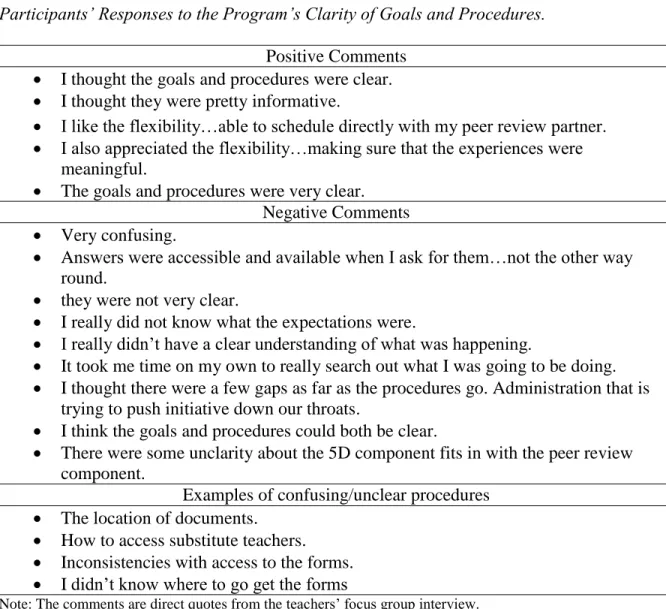
5. Participants’ Responses to the Program’s Clarity of Goals and Procedures ... 62
6. Teachers’ General Perception of the Reciprocal Peer Review Program (RPRP) ... 63
7. Teachers Reported Feelings about Reciprocal Peer Review Program (RPRP) ... 64
8. Reported Rewarding Features of Reciprocal Peer Review Program (RPRP) ... 65
9. Reported Perceptions on the Programs Effect on Overall Teacher Quality ... 66
10. Administrators’ Reported Features of Strength about the Reciprocal Peer Review Program (RPRP) ... 67
11. Reported Demographic Information of Participating Teachers in the SoCQ ... 69
12. Results Percentile Scores of Stages of Concern ... 70
13. Results of Stages of Concern Questionnaire by Gender ... 73
14. Results of Teachers’ Concerns by Years of Teaching Experience ... 74
15. Teachers’ Reported Concerns about Reciprocal Peer Review Program (RPRP) ... 75
Table Page 16. Results of Survey Questions Sorted by the Highest Total Scores ... 77 17. Teachers Expression of Concern Reported in Stages of Concern Model ... 79 18. Reported Effective Features of the Reciprocal Peer Review Program
(RPRP) ... 81 19. Reported Strength of the Reciprocal Peer Review Program by
Administrators ... 82 20. Reported Negative Features of the Reciprocal Peer Review Program
(RPRP) ... 83 21. Reported Features Not Liked by Teachers ... 84 22. Negative Features of the Reciprocal Peer Review Program as Reported by
Administrators ... 85 23a. Teachers’ Reported Features of the Program that Needed to Change ... 86 23b. Examples of Teachers’ Statements Regarding Features of the RPRP that
Needed to be Changed ... 86 24. Reported Challenging Features of Reciprocal Peer Review Program ... 87 25. Reported Negative Features of the Reciprocal Peer Review
Program that Needed to be Improved ... 88 26. Reported Features of the Peer Review Program that Teachers Would
Like to Change ... 88 27. Reported Features of Recommendations by Administrators in a Focus Group
Table Page 28. Teachers’ Statements on their Struggles with the Reciprocal Peer Review
List of Graphs
Graph Page
1. Teachers’ Stages of Concern: Reciprocal Peer Review Program ... 71 2. Stages of Concern by Teachers Reported Gender for RPRP ... 73
Chapter 1: Introduction
The Minnesota Department of Education required all school districts to institute Peer Review as a component of their teacher evaluation process beginning 2014. Minnesota Statute. §.122A.41, reads, in part:
To improve student learning and success, a school board and an exclusive representative of the teachers in the district…may develop an annual teacher
evaluation and Peer Review process for probationary and non-probationary teachers through joint agreement […] The process must include having trained observers serve as peer coaches or having teachers participate in professional learning communities. (Subd. 5)
Recently, several states modified their teacher evaluation processes from low stakes to high stakes in which poor performance in the teacher evaluation could result in a first step toward dismissal (Matula, 2011). In Minnesota, schools are required to have an improvement plan for teachers with unsatisfactory evaluations and also a disciplinary plan, including possible dismissal, for teachers who underperform (Minn. Stat. § 122A.40). Researchers note that given the high state of accountability for teacher performance, it is important to find credible ways to effectively evaluate teachers (Papay & Johnson, 2012; Welsh, 2011). Teacher evaluation should promote quality instruction centered on intellectual rigor, student learning, and an accurate and fair assessment of that student learning (Goldstein, 2010b; Weems & Rogers, 2010). A successful evaluation system needs to be comprehensive, fair and developed with the involvement of teachers (Matula, 2011).
Although many schools in Minnesota have had peer review and peer coaching programs in place for over seven years as part of the state’s voluntary pay-for-performance program called Quality Compensation-Q-Comp (OLA, 2009), no study had been conducted to examine teachers’ perceptions and concerns regarding the implementation of peer review
programs in Minnesota. This study intended to address that research void by gathering teachers’ perceptions and concerns about the implementation of a Reciprocal Peer Review Program (RPRP) in their school. The findings should assist the school district studied, other Minnesota school districts, and the Minnesota Department of Education (MDE) to better understand teachers’ perceptions and concerns about the RPRP. The study should result in providing recommendations for design and implementation of a peer review program that is effective in improving teachers’ professional development and growth.
Statement of the Problem
The new Minnesota teacher evaluation statute effective in 2014 requires peer review of teachers (Minn. Stat. § 122A.40). Although some schools in Minnesota have had peer review process for several years, no study has been conducted to evaluate the program or participants’ perceptions on the effectiveness of the program or has there been a study on the concerns of teachers on the implementation of peer review program in Minnesota. This study was intended to address that research gap by providing data on the perceptions of teachers of the effectiveness of RPRP and teachers’ concerns about the implementation of the program. The findings of the study enable the school district studied and other schools in Minnesota to better design and implement peer review programs that are effective, achieve desired
outcomes of teacher professional growth and fulfill the requirements of the state statute. Program Design
The school district participating in the study decided to pilot the RPRP one year prior to the full implementation of the Minnesota Teacher Review law (Minn. Stat. § 122A.40). The stature required all Minnesota public schools to implement a RPRP for all teachers who
were not receiving a formal evaluation by principals. The school district’s pilot program was launched to study how a full implementation, if agreed to by teachers’ representatives and the school board, would work. Sixty teachers agreed to participate in a 1-year pilot program in which pairs of teachers would alternatively observe each other teaching and provide and receive feedback.
The goals of the RPRP were two-fold: 1) to fulfill the statutory requirements (Minn. Stat. § 122A.40) and 2) to promote teacher growth by providing teachers with the opportunity to observe, learn, and collaborate with one another.
The school district created a Reciprocal Peer Review Program team comprised of teachers and administrators. The team designed a strength-based questionnaire which was to be employed in peer review observations. The observing teacher (peer reviewer) was
instructed to identify four strengths and one recommendation for the observed teacher. The observed teacher was instructed to document two points of reflection.
Although, the school district identified this program as peer review, largely because the Statute also labeled the program as peer review, literature review suggests the program more appropriately fits the definition of reciprocal peer coaching (Kohler et al., 1999; McGreal, 1980; Vogt & Rogalla, 2009; Zwart, Wubbels, Bergen & Bolhuis, 2009).
The program process evolved so that in the first semester, participating teachers were paired by the program leaders. In the second semester, teachers were expected to pair with a teacher of their choice. The goal was to provide teachers the opportunity to stretch themselves beyond their comfort zones by collaborating with another teacher with whom they might otherwise not have selected and, also, to grant teachers opportunities to focus on the colleague
with whom they would like to work. Program leaders reported that over 100 teachers volunteered to participate in the pilot RPRP but teachers who were in their formal year of evaluation were removed from participation. As a result the pilot RPRP had only 60 teachers actually participated.
It was noted by both participating administrators and teachers that the design of the RPRP was a collaborative effort between teachers and school administrators. This was critical to the success of the program since Minnesota stature requires mutual agreement of the school district and teacher organization on the content of a teacher evaluation system (of which peer review is a component).
If achievement by the school district and teacher organizations could not be achieved to adapt an acceptable RPRP for the succeeding school year, the school district and teachers would be required to adapt the state teacher evaluation model in which the district and its staff would have no input.
Purpose of the Study
The study was conducted in spring semester of the 2013-14 school year to review a pilot Reciprocal Peer Review Program (RPRP) in one mid-size suburban school district in Minnesota. The focus of the study was to determine the perspective of the teachers and administrators about the pilot RPRP. The study also hoped to determine participant perceptions related to the effective features of the program and the areas that needed refinement.
A mixed method using both quantitative and qualitative measures was selected as the study methodology for its potential to provide in-depth data about RPRP (Also, this study
design was selected for its potential for yielding rich data that would provide deeper understanding of the problem. The data were considered useful for policy makers but not intended as a sample representation of a larger population (Babchuk, & Badiee, 2010). Slayton and Llosa (2005) favored including qualitative method in a study partly because a qualitative method of study attempted to answer the how and why questions which with its rich narrative data, potentially adds significantly to the usefulness of the findings for policy-making purposes. Mixed method design was aimed at providing more accurate and in depth findings for policy makers and practitioners (Croninger, Buese, & Larson, 2012).
The study explored the perceptions of teachers and administrators regarding the pilot RPRP at a school district. Both quantitative and qualitative data were collected and analyzed for the study. The use of a triangulation approach where multiple forms of data collection were used to bolster the integrity of study, in this case online surveys, and focus group interviews were used to provide richer and in-depth data (Babchuk, & Badiee, 2010).
Two electronic quantitative surveys were conducted. The first survey focused on gathering information on teachers’ level of concern about the program and the second survey focused on teachers’ perceptions on specific features of the program. Structured interviews were conducted for two focus groups, one with school district administrators who took part in designing and implementation of the RPRP and the second one was with participating
teachers.
Assumptions of the Study
The researcher identified the following assumptions for the study.
Demographic data and participants’ perceptions about the program would be provided and reported correctly and honestly.
In focus group interviews, participants would express their opinions openly and honestly.
The sample studied is not representative of the school district’s entire teacher and administrative staff.
Delimitation of the Study
1. The study focused on the examination a pilot program in one Minnesota school district. The study sample included teachers who had volunteered to participate in the pilot of the Reciprocal Peer Review Program (RPRP) in the school district. 2. This program evaluation focuses exclusively on perceptions of teachers and
administrators involved in the pilot program and not on observed data or quantitative outcomes measures consequently, it may not be appropriate to extrapolate result or conclusions of the effectiveness of all RPRP in other school district settings.
3. All 60 teachers who participated in the pilot RPRP were invited to participate in the study. This small number may not be sufficient to generalize results about the RPRP in the participating school district or n other Minnesota schools.
4. Since information was not readily available on who among the participating teachers had already completed at least one observation, a group email was sent to all 60 teachers with instructions that all participants were to take to take the SoCQ
but was to be taken by only those teachers who had completed had observed or were observed at least once.
Study Questions
In order to examine the perceptions of teachers and administrators regarding the Reciprocal Peer Review Program (RPRP) and to evaluate teachers’ concerns on the
implementation of the program, the following four study questions were established to guide the study:
1. What are the perceptions of teachers and administrators regarding the piloted Reciprocal Peer Review Program?
2. What concerns do participating teachers identify or express about the Reciprocal Peer Review Program?
3. What features of the Reciprocal Peer Review Program are considered to be effective and worthy of retention?
4. What features of the Reciprocal Peer Review Program are not considered effective and in need of refinement or elimination?
Definition of Terms
Although the study focuses on RPRP as referred by the school district or reciprocal peer coaching, as it should technically be referred, it is useful to define some of the related and possibly confusing terms and concepts. The following definitions were are defined: teacher evaluation, peer coaching, reciprocal peer coaching, peer mediated peer appraisal, peer review, peer assessment and review, value-added models, peer mentoring, professional development, and Concern Based Adoption Model (CBAM)
1. Peer Coaching: Peer coaching can be defined as “a confidential process through which two or more professional colleagues work together to reflect on current practices; expand, refine, and build new skills; share ideas; teach one another; conduct classroom research; or solve problems in the work place” (Slater & Simmons, 2001, p. 68). Peer coaching “is non-evaluative, based on classroom observation followed by feedback, and intended to improve specific instructional techniques” (Anderson, 1997, p. 241).
2. Reciprocal Peer Coaching: “Reciprocal peer coaching entails two teachers observing each other and exchanging feedback in an alternating fashion” (Kohler et al., 1999, p. 154). Reciprocal peer coaching fosters mutual relationship and support teacher learning and development (McGreal, 1980). Reciprocal interactions seem to be influenced factors such as personality, emotional
connection, beliefs about teaching and learning, personal obligations, resources, school culture, cognition and by affect (McGreal, 1980).
3. Peer-Mediated Self-Appraisal (PMSA) is a parallel model whereby the teacher-driven formative evaluation is conducted be for the sole purpose of professional development with data generated strictly for internal use and the principal-driven summative evaluation for the purpose of determining teacher’s worth and for high stakes personnel decision making taking place once every three years (Barber & Klein, 1983).
4. Peer Assistance and Review (PAR) is a dual evaluative and professional growth program where a consulting teacher and the new teacher or a veteran teacher who
needs improvement, work collaboratively to identify specific pedagogical and instructional needs and develop a concrete plan to address them over time (Koppich & Humphrey, 2011; Sullivan, 2012; Wilkins & Shin, 2011).
5. Teacher Evaluation: Teacher evaluation serves a dual purpose: (a) it measures teacher’s competence; and (b) it promotes professional development (Weems & Rogers, 2010). Most evaluation systems measures are designed to measure pedagogical knowledge of a teacher which involves skills such as teacher’s mastery of the content area, delivery of instruction and understanding of how student learn (Gallagher, 2004).
6. Value Added Models (VAMs) are complex mathematical models that estimate teachers and schools effectiveness by assigning teacher’s contribution or value added to students’ gain on standardized tests. The underlying assumption in using VAMs to measure teacher’s contribution in relation to student gain is that student scores in standardized tests are valid and reliable indicators of achievement, attributable to the specific teacher (Ballou, Sanders, & Wright, 2004; Goe, Bell, & Little, 2008; Hill, Kapitula, & Umland, 2011).
7. Teacher Observation: Teacher observation is a process of observing teachers for the purpose of assessing their performance in the classroom. An effective teacher observation system contains formal classroom observation, collection of teaching work samples, and classroom walkthroughs. Skills to be evaluated include
students and how to properly assess their learning (Borman & Kimball, 2005; Milanowski, 2011; Weems & Rogers, 2010).
8. Peer Mentoring: Peer mentoring is a process whereby, “expert teachers pass on experiences and strategies to novices…as the new teachers gain experiences, they contribute new ideas and strategies to improve the practices of their peer mentors” (Glazer, & Hannafin, 2006, p. 181). “The mentoring process involves developing teaching expertize, fostering relationships between colleagues, and responding to learning needs” (Glazer & Hannafin, 2006, p. 180).
9. Concern: Hall and Hord (2006) defined as “the composite representation of the feelings, preoccupation, thoughts, and consideration given to a particular issue or task” (p. 138).
10. Professional Development: “any activity that is intended partly or primarily to prepare paid staff member s for improved performance in present or future roles in the school district” (Little, 1997, p. 491, as quoted in Desimone, 2009, p. 181). Teacher learning takes place in activities such as lesson planning…self or peer observation, lesson reflection, conversation in the hallway (Desimone, 2009). Summary
Chapter 1 defined the research problem and corresponding study questions that would help the researcher determine teachers’ and administrators’ perceptions of the Reciprocal Peer Review Program (RPRP) piloted by a mid-sized suburban school district in Minnesota. The pilot was implemented prior to the required implementation of a new statute requiring teacher evaluation in Minnesota to include peer review as part of teacher evaluation system starting in
the 2014/15 school year. It has been observed that although there had been a variety of Peer Review programs in Minnesota schools prior to the law enactment, especially through the QComp, a pay-for-performance program, no study on teachers’ perceptions and concerns in the implementation of a peer review program had been conducted. This study addresses that research gap.
A review of related literature focused on three main areas: (1) the overview of teacher evaluation systems with specific focus on teacher quality and teacher effectiveness, (2) peer review and peer coaching models and (3) the use of Concerned Based Model (CBAM) specifically the use of the Stages of Concern Questionnaire (SoCQ) in examining teachers’ concerns in the implementation of a new program.
The researcher employed both quantitative and quantitative methods to collect,
organize, interpret and analyze data. On the quantitative method, the researcher employed two surveys: (1) a Stages of Concern Questionnaire (SoCQ) and (2) a Perception Survey. On the qualitative side, the researcher conducted two focus group interviews, one with seven
volunteer teachers and another one with three purposely selected school district administrators with the knowledge of the program design and implementation.
Chapter 2 reviews related literature, Chapter 3 presents research methods which includes data sample, tools for data collection, and data analysis. Chapter 4 presents results of the study and Chapter 5 summarizes the study, gives conclusions and recommendations for practice and for further research.
Chapter 2: Review of Literature
The new Minnesota teacher evaluation statute effective in 2014, requires peer review of teachers in the years that summative evaluation occurs (Minn. Stat. § 122A.40). Although some schools in Minnesota have had a Peer Review process for several years, no study has been conducted to evaluate the program or participants’ perspectives on the effectiveness of the program. This study is intended to fill the research gap by providing data regarding the perceptions of teachers as to the effectiveness of the Reciprocal Peer Review Program (RPRP). The study examines teachers’ and administrator’s perceptions, concerns and
effectiveness of a one year pilot program implemented by one school district in Minnesota of a Reciprocal Peer Review Program (RPRP).The findings of the study will help the school district and possibly other schools in Minnesota in effective implementation of a peer review process.
Three broad themes were explored in this review of related literature namely,
overview of teacher evaluation, peer review and peer coaching models, and Concerns Based Adoption Model
o An overview of teacher evaluation included specific focus on teacher quality and teacher effectiveness. The researcher reviewed studies on the question of what constituted teacher quality and teacher effectiveness and how to effective measure that quality and effectiveness.. Since peer review and peer coaching in Minnesota are a components of teacher evaluation, the researcher reviewed studies and
globally. Topics such as meaning, purpose, methods, and issues found in teacher evaluation were reviewed.
o Peer review and peer coaching. The researcher reviewed literature on various models of peer review and peer coaching, either as integral parts of teacher evaluation or as complimentary or separate from teacher evaluation.
o Concern Based Adoption Model (CBAM). The researcher reviewed the CBAM
with a focus on the SoCQ as an instrument for examining teachers’ concerns about the implementation of the RPRP.
Overview of Teacher Evaluation
Naugle, Naugle, and Naugle (2000) noted a paradigm shift from the input-process model to output/outcome models, in which the emphasis appeared to be a shift from teacher quality, curriculum and instruction to measuring teachers’ effectiveness by their contribution to student achievement. Researchers suggested that better teaching appears to correlate with higher student achievement (Borman & Kimball, 2005; Gallagher, 2004). Specifically, active teaching (i.e., the amount of time the teacher is actively engaged in instruction) appears to correlate with student achievement (Rowan, Correnti, & Miller, 2002).
Some researchers argue that teaching is a complex task that needs to be viewed from multiple angles (Croninger et al., 2012). There is no sufficient research on what constitutes an effective teacher, thus, making it difficult to develop a teacher evaluation model that would adequately and effectively capture characteristics of effective teacher behaviors (Borman & Kimball, 2005; Goe et al., 2008; Medley & Coker, 1987). Teacher characteristics, such as confidence in teaching, organization, and allocation of instruction time, have been found to
positively correlate with student achievement (Konstantopoulos, 2011). Allday (2006) notes that it is difficult to measure teacher behaviors, such as caring and trusting, as important ingredients in creating a positive learning environment that may inspire students to reach their highest potential. Positive relationship between teachers and students can be attributed to increased academic achievement (Allday, 2006). Allday (2006) observed that even students who were not successful at school could identify qualities of good teachers, such as fairness, caring, positively dealing with students, inspiring, excited about teaching and respected by students.
The Federal government increasingly appears to be more assertive in matters of teacher quality and teacher effectiveness. As early as 1996, The Coleman Report observed a significant influence of teacher’s characteristics on student achievement (Borman & Kimball, 2005). The No Child Left Behind legislation (NCLB) mandated testing with associated school consequences for failing to achieve desired results. The Federal government, through a Race to the Top grant, awards a monetary grant to states on a competitive basis using teacher effectiveness as one of the awarding criteria (Welsh, 2011).
The Minnesota teacher evaluation law requires public schools to evaluate all teachers on an annual basis starting 2014 and to include: at least one summative evaluation in 3 years; a 35% measure of student achievement data; peer review; and a discipline plan for teachers who continue to underperform after an improvement plan (Minn. Stat. § 122A.40).
Teacher evaluation serves a dual purpose: (a) it measures teacher’s competence; and (b) it promotes professional development (Weems & Rogers, 2010). In addition, teacher evaluation serves to foster teacher growth and assigns teachers a rating on the
Unsatisfactory-to-Excellent continuum-with possible serious consequences for continued employment with unsatisfactory ratings (Matula, 2011). Most evaluation systems measures are designed to measure pedagogical knowledge of a teacher which involves skills such as teacher’s mastery of the content area, delivery of instruction, and understanding of how student learn
(Gallagher, 2004). Danielson’s Framework for Teaching described good teaching practice as “active, consistent with curriculum standards, differentiated, inclusive, engages students, aims at developing a community of learners, and incorporates teacher reflection” (as cited in
Milanowski, 2004, p. 35).
Peterson (2004) proposed the use of “constellations of teacher quality”, which allows teacher quality to be measured on a selected menu of measures, such as systematic
observation, student achievement data, peer review, parent surveys, student surveys, professional engagements, and National Board Teacher Certification. After analyzing the research in teacher effectiveness in England, Campbell, Kyriakides, Muijs, and Robinson, (2004) favor the need of considering the difficulty-to-measure yet important values held by a teacher that may or may not be the same as those implicitly used to create the teaching standards and by extension evaluation measurements. Campbell et al. (2004) concurred that very often, teacher evaluation systems were not designed to measure teacher values, such as belief in independent learning and respect for students as self-directed learners; values can help create an environment that encourages students become independent learners, an important skill in today’s knowledge economy.
Darling-Hammond, Wise, and Pease (1983), in their review of literature advised that a teacher evaluation system that is used to make personnel decisions, such as dismissing
teachers for poor performance, must meet three important criteria to stand legal scrutiny. These include: clear standards of performance; a mechanism for detection and prevention of incompetence; and a way of communicating to the teacher the deficient standards and allowing him/her to correct the deficiency.
In examination of teacher evaluation systems in organizational context, Darling-Hammond et al. (1983) suggested an evaluation system reflects current societal thoughts about teaching, i.e., teaching as a labor, a craft, a profession or an art. If teaching is viewed as a labor, it would be expected to adhere to specific standards and routines and the principal would be viewed as a supervisor to monitor for quality. If teaching is viewed as a craft, the teacher would be expected to have a repertoire of teaching and learning and the principal would be viewed as a manager. If teaching as a profession, a teacher would be expected, not only to master his/her craft but also to diagnose, problem-solve and use judgment. In this case, standards of performance would be developed by peers and the principal would be viewed as an administrator available to provide resources and support. If teaching is viewed as an art, the teacher is expected to be creative and autonomous and make judgment calls as he/she brings knowledge, skills and personality in dynamic and complex interactions with highly diverse population of students. Evaluation, in this case, is largely self-assessment and peer assessment (Darling-Hammond et al., 1983).
In order to understand how to how teacher evaluation is conducted , it is important to understand the concept of “teacher quality” and “teacher effectiveness” For the purpose of the study, three teacher evaluation concepts are reviewed in depth, namely, standard-based
Teacher Evaluation by Principals
The purpose of teacher observation is to “obtain a representative sample of a teacher’s performance in the classroom” (Weems & Rogers, 2010, p. 20). An effective teacher
observation system contains formal classroom observation, collection of teaching work samples, and classroom walkthroughs by a trained evaluator (Milanowski, 2011). In order to make teacher observation more effective, researchers point out the need to provide principals with training on how to properly conduct teacher observations on clearly defined rubrics, and how to give useful feedback to teachers with the purposes of improving instruction (Kimbal & Milanoski, 2009; Matula, 2011; Shao, Anderson, & Newsome, 2007).
Sparks and Loucks-Horsley (1989) observed that “Observation and assessment of instruction provide the teacher with data that can be reflected upon and analyzed for the purpose of improving student learning” (p. 44). Peterson (2004) found that classroom visits had a light focus on curriculum content and they missed students’ achievement data and lacked many professional performance measures of a quality teacher, such as collaboration. However, research indicates that principals do not have the time and resources to provide comprehensive reviews and support to teachers. Kimbal and Milanowski (2009) suggested that evaluation results seem to be influenced by the evaluator’s motive, expertise and school environment, which one might argue include culture of the school (Koppich & Humphrey, 2011). While some see the increasing importance of principal teacher evaluation system (Marzano, Frontier, & Livingston, 2011; Milanowski, 2011), others see principal evaluation as “rapidly becoming obsolete” (Weems & Rogers, 2010).
Value-added Models
Judging teacher’s effectiveness by students’ achievement is increasingly becoming a reality at state and federal level. Some researchers see the use of Value-Added Models
(VAMs) to achieve this goal as both promising and controversial (Goe et al., 2008). Research has found little correlation between teacher’s evaluation and student achievement bringing to question its value (Gallagher, 2004; Medley & Coker, 1987; Valli, Croninger & Buese, 2012). However, Value-Added Models and performance plans have proven popular because some research indicates that teachers have a large and lasting impact on students’ achievement (Chetty, Friedman, & Rockoff, 2011; Hill et al., 2011). Borman and Kimball (2005) found a correlation between better teaching and higher student achievement with a high quality teacher accounting for up to one grade level gain on a student achievement within one school year.
Supporters of the VAMs see student scores as the most direct indicators of teacher quality and effectiveness (Hill et al., 2011). The underlying assumption in using VAMs to measure teacher’s contribution in relation to student gain is that student scores in standardized tests are valid and reliable indicators of achievement, attributable to the specific teacher (Goe et al., 2008). Under the value-added models, a teacher is labeled either as effective or not depending on whether students in particular classroom exceed or fail to meet predicted gain scores (Goe et al., 2008). While some researchers fault the model’s inability to predict a teacher’s effect on student’s lifetime achievement (Broatch, & Lohr, 2012), Chetty et al. (2011) found otherwise. Chetty et al. (2011) analyzed 10 years of school and other public data of more than 2.5 million students and found a strong correlation between teacher quality and
students’ long-term life achievements. The authors concluded that students with higher value-added teachers had a better life as measured by social and economic indicators such as lower teenage birth rates, better colleges, lived in higher income neighborhoods, and saved more for retirement.
Critics of the VAMs doubt the accuracy and validity of value-added scores of teacher scores based on students’ performance in standardized tests (Hill et al., 2011). The critics also note that the value-added scores represent not only partial teacher contribution to student learning. The effects of prior teachers, measurement error, and potential bias resulting from the distribution of students into classrooms and teachers into schools also must be considered. As a result, these VAM models may fail to accurately represent teacher quality (Hill et al., 2011; Kupermintz, 2003; Papay, 2011). Welsh (2011) argued that most standardized tests used in VAMs are designed to capture skills of average students and less in describing the gains by gifted students.
Since teaching and learning are such a complex tasks, VAMs present four practical shortcomings especially when they are used for high stakes decisions such as employment status and financial compensations. First, it is challenging to accurately determine the influence of a specific teacher on students’ test score (Broatch & Lohr, 2012; Hill et al., 2011). Second, it brings concerns on ways to fairly and accurately compare teachers’ scores with their peers’ (Hill et al., 2011). Third, it can be difficult to account for the wide
discrepancy in testing in value-added measure within the school district (Broatch & Lohr, 2012). Fourth, it provokes further debates on how to accurately and fairly rate gifted students who may master the average standards measured by the test, but differ in the degree to
comprehend and master complex knowledge components (Welsh, 2011). Fifth, VAMS could discourage teacher collaboration (Kupermintz, 2003)
Research suggests for caution on the use of VAMs in high stake decision-making given the inconsistent validity and reliability. Since teaching is a “collective enterprise” and not “an individual endeavor” (Valli et al., 2012), Value-Added Models could potentially have the negative effect of discouraging teacher collaboration (Kupermintz, 2003), especially if they are used in high stake decision–making, such as compensation and employment status (Chetty et al., 2011).
Although they see the correlation between teacher quality and student long-term achievement as measured by VAMs, Chetty et al. (2011) contended that the use of VAMs in high stakes environment may be counterproductive, as they may encourage practices such as preparing for the test, that do not increase student learning. The authors also argued that VAMs may also be detrimental when used in making personnel decisions, such as teacher compensation and layoffs. Conley, Muncey, and Could (2002) noted that individual merit-pay systems cause conflict among teachers and between teachers and administration and therefore counsels school districts to consider group-based merit pay that rewards teachers or group of teachers for meeting prescribed organizational goals merit-based pay systems, instead of the failed individual merit-pay systems.
Despite the many criticisms of the value-added models, and insistence that it should not be used in high stake decision–making, such as hiring and firing of teacher compensation. Hill et al. (2011) suggested using the models either in combination with other evaluation
methods, or as a trigger for further evaluation of content, VAMs should not be used to target teachers for reward, remediation, removal, continuing contracts.
Several limitations of VAMs were identified from review of literature. First, only major subject area is tested. Second, Value-added models, as championed by Sanders and now widely used across the country, do not account for demographics and other
socio-economic status. In response, Ballou et al. (2004) argued that the complex value-added model they use, not a simple gain estimator, shows little effect when controlled for demographics and SES. Furthermore, Sanders argued that since these complex value added models use pre-test and postpre-tests, they implicitly account for demographics and social economic status in the pre-test (Viadero, 2008). Third, VAMs present concerns on the overreliance on students’ scores, which could undervalue the qualitative components of professional practice. Fourth, the use of VAMs does not account for high student mobility rates (Andrejko, 2004). Finally, if VAMs are viewed as inaccurate and unfair, it could discourage teachers from teaching in difficult areas such as special education and classes for lowest-performing students (Hill et al., 2011).
Given the shortcomings of the traditional teacher evaluation systems and the skepticism towards value-added models, it is useful to look at other models of supporting teachers’ development needs. Peer review, in its many forms, provides teachers with opportunity to observe, exchange feedback, collaborate and learn from each other in a non-evaluative manner.
Peer Review and Peer Coaching
The state of Minnesota required school districts to establish peer review processes as part of teacher evaluation plans for all teachers starting in 2014/15 school year (Minn. Stat. § 122A.40). Although a number of Minnesota schools have participated in a voluntary merit-pay program, also called Quality Compensation program also known as Q-Comp (OLA, 2009) no study on teachers’ perceptions or concerns on peer review program was found. Peer review can be used to supplement or compliment teacher evaluation’s duo purpose of
evaluating teacher performance and that of improving teacher growth. One of the deficits of a traditional evaluation is that principals do not have enough time to evaluate teachers and provide meaningful feedback to all teachers (Koppich & Humphrey, 2011), thus faced with limited time and resources, principals tend to put more evaluation effort on low-performing teachers (Sosanya-Tellez, 2010). The use of consulting teachers in peer review is one way for school districts to increase capacity to provide frequent and comprehensive teacher
evaluations, an increasing demand by most states (Koppich & Humphrey, 2011).
Barber and Klein (1983) argued for the need to separate the separate formative and summative evaluations noting that teachers naturally distrust evaluation systems that purport to help them improve while at the same time provide data for their possible removal. Barber and Klein (1983) point to a parallel model such as the Peer-Mediated Self-Appraisal (PMSA) in which the teacher-driven formative evaluation would be for the sole purpose of
professional development with data generated strictly for internal use and the principal-driven summative evaluation for the purpose of determining teacher’s worth and for high stakes personnel decision making taking place once every 3 years.
Valli et al. (2012) submitted that teaching is a collective rather than an individual enterprise “in all three phases of teaching: planning, instruction, and assessment” (p. 6) yet teachers have limited opportunity to work with colleagues to improve as professionals (Goldstein, 2010b; Swafford, 1998). “Teachers provide each other with observational data in a supportive environment, working together…to enhance thinking and self-analysis around the application of newly learned skills” (McGreal, 1980, p. 5).
A review of literature identified multiple forms of peer review models, including but not limited to; Peer Assistance and Review (PAR); Peer Mediated Self-Appraisal (PMSA); Peer Observation of Teaching (POT); Peer Coaching; Reciprocal Peer Coaching, and Peer Mentoring. The study focuses on the Reciprocal Peer Review Program (RPRP) by a school district in which, unlike teacher evaluation, it did not focus on the review of teacher
performance for evaluative purposes of determining the teachers’ worth but purely focused on teachers’ professional growth.
Peer assistance and review (PAR). Peer Assistance and Review (PAR) is a dual evaluative and professional growth program in which a consulting teacher and a new teacher or a veteran teacher who needs improvement, work collaboratively to identify specific pedagogical and instructional needs and develop a concrete plan to address them over time (Koppich & Humphrey, 2011; Sullivan, 2012; Wilkins & Shin, 2011).
For PAR to be successful, it must fulfill seven criteria identified from research. First, it needs transparency (Goldstein & Noguera, 2006). Second, it should demonstrate a high
degree of fairness and accountability (Koppich & Humphrey, 2011). Third, PAR must have a high validity and inter-rater reliability. Third, it must be based on observable checklist (Shao
et al., 2007). Fourth, it must have a strong link between the evaluation process and
professional development. Fifth, it must be well funded (Papay & Johnson, 2012). Sixth, it must be relevant and flexible enough (Milanowski, 2011) to meet the needs of the
probationary teachers, the struggling tenured teachers and the competent continuing teachers (Goldstein & Noguera, 2006). Last but not least, it must be accepted and preferably co-developed collaboratively by the teachers and administration (Goldstein & Noguera, 2006; Papay & Johnson, 2012).
School districts need to understand that PAR is more expensive than traditional principal evaluation and requires more resources, mostly in terms of salary for the consulting teachers (Kumrow & Dahlen, 2002; Papay & Johnson, 2012). In addition, it requires more time and commitment from the district and the teacher union (Sullivan, 2012). School districts can save money by avoiding costly teacher turnover and by retaining the new effective
teachers (Goldstein & Noguera, 2006; Papay & Johnson, 2012). Furthermore, PAR helps to foster collaboration among teachers, and between teacher unions and school administration (Papay & Johnson, 2012).
Researchers indicated five benefits of PAR. First, PAR gives teachers more direct authority for establishing and enforcing teaching standards (Goldstein & Noguera, 2006). Second, it allows teachers to take have increasing leadership roles. Third, it leads to increased overall teacher quality and professionalism (Goldstein, 2003). Fourth, it creates conditions for shared leadership between principals and teachers, and allows teacher collaboration. Fifth, it improves relationship between labor and management (Goldstein & Noguera, 2006; Koppich & Humphrey, 2011).
Peer coaching. Peer coaching can be defined as “a confidential process through which
two or more professional colleagues work together to reflect on current practices; expand, refine, and build new skills; share ideas; teach one another; conduct classroom research; or solve problems in the work place” (Slater & Simmons, 2001, p. 68). “Peer coaching is non-evaluative, based on classroom observation followed by feedback, and intended to improve specific instructional techniques (Ackland, 1991; Skinner &Welsh, 1996; Swafford, 1998; Valencia & Killion, 1998). Assumptions are that teachers can learn, and through observation and analysis of instruction can improve teacher learning (Sparks & Loucks-Horsley, 1989). In peer coaching, the main goal is improving instruction through teacher peer observation and feedback (Skinner & Welsh, 1996). Effective feedback is problem-solving focused, uses open-ended questioning, is immediate, specific, task or goal focused, and corrective in nature (Thurlings, Vermeulen, Kreijns, Bastiaens, & Stijnen, 2012). Reciprocal Peer Coaching is a process of peer coaching in which two teachers alternate b between being a peer coach and being peer coached (Kohler et al., 1999). McGreal (1980) suggested that reciprocal peer coaching can enhance mutual learning and support between the two teachers and that such interactions are influenced by factors such as personality, emotional connection, beliefs about teaching and learning, personal obligations, resources, and school culture.
Peer coaching may include such activities such as peer observation, co-planning, study groups, problem solving, and curriculum development (Swafford, 1998). Teachers involved in peer coaching can collaborate in lessons planning, and dialogue on curricular issues and instruction, team teaching, problem solving, reflective journals, action research, and videotape analysis (Robbins, 1991).
Successful peer coaching programs were found to be separated from evaluation, had strong trust among teachers, and were flexible (Slater & Simmons, 2001). In emphasizing the importance of confidentiality and non-evaluative features of peer coaching, Skinner and Wash (1996) warned that “evaluative coaching destroys the collegial collaboration.”
Some of the reported benefits of peer coaching include teachers include learning practical skills, improved problem-solving skills, receiving emotional support, and breakdown of teacher isolation (LeBlanc & Zide, 1987). Peer coaching, implemented properly can be a tool that breaks teacher isolation through collaboration (Slater & Simmons, 2001).
There are mainly two categories of peer coaching, (1) expert peer coaching, such as mentoring, Peer Assistance and Review (PAR), in which trained outside or inside teachers coach other teachers for the purpose of helping them improve instruction and (2) Reciprocal Peer Coaching, where teachers take turns to observe and give feedback to each other to improve the practice of teaching (Ackland, 1991).
A study in Cyprus showed that intensive peer coaching helped student teachers become more confident in their teaching strategies and reported more positive learning experience than their traditional professor supervision counterparts. Student teachers seem to promote feedback and professional dialogue from peer coaches (Goker, (2006). In medical clinical setting, Peer Observation of Teacher, whether for evaluative or collaboration purposes, seemed to benefit both sides of the evaluation process, especially through the improved reflection of their practice (Finn, Chiappa, Puig, & Hunt, 2011).
Goker (2006) found that student teachers who experienced peer coaching appeared to have gained the following positive skills; self-confidence, freedom to ask questions,
expressing own opinions, integrating teaching strategies into their teaching repertoire, and appeared to be more open to collaboration in later years.
It is not enough to establish a peer review or peer coaching program without taking necessary steps to ensure its sustainability as pointed out in LeBlanc and Zide (1987).
Garmston (1987) identifies five ways in which administrators develop and maintain peer coaching within their schools. These include: 1) selecting a model tied to expected outcomes, 2) demonstrating the value, 3) providing the topic for coaching, 4) providing training, and 5) exemplifying positive coaching behaviors. (p. 9) Slater and Simmons (2001) found that successful peer coaching programs were flexible, had strong trust among teachers and were separated from evaluation. For peer coaching to be effective in the long run, it needs to become part of the school culture
(Robbins, 1991; Skinner & Welsh, 1996). It is suggested that observation takes into account teacher behavior that facilitates learning and behaviors that interferes with learning (Sparks & Loucks-Horsley, 1989).
CBAM and Stages of Concern
Concern Based Adoption Model (CBAM) model is based on the belief that individuals respond and adopt to organizational change in personal and unique ways therefore for the change process to be successful policy makers and planners need to focus on individual feelings, thoughts, perspectives needs and reactions to the new innovation (Christou et al., 2004; Tunks & Weller, 2009). CBAM contains three diagnostic tools namely Stages of Concern, Levels of Use and Innovation Configuration that can be used to process of change by teachers when implementation a new curriculum or new innovation (Hall & Hord, 2011). Roach, Kratochwill and Frank, (2009) argue that, “CBAM’s conceptualization of Stages of Concern provides a potential evaluative framework for considering teacher’s attitudes at all
stages of implementation” (p. 305). The diagnostic tools can be used individually or in any combination (Anderson, 1997; Bellah & Dyer, 2009). Given the infancy stage of the program’s implementation and limited resources, the study uses only the SoCQ to measure teachers’ concerns about the implementation of the RPRP.
Fullan (1999, cited in Christou et al., 2004) emphasizes the importance of
administrators and educators to work to understand teachers’ concerns before and during the implementation phase of an innovation. The seven Stages of Concern by Hall et al. (1979) include: (1) awareness, (2) information, (3) personal (4) management, (5) consequence, (6) collaboration and (7) refocusing.
Despite its wide use in education research, some researchers have questioned the structure and reliability of the seven Stages of Concern model and some have suggested revising the model by reducing the number of stages and/or reducing or reassigning the
questions (Bailey & Palsha, 1992; Bellah & Dyer, 2009; Shotsberger & Crawford, 1996). One such example is by Bailey and Palsha, (1992) which revises the model to 5-Stages by
combining the Informational and the Awareness stages and the Refocusing with the
Collaboration stages. Researchers suggest using qualitative data such as open-ended questions and interviews alongside SoCQ for a deeper understanding of specific concerns that teachers may have in implementation of an innovation (Shotsberger, & Crawford, 1996).
Synthesis of Review of Literature
Most evaluation systems measures are designed to measure pedagogical knowledge of a teacher which involves skills such as teacher’s mastery of the content area, delivery of instruction, and understanding of how student learn (Gallagher, 2004).
Peterson (2004) proposed the use of “constellations of teacher quality”, which allows teacher quality to be measured on a selected menu of measures, such as systematic
observation, student achievement data, peer review, parent surveys, student surveys, professional engagements, and National Board Teacher Certification.
The emphasis on reciprocal peer coaching is that teachers engage in mutual
interactions and learning (McGreal, 1980) to “improve their instructional capacity” (Kohler et al., 1999, p. 154). Successful peer coaching programs were found to be separated from
evaluation, had strong trust among teachers, were flexible and focused on teacher growth (Skinner & Welsh, 1996; Slater & Simmons, 2001). Skinner and Wash (1996) warn against “evaluative coaching” which in their opinion antithetic to the teacher collaboration.
Concern Based Adoption Model (CBAM) model is based on the belief that individuals respond and adopt to organizational change in personal and unique ways therefore for the change process to be successful policy makers and planners need to focus on individual feelings, thoughts, perspectives needs and reactions to the new innovation (Christou et al., 2004; Hall & Hord, 2011; Tunks & Weller, 2009). CBAM Stages of Concern can be useful for assessing feelings and attitudes of teachers towards a school-based program (Roach et al., 2009).
Chapter 3: Method
The 2012 Minnesota teacher evaluation statute required peer review of teachers in the years that they are not formally evaluated starting in 2014/15 school year (Minn. Stat. § 122A.40). Some Minnesota schools have been participating in some type of peer review for several years, but no study has been conducted in the state to evaluate teachers’ and
administrators’ perceptions of the peer review program. A review of literature failed to find studies that examined teachers’ levels of concern about peer review programs in Minnesota. This study attempts to start filling that research gap. The study examines a pilot Reciprocal Peer Review Program (RPRP) in one school district in Minnesota to determine teachers’, working as peer coaches, and school administrators’ perceptions of RPRP. The study results provide the school district and policy planners with valuable information on the implementation of RPRP that would both meet the state statute and prove to be of high quality and useful to teachers and administrators in improving the quality of teaching and student learning.
Study Questions
In developing research questions, the researcher addressed three main features of the Reciprocal Peer Review Program (RPRP) piloted by the school district for 1 year. The three issues addressed were: the overall perceptions of the program, concerns about the program and the effectiveness of the RPRP. The study sought to answer the following basic questions:
1. What are the perceptions of teachers and administrators regarding the piloted Reciprocal Peer Review Program?
2. What concerns do participating teachers identify or express about the Reciprocal Peer Review Program?
3. What features of the Reciprocal Peer Review Program are considered to be effective and worthy of retention?
4. What features of the Reciprocal Peer Review Program are not considered effective and in need of refinement or elimination?
Study question one was designed to elicit teachers’ and administrators’ general
perceptions regarding the RPRP. Study question two was designed to gather data on the concerns of teachers and administrators regarding the RPRP with specific attention towards its
implementation. Study question three was designed to gather information on perceived positive features of RPRP that in the opinion of participating teachers and administrators, needed to be preserved. Study question four was designed to collect data on those features of the RPRP that were viewed negatively by teachers and administrators and in need of change or elimination to achieve successful school-wide implementation of the RPRP.
Sample Selection
The study sample was composed of 60 teachers and three administrators who volunteered to participate in a Reciprocal Peer Review Program (RPRP). The PRPR was being piloted by the school district for one year.
The study used purposeful sampling (Maxwell, 1998) rather than random sampling in selecting the setting and participants who were in position to provide the specific study data. Surveys
Stages of concern questionnaire. The 60 participating teachers were invited to complete the first electronic Stages of Concern Questioner (SoCQ) which was based on the Concerns-Based Adoption Model (CBAM). SoCQ is a 35-item survey that is used to measure teachers’ concerns about the implementation of a program and classify them into seven Stages of Concern
(Hall & Hord, 2006). As reported in Table 1, the seven Stages of Concern are (0-Awareness, 1-Information, 2-Personal, 3-Management, 4-Consequence, 5-Collaboration and 6-Refocusing). The concerns are grouped in four dimensions: Unrelated-teacher is not concerned about or has little involvement with the program, Self-teacher’s concerns about the impact of program on him or herself; Task-teacher’s concerns about his or her ability and that of others to carry out or manage the program; and Impact-teacher’s concerns about the impact of the program or program on students or on student outcomes (Hall & Hord, 2006)
Table 1
Stages of Concern: Typical Expressions of Concern about the Innovation
Stages of Concern Expressions of Concern
IMPACT 6 Refocusing I have some ideas about something that
would work even better.
5 Collaboration I am concerned about relating what I am
doing with what my co-workers are doing.
4 Consequences How is my use affecting clients?
TASK 3 Management I seem to be spending all of my time
getting materials ready.
SELF 2 Personal How is using it affect me?
1 Informational I would like to know more about it.
UNRELATED 0 Awareness I am not concerned about it.
(Hall & Hord, 2006, p. 139)
Hall et al. (1979) tested the reliability and validity of the Stages of Concern:
During the two and one-half years of research related to measuring Stages of Concern about the Innovation, the 35-item Stages of Concern Questionnaire was developed. In a one-week test-retest study, stage score correlations ranged from 0.65 to 0.85 with four of the seven correlations being above 0.80. Estimates of internal consistency (alpha coefficients) ranged from 0.64 to 0.83 with six of the seven coefficients being above 0.70. A series of validity studies [factor analysis, known-group differences, predictive, etc. among these] was conducted, all of which provided increased
confidence that the SoC Questionnaire measures the hypothesized Stages of Concern. (p. 20)
Focus group interviews. After administration of the two surveys, two separate focus group interviews were conducted, one with school administrators and another with teachers to gain insights and understanding about their perceptions of and concerns on the Reciprocal Peer Review Program (RPRP). The interviews were conducted separately for three main reasons, (1) it was convenient to plan separate meetings for administrators and for teachers (2) the two interview protocols were different and (3) conducting separate meetings for teachers and administrators allowed the participants in each group to give more honest assessment of the pilot program.