IMPLEMENTATION OF ACTIVITY BASED COSTING (ABC) SYSTEM TO DETERMINE THE COST OF GOODS MANUFACTURED
(Case Study at PG. Kebon Agung Malang) Farah Oliviatie
Suhadak Siti Ragil Handayani Fakultas Ilmu Administrasi
ABSTRACTION
This research aims to clarify the calculation of the cost of traditional accounting in determining cost of goods manufactured and explains the application of the calculation of Activity Based Costing System (ABC system) in determining cost of goods manufactured and differences in the calculation of cost of goods manufactured based on traditional cost accounting and calculation of the ABC system. Data collection technique is documentary with secondary data as a source of data. Data analysis was carried out in three stages are analyze the cost of goods manufactured PG. Kebon Agung Malang by the traditional cost accounting methods, calculation the cost of goods manufactured with the ABC system, compare the results of calculation of the cost of goods manufactured between the ABC traditional cost accounting systems. Based on the results of the first analysis in traditional cost accounting calculation in determining cost of goods manufactured showed that the sugar product Rp. 267,289,500,697, a molasses product Rp. 112,109,106,505. The second analysis results in the calculation of Activity Based Costing System (ABC system) in determining cost of goods manufactured showed that the sugar product Rp. 266,794,777,272, molasses product Rp. 111,873,541,769. A third analysis results show the difference obtained in traditional cost accounting calculation with calculation of the ABC system on sugar product Rp. 494,723,425 (overcosted), Molasses product Rp. 235,564,736 (overcosted).
Keywords: Traditional Cost Accounting, Activity Based Costing System, Cost Of Goods Manufactured.
1. INTRODUCTION
1.1 Background
Development of globalization result in increasing levels of competition among business enterprises, both companies engaged in industry, services and trade. The high level of business competition, require company always prepare a winning strategy with emphasis on long-term goals in order to continue to compete with other companies. The company's goal is to obtain the optimal profit and maintain the viability of the company. It can be achieved if the company is able to adapt to the environment, because the environment is an external factor affecting the life and development of the company.
Developments in science and technology is a major factor cause of globalization. Advances in science and information technology resulted in the company must be prepared to face consequences, where the information flow is fast and intense competition in the business world must be addressed by the company by applying an appropriate strategy. One strategy that can be done by the company is to change the cost accounting system used by the new cost accounting system that is able to produce more accurate cost information
Many concepts and cost accounting methods developed in the past are no longer suitable for use in a business environment today is experiencing many changes. The concept of past cost accounting, now has turned into a new cost accounting concepts in contemporary management. The new concept is expected to record costs as they are and can motivate management in providing products or services in a cost effective manner. Companies in providing products or services in a cost effective need to have benchmarks that can be used, one of it is the cost of goods manufactured..
One of the cost accounting concept is traditional cost accounting system or the conventional method of allocating overhead costs to production based on units. According to Filipe &RUGHLUR ³WUDGLWLRQDO FRVW accountingmainly focuses on production, a source related allocation of logistics cost to cost units FDQQRW EH DFKLHYHG´ 7KLV UHDVRQ LV WKDW ORJLVWLFV costs are mostly overhead costs. Calculation of raw materials, direct labour and there is no problem when using traditional cost accounting, but there will be a problem in the calculation of the cost of an enterprise the overhead using traditional cost accounting system, especially the company produces a wide range of products.
The new accounting concept provides solutions to overcome the problems posed by conventional methods is using Activity Based Costing System (ABC System) is a system-oriented cost information on providing detailed information about the company's activities to enable personnel management discriminate against activities. According to Horngren, Harrison, & Bamber (2005:1036), "Activity Based Costing (ABC) focuses on activities as the fundamental cost objects. The costs of those activities become building blocks for compiling the indirect cost of products, services, and customers." ABC System is a new accounting concept that is able to reduce the disadvantages of the traditional cost accounting, because the ABC V\VWHP GRHVQ¶W UHJDUG WKH H[SHQVH DV VRPHWKLQJ that should be allocated, but also to understand what activity is the cause of the onset of the cost. ABC system will show how the resources released by tracing the activities undertaken in producing the product.
PG. Kebon Agung Malang engaged in the sugar producing industry. The company is located at Kebon Agung village, Pakisaji sub district, Malang regency, for about 480 meters above the sea level, 5 km on the south of Malang city, between the main road of Malang and Blitar. The reasons for selecting the company as a research object because the allocation of overhead costs factory still use the traditional or conventional system, that is by charging manufacturing overhead based on the amount of units produced as cost, so that the calculation of the cost of production becomes inaccurate.
Based on the description above, this research will discuss the implementation of the ABC system on PG. Kebon Agung Malang in an effort to determine the cost of production so as to produce cost effective product. Researcher intend WR FRQGXFW UHVHDUFK HQWLWOHG ³Implementation of Activity Based Costing (ABC) System to 'HWHUPLQH WKH &RVW RI *RRGV 0DQXIDFWXUHG´ (Case Study at PG. Kebon Agung Malang).
1.2 Problems Formulation
Based on the background of described earlier, it can be the formulation of the problem as follows:
a. How is the traditional cost accounting calculations in determining the cost of goods manufactured at PG. Kebon Agung Malang? b. How is the ABC system calculations in determining the cost of goods manufactured at PG. Kebon Agung Malang?
c. How is the difference between the cost of goods manufactured calculations based on traditional cost accounting system and ABC system at PG. Kebon Agung Malang?
2. THEORETICAL REVIEW
2.1 Cost Accounting
Cost accounting is used to calculating the cost of a product of both goods and services contain elements of raw material, direct labor, and factory overhead costs. According to Banerjee (2006:1), ³FRVW DFFRXQWLQJ LV one of the branches of accounting and is predominantly mean for meeting the informational need of the management. Managers need cost information for LQIRUPHG GHFLVLRQ PDNLQJ´ $FFRUGLQJ WR 5DMDVHNDUDQ ³FRVW $FFRXQWLQJ LV D system that measures and reports financial as well as non-financial information about the cost of SURGXFWV RI VHUYLFHV EHLQJ SURGXFHG RU VROG´
Based on some definition it can be concluded that the cost accounting is an information system that produces information costs and operating information of an organization or company that used as a basis for planning, control, reporting, and decision making. Cost information generated by accounting charges are very important for management, particularly in the management of decision making in order to achieve company goals.
2.2 Production Cost
Cost terms and concepts have been developed in line with the development of the business world today. Understand the cost is important in the study of cost accounting. According to Banerjee (2006: ³Fost is defined as the amount of expenditure (actual or national) incurred on, or attributable to, a spHFLILHG WKLQJ RU DFWLYLW\´. According to Horngren, Datar, & Foster ³GHILQH FRVW DV D UHVRXUFH VFDULILHG RU forgone to achieve a specific objective. A cost usually measured as the monetary amount that PXVW EH SDLG WR DFTXLUH JRRGV RU VHUYLFHV ´
Based on some definition it can be concluded that the cost is the cash or equivalent value of cash sacrificed in order to obtain goods or services expected to bring benefits in the present or the future.
2.3 Cost object
Definition cost object according to 5DMDVHNDUDQ ³UHSUHVHQW DQ\WKLQJ LQ respect of which a separate measurement of cost is GHVLUDEOH´ According to Hansen and Mowen (2005:3 ³cost object is any item, such as
products, customers, departments, projects, activities, etc, where the cost is measured and charged´. While according to Carter (2009:31)³definition of cost objects is a system of activities whose costs are accumulated and measured´.
Based on some definition it can be concluded that the cost object is something that accumulated for management purposes. The activities can be cost objectives according to Carter (2009:31), ³SURGXFW D EDWFK RI VLPLODU XQLWV FXVWRPer orders, contracts, product lines, process departments, GLYLVLRQV SURMHFWV DQG VWUDWHJLF REMHFWLYHV´
2.4 Cost Driver
Definition cost driver according to Jawaharlal 6ULYDVWD LV ³an activity which generates cost. A cost driver is a factor, such as the level of activity or volume, that casually affects costs (over a given time span). That is, a cause and effect relationship exists between a change in the level of activity or volume and a change in the level of the total costs of the cost object´.$FFRUGLQJ WR 5DMDVHNDUDQ ³FRVW driver is a variable (level of activity, volume, etc) WKDW FDVXDOO\ DIIHFWV RYHU D JLYHQ WLPH VSDQ´ While, according to Blocher, Stout & Cokins
³cost driver is a factor that causes changes in the cost of an activity´.
Based on some definition it can be concluded that the cost driver is something that used as the basis of the change in total costs for a cost object. For example is the electric charge of a factory. The cost of electricity is a cost object, while the number of hours the machine is a cost driver who found the size of the total cost of electricity. 2.5 Cost of Goods Manufactured
In the manufacture of a product requires production costs used to establish the cost of goods manufactures. According to Horngren,
'DWDU )RVWHU ³FRVW RI JRRGV
manufactured indicate the cost of the goods until it is resolved, whether started before or during the FXUUHQW DFFRXQWLQJ SHULRG´
The cost of goods manufactured mainly consist of direct materials, direct labor, and factory overhead. The purpose of the cost of goods manufactured is to establish the cost of production cost of the goods or products produced by the company. Cost of goods manufactured is important for the company because it is useful in order to determine the selling price of the product. 2.6 Traditional Cost Accounting
Traditional cost accounting assumes that the product will cause costs. Traditional cost accounting is recognized immediately in the product based on the cost of direct labor, direct material cost, and overhead cost. Cost of direct labor and direct materials easily traced to the product, but happens tough overhead traced to the product because of the overhead that occurs is not associated with the cause of the cost driver.
According to Jawaharlal, Srivasta (2009:323), ³In traditional product costing system, cost are, first, traced not to activities but to an organisational unit, such as department or plant and then to products. It means under both ABC and traditional costing system, the second and final stage consists of tracing costs to the product. By emphasing activities, ABC tries to ascertain the factors that cause each major activity, cost of such activities and the relationship between activities and product produced´.
2.7 Activity Based Costing System (ABC System)
Some management experts provide a definition as meaning ABC System, among others according to Jawaharlal, Srivastava (2009:323) Activity based Costing (ABC) is that costing in which cost are first traced to activities and then to products. The ABC is a costing system which focuses on activities performed to produce products. Activities become the focal points for cost accumulation. This costing system assumes that activities are responsible for the incurrence of costs and products create the demands for activities. Cost are charged to products based on individual products use of each activity.
According to Horngren, Datar, &Foster (2006:138) ³$FWLYLW\ %DVHG &osting (ABC) refines a costing system by identifying individual activities as the fundamental cost object. An activity is an event, task, or unit of work with a specified purpose. For example, designing product, setting up machines, operating machines, and distributing products. ABC system calculate the costs of individual activities and assign cost to cost objects such as products and services on the basis of the activities needed to produce each SURGXFW RU VHUYLFH´
Based on some definition, it can be concluded that the ABC system is a system which imposes a production costing activity based cost required to produce each product or service. ABC method management system is expected to help reduce or even eliminate activities that are not value added, so the company will be able to offer their products at competitive prices.
2.8 Benefits of ABC System
According to Banerjee (2006:301), ABC is more expensive than the traditional system. So a cost benefit analysis is desirable. The benefits of ABC are many :
a. Because cost are identified with activities and then allocated to products or services, based on appropriate cost drivers, more accurate product/service cost result. Since overheads or indirect costs occupy a significant proportion of the total costs of the firm, the overall impact of allocation of indirect costs to product/services more accurately is significant.
b. Managers manage activities and not products. Changes in activities lead to changes in costs. Therefore, if the activities are managed well, costs will fall and resulting products will be more competitive. c. Allocating overhead cost to production
based on a single cost driver (allocation base) can result in an unrealistic product cost because the traditional system fails to capture cause and effect relationship. To manage activities better and to make wiser economic decision, managers need to identify the relationships of causes (activities) and effects (costs) in a more detailed and accurate manner. ABC focuses on this aspect. It may be mentioned that activities drive costs. Therefore, cost should be assigned to factors that cause them. d. ABC highlights problem areas that deserve
WKH PDQDJHPHQW¶V DWWHQWLRQ DQG PRUH detailed analysis. Many actions are possible on pricing, on process technology, on product design, on operational movements and on product mix, once management realizes that a large number of its products and customers may break even or are unprofitable. The ABC system is useful in setting priorities for managerial attention and action
2.9 Weaknesses of ABC System
ABC is not free from certain weaknesses, as argued by the critics. They are mentioned below:
a. ABC fails to encourage managers to think about changing work processes to make business more competitive.
b. ABC does not conform to generally accepted accounting principles in some areas. For example, ABC encourage allocation of such non-product costs as research and development to products while committed product costs such as factory
depreciation are not allocated to products. In the USA, most companies have accordingly used ABC for internal analysis and continued using their traditional costing for external reporting.
c. Using ABC for short-run decisions may sometimes prove costly in the long run. Consider, for example, the decision about lowering sales order handling costs by eliminating small orders that generate lower margins. While this strategy reduces the number of sales orders (the driver), customer may want frequent delivery in small lots at infrequent intervals. In a competitive environment (when other companies may be willing to meet the customers needs), long term profits may suffer due to elimination of small orders. d. ABC does not encourage the identification
and removal of constraints creating delays and excesses. An overemphasis on cost reduction without regard to the constraints does not create an environment for learning about the problems and their management. Banerjee (2006:301).
2.10 Comparing between the ABC System with Traditional Cost of Accounting
$FFRUGLQJ WR -DZDKDUODO ³LQ
traditional costing system, overhead costs are assumed to be influenced by only units produced. It means, in traditional costing system, costs of batch level, product level and facility level activities are fixed costs, that is, costs of these do not vary as production volume changes. Unit based cost systems apportion fixed overhead to individual products and variable overhead are directly assigned to products using the base of number of XQLWV SURGXFHG´
In ABC, variable overhead is appropriately traced to individual products. The costs incurred as the units are produced have been traditionally treated as variable overhead. But when fixed overheads are apportioned on the basis of units made, as in traditional costing, such apportionment is likely to be arbitrary and also may not reflect activities and cost actually consumed by the products. ABC improves product costing procedure (as compared to traditional costing) because it recognizes that many so called fixed overhead costs vary in proportion to changes other than production units. It means, under ABC, the other two level activities, batch level and product level are assumed to influence fixed overhead costs and batch level and product level, thus, are accepted as non unit based cost drivers.
By establishing the link between these cost drivers and fixed overhead costs, they are finally traced to individual products.
3. RESEARCH METHOD
A scientific research should use appropriate research methods so that research results can be accounted for validity. Research is a systematic and scientific activity directed data used must endure, deals, and must be relevant to the issue at hand. Referring to the background, formulation of the problems and the theories that have been described previously, the type of research used in this research is descriptive research with quantitative approach.Regarding with the background of the problems, the researcher took the place at PG. Kebon Agung Manufacture of Sugar Products located at at Kebon Agung village, Pakisaji sub district, Malang regency, for about 480 meters above the sea level, 5 km on the south of Malang city, between the main road of Malang and Blitar.
4. RESULT AND DISCUSSION 4.1 The calculation Cost of Goods
Manufactured PG. Kebon Agung Malang with Traditional Cost Accounting System Factory overhead costs of PG. Kebon Agung is all production costs other than the cost of raw material and direct labor. These costs consisted of indirect labor costs, indirect materials, production costs and other indirect. Budget and realization of factory overhead costs PG. Kebon Agung Malang in 2011. Factory overhead rate is calculated by dividing factory overhead costs with total amount of production. Factory overhead rates per unit : Rp. 257.175.750.711
639.440 = Rp. 402.189,025883/ unit After known the cost of raw materials, direct labor costs, and factory overhead, can be determined amount the cost of goods manufactured PG. Kebon Agung Malang with traditional cost accounting system. The calculation the cost of goods manufactured PG. Kebon Agung Malang with traditional cost accounting system for the year 2011 are as follows:
Table 1 Cost of Goods Manufactured PG. Kebon Agung Malang by Traditional System in 2011 (rupiah)
4.2 Cost of Goods Manufactured Based on ABC System
a. Identify the Various Costs
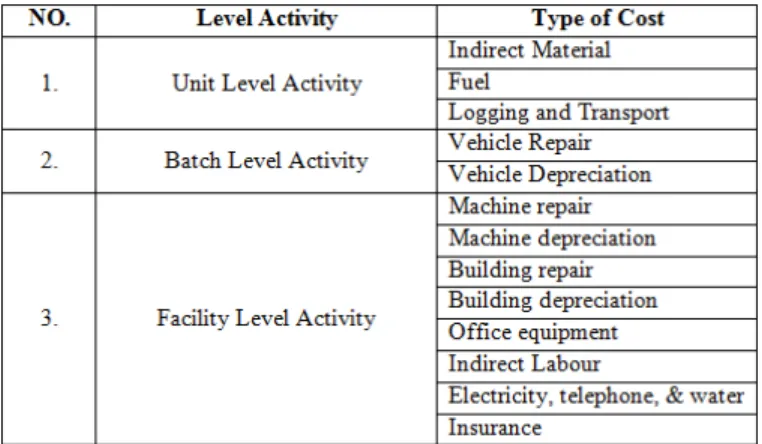
The first stage in implementing the ABC system is to analyze the activity of identify resource costs and activities of the company. To identify the cost of resources on a variety of activities, it is need to classify all activities according to how the activities consume resources. Classification of the activities are as follows in table 2.
Table 2 Classification Activities of Factory Overhead Cost PG. Kebon Agung Malang
The explanation classification of activities against factory overhead costs are as follows:
a. Indirect materials. Indirect materials are materials supporting main material in producing a product. The use of indirect labor are classified into activities of unit level because the use of indirect materials is influenced by the total amount of units produced.
b. Fuel. The fuel cost are costs incurred for the purpose of transporting raw materials purchasing for production purposes. Fuels are included in the unit level facilities. c. Logging and transport. Logging and
transport costs are the costs incurred for the purpose of cane permanent and transport of cane in order to the production process. Logging and transport are classified into unit level activities.
d. Vehicle repair. Vehicle repair conducted to maintain the condition of the vehicle company. This is done so that the vehicle is always ready when a company needs. Cost of repair the vehicle are classified in the batch level activities.
e. Vehicle depreciation. Vehicles factory depreciated each year, because the vehicle has the economic life as well as machinery and buildings. Depreciation of vehicles including bstch level activites.
f. Indirect Labor. Indirect labor required to help steady of production process. Indirect labor costs are included in the facility level activities.
g. Machine repair. Machine repair carried for the machine to continuous operation fluently and not damaged during the production process. Machine maintenance costs are classified in the facility level activities. h. Machine depreciation. Factory machine
have economic life that should depreciated each year. Depreciation of machines cost including facility level activities.
i. Building repair. Factory building repair is done to maintain the condition of the factory building. This raises the cost of building maintenance are classified into the activity of the facility level activities.
j. Building depreciation. Buildings are depreciated in each year, because the building has economic life as well as machines and buildings. Depreciation of building cost including facility level activities.
k. Office Equipment. Office equipment are costs incurred for office factory during the production process. Office equipment are included in the facility level activites.
l. Electricity, telephone & water. Electricity, telephone & water are the cost incurred by the company to meet the communication needs, water supply and plant lighting. Electricity, telephone and water are classified in facility level activities.
m.Insurance. Insurance is a cost incurred by the company to ensure the activities of employees in work. Insurance costs are classified in the facility level activities. 4.3 Allocate Costs based on Activities
The next step in the implementation of the ABC system is allocate costs based on activity. Calculations using the ABC system cost drivers for resource consumption in charge of resource to
activities. This is because triggers activity costs used in the production process.
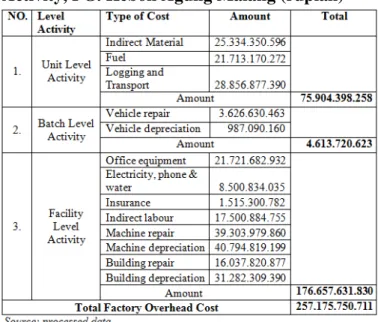
Raw material costs and direct labor costs are not traced to the activity because these costs have been attached to the product depends on the units produced. Costs are traced to each activity is factory overhead costs. The following classification of factory overhead costs PG. Kebon Agung Malang based on activities:
Table 3 Classification of Factory Overhead for Activity, PG. Kebon Agung Malang (rupiah)
4.4 Determine the Homogeneus Cost Pool In this step is clarified various overhead costs into homogeneus cost pool where each group consist of the costs depending on the cost driver. Cost driver is the cause of the factors that explain the overhead cost or overhead consumption. The following information about the classification of the cost into cost pool:
Table 4 Cost Driver and Cost Pool Factory Overhead PG Kebon Agung Malang (rupiah)
4.5 Cost Driver
There are will be seen information of cost driver which selected for the PG. Kebon Agung:
a. Unit production. Cost objects charged in level unit of production because of the amount of produced by object the tab is influenced by the amount of units produced. The amount of production units used as cost drivers that use units of kuintal.
b. Kilometer usage. Object classification costs the unit level batch used is the amount of usage kilometers. The imposition is used because of the costs generated by the cost object are influenced by the amount of usage kilometers.
c. Machine hours. The activity level of this facility do not depend on the unit as well as the product. The object of this fixed cost is issued even though the number of units and the product produced reduced and increased. These activities served as the support operations because all operations carried out by humans and machine. So the facility level activity cost driver is set to use machine hours.
d. Direct labor hours. The activity level of this facility do not depend on the unit as well as the product. The object of this fixed cost is issued even though the number of units and the product produced reduced and increased. So the facility level activity cost driver is set to use direct labor hours.
4.6 Determine of Pool Rate
The last step is calculate the rate group obtained by dividing the total cost of the group with the cost driver. Rate calculation of each group can be seen in the following tables:
Table 5 Pool Rate of Each Cost Pool (rupiah)
4.7 Activity Based Object Costing (ABOC) Activity Based Object Costing is the process of calculating the cost of goods manufactured is based on the consumption of each product to the activity. This stage is the last stage in setting the cost of goods manufactured by using the ABC system. Imposition of factory overhead costs to each cost driver actually by each type of product multiplied by each cost pool, so that obtained factory overhead costs for each type of product as in the following table 17.
After calculating factory overhead costs with ABC system, furthermore can be known determination of the difference between the cost of goods manufactured with traditional cost accounting compared ABC system. The following is a table cost of goods manufactured PG. Kebon Agung Malang with ABC system and table comparison cost of goods manufactured between traditional cost accounting with ABC system. Table 6 Imposition Overhead Costs to Each Products PG. Kebon Agung Malang
4.7 Comparison Cost of Goods Manufactured with ABC Traditional Cost Accounting System
After calculating factory overhead costs with ABC system, furthermore can be known determination of the difference between the cost of goods manufactured with traditional cost accounting compared ABC system. The following is a table cost of goods manufactured PG. Kebon Agung Malang with ABC system and table comparison cost of goods
manufactured between traditional cost accounting with ABC system.
Table 7 Calculation Cost of Goods Manufactured PG. Kebon Agung Malang with ABC System in 2011 (rupiah)
Table 8 Comparison Cost of Goods Manufactured Between Traditional Cost Accounting System with ABC System (rupiah)
From the table above can be known that there are a difference in the result calculation cost of goods manufactured by traditional cost accounting and calculation with ABC system. Sugar product had overcosted of Rp. 494.723.425 and the molasses product had overcosted Rp. 235.564.736. Overcosted is calculations of cost charged by the company too high.
This comparison obviously illustrates the impact of using traditional cost accounting using a single cost driver when compared with ABC system charge based activities using multiple cost drivers, improper charging will cause distortion cost. Source of distortion lies in imposition of costs factory overhead costs based on only one cost driver, the production unit. Calculation of factory overhead which can lead to less precise serious consequences for the company. An example can lead to a wrong decision about selling the product pricing.
ABC calculations indicate charge costs system is more accurate than traditional cost accounting. Calculation cost of goods manufactured with ABC system is more accurate was expected to help the company management in decision making concerning the company determination selling price of the product.
5. CONCLUSION AND SUGGESTIONS
Based on the research that has been done, researchers conclude on the implementation of Activity Based Costing (ABC) System at PG. Kebon Agung Malang. Researchers also will give suggestions in order to be useful for PG. Kebon Agung Malang in determining the cost of goods manufactured.
5.1 CONCLUSION
a. PG. Kebon Agung Malang establish cost of goods manufactured are still using traditional method, where the basic is used to assign manufacturing overhead to each product using a single rate which only use one cost driver is the amount of production units. This resulted in the imposition of distorted overhead costs, because the overhead imposition on any type of product manufactured are products that imposed is too big or too small imposed. Inaccuracies in manufacturing overhead imposition of effect on the determination cost of goods manufactured is also affecting the selling price of the product.
b. Traditional cost accounting systems are not able to give actual information on resource consumption occurs. This can be seen by the distortion costs on traditional cost accounting methods when compared to the ABC system. c. Based on calculations and comparisons are
made in chapter IV, it can be seen that there are mistake in the imposition of factory overhead costs by each type of product produced by PG. Kebon Agung Malang. Sugar products had overcosted Rp. 494.723.425, and molasses products had overcosted Rp. 235.564.736, differences in the calculation of the amount cost driver are used as the basis for imposition of factory overhead costs applied by traditional method companies use only one cost driver that is amount of unit production, while ABC system using more cost drivers there are unit production, kilometer usage, machine hours, and direct labor hours.
5.2 SUGGESTIONS
a. PG. Kebon Agung Malang need to attention the problem imposition of the factory overhead costs, because if the company is not proper in imposition of factory overhead cost can lead to making the wrong decision by the management company in determining the cost of goods manufactured and also
affect the determining the selling price of the product. Then the company will be unable compete with similar companies that have manufacturing accurate information.
b. The appropriateness of applying the ABC system also depends on the policies of the management PG. Kebon Agung Malang. Therefore, company management needs to consider the obstacle and benefits that will be experienced by the company. Obstacle experienced by the company is need for additional and specific time to conduct training for employees associated with the new established system. The benefits of applying the ABC system is the accuracy factory overhead costs that affect the quality of management decisions in determining the selling price of the product.
REFFERENCES
Albrecht, Stice, & Swain. 2008. Accounting Concept & Applications, 11th Edition. Canada: Nelson Education. Ltd.
Arnold, Glen. 2005. Corporate Finance a Business Companion to Financial Market,
Decision and Techniques. England:
Prentice Hall Finance Times.
Bhabatosh Banerjee. 2006. Cost Accounting: Theory and Practice. 12th Edition. India: Prentice Hall
Brigham, Eugene F. 2004. Financial Management: Theory and Practice. 12th
Edition. South-Western: Thomson
Learning.Inc.
Charles T. Horngren, Srikant. M. Datar, & George Foster. 2006. Cost Accounting: A
Managerial Emphasis. New Jersey:
Pearson Prentice Hall
Colin Drury. 2006. Cost and Management Accounting: An Introduction. 6th Edition. London: Thomson Learning
Cooper, D, R., & Schindler, Pamela S. 2006.
Business Research Methods. Ninth
Edition. New York: Mc Graw Hill.
Dosen FIA UB. 2011. Pedoman Penyusunan dan Ujian Skripsi Program Sarjana (S1). Universitas Brawijaya: Fakultas Ilmu Administrasi.
Dr. C. Rajendra Kumar. 2008. Research Methodology. India: APH Publishing Corporation.
Filipe, Cordeiro. 2009.Enterprise Information System. 11th Edition. Italy: Proceedings. Frederick J. Gravetter, Lori-Ann B. Forzano.
2011. Research Methods for the Behavioral Sciences. Canada. Nelson Education, Ltd.
Gwartney, Stroup, Sobel, Macperson. 2009.Macroeconomics: Private and Public Choice. Canada: Nelson Education. Ltd. Hansen & Mowen. 2005.Managerial Accounting
8th Edition. USA: Thonson Higher
Education
Hornrgen, Harrison, Bamber. 2005. Accounting. 6th Edition. New Jersey: Prentice Hall. Jawaharlal Lal. 2002. Cost Accounting 3rd
Edition. India: Tata McGraw-Hill
Jawaharlal Lal, Seema Srivasta. 2009. Cost Accounting 4th Edition. India. Tata McGraw-Hill. Ltd.
Kothari, C.R. 2004. Research Methodology: Methods & Techniques. Second Edition. New Delhi: New Age International Ltd. M. Y. Khan, P. K. Jain. 2007. Cost Accounting.
India: Tata McGraw-Hill Ltd.
N. Gregory Mankiw. 2009. Principles of Economics 6th Edition. Canada. Nelson Education. Ltd.
Needles, Belverd E. 2007. Financial Accounting. Ninth Edition. USA: Houghton Mifflin Company.
Rajasekaran, Lalitha. 2010. Cost Accounting. India: Dorling Kindersley. Ltd
Ray H. Garrison, Eric W. Noreen, Peter C. Brewer. 2009. Managerial Accounting. New Jersey: McGraw-Hill
Van Horne, James C. 2002. Financial Management. 11th Edition. London: Prentice Hall International
Warren, Carl S. 2009. Financial Accounting. 12th Edition. Canada: Nelson Education.