TEST AND EVALUATIO
N
MANAGEMENT GUID
E
1
Contents
Foreword 8 Chapter 1: 9 1.1 Introduction 9 1.2 Congress 91.3 OSD Oversight Structure 10
1.4 Service T&E Management Structures 14
1.5 Summary 22
Chapter 2: The T&E Process 23
2.1 Introduction 23
2.2 Defense Systems Acquisition Process 23
2.3 T&E And SE Processes 35
2.4 Five-Step Illustrative T&E Process 40
2.5 Scientific Test and Analysis Techniques (STAT) 42
2.6 Summary 44
Chapter 3: Program Office Responsibilities for T&E 45
3.1 Introduction 45
3.2 Relationship To The PM 47
3.3 Early Program Stages 48
3.4 PMO/Contractor Test Management 51
3.5 Test Program Funding/Budgeting 52
3.6 Contractor Testing 53
3.7 Specifications 53
3.8 Independent Test And Evaluation Agencies 54
3.9 PMO Involvement In Operational T&E Activities 54
3.10 Summary 60
Chapter 4: Test - Related Documentation 61
4.1 Introduction 61
4.2 Requirements Documentation 62
4.3 Program Decision Documentation 64
4.4 Program Management Documentation 65
4.5 Test Program Documentation 68
4.6 Other Test-Related Status Reports 74
4.7 Summary 75
Chapter 5: Test & Evaluation 76
5.1 Introduction 76
5.2 "Test" and "Evaluation" 76
5.3 The Evaluation Process 76
5.4 Distinction Between Issues and Criteria 77
5.5 MOEs 81
2
5.7 Evaluating Developmental And Operational Tests 84
5.8 Summary 85
Chapter 6: Introduction to DT&E 86
6.1 Introduction 86
6.2 DT&E and The System Acquisition Cycle 87
6.3 DT&E Responsibilities 90
6.4 Test Program Integration 92
6.5 Areas Of DT&E Focus 92
6.6 System Design For Testing 94
6.7 DT&E OF Limited Procurement Quantity Programs 95
6.8 Summary 95
Chapter 7: DT&E Support of Technical Reviews and Milestone Decision 96
7.1 Introduction 96
7.2 DT&E and The Review Process 96
7.3 Tailoring Reviews to Specific Needs 106
7.4 Summary 107
Chapter 8: Integrated Testing 108
8.1 Introduction 108 8.2 Integrated Testing 108 8.3 Early Involvement 109 8.4 Evaluation Framework 112 8.5 Test Data 115 8.6 Summary 115
Chapter 9: Production - Related Testing Activities 116
9.1 Introduction 116
9.2 Quality In Design 116
9.3 Production Management 116
9.4 Role Of The PRR 117
9.5 Production Qualification Testing 117
9.6 Transition To Production 119
9.7 LRIP 120
9.8 PAT&E 120
9.9 Summary 121
Chapter 10: Introduction to Operational Test and Evaluation 122
10.1 Introduction 122
10.2 Purpose and Scope of OT&E 122
10.3 Test Participants 124
10.4 OT&E as it Relates to DT&E 125
10.5 Types of OT&E 125
10.6 Test Planning 128
10.7 Test Execution 130
10.8 Test Reporting 130
3
Chapter 11: OT&E to Support Decision Reviews 132
11.1 Introduction 132
11.2 OT&E During the TD Phase 132
11.3 OT&E During the EMD Phase 132
11.4 OT&E During the P&D Phase 133
11.5 OT&E During the O&S Phase 133
11.6 Summary 135 Chapter 12: TEMP 136 12.1 Introduction 136 12.2 Temp Development 136 12.3 Temp Requirements 141 12.4 Temp Format 141 12.5 Summary 143
Chapter 13: Test Resources 144
13.1 Introduction 144
13.2 Obtaining Test Resources 144
13.3 Test Resource Planning 149
13.4 Test Resource Funding 154
13.5 Summary 157
Chapter 14: Introduction to Acquisition of Defense Business Systems (DBSs) 159
14.1 Introduction 159
14.2 DBSs 159
14.3 BCL Model 159
14.4 Incremental Acquisition Approach For DBSs 160
14.5 Summary 164
Chapter 15: Software and IT Testing Considerations 165
15.1 Introduction 165
15.2 Role Of The Software Specification Review 165
15.3 Role Of The TRR For Software 169
15.4 Software Development Process 170
15.5 Potential Power Of Human-Based Testing 171
15.6 "Black Box" Versus "White Box" Testing 172
15.7 On the Impossibility of Exhaustive Software Testing 173
15.8 Software Error Categorization And Priority 174
15.9 Overview of Software Measurement With T&E Applications 175
15.10 Independent Verification and Validation (IV & V) 184
15.11 T&E Issues Associated With Spiral and Agile Development Approaches 185
15.12 COTS Considerations 188
15.13 Mature Software 189
4
Chapter 16: Testing for Vulnerability and Lethality 191
16.1 Introduction 191
16.2 LFT 191
16.3 Nuclear Weapons Testing 196
16.4 Testing For NH&S 196
16.5 Summary 198
Chapter 17: Logistics Support T&E 200
17.1 Introduction 200
17.2 Planning For Logistics T&E 204
17.3 Aspects of LOG T&E 209
17.4 Limitations to LOG T&E 217
17.5 Summary 217
Chapter 18: M&S Support to T&E 218
18.1 Introduction 218
18.2 Types of Models and Simulations 218
18.3 Scope of M&S 221
18.4 Support to Test Design and Planning 222
18.5 Support to Test Execution 224
18.6 Support to Analysis and Test Reporting 224
18.7 Simulation Integration 226
18.8 Simulation Planning 227
18.9 Summary 227
Chapter 19: Electromagnetic Environmental Effects (E3) Testing and Spectrum Supportability (SS) 228
19.1 Introduction 228
19.2 Key Definitions and Concepts 228
19.3 E3/SS Planning, Analysis, Systems Engineering, and T&E For the Systems Acquisition Process 233
19.4 Summary 244
Chapter 20: Special Topics: Interoperability and Cyber Security 248
20.1 Policy 248
20.2 Interoperability Testing 248
20.3 "Operationalizing" the NR KPP 251
20.4 Role of JITC 252
20.5 Supporting Integrated Architecture Products 253
20.6 Cyber Security and IA Requirements 255
20.7 Agile Development and T&E 259
20.8 Summary 260
Chapter 21: Multi-Service and Joint Testing 263
21.1 Introduction 263
21.2 Background 263
21.3 Test Program Responsibilities 264
21.4 Test Team Structure 265
21.5 Test Planning 265
5
21.7 Test Reporting 267
21.8 Joint Test and Evaluation 267
21.9 Summary 269
Chapter 22: International T&E Programs 270
22.1 Introduction 270
2.2 FCT Program 270
22.3 NATO Comparative Test (NCT) Program 272
22.4 T&E Management in Multi-National Programs 272
22.5 U.S. and NATO Acquisition Programs 273
22.6 Summary 273
Chapter 23: Commercial Off-The-Shelf and Non-Developmental Items Considerations 274
23.1 Introduction 274
23.2 Market Investigation and Procurement 276
23.3 COTS and NDI Testing 277
23.4 Resources and Funding 279
23.5 Summary 279
Chapter 24: Testing the Special Cases 280
24.1 Introduction 280
24.2 Testing with Limitations 280
24.3 Space System Testing 283
24.4 Cyber Warfare 284
24.5 Operations Security and T&E 288
24.6 Joint Concept Technology Demonstrations 289
24.7 Chemical and Biological Agent (CBA) Testing 289
24.8 Summary 290
Appendix A - Acronyms 291
6
List of Figures
Figure 1-1 DoD Test and Evaluation Organization 10
Figure 1-2 Army Test and Evaluation Organization 15
Figure 1-3 Navy Test and Evaluation Organization 18
Figure 1-4 Air Force Test and Evaluation Organization 21
Figure 2-1 Defense Acquisition System Model 24
Figure 2-2 Improving Milestone Process Effectiveness 25
Figure 2-3 Key Technical Activities and Technical Reviews/Audits during the Acquisition Lifecycle 30 Figure 2-4 Illustrative Systems Engineering Activities (EMD Phase) 38
Figure 2-5 Impact of Decision Timing on Lifecycle Costs 40
Figure 2-6 Five Step Test and Evaluation Process 41
Figure 3-1 T&E WIPT Focus Areas 47
Figure 3-2 Examples of T&E Lessons Learned 55
Figure 4-1 Examples of T&E-related Program Plans and Documentation 61
Figure 4-2 Example of Requirements Evolution 63
Figure 4-3 Example of Typical Test Plan Format 71
Figure 4-4 Types of Information in a Final Test Report 73
Figure 5-1 Illustrative Generic Evaluation Process 77
Figure 5-2 Example of Key Topics in an Evaluation Plan 78
Figure 5-3 Example of Dendritic Analysis Showing Critical Issue Decomposition 83 Figure 6-1 Examples of Testing Activities Throughout the Acquisition Life Cycle 87 Figure 7-1 Example DT&E Activities Across Phases of the Acquisition Life Cycle 01 Figure 7-2 Example of Technical Review Timing Across the Acquisition Life Cycle 98
Figure 7-3 Specifications Summary 99
Figure 8-1 Integrated Testing as Part of an Overall T&E Continuum 111
Figure 8-2 Top-Level Evaluation Framework Matrix 114
Figure 9-1 Typical Criteria Evaluated as Part of a PRR 118
Figure 10-1 Illustrative Scope of the Operational Test and Evaluation Effort 123 Figure 10-2 Comparisons of DT and IOT&E Differences Highlighted 125
Figure 12-1 TEMP Format 142
Figure 13-1 DoD MRTFB by DoD Component 148
Figure 13-2 TEMP Part IV - Resource Summary 150
Figure 13-3 Resourcing Cycle Overlaps in the DoD Budget Process 155
Figure 14-1 BCL Acquisition Business Model 161
Figure 15-1 “Error Avalanche” Showing How Software Errors Can Accumulate 164
Figure 15-2 Software Error Distribution Summary (Notional) 166
Figure 15-3 Illustrative Software Test Planning Activities 168
Figure 15-4 Illustrative Software Development Activities in System WBS Context 171
Figure 15-5 Testing Example 174
Figure 15-6 Priority Classification Scheme for Software Errors 175
Figure 15-7 Example of Requirements Stability Measure 177
Figure 15-8 Example of Computer Resource Utilization Measure 178
Figure 15-9 Test Progress Measure Indicating Schedule Slip 179
Figure 15-10 Test Facility Under-Utilization Example 180
Figure 15-11 Problem Report Closure Rate Status Problems 181
7
Figure 15-13 Problem Report Open Status Example 183
Figure 15-14 Tracking Problem Report Severity 183
Figure 15-15 Spiral Model Software Development Approach 186
Figure 15-16 Notional Agile Development Model Depicting Testing 198
Figure 15-17 Example of Software “Maturity” Criteria 190
Figure 16-1 Summary of Key Parts of the U.S.C. Regarding LFT 192
Figure 16-2 Summary of Degrees of LFT 193
Figure 16-3 Illustrative LFT&E Planning and Execution Process 195
Figure 16-4 Nuclear Weapons Effects vs. System Survivability 197
Figure 17-1 Illustrative Scope of LOG T&E 200
Figure 17-2 IPS Elements 202
Figure 17-3 Logistics Supportability Objectives in the Overall T&E Program 206
Figure 17-4 Example RGC 213
Figure 18-1 The Simulation Spectrum 219
Figure 18-2 Criteria Values Conducive to Use of M&S 221
Figure 18-3 Illustrative Use of M&S in T&E 224
Figure 19-1 Key E3/SS Terms and Definitions 232
Figure 19-2 S-Diagram 233
Figure 20-1 RMF Process 257
Figure 20-2 Procedures for OT&E for IA in Acquisition Programs 258 Figure 21-1 Multi-Service OT&E (MOT&E) Team Composition 261
Figure 21-2 Deficiency Report Summary Format 266
Figure 21-3 JT&E Process 267
8
Test & Evaluation Management Guide
Foreword
This 6th edition of the Test and Evaluation Management Guide (TEMG) was updated with the cooperation and support of the Deputy Assistant Secretary of Defense for Developmental Test and Evaluation (DASD(DT&E)), the Director of Operational Test and Evaluation (DOT&E), the President of the Defense Acquisition University (DAU), and the DoD Component test and evaluation (T&E)
representatives. The TEMG is one of many technical management educational guides developed for use by DAU. Although some Service-specific processes are included as illustrative examples, the TEMG, like all DAU products, is written primarily from a Department of Defense (DoD) perspective, i.e., non-Service specific.
The TEMG is intended primarily for use in courses at DAU and secondarily as a generic desk reference for program and project management, and T&E personnel. It is written for current and potential acquisition management personnel and assumes some familiarity with basic terms, definitions, and processes as employed by the DoD acquisition process. The TEMG is designed to assist Government and industry personnel in executing their management responsibilities relative to the T&E support of defense systems and facilitate learning during DAU coursework.
The objective of a well-managed T&E program is to provide timely and accurate information to decision makers and program managers (PMs). The TEMG was developed to assist the acquisition community in obtaining a better understanding of who the decision makers are and determining how and when to plan T&E events so that they are efficient and effective.
Although the TEMG includes some references to DoD policies, it is not a policy document and should not be viewed as such. The latest versions of the DoD 5000 series, as well as the Defense Acquisition
Guidebook (DAG) (Chapter 9, Test and Evaluation), should be consulted for specific policies and DoD recommended practices.
References to Military Handbooks (MIL-HDBKs) appear throughout the TEMG: however, these handbooks are for guidance only and cannot be cited as a requirement.
For additional learning materials about DoD T&E, consult the DAU Website ( www.dau.mil ), for reviewing T&E continuous learning modules and accessing T&E courses, and go to the DAU Acquisition Community Connection, T&E Community of Practice (CoP) available at https://acc.dau.mil/t&e . Comments, updates, changes, and/or comments to this guide should be provided to Office of the DASD(DT&E) T&E Competency and Development Directorate and to DAU.
9
Test & Evaluation Management Guide
Chapter 1
1.1 Introduction
This chapter provides an introduction to the policy and organizations that govern the conduct of T&E activities within the DoD and discusses congressional legislation of T&E activities for compliance by DoD. It outlines the responsibilities of DoD test organizations at the Office of the Secretary of Defense (OSD) and Service levels and describes related T&E policy.
1.2 Congress
Congress requires the DoD to provide the following reports that include information on T&E:
• Selected Acquisition Report (SAR). This report consists of cost, schedule, and performance data. The SAR describes Acquisition Category (ACAT) I system characteristics required and outlines significant progress and problems encountered. It lists tests completed and issues identified during testing. The program manager (PM) uses the Consolidated Acquisition Reporting System software to prepare the SAR.
• DOT&E Annual Report. This report is provided by the DOT&E to the Secretary of Defense (SecDef) and the committees on Armed Services, National Security, and Appropriations. The report provides a narrative and resource summary of all operational test and evaluation (OT&E) and related issues, initiatives, other interest areas, activities, and assessments in the previous fiscal year. When oversight of live-fire testing (LFT) was moved to DOT&E, this issue was added to the report.
• Beyond Low-Rate Initial Production (BLRIP) Report. Before proceeding to BLRIP for each major defense acquisition program (MDAP), the DOT&E must report to the SecDef, Deputy Secretary of Defense, Under Secretary of Defense for Acquisition, Technology and Logistics (USD(AT&L)), Secretaries of the Military Departments, and Congress. This report addresses the adequacy of the Service initial operational test & evaluation (IOT&E) and whether the T&E results confirm that the tested item or component is effective, suitable, and survivable for combat. When oversight of live-fire test & evaluation (LFT&E) was moved to the DOT&E, the LFT Report was added to the BLRIP report content.
• Foreign Comparative Testing (FCT) Report. The USD(AT&L) should notify Congress a minimum of 30 days prior to the commitment of funds for initiation of new FCT evaluations of equipment produced by select allied and friendly foreign countries.
• Joint DASD(DT&E) and Deputy Assistant Secretary of Defense for Systems Engineering (DASD(SE)) Annual Report. This report is required by statute to be provided to the committees on Armed Services and Appropriations. The joint report includes the significant Developmental Test and Evaluation (DT&E) and systems engineering (SE) activities for the Department's MDAPs, major automated information systems (MAIS), and special interest programs. The report
10
evaluates the progress of weapon systems' performance for programs designated for OSD T&E oversight.
1.3 OSD Oversight Structure
The DoD organization for the oversight of T&E is illustrated in Figure 1-1. For the USD(AT&L), DT&E oversight is performed by the DASD(DT&E), within the Office of the Assistant Secretary of Defense for Research and Engineering (ASD(R&E)). The DOT&E provides OT&E oversight for the SecDef. The management of MDAPs in OSD is performed by the Defense Acquisition Executive (DAE), who uses the Defense Acquisition Board (DAB) and Overarching Integrated Product Teams (OIPTs) to process information for decisions.
Figure 1-1 DoD Test and Evaluation Organizations 1.3.1 DAE
The DAE position, established in September 1986, is held by the USD(AT&L). As the DAE, the USD(AT&L) uses the DAB and its OIPTs to provide the senior-level decision process for the acquisition of weapon systems. DAE responsibilities include establishing policies for acquisition (including procurement,
11
research and development (R&D), logistics, developmental testing (DT), and contracts administration) for all elements of DoD. The DAE's charter includes the authority over the Services and Defense Agencies on policy, procedure, and execution of the weapon systems acquisition process.
1.3.2 DAB
The DAB is the senior advisory board for the DoD acquisition system. The board includes the Vice Chair of the Joint Chiefs, the service Secretaries, and a number of Undersecretaries of Defense. Members of the DAB are responsible for approving the MDAPs and serve as the most important executive review of the most expensive acquisition projects in the DoD. The DAB is also the principal review forum enabling the USD(AT&L) to fulfill 10 USC Chapter 144 responsibilities concerning ACAT ID MDAPs.
The USD (AT&L) is the Milestone Decision Authority (MDA) for ACAT ID programs and ACAT IAM programs that have not been delegated. The USD(AT&L) conducts DAB Reviews for ACAT ID and IAM programs at major milestone decision points, at the Full-Rate Production Decision Review, at Interim Program Reviews, and at other times as necessary.
1.3.3 DASD(DT&E)
In accordance with DoD Instruction (DoDI) 5134.17 (Reference (a)), the DASD(DT&E) shall be the focal point for all policy, practice, procedures, and acquisition workforce issues relating to DT&E within DoD. The DASD(DT&E) is the principal advisor to the SecDef and the USD(AT&L) on DT&E in the DoD in accordance with section 139b of Title 10, United States Code (U.S.C.) (Reference (b)). See Figure 1-1. 1.3.3.1 Responsibilities of the DASD(DT&E)
Some of the key duties of the DASD(DT&E) include:
• Develops policies and guidance for the following:
o The planning, execution, and reporting of DT&E in the DoD, including integration and DT&E of software;
o The integration of developmental and operational tests in coordination with the DOT&E; o The planning, execution, and reporting of DT&E executed jointly by more than one
Military Department or Defense Agency;
o The use of DT&E planning principles and best practices; and
o The development of test and evaluation strategies (TESs) and test and evaluation master plans (TEMPs) in conjunction with the DOT&E.
• Provides guidance to defense acquisition programs for developing and documenting the program's evaluation strategy and management approach in the TES and TEMP throughout the program's life cycle.
12
• Reviews and approve DT&E portions in the TES and TEMP for each program on the OSD T&E
oversight list.
• Monitor and review, beginning with the materiel development decision, the DT&E and development planning activities of the pre-MDAPs and pre-MAIS programs.
• Monitor and review the DT&E activities of all MDAPs and MAIS programs and special interest programs identified on the OSD T&E oversight list.
• In accordance with (IAW) DTM 09-027 (Reference (ac)), ensure access to all test data and program information relevant to the execution of testing and fulfillment of DASD(DT&E) responsibilities.
• Serves as the DoD functional leader for the T&E acquisition career field. Provide advocacy, oversight, and guidance to the acquisition workforce responsible for T&E.
• As an advisory member of the DAB and other key acquisition bodies, provides independent assessments, planned and ad hoc, of programs' DT&E, execution, and risk.
• Periodically review the organizations and capabilities of the Military Departments with respect to DT&E. Identify needed changes or improvements to such organizations and capabilities, and provide input regarding needed changes or improvements for the T&E strategic plan.
• Submit to the congressional defense committees an annual report, jointly with the DASD(SE).
• Conduct an independent assessment of operational test readiness (AOTR) for all MDAPs and special interest programs.
• Jointly with the DOT&E, and in consultation with the T&E executives of the cognizant DoD Components, determine the programs designated for OSD T&E oversight.
• Serve concurrently as the Director, Test Resource Management Center (TRMC), and in this capacity, report directly to the USD(AT&L) (as illustrated in Figure 1-1) in accordance with section 196(f) of reference (b).
1.3.3.2 DASD (DT&E) and Service Reports
During the testing of ACAT I and designated weapon systems, the DASD(DT&E) and Services interaction includes the following reporting requirements:
• A TES must be provided for Milestone (MS) A and a TEMP (either preliminary or updated, as appropriate) must be provided for consideration and approval before each milestone review, starting with MS B.
• A technical assessment of DT&E is provided to the ASD(R&E) and DOT&E listing the T&E results, conclusions, and recommendations prior to a milestone decision or the final decision to proceed to BLRIP.
13 1.3.4 DOT&E
The DOT&E reports to the SecDef (as illustrated in Figure 1-1) and has special reporting requirements to Congress. The DOT&E must provide to Congress independent analysis and insight into the operational effectiveness, suitability, and survivability of new weapon systems.
1.3.4.1 Duties and Authority of the DOT&E
Some of the key duties and authority of the DOT&E as outlined in DoD Directive (DoDD) 5141.2
(Reference (c)); DODI 5000.02 (Reference (d)); and sections 139 , 2366 , 2399 , and 2400 of Reference (b) are as follows:
• Comply with requests from Congress for information relating to operational OT&E in the DoD.
• In conjunction with the DASD(DT&E), co-approve the TEMP and TES for major and other designated defense acquisition programs, special interest programs, and other designated automated information system (AIS) programs.
• Approve operational test plans, and OT&E portions of test planning documents for major and other designated defense acquisition programs, special interest programs, and major and other designated AIS programs.
• Approve the TEMP and T&E portions of integrated program management documents for programs that are solely under DOT&E oversight. Approve test plans for operational test events of acquisition systems under DOT&E oversight.
• Approve LFT&E strategies and management plans and, if developed in support of waivers of full-up system-level LFT, alternative LFT&E strategies.
• Following consultation with the PM, determine the number of production or
production-representative test articles required for LFT&E and IOT&E of programs on the OSD T&E oversight list.
• Obtain reports and information, as necessary in carrying out assigned responsibilities and functions.
• Provide independent oversight, independent evaluation, and objective reporting of the results of operational test and LFT&E.
• Determine adequacy of operational test capabilities.
• Monitor all OT&E activities.
• Coordinate Military Services planning and execution of OT&E.
14
• Provide early involvement in the acquisition cycle (integrated product team (IPT), informal
reviews, etc.).
• Submit special reports to the SecDef and Congress. 1.3.4.2 DOT&E and Service Interactions
For DoD and DOT&E-designated oversight acquisition programs, the Service provides the DOT&E the following:
• A draft copy of the operational test plan for review and approval.
• Significant test plan changes.
• The final Service IOT&E report, which must be submitted to DOT&E before the Full-Rate Production Decision Review (FRPDR) for incorporation in the BLRIP report.
• The LFT&E plan for approval, and the Service LFT report for review. 1.3.5 Defense Information Systems Agency (DISA)
The DISA is responsible for planning, engineering, acquiring, testing, fielding, and supporting global net-centric information and communications solutions to serve the needs of the President, the Vice
President, the SecDef, and the DoD Components, under all conditions of peace and war. The DISA supports national security communications requirements as identified in the National Security Presidential Directive 28 (Reference (e)) and Executive Order 12472 (as amended) (Reference (f)). In accordance with DoDD 5105.19 (Reference (g)), the DISA maintains a major field independent operational test capability (See Figure 1-1) through the Joint Interoperability Test Command (JITC). Under the direction of the Director, DISA, the JITC conducts operational test and evaluation, consistent with DoD Directive 5000.1 (Reference (h)) and Reference (d) .
1.4 Service T&E Management Structures 1.4.1 Army T&E Organizational Relationship
Army Regulation (AR) 73-1 (Reference (i)) prescribes implementing policies and assigns responsibilities for T&E activities during the systems acquisition processes. It applies to all systems (materiel and command, control, communications, and computers (C4), intelligence (I), and information technology (IT) (C4I/IT) developed, evolved, acquired, and managed under the
auspices of AR 701 and the DAG (Reference (j)). Reference (i) applies to Army participation in joint test and evaluation (JT&E) and multi-Service operational test and evaluation (MOT&E). The Army
15
Figure 1-2 Army T&E Organization 1.4.1.1 Army Acquisition Executive (AAE)
The Assistant Secretary of the Army for Acquisition, Logistics, and Technology (ASA(ALT)) has the principal responsibility for all Department of the Army matters and policy related to acquisition, logistics, technology, procurement, the industrial base, and security cooperation. Additionally, the ASA(ALT) serves as the AAE. The AAE administers acquisition programs by developing/promulgating acquisition policies and procedures as well as appointing, supervising, and evaluating assigned program executive officers (PEOs) and direct-reporting PMs .
1.4.1.2 Army T&E Executive
The Army T&E Executive establishes, reviews, enforces, and supervises Army T&E policy and procedures including overseeing all Army T&E associated with the system research, development, and acquisition of all materiel systems and C4/IT systems. As delegated by the AAE, the Army T&E Executive is the sole Headquarters, Department of the Army (HQDA) approval authority for TEMPs.
The Test and Evaluation Office within the Office of the Deputy Under Secretary of the Army, known as the Deputy Under Secretary of the Army for Test and Evaluation (DUSA-TE), provides support for the
16
Army T&E Executive. In this capacity, it has the mission to establish policy and resources that are disciplined and flexible enough to support safe and reliable equipment for the current and future Army and DoD chemical and biological defense. DUSA-TE also provides T&E subject matter expertise and oversight of Army and DoD chemical and biological acquisition programs and represents Army T&E interests at OSD and tri-Service committees and forums.
1.4.1.3 Army Test and Evaluation Command (ATEC)
ATEC supports the systems acquisition, force development, and experimentation processes through overall management of the Army’s T&E programs. In this role, ATEC manages the Army’s developmental and operational testing, all system assessments and evaluations, and management of joint T&E. ATEC is the Army’s independent operational test agency (OTA) reporting directly to the Vice Chief of Staff of the Army (VCSA) through the Director of the Army Staff (DAS).
ATEC has the primary responsibility for conducting (DTs) for the Army. Responsibilities include the following:
• Perform the duties of Government developmental tester for all Army systems except for those systems assigned to the Communications-Electronics Research, Development, and Engineering Center of the Army Materiel Command (AMC) Research, Development and Engineering Command (RDECOM) by HQDA (Deputy Chief of Staff, G-6); Medical Command (MEDCOM); Intelligence and Security Command (INSCOM); Space and Missile Defense Command (SMDC); and Army Corps of Engineers (ACE).
• Provide test facilities and testing expertise in support of the acquisition of Army and other defense systems.
• Operate and maintain the Army's portion of the Major Range and Test Facility Base (MRTFB) (except for the United States Army Kwajalein Atoll in accordance with DoDD 3200.11 , (Reference (k)).
• Provide testers with a safety release for systems before the start of pretest training for tests that use Soldiers as test participants.
• Provide safety confirmations for milestone acquisition decision reviews and the materiel release decision.
• Manage the Army Test Incident Reporting System. 1.4.1.3.1 Army Operational Testers
The U.S. Army Operational Test Command (OTC) within ATEC has the primary responsibility for conducting most Operational Tests (OTs) for the Army and supporting Army participation in Joint T&E. OTC responsibilities include the following:
17
• Perform the duties of operational tester for all Army systems except for those systems assigned
to MEDCOM, INSCOM, SMDC, and United States Army Special Operations Command (USASOC).
• Perform the duties of operational tester for assigned multi-Service OTs and (on a customer service basis) for Training and Doctrine Command (TRADOC) force development tests and/or experimentation (FDT/E).
• Provide test facilities and testing expertise in support of the acquisition of Army and other defense systems, and for other customers on a cost-reimbursable and as-available basis.
• Program and budget the funds to support OT except out-of-cycle tests (which are usually paid for by the proponent).
• Develop and submit OT and FDT/E test resource plans (TRPs) to the Army's Test Schedule and Review Committee (TSARC).
1.4.1.3.2 Army Evaluation Center (AEC)
The AEC is an independent subordinate element within ATEC that has the primary responsibility for conducting Army system evaluations and system assessments in support of the systems acquisition process. Decision makers use AECs independent report addressing an Army systems operational effectiveness, suitability, and survivability. AEC responsibilities include the following:
• Perform the duties of system evaluator for all Army systems except for those systems assigned to MEDCOM, INSCOM, and the commercial items (CI) assigned to ACE; conduct continuous evaluation (CE) on all assigned systems.
• Develop and promulgate evaluation capabilities and methodologies.
• Coordinate system evaluation resources through the TSARC.
• Preview programmed system evaluation requirements for possible use of modeling and simulation (M&S) to enhance evaluation and reduce costs.
• Perform manpower and personnel integration assessments in coordination with Deputy Chief of Staff, G-1 Army Research Laboratory (ARL)-Human Research and Engineering Directorate.
• Perform the integrated logistics support (ILS) program surveillance for Army systems. Perform independent logistics supportability assessments and report them to the Army logistician and other interested members of the acquisition community .
18 1.4.2 Navy T&E Organizational Relationship
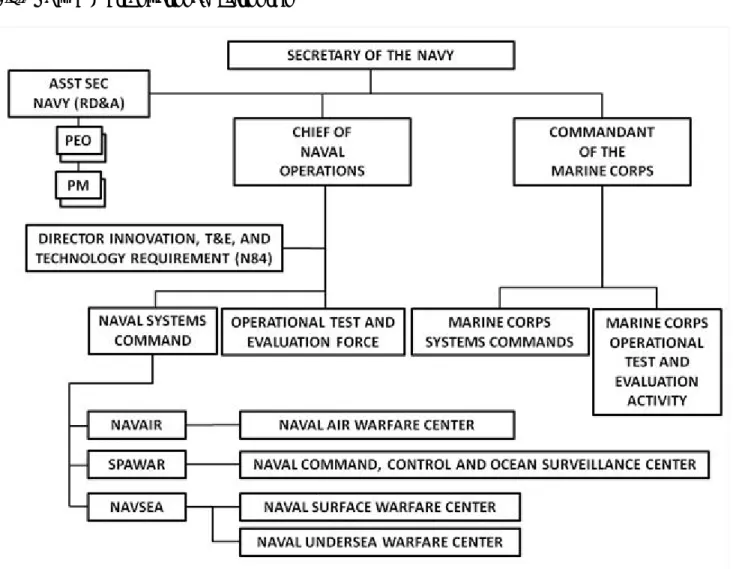
Figure 1-3 Navy Test and Evaluation Organization
The organizational structure for T&E in the Navy is illustrated in Figure 1-3. Within the Navy Secretariat, the Secretary of the Navy (SECNAV) has assigned general and specific research, development, test, and evaluation (RDT&E) responsibilities to the Assistant Secretary of the Navy for Research, Development, and Acquisition (ASN(RD&A)) and to the Chief of Naval Operations (CNO). The CNO has responsibility for the TEMP process. T&E policy and guidance are exercised through the Director, Innovation, Test and Evaluation, and Technology Requirements (CNO (N84)).
1.4.2.1 Navy DT&E Organizations
The Navy’s senior systems development authority is divided among the commanders of the system commands with Naval Air Systems Command (NAVAIR) developing and performing DT&E on aircraft and their essential weapon systems; Naval Sea Systems Command (NAVSEA) developing and performing DT&E on ships, submarines, and their associated weapon systems; and Space and Naval Warfare
Systems Command (SPAWAR) developing and performing DT&E on all other systems. System acquisition is controlled by a chartered PM or by the commander of a systems command. In both cases, the
19
designated developing agency is responsible for DT&E and for the coordination of all T&E planning in the TEMP. Developing agencies are responsible for the following:
• Develop test issues based on the thresholds established by user requirements.
• Identify the testing facilities and resources required to conduct the DT&E.
• Develop the DT&E test reports.
Reporting directly to the CNO, the President of the Board of Inspection and Survey is responsible for conducting acceptance trials of new ships and aircraft acquisitions and is the primary Navy authority for Production Acceptance Test and Evaluation (PAT&E) of these systems.
1.4.2.2 Navy Operational Test and Evaluation Force (OPTEVFOR)
The Commander, Operational Test and Evaluation Force (COMOPTEVFOR) commands the Navy's independent OT&E activity and reports directly to the CNO. The functions of the OPTEVFOR include the following:
• Establish early liaison with the developing agency to ensure an understanding of the requirements and plans.
• Review acquisition program documentation to ensure that documents are adequate to support a meaningful T&E program.
• Plan and conduct realistic OT&E.
• Develop tactics and procedures for the employment of systems that undergo OT&E (as directed by the CNO).
• Provide recommendations to the CNO for the development of new capabilities or the upgrade of ranges.
• Conduct OT&E on Marine Corps aviation systems. 1.4.3 Marine Corps T&E Organizational Relationship
The Office of Program, Budget, and Execution, Headquarters Marine Corps, directs the total Marine Corps program effort to support the acquisition of new systems. The Marine Corps does not have a position that is analogous to that of the Director, Innovation, T&E and Technology Requirements (CNO (N84)). The Commanding General (CG), Marine Corps Systems Command (MCSC) is the sponsor for RDT&E and is responsible for DT&E within the Marine Corps. The CG MCSC also reports directly to the ASN(RD&A). Figure 1-3 illustrates the Marine Corps organization for T&E management.
20 1.4.3.1 Marine Corps DT&E Organizations
The CG MCSC is the Marine Corps materiel developing agent and directly interfaces with the Navy Systems Commands. The CG MCSC implements policies, procedures, and requirements for DT&E of all systems acquired by the Marine Corps. The Marine Corps also uses DT&E and OT&E performed by other Services, which may develop systems of interest to the Corps.
1.4.3.2 Marine Corps Test and Evaluation Activity (MCOTEA)
MCOTEA is responsible for the independent OT&E of assigned Navy, Marine Corps, and joint acquisition programs to ensure that all events are effectively planned, conducted, and reported. MCOTEA
coordinates the scheduling of resources for OT requiring Marine operating forces support through the Marine forces synchronization conferences. Aviation programs sponsored by the CNO undergo independent OT&E by the COMOPTEVFOR.
1.4.4 Air Force T&E Organizational Relationships
Air Force Policy Directive (AFPD) 99-1 (Reference (l)) and the Air Force 99-serices of Instructions establishes policies for the T&E process and infrastructure.
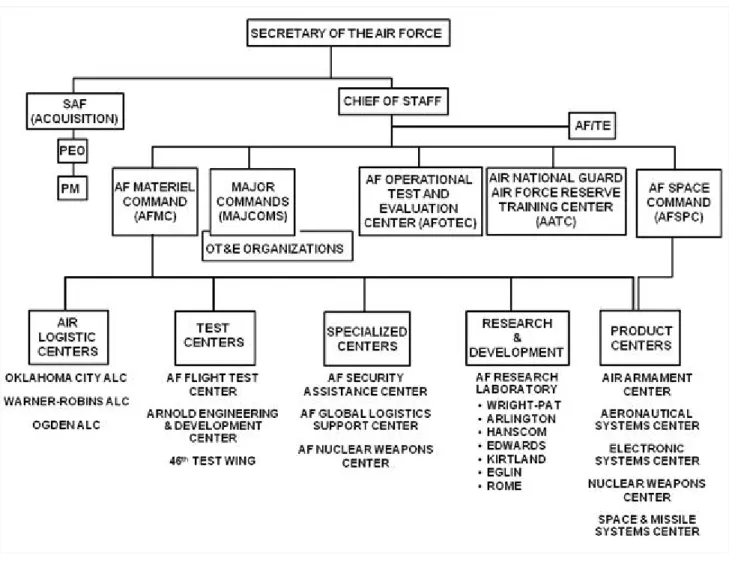
The Assistant Secretary of the Air Force for Acquisition (SAF/AQ) is the senior-level authority for research, development, and acquisition (RDA) within the Air Force. As illustrated in Figure 1-4, the SAF/AQ is an advisor to the Secretary of the Air Force and interfaces directly with the DASD(DT&E) and the DOT&E. The SAF/AQ receives DT&E and OT&E results as a part of the acquisition decision process. Within the SAF/AQ structure, there is a military deputy (acquisition) who is the Air Force primary staff officer with responsibility for RDA. The Director, Air Force Test and Evaluation (AF/TE), provides T&E policy and oversight and reports directly to the Chief of Staff of the Air Force (CSAF). AF/TE processes DT&E and OT&E documentation, resolves T&E issues for the Air Force, and manages the review of the TEMP.
1.4.4.1 Air Force DT&E Organization
The Air Force Materiel Command (AFMC) and Air Force Space Command (AFSPC) are implementing commands that conduct Government DT&E and manage acquisition programs. AFMC and AFSPC perform all levels of research; develop weapons systems, support systems, and support equipment. Within these implementing commands are product centers, logistics centers, test centers, and laboratories as well as a wide variety of test ranges.
Once the weapon system is fielded, AFMC and AFSPC retain management responsibility for developing and testing system improvements and upgrades. The AFSC is responsible for DT&E of space and missile systems .
21
Figure 1-4 Air Force Test and Evaluation Organization 1.4.4.2. Air Force Operational Test and Evaluation Center (AFOTEC)
As the Air Force OTA, AFOTEC conducts independent OT&E of all programs on the OSD OT&E Oversight List and other programs as directed. AFOTEC also conducts OTs in support of joint urgent operational needs and Warfighter rapid acquisition programs. The AFOTEC commander reports directly to the CSAF. In preparation for OT&E, AFOTEC reviews all relevant operational and training requirements,
employment and maintenance concepts, and tactics. Operational and implementing major commands (MAJCOMs) provide operational concepts, personnel, and resources to assist AFOTEC in performing OT&E.
1.4.4.3 MAJCOM Operational Test Organizations
OT organizations (squadrons and wings) are embedded in each operating MAJCOM to conduct follow-on operational test and evaluation (FOT&E) for systems past AFOTEC-conducted IOT&E and to conduct OT&E on all systems in sustainment. Force development evaluations (FDEs), which are a type of OT&E, are performed by MAJCOM OT organizations in support of MAJCOM-managed system acquisition-related decisions prior to initial fielding or for MAJCOM sustainment or upgrade activities.
22 1.5 Summary
An increased emphasis on T&E has placed greater demands on the OSD and DoD Components to carefully structure organizations and resources to ensure maximum effectiveness. Renewed interest by Congress in testing as a way of assessing systems utility and effectiveness, reports by a variety of organizations on improving acquisition effectiveness, and continuing acquisition reform initiatives have resulted in reorganizations within the DoD and the Services to improve the management of T&E resources, planning, execution, and reporting, in support of acquisition programs.
23
Test & Evaluation Management Guide
Chapter 2 - The T&E Process
2.1 Introduction
The fundamental purpose of T&E is to provide essential information to decision makers, verify and validate performance capabilities documented as requirements, assess attainment of technical performance parameters, and determine whether systems are operationally effective, suitable, survivable, and safe for intended use. During the early phases of development, T&E is conducted to demonstrate the feasibility of conceptual approaches, evaluate design risk, identify design alternatives, compare and analyze trade-offs, and estimate satisfaction of operational requirements. As a system undergoes design and development, the iterative process of testing moves gradually from a
concentration on DT&E, which is concerned chiefly with attainment of engineering design goals and verification of technical specifications, to increasingly comprehensive OT&E, which focuses on questions of operational effectiveness, suitability, and survivability. Although there are usually separate DT and OT events, DT&E and OT&E are not necessarily serial phases in the evolution of a weapon system
development. Integrated DT and OT are encouraged when appropriate; i.e., conferring possible cost or time savings.
The discipline of T&E has its origins in the testing of hardware. This tradition is heavily embedded in its vocabulary and procedures. The advent of software-intensive systems has brought new challenges to testing, and new approaches are discussed in Chapter 15. Remaining constant throughout the T&E process, whether testing hardware or software, is the need for thorough, logical, systematic, and early test planning followed by feedback of well-documented and unbiased T&E results to system developers, users, and decision makers.
T&E provides useful information to many customers and value to the PM. DT&E and OT&E must be integrated into an efficient continuum of testing as much as practical without compromising the objectives of either T&E activity. Information assurance (IA) and interoperability testing as well as reliability analysis, planning, tracking, and reporting must also be integrated into this continuum.
2.2 Defense Systems Acquisition Process
The primary objective of the defense acquisition process is the acquisition of quality products that satisfy user needs with measurable improvements to mission capability and operational support, in a timely manner, and at a fair and reasonable cost. As it is now structured, the defense system life cycle is to replicate the preferred acquisition strategy of an evolutionary acquisition process that uses
incremental development or rapid acquisition processes. The three major elements-pre-system acquisition, system acquisition, and sustainment-may include the following five phases:
1. Materiel Solution Analysis (MSA). 2. Technology Development (TD).
24 4. Production and Deployment (P&D).
5. Operations and Support (O&S).
As Figure 2-1 shows, these phases are separated by key decision points when a MDA reviews a program, considers its development maturity, and determines authorization to advance to the next phase in the cycle. Thus, T&E planning and test results play an important part in the MDA review process.
Figure 2-1 Defense Acquisition System Model
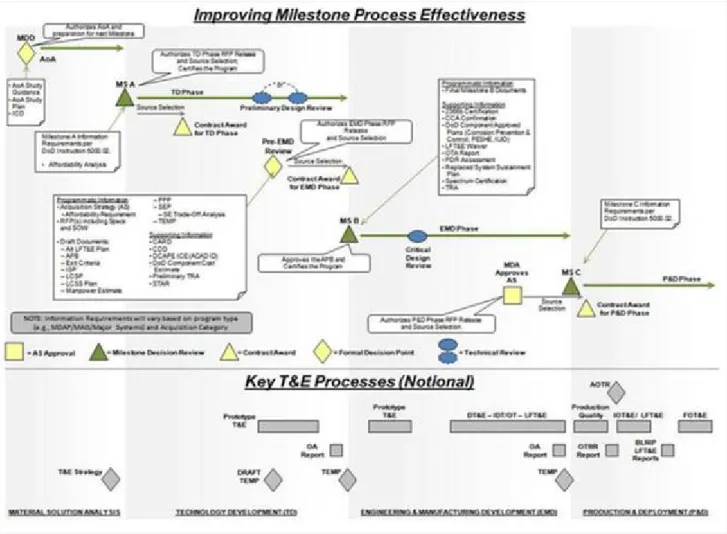
USD(AT&L) memorandum (Reference (m)) provided supplementary guidance which introduced procedural changes to the acquisition model. These changes included, for example, the addition of a Pre-EMD phase as well as directing that the substance of milestone reviews (e.g. SEPs and TEMPs) be addressed earlier at each point of the milestone decision process. Figure 2-2 shows this process and its relationship with T&E processes. USD(AT&L) memorandum (Reference (m)) provided supplementary guidance which introduced procedural changes to the acquisition model. These changes included, for example, the addition of a Pre-EMD phase as well as directing that the substance of milestone reviews
25
(e.g. SEPs and TEMPs) be addressed earlier at each point of the milestone decision process. Figure 2-2 shows this process and its relationship with T&E processes.
Figure 2-2 Improving Milestone Process Effectiveness .
2.2.1 The T&E Contribution at Major Milestones
The following description of the defense system acquisition process, summarized from Reference (d), shows how T&E fits within the context of the larger process.
T&E progress is monitored by OSD throughout the acquisition process. OSD oversight extends to MDAPs, MAIS programs, or designated acquisition programs to include defense business systems as defined in Directive-Type Memorandum (DTM) 11-009 (Reference (n)). T&E officials within OSD render
independent assessments-based on participation in test events, direct observation of test events, and continuous oversight of activities-to the DAB, the DAE, and the SecDef at each system milestone review. These assessments are based on the following T&E information:
26
Test planning documents, such as the TEMP and more detailed supporting documents, developed by the responsible DoD Component activities.
Test reports and briefings prepared by the Component test activities.
Data from tests, M&S, and data from other sources such as Component PMs, laboratories, industry developers, studies, and analyses.
At MS B, the OSD T&E assessments reflect an evaluation of system concepts and technology alternatives using early performance parameter objectives and thresholds found in an approved preliminary TEMP. At MS C, assessments include an evaluation of system-level test plans and test results. At the FRPDR, assessments include consideration of the operational effectiveness and suitability evaluations of low-rate initial production (LRIP) systems.
In accordance with DTM 11-003 (Reference (o)), PMs formulate a comprehensive reliability, availability, and maintainability (RAM) program using an appropriate reliability growth strategy to improve RAM performance until RAM requirements are satisfied. The program consists of engineering activities including RAM allocations, block diagrams, and predictions; failure definitions and scoring criteria; failure mode, effects, and criticality analysis (FMECA); maintainability and built-in test demonstrations; reliability growth testing at the system and subsystem level; and a failure reporting and corrective action system maintained through design, development, production, and sustainment. In accordance with USD(AT&L) Memorandum (Reference (p)), it is DoD policy for programs to be formulated to execute a viable RAM strategy that includes a reliability growth program as an integral part of design and development. The RAM program is an integral part of the systems engineering (SE) process. A key contribution made by T&E in the acquisition process is the early detection and reporting of deficiencies that may adversely impact the performance capability or availability and supportability of a system. A comprehensive and repeatable deficiency reporting process should be used throughout the acquisition process to report, evaluate, and track system deficiencies and to provide the impetus for corrective actions that improve performance to desired levels. The lead DoD Component and the PM, or equivalent, prepares a preliminary RAM and cost rationale report in support of the MS A decision. In accordance with Reference (d), there shall be only one MS B per program or evolutionary increment. Each increment of an evolutionary acquisition shall have its own MS B unless the MDA determines that the increment will be initiated at MS C.
2.2.2 MSA and TD Phases
A defense pre-system acquisition process begins with the requirements process identification of a materiel need and the development of the Initial Capabilities Document (ICD). A decision is made to start MSA phase, and the Technology Development Strategy (TDS) evolves with the development of initial test planning concepts in the TES. MSA ends when the MDA approves the preferred solution resulting from the Analysis of Alternatives (AoA), identifying measures of effectiveness (MOEs), and
27
approves the associated TDS. NOTE: A useful reference on such items as MOEs and measures of performance (MOPs) and their relationship to the overall technical measurement process including technical performance measurement (TPM) can be found in International Council on Systems Engineering (INCOSE)-TP-2003-020-01 (Reference (q)) which is a technical report developed as a collaborative effort between the DoD Practical Software and Systems Measurement organization and INCOSE. The TD phase follows a MS A decision during which the risks of the relevant technologies of the alternative selected for satisfying the user’s needs are investigated. Shortly after the milestone decision, an integrated team begins transitioning the test planning in the TES into the evaluation strategy for formulation of a TEMP.
The integrated team that supports the PM and program management office (PMO) is the T&E Working-level Integrated Product Team (WIPT). The T&E WIPT is a defined forum serving the PM and PMO as the T&E subject matter experts (SMEs) responsible for supporting the PM and other program WIPTs on all aspects of a programs T&E effort. This effort includes T&E program strategy, design, development, oversight, analysis, assessment, and reporting of test results. The T&E WIPT should be established and chartered as early as possible around MS A so it can be involved in program strategy discussions and plans.
The lead DoD Component and the PM, or equivalent, should prepare a preliminary RAM and cost rationale report in support of the MS A decision. This report provides a quantitative basis for reliability requirements and improves cost estimates and program planning. The report should be attached to the Systems Engineering Plan (SEP) at MS A and updated in support of MS B and MS C.
As stated in the ASD(R&E) Guidance (Reference (r)), a Technology Readiness Assessment (TRA) is a systematic, metrics-based process that assesses the maturity of and the risk associated with critical technologies to be used in MDAPs. It is conducted by the PM with the assistance of an independent team of SMEs. It is provided to the ASD(R&E) and will provide part of the basis upon which the ASD(R&E) advises the MDA at MS B or at other events designated by the MDA to assist in the determination of whether the technologies of the program have acceptable levels of risk-based in part on the degree to which they have been demonstrated (including demonstration in a relevant environment)-and to support risk-mitigation plans prepared by the PM. The plan for conducting a TRA is provided to the ASD(R&E) by the PM upon approval by the Component Acquisition Executive (CAE).
A TRA is required by Reference (d) for MDAPs at MS B (or at a subsequent milestone if there is no MS B). It is also conducted whenever otherwise required by the MDA. A TRA is required for space systems by DTM 09-25 (Reference (s)). The TRA final report for MDAPs must be submitted to the ASD(R&E) for review to support the requirement that the ASD(R&E) provide an independent assessment to the MDA. A TRA focuses on the programs critical technologies (i.e., those that may pose major technological risk during development, particularly during the EMD phase of acquisition). Technology Readiness Levels (TRLs) can serve as a helpful knowledge-based standard and shorthand for evaluating technology maturity, but they must be supplemented with expert professional judgment.
28
To reduce the risk associated with entering EMD, Reference (d) requires requests for proposals (RFPs) to incorporate language that prevents the award of an EMD contract if it includes technologies that have not been demonstrated adequately. Adequate demonstration in a relevant environment (TRL 6) is one benchmark that is evaluated, but it is not the only consideration, nor necessarily dispositive. As such, a generic TRA not based on the planned specific technical solution is insufficient. Since the TRA must be based on the technologies of the program that entail some element of risk, TRAs may have to be performed on all the competitors' proposals in a source selection.
The TRAs described in USD(AT&L) Memorandum (Reference (t)) replace the former TRAs described in the Director, Research Directorate, Deskbook (Reference (u)). TRAs that must be submitted to the ASD(R&E) are required only for MDAPs that require certification under section 2366b of Reference (b) or other provisions of law, or when otherwise directed by the MDA. Generally, TRAs are not required for MDAPs at MS C. Independent of the elimination of the formal requirement to conduct a TRA for a MAIS, MS C, and ACAT IIIV programs, all PMs and their chains of command retain complete responsibility for assessing, managing, and mitigating acquisition program technology risk. MDAs for non-ACAT I programs should consider requiring TRAs for those programs when technological risk is present.
The TD effort concludes with a decision review at MS B when an affordable increment of militarily useful capability has been identified, the technology for that increment has been demonstrated in a relevant environment, and a system can be developed for production within a reasonable time frame or the MDA decides to terminate the effort.
Typical T&E-related documents at the MS B review are the Acquisition Decision Memorandum (ADM) (exit criteria), ICD, Capability Development Document (CDD) (performance parameters), Acquisition Strategy, System Threat Assessment (STA), an Early Operational Assessment (EOA), and the TEMP. Additional program management documents prepared before MS B include the AoA, Independent Cost Estimate , and the concept baseline version of the Acquisition Program Baseline (APB), which
summarizes the weapons functional specifications, performance parameters, and cost and schedule objectives.
The program office for major programs (OSD oversight) must give consideration, if relevant, to requesting a waiver for full-up, system-level (FUSL) LFT and identification of LRIP quantities for IOT&E. 2.2.3 T&E Contributions Prior to MS B
During MSA and TD activities prior to MS B, laboratory testing and M&S are conducted by the
contractors and the development agency to demonstrate and assess the capabilities of key subsystems and components. The test and simulation designs are based on the operational needs documented in the ICD. Studies, analyses, simulation, and test data are used by the development agency to explore and evaluate alternative concepts proposed to satisfy the user’s needs. Also during this period, the OTA monitors MSA and TD activities to gather information for future T&E planning and to provide
effectiveness and suitability input desired by the PM. The OTA also conducts EOAs, as feasible, to assess the operational impact of candidate technical approaches and to assist in selecting preferred alternative system concepts.
29
The development agency prepares the TDS in conjunction with the early T&E strategy for DT&E and M&S. The TES presents T&E plans for system design(s) engineering and performance evaluations. The strategies also include the tasks and processes to be stated in the RFP that the contractor will be required to employ to demonstrate the achievement of reliability design requirements. The TES and TEMP specify how reliability will be tested and evaluated during the associated acquisition phase. The OTA may provide an EOA. This information is incorporated into the PMs TEMP that documents the programs T&E strategy that supports the MS B decision to proceed to the next phase.
2.2.4 EMD Phase
The MS B decision is program initiation for systems acquisition; establishes broad objectives for program cost, schedule, and technical performance; and starts the EMD phase of the acquisition life cycle. The EMD phase is divided into two sub phases: Integrated Systems Design (ISD) and System Capability and Manufacturing Process Demonstration (SC&MPD).
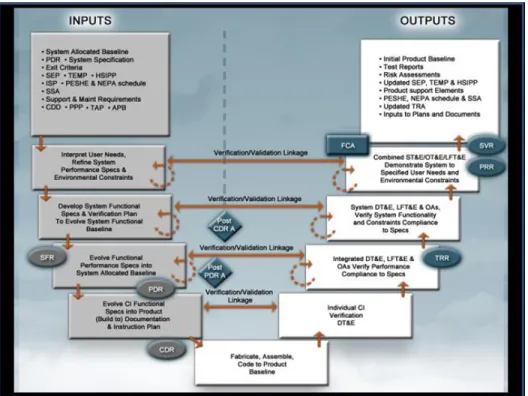
After the MS B decision for a program start, the ISD work effort begins during which a selected concept, typically brassboards or early prototypes, is refined through SE, analysis, and design. SE must manage all requirements as an integrated set of design constraints that are allocated down through the various levels of design and other technical activities (see example in Figure 2-2). This work effort ends when the integration of the system components during DT of prototypes demonstrates adequate maturity and readiness to either enter into SC&MPD or make a change to the acquisition strategy.
The SC&MPD work effort is intended to demonstrate the ability of the system to operate consistent with the approved key performance parameters (KPPs). Work advances the design to an engineering
development model (EDM) that is evaluated for readiness to enter LRIP. The EDM should have
demonstrated acceptable performance in DT&E and the Operational Assessment (OA), with acceptable interoperability and operational supportability. DT&E results include systems meeting KPPs and key system attributes (KSAs) as part of the exit criteria for EMD.
Preparation for the MS C decision establishes more refined cost, schedule, and performance objectives and thresholds, and the Capability Production Document (CPD) establishes the criteria for testing of LRIP items. Documents of interest to the T&E manager at the time of the MS C review include the ADM (exit criteria), updated TEMP, updated STA, AoA, Development Baseline, DT results, and the OA.
30
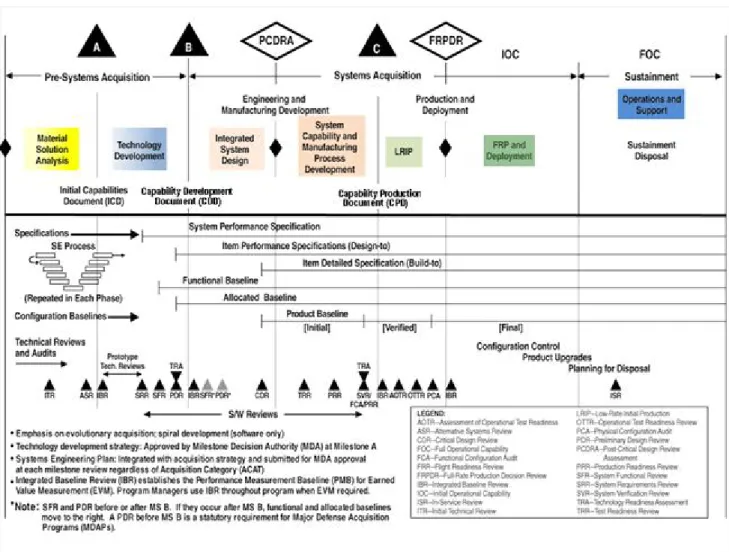
Figure 2-3 Key Technical Activities and Technical Reviews/Audits during the Acquisition Lifecycle 2.2.4.1 T&E Contributions During ISD
During the EMD phase, concepts approved for prototyping form the baseline that is used for detailed test planning. The design is matured into an EDM, which is tested in its intended environment prior to MS C.
In ISD, the development agency conducts DT&E to assist with engineering design, system development, and risk identification and to evaluate the contractors’ ability to attain desired technical performance in system specifications and achieve program objectives. The DT&E includes T&E of components,
subsystems, and prototype development models. T&E of functional compatibility, interoperability, and integration with fielded and developing equipment and systems is also included. During this phase of testing, adequate DT&E is accomplished to ensure that engineering is reasonably complete (including survivability/vulnerability, compatibility, transportability, interoperability, reliability, maintainability, safety, human factors, and logistics supportability). Also, this phase confirms that all significant design problems have been identified and solutions to these problems are in place.
31
The Service OT&E agency should conduct an OA for the Post-Critical Design Review Assessment (PCDRA) to estimate the systems potential to be operationally effective and suitable; identify needed
modifications; and provide information on tactics, doctrine, organization, and personnel requirements. The early OT&E program is accomplished in an environment containing limited operational realism. Typical operational and support personnel are used to obtain early estimates of the user’s capability to operate and maintain the system. Some of the most important products of user assessments of system maintainability and supportability are human factors and safety issues.
2.2.4.2 T&E Contributions During SC&MPD
In SC&MPD, the objective is to design, fabricate, and test a preproduction system that closely approximates the final product. T&E activities of the EDM during this period yield much useful
information. For example, data obtained during EDM T&E can be used to assist in evaluating the systems maintenance training requirements and the proposed training program. Test results generated during EDM T&E also support the user in refining and updating employment doctrine and tactics.
T&E activities intensify during SC&MPD and make significant contributions to the overall acquisition decision process. During SC&MPD, T&E is conducted to satisfy the following objectives:
• As specified in program documents, assess the critical technical issues by:
o Determining how well the development contract specifications have been met. o Identifying system technical deficiencies and focus on areas for corrective actions. o Determining whether the system is compatible and interoperable and can be integrated
with existing and planned equipment or systems. o Estimating the RAM of the system.
o Determining whether the system is safe and ready for LRIP.
o Evaluating effects on performance of any configuration changes caused by correcting deficiencies, modifications, or product improvements (PIs).
o Assessing human systems integration (HSI) and identify limiting factors.
• Assess the technical risk and evaluate the trade-offs among specifications, operational requirements, life cycle costs (LCCs), and schedules.
• Assess the survivability, vulnerability, and logistics supportability of the system.
• Verify the accuracy and completeness of the technical documentation developed to maintain and operate the weapons system.
• Gather information for training programs and technical training materials needed to support the weapons system.
32
• Provide information on environmental issues for use in preparing environmental impact
assessments.
• Determine system performance limitations, capabilities, and safe operating parameters. The development agency evaluates the results of T&E for review by the Service headquarters and the Service acquisition review council prior to system acquisition review by the MDA. The evaluation includes the results of testing and supporting information, conclusions, and recommendations for further engineering development. At the same time, the OT&E agency prepares an independent OA, which contains estimates of the systems potential operational effectiveness and suitability. The OA provides a permanent record of OT&E events, an audit trail of OT&E data, test results, conclusions, and recommendations. This information is used to prepare for MS C and supports a recommendation of whether the design and performance of the system in development justifies proceeding into LRIP. 2.2.5 P & D Phase
During the LRIP work effort, the purpose is to achieve an operational capability that satisfies mission needs. The selected system design and its principal items of support are fabricated as production configuration models. Test articles normally are subjected to qualification testing, interoperability certification, full-up LFT, and IOT&E. This work effort ends with the FRPDR or a Full-Rate Production Deployment Decision Review for MAIS or software-intensive systems with no production components. Timing of deployment of the system for initial operational capability (IOC) is usually determined by the Service. Key documents for the T&E manager at the time of the FRPDR are the updated TEMP, DT results, the Service IOT&E report, and LFT report. For ACAT I and designated oversight systems, the DOT&E is required by law to document the assessment of the adequacy of IOT&E and the reported operational effectiveness and suitability of the system. This is done in the BLRIP report. Also mandated by law is the requirement for the DOT&E to submit the LFT report prior to the program proceeding beyond LRIP. These DOT&E reports may be submitted as a single document.
The DOT&E will evaluate whether systems are production representative. Wherever practicable, IOT&E will be conducted using LRIP systems assembled using the parts, tools, and manufacturing processes intended for use in full-rate production (FRP).
The system will also utilize the intended production versions of software. In addition, the logistics system and maintenance manuals intended for use on the fielded system should be in place. When the use of LRIP articles is impractical, the system used in T&E should, at a minimum, incorporate the same parts and software to be used in LRIP articles. In particular, the hardware and software should be as defined by the system-level Critical Design Review (CDR), Functional Configuration Audit (FCA), and System Verification Review (SVR), including correction of appropriate major deficiencies identified during DT. Manufacturing processes to be used in FRP should also be adhered to as closely as possible.
33 2.2.5.1 T&E Contributions Prior to FRPDR
The development agency transitions the final design to LRIP while fixing and verifying any technical problems discovered during the final testing of the EDM in its intended environment. The maturity of the hardware and software configurations and logistics support system available from LRIP are assessed when the development agency considers certifying the systems readiness for IOT&E.
The DOT&E must be provided detailed information describing any process differences in order to independently evaluate whether the differences are acceptable. The Office of the DOT&E will assess adherence to DoD guidelines as part of its responsibility for reviewing and approving TEMPs and test plans. Proposals to use articles that are not from LRIP to conduct IOT&E will be considered.
IOT&E is conducted prior to the production decision at FRPDR to:
• Estimate system operational effectiveness, operational suitability, and survivability.
• Identify operational deficiencies.
• Evaluate changes in production configuration.
• Provide information for developing and refining logistics support requirements for the system and training, tactics, techniques, and doctrine.
• Provide information to refine O&S cost estimates and identify system characteristics or deficiencies that can significantly impact O&S costs.
• Determine whether the technical publications and support equipment are adequate in the operational environment.
Before the certification of readiness for IOT&E, the Service Acquisition Executive (SAE) should have obtained the JITC certification of interoperability for the system components. For the sake of efficiency and completeness, the AOTR should be conducted in conjunction with the DoD Components
certification of readiness review. In parallel with IOT&E, LFT&E may be used to evaluate vulnerability or lethality of a weapon system as appropriate and as required by public law. The PMs briefing and the BLRIP report address the risks of proceeding into FRP.
2.2.5.2 T&E Contributions After the FRPDR
After FRPDR, when the FRP decision is normally made, T&E activities continue to provide important insights. Tests described in the TEMP but not conducted during earlier phases are completed. The residual DT&E may include extreme weather testing and testing corrected deficiencies. System elements are integrated into the final operational configuration, and DT is completed when all system
performance requirements are met. During FRP, Government representatives normally monitor or conduct the PAT&E. Each system is verified by PAT&E for compliance with the requirements and specifications of the contract.