1 Page 1-5 © MAT Journals 2018. All Rights Reserved
Providing accurate course/video recommendations in E-Learning
environment using association rule mining and collaborative
filtering
Rishabh Satish Varma,Computer Department K.K. Wagh Institute of Engineering Education and
Research, Nashik-422003 [email protected]
Bhushan Milind Gosavi
Computer Department K.K. Wagh Institute of Engineering Education and Research,
Nashik-422003 [email protected]
Ankit Manoj Chawrai
Computer Department K.K. Wagh Institute of Engineering Education and
Research, Nashik-422003 [email protected]
Omkar Mahesh Deshpande
Computer Department K.K. Wagh Institute of Engineering Education and
Research, Nashik-422003 [email protected]
Abstract
Internet has huge number of learning resources, reason why students fail to take benefit of those is because they don't know where to look for resources, and more importantly which of these will be ideal for their respective academics. To provide related content to students most of the institutes uses different E-Learning solutions which acts as a repository of learning resources for students.
These E-learning solutions often don't provide personalized recommendations to users. We propose an E-Learning solution which provides users with recommendations based on his/her preferences and content consumed by similar students, further more system we propose provide all the facilities like course sharing between two universities, online tests, analytics etc. in one software. Collaborative filtering and its modifications is one of the most commonly used recommendation algorithm. Collaborative Filtering find people with similar interests, analyze their behavior derived from their ratings, and recommend target user the same items. As online social networks are growing, users can now make friends, share thoughts, images etc. on the Internet and express different level of trust on their web friends. Recommendations generated by the trusted friends are more relevant than other users. This paper proposes a video recommendation system that generates recommendations from the collaboration of trusted friends of the target user and uses association rule mining to capture current trends of users in the network.
Keywords: Data mining, E-Learning, Trust Network, Association Rule mining, Collaborative filtering, Recommendation system, Algorithm, E-Learning.
INTRODUCTION
All e-learning websites provide recommendations for their users but most of them are beside the point. Collaborative filtering and its modifications is one of the most commonly used recommendation algorithm. Collaborative Filtering find people with similar interests, analyze their behavior derived from their ratings, and recommend target user the same items. With the help of trust mechanism users can assign different level of trust on their friends. In this paper we have proposed a collaborative Trust based content
recommendation system that generates the recommendations to the target user based on his trusted friends.
COLLABORATIVE FILTERING
Collaborative filtering (CF) is a technique used by recommender systems. Collaborative filtering has two senses, a narrow one and a more general one. In the newer, narrower sense, collaborative filtering is a method of making automatic predictions (filtering) about the interests of a user by collecting preferences or taste information from many users
2 Page 1-5 © MAT Journals 2018. All Rights Reserved
(collaborating). Collaborative filtering also called as social filtering is one of the ways to generate recommendations. Collaborative filtering generates recommendations for the target user in collaboration of the other users in the database. User based Collaborative filtering functions by collecting the ratings of the target user in a given domain and matching it with other users in the same domain and returns useful personalized recommendation for the target user. Similarity between the two users can be calculated using Pearson‟s correlation formula as shown in equation 1.
(1)
Where Rm,a is the rating of the item a by user m, Am is the average rating of user m, and Imn is the item set rated by both user
m and user n. Next select all the neighbors of the target user whose similarity is above certain threshold as potential recommenders. Then the rating Pxk of the target user x to the target item k is calculated using equation 2.
(2) Where Ax the average rating of the target user x, Rm,k is the rating of the neighboring user m to the target item k, Am
is the average rating of user m, Sim(x,m) is the similarity between the target user x and the neighboring user m and c is the total number of the neighbors of the target user.
ASSOCITAION RULE MINING
Association rule mining (ARM) discovers correlation among large number of items.
ARM analyses customer shopping cart to guess occurrence of items. Let I = {i1, i2, i3..., im} is a collection of items or itemset. An association rule can be written as A B, where A ⊆ I, B ⊆ I and A ∩ B = ∅.
Association rule evaluation metrics are as follows.
Support: It shows number of transactions in the database that contains both A and B.
Support (A ∪B) =P (A ∪B) (3)
Confidence: It tells how frequently item B occurs in a transaction, if A has already bought.
Confidence (A B) = P (B | A) (4) The main idea behind ARM is to find rules based on criteria given below.
a) Generate all item sets having support
factor bigger than or equal to the domain expert set minimum support. b) Generate all the rules having the
confidence factor bigger than or equal to the domain expert set minimum confidence.
TRUST IN SOCIAL NETWORK
Personal trust means one person trusts another person, persons or thing(s) in the specific domain or situation. Interpersonal trust implies that two or more people trust each other in certain domain. Web 2.0 has provided a platform for social networking websites with millions of users, where users can share thoughts, images, make new friends. Some of the social networking websites have offered a facility to the users to express different kind of trust on different friends. Every person prefers to get recommendation from friends rather than strangers. The trust of one person on another varies from person to person.
A. Web of Trust
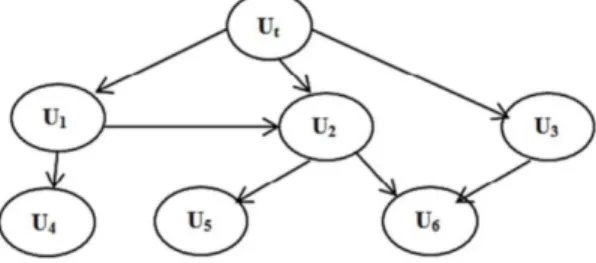
Web based social networks provides freedom to users to create their own contents, express their likes and dislikes about certain items and/or persons. Many websites allow users to express their degree of trust on another user. Fig.1
3 Page 1-5 © MAT Journals 2018. All Rights Reserved Fig 1 Example Trust Network
shows the web of trust where users are expressing their trust on other users in the form of ratings. In this network users are represented by nodes and trust between the two users are shown by edges along with their trust values.
TRUST BASED BOOK
RECOMMENDATION SYSTEM
The sole purpose of the trust-based book recommendation system is to recommend books to the target user that is useful and according to his likes. It uses the combine features of collaborative filtering, association rule mining and user‟s trust on its neighbors. system uses properties of web based social networks to find target user friends. The system has following steps:
1. Given a trust based social network as shown in Fig, SYSTEM finds all the directly connected friends of the target user (Ut) and stores it in the list (L1). i.e. now L1 = {U1, U2, U3}.
2. Next the system finds the friends of friends of the target user and stores it in another list (L2). So L2 stores {U4, U2, U5, U6} as shown in Fig.
3. Then SYSTEM removes all those users in the second list (L2) that are already present in the first list (L1). Now L2 has only three users. i.e. {U4, U5, U6}. 4. Next it calculates the inferred trust of target user on all the users listed in L2 using trust.
5. SYSTEM now creates the pool of friends using L1 and L2. Then it
removes all those users from the pool whose direct or inferred trust ratings are below threshold, as defined by the domain expert.
6. Now the system has most trusted friends of the target user, those may act as potential recommenders of the target user.
7. Next the system computes the similarity between the target user and his trusted friends found at step 7 using equation (1).
8. Apply association rule generation algorithm on the course content transaction database. Adjust the support and confidence parameters to generate stronger rules.
9. Afterwards SYSTEM applies generated association rules on the order history of the target user and stores the course content that he may buy.
10.Now SYSTEM calculates the collaborative ratings of all the course content found at step 10 using equation and similarity calculated among trusted friends at step 8.
11.Finally, SYSTEM generates the recommendations for the target user in decreasing order of course content ratings calculated at step 11. The block diagram m of SYSTEM is shown in Fig.
Fig 2 Block diagram- Recommendation system
4 Page 1-5 © MAT Journals 2018. All Rights Reserved Fig 3 Block diagram of complete E-Learning solution
This SYSTEM is tested over live data and the results are compared with standard benchmark recommendation methods like collaborative filtering. It uses the trust network of students of KKWIEER and generated test data. The complete SYSTEM runs on Intel Core i7 7700HQ machine with 16 GB RAM. Association rules are generated for various combination of support and confidence, but the rules generated at 10% support and 70% confidence are more accurate for given data than other combinations. To evaluate the performance of proposed system precision measuring technique is used. Precision is defined as the ratio of total number of relevant recommendations to the total number of recommendations. During every execution of the experiment SYSTEM performs better than collaborative filtering algorithm.
CONCLUSION
As the World-Wide Internet continues to grow at an associate degree exponential rate, the dimensions and complexness of the many internet sites grow on with it. For the users of those internet sites it becomes increasingly tough and time intense to search out the information they are searching for. User interfaces may facilitate users realize the data that‟s in
accordance with their interests by personalizing an online web site. Some internet sites gifts users with personalized data by letting them opt from a collection of predefined topics of interest. Users but do not continuously apprehend what they„re curious about beforehand and their interests might modification overtime which might need them to change their choice frequently. Our Recommender system offer personalized data by learning the users interests from traces of interaction therewith user.
REFERENCES
1. Ashish Shah, “Association Rule Mining with Modified Apriori Algorithm using Top Down Approach”, 2nd
International Conference on Applied and Theoretical Computing and Communication Technology, IEEE, 2016.
2. Mayur Bhosale, Tushar Ghorpade, Rajashree Shedge, “On Demand Recommendation using Association Rule Mining Approach”, International conference on Signal Processing, Communication, Power and Embedded System (SCOPES), IEEE 2016.
3. Xu Xiaowei, Wang Fudong, “Trust -Based Collaborative Filtering
5 Page 1-5 © MAT Journals 2018. All Rights Reserved
Algorithm”, Fifth International Symposium on Computational Intelligence and Design, 2012, pp. 321-324.
4. P. Massa, P. Avesani, “Trust-aware collaborative filtering for recommender systems”, Proceedings of Confederated International Conference, On the Move to Meaningful Internet CoopIS, DOA, ODBASE. Springer LNCS, Vol. 3290, 2004, pp. 492-508.
5. R.Revathi, M.Geetha, “Re-Modified Apriori Algorithm in E-Commerce Recommendation\ System”, IEEE. 6. Pijitra Iomsari, “Book
Recommendation System for Digital
Library Based on User Proles by Using Association Rule”, IEEE 2014.
7. Fengkun Liu, Hong Joo Lee, “Use of social network information to enhance collaborative filtering performance, Expert Systems with Applications”, Vol. 37, pp 4772- 4778, 2010.
8. Xiaoyuan Su, Taghi M. Khoshgoftaar, “A survey of collaborative filtering techniques, Advances in Artificial Intelligence, Vol.2009, No. 4, 2009. 9. Kavinkumar.V, Rachamalla Rahul
Reddy, Rohit Balasubramanian, Srid- har.M, Sridharan.K, Dr. D.Venkataraman, “A Hybrid Approach for Recommendation System with Added Feedback Component”,IEEE 2015.