2008 TABLE OF CHANGES
(Changes to Manual from 2003 to 2008)
ITEMS SECTIONS
PAGES
Table of contents re-paginated (revised)
TOC
TOC
Figures 1, 2 and 16 (added), status of figure 6 and 7
(revised)
Chart and Figure
Contents
ii
Bus inspection committee members’ names (deleted)
Preface
iii
State Board rule language (revised) to include latest version
of 6A-3.0171 FAC excerpt
FL Statute and
State Board Rule
iv
Contact information (revised)
Specifications Notes
v
Inspection Form instructions (revised) Instructions
vi
Inspection Form item D.10. (revised)
Inspection
Form/Sample Form
ix - xii
100-question online test and procedures (added); open book
testing (added)
School Bus Inspection
Certification Program
xv
Inspection classification requirements table and notes
(revised)
School Bus Inspection
Certification Program
xix
30-question online test and procedures (added)
School Bus Inspection
Re-certification
Program
xx
Application (revised) to include signature requirements and
file retention recommendations
Application for State
of Florida School Bus
Safety Inspector
Certification
xxi - xxii
Application for Re-certification (revised) to include name
change to Re-certification Form and to include signature
requirements and file retention recommendations
Application for State
of Florida School Bus
Safety Inspector
Re-certification
xxiii - xxiv
Out-of-service (OOS) criterion for fire extinguisher safety pin
tamper proof seal (revised)
A. 1. a. 6)
2
Repair or note criterion for first aid kit tamper proof seal
(revised)
A. 1. b. 1)
2
OOS criterion for first aid kit mounting (revised)
A. 1. b. 2)
2
Note concerning annual inspection of first aid and body fluid
cleanup kits (added)
A. 1.
3
Inspection procedures for first aid kit (revised)
A. 1. b. 3)
4
Repair or note criterion for body fluid cleanup kit tamper proof
seal (revised)
A. 1. c.
OOS criterion for reflectors storage box (revised)
A. 1. d. 3)
5
Noise Abatement Switch criterion (added)
A. 3. d.
9
Inspection procedures and OOS criterion for temperature
gauges (revised)
A. 5. a.
12
OOS criterion for volt or ammeter check (added)
A. 5. a. 5)
12
Repair or note criterion for temperature gauge light bulb
(revised)
A. 5. b.
13
Dimmer Control check for dash and panel lights (added)
A. 5. b. 4)
13
High transmission temperature warning light or buzzer
ITEMS SECTIONS
PAGES
ABS Warning Light check (revised) to include system check
A. 5. d.
14
Note concerning use of wheel chocks (added)
A. 6. and A. 7.
15 and 21
Air Brake System Adjustment Check procedures (revised)
A. 6. e.
17 - 18
Windshield Wipers (revised) to include intermittent wipers
A. 8. a. 2)
35
Note concerning dash fan (added) to inspection procedures
A. 9. c. 1)
38
Driver dome lights repair or note and OOS criterion (revised)
A. 10.
Service door operation repair or note and OOS criterion
(revised)
A. 11. a.
40
Service door control repair or note and OOS criterion
(revised)
A. 11. b. 1)
41
Air / Vacuum Door OOS language (revised)
A. 11. b. 2)
41
OOS criterion for horns (revised) to include “either horn is
inoperative.”
A. 12.
42
Electric Mirrors Repair or note criterion (added)
A. 13. a. b.
43 - 44
OOS criterion for mirrors (revised)
A. 13. a. b.
43 - 44
Convex Mirrors “No Blind Spot” and system’s vision
requirements language in OOS column (revised)
A. 13. b.
44 - 45
Driver’s Seat and Belt (revised) to include color requirement
and Repair or note criterion for incorrect color
A. 14.
46
OOS criterion for seat mounting fastners (revised)
A. 15. b.
48
Inspection procedures and OOS criteria (revised)
A. 15. c.
49
Repair or note criteria for seat covering material color
(added)
A. 15. d.
50
Passenger Securement Devices (revised) to include Repair
or note criterion for belt color coding
A. 15. h.
53
Webbing Cutter check and OOS criterion (revised)
A. 15. i.
53
OOS criterion for emergency door handle, latch, and
hardware (added)
A. 16. a.
54
Repair or note criterion for roof hatch power ventilator
(added)
A. 16. a.
54
Repair or note criterion for door hold open device labeling
(added)
A. 16. c. 1)
55
Repair or note criterion for emergency hatch labeling (added) A. 16. c. 1)
56
Post Trip Passenger Check criterion (added)
A. 16. d.
56
Inspection procedures (revised)
A. 18. 1)
61
OOS (revised) to include safety chain or belt
A. 18. 1)
61
Wheel Chair Track Repair or note and OOS criterion
(revised)
A. 18. 2)
62
Inspection procedure and OOS criteria for webbing cutter
(revised)
A. 18. 3)
62
OOS criterion for flat floor step warning decals (revised)
A. 21. a.
65
Grab Rail(s) Repair or note criterion (added)
A. 21. c.
66
Daytime Running Lamps criterion (added)
B. 1. a.
68
LED type lights criterion (added)
B. 1. b.
68
Backup Alarm criterion (revised) to include Variable Alarm
B. 1. i.
72
ITEMS SECTIONS
PAGES
Student Crossing Arm opening language (revised) to include
+/- 5 degrees to the 90 degree opening requirement
B. 4. b.
80
OOS criterion for crossing arm air leak (added)
B. 4. b.
80
Note concerning crossing and stop arm Federal Motor
Vehicle Safety Standards (FMVSS) requirements (added)
B. 4. b.
80
Steering wheel covering repair or note and OOS (revised)
C. 1. a
87
Transmission fluid criterion (revised) to include wrong
dipstick and coolant contamination
C. 3. d.
103
Transmission fluid OOS criterion (revised) to include broken
dipstick
C. 3. d.
103
Note concerning manufacturers recommendations for coolant
(added)
C. 3. f.
104
Belts and Hoses (revised) to include language that
addresses the presence of accessory drive belts
C. 4. a. 2)
106
Repair or note criterion (revised)
C. 4. b. 1)
109
Engine Air Cleaner Inspection Note (added), Repair or note
and OOS criteria (revised)
C. 5. a.
110
Water Pump and Fan Fasteners OOS criteria (added)
C. 5. d. e.
111
Wiring Routing and Condition OOS criterion (revised)
C. 6.
112
Radiator OOS criterion (added)
C. 8. a.
115
Verticle play OOS criterion (revised)
D. 1. c. 2)
117
Wheel seal seeping repair or note criterion (added)
D. 1. l.
121
Front Brake Chambers criterion (revised)
D. 2. c.
124
Brake lines OOS criterion (revised) to include seeping
D. 2. b.
123
Repair or note criterion (revised)
D. 2. f.
125
Wheel cylinder and caliper OOS criterion (revised) to include
seeping
D. 2. i.
128
Front Brake Adjustment procedures (revised)
D. 2. j.
128 - 129
Figure 15, 90 degree push rod / slack adjuster angle during
full brake application language (revised)
D. 130
Repair or note and OOS criterion (revised)
D. 4. c.
133 - 134
Note defining leaks and seepage (added) and referenced
throughout the manual
D. 5.
136
Leakage OOS criterion (revised)
D. 6. a.
138
Antilock brake systems criterion (added)
D. 7. e.
141
Driveshaft phasing repair or note criterion (revised)
D. 8. a.
142
Axle housing seepage repair or note criterion (added)
D. 9. a.
145
Differential seepage repair or note criterion (added)
D. 9. c.
145
Note concerning wheel bearing play (added)
D. 9. k.
149
Rear Brake Chambers criterion (revised)
D. 10. c.
151
Rear Brake Adjustment procedures (revised)
D. 10. j.
156 - 157
Tailpipe inspection procedure and OOS criterion (revised),
Figure 16 (added)
D. 12. d.
160 - 161
Tire Tread Depth measurement language (clarified)
D. 13. a.
162
ITEMS SECTIONS
PAGES
Stopping Distance and Equalization (revised) to include a
number value for decelerometer reading in repair or note and
OOS, to include criteria for flat spotting of tires, and to revise
the note
F. 1. b.
168 - 169
Engine Performance and Governor criterion (revised) to
include color and quantity of exhaust smoke
F. 2. a.
170
OOS criterion (revised)
F. 3. a.
172
TABLE OF CONTENTS
CHART AND FIGURE CONTENTS ---
ii
PREFACE --- iii
FLORIDA STATUTE AND STATE BOARD RULE ---
iv
SPECIFICATIONS NOTES ---
v
INSTRUCTIONS ---
vi
INSPECTION FORM ---
ix
SAMPLE OF COMPLETED INSPECTION FORM --- xi
REPAIR ORDER --- xiii
SAMPLE OF COMPLETED REPAIR ORDER ---
xiv
CERTIFICATION PROGRAM --- xv
RE-CERTIFICATION PROGRAM---
xx
APPLICATION FOR SCHOOL BUS SAFETY INSPECTOR CERTIFICATION ---
xxi
INSPECTOR RE-CERTIFICATION FORM --- xxiii
INSPECTION PROCEDURES AND CRITERIA
A. INSIDE BUS (Required)
1.
Emergency
Equipment--- 1
2.
Registration,
Insurance Card --- 6
3. Neutral Safety Switch, Shifter and Noise Abatement --- 7
4.
Engine
Controls--- 10
5. Gauges, Indicators and Dash Lights, ABS Warning Light,
Engine Warning Lights, and Buzzers --- 12
6.
Air
Brake System--- 15
7.
Hydraulic
Brake System --- 21
8.
Windshield
Wipers and Washers--- 35
9.
Heaters,
Defrosters,
External Dash Fan(s) ---
36
10. Dome and Stepwell Lights --- 39
11. Service Door---
40
12. Horn(s) --- 42
13. Mirror
Adjustment, Condition --- 43
14. Driver’s
Seat and Belt --- 46
15. Passenger Seats ---
48
16. Emergency
Doors/Windows/Hatches --- 54
17. Windshield,
Side, and Rear Windows--- 57
18. Wheelchair Lift, Door, and Securement System---
60
19. 2 Way Radio Operation--- 63
20. Interior Wiring, Cab Hoses, and Fire Wall Seals --- 64
B. OUTSIDE BUS (Required)
1. Headlights, Turn Signals, Hazard, Side Marker
Brake, Tail, Backup Lights, Backup Alarm, and Park Lights ---
68
2. Clearance and ID Lights, Reflectors, Strobe Light --- 74
3.
Pupil
Warning Lights --- 77
4. Stop Arm(s), Student Crossing Arm --- 79
5.
General
Condition, Bus Exterior --- 81
C. ENGINE COMPARTMENT (Required)
1.
Steering--- 87
2.
Batteries --- 98
3.
Fluid
Levels
and Condition--- 102
4.
Belts
and
All Hoses --- 106
5.
Accessory
Mounting and Condition--- 110
6.
Wiring --- 112
7.
Fuel
System and Lines --- 114
8.
Radiator --- 115
D. UNDERNEATH BUS (Required)
1.
Front
Suspension --- 116
2.
Front
Brakes--- 123
3.
Engine/Transmission
Mounts, Starter Mounting--- 132
4.
Transmission --- 133
5.
Fluid
Leaks--- 136
6.
Fuel Tank---
138
7.
Brake
Equipment ---
140
8.
Driveline --- 142
9.
Rear
Suspension --- 145
10. Rear
Brakes --- 150
11. Body
Securement and Structure --- 158
12. Exhaust
Systems--- 160
13. Wheels
and Tires--- 162
E. LUBRICATION and MAINTENANCE (Optional)
--- 167
F. ROAD TEST (Required)
1.
Brake
Performance --- 168
2.
Engine,
Transmission, Driveline --- 170
CHART AND FIGURE CONTENTS
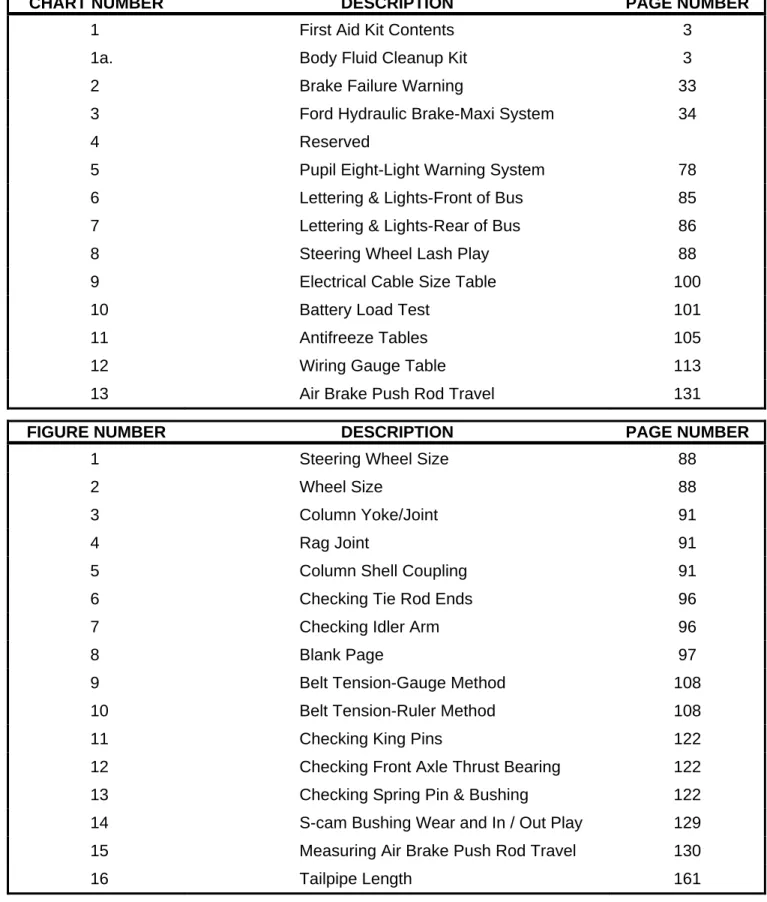
CHART NUMBER DESCRIPTION PAGE NUMBER
1 First Aid Kit Contents 3 1a. Body Fluid Cleanup Kit 3 2 Brake Failure Warning 33 3 Ford Hydraulic Brake-Maxi System 34 4 Reserved
5 Pupil Eight-Light Warning System 78 6 Lettering & Lights-Front of Bus 85 7 Lettering & Lights-Rear of Bus 86 8 Steering Wheel Lash Play 88 9 Electrical Cable Size Table 100 10 Battery Load Test 101
11 Antifreeze Tables 105
12 Wiring Gauge Table 113 13 Air Brake Push Rod Travel 131
FIGURE NUMBER DESCRIPTION PAGE NUMBER
1 Steering Wheel Size 88
2 Wheel Size 88
3 Column Yoke/Joint 91
4 Rag Joint 91
5 Column Shell Coupling 91 6 Checking Tie Rod Ends 96 7 Checking Idler Arm 96
8 Blank Page 97
9 Belt Tension-Gauge Method 108 10 Belt Tension-Ruler Method 108 11 Checking King Pins 122 12 Checking Front Axle Thrust Bearing 122 13 Checking Spring Pin & Bushing 122 14 S-cam Bushing Wear and In / Out Play 129 15 Measuring Air Brake Push Rod Travel 130
PREFACE
The purpose of this manual is to standardize school bus vehicle inspection criteria for school bus inspectors, technicians, maintenance supervisors, and transportation directors. This manual must be used in conjunction with the school bus inspection form as required by Rule 6A-3.0171, Florida Administrative Code (FAC). A copy of this form is included on pages ix and x of this section. The goal is to ensure that all inspections in Florida are conducted using the same standards and that all maintenance personnel know which items are to be inspected, how they are to be inspected, which items are to be considered in need of repair, and which defects constitute an “out of service” condition (causing a bus to be removed from service until the item is repaired). This manual was prepared to clarify many of the gray areas pertaining to school bus inspections. This manual will not answer all technical or interpretive questions and will not eliminate the need for trained personnel to exercise professional judgment. The emphasis of this manual is on “SAFETY,” which should be the foremost consideration when inspecting school buses in Florida.
Resources used in preparing this manual include Florida School Bus Specifications, National School Transportation Specifications and Procedures, Federal Motor Vehicle Safety Standards (FMVSS), manufacturers’ maintenance and shop service manuals, other states’ inspection standards, and other industry standards for maintenance and repair procedures.
Appreciation is extended to the past and present members of the Florida Association for Pupil Transportation (FAPT) School Bus Inspection Committee, Florida Department of Education (DOE) staff, and many others who contributed.
EXCERPT FROM FLORIDA STATUTES CHAPTER 1006, Part I. e. TRANSPORTATION OF SCHOOL CHILDREN
1006.22 Safety and Health of Pupils - Maximum regard for safety and adequate protection of health are primary requirements that must be observed by school boards in routing buses, appointing drivers, and providing and operating equipment, in accordance with all requirements of law and rules of the State Board of Education in providing transportation pursuant to s. 1006.21:
(10) Each district school board shall designate and adopt a specific plan for adequate examination, maintenance, and repair of transportation equipment. Examination of the mechanical and safety condition of each school bus must be made as required pursuant to rule of the State Board of Education. The State Board of Education shall base the rule on student safety considerations.
(11) The district school superintendent shall notify the district school board of any school bus which does not meet all requirements of law and rules of the State Board of Education and the district school board shall, if such school bus is in an unsafe condition, withdraw it from use as a school bus until the bus meets the requirements. The department may inspect or have inspected any school bus to determine whether the bus meets requirements of law and rules of the State Board of Education. The department may, after due notice to a district school board that any school bus does not meet certain requirements of law and rules of the State Board of Education, rule that the bus must be withdrawn from use as a school bus, this ruling to be effective immediately or upon a date specified in the ruling, whereupon the district school board shall withdraw same from use as a school bus until it meets requirements of law and rules of the State Board of Education and until the department has officially revoked the pertinent ruling. Notwithstanding any other provisions of this chapter, general-purpose urban transit systems are declared qualified to transport children to and from school.
EXCERPT FROM FLORIDA ADMINISTRATIVE CODE (FAC) CHAPTER 6A-3 TRANSPORTATION
6A-3.0171 Responsibilities of School Boards for Student Transportation. Each school board shall exercise specific powers and responsibilities, as follows:
(8) Inspection and maintenance of school buses.
(a) To provide, after considering recommendations of the superintendent, adequate storage, maintenance and inspection procedures for all buses owned by the school board, and to assure that all contract buses in use in the district are properly inspected and maintained in accordance with law and rules of the State Board.
(b) The inspection shall be conducted in accordance with procedures and include all items listed in the State of Florida School Bus Safety Inspection Manual, 2008 Edition which is hereby incorporated by reference and made a part of this rule. This document may be obtained from the Bureau of Career Development, Department of Education, 325 West Gaines Street, Tallahassee, Florida 32399, at a cost not to exceed actual production and distribution cost.
(c) Inspection of buses shall be scheduled and performed at a maximum interval of thirty (30) school days. Any bus that is removed from service or deadlined so as to disrupt the safety inspection schedule shall be inspected prior to being returned to service. All deficiencies discovered during the safety inspection shall be noted on the inspection form. Follow-up repairs of all safety related items shall be made before the bus is returned to service and shall be documented.
(d) School bus inspections shall be conducted by technicians certified as school bus inspectors in accordance with the State of Florida School Bus Safety Inspection Manual, 2008 Edition. The requirement that inspections be performed by a certified school bus inspector may be waived for a period not to exceed six (6) months when an emergency condition exists, upon written notification to the Commissioner by the district superintendent. (e) No person shall knowingly render inoperative or reduce compliance of any school bus equipment required to meet Federal Motor Vehicle Safety Standards applicable at the time of manufacture.
SPECIFICATIONS NOTES
1. School buses may be updated to current specifications (i.e., specifications in effect at the time of the update) if the district so desires. The applicable inspection procedure would be revised accordingly (per the applicable specifications).
2. Pilot test items approved by the Florida Department of Education and the Florida Association for Pupil Transportation (FAPT) School Bus Specifications Subcommittee may vary from specifications listed in this manual.
3. All Florida Specifications dates that appear in this manual correspond to the date the vehicle was ordered or to the procurement (bid) under which the vehicle was purchased. Actual production dates cannot always be used to determine applicable specifications due to lead-time between ordering and build dates. 4. All Federal Motor Vehicle Safety Standards (FMVSS) dates listed in this manual refer to the chassis build
date.
5. Section 1006.25, Florida Statutes, requires that all school buses transporting public school students meet specifications applicable for the year of manufacture. Any public school bus not meeting all applicable specifications must be immediately removed from service until all specification(s) non-compliance items are corrected.
NOTE:
The inspection form and manual were first approved by the FAPT and adopted by reference and made part of the State Board of Education rules in November 1994. The manual is to be used by all school transportation providers regulated under Section 1006.22, Florida Statutes, and Rule 6A-3.0171, FAC. We encourage comments regarding improvements to this manual and ask that they be sent to the following address:
FAPT School Bus Inspection Committee c/o Bud Fletcher, Program Specialist School Transportation Management Section
325 West Gaines Street, Suite 1134 Tallahassee, FL 32399-0400
INSTRUCTIONS
This manual must be used in conjunction with the state school bus inspection form (pages ix and x) when inspecting school buses as required by Rule 6A-3.0171, FAC. Districts are encouraged to ensure that copies of all applicable Florida School Bus Specifications manuals are available for use by inspectors during their inspections. Instructions on proper use of the state inspection form and the Florida School Bus Safety Inspection Manual are as follows:
The Florida School Bus Safety Inspection Form 1. Heading:
Fill in completely; including the Local Bus Number, Mileage, Repair Order Number (RO#), Date of Inspection, Chassis/Body Manufacturer, Seating Capacity, Model Year of Bus, and Shop Location (if district has more than one shop).
2. Status Code Indicators:
a) A "√ " (check) indicates the item inspected meets all requirements of this manual and is in proper working order.
b) An “X” denotes a type of defect that does not affect the safe operation of the bus. This item could be repaired before returning the bus to service (if in district policy) or a note could be put on the form for the item to be repaired in a reasonable amount of time.
c) The letter “O” indicates defects of those items of a safety nature. The bus shall be removed from service until such items are repaired.
3. Status Code Column:
As each numbered item in the “Inspection Items” column is inspected, a √, X, or O pertaining to the results of the inspection shall be placed in this column. Examples for specific items (see Sample Form pages xi through xii) are as follows:
a) Item “2., Section A-Inside Bus” is okay; therefore a “√ “ must be put in the Status Column.
b) Item “2., Section B-Outside Bus” is marked with an “X” for a nonfunctional clearance light. To help in identifying which clearance light is nonfunctional, a circle shall be put around the words “clearance light,” and a brief description put in the “Comment” column; i.e., L.F. (left front) corner. This description will also help if a technician other than the person inspecting the bus will be repairing the deficiency.
c) Item “13. Section D-Wheels and Tires”, Low air pressure in the R/F tire. Since this is an “out of service” item, the letter “O” shall be placed in the “Status Code” column.
4. Inspection Items:
All items on the form are to be inspected. Items in bold print are the main areas to be inspected. All other items pertain to the main areas.
Example: “Section A-Inside Bus”, Item “1. Emergency Equipment” would cover such items to be inspected as the fire extinguisher, first aid kit, body fluid cleanup kit, and roadside reflectors. Inspection procedures for A-1 are found in the inspection manual.
5. Comments:
This column must indicate the nature of the problem with the item circled in the “Inspection Items” column. For example, if the left front clearance light was not in accordance with the written instructions in the manual, it would be noted in the “Comments” column (see sample form pages xi and xii).
6. Technician’s Initials:
This column must be used by the technician who actually made the repair to show the correction was made on that particular item (see sample form, pages xi and xii). Service managers or delegates who decide not to correct “Out of Service” items identified during an inspection shall initial in the corresponding "Tech. Init.” box.
7. Section E, “Lubrication and Maintenance” is optional and is provided for the district’s convenience. 8. The additional space for “Comments” on the back page of the form must be used to provide additional
information related to the inspection. When using the comments section, you should identify the comments by section letter and number, when possible. This area is also used to denote any deficiency not covered on the form.
9. The “Tire Section” must be completed on each inspection. The tread depth must be measured according to this manual and recorded. The air pressure shall be recorded as is and then the pressure shall be adjusted (if necessary).
10. The “Inspector’s Signature” must be completed on each inspection form.
11. The “Certification Number” must be the inspector’s assigned certification number as shown on his/her certificate or certification letter.
12. Confirmation of “Bus Returned To Service Date” provides the date that the school bus was returned to use.
13. The inspection form must be initialed by the service manager or his/her delegate. Sample Repair Order
1. Repair of all deficiencies noted on the inspection form must be verified on a repair order, including complete parts information and labor descriptions (see sample repair order forms, pages xiii and xiv). 2. The technician who makes the correction should initial the repair order in the “Tech. Init.” box
corresponding to the item corrected.
3. It is recommended that the inspection form is also attached to a repair order and both documents placed in the vehicle record.
Manual
The Florida School Bus Safety Inspection Manual provides detailed information and instructions corresponding to the individual items listed on the state inspection form.
In the upper left-hand corner of each page the subject matter is listed by section and subsection, such as “Section A-Inside Bus, 1. Emergency Equipment; Fire Extinguisher; First Aid Kit; Body Fluid Cleanup Kit; and Reflectors.” There are three columns on each page with the headings left to right; “Inspection Procedures,” “Repair (or note) If,” and “Out of Service If.” Their descriptions are as follows:
1. Inspection Procedures: Describes the checks inspectors must perform and what inspectors must observe, such as the presence, condition, operation, mounting, specifications, and other pertinent information related to the particular item being inspected.
2. Repair (or note) If: This column describes deficiencies that, if found, would be considered non-safety-related. Deficiencies found meeting the “Repair” failure criteria in this column must be repaired in a reasonable period. If “Note” is the appropriate failure criterion, the item is okay currently but may need repair soon.
3. Out of Service If: This column describes deficiencies that, if found, would be considered safety related. Deficiencies discovered during the inspection that meet the failure criteria in this column shall cause the bus to be removed from service until those deficiencies are repaired.
Role of the School Bus Inspector
The role of the school bus inspector is to identify and document deficiencies on buses according to the procedures and criteria within this manual. Results of those inspections are to be reviewed by the district service manager, who shall make the final determination regarding whether buses are safe or unsafe to operate, unless this authority has been specifically delegated.
Florida School Bus Safety Inspection Form
______________________________________ District School BoardStatus Code
√ = Item OK Bus # ___________ Mileage ________________ RO # ___________ Date ____________
X = Needs Repair
O = (or as noted) Chassis/Body _____________/_____________ Capacity _______ Model Year _________
O = Out of Service
N/A = Not Applicable Shop Location ______________________________________________________________________________
Status
Code INSPECTION ITEMS
COMMENTS (Note Specific Deficiencies)
Tech Init. A. INSIDE BUS (REQUIRED)
1. Emergency Equipment - Fire Ext. (press., tag, mount), First Aid Kit, Body Fluid Cleanup Kit, and Reflectors
2. Registration, and Insurance Card
3. Neutral Safety Switch, Shifter, and Noise Abatement Switch
4. Engine Controls - Key Switch, Choke, Accelerator, and Engine Shutdown 5. Gauges, Indicators & Dash Lights, Engine Warning
Lights, and Buzzers, and ABS Warning Light
6. Air Brake System- Gauge(s), Build-Up, Governor, Park Brake, Adjustment, Air Leaks, Low Air Warning, PP-1 Pop-Off, and Pedal 7. Hydraulic Brake System - Warning Light, Gauge, Pedal, Travel &
Fade, Power Assist, and Park Brake
8. Windshield Wipers & Washers - Operation, Park, and Blades 9. Heaters, Defrosters, and External Dash Fan(s)
10. Dome, and Step Well Lights
11. Service Door - Operation, Control, and Overhead Pad 12. Horn(s)
13. Mirror Adjustment, Condition - Rearview, Convex, and Interior 14. Driver’s Seat and Seat Belt
15. Passenger Seats - Frames, Mounting, Pads, Cuts, Bottoms, Modesty Panels, Stanchions, Passenger Securement Devices, and Webbing Cutter 16. Emergency Door(s)/Windows/Hatch(es) Operation, Buzzers, Labeling,
Overhead Pad(s), and Passenger Check System
17. Windshield, Side & Rear Windows Cracks, Fogging, Latches, and Visor 18. Wheelchair Lift, Door, and Securement System - (if equipped) 19. 2 Way Radio Operation - (if equipped)
20. Interior Wiring, Cab Hoses, and Fire Wall Seals
21. General Condition, Bus Interior - Floor, Step well, Grab Rail(s), Paneling, Broom Mounting, Loose Objects Secured, and Engine Cover
B. OUTSIDE BUS (REQUIRED)
1. Headlights, Turn Signals, Hazard, Side Marker, Brake, Tail, Backup Lights, Backup Alarm & Dash Sticker (if equipped), and Park Lights
2. Clearance & ID Lights, Reflectors, and Strobe Light (if equipped) 3. Pupil Warning Lights - (see eight light warning system chart)
4. Stop Arm(s), and Student Crossing Arm - Wiring, Air or Vacuum Leak, and Decal
5. General Condition, Bus Exterior Mirrors, Bumpers, Body Damage, Paint Reflective Marking, Lettering, Emergency Door, Engine Hood, and Cleanliness
C. ENGINE COMPARTMENT (REQUIRED)
1. Steering - Play, Column, Steering Gear Box Mounting, Pitman Arm, Drag Link, Steering Arm, Tie Rod & Ends, and Idler Arm
2. Batteries - Hold Down, Terminals, Cables, Cleanliness, Slide Tray, & Load Test
3. Fluid Levels and Condition- Brake, Power Steering, Oil, Transmission, Windshield Washer, Coolant, and (Antifreeze ______________°F) 4. Belts & Hoses - Tightness, Condition, Routing, and Belt Alignment 5. Accessory Mounting & Condition - Air Cleaner (Restriction ____”H20),
Status
Code INSPECTION ITEMS (Note Specific Deficiencies)COMMENTS
Tech Init.
7. Fuel System and Lines
8. Radiator - Mounting, Cap, Reservoir, and Fan Shroud
D. UNDERNEATH BUS (REQUIRED)
1. Front Suspension - Wheel Bearings, I-Beam (King Pins, Shackles, Spring Mounts, Pins & Bushings), A-Frames and Bushings (Ball Joints), U-Bolts, Shocks, Springs, and Seals
2. Front Brakes - Hoses, Lines, Chambers, Slack Adjusters, Pushrods, Linings,
Drums, Rotors, Wheel Cylinders or Calipers. Check and Adjust MSA Equipped Brakes. Do Not Adjust ASA Equipped Brakes
3. Engine/Transmission Mounts, Starter Mounting
4. Transmission - Bolts, Linkage, Lines, Filter and Cooler, & Clutch (if equipped) 5. Fluid Leaks - Oil, Coolant, Transmission, P.S., etc.
6. Fuel Tank - Leaks, Mounting, Hoses, and Wiring
7. Brake Equipment – ABS, Lines, Valves, Reservoir Mounting, and Bleed Reservoirs 8. Driveline - Shafts, U-Joints, Yokes, Hanger Bearings, Guards, and Driveshaft
Park brake
9. Rear Suspension - Axle Housing, Vent, Differential, Springs, U-Bolts, Shocks, Spring Shackles, Pins and Bushings, Hangers, Seals, and Wheel Bearings 10. Rear Brakes - Hoses, Lines, Chambers, Slack Adjusters, Pushrods, Linings,
Drums, Rotors, Wheel Cylinders or Calipers. Check and Adjust MSA Equipped Brakes. Do Not Adjust ASA Equipped Brakes
11. Body Securement & Structure - Hold Downs, Floor, Outriggers, Braces, Skirts, and Chassis Frame Rails
12. Exhaust Systems - Leaks, Mounting, Muffler and Tailpipe
13. Wheels and Tires - Tread Depth, Pressure, Damage, Matching, Alignment, and Wheel Hardware
E. LUBRICATION & MAINTENANCE (OPTIONAL)
1. Change Oil and Replace Oil Filter(s) qts. _______________
2. Replace Fuel Filter(s) Primary/Secondary and Drain Separator.
3. Replace Transmission Filter(s) qts. _______________
4. Replace Air Compressor Filter (if applicable)
5. Replace P/S Filter pts. ______________
6. Replace Engine Air Cleaner Filter
7. Replace Coolant Filter (if applicable)
8. Test Starting and Charging System Amps ________) Volts __________)
9. Lubricate Chassis and Body Lbs. ______________
10. Air Conditioning Perform A/C system preventive maintenance (if equipped) according to district procedure.
F. ROAD TEST (REQUIRED)
1. Brake Performance - Park Brake, Stopping Distance and Equalization 2. Engine, Transmission, Driveline - Engine Performance, Governor, & Shifting 3. Steering & Handling - Free Play, Power Assist, Column, and Tracking
Comments: ______________________________________________ Depth / Pressure Depth / Pressure
_________________________________________________________ RF ______/_______ RRO ______/_______
_________________________________________________________ RRI _______/_______
_________________________________________________________ LRI ______/_______
_________________________________________________________ LF ______/________ LRO ______/_______
NOTE: If bus is equipped with equipment not noted on this form, follow the manufacturer’s inspection and maintenance procedures for that equipment.
Inspector’s Signature: _____________________________ Inspector’s Certification #: _________-___________ Service Manager’s or Delegate’s Initials: _____________ Bus Returned To Service Date: ______/______/________
Florida School Bus Safety Inspection Form
Sunshine District School Board
Status Code Bus # 6945 Mileage 12,000 RO # Y43219-I-R Date 8/20/03
√ = Item OK
X = Needs Repair Chassis/Body Navistar/Thomas Capacity 65 Model Year 1969 (or as noted)
o = Out of Service Shop Location Busville N/A = Not Applicable
Status
Code INSPECTION ITEMS
COMMENTS
(Note Specific Deficiencies)
Tech Init. A. INSIDE BUS (REQUIRED)
9
1. Emergency Equipment - Fire Ext. (press., tag, mount), First Aid Kit, Body Fluid Cleanup Kit, Reflectors.9 2. Registration, Insurance Card
9 3. Neutral Safety Switch, Shifter, and Noise Abatement Switch 9 4. Engine Controls - Key Switch, Choke, Accelerator, Engine Shutdown.
9 5. Gauges, Indicators & Dash Lights, Engine Warning Lights, and Buzzers, ABS Warning Light.
9 6. Air Brake System- Gauge(s), Build-Up, Governor, Park Brake,
Adjustment, Air Leaks, Low Air Warning, PP-1 Pop-Off, Pedal. N/A 7. Hydraulic Brake System - Warning Light, Gauge, Pedal, Travel &
Fade, Power Assist, Park Brake.
9 8. Windshield Wipers & Washers - Operation, Park, Blades.
9 9. Heaters, Defrosters, External Dash Fan(s).
9 10. Dome & Step Well Lights
9 11. Service Door - Operation, Control, and Overhead Pad.
9 12. Horn(s)
9 13. Mirror Adjustment, Condition - Rearview, Convex, Interior.
9 14. Driver’s Seat and Seat Belt
9 15. Passenger Seats - Frames, Mounting, Pads, Cuts, Bottoms, Modesty
Panels, Stanchions, Passenger Securement Devices, and Webbing Cutter.
9 16. Emergency Door(s)/Windows/Hatches - Operation, Buzzers, Labeling,
Overhead Pad, and Passenger Check System.
9 17. Windshield, Side & Rear Windows -Cracks, Fogging, Latches, Visor. N/A 18. Wheelchair Lift, Door, Securement System - (if equipped).
N/A 19. 2 Way Radio Operation - (if equipped).
9 20. Interior Wiring, Cab Hoses, and Fire Wall Seals
9 21. General Condition, Bus Interior - (Including floor, step well, grab rail(s),
paneling, broom mounting, loose objects secured, and engine cover).
B. OUTSIDE BUS (REQUIRED)
9 1. Headlights, Turn Signals, Hazard, Side Marker, Brake, Tail, Backup Lights, Backup Alarm & Dash Sticker (if equipped), and Park Lights.
X 2. Clearance & ID Lights, Reflectors, Strobe Light (if equipped). LF Corner Not Working RM
9 3. Pupil Warning Lights - (see eight light warning system chart).
9 4. Stop Arm(s), Student Crossing Arm - Wiring, Air or Vacuum Leak, & Decal
9 5. General Condition, Bus Exterior - Mirrors, Bumpers, Body Damage, Paint,
Reflective Marking, Lettering, Emergency Door, Engine Hood, Cleanliness.
C. ENGINE COMPARTMENT (REQUIRED)
9 1. Steering - Play, Column, Steering Gear Box Mounting, Pitman Arm,
Drag Link, Steering Arm, Tie Rod & Ends, and Idler Arm.
9 2. Batteries - Hold Down, Terminals, Cables, Cleanliness, Slide Tray, Load
Test.
9 3. Windshield Washer, Coolant, (Antifreeze ______________°F). Fluid Levels and Condition- Brake, Power Steering, Oil, Transmission,
X 4. Belts & Hoses - Tightness, Condition, Routing, Belt Alignment. P/S Very Loose RM
9 5. Accessory Mounting & Condition - Air Cleaner (Restriction ____”H20),
Status
Code INSPECTION ITEMS
COMMENTS
(Note Specific Deficiencies)
Tech Int. 9 6. Wiring - Routing and Condition.
9 7. Fuel System and Lines
9 8. Radiator - Mounting, Cap, Reservoir, Fan Shroud.
D. UNDERNEATH BUS (REQUIRED)
9
1. Front Suspension - Wheel Bearings, I-Beam (King Pins, Shackles, Spring Mounts, Pins & Bushings), A-Frames and Bushings (Ball Joints), U-Bolts, Shocks, Springs, and Seals.
X
2. Front Brakes - Hoses, Lines, Chambers, Slack Adjusters, Pushrods, Linings,
Drums, Rotors, Wheel Cylinders or Calipers, Check and Adjust MSA Equipped Brakes. Do Not Adjust ASA Equipped Brakes
Adjust MSA
BS
9 3. Engine/Transmission Mounts, Starter Mounting.
9 4. Transmission - Bolts, Linkage, Lines, Filter and Cooler, Clutch (if equipped).
9 5. Fluid Leaks - Oil, Coolant, Transmission, P.S., etc..
9 6. Fuel Tank - Leaks, Mounting, Hoses, Wiring.
X 7. Brake Equipment – ABS, Lines, Valves, Reservoir Mounting, Bleed Reservoirs. Bleed Tank BS
9 8. Driveline - Shafts, U-Joints, Yokes, Hanger Bearings, Guards, Driveshaft Park
Brake.
9 9. Rear Suspension - Axle Housing, Vent, Differential, Springs, U-Bolts, Shocks,
Spring Shackles, Pins and Bushings, Hangers, Seals, Wheel Bearings.
X
10. Rear Brakes - Hoses, Lines, Chambers, Slack Adjusters, Pushrods, Linings,
Drums, Rotors, Wheel Cylinders or Calipers, Check and Adjust MSA Equipped Brakes. Do Not Adjust ASA Equipped Brakes
Adjust MSA
BS
9 11. Body Securement & Structure - Hold Downs, Floor, Outriggers, Braces,
Skirts, Chassis Frame Rails.
9 12. Exhaust Systems - Leaks, Mounting, Muffler and Tailpipe.
O 13. Wheels and Tires - Tread Depth, Pressure, Damage, Matching, Alignment,
Wheel Hardware.
RF 1/32” and Low Air Pressure
RM
E. LUBRICATION & MAINTENANCE (OPTIONAL)
X 1. Change Oil and Replace Oil Filter(s) qts. ____14_________ BS
X 2. Replace Fuel Filter(s) Primary/Secondary and Drain Separator. BS
N/A 3. Replace Transmission Filter(s) qts. _______________ N/A 4. Replace Air Compressor Filter (if applicable)
N/A 5. Replace P/S Filter pts. ______________ N/A 6. Replace Engine Air Cleaner Filter
X 7. Replace Coolant Filter (if applicable) BS
X 8. Test Starting and Charging System Amps ___105___) Volts ___15.2___) RM
X 9. Lubricate Chassis and Body Lbs. ____1/2_______ BS
9 10. Air Conditioning – Perform A/C System Preventive Maintenance
(if equipped) according to district procedure.
F. ROAD TEST (REQUIRED)
9 1. Brake Performance - Park Brake, Stopping Distance & Equalization.
9 2. Engine, Transmission, Driveline - Engine Performance & Governor, Shifting.
9 3. Steering & Handling - Free Play, Power Assist, Column, Tracking.
Comments: N e e d s r e a r b r a k e s s o o n . Depth / Pressure Depth/ Pressure
B r a k e b l o c k s 5 / 1 6 ” t h i c k. ____________________________ RF 1/32 / 50 RRO 6/32 / 85
_________________________________________________ RR I 6/32 / 85
_________________________________________________ LR I 6/32 / 85
_________________________________________________ LF 8/32 / 90 LRO 6/32 / 85
NOTE: If bus is equipped with optional equipment not noted on this form, follow the manufacturer’s inspection and maintenance procedures.
Inspector’s Signature: B i l l S m i t h_____ Inspector’s Certification #: ___099___-___0039____ Service Manager’s or Delegate’s Initials: ______CH______ Date Bus Returned To Service: ___August_/__21__/__2006__
Sample Repair Order
Vehicle Number Mileage Description of Vehicle
Make Year Reg. Lift A/C
Repair Order #
Date: Safety Inspection
Yes ( ) No ( ) Route / Driver:
District Name:
__________________ School District
Inspected By:Repairs Needed: Out of Service Date:
In Service Date:
Time Quantity Parts Est. Cost Tech
Init. Repairs Hrs 1/10
Cost Sub Total
Total Man-Hours
Quantity Tires and Batteries Filters Mileage Yes No Tune/Up-Frt/Wheels-Oil Mileage Yes No
Fuel/Oil Tune/Up
Air Frt Wheels
Coolant Oil Change
Trans
Sample Repair Order (Completed)
Vehicle Number Mileage Description of Vehicle
6945
12,000
Make Thomas Year2006
Reg. X Lift A/C X Repair Order #Y13219-I-R
Date:08/20/2008
Safety Inspection Yes ( X ) No ( ) Route / Driver:15 / Betty Bus Driver
District Name:
Sunshine School District
Inspected By:Bill Smith
Repairs Needed:
See inspection form dated 08/20/2003
Out of Service Date:
08/20/2008
In Service Date:08/21/2008
Time Quantity Parts Est. Cost Tech.
Init.
Repairs
Hrs 1/10
1 1157
Bulb
67
RM
Replaced
Bulb
0 1
1
187439CI oil filter
8 50
RM Replaced
Filter
0 1
1
LF 3949 oil filter
14 50
RM
Replaced Filter
0 1
1
1872526CI fuel filter
7 82
RM Replaced
Filter
0 1
1
PH79 fuel filter
5 32
RM Replaced
Filter
0 1
1
1875921CI fuel filter
4 90
RM Replaced
Filter
0 1
14
Qts. Oil
11 40
RM
Changed Oil
0 2
1/2 Lb.
grease
1 50 RM Lubricated
Chassis
0 1
1.0 Labor,
Technician
(@16/hr)16 00
BS
Inspection Adjustments and Repairs
1 0
1.0 Labor,
Helper
(@10/hr)10 00
RM
Inspection Adjustments and Repairs
1 0
1.0
Tire (see cost below)
RM
Change R/F Tire
0 3
Cost Sub Total
77 66
Total Man-Hours2 3
Quantity Tires and Batteries Filters Mileage Yes No Tune/Up-Frt/Wheels-Oil Mileage Yes No
1
10Rx22.5 new tire
197
00
Fuel/Oil12,000
X
Tune/UpX
Air
X
Frt WheelsX
Coolant
X
Oil Change12,000
X
Trans
School Bus Inspection Certification Program
This program shall meet the requirements of Rule 6A-3.0171(8)(d), FAC, that technicians who perform school bus inspections must be certified as School Bus Inspectors. Certification shall be in effect until the end of the fifth calendar year from the certification date stated on the certificate or certification letter, and person(s) must re-certify every five (5) years thereafter to maintain certification (see Re-certification Program for details). The qualifications, training, and testing requirements for certification are as follows: A. Level 1. Certified School Bus Inspector
1. Qualifications Requirements:
a) Candidates must be able to document a minimum of two years of journeyman level mechanical experience in the repair and maintenance of motor vehicles in the areas of automotive, truck, heavy equipment, or bus; or successful completion of a course in vehicle maintenance and repair, with a minimum two-year curriculum from an accredited school. The required mechanical experience is defined as “hands-on” or “wrench-turning” experience.
b) Candidates must submit a completed “Application for State of Florida School Bus Safety Inspector Certification” to the inspection-trainer and test administrator prior to online and hands-on testing.
c) Candidates must be or have been classified by their current employers as journeyman level mechanics/technicians. This classification must be in the form of an official job description. Alternatively, in cases where candidates are working as journeyman level mechanics/technicians without being classified as such by their employer, the employer may submit a letter to the School Transportation Management Section of the Florida Department of Education requesting a waiver of the job description requirement. Acceptable job descriptions cannot contain language indicating candidates are expected to perform primarily mechanic’s assistant or equivalent duties. 2. Training Requirements:
a) Candidates shall attend a minimum two-day school bus inspection training program conducted by a certified school bus inspection trainer.
b) Candidates should be thoroughly familiar with the current edition of the State of Florida School Bus Safety Inspection Manual prior to attending a training class.
c) Candidates shall train/practice performing school bus inspections on several school buses prior to hands-on testing using the procedures and information learned in the training class.
3. Testing Requirements:
a) Testing consists of two parts, a 100 question written online test and a hands-on application test. b) Online testing will be conducted by district test administrators. Test administrators shall either be
qualified school district driver trainers, or third parties who are not employed by the school district transportation department or by contracted providers of transportation to the school district. Test administrators may also be “third-party testers” working for other private or non-school district government entities.
c) Test administrators must complete and submit a form titled “Application to be a School Bus Inspector Test Administrator” to the DOE for approval. Each school district’s transportation director and service manager receive this form along with applicable information/instructions. The DOE will provide test administrators with additional instructions and assistance regarding the online test.
d) Online test candidates must be tested by an approved district test administrator.
e) Hands-on testing will be administered in the field by the Department of Education, School Transportation Management Section.
4. Written (online) Test:
a) All written test questions are related to material in the inspection manual. b) Candidates will be allowed 90 minutes to take the test.
c) The minimum passing grade is 80 percent.
d) This test is an open book test. Candidates will be allowed to use the State of Florida School Bus Safety Inspection Manual during the 100 question online test.
5. Hands-on Test:
a) Hands-on testing sessions will be scheduled regionally. School district transportation departments will be notified by DOE of the locations, times, etc.
b) Candidates will be required to perform actual physical inspections of school buses and should dress accordingly. All equipment (except pen or pencil) needed to take the test will be provided at the test site.
c) Candidates must bring a current copy of the inspection manual, a driver’s license, job description, and a completed “Application for State of Florida School Bus Safety Inspector Certification” to the test site.
d) Candidates should use the information learned in their training class, the inspection manual, and their professional knowledge while taking their hands-on inspection test.
e) Candidates will be allowed 90 minutes to take the test.
f) The bus will have a minimum of nine specific and pre-determined deficiencies that the candidate must identify and properly describe on the inspection form. The specific deficiencies may be either existing or ones created by the DOE.
g) Each of the nine deficiencies counts as ten points.
h) A properly completed inspection form counts as ten points. The candidate will be allowed to make a maximum of three mistakes on the form. Examples of the types of mistakes are: odometer reading not recorded; a blank in the Status Code column; and any of the nine specific deficiencies discovered are not clearly identified or described on the form.
i) The minimum passing grade is 90 percent. The district or employer will be notified in a timely manner regarding the certification status of each test candidate.
B. Level 2. Certified School Bus Inspector / Trainer 1. Qualifications Requirements
All the requirements listed in Section A, plus the following additional items:
a) Candidates should be thoroughly knowledgeable of the contents of the current edition of the State of Florida School Bus Safety Inspection Manual.
b) Candidates must possess skills and abilities required to present school bus inspection training material in a manner that facilitates learning and must exhibit leadership qualities and above average professionalism in the performance of their duties.
c) Candidates must submit a copy of their completed “Application for State of Florida School Bus Safety Inspector Certification” to the DOE trainer at the time of the train-the-trainer class.
2. Training Requirements
a) Trainer candidates must attend a two-day DOE sponsored train-the-trainer class and testing session, and periodic update training sessions.
b) Candidates will receive intense training and detailed inspection program information from the DOE trainer in the following specific areas:
1) Training techniques;
2) Purpose of the program and applicable laws and State Board of Education rules; 3) How to use the inspection manual and the inspection form;
4) Recertification program;
5) Inspection, repair or note, and out-of-service criteria;
6) Information in additional areas where class participants may need additional training 3. Testing Requirements
a) See: Section A. Trainers must meet the same testing requirements as an inspector.
b) Additional testing requirements include performance-based scoring at the two-day train-the-trainer class in which train-the-trainer candidates will be required to conduct simulated training classes. c) Periodic train-the-trainer update classes will be scheduled by DOE.
4. Duties
a) Trainers must ensure that inspector testing candidates meet requirements. Trainers must sign the “Application for State of Florida School Bus Safety Inspector Certification” to verify that inspector candidates have received appropriate training and are prepared to be tested.
b) Occasionally, trainers may be asked to conduct inspection training for school districts, charter schools, and private transportation providers that do not otherwise have trainers available to them. This may entail travel to another district or organization.
C. Level 3. Supervisor I
D. Level 4. Supervisor II Certificate
This classification is made available to supervisors who manage a district’s school bus inspection process, but do not perform actual bus inspections. NOTE: The School Bus Inspection Program Manager Certificate will not qualify the holder to perform school bus safety inspections. The qualifications, eligibility, and testing requirements for this certificate are:
1. Qualifications Requirements
a) Supervisor II candidates must have a minimum of one (1) year experience in school transportation management, or:
b) Successful completion of a course in vehicle maintenance management with a minimum of two years from an accredited school may be substituted for the required one year of experience. 2. Eligibility Requirements
a) Any shop foreman, service manager, or other transportation management position in the field related to the maintenance, repair, and inspection of school buses.
b) Must have general knowledge of basic transportation management principles. 3. Testing Requirements
a) Candidates must pass the 100 question online test.
b) Candidates will be allowed 90 minutes to complete the test.
c) The minimum passing grade is 80 percent. The district or employer will be notified in a timely manner regarding the certification status of each test candidate.
Requirements for each Inspection Classification
are summarized in the following table:
Classification Levels Min. 2 years Technical Experience Classified as Journeyman Written Test Passed Hands-on Test Passed Update Course Attended 1. Inspector X X (1) X (3) X (5) 2. Trainer X X (1) X (3), (4) X (5) 3. Supervisor I X X (2) X (3) X (5) 4. Supervisor II (5) Note:
Supervisor II level not qualified to perform
School Bus Safety Inspections One (1) yr. in transportation management position or 2 yr. degree NA X (3) NA
(1) Requirements specified in section A.
(2) Supervisors with two years of journeyman level experience are not required to have job descriptions containing mechanic and/or technician classification language.
(3) 100 question online test
(4) For trainer endorsement, no written “trainer” test required. Candidates will be scored during the two-day train-the-trainer class. Trainers must also be classified as inspectors.
(5) 30 question online re-certification test.
Note: A Trainer must provide candidate with inspection manual update/revision information and sign candidate’s re-certification form prior to re-certification testing.
School Bus Inspection Re-certification Program
School bus Inspectors, Inspection-trainers, Supervisors I, and Supervisors II must re-certify during the fifth calendar year of certification. The following are qualifications, eligibility, and testing requirements for re-certification:
1. Qualifications Requirements:
a) Re-certification must take place sometime between January 1st and December 31st of the fifth full calendar year following the calendar year of original certification or subsequent re-certification. For example: if an inspector became certified in January, 2008, he/she would need to re-certify anytime between January 1, 2013, and December 31, 2013. If an inspector became certified in December, 2008, re-certification would still be required during calendar year 2013. Recertification candidates are encouraged to begin re-certification study and testing as early as possible in the calendar year during which re-certification is required.
b) Candidates are required to obtain inspection manual update/revision information. An inspection-trainer must ensure this and sign the certification form prior to testing. NOTE: The re-certification form should be kept on file within the school district transportation department.
2. Eligibility Requirements:
Inspectors who fail to re-certify by the deadline must not inspect buses until being re-certified (see g) and h) below).
3. Testing Requirements:
a) Testing consist of a 30-question online written test.
b) The test consists of questions on revised and non-revised inspection criteria in the Florida School Bus Safety Inspection Manual.
c) Online testing will be conducted by district test administrators.
d) This test is an open book test. Candidates will be allowed to use the State of Florida School Bus Safety Inspection Manual during the 30-question online test.
e) The candidate must provide the test administrator with a valid driver’s license and a completed re-certification form. An e-mail address is recommended.
f) Re-certification candidates will be allowed 30 minutes to take the test.
g) Re-certification candidates can take the test as many times as necessary to pass the test. If a candidate fails the test twice, additional training is recommended before retaking the test.
h) If an inspector does not pass the test by the deadline date, the certification will expire. The candidate can become certified again up to one year after expiration by passing the 30-question test; however, the candidate must not inspect buses until that time. After one year of expiration the candidate must complete the whole certification process to become certified again.
i) The minimum passing grade for this test is 80 percent.
j) The online test program will grade all tests taken and provide the candidate with pass/fail information immediately after the test is completed. Inspector re-certification certificates will be sent to applicable school district transportation directors in a timely manner.
Certification #: ________ - _____________ (For Official Use Only) Written ___ -- ______
H.O. ___________
APPLICATION FOR STATE OF FLORIDA
SCHOOL BUS SAFETY INSPECTOR CERTIFICATION
(Please Type or Print)
________________________________ _______ ______________________________
First Name M.I. Last Name
____________________________________________
Email Address
__________________________________ ______________________ Florida ___________
Home Street Address, Apt. # City Zip
_______________________
____ / ____ / ____
Education: (Check Highest Level Achieved) Driver License Number Birth Date ___ High School or GED ___ 2 yr. College __________________________________________________________ ___4 yr. College ___ Post graduateThe School District or Employer You Work For
APPLICATION LEVEL - CHECK ONE:
___ 1. INSPECTOR ___ 2. TRAINER ___ 3. SUPERVISOR I ___ 4. SUPERVISOR II
MECHANICAL WORK EXPERIENCE or SUPERVISORY EXPERIENCE:
Candidate must be able to document a minimum of 2 years journeyman level mechanical experience for certification level #1, #2, or #3 above (wrench turning or 2 yrs. Vo-Tech degree) in any of the following areas: a) Automotive; b) Truck; c) Heavy Equipment; or d) Buses (transit or school) or minimum one year supervisory experience in school transportation management for Level #4.List employers where you gained applicable experience:
1. Employer (Current or most recent): ________________________________________________ ______________________________ ___________________ ___________ _______________
Street Address City State Zip
Your Position or Job Title: _______________________________________________________ Supervisor’s Name: _________________________________ Title: ___________________________ Tel. #: ( ______ ) _____ - ________ Employed From: _____/_____/_____ To: _____/_____/_____ ---2.
Employer (Previous): ____________________________________________________________ _____________________________ __________________ ___________ _______________
Street Address City State Zip Your Position or Job Title: __________________________________________________________ Supervisor’s Name: ________________________________ Title: __________________________ Tel. #: ( ______ ) ______ - _________ Employed From: _____/_____/_____ To: _____/_____/_____
Note: If needed to demonstrate compliance with requirements, list additional employers, mechanical experience, or Vo-Tech degree information on a separate piece of paper and attach to this application.
EMPLOYER INFORMATION
______________________________________________________________
Name of Employer or District Where Applicant is Employed
_______________________________ ____________________,
Florida________
Work or Mailing Address City Zip
Supervisor’s Name:
__________________________
Title:___________________
NOTE: All signatures are required. Candidate must bring a driver’s license, this completed application, and a copy of his/her current job description or waiver letter to the hands-on test site. Trainers and/or test administrators must ensure that a copy of this completed application is filed within the district transportation department.
Applicant’s Signature: _____________________________ Date: ______/______/______
The Applicant meets all training requirements:
Trainer’s Signature: ____________________ Cert. # ______ Date: ______/______/______
The Applicant meets all applicable qualifications and requirements:
Trans. Director’s Signature: ____________________________ Date: ______/______/______
THIS SECTION FOR DOE USE ONLY
Inspector: ________ Trainer: ______ Supervisor I: _______ Supervisor II: _________ Applicant is denied or no number issued due to:
Insufficient Data ______ Does Not Qualify ___ Insufficient Experience _____ Classified as a Mechanic’s Helper ___ No Training Received ___
Written (online) Test Date: ______/_____/______ Passed_________Failed________ * Retest Date: 1. ______/_____/______ Passed_________Failed________ * Retest Date: 2. ______/_____/______ Passed_________Failed________ * Retest Date: 3. ______/_____/______ Passed_________Failed________
Hands-On Test Date: ______/_____/______ Passed_________Failed________ * Retest Date: 1. ______/_____/______ Passed_________Failed________ * Retest Date: 2. ______/_____/______ Passed_________Failed________ * Retest Date: 3. ______/_____/______ Passed_________Failed________ * If Applicable
Certified By: __________________________________ Date: ______/______/_______
Name of DOE Official