A
A
l
l
m
m
a
a
M
M
a
a
t
t
e
e
r
r
S
S
t
t
u
u
d
d
i
i
o
o
r
r
u
u
m
m
–
–
U
U
n
n
i
i
v
v
e
e
r
r
s
s
i
i
t
t
à
à
d
d
i
i
B
B
o
o
l
l
o
o
g
g
n
n
a
a
DOTTORATO DI RICERCA IN
Ingegneria elettronica, telecomunicazioni e tecnologie
dell’informazione
Ciclo 31
Settore Concorsuale:
09/E3 - Elettronica
Settore Scientifico Disciplinare:
ING-INF/01 - Elettronica
A Dataflow Framework For Developing Flexible Embedded Accelerators
A Computer Vision Case Study
Presentata da:
Arthur Stoutchinin
Coordinatore Dottorato
Supervisore
Alessandra Costanzo
Luca Benini
Arthur Stoutchinin: A Dataflow Framework for Developing Flexible Em-bedded AcceleratorsPhD Thesis © october2018.
e-mail:
Dedicated to my mother, my source of support, and to my kids, Girgory and Anastasia, my source of energy and motivation ...
C O N T E N T S
Introduction xv
1 dataflow computation model review 1
1.1 Kahn Process Networks (KPN) . . . 2
1.2 Dataflow Process Networks (DPN) . . . 4
1.2.1 The Synchronous Dataflow (SDF) Model . . . . 6
1.2.2 Parameterized Dataflow Models . . . 7
1.2.3 Structured Dynamic Dataflow Models . . . 8
1.3 Landscape of Dataflow Implementations . . . 9
1.3.1 Domain-specific Architectures . . . 12
1.3.2 Model Driven Frameworks . . . 12
1.3.3 C Based Frameworks . . . 15
1.3.4 CAL Dataflow Language . . . 17
1.4 Summary . . . 19
2 designing streaming accelerators with streamdrive 21 2.1 StreamDrive Communication Protocol . . . 25
2.2 The StreamDrive Architecture . . . 28
2.2.1 The Event Synchronization Network . . . 30
2.2.2 The Hardware Block Bridge . . . 31
2.2.3 The Dataflow-Aware DMA . . . 34
2.3 The StreamDrive API . . . 35
2.3.1 Actor API . . . 37
2.3.2 Graph API . . . 39
2.4 The Successive Refinement Flow . . . 43
2.4.1 Identification of the dataflow graph . . . 44
2.4.2 Building the initial dataflow graph . . . 47
2.4.3 The dataflow graph refinement . . . 52
2.4.4 Adding application-specific hardware blocks . . 55
2.4.5 Data Parallelism . . . 56
2.4.6 Optimizing Scheduling via Firing Rules . . . 60
2.4.7 Further refinement and optimization . . . 62
2.5 The StreamDrive Runtime System . . . 64
2.5.1 Actor Management and Scheduling . . . 64
2.5.2 Control Flow . . . 65
2.5.3 User-Mode Context Switch . . . 68
2.5.4 Communication Layer . . . 70
2.5.5 Deadlock Detection . . . 71
2.5.6 Accounting Options . . . 72
2.6 Summary . . . 73
3 computer vision accelerator 75
contents v
3.1 Designing CNN Convolution Accelerator . . . 76
3.1.1 Background on CNNs . . . 78
3.1.2 State-of-the-Art . . . 82
3.2 Memory Performance Optimization . . . 87
3.2.1 Data Locality Optimization . . . 89
3.2.2 Previous Work . . . 91
3.2.3 Memory Performance Model . . . 94
3.2.4 Comparison vs Existing Models . . . 97
3.3 The Computer Vision Engine . . . 101
3.3.1 The HWC Hardware Block . . . 102
3.3.2 Optimizing HWC Memory Subsystem . . . 104
3.3.3 Optimizing Off-Cluster Memory Access . . . 107
3.4 Summary . . . 109
4 performance evaluations 110 4.1 Case-Study1: Image Processing . . . 111
4.1.1 ORB . . . 112
4.1.2 Face Detection . . . 115
4.1.3 StreamDrive Parallelization Overhead . . . 117
4.1.4 Memory Footprint . . . 121
4.1.5 Performance Scaling . . . 123
4.1.6 KPN vs. DPN Trade-off . . . 126
4.2 Case-Study2: Convolutional Neural Networks . . . 128
4.3 Putting It All Together . . . 131
5 conclusions and further directions 133 5.1 A Critical View . . . 137
5.2 Future Directions . . . 138
a streamdrive api reference 140 b peemen equations for the cnn convolution loop-nest146 c cnn layers configuration used in this thesis 148 c.1 AlexNet, ZFNet, VGG . . . 148 c.2 VGG . . . 148 c.3 Google Inception . . . 149 c.4 ResNet . . . 150 c.5 DenseNet . . . 151 abbreviations 152 Bibliography 153
L I S T O F F I G U R E S
Figure1.1 A Kahn Process Network Example . . . 3 Figure2.1 The Illustration of StreamDrive
Communica-tion Protocol . . . 26 Figure2.2 The StreamDrive Cluster Block Diagram . . . . 28 Figure2.3 The HBB Block Diagram . . . 32 Figure2.4 The HBB Network Interface Example . . . 33 Figure2.5 A StreamDrive Application Organization . . . 36 Figure2.6 Initial ORB dataflow graph: the actors correspond
to the original kernels; the input image data are read via the DMA by theSRCactor and are broad-cast to the FAST, GAUSS, HARRIS, and ANGLE actors; the BRIEF writes result descriptors directly to the external memory. . . 52 Figure2.7 Refined ORB dataflow graph: most communication
buffers have been moved to cluster shared mem-ory. The SRCtoANGLE, and theGAUSSto BRIEF re-quire bufferring capacity that exceeds the cluster memory, these data need to be stored externally. Two additional DMA actors, the second SRC and theBLUR, are used to handle this situation. . . 56 Figure2.8 The ORB dataflow graph with data-parallel actors:
theFAST, the ANGLEand theBRIEFactors are repli-cated4 times, and the HARRISactor is replicated2 times. . . 57 Figure2.9 Transitions between dataflow actor states. A
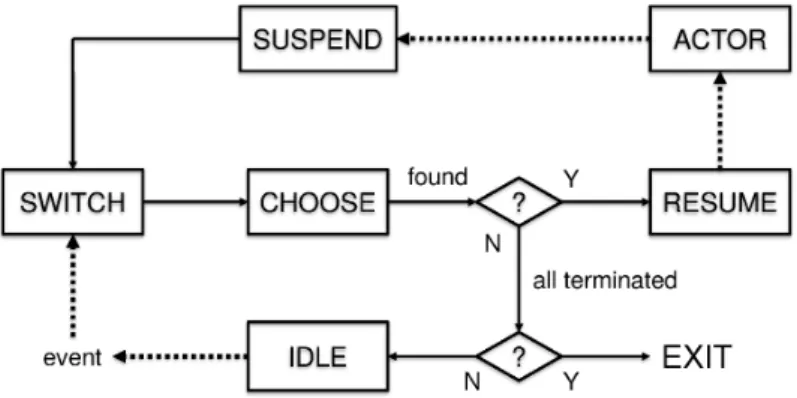
sleeping actor is unblocked when last KPN blocking condition has been removed or when all firing rules are satisfied. . . 64 Figure2.10 Runner control flow. When all actors reach the
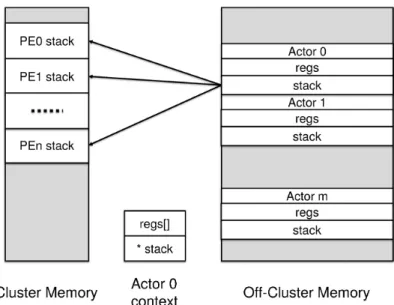
TERMINATED state, the scheduler exits the loop. 66 Figure2.11 Actor context descriptor and stack spilling. . . 69 Figure3.1 AlexNet CNN that won the ImageNet 2012
con-test [May look weird because there are two differ-ent processing “streams”. This is because the train-ing process was so computationally expensive that they had to split the training onto2GPUs.]. . . . 78 Figure3.2 CNN convolutional layer illustration. . . 79 Figure3.3 Canonical form of the CNN convolution layer
loop-nest. . . 80
List of Figures vii
Figure3.4 Generic view of a CNN accelerator
combin-ing a computcombin-ing datapath with an optimized application-managedlocal reuse buffer, and
off-accelerator memory external to the datapath. . 88
Figure3.5 Tiled CNN convolution layer loop-nest. . . 90
Figure3.6 Memory traffic comparison of the best com-putation schedules identified by our model, the model proposed in Peemenet al. and the cache model on a set of representative CNNs, while sweeping the local memory constraint from 1 to 256 KB. Both axes are in logarithmic scale. Results aggregate traffic contributions from all convolutional layers; the dashed red line indi-cates the ideal memory traffic when all data reuse is fully exploited. . . 97
Figure3.7 Memory traffic overhead with respect to our proposed model when using the model pro-posed in Peemenet al. to select the best compu-tation schedule, while sweeping the local mem-ory size from1to256kB. . . 98
Figure3.8 The Computer Vision Engine Clusters. . . 101
Figure3.9 HWC block internal architecture. . . 102
Figure3.10 The SIMD datapath block diagram. . . 103
Figure3.11 Distribution ofcomputation schedulesacross dif-ferent loop-nest permutations, binned depend-ing on the amount of memory traffic they gen-erate. . . 106
Figure3.12 HWC computation schedule: gives best band-width trade-off with local storage capacity less than4KB. . . 106
Figure3.13 Cluster-level CNN convolution loop-nest. . . . 107
Figure3.14 Off-cluster bandwidth requirements vs perfor-mance of different CNN networks under vari-ous TCDM memory capacities. . . 108
Figure4.1 Functional blocks from reference ORB algorithm.113 Figure4.2 ORB StreamDrive dataflow graph. . . 114
Figure4.3 Functional blocks from reference Face Detec-tion algorithm. . . 115
Figure4.4 Face Detection StreamDrive dataflow graph. . 116
Figure4.5 StreamDrive parallelization overhead: ratio of time spent in computation vs. data transfer vs communication API, for the ORB application. . 118
Figure4.6 StreamDrive parallelization overhead: ratio of time spent in computation vs. data transfer vs communication API, for the FD application. . 118
Figure4.7 Ratio of time spent, on average, by each PE in
actor computation, runtime scheduler, and the idle, for the ORB application. . . 119 Figure4.8 Ratio of time spent, on average, by each PE in
actor computation, runtime scheduler, and the idle, for the FD application. . . 120 Figure4.9 Performance gain vs. TCDM memory
capac-ity for different ORB dataflow graph configu-rations. A minimum of 64KB of the TCDM
memory is necessary for smaller configura-tions. Starting with larger configurations (8PEs
and bigger) a minimum of 256KB of TCDM
memory is necessary. . . 122 Figure4.10 Performance gain vs. TCDM memory
capac-ity for different FD dataflow graph configu-rations. A minimum of 128KB of the TCDM
memory is necessary for our implementation. Starting with8PEs and bigger configurations a
minimum of256KB of TCDM memory is
nec-essary. . . 123 Figure4.11 ORB performance scaling: speed-up vs.
num-ber of PEs. . . 124 Figure4.12 FD performance scaling: speed-up vs. number
of PEs. . . 125 Figure4.13 DPN vs KPN performance for different ORB
dataflow graph configurations. . . 127 Figure4.14 Functional blocks from a typical CNN layer. . 128 Figure4.15 StreamDrive dataflow graph for a typical CNN
layer. . . 129 Figure4.16 Bandwidth (in terms of Bytes/cycle) required
by the HWC for a number of different CNN layers: the input feature maps, output feature maps and weights are assumed to be8-bit
val-ues, the accumulation is done in 32-bits. The
red line corresponds to the standard 2D
con-volver bandwidth. . . 130
Figure4.17 Bandwidth (in terms of Bytes/cycle) required
by the HWC for a number of different CNN layers: the input feature maps, output feature maps and weights are assumed to be16-bit
val-ues, the accumulation is done in 32-bits. The
red line corresponds to the standard 2D
con-volver bandwidth. . . 130
L I S T O F T A B L E S
Table1.1 Selected related work summary . . . 11 Table2.1 Basic functions of StreamDrive
Communica-tion Protocol . . . 26 Table2.2 Additional functions provided by the HBB to
HWPEs. . . 34 Table2.3 Granularity of actors in the ORB application. . 53 Table2.4 The ORB execution time breakdown. . . 56 Table3.1 Symbols used to discuss the CNN convolution
in this thesis. . . 80 Table3.2 Carrying loops of array references of the CNN
loop-nest. . . 81 Table3.3 Reuse distance of arrays in CNN convolution
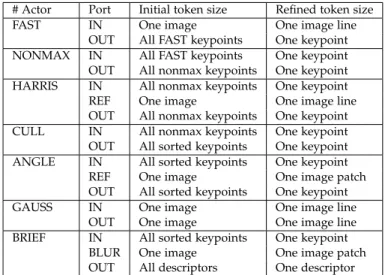
loop-nest. . . 94 Table4.1 Granularity of actors in ORB dataflow graph. . 115 Table4.2 Granularity of actors in FD dataflow graph. . . 117 Table4.3 The HWC buffering size for the three CNN
ar-rays. . . 131 Table4.4 Proposed CVE cluster configurations. . . 132
L I S T I N G S
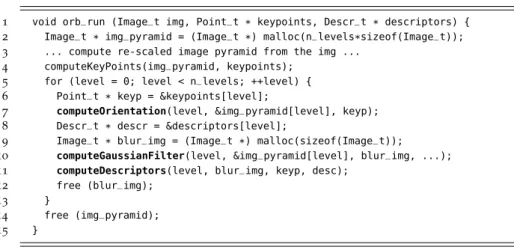
Listing2.1 The FAST actor header declaration . . . 37 Listing2.2 The FAST actor definition . . . 38 Listing2.3 Extract from the reference ORB application . . 44 Listing2.4 Extract from the reference ORB application . . 45 Listing2.5 The orb_run function modified to execute
un-der the StreamDrive runtime . . . 46 Listing2.6 TheORBactor definition . . . 46
Listings x
Listing2.7 TheORBactor definition . . . 47
Listing2.8 TheCompute_Keypoints function from theORB application . . . 48
Listing2.9 InitialFAST actor definition . . . 49
Listing2.10 InitialFAST actor definition . . . 49
Listing2.11 The Build_Graph function that constructs the initial ORB graph. . . 50
Listing2.12 TheFASTactor KPN definition. . . 53
Listing2.13 TheFASTactor KPN definition. . . 54
Listing2.14 Data-parallel version of theFASTactor. . . 58
Listing2.15 Data-parallel version of theFASTactor. . . 58
Listing2.16 ORBFAST dataflow actor definition. . . 60
A B S T R A C T
The focus of this dissertation is the design and the implementa-tion of a computing platform which can accelerate data processing in the embedded computation domain. We focus on a heterogeneous computing platform, whose hardware implementation can approach the power and area efficiency of specialized designs, while remain-ing flexible across the application domain. In a heterogeneous plat-form, programmable cores are combined with the application-specific hardware elements. The programmable cores guarantee flexibility — that is, the ability to support different applications; the application-specific hardware elements provide the computational capability and efficiency needed to meet the requirements of modern applications.
In the embedded systems domain, limited area and energy budgets are key design constraints which make the design of such platforms challenging. These limitations call for innovative and effective solu-tions - since the last few years we have been witnessing a growth in popularity of multi-core heterogeneous shared memory clusters. An important advantage that they provide is a flexible communication in-frastructure leveraging on an efficient shared memory. Using shared memory it is possible to build different communication topology for a wide variety of communication patterns. Above all, shared mem-ory clusters are programmable and are able to meet the fast changing needs of the applications.
The multi-core architectures require parallel programming, which is widely-regarded as more challenging than sequential program-ming. Although shared memory parallel programs may be fairly easy to write (using OpenMP, for example), they are quite hard to optimize; providing embedded application developers with optimiz-ing tools and programmoptimiz-ing frameworks is a challenge. The hetero-geneous specialized elements make the problem even more difficult. Dataflow is a parallel computation model that relies exclusively on message passing, and that has some advantages over parallel pro-gramming tools in wide use today: simplicity, graphical represen-tation, and determinism. Dataflow model is also a good match to streaming applications, such as audio, video and image process-ing, which operate on large sequences of data and are character-ized by abundant parallelism and regular memory access patterns. Dataflow model of computation has gained acceptance in simulation and signal-processing communities. This thesis evaluates the appli-cability of the dataflow model for implementing domain-specific em-bedded accelerators for streaming applications. In particular, it in-vestigates1) how a shared memory cluster platform can support the
Abstract xii
dataflow model of computation in a simple and efficient way;2) how
sequential reference algorithms can be transformed into a dataflow implementation;3) how an efficient dataflow run-time can be
imple-mented;4) what are performance characteristics of a dataflow
imple-mentation.
This thesis describes StreamDrive, a dynamic dataflow framework that includes a dataflow cluster architecture template, a dataflow programming API, and an efficient runtime system for executing dynamic dataflow applications. Based on StreamDrive architecture template, a full Computer Vision Engine (CVE) have been imple-mented, targeting streaming image processing applications including Convolutional Neural Networks (CNN). It is experimentally demon-strated that sequential reference algorithms can be systematically transformed into a dataflow implementation through an incremental process, called successive refinement transformation. Using state-of-the-art image processing applications implemented in StreamDrive, the performance overhead, memory requirements, performance scal-ing, and tolerance to reduced off-cluster memory bandwidth of the dynamic dataflow model have been evaluated. It is shown that it is possible to support efficient dataflow processing on heterogeneous multi-core shared memory clusters with simple hardware extensions and a high-performance dynamic dataflow runtime.
Finally, a specialized tightly-coupled convolution hardware block (HWC) has been developed, optimized to efficiently execute the CNN convolutional layers. The computation of convolutional layers in neu-ral networks must be scheduled such that their working set fits with limited local memory, while the number of data transferred from the next level in memory hierarchy is minimized. This thesis pro-poses a new methodology for scheduling the convolutional CNN layer computations that yields better schedules than previously pub-lished methods. The algorithm developed while designing the HWC is significant not only in the context of the CNN processing, but also in the more general context of scheduling nested loop computations using application-managed memory buffers.
This thesis is based on work done by the author within the project conducted by the ST Microelectronics and by the University of Bologna. It is a summary of the individual research done by the author while working within the team framework. Therefore, the author refers to work being done individually as "we" instead of "I" because without the dedication and contribution of the entire team, the individual research presented within this thesis would not have been possible.
My grandfather once told me that there are two kinds of people, those who do the work and those who take the credit. He told me to try to be in the first group; there was less competition there. — Indira Gandhi
A C K N O W L E D G E M E N T S
This dissertation is a result of an unusual academic path. I have started my PhD studies in1996in the University of Delaware, USA. I
went over and completed the required course-work, passed the PhD qualifying examination, made my Doctoral proposal in 1999, and ...
have left the school. This decision was motivated by several personal circumstances and I have not returned to the idea of completing my PhD degree until 15 years later, in2015, while working at ST
Micro-electronics in Grenoble. However, many exceptional people that I have met during that period have greately influenced my following life and were an inspiration for my decision to give it a second try. My first thougt goes to them.
First of all I want to express my greatest gratitude to professor Guang Gao from the University of Delaware to whom I owe my entire engineering carrier. Dr. Gao has been my advisor for many years, first during my Master’s thesis work in Montreal, and then in Newark, in Delaware. Thanks to professor Gao I have discovered the world of computer science, electrical enginnering, and scientific research. One thing that encouraged me to work hard is seeing professor Gao’s dedication to his work and research. It was an honor to be his student - an honor that I am proudly cherishing through my entire carrier and life. Most of all, our relationship went far beyond professional. I also dedicate this dissertation to Prof. Gao’s wife, Peggy, and I wish to thank Gao family for supporting me and for making their house also mine during the many years in Montreal and in Newark.
I also wish to thank my good school friends Andres Marquez, Shadi Abughazaleh, Vasco Jerenic, Jose Nelson Amaral for having been great friends during all this time. I always remember the good times we had together. I wish to thank Steve and Lilly Weissinger for their help and support during my summers at Silicon Graphics, California, while I was working on my initial research proposal. I thank those brilliant people whom I met at Silicon Graphics at that time, John Ruttenberg, Woody Lichtenstein, Suneel Jain, Jim Dehnert, and others, and who had greately influenced my formation during my first PhD period.
Going back to school after15years, and while keeping a day job, is
not easy. It would never have happened if I had not encounter Prof.
xiv
Luca Benini, from the University of Bologna, who I sincerelly thank for having accepted to became my PhD adviser. Luca is one of the most brilliant people that I have encountered in my carrier and I am infinitely greatefull to him for his guidance and support.
I am specially greatfull to Philippe Galliard, my manager at ST Mi-croelectronics, for supporting me in my endeavor. Without Philippe’s support, this dissertation would not have happened. Many thanks go to my collegues from Grenoble and Bologna who have helped me during my work on this dissertation. I thank Mario Toma, Didier Fuin, Min Xue, Francesco Conti, and others, for many discussions and ideas that were inspiring for this work.
Finally, I wish to thank Prof. Kevin Martin from the University of Bretagne Sud and Prof. Andrea Calimera from Politecnico di Torino for serving as my external reviewers and for critically evaluating my dissertation. I have specifically appreciated Prof. Martin’s comments and suggestions that improved the overall presentation of the disser-tation.
I N T R O D U C T I O N
Science can amuse and fascinate us all, but it is engineering that changes the world. — Isaac Asimov Application-specific hardware acceleration has surfaced as the pre-vailing approach across many application domains in embedded sys-tems because of its performance and energy benefits compared to general-purpose solutions. Depending on the domain, accelerators often bring greater than a 10× advantage in performance, or cost,
or power over a general-purpose processor. Accelerators can have macro architectures that span from fixed-function, special-purpose chips (early generations of graphics chips were of this variety) to highly programmable engines tuned to the needs of a particular do-main.
When hardware accelerators of various forms are designed, there is always a trade-off between how general versus function-specific to make the architecture. While fixed-function hardware accelera-tors are effective, they pose many challenges. As algorithms change rapidly, hardware must be re-designed and re-verified, which is costly in terms of development cost and time-to-market. As a corollary, innovation in algorithms becomes more difficult without access to flexible hardware. Furthermore, fixed accelerators cannot be shared across applications, making them more costly in terms of silicon. Fi-nally, from the academic viewpoint, it is difficult to formalize and ap-ply improvements from narrowly specialized hardware to the broader field of computer architecture – limiting the intellectual impact of such work.
Thus, the flexibility of a programmable accelerator, where modi-fications and enhancements can be done by software changes rather then by re-spins of the hardware presents important advantages. Flex-ible accelerators are applicable across a variety of applications, allow bug fixes and support new product requirements over the lifetime of the accelerator without a chip re-spin. Ideally, what is required is hardware that is capable of executing compute-intensive algorithms at high performance with much lower power than programmable ar-chitectures, while remaining broadly applicable and adaptable. This thesis focuses on development of such programmable accelerator.
Introduction xvi
streaming accelerators
Streaming applications represent an important class of high per-formance computations. Defined by their regular processing of se-quences of data, streaming applications appear in the context of audio, video, and image processing, digital signal processing, net-working, encryption, and other areas. Streaming application prop-erties lend themselves to very efficient hardware implementations through exploitation of parallelism. From a more technical perspec-tive, streaming applications are amenable to an accelerator-based so-lution, for which a combination of parallelism, pipelining, and regu-larity of computation are necessary. Accelerators use parallelism to gain their performance advantage over the general-purpose proces-sors, while the streaming computation exhibit substantial parallelism to take advantage of the accelerator. Accelerators benefit from sim-ple (or none) address generation logic, while typical streaming ap-plications demonstrate predictable, well-behaved streaming memory access patterns.
There is strong demand for streaming applications, such as com-puter vision solutions, for example. The comcom-puter vision market size is estimated to grow to many billions of dollars over the coming years [1]. Tractica forecasts that global revenue from computer vision software, hardware, and services will grow from $1.1 billion in2016
to $26.2 billion by2025. This prompts new research and commercial
solutions to appear, specifically targeting the mobile sector.
Recently, heterogeneous multi-core platforms have emerged as the general and structured approach for designing flexible domain-specific accelerators [2]. To achieve high performance, lower cost, energy-efficiency, and required flexibility, these platforms combine
Introduction xvii
programmable processor cores with a number of application-specific hardware elements.
The application-specific hardware elements can exploit the par-allelism available within target applications by executing grained functions. For a large set of streaming applications, coarse-grained processing elements (i.e., processing elements implement-ing coarse-grained functions) result in the best balance between ef-ficiency and programmability [3]. A number of architectures also advocate the approach of coupling the processing cores and spe-cialized processing elements by sharing a level of memory hierar-chy [4,5,6,7,8,9,10,11]. The GreenDroid architecture [12], features clusters with a single general-purpose core, which is coupled smaller conservation cores (or c-cores) [11] that communicate with the rest of the system through a first level coherent cache. Fajardo [8] pro-posed coupling of programmable processors and application-specific hardware units via a buffer-integrated-cachedsubstrate. The EXOCHI architecture [13] features hardware accelerators modeled as coarse-grain MIMD functional units, collaborating with IA32 CPU cores by
sharing of the same virtual memory space. Conget al.[14] developed a heterogeneous multi-core architecture with shared-memory accel-erators, which communicate by means of shared level two caches, accessible through NoC nodes. Dehyadegari [7], Conti [6], and Bur-gio [4] proposed architectures for interfacing RISC32 programmable
cores and application-specific hardware blocks via shared scratchpad memory.
The work in this dissertation is an evolution of the fabric of tightly-coupled homogeneous clusters, called Platform 2012 built by the
STMicroelectronics [15]. In the tightly-coupled cluster paradigm, each cluster is composed by a relatively small number of simple RISC cores that communicate through a fast low-latency interconnection to a shared data memory. Multiple clusters can be connected through a high-bandwidth scalable medium such as a network-on-chip. He-P2012[16] extended the P2012with hardware elements (HWPEs) and
proposed a methodology for the semi-automatic definition and in-stantiation of shared-memory HWPEs from a C source. This thesis builds upon this earlier work.
programming streaming accelerators
To take advantage of the potential performance offered by a hetero-geneous multi-core platform, applications need to manage multiple programmable cores, application-specific hardware elements, limited on-chip memory, and explicitly managed memory hierarchy. Among existing programming models, OpenMP has been particularly appeal-ing for programmappeal-ing shared memory clusters, mainly for two
rea-Introduction xviii
sons: (1) it is based on familiar standard C language, extended with
intuitive pragmas, and (2) a number of OpenMP ports for embedded
systems exist, which provides guidelines and code to get started [5]. In practice, although initial parallelization of the reference code with OpenMP is simplified, tuning them for performance is hard and may require considerable development effort. There is a gap between the application specification in a standard sequential imperative lan-guage such as C and its parallel implementation that must be ”filled” by the application developer.
The OpenMP does not provide sufficient abstraction for helping to achieve the right trade-off between various optimization parameters. Getting good performance on a multi-core heterogeneous platform often requires sophisticated code and data structure transformations to expose the right variety and amount of parallelism. One typically needs to perform simultaneous optimization of the algorithm, selec-tion of data structures, task granularity, data-tiling dimensions, data prefetch distance, and loop unrolling. These parameters are often not orthogonal to each other: changing one may require changing another due to limited resources. The performance effect of varying these parameters is often non-intuitive and requires actual code de-velopment and execution time measurements to quantify. One more source of complexity arises from the fact that application-specific hardware elements often have software-managed memories, which require additional software complexity for management or tuning for the higher performance. For example, software-managed Static Ran-dom Access Memory (SRAM) requires additional work on part of the developer to manage the SRAM and to remap data structures to the address space of the local memories. The OpenMP does not provide a suitable abstraction for these details so as to insulate the developer from managing their own on-chip memory.
The OpenMP does not match well with streaming applications, and suffers from the inability to tolerate long memory latencies and waits due to synchronization events [17]. Memory barriers (such as used by the OpenMP) are one of the key sources of performance degrada-tion in communicadegrada-tion intensive (e.g. streaming) applicadegrada-tions. What makes optimization even more difficult is that data transfer between the CPU and the hardware elements is often a major performance overhead, and so needs to be tuned and optimized. To reduce this overhead, hardware elements granularity of computation needs to be of relatively large size, and data sent to the hardware element in a decoupled, pipelined fashion, without stalling on the return of the results. Therefore, the application developer must overlap the computation with data transfer in a pipelined fashion, which often requires major changes to the program structure surrounding those components to be offloaded.
Introduction xix
In OpenMP, hardware units are working under the control of the CPU, which is running the bulk of the application code, offloading the computations that can be accelerated onto the hardware elements. The nature of hardware elements as separate architectural entities working in concert with the general-purpose CPU, makes the appli-cation development intrinsically more complex. An appliappli-cation de-veloper must identify the portions of the computation to offload, iso-late the data structures required by these portions, manage the trans-fer of these data structures to the hardware element memory (if the hardware elements have a separate address space from the processing cores), synchronize between the processing cores and the hardware elements, transfer the result data back to the main memory, and in-tegrate the results into the original data structures. These offloading tasks are in addition to the original development effort required for parallelizing the application.
The lack of sufficiently high-level abstraction for pipelining, asyn-chronous task execution, and data communications between tasks, increases the complexity of parallel programming using the OpenMP. This is less of a constraint in general-purpose computing. In a typ-ical embedded application scenario, however, engineering cost can quickly erode the performance benefit. Finally, practical OpenMP im-plementation requires sophisticated runtime system support, which typically implies important space and time overheads. The applica-bility of the approach is thus often limited to applications exhibit-ing units of work which are coarse-grained enough to amortize these overheads. While this is often the case for general-purpose systems and associated workloads, things are different when considering em-bedded streaming applications.
dataflow computation model
The dataflow model of computation describes an algorithm as a net-work of communicating computational kernels, also called actors. Ac-tors are connected by directed, loss-less, FIFO channels. This makes the flow of data explicit between actors, which are not permitted to share data in any other way than by sending each other messages, called tokens. The use of a dataflow computation model creates sev-eral opportunities for efficient implementation in embedded context:
1. The dataflow exposes the maximum degree of parallelism in
a program since the flow model only enforces true data-dependencies.
2. The dataflow allows asynchronous data-driven execution of
finer-grained tasks; fine-grain tasks have a greater potential to efficiently use the underlying hardware [18, 19]. Furthermore,
Introduction xx
finer-grain tasks have smaller memory footprint reducing the size of required memory.
3. The dataflow can tolerate memory and synchronization
laten-cies efficiently [17].
4. The dataflow does not require power hungry modules like
out-of-order execution (since there are only true data-dependencies) and can utilize non-coherent memory hierarchies.
5. The dataflow model matches well application-specific
stream-ing hardware elements.
Among numerous dataflow models, the statically decidable mod-els offer predictability, strong formal properties, and are amenable to automated optimization techniques. However, for many streaming applications, it is not possible to represent all of the functionality in terms of decidable dataflow models. This is due to the increasing lev-els of application dynamics that must be supported, such as the need to support multiple standards, variable data rate processing, or com-plex forms of data dependent application behaviors. On the other hand, the dynamic dataflow models do not provide compile-time guarantees such as deadlock-free execution and must be scheduled dynamically in general, because their expressive power does not al-low them to be statically analyzed. A run-time system is required to schedule the execution of actors and to manage their communications. The important dynamic dataflow model is the Dataflow Process Net-work (DPN) model in which the token production and consumption rates of actors can vary in ways that are not entirely predictable at compile time.
This thesis is addressing the issues related to supporting DPN ex-ecution in a heterogeneous clustered shared memory platform, such as mentioned earlier. It also addresses the DPNimplementation effi-ciency issues related to executing streaming applications in resource-and energy-constraint embedded context. Finally, this thesis ad-dresses the issue of transforming and optimizing existing sequential reference applications into theDPNform.
contributions of this thesis
Our ultimate goal is to provide an effective dynamic dataflow framework and to investigate its applicability in a realistic industrial environment in the embedded domain. To do it, this thesis elaborates the dataflow shared memory cluster concept to yield an approach that combines hardware and software elements into an experimental dynamic dataflow framework, called StreamDrive. The applicabil-ity of the dynamic dataflow model of computation to parallelizing
Introduction xxi
streaming applications on this platform is then experimentally inves-tigated. In particular, the thesis addresses the following questions:
1. What architecture support is necessary for efficient execution of
dataflow applications in tightly-coupled clusters with streaming hardware elements ?
2. How do we transform a sequential reference code into an
op-timized dynamic dataflow implementation and what is the re-quired effort of doing so ?
3. How can we make an efficient run-time system for executing
dataflow applications on top of a memory limited embedded platform ?
4. What are the performance characteristics of applications
imple-mented within our dataflow framework?
This work is based on the Platform2012shared memory cluster [15] extended with tightly-coupled application-specific streaming hard-ware elements. Since none of the existing dynamic dataflow im-plementations (see chapter 2) where readily available on the P2012
shared-memory cluster, the StreamDrive Application Programming Interface (API) and the runtime environment have been implemented from scratch. We have estimated that a clean-start implementation would not take considerably longer time than porting and implement-ing the missimplement-ing functionality for an existimplement-ing implementation. A clean-start implementation also removes the risks of encountering bugs in a large and unfamiliar code-base.
To answer the first question, the requirements for dataflow syn-chronization and communication in a shared memory platform have been thoroughly analyzed. A lock-free counter based synchroniza-tion have been proposed by Bhattacharyya et al. in [20] for imple-menting the dataflow applications in a shared memory multiproces-sors. The synchronization counters can significantly reduce synchro-nization overhead in a dataflow execution. However, the implementa-tion also requires polling of the shared counter locaimplementa-tions in order to detect changes in synchronization counter value. Polling has perfor-mance penalty and, most importantly, will saturate the shared mem-ory interconnect in the context of a tightly-coupled cluster. One pos-sibility would be to use the interrupts for signaling when a counter value changes, but interrupts incur unacceptably high performance overhead. StreamDrive addresses the issue by implementing a light-weight event mechanism. Events signal the change in synchroniza-tion counter value similar to interrupts, however unlike the inter-rupts, they do not deviate the execution of the program and do not need a context-switch. Our processor instruction set architecture is extended with a few instructions dedicated to generating and han-dling events. The Direct Memory Access Unit (DMA) is also extended
Introduction xxii
with event generation functionality, so that DMA memory transfers can be handled as usual dataflow actors. In the StreamDrive cluster, the application-specific hardware elements are connected to cluster shared memory similar to programmable cores. A special Hardware Block Bridge (HBB) is inserted between the hardware elements and the shared memory, which is responsible for synchronizing the hardware elements execution via synchronization counters and events. Thus, in StreamDrive architecture all elements are able to send and receive dataflow synchronization events. In order to efficiently communicate these events to all actors, a dedicated event network connects all clus-ter programmable cores, theDMA, and hardware elements inside the cluster.
In StreamDrive architecture, dataflow actors communicate via the shared memory. Software implemented actors use a dataflow FIFO abstraction via the StreamDriveAPI to send and receive dataflow to-kens. The API implementation is based on standard load/store ac-cesses to shared memory. The application-specific hardware elements, on the other hand, are streaming and cannot generate load/store ad-dresses to access the shared memory. Instead, these hardware ele-ments generate streaming requests without address, while the HBB
translates these requests into a sequence of load/store accesses with addresses. Altogether, the HBB and the synchronization event net-work enable efficient dataflow execution in a shared memory cluster.
To answer the second question, an observation has been made that turning the sequential code into a Kahn Process Network (KPN) is relatively straightforward. Moreover, the transformation can be per-formed incrementally, one KPN process (actor) at a time, while veri-fying modified application functionality and properties at each step. Further, converting the KPN network into a DPN network consists in dividing continuousKPNprocesses into a sequence of firings, and in associating the firing rules to them. This turns out to be relatively straightforward as well and also can be done incrementally, one pro-cess and one firing rule at a time. For example, dividing a KPN pro-cess into firings can be as simple as executing itswhile loop one iter-ation per firing. Altogether, transformiter-ation of a sequential reference algorithm into an optimized DPN implementation can proceed as a structured process consisting in a sequence of well-definedsuccessive refinement steps. In order to allow such incremental approach, the StreamDrive scheduler allows simultaneous execution of both, the
KPNprocesses and theDPNactors, inside the same application. In par-ticular, this allows only a subset of an application to be transformed into the DPN form at any given step of the transformation process. Our successive refinement methodology significantly reduces the ef-fort required for parallelizing the streaming applications. One addi-tional benefit of simultaneously supporting the two execution models is that the software implemented actors and the hardware functions
Introduction xxiii
can be executed as efficiently as possible. The software actor exe-cution is most efficient under the DPN scheduler control, while the hardware implemented functions are best executed asKPNprocesses without the scheduler intervention.
To answer the third question, investigation of several implementa-tion techniques for optimizing dataflow execuimplementa-tion under a very lim-ited shared memory has been conducted. Although zero-copy com-munication has been implemented earlier via sharing the dataflow buffers between the producing and the consuming actors of a dataflow channel [21, 22, 23, 24], this thesis went further by allow-ing sharallow-ing a buffer by multiple actors. This enables much more effi-cient and less memory hungry implementation of broadcasting data between several actors, and efficient implementation of data-parallel actors. Usually, these functionalities are cumbersome and costly in dataflow implementations.
One particular problem that arises when one intends to support
KPN process execution is the excessive runtime stack size. Because during theKPNprocess suspension and resuming, the stack contents need to be saved along with other current process state, each KPN
process needs to be allocated a dedicated runtime stack in memory. When multiple KPNprocesses exist, this uses too much memory. Al-ternatively, in theDPNimplementation actors can share one runtime stack per processing core, making the memory requirements indepen-dent of the number of actors in the network. In StreamDrive succes-sive refinement approach, an actor starts out as a KPN process and evolves via a sequence of transformations into a DPN actor with fir-ing rules. The two models seem incompatible and the worst case implementation requires one runtime stack per actor for supporting theKPNexecution. StreamDrive introduces a novelstack spilling tech-nique that allows runtime stack sharing during the DPN execution, while supporting a dedicated stack perKPNprocess.
Our case-studies are focused on computer-vision applications. To answer the fourth question, a complete tightly-coupled shared mem-ory cluster aimed at computer vision applications, the Computer Vi-sion Engine (CVE), has been implemented. We have then used CVE
to implement several real-world problems, the Oriented FAST and Rotated Brief (ORB) [25], the Face Detection (FD) [26], and several Convolutional Neural Networks (CNN). The experiments show that StreamDrive based implementation achieves high performance, small memory footprint, scales well from 1 to 16 processing cores, and is
tolerant to the external memory latency.
During this research, one additional topic has also been investi-gated, not originally addressed by our questions leading to develop-ment of the application-specific hardware unit, the Hardware Convo-lution Block (HWC), optimized for neural network convolution pro-cessing. The main bottleneck for implementing efficient and cost
ef-Introduction xxiv
fective embedded accelerators for state-of-the-artCNNis the memory system. The working set of a typicalCNNconvolution layer does not fit entirely with limited internal HWC storage, and the CNN compu-tation volume needs to be tiled into smaller pieces. Different tilings lead to different computation schedules and memory access patterns having a dramatic effect on performance, energy and the cost of the accelerator. Inefficient memory access can potentially void accelerator advantages.
The problem of CNN computation scheduling and tiling has been addresses before but the memory usage model was not accurate for the case of application managed memory buffers, which is the most common memory architecture template for CNN accelera-tors [27,28,29,30,31,32,33,34,35,36]. Existing work on scheduling
CNNcomputations [37,38,39] is based on memory model originally developed for cache-based memory hierarchies [40]. Previously pub-lished models essentially search the tiling (or blocking) space of the
CNN convolution loop-nest with the objective to identify the inner-most loops set such that the working set of these innerinner-most loops fits the available internal storage while the data transfers between the internal and external memories are minimized. In case of applica-tion managed buffers, published models overestimate internal stor-age requirements of theCNNcomputation and result in sub-optimal computation schedules. This thesis proposes a new analytical mem-ory performance model to evaluate computation schedules in terms of their required footprint and memory access bandwidth. The pro-posed analytical model is more accurate than existing models in case of application managed buffers. This model has been validated by applying it in the context of ourCVEcluster.
The CVE cluster described in this thesis enables more flexibility in comparison to competing solutions. The common shared mem-ory enables efficient exchange of data between the HWCs and pro-grammable cores, achieving high degree of flexibility by computing non-convolutional functions, such as pooling, normalization, etc., in software. The CVE can also efficiently support traditional computer vision algorithms, ORB, HOG, etc. because many image processing algorithms are essentially based on convolutional operations.
organization of this thesis
first chapter gives background information on the dataflow
model of computation. It describes two dataflow models, the Kahn Process Networks (KPN) and the Dataflow Process Net-works (DPN), discusses their implementation issues and goes over a number of decidable dataflow models derived from the
im-Introduction xxv
plementations focusing on dynamic dataflow models. It shows that existing implementations failed to fully address three im-portant issues: (1) efficiently support the dataflow processing
with built-in hardware mechanism while remaining compati-ble with standard and familiar development tools, (2) deliver
the highly optimized implementation of dataflow applications on resource-constrained embedded platforms, and (3) propose
a systematic sequential applications transformation flow that would simplifyDPNapplications development.
second chapter describes StreamDrive implementation in depth,
focusing on our zero-copy and lock-free communication pro-tocol, the dataflow shared memory cluster architecture tem-plate, the StreamDrive API, the successive refinement applica-tion transformaapplica-tion flow, and the efficient runtime system im-plementation. StreamDrive extends the standard dataflow com-munication protocol with the possibility for dataflow actors to share communication channels in order to reduce the applica-tion memory footprint and improve performance. StreamDrive implements hardware built-in support for the dataflow synchro-nization to the shared memory cluster. This Chapter also de-scribes a dataflow hardware bridge for connecting streaming application-specific hardware elements to the shared memory cluster. Based on these hardware mechanisms and the Stream-Drive runtime implementation, the Chapter describes a system-atic incremental successive refinement flow for transforming a sequential reference algorithm into a highly optimizedDPN par-allel implementation. The future development consists in au-tomating different steps of this process. Finally, the Second chapter also describes StreamDrive’sAPI and several advanced runtime system implementation techniques required for a small footprint, low overhead implementation.
third chapter is dedicated to design of an image processing
ac-celerator particularly focusing on Convolutional Neural Net-works (CNN) acceleration. First, the Chapter reviews existing
CNNhardware accelerators and expalains their inefficiencies. It then describes the implementation of our Computer Vision En-gine (CVE). The main element of the CVE is a tightly-coupled convolution hardware element, theHWCblock. The Chapter ex-plains the design of the HWCbased on a novel analytical mem-ory performance model for evaluating the trade-off between the internal accelerator buffering capacity versus the off-accelerator memory bandwidth. This analytical model is tailored for im-plementations using application-managed buffers rather than cache based memory hierarchies and is more accurate than pre-viously published models for such implementations.
Introduction xxvi
forth chapter is dedicated to performance evaluations. Two case
studies are conducted. The first case study visits two traditional image processing applications, the Oriented FAST and Rotated BRIEF (ORB), and the Face Detection (FD). Experiments show
that StreamDrive implementation of these applications achieves high performance even with very limited cluster memory, that it is scalable with increased number of processing elements, and that it is stable under varying off-cluster memory access latency. The second case-study investigates the shared memory band-width requirements of our HWC block. It compares this
band-width with requirements of a state-of-the-art tightly-coupled convolution hardware block from [29]. Simulations show that the HWC achieves several times reduction in shared memory
traffic. Finally, these results are put together by proposing three
CVEconfigurations, from a low-cost implementation with lower performance to a high-performance but also higher cost one.
concluding chapter summarizes the most important insights
gained through this thesis work and offers future research di-rections.
1
D A T A F L O W C O M P U T A T I O N
M O D E L R E V I E W
All models are wrong, but some are useful. — George Box Unlike general-purpose systems, where the ease of programming and code portability have priority, in embedded platforms, efficiency (in terms of latency and throughput) is of primary concern, as well as power consumption, memory requirements, and code size. As we have explained in the previous chapter, the tightly-coupled shared memory clusters with multiple programmable cores and application-specific hardware units are becoming widely used in modern embed-ded platforms. Currently, the OpenMP [41] is the most widely used method for developing applications for this attractive architecture.
OpenMP is based on thefork-joinmodel of parallel execution: an ap-plication starts with a main thread which forks off a team of threads when it encounters a parallel region of code. All threads are synchro-nized at the barrier of the parallel region. OpenMP primarily targeted the data parallelism that works by processing in parallel independent data elements of a single computation, and was not specifically de-signed to support streaming applications. A streaming computation works by applying different tasks to each element of a data stream in the program. Although starting with 3.0version the OpenMP has
been extended with thetaskconstruct to manage the execution of a set of tasks, there are still limitations in this approach: OpenMP fork-join model is inherently limited for expressing pipelining of tasks; and the OpenMP barrier based synchronization is inefficient in streaming ap-plications.
Our goal is to investigate the use of the dataflow model for devel-oping applications for the tightly-coupled cluster platform. The use of the dataflow model of computation is motivated by the following observations:
• The dataflow computation model matches well streaming ap-plications; it provides a natural and intuitive representation of streams, therefore having a positive effect on readability, robust-ness, and programmer productivity.
• The dataflow computation model matches well specialized streaming hardware elements; they usually communicate with the system via data queues and synchronize on the availability of data in the queues.
1.1 kahn process networks (kpn) 2
• The dataflow computation model simplifies parallelization of sequential reference algorithms; there is no need to think in parallel, no critical sections, mutexes, race conditions, etc. • The dataflow communication buffers reduce the negative
im-pact of limited shared memory in two complementary ways: (1)
they naturally hide memory latency; and (2) they favor shared
memory communications, bypassing off-cluster memory. The advantages of the dataflow model for application developers are related to the ability of expressing the natural parallelism of an al-gorithm without complex synchronization mechanisms. This is made possible by representing the computation as a network of process-ing blocks that only communicate through communication channels. This removes the potential concurrency issues that could arise when the application must explicitly manage the synchronization between parallel computations [42,43].
In this chapter, we will review two basic dataflow models, theKahn Process Networks (KPN) and the Dataflow Process Networks (DPN), fol-lowed by a brief overview of a plethora of more restricted dataflow models derived from these two. We will then discuss the ways in which these models have been used in the past, specifically in the embedded context, and explain the associated issues.
1.1
kahn process networks (kpn)
The KPN model of computation [44] was defined by Gilles Kahn as a network of autonomous, concurrently executing processes that communicate point-to-point via unbounded FIFO channels. It is a natural model for describing streaming applications where infinite streams of data are incrementally transformed by processes executing in sequence or in parallel. Formally,
Definition1. AKPNis a directed graphG= (N,C), where:
• Nis a set of nodes, representing computational processes. Each node is connected tonINinput channels andnoutoutput
chan-nels.
• C is a set of unidirectional channels representing infinite data FIFO buffers. The processes communicate with each other via these FIFO buffers by sending and receiving data elements, called tokens. Each FIFO is connected to a source process (which provides tokens to the FIFO) and a destination process (which consumes tokens from the FIFO). A FIFO can possess some initial number of data tokens stored in it at the beginning of the application.
1.1 kahn process networks (kpn) 3 1 f u v w
(a)A Simple Kahn Process
2
process f (in int u, in int v, out int w) {
int i; bool b = true; for (;;) {
i = b ? wait(u) : wait(w); printf("%i\n", i); send(i, w); b = !b; } }
(b)Kahn Pseudo code
Figure 1.1: A Kahn Process Network Example
Figure 1.1 taken from original Kahn paper [44] shows an example of a simple KPN process. The process in the Figure 1.1(a) has two input channels uand v, and one output channel w. The process al-ternately reads integer values from the two input channels, prints the value, and writes it to the output channel. Kahn proposed a simple language for specifying the KPN. The Figure 1.1(b) shows the Kahn pseudo-code for describing the process. In particular, the process in-terface includes declaration of the FIFO channels and their data type, while the process function contains the wait() method returning a data token from an input channel (blocking on an empty channel), and the non-blockingsend()method for writing a data token to the output channel.
EachKPNprocess runs asynchronously and independently of other processes, and its state is inaccessible to other processes. Communi-cation between processes is possible only by sending and receiving data tokens over channels. A process may have multiple input and output channels, but each channel is connected to exactly two pro-cesses – the sender on the one end of the channel and the receiver on the other end. In theory, it is always possible to send a token because channels have infinite capacities. A process may at any time attempt to receive a token from any of its input channels, but if the channel is empty, the process becomes blocked until the token arrives.
The restrictions whichKPNplaces on processes may be summarized
as follows:
• A process may not access the state (code, data, program counter, etc.) of another process.
• The receive operation always blocks on an empty channel, and a blocked receive cannot be interrupted.
• A process is not allowed to test for the presence of data tokens on a channel.
These restrictions have one very important consequence - the KPN
indepen-1.2 dataflow process networks (dpn) 4
dent of the order in which processes are executed. In other words, given the same input, a KPN will produce the same sequence of to-kens on all channels during every run. This determinism is very important for the parallel application development. More generally, theKPNmodel benefits application development in several ways:
• Sequential coding of individual components.KPNprocesses are writ-ten in the usual sequential manner where synchronization is implicit in communication primitives (data send and receive). Developers can thus reuse their existing development environ-ment, tools, and expertise, and need not worry about orchestrat-ing the concurrent execution.
• Composability. Determinism guarantees that connecting the out-puts of processesf(x)andg(x)to the inputs of a processh(x,y)
will result in h(f(x),g(x)). Thus, processes can be developed and tested individually, and later assembled into more complex programs.
• Transparent parallelization. The actual mechanisms for achieving parallelization are hidden from developers. Components are written in a sequential way and can run on multi-core platforms under a run-time system control.
• Reliable reproduction of program faults. An otherwise notoriously difficult problem with concurrent systems, is resolved because theKPNhas deterministic behavior.
These benefits make KPN computation model very attractive for its
simplicity and relatively low effort required for developing a KPN
application.
1.2
dataflow process networks (dpn)
The Dataflow Process Networks (DPN) are a special case of KPNs,
where process execution (processes are calledactors in DPN), instead of being continuous, is composed of a sequence of “atomic” fir-ings [45]. A firing is “atomic” because an actor cannot be interrupted during a firing. Activation of actor firings is controlled by a set of fir-ing rules. In each firing, the actor will read a specific number of data tokens from the input channels, perform computations and write a specific number of tokens to the outgoing channels. The firing rules specify the number of tokens that have to be available on the input ports to fire the actor. An actor can only fire if all the input tokens are available on the channels.
1.2 dataflow process networks (dpn) 5
• N is a set of nodes, called actors, representing computational processes. Each actor is connected to nIN input channels and noutoutput channels. Each actor is a tuple(A,F,R)with:
– Ais the actor function.
– Fis a set of firing rules. A firing rule is a condition which, when satisfied, enables the execution (firing) of this actor function.
– Ris a set of rates. A rate is the number of tokens consumed at an input channel or produced at an output channel cor-responding to a specific firing rule. Each firing rule has nin+nout corresponding rates: one for each communica-tion channel.
• C is a set of channels representing infinite data FIFO buffers. These FIFOs are the only channels allowed to perform data com-munications between actors. Each FIFO is connected to a source actor (which provides tokens to the FIFO) and a destination ac-tor (which consumes tokens from the FIFO). A FIFO can possess some initial number of data tokens stored in it at the beginning of the application.
DPNs are more difficult to develop than KPNs; it involves divid-ing actors into firdivid-ings and specifydivid-ing the firdivid-ing rules. Practical DPN
implementations can create the artificial deadlock because in practice the communication buffers are not infinite. TheDPNdataflow model is dynamic and cannot be statically analyzed, i.e. it is impossible to determine whether the algorithm will deadlock and how much buffering is necessary for the algorithm to execute without a dead-lock. The DPN model may also be costly to implement because the
DPNscheduling is dependent on the runtime data of the actors. Numerous dataflow models placing restrictions on the DPN have
evolved over the past three decades aiming to balance conflicting concerns of expressiveness, analyzability, and implementability [46]. These models are called static or decidable because they have pre-dictable behavior making them analyzable and easier to implement efficiently. The statically analyzable dataflow models can also be scheduled at compile time. However, they offer a reduced expres-siveness and lower flexibility for application developers, when com-pared with Turing-completeDPNmodel. Below we quickly overview a few of the most important decidable dataflow models that have been used in domain-specific embedded computing; for a complete review of static dataflow models the reader is referred to [47].
1.2 dataflow process networks (dpn) 6
1.2.1 The Synchronous Dataflow (SDF) Model
The most widely used decidable dataflow model is the Synchronous Dataflow (SDF) model introduced by Lee and Meser-schmitt [48]. AnSDF model imposes restrictions on dataflow actors firing rules and token rates:
• There is only one firing rule per actor.
• Rates for all channels are fixed and constant for the entire exe-cution.
A major advantage ofSDFis that it is predictable and analyzable at compile-time. If it exists, a bounded schedule can be found statically. Such a schedule ensures that each actor is eventually fired (liveness) and that the dataflow graph returns to its initial state after a certain se-quence of firings (boundednessof the FIFOs). Such sequence is called an iteration and can be repeatedly executed. Useful features of SDF
include formal validation of deadlock-free operation and bounded memory requirements; support for efficient static scheduling; and memory size optimization [49]. SDFs can be very efficiently imple-mented and have been widely accepted as computation model in the domain of digital signal processing. The important drawback of the model, which prevents its wider use, is its lack of expressive power; theSDFcannot express dynamic algorithms where the processing con-ditionally depends on input data or the results of intermediate com-putations.
Over the years, many extensions toSDFmodel have been proposed to extend its expressive power, while maintaining its compile-time predictability as much as possible.
The Cyclo Static Dataflow (CSDF) model [50] extendsSDFactors al-lowing the number of tokens produced and consumed in each firing to vary cyclically. This variation is modeled with a state in the ac-tor, which returns to its initial value after a defined number of firing. However, the CSDF model only improves SDF compactness. An ap-plication that can be described in CSDF can also be described inSDF; generally, the CSDF description requires fewer actors than in SDF. A transformation has even been proposed in [51] to transform a CSDF graph into an SDFgraph with same properties. All techniques used to analyze a SDF graph can be applied to CSDF after transformation. Similarly, the Affine Dataflow (ADF) model [52] is another extension ofSDFmodel with the same objective: improving model compactness. While CSDF has an infinite sequence of rates, the ADF replaces the unique rate of SDF with an initial sequence of firing rates followed by an infinitely repeated sequence of firing rates. These two con-catenated sequences are called the ultimately periodic sequence. A transformation also exists to convert anADFgraph into an equivalent
1.2 dataflow process networks (dpn) 7
The Heterochronous Dataflow (HDF) model and the Scenario-Aware Dataflow (SADF) model are limited to a range of applications that follow a sequence of fairly static scenarios. The idea of theHDF
model [53] is to allow dynamic change in consumption and produc-tion rates of the actors and represent it via the Finite-State-Machine (FSM). All FSMs in the HDFcan change state only once the dataflow graph has executed a full iteration. After the iteration is finished the
HDF actors are free to change their state and their token consump-tion and producconsump-tion rates. For the duraconsump-tion of next iteraconsump-tion the rates stay unmodified and the HDF executes an SDF schedule. The SADF
model [54] views applications as collections of different SDF graphs.
SADFis able to perform some worst-case and stochastic analyses, and to provide implementation with limited run-time overhead, while re-laxing some of the limitations of theSDF.
Buck’s Boolean Dataflow (BDF) model [55] extends the SDF model with token production/consumption rates that depend on an input control channel that itself consumes one token per firing. Basically, the number of tokens consumed or produced by a given data channel can be controlled by its associated control channel, which can vary the token rate for the data channel. The fundamental dynamic actors of theBDFmodel are theSwitchandSelect that simply choose one of its two inputs or outputs according to the control token. Scheduling tech-niques for BDF graphs attempt to build quasi-static schedules derived at compile-time that reduces the complexity of run-time scheduling involved. The Integer Controlled Dataflow (IDF) model [56] used in-teger control variables instead of boolean values. The BDF and IDF
models has been proven Turing-complete but they imply a very re-strictive coding style that is not useful for a practical application.
1.2.2 Parameterized Dataflow Models
Parameterized dataflow models aremeta-models: they are applied to any underlying synchronous dataflow model that has a well-defined notion of dataflow graph iteration. Parameterized models extend the targeted model semantics by adding dynamically reconfigurable hierarchical actors and achieve increased expressiveness due to pa-rameters modifiable at runtime. A reconfiguration occurs when val-ues are dynamically assigned to the parameters of a reconfigurable actor, causing changes in the actor computation and in its produc-tion and consumpproduc-tion token rates. As presented in [57], reconfigu-rations can only occur at certain points, namelyquiescent points, dur-ing the execution of a graph in order to ensure the runtime integrity of the application. The Parameterized Synchronous Dataflow (PSDF) model introduced by Bhattacharya and Bhattacharyya in [58] can be applied to SDF [58] or to CSDF [59]. The Schedulable Parametric Dataflow (SPDF) model [60] is designed to avoid some of the PSDF
1.2 dataflow process networks (dpn) 8
model restrictions. The Parameterized and Interfaced Synchronous Dataflow (PiSDF) model [61] is another extension of the SDF model. In addition to the SDF semantics, the PiSDF model contains a set of parameters and parameter dependencies that can be used to change the production and consumption token rates of actors. ThePiSDF im-proves parameterization compared toPSDFby introducing an explicit parameter dependency tree and by enhancing graph composition. This allows to overcome some restrictions on dataflow scheduling and analysis imposed by thePSDFstructure. The Boolean Parametric Dataflow (BPDF) model [62] combines integer parameters to express dynamic rates, and boolean parameters to express the activation and deactivation of communication channels. Application dynamism is provided by integer parameters which can change at each dataflow graph iteration and boolean parameters which can change within the iteration. Parameterized models rely onquasi-static schedulesfor their execution where part of the scheduling decisions are defined stati-cally but also contain parameterized parts that are resolved at run-time. Nevertheless, in practice parameterized models’ coding style is quite restrictive, while implementation efficiency was not clearly demonstrated for modern streaming applications.
1.2.3 Structured Dynamic Dataflow Models
Alternatively, some degree of analyzability and a more efficient implementation of the dynamic dataflow model can be achieved by structuring dataflow actor semantics.
Plishker et al.[63] proposed the Enable-Invoke Dataflow (EIDF). In the EIDF, an actor has a set of valid modes in which it can execute. The actor specification is divided into separateenableandinvoke func-tions. Theenableis designed to be used as a “hook” for the dynamic scheduler to rapidly query actors at run-time, and check whether or not they are executable. Theinvoke function implements actor func-tionality and can generally change the mode of the actor for the next invocation. TheEIDFsubset, the Core Functional Dataflow (CFDF) re-stricts actor execution to proceed deterministically to a single “next mode” of execution. The EIDF and CFDF were used for prototyping and simulation of dataflow applications. Plishkeret al.[64] have pre-sented an analysis method that can exploit theCFDF to improve the scheduler.
Similarly, Kienhuis and Deprettre proposed the Stream Based Func-tion (SBF) model for streaming applications [65]. An SBF is composed of a set of functions, called function repertoire, a transition and se-lection function, called controller, and a combined function and data state, called private memory. The controller selects a function from the function repertoire that is associated with a current function state, and makes a transition to the next. The SBF model is equivalent to
![Figure 1 .1 taken from original Kahn paper [ 44 ] shows an example of a simple KPN process](https://thumb-us.123doks.com/thumbv2/123dok_us/10116552.2912208/29.892.234.684.118.314/figure-taken-original-kahn-paper-example-simple-process.webp)