Full Length Article
Development of hybrid artificial intelligent based handover decision
algorithm
A.M. Aibinu
a,⇑, A.J. Onumanyi
b, A.P. Adedigba
a, M. Ipinyomi
a, T.A. Folorunso
a, M.J.E. Salami
c aDepartment of Mechatronics Engineering (DOME), Federal University of Technology (FUT) Minna, P. O. Box 63, Minna, Nigeriab
Telecommunication Engineering Department, Federal University of Technology (FUT) Minna, P. O. Box 63, Minna, Nigeria c
Mechatronics Engineering Department, International Islamic University Malaysia (IIUM), Malaysia
a r t i c l e i n f o
Article history:Received 31 October 2016 Revised 3 January 2017 Accepted 19 January 2017 Available online 3 February 2017 Keywords:
Artificial Neural Network Base Transceiver Station Fuzzy logic
Handover Prediction
Received signal strength
a b s t r a c t
The possibility of seamless handover remains a mirage despite the plethora of existing handover algo-rithms. The underlying factor responsible for this has been traced to the Handover decision module in the Handover process. Hence, in this paper, the development of novel hybrid artificial intelligent han-dover decision algorithm has been developed. The developed model is made up of hybrid of Artificial Neural Network (ANN) based prediction model and Fuzzy Logic. On accessing the network, the Received Signal Strength (RSS) was acquired over a period of time to form a time series data. The data was then fed to the newly proposedkstepahead ANN-based RSS prediction system for estimation of prediction model coefficients. The synaptic weights and adaptive coefficients of the trained ANN was then used to compute thekstepahead ANN based RSS prediction model coefficients. The predicted RSS value was later codified as Fuzzy sets and in conjunction with other measured network parameters were fed into the Fuzzy logic controller in order to finalize handover decision process. The performance of the newly developedkstepahead ANN based RSS prediction algorithm was evaluated using simulated and real data acquired from available mobile communication networks. Results obtained in both cases shows that the proposed algorithm is capable of predicting ahead the RSS value to about ±0.0002 dB. Also, the cascaded effect of the complete handover decision module was also evaluated. Results obtained show that the newly proposed hybrid approach was able to reduce ping-pong effect associated with other handover techniques.
Ó2017 Karabuk University. Publishing services by Elsevier B.V. This is an open access article under the CC BY-NC-ND license (http://creativecommons.org/licenses/by-nc-nd/4.0/).
1. Introduction
With recent increase in the demand for wireless communica-tions services, there is need to address the problem of inefficient communication and sometimes poor Quality of Service (QoS) asso-ciated with wireless mobile communication. Seamless mobility with minimal packet loss and low latency across various mobile network operators have been a mirage[1–5].
In solving the problem of poor QoS coupled with the high demand for quality and efficient on-the-go communication capa-bilities, network operators have resulted into deployment of mobile cellular network stations in form of Base Transceiver Sta-tion (BTS). Signal coverage is usually segmented into cells and each cell is covered by overlapping BTS coverage areas. Movement of communication nodes or mobile stations sometimes refers to as
cellular phones or mobile phones in wireless mobile communica-tion system is handled by mobility management protocols which tracks the location of mobile stations in the network (known as location management) and ensures accurate delivery of packets as mobile nodes transverses from one BTS coverage area to another (Handover management)[6].
Handover (also known as Handoff) refers to the process of transferring the point of attachment of mobile station to the net-work from a BTS to another BTS as the mobile station moves from the region of coverage of the initial BTS to the coverage region of the target BTS. This process is expected to be seamless, thus ensur-ing that the ongoensur-ing process is not dropped and the user does not experience poor QoS.
Efforts in solving the aforementioned problem have resulted in the use of more than one mobile phone with multiple subscriber identification module cards. Despite the short term measures adopted by users, the identified problem especially handover prob-lem across various networks of the same technology has not been solved. Hence, the development of hybrid artificial intelligent
http://dx.doi.org/10.1016/j.jestch.2017.01.005
2215-0986/Ó2017 Karabuk University. Publishing services by Elsevier B.V.
This is an open access article under the CC BY-NC-ND license (http://creativecommons.org/licenses/by-nc-nd/4.0/). ⇑ Corresponding author.
E-mail address:[email protected](A.M. Aibinu). Peer review under responsibility of Karabuk University.
Contents lists available atScienceDirect
Engineering Science and Technology,
an International Journal
based handover decision algorithm has been developed in this paper. The hybrid approach consists of a cascade ofkstepahead Artificial Neural Network (ANN) based prediction algorithm and Fuzzy inference system for handover decision making in wireless mobile communication system.
The remaining part of this paper is organized as follows: Detailed review of application of artificial intelligent approaches in handover process is discussed in Section2. Mathematical deriva-tion of the kstep ahead ANN based prediction algorithm and Fuzzy logic system is presented in Section3. Results obtained and conclusion are contained in Section4and Section5respectively.
2. Review: application of artificial intelligence techniques in handover scheme
Several efforts have been reported in the literature regarding application of various artificial intelligent techniques in Handover processes[1–5,7–9]. In this paper, review of reported efforts have been grouped into: ANN based approach; Fuzzy logic based approach; Genetic Algorithm based approach and prediction based approach. Review of ANN based approaches in handover decision process are presented in Section 2.1, while Fuzzy logic based approaches are contained in Section2.2. Handover decision pro-cesses using Genetic Algorithm are presented in Section2.3 and prediction based are contained in Section2.4.
2.1. Application of ANN approach in handover Process
The use of a three-layer ANN in Cellular handover management was reported in [3]. The proposed approach involve the use of received signal strength and traffic intensities from the serving and target BTSs in implementing handover decision system. A threshold and hysteresis margin based scheme was adopted and handover decision was triggered only when the received signal is above certain value. Thus, handover decision was based on signal based measurement approach[3].
Development of an ANN based pattern recognition handover Algorithm for micro-cellular systems was proposed in [4]. The scheme adopted the use of Received Signal Strength (RSS) as the measured network parameter for handover decision system. The algorithm works on the assumption that two BTS between which a mobile device moves has the capacity to provide same services. Though, this is often not true due to differences in cell capacity and other conditions. The proposed algorithm involves sampling of the RSS and spatial averaging to formatting pattern at each sam-pling point as the mobile device moves from one BTS to another. It then assign patterns to different BTS to represent the classes after which ANN was then used for pattern classification. The scheme keeps the average number of handovers and call-drops low, though there was a negligible handover decision delay with the introduc-tion of threshold technique. The method also requires only one training vector of each path and environment which makes the method simpler than other pattern recognition based schemes.
The development of handover performance enhancement in heterogeneous wireless network using ANN was reported in[10]. It involve access modeling along with an adaptive parameter adjustment algorithm using ANN technique. The reported scheme has an adaptive parameter adjustment which makes the handover adaptive to the destination network environment quickly and the variation of the throughput can be avoided efficiently.
Handover decision in wireless mobile communication system using ANN approach was carried out in [11]. A model of 7 cells with different traffic intensities was adopted. The adopted model uses the principle that mobile station in the hysteresis area can connect to more than one BTS and may decide to handover to
the BTS with the lowest traffic intensity. ANN was used in taking decision to handover to target BTS. Reduction in the number of handovers was achieved using the proposed approach despite the fact that it considered traffic intensity instead of the number of free channels. Although, incoming calls from mobile stations not in the hysteresis area were blocked.
Using predictive RSS and dwell time, handover decision using ANN was reported in[12]. Adaptive dwell time and merit function were defined, with the dwell time being adjusted according to the movement of the mobile station. In evaluating the proposed approach, heterogeneous wireless network integrating the UMTS, Mobile WiMAX and WLAN was modeled and the proposed network selection algorithm was tested using mobile Internet protocol.
Nasser et al. in[5]presented a handoff network arrangement that depends on neural networks to choose the best cellular net-work. The developed approach is expected to add into the arrange-ment of predefined users inclinations, and network parameter. The criteria of weighted elements like cost function, security and band-width utilization were normalized between 0 and 1 before being fed into ANN algorithm for handover decision. Performance analy-sis shows that higher success rate was achieved when compared to other handover techniques.
The use of Cell-based neural networks and K-Means clustering in estimating road traffic congestion from Cellular handover infor-mation was reported in[1]. By performing multiple rounds of data collection covering various times of the day, traffic data of various degrees of congestion were obtained. Cell down time information were measured by a cellular phone with specialized features and classified accordingly by K-means clustering algorithm and ANN. The results were then compared against human classification. The results obtained from ANN approach shows better perfor-mance with high true positive rate for all degrees of congestion as compared to other techniques. However, the proposed method only estimated for non-signaled road which expert consider to be simple and the pooled cell down time values from all cell sites, without their associated cell identification information, were not adequate to train the network.
2.2. Application of Fuzzy logic approach in handover process
In [7], three separate fuzzifier namely: RSS, speed, and load-balancing were obtained from three distinctive wireless networks in initiating handover process. The approach aimed at applying Fuzzy logic to accomplished the standardization of network parameters so that the same parameters measured from various wireless network would be examined by the fuzzy induction tech-nique. The yield of the fuzzy deduction framework is a numerical measure that is utilized to rank every candidates network. The ranked networks in conjunction with the user inclinations was then utilized in deciding the optimal network.
A multi-adaptive handover technique implemented with Fuzzy logic and optimized with Elman neural system was proposed in[8]. RSS was fundamentally used to trigger handover procedure while the neural system was used to forecast the number of network users in terminal network. The number of users and the mobile sta-tion speed, and the bandwidth of the terminal network served as input data to the fuzzy network. The normalization and the con-verging velocity pace of a conventional Elman neural technique is very slow which needs to be modified by the adjoining network nodes and adjusting the weights to obtain better performance. The technique was benchmarked against the traditional-based vertical handover approach and results obtained shows that the proposed technique gives better precision during handover execution and decision making process.
In [9], Fuzzy logic handover system capable of avoiding ping-pong effect in wireless mobile communication system was
proposed. The method reported the use of three RSS based param-eters namely: change in RSS of the original BTS; signal strength from the neighboring BTS, and the distance between mobile station and BTS. The performance evaluation of the system via simulations shows that the method can avoid ping-pong effect and has a good handover decision.
A novel handover decision for overlapped networks using Fuzzy logic was established in[13]. The terminal network was chosen using a fuzzy logic based standardized quantitative selection algo-rithm. It involve the development of multi-criteria handover choice scheme with capability of selecting network with the highest opti-mal value of the parameters for executing network handover deci-sion. In the model, system parameters used includes bandwidth, latency, SNR and throughput. The network with the least latency value, cost-effective, SNR and high throughput will be selected.
2.3. Application of genetic algorithm approach in handover process
Call Admission Control (CAC) for mobile station in wireless mesh networks was reported in [14]. The method involve the development of a proportional threshold based optimal access bandwidth policy for CAC on the mesh route. The development of Genetic Algorithm (GA) based approximation in achieving differ-entiated priorities during the mobile station based handover was also proposed. The simulation results shows that the proposed CAC scheme had a satisfying trade-off between differentiated pri-orities and statistical access bandwidth in real life handover envi-ronment. The performance of the CAC scheme was evaluated by extensive analysis and simulation study, giving differentiated pri-orities for CAC of ongoing calls and new calls, but it doesnt take into cognizance the effects of multi-users during peak periods.
In[15], optimizing vertical handover performance parameters in heterogeneous wireless networks was reported. Multiple opti-mization problem concept was used to represent multiple num-bers of vertical handover criteria which was then used to select the best available network with optimized parameter values. The formulated multiple objective functions were implemented using GA. Results obtained shows that the number of unnecessary han-dover was reduced compared to other schemes. No effective mobil-ity framework was introduced and the rate at which users access the networks was not given consideration.
Genetic Algorithm was used to reduce number of handovers in
[23]. The method focuses mainly on the handover decision prob-lems and it was designed on a three-phase approach. The first phase minimizes the handover latency, operation cost and avoid unnecessary handovers. The second phase satisfies network requirement such as maximizing network utilization. The third phase satisfies user requirement such as providing active applica-tion with required degree of QoS. The method was able to elimi-nate the bottle neck in the traditional vertical handover by providing a faster and seamless handover in the heterogeneous mobile network. Other associated advantages from the proposed approach include: handover is done fast and its delay is as low as possible, Number of handover is minimized which avoids degra-dation in signal quality and additional loads of the network, han-dover procedure is reliable and successful, hanhan-dover algorithm is simple and has less computational complexity.
2.4. Review of prediction algorithm in handover process
Various artificial intelligence based prediction techniques have been reported in literature[16–30]. In[16], the use of ANN based parametric model prediction was reported. The proposed approach can only handle one-step ahead prediction and has not been used for RSS prediction in handover decision making process.
In[25], handover decision algorithm with parameter prediction was reported. Using available network history, prediction of net-work parameters followed by QoS computation was adopted. The proposed cascaded approach was able to eliminate unnecessary handover during evaluation.
In[26], the combination of RSS prediction scheme and hystere-sis algorithm for enhancing handover decision under different shadowing environments was reported. A cascade approach of pre-diction and hysteresis scheme was adopted in the work. Perfor-mance analysis shows that the optimal and best results was obtained using a cascaded scheme instead of a single scheme.
A robust prediction techniques to control micro-cellular han-dover technique was proposed in[30]. The work adopted the use of next-cell prediction and RSS prediction method for handover decision system. The reported work was based on a heuristic next-cell prediction mechanism in selecting appropriate BTS and RSS in initiating handover requests. However, it was observed that the network weight in the method used was huge due to the com-bination of two different approaches.
A predictive mobility management scheme that continuously monitors the mobile node, pre-scanned and predicts the next pos-sible access point before handover was reported in[24]. Though, it reduces the packet drop during handover process and improve the QoS, however the method involve authentication and pre-association of mobile node to the predicted new access point hence prediction results are sometimes not accurate.
Other prediction based approaches reported in literature are contained: Adaptive prediction based algorithm for optimizing handover decisions [27]; a study of vertical handover using Micro-Mobility prediction scheme[28]; a service-aware proactive vertical handover algorithm based on bandwidth requirement pre-diction[29].
It is evident that the use ofkstepahead ANN-based RSS pre-diction algorithm in handover management system has not been given due consideration. Though in[16], effort was made in devel-oping a one-step ahead algorithm but its applicability in RSS pre-diction for handover has not been reported. Consequently, it is envisioned that the use of artificial intelligent based approaches that has capability of making akstepahead RSS value prediction cascaded with Fuzzy logic will be appropriate in making better handover decision across various mobile networks with little error margin and ping-pong effect.
3. Development of hybrid artificial intelligent based handover algorithm
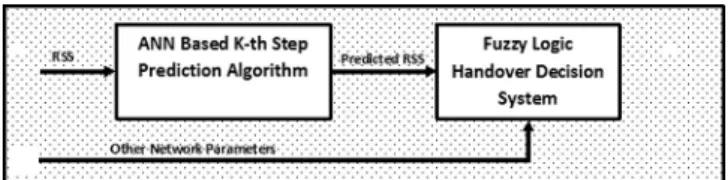
In this section, the development of the hybrid artificial intelli-gent based handover algorithm is presented. The proposed algo-rithm is based on a two-stage approach, the first stage involves the mathematical development of a novel kstep ahead ANN based prediction algorithm while the second stage involves the development of Fuzzy logic based Handover decision making algo-rithm. The block diagram of the proposed system is as shown in
Fig. 1.
Fig. 1.The block diagram of the proposed Hybrid AI based Handover Decision Algorithm.
The choice of cascaded approach has been justified in[26], in addition, the choice of ANN and Fuzzy logic for handover decision algorithm is based on the performance analysis of some of the existing artificial intelligent techniques. Table 1 shows some of the criteria used in the selection of ANN and FL for the handover system.
The mathematical derivation and computation associated with the development ofkstepahead ANN based prediction algorithm is presented inSection 3.1while in Section3.2, the development of Fuzzy Logic based handover decision subsystem is presented.
3.1. Development of K-th step artificial neural network based handover prediction algorithm
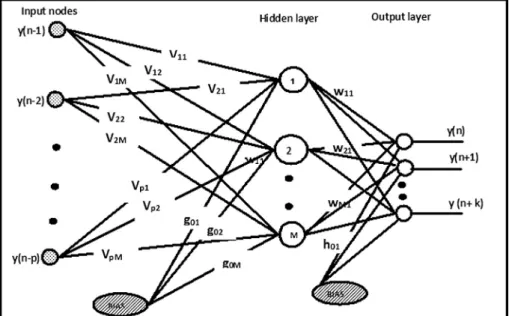
Consider the ANN structure shown in Fig. 2 representing
kstepahead ANN based prediction model, the various outputs of the system can be expressed as
yðnþ ðk1ÞÞ ¼
a
kF X M l¼1 wlk#lþh0k ! ð1aÞThus fork¼1, we have theyðnÞoutput expressed as yðnÞ ¼
a
1F X M l¼1 wl1#lþh01 ! ð1bÞwhere:Mis the number of neurons in the hidden layer;wl1is the
weight connecting nodelin the hidden layer to neuron 1i:ek¼1 in the output layer;h01is the bias term of neuron 1 in the output
layer;#lis the output of the neuronlthin the hidden layer; and
a
kis the adaptive coefficient of the linear activation function of the
kth output neuron;yðn1Þ;yðn2Þ. . .yðnpÞare the pastpRSS values obtained the system; yðnÞ;yðnþ1Þ. . .yðnþ1Þ are the expected predicted values of the system.
Similar to (1b), the two-step ahead output yðnþ1Þ can be expressed as yðnþ1Þ ¼
a
2F X M l¼1 wl2#lþh02 ! ð1cÞThus, thekþ1-step ahead outputyðnþkÞcan be expressed as yðnþkÞ ¼
a
kþ1F XM l¼1 wlðkþ1Þ#lþh0ðkþ1Þ ! ð1dÞHowever, the output#lof each of the neuron in the hidden layer
can be expressed as #l¼blF Xp r¼1
v
rlyðnrÞ þg0l ! ð2Þwhere
v
rlis the weight connecting input noderto hidden nodel;g0lis the bias of the hidden nodelandblis the adaptive coefficient of
hidden node linear activation function. Substituting(2)into(1b) to (1d)gives yðnÞ ¼
a
1F X M l¼1 wl1ðblF Xp r¼1v
rlyðnrÞ þg0l ! Þ þh01 ! ð3aÞ yðnþ1Þ ¼a
2F X M l¼1 wl2 blF Xp r¼1v
rlyðnrÞ þg0l !! þh02 ! ð3bÞand can be generalized up till the k-th step predicted value as
yðnþkÞ ¼
a
kþ1F XM l¼1 wlðkþ1Þ blF Xp r¼1v
rlyðnrÞ þg0l !! þh0ðkþ1Þ ! ð3cÞon expanding(3a)–(3c)and using linear activation functions in both the hidden and output layer (i.eFis linear), thekstepahead ANN based prediction model coefficients can be obtained from the extracted synaptic weights and adaptive coefficients of a well trained ANN with the general equation given as
apk¼
a
kþ1 XMl¼1
wlkþ1
v
plbl ð4ÞThus,kstepahead ANN based RSS prediction model coeffi-cientsapkare estimated from the synaptic weights and the
coeffi-cients of the adaptive activation function of a properly trained two-layer ANN shown inFig. 2.
In implementing thekstepahead ANN based prediction algo-rithm in handover decision making module The coefficients were used to form a matrix from which appropriate prediction level can be easily obtained. Thus the prediction problem shown in
Fig. 2reduces to matrix multiplication given as a11 a21 a31 . . . ap1 a12 a22 a32 . . . ap2 a13 a23 a33 . . . ap3 ... ... ... ... ... a1p a2p a3p . . . apk 2 66 66 66 64 3 77 77 77 75 yðn1Þ yðn2Þ yðn3Þ ... yðnpÞ 2 66 66 66 64 3 77 77 77 75¼ yðnÞ yðnþ1 yðnþ2Þ ... yðnþkÞ 2 66 66 66 64 3 77 77 77 75 ð5Þ AYp ¼Yþk ð6Þ
whereAis aðpkÞmatrix of model coefficients;Yp is ap1 vector
of past RSS values andYþk is aðkþ1Þ 1 matrix of step ahead
pre-dicted RSS values. One advantage of(5)is its implementation using low configuration embedded platform such as ATMEGA 328 that otherwise would not have been able to handle implementation of ANN can now handle the matrix multiplication given in(5). Thus, in this work a new technique for implementing a trained multilayer neural network on a low cost and low specification Micro-controller system has also been introduced.
Table 1
Performance comparison of selected artificial intelligent based techniques.
Criteria FL ANN GA Choice
Mathematical model U Already in existence
Learning ability U ANN
Initialization capability U U ANN
Knowledge representation U FL
Non-linearity U U ANN
Optimization ability U U ANN
3.2. Development of Fuzzy logic based handover decision algorithm
The development of Fuzzy logic based Handover decision algo-rithm shown inFig. 3is presented in this section. The developed system consists of three different stages, namely Fuzzification stage, Fuzzy inference stage and Deffuzification stage. Detailed dis-cussion of each of the stages is provided herewith.
3.2.1. Fuzzy logic based handover decision fuzzification stage
The fuzzification stage involves defining the membership func-tion of each of the input to the FL. In this work, triangular member-ship function was adopted. Aside from the predicted RSS level, other inputs used in this work include mobile station GPS coordi-nates for calculating the distance of the mobile station from the surrounding BTSs; Channel availability and Cell ID.
The Fuzzy sets for each of the input parameters are:
RSS¼FðVL;L;H;VH;EHÞ ð7aÞ
whereVLmeans Very Low RSS value;Lmeans Low RSS value;H
means High RSS value; VH means Very high RSS value and EH
means Extremely High RSS value,
CA¼FðA;NAÞ ð7bÞ
where Ameans Channel is available; andNAmeans No available channel for communication.
D¼FðVF;F;N;VNÞ ð7cÞ
whereVFmeans Very Far from the BTS;Fmeans Far from the BTS;N
means Near to the BTS andVNmeans Very near to the BTS.
CI¼FðVB;NTÞ ð7dÞ
whereNTmeans known terrain andVBmeans Very new terrain The output linguistic variable Handover Decision (HD) Fuzzy set is defined as
HD¼FðHG;HM;HHEHGÞ ð7eÞ
whereHGmeans Handover to Glo,HMmeans Handover to MTN,HE
means Handover to Etisalat andHAHandover to AIRTEL.
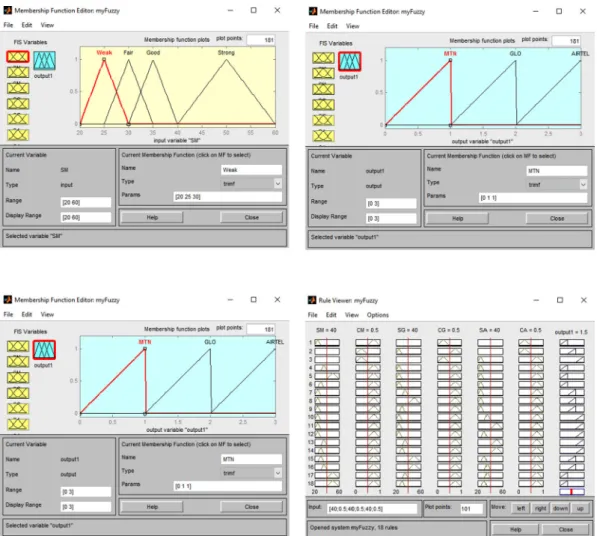
Every element in the input and output fuzzy sets have a corre-sponding value of membership. Triangular membership function was used in this work and a typical membership functions for Pre-dicted RSS value and Handover Decision are shown inFig. 4a-c.
Fig. 2.ANN structure showing synaptic weights connection for the K-th Step Artificial Neural Network Based Handover Prediction System.
3.2.2. Fuzzy logic based handover decision fuzzy inference stage
In the Fuzzy logic based handover decision Fuzzy inference stage, max–min inference was exploited using if-then rules which is as shown inFig. 4d. The inference applies the minimum linguis-tic variables of the input parameters to deduce the output of the system based on the set rules.
3.2.3. Fuzzy logic based handover decision deffuzification stage
When the output is obtained, centroid defuzzification is applied to obtain the numerical value of the obtained handover decision. The defuzzification state decides which network to handover to based on the defuzzifier.
4. Results and discussion
Results obtained from the performance analysis of the devel-oped Handover algorithm are reported in this section. Two differ-ent metrics were used to measure the accuracy of the predicted RSS prior to taken handover decision. These are: The Prediction Error (PE) and Relative error (RE). The two metrics are defined by
(8) and (9)respectively.
PE¼RSSACRSSPR ð8Þ
RE¼RSSACRSSPR
RSSAC ð9Þ
whereRSSACis the actual RSS level measured andRSSPRis the
pre-dicted price RSS level.
4.1. Performance analysis of kstep ahead ANN based prediction (KSABP) algorithm
In evaluating the kstep ahead ANN based prediction algo-rithm developed in this work, results obtained from two different scenarios have been reported. In Section4.1.1, results obtained from the prediction of RSS signal acquired from mobile network operators has been provided while in Section 4.1.2, results obtained from application of the developed algorithm in predicting gold coin price has been reported.
4.1.1. Received signal strength prediction using kstep ahead ANN based prediction algorithm
In the first case, a multiple operators enabled sim card system reported in[31] was used to acquire RSS levels of a particular mobile network operator on different time intervals. In this paper results obtained from 5 s acquisition time interval has been reported only as similar results were obtained using other different time intervals. The acquired data was then normalized using yðnÞ ¼ yacqðnÞ
maxðyacqðnÞÞ ð10Þ
Fig. 4.Fuzzy Inference System (a) Predicted RSS Level Membership Function (a) Predicted Channel Availability (CA) Membership Function (c) Handover Decision Output Membership Function (d) Handover Decision Inference Engine.
whereyacqðnÞis the acquired RSS data using the card andyðnÞis the
normalized RSS value. The normalized data were then fed into the developed ANN based prediction model for prediction coefficients computation using(4)while(5)was used to compute the predicted value. For a case study, the computed coefficients are now substi-tuted into the prediction model to form a one-step ahead prediction model given as
yðnÞ ¼ ½0:8268yðn1Þ þ0:1730yðn2Þ ð11Þ
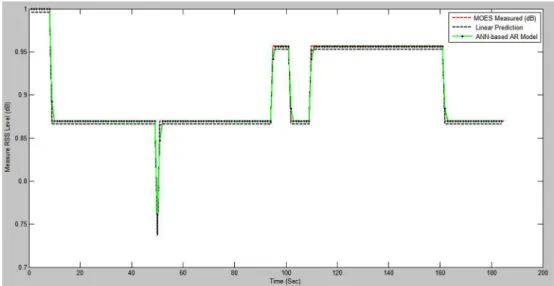
which was then used to predict the RSS value ahead of feeding it into the Fuzzy system for handover decision module. Results obtained are shown inTable 2andFig. 5. Results obtained shows that the use of ANN-based prediction technique shows better per-formance in term of accurately predicting the next RSS level required for Handover than even the use of Linear prediction tech-nique. Furthermore, it was also observed that the predicted RSS level is very close to the measured RSS value with a very low error margin. It can be observed that the proposed algorithm is capable of predicting RSS level to about ±0.0002 error margin.
4.1.2. Gold coin price prediction using kstep ahead ANN based prediction algorithm
In evaluating the developed algorithm and justifying its applica-bility to other fields, the daily price of Gold coin was obtained over a period of six months. The data was adopted due to the fact that one-day ahead price could now be obtained and can be used to test the accuracy of the proposed algorithm. The obtained data was for-matted as an input data to thekstepahead ANN-based predic-tion (KSABP) model withp past input data and one step ahead target data as the output of the model.
The designed model was trained using back propagation approach and upon convergence, the synaptic weights and adap-tive coefficients of the activation function were extracted from which the required prediction coefficients were computed using
(4). The obtained model coefficients were used to predict the future price on a one-day ahead prediction approach. The proposed approach was benchmarked against Yule Walker approach. For the duo, the Prediction Error (PE) and Relative Error (RE) were
com-puted and part of the results obtained are shown in Fig. 6 and
Table 3.
Results obtained shows that the proposed technique provides better performance as compared to that of using Yule Walker tech-nique. In most cases, it was also observed that the predicted price using the proposed algorithm gave almost similar results as the ground truth. Thus, low RE values were obtained using the pro-posed technique.
4.2. Handover decision results using simulated data
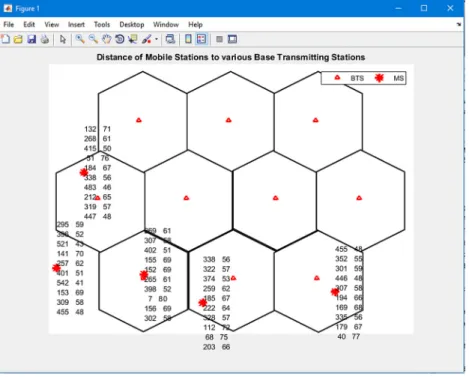
In order to evaluate the developed Fuzzy Inference Handover System, MATLAB was used to simulate BTS environment and mobile stations. The environment consist of Ten (10) different BTSs with different mobile stations. The simulated environment is as shown inFig. 7.
The pseudo-code developed for the simulation of Handover by mobile stations is as presented herewith:
1. Given BTS cell map of an area
2. Find the location of the BTS and its boundary coordinates 3. Display the BTS on the map
4. Randomly generate coordinate for mobile stations 5. For each Mobile Station, do the following
(a) Find the Euclidean distance to each BTS location (b) Estimate the RSS of the BTS using Lagrange interpolation. Taking minimum distance to be 0 Unit and the correspond-ing RSS value as 80dBm and maximum distance to be 560 units and the corresponding RSS value as 30 dBm
(c) Display the mobile stations with the corresponding dis-tance from each of the BTS and the corresponding RSS value of each BTS.
Mobility of the mobile stations were also simulated and at each stage in order to take handover decision, network parameters that serves as the input to the FIS system were calculated. Firstly the RSS was predicted using the proposedkstepahead ANN based prediction model. The predicted RSS value and other network parameters were then fed to the FIS to determine Handover deci-sion. Since the environment was a simulated one, the Handover
Table 2
Performance evaluation of Prediction Algorithm Using Acquired RSS data.
Measured AR-Pred. KSABP AR Model KSABP AR Model KSABP
RSS RSS Pred. RSS PE PE RE RE 1.0000 0.9959 0.9998 0.0041 0.0002 0.4105 0.0211 1.0000 0.9959 0.9998 0.0041 0.0002 0.4105 0.0211 1.0000 0.9959 0.9998 0.0041 0.0002 0.4105 0.0211 1.0000 0.9959 0.9998 0.0041 0.0002 0.4105 0.0211 1.0000 0.9959 0.9998 0.0041 0.0002 0.4105 0.0211 0.8696 0.8660 0.8694 0.0036 0.0002 0.4105 0.0211 0.8696 0.8660 0.8694 0.0036 0.0002 0.4105 0.0211 0.8696 0.8660 0.8694 0.0036 0.0002 0.4105 0.0211 0.8696 0.8660 0.8694 0.0036 0.0002 0.4105 0.0211 0.8696 0.8660 0.8694 0.0036 0.0002 0.4105 0.0211 0.8696 0.8660 0.8694 0.0036 0.0002 0.4105 0.0211 0.8696 0.8660 0.8694 0.0036 0.0002 0.4105 0.0211 0.8696 0.8660 0.8694 0.0036 0.0002 0.4105 0.0211 0.9565 0.8660 0.8694 0.0905 0.0871 9.4641 9.1101 0.9565 0.9519 0.9413 0.0047 0.0152 0.4879 1.5935 0.9565 0.9526 0.9563 0.0039 0.0002 0.4105 0.0211 0.9565 0.9526 0.9563 0.0039 0.0002 0.4105 0.0211 0.9565 0.9526 0.9563 0.0039 0.0002 0.4105 0.0211 0.9565 0.9526 0.9563 0.0039 0.0002 0.4105 0.0211 0.9565 0.9526 0.9563 0.0039 0.0002 0.4105 0.0211 0.8696 0.8660 0.8694 0.0036 0.0002 0.4105 0.0211 0.8696 0.8660 0.8694 0.0036 0.0002 0.4105 0.0211 0.8696 0.8660 0.8694 0.0036 0.0002 0.4105 0.0211 0.8696 0.8660 0.8694 0.0036 0.0002 0.4105 0.0211
output of the FIS was compared with the ground truth and it was seen that in almost all the situations, Handover decision from the FIS correspond with the ground truth. The error margin obtained
from various simulated handover decision was calculated and results obtained show that only 2% error in handover decisions were made by the developed system. The proposed algorithm
Fig. 5.Performance Analysis of thekstepahead ANN based prediction using acquired RSS Data.
Fig. 6.Gold Coin Prediction Usingkstepahead ANN-based prediction (KSABP) model.
Table 3
Gold Price Prediction Usngkstepahead ANN based Prediction Algorithm.
Actual AR-Pred. KSABP AR Model KSABP AR Model KSABP
Price Price Pred. Price PE PE RE RE
665.000 651.163 656.136 13.837 8.864 2.081 1.333 671.000 661.235 665.294 9.765 5.706 1.455 0.850 661.000 667.088 671.221 6.088 10.221 0.921 1.546 661.000 657.056 661.418 3.944 0.418 0.597 0.063 661.000 657.208 661.640 3.792 0.640 0.574 0.097 669.000 657.181 662.136 11.819 6.864 1.767 1.026 668.000 665.152 669.045 2.848 1.045 0.426 0.156 681.000 664.067 668.312 16.933 12.688 2.486 1.863 680.000 677.096 680.310 2.904 0.310 0.427 0.046 686.000 675.970 680.173 10.030 5.827 1.462 0.849 686.000 682.023 685.495 3.977 0.505 0.580 0.074 680.000 681.981 686.400 1.981 6.400 0.291 0.941 682.000 676.009 680.643 5.991 1.357 0.878 0.199 675.000 678.084 682.701 3.084 7.701 0.457 1.141 675.000 671.046 676.304 3.954 1.304 0.586 0.193 682.000 671.117 675.755 10.883 6.245 1.596 0.916
was tested and handover without pin-pong effect associated with some other techniques were also obtained.
5. Conclusion
In this paper, the use of a cascaded ANN and Fuzzy logic for han-dover decision in a wireless mobile communication system has been presented. Basically, the ANN has been used in the determi-nation of model coefficients for effective prediction of RSS level in handover decision management system. The computed coeffi-cients were concatenated to form a matrix and simple matrices multiplication can be undertaken in obtaining the predicted val-ues. The predicted values using the ANN based prediction algo-rithm was compared with some known techniques and it was observed that the developed approach was able to demonstrate good prediction values as obtained during performance analysis. The output of the prediction system was then fed to the Fuzzy inference system for taking necessary handover decision. Results obtained shows that the proposed approach was able to take nec-essary handover decision and avoid ping-pong effect when evaluated.
Acknowledgement
This research work is sponsored by the Nigerian Communica-tions Commission (NCC), Nigeria under research funding NCC/ CS/007/15/C/040 of 2014.
References
[1]W. Hongsakham, W. Pattara-Atikom, R. Peachavanish, Estimating road traffic congestion from cellular handoff information using cell-based neural networks and K-means clustering, 5th International Conference on Electrical Engineering/Electronics, Computer, Telecommunications and Information Technology (ECTI-CON), vol. 1, 2008, pp. 13–16.
[2]F. Ahdi, B.H. Khalaj, Vertical handoff initiation using road topology and mobility prediction, IEEE Wireless Communications and Networking Conference, 2006, pp. 593–598.
[3]P.P. Bhattacharya, Application of artificial neural network in cellular handoff management, IEEE International Conference on Conference on Computational Intelligence and Multimedia Applications (ICCIMA), 2007, pp. 237–241.
[4]Y. Salahshuori, G. Azemi, A pattern recognition based handoff algorithm for micro-cellular systems, 19th Iranian Conference on Electrical Engineering (ICEE), 2011, pp. 1–6.
[5]N. Nasser, S. Guizani, E. Al-Masri, Middleware vertical handoff manager: a neural network-based solution, IEEE International Conference on Communications, ICC’07, 2007, pp. 5671–5676.
[6]M. Okwori, E.N. Onwuka, A.M. Aibinu, O.C. Ugweje, Implementation of a locator-based route switching scheme for improved routing in proxy mobile IPv6, Int. J. Wirel. Microw. Technol. (2014) 119.
[7]S.J. Wu, An intelligent handover decision mechanism for heterogeneous wireless networks, Sixth International Conference on Networked Computing and Advanced Information Management (NCM), 2010, pp. 688–693. [8]Q. Guo, J. Zhu, X. Xu, An adaptive multi-criteria vertical handoff decision
algorithm for radio heterogeneous network, 2005 IEEE International Conference on Communications (ICC), 2005, pp. 2769–2773.
[9]L. Barolli, F. Xhafa, A. Durresi, A. Koyama, A fuzzy-based handover system for avoiding ping-pong effect in wireless cellular networks, International Conference on Parallel Processing-Workshops ICPP-W’08, 2008, pp. 135–142. [10] R. Chai, J. Cheng, X. Pu, Q. Chen, Neural network based vertical handoff performance enhancement in heterogeneous wireless networks, 2011 7th International Conference on Wireless Communications, Networking and Mobile Computing (WiCOM), 2011, pp. 1–4.
[11] P. Moungnoul, P. Pinprasert, T. Paungma, Handoff decision in cellular mobile system using neural network accessed online October 2016.
[12]S. Kunarak, R. Sulessathira, E. Dutkiewicz, Vertical handoff with predictive RSS and dwell time, 2013 IEEE Region 10 Conference (31194) TENCON, 2013, pp. 1–5.
[13]L. Xia, L.G. Jiang, C. He, N. Nasser, S. Guizani, E. Al-Masri, A novel Fuzzy logic vertical handoff algorithm with aid of differential prediction and pre-decision method, 2007 IEEE International Conference on Communications, ICC’07, 2007, pp. 5665–5670.
[14]S. Kabahuma, O.E. Falowo, Analysis of network operators revenue with a dynamic pricing model based on user behaviour in NGWN using JCAC, Proceedings of the Southern Africa Telecommunication Networks and Applications Conference (SATNAC), 2010, pp. 3258–3272.
[15] Chandralekha, P.K. Behera, Optimization of vertical handoff performance parameters in heterogeneous wireless networks, Int. J. Modern Eng. Res. (IJMER) ISSN: 2249-6645, 1(2), (2011) pp. 597–601.
[16]A.M. Aibinu, M.J.E. Salami, A.A. Shafie, Artificial neural network based autoregressive modeling technique with application in voice activity detection, Eng. Appl. Artif. Intell. 25 (6) (2012) 1265–1276.
[17] V.Q. Bien, R.V. Prasad, I. Niemegeers, A Handoff scheme using movement prediction in radio over fiber indoor network at 60 GHz, In: 2011 IEEE Workshops of International Conference on Advanced Information Networking and Applications (WAINA), (2011) 664–669.
[18]L. Chuyen, D. Son, H. Thang, C. Deokjai, A mobility prediction algorithm for the seamless handoff, 2013 Fifth International Conferenceon Ubiquitous and Future Networks (ICUFN), 2013, pp. 424–429.
[19]C. Benedetto, E. Mingozzi, C. Vallati, A handoff algorithm based on link quality prediction for mass transit wireless mesh networks, 2013 IEEE Symposium on Computers and Communications (ISCC), 2013, pp. 969–974.
[20]M.T. Soleimani, M. Kahvand, R. Sarikhani, Handoff reduction based on prediction approach in Cognitive Radio Networks, Communication Technology (ICCT), 2013 15th IEEE International Conference, 2013, pp. 319– 323.
[21]N. Omheni, F. Zarai, M.S. Obaidat, K.F. Hsiao, A novel vertical handoff decision making algorithm across Heterogeneous Wireless Networks, 2014 International Conference on Computer, Information and Telecommunication Systems (CITS), 2014. pp. 1–6, 7–9.
[22]R.S. Campos, L. Lovisolo, Mobile Station Location Using Genetic Algorithm Optimized Radio Frequency Fingerprinting, Proceedings of ITS, International Telecommunications Symposium 1 (June 2010) 1–5.
[23]P.B. Chandralekha, K.B. Praffula, Minimization of number of handoff using genetic algorithm in heterogeneous wireless networks, Int. J. Latest Trends Comput 1 (2) (2010) 24–28.
[24]B.C. Manjith, C.S. Shijin, Mobile end-node location tracking and prediction, Procedia Eng. 38 (2012) 821–828.
[25]Y. Shen, N. Xi, Q. Pei, J. Ma, Y. Niu, The wireless vertical handoff decision algorithm with parameter prediction, 2012 4th International Conference on Intelligent Networking and Collaborative Systems (INCoS), 2012, pp. 185–192.
[26]A. Calvagna, G. Di Modica, A user-centric analysis of vertical handovers, Proceedings of the 2nd ACM international workshop on Wireless mobile applications and services on WLAN hotspots, 2004, pp. 137–146.
[27]V. Kapoor, G. Edwards, R. Sank, Handoff Criteria for Personal Communication Networks, IEEE, 1994. pp. 1297–1301.
[28]H. Pin-Han, Y. Wang, F. Hou, S. Shen, A study on vertical handoff for integrated WLAN and WWAN with micro-mobility prediction, 3rd International Conference on Broadband Communications, Networks and Systems BROADNETS, 2006, pp. 1–11.
[29]J. Mei, H. Ji, Y. Li, Service-aware proactive vertical handoff algorithm based on bandwidth requirement prediction, 011 6th International Conference on Communications and Networking in China ICST (CHINACOM), 2011, pp. 569–573.
[30]N. Savkoor, R. Sankar, Microcellular Handoff Control Using Robust Prediction Techniques, Southeast Conference Proceedings, IEEE, 1999. pp. 337–339. [31]A.M. Aibinu, A.J. Onumanyi, T.A. Folorunso, S.J. Salubuyi, H. Oziegbe,
Development of embedded-multiple operators enabled sim (e-moes) card system for mobile phone initiated handover across various network operators, J. Eng. Sci. Technol. (2016). submitted for publication.