POUR L'OBTENTION DU GRADE DE DOCTEUR ÈS SCIENCES
acceptée sur proposition du jury: Prof. C. Koch, président du jury Prof. M. Odersky, directeur de thèse
Prof. V. Kuncak, rapporteur Prof. K. Olukotun, rapporteur
Prof. W. Taha, rapporteur
Lightweight Modular Staging and Embedded Compilers:
Abstraction without Regret for
High-Level High-Performance Programming
THÈSE N
O5456 (2012)
ÉCOLE POLYTECHNIQUE FÉDÉRALE DE LAUSANNE
PRÉSENTÉE LE 30 jUILLET 2012À LA FACULTÉ INFORMATIQUE ET COMMUNICATIONS LABORATOIRE DE MÉTHODES DE PROGRAMMATION 1
PROGRAMME DOCTORAL EN INFORMATIQUE, COMMUNICATIONS ET INFORMATION
Suisse PAR
Tiark ROMPF
Abstract
Programs expressed in a high-level programming language need to be translated to a low-level machine dialect for execution. This translation is usually accomplished by a compiler, which is able to translate any legal program to equivalent low-level code. But for individual source programs, automatic translation does not always deliver good results: Software engineering practice demands generalization and abstraction, whereas high performance demands spe-cialization and concretization. These goals are at odds, and compilers can only rarely translate expressive high-level programs to modern hardware platforms in a way that makes best use of the available resources.
Explicit program generation is a promising alternative to fully automatic translation. Instead of writing down the program and relying on a compiler for translation, developers write a program generator, which produces a specialized, efficient, low-level program as its output. However, developing high-quality program generators requires a very large effort that is often hard to amortize.
In this thesis, we propose a hybrid design: Integrate compilers into programs so that programs can take control of the translation process, but rely on libraries of common compiler functionality for help.
We presentLightweight Modular Staging (LMS), a generative programming approach that lowers the development effort significantly. LMS combines program generator logic with the generated code in a single program, using only types to distinguish the two stages of execution. Through extensive use of component technology, LMS makes a reusable and extensible compiler framework available at the library level, allowing programmers to tightly integrate domain-specific abstractions and optimizations into the generation process, with common generic optimizations provided by the framework. Compared to previous work on program generation, a key aspect of our design is the use of staging not only as a front-end, but also as a way to implement internal compiler passes and optimizations, many of which can be combined into powerful joint simplification passes.
LMS is well suited to develop embedded domain specific languages (DSLs) and has been used to develop powerful performance-oriented DSLs for demanding domains such as ma-chine learning, with code generation for heterogeneous platforms including GPUs. LMS has also been used to generate SQL for embedded database queries and JavaScript for web applications.
Zusammenfassung
In einer “high-level” Programmiersprache geschriebene Programme müssen zur Ausführung in einen “low-level” Maschinendialekt übersetzt werden. Diese Übersetzung wird üblicherwei-se von einem Compiler durchgeführt, der jedes zulässige Programm in äquivalenten low-level Code übersetzen kann. Für individuelle Quellprogramme führt die automatische Übersetzung allerdings nicht immer zu einem guten Ergebnis: Anforderungen des Software-Engineering (Generalisierung und Abstrahierung) stehen im Widerspruch zu denen hoher Rechenlei-stung (Spezialisierung und Konkretisierung). Compiler können ausdrucksstarke Programme nur selten auf eine solche Weise übersetzen, dass sie die verfügbaren Ressourcen moderner Hardware-Plattformen in günstigster Weise ausnutzen.
Explizite Programmgenerierung is eine vielversprechende Alternative zur vollautomati-schen Übersetzung. Anstatt ein Programm fertig auszuformulieren und sich auf einen Compi-ler zur Übersetzung zu verlassen, können EntwickCompi-ler einen Programmgenerator schreiben. Dieser erzeugt ein spezialisiertes, effizientes low-level Programm als Ausgabe. Die Entwick-lung qualitativ hochwertiger Programmgeneratoren erfordert allerdings einen sehr großen Aufwand der schwer zu amortisieren ist.
Diese Dissertation schlägt ein Hybrid-Modell vor: Man integriere Compiler in Programme so dass die Programme Kontrolle über den Übersetzungsvorgang übernehmen können wobei sie von Bibliotheken gängiger Übersetzerfunktionalität unterstützt werden.
Wir präsentierenLightweight Modular Staging (LMS), eine Methode zur Programmge-nerierung die den Entwicklungsaufwand deutlich verringert. LMS verbindet Logik des Pro-grammgenerators mit erzeugtem Code im gleichen Programm und unterscheidet die zwei Ausführungsstufen anhand von Typen. Durch weitreichenden Einsatz von Komponenten macht LMS ein erweiterbares Compiler Framework als Bibliothek verfügbar. Dies erlaubt Prorammierern die enge Integration von Programm-spezifischen Abstraktionen und Optimie-rungen in den Generatorprozess, wobei generische OptimieOptimie-rungen vom Framework bereit gestellt werden. Ein wesentlicher Aspekt ist die Verwendung von Staging nicht allein als Front-End sondern auch zur implementierung interner Compiler-Stufen.
LMS ist gut geeignet zur Entwicklung von Domain-Specifc Languages (DSLs) und wurde erfolgreich eingesetzt um Performance-orientierte DSLs für anspruchsvolle Bereiche wie Machine Learning zu implementieren, einschließlich Code Generierung für GPUs. LMS wurde ebenfalls eingesetzt um SQL for eingebettete Datenbankabfragen und JavaScript für Web Anwendungen zu erzeugen.
Acknowledgments
I would like to thank my advisor Martin Odersky for giving me the opportunity to work on exciting projects, introducing me to the right people at the right times, and betting a large ERC grant proposal on my early ideas. I would also like to thank the members of my thesis jury, Christoph Koch, Viktor Kuncak, Kunle Olukotun and Walid Taha for their time and helpful comments. I am also grateful to my late MS advisor Walter Dosch for encouraging me to pursue a PhD in the first place.
The work presented in this thesis is part of a large collaborative effort driven by many people, both at EPFL and at Stanford University. It is hard to do justice to the profound and numerous ways this thesis was shaped by the joint work on Delite with Kevin Brown, Hassan Chafi, HyoukJoong Lee, Arvind Sujeeth, and Kunle Olukotun (Stanford). A huge thanks and it’s a pleasure working with you! Additional thanks go to Adriaan Moors for the joint work on Scala-Virtualized, Christopher Vogt for SIQ, Vlad Ureche for StagedSAC, Philipp Haller and Manohar Jonalagedda for debugging and profiling facilities, Nada Amin and Grzegorz Kossakowski for embedded JavaScript, Stefan Ackermann, Vojin Jovanovic and Aleksandar Prokopec for distributed and collection operations (EPFL).
I would also like to thank everybody at LAMP, present and past, for providing a great and enjoyable work environment.
Last but not least, I would like to thank my friends and my family for their support and for providing a healthy counterbalance to work and research, in particular my parents and my lovely wife Maria.
Contents
1 Introduction 1
1.1 Embedded Compilers: A Hybrid Approach . . . 3
1.2 Lightweight Modular Staging . . . 4
1.3 Combining Staging and Extensible Compilers . . . 4
1.4 Deep Linguistic Reuse . . . 4
1.5 Abstraction Without Regret . . . 5
1.6 Language Virtualization . . . 5 1.7 Domain-Specific Languages (DSLs) . . . 5 1.8 Delite . . . 6 1.9 Contributions . . . 6 1.10 Terminology . . . 8 1.11 Outline . . . 8 2 Background 11 2.1 Economics of Productivity, Performance and Safety . . . 11
2.2 Hardware Trends and Productivity Challenges . . . 12
2.2.1 Hitting the Power Wall . . . 12
2.2.2 Proliferation of Programming Models . . . 12
2.3 Domain-Specific Languages (DSLs) . . . 12
2.3.1 DSLs for Performance . . . 13
2.3.2 External DSLs . . . 13
2.3.3 Embedded DSLs . . . 13
2.4 Programming Language Trends and Performance Challenges . . . 14
2.4.1 The Abstraction Penalty . . . 14
2.4.2 The General Purpose Bottleneck . . . 14
2.4.3 Static or Dynamic Compilation . . . 15
2.4.4 Combinatorial Explosion . . . 15
2.4.5 Functional Programming Challenges . . . 15
2.4.6 Scala Challenges . . . 16
2.4.7 JVM Challenges . . . 16
2.5 Staging and Generative Programming . . . 17
2.5.2 Partial Evaluation . . . 17
2.5.3 Generative Front-Ends and Extensible Compilers . . . 18
I Defining Embedded Programs 21 3 Intro: Staging as Meta Programming 23 4 Language Virtualization 27 4.1 Defining Language Virtualization . . . 27
4.1.1 Virtualization and Reflection . . . 28
4.2 Achieving Virtualization . . . 28
5 Scala-Virtualized 31 5.1 Everything is a Method Call . . . 32
5.1.1 Virtualizing Control Structures . . . 32
5.1.2 Virtualizing Method Calls . . . 33
5.1.3 Virtualizing Record Types . . . 34
5.1.4 Virtualizing Pattern Matching . . . 35
5.2 Putting Static Information to Work . . . 36
5.2.1 Virtualizing Static Type Information . . . 37
5.2.2 Virtualizing Static Source Information . . . 37
6 Staging: Deep Linguistic Reuse for Easier Program Generator Development 39 6.1 State of the Art . . . 39
6.1.1 Program Generation with Strings . . . 39
6.1.2 Program Generation with Quasi-Quotes . . . 40
6.1.3 Syntactic Correctness through Deep Reuse of Syntax . . . 40
6.1.4 Scope Correctness through Deep Reuse of Scope . . . 41
6.1.5 Type Correctness through Deep Reuse of Types . . . 41
6.1.6 Value Correctness is an Open Problem . . . 41
6.2 Contributions . . . 43
6.2.1 Value Correctness through Deep Reuse of Evaluation Order . . . 44
6.2.2 Removing Syntactic Overhead . . . 46
6.2.3 Staging as a Library and Modular Definition of Object Languages . . . . 47
6.2.4 Functions and Recursion . . . 49
6.2.5 Semi-Automatic BTA through Deep Reuse of Type Inference . . . 50
6.2.6 Generating and Loading Executable Code . . . 51
II Compiling Embedded Programs 53
Contents
8 Intermediate Representation: Trees 57
8.1 Trees Instead of Strings . . . 57
8.1.1 Modularity: Adding IR Node Types . . . 59
8.2 Enabling Analysis and Transformation . . . 59
8.2.1 Modularity: Adding Traversal Passes . . . 60
8.2.2 Solving the “Expression Problem” . . . 61
8.2.3 Generating Code . . . 61
8.2.4 Modularity: Adding Transformations . . . 61
8.2.5 Transformation by Iterated Staging . . . 62
8.3 Problem: Phase Ordering . . . 63
9 Intermediate Representation: Graphs 65 9.1 Purely Functional Subset . . . 65
9.1.1 Modularity: Adding IR Node Types . . . 66
9.2 Simpler Analysis and More Flexible Transformations . . . 67
9.2.1 Common Subexpression Elimination/Global Value Numbering . . . 67
9.2.2 Pattern Rewrites . . . 67
9.2.3 Modularity: Adding new Optimizations . . . 68
9.2.4 Context- and Flow-Sensitive Transformations . . . 69
9.2.5 Graph Transformations . . . 69
9.2.6 Dead Code Elimination . . . 70
9.3 From Graphs Back to Trees . . . 71
9.3.1 Code Motion . . . 71
9.3.2 Tree-Like Traversals and Transformers . . . 74
9.4 Effects . . . 75
9.4.1 Simple Effect Domain . . . 75
9.4.2 Fine Grained Effects: Tracking Mutations per Allocation Site . . . 75
10 Advanced Optimizations 79 10.1 Rewriting . . . 79
10.1.1 Context-Sensitive Rewriting . . . 79
10.1.2 Speculative Rewriting: Combining Analyses and Transformations . . . . 79
10.1.3 Delayed Rewriting and Multi-Level IR . . . 80
10.2 Splitting and Combining Statements . . . 81
10.2.1 Effectful Statements . . . 81
10.2.2 Data Structures . . . 81
10.2.3 Representation Conversion . . . 82
10.3 Loop Fusion and Deforestation . . . 83
III Staging and Embedded Compilers at Work 87 11 Intro: Abstraction Without Regret 89 11.1 Common Compiler Optimizations . . . 89
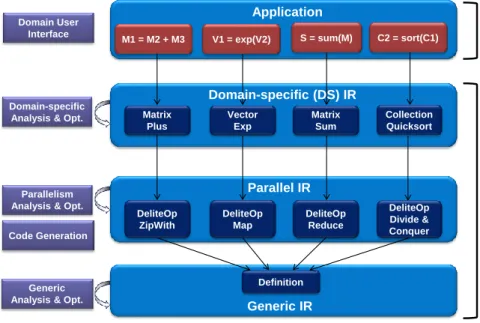
11.2 Delite: An End-to-End System for Embedded Parallel DSLs . . . 90
11.2.1 Building a Simple DSL . . . 91
11.2.2 Code Generation . . . 93
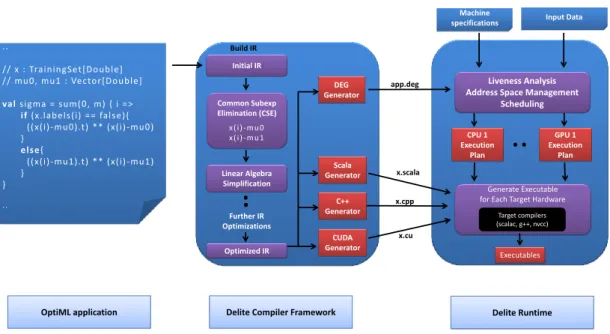
11.2.3 The Delite Compiler Framework and Runtime . . . 93
12 Control Abstraction 95 12.1 Leveraging Higher-Order Functions in the Generator . . . 95
12.2 Using Continuations in the Generator to Implement Backtracking . . . 97
12.3 Using Continuations in the Generator to Generate Async Code Patterns . . . 99
12.3.1 CPS and Staging . . . 100
12.3.2 CPS for Interruptible Traversals . . . 101
12.3.3 Defining the Ajax API . . . 103
12.3.4 CPS for Parallelism . . . 104
12.4 Guarantees by Construction . . . 106
13 Data Abstraction 109 13.1 Static Data Structures . . . 109
13.2 Dynamic Data Structures with Partial Evaluation . . . 110
13.3 Generic Programming with Type Classes . . . 112
13.4 Unions and Inheritance . . . 113
13.5 Struct of Array and Other Data Format Conversions . . . 113
13.6 Loop Fusion and Deforestation . . . 115
13.7 Extending the Framework . . . 116
14 Case Studies 119 14.1 OptiML Stream Example . . . 119
14.1.1 Downsampling in Bioinformatics . . . 119
14.2 OptiQL Struct Of Arrays Example . . . 123
14.3 Fast Fourier Transform Example . . . 124
14.3.1 Implementing Optimizations . . . 126
14.3.2 Running the Generated Code . . . 126
14.4 Regular Expression Matcher Example . . . 127
IV Validation and Evaluation 131 15 Intro 133 16 Delite 135 16.1 Building Parallel DSLs Using Delite . . . 135
16.1.1 Building an Intermediate Representation (IR) . . . 135
16.1.2 Heterogeneous Target Code Generation . . . 137
16.2 Executing Embedded Parallel DSLs . . . 138
Contents
16.2.2 Generating Execution Plans for Each Hardware Resource . . . 139
16.2.3 Managing Execution on Heterogeneous Parallel Hardware . . . 140
16.3 Putting It All Together . . . 141
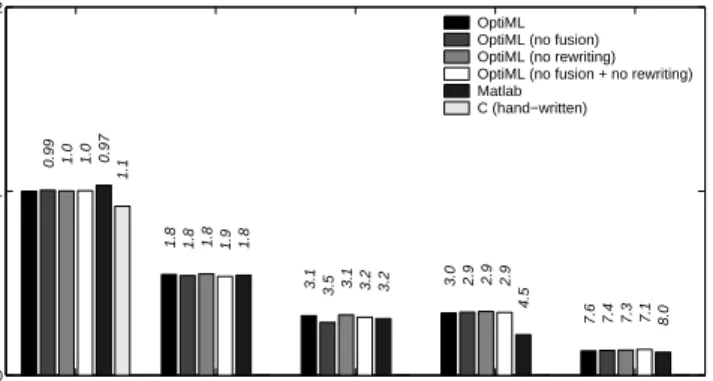
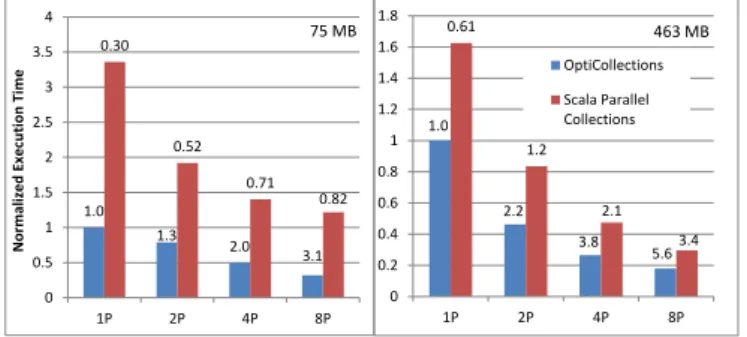
16.4 Delite DSLs . . . 141 16.4.1 OptiML . . . 141 16.4.2 OptiQL . . . 141 16.4.3 OptiMesh . . . 142 16.4.4 OptiGraph . . . 143 16.4.5 OptiCollections . . . 143 16.4.6 DSL Extensibility . . . 144 16.4.7 DSL Interoperability . . . 145 16.5 Performance Evaluation . . . 146 16.5.1 Discussion . . . 150
16.5.2 OptiML vs C++ Performance Measurements . . . 150
17 Other Projects 153 17.1 StagedSAC . . . 153
17.2 Scala Integrated Query (SIQ) . . . 154
17.3 Jet: High Performance Big Data Processing . . . 154
17.4 JavaScript as an Embedded DSL . . . 155
17.4.1 Sharing Code between Client and Server . . . 156
17.4.2 Evaluation . . . 157
Chapter 1
Introduction
Computer programs are written by humans and executed by machines. But humans and machines do not speak the same language. Programs expressed in ahigh-levelprogramming language convenient for human programmers need to be translated to alow-levelmachine dialect. This translation is usually accomplished by a separate program, acompiler. Compil-ers can translate any legal program to equivalent low-level code. But for individual source programs, automatic translation does not always deliver good results.
High-level programming languages such as Scala increase development productivity by focusing on abstraction and generalization. Efficient execution, by contrast, demands concretization and specialization. In many cases, programmers are forced to rewrite large parts of their own and possibly third-party code in a low-level style, which is time consuming and makes the program harder to understand and maintain.How can we scale productivity gains to performance-critical software?
On the hardware side, performance increasingly depends on multi-core processors and specialized accelerators such as GPUs, which are much harder to program efficiently than traditional sequential processors. The trend towards heterogeneous execution targets is not just performance driven, though. Web applications, for example, must deliver client components as executable JavaScript. Similar constraints apply to apps for mobile devices.
How can we target heterogeneous platforms from single high-level programs?
In broad terms, these are the research questions this thesis seeks to address. The software industry is facing a difficult tradeoff: Hardware developments and heterogeneous targets pose increasing productivity challenges, and expressive programming languages pose growing performance challenges. Compilers have not kept pace for two primary reasons:
1. Abstraction penalty:High level programs contain a lot of indirection and redundant
dispatch overhead due to module and abstraction boundaries which are essential for productivity. These indirections impose a runtime cost and perhaps more importantly, they cloud the compiler’s view of the program so that it becomes much harder to apply optimizations.
2. Lack of domain-specific optimizations:To obtain good performance a compiler needs
General purpose language compilers can only perform generic optimizations but cannot employ knowledge about the specific application domain (particularly important for efficient parallelization).
Other reasons include:
1. Dependence on program input: Domain specific optimizations or abstraction
over-head may depend on parts of the program input, which is not available at compile time.
2. Overwhelming number of choices:An optimizing compiler is confronted with a large
set of choices with uncertain outcomes. Exploring them all is not tractable for large programs.
An alternative to automatic program translation is explicit program generation. In this case, programmers write a high-level program that produces a lower-level program as its output. This approach has the potential to solve the issues listed above but comes with a set of other challenges:
1. Not much support to build program generators. Compilers are well understood. The
development effort for a new (general purpose) compiler is large but it can be amortized over a huge number of programs. Program generators are less widespread and more spe-cialized. There is much less practical experience to draw from. The development effort is also large but the scope of use is much narrower. Thus, building program generators is only feasible for key libraries (FFT, BLAS), not for everyday programming. Specialized
multi-stageprogramming languages[133] aim to increase productivity in building code generators by providing special syntax that allows to markstagedprogram expressions that will become part of the generated program (as opposed to the generator). While there are certain well-formedness and type safety guarantees, the program abstraction is still essentially syntactic, and programmers have to explicitly manage the execution order of staged expressions. This makes it hard to avoid subtle errors caused by dupli-cating or reordering computation. Moreover, since the original intention is to generate low-level programs, it is often desirable to have a more restricted target language.
2. Lack of generic optimizations. Program generators can easily implement domain
specific optimizations that are expressible asspecializationsof a certain template. But to work well in a more general setting, theyalsoneed to apply all the generic optimizations of a regular compiler. Generic and specific optimizations need to be integrated for maximum effectiveness. This means that common compiler optimizations that, for example, remove redundant or unnecessary computations or move computation out of loops, need to be applied on the level of domain operations, for example, on matrix and vector operations in a linear algebra program. Applying these common optimizations only on the level of generated low-level code is too late. For example, a duplicated matrix multiplication will lead to two sets of nested loops that a low-level compiler cannot easily recognize as identical. This is a key reason why compiler preprocessors and macro systems are only suited for a limited range of optimizations.
1.1. Embedded Compilers: A Hybrid Approach
1.1 Embedded Compilers: A Hybrid Approach
In this dissertation we investigate an alternative approach to fully automatic translation or fully manual program generation. We propose a hybrid design: integrate compilers into programs so that programs can take control of the translation process, but rely on libraries of common compiler functionality for help. This raises three important questions. If compilers are embedded into programs then:
1. What language does an embedded compiler understand? Compared to
general-pur-pose languages, embedded compilers understand simpler but larger languages. Their languages are domain specific: they provide only a minimum of abstraction facilities but lots of concrete operations with efficient translations. Embedded compilers are essentially libraries. They are modular and extensible through modularity features of the language they are written in. For the embedded languages, core constructs and generic optimizations are provided by a framework. New domain specific features and optimizations can be added by additional libraries or by the application itself. Depending on the code generation target, compiler modules exist that lift large parts of the standard library of the enclosing language to the embedded domain and add library specific optimizations.
2. Which programs does an embedded compiler translate?Embedded compilers do not
implement lexers, parsers or type checkers. They rely on the surrounding program to provide input in an intermediate representation (IR). Embedded compilers expose the syntax of their language as an API that the program can use to create and assemble IR expressions. This API behaves just like a library that would otherwise directly execute the operations, but instead it creates IR nodes. In this thesis, expressions that create IR nodes are identified by their type. Many operations on regular values are lifted to the domain of IR nodes. The types of the arguments define which version is used, whether the operation is executed directly or an IR node created. Compiler API calls and direct computation can be mixed freely in the same program. This way, the program can resolve indirection and abstraction overhead through immediate computation and will create IR expressions only for those operations that need to run fast.
3. What is the output of an embedded compiler?The final output of an embedded
com-piler is low-level source or binary code in one or more target languages (e.g. Scala, C, assembly, CUDA, JavaScript, SQL) that the program can load and run at its convenience. Embedded compilers can also be layered to form multi-pass compilation pipelines. In that case, the program traverses (i.e. interprets) the IR-form output of one compiler and computes input for another, possibly lower-level compiler. Thus, program transforma-tion passes can take advantage of the same benefits as the initial program generatransforma-tion. Most importantly, they need not implement low-level IR manipulation but use the regular compiler API, intermixed with direct computation to resolve abstraction. The rest of this thesis will explain the technical details and demonstrate the validity and usefulness of this approach.
1.2 Lightweight Modular Staging
Embedded compilers try to overcome the performance and productivity gap by leveraging productivity where performance does not matter and vice versa: Generating embedded programs and compiling them is not performance critical but productivity is paramount to make the development of staged programs and embedded compilers affordable. Embedded programs need to run fast but they are generated programmatically and not written by humans, so programmer productivity is not a concern.
Programming with embedded compilers makes a pattern explicit that is found in many programs, namely a division into computationalstages, separated by frequency of execution or availability of information [68]. Thus, embedded compilers can be seen as a form of multi-stage programming (MSP)[130]. We will refer to the program phase of constructing embedded program IR nodes via the embedded compiler API asstaging time. The particular method, developed throughout this thesis, is called lightweight modular staging (LMS)[110, 111]. Compared to previous multi-stage programming approaches, LMS uses types to identify stages instead of syntax annotations, provides execution order guarantees, and offers a principled interface for extensible optimizations.
1.3 Combining Staging and Extensible Compilers
In order to reason about user or library defined abstractions compilers need to be extensi-ble. Common mechanisms to extend compilers fall into two categories. Frontend macros, staging or partial evaluation systems can be used to programmatically remove abstraction and specialize programs before they enter the compiler. Alternatively, some compilers allow extending the internal workings by adding new transformation passes at different points in the compile chain or adding new IR types. None of these mechanisms alone is sufficient to handle the challenges posed by high level abstractions such as domain specific data structures. We present a novel way to combine them to yield benefits that are greater than the sum of the parts.
Instead of using staging merely as a front end, we implement internal compiler passes using staging as well. These internal passes delegate back to program execution to construct the transformed IR. Staging is known to simplify program generation, and in the same way it can simplify program transformation. Defining a transformation as a staged IR interpreter is simpler than implementing a low-level IR to IR transformer. Custom IR nodes can be added easily and many optimizations that are expressed as rewritings from IR nodes to staged program fragments can be combined into a single pass, mitigating phase ordering problems. Speculative rewriting can preserve optimistic assumptions around loops.
1.4 Deep Linguistic Reuse
Similar to previous MSP approaches, LMS leverages linguistic reuse [80] to increase produc-tivity for developing program generators by expressing program generator and generated
1.5. Abstraction Without Regret
code in a single program. We distinguish mostly syntacticshallowreuse fromdeepreuse that includes a nontrivial translation step: We say that we are reusing a language feature of the surrounding language in a deep way in embedded programs if the embedded compiler and its language do not need to implement the particular feature. Reusing the type system of the embedding language to produce type-correct target code without implementing type checking in an embedded compiler is an example of deep reuse. Deep reuse is key for productivity as it drastically simplifies embedded compiler development.
1.5 Abstraction Without Regret
As explained earlier, abstraction and generalization enable productivity but hinder perfor-mance by incurring interpretive overhead at runtime and obscuring semantic information at compile time, which complicates static analysis.
Deep reuse of abstraction facilities like functions or objects enables “abstraction without regret”: Programmers can use arbitrary language features to structure their programs in the generator stage, with the comforting knowledge that these abstractions are guaranteed to be removed at staging time. No runtime price will need to be paid, and the embedded compiler will see a program that has the abstraction stripped away. Thus, deep reuse is also important for performance. We demonstrate deep reuse of a variety of language features including functions, continuations, type classes, and staging-time data structures.
1.6 Language Virtualization
Coupled with an expressive general purpose language, embedded compilers are a key com-ponent to enable what we calllanguage virtualization[19]: Tweaking the language so that other languages can be embedded in it and embedded programs are “as good as” stand-alone programs. Of course “as good as” has many facets (expressiveness, safety, performance). Embedded compilers enable the performance aspect, which is otherwise a key obstacle for providing domain specific abstractions as libraries as opposed to building full fledged external domain specific languages.
This thesis presents Scala-Virtualized, an effort in virtualizing the Scala programming language. We understand virtualization also in the sense of virtual (i.e. overridable) methods, making core language features overridable. Overriding control structures such as conditionals is necessary to provide variants that create IR nodes for embedded compilers.
1.7 Domain-Specific Languages (DSLs)
With embedded compilers, developers can program with efficiently compiled domain-specific abstractions without having to build a complete DSL and a separate compiler toolchain. In other words, embedded compilers significantly enhance the power of the embedded DSL approach [58] of implementing DSLs as domain-specific libraries in an expressive general purpose host language.
Programmers get most of the benefits of a full external DSL (domain specific abstractions, efficient compilation; minus domain specific syntax) without the drawbacks (DSL develop-ment effort, overhead of several DSLs in a single program). They also get the benefits of an embedded DSL or a specific library (familiar constructs across different domain-specific extensions: loops, functions, etc). Many host language libraries can be lifted to the compiled DSL domain, so that DSLs need not implement standard library functionality. DSLs can be built from components and interoperate through the host language.
1.8 Delite
We have implemented the concepts described in this thesis as part of the LMS-Core and Delite frameworks, which are the basis for a number of highly efficient embedded DSLs [126, 11, 113, 127, 83]. Delite is a parallelization and heterogeneous computing platform that started out as a library-based deferred execution runtime [18]. Version 2 of Delite uses LMS and embedded compilation with very good results to provide a full-stack embedded DSL framework.
Among the DSLs developed using Delite are the following: • OptiML / OptiLA: Machine Learning and linear algebra • OptiQL / OptiCollections: Collection and query operations • OptiMesh: Mesh-based PDE solvers
• OptiGraph: Graph analysis
More details about Delite and the individual DSLs are presented in Chapter 16.
1.9 Contributions
In addition to demonstrating the power and usefulness of LMS and embedded compilers on the whole this thesis makes the following individual contributions:
Staging
• We present staging combinators that maintain the relative execution order of expres-sions within a stage. In previous work, arbitrary and context free combination of code fragments (plain strings or quasi-quoted expressions) may reorder effects or slow down programs by duplicating computation. We build on previous work on let-insertion, and on partial evaluation with side effects [137].
• We implement staging facilities as a library, with only minimal language support (virtual-ized control structures) and without extra syntax. Types within the language distinguish stages, and type inference provides a semi-automatic local binding-time analysis (BTA). Thus, the approach shares features of automatic partial evaluation and manual staging.
1.9. Contributions
Previous work focused on dedicated MSP languages with explicit quasi-quote syntax (Lisp, MetaML), or on fully automatic partial evaluation. We build on previous work on embedding typed languages [55, 15].
• We combine staging with extensible compilation. In particular, staged IR interpreters act as IR transformers. Thus we show that staging is not only beneficial for program generation but also for program transformation. Among the previously presented MSP languages, some (but not all) allow inspection of staged ASTs but in general there are no facilities to integrate domain specific optimizations into the compilation pipeline of staged expressions.
• We present applications and case studies that use advanced host language abstractions as part of code generator and obtain the effect of those abstractions in generated code without overhead (abstraction without regret) and without much additional work (deep linguistic reuse). In particular we discuss closures, continuations, type classes, trait-s/objects, gradual typing, object literals, for comprehensions and pattern matching. Many staged applications presented previously used monadic front-ends, or explicit interpreters that were staged to remove overhead.
Compiler Architecture
• We present an extensible compiler architecture that allows to compose many inde-pendent optimizations and maintains optimistic assumptions for combined optimiza-tions through speculative rewriting. In previous work, extensible compilers are often restricted to adding new phases and implementing combined optimizations often re-quires manually devising complicated superanalyses. We build on previous work on combining data flow analyses [85].
• We present a structured “sea of nodes” IR with nesting, frequency and parallelism infor-mation. On this IR we implement a code motion algorithm that can rearrange structured expressions such as nested loops or lambdas. The algorithm is driven by nesting instead of dataflow information. Most previously presented code motion algorithms rely an dataflow information which precludes their use for situations where flow information is not available.
• We present a novel data structure traversal and loop fusion algorithm that handles high-level data parallel loops and also supports asymmetric traversal operations, includ-ingflatMapandgroupBy. In previous work, imperative loop fusion has been studied extensively but most algorithms only support flat array traversals, noflatMap,filter, orgroupBy. In the functional setting, deforestation [153] and stream fusion [30] are able to combine linear traversals but neither data parallel loops norgroupBy.
Artifacts (developed in collaboration with others)
• Scala-Virtualized (Chapter 5): An extension of the Scala language to make embeddings more seamless.
• LMS-Core framework (Chapter 9): Common building blocks for core language features, lifting parts of the Scala standard library, generic optimizations.
• Delite DSL framework (Chapter 16): Data parallel operations and code generation for heterogeneous parallel devices.
• Various DSLs (Section 16.4, Chapter 17)
1.10 Terminology
Since much of the implementation work has been carried out in the context of compiled em-bedded DSLs that share common generic functionality, we will use the term “DSL” frequently with a broad meaning, for example to refer to arbitrary library modules that can construct program fragments for an embedded compiler (domain specific or not). Drawing a clear distinction between embedded DSLs and regular libraries seems like a futile undertaking in general. Moreover, we will use the following terms interchangeably (per line) except where otherwise noted:
host language meta language surrounding language embedded language object language DSL embedded program object program DSL program
embedded compiler DSL compiler
If further precision is required, we take the termobject programto denote a program expressed in an embedded compiler’s IR representation andDSL programto denote the larger class of programs that may also contain operations that are evaluated at staging time. Likewise,
object languagerefers to the language of an embedded compiler whereasDSLis the user-facing language that may contain staging-time operations.
1.11 Outline
Chapter 2 gives background information on hardware developments (Section 2.2), program-ming language advances (Section 2.4) and their respective challenges. Section 2.3 discusses domain-specific languages. Section 2.5 presents background on staging and generative programming.
Then two technical parts follow. The question Part I seeks to answer is: How do we define programs for embedded compilers? Correspondingly, Part II seeks to answer: How do embedded compilers compile these programs?
Within Part I, Chapter 3 reviews multi-stage programming as a way of increasing produc-tivity in program generator development by linguistic reuse, namely embedding generated code templates and generation logic in a single program. Chapter 4 discusses language virtu-alization. Chapter 5 introduces Scala-Virtualized. Chapter 6 discusses staging from the point
1.11. Outline
of view of linguistic reuse, Section 6.1 reviews the state of the art and Section 6.2 presents the contributions of LMS, as far as they apply to generating concrete syntax from staged expressions.
Within Part II, Chapter 7 switches to the intermediate representation level and gives an overview of the challenges that embedded compilers face and the design decisions taken in this thesis. Chapter 8 discusses a straightforward intermediate representation based on expression trees. Chapter 9 presents a more refined, graph-based representation that is better suited to extreme modularity. Chapter 10 discusses advanced optimizations.
Part III demonstrates staging and embedded compilers at work, discussing small but in-depth examples, in particular how embedded compilers provide abstraction without regret. Chapter 11 presents an overview, Chapter 12 focuses on control abstraction and Chapter 13 on data abstraction. Chapter 14 discusses case studies related to data representation conversion and loop fusion, as well as more common staging challenges.
Part IV provides additional validation and evaluation by describing larger projects that use the techniques developed in this thesis. Chapter 16 discusses the Delite DSL Framework. Section 16.4 discusses individual Delite DSLs. Chapter 17 discusses other projects (StagedSAC, SIQ, Jet embedded JavaScript). Chapter 18 finishes by surveying related work.
Chapter 2
Background
This chapters expands upon some of the topics from the introduction, such as hardware trends, programming language trends, domain specific languages and generative programming. The discussion focuses on the prior state of the art, not including the contributions of this thesis.
2.1 Economics of Productivity, Performance and Safety
Software development is largely driven by economic concerns. Project managers and devel-opers face a dilemma in choosing their tools: On the one hand, it is desirable to write very high level code and use programming abstractions close to the problem domain, while on the other hand, software is required to be efficient.
High-level abstractions make code easy to write and modify, thus economizing on devel-opment and maintenance hours. At the same time, high-level code is easy to understand for others. It is easier to reuse and adapt for new projects, so development efforts are more likely to amortize in the long run. In addition, the closer executable code is to a formal or informal specification, the easier it is to verify and test, reducing the chance of costly bugs in the field. Efficiency comprises low resource demands, so the system can be deployed on inexpensive hardware, as well as the system itself achieving low latency and high throughput.
Manually optimizing programs for performance incurs a great loss in productivity. Pro-grammers typically start with a high-level implementation and translate it to low-level, high performance code in a time-consuming process. This optimization process obfuscates the programmer’s intent and makes the code harder to understand, debug and maintain. The low-level code is tied to hardware details (e.g. cache-line size, number of processor cores) and is not easily portable to different architectures. A specification change may require re-optimizing the high-level code, or worse, the optimized code is modified and the high-level reference implementation is no longer in accordance with the specification. The use of low-level programming models is also detrimental to program safety because low-low-level code is more likely to attract bugs and is harder to verify correct. From a safety point of view, code generation and program synthesis are preferable to low-level post-hoc verification.
need to cope with a heterogeneous programming environment due to external reasons. In-terfacing with relational databases, for example, happens through SQL statements. Web applications contain server and client functionality where the client part that is supposed to run inside a web browser has to be provided as JavaScript code. This split makes it hard to refactor programs and move pieces of functionality from the server to the client or vice versa. Thus, equivalent functionality is often duplicated. In the case of web applications, input validation logic is frequently implemented twice, to be executed on the client for responsive-ness and on the server for security. Both versions must be maintained independently and if validation logic is accidentally changed in only one place there is a potential security risk.
2.2 Hardware Trends and Productivity Challenges
2.2.1 Hitting the Power Wall
Power constraints have limited the ability of microprocessor vendors to scale single-core performance with each new generation. Instead, vendors are increasing the number of processor cores and incorporating specialized hardware such as GPUs and SIMD units to improve performance [61].
2.2.2 Proliferation of Programming Models
To take advantage of heterogeneous systems, programmers need expertise in a variety of programming models (Pthreads or OpenMP for multi-core CPU, OpenCL or CUDA for GPU, MPI for clusters [136, 96]). An efficient mapping of an application to a heterogeneous architec-ture needs to match the characteristics of the application to the different capabilities of the hardware. At this time, there are no compilers or other automatic solutions that can reliably create efficient mappings for entire programs. This suggests that for each application and for each computing platform a specialized mapping must be created by a programmer that is an expert in the specific domain as well as in the targeted parallel architecture. This approach is unsatisfactory and likely infeasible at scale, as it incurs an explosion and fragmentation of mapping solutions. The key challenge is to find ways to take good mapping solutions created by experts and reuse them for larger classes of programs or entireapplication domains.
2.3 Domain-Specific Languages (DSLs)
One way to capture application-specific knowledge for a whole class of applications and simplify application development at the same time is to use a domain specific language (DSL). A DSL is a concise programming language with a syntax that is designed to naturally express the semantics of a narrow problem domain [143]. Examples of commonly used DSLs are TeX and LaTeX for typesetting academic papers, Matlab for prototyping numerical linear algebra algorithms, and SQL for querying relational databases.
2.3. Domain-Specific Languages (DSLs)
2.3.1 DSLs for Performance
DSLs have a long history of increasing programmer productivity by providing extremely high-level, in a sense “ideal”, abstractions tailored to a particular domain. Performance-oriented DSLs strive to also make thecompilermore productive (producing better code) by enabling it to reason on a higher level as well. While productivity and performance are often at odds in general-purpose languages, DSLs can expose significantly more semantic information about the application in addition to providing a means of writing concise, maintainable code. This semantic information, obtained in particular through domain constructs that expose structured, coarse-grained parallelism, makes it feasible for a DSL compiler to generate high performance code targeting parallel heterogeneous architectures, from high-level, single-source application code [18].
2.3.2 External DSLs
Despite the benefits of performance oriented DSLs, there are significant challenges to their widespread adoption. The dominant approach is to implement a DSL compiler tool chain from scratch. First, the cost of developing a DSL to a sufficient degree of maturity is immense and it is unclear whether this investment can be be made time and time again for all possible domains. This means that many DSLs will likely be immature and buggy. They will not provide state of the art tooling (IDEs, debuggers, profilers), they will be lacking in terms of modularity, and they are unlikely to support advanced programming constructs like objects or higher order functions due to their restricted execution model. Tools like Spoofax [71] address some of these issues by providing infrastructure for not only defining DSLs but also associated components like IDE editors and debuggers. There is also a tendency for DSLs to accumulate general purpose features over time but the implementation of those features will be substandard compared to general purpose languages (“inner platform effect”). Second, significant applications may need to use several DSLs. Having to use multiple different, incompatible, and immature DSLs to get high performance is not a clear advantage over the current low-level programming approach with multiple frameworks.
2.3.3 Embedded DSLs
Embedded, or internal DSLs require significantly less investment for development and use, especially if they are well integrated with the host language and environment [58, 59]. Such DSLs can be used like libraries and DSL programs can use regular host language syntax. Since embedded DSL programs can interoperate more easily with one another and with generic code written in the host language, programmers do not need to learn different syntax for common features and much of the host language tooling can be reused. However, embedded DSLs usually cannot perform optimizing transformations or compile to platforms not supported by the host language. Therefore, they are limited in the performance they can achieve on modern hardware. Individual compiled embedded DSLs have been studied [42, 84] but no general frameworks for their construction have emerged yet.
2.4 Programming Language Trends and Performance Challenges
General-purpose languages focus on primitives for abstraction and composition, so that programmers can build large systems from few and relatively simple but versatile parts. Modern expressive languages allow to build domain-specific language extensions as libraries (in fact, purely embedded DSLs). However, the compiler has no knowledge about the extended semantics.
2.4.1 The Abstraction Penalty
High-level programming languages such as Scala increase development productivity by fo-cusing on abstraction and generalization. In fact, building and managing complex software systems is only possible by generalizing functionality and abstracting from particular use cases. But abstraction does not come for free. Efficient execution, by contrast, demands con-cretization and specialization. These requirements are at odds. High level programs contain a lot of indirection and redundant dispatch overhead due to module and abstraction boundaries which are essential for productivity.
These indirections incur interpretive overhead and thus impose a runtime cost. Perhaps more importantly, they also cloud the compiler’s view of the program so that it becomes much harder to apply optimizations. Control flow analysis is a prerequisite for many other optimizations, but higher order control flow analysis is a tough problem because the flow of control depends on the flow of data, which again depends on the flow of control [145, 38].
2.4.2 The General Purpose Bottleneck
To obtain good performance a compiler needs to optimize programs based on semantic knowledge about the program operations. General purpose language compilers can only perform generic optimizations but cannot employ knowledge about the specific application domain. Domain knowledge is particularly important for efficient parallelization.
General-purpose compilers do not understand the semantics of the complex operations performed within an application. Reasoning across domain constructs, however, enables more powerful and aggressive optimizations that are infeasible otherwise. Because of the general-purpose nature needed to support a wide range of applications, compilers can usually infer little about the structure of the data or the nature of the algorithms the code is using. By contrast, DSL compilers can use aggressive optimization techniques using knowledge of the data structures and algorithms derived from the DSL.
General-purpose languages impose very few restrictions on programmers which in turn requires the compiler to perform non-trivial analyses to prove that optimizations are safe. Unfortunately, safety of optimizations often cannot be determined and therefore the compiler must be conservative and not apply the optimization to guarantee correctness of the generated code.
Performance-oriented DSLs can take the opposite approach to the problem, namely re-strict the programmer from writing code that would prevent the compiler from generating
2.4. Programming Language Trends and Performance Challenges
an efficient implementation. The compiler is then able to perform very aggressive optimiza-tions with much simpler or even without safety analyses, providing the programmer with efficient code for significantly less effort. For example, a program requiring graph-analysis would express graph traversals using a breadth-first search or depth-first search language construct without spelling out the implementation of such traversals [57]. A corresponding domain-specific compiler can reason about the program at the level of domain operations, enabling coarse grain optimizations, for example eliminating whole linear algebra operations as opposed to individual arithmetic instructions. Furthermore, these abstractions leave im-plementation details unspecified, providing the compiler with the freedom to translate the application to a number of different low-level programming models.
2.4.3 Static or Dynamic Compilation
Domain specific optimizations or abstraction overhead may depend on parts of the program input, which is not available at compile time.
Programs can be compiled either ahead of time or just in time (JIT). Some modern lan-guage environments such as the Java Virtual Machine (JVM) employ a combination of these techniques. Virtual machines that employ JIT compilation obtain some information on dy-namic behavior of the program, for example by call-site specific profiling or class analysis (HotSpot/V8). Nevertheless, compilation happens mostly automatically and it is hard for JIT compilers to guess the right specialization points. While VMs employ aggressive inlining they do not usually generate multiple specialized code paths based on program data (monovariant specialization only).
2.4.4 Combinatorial Explosion
An optimizing compiler is confronted with an overwhelmingly large set of choices with uncer-tain outcomes. It cannot possibly explore all of them and must rely on heuristics which, by their very nature, work some but not all of the time.
2.4.5 Functional Programming Challenges
Functional programming presents lots of theoretical opportunities for program optimization due to referential transparency: Evaluating a particular expression produces always the same result, independent of the context. Expressions can be reordered or eliminated as long as input dependencies are maintained. Control and anti-dependences do not exist in pure functional programs. This simplicity is also exploited by mostly-functional intermediate representations such as SSA-form [3].
In practice however, functional programs are often less efficient than tight imperative code because they create lots of temporary data structures instead of modifying data in place. In a sense, impure functional languages that discourage but do not disallow side effects get the worst of both worlds because their compilers cannot safely apply optimizations that rely on
functional properties without proving the absence of side effects with the help of sophisticated effect systems.
2.4.6 Scala Challenges
The Scalac compiler does not employ effect analysis and thus has to be very conservative, assuming worst case side effects in many places. This slows down functional programs in Scala noticeably. If generic types are instantiated to primitives, primitive values will need to be “boxed” in order to maintain the uniform representation as heap allocated objects. Boxing is expensive in terms of memory use, allocation cost and garbage collection overhead. Thus, programmers can request to specialize generics for primitive types by adding@specialized
annotations to type parameters of classes or methods [36]. However, programmers must take care that indeed the full call paths are specialized, otherwise boxing will still occur. There is also a risk of code bloat: When naively specializing a class with three type parameters for all 10 primitive types, 1000 versions of this class will be produced.
The Scala compiler is also prone to a few instances of phase ordering problems. Early on, for example, local variables that are accessed by closures will be converted to heap allocated reference cells. Later, the closure allocation may get eliminated and the code inlined. However, the local variables have already been converted to heap objects and will not be converted back. Another example is tail call elimination happening before inlining. If an invocation becomes a recursive tail call only via inlining it will not be converted to a jump. Inlining in general has to be conservative, since Scalac has to operate under a fundamental open-world assumption. Inlining implicitly assumes that the inlined bytecode will not change between compilation and runtime. Scalac chooses to inline only (effectively) final methods that can never be overridden. This decision is slightly more conservative than it needs to be: If the exact type of an object is known at compile time even non-final methods could safely be inlined.
2.4.7 JVM Challenges
The Java Virtual Machine (JVM) comes with its own set of challenges. The uniform reference object representation that requires boxing of primitives was already mentioned above. A related problem is that there is no notion of structs or records that can be allocated on the stack or stored consecutively in arrays. Array accesses also require bounds checks. The JIT compiler will eliminate bounds checks in many cases but these mechanisms do not work reliably for complex access patterns. Furthermore, all freshly allocated arrays are initialized with zero values, which can impose some slowdown and hinder efficient parallelization.
The HotSpot JIT compiler performs aggressive inlining of “hot” methods driven by runtime profiling. The profiling is done on a per call site basis, which produces very good results if call sites are monomorphic, i.e. always call the same target method. However the scheme breaks down for higher order control flow [22]. Taking the higher order functionforeachas an example, the number of distinct functions called fromforeachis very large and thus every iteration step pays the overhead of a virtual method call. A much better strategy would be to
2.5. Staging and Generative Programming
first inlineforeachat its caller which would produce a monomorphic call to the particular closure argument.
2.5 Staging and Generative Programming
Generative programming is a promising alternative to fully automatic translation. Instead of writing down the target program directly, developers write a high-level, generic program generator, which produces a specialized, efficient program as its output. However, developing high-quality program generators requires a very large effort that is often hard to amortize.
Generative programming can be broadly classified as static or dynamic. Static code gener-ation happens at compile time, a widely used example is the C++ template language or macro systems in other languages. Dynamic code generation that takes place at program runtime brings additional flexibility because code can be specialized with respect to parameters not yet available at compile time.
2.5.1 Multi-Stage Programming With Explicit Annotations
Many computations can naturally be separated into stages distinguished by frequency of execution or availability of information. Staging transformations aim at executing certain pieces of code less often or at a time where performance is less critical. In the context of program generation, multi-stage programming (MSP,stagingfor short) as established by Taha and Sheard [133] allows programmers to explicitly delay evaluation of a program expression to a later stage (thus,stagingan expression). The present stage effectively acts as a code generator that composes (and possibly executes) the program of the next stage. A nice property of this approach is that generator and generated code are expressed in a single program, with the aim that programmers can construct a multi-stage program from a naive implementation of the same algorithm by adding staging annotations in a selective way.
Basic mechanisms for composing program fragments at runtime have existed for a long time in the form of Lisp’s “code is data” model and its use of quasi-quotation: syntactic annotations to denote expressions that should remain unevaluated and to mark holes within them, to be filled in with expressions computed elsewhere. Dedicated MSP languages such as MetaML [133] and MetaOCaml [13] add well-scoping and well-typing guarantees about the generated code. Despite these advances, building “active” libraries or domain-specific languages (DSLs) that incorporate dynamic code generation remains a significant challenge.
2.5.2 Partial Evaluation
Partial evaluation is an automatic program transform that essentially performs very aggressive constant propagation [65]: Given somestaticparts of the program input, partial evaluation produces aresidualprogram that is specialized to the already provided static inputs. Passing the remainingdynamicinput to the residual program will produce the final result, but in a more efficient way than just executing the original program.
Partial evaluation literature calls stages “binding times”. Where staging requires the pro-grammer to define the binding times of each expression, partial evaluation determines the binding times automatically. Offline partial evaluation itself works in two stages, with a ded-icated binding time analysis (BTA) followed by a specialization pass. BTA annotates each expression of the input program whether it can be computed statically or must beresidualized, i.e. become part of the residual staged program. Staging can be seen as a manual form of BTA and BTA as a form of automatic staging.
Since partial evaluation is a form of program specialization, it usually comes with sound-ness guarantees and preserves semantics of programs. In general this is not the case with staging, where programmers can more freely compose program fragments. Nevertheless staging is often used with the intent of achieving specialization, so tighter semantic guarantees seem highly desirable.
An alternative to offline partial evaluation is online partial evaluation, which makes deci-sions what to specialize during the specialization process itself, instead of relying on a separate BTA. Hybrid approaches exist as well [128, 116]. Closely related to partial evaluation is super-compilation [141, 123], and there have been efforts to unify different notions of automatic program transformation [12, 122].
2.5.3 Generative Front-Ends and Extensible Compilers
Macro systems, staging and partial evaluation are used to specialize programs before they reach the real compiler. Thus, they provide a simple way of extending a general purpose language with domain-specific abstractions that can be resolved in a controlled way.
Another option is to teach the compiler itself new domain-specific rules [97, 41, 67]. In many cases, compiler extensibility is understood as allowing to add new phases. This leads to phase ordering issues if there are many optimization passes. Also, passes need to be defined as transformations on some kind of program IR. This is much more difficult than the macro or staging approach, which can use regular (multi-stage) computation to express the desired target code. Some extensible compilers also allow adding new IR types but often it is not clear how new nodes interact with existing generic optimizations.
We argue that none of these approaches alone is sufficient and a lot is to be gained if they are combined. To give an example, if all we have is staging or macros, and we implement a linear algebra package, then a matrix multiplicationm*idwill be expanded into while loops before it even reaches the compiler, so no simplification tomcan take place.
Let us imagine that we use a system which allows us to implement the matrix multiplication in such a way that it can inspect its arguments to look for uses ofid. This would cover the simple casem*idbut we would still run into problems if we complicate the use case slightly and first assignval m2 = idand then computem*m2. To handle programs like this, it is not sufficient to just inspect the (syntactic) arguments. We need to integrate the staging expansion with some form of forward data flow propagation, otherwise the argument is just an identifier. In general, limited forms of simplification can be added (see C++ expression templates [146]) but to be fully effective, the whole range of generic compiler optimizations
2.5. Staging and Generative Programming
(constant propagation, dead code elimination, etc) would need to be duplicated, too. If on the other hand all we have is a facility to add new compiler passes, then we can add an optimization pass that simplifiesm*idtom, but we need another pass that expands matrix multiplications into loops. This pass needs to be implemented as a low-level IR to IR transfor-mation that is much more complicated than a straightforward staged implementation. Phase ordering problems are also likely to arise if multiple optimizations are added independently. The deeper problem is that we are forced to commit to a single data representation. Even if we combine staging with an extensible compiler we need to make a decision: Should we treat matrices as symbolic entities with algebraic laws, implemented as IR nodes amenable to optimization? Or should we stage them so that the compiler sees just loops and arrays without abstraction overhead?
What we really want instead is to first treat operations symbolically, subject to linear algebra optimizations and generic optimizations (combined for maximum effectiveness). Once no further simplification is possible, lower the operations to expose the representation as arrays and loops and apply another set of specific optimizations (e.g. loop fusion), again combined with the usual generic ones. Since we have changed the representation, there may be new opportunities for generic optimizations, e.g. newly exposed internal sharing between two matrix or vector ops, which should become subject to common subexpression elimination again.
Part I
Chapter 3
Intro: Staging as Meta Programming
How do we define programs for embedded compilers?
First a bit of terminology: Meta-programs are programs that manipulate other programs. Object-programs are programs manipulated by other programs. Meta-languages and object-languages are the object-languages of meta-programs and object-programs, respectively. Program generators are meta-programs that produce object-programs as their final result [130].
In the context of program generation, multi-stage programming (MSP,stagingfor short) as established by Taha and Sheard [133] allows programmers tostageprogram expressions, moving them from the meta program to the object program and delaying their evaluation until the object program is executed. The presently executing (meta program) stage acts as a program generator that composes and possibly executes the programs of the next stage. The meta program and the object programs are uniformly expressed in a singlemulti-stage
program. Thus, object programs areembeddedprograms.
For the programmer, the key benefit of multi-stage programming is linguistic reuse [80]: Multi-stage programs inherit functionality of the meta-language, such as scoping and typing rules, so if a multi-stage programs type checks, all the generated code will be syntactically valid and well-typed. The goal is to allow programmers to construct a multi-stage program from a naive implementation of the same algorithm by adding staging annotations in a small number of key places. Unfortunately, staging does not generally preserve the semantics of a program [60]. Thus, it is not so easy to achieve this goal in practice because adding staging annotations can drastically change the result of even very simple and straightforward programs. A contribution of this thesis is to systematically preserve statement execution order within a stage, following earlier work on partial evaluation in the presence of effects [137]. This preserves semantics in many more cases and takes us a step closer to our goal.
Lightweight Modular Staging (LMS) The following chapters present the front end part of
Lightweight Modular Staging (LMS), a new multi-stage programming approach developed as part of this thesis [110, 111]. The elaboration continues in Part II, which presents the back end parts.
The classical introductory staging example is to specialize the power function for a given exponent, assuming that a program will take many different numbers to the same power.
Considering the usual implementation,
def power(b: Double, n: Int): Double =
if (n == 0) 1.0 else b * power(b, n - 1)
we want to turn the basebinto astagedexpression. LMS uses types to distinguish the compu-tational stages. In particular, we changeb’s declared type fromDoubletoRep[Double]. The meaning of having typeRep[Double]is thatbrepresentsa computation that will yield aDouble
in the next stage. We also change the function’s return type accordingly.
Now we need to regain the ability to do arithmetic onb, which is no longer a plainDouble. The second idea of LMS is to package operations on staged types as components. To make its required functionality explicit, we wrap the power function itself up as a component (a trait):
trait Power { this: Arith =>
def power(b: Rep[Double], n: Int): Rep[Double] =
if (n == 0) 1.0 else b * power(b, n - 1)
}
LMS shares many properties of earlier staging approaches but has some important differ-ences:
1. In most previous approaches, the meta language and the object language are the same (homogeneous staging). Both are part of a dedicated, fixed multi-stage language. But sometimes we would like the object and the meta languages to be different, as there is a lot to be gained from simpler object languages. Where meta languages should focus on abstraction, embedded languages should provide only a minimum of abstraction facilities but lots of concrete operations with efficient translations. Similar to previous “offshoring” approaches [39], LMS allows programmers to write combined multi-stage programs and profit from linguistic reuse, even if the object and meta languages are different. Since LMS is a purely library-based staging solution, the embedded languages can also be extended and composed by the multi-stage program itself, without changing the meta language implementation.
2. Linguistic reuse has previously been exploited for scoping and typing, but not for execu-tion order. Naturally, staging allows programmers to define execuexecu-tion order by adding staging annotations. But in practice, programmers must explicitly and precisely define the execution order ofallstaged program fragments! As shown in Section 6.1.6, the execution order is not related to the appearance of the statements in the multi-stage program. With our approach, programmers only define the stage. The execution order within a stage is retained from the multi-stage program. As shown in Section 6.2.1, this aspect of LMS is also applicable to more traditional staging approaches based on quasiquotation, which previously relied on monads for sequencing [129].
3. Previous staging approaches used syntactic annotations to distinguish stages. LMS reduces the syntactic overhead by using only types. This makes the system more expres-sive because changes required to add staging are more localized. Deep reuse of type inference provides a simple form of local binding-time analysis.
Organization Before we dive into the details of LMS, we take a look at language virtualization (Chapter 4) and the Scala-Virtualized language extensions (Chapter 5), which are helpful to support embedded languages and in particular library based staging in Scala.
After that, we examine how linguistic reuse allows staging to simplify the development of program generators (Chapter 6). We review the state of the art (Section 6.1), identify open problems and present the contributions of LMS in detail (Section 6.2).
Chapter 4
Language Virtualization
The necessity of general purpose languages to serve as meta languages is widely recognized [81, 125, 118], not only in the context of program optimizations through code generation and staging but also more generally for embedding DSLs [58, 59].
We propose language virtualization as a concept to capture necessary conditions to assess the ability of a programming language to serve as meta language. In an analogy to hardware virtualization [106], where one wants to virtualize costly “big iron” server resources in a data center and run many logical machines on top of them, it is desirable to leverage the engineering effort that went into a general-purpose language to support many small embedded languages, each of which should behave more or less like a real language. The following material is taken from [19].
4.1 Defining Language Virtualization
Definition. A programming language isvirtualizablewith respect to a class of embedded
languages (and by extension programs) if and only if it can provide an environment to these embedded languages that makes the embedded implementations (and by extension programs) essentially identical to corresponding stand-alone language implementations (programs) in terms ofexpressiveness,performance andsafety—with only modestly moreeffort than implementing the simplest possible complete embeddings (as pure libraries).
Expressivenessencompasses syntax, semantics and, in the case of domain-specific lan-guages, general ease of use for domain experts. Just as virtual hardware resources are not exactly identical to real ones, we do not require that an embedded language can exactly model the syntax of a stand-alone language but settle for a syntax that is essentially the same, i.e. modulo syntactic sugar. The same consideration applies to the other criteria as well.
Performanceimplies that programs in the embedded language must be amenable to extensive static and dynamic analysis, optimization, and code generation, just as programs in a stand-alone implementation would be. For many embedded languages, in particular those that are the focus of this paper, this rules out any purely interpretation-based solutions.