CO-OPTIMIZING HARDWARE DESIGN AND
META-TRACING JUST-IN-TIME COMPILATION
A Dissertation
Presented to the Faculty of the Graduate School
of Cornell University
in Partial Fulfillment of the Requirements for the Degree of
Doctor of Philosophy
by
Berkin Ilbeyi
CO-OPTIMIZING HARDWARE DESIGN AND META-TRACING JUST-IN-TIME COMPILATION
Berkin Ilbeyi, Ph.D. Cornell University 2019
Performance of computers has enjoyed consistent gains due to the availability of faster and cheaper transistors, more complex hardware designs, and better hardware design tools. Increasing computing performance has also led to the ability to develop more complex software, rising popularity of higher level languages, and better software design tools. Unfortunately, technology scaling is slowing, and hardware and software depend more on each other to continue deliver performance gains in the absence of technology scaling. As single-threaded computing performance slows down, emerging domains such as machine learning are increasingly using custom hardware. The proliferation of domain-specific hardware requires the need for more agile hardware design methodologies. Another trend in the software industry is the rising popularity of dynamic languages. These languages can be slow, but improvements in single-threaded performance and just-in-time (JIT) compilation have improved the performance over the years. As single-threaded performance slows down and software-only JIT techniques provide limited benefits into the future, new approaches are needed to improve the performance of dynamic languages.
This thesis aims to address these two related challenges by co-optimizing hardware design and tracing JIT compilation technology. The first thrust of this thesis is to demonstrate meta-tracing JIT virtual machines (VMs) can be instrumental in building agile hardware simulators across different abstraction levels including functional level, cycle level, and register-transfer level (RTL). I first introduce an instruction-set simulator that makes use of meta-tracing JIT compilation to productively define instruction semantics and encodings while rivaling the performance of purpose-built simulators. I then build on this simulator and add JIT-assisted cycle-level modeling and embedding within an existing simulator to achieve a very fast cycle-level simulation methodology. I also demonstrate that a number of simulation-aware JIT and JIT-aware simulation techniques can help productive hardware generation and simulation frameworks to close the performance gap with commercial RTL simulators. The second thrust of this thesis explores hardware acceleration
opportunities in meta-tracing JIT VMs and proposes a software/hardware co-optimization scheme that can significantly reduce dynamic instruction count in meta-tracing JIT VMs. For this, I first present a methodology to study and research meta-tracing JIT VMs and perform a detailed cross-layer workload characterization of these VMs. Then I quantify a type of value locality in JIT-compiled code called object dereference locality, and propose a software/hardware co-optimization technique to improve the performance of meta-tracing JIT VMs.
BIOGRAPHICAL SKETCH
Berkin ˙Ilbeyi was born on September 26, 1989 in Istanbul, Turkey. He is the only child of U˘gur and Gül ˙Ilbeyi. He grew up in Istanbul. He attended FMV Ayaza˘ga I¸sık Lisesi from kindergarten until the 8th grade and Robert College for high school. During high school, he first discovered programming by writing games on his TI-84 Plus calculator. He took Java programming and electronics elective classes and was fascinated by the limitless possibilities of software and hardware design at an early age. At this time, he also took lessons for oil painting and violin and enjoyed these activities. He attended Lafayette College in Easton, PA, double majoring in Electrical and Computer Engineering, and Computer Science. His passion for software and hardware grew as he took advanced classes. His summer internship at EPFL in Lausanne, Switzerland, working with Prof. Babak Falsafi introduced him to computer architecture research, and he decided to do a PhD in computer architecture.
Berkin was accepted to Cornell University in 2012. At Cornell, he was advised by Prof. Christopher Batten. He initially worked on the explicit loop specialization project with Shreesha Srinath. Later, he helped write a funded grant on hardware acceleration techniques for Python, which funded the majority of his PhD. He worked on a number of projects at the intersection of meta-tracing just-in-time compilers and hardware design that are detailed in this dissertation. During his PhD, he had two internships: one at Google Platforms working on a prototype FPGA backend for the XLA compiler, and another at Oracle Labs working on the Truffle/Graal system. He also frequently played, and still very much enjoys, squash. Berkin has matured as a researcher, engineer, and as a person during this time, and he is very thankful to everybody who has supported him during this challenging but rewarding adventure. Berkin will start working at Google upon the completion of his PhD.
ACKNOWLEDGEMENTS
This thesis became a reality with the support of numerous people in my life. First and foremost, my advisor, Christopher Batten, was tremendously influential not only for my research direction, but also for the development of my professional skills. His vision on vertically integrated computer architecture research was what attracted me to Cornell and it has been a fascinating ride. He remains one of my biggest role models with his technical knowledge, intellect, ability to distill and teach complicated concepts, writing and presenting style, and skill in asking the right (often hard) questions. I am excited to find out what Chris and the Batten Research Group achieve in the future. I hope that our paths coincide and get to work together again!
I would like to thank Carl Friedrich Bolz-Tereick. He has a wealth of knowledge for everything PyPy, dynamic languages, and JITs in general. He has been a great collaborator for many of the works presented in this thesis so his help was invaluable. There were also many other teachers and professors who helped and guided me to reach this point. My committee members José Martínez and Zhiru Zhang helped me refine my research direction with their thoughtful feedback. I also enjoyed the classes I took from them. Additionally, Compilers and Programming Languages classes I took from Andrew Myers and Adrian Sampson respectively were excellent. Also many thanks to my professors in college, especially John Nestor, John Greco, and Chun Wai Liew. The classes they taught and being mentored by them stirred my intellectual curiosity, leading me to pursue a PhD degree. Furthermore, many thanks to my high-school teachers, Alison O˘guz, Joe Welch, Cengiz A˘galar, Sandra Çorbacıo˘glu, and many others for inspiring to be creative and introducing me to the fascinating world of engineering, programming, and electronics.
I would like to acknowledge the members of the Batten Research Group (BRG). In particular, I collaborated with four BRG members very closely and each of these experiences have been very enjoyable. Firstly, many thanks to Shreesha Srinath for being a great friend and collaborator. I really enjoyed working on the XLOOPS project together. Whiteboarding sessions, attending conferences together, and grabbing beers after work to rant about research and life were some of the highlights of graduate school. Secondly, I collaborated with Derek Lockhart on the Pydgin project and it was a lot of fun to hack PyPy together to support more ISAs and get great performance. He also mentored me during my internship at Google and remains a good friend. I collaborated with Shunning Jiang on the Mamba project, and working together to make PyMTL go fast was a great experience. Lastly, Lin Cheng helped me with the skippable sub-traces project, and I enjoyed working with him. I am
also excited to see where he takes the project as he takes ownership over co-optimization techniques to make PyPy go fast. I thank the other members of BRG as well: Ji Kim led the Loop Task Accelerator project that I was briefly a part of (and I had a lot of fun playing board games with him); Chrisopher Torng led the BRG Test Chip 2 (and I always enjoyed chatting with him about research and career); and despite I did not collaborate as much with the rest of BRG, Moyang Wang, Khalid Al-Hawaj, Tuan Ta, Yanghui Ou, and Peitian Pan, I appreciate their friendship and support. I would also like to acknowledge the members of Cornell Computer Systems Laboratory, Skand Hurkat, Andrew Ferraiuolo, and many others, for their support. Additional thanks to Yunsup Lee, Sarah Mount, Maciej Fijalkowski, Alex Katz, Mohammad Dohadwala, Scott McKenzie, and Alvin Wijaya for other technical help and feedback on the work presented in this thesis. A more detailed discussion of the technical contributions by my collaborators can be found in Section 1.5. This work was supported in part by NSF CRI Award #1512937, NSF SHF Award #1527065, NSF XPS Award #1337240, NSF CAREER Award #1149464, DARPA POSH Award #FA8650-18-2-7852, DARPA Young Faculty Award #N66001-12-1-4239, AFOSR YIP Award #FA9550-15-1-0194, and equipment, tool, and/or physical IP donations from Intel, Xilinx, Synopsys, Cadence, and ARM.
This degree would definitely not be possible without my parents and their constant love, affection, and support. Their financial support enabled me to attain a great elementary school education, attend the best high school in Turkey, and then make my dream of studying in the US come true. Supporting my education meant that they had to make significant sacrifices to their quality of life they could have otherwise had. Besides financial support, their emotional support in difficult times also was crucial. I will be forever thankful to them.
Lastly, many thanks to Jocelyn for the unlimited support she has provided. Even though I have met her only in the last two years of graduate school, she became an unreplaceable part of my life. I am looking forward to a life together with her.
TABLE OF CONTENTS
Biographical Sketch . . . iii
Dedication . . . iv
Acknowledgements . . . v
Table of Contents . . . vii
List of Figures . . . x
List of Tables . . . xii
List of Abbreviations . . . xiii
1 Introduction 1 1.1 Software/Hardware Co-Evolution . . . 1
1.2 The Present and Future of Hardware Design . . . 5
1.3 The Present and Future of Software Performance . . . 6
1.4 Thesis Overview . . . 8
1.5 Collaboration, Previous Publications, and Funding . . . 9
2 Background on Meta-Tracing JIT VMs 11 2.1 Dynamic Languages . . . 11
2.2 Just-in-Time Compilation . . . 14
2.2.1 JIT Design Decisions . . . 17
2.2.2 Classic JIT Optimizations and Techniques . . . 18
2.3 Partial Evaluation . . . 21
2.4 Meta-Tracing . . . 23
2.4.1 RPython Usage . . . 25
2.4.2 Meta-Tracing vs. Partial Evaluation . . . 30
I Accelerating Hardware Simulations with Meta-Tracing JIT VMs 31 3 Pydgin: Accelerating Functional-Level Modeling using Meta-Tracing JIT VMs 32 3.1 Introduction . . . 32
3.2 Pydgin ADL and Framework . . . 34
3.3 Pydgin JIT Generation and Optimizations . . . 36
3.3.1 Self-Modifying Code Support . . . 44
3.4 Pydgin Productivity . . . 46
3.5 Pydgin Performance . . . 47
3.6 Related Work . . . 48
3.7 Conclusion . . . 49
4 PydginFF: Accelerating Cycle-Level Modeling using Meta-Tracing JIT VMs 51 4.1 Introduction . . . 51
4.2 Background . . . 55
4.2.1 DBT-Based Instruction Set Simulation . . . 55
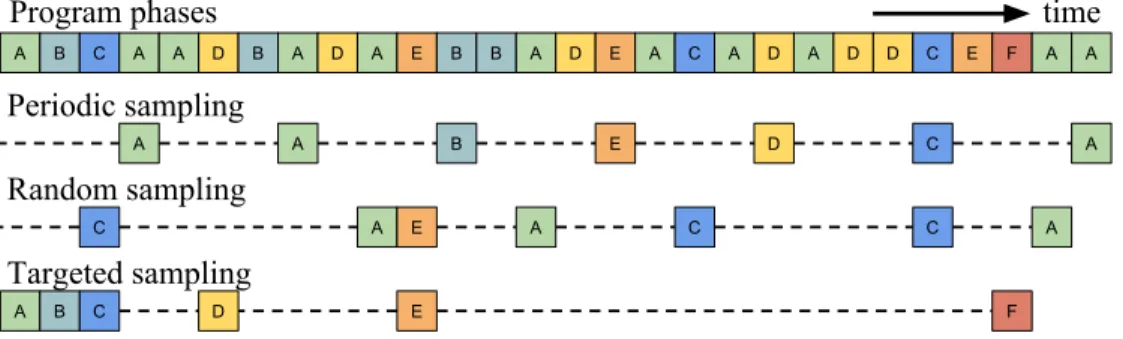
4.2.2 Sampling-Based Detailed Simulation . . . 57
4.3.1 JIT-FFE Proposal . . . 60
4.3.2 JIT-FFE Implementation . . . 61
4.4 JIT-Assisted Fast-Forward Instrumentation . . . 62
4.4.1 JIT-FFI Proposal . . . 63 4.4.2 JIT-FFI Implementation . . . 64 4.5 Evaluation . . . 66 4.5.1 Benchmarks . . . 66 4.5.2 Simulation Methodology . . . 68 4.5.3 Overall Results . . . 69
4.5.4 JIT-FFI Case Study: Cache Modeling . . . 72
4.5.5 JIT-FFI Case Study: BBV Generation . . . 73
4.6 Related Work . . . 74
4.7 Conclusion . . . 76
5 Mamba: Accelerating RTL Modeling using Meta-Tracing JIT VMs 78 5.1 Introduction . . . 78
5.2 The Mamba HGSF . . . 79
5.2.1 JIT-Aware HGSF . . . 80
5.2.2 HGSF-Aware JIT . . . 86
5.3 Case Study: RISC-V Multicore . . . 87
5.4 Conclusion . . . 89
II Building Hardware Accelerators for Meta-Tracing JIT VMs 90 6 Meta-Tracing Workload Characterization 91 6.1 Introduction . . . 91
6.2 Background on Meta-Tracing and RPython . . . 93
6.3 Baseline Characterization Methodology . . . 95
6.4 Cross-Layer Characterization Methodology . . . 96
6.5 Cross-Layer Workload Characterization . . . 98
6.5.1 Application-Level Characterization . . . 98
6.5.2 Framework-Level Characterization: Phases . . . 99
6.5.3 Framework-Level Characterization: JIT Calls . . . 102
6.5.4 Interpreter-Level Characterization: JIT Warmup . . . 104
6.5.5 JIT IR-Level Characterization: Compilation Burden and Usefulness of Meta-Traces . . . 108
6.5.6 JIT-IR-Level Characterization: Composition of Meta-Traces . . . 109
6.5.7 Microarchitecture-Level Characterization . . . 110
6.6 Discussion . . . 111
6.7 Related Work . . . 114
7 Software/Hardware Co-Design to Exploit Object Dereference Locality 117 7.1 Introduction . . . 117 7.2 Motivation . . . 119 7.3 Skippable Sub-Traces . . . 122 7.3.1 SST Profiling . . . 122 7.3.2 SST Recompilation . . . 124 7.3.3 SST Execution . . . 127 7.3.4 SST Invalidation . . . 129 7.4 Evaluation . . . 131 7.4.1 Methodology . . . 131
7.4.2 Reduction in Dynamic Instructions in JIT-Compiled Regions . . . 133
7.4.3 Whole-Program Analysis . . . 135
7.4.4 SSIE Sweep Case Study . . . 137
7.4.5 Recompile Options Case Study . . . 138
7.4.6 Prototype Chip Tapeout and Area Analysis . . . 140
7.5 Related Work . . . 142
7.6 Conclusion . . . 144
8 Conclusion 145 8.1 Thesis Summary and Contributions . . . 145
8.2 Future Work . . . 146
LIST OF FIGURES
1.1 Software/Hardware Co-Evolution . . . 2
2.1 Dynamic Language Features . . . 12
2.2 Example Python Code (HLR) . . . 15
2.3 Python Bytecode (DIR) . . . 15
2.4 JIT Pseudo-IR . . . 15
2.5 Simplified Python Interpreter . . . 15
2.6 Typical JIT VM Architecture . . . 17
2.7 Meta-JIT VM Architecture . . . 17
2.8 JIT Pseudo-IR with a Polymorphic Inline Cache (PIC) . . . 19
2.9 Partial Evaluation Example . . . 21
2.10 The RPython Framework . . . 24
2.11 Simplified RPython Interpreter . . . 27
2.12 Unoptimized Meta-Trace . . . 27
2.13 Optimized Meta-Trace . . . 27
2.14 Meta-Trace forc=(a+b)/2Without Escape Analysis . . . 28
2.15 Meta-Trace forc=(a+b)/2With Escape Analysis . . . 28
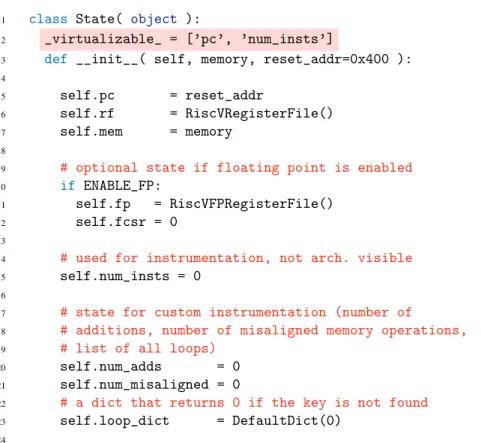
3.1 Simplified RISC-V Architectural State Description . . . 35
3.2 RISC-V Instruction Encoding . . . 36
3.3 RISC-V Instruction Semantics . . . 37
3.4 Simplified Pydgin Interpreter Loop . . . 38
3.5 Simplified PydginMemoryandPageClasses . . . 39
3.6 Unoptimized JIT IR for ARMv5LDRInstruction . . . 40
3.7 Optimized JIT IR for ARMv5LDRInstruction . . . 40
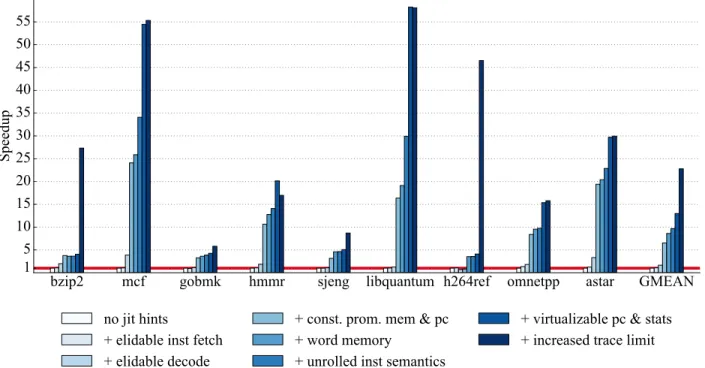
3.8 Impact of JIT Annotations . . . 41
3.9 Performance Results . . . 47
4.1 Sampling Methods . . . 57
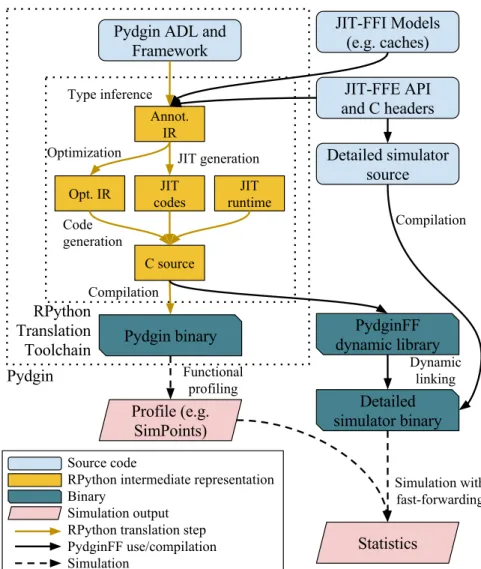
4.2 PydginFF Compilation and Simulation Flow . . . 61
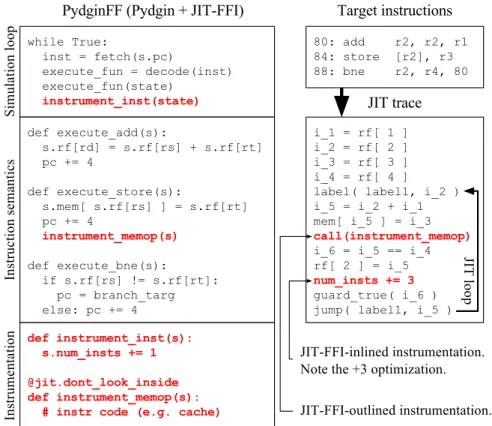
4.3 JIT-FFI Flow . . . 63
4.4 JIT-FFI for Cache Warmup . . . 64
4.5 JIT-FFI for BBV Generation . . . 65
4.6 SMARTS Results . . . 69
4.7 SimPoint Results . . . 70
4.8 PydginFF Cache Modeling . . . 71
4.9 BBV Generation with Optimizations . . . 73
5.1 Example PyMTL/Mamba Component . . . 80
5.2 Mamba Combinational Update Block Schedules . . . 81
5.3 Meta-Traces of One Simulated Cycle . . . 82
5.4 Performance of Simulating RISC-V Multicore . . . 88
6.2 RPython Framework Breakdown . . . 99
6.3 Framework Phases in Time . . . 101
6.4 Python Bytecode Execution Rates . . . 103
6.5 RPython Framework Breakdown . . . 104
6.6 PyPy Warmup . . . 105
6.7 JIT IR Node Compilation and Execution Statistics . . . 107
6.8 Categorized Weighted IR Node Frequency by Benchmark . . . 107
6.9 IR Node Frequency . . . 108
6.10 Average Number of Assembly Instructions of IR Nodes . . . 110
7.1 Python Accumulate Example . . . 119
7.2 Simplified Python Interpreter Snippet . . . 119
7.3 Pseudo-IR of JIT-Compiled Trace . . . 119
7.4 JIT IR Dataflow Graph for Accumulate Example . . . 121
7.5 Example JIT IR Dataflow Graph from Richards . . . 121
7.6 SST Architecture . . . 123
7.7 SST Synchronous Invalidation Engine (SSIE) . . . 123
7.8 Memory Regions Allocated in Main Memory . . . 123
7.9 JIT IR Dataflow Graph with Conservative SSTs . . . 125
7.10 Conservative SSTs . . . 125
7.11 JIT IR Dataflow Graph with Aggressive SSTs . . . 126
7.12 Aggressive SSTs . . . 126
7.13 SST ISA Extensions . . . 128
7.14 Speedup in JIT-Compiled regions for SST-I in Dynamic Instructions . . . 133
7.15 Percentage of Skipped Sub-Traces . . . 133
7.16 Skip Rate Percentage Compared to SST-I (No Asynchronous Checking) . . . 137
7.17 Skip Rate Percentage Compared to SST-I (With Asynchronous Checking) . . . 137
7.18 512-bit Bloom Filter False Positive Rates . . . 138
LIST OF TABLES
2.1 Top Ten Most Popular Programming Languages . . . 13
4.1 Simulator Methodologies . . . 52
4.2 Simulation Terminology . . . 58
4.3 Comparison of SMARTS and SimPoint . . . 59
4.4 Benchmarks . . . 67
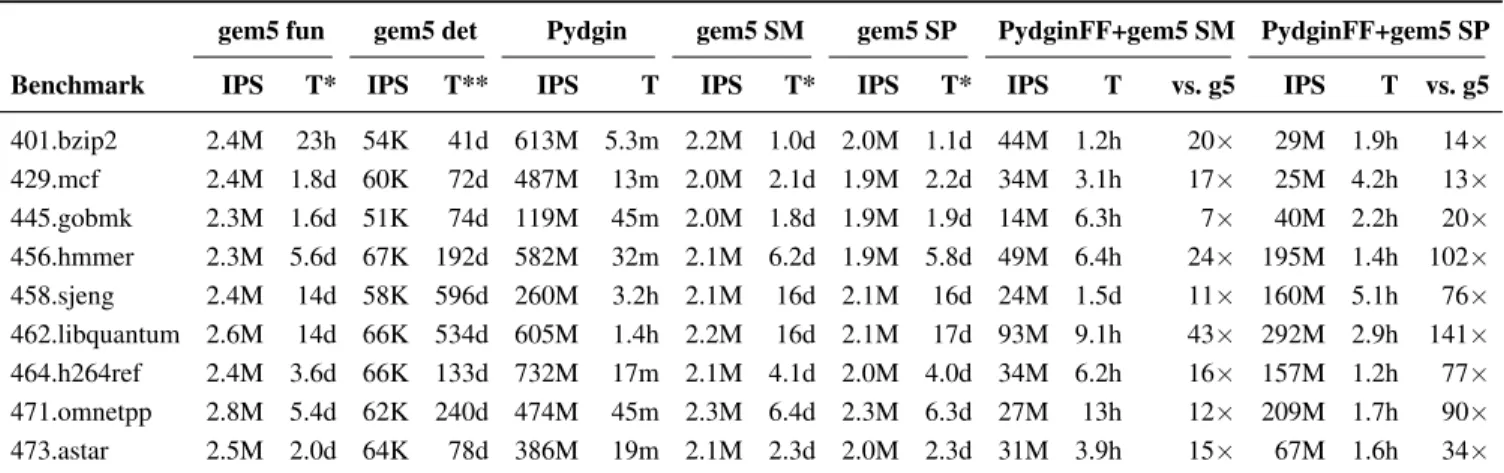
4.5 SMARTS and SimPoint Results . . . 67
5.1 Mamba Performance . . . 82
6.1 PyPy Benchmark Suite Performance . . . 100
6.2 CLBG Performance . . . 101
6.3 Significant AOT-Compiled Functions From Meta-Traces . . . 106
6.4 Microarchitectural Characterization of Phases . . . 112
7.1 Value Locality in JIT-Compiled Code . . . 122
7.2 ZSim Microarchitectural Parameters . . . 132
7.3 Racket VM Performance . . . 134
7.4 Python VM Performance . . . 135
7.5 Python VM SST Statistics . . . 136
7.6 Impact of Recompilation Options . . . 139
7.7 BRGTC2 Area Breakdown . . . 141
LIST OF ABBREVIATIONS
JIT just-in-time (compilation)
VM virtual machine
IR intermediate representation
AOT ahead-of-time (compilation)
FL functional level
CL cycle level
RTL register-transfer level
PC program counter
CAD computer-aided design
FPU floating point unit
ALU arithmetic and logic unit
SOC system-on-chip
GPU graphics processing unit
HLS high-level synthesis
API application programming interface
HLR high-level representation
DIR directly interpretable representation
DER directly executable representation
OSR on-stack replacement
AST abstract syntax tree
RF RPython framework
RL RPython language
RR RPython runtime
RTT RPython translation toolchain
ISA instruction set architecture
DSL domain-specific language
ISS instruction-set simulator
IPS instructions per second
MIPS millions of instructions per second
DBT dynamic binary translation
ADL architecture description language
FF fast forwarding
NNFF native-on-native fast forwarding
JIT-FFE JIT-assisted fast-forward embedding
JIT-FFI JIT-assisted fast-forward instrumentation
BBV basic block vector
LRU least recently used
HDL hardware description language
HGF hardware generation framework
HGSF hardware generation and simulation framework
DAG directed acyclic graph
CLBG computer languages benchmark suite
GIL global interpreter lock
PAPI performance application programming interface
GC garbage collector/collection
IPC instructions per cycle
MPKI misses per thousand instructions
SST skippable sub-traces
ODL object dereference locality
DVL dependent value locality
IVL IR-level value locality
DFG data flow graph
HP helper processor
SSIE SST synchronous invalidation engine
ET entry table
STEBA sub-trace entry base address register
STEA sub-trace entry address
STEPC sub-trace end PC
NR no-recompile
RO recompile-only
CHAPTER 1
INTRODUCTION
The performance of a computer program depends on many factors: algorithms, programming languages, compilers, and the underlying hardware. The performance of the underlying hardware in turn depends on the process technology, architectures, and the computer-aided design (CAD) tools. All of these factors have co-evolved significantly since the era of mainframes and minicomputers into today’s wide spectrum of computer systems from embedded to cloud computing. This co-evolution has been primarily fueled by Moore’s Law and Dennard Scaling, which have delivered exponentially faster, smaller, and cheaper transistors. However, with Dennard Scaling breaking down, and Moore’s Law slowing down, better hardware design tools and software/hardware co-design are increasingly important to ensure that computer systems meet demands of the future.
1.1
Software/Hardware Co-Evolution
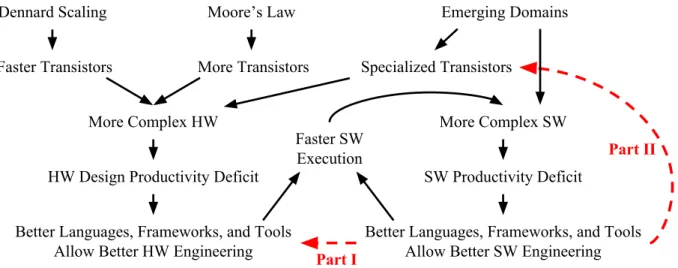
Figure 1.1 shows the software and hardware co-evolution trend over the past several decades. As predicted by Moore’s Law, new process technologies reduced transistor feature sizes by a constant ratio every 18 months to two years for roughly the same dollar budget [Moo65]. This effectively leads to exponentially more transistors in a chip for the same cost. Similarly, Dennard Scaling outlined a constant-factor scaling down of feature sizes, voltages, and gate capacitances [DGY+74], which leads to exponentially faster transistors for roughly the same power budget. These two factors combined gave hardware designers more and better transistors.
More transistors meant that more features could be moved to the same chip, increasing the level of integration. Transitioning from mini-computers to micro-computers, more of the hardware could be concentrated to fewer chips, until the entire processor could be built in a single chip. In addition to building hardware for general-purpose computation, some of the transistors have been specialized to enable hardware support for emerging domains. Initially, domain-specific units such as the floating point unit (FPU) could be moved on-chip. More recently, systems-on-chip (SOCs) combined all of the computing resources that an embedded system needs into a single chip. More transistors also enabled more aggressive designs to improve the performance. Multiple arithmetic and logic units (ALUs) were added to processors, additional auxiliary memories and logic were added to coordinate multiple instructions to be executed concurrently, out-of-order, and in deep
Figure 1.1: Software/Hardware Co-Evolution –The Part I arrow represents using state-of-the-art (JIT) compilers to allow building better hardware design tools and is the first part of this thesis; the Part II arrow represents building specialized hardware accelerators for higher level (dynamic) programming languages and is the second part of this thesis.
pipelines [SS95, TEL95]. Sophisticated branch and value prediction techniques were implemented, bookkeeping hardware was added to allow rollbacks in case of misspeculations [Smi81]. The addition of many levels of coherent caches enabled memory systems to navigate the latency and capacity trade-off. Homogeneous and heterogeneous many-core systems and graphical processing units (GPUs), with scalable networks-on-chip, led to highly parallel hardware for workloads that can take advantage of parallelism.
While hardware itself was getting cheaper, the design of the hardware was getting more ex-pensive. The additional hardware to design and verify required the use of more numerous but novice hardware designers. Whereas hardware design at its infancy only required small teams of expert designers, the new hardware design paradigm required coordinating hundreds of engineers at various skill levels working on various aspects of design space exploration, implementation, and verification. Unfortunately, coordinating large teams of hardware designers is difficult, leading
to aproductivity deficit. Coordinating these designers requires raising the level of abstraction of
hardware design. Instead of drawing polygons, first gate-level design, then register-transfer-level (RTL) design became more popular. More recently, even higher levels of design such as high-level synthesis (HLS) are gaining traction [CLN+11].
One downside of hardware design using higher levels of abstractions is that it can lead to a
designed in a lower level of abstraction. This is especially true when a higher level of abstraction is first developed, and the tools are at their infancy. However, high-level design is certainly much more scalable across large teams of varied skill levels and enable better hardware engineering. Over time, better computer-aided design (CAD) tools and algorithms are developed that target the higher levels of abstraction, and close a major part of the performance deficit. With the help of advanced CAD tools, hardware designed at a higher level is very competitive with, and often better than, hardware designed at a lower level. To this day, some extremely performance-critical parts of the chip have to be designed at gate- or polygon-level, but an average hardware designer seldom works at these levels. With the combination of better hardware engineering, better CAD tools afforded through better software engineering, and more transistors, increasingly faster computers were built.
A similar trend exists in software design as well. As computers were getting faster for the same budget, legacy programs could be executed faster. The availability of cheap computing resources led to the ability and demand to automate more tasks from different industries that were previously done manually. More businesses started relying on electronic bookkeeping, reporting, and analysis of their data. The proliferation of software created its own demand for more systems software development to enable easier development of software and for programs to better work with each other. Virtual memory support had to be implemented to coordinate multiple programs to run reliably at the same time. Multi-user, time-sharing operating systems had to be developed so that multiple users can use the same machine as if they are the only ones logged in. Networking and the internet required efficient sharing of data across a diverse set of hardware. The rise of bad actors required re-thinking the software architecture with a heavier emphasis on security and heavier use of encryption. Graphical user interfaces and computer graphics required a new set of software technologies to be developed (e.g., Self [HU94b]).
This led to a large proliferation of software engineers to meet the software development demand. A higher proportion of these developers were novice developers and the tools and languages of the time, e.g. assembly programming, were not scalable across large teams. This created a productivity deficit in the software world as well. To bridge this deficit, higher level languages were developed. Languages such as C required less boilerplate code to be written while still staying close to the machine. These languages also enabled limited portability across multiple hardware architectures. Later, object-oriented programming, e.g., with C++, enabled representing program logic and data at a higher level. There was also a trend towards better defined application programming
interfaces (APIs), data encapsulation, permission management, inheritance techniques to reduce code duplication, and version control systems to enable more effective collaboration. Later still, automatic memory management, e.g., with Java, made programming safer and more productive. More recently, dynamic programming languages have been rising in popularity mostly due to their advanced productivity features.
Analogous to the raised abstraction levels in hardware design, using higher level languages causes a performance deficit. Especially during the infancy of a new language, there could be significant performance degradation compared to a low-level language. For example, when C was first developed, it did not have an optimizing compiler, so the performance could be much worse than writing assembly. Similarly, Java originally did not have a just-in-time (JIT) compiler, so its performance was much worse than C++. However, high-level languages enabled scalable productivity for large teams of software developers, leading to better software engineering. This, in turn, enabled the development of compilers with advanced optimizers. Better optimizing compilers allow faster execution of programs, and importantly they close a major part of the performance deficit. Today, assembly-level programming, just like drawing polygons, is often used only in the most extremely performance critical parts of modern software, while the vast majority of programmers write code at much higher levels.
It is important to note the synergy between hardware and software in this co-evolution. More and more problems encountered by humans can be automated and solved using software running on ever-faster processors. The software engineering improvements and higher level languages lead to the development of more sophisticated CAD algorithms. These CAD algorithms can close the performance deficit by raising the abstraction level used for hardware design. Designing hardware in higher abstraction levels often outperforms hardware designed using lower abstraction levels. Newer hardware design methodologies can help pick more optimal choices in the large design space, and larger chips to be designed and verified at scale. With better hardware engineering and improvements in process technology allows building faster computers, and this co-evolution continues as long as Moore’s Law continues to deliver more transistors.
1.2
The Present and Future of Hardware Design
Dennard Scaling has long stopped delivering faster transistors since the early 2000s. Furthermore, Moore’s Law has been slowing down. Below, I present some of my observations and predictions on how this might affect hardware design.
Large hardware designs will continue to be economical. Even though Moore’s Law is slowing down, there is likely plenty of unrealized potential with the current economics of chips. Over the decades, the pace of hardware design was not able to catch up with the available transistors for a given cost. With better hardware engineering and domain-specific specialization, the currently available transistors could be used more effectively. Furthermore, with newer process technologies becoming far in between, slightly older technologies, which are still very competitive, might get commoditized. As the research and development costs for these technologies are recouped, the price per transistors will likely continue to fall into the future.
Single-threaded performance gains will come to an end. Since the end of Dennard Scaling and stagnating maximum clock frequencies, the performance of single-threaded applications con-tinued to improve. This was achieved using larger hardware designs with the addition of larger caches, wider networks, more accurate but larger branch predictors, larger issue windows, etc. Furthermore, with the help of better hardware engineering, the existing designs could be refined for more effective uses of the transistors. Unfortunately, the number of tricks available to hardware engineers is running out, and single-threaded performance improvements will eventually come to an end.
Domain specific designs will continue to gain importance. With the slowing single-threaded performance gains, yet relatively cheap transistors, more and more domains will invest in domain-specific hardware. Recently, machine learning had a significant amount of success building custom hardware [CDS+14, JYP+17]. Building custom hardware could become the most economic way of improving the performance and/or reducing the energy of different domains’ computing needs.
Newer hardware design tools are emerging. Given that hardware engineering is becoming more widespread, the designs more varied, and performed by smaller teams, the productivity deficit continues to be a major issue. To address this, higher level abstractions and design tools are being introduced. For example, new hardware generation frameworks such as Chisel [BVR+12], Genesis2 [SAW+10], and PyMTL [LZB14] allow higher level software languages to be used for
hardware design. Cycle-level simulators such as ZSim [SK13] and Sniper [CHE11] make use of dynamic binary translation technology to enable very fast simulations as long as the host and guest instruction set architectures (ISAs) match. Furthermore, approaches such as high-level synthesis (HLS) automatically generate hardware from untimed algorithms [CLN+11]. The trend for newer methodologies and tools will likely continue to gain importance.
Challenge: More agile hardware design methodologies are needed. While newer hardware design methodologies have promise in increasing productivity to meet the demands of increased and more diverse hardware engineering challenges, these approaches still have a number of practical shortcomings. To name a few, the hardware generation frameworks often do not support fast simulations in the high-level language but require simulating in lower level Verilog, fastest functional and cycle-level simulation methodologies do not allow simulating guest ISAs that are different than the host ISAs, and current HLS approaches still typically require heavy designer involvement in generating the desired hardware. These challenges currently prohibit the new hardware design tools to be trulyagile. Agile hardware design methodology and tools combine flexibility, productivity, and performance. Agile hardware design, just like agile software design, can be crucial for hardware engineering teems to quickly explore and iterate many different design choices at different levels of hardware design, and eventually refine their designs to hardware. But to achieve this, the practical issues in newer hardware design tools need to be solved.
1.3
The Present and Future of Software Performance
The software design and performance will also continue to evolve into the future. The slowing of Moore’s Law will also have repercussions on software performance.
Software will continue to get larger and more complex. Humans will continue to have new and more complex problems, and writing software will continue to be the primary way to automate solutions to those problems. Computing devices are currently the most ubiquitous and inexpensive that they have ever been, and the availability of cheap and fast hardware creates an increasing demand to write more, larger, and more complicated programs. The increasing diversity and complexity of software itself is a challenge that is addressed with larger and more complex systems software. I do not expect the pace of software development to slow down soon.
Higher level languages will continue to be popular. As the demand for software grows, and more people than ever develop software, higher level languages will continue their rise in popularity. This is already being experienced with dynamic languages such as Python and JavaScript being used more widely and for a wider number of domains. Dynamic languages use dynamic type systems that can allow rapid prototyping, but also typically have other productivity-oriented features such as: lightweight syntax, managed memory, rich standard libraries, support for dynamic code execution, interactive execution environments, and advanced reflection capabilities.
Just-in-time (JIT) compilation will be more important. Higher level languages are usually slower than lower level languages. This is especially true for dynamic languages. As more code is being developed using higher level languages, and since single-threaded performance stops delivering performance improvements, the performance of these languages will be an issue. Luckily, JIT compilation has seen a lot of success and wider adoption over the last decade. One drawback of JIT compilation is the engineering challenge to develop, maintain, and extend state-of-the-art JIT compilation frameworks. However, there have been successful projects that use partial evaluation and meta-tracing to repurpose a JIT compiler across multiple languages (see Chapter 2 for more details). These approaches will become more important for achieving the productivity benefit of higher level language while approaching the performance of lower level languages.
JIT compilation will have diminishing performance improvements. JIT compilation un-locks significant performance benefits compared to simpler ways to execute higher level languages, such as interpreters. A JIT can typically achieve 10× or better performance compared to a fast interpreter (see Chapter 6). Unfortunately, software-only improvements in JIT technology will likely yield diminishing returns as low-hanging fruit opportunities are exploited.
Challenge: Novel JIT execution methods are needed. While higher level languages enable the development of diverse and ambitious software, JIT compilation and improving single-threaded performance have been the best tools in ensuring these languages maintained their performance appeal. With both of these factors slowing down, there is a challenge in ensuring high-level languages to be performance competitive with lower level languages. Hardware specialization for the execution of high-level and dynamic languages can be a unique opportunity to address this challenge.
1.4
Thesis Overview
This thesis presents approaches to address the agile hardware design and novel JIT execution challenges by co-optimizing meta-tracing JIT VMs and hardware design. This thesis has two thrusts that tackle two opposite but related problems: (1) accelerating agile hardware simulations with meta-tracing JIT VMs, and (2) building hardware accelerators for meta-tracing JIT VMs. The first thrust can be seen as using JIT compilation technology to allow building better hardware design tools, as seen in the new Part I arrow in Figure 1.1. The second thrust can be seen as building hardware specialization not for new application domains, but for generally targeting high-level, dynamic languages, as seen in the new Part II arrow in the figure.
Since meta-tracing is a key enabler for the contributions of this thesis, Chapter 2 presents an extensive background on dynamic languages, JIT compilation, partial evaluation, and meta tracing. The rest of the thesis is organized in two parts. Part I presents the first thrust and demonstrates how meta-tracing JIT VMs can be used to accelerate functional-level (FL), cycle-level (CL), and register-transfer level (RTL) hardware simulations. Chapter 3 presents Pydgin, where we have built an agile instruction-set simulator; Chapter 4 presents PydginFF, where I introduce fast-forward embedding and instrumentation to Pydgin to speed up sampling-based agile cycle-level simulation; and Chapter 5 presents the Mamba techniques, which are simulation-aware JIT and JIT-aware simulator techniques to speed up the new version of PyMTL, an agile hardware generation and simulation framework [LZB14]. Part II of the thesis is dedicated to the second thrust of building hardware accelerators for meta-tracing JIT VMs. Chapter 6 provides a comprehensive cross-layer workload characterization of meta-tracing JIT VMs to identify hardware acceleration opportunities, and Chapter 7 identifies object dereference locality and intermediate-representation-level value locality in JIT-compiled codes of meta-tracing JIT VMs and software/hardware co-design mechanisms to exploit these patterns. Finally, Chapter 8 concludes this thesis.
The primary contributions of this thesis are:
• I demonstrate meta-tracing JIT VMs can be used to speed up agile FL simulation of processors.
• I extend agile FL simulation using JIT fast-forward embedding and instrumentation for sampling-based agile CL simulation of computer systems.
• I present JIT-aware hardware generation and simulation framework (HGSF) and HGSF-aware JIT mechanisms for accelerating agile RTL hardware simulations using meta-tracing JIT VMs.
• I present a novel methodology to study meta-tracing JIT VMs and allow experimenting with hardware acceleration techniques.
• I perform an extensive cross-layer workload characterization of meta-tracing JIT VMs.
• I identify and quantize object dereference locality (ODL) and intermediate-representation-level value locality (IVL) in JIT-compiled code in the context of meta-tracing JIT VMs.
• I propose a software/hardware co-design approach to exploit ODL and IVL.
1.5
Collaboration, Previous Publications, and Funding
This thesis was made possible by the contributions of many people at Cornell University and elsewhere. My thesis advisor, Christopher Batten, has been tremendously helpful with insightful advice and feedback in research ideas and writing in all of the projects presented in this thesis. Furthermore, Carl Friedrich Bolz-Tereick has been a very valuable mentor and collaborator for most of the work presented in this thesis.
The Pydgin project was lead by Derek Lockhart and was published at ISPASS 2015 [LIB15]. I led the meta-tracing JIT optimizations and co-led the RISC-V port [ILB16]. Additionally, Carl Friedrich Bolz-Tereick gave useful feedback for the paper and help with advanced optimization options of the RPython framework, Maciej Fijalkowski gave useful feedback for the paper, and Yunsup Lee helped towards the RISC-V port effort. Shreesha Srinath has been an early and extensive user of Pydgin and gave useful feedback. I additionally thank Sarah Mount for her work in using Pydgin for the Adapteva Epiphany instruction set. Even though Lockhart’s thesis also covers Pydgin [Loc15], Chapter 3 emphasizes aspects not covered earlier, including the RISC-V port and self-modifying code support. Also importantly, it forms the foundation for the PydginFF project. I have led the PydginFF project, which was published at ISPASS 2016 [IB16]. I would like to thank Trevor Carlson for his feedback for improving the paper. The Mamba project was led by Shunning Jiang and was published at DAC 2018 [JIB18]. I co-led the meta-tracing JIT optimizations to achieve competitive performance compared to commercial Verilog simulations. I have included parts of Mamba work primarily because it demonstrates a complete picture of the power of meta-tracing JIT VMs towards accelerating agile hardware simulation at different modeling levels.
I have led the work of cross-layer workload characterization of meta-tracing JIT VMs and published this work at IISWC 2017 [IBTB17]. Carl Friedrich Bolz-Tereick helped with useful feedback and literature review and Alex Katz helped modifying and running benchmark scripts. Finally, Lin Cheng led cycle-level evaluation and parts of functional-level evaluation for the work presented in Chapter 7. Carl Friedrich Bolz-Tereick has helped with research direction and useful feedback for this project. Mohammad Dohadwala, Scott McKenzie, and Alvin Wijaya helped with various aspects of the earlier iterations of the project. Also thanks to Christopher Torng for leading the BRGTC2 chip tapeout and accommodating the addition of Bloom filter accelerators [TJAH+18].
This work was supported in part by NSF CRI Award #1512937, NSF SHF Award #1527065, NSF XPS Award #1337240, NSF CAREER Award #1149464, DARPA POSH Award #FA8650-18-2-7852, DARPA Young Faculty Award #N66001-12-1-4239, AFOSR YIP Award #FA9550-15-1-0194, and equipment, tool, and/or physical IP donations from Intel, Xilinx, Synopsys, Cadence, and ARM. The U.S. Government is authorized to reproduce and distribute reprints for Government purposes notwithstanding any copyright notation thereon. Any opinions, findings, and conclusions or recommendations expressed in this publication are those of the author(s) and do not necessarily reflect the views of any funding agency.
CHAPTER 2
BACKGROUND ON META-TRACING JIT VMS
This chapter provides background on dynamic languages, just-in-time (JIT) compilation, types of JIT compilers, classical JIT optimization techniques, and partial evaluation. Furthermore, it provides details on the meta-tracing JIT technology, which is an essential part of this thesis. The first thrust of the thesis, accelerating hardware simulations with meta-tracing JIT VMs, exploits the features provided by meta-tracing in novel ways to accellerate architectural simulations. The second thrust, building hardware accelerators for meta-tracing JIT VMs, identifies shortcomings in meta-tracing and proposes software/hardware co-design techniques to address those. The RPython framework is the only production-grade implementation of a meta-tracing JIT framework, so this chapter also provides details on this framework.
2.1
Dynamic Languages
Languages such as C, C++, Java, Rust, and Go are all statically typed: the types of variables are statically declared by the programmer, or are statically inferred. Once determined, the type system ensures that the types of variables cannot be modified. Static type systems can encourage disciplined programming and enable sophisticated correctness checks of the program before any execution takes place. Also very importantly, static typing generally makes it more efficient to execute a program. In a program, operators may be overloaded across multiple data types (e.g., the+operator can act as integer addition or string concatenation) and unrelated classes might have members with identical lexical names, leading to ambiguity which semantics should be performed without static typing. Static typing allows compilers to precisely determine which concrete version of overloaded operators need to be used, and generate specialized code for this particular type. Staticandstrong typing (i.e., no reinterpretive type casting), for example in Java, Go, and Rust, can enable further compiler optimization opportunities (e.g., type-based alias analysis [CWZ90, DMM98]).
In contrast to statically typed languages, dynamically typed languages do not statically bind types to variables. As the program executes, a variable might contain data of a certain type, and later take on data of an unrelated type. While orthogonal to the typing system, many popular dynamically typed languages, also known as dynamic languages, have other common features: strong typing (not to be confused with static typing), lightweight syntax, managed memory, rich standard libraries,
1 # Variables can contain objects of different types.
2 a = 1; a = "foo"
3
4 # Unrelated classes that happen to both have methods called bar.
5 class A: 6 def bar(self): 7 return 0 8 class B: 9 def bar(self): 10 return "bar" 11
12 # Lists can contain objects of unrelated types.
13 l = [ A(), B() ]
14 # Duck typing for unrelated types, prints "[0, 'bar']".
15 print [ x.bar() for x in l ] 16
17 # Reflection allows programmatically retrieving class object A using a string.
18 C = globals()["A"]
19 a = C()
20 # We can call the bar method again using reflection, prints 0.
21 print getattr( a, "bar" )() 22
23 # Reflection allows modifying the type A.
24 A.bar = lambda self : "new_value"
25
26 # The line from above, with objects constructed before we modified the type A,
27 # now prints "['new_value', 'bar']".
28 print [ x.bar() for x in l ]
Figure 2.1: Dynamic Language Features –Examples of features that dynamic languages typically provide.
support for dynamic code execution (e.g., theevalkeyword in Python and JavaScript), interactive execution environments, and advanced reflection capabilities. The categorization of dynamic and static languages is not always clear cut, and languages are typically on a spectrum. For example, Java, a static language, has many dynamic features: it makes heavy use of dynamic method dispatch, uses managed memory, type inference, dynamic code execution, and reflection. Unfortunately, many of these powerful dynamic features mean that ahead-of-time- (AOT-) compilation will not result in meaningful performance improvements. An AOT compiler, without a priori knowledge of the types of variables, cannot generate efficient, type-specialized code. Because of this, dynamic languages typically use interpreters for execution.
Figure 2.1 shows some of the dynamic features that are typically present in dynamic languages through an example Python snippet. Line 2 shows that a variableais allowed to contain values of different types throughout execution; line 13 shows that builtin types such as lists allow containing
Year: 2018 2018 2018 2018 2014 2013 2013
Ref: [Cas18] [TIO18] [Car18] [O’G18] [Tre15] [Lan13] [tlp13]
IEEE Trendy Skills Trans. Lang.
Rank Spectrum TIOBE PYPL RedMonk (best paying jobs) LangPop Pop. Idx.
1 Python Java Python JavaScript Python C C
2 C++ C Java Java Java Java Java 3 Java Python JavaScript Python C++ PHP Objective-C
4 C C++ C# PHP C JavaScript C++
5 C# Visual Basic PHP C# JavaScript C++ Visual Basic 6 PHP C# C/C++ C++ HTML5 Python PHP
7 R JavaScript R CSS XML Shell Python
8 JavaScript PHP Objective-C Ruby PHP Ruby C#
9 Go SQL Swift C C# Objective-C Perl
10 Assembly Objective-C Matlab Objective-C HTML C# Ruby
Table 2.1: Top Ten Most Popular Programming Languages– Adapted from [RO14] and updated. Using most up-to-date versions of the rankings as indicated by year. Languages inboldare dynamic languages.
objects of unrelated types; line 14 demonstrates duck typing, where thebarmethods of unrelated objects would be called without the need to use inheritance; lines 18–21 show the power of reflection in programmatically accessing variables and types, constructing, and calling them; line 24 demonstrates monkey patching, where a different methodbargets attached to classA; and line 28 shows objects of typeAthat were instantiated beforeAhas been modified are affected by the type modification.
Even though dynamic typing gives up static error checking through type checking, the powerful features of these languages while maintaining simplicity can help productivity. Productivity is a notoriously difficult and subjective metric to measure, and there have been a few empirical studies that suggest programmers prefer static typing in the interfaces of programs but dynamic in smaller, frequently changing code [SF14, HKR+14, DSF09]. Furthermore, dynamic languages have been increasing in popularity. Table 2.1 shows the top ten most popular languages across different rankings that compare the popularity of keywords in search engines, social media sites, and public code repositories such as GitHub. Even though the exact ordering is different, every ranking indicates that three to five of ten most popular languages are dynamic languages with Python, JavaScript, PHP, Ruby, and R consistently selected as the most popular dynamic languages.
2.2
Just-in-Time Compilation
Just-in-time- (JIT-) compilation (often also referred to as simply JIT or adaptive optimization), is an optimization technique with a long history [AFG+05, Ayc03]. As in Arnold et al. [AFG+05], it is useful to employ Rau’s categorization of program representations [Rau78] to crisply define what JIT compilation is:
• High-level representation (HLR): high-level source code, e.g., C++, Java, or Python. (For
example, Figure 2.2)
• Directly interpretable representation (DIR): an intermediate-level representation suitable for
executing on an interpreter, e.g., Java bytecode or Python bytecode. (For example, Figure 2.3)
• Directly executable representation (DER): binary code assembled for a particular ISA, e.g.,
x86 or RISC-V binary.
An interpreter is a piece of software that directly executes DIR, whereas a JIT compiler is a piece of software that translates DIR to DER. Some of the earliest JIT compilers had the primariy goal of reducing the memory usage. As the available memory of early computers was exteremely limited, and because DIR tended to be a much more compact representation than DER, there were two related techniques proposed to reduce the memory usage: mixed code [DP73, Daw73], where frequently executed parts of the code are statically compiled to DER and others were interpreted, and throw-away compiling [Bro76], where parts of a program are dynamically compiled on an as-needed basis and thrown away if memory is exhausted.
While earlier efforts on JITs were primarily driven as a space-saving measure for static languages, the poor performance of the interpreter for Smalltalk, an early dynamic language, made clear that the performance of interpreter-only execution was an issue. An important early work on JITs for dynamic languages was implemented in the VM for Smalltalk-80 [DS84]. Then, the Self project introduced many important advanced JIT techniques still used today: polymorphic inline caches [HCU91], on-stack replacement [HU94b], dynamic deoptimization [HCU92], selective compilation with multiple tiers of compilers [DA99], type prediction and splitting [CU91], and profile-directed inlining integrated with adaptive recompilation [HCU91].
Then, with the introduction of Java, JIT-optimized VMs became truly mainstream. The early versions of Java VMs did not have JIT compilers, resulting in very poor performance compared to
1 def max(a, b):
2 if a > b:
3 return a 4 else: 5 return b
Figure 2.2: Example Python Code (HLR) 1 # Line 2: 2 0 LOAD_FAST 0 (a) 3 3 LOAD_FAST 1 (b) 4 6 COMPARE_OP 4 (>) 5 9 POP_JUMP_IF_FALSE 16 6 # Line 3: 7 12 LOAD_FAST 0 (a) 8 15 RETURN_VALUE 9 # Line 5: 10 16 LOAD_FAST 1 (b) 11 19 RETURN_VALUE 12 20 LOAD_CONST 0 (None) 13 23 RETURN_VALUE
Figure 2.3: Python Bytecode (DIR) –Python byte-code uses a stack machine and this byte-code corresponds to Figure 2.2 1 w1_type = w1.type 2 w2_type = w2.type 3 guard(w1_type == IntObj) 4 guard(w2_type == IntObj) 5 i1 = w1.intval 6 i2 = w2.intval 7 res = i1 > i2 8 if res == True: 9 retval = w1 10 else: 11 retval = w2
Figure 2.4: JIT Pseudo-IR –The DER before as-sembly, corresponding to Figure 2.3.
1 class Frame:
2 def __init__(self, size):
3 self.stack = [None] * size
4 self.depth = 0
5 def pushval(self, val):
6 self.depth += 1 7 self.stack[self.depth] = val 8 def popval(self): 9 self.depth -= 1 10 return self.stack[self.depth + 1] 11
12 def interpret(bcs, frame):
13 while True: 14 bc = bcs[i] 15 if bc == LOAD_FAST: 16 idx = bcs[i + 1] 17 frame.pushval(frame.stack[idx]) 18 i += 3 19 elif bc == COMPARE_OP: 20 cmpop = bcs[i + 1] 21 w2 = frame.popval() 22 w1 = frame.popval() 23 if cmpop == 0: # lt 24 ... 25 elif cmpop == 4: # gt
26 if w1.type == IntObj and \
27 w2.type == IntObj:
28 i1 = w1.intval
29 i2 = w2.intval
30 frame.pushval(i1 > i2)
31 elif w1.type == FloatObj and \
32 w2.type == FloatObj:
33 ...
34 elif w1.type == UserInstanceObj:
35 frame.pushval(w1.call('__gt__', w2))
36 elif ... # Other types.
37 elif ... # Other cmpops.
38 i += 3
39 elif ... # Other bytecodes.
Figure 2.5: Simplified Python Interpreter
C and C++. Because Java is mostly a static language, AOT-compilation is possible (e.g., gcj [gcj18], Java 9 [Koz18], and Android ART [and]). However, some of the dynamic features of Java (e.g., dynamic class loading) cannot be AOT-compiled, so those are either not allowed or fall back to being executed on the interpreter and JIT. Since efficient AOT-compilation of Java is possible, the main purpose of using a JIT VM for Java is portability across multiple targets and security.
Over the last decade, JIT VMs have increased their mainstream adoption, but this time in the context of dynamic languages. Because types are dynamically determined, the best AOT compila-tion can achieve is to get rid of the DIR dispatch overhead, and this would only be marginally faster than execution on an interpreter. The AOT-compiled code would have to include the type dispatch logic and semantics of all types. Furthermore, dynamic languages typically allow programmatic creation and execution of new programs (e.g., Python and JavaScripts’seval()). Dynamically created programs, by definition, cannot be AOT compiled. Because of this, as opposed to Java JIT’s goal of primarily providing portability, JITs for dynamic languages primarily aim to improve the per-formance. JIT VMs for dynamic languages are ubiquitous these days especially with the JavaScript engines of browsers (e.g., Google (Chrome) V8 [v8], Mozilla (Firefox) SpiderMonkey [spi], Webkit (Safari) JavaScriptCore [jav], and Microsoft (Edge) Chakra [cha]), but also for servers (e.g., HHVM for PHP [Ott18]), scientific computing (e.g., Julia [jul]), and general purpose programming (e.g., PyPy for Python [pypa], TruffleRuby for Ruby [trub], and LuaJIT for Lua [lua]).
Executing a dynamic language program on an interpreter has a number of overheads compared to running the same program in C. We will look at how JIT compilation can address some of these overheads:
• DIR dispatch overhead: An interpreter has to get the next available DIR instruction (e.g.,
bytecode), decode it, and dispatch to the interpreter code that implements the semantics of this instruction. This is shown in lines 15, 19, and 39 in Figure 2.5.
• Type dispatch overhead: In a dynamic language, since types are dynamically determined, the
semantics of operations changes depending on the type. Lines 26, 31, and 34 in Figure 2.5 show an example of these overheads.
• Semantic overhead: The language may provide more semantically rich operators and data
types compared to a lower level language. For example, integers in Python are semantically infinite bits wide. Even if a programmer does not need infinite-width integers, machine-width integers might not be available in the language or more cumbersome to use.
There are a number of design decisions regarding the construction of JIT VMs for dynamic languages. Figure 2.6 shows a typical architecture. The HLR gets compiled down to DIR (arrow 1), and DIR executes on an interpreter (arrow 2). The interpreter serves three purposes: it can execute DIR with low latency (but low peak performance as well), identify hot (frequently executed) parts
Figure 2.6: Typical JIT VM Architecture –Arrow 1: high-level representation (HLR) compiles to directly in-terpretable representation (DIR), 2: the DIR is interpreted using an interpreter, 3: hot DIR methods can be compiled using a JIT compiler, 4: for good performance, runtime type information also needs to be used by the compiler, 5: the compiler generates directly executable representation (DER), and 6: if the type assumptions in the DER are incorrect, the execution falls back to the interpreter using deoptimization.
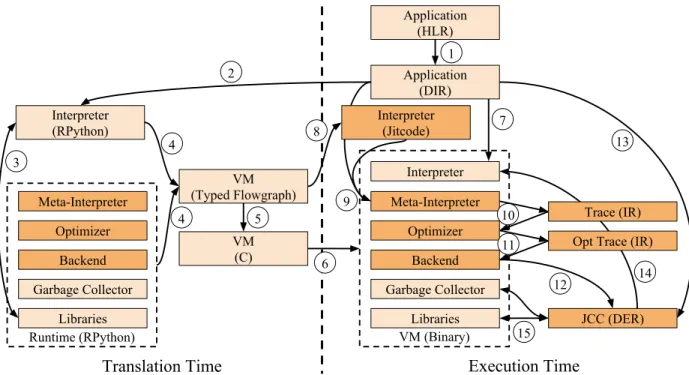
Figure 2.7: Meta-JIT VM Architecture –PE = partial evaluator, MI = meta-interpreter. Arrows 3 and 4: the interpreter itself is used to generate the DER along with runtime type information. The other arrows are the same as Figure 2.6
of the DIR, and gather runtime information such as types and constant values. Once a part of the DIR is determined to be hot enough, the (JIT) compiler compiles it to DER (arrows 3 and 5). Importantly, the compiler also uses the runtime information gathered by the interpreter (arrow 4). Without this information, the best a compiler can do is to get rid of the DIR dispatch overhead. Using these runtime type observations, the compiler can generate type-specialized DER. As there are no semantic guarantees of the type information to be stable, the DER generated also includes type checks. In case any of these type checks fail, the DER would not be able to handle the program semantics that it was not specialized for, and it deoptimizes to the interpreter (arrow 6). The interpreter can then continue execution, and compile again with the additional observed type.
2.2.1 JIT Design Decisions
Multi-Tier Compilation – While Figure 2.6 shows an architecture with an interpreter and a compiler, many of the state-of-the-art JIT VMs for dynamic languages employ multiple levels of compilation. For example, JavaScriptCore used in Safari uses an interpreter, a baseline non-optimizing compiler that does not use the type information to specialize, a second-tier non-optimizing
compiler that uses the runtime types and values observed by the interpreter and baseline compiler, and finally a third-tier optimizing compiler that uses more aggressive and expensive compilation passes. If the DER produced by any of the optimizing compilers encounters a type that it is not optimized for, it falls back to the interpreter or DER produced by the baseline compiler [jav]. Other JavaScript VMs, such as V8, use similar multi-tier architectures. The chosen VM architecture aims to balance latency and peak performance. More aggressive compilation passes produce better code but require additional compilation time. As the VM does not have a priori information about how often a part of a DIR will be executed, it heuristically uses consecutively more aggressive compilation tiers in an effort to balance time spent in compilation and the performance of DER. One of the drawbacks of having an interpreter and multiple tiers of compilers is the engineering challenge of developing and maintaining two separate and complicated pieces of code.
Granularity of Compilation –Another design decision is the granularity of compilation for the DERs. The traditional approach is to compile DERs that correspond to HLR methods, and this approach is called a “method JIT”. Besides methods, contemporary method JITs also have special support to compile regions smaller than methods such as loops, and larger than methods using method inlining and region-based compilation [Ott18, HHR95]. Method JITs maintain the control-flow graph in the DIR in the code that they compile. An alternative approach to method JITs is a tracing JIT, which captures and compiles a linear trace through the DIR [GES+09]. Tracing JITs compile a linear DER, which contains guards for control-flow diversions. In case the control flow takes a different path than the linear DER, these guards would fail, and bridges, which are additional linear traces that attach to these failing guards may be compiled. One benefit of tracing JITs over method JITs is that certain compiler optimizations may be less expensive due to cheaper compiler optimization passes that do not have to deal with control flow diversions.
2.2.2 Classic JIT Optimizations and Techniques
There has been a number of JIT optimizations developed over the years tackling the dynamic language execution overheads. Below is a list of some of the most well known ones:
DIR Dispatch Overhead Removal –This is the first and easiest overhead to tackle. This is also the only optimization that AOT compilers for dynamic languages can implement. This optimization can be implemented by inlining the semantics of the DIR instructions.
1 w1_type = w1.type 2 w2_type = w2.type 3 if w1_type == IntObj: 4 guard(w2_type == IntObj) 5 i1 = w1.intval 6 i2 = w2.intval 7 res = i1 > i2 8 else: 9 if w1_type == UserInstanceObj1: 10 res = call(UserInstanceObj1_gt_fun, w1, w2)
11 elif w1_type == UserInstanceObj2:
12 res = call(UserInstanceObj2_gt_fun, w1, w2) 13 else: 14 gt_fun = call(get_fun, w1, "__gt__") 15 res = call(gt_fun, w1, w2) 16 if res == True: 17 retval = w1 18 else: 19 retval = w2
Figure 2.8: JIT Pseudo-IR with a Polymorphic Inline Cache (PIC) –Corresponds to the pseudo-IR from Figure 2.4, but after two additional user types have been encountered and optimized using a PIC.
Type Feedback –Even though dynamic languages allow different types at each DIR instruction, in practice, programmers only use a few types. Optimizing away the type dispatch overhead uses this observation. The first step towards optimizing this overhead is for the interpreter (or sometimes first-tier DER as in JavaScriptCore [jav]) to collect type information and feed this to the optimizing compiler. The optimizing compiler would use this information to generate specialized DER for the observed types. It will also include guards for checking if the types of variables match the types the DER was optimized for. This technique was first used in Self [HU94a].
Inline Caching – One of the optimizations that can be done by the JIT compiler using type feedback is inline caching. For example, in dynamic-language method call such asfoo.bar(), the type of the receiver object (foo) often cannot be deduced statically. However, in practice, very few types might be observed at the call site. Normally, a type dispatch needs to be performed to find the concrete method that corresponds to the type of the receiver object. This optimization inlines into the DER the concrete method along with a type check to ensure the receiver object is indeed what it was expected. Figure 2.4 shows an example of what inline caching might look like in the DER. This example shows that the type for themaxfunction arguments are observed to beIntObj. Using this observation, the semantics of the greater-than function (__gt__) for integer types have been inlined in the trace. Type checking is done using guards, allowing falling back to the interpreter in
case different types are observed when executing the DER. Note that even though type feedback is often used to determine which types to inline cache, inline caching can also be used without type feedback but with type heuristics (using common paradigms in the language). This technique was first used in the Smalltalk system [DS84].
Polymorphic Inline Caches (PIC) – An extension of inline caching is polymorphic inline caches. While the vast majority of the call sites indeed have a single receiver object type (monomor-phic), deoptimizing to the interpreter every time the inline cache is different can be expensive. This approach grows the inline caches for all the common receiver object types observed at each call site. Figure 2.8 shows an example PIC in the DER that corresponds to the earlier DER in Figure 2.4, after additional user-defined types have been encountered and DER recompiled. This particular example uses a polymorphic inline cache both for the builtinIntObjtype as well as two different user-defined types. In case the argument is of a fourth type, this code will manually retrieve the __gt__function for the type, which can be expensive. This technique was first implemented in Self [HCU91].
On-Stack Replacement (OSR) –One issue of having multiple representations of the program, the DIR and DERs produced through multiple levels of compilation is that switching from one representation to another is difficult because each representation uses a different stack layout. This is especially a problem if the current DER receives a different type that what it was specialized for, and needs to deoptimize. It cannot simply return from the currently executing DER because there is intermediate state in the current stack frame that needs to be communicated to the interpreter so that it can continue execution from that point. Similarly, JIT compilation might need take place while the interpreter is in the middle of executing a method, especially important for loops. This technique retains enough meta-information and stack layouts of each representation to reproduce the stack layout for the target representation. This technique, too, was first demonstrated in Self [HU94b].
Semantic Overhead Optimizations –In addition to type specialization techniques, there are also a number of techniques that target the semantic overheads of dynamic languages. One example is the infinite-bitwidth integer types used in Python. Even though semantically, integers need to behave as if they have infinite bits, in practice, most values would fit in machine-bitwidth-sized integers. To efficiently handle this, the VM would actually use a machine-bitwidth-sized integer to represent the dynamic language integer, but check for overflows for any operation that might cause an overflow. In case of an overflow, it changes the representation of the integer to use multiple
1 def f(n, x): 2 if n == 0: 3 return 1 4 elif n % 2 == 1: 5 return x * f(n - 1, x) 6 else: 7 return f(n / 2, x) ** 2 8 9 def f_13(x): 10 return x * ((x * (x ** 2)) ** 2) ** 2
Figure 2.9: Partial Evaluation Example –The partial evaluation offwithn == 13yieldsf_13, and it has identical semantics tofas long asn == 13. Example adapted from [JG02].
words. Similarly, in Python, lists can contain any data type. However, in practice, it is quite common for programmers to put objects of the same type, such as a list of integers. The VM can then opportunistically use an integer array to hold the data. Besides saving memory, this also reduces the number of type checks for reads. For correctness, the VM checks for insertions into the list and changes the list to a generic object array if an object of a different type is being inserted. Note that these optimizations, unlike the optimizations targeting DIR dispatch and type dispatch, can be implemented for interpreter-only VMs.
2.3
Partial Evaluation
Partial evaluation is the specialization of a program for certain inputs. For example, as Figure 2.9 shows, it is possible to specialize a piece of code for a subset of its inputs. If we use a partial evaluator, pe, which is a piece of code that partially evaluates a program for certain inputs, we can specializeflike following: pe(f,13)→f_13. f_13is a partially evaluated version offwheren == 13. The partially evaluated version can be significantly faster than the generic version, with the restriction that it only gives the correct answer ifn == 13.
Partial evaluation can also be applied to interpreters of dynamic languages. This allows generating specialized code out of an interpreter. This is known as the first Futamura projec-tion[Fut71, JG02]. There are a total of three Futamura projections:
1. Partial evaluation of an interpreter with a subset of the interpreter inputs (application source code and subset of inputs) yields specialized programs. For an interpreter that can evaluate
inter preter(in1,in2)→out; partial evaluation can be used to yieldpe(inter preter,in1)→sp, wheresp(in2)→out.
2. Partial evaluation can be applied to other programs, including partial evaluators. Partial evaluation of a partial evaluator that has an interpreter as its input would generate a specialized partial evaluator for the language the interpreter is written for. A specialized partial evaluator is a compiler, as it takes in the application source code and generates a specialized program.
pe(pe,inter preter)→compiler, wherecompiler(in1)→sp.
3. Taking this further, we can also generate a compiler generator by partially evaluating a partial evaluator with a partial evaluator as its input. The generated compiler generator will be able to generate compilers given interpreter source code as its input. pe(pe,pe)→compgen, where
compgen(inter preter)→compiler.
The first Futamura projection is a very attractive observation, as it can potentially allow building JIT compilers from dynamic language interpretersautomatically. It can eliminate the engineering problem of developing and maintaining an interpreter and a JIT compiler for a particular DIR. Furthermore, engineering effort can be concentrated on developing an aggressive partial evaluator that can be used to automatically build JIT compilers for multiple dynamic languages out of interpreters, which tend to require less engineering effort. While theoretically, partial evaluation can be applied to any program including interpreters, there are a number of practical challenges [JG02]. One problem is ensuring the termination of the partial evaluation algorithm. Partial evaluation might not terminate with certain patterns of recursive calls. To ensure termination, the algorithm would need to determine the bounds of partial evaluation, and needs to use the generic (unspecialized) version of the code. Secondly, determining which inputs are good candidates for specialization (e.g., specializingin1vs.in2vs.bothin1andin2forf) is hard. The partial evaluator needs to avoid overspecialization (and the specialized code might not be used enough times to amortize the time it takes to specialize) and underspecialization (and the specialized code might not give sufficient speedups). Because of these challenges, fully automatic partial evaluators are not very practical.
The Truffle project was the first successful implementation of partial evaluation for automatically generating JIT VMs [WWH+17, WWW+13, WWS+12]. The Truffle framework allows writing abstract-syntax-tree (AST) interpreters for dynamic languages in Java. Each different AST node is represented using a Java class with the corresponding semantics of executing the AST node.