Optimizing Hierarchical Storage
Management For Database System
by
Xin Liu
A thesis
presented to the University of Waterloo in fulfillment of the
thesis requirement for the degree of Doctor of Philosophy
in
Computer Science
Waterloo, Ontario, Canada, 2014
c
Author’s Declaration
I hereby declare that I am the sole author of this thesis. This is a true copy of the thesis, including any required final revisions, as accepted by my examiners.
Abstract
Caching is a classical but effective way to improve system performance. To improve system performance, servers, such as database servers and storage servers, contain signif-icant amounts of memory that act as a fast cache. Meanwhile, as new storage devices such as flash-based solid state drives (SSDs) are added to storage systems over time, using the memory cache is not the only way to improve system performance. In this thesis, we address the problems of how to manage the cache of a storage server and how to utilize the SSD in a hybrid storage system.
Traditional caching policies are known to perform poorly for storage server caches. One promising approach to solving this problem is to use hints from the storage clients to manage the storage server cache. Previous hinting approaches are ad hoc, in that a predefined reaction to specific types of hints is hard-coded into the caching policy. With ad hoc approaches, it is difficult to ensure that the best hints are being used, and it is difficult to accommodate multiple types of hints and multiple client applications. In this thesis, we propose CLient-Informed Caching (CLIC), a generic hint-based technique for managing storage server caches. CLIC automatically interprets hints generated by storage clients and translates them into a server caching policy. It does this without explicit knowledge of the application-specific hint semantics. We demonstrate using trace-based simulation of database workloads that CLIC outperforms hint-oblivious and state-of-the-art hint-aware caching policies. We also demonstrate that the space required to track and interpret hints is small.
SSDs are becoming a part of the storage system. Adding SSD to a storage system not only raises the question of how to manage the SSD, but also raises the question of whether current buffer pool algorithms will still work effectively. We are interested in the use of hybrid storage systems, consisting of SSDs and hard disk drives (HDD), for database management. We present cost-aware replacement algorithms for both the DBMS buffer pool and the SSD. These algorithms are aware of the different I/O performance of HDD and SSD. In such a hybrid storage system, the physical access pattern to the SSD depends on the management of the DBMS buffer pool. We studied the impact of the buffer pool caching policies on the access patterns of the SSD. Based on these studies, we designed a caching policy to effectively manage the SSD. We implemented these algorithms in MySQL’s InnoDB storage engine and used the TPC-C workload to demonstrate that these cost-aware algorithms outperform previous algorithms.
Acknowledgments
I would not have been able to complete my Ph.D. dissertation without the support of many people. First, I owe my deepest gratitude and respect to my supervisor Kenneth Salem. His scholarship, attention to detail, enthusiasm, and immense knowledge have helped me in all stages of my doctoral studies. His continues encouragement and positive attitude made it not only possible to earn my PhD degree but also a delightful experience. My thanks are also due to my committee members for their numerous insightful sugges-tions for the final revision of this dissertation. I would like to thank my thesis committee at the University of Waterloo, Tamer Ozsu, Ashraf Aboulnaga, and Ladan Tahvildari, and my external examiner Bettina Kemme from University of McGill.
Last but not least, I would like to thank my family for their support, constant love, understanding, and care.
Table of Contents
List of Figures viii
1 Introduction 1
1.1 Cache Hierarchies . . . 2
1.2 Hybrid Storage . . . 3
1.3 Contributions . . . 4
1.4 Organization of the Thesis . . . 5
2 Related Work 7 2.1 Second-Tier Cache Management . . . 7
2.1.1 Hierarchy-aware Approaches . . . 8
2.1.2 Aggressively Collaborative Approaches . . . 8
2.2 Solid State Disks . . . 11
3 CLIC: Client-Informed Caching for Storage Servers 15 3.1 Generic Framework for Hints . . . 16
3.2 Hint Analysis . . . 18
3.2.1 Hint Benefit/Cost Analysis. . . 20
3.2.2 Tracking Hint Set Statistics . . . 23
3.2.3 Time-Varying Workloads . . . 24
3.2.4 Cache Management . . . 24
3.3 Handling Large Numbers of Hint Sets . . . 25
3.3.1 Frequently-Occurring Hint Sets . . . 27
3.4.1 Comparison to Other Caching Policies . . . 32
3.4.2 Limiting the Outqueue Size . . . 34
3.4.3 Tracking Only Frequent Hint Sets . . . 35
3.4.4 Increasing the Number of Hints . . . 36
3.4.5 Multiple Storage Clients . . . 42
3.5 Conclusion . . . 43
4 Dynamic Priority CLIC 45 4.1 Re-reference Histogram of Hint Sets . . . 47
4.2 Dynamic Benefit/Cost Model . . . 47
4.3 Tracking Hint Statistics . . . 49
4.4 Cache Management . . . 50
4.5 DP-CLIC Priority vs. CLIC Priority . . . 51
4.6 Experimental Evaluation . . . 55
4.6.1 Evaluation with TPC-C Traces . . . 57
4.6.2 Evaluation with TPC-H traces . . . 59
4.6.3 Limiting the Histogram Size . . . 60
4.6.4 Tracking Only Frequent Hint Sets for DP-CLIC . . . 61
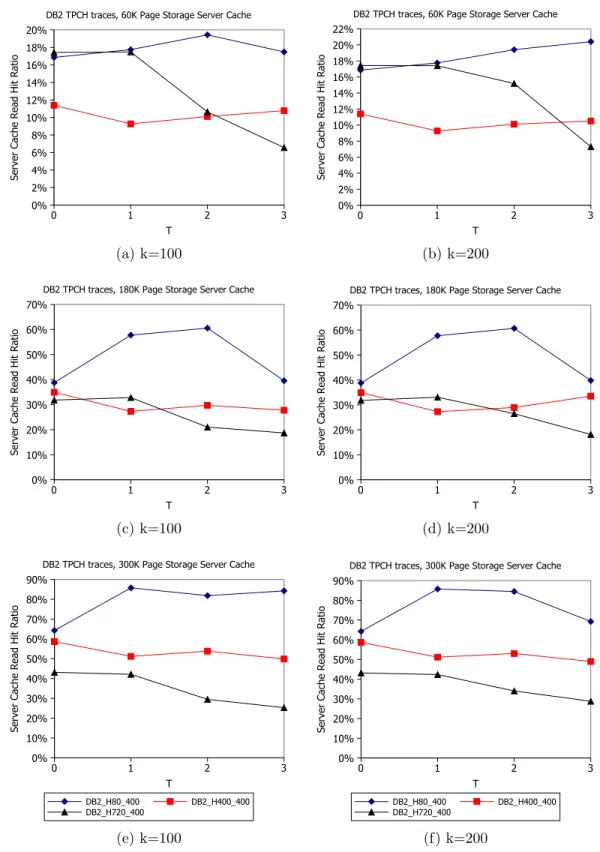
4.6.5 Increasing the Number of Hints for DP-CLIC . . . 65
4.7 Conclusion . . . 66
5 Classification of Hint Sets 69 5.1 Hybrid Algorithms . . . 71
5.2 Impurity of Hint Types . . . 72
5.3 Experimental Evaluation . . . 74
5.4 Conclusion . . . 79
6 Hybrid Storage Management for Database Systems 80 6.1 System Overview . . . 83
6.2 Buffer Pool Management . . . 85
6.2.1 Implementation of GD2L on MySQL . . . 86
6.4 SSD Management . . . 90
6.4.1 CAC: Cost-Adjusted Caching . . . 91
6.4.2 The Miss Rate Expansion Factor . . . 94
6.4.3 Sequential I/O . . . 96
6.4.4 Implementation of SSD Management on MySQL . . . 96
6.4.5 Failure Handling . . . 98
6.5 Evaluation . . . 98
6.5.1 Methodology . . . 100
6.5.2 Cost Parameter Calibration . . . 101
6.5.3 Analysis of GD2L and CAC . . . 101
6.5.4 Comparison with LRU2 and MV-FIFO . . . 106
6.5.5 Impact of the Eviction Zone . . . 108
6.6 Conclusion . . . 109
7 Conclusion and Future Work 111 7.1 Future Work . . . 112
List of Figures
1.1 Prices and Performance of SSDs and HDDs
Data are from Graefe [27] in 2007. . . 2
1.2 Architecture of Multi-tier Caches . . . 3
2.1 Trend of HDD and SSD Price [59] . . . 10
2.2 FTL and NAND Flash Memory FTL emulates sector read/write functionalities of a hard disk to use conventional disk file systems in NAND flash memory . . . 11
3.1 System Architecture . . . 17
3.2 Types of Hints in the DB2 I/O Request Traces. . . 18
3.3 Types of Hints in the MySQL I/O Request Traces . . . 19
3.4 Hint Set Priorities for the DB2 C60 Trace Each point represents a distinct hint set. All hint sets are shown. . . 22
3.5 Priority Calculation Timeline . . . 24
3.6 Structures Used by CLIC Arrows show possible movements among queues in response to I/O requests . . 25
3.7 Hint-Based Server Cache Replacement Policy This pseudo-code shows how the server handles a request for pagepwith hint set H and request sequence numbers. . . 26
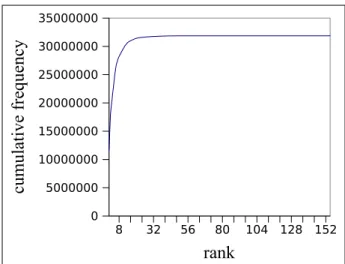
3.8 Cumulative Hint Set Frequency in the DB2 C300 400 Trace . . . 27
3.9 I/O Request Traces. The page sizes for the DB2 and MySQL databases were 4KB and 16KB, respec-tively. For the TPC-C workloads, the table shows the initial database size. The TPC-C database grows as the workload runs. . . 31
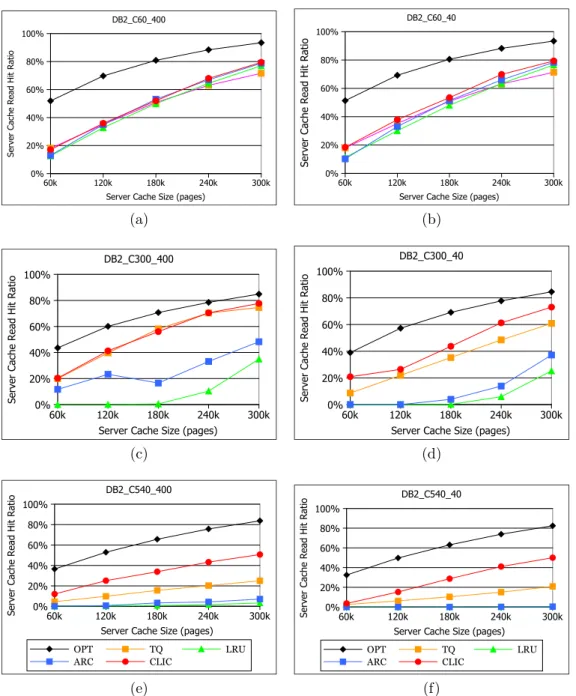
3.10 Read Hit Ratio of Caching Policies for the DB2 TPC-C Workloads . . . . 33
3.12 Read Hit Ratio of Caching Policies for the MySQL Workloads . . . 36 3.13 Effect of Outqueue Size on Read Hit Ratio
Each bar represents a different outqueue size. . . 37 3.14 Effect of Top-K Hint Set Filtering on Read Hit Ratio . . . 38 3.15 Effect of Top-K Hint Set Filtering on Read Hit Ratio with TPC-C Workload
Traces . . . 40 3.16 Effect of Top-K Hint Set Filtering on Read Hit Ratio with TPC-H Workload
Traces . . . 41 3.17 Read Hit Ratio with Three Clients
Read hit ratio is near zero for the DB2 C300 and DB2 C540 traces in the 180K page shared cache, so bars are not visible. . . 43 4.1 Temporal Locality of Upper-tier and Lower-tier Cache Accesses Using Reuse
Distance Histograms. (a) Auspex Client Trace and (b) Auspex Server trace[76].. . . 46 4.2 Read Reference Distance Histograms of DB2 TPC-C Workload Traces . . . 47 4.3 Illustration of Read Reference Histogram . . . 48 4.4 Hint Set Priority Produced by Dynamic Benefit/Cost Model of DB2 TPC-C
Workload Traces . . . 50 4.5 The DP-CLIC Cache Replacement Policy
This pseudo-code shows how the server handles a request for pagepwith hint set
H and request sequence numbers. . . 52 4.6 Hint Set Priorities for the DB2 C60 400 Trace
Each point represents a distinct hint set. All hint sets are shown. . . 54 4.7 Hint Set Statistics for the DB2 C60 400 Trace
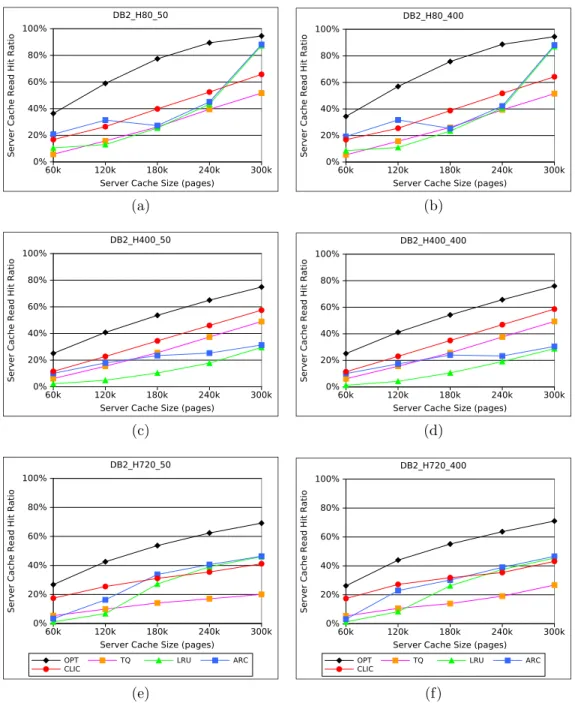
Each bubble represents a distinct hint set - not all hint sets in the trace are shown. Each bubble’s radius is proportional to the frequency of its hint set. . . 54 4.8 DP-CLIC Priority vs. CLIC Priority . . . 55 4.9 Read Hit Ratio of Caching Policies for the DB2 TPC-C Workloads . . . . 56 4.10 DP-CLIC Priority vs. CLIC Priority . . . 57 4.11 DP-CLIC Priority vs. CLIC Priority . . . 58 4.12 Read Hit Ratio of Caching Policies for the DB2 TPC-H Workloads . . . . 59 4.13 CLIC priority vs. DP-CLIC priority of DB2 H80 400 trace . . . 60 4.14 Effect of Width of Buckets on Read Hit Ratio (number of bucket = 3000) . 62 4.15 Effect of Numbers of Buckets on Read Hit Ratio (width of bucket = 50000) 62
4.16 Effect of Numbers of Buckets on Read Hit Ratio (width of bucket = 10000) 62 4.17 Effect of Width of Buckets on Read Hit Ratio (number of bucket = 3000) . 63 4.18 Effect of Number of Buckets on Read Hit Ratio (width of bucket = 100000) 63
4.19 Effect of Top-K Hint Set Filtering on Read Hit Ratio (DP-CLIC) . . . 64
4.20 Effect of Top-K Hint Set Filtering on Read Hit Ratio with TPC-C Workload Traces . . . 67
4.21 Effect of Top-K Hint Set Filtering on Read Hit Ratio with TPC-H Workload Traces . . . 68
5.1 Architecture of Data Center . . . 70
5.2 Parameters of the Hybrid Algorithm . . . 72
5.3 CLIC Read Hit Ratio . . . 75
5.4 CLIC Read Hit Ratio . . . 76
5.5 DP-CLIC Read Hit Ratio . . . 77
5.6 DP-CLIC Read Hit Ratio . . . 78
6.1 System Architecture (the arrows represent read/write requests) . . . 81
6.2 The Management of the Buffer Pool and the SSD . . . 84
6.3 Storage Device Parameters . . . 86
6.4 The GD2L Algorithm This pseudo-code shows how GD2L handles a request for page p. L is initialized as 0 . . . 87
6.5 Buffer Pool Managed by GD2L on MySQL . . . 88
6.6 Miss Rate/Write Rate While on HDD vs. Miss Rate/Write rate while on SSD. Each point represents one page . . . 90
6.7 The Measured and Estimated Statistics of a Page Note thattS andtD represent the total time that the page is on the SSD and not on the SSD. . . 92
6.8 Summary of Notation . . . 93
6.9 Miss Rate Expansion Factor for Pages from Three TPC-C tables. . . 95
6.10 The Data Structures Used by the SSD Manager . . . 97
6.12 Performance Statistics (DB size=30GB)
I/O is reported as ms. per New Order transaction. . . 103 6.13 Performance Statistics (DB size=15GB)
I/O is reported as ms. per New Order transaction. . . 103 6.14 Performance Statistics (DB size=8GB)
I/O is reported as milliseconds of device time per New Order transaction. . . . 104 6.15 TPC-C Throughput. . . 107 6.16 Performance Statistics (DB size=30GB)
I/O is reported as ms. per New Order transaction. . . 108 6.17 Performance Statistics (DB size=15GB)
I/O is reported as milliseconds of device time per New Order transaction. . . . 108 6.18 Performance Statistics (DB size=8GB)
I/O is reported as milliseconds of device time per New Order transaction. . . . 109 6.19 Throughput of TPC-C Runs in term of Eviction Zone Size . . . 109
Chapter 1
Introduction
In computing systems, one of the most serious performance bottlenecks is accessing data on the hard disk drive (HDD). For example, in a database system, much of a transaction’s lifetime is spent on waiting to access data on disks. The time required to access data on the HDDs is determined by the mechanical nature of the rotating disks and by the moving disk arms. Caching is a classical but effective way to improve system performance. The purpose of caching is to keep frequently accessed data in a faster media, and thus, to reduce disk I/O traffic. Consequently, conventional storage systems consist of two levels: the memory and HDDs. As the memory is significantly faster and significantly more expensive than the HDD, a larger memory means more performance gains but more cost to the system. In 1987, Gray, et al. [29], argued that data accessed every five minutes or more should be resident in memory. The “five-minute rule” is based on the trade-off between the dollar cost of accessing data in the memory versus using HDD.
Over the past decades, the access time gap and cost gap between the memory and HDDs have continued to increase. Meanwhile, new storage devices have been introduced. Figure1.1 lists prices and performance of RAM, flash-based Solid State Drives (SSDs) and HDDs presented by Graefe [27] in 2007, from which we see that the performance of HDDs largely lags behind the memory. As the price of flash memory has fallen dramatically, it has made inroads into the laptop market, desktop storage market and the enterprise server market. Currently, SSDs are about 17−32×more expensive per GB, but about 50−150× less expensive per random I/O per second than are hard disks. Graefe [27] reviewed the five-minute rule for trading off memory and I/O capacity based on prices and performance of SSDs and HDDs current at that time. He pointed out that the five-minute rule still held if flash-based Solid State Drives (SSDs) were introduced to fill the gap between RAM and HDDs. Flash can accordingly augment the system to form a new tier in the storage hierarchy.
As new storage devices, e.g. SSDs, are added to storage systems over time, using the memory cache is not the only way to improve system performance. On the storage side, although the cost of flash per gigabyte is falling quickly, it is still expensive to replace
RAM Flash disk SATA disk Price and capacity $3 for 8x64 Mbit $999 for 32GB $80 for 250GB
Access latency 0.1ms 12ms average
Transfer bandwidth 66MB/s API 300 MB/s API
Active power 1W 10W
Idle power 0.1W 8W
Sleep power 0.1W 1W
Figure 1.1: Prices and Performance of SSDs and HDDs
Data are from Graefe [27] in 2007.
all hard disks with SSDs. Hence, rather than as a replacement for HDDs, SSDs should be viewed as a means to enhance them. Hard disks are cost-effective and better suited for sequential accesses, while SSDs can be targeted for high throughput of small random I/O requests, as SSDs will have significantly better performance on random data accesses. Heterogeneous storage systems have been investigated inside and outside of industry. For example, OCZ launched a hybrid PCIe SSD (the RevoDrive Hybrid) [56] which integrates 100GB SSD capacity along with an onboard tegabyte HDD. Heterogeneous storage systems are designed to balance performance and storage capacity on a limited budget.
1.1
Cache Hierarchies
In this thesis, we address two challenges in the storage hierarchy: First, how to manage the lower-tier cache in a multi-tier cache system? Multi-tier block caches arise in many situations in modern computing systems. One scenario is illustrated in Figure 1.2. Most DBMS have their own buffer pool for various reasons. At the same time, the applications may store their data in a file system, which also manages a cache. Besides this, if the storage is provided by a dedicated storage server, the storage server also uses its memory for data caching. When applications issue I/O requests, the requested data may go through all tiers of these caches before it reaches its destination. Management of these caches has a significant impact on overall system performance.
In Chapter 3 and Chapter 4, we discuss how to manage the lower-tier cache. As illustrated in Figure 1.2, whether it is over a network or used for local access, running a database management system (DBMS) on top of a storage server results in at least two tier caches. The challenges of making effective use of caches below the first-tier are well known [54,70, 76]. Zhou et al. [76], investigated the access patterns of second-tier caches and found that they are different from those at the first-tier caches. Filtered by the upper-tier cache, the request streams to the lower-upper-tier cache have poor temporal locality. Thus, locality-based replacement policies, such as Least Recently Used (LRU), and CLOCK, do not work well for the second-tier cache. Another difficulty in managing multiple tiers of caches is the inclusiveness problem [70]. Multi-tier caches do not lead to performance in
DBMS Buffer Pool
Storage Server Cache
... HDDs
I/O requests
Figure 1.2: Architecture of Multi-tier Caches
proportion to their aggregate cache size, since caches fail to maintain exclusive content. Duplicated content in both the first-tier and second-tier caches result in wasting available cache space. To address these problems, many techniques have been proposed for improving the performance of second-tier caches. One promising class of techniques relies on hinting: the application that manages the first-tier cache generates hints and attaches them to the I/O requests that it directs to the second-tier. The cache at the second-tier then attempts to exploit these hints to improve its performance. Previous work has taken an ad hoc
approach to hinting.
We provide two generic techniques for exploiting application hints to manage the second-tier cache. The first one, Client-informed Caching (CLIC), is discussed in Chap-ter 3. Unlike ad hoc techniques, CLIC does not hard-code responses to any particular type of hint. Instead, it is an adaptive approach that attempts to learn to exploit any type of hint supplied to it. Applications in the upper-tier cache are free to supply any hints that they believe to be of value to the lower-tier cache.
The second technique is dynamic priority CLIC (DP-CLIC), introduced in Chapter4, which is an extension of CLIC. Both techniques analyze available hints and determine which can be exploited to improve performance. As any hints are allowed to pass to the lower-tier cache, tracking all hint sets may cause space and time overhead. Our techniques learn to ignore hints that do not help using a top-k algorithm (in Chapter 3) and a feature selection algorithm (in Chapter5),
1.2
Hybrid Storage
The second question addressed in this thesis is how to place data in the memory and the SSD in a hybrid storage system. As SSDs become a new tier of the storage hierarchy, it is not uncommon for servers to consist of a memory cache and hybrid storage devices. For
example, a database server may use a hybrid storage system including a SSD and a HDD to improve performance while saving cost. Thus, besides managing its own buffer pool, the database server also needs to make data placement and replacement decisions for the SSD. The use of hybrid storage devices raises the question of how to make efficient use of both the memory and the SSD.
In Chapter6, we are concerned with the use of hybrid (SSD and HDD) storage systems for database management. The promise of good performance for database workloads with SSDs [40] suggests that storage systems will likely continue to include SSDs and cost-effective HDDs. We consider hybrid storage systems in which the HDD and the SSD are both visible to the database management system (DBMS) buffer manager. As all data are stored in the HDD, the SSD forms a new tier between the buffer pool and the HDD. Thus, the DBMS buffer manager can use both the buffer pool and the SSD to improve system performance. However, managing both the buffer pool and SSD effectively is more difficult than managing one alone. The challenges arise from the impact of the buffer pool and the SSD on each other.
The hybrid storage management problem is different from the multi-tier cache problem. First, in the multi-tier cache problem, the upper-tier cache and the lower-tier cache belong to different servers, and are managed separately. Hints are passed for helping the lower-tier cache to understand the management of the upper-tier cache. However, the management of the lower-tier cache has no impact on the management of the upper-tier cache. In the hybrid storage management problem, the memory and the hybrid storage system belong to the same server. The buffer manager can make data placement and replacement decisions for both the memory and the SSD. Second, one key feature of flash memories is non-volatility, i.e. data stored on flash memory will not be lost even without power. Thus, the SSD can be also viewed as a part of the permanent storage. Unlike the memory cache in the storage server, dirty pages in the SSD do not need to be flushed to the HDD immediately. We present cost-based caching algorithms for both the buffer pool and the SSD cache. To make replacement decisions for the buffer pool, the cost-aware algorithm considers not only page recency but also future retrieval costs. Correspondingly, the responsibility of the SSD caching algorithm is to identify pages with the largest access cost savings and place them in the SSD. As a characteristic of SSD is that it has fast random I/Os, caching hot pages in the SSD reduces the overall I/O access cost and improves the system performance.
1.3
Contributions
This thesis addresses the problems of two-tier cache management and hybrid storage man-agement in database systems. In the area of two-tier cache manman-agement, it makes the following contributions:
determine which hints provide potentially valuable information to the second-tier cache.
• We define an adaptive, priority-based cache replacement policy for the second-tier cache. This policy exploits the results of the hint analysis to improve the hit ratio of the second-tier cache.
• We extend CLIC’s cost/benefit model to a dynamic cost/benefit model, on which dynamic priority CLIC (DP-CLIC) is based. The caching policy of DP-CLIC is priority-based, but DP-CLIC’s priorities vary with reference distances.
• We propose to reduce the overhead of tracking hint set statistics using a frequency selection algorithm and a feature selection algorithm.
• We use trace-based simulation to provide a performance analysis of CLIC. Our results show that CLIC outperforms ad hoc hinting techniques and that its adaptivity can be achieved with low overhead. We also evaluate DP-CLIC by comparing it with CLIC. Our results show that DP-CLIC performs at least as well as CLIC in all cases, and outperforms CLIC for some traces.
In the area of hybrid storage management, it makes the following contributions:
• We present GD2L, a cost-aware algorithm for buffer pool management in DBMS with hybrid storage systems. GD2L takes the usual concerns of DBMS buffer management (exploiting locality, scan resistance) into account, but also considers the fact different devices in a hybrid storage system perform differently.
• We present CAC, an anticipatory cost-based technique for managing the SSD. Unlike previous techniques, CAC is intended to work together with a cost-aware buffer manager such as GD2L. The technique expects that moving a page into or out of the SSD will change the access pattern for that page, and it anticipates these changes when making SSD placement decisions.
• We present an empirical evaluation of GD2L and CAC. We have implemented both techniques in MySQL’s InnoDB storage engine. We compare the performance of GD2L with of InnoDB’s native buffer manager, which is oblivious to the location of pages in a hybrid storage system. We compare CAC to several alternatives, in-cluding a non-anticipatory cost-based technique and LRU2. Our evaluation uses transactional workloads.
1.4
Organization of the Thesis
The remainder of this thesis is structured as follows. Chapter3 discusses Client-Informed Caching for Storage Servers. Chapter 4 introduces Dynamic Priority CLIC, an extension
of CLIC. Chapter5introduces how to classify hint sets with the feature selection algorithm to reduce the overhead for tracking hint set statistics. Chapter 6 presents the data man-agement for hybrid database storage. Chapter2 discusses the existing work related to the management of the lower-tier cache and the management of the SSD. Finally, Chapter 7 concludes the thesis.
Chapter 2
Related Work
Chapter 1 introduces two problems: the management of second-tier caches, and manage-ment of hybrid storage which includes SSD and HDD. In this chapter we survey other work related to these two problems.
2.1
Second-Tier Cache Management
Compared to other general-purpose replacement algorithms, e.g. Least Frequently Used (LFU), First In First Out (FIFO), and Most Recently Used (MRU), Least Recently Used (LRU) is the most widely used in practice. Based on these classical replacement algo-rithms, many general-purpose algoalgo-rithms, such as 2Q [34], Adaptive Replacement Cache (ARC) [52], Clock with Adaptive Replacement (CAR) [4], and Multi-Queue (MQ) [76], have been proposed recently. Among them, ARC considers both recency and frequency in making replacement decisions, and adapts to changing workloads by automatically bal-ancing recency and frequency. While any of the general-purpose algorithms can be used at any level of a cache hierarchy, researchers have recognized that cache management at lower-tiers of a hierarchy poses particular challenges. Many techniques have been proposed specifically for second (or lower) tier caches. For example, MQ was developed specifically for second-tier caches based on the access patterns of second-tier caches observed by Zhou et al. [76]. Since the requests to the second-tier cache have little temporal locality avail-able, studies [52,76] have shown that these new proposed algorithms (e.g. MQ, ARC) had better performance than LRU. ACME [1] is a mechanism that can be used to automatically and adaptively choose a good policy from among a pool of candidate policies, based on the recent performance of the candidates. Other approaches for second-tier cache manage-ment, presented in the following two subsections, have been classified by Chen et al. [13] as either hierarchy-aware or aggressively collaborative based on whether the approaches require changes to the first-tier.
2.1.1
Hierarchy-aware Approaches
Hierarchy-aware approaches, including eviction-based cache placement [14], X-RAY [3], and semantically-smart disks [2], exploit knowledge of the existence of the upper-tier cache, but they are transparent to it. An example of a hierarchy-aware technique is quick eviction of read pages from a second-tier cache, under the assumption that such pages are likely to remain in the first-tier cache. Eviction-based cache placement [14] was developed in the context of database systems. The storage server cache manager maintains a Client Content Track (CCT) table to estimate eviction information (which blocks have been evicted) for the storage client (DBMS) cache by monitoring the target memory location of each block request from the storage client. Instead of managing its cache in an on-demand fashion, which leads to cache misses. The storage server cache manager preloads the blocks evicted from the first-tier cache to the second-tier cache. Semantically-smart disks and X-RAY are related techniques which use gray-box methods [15], and they both assume the first tier is a file system. Semantically-smart disks [2] can exploit layout information (e.g. to categorize disk blocks as data blocks, inodes blocks, or superblocks) and extract semantic information for file systems that are similar to the Berkeley Fast File System. With this semantic information, it is able to infer higher-level file system behavior and improve caching performance by avoiding duplicating the contents of the file system cache. X-RAY [3] tracks the file system cache using a recency list. Like a semantically-smart disk, X-RAY can identify inode blocks (file meta-data) when they are flushed to the storage server cache, and can extract information (e.g. access and update timestamp) to update its recency list. Using the recency list, it can predict which blocks are likely to be in the first-tier cache, and which ones have been evicted. Like eviction-based cache replacement, X-RAY needs extra disk bandwidth to preload blocks evicted from the first-tier cache to the second-tier cache. X-RAY has also been used for DBMS clients [63].
2.1.2
Aggressively Collaborative Approaches
Aggressively collaborative approaches [13] require some modification to the first-tier. Wong et al. [70] observed the wasteful inclusiveness of second-tier caches. To maintain exclusivity among caches, they suggested adding a DEMOTE I/O operation to the SCSI command set in order to send blocks evicted from the first-tier to the second-tier cache. In contrast to the DEMOTE technique, which moves blocks down the cache hierarchy, PROMOTE [26] transfers blocks with high hit ratio from the lower-tier cache to the upper-tier cache grad-ually as they are read. Gill et al. [26] claimed that PROMOTE outperformed DEMOTE, especially in limited bandwidth scenarios as it avoided the bandwidth overheads caused by DEMOTE. PROMOTE must be used by all tiers, including the first-tier. This may be undesirable if the first-tier cache is managed by a database system or other application that prefers an application-specific policy for cache management.
Unified and Level-aware Caching (ULC) [33] uses a centrally-controlled cache placement and replacement protocol for multi-tier buffer caches. It gives complete responsibility for
management of the lower-tier caches to the first-tier cache manager, which moves blocks up or down the cache hierarchy using RETRIEVE or DEMOTE commands. Karma [72] relies on application hints to group blocks into “ranges”, and then calculates the priority of each range based on its access pattern and replacement algorithm (e.g. LRU for random access pattern). Ranges with higher priorities will be maintained in the upper-tier cache. Each range is managed separately and exclusiveness is maintained by using DEMOTE and READ-SAVE commands. MC2 [71] applies Karma for managing multi-tier caches shared by multiple clients. Multiple clients raise another problem: the goal of the cache manager is not only to improve the overall system performance (e.g. latency, hit ratio), but also to consider the performance of each client. To achieve the goal of reducing I/O response time for all clients, MC2 tries to allocate cache space fairly among clients.
Several hint-based techniques have been proposed, including importance hints [13] and write hints [44]. The Type-Queue (TQ) algorithm, which exploits I/O type hints (read-/write) for cache management, has been proposed by Li et al. [44]. They distinguished different kinds of write requests (e.g. synchronous write, asynchronous replacement write) that provide clues about future data access by storage clients. Thus, these hints can be used by the storage server to maintain data exclusiveness. In their work on informed prefetching and caching, Patterson et al. [58] distinguished hints that disclose from hints that advise, and advocated the former. Most subsequent hint-based techniques, including CLIC [45], use hints that disclose. Informed prefetching and caching rely on hints that disclose sequential access to entire files or to portions of files. Unlike CLIC, all of these techniques are designed to exploit specific types of hints. As was discussed in Chapter1, this makes them difficult to generalize and combine.
Content-aware caching [13], instead of piggybacking simple hints onto each I/O request, sends a summary of the storage client cache content periodically to the storage server. The storage server cache manager can then use the summary to avoid duplicating the contents of the upper-tier cache.
Although all aggressively collaborative techniques require changes to the first-tier, they vary considerably in the intrusiveness of the changes required. ULC [33] requires all tiers to understand the new protocol, and thus extensive code update in each tier is needed. Hint-based techniques are arguably the least costly. Hints are small and can be piggybacked onto regular I/O requests. More importantly, hint-based techniques do not require any changes to the policies used to manage the upper-tier cache.
A previous study [13] suggested that aggressively collaborative approaches provided little benefit beyond that of hierarchy-aware approaches and thus, the loss of transparency implied by collaborative approaches was not worthwhile. However, that study only consid-ered one ad hoc hint-based technique. Li et al. [44] found that the hint-based TQ algorithm could provide substantial performance improvements in comparison to hint-oblivious ap-proaches (LRU and MQ) as well as simple hint-aware extensions of those apap-proaches.
There has also been work on the problem of sharing a cache among multiple competing client applications [8, 51, 65,71]. Often, the goal of these techniques is to achieve specific
Figure 2.1: Trend of HDD and SSD Price [59]
quality-of-service objectives for the client applications, and the method used is to somehow partition the shared cache. This work is largely orthogonal to CLIC, in the sense that CLIC can be used, like any other replacement algorithm, to manage the cache contents in each partition. CLIC can also be used to directly control a shared cache, as in Section3.4.5, but it does not include any mechanism for enforcing quality-of-service requirements or fairness requirements among the competing clients.
The problem of identifying frequently-occurring items in a data stream occurs in many situations [50, 53, 15]. Metwally et al. [53] classify solutions to the frequent-item problem as counter-based techniques or sketch-based techniques. The former maintain counters for certain individual items, while the latter collect information about aggregations of items. For CLIC, we have chosen to use the Space-Saving algorithm [53] as it is both effective and simple to implement. A recent study [15] found the Space-Saving algorithm to be one of the best overall performers among frequent-item algorithms.
In machine learning and statistics, feature selection has been widely studied [30, 60]. Guyon and Elisseeff [30] provide an excellent overview of feature selection for the particular problem, e.g., classification, clustering. In feature selection, the important features are determined as an useful preprocessing step before building the classifier (and this is usually done by selecting attributes that are highly correlated with the class attribute). Yang and Pederson [73] discusse feature selection for text classification. Das et al. [16] propose rank-based attribute selection which is related to feature selection to select attributes that best distinguish tuples of a query. In our work, we use feature selection to select important hint types and thus to reduce the number of hint sets CLIC has to track.
Page
Read BlockErase PageWrite
Flash Translation Layer
Page Page ... Page ... Page Page ... Page Page Page ... Page NAND Flash Memory
File System Logical
Sector Read Sector WriteLogical
Figure 2.2: FTL and NAND Flash Memory
FTL emulates sector read/write functionalities of a hard disk to use conventional disk file systems in NAND flash memory
2.2
Solid State Disks
The flash memory disk has been widely used for portable computing devices, such as PDAs, MP3 plays, and mobile phones. As its price drops and capacity increases (Figure 2.1) [59], some recent studies have proposed that flash memory disk might be an attractive alternative for non-volatile data storage in desktop systems [36] and lower-level storage systems [38, 39, 40]. The Flash Translation Layer (FTL) [32], which is the driver to make linear flash memory appear to the OS like a disk drive, makes it easy to replace magnetic disks with flash disks in most applications (Figure2.2).
Unlike DRAM, one key feature of flash memories is non-volatility, i.e. data stored on flash memory will not be lost even without power. This feature makes flash memories suitable for use as a consistent cache or for persistent storage. If flash memory is introduced to fill the gap between RAM and traditional rotating disks, a common question is whether it should work as a special part of main memory or a special part of persistent storage.
Placing hot data in fast storage (e.g. hard disks) and cold data in slow storage (e.g. tapes) is not a new idea. Hierarchical storage management (HSM) is a data storage tech-nique which automatically moves data between high-cost and low-cost storage media. It
uses fast storage as a cache for slow storage [31]. The performance and price of SSDs suggests that “Tape is dead, disk is tape, flash is disk” [28] seems to have come true.
Some research has focused on how to partially replace hard disks with SSDs in database systems. Koltsidas, et al. [38] assumed that random reads from SSD are ten times faster than random reads from HDD, while random writes to SSD are ten times slower than random writes to HDD. They designed an algorithm to place read-intensive pages on the SSD and write-intensive pages on the HDD. Canim et al. [10] introduced an object placement advisor for DB2. Using run-time statistics about I/O behavior gathered by the buffer manager, the advisor helps the database administrator make decisions about SSD sizing, and about which database objects, such as tables or indices, should be placed on limited SSD storage. Ozmen et al. [57] presented a database layout optimizer which places database objects to balance workload and to avoid interference. It can generate layouts for heterogeneous storage configurations that include SSDs.
Flash memory has been used as cache for extending DRAM. Examples include ZFS [42], FlashCache [22], XtremSW Cache [21], and ioTurbine [25]. The flash memory cache sits between DRAM and the disks and is populated as entries are evicted from the DRAM cache. These flash-based caches are designed as write-through caches, which means dirty pages are written to both the based cache and the HDD. Thus, all pages in the flash-based cache are consistent with these in the HDD. The main purpose of the flash-base cache is to offload the read workload from the underlying HDD. Recent studies [9, 11, 62] also propose to use SSD as a write through cache. For example, Canim et al. [11] investigated the use of SSD as a second-tier cache. The most-frequently read pages, identified by run-time I/O statistics gathering, are moved into the SSD. Reads are served from the SSD if the page is in the SSD, but writes need to go to the hard disks immediately.
Unlike DRAM, flash memory is non-volatile, i.e. data stored on flash memory will not be lost in case of a loss of power. As its persistence enables cache contents to survive crashes or power failures, recent studies have argued to use SSDs as write-back caches. Unlike a write-through cache, a write-back cache maintains dirty pages and writes are acknowledged immediately after the write to the cache. Koller et al. [37] has argued that write-back caching policy offers critical performance benefits as it reduces write latencies and write I/O traffic to the storage. Recent studies [41, 55] report a trend of increasing write/read ratios in production workloads as newer systems with larger DRAM caches filter more reads. Koller et al. [37] propose journaled write-back flash-based cache to offload the write workload from the storage devices. Do et al. [20] propose lazy cleaning, an eviction-based mechanism for managing an SSD as a second-tier write-back cache for database systems. Dirty pages are written to the SSD first, and are later copied to the HDD in batch mode. FlashStore [17] uses SSDs as a write-back cache between RAM and the HDD. It organizes data as key-value pairs, and writes the pairs in a log-structure on flash to improve the write performance. Kang et al. [35] proposed FaCE, an alternative write-back design. FaCE is based on the FIFO replacement algorithm. FaCE invalidates stale pages on the SSD and writes new versions to the end of the FIFO queue. Therefore,
FaCE always writes pages sequentially to the SSD, improving the performance by avoiding random writes. hStorage-DB [47] extracts semantic information from the query optimizer and query planner and passes it with I/O requests to the SSD manager. The semantic information includes hints about the request type, e.g, random or sequential. hStorage-DB associates a priority with each request type, and the SSD manager uses these priorities when making placement and replacement decisions. SSD can also be exploited to save energy for RAID systems consisting of hard disks. Snyder et al. [64] propose QMD which saves energy by using SSD as a write buffer.
As a write-back cache maintains dirty pages, it introduces data staleness and inconsis-tency at the storage devices. Thus, it needs to be recovered after a system crash. As the SSD is non-volatile, a naive way to restore the data in the SSD is to scan the whole SSD. However, scanning a whole SSD cache is time consuming if the SSD size is large. Do et al. [20] and Koller et al. [37] set checkpoints to flush dirty pages in the SSD to the storage devices. Debnath et al. [17] address this problem by checkpointing the hash map of the SSD and logging all writes to the SSD. As an extension to the work of Do et al. [20], DeWitt et al. [19] revisit the failure recovery problem of the SSD cache. They propose to flush the SSD buffer table during the DBMS checkpoint operation, and to log the updates made to the SSD buffer table in the regular database transactional log. Upon restart, the SSD buffer table can be reconstructed from the log. They also propose another method to restore the the SSD buffer table using the log. During a restart, the contents of the SSD buffer table are lazily verified on demand by checking the version in the SSD against that in the storage devices.
Most previous work focuses on the caching policy of the SSD and leaves DBMS buffer pool management unchanged. In addition to the placement policy for the SSD, Koltosidas, et al. [38] designed a cost-aware replacement algorithm for the buffer pool. The page I/O access cost is the I/O performance of the storage device that the page is on. For example, it considers the cost of writing a dirty page to SSD to be the highest and the cost of reading a page from SSD the lowest, and it always evicts the page with the lowest I/O access cost. One drawback of this algorithm is that it does not combine recency with the I/O access cost properly. Assume that a page in the SSD has been modified in the buffer pool, and then it is one of the pages with the highest cost. As long as there is a page with a lower cost, this dirty page will be kept in the buffer pool even if there are no further references to it. However, multiple reads may cost more than a single write. Another potential problem with this algorithm is that it delays the flushing of dirty pages.
Most replacement policies for the buffer cache, such as LRU and ARC, are cost-oblivious. Existing cost-aware algorithms for heterogeneous storage systems, e.g. balance algorithm [49] and GreedyDual, were proposed for file caching. Cao et al. [12] extended GreedyDual to handle cached objects of varying size, with application to web caching. Forney et al. [24] revisited caching policies for heterogeneous storage systems. They sug-gest partitioning the cache for different classes of storage according to the workload and performance of each class. Lv, et al. [48] designed another “cost-aware” replacement
algo-rithm for the buffer pool. However, it is designed for storage systems that only have SSD, not for heterogeneous storage systems. The algorithm is aware that SSD read costs and write costs are different and tries to reduce the number of writes to the SSD. Thus, it is “cost-aware” in a different sense than GD2L.
Our work, GD2L and CAC [46], builds upon previous studies [11, 12, 20, 49]. The GD2L algorithm for managing the buffer pool is a restricted version of GreedyDual [49], which we have adapted for use in database systems. Our CAC algorithm for managing the SSD is related to the previous cost-based algorithm of Canim et al. [11]. CAC is aware that the buffer pool is managed by a cost-aware algorithm and adjusts its cost analysis accordingly when making replacement decisions.
Chapter 3
CLIC: Client-Informed Caching for
Storage Servers
The challenges of making effective use of caches below the first tier are well known [54, 70,
76]. Poor temporal locality in the request streams experienced by the second-tier caches reduces the effectiveness of recency-based replacement polices [76], and failure to maintain exclusivity among the contents of the caches in each tier leads to wasted cache space [70]. One promising approach is hint-based: let each individual sub-system manage its own cache, but with more information - hints. Specifically, hints are I/O related information carried from an upper-tier cache [70, 44, 72]. The system that manages the upper-tier cache generates hints and attaches them to individual I/O requests in order to provide some information about the request. The lower-tier cache then is able to exploit these hints to improve its performance. For example, hints can be used to pass data access and eviction predictions from an upper-tier to a lower-tier. A write hint [44] indicates whether the upper tier cache is writing a page to ensure recoverability of the page, or to facilitate replacement of the page. The lower-tier cache then may infer that replacement writes are better candidates for caching than the recovery writes, since they indicate pages that are eviction candidates in the upper-tier cache. Furthermore, hints can pass application semantics [13]. An importance hint indicates the priority of a particular page to the buffer cache manager in the upper-tier application. Given such hints, the lower-tier cache can infer that pages having higher priority in the upper-tier cache are likely to be retained there, and thus give these pages lower priority in the lower-tier cache.
Hinting is valuable because it is a way of making additional information available to the second (or lower) tier, which needs a good basis on which to make its caching decisions. However, previous work has taken anad hocapproach to hinting. The general approach is to identify a specific type of hint that can be generated from the first-tier, e.g., a DBMS. A replacement policy that knows how to take advantage of this particular type of hint is then designed for the second-tier cache. For example, the TQ algorithm [44] is designed
specifically to exploit write hints. The desired response to each possible write hint is hard-coded into the TQ algorithm.
Ad hoc algorithms can significantly improve the performance of the second-tier cache when the necessary type of hint is available. However ad hoc algorithms also have some significant drawbacks. First, because the response to hints is hard-coded into an algorithm at the second-tier, any change to the hints requires changes to the cache management policy at the second-tier server. Second, even if change is possible at the server, it is difficult to generalize ad hoc algorithms to account for new situations. For example, suppose that applications can generatebothwrite hints and importance hints. Clearly, a low-priority (to the first tier) replacement write is probably a good caching candidate for the second-tier, but what about a low-priority recovery write? In this case, the importance hint suggests that the page is a good candidate for caching in the second-tier, but the write hint suggests that it is a poor candidate. One response to this might be to hard code into the second-tier cache manager an appropriate behavior for all combinations of hints that might occur. However, each new type of hint will multiply the number of possible hint combinations, and it may be difficult for the policy designer to determine an appropriate response for each one. A related problem arises when multiple first-tier caches are served by a single cache in the second-tier. If the first-tier caches generate hints, how is the second-tier cache to compare them? Is a write hint from one first-tier cache more or less significant than an importance hint from another?
In this chapter, we propose CLient-Informed Caching (CLIC), a generic technique for exploiting application hints to manage a second-tier cache, such as a storage server cache. Unlike ad hoc techniques, CLIC does not hard-code responses to any particular type of hint. Instead, it is an adaptive approach that attempts to learn to exploit any type of hint that is supplied to it. Caches in the first-tier are free to supply any hints that they believe may be of value to the second-tier. CLIC analyzes the available hints and determines which can be exploited to improve second-tier cache performance. Conversely, it learns to ignore hints that do not help. Unlike ad hoc approaches, CLIC decouples the task of generating hints (done by the first-tier) from the task of interpreting and exploiting them. CLIC naturally accommodates multiple hint types, as well as scenarios in which multiple first-tier caches share a second-tier cache.
3.1
Generic Framework for Hints
We assume a system in which multiple storage server clients in the first-tier cache generate requests to a storage server, as shown in Figure 3.1. We are particularly interested in clients that cache data, since it is such clients that give rise to multi-tier caching.
There is a variety of realistic scenarios that fit the general architecture shown in Fig-ure 3.1. For example, client application may be a database system accessing a shared
storage client cache storage client cache storage client cache storage server cache
…
Figure 3.1: System Architecture
storage system through a storage area network. Alternatively, the storage server could represent a local file system serving a set of clients running on the same machine.
The storage server’s workload is a sequence of block I/O requests from the various clients. When a client sends an I/O request (read or write) to the server, it may attach hints to the request. Specifically, each storage client may define one or more hint types
and, for each such hint type, ahint value domain. When the client issues an I/O request, it attaches ahint setto the request. Each hint set consists of one hint value from the domain of each of the hint types defined by that client. For example, we used IBM DB2 Universal Database1as a storage client, and we instrumented DB2 so that it would generate five types
of hints, as described in Figure 3.2. Thus, each I/O request issued by DB2 will have an attached hint set consisting of five hint values: a pool ID, an object ID, an object type ID, a request type, and a DB2 buffer priority. Together, a pool ID, object ID and object type ID uniquely identify a specific database object, such as a table or an index. The request type flag indicates whether a particular request was generated asynchronously (e.g., by a DB2 prefetch or page cleaning thread) and, for write requests, whether the request was generated for recoverability or buffer cache replacement purposes. (These are essentially
write hints [44].) Finally, the DB2 buffer priority hint indicates the priority given to the requested page by DB2’s buffer cache manager.
We also instrumented MySQL InnoDB the same way DB2 was instrumented, and Fig-ure 3.3 shows the hint types in the MySQL InnoDB I/O request stream. From the two figures we see that the hint types of DB2 are different from that of MySQL. This is because the two database systems have different storage engines, and manage data differently.
CLIC does not require these specific hint types. We chose these particular types of hints because they could be generated easily from DB2 and MySQL InnoDB, and because
Value Value
Hint Domain Domain
DBMS Type Cardinality Cardinality Description
(TPC-C [67]) (TPC-H [68])
DB2 pool ID 2 5 Identifies which DB2 buffer pool generated
the I/O request.
DB2 object ID 21 23 Identifies a group of related database
ob-jects, such as a table and its associated in-dices.
DB2 object type ID 6 9 Identifies object type, such as table or index.
Together, a pool ID, object ID and object type ID uniquely identify a database object.
DB2 request type 5 5 For read requests, distinguishes regular
reads from prefetch reads. For writes, provides write hints ([44]), which distin-guish between recovery writes, replacement writes, and synchronous writes. Syn-chronous writes are replacement writes that are not performed by an asynchronous page cleaning thread.
DB2 buffer priority 4 1 Identifies the priority of the page in its DB2
buffer cache.
Figure 3.2: Types of Hints in the DB2 I/O Request Traces
we believed that they might prove useful to the underlying storage system. Each client can generate its own types of hints. CLIC itself only assumes that the hint value domains are categorical. It neither assumes nor exploits any ordering on the values in a hint value domain. Each storage client may have its own hint types. In fact, even if two storage clients are instances of the same application (e.g., two instances of DB2) and use the same hint types, CLIC treats each client’s hint types as distinct from the hint types of all other clients.
3.2
Hint Analysis
When a storage client issues a read request for a page that is not in the server’s cache, the server obtains the page from persistent storage and returns it to the client. At this time, storage server also has an opportunity to place the page into its cache. Similarly, when a storage client issues a write request, it supplies a page to the server, which then has the opportunity to cache the page. For each such opportunity, the storage server must decide whether to take advantage of it by caching the page. If it chooses to cache, it must also choose which page to evict from its cache to make room for the newcomer. Our approach
Value
Hint Domain
DBMS Type Cardinality Description
(TPC-H)
MySQL thread ID 5 ID of server thread that issued the request.
MySQL request type 6 Read, read ahead, replacement write, or recovery write. For read ahead, provides read ahead linear, read ahead random, and read ahead merge. Read ahead linear is a read request for pages before or after a page that is a bor-der in a linear read-ahead area. Read ahead random is a read request for all pages in a random read-ahead area when a number of pages in this area has been accessed re-cently. Read ahead merge is a read request for pages which the ibuf module wants to read in, in order to contract the insert buffer tree.
MySQL file ID 9 MySQL is configured so that each table is stored in a sep-arate file, together with any indexes defined on that table, so this hint distinguishes groups of database objects.
MySQL fix count 9 indicates how many MySQL threads are have currently
fixed (pinned) this page in the buffer pool
Figure 3.3: Types of Hints in the MySQL I/O Request Traces
is to base these caching decisions on the hint sets supplied by the client applications with each I/O request. CLIC associates each possible hint setHwith a numeric priority,Pr(H). When an I/O request (read or write) for page p with attached hint set H arrives at the server, the server uses Pr(H) to decide whether to cache p. Cache management at the server will be described in more detail in Section 3.2.4, but the essential idea is simple: the server cachespif there is some page p0 in the cache that was requested with a hint set H0 for which Pr(H0)<Pr(H). In other words, the priority of a page in the server cache is equal to the priority of the most recent hint set with which that page was requested.
We expect that some hint sets may signal pages that are likely to be re-used quickly, and thus are good caching candidates. Other hint sets may signal the opposite. Intuitively, we want the priority of each hint set to reflect these signals. But how should priorities be chosen for each hint set? One possibility is to assign these priorities, in advance, based on knowledge of the client application that generates the hint sets. Most existing hint-based caching techniques use this approach. For example, the TQ algorithm [44], which exploits write hints, understands that replacement writes likely indicate evictions in the client application’s cache, and so it gives them high priority, which are essentially the same as the request type hints shown in Figure 3.2. Based on knowledge of the storage client (the DB2 relational DBMS, in this case), the TQ algorithm gives higher priority to pages that are requested with the replacement write tag than those that are requested with the recovery write tag. TQ understands how the client works, and knows that pages
written as replacement writes are more likely to be needed again soon than those that are written with recovery writes. Similarly, quick eviction [13], gives low priority to any page in a read request, under the assumption that the storage client application is using a recency-based caching policy and is thus unlikely to need that page again soon.
This way of assigning priorities has been shown to be effective, when it can be applied. However, it has some significant disadvantages. Since the priority of each possible hint value is predefined and hard-coded into the storage server’s cache management policy, incorporating new types of hints involves changing the server’s cache management policy. New hint types can manifest themselves in two different ways. One is through new types of storage clients. It may be clear that DB2’s replacement writes should have higher priority than DB2’s recovery writes, but how does a DB2 replacement write compare to a write issued by another relational database system, or by a file system, that is sharing the same storage server? For that matter, how does a replacement write from one instance of DB2 compare to a replacement write from another instance of DB2 sharing the same storage server? A similar complication arises when a single application attaches more than one type of hint to each request. For example, our DB2 traces include both request type hints and DB2 buffer priority hints. Previous work has shown that recovery writes are poor server caching candidates and that pages with low DB2 buffer priority are good candidates. What should the server do with a recovery write that has low DB2 buffer priority?
3.2.1
Hint Benefit/Cost Analysis
CLIC takes a different approach to this problem. Instead of predefining hint priorities based on knowledge of the storage client applications, CLIC assigns a priority to each hint set by
monitoring and analyzing I/O requests that arrive with that hint set. Next, we describe how CLIC performs its analysis. With CLIC, each storage client is responsible forclassifyingits I/O requests by attaching hint sets to them. Clients may generate any types of hints that are feasible to generate and thatmightprove valuable for cache management at the server. The storage server is responsible for assigning a priority to each hint set (class of requests) through its monitoring and analysis process. CLIC is adaptive, so adding new hint types and new storage client applications is easy. As new hints arrive, CLIC begins monitoring them and assigns priorities to them. To simplify the presentation, we will ignore, for now, the cost (in time and space) of performing the analysis.
We will assume that each request that arrives at the server is tagged (by the server) with a sequence number. Suppose that the server gets a request (p, H), meaning a request (read or a write) for a page p with an attached hint set H, and suppose that this request is assigned sequence number s1. CLIC is interested in whether and when page p will be
requested again afters1. There are three possibilities to consider:
write re-reference: The first possibility is that the next request for p in the request
there would have been no benefit whatsoever to caching p at time s1. A cached
copy of p would not help the server handle the subsequent write request any more efficiently. A cached copy of p may be of benefit for requests for p that occur after s2, but in that case the server would be better off caching pat s2 rather than at s1.
Thus, the server’s caching opportunity at s1 is best ignored.
read re-reference: The second possibility is that the next request for p in the request
stream is read request at time s2. If the server caches p at time s1 and keeps p in
the cache until s2, it will benefit by being able to serve the read request at s2 from
its cache. For the server to obtain this benefit, it must allow p to occupy one page “slot” in its cache during the interval s2−s1.
no re-reference: The third possibility is thatp is never requested again after s1. In this
case, there is clearly no benefit to caching p ats1.
Of course, the server cannot determine which of these three possibilities will occur for any particular request, as that would require advance knowledge of the future request stream. Instead, we propose that the server base its caching decision for the request (p, H) on an analysis of previous requests with hint setH. Specifically, CLIC tracks three statistics for each hint setH:
N(H): the total number of requests with hint set H.
Nr(H): the total number requests with hint setH that result in a read re-reference (rather than a write re-reference or no re-reference).
D(H): for those requests (p, H) that result in read re-references, the average number of requests that occur between the request and the read re-reference. These requests will be requests for pages other than p.
Using these three statistics, CLIC performs a simple benefit/cost analysis for each hint set H, and assigns higher priorities to hint sets with higher benefit/cost ratios. Suppose that the server receives a request (p, H) and that it elects to cache p. If a read re-reference subsequently occurs whilepis cached, the server will have obtained a benefit from caching p. We arbitrarily assign a value of 1 to this benefit (the value we use does not affect the relative priorities of pages). Among all previous requests with hint setH, a fraction
fhit(H) =Nr(H)/N(H) (3.1)
eventually resulted in read re-references, and would have provided a benefit if cached. We call fhit(H) the read hit rate of hint set H. Since the value of a read re-reference is 1, fhit(H) can be interpreted as the expected benefit of caching and holding pages that are requested with hint set H. Conversely, D(H) can be interpreted as the expected cost of
STOCK table replacement writes
ORDERLINE table reads
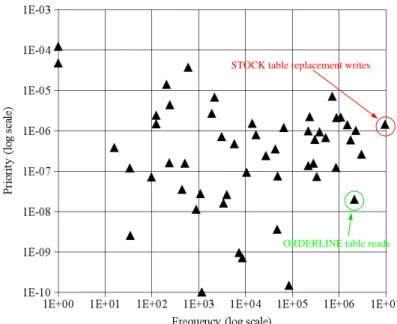
Figure 3.4: Hint Set Priorities for the DB2 C60 Trace
Each point represents a distinct hint set. All hint sets are shown.
caching such pages, as it measures how long such pages must occupy space in the cache before the benefit is obtained. We define the caching priority of hint set H as:
Pr(H) = fhit(H)
D(H) (3.2)
which is the ratio of the expected benefit to the expected cost.
Figure3.4illustrates the results of this analysis for a trace of I/O requests made by DB2 during a run of the TPC-C [67] benchmark. Our workload traces will be described in more detail in Section3.4. Each point in Figure 3.4represents a distinct hint set that is present in the trace, and describes the hint set’s caching priority and frequency of occurrence. All hint sets with non-zero caching priority are shown. Clearly, some hint sets have much higher priorities, and thus much higher benefit/cost ratios, than others. For illustrative purposes, we have indicated partial interpretations of two of the hint sets in the figure. For example, the most frequently occurring hint set represents replacement writes to the STOCK table in the TPC-C database instance that was being managed by the DB2 client. We emphasize that CLIC does not need to understand that this hint represents the STOCK table, nor does it need to understand the difference between a replacement write and a recovery write. Its interpretation of hints is based entirely on the hint statistics that it tracks, and it can automatically determine that a request with the STOCK table hint set is a better caching opportunity than a request with the ORDERLINE table hint set.
3.2.2
Tracking Hint Set Statistics
To track hint set statistics, CLIC maintains a hint table with one entry for each distinct hint set H that has been observed by the storage server. The hint table entry for H records the current values of the statistics N(H), Nr(H) and D(H). When the server receives a request (p, H), it increments N(H). Tracking Nr(H) and D(H) is somewhat more involved, as CLIC must determine whether a read request for page p is a read re-reference. To determine this, CLIC records two pieces of information for every pagepthat is cached: seq(p), which is the sequence number of the most recent request for p, and
H(p), which is the hint set that was attached to the most recent request for p. In addition, CLIC records seq(p) and H(p) for a fixed number (Noutq) of additional, uncached pages. This additional information is recorded in a data structure called the outqueue. Noutq is a CLIC parameter that can be used to bound the amount of space required for tracking read re-references. When the server receives a read request for pagep with sequence number s, it checks both the cache and the outqueue for information about the most recent previous request, if any, for p. If it finds seq(p) and H(p) from a previous request, then it knows that the current request is a read re-reference ofp. It increments Nr(H(p)) and it updates D(H(p)) using the re-reference distance s−seq(p).
When a page p is evicted from the cache, an entry for p is inserted into the outqueue. The entry records the hintHwith whichpwas last requested as well asseq(p). An entry is also placed in the outqueue for any requested page that CLIC elects not to cache. (CLIC’s caching policy is described in Section3.2.4.) When an outqueue page is inserted into the cache, the page’s entry is removed from the outqueue. If the outqueue is full when a new entry is to be inserted, the least-recently inserted entry is evicted from the outqueue to make room for the new entry.
Since CLIC only records seq(p) and H(p) for a limited number of pages, it may fail to recognize that a new read request (p, H) is actually a read re-reference for p. Some error is inevitable unless CLIC were to record information about all requested pages. However, CLICs approach to tracking page re-references has several advantages. First, since CLIC tracks the most recent reference to all pages that are in the cache, we expect to have accurate re-reference distance estimates for hint sets that are believed to have the highest priorities, since pages requested with those hint sets will be cached. If the priority of such hint sets drops, CLIC should be able to detect this. Second, by evicting the oldest entries from the outqueue when eviction is necessary, CLIC will tend to miss read re-references that have long re-reference distances. Conversely, read re-references that happen quickly are likely to be detected. These are exactly the type of re-references that lead to high caching priority. Thus, CLIC’s statistics tracking is biased in favor of read re-references that are likely to lead to high caching priority.
requests
W W
Points of calculating priority
Figure 3.5: Priority Calculation Timeline
3.2.3
Time-Varying Workloads
To accommodate time-varying workloads, CLIC divides the request stream into non-overlapping windows, with each window consisting ofW requests, as shown in Figure 3.5. At the end of each window, CLIC adjusts the priority for each hint set using the statistics collected during that window. The adjusted priority will be used to guide the caching policy during the next window. It then clears the statistics (N(H), Nr(H), D(H)) for all hint sets in the hint table so that it can collect new statistics during the next window.
LetPr(H)i represent the priority ofH that is calculated after theith window, and that is used by CLIC’s caching policy during window i+ 1. Priority Pr(H)i is calculated as follows
Pr(H)i =rcPr(H)i+ (1−r)Pr(H)i−1 (3.3)
where cPr(H)i represents the priorities that were calculated using the statistics collected during the ith window (and Equation 3.2), and r (0 < r ≤ 1) is a CLIC parameter. The effect of Equation 3.3 is that the impact of statistics gathered during the ith window decays exponentially with each new window, at a rate that is controlled by r. Setting r = 1 causes CLIC to base its priorities entirely on the statistics collected during the most recently completed window. Lower values of r cause CLIC to give more weight to older statistics. For all of the experiments reported for CLIC and DP-CLIC, we have set W = 106 and r= 1.
3.2.4
Cache Management
In Section 3.2.1 , we described how CLIC assigns a caching priority to each hint setH. In this section, we describe how the server uses these priorities to manage the contents of its cache. Structures used by CLIC are summarized in Figure 3.6 and CLIC cache policy is described in Figure 3.7.
Figure 3.7 describes CLIC’s priority-based replacement policy. This policy evicts a lowest priority page from the cache if the newly requested page has higher priority. The priority of a page is determined by the priority Pr(H) of the hint set H with which that
Out Queue (Metadata only ) Highest priority list
List of hint set H1 (Metadata & blocks)
Lowest priority list List of hint set H2
(Metadata & blocks) (Metadata & blocks)List of hint set Hn
Page requested
with H2
Page requested with H1
eviction
Page requested with Hn
Figure 3.6: Structures Used by CLIC
Arrows show possible movements among queues in response to I/O requests
page was last requested. Note that if a page that is cached after being requested with hint set H is subsequently requested with hint set H0, its priority changes from Pr(H) to Pr(H0). The most recent request for each cached page always determines its caching priority.
The policy described in Figure 3.7 can be implemented to run in constant expected time. To do this, CLIC maintains a heap-based priority queue of the hint sets. For each hint setH in the heap, all pages with H(p) = H are recorded in a doubly-linked list that is sorted by seq(p). This allows the victim page to be identified (Figure 3.7, lines 7-11) in constant time. CLIC also maintains a hash table of all cached pages so that it can tell which pages are cached (line1) and find a cached page in its hint set list in constant expected time. Finally, CLIC implements the hint table as a hash table so that it can look upPr(H) (line 12) in constant expected time.
As described in Section3.2.3, CLIC adjusts hint set priorities after every window of W requests. When this occurs, CLIC rebuilds its hint set priority queue based on the newly adjusted priorities. Hint set priorities do not change except at window boundaries.
3.3
Handling Large Numbers of Hint Sets
As described in Section3.2.2, CLIC’s hint table records statistical information about every hint set that the server has observed. Although the amount of statistical information
if p is not cached then
1
if the cache is not full then
2 cache p 3 set seq(p) = s 4 set H(p) = H 5 else 6
let m be the minimum priority
7
of all pages in the cache
8
let v be the page with the
9
minimum sequence number seq(v)
10
among all pages with priority m
11
if Pr(H)>m then
12
evict v from the cache
13
add entry for v (with seq(v)
14
and H(v)) to the outqueue
15 cache p 16 set seq(p) = s 17 set H(p) = H 18
else /* do not cache p */
19
add entry for p to the outqueue
20
set seq(p) = s
21
set H(p) = H
22
else /* p is already cached */
23
seq(p) = s
24
H(p) = H
25
Figure 3.7: Hint-Based Server Cache Replacement Policy
This pseudo-code shows how the server handles a request for page pwith hint setH and request sequence numbers.
![Figure 2.1: Trend of HDD and SSD Price [59]](https://thumb-us.123doks.com/thumbv2/123dok_us/10173770.2919671/21.918.295.637.123.386/figure-trend-hdd-ssd-price.webp)