Establishing a multi-pillar decision-making framework for
supporting the selection of green features and technologies
in office projects within Australia
A thesis submitted in the fulfilment of the requirements for the degree of Doctor of Philosophy
THI KIEU OANH HO
Master of Construction Management in Professional Practice, the University of New South Wales Bachelor of Construction Economics and Project Management, Danang University of Technology, the
University of Danang.
School of Property Construction and Project Management College of Design and Social Context
RMIT University
PhD thesis: Establishing MPDM framework for supporting the selection of GFTs 1 | P a g e
DECLARATION
I certify that except where due acknowledgement has been made, the work is that of the author alone, the work has not been submitted previously, in whole or in part, to qualify for any other academic award; the content of the thesis is the result of work which has been carried out since the official commencement date of the approved research program; any editorial work, paid or unpaid, carried out by a third party is acknowledged; and, ethics procedures and guidelines have been followed.
I acknowledge the support I have received for my research through the provision of an Australian Government Research Training Program Scholarship.
Thi Kieu Oanh Ho Date: 28th June 2019
Copyright statement
Apart from the use permitted by Copyright Act of 1968, no part of this work can be reproduced or stored in a document management system (electronic or hard copy) without the author’s written permission. Permission is granted to RMIT University to store in the Australian Thesis Repository and make it available for the personal study purpose.
PhD thesis: Establishing MPDM framework for supporting the selection of GFTs 3 | P a g e
ACKNOWLEDGEMENT
I express my deepest gratitude to my principal supervisor, Prof. Usha Iyer-Raniga, for her invaluable supervision, feedback and encouragement during my PhD journey. I deeply thank my co-supervisor, Dr. James PC Wong for his feedback provided and challenges presented to support my study. I am indebted my former supervisor, Dr Rebecca Yang for her prompt advice and discussions during my first year of study. Without their support and contributions, my PhD study and the thesis would not have been finished and presented here.
More importantly, I wish to acknowledge RMIT University for PhD scholarship that assisted in my study duration. Without this financial support, I could not have had an excellent focus on my research and a smooth progress in approximately 4-year PhD study. I also want to thank RMIT health and well-being counsellors and RUSU, who always listened and supported me in the PhD journey.
I would like to express my gratitude to those who participated and supported my PhD research. In particular, a deep thank you to twenty survey participants and ten interview participants. They have contributed their knowledge, experience and moral support during the research process. This acknowledgement would not be completed without their valuable participations and comments in my research.
Finally, I would love to express my deepest appreciation to my family members, who always encouraged me mentally; especially my mom, dad, brother, sister-in-law and little nephew for their patience, tolerance and continuing love throughout the long-time of PhD study. I specially thank to my beloved Sweet Choc Muffin for all his support and encouragement. With him, my life is much easier for concentrating on this study. In addition, I thank my Master’s study Supervisor – John Cowan as well as my friends Leon, Dung, Prachi, Mintah, Kasey, Kelvin and Salman, who always provided good company in my PhD journey. For all, thank you very much for supporting me during this PhD study time.
PhD thesis: Establishing MPDM framework for supporting the selection of GFTs 5 | P a g e
LIST OF PUBLICATIONS
The following are publications that form the part of this PhD thesis:
1. Oanh Thi-Kieu Ho, Usha Iyer-Raniga & James PC Wong, (2019). Sustainability Balance. Encyclopedia of Sustainability in Higher Education. W. Leal Filho. Cham, Spinger International Publishing: 1-13.
2. Usha Iyer-Raniga, Oanh Thi-Kieu Ho, 2018. Internalising environment and society into a sustainability assessment model for assisting decision-making of green office projects in Australia. Encyclopedia of UN Sustainable Development Goals. Responsible Consumption and Production, in progress.
3. Oanh Thi-Kieu Ho, James P.C Wong, Usha Iyer-Raniga & Rebecca Yang, 2017. Identifying cost trend and affected cost factors for green office buildings in Australia. Proceedings of the 33rd International PLEA Conference on Passive Low Energy
PhD thesis: Establishing MPDM framework for supporting the selection of GFTs 7 | P a g e TABLE OF CONTENTS DECLARATION ... 1 ACKNOWLEDGEMENT ... 3 LIST OF PUBLICATIONS ... 5 List of figures ... 13 List of tables ... 17 ABSTRACT ... 19
LIST OF ACRONYMS AND ABBREVIATIONS ... 21
CHAPTER 1INTRODUCTION... 25
1.1. RESEARCH BACKGROUND ... 25
1.2. RESEARCH CONTEXT AND RESEARCH GAP ... 25
1.3. RESEARCH AIM AND OBJECTIVES ... 30
1.4. RESEARCH CONTRIBUTIONS ... 32
1.5. RESEARCH JUSTIFICATION ... 33
1.6. RESEARCH SCOPE ... 34
1.7. RESEARCH APPROACH AND METHODOLOGY ... 34
1.8. STRUCTURE OF THE THESIS ... 36
1.9. CHAPTER SUMMARY ... 39
CHAPTER 2SUSTAINABILITY CONSIDERATIONS IN OFFICE PROJECTS ... 41
2.1. INTRODUCTION ... 41
2.2. SUSTAINABILITY AND SUSTAINABLE BUILDINGS ... 41
2.3. OFFICE BUILDING AND SUSTAINABILITY ... 45
2.4. A REVIEW OF SUSTAINABILITY APPROACHES ... 45
2.4.1. Sustainability approach using Triple Bottom Line ... 46
2.4.2. Concentric circles (concentric rings) approach of sustainability ... 47
2.5. OVERVIEW OF INTERNATIONAL AND NATIONAL TOOLS RELATED TO SUSTAINABILITY IN THE BUILDING AND CONSTRUCTION INDUSTRY... 49
2.5.1. BREEAM and LEED ... 49
2.5.2. Tools related to sustainable office projects in Australia ... 49
2.5.2.1. Green Star rating tools ... 50
2.5.2.2. National Construction Code (NCC) – Section J ... 51
2.5.2.3. National Australian Built Environment Rating System (NABERS) ... 52
2.5.3. Green Star rating tool – office design ... 53
2.6.1. Inconsistency in findings of additional cost for green office projects ... 58
2.6.2. Factors affecting cost in green office projects ... 65
2.7. DECISION-MAKERS AND PROJECT STAKEHOLDERS IN A GREEN OFFICE PROJECT ... 66
2.8. CHAPTER SUMMARY ... 68
CHAPTER 3 A REVIEW OF MODELS AND FRAMEWORKS RELATED TO SUSTAINABILITY ASSESSMENT AND COST IN SUSTAINABLE PROJECTS ... 69
3.1. INTRODUCTION ... 69
3.2. OBJECT-ORIENTED FRAMEWORK FOR OPTIMISING GREEN BUILDING DESIGN ... 69
3.3. OPTIMISATION MODEL FOR MAXIMISING LEED CREDITS ... 70
3.4. MODEL RELATED TO COSTS AND BENEFITS... 71
3.5. MODELS AND FRAMEWORKS RELATED TO LIFE CYCLE APPROACH ... 71
3.6. MODEL OF MARGINAL COST AND CO-BENEFITS ... 76
3.7. REGRESSION MODEL FOR COST PREDICTION ... 77
3.8. FRAMEWORKS RELATED TO MULTI-CRITERIA DECISION-MAKING ... 77
3.9. THE IMPLEMENTATION OF ANALYTICAL HIERARCHY PROCESS (AHP) IN DEVELOPING MULTI-CRITERIA DECISION-MAKING FRAMEWORK ... 80
3.10. CHAPTER SUMMARY ... 82
CHAPTER 4RESEARCH DESIGN AND METHODOLOGY ... 85
4.1. INTRODUCTION ... 85
4.2. RESEARCH PARADIGM ... 85
4.2.1. Paradigm as the perspective of research process through ontology, epistemology and methodology ... 85
4.2.2. Paradigm as the belief system or theoretical perspective, stretched from thought patterns to actions... 86
4.3. THEORETICAL FRAMEWORK ... 87
4.3.1. A review of theories ... 88
4.3.1.1 The theory underpinning lifecycle evaluation ... 88
4.3.1.2 The theory underpinning optimisation model and object-oriented framework ... 89
4.3.1.3 The theory underpinning a model of marginal cost and co-benefits ... 89
4.3.1.4 The theory underpinning regression models ... 90
4.3.1.5 The theory underpinning multi-criteria decision-making frameworks and models ... 90
4.3.1.6 A summary of theories reviewed ... 91
4.3.2. Underpinned theory for this research ... 91
4.4. RESEARCH DESIGN ... 94
4.4.1 Research method ... 95
PhD thesis: Establishing MPDM framework for supporting the selection of GFTs 9 | P a g e
Secondary data analysis ...101
4.4.3 Phase 2: Questionnaire Survey ...103
4.4.3.1 Survey structure ...103
4.4.3.2 Survey development ...104
4.4.3.3 Survey sampling ...105
4.4.3.4 Survey sample size (without the effect of a snowball sampling) ...107
4.4.4 Phase 3: Interview...108
4.5. PRINCIPAL STEPS OF ESTABLISHING A MULTI-CRITERIA DECISION-MAKING (MCDM) FRAMEWORK ...110
4.6. THE SELECTION OF ANALYTICAL HIERARCHY PROCESS FOR THIS RESEARCH ...115
4.7. THE SELECTION OF GREEN STAR TOOLS IN AUSTRALIA FOR SECONDARY DATA COLLECTION ...117
4.8. ETHICS APPROVAL ...118
4.9. CHAPTER SUMMARY ...118
CHAPTER 5MULTI-PILLAR DECISION-MAKING FRAMEWORK ...121
5.1. INTRODUCTION ...121
5.2. LITERATURE REVIEW FOR IDENTIFICATION OF GREEN FEATURES AND TECHNOLOGIES123 5.3. LITERATURE REVIEW FOR PILLARS AND SUB-PILLARS IN SUSTAINABILITY ASSESSMENT136 5.4. DETERMINATION OF PILLARS AND SUB-PILLARS FOR A MPDM FRAMEWORK ...144
5.5. CHAPTER SUMMARY ...147
CHAPTER 6 THE AVAILABILITY OF GREEN FEATURES AND TECHNOLOGIES IN AUSTRALIAN OFFICE PROJECTS ...149
6.1. INTRODUCTION ...149
6.2. OFFICE PROJECTS CERTIFIED AS GREEN STAR – OFFICE DESIGN ...149
6.3. EXAMINING GREEN FEATURES AND TECHNOLOGIES IN 181 PROJECTS OF GREEN STAR – OFFICE DESIGN ...153
6.3.1. The analysis of forty-six green features and technologies ...154
6.3.2. The frequency of GFTs in the Management category ...158
6.3.3. The frequency of GFTs in IEQ category ...158
6.3.4. The frequency of GFTs in Energy category ...160
6.3.5. The frequency of GFTs in Transport category ...162
6.3.6. The frequency of GFTs in Water category ...163
6.3.7. The frequency of GFTs in Materials category ...165
6.3.8. The frequency of GFTs in Ecology and Land Use category and Emissions category ...165
6.4. INITIAL ANALYSIS OF GREEN FEATURES AND TECHNOLOGIES IN GREEN STAR-RATED OFFICE BUILDINGS IN AUSTRALIA ...166
6.5. CHAPTER SUMMARY ...167
CHAPTER 7DEPLOYMENT OF THE SURVEY ...169
7.1. INTRODUCTION ...169
7.2. QUESTIONNAIRE DESIGN ...169
7.2.1. SURVEY PILOT ...171
7.3. QUESTIONNAIRE CONTENT ...172
Section A: General information of a survey participant ...172
Section B: The ranking of green features and technologies to achieve green credits ...176
Section C: Ranking green features and technologies with the consideration of three pillars ....177
Section D: Weightings of pillars and sub-pillars ...180
7.4. PARTICIPANT RECRUITMENT ...181
7.5. SURVEY PARTICIPANT NUMBERS...182
7.6. CHAPTER SUMMARY ...184
CHAPTER 8FINDINGS FROM THE RESEARCH SURVEY...187
8.1. INTRODUCTION ...187
8.2. SECTION A: GENERAL INFORMATION OF A PARTICIPANT ...189
8.2.1. Participants’ Background ...189
8.2.2. Green objectives ...190
8.2.3. Green drivers ...191
8.2.4. Additional cost for sustainability requirements and related issue ...193
8.2.5. The best way to work with sustainability requirements ...194
8.3. SECTION B: THE RANKING OF GREEN FEATURES AND TECHNOLOGIES TO ACHIEVE GREEN CREDITS ...196
8.4. SECTION C: RANKING GFTs WITH THE CONSIDERATION OF THREE PILLARS ...201
8.4.1. Ranking of GFTs in the Economic pillar (Corresponding Section C1 of Survey) ...202
8.4.2. Ranking of GFTs in the Environmental pillar (Corresponding to: Section C2 of Survey) .203 8.4.3. Ranking of GFTs in the Societal pillar (Corresponding to: Section C3 of Survey) ...203
8.5. SECTION D: WEIGHTINGS OF PILLARS AND SUB-PILLARS ...204
8.6. THE RANKINGS OF GREEN FEATURES AND TECHNOLOGIES BASED ON ANALYTICAL HIERARCHY PROCESS (AHP) ...208
8.7. OTHER FINDINGS EXPLORED BY MPDM FRAMEWORK PERFORMANCE ...214
8.8. CHAPTER SUMMARY ...219
CHAPTER 9ESTABLISHING A MULTI-PILLAR DECISION-MAKING FRAMEWORK ...221
9.1. INTRODUCTION ...221
PhD thesis: Establishing MPDM framework for supporting the selection of GFTs 11 | P a g e
9.3. PRIMARY CHARACTERISTICS OF A MULTI-PILLAR DECISION-MAKING FRAMEWORK ...222
9.4. ESTABLISHING A MULTI-PILLAR DECISION-MAKING FRAMEWORK ...223
9.4.1. Step 1: Project definition ...226
9.4.2. Step 2: Specification of green features and technologies ...227
9.4.3. Step 3: Determination of sustainability pillars and sub-pillars ...228
9.4.4. Step 4: Sustainability assessment ...229
9.4.5. Step 5: Decision-making for selecting green features and technologies ...230
9.5. IMPLEMENTATION OF MPDM FRAMEWORK ...230
9.6. CHAPTER SUMMARY ...232
CHAPTER 10FRAMEWORK VALIDATION: INTERVIEWS ...235
10.1. INTRODUCTION ...235
10.2. VALIDATION OF THE MULTI-PILLAR DECISION-MAKING FRAMEWORK ...235
10.3. INTERVIEW PILOT ...236
10.4. THE RECRUITMENT OF INTERVIEW PARTICIPANTS ...237
10.5. DESCRIPTION OF INTERVIEW PROCESS ...237
10.6. INTERVIEW OUTCOMES ...238
10.7. INTERVIEW ANALYSIS ...238
10.7.1. Participant’s introduction ...238
10.7.2. The validation of relative importance of pillars and sub-pillars ...239
10.7.3. The rankings from sustainability assessment (framework performance) ...246
10.7.4. Rankings from sustainability assessment and consideration of additional cost ...251
10.7.5. The comparison between sustainability assessment (framework performance) and green credit achievement (Green Star credits) ...253
10.8. VALIDATION OF MULTI-PILLAR DECISION-MAKING FRAMEWORK ...255
10.9. CHAPTER SUMMARY ...257
CHAPTER 11DISCUSSIONS AND CONCLUSIONS ...259
11.1. INTRODUCTION ...259
11.2. RESEARCH DISCUSSION...259
11.2.1. The value of using decision theory in this research ...260
11.2.2. Research aim ...263 11.2.3. Research Objective 1 ...263 11.2.4. Research Objective 2 ...264 11.2.5. Research Objective 3 ...265 11.2.6. Research Objective 4 ...266 11.2.7. Research Objective 5 ...267
11.3. RESEARCH CONTRIBUTIONS ...268
11.4. RESEARCH IMPLICATIONS ...269
11.4.1. Academic implications ...269
11.4.2. Practical implications ...270
11.5. RESEARCH LIMITATIONS ...270
11.6. RECOMMENDATIONS FOR THE FURTHER RESEARCH ...272
11.7. CONCLUSION...273
REFERENCES ...277
APPENDICES ...293
APPENDIX A: ETHICS APPROVAL FOR SUVEY AND INTERVIEW ...293
A.1. The Survey ...293
A.2 The Interview and other modification of research ...295
APPENDIX B: THE SURVEY...297
APPENDIX C: THE INTERVIEW ...319
C.1. Research Summary ...319
C.2. Interview Question ...322
APPENDIX D: WEIGHTING OF RELATIVE IMPORTANCE FOR PILLARS AND SUB-PILLARS ...327
PhD thesis: Establishing MPDM framework for supporting the selection of GFTs 13 | P a g e
List of figures
Figure 1.1 The primary consideration of sustainability assessment as a research gap in the
research ... 29
Figure 1.2 Mapping the relationship between research aim, objectives and questions. ... 32
Figure 1.3 Research process map ... 36
Figure 2.1 Triple Bottom Line sustainability ... 47
Figure 2.2 Concentric circles sustainability ... 48
Figure 2.3 Timeline of rating tools development ... 50
Figure 2.4 NCC Energy Efficiency requirements and Timeline. ... 52
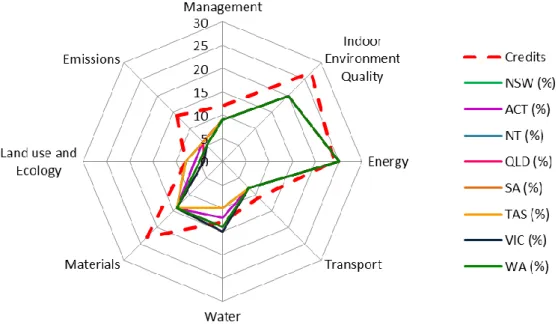
Figure 2.5 Credits in eight categories and weightings for different States and territories ... 56
Figure 2.6 Green Star rating scales for various Green Star tools ... 57
Figure 3.1 The difference between WLC and LCC ... 72
Figure 3.2 Lifecycle-based methods ... 75
Figure 3.3 Proposed green supplier evaluation methodology ... 78
Figure 4.1. The interconnection of worldviews, research design, approach and method ... 87
Figure 4.2. A theoretical framework in this research ... 94
Figure 4.3. Four primary stages in the MCDM process ... 111
Figure 4.4. Distribution of MCDM papers by methods between 1980 and 2012 ... 115
Figure 5.1. The position of Chapter 5 in the research theoretical framework ... 122
Figure 5.2 Forty-six green features and technologies presented in 8 categories ... 135
Figure 5.3 The criteria and sub-criteria for the assessment of green features and technologies ... 137
Figure 5.4 Criteria use ... 139
Figure 6.1 The proportion of new build – office projects out of total projects ... 150
Figure 6.3 The numbers and percentages of office projects in different States and Territories
of Australia ... 152
Figure 6.4 Numbers of Green Star-rated office projects during 12 years, from 2004 to 2016 ... 153
Figure 6.5 Frequencies of forty-six GFTs in 181 Green Star – Office Design-rated office projects ... 157
Figure 6.6 Frequencies of GFTs in Management category (from GFT1.1 to GFT1.4) ... 158
Figure 6.7 Frequencies of GFTs in IEQ category - Part 1 (from GFT2.1 to GFT2.7) ... 159
Figure 6.8 Frequencies of GFTs in IEQ category - Part 2 (from GFT2.8 to GFT2.13) ... 160
Figure 6.9 Frequencies of GFTs in Energy category - Part 1 (from GFT3.1 to GFT3.6) ... 161
Figure 6.10 Frequencies of GFTs in Energy category - Part 2 (from GFT3.7 to GFT3.11) ... 162
Figure 6.11 Frequencies of GFTs in Transport category (from GFT4.1 to GFT4.2) ... 163
Figure 6.12 Frequencies of GFTs in Water category – Part 1 (from GFT5.1 to GFT5.4) ... 164
Figure 6.13 Frequencies of GFTs in Water category – Part 2 (from GFT5.5 to GFT5.8) ... 164
Figure 6.14 Frequencies of GFTs in Materials category (from GFT6.1 to GFT6.4) ... 165
Figure 6.15 Frequencies of GFTs in Ecology and Land use category and Emissions category ... 166
Figure 7.1 The position of surveys in the process of research theoretical framework... 170
Figure 7.2 Snapshot of Section A for the option of participant from the building and construction industry – ... 174
Figure 7.3 Snapshot of Section A for the option of participants from the academia ... 175
Figure 7.4 Snapshot for the ranking of forty-six GFTs in Section B ... 176
Figure 7.5 Snapshot for the ranking of other GFTs recommended in Section B ... 177
Figure 7.6 Snapshot of Section C under C.1. Economic pillar ... 179
Figure 7.7 Snapshot for participant’s suggestion in Section C ... 180
Figure 7.8 Snapshot of section D ... 181
PhD thesis: Establishing MPDM framework for supporting the selection of GFTs 15 | P a g e
Figure 8.1 The position of Chapter 8 in the research theoretical framework ... 188
Figure 8.2 Distribution of respondents by their disciplines ... 189
Figure 8.3 Green objectives selected by participants ... 191
Figure 8.4 Percentage of participants’ answers to the barrier of additional cost ... 193
Figure 8.5 Percentage of different levels in achieving green credits for Management category ... 198
Figure 8.6 Percentage of different levels in achieving green credits for Energy category .... 199
Figure 8.7 Assessment of GFTs regarding Economic pillar ... 202
Figure 8.8 Assessment of GFTs regarding Environmental pillar ... 203
Figure 8.9 Assessment of GFTs regarding Societal pillar ... 204
Figure 8.10 Hierarchy tree of Relative Importance (RI) of pillars and sub-pillars ... 207
Figure 9.1 The multi-pillar decision-making framework for supporting the selection of green features and technologies in an office project ... 225
Figure 11.1 Mapping the implementation of research theoretical framework in this research ... 262
PhD thesis: Establishing MPDM framework for supporting the selection of GFTs 17 | P a g e
List of tables
Table 2.1 NABERS rating scale ... 53
Table 2.2 Weightings in different States of Green Star – Office v3 in various States ... 55
Table 2.3 Various findings of additional cost percentage in existing studies in the world ... 62
Table 4.1 Distinct features of quantitative and qualitative methods ... 96
Table 4.2 Morgan’s Four - Quadrant Typology ... 98
Table 4.3 Research approach and methods ... 99
Table 4.4 The advantages and disadvantages of Secondary Data Review and Analysis ... 102
Table 5.1 Green features and technologies selected based on Green Star requirements ... 124
Table 5.2 Review of green features and technologies based on ESD principles ... 125
Table 5.3. Green features and technologies and their corresponding costs ... 128
Table 5.4. Main green features and technologies in office projects based on their age ... 129
Table 5.5. Green features and technologies for ease and difficulty in achieving green credits ... 130
Table 5.6. The classification and description of 46 green features and technologies ... 132
Table 5.7 Green criteria and sub-criteria identified for the selection of façade materials ... 140
Table 5.8 Multi-criteria for various perspectives beyond standard TBL ... 141
Table 5.9 Criteria and sub-criteria for decision-making in selecting sustainable materials .. 142
Table 5.10 Rationale supporting the structure of pillars and sub-pillars ... 146
Table 6.1 Project numbers in different Versions, States and Territories ... 152
Table 6.2 Codes for forty-six green features and technologies ... 155
Table 7.1 Content of Questionnaire – Underpinned by AHP tool ... 172
Table 7.2 Participant numbers for questionnaire survey ... 183
Table 8.1 Summary of participants’ backgrounds ... 190
Table 8.2 Ranking of green drivers for sustainable development ... 193
Table 8.4 Summary of best ways to work with sustainability requirements ... 195 Table 8.5 Rankings of green features and technologies based on achieving green credits .. 197 Table 8.6 Other green features and technologies recommended by participants ... 201 Table 8.7 Weightings of pillars and sub-pillars ... 208 Table 8.8 Ranking of green features and technologies under sustainability assessment ... 209 Table 8.9 Ranking of green features and technologies in sustainability assessment integrated with C1.1.a Initial/Capital cost and C1.1.b Construction cost premium ... 213 Table 8.10 The comparison in the rankings of green features and technologies through different groups of participants ... 214 Table 10.1. Summary of participants’ information for interviews ... 239 Table 10.2 The summary of participants’ validation to the relative importance system ... 241 Table 10.3 The summary of participants’ validation to the rankings of green features and technologies ... 247 Table 10.4 Validation for the multi-pillar decision-making framework ... 256
PhD thesis: Establishing MPDM framework for supporting the selection of GFTs 19| P a g e
ABSTRACT
With recent global attention on the state of environment and climate change, sustainability solutions and outcomes are being integrated in the building and construction industry worldwide. However, the additional cost associated with sustainability requirements is a substantial hurdle to mainstream sustainability practices and outcomes. Project stakeholders and decision-makers contemplate implementing sustainability solutions in office projects. The inconsistency on determining the additional cost in achieving sustainability outcomes from historical studies causes more impediments for decision-makers and project stakeholders in the building and construction industry. To overcome this hurdle through efficient selection of green features and technologies, this research establishes a multi-pillar decision-making framework to achieve transparency in sustainability assessment leading to the development of sustainability outcomes in such projects.
The research commences with a literature review of sustainability, Green Star rating tools, green office buildings in Australia, the inconsistent range of additional cost and different approaches associated with additional cost identified from historical studies. The research continues with the development of a multi-pillar decision-making (MPDM) framework as the primary research outcome, using Analytical Hierarchy Process (AHP) and Triple Bottom Line (TBL) sustainability approach. AHP is employed for the primary reason of pair wise-comparison, which is the process of comparing pillars and sub-pillars of sustainability indicators in pairs encompassing the consideration of project sustainability priorities for evaluation by decision-makers and project stakeholders in office projects. Data input and framework establishment involved literature review, secondary data analysis, online survey and interview. The literature review assisted the identification of green features and technologies as well as the determination of sustainability pillars and sub-pillars used in AHP. The secondary data analysis provided the examination of green features and technologies available within Green Star-rated office projects in Australia. An online survey was undertaken for collecting participants’ sustainability assessment towards these features and technologies. This survey also supported the initial establishment of the MPDM framework. Following this, the MPDM framework was validated by interviews for seeking feedback and undertaking refined modifications. The MPDM framework is the most important research outcome, essential for reducing the additional cost burden in the development of sustainability outcomes within office projects. Besides that, the ranking of green features and technologies is able to be used as a reference list for stakeholders to implement or add
other green features and technologies to meet sustainability requirements in their projects. Also, the list of pillars and sub-pillars may be used to support sustainability assessment in such projects. Therefore, the MPDM framework established in this research forms the foundation for further research to support transparency in decision-making with respect to sustainability and office projects. It also can be used to develop other research related to this discipline in other types of buildings and other countries, beyond office building projects and Australia.
Key words: green features and technologies, Green Star rating tools, Triple Bottom Line, multi-pillar decision-making framework and sustainability assessment.
PhD thesis: Establishing MPDM framework for supporting the selection of GFTs 21| P a g e
LIST OF ACRONYMS AND ABBREVIATIONS
ANN: Artificial Neural Network, ANP: Analytic Network Process, AHP: Analytical Hierarchy Process, BRE: Building Research Establishment,
BREEAM: Building Research Establishment Environmental Assessment Method, CAD: Credit Achievement Degree,
CAPEX: Capital Expenditure, CAR: Credit Application Rate, CBR: Case-based Reasoning, CGI: Credit Gain Index,
CWLC: Continuous Whole Life Cycle, DEA: Data Envelopment Analysis,
ESD: Environmentally Sustainable Design, EE: Energy Efficiency,
GA: Genetic Algorithm,
GBCA: Green Building Council of Australia, GHG: Greenhouse Gas Emissions,
GFs: Green Features,
GFTs: Green Features and Technologies, GTs: Green Technologies,
I: investment cost, IB: Intelligent Building,
IEQ: Indoor Environment Quality, LCA: Life Cycle Assessment,
LCAA: Life Cycle Attribute Assessment, LCC: Life Cycle Cost,
LCEI: Life Cycle Environmental Impact, LCSA: Life Cycle Sustainability Assessment,
LEED: Leadership in Energy and Environmental Design, MADM: Multi-attribute Decision Making,
MAUT: Multi-attribute Utility Theory, MCDM: Multi-criteria Decision Making, MODM: Multi-objective Decision Making, MPDM: Multi-pillar Decision Making, NSW: New South Wales,
NCC: National Construction Code,
NABERS: National Australian Built Environment Rating System, NWLC: New generation Whole-life Costing,
NPV: Net Present Value,
O&MC: Operating &Maintenance Cost, OPEX: Operating Expenses,
QBL: Quadruple Bottom Line, QLD: Queensland,
Repl: Replacement cost, Res: Residual value,
SAW: Simple Additive Weighting, SBS: Sick Building Syndrome, SLCA: Social Life Cycle Assessment,
SMART: Simple Multi-Attribute Rating Technique, TBL: Triple Bottom Line,
PhD thesis: Establishing MPDM framework for supporting the selection of GFTs 23| P a g e
TC: Through-life Costing,
TOPSIS: Technique for Order of Preference by Similarly to Ideal Solution, US: United States,
VOCs: Volatile Organic Compounds, VIC: Victoria,
WLC: Whole Lifecycle Cost, WLCC: Whole Lifecycle Costing, WA: Western Australia.
PhD thesis: Establishing MPDM framework for supporting the selection of GFTs 25| P a g e
CHAPTER 1
INTRODUCTION
1.1.
RESEARCH BACKGROUND
Sustainability has gained undivided attention in the building and construction industry worldwide with a primary focus on healthy environments and environmental protection for current and future generations. To contribute to the ongoing development of sustainability outcomes in Australian office projects, this research presents an in-depth study by establishing a multi-pillar decision-making framework to support the selection of green features and technologies in Australian office projects. This research is placed in the context of Green Star - Office design – new build with three versions of v1, v2 and v3. These versions are applicable for a range of Australian office projects from 2004 to 2016.
This first chapter - Introduction forms the foundation of this research. It provides the research context and general understanding relating to the research problem, aim, objectives and research questions. This chapter also provides an understanding of the research approach and methods undertaken to seek research findings and outcomes. Finally, this chapter highlights expected research contributions in sustainability within the building and construction industry, in particular office projects within Australia.
1.2.
RESEARCH CONTEXT AND RESEARCH GAP
As a result of climate change, unexpected changes in weather patterns have become a worldwide issue and urgent request for taking action. Greenhouse gas emission outputs, resources consumption and production of waste have a significant impact on the environment (Zhao et al., 2011). The building and construction industry consumes about 40% of the world’s natural resources, requires 40% of global energy, emits 30% of greenhouse gas and uses 25% of water in the world (UNEP, 2016). Therefore, this industry has put a greater focus on sustainability as a proactive measure and worthy solution for reducing its impacts on environment and also creating economic and societal benefits. Within the building and construction industry, a sector of office buildings has a significant impact on the environment. Office buildings by nature, play an influential role in energy consumption, waste generation, greenhouse gas emissions and natural resources depletion during a project lifecycle from the concept stage to the demolition stage (Ortiz et al., 2009).
In the United States (US), office buildings alone consumed 39% of energy use, emitted 39% of carbon dioxide and consumed 13.6% of portable water in 2008 (EIA report, 2008). In Singapore, the building industry accounted for 35.9% of energy consumption and 37.8% of electricity consumption (Energy Market Authority, 2018). In Australia, office buildings generated about 9% of national greenhouse gas emissions in 2013 (Australian Government, 2015), 30% to 40% of solid waste in 2002 (ABS, 2016), 21% to 30% of the total potable water was used in Australian urban centres (Corr et al., 2008). With such a significant consumption and emissions profile, the integration of sustainability practices into office building projects within Australia is critical for reducing ongoing environmental impacts and creating other benefits related to economics and society.
Another reason for the integration of sustainability in office building projects is employee physical and psychological wellbeing. As documented in past studies, the sitting time in an office building for an employee is over eight hours per day and a third of an employee life is spent in the office (Alkhajah et al., 2012, ASHRAE, 1993). Studies show that employees’ health, comfort and productivity are influenced by office environment (Frontczak et al., 2012, Roelofsen, 2002, OECD, 2002). Previous studies demonstrate green buildings are able to improve satisfaction and productivity for employees in human resource areas, such as reduction in absenteeism and improvement on employees’ performance (Romm and Browning, 1994, Miller et al., 2009, Singh et al., 2010). Therefore, an office environment with sustainability outcomes and practices has tangible and intangible benefits to develop potentially positive outcomes, which protect employees’ physical and mental health as well as enhance employees’ work performance.
While examining issues associated with green office projects, the development of sustainability outcomes for such projects has an impediment around additional cost, sometimes referred to extra cost for sustainability requirements. The issue associated with this impediment has been explored in various building case studies with expressions of “No”, “Insignificant” and “Significant” (Issa et al., 2010, Hwang and Tan, 2012, Yudelson, 2010, Kim et al., 2014). These diverse findings cause a dilemma for decision-makers and project stakeholders to make decisions on sustainability outcomes in such projects (Montoya, 2010). The additional cost for achieving Leadership in Energy and Environmental Design (LEED) certification in the US has been found to be different through different studies. For instance, “Significant” additional cost has been associated with a wide percentage variance, from 2%
PhD thesis: Establishing MPDM framework for supporting the selection of GFTs 27| P a g e
(Kats et al., 2003) to 13.8% of construction cost (Kats, 2010). It has been found to be “Insignificant” in the studies undertaken by Matthiessen et al. (2007) and Rehm and Ade (2013). Similarly, for achieving Green Star in Australia, research by Langdon (2007) illustrated that 3% to 5% of additional cost was attributed for 5-Star and 5% for 6-Star buildings without the use of green design in office projects. Research undertaken by Bond University in Australia concluded “No significant” additional cost for Green Star certification (GBCA, 2008a). Therefore, the additional cost for sustainability requirements needs to be carefully analysed to achieve pragmatic sustainability outcomes.
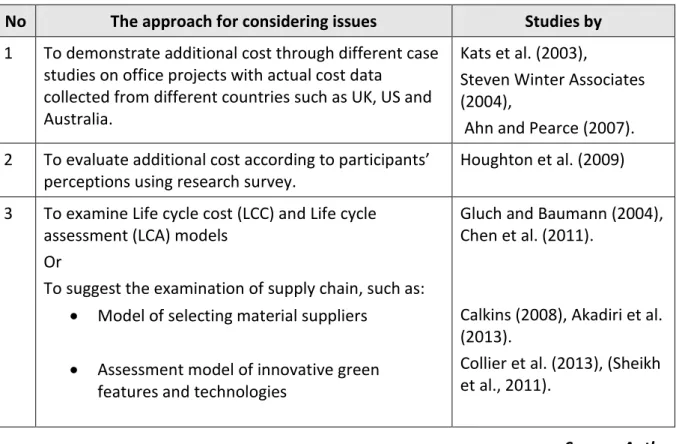
The issue associated with the additional cost for sustainability requirements has been addressed by different approaches in existing studies. These approaches include:
Demonstrating additional cost in many case studies in office projects with actual cost data collected from different countries. This approach has been taken in the United Kingdom (UK), the United States (US) and Australia (Kats et al., 2003, Steven Winter Associates, 2004, Ahn and Pearce, 2007).
Evaluating additional cost according to participant perceptions by using a research survey (Houghton et al., 2009, Chan et al., 2009, McGraw-Hill Construction, 2006).
Examining the life-cycle cost (LCC) and life cycle assessment (LCA) models (Gluch and Baumann, 2004, Chen et al., 2011, Kneifel, 2010, Goh and Sun, 2016).
Understanding supply chain, such as the model of selecting material suppliers (Calkins, 2008, Akadiri et al., 2013) and the assessment model of innovative green features and technologies (Collier et al., 2013, Sheikh et al., 2011).
These approaches are mainly focused on the economic underpinning by determining the cost and economic assessment in green office projects. Such studies have provided an understanding of the proportion of additional cost for sustainability requirements in some instances. These approaches still contain some restriction for assessing sustainability contributions in three accepted pillars: economics, environment and society as well as providing a practical solution to decision makers.
Most of the established models and frameworks emphasise economic savings rather than environmental and societal benefits while dealing with sustainability. Ideally, the three pillars of sustainability need to be treated equally. These existing models and frameworks are developed based on several theories, which are principally from the perspective of
economic understanding. For example, lifecycle evaluation models (such as life cycle cost and life cycle assessment) are based on the theory of neoclassical economics, underlying an economist’s approach to performance (Gluch and Baumann, 2004, Saunders, 2014). This economic theory is focused on profit maximisation rather than environmental and societal benefits so that the issue related to additional cost and sustainability contributions is solved partly or not at all. For green office projects, it is essential to establish a framework for supporting sustainability assessment in a simple and transparent manner with the integration of economic, environmental and societal assessments in the early stages of a project. Such framework may advise decision-makers and project stakeholders in the process of finalising their sustainability underpinnings in such projects.
Besides the necessity of a framework for sustainability assessment, this research also explores that appropriate selection of green features and technologies is able to reduce issue related to additional cost and enhance sustainability contributions underpinning the three pillars. Based on the research of Zainab et al. (2013), green features and technologies directly improve building performance, particularly energy efficiency and carbon emission reduction. Therefore, the evaluation of green features and technologies should be considered holistically beside the consideration of additional cost in the development of green office projects.
However, having undertaken extensive literature review related to sustainability and office projects, most of the studies in Australia emphasise Green Star credits in building projects (Xia et al., 2013), the comparison between Green Star tools and international sustainability tools (Reed et al., 2011, Roderick et al., 2009) and green building projects from the perceptions of different stakeholders, such as occupiers (Kato et al., 2009) and users (Leaman et al., 2007). This research therefore contends that studies related to green features and technologies in Australia are limited although these features and technologies have had direct impact on sustainability practices and outcomes in these projects.
Taking the approach of sustainability assessment framework integrated with the selection of green features and technologies, this research targets the establishment of a multi-pillar decision-making (MPDM) framework to support decision-makers and project stakeholders in the selection of green features and technologies for new office projects in Australia. Such a framework may be used to assess sustainability contributions generated by green features and technologies in the initial design stage of a project (Vyas and Jha, 2017, Da Silva and
PhD thesis: Establishing MPDM framework for supporting the selection of GFTs 29| P a g e
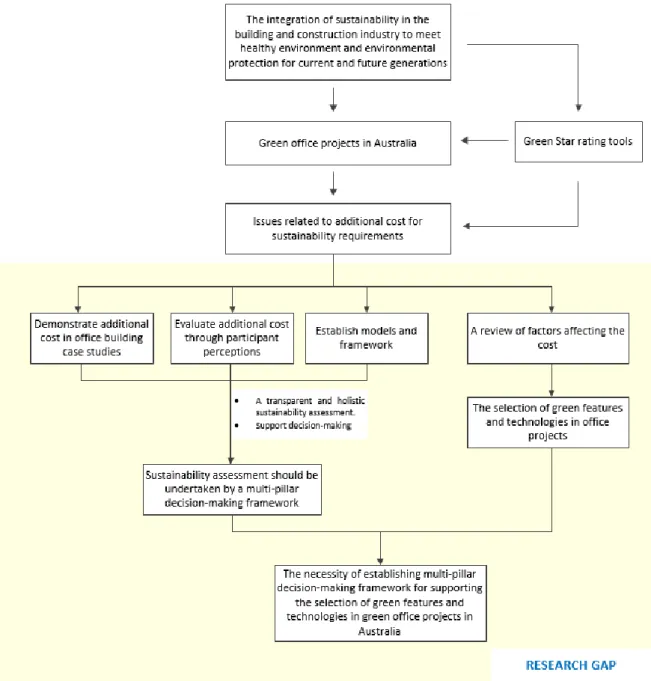
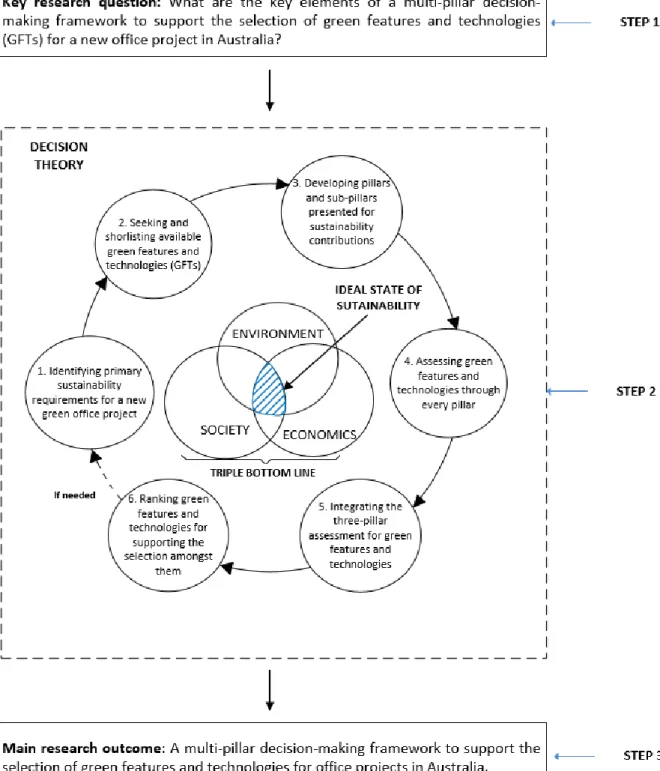
Ruwanpura, 2009). As a result, the MPDM framework is able to address the issue related to additional cost as well as reduce the impediment for decision makers and project stakeholders. Furthermore, this framework motivates the development of sustainability practices and outcomes in Australian office projects from best practice to mainstream (see Figure 1.1).
Figure 1.1 The primary consideration of sustainability assessment as a research gap in the research – Source: Author
A multi-pillar decision-making framework is established in this research based on the context of sustainability, Australian building and construction industry and Australian office projects are considered the starting point for setting up a particular scenario for undertaking this research.
1.3.
RESEARCH AIM AND OBJECTIVES
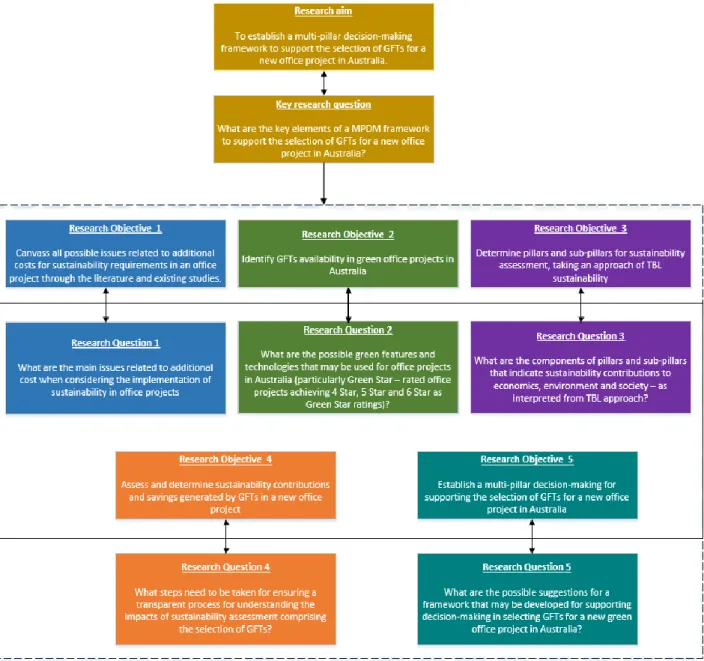
As illustrated in Figure 1.1, this research aims to establish a multi-pillar decision-making (MPDM) framework to support the selection of green features and technologies (GFTs) for a new office project in Australia. The MPDM framework provides a transparent approach of sustainability assessment for GFTs before deciding the implementation in such projects. MPDM framework internalises environmental assessment and societal assessment to economic assessment, which is undertaken by a Triple Bottom Line (TBL) approach of sustainability. As a result, the appropriate selection of GFTs is able to meet sustainability requirements and mitigate issues related to additional cost for sustainability requirements. In this research, green feature (GF) can be defined as the feature or structural aspects of a building that improve the environmental friendliness in different methods such as energy savings and waste reduction. Green technology (GT) is “any well designed technology capable of addressing high energy demands without posing negative effects to the environment” (Dadzie et al., 2017). Green technologies exceed the benchmark of using conventional systems, such as reduction of energy use (Syed, 2012). Despite the definitions of green features and green technologies, green features (GFs) and green technologies (GTs) in this research are grouped or clustered as green features and technologies (GFTs) rather than separating them. The combined use of GFs and GTs to GFTs aims to reduce the confusion for participants from the building and construction industry participating in further stages of this research. More importantly, this research doesn’t aim to distinguish green features and green technologies, and neither does Green Star.
For pursuing the aim of MPDM establishment, the research objectives are defined below:
Canvass all possible issues related to additional costs for sustainability requirements in office projects through literature review and existing studies.
Identify available green features and technologies within green office projects in Australia.
Determine pillars and sub-pillars for sustainability assessment, taking a TBL sustainability approach.
Assess and determine sustainability contributions generated by green features and technologies in a new office project.
PhD thesis: Establishing MPDM framework for supporting the selection of GFTs 31| P a g e
Establish a multi-pillar decision-making framework for supporting the selection of green features and technologies for a new office project in Australia.
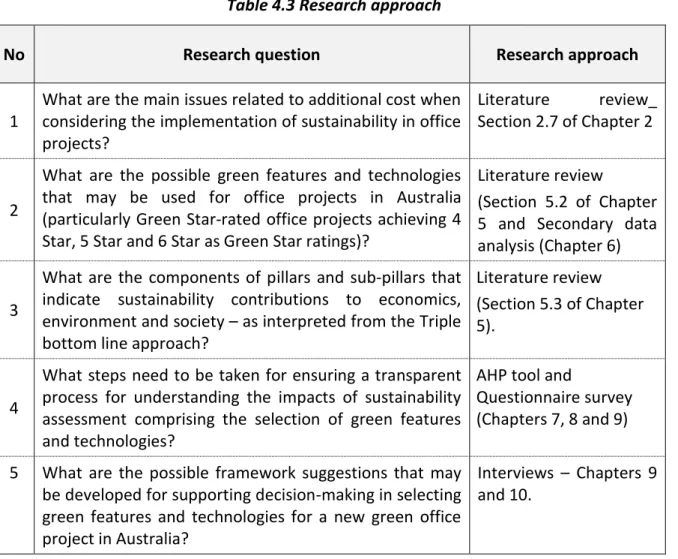
Deriving from these objectives, the research questions are indicated with a key research question and five sub-questions below:
Key research question: What are the key elements of a multi-pillar decision-making
framework to support the selection of green features and technologies for a new office project in Australia?
To answer this key research question, the sub-questions are:
1. What are the main issues related to additional cost when considering the implementation of sustainability in office projects?
2. What are the possible green features and technologies that may be used for office projects in Australia (particularly Green Star-rated office projects achieving 4 Star, 5 Star and 6 Star as Green Star ratings)?
3. What are the components of pillars and sub-pillars that indicate sustainability contributions to economics, environment and society – as interpreted from the Triple Bottom Line approach?
4. What steps need to be taken for ensuring a transparent process for understanding the impacts of sustainability assessment comprising the selection of green features and technologies?
5. What are the possible suggestions for a framework that may be developed for supporting decision-making in selecting green features and technologies for a new green office project in Australia?
The relationship between research aim, objectives and research questions is presented in Figure 1.2.
Figure 1.2 Mapping the relationship between research aim, objectives and questions – Source: Author.
1.4.
RESEARCH CONTRIBUTIONS
The research contributes to enhancing sustainability outcomes for the building and construction industry, particularly office projects in Australia, as noted below:
A multi-pillar decision-making (MPDM) framework supports sustainability assessment on selection of GFTs with the inclusion of quantitative and qualitative perspectives. This MPDM framework can be seen as a new approach in providing transparency in sustainability assessment for supporting the selection of GFTs in the initial stages of a new green office project.
PhD thesis: Establishing MPDM framework for supporting the selection of GFTs 33| P a g e
The MPDM framework is a decision-making tool to understand and support decision-making in relation to additional cost associated with green office projects, since this framework is able to analyse the impact of additional cost and life cycle cost for GFTs in sustainability assessment.
The MPDM framework requires early involvement of decision-makers and project stakeholders. Early involvement supports collaborative stakeholder contributions for generating consistent outcomes for sustainability in a new office project.
This research informs transparency in decision making for sustainability in office projects. Further research to commercialise MPDM framework may result in the development of software and applications, which will provide an easy to use and a convenient process for framework adoption in the building and construction industry.
1.5.
RESEARCH JUSTIFICATION
The research is justified as follows:
Sustainability assessment of GFTs in office projects are necessary to reduce the impediment around additional cost for decision-makers and project stakeholders when they have to reconcile inconsistent findings documented in previous studies, including some models and frameworks established for solving part of sustainability consideration, mainly economic consideration. The proposed MPDM framework supports sustainability assessment for tangible and intangible contributions of green features and technologies. Based on this assessment, the green features and technologies that are selected can meet the requirements not only considering the economic pillar but also environmental and societal pillars. Thus, MPDM framework has the potential to reduce the impediment of additional cost associated with developing sustainability outcomes for green office projects.
A MPDM framework for supporting GFTs selection is necessary for developing sustainability outcomes in office projects as demonstrated in this research. Based on an extensive literature review as shown in the coming chapters, the review addresses the research gap for developing MPDM framework, especially for office projects within Australia. Therefore, the establishment of the MPDM framework is an essential contribution to sustainable development in Australian office projects.
1.6.
RESEARCH SCOPE
The research focuses on new build – green office project sector in Australia, particularly in the initial design stage of a project. This research is based on previous studies related to sustainable office development in the United Kingdom (UK) and United States (US), as significant studies have been undertaken in these countries. Using the underlying foundation of decision theory focusing on seeking best choice/s in decision-making, the research concentrates on identifying available GFTs in Australian green office projects. Following this, the research determines pillars and sub-pillars for sustainability assessment from the consideration of three pillars: economics, environment and society. However, the development of pillars and sub-pillars in the research is impacted by the interpretation of TBL sustainability. Ideally, the pillars and sub-pillars of TBL sustainability should be considered equally but in reality, the consideration of these pillars and sub-pillars is not equal because of the domination of one or two pillars towards the other pillar in sustainable office projects (see Section 2.4.1).
The MPDM framework establishment assists in developing a transparent and holistic approach of sustainability assessment, which isn’t a single approach of business as usual (BAU); considering economic assessment only. Within this research scope, main findings are based on contributions of participants, who are principally from the building and construction industry. Although there are challenges in seeking participants from the industry, this research has sought participant representation for almost all stakeholders in office projects across different construction organisations in Australia at the design or concept stage. They include Ecological Sustainability Development (ESD) consultants, Building service engineers, Architects, Builders, Facility Managers, Developers and Quantity surveyors. Other participants are from academia including researchers, who have undertaken studies aligned with the research focus (see Section 7.4).
1.7.
RESEARCH APPROACH AND METHODOLOGY
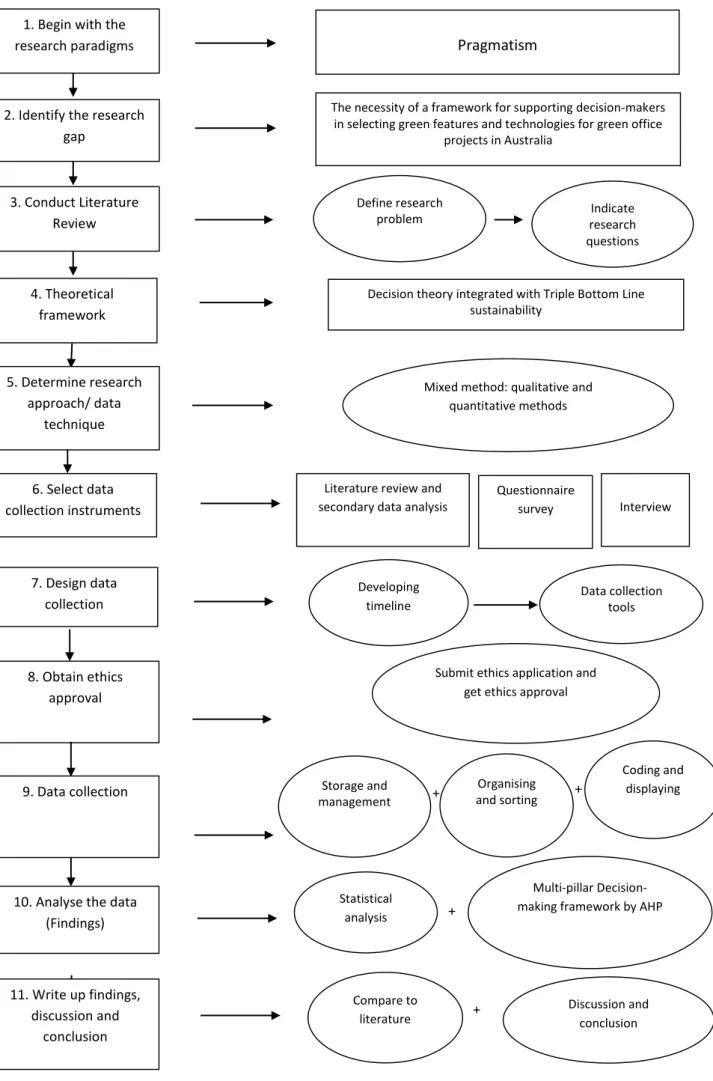
This research is an exploratory study within a pragmatic paradigm, using a mixed method approach for taking advantages of both quantitative and qualitative methods. Also, AHP is employed as a key tool for establishing MPDM framework. AHP implementation thereby involves secondary data analysis and an online survey. In this research, secondary data analysis aims to identify GFTs implemented in existing Green Star-rated office projects within
PhD thesis: Establishing MPDM framework for supporting the selection of GFTs 35| P a g e
Australia. Besides that, the questionnaire surveys are undertaken for seeking sustainability assessment of these GFTs from participants. Following this are the interviews with specific individuals for validating MPDM framework. The interviews also seek participant feedback regarding MPDM components and results generated by this framework. By taking this research approach, the research is able to explore and establish MPDM framework appropriately.
1.8.
STRUCTURE OF THE THESIS
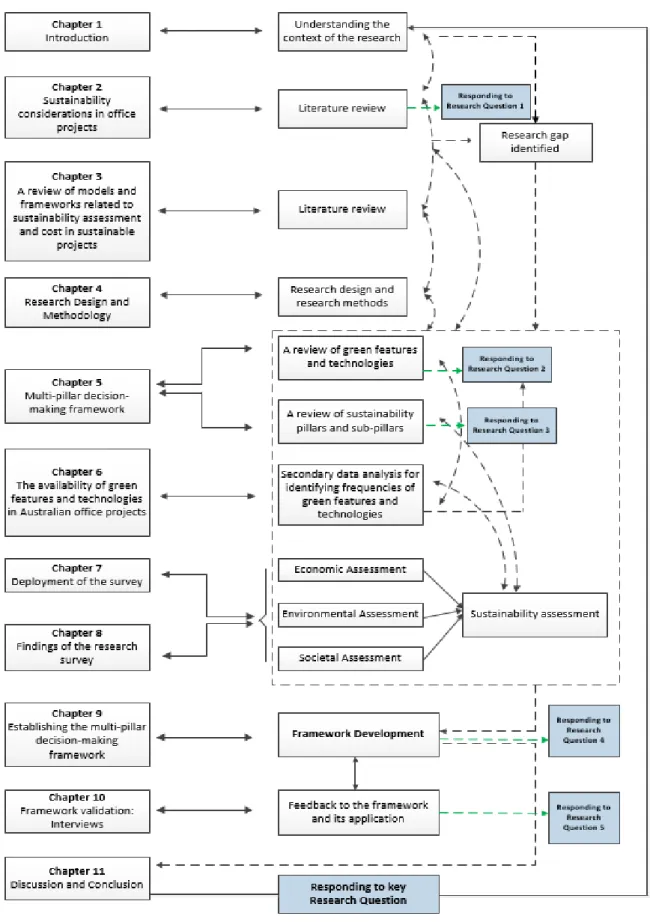
This thesis consists of eleven (11) chapters with their contents summarised below:
PhD thesis: Establishing MPDM framework for supporting the selection of GFTs 37| P a g e
Chapter 1 provides the thesis introduction with the background and justification towards the
selection of a research topic. This chapter presents research aim, objectives and questions. The research approach and thesis structure are presented as also the research scope and contributions on the development of green office projects in Australia.
Chapter 2 reviews available literature on the broad areas of sustainability and its importance
globally. This chapter presents sustainability tools related to office projects in Australia. The review of issues related to additional cost for sustainability requirements is also presented using global and Australian perspectives leading to a review of factors affecting the cost in green office projects. Based on this, the research identifies the research gap on the need for a simple and transparent sustainability assessment framework for supporting decision-making regarding Australian sustainable office projects. Finally, this chapter provides descriptions and clarification of decision-makers and project stakeholders in office projects.
Chapter 3 presents a review of currently available models and frameworks established for
mitigating the issues related to additional cost and supporting sustainability outcomes in such projects. These models and frameworks are objective-oriented, cost-benefit assessment and lifecycle assessment of sustainability, regression models and multi-criteria decision-making frameworks. Of these models and frameworks, this chapter demonstrates that a MPDM is a suitable assessment framework to address the research gap.
Chapter 4 discusses research design for addressing research questions and objectives. This
chapter identifies a theoretical framework for developing an assessment framework based on examining appropriate theories. This chapter also presents research paradigms, quantitative and qualitative methods and advantages of using mixed research methods.
Chapter 5 presents principal requirements of a multi-criteria decision-making framework
(MCDM). Based on MCDM requirements adapting to MPDM framework in this research, this chapter initially analyses two principles: the selection of green features and technologies and determination of sustainability pillars and sub-pillars. GFTs selection is based on a review of Green Star rating tools, Environmentally Sustainable Design (ESD) principles, reports and previous studies related to green office projects. Pillars and sub-pillars are indicated by an extensive literature review related to sustainability assessment in Australian office projects.
Chapter 6 takes a logical extension to validate the selection of GFTs in Chapter 5 through the analysis of Green Star-rated office projects from 2004 to 2016 since the information of these projects have been published as open access on Green Building Council of Australia (GBCA) website. Beyond GBCA website, the information related to these projects has been collected from different sources, such as project stakeholders’ websites. The information is analysed to understand frequencies of GFTs and validate GFTs availability in Green Star-rated office projects.
Chapter 7 presents the second research stage – the Survey. The survey is a questionnaire
designed to be deployed comprising four main sections. This survey aims to seek sustainability assessment of GFTs from decision-makers and project stakeholders. Chapter 7 describes the survey pilot for revising survey questions and results initially before online distribution. Taking on board feedback from pilot participants, this chapter then undertakes revisions to survey questions. Also, the recruitment process of survey participants is presented, including participant selection criteria and measures for contacting and recruiting participants in the survey. Participants are from the academia and construction industry.
Chapter 8 presents results from survey deployment using statistical analysis and AHP
process. Data collection from the survey regarding assessment of GFTs contributions to TBL sustainability: economics, environment and society; is undertaken. This chapter also presents a holistic sustainability assessment determined by the integration of economic, environmental and societal assessments. Based on sustainability assessment, the rankings of GFTs are provided for further analysis of GFTs selection.
Chapter 9 leads to the establishment of a MPDM framework for selecting GFTs in new green
office projects. Every step of this framework is described to explain the determination of weightings for pillars and sub-pillars. Subsequently, economic, environmental and societal assessments of GFTs are determined. A holistic sustainability assessment is indicated by the integration of these assessments. This chapter also describes primary characteristics of a MPDM framework and how to implement this framework in a new green office project.
Chapter 10 validates MPDM framework through interviews. This research stage is designed
to elicit participants’ feedback to determine real world application, performance and contribution of this framework in green office projects. This chapter develops a structured set of questions for the interview and establishes a recruitment process for interview
PhD thesis: Establishing MPDM framework for supporting the selection of GFTs 39| P a g e
participants. The chapter concludes with an analysis of how the interviews were undertaken and participants’ feedback regarding the proposed MPDM framework.
Chapter 11 discusses and concludes findings of this research. A summary of research process
is presented, demonstrating how the research aim and objectives have been achieved by addressing every research question. This chapter also addresses overall research contributions, implications and recommendations for further research in sustainability and the building and construction industry. This chapter presents the research limitations and how to deal with these limitations.
1.9. CHAPTER SUMMARY
This chapter provides the thesis overview. In this chapter, research gap, aim, objectives and questions are presented. A summary of eleven thesis chapters are also provided. This chapter also describes research design and research methods employed to address research questions and achieve research objectives. The next chapter is Chapter 2 – Sustainability considerations in office projects focused on the review of sustainability, green office projects in Australia, Green Star rating tools, issues related to additional cost for sustainability requirements. Chapter 2 reviews the factors affecting additional cost for sustainability requirements in such projects as well. Deriving from this review, Chapter 2 assists in identifying the research gap – the necessity of a simple and transparent framework for sustainability assessment to support the selection of GFTs in Australian green office projects.
CHAPTER 2
SUSTAINABILITY CONSIDERATIONS IN OFFICE PROJECTS
2.1. INTRODUCTION
This chapter aims to identify the research gap with an extensive literature review providing an overview of sustainability, sustainable/green office buildings, sustainable/green rating tools, especially Green Star rating tools used by the office building sector in Australia. This chapter also explores the issue of inconsistent findings related to additional cost for sustainability requirements in office projects within Australia and worldwide. This inconsistency of additional cost findings causes an impediment for decision makers and project stakeholders interested in the integration of sustainability in office projects. This chapter sets the key arguments for the research gap, which is necessary for a framework to support decision-making in green office projects.
The word “green” is often used for the environmental target while the word “sustainability” considers three pillars of economics, environment and society. However, over time, “green” has been extended to be closely associated with “sustainability”, considering beyond environmental to other pillars of economics and society. Therefore, in this research, the words ‘sustainability’ and ‘green’ are used interchangeably. Additionally, sustainable projects are also known as green projects in both Australia and globally (Wong and Zhou, 2015, Kats et al., 2003, Woolley et al., 2002, Presley and Meade, 2010).
2.2. SUSTAINABILITY AND SUSTAINABLE BUILDINGS
Sustainability has been defined differently depending on the context and its implementation (Berardi, 2013). A concise and consistent definition of sustainability has not been assigned yet and sustainability has been redefined over many years. Some of the early references to sustainability has been cited in the document of Ecologist’s A Blueprint for Survival in 1972 (Goldsmith et al., 1972). Sustainability has gained increasing prominence in the international environmental treaties and references to fairness of future human generations. Subsequently, sustainability may be interpreted from the definition of sustainable development defined by WCED (1987) as
“… development that meets the needs of the present, without compromising
Based on this, other research defines sustainability as:
“…using, conserving and enhancing the community’s resources so that ecological processes, on which life depends are maintained and the total quality of
life, now and in the future, can be increased” (Ecologically Sustainable
Development Steering Committee, 1992) (part 1). Also, sustainability can be defined as:
“A dynamic equilibrium in the process of interaction between a population
and the carrying capacity of its environment such that the population develops to express its full potential without producing irreversible adverse effects on the
carrying capacity of the environment upon which it depends” (Ben-Eli, 2018)
(p.1340).
Gladwin et al. (1995) have defined sustainability as:
“A participatory process that creates and pursues a vision of community that respects and makes prudent use of all its resources – natural, human, human-created, social, cultural, scientific, etc. Sustainability seeks to ensure that present generations attain a high degree of economic security and realise democracy and popular participation in control of their communities, while assuming responsibility to future generations to provide them with the where-with-all of their vision”
(p.877).
Also, sustainability has been defined in other studies for outlining the importance of future generation. These definitions are summarised in Table 2.1 below:
Table 2.1. Sustainability definitions in previous studies
Definitions of sustainability References
Sustainability provides for food, fibre and other natural and social resources needed for the survival of a group. Sustainability is provided in a manner that maintains the essential resources for present and future generations.
Wimberley (1993)
Sustainability is the evolution process to incorporate humans and their institutions into a larger ecological system. In the new ecological arena, human creatures need to pay the way to maintain system structure. This is precisely a cooperative enterprise, for our species, that don’t have the resources or cunning to dominate natures for very long time.
Allen and Hoekstra (1993)
Definitions of sustainability References
Sustainability aims to exist generations in the next century by protecting natural and built environment. It takes care of continuity of human beings and natural resources.
Osso et al. (1996)
Sustainability may be considered a three-legged stool with each leg representing ecosystem, economy and society. A leg missing from this stool causes instability in sustainability because society, economy and ecosystem are intricately linked together.
Young (1997)
Although many definitions of sustainability have been found in the literature, mostly the focus of sustainability is a strategic approach to balance needs of technology development, economic imperatives and environmental protection (Gilmour et al., 2011, Parkin et al., 2003, Martens and Carvalho, 2017, Bragança et al., 2007, Yılmaz and Bakış, 2015). In other words, sustainability balances the relationship between the goals of economic prosperity, environmental quality and social justice – known as Triple Bottom Line (TBL) (Elkington, 1997). Sustainability is also concerned with long-term impacts of current actions affecting current and future human generations as the primary objective of sustainable development (Aarseth et al., 2017). Sustainability thereby encourages the explorations of appropriate measures to minimise negative resource impacts and ensure the fairness amongst different human generations.
Following an understanding of the primary principles of sustainability, a sustainable building is defined accordingly. According to Shukla et al. (2015), a sustainable building is a building that considers utilisation of sustainable resources for ensuring building sustainable performance. Such a building has to put attention on the balance of Triple bottom line as well
as consider the impacts to current and future human generations. In addition to this
definition, another definition may be presented as:
“A sustainable building is a building that contributes – through its characteristics and attributes – to sustainable development. By safeguarding and maximizing functionality, serviceability and aesthetic quality, a sustainable building should contribute to the minimization of life cycle costs; the protection and/or increase of capital values; the reduction of land use, raw material and resource depletion; the reduction of malicious impacts on the environment, the protection of health, comfort and safety of workers, occupants, users, visitors and
neighbours; and (if applicable) to the preservation of cultural values and heritage”
(Lützkendorf and Lorenz, 2007) (p.646). Yet others have defined sustainable building as:
“The practice of creating structures and using processes that are environmentally responsible and resource-efficient throughout a building’s life cycle from siting to design, construction, operation, maintenance, renovation and deconstruction. This practice expands and complements the classical building design concerns of economy, utility, durability and comfort”(EPA, 2007) (Section of Green Building).
Using a narrower scope, Cassidy (2003) defined sustainable building as:
“A sustainable building should be able to provide the high efficiency of energy, water and material usages and minimise the negative impact to users’ health and the environment during the building lifecycle”.
In other definition, a sustainable building was stated as:
“A sustainable building is a building that uses a careful integrated design strategy that minimised energy use, maximises daylight, has a high degree of indoor air quality and thermal comfort, conserves water, reuses materials and uses materials with recycled content, minimises site disruptions and generally provides a high degree of occupant comfort”. (Kozlowski, 2003) (p.27).
Although sustainable building definitions are diverse, a definition needs to meet certain principles for regeneration of site, energy efficiency, water conservation, resource conservation, building space, material use, improved indoor air quality and waste recycling (Shukla et al., 2015, John et al., 2005). A sustainable building may consider reducing negative impacts on human lives, particularly human health and productivity (Azar et al., 2016). Put simply, sustainable building demonstrates sustainability during its life cycle, underpinned by the consideration of three sustainability pillars: economics, environment and society in a project. By using this approach, a sustainable building may be considered a win-win solution in the building and construction industry for current and future human generations.