Environmental Management Systems As
A Source of Competitive Advantage
ROBERT P. SROUFE STEVEN A. MELNYK,
GYULA VASTAG
Department of Marketing and Supply Chain Management Michigan State University
The Eli Broad Graduate School of Management East Lansing, MI 48824-1122
Tel: (517) 353-6381 FAX: (517) 432-1112
Environmental Management Systems As
A Source of Competitive Advantage
Abstract
The resource-based view of the firm is an emerging framework that includes bundles of resources, barriers, and isolating mechanisms that help a firm’s competitive position to be stable and defensible. This existing theory can provide insight into environmental management policy and specifically Environmental Management Systems (EMS) as a source of competitive advantage.
To date, little attention has been devoted to addressing the implications of EMS as a contributing factor to firm competitive advantage. Contrary to an often-expressed view, environmental management systems may do more than just add to the costs of operations. Environmental Management Systems are a corporate paradox. They can be major contributing factors to the isolating mechanisms that firms use for protection against new entrants and to enhance profits. However, many managers see such systems as costs, not opportunities. The result is that they invest only enough to meet regulatory requirements
This paper explores the events leading up to the development of EMS and how EMS can bring about a competitive advantage. Moreover, it attempts to resolve the paradox by developing a theory-based framework. This framework shows that the benefits of an EMS are the result of endogenous and exogenous factors that impact a firm’s awareness of these strategic benefits. The framework is used to generate research propositions and questions to be tested later.
The relationship between a firm’s resources and competitive advantage has been well established in literature as far back as Penrose (1959) and Andrews (1971), and more currently Barney (1991), Peteraf (1993), Rumelt (1984). In the past, firms have turned to such areas as product differentiation, cost, quality, lead-time and flexibility as the foundation of their strategic advantages. In each instance, resources were invested to insure that the proper systems were in place – systems aimed at enhancing a firm’s ability to compete on one or more of these dimensions. The competitive advantage offered by these dimensions has often been momentary, as changes in customer expectations make these new dimensions a minimum requirement and as the competition emulates and refines the new systems. Organizations now find themselves asking the question, what will be the next source of competitive advantage for multinational firms? The answer could be the systemic approach to greater efficiencies gained from Environmental Management Systems, or EMS, as it is more commonly called. One of the most important tasks for multinational firms will be to implement uniform environmental management practices and policies as they are driven by the convergence of national compliance requirements (Karls, 1993; Walter, 1994). Balikov (1995) suggests that international EMS standards will serve as a guideline if EMS receive widespread acceptance. However, the literature fails to describe a critical paradox impacting the acceptance, implementation and use of an EMS. Many firms only see EMS as a cost of doing business. As a result, firms may only invest enough resources to meet the minimum regulatory requirements. For those firms ready to face the challenges of successful EMS implementation and even go beyond compliance, there are many potential benefits.
EMS are becoming increasingly important to both national and multinational firms. Underlying its emergence and acceptance is the premise that improved systems associated with EMS can make achievement of strategic goals more likely. Additionally, new standards such as ISO 14000
are predicted to set a higher level of expected environmental performance worldwide, facilitate trade and remove trade barriers (Curkovic, Handfield, Melnyk and Sroufe, 1997). Many issues surround the role of these types of systems in the strategic management of a firm. However, in spite of the evidence of a linkage between EMS and enhanced corporate performance (Rondinelli, Berry and Vastag, 1997), there exists evidence arguing against the need for investing in EMS. For example, Walley and Whitehead (1994) noted a negative correlation between environmental investments and stockholder value. Many firms are apparently taking the position of only investing enough to meet the current regulatory requirements. They seem to have found little incentive for taking a leadership role, as it pertains to EMS. This lack of EMS leadership reinforces the before mentioned paradox and sets the stage for the further development of theory. An alternative strategy for building theory is to “look for theoretical tensions or oppositions and use them to stimulate and develop more encompassing theories” (Pool and Van De Ven, 1989). The proposed framework will help develop the transition and evolution of theory concerning the EMS decision making process.
The primary focus of this paper concerns the role of EMS in providing a competitive advantage. First, we will describe the elements of a developing framework, relate the new framework to an existing theory, and subsequently develop a new theory of EMS. The paper examines the role of EMS in obtaining a competitive advantage by focusing on the paradox previously introduced. It uses this paradox as a basis for generating a comprehensive framework. This framework is drawn from a review of the existing business strategy literature as it relates to EMS. At its core, this framework attempts to explain the level of awareness and investment in EMS. This perspective is based on the premise that firms will invest in environmental management systems to the extent that they are perceived as offering opportunities for gaining or generating a competitive advantage. To make this
transition from EMS to a competitive advantage, as captured by investments in EMS, this paper explores the following questions:
1. What constitutes an EMS?
2. How does an EMS provide for competitive advantage? 3. Can EMS be an isolating mechanism?
4. What factors influence the emergence of EMS as a strategic advantage?
These questions will be explored by first defining EMS, reviewing the resource-based strategy literature, and then expanding on this literature review by looking outside of traditional strategy and management literature to other disciplines for insight into the integrated approach of EMS. Next, sections will follow focusing on the evolution of the natural-resource-based view of the firm, and the forces behind the “greening” of business are identified. A model of the decision to implement EMS is proposed. The factors affecting the level of investment in EMS are then identified and, from this model and its associated factors, propositions are then generated. Finally, there is a discussion of the difficulties of operationalizing environmental constructs, and implications of this research to competitive advantage and business strategy.
DEFINING THE CONCEPT OF AN ENVIRONMENTAL MANAGEMENT SYSTEM
EMS is “that part of the management system which includes organizational structure, planning activities, responsibilities, practices, procedures, processes and resources for developing, implementing, achieving, reviewing and maintaining the environmental policy” (Tibor and Feldman, 1996; Cascio, 1996). In other words, EMS is a management system that plans, schedules, implements and monitors those activities aimed at improving environmental performance. Underlying this definition is the implicit assumption of a positive correlation between environmental and corporate performance (Tibor and Feldman, 1996).
EMS is a more comprehensive systems approach to what is typically found in disaggregate form in current Environmental Health and Safety functions of firms. EMS is not an entirely new concept, or system for firms to deal with. In many cases the infrastructure for an EMS system is in place. What is needed for an existing system to become an EMS is the integration of the system capabilities with environmental metrics and goals. Utilization of this system should allow people from all functions within the firm to understand and carry out environmental “waste reduction” goals.
The emergence of EMS can be traced to two major factors. The first involves the development of environmental standards. The second is drawn from the lesson learned by studying how firms in the past have responded to risk due to environmental problems.
The Development of Environmental Standards.
For those not familiar with the evolution of EMS, many of the components of EMS are found in the development of different standards in the last six years. Masaaki Imai (1986) states “there can be no improvement where there are no standards.” Thus, the world’s first standard for EMS, British Standard (BS) 7750 was developed and published by the British Standards Institute in 1992. The BS 7750 standard was the model for the ISO 14000 series of standards for EMS developed by the International Organization for Standardization (ISO). BS 7750 is also the basis for the European Union’s Eco-Management and Audit Scheme (EMAS).
Found within these various EMS standards are almost the same set of basic elements of an effective environmental management system. They include: (1) creating an environmental policy; (2) setting objectives and targets; (3) implementing a program to achieve those objectives; (4) monitoring and measuring its effectiveness; (5) correcting problems; and, (6) reviewing the system to improve it and its overall environmental performance. However, while the elements are somewhat common, it is the special information the system can generate that serves to differentiate the EMS of one firm from
that of another. Thus, many firms can have an EMS, and each of these systems can be a unique resource, delivering specialized information to individual firms.
To date, ISO 14000 standards may be the best example of a structured EMS. For a better understanding of EMS standards we need to consider the following point: ISO 14000’s EMS standards are process not performance standards. In other words these standards do not tell organizations what environmental performance they must achieve aside from compliance with environmental regulation. Instead the standards describe a "system" that will help an organization to achieve its own objectives and targets. While many believe in the link between firm performance and EMS, the question still remains; can EMS lead to enhanced profitability? There is a clear need for empirical testing of this research question.
An effective EMS can help a firm manage, measure, and improve the environmental aspects of its operations. EMS has the potential to lead to more efficient compliance with mandatory and voluntary environmental requirements. EMS may help companies effect a culture change as environmental management practices are incorporated into its overall business operations. Just as the quality cultural change has taken place over the last twenty years, EMS may become the next extension of quality to waste reduction. Experts who have guided manufacturers through the ISO 14000 process agree that companies that have already achieved either ISO 9000 or QS-9000 certification will have less trouble implementing ISO 14000 (Minner, 1997). When ISO 9001 is blended with ISO 14001, together they provide a reasonable framework to help organizations achive functional clarity and achieve goals (Beechner, and Koch, 1997).
A RESOURCE-BASED VIEW OF THE FIRM
The resource-based view of the firm posits that competitive advantage can be sustained only if the capabilities creating the advantage are supported by resources that are not easily duplicated by a firms competitors (Rumelt, 1984). These resources are considered valuable, rare, and in fact raise barriers to imitation, and entry (Barney, 1991). Competitive advantage is rooted inside a firm, in these resources and assets that are valuable and inimitiable (Itami, 1987; Wernerfeldt, 1984; Peteraf, 1993).
Rumelt (1984) presents a theory of strategy that may be explained in terms of the unexpected events that created, (or will create) potential profitability together with isolating mechanisms that will act to preserve them. These isolating mechanisms, or barriers identified by Rumelt include:
Causal ambiguity Unique resources Specialized assets Special information Switching and search costs Patents and trademarks Consumer and producer earnings Reputation and image Team embodied skills Legal restrictions on entry
The importance of isolating mechanisms in business strategy is that they are the phenomena that make competitive positions stable and defensible. Many of them appear as first-mover advantages (Rumelt, 1984; Wermerfelt, 1984). If a firm waits until the proper methods for entering markets or producing products is fully understood it will normally be too late to take advantage of the information (Rumelt, 1984). Here we see the potential of being the first to adopt an EMS as a unique resource. This unique resource can provide special information (e.g., costs of wastes leaving the firm in the form of liquid, solid or gaseous, documentation for auditing, and public environmental information) both internally and externally to the firm. Much of this special information was not available in the past and typically was lost in overhead. An EMS can provide new information that can be used to aid decision making, enhance firm image, or if part of a certified standard, can facilitate entry into markets having legal restriction on entry to only those firms with a certified EMS. We have just celebrated the twenty-eighth Earth Day, so why is EMS just now being considered?
THE FORCES FOR GREEN BUSINESS
When asking firms about the importance of the environment, we find that it is more than some will admit and less than some would hope. The proponents of more environmental regulation for business have gained support from Porter (1991), who briefly discussed the question of whether strict environmental standards make American industry less competitive in international markets? The viewed conflict between environmental protection and economic competitiveness as a false dichotomy. Strict environmental regulations do not inevitably hinder competitive advantage against foreign competition; indeed they often enhance it (Rondinelli, Berry and Vastag, 1997). It is here that we can see the paradox of the view that EMS is only a cost to the firm. The view that EMS is only a cost to the firm surfaced in other forms in the literature. Multinational corporations that invest in emerging market economies are often accused of seeking pollution heavens and exploiting local conditions to gain quick profits at the expense of the poor and vulnerable (Korten, 1996). Rondinelli and Vastag (1998b) using an instrumental case study of Alcoa argue that the leading multinational corporations make substantial contributions to human and natural resource development in emerging market economies—focusing on longer term goals and competitive gains and putting aside short-term cost considerations. The MNCs’ implementation of cutting-edge environmental management systems and practices changes the network relationships with their suppliers, contractors and customers and make these emerging market economies more competitive.
It has been claimed that firms involved in proactive environmental programs can lead the way into environmental stewardship, and new regulatory requirements (Rondinelli, Berry and Vastag, 1997). While there are cost/benefit tradeoffs associated with being the standard setter and being a follower, there are also times, when government or the competition seek “best-in-practice”
environmental companies as a benchmark. Firms that are laggards in adopting new standards and conforming to existing regulations will spend valuable resources in order to stay abreast of the active development of their competitors, and new governmental regulations. The United States alone has passed the 20,000 page threshold during 1993 and continues to add exponentially to the number of environmentally related pages of regulations since 1993. This increase in federal laws does not even include the state and local level regulations which tend to compound the already complex issue of legal compliance. Those firms who choose to be reactive to environmental legislation and implement end-of-pipe solutions to pollution problems will consume more resources just to comply with these new regulations. It should be easy to see that compliance is a minimum requirement for competitive advantage. For those firms who are already exceeding regulatory compliance, the proactive investments in previous environmental initiatives can help defend the firm against new compliance issues, costs, and competitors.
Additional evidence of the growing importance of environmental business practices is seen in the Environmental Protection Agency’s publishing of a Code of Environmental Management Principles (CEMP) for all Federal Agencies. The intention of this code is to move federal agencies toward a “systems” approach to environmental management that will mirror private sector initiatives such as EMS standards (Anonymous, 1997).
Examples of international government’s recognition of environmental importance may also be seen in Indonesia’s recently introduced Program for Pollution Control, Evaluating and Rating (Wheeler and Afsah, 1996). This is a landmark initiative under which polluters are assigned environmental performance ratings that are announced to the public. The main objectives of the program, which went into effect in June 1995, are to increase compliance with environmental regulations, promote adoptions of clean technologies, create incentives for polluters to strengthen their
in-house environmental management capabilities, and prepare companies in Indonesia for ISO 14000 certification. Due in part to governments recognizing the importance of environmental business practices, corporations now must evaluate the appropriate corporate environmental policies for their plants and supply chain partners while being consistent with new international standards (Rondinelli and Vastag, 1996).
Aside from the looming environmental legislation, firms still have to handle the delicate issues of special interest groups, stakeholders, customers, and communities around the firm. The recent United Nations Climate Conference discussing the controlling of global warming, and specifically reduction of carbon dioxide and other greenhouse gases to below 1990 levels has brought growing attention to the environmental impacts of businesses in many countries. So how can a firm keep track of all the environmental complexities it needs to while meeting the specialized internal and external information needs of the firm? To see how this can be accomplished need to better understand the risks and issues involved in the decision to implement an EMS.
While some models of firm performance and the relationship to environmental constructs have been introduced (Porter & Van Der Linde, 1995; Hart, 1995; Vastage, Kerekes, and Rondinelli, 1996), research has not yet adequately resolved the EMS paradox. As pointed out by Pool and Van De Ven (1989), when a paradox is encountered, it can be resolved in one of four ways. The first and least desirable is to ignore the paradox. The second is to assume that the paradox reflects differences in organizational levels. That is, what is done on the shop floor differs from what is done by top management, when carrying out strategic planning. The third is that the paradox reflects temporal differences. Firms at one stage of development behave differently from firms that are observed at another point in time or stage in development. The fourth and final option is to revisit the theory and to revise it so that it can cope with this paradox. This is the approach advocated by this paper. To
pursue this approach, we must expand on the existing theory and develop a model that specifically deals with the issues surrounding the EMS paradox.
A NEW FRAMEWORK
A new and different approach to traditional resource-based views of the firm looks at the “environment” in a new way. According to Starik and Rands (1995), organizations have environmentally oriented interactions with other levels and systems, internal and external to the firm. These interactions are in what is called a web of relationships. The multilevel interactions exist, whether planned and/or recognized. At the enterprise level of strategy, managers should ask “what does our organization stand for?” and “what is our role in society?” Starik and Rands go on to claim managers need to adopt sustainable corporate-level strategies that develop lines of business that have low depletion and pollution impacts, and divest in lines of business that have the opposite effects.
An emerging theory is the based view of the firm. This natural-resource-based view is centered on the premise that business (markets) will be constrained by and dependent upon ecosystems (Hart, 1995). He suggests that strategy and competitive advantage in the coming years will be rooted in capabilities that facilitate ecologically sustainable economic activity (Hart, 1995; Jennings and Zandbergen, 1995; Magretta, 1997).
Hart (1995) expanded the resource-based view of the firm to include the constraints and opportunities of the biophysical environment. Two generic types of corporate environmental policy came out of Hart’s work. One, is a compliance strategy which is short term and reactive, with firms resisting the enactment and enforcement of environmental legislation. The second environmental policy is a focus on proactive pollution prevention, such as source reduction and process innovation. Hart’s two strategies fit well and are components within Vastag, Kerekes and Rondinelli (1996) and Rondinelli and Vastag’s (1996) four corporate environmental policies. These policies are dependent
on endogenous and exogenous dimensions of environmental risk. Endogenous environmental risks are those risks created by the internal operations of a company and are more clearly under the control of management. Exogenous environmental risks are created by externalities (location, for example) which are usually beyond the influence or control of the company.
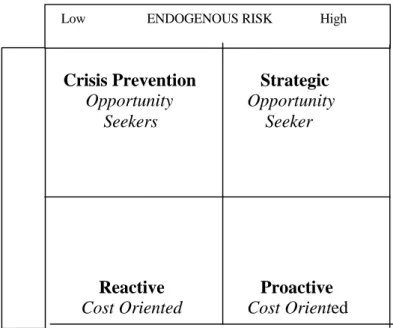
Of the four environmental policies, a Reactive policy is found when there is a small level of endogenous risk and a small level of exogenous risk. Reactive firms can be likened to Hart’s compliance strategy, and require corrective environmental management action as regulations and norms change. Proactive policy is present when endogenous risks are large and exogenous risks are small. Proactive environmental policies seek immediate corrective environmental management action as regulations and norms change and try to anticipate these changes. Crisis Prevention policy is present when endogenous risks are small and exogenous risks are large. Crisis prevention usually entails environmental management actions due to public exposure, where there are continuous emergency monitoring procedures and immediate intervention if an emergency occurs. Finally,
Strategic policy is present when endogenous risks are large and exogenous risks are large. Much the same as Hart’s second prevention based policy, environmental management actions include continuous improvements in all aspects of business activity toward pollution prevention and waste elimination. It is partially from these previous models Hart (1995), and Rondinelli and Vastag (1996) that a theory of EMS will be developed in this paper.
The resolution of the paradox that EMS are only a “cost,” may be true where there is not a strong environmental corporate culture and the system was not designed, developed, or implemented correctly. Naysayers can point to failed environmental initiatives, but this myopic approach overlooks the many benefits available to firms who choose to implement an EMS. We must remember that all waste comes at a cost. Without capturing waste information we are left with few tools, or facts, and
many opinions to fight environmental battles. The tendency to focus on the failures and overlook these benefits may be due to several factors.
Environmental Mindset
The categories of firms identified by Rondinelli and Vastag, point to a dichotomy among firms. These firms may be aware of EMS as either a "cost" or an "opportunity." Those firms looking at EMS as a cost tend to do the minimum amount of investment in EMS, or may try to get by with no system at all. These cost oriented firms typically have low exogenous risks. Opportunity seekers tend to be more aware of the benefits of an EMS, and attempt to realize the competitive advantages and isolating mechanisms EMS can bring about. Opportunity seekers tend to be found in situations where exogenous risks are high.
---Insert Figure 1 about here.
---If we look to some of the exogenous issues impacting the firm, we find pressure from stakeholders, regulations, and the industry impacting the awareness a firm will have about competitive advantage through EMS. These agents: stakeholders, regulations, and industry all impact the awareness of a firm to environmental initiatives and potential market niches. If a firm’s customers are demanding “greener” products, then that firm tends to look for ways to improve image and marketability of it products. Alternatively, some firms may believe this green movement is another marketing fad, and may choose to wait and see before committing any resources to an EMS. Other customers such as stockholders may also demand more environmentally conscious practices. Investment research firms such as Kinder and Lyndenberg provide environmental information about companies to potential investors.
If regulatory agents demand the company emit fewer hazardous materials, then the firm will react in a different way. Begrudgingly at first, firms may accept this as a cost of doing business and invest only the minimum amount necessary for compliance. Some firms will not stray from this minimum “cost” approach to thinking, and are reactive or proactive at best. According to Porter, (1991) and Porter, Van der Linde (1995) these types of strict environmental regulations can enhance competition and lead to better efficiencies and competitiveness. Other factions may argue that exceeding regulations will set up problems because no one knows what the government will do next. Firms who are willing to take a more strategic approach to EMS should be able to integrate pollution prevention throughout the firm’s practices and processes and use them to create long-term advantages (Rondinelli, Berry and Vastag, 1997). Alternatively, exogenous factors such as increased costs of waste, industry promoting greener products, and the organization of such things as Responsible Care for the chemical industry, can force firms to do more than just comply with regulations. Industry can become the driving force for environmental improvement. The furniture industry has shown us that greener products can be an order winner if all other things (cost, quality and flexibility, for example) are equal (Handfield et al, 1997).
Technological Reality
Looking inward, endogenous factors such as existing technology and metrics contribute greatly to the complexity of issues surrounding EMS. The awareness of top management will play a significant role in the strategic impact of an EMS. However, awareness in itself is not enough. Endogenous risks related to the existing technology may change the environmental mindset to a great extent. Moreover, if firms are not measuring the wastes associated with their production processes and do not have an integrated approach to managing these wastes, then many of the costs are not
captured and subsequently placed into overhead. Overhead allocation is a potential problem because, if you do not measure the wastes associated with your processes, you can not manage it, and no one is accountable for it. Environmental issues tend to be very opinionated, data helps to remove the opinions and uses facts as the basis of decision making. Other endogenous issues impacting the firm include the foreign ownership, the history of the firm (proactive or reactive nature of the firm), and the amount of hazardous materials on site. Additionally, the amount of change in the industry, coupled with environmental pressures, will impact equipment selection, product or process selection, and especially the decision to certify an EMS.
The early adopters of EMS stand to gain an advantage over other firms who are not seeking systems development early. This advantage may well be the ability to shape regulatory policy or standards because the firm is benchmarked as an environmental leader in its industry. Dean and Brown (1995) claim that some firms may acquire strategic benefits in this manner. This argument relies on the potential for environmental regulations to affect certain types of firms more severely than others. Environmental regulations may create entry barriers for new firms through a number of mechanisms that include increased capital required for effective entry to pollution intensive industries, and increased capital for the EMS certification processes. Other barriers include the added complexities involved in business operations, the expanded difficulties and costs in identifying and permitting new operations, and the stricter regulatory standards that often apply to more modern facilities.
Firms which react to new environmental regulations with end-of-pipe (e.g., scrubbers on smokestacks is at the end of the pollution proverbial pipe) solutions to pollution problems are the first to say that environmental regulations have only added to the cost of doing business. Contrary to this often-expressed view, EMS and environmental regulations may do more than just add to the costs of
operations. Environmental regulations that place a heavier burden on new entrants confer an advantage on existing firms by increasing the barriers to entry in industries in which pollution abatement is important (Dean and Brown, 1995). This implies that incumbents may be able to use environmental regulations strategically to enhance competitive advantage.
Dean and Brown (1995) show that environmental regulations influence rates of new firm entry across a broad rang of manufacturing industries. While an EMS is not a regulation, it can be a resource that is hard for other firms to perfectly imitate and poses new barriers to entry and mobility that many firms may not have yet contemplated. Firms that have an EMS in place have better systems capabilities to allow them to function in new industries. To get a better understanding of the decision to implement an EMS, and the forces driving the need for this type of management system we need to look at some of the ways benefits develop when firms have an EMS.
AWARENESS OF ENVIRONMENTAL BENEFITS
There are many reasons why EMS and EMS standards should be potentially attractive to firms. First, there is the increasing use of voluntary standards in industry. Second, we see the potential of EMS becoming important to supply chain members (Rondinelli and Vastag 1996). Third, government adoption (Wheeler and Afsah, 1996). Fourth, is the potential of EMS to reduce insurance rates (Greenwald, 1997). Fifth, pollution prevention leading to reduced costs of production and higher profits (Dechant and Altman, 1994; Makower, 1994; Russo and Fouts, 1997; Feldman, Soyka, and Ameer, 1997). Sixth, the increased importance of corporate social responsibility (Pava and Krausz, 1996). Finally, the ability to help the firm achieve environmental excellence (Melnyk, et al., 1996).
We have already reviewed some of the examples of government adoption of environmental initiatives. If we now look at EMS standards such as ISO 14000 becoming a de facto requirement for
doing business, we start to see the acceptance of and increased use of ISO 14000 in some Asian and European countries. From our research efforts at Michigan State University1 we are seeing an increased need for companies to look down the supply chain and assess suppliers on “green” dimensions (Sroufe et al., 1998). All things being equal (cost, quality, flexibility), many firms would rather choose a supplier with better environmental performance than other higher environmental risk suppliers. With companies such as Ford Motor implementing EMS and ISO 14000 certification at all North American manufacturing facilities, EMS is an environmental management tool that many of Ford's suppliers will undoubtedly have to be paying very careful attention to (Bergstrom, 1996). This "web" of relationships (Starik and Rands, 1995) with suppliers now takes on a new performance dimension.
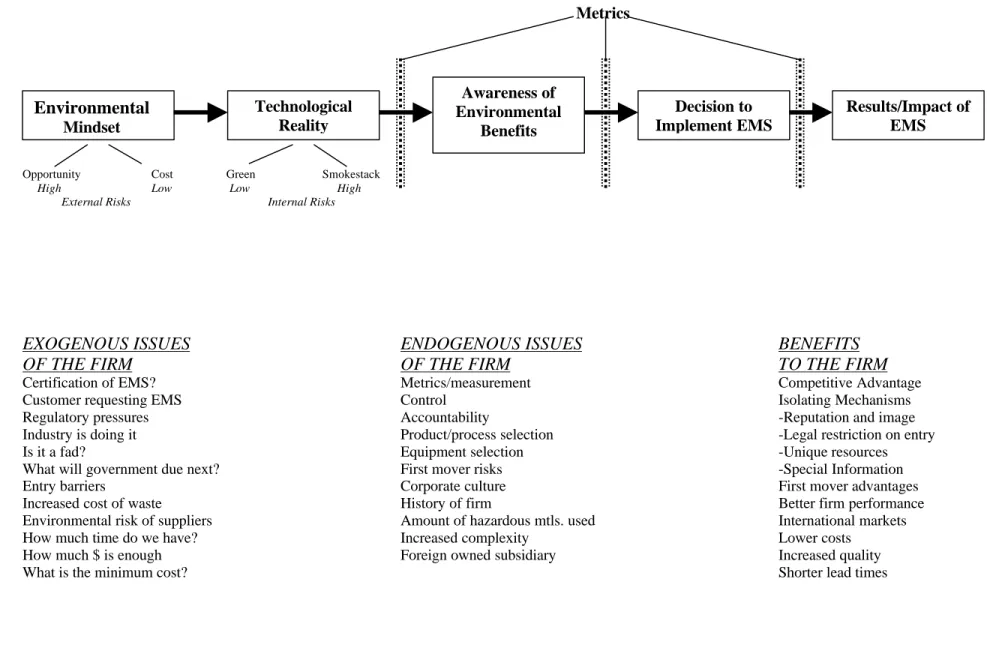
Figure 2 summarizes our proposed framework. In this framework, a firm’s environmental mindset is determined by the firm’s exogenous risks. The high and or low level of this risk categorizes the firms into “opportunity seeker” and “cost minimizer” subgroups. This environmental mindset is confronted then with the technological reality – determined by the firm’s endogenous risks. For the sake of simplicity, firms can be either “green” or “smokestacks” based on their technological reality, or endogenous risks. These internal and external factors together determine a firm’s awareness of EMS benefits. The level of awareness leads to the decision about the EMS implementation and consequently to the EMS results. These relationships are filtered through the lenses of environmental metrics.
---Insert Figure 2 about here.
1
This research is supported by the NSF Division of Design, Manufacture, and Industrial innovations (ECM Initiative, Grant Number DMI-9528759). The authors acknowledge with gratitude the generous support provided by the National Science Foundation.
Before we go into further details about our proposed new framework, we have to discuss how this framework addresses the four elements of any theory definitions. As Wacker (1998) writes, “any definition of theory should answer common questions that researchers face. First, theory defines all
variables by answering the common questions of who and what. The domain, the conditions where the theory is expected to hold by using the common questions of when and where. The relationship-building stage specifies the reasoning by explaining how and why variables are related. And last, the predictive claims specify the whether ‘could the specific event occur?’, and ‘would a specific event occur?’”.
The domain of our proposed framework not only those firms who are contemplating an EMS or who have an EMS, but also those firms who have chosen not to implement an EMS. A very interesting research question will be; what factors most strongly impacted those companies who have gone through the decision making process and do not have an EMS? The variables and their relationships were discussed earlier and are shown in Figure 2.
The next section discusses the last point, specific predictions or propositions derived from this framework. In forming these propositions, we are guided and motivated by the guidelines and
recommendations presented by Davis (1971), Kuhn (1963) and Platt (1964), who noted that research should be driven by four major considerations. The first is that it should be feasible (i.e., we can do it). The second is that it should be useful. Readers will find the results applicable to a range of situations actually encountered. The third is that it should be linked to the theory. In proposing and testing the propositions, we are refining the underlying theory. Our results should help us to drop certain aspects of the model, introduce new dimensions to consider and reframe other aspects. Finally, the research should be “interesting” (Davis, 1971). That is, the reader must be made to sit up and take notice of the results because they provide the person with unique and “interesting” insights into the
events being studied. The propositions presented in the next section conform to these four requirements.
Propositions
The propositions are presented in the following format: The first two propositions take into consideration the information already presented about the resource based view of the firm. Propositions 3 and 4 address the ability of an EMS to have a direct effect on a firm’s competitive advantage. Next, propositions 5 through 7 address the benefits an EMS may provide for integration of processes, and resource based “special” information. Propositions 8 through 10 posit the benefits of an enhanced reputation derived from EMS, and finally, proposition 11 addresses the culmination of a better reputation as a less risky alternative rewarded by potential investors.
Proposition 1: EMS can be an entry barrier to those firms who do not have such systems.
Proposition 2: Opportunity seeking companies will typically be first movers, and decide to implement EMS before other firms
If we are going to require it of our supplier, we need to demonstrate some of the benefits of having an EMS. Russo and Fouts (1997) provide some evidence of the link between environmental performance and economic performance in high growth industries, while Pava and Krausz’s (1996) literature review of Corporate-Social-Responsibility found nine empirical studies using environmental performance criteria to predict financial performance. Of these nine studies, four reported a positive association, while none of the studies reported a negative association with financial performance. There is additional evidence that firms recognize the before mentioned positive associations with financial performance, and go beyond compliance and position themselves for future changes in environmental policy (Business Week, 1990). In fact, firms making investments in environmental health and safety initiatives that are not required by international laws or social standards, and are not
in the interest of maximizing short-term profits, find the investments do pay off in the long-term (Rondinelli and Vastag, 1998). Feldman, Soyka, and Ameer (1997) show that companies investing in environmental improvements could lead to a reduction in perceived risk with an accompanying increase in stock price of perhaps 5%. Additionally, an Arthur D. little survey of executives at 115 large North American businesses found that 61% expected meeting ISO 14000 requirements will bring a potential competitive advantage.
Proposition 3: Firms that decide to implement an EMS will have a unique resource positively associated with enhanced quality, lead times, lower costs, and thus a competitive advantage.
Proposition 4: Firms who see a competitive advantage from an EMS will have opportunity seeking environmental policies.
When EMS is considered an integrated part of proactive business practices, than additional advantages may also include; benefits of cross-functional efficiencies, introduction of environmental improvements ahead of the competition, the reduction of new product development cycle time, and unique information to aid the cost/benefit decision making process. In most cases, a thorough strategic assessment of environmental issues will identify areas of weakness in the manufacturing function that can be addressed through targeted EMS development and improvement initiatives. Florida (1996) found firms leveraging their industrial modernization strategies toward environmental ends, and firms see pollution prevention as important to overall corporate performance. EMS are by nature firm and product specific. EMS awareness and the decision to implement such a system will include an assessment and analysis phase and a development and improvement phase. The development and improvement phase is focused on formulating missing elements (e.g., policies, procedures), integrating important EMS principles and tools, and establishing strategies for achieving desired patterns of internal and external information flow. It is from these EMS assessment and
analysis phases that firms will be able to obtain information they may not have captured or tracked (i.e., costs of different kinds of wastes typically lost in overhead) before and move toward continuous improvement of waste reduction.
Proposition 5: Firms with an EMS will have an integrated approach to providing specialized information, better tracking and controlling of manufacturing processes and waste streams.
Proposition 6: Cost oriented firms will decide to only invest the minimum amount of resources needed to be in compliance.
Proposition 7: Opportunity oriented firms in high-risk endogenous environments will have an integrated approach to environmental policy and information.
Benefits also include using an EMS as a means for companies with typically bad environmental practices to demonstrate a change in ways, or improved social responsibility. This improved social responsibility can be seen as a product the firm has to offer to the key publics of the firm (Murry & Montanari, 1996). Firms can build trust by being environmentally responsible and not denying pollution problems (Berry, Rondinelli, and Vastag, 1996). Socially responsible actions of the firm hold the potential for promoting positive acceptance of the organization, thus increasing its competitive position in relationship to its industry rivals.
Proposition 8: Firms with an EMS will be perceived as having a good environmental reputation and, or, image.
Proposition 9: High exogenous risk environments will force opportunity-seeking firms to certify their EMS to enhance the firm’s environmental reputation.
Proposition 10: Firms with low endogenous risks and lesser needs for good environmental reputation will be cost oriented.
Beyond the disclosure of information to the general public, investors are also interested in the environmental initiatives of publicly held firms. How would an executive of a firm react to finding that investors are now looking at environmental attributes of firms when determining risk and making investment decisions? Additionally, how will insurance companies assess a company with an EMS? Organizations such as Kinder Lydenberg, and Domini KLD & Co. provide social research on environmental attributes of corporations for institutional investors. Additionally, the Environmental Information Service at the Investor Responsibility Resource Center, in Washington D.C., collects, tracks and disseminates corporate environmental information to interested investors. If investors use this pollution information in making investment decisions, as empirical evidence indicates (Freedman & Jaggi, 1982; Makower, 1994; Pava and Krausz, 1996), then meaningful pollution prevention information such as having an EMS, or EMS certification should benefit the firm. Ultimately, an EMS could result in significant economic benefits for businesses beyond insurance premium savings (Greenwald, 1997).
Proposition 11:Firms with an EMS will be perceived as having less risk by investors.
While there are a limited number of propositions we can make, many questions still remain about the decision to implement an EMS. How sustainable is a firm’s competitive advantage from EMS, this is assuming a firm can obtain an advantage. Additionally, what are the critical success factors of EMS? It is from testing these propositions that we hope to resolve the EMS paradox. If firms can be shown the relationship between EMS and improved quality, enhanced profitability, or increased markets for their product, then we can resolve this paradox and better understand how firms make decisions regarding EMS. There are still many question and few answers to the issues of EMS.
THE NEED FOR BETTER MEASURES
The use of EMS is recognized as a means to better understand and control conversion processes for manufacturers. The ISO EMS series provides a structure for building environmental measures into a company's processes (Minner, 1997). EMS can meet new environmental objectives, become a unique resource of the firm, and influence behavior by improving accountability, creating a store of corporate knowledge and supporting decision making processes where the work is done (Eckel et al., 1992).
Eckel et. al., go on to suggest that Environmental Performance Measurement must be integrated with and rely on the accounting and reporting system of a firm. This new approach to performance measurement will cause an inward focus on an evolving resource. It will function differently by gathering information both externally and internally, and some of the information may be unusual in form and source. There may be some new information residing in the accounting systems, but how do we determine and measure the performance of EMS?
Businesses are finding that it is not enough to just be compliant with environmental regulations. New performance measures and the means to capture these measures are needed to compete on a new level and enhance profitability. There is a need for both quantitative and qualitative data that captures the results of EMS implementation. We need measures that show more than the lack of compliance, i.e., the number of environmental infractions in a year. The result of having an EMS should be measured in terms of costs, quality, lead time, the extent of integration with planning, and how this new information provided by the EMS effects decision making at all level of the firm. If environmental leadership can be profitable and a source of competitive advantage as Dechant & Altman (1994), and Begley (1996) claim, then what are the compelling reasons for firms to pursue the
development of an EMS and how will this effect strategy? A vast amount of work may be found in further developing and operationalizing theory in this growing field.
IMPLICATIONS FOR MANAGEMENT RESEARCH
Review of the literature reveals that it is tilted heavily toward conceptual analyses and anecdotal case examples. Very few published empirical studies have undertaken hypothesis generation and theory testing (Klassen, 1995; Dean and Brown, 1995; Porter and Van der Linde, 1995; Vastag, Kerekes, and Rondinelli,1996). So why are firms reluctant to develop EMS? Of those firms that are the early adopters of this new systems approach to environmental management, what determines success? What are the incentives for firms to exceed regulatory requirements, and what factors influence the decisions to implement an EMS? There is a clear need for investigation of the issues associated with EMS and the implications for business strategy.
To date, little attention has been devoted to answering the questions surrounding EMS. The propositions generated in this manuscript will set the framework for significant contributions to understanding why firms may gain a competitive advantage from EMS, and better understand why some firms are reluctant to develop EMS. The proposed theory will help develop hypothesis generation, and will lay the groundwork for more research on organizational metrics involving strategy and the environment. It is hypothesized that if EMS is recognized as a isolating mechanism for the firm, then firms with these systems have the potential for competitive advantage, will make their processes better by eliminating waste, and have more information available for better decision making. Any research, which can further define this area of strategy for businesses, is important, as the area is still very much incomplete.
REFERENCES
Andrews, K. R.,1971. The Concept of Corporate Strategy, Irwin, Homewood, IL. Anonymous, 1997. “CEMP for Federal Agencies.” Environmental Manager. 8, (6): 15.
Balikov, H.R., 1995. “Developing global environmental standards-progress and implications of the new wave.” Total Quality Environmental Management:4, (3): 1-4.
Barney, J. 1991. “Firm Resources and Sustained Competitive Advantage.” Journal of Management, 17: 99-120.
Beechner, Alice B., Koch, James E., 1997. “Integrating ISO 9001 and ISO 14001.” Quality Progress,
30, (2): 33-36.
Begley, Ronald, 1996. “Is ISO 14000 Worth It?” Journal of Business Strategy, 17, (5): 50-55. Berry, Michael A., Rondinelli, Dennis, and Vastag, Gyula. 1996. “Building Public Trust Trough Effective Communications.” Corporate Environmental Strategy, 4, (1): 73-79.
Bergstrom, Robin Yale, 1996. “The Next Quality Job For Ford: Getting Green.” Automotive Production, 108, (11): 54.
Business Week, 1990. “The Greening of Corporate America.” April 23: 96-103.
Cascio, Joe. 1994. “International Environmental Management Standards.” ASTM Standardization News, April, 1994, p. 44-48.
Curkovic, Sime, Handfield, Rob, Melnyk, Steven, and Sroufe, Robert. 1997. “Literary Review of Environmentally Responsible Manufacturing.” Decision Sciences Institute paper, 1997 National Conference. P. 31-33.
Davis, M. 1971. “That's Interesting!” Towards a Phenomenology of Sociology and a Sociology of Phenomenology. Philosophy of the Social Sciences, 1: pp. 309-344.
Dean, T. J., Brown, R. L., 1995. “Pollution Regulation as a Barrier to New Firm Entry: Initial Evedence and Implications for Future Research.” Academy of Management Journal 38: 288-303. Decant, K., Altman, B. 1994. “Environmental Leadership: From Compliance to Competitive Advantage.” Academy of Management Executives, 8, (3): 7-20.
Eckel, Len, Fisher, Kathryn, and Russel, Grant. 1992. “Environmental Performance Measurement.”
Feldman, Stanely J., Soyka, Peter A., Ameer, Paul G., 1997. “Does Improving A Firm's
Environmental Management System and Environmental Performance Result in a Higher Stock Price?”
Jounal of Investing, 6, (4): 87-97.
Florida, Richard. 1996. “Lean and Green: The Move to Environmentally Conscious Manufacturing.”
California Management Review. 39, (1): 80-105
Freedman, M., Jaggi, B. 1982. “The SECs Pollution Disclosure Requirements—Are They Meaningful?” California Management Review, 24, (2): 60-67.
Greenwald, Judy 1997. “Partnerships Seek to Link Profits, Pollution Prevention.” Business Insurance, 31, (23): 22-23.
Handfield, R.B., Walton, S.V., Seegers, L.K., and Melnyk, S.A. 1997. “’Green’ Value Chain Practices in the Furniture Industry.” Journal of Operations Management, 15: 293-315.
Hart, S. L. 1995. “A Natural Resource Based View of the Firm.” Academy of Management Review, 20: 986-1014.
Imai, Masaaki. 1986. Kaizen, the key to Japan’s competitive success, New York, McGraw Hill. Itami, H. 1987. Mobilizing Invisible Assets. Harvard University Press. Chpt. 1.
Jennings, P. D., Zandbergen, P. A. 1995. “Ecologically Sustainable Organizations: An Institutional Approach.” Academy of Management Review, 20:1015 - 1052.
Karls, B. 1993. “Oversees E-Management: An Opportunity to Beat the Church.” Environment Today,
4: 36 - 38.
Klassen, R.. D. 1995. “The Implications of Environmental Management Strategy for Manufacturing Performance.” Doctoral Dissertation, University of North Carolina at Chapel Hill.
Kuhn, T.S. The Essential Tension: Tradition and Innovation in Scientifc Research. In C.W. Taylor and F. Barron (Eds.). Scientific Creativity: Its Recognition and Development, New York, NY, Wiley & Sons, 1963.
Magretta, J. 1997. “Growth Through Global Sustainability.” Harvard Business Review, January-February, 79-88.
Makower, J. 1994. The E-Factor: The Bottom-Line Approach to Environmentally Responsible Business. New York: Times Books.
Melnyk, Steven A., Calantone, Roger, Handfield, Robert B., Helferich, Keith. 1996. “ISO 14000, Corporate Agreement or Corporate Dissension?” Proposal for a large-scale survey, Submitted to the E&R Foundation, American Production and Inventory Control Society (APICS), October.
Minner, Jill F., 1997. “The Quality Pro is Key in Pursuit of ISO 14000.” Quality, 36, (1): 40-41. Murry, K. B. Montanari, J. R. 1986. “Strategic Management of the Socially Responsible Firm: Integrating Management and Market Theory.” Academy of Management Review, 11: 815-827. Pava, M., and Krausz, J., 1996. “The Association Between Corporate Social Responsibility and Financial Performance: The Paradox of Social Cost.” Journal of Business Ethics, 15: 321-375. Penrose, E. T., 1959. The Theory of the Growth of the Firm, John Wiley, New York.
Peteraf, M., 1993. “The Cornerstone of Competitive Advantage: A Resource-Based View.” Strategic Management Journal, 13: 363-380.
Platt, J.R. 1964 “Strong Inference.” Science, 146: 347-353.
Pool, Marshall S., and Van De Ven, Andrew H. 1989. “Using Paradox to Build Management and Organizational Theories.” Academy of Management Review, 14, (4): 563.
Porter, M. E. 1991. “America’s Greening Strategy.” Scientific American, 264, (4): 168.
Porter, M. E., Van der Linde, C. 1995. “Green and Competitive: Ending The Stalemate.” Havard Business Review, vol. 73, 5, pp. 120 – 134.
Rondinelli, Dennis A., and Vastag, Gyula. 1996. “International Environmental Standards and Corporate Policies: An Integrative Framework.” California Management Review, 39, (1):106-122. Rondinelli, Dennis A., and Vastag, Gyula. 1998a. “Private Investment and Environmental Protection: Alcoa-Köféms Strategy in Hungary.” European Management Journal, 16, (4) (July-August): 422-430 Rondinelli, Dennis A., and Vastag, Gyula. 1998b. “Alcoa’s Environmental Performance and
Operations in Emerging Markets.” Manuscript under review.
Rondinelli, D. A., Berry, M. A., and Vastag, G., 1997. “Strategic Programming for Environmental Management: Sonoco’s Take-Back Policy.” Business Horizons, 40, (3), 23-32.
Rumelt, R. 1984. “Towards a strategic theory of the firm.” in R. Lamb (ed). Competitive Strategic Management, Englewood Cliffs, NJ: Prentice-Hall. 556-570.
Russo, M. V., Fouts, P. A., 1997. “A Resource-Based Perspective on Corporate Environmental Performance and Profitability.” Academy of Management Journal, 40, (3):534-559.
Sroufe, R., Handfield, R., Melnyk, Steve, A., and Walton, Steve, 1998. “Applying Environmental Criteria to Supplier Assessment: A Study of the Application of Analytical Hierarchy Process.” Manuscript under review.
Starik, M., Rands, G. P. 1995. “Weaving an Integrated Web: Multilevel and Multisystem Perspectives of Ecologically Sustainable Organizations.” Academy of Management Review, 20: 908 - 935.
Tibor, Tom and Feldman, Ira. 1996. ISO 14000 A Guide to the New Environmental Management Standards. Irwin.
Vastag, G., Kerekes, S., and Rondinelli, D. A., 1996. “Evaluation of Corporate Environmental Management Approaches: A Framework and Application.” International Journal of Production Economics, 43: 193-211.
Vastag, G., Rondinelli, D. A., and Kerekes, S. 1996. “How Corporate Executives Perceive
Environmental Issues: Comparing Hungarian and Global Companies.” Journal of Euromarketing, 5, (3), 5-27.
Wacker, J.G. 1998. “A Definition of Theory: Research Guidelines for Different Theory-Building Research Methods in Operations Management.” Journal of Operations Management, in print.
Walter, M. 1994. “Multinationals Broaden Environmental Horizons.” Hazmat World, January, p. 46 -52.
Wernerfeldt, B. 1984. “A Resource-Based View of the Firm.” Management Journal, 5: 171-180. Wheeler, D., Afsah, S. 1996. “Going Public on Polluters: Indonesia’s New Program.” Asian Executive Reports, 18, (9): 9.
Figure 1. Environmental Mindset Matrix
(Modified from Vastag, Kerekes, and Rondinelli, 1996)
Crisis Prevention Strategic
Opportunity Opportunity
Seekers Seeker
Reactive Proactive
Cost Oriented Cost Oriented
Figure 2. Factors Influencing EMS Implementation Decisions
Metrics
Opportunity Cost Green Smokestack
High Low Low High
External Risks Internal Risks
EXOGENOUS ISSUES ENDOGENOUS ISSUES BENEFITS
OF THE FIRM OF THE FIRM TO THE FIRM
Certification of EMS? Metrics/measurement Competitive Advantage
Customer requesting EMS Control Isolating Mechanisms
Regulatory pressures Accountability -Reputation and image
Industry is doing it Product/process selection -Legal restriction on entry
Is it a fad? Equipment selection -Unique resources
What will government due next? First mover risks -Special Information
Entry barriers Corporate culture First mover advantages
Increased cost of waste History of firm Better firm performance
Environmental risk of suppliers Amount of hazardous mtls. used International markets
How much time do we have? Increased complexity Lower costs
How much $ is enough Foreign owned subsidiary Increased quality
What is the minimum cost? Shorter lead times
Environmental Mindset Technological Reality Awareness of Environmental Benefits Decision to Implement EMS Results/Impact of EMS