Light-Bulb Moment? Towards Adaptive Presentation of
Feedback based on Students’ Affective State
Beate Grawemeyer
London Knowledge Lab
Birkbeck College
University of London, UK
[email protected]
Wayne Holmes
London Knowledge Lab
UCL Institute of Education
University of London, UK
[email protected]
Sergio Guti´errez-Santos
London Knowledge Lab
Birkbeck College
University of London, UK
[email protected]
Alice Hansen
London Knowledge Lab
UCL Institute of Education
University of London, UK
[email protected]
Katharina Loibl
Institute of Educational
Research
Ruhr-Universit¨at Bochum,
Germany
[email protected]
Manolis Mavrikis
London Knowledge Lab
UCL Institute of Education
University of London, UK
[email protected]
ABSTRACT
Affective states play a significant role in students’ learning behaviour. Positive affective states can enhance learning, whilst negative affective states can inhibit it. This paper de-scribes a Wizard-of-Oz study which investigates whether the way feedback is presented should change according to the af-fective state of a student, in order to encourage affect change if that state is negative. We presented high-interruptive feed-back in the form of pop-up windows in which messages were immediately viewable; or low-interruptive feedback, a glow-ing light bulb which students needed to click in order to ac-cess the messages. Our results show that when students are confused or frustrated high-interruptive feedback is more ef-fective, but when students are enjoying their activity, there is no difference. Based on the results, we present guidelines for adaptively tailoring the presentation of feedback based on students’ affective states when interacting with learning envi-ronments.
Author Keywords
Affect; emotions; adaptive feedback presentation.
ACM Classification Keywords
H.5.m. Information Interfaces and Presentation (e.g. HCI): Miscellaneous
INTRODUCTION
This paper reports on a Wizard-of-Oz study which explores the effect of different presentations of feedback on students’
Permission to make digital or hard copies of all or part of this work for personal or classroom use is granted without fee provided that copies are not made or distributed for profit or commercial advantage and that copies bear this notice and the full cita-tion on the first page. Copyrights for components of this work owned by others than ACM must be honored. Abstracting with credit is permitted. To copy otherwise, or re-publish, to post on servers or to redistribute to lists, requires prior specific permission and/or a fee. Request permissions from [email protected].
IUI 2015, March 29–April 1, 2015, Atlanta, GA, USA. Copyright c2015 ACM 978-1-4503-3306-1/15/03 ...$15.00. http://dx.doi.org/10.1145/2678025.2701377
affective states. Our aim is to provide guidelines for adaptive feedback presentation, which is tailored to the affective state of the student, in order to enhance the learning experience. Affective states have physiological and behavioural manifes-tations, and prepare the body for actions [3, 7]. Further, as described in Kort et al. [8], affective states interact with and influence the learning process. While positive affective states such as awe, satisfaction or curiosity contribute towards con-structive learning, negative ones including frustration or disil-lusionment at realising they have a misconceptions can inhibit learning. The learning process includes a range and combi-nation of positive and negative affective states.
It is important then, to understand the role of affective states for learning, and to be able to move students out of states that inhibit learning. Pekrun [12] discusses achievement emo-tions or affective states, which arise in a learning situation. Achievement emotions are states that are linked to learning, instruction, and achievement. We focus on a subset of affec-tive states identified by Pekrun: enjoyment, surprise, frus-tration, and boredom. We also add confusion, which has been identified elsewhere as an important affective state dur-ing learndur-ing (e.g. [13]).
As described in Woolf et al. [18] students can become over-whelmed (very confused or frustrated) during learning, which may increase cognitive load [17], especially for low-ability or novice students. However, appropriate feedback might help to overcome such problems. Carenini et al. [2] describe how effective support or feedback needs to answer three main questions: when, what, and how: (i) when the support should be provided during learning; (ii) what the support should con-tain; and (iii) how it should be presented.
In this paper we focus onhowthe support or feedback should be presented based on the student’s affective state.
A limited number of researchers have looked at how the pre-sentation of information or feedback could be adapted
ac-cording to certain user characteristics. For example, in the area of information visualisation, Carenini et al. [2] describe a study that looks at tailoring visual prompts, based on task complexity, user characteristics (such as perceptual speed, vi-sual working memory, and verbal working memory) and de-livery times. Also, Grawemeyer & Cox [6] describe a sys-tem that is able to recommend a particular representation (bar chart, plot chart, pie chart, sector graph, eulers diagram, or ta-ble) based on the user expertise with representations as well as their preferences for particular representations, the task, the information to be presented and the representation’s se-mantics. Additionally, Gotz & Wen [5] outline a system that is able to recommend alternative visualisations by inferring the user’s intended visual task. Further, Ahn & Brusilovsky [1] describe a system which adapts the visualisation of search results dynamically, based on a user’s emerging interests. In contrast, in this project, we investigated the impact of students’ affective state on the effectiveness of the presenta-tion of feedback. We present guidelines for adaptively tailor-ing the presentation of feedback based on students’ affective states when interacting with learning environments.
THE WIZARD-OF-OZ STUDY Aims
One of our research aims is to design guidelines for adapting the presentation of feedback to a student’s affective state in order to enhance their learning experience. We were specifi-cally interested in the following questions:
• Is there an effect of different presentations of feedback on a student’s affective state?
• Does a student’s perception of the learning environment and the feedback differ, according to whether low or high-interruptive feedback is provided?
In order to address these questions we ran an ecologically valid Wizard-of-Oz study (e.g. [10, 4]) which investigated the effect of feedback presentation on students’ affective states. Additional information about the study setup can be found in Mavrikis et al. [9].
Participants
In total, 17 Year-5 (9 to 10-year old) students took part in the Wizard-of-Oz study. The sessions were run in a typical classroom with multiple computers, where additional chil-dren were working with the learning platform (not wizarded) in order to support ecological validity.
Procedure
Participants were randomly assigned to two groups (8 partic-ipants in the high- and 9 particpartic-ipants in the low-interruptive feedback group). In both groups students were provided with a fixed sequence of tasks within an exploratory learning en-vironment designed to learn fractions (Fractions Lab). Feed-back was provided by the wizard based on student’s speech and on their performance. Table 1 shows examples of the dif-ferent feedback types provided during the study (additional information about the feedback can be found in Mavrikis et al. [9]).
Feedback type Example
Affect boost You’re working really hard! Keep going!
Problem solving You can’t add fractions with differ-ent denominators.
Reflection What do you notice about the two fractions?
Talk aloud Remember to talk aloud, what are you thinking?
Talk mathematics Can you explain that again using the terms denominator, numerator? Table 1. Examples of feedback types.
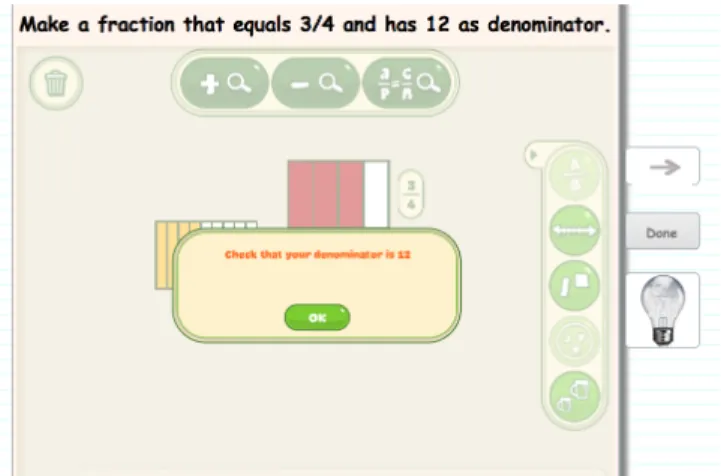
Based on which group the student was assigned to, they ei-ther received this feedback in a ‘high-interruptive’ way as a pop-up window (see Figure 1) or in a ‘low-interruptive’ way through an indication that feedback was available which they could access through clicking on a highlighted light bulb but-ton (see Figure 2).
Figure 1. High-interruptive feedback - pop-up window that includes a feedback message.
Figure 2. Low-interruptive feedback - light bulb glows (on the right hand side), indicating that feedback is available.
Participants in the low-interruptive group were able to ignore the feedback provided, by not clicking on the highlighted light bulb. In contrast, participants in the high-interruptive
group had to dismiss the pop-up window before they could proceed with the task. Each session lasted on average 15 min-utes.
Participants completed a post-session questionnaire about the learning environment, and in particular about what they thought of the feedback and whether they found it interrup-tive (7 questions). A smiley face scale [14] was used and scored 1 through 5 (see Figure 3).
Figure 3. Smiley scale used for post questionnaire
ANNOTATION OF AFFECTIVE STATES
From the Wizard-of-Oz study we recorded the students’ screen display and their voices. From this data, we annotated affective states before and after feedback was provided. As described earlier, for the affective state detection we dis-criminated between five different affective types: enjoyment, surprise, confusion, frustration, and boredom. For the annota-tion of those affective states we used a similar strategy to that described in [13], where a dialogue between a teacher and a student was annotated by categorising utterances in terms of different feedback types. We annotated the student’s affective state before and after each piece of feedback was provided. In addition to the student’s voice we also used the video of the screen capture to support the annotation process. Students’ affective states were annotated as follows:
• ENJOYMENT:Engagement with the learning task. State-ments like ‘This is fun’.
• SURPISE:Gasping. Statements like ‘Huh?’ or ‘Oh, no!’.
• CONFUSION:Failing to perform a particular task. State-ments such as ‘I’m confused!’ or ‘Why didn’t it work?’.
• FRUSTRATION:Tendency to give up, repeatedly click-ing on objects in the learnclick-ing platform or repeatedly failclick-ing to perform a particular task, sighing, statements such as, ‘What’s going on?!’.
• BOREDOM:Statements such as ‘Can we do something else?’ or ‘This is boring’.
RESULTS
Wizard-of-Oz session
In total 306 messages were sent to 17 students (153 high-interruptive and 153 low-high-interruptive messages). The feed-back messages provided were based on students’ speech as well as their interaction with the learning environment. On average students received 18 messages per session (min = 4; max = 35).
The video data combined with the sound files were analysed independently by two researchers who categorised the affec-tive states of students. There was moderate agreement be-tween the two researchers, Kappa=.52, p<.001. Where there
was a mismatch, the categorisations were re-analysed and agreed upon between the researchers.
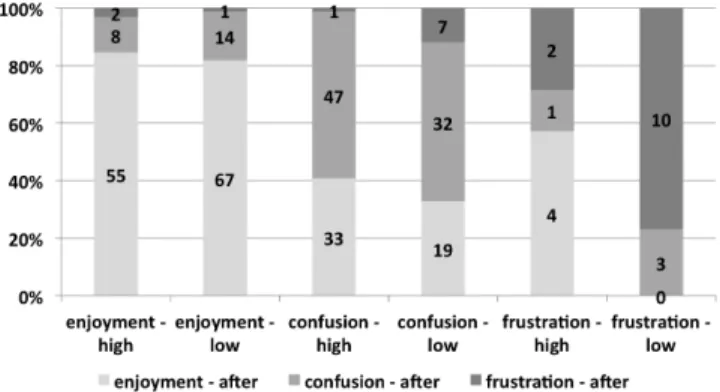
Figure 4 shows students’ affective states that occurred before and after the feedback was given in respect to the different groups. Only three out of the five affective states were de-tected during this study (enjoyment, confusion, and frustra-tion). This might be because the sessions only lasted 15 min-utes and this may have been too short a time for students to get bored. Also, we might have missed the short-duration ex-perience of surprise with our annotation strategy.
In order to investigate whether there was an effect of the presentation of the feedback on the learning experience, we looked at whether a student’s affective state was enhanced, stayed the same or worsened. As the data is categorical [15],
Figure 4. Students’ affective states before and after feedback was given. we applied chi-square tests to investigate whether there were statistically significant differences between the groups. When students were enjoying their activity there was no sig-nificant difference between the groups on whether their af-fective state stayed the same or worsened after feedback was sent (X2(1, N=147) = .22, p>.05). Students in the high-interruptive group mainly stayed within the same enjoyment state (85%). Their affective state worsened in 15% of cases. Similarly, the low-interruptive group stayed mainly in the same affective state (82%), and worsened in 18% of cases. However, when students were confused there was a signifi-cant association of the group on the change of their affective states (improvement, same, worsened),X2(2, N=139) = 7.52, p<.05. Here, within the high-interruptive group students’ af-fective state was enhanced in 41% of cases, stayed the same in 58%, and worsened in only 1% of cases. In contrast, in the low-interruptive group, the affective state was enhanced in 33% of cases, stayed the same in 55%, and worsened in 12%.
When students were frustrated there was also a significant ef-fect of the group on whether their afef-fective state improved, or stayed the same,X2(1, N=20) = 4.43, p<.05. Here, in the high-interruptive group, there was an enhancement of stu-dents’ affective state in 71% of cases. For the other 29%, affective state remained the same. In contrast, in the low-interruptive group affective state was enhanced in only 23% of cases, and stayed the same for 77%.
High Low Q1: Now that you have finished the
session, how do you feel?
4.0 (3/4) 4.0 (3/5)
Q2: How much fun was it? 4.0 (3/5) 4.5 (3/5)
Q3: How helpful was the learning en-vironment?
4.0 (2/5) 4.0 (2/5) Q4: What did you think of the
feed-back?
4.0 (2/5) 4.0 (2/5) Q5: Was the feedback easy to
under-stand?
4.0 (2/5) 4.0 (2/5) Q6: Was the feedback helpful? 3.0 (1/5) 4.0 (2/5) Q7: How much did the feedback get in
your way?
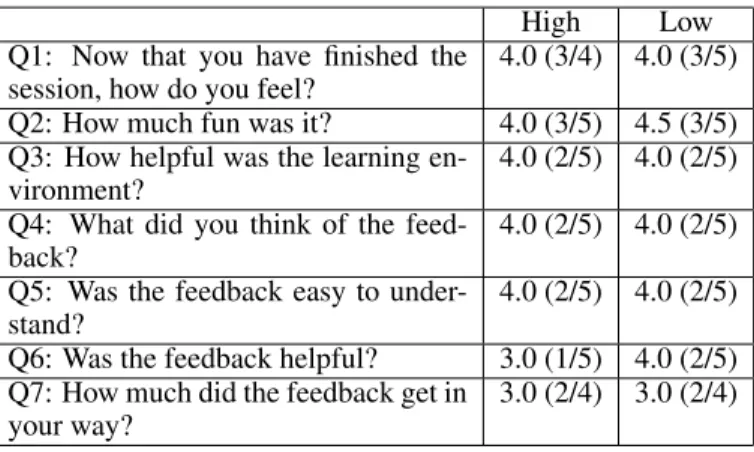
3.0 (2/4) 3.0 (2/4) Table 2. Results of the post-assessment smiley questionnaire. Median (min/max).
Within the low-interruptive group there was a significant as-sociation between the different affective states and whether or not students clicked on the light bulb to view the feed-back (X2(2, N=153) = 13.12, p<.05). When students were enjoying their activity they clicked on the light bulb in 71% of cases, when confused in 81%, but when frustrated in only 31% of cases.
When students were confused within the low-interruptive group, there was a significant association between clicking on the light bulb and when the affective state was enhanced, stayed the same, or worsened (X2(2, N=58) = 11.26, p<.05). Here, when students viewed the feedback, their affective state was enhanced in 41%, stayed the same in 53%, and worsened in 6% of cases. When students did not view the feedback, their affective state was unchanged in 64%, and became neg-ative in 37% of cases.
When students were frustrated within the low-interruptive group, there was a significant association between message viewed and whether the student’s affective state was en-hanced or was unchanged (X2(1, N=13) = 8.78, p<.05). When students viewed the feedback there was enhancement to their affective state in 75% of cases, and it stayed the same in 25% of cases. When students did not view the feedback the affective state stayed the same in 100% of cases.
Post-assessment questionnaire
Seven post-assessment questions were asked after each Wizard-of-Oz session. Table 2 shows medians (min/max) for each of the questions.
A Mann-Whitney test revealed no significant differences be-tween the groups on any of the questions. A small non-statistically significant difference can be seen at Question 2 (‘How much fun was it?’) and Question 6 (‘Was the feedback helpful?’).
DISCUSSION
Effect of the presentation of feedback on a student’s af-fective state
When students were enjoying their activity, both high- and low-interruptive feedback were effective. In both groups, stu-dents mainly stayed in the same positive affective state.
When students were confused, the results show that they welcomed feedback. However, when students in the low-interruptive group ignored the feedback available, this re-sulted in a significantly worsened affective state. Students may have ignored the feedback because their motivation at this point was low. In order to enhance the learning experi-ence when students are confused, high-interruptive feedback should be provided.
Within the low-interruptive group, frustration was associ-ated with not viewing the feedback, but when feedback was viewed it was associated with an enhanced affective state. This indicates that when students were frustrated they ignored the low-interruptive feedback. Frustration can increase cog-nitive load [16], which might explain why students did not react to the highlighted light bulb, as they might not have re-alised that help was available. Therefore, when students are frustrated, the presentation of the feedback should be highly visible and interruptive, as it is otherwise likely to be ignored.
Student’s perception of the learning environment includ-ing feedback
Although there were no significant differences between the groups on the perception of the learning environment includ-ing the feedback provided, research from Mavrikis et al. [11] shows that students prefer to be able to decide themselves when to receive help (by e.g. clicking on a help button) rather than being interrupted by the learning environment.
This might also explain the slight increase in the low-interruptive feedback group (non-statistically significant) of how much fun the learning environment was and whether the feedback was helpful.
Therefore, the presentation of feedback should be tailored to the student’s affective state. When students are enjoying their activity, low-interruptive feedback should be provided. How-ever, as indicated by our results to the first research question, high-interruptive feedback should be provided when students are frustrated or confused.
CONCLUSION AND FUTURE WORK
This study reaffirms that the affective state of a student can be enhanced through feedback, and it demonstrates that when students are confused or frustrated, the way in which the feedback is presented is important. For these states, high-interruptive feedback is more effective: the cost of not view-ing the feedback is likely to be a negative affective state. Our next steps involve further development of intelligent feedback for a learning environment which is able to automat-ically tailor the presentation of the feedback (high- or low-interruptive) as well as the type of feedback (e.g. problem solving support, reflective prompts, affect boosts) according to the affective state of the student.
ACKNOWLEDGMENTS
This research has been funded by the European Union in the Seventh Framework Programme (FP7/2007-2013) in the iTalk2Learn project (318051).
REFERENCES
1. Ahn, J., and Brusilovsky, P. Adaptive visualization for exploratory information retrieval.Information Processing and Management 49(2013), 1139–1164. 2. Carenini, G., Conati, C., Hoque, E., Steichen, B., Toker,
D., and Enns, J. Highlighting interventions and user differences: Informing adaptive information
visualization support. InCHI ’14 Proceedings of the SIGCHI Conference on Human Factors in Computing Systems(2014), 1835–1844.
3. Ekman, P. An argument for basic emotions.Cognition & Emotion 6, 3-4 (1992), 169–200.
4. Eynon, R., Davies, C., and Holmes, W. Supporting older adults in using technology for lifelong learning: the methodological and conceptual value of wizard of oz simulations. InProceedings of the 8th International Conference on Networked Learning 2012, V. Hodgson, C. Jones, M. de Laat, D. McConnell, T. Ryberg, and P. Sloep, Eds. (2012), 66–73.
5. Gotz, D., and Wen, Z. Behaviour driven visualization recommendation. InIUI ’09 Proceedings of the 14th international conference on Intelligent user interfaces
(2009), 315–324.
6. Grawemeyer, B., and Cox, R. Graphical data displays and database queries: Helping users select the right display for the task. InSmart Graphics, 5th International Symposium(2005), 53–64.
7. Izard, C. The many meanings/aspects of emotion: Definitions, functions, activation, and regulation.
Emotion Review 2, 4 (2010).
8. Kort, B., Reilly, R., and Picard, R. An affective model of the interplay between emotions and learning. InIEEE International Conference on Advanced Learning Technologies, no. 43-46 (2001).
9. Mavrikis, M., Grawemeyer, B., Hansen, A., and Guti´errez-Santos, S. Exploring the potential of speech recognition to support problem solving and reflection -wizards go to school in the elementary maths classroom.
InOpen Learning and Teaching in Educational
Communities - 9th European Conference on Technology Enhanced Learning, EC-TEL 2014(2014), 263–276. 10. Mavrikis, M., and Guti´errez-Santos, S. Not all wizards
are from Oz: Iterative design of intelligent learning environments by communication capacity tapering.
Computers & Education 54, 3 (Apr. 2010), 641–651. 11. Mavrikis, M., Guti´errez-Santos, S., Geraniou, E., and
Noss, R. Design requirements, student perception indicators and validation metrics for intelligent exploratory learning environments.Personal and Ubiquitous Computing 17, 8 (May 2013), 1605–1620. 12. Pekrun, R. The control-value theory of achievement
emotions: Assumptions, corollaries, and implications for educational research and practice.J. Edu. Psych. Rev.
(2006), 315–341.
13. Porayska-Pomsta, K., Mavrikis, M., and Pain, H. Diagnosing and acting on student affect: the tutor’s perspective.User Modeling and User-Adapted Interaction 18, 1 (Feb. 2008), 125–173.
14. Read, J., MacFarlane., S., and Casey, C. Endurability, engagement and expectations: Measuring children’s fun. InInteraction Design and Children(2002).
15. Rosenthal, R., and Rosnow, R.Essentials of Behavioral Research: Methods and data analysis, 3rd ed. McGraw Hill, 2008.
16. Sweller, J. Cognitive load theory and the use of educational technology.Educational Technology Magazine: The Magazine for Managers of Change in Education 48, 1 (2008).
17. Sweller, J., van Merrienboer, J. G., and Paas, G. W. Cognitive Architecture and Instructional Design.
Educational Psychology Review 10(1998), 251–296. 18. Woolf, B., Burleson, W., Arroyo, I., Dragon, T., Cooper,
D., and Picard, R. Affect-aware tutors: recognising and responding to student affect.Int. J. Learning Technology 4, 3-4 (2009), 129–164.