Effects of the ISIS Recommender System for
navigation support in self-organised Learning
Networks
Hendrik Drachsler*, Hans Hummel, Bert van
den Berg, Jannes Eshuis, Wim Waterink, Rob
Nadolski, Adriana Berlanga, Nanda Boers and
Rob Koper
Educational Technology Expertise Centre, Open University of the Netherlands, Valkenburgerweg 177, 6419 AT Heerlen, The Netherlands. *Corresponding author [email protected]
Abstract: The need to support users of the Internet with the selection of information is becoming more important. Learners in complex, self-organising Learning Networks have similar problems and need guidance to find and select most suitable learning activities, in order to attain their lifelong learning goals in the most efficient way. Several research questions regarding efficiency and effectiveness deal with adequate navigation support through recommender systems. To answer some of these questions an experiment was set up within an Introduction Psychology course of the Open University of the Netherlands. Around 250 students participated in this study and were monitored over an experimental period of four months. All were provided the same course materials, but only half of them were supported with a personalised recommender system. This study examined the effects of the navigation support on the completion of learning activities (effectiveness), needed time to comply them (efficiency), actual use of and satisfaction with the system, and the variety of learning paths. The recommender system positively influenced all measures, by having significant effects on efficiency, satisfaction and variety.
Keywords: technology-enhanced learning, self-organised learning, informal learning, learning networks, recommender systems, navigation support, ontology, collaborative filtering, learner profiling
1 Introduction
Learning Networks (LN) strongly differ from traditional virtual learning environments because they are driven by the contribution of their members (Koper & Tattersall, 2004). Traditional approaches are designed top-down, because their structure, learning resources, and learning plans are predefined by an educational institution or domain professionals (e.g., teachers). In LNs, also the learners are able to publish their own learning activities (learning resources), or share, rate, and adjust learning activities (LA) from other learners. Thus, LNs explicitly address informal learning but are also capable to integrate formal learning offers. As a consequence of this more informal character, LNs have several functionalities in common with Web 2.0 technologies nowadays. One effect of Web 2.0 technologies is the dramatically increasing amount of available
information, which also applies to LNs. It is a common problem for users of the Internet to select or discover information they are interested in. The need to support users with the selection of information or giving reference to relevant information in order to improve their self-organisation is becoming more important.
This is where navigation plays a major role. Navigation has been defined as “the process of determining a path to be travelled by any object through any environment” (Darken & Sibert, 1993) to attain a certain goal. Therefore, the object requires a position, feedback about the environment, and an idea about its goal. The learners in dynamic and informal LNs are in need of supportive information in order to self-determine their position, to self-regulate their learning path, and to adjust their competence development to their learning goal. Considering this definition, navigation support in informal LNs has major influences for the self-organisation of the learners. Information about other learners’ behavior is beneficial for the individual learner in the self-determination and self-regulation of the learning process.
We have carried out an experimental study with personalised navigation support within the ISIS project, and this article presents the setup and results from that study. Members in complex, self-organising, informal LNs need guidance in finding and composing their most suitable LA (route guidance), in order to attain their learning goals in the most efficient way (Prins, Nadolski, Drachsler, Berlanga, Hummel, & Koper, in press). The innovation of the research is the implementation of existing recommender system technologies into self-organised, informal LNs to support lifelong learners. Therefore, our focus is more on the evaluation of the learning outcomes through personal navigation support systems like recommender systems and less on measures like algorithm performance of the machine-learning field (Sarwar, Karypis, Konstan, & Riedl, 2000; Huang, Zeng, & Chen, 2007) which heavily influence the recommender system research.
The main purpose of recommender systems on the Internet is to filter information a user might be interested in. For instance, the company Amazon.com (Linden, Smith, & York, 2003) is using a recommender system to direct the attention of their users to other products in their collection. Existing ‘navigation services’ help to design and develop specific solutions for lifelong learners. Personal recommenders systems (Adomavicius, Sankaranarayanan, Sen, & Tuzhilin, 2005) are becoming increasingly popular for suggesting tailored information to individual users. In this article we discuss the effects of the ISIS experiment with a personal recommender systems (PRS) for LNs. Section two will describe our approach to navigation support in technology-enhanced learning, and presents our hypotheses for the experimental study. In the method section (third section) we describe the experimental design and the used recommendation strategy. In the results section (fourth section) we will describe measured observations and effects in response to the hypotheses. Finally, the fifth section discusses the effects and limitations of the study, and gives an outlook on future research.
Drachsler, H., Hummel, H., van den Berg, B., Eshuis, J., Waterink, W., Nadolski, R., Berlanga, A., Boers, N., & Koper, R..: Effects of the ISIS Recommender System for navigation support in self-organised Learning Networks
organised LNs is enabling more personalised learning paths, while at the same time taking into account pedagogical issues and available resources. One way to implement pedagogical decisions into a PRS is to use a variety of recommendation techniques in a recommendation strategy (Setten, 2005).
Recommendation strategies are a combination of different recommendation techniques to improve the overall accuracy of any recommender system, and to overcome disadvantages of one singular recommendation technique. Such recommendation strategies are implemented into hybrid recommendation systems, because they combine different recommendation techniques in one recommender system (Hummel, Van den Berg, Berlanga, Drachsler, Janssen, Nadolski, & Koper, 2007). Recommendation strategies can be used in technology-enhanced learning to apply specific recommendation techniques in particular learning situations. The decision to change from one recommendation technique to another can be done according to pedagogical reasons, derived from specific demands of lifelong learning (reference deleted to ensure blind review).
The PRS that we used in ISIS combined a top-down, ontology-based recommendation technique (Middleton, Shadbolt, & De Roure, 2004) with a bottom-up, stereotype filtering technique (Sollenborn & Funk, 2002). Both techniques were combined in a recommendation strategy that decided which of the techniques were most suitable for the current situation a learner was in. If stereotype filtering was used to create a recommendation the next best LA was based on the most popular LA of a specific learner group using Collaborative Filtering. In case the ontology was used to create the recommendation, learner preferences (taken from their user profiles) were matched to the domain ontology to recommend the most suitable next best LA.
The following 4 hypotheses were tested in the ISIS experiment, where the control group was provided with the Moodle learning environment and a text book; whereas the experimental group was additionally provided with a PRS that recommended best next LA based on successful choices of other learners with similar profiles.
1.
The experimental group will be able to complete more LAs than the control group (Effectiveness).2.
The experimental group will complete LAs in less time, because alignment of learner and LA characteristics will increase the efficiency of the learning process (Efficiency).3.
The experimental group has a broader variety of learning paths than the control group because the PRS supports more personalised navigation (Variety).4.
The experimental group will be satisfied with the navigational support of the PRS (Satisfaction).In the next section (method section) we will describe the experimental design and the used recommendation strategy in more detail. In section four results and statistical effects will be presented.
3 Method
To test our hypotheses in an authentic learning situation, we carried out an experimental study within the regular “Introduction Psychology” course as offered by the Psychology faculty of the Open University of the Netherlands (OUNL). This new course was offered as alternative next to the existing, old version of the course. The LAs and the PRS were implemented in the Moodle LMS (Dougiamas, 2007).
3.1 Participants
No prior knowledge was required from the participants to attend the Introduction Psychology course. A total of 244 participants subscribed to this pilot. Both the experimental and control group contained an equal amount of learners (122 learners per group) because the learners were randomly allocated. 24 participants (19.7%) in the experimental group and 30 participants (24.5%) in the control group never logged into the Moodle environment. This group of non-starters was not included in our analyses. This leaves a group of 190 learners who did enter the Moodle environment; 98 in the experimental and 92 in the control group.
From the 98 participants in the experimental group 60% of them were women, within an average age of 38,5 years, and 70% of the participants had a higher professional education or university level. In the control group 65% of them were woman, within an average age of 34,7 years, and 62% of the participants had a higher educational level.
The group of actual starters had to be further differentiated into active and passive learners, because not all of the learners actually used or made progress in the Moodle environment. From the 98 participants in the experimental group 72 learners completed LAs; from the control group 60 learners completed LAs. Thus, in total a group of 132 were active learners during the experiment. We used this total amount of active learners to analyse hypotheses 1 (Effectiveness), hypotheses 2 (Efficiency), and hypotheses 3 (Variety). The group of participants was further characterised by an average age of 36.5 years, 62.5% being female students, and 66% having a higher education level.
3.2 Materials
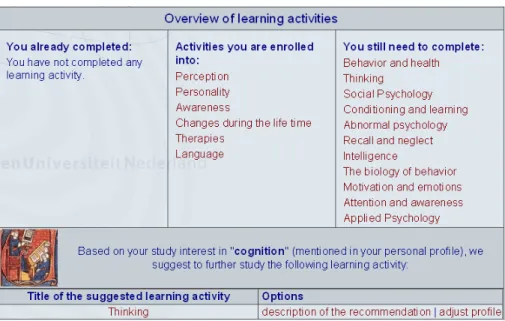
The Learning Network. Moodle was adjusted to the experimental setup. Figure 1 shows the overview screen of LAs for a learner in the experimental group. The overview is divided into three columns. The right column shows the LAs the learner still has to study. The middle column presents the courses the learner is already enrolled for. Finally, in the left column all completed courses are listed. Below an explanation of the recommendation is given. In this screen, the PRS has recommended ‘Thinking’ as next best course. Next to the recommendation there are additional options to get further information about the recommendation and to adjust the preferences set in the learner profile.
Drachsler, H., Hummel, H., van den Berg, B., Eshuis, J., Waterink, W., Nadolski, R., Berlanga, A., Boers, N., & Koper, R..: Effects of the ISIS Recommender System for navigation support in self-organised Learning Networks
Figure 1: Overview page of the experimental group with a recommendation
The LN contained 17 LAs with an average study load of 12 hours. Formal completion of each LA was assessed by multiple-choice tests consisting of seven equally weighted questions. A score of 60% or more was considered as a successful completion of the LA. With the Moodle environment the learners received an Introduction to Psychology handbook that contained additional information to the 17 LAs. All LAs were separate entities in Moodle, setup according to the same didactical structure. The Moodle environment contained all further learning materials, including support and guidance, task assignments, progress tests, additional pictures and links, summarizations, and other attractive learning tasks.
The Personal Recommender System. The PRS with a combined recommendation strategy provide more accurate recommendations when compared to single techniques PRSs (Melville, Mooney, & Nagarajan, 2002; Pazzani, 1999; Soboro & Nicholas, 2000). The implemented PRS combined an ontology-based recommendation technique with a stereotype filtering technique. The ontology used personal information of the learner (e.g., interest) and compared that with the domain knowledge to recommend the most suitable LA. Stereotype filtering used profile attributes of the learners (e.g., interest, motivation, study time) to create learner groups and recommend LAs preferred by similar learners.
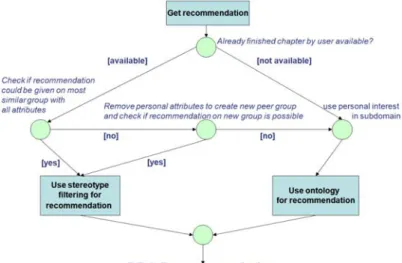
The PRS advices the next best LA to follow based on the interest of learners (ontology-based recommendation), and on the behaviour of the peers (stereotype filtering). If only information about the interest of a learner was available, then ontology-based recommendation technique was used, else the stereotype filtering technique was applied. The underlying recommendation strategy is presented in Figure 2.
Figure 2: Recommendation strategy for the implemented PRS
The use of the stereotype filtering was prioritized and the ontology approach was used mainly to cover the ‘cold-start problem’ (Herlocker, Konstan, & Riedl, 2000) of the stereotype filtering technique. The stereotype filtering technique was personalised through attributes of the personal profile of the learners. If it was not possible to give any advice it disabled one of the personal attributes and tried to make a recommendation based on larger peer group with less common attributes (Figure 2).
Drachsler, H., Hummel, H., van den Berg, B., Eshuis, J., Waterink, W., Nadolski, R., Berlanga, A., Boers, N., & Koper, R..: Effects of the ISIS Recommender System for navigation support in self-organised Learning Networks
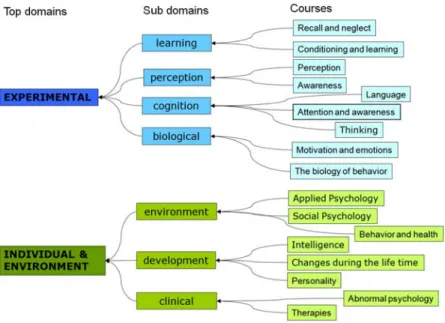
Figure 3: Structure for ontology based recommendations
Only in the case that the stereotype filtering was not able to provide any recommendation, the PRS created ontology-based recommendations. The ontology visualized in Figure 3 consists of two top domains (e.g., ‘Environmental Psychology’) that contain several sub domains (e.g., ‘learning’), each containing two or three courses (or LA) (e.g., ‘recall and neglect’). The learners had to select a special interest (one of the sub domains of the ontology) in their profile. If the learners had chosen a sub domain (e.g., ‘clinical’), they received recommendations on courses located in that particular sub domain. If none of these courses had been completed by others so far, the PRS randomly recommended one of them. If one course had already been completed by the learner the other course(s) was/were recommended. If all courses of the sub domain (e.g., ‘clinical’) were completed the ontology recommended a course that was part of the top domain ‘Environmental Psychology’.
3.3 Procedure
The participants could voluntarily register for the new version of the course, and were informed that they were taking part in an experiment with a new learning environment. They were not informed that only half of the students would receive additional navigation support. The participants were randomly assigned either to the experimental group or the control group. Both groups received the same treatment (course materials); all were able to ask questions to a tutor in a forum. In order to draw conclusions to self-organised informal LNs both groups got a maximum of freedom for their studies. Both groups were informed that they did not have to follow the LAs in a certain order or pace. In principle they were able to study the course over years.
As a consequence not all students started their study in October; some of them started later, (dynamic starting point). Furthermore, they were allowed to complete LAs at their own pace. Students could register for a final exam whenever they wanted, even without completing any of the multiple choice online progress tests available. The experiment ran for four months, from early October 2006 until late January 2007. During this period no further information about the experiment was given to the participants. In the experimental period of four months, measures were taken every two weeks.
3.4 Analysis of Effectiveness and Efficiency
In order to deal with a selection problem in our experiment we defined a goal attainment of 5 completed LAs out of 17 in total. Our aim was to support as much learners as possible to complete these 5 LAs as fast as possible. To measure the effectiveness and efficiency of the PRS learners were taken into account that applied to the following rule; completed more than 5 LAs, or successfully completed the final exam, or were still studying at the measure point. This rule leaves a number of 101 students at the end of the experiment (n=52 in the experimental group and n=49 in the control group). Regarding the individual dynamic starting points of the students the recorded measure in Table 1 contained 0 values in case students started later (see Table 1). In order to ran a MANOVA analysis all individual starting points of the students were moved in one ‘starting’ column through deleting the 0 values. Therefore, Table 1 was transformed into a study progress table (see Table 2). Table 2 differentiate from Table 1 through moving the individual starting points into one ‘starting’ column (first column), and the duplication of the study results towards the end of the Table 2 if the students applied to the above mentioned rule.
Table 1
Example table of biweekly recorded measures.
Learner Biweekly measure points
Oct Oct 2 Nov Nov 2 Dec Dec 2 Jan
1 1 2 4 7 7 7 8
2 0 0 0 1 3 5 9
3 0 0 0 0 0 1 1
4 1 2 3 4 4 4 4
Table 1: This table represents the ‘raw’ recorded measures of the biweekly measure points. The 0 values are related to the individual starting point of the participants.
Table 2
Example table of prepared biweekly measures for MANOVA analysis.
Learner Study progress per learner per measure point
1 2 3 4 5 6 7
1 1 2 4 7 7 7 8
2 1 3 5 9 9 9 9
3 1 1
4 1 2 3 4 4 4 4
Table 2: This table shows the actual study progress of all active learners. Therefore, all 0 values from Table 1 are deleted and the individual starting points were moved into one ‘starting’ column (first column).
To test hypothesis 1 and 2, we analyzed the measures taken using SPSS 12. To avoid inflated Type I error due to multiple tests, a priori tests of specific contrast scores were used. The effectiveness and efficiency was analyzed by means of linear and quadratic trend analysis. Averaged completion scores and averaged completion time during the two experimental periods were transformed into linear and quadratic trend contrast scores by means of computation of orthogonal polynomials. We applied multivariate analysis of variance (MANOVA) for repeated measures on these a priori chosen contrast scores with Group as between subjects factor and Time (or Progress) as within subjects factor. A significant interaction of contrast scores with Group was followed by testing of simple contrast effects. Due to the a priori character of these tests, they were performed with the conventional Type I error of .05 (Tabachnick & Fidell, 2001).
3.5 Analysis of variety of learning paths
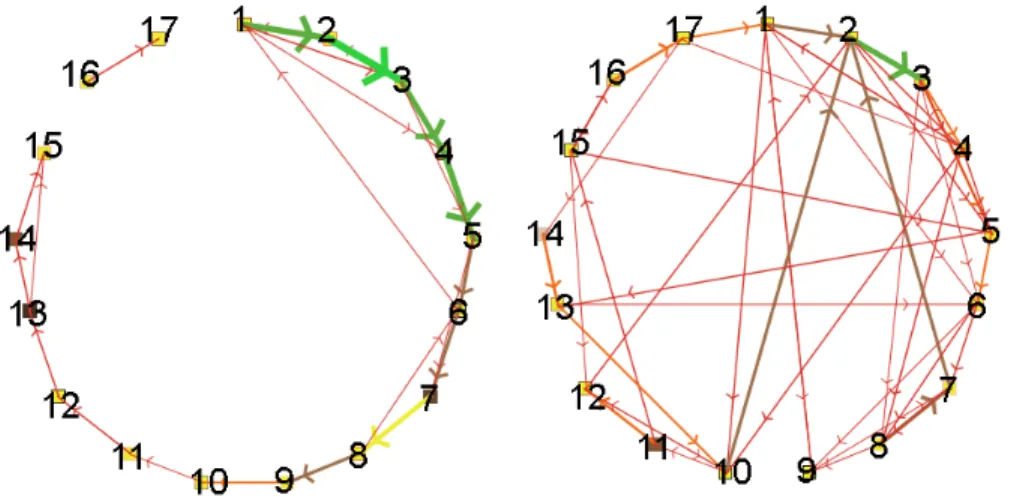
To test hypotheses 3, the variety of learning paths, we analyzed the behaviour of the learners with a Graph Theory approach (Gross & Yellen, 2006). Therefore, we modelled the LN in Netlogo 4 (Tisue & Wilensky, 2004), and observed the completion of LAs by the learners. If a learner completed for instance first LA 1 and second LA 7 it was counted as traffic between LA 1 and LA 7. A line was drawn between both LAs in the graph when the traffic became larger than 3. If the learning path was used even more frequently, the traffic line got thicker and changed its colour. Consequently, the thickest path was used most often and the thinnest path was used only three times.
3.6 Analysis of satisfaction with the PRS
To test hypothesis 4, the general satisfaction of the PRS, we conducted an online recall questionnaire. This questionnaire was sent to all 190 participants in both groups at the end of the experiment. We received answers from 52 people in total, thus we had a response rate of 27%. From the control group 24 out of 92 learners responded and from the experimental group 28 out of 98 learners. The response rate of the control group was 22% and the response rate of the experimental group was 27%.
4 Results
4.1 Effectiveness
The amount of progress made by learners in both groups as indicated by the number of LAs completed after four months (half-way) of the experiment is represented in Figure 4. The overall completed LAs (the overall progress of both groups) over time was denoted by a significant positive linear trend (F(1,99) = 203.22 p < .001) and a significant positive quadratic trend (F(1,99) = 40,31, p < .001). There was no significant effect of Group for effectiveness on the linear and quadratic trend.
Drachsler, H., Hummel, H., van den Berg, B., Eshuis, J., Waterink, W., Nadolski, R., Berlanga, A., Boers, N., & Koper, R..: Effects of the ISIS Recommender System for navigation support in self-organised Learning Networks
4.2 Efficiency
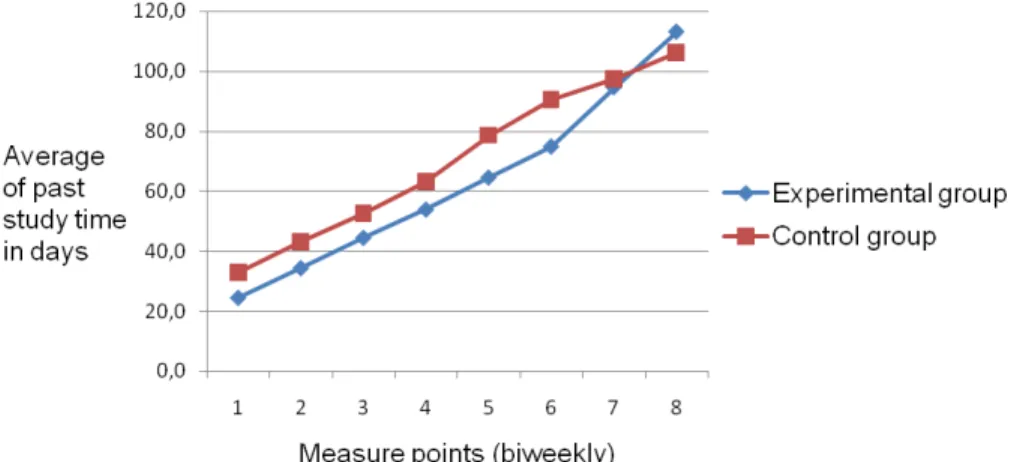
The time learners spend after four months is represented in Figure 5. The overall effect of time was denoted by a significant positive linear trend (F(1,99) = 101.32, p < .001) and a significant positive quadratic trend (F(1,99) = 4.3, p < .05). The experimental group, needed constantly less time to complete equal amounts of LAs. This result was also confirmed by SPSS with a significant effect of Group on the quadratic trend (F(1,99) = 5.14, p = .026). No significant effect of Group was found on the linear trend. Simple effects analysis showed that for the control group the curve got a declining trend at the end, whereas the experimental group behaved increasingly linear.
Figure 5: Average study time during the experimental period
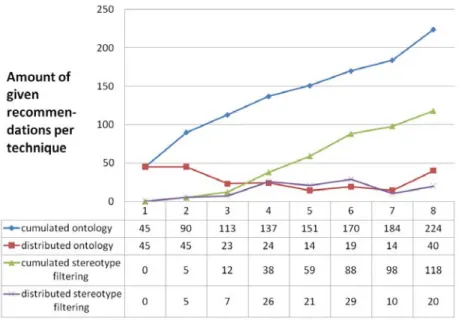
Figure 6 shows how often the recommendations techniques were used during the experiment in the distributed and cumulated values. During the first month the cold-start problem of the PRS occurred, because there was no data available for stereotype filtering. Nearly all recommendations in this period were covered by ontology-based recommendations. But starting from the second month, stereotype filtering has been used more often and became equally used, when we consider distributed numbers at the end of the experiment.
Figure 6: Usage of recommendation techniques during the experiment
4.3 Variety of learning path
To compare the emerged learning paths of both groups we placed all LAs in Netlogo 4 in a circle. LA 1 is the starting chapter of the additional given book labelled as the ‘biology of psychology’. The numbers attached to the nodes in the graph mark the chapter number from the additional given psychology book. Figure 7 presents the emerged learning paths of the control group, and Figure 8 presents the emerged learning paths of the experimental group. Both Figures were drawn with the recorded user behaviour at the end of the experiment.
Drachsler, H., Hummel, H., van den Berg, B., Eshuis, J., Waterink, W., Nadolski, R., Berlanga, A., Boers, N., & Koper, R..: Effects of the ISIS Recommender System for navigation support in self-organised Learning Networks
Figure 7: Emerged learning path of the control group at the end of the experiment
Figure 8: Emerged learning path of the experi-mental group at the end of the experiment
For the control group we see (Figure 7) that most of the participants followed the order of the textbook that was given to the Moodle environment. For the experimental group (Figure 8) many more thin and medium size lines reflect the influence of the PRS. The participants in the experimental group have taken more personalised learning paths than the control group. They hardly followed the chapter order of the textbook.
4.4 Satisfaction of the PRS
In this section we present the most relevant answers from the online recall questionnaire of the experimental group regarding the satisfaction of the PRS. We also asked for the general usage of the PRS as an indicator for satisfaction. The results of the questions about the general use can be found in Table 3. The more detailed questions about the satisfaction are shown in Table 4.
Table 3
General question about the usage of the PRS from the experimental group (n = 28). Question Values
Yes No, because
of technical problems
No, because the description of the recommendations were not transparent to me
No, because I also wanted to follow the book
Did you use the recommender system during the whole period of the course?
64% (n=18) 0% (n=0) 4% (n=1) 32% (n=9) Yes No
Do you think the PRS helped you to structure the learning activities in a more personalised way? 46% (n=13) 54% (n=15) Very often
Often Neutral Seldom Very
seldom How often did you
follow the
recommendation that was given to you?
32% (n=9) 29% (n=8) 11% (n=3) 11% (n=3) 17% (n=5)
In Table 3, Question 1 it is shown that 64% (n=18) of the participants used the PRS during the whole period, 4% (n=1) did not use it the whole time because the explanation of the recommendation was not clear enough for them, and 32% (n=9) answered that they did not use the PRS the whole period because they also wanted to follow the book.
For question 2 46% (n=13) answered that the PRS helped them to organise the study in a more personalised way, whereas 54% (n=15) of the learners answered that the PRS did not help them to organise their study in a more personalised way.
Finally, the learners were asked about their ‘obedience’ to the system, i.e., how often they follow up on the advice that was given to them (Table 3, question 3). 32% (n=9) answered they had followed the advice very often, and 29% (n=8) answered they had followed the advice often. 11% (n=3) were neutral to this question and around 29% (n=8) answered that they seldom / or very seldom had followed the advice.
Drachsler, H., Hummel, H., van den Berg, B., Eshuis, J., Waterink, W., Nadolski, R., Berlanga, A., Boers, N., & Koper, R..: Effects of the ISIS Recommender System for navigation support in self-organised Learning Networks
Table 4
Detailed responses about the benefit of the PRS from the experimental group (n = 28).
Question Values Very
good
Good Neutral Less Very less
Did the recommendation of the recommendation system follow your expectations for studying the next learning activity?
14% (n=4) 21% (n=6) 61% (n=17) 4% (n=1) 0% (n=0)
How satisfied have you been with the recommendation given by the recommendation system during the first two month of your studies?
7% (n=2) 18% (n=5) 71% (n=20) 4% (n=1) 0% (n=0)
How satisfied have you been with the
recommendations given by the PRS during the last two month of your studies?
7% (n=2) 39% (n=11) 46% (n=13) 7% (n=2) 0% (n=0)
To further analyse the impact of our recommendation strategy, we asked the learners if they were more satisfied with the recommendation given in the beginning or at the end of the experiment (Table 4, questions 2 and 3). We wanted to know if the learners noticed any differences in the given recommendation over time, since the ontology recommendation was mainly used in the beginning of the learning progress and the stereotype filtering technique was used mainly at the end of the learning progress. Surprisingly, the learners rated their satisfaction for both periods quite different. 7% (n=2) and 18% (n=5) were positive about the recommendations during the first two month (ontology). But 7% (n=2) and 39% (n=11) rated the last two month more satisfying. It seems that they are more satisfied with recommendations based on the stereotype filtering. A minor percentage 4% (n=1) and 7% (n=2) were less satisfied with the recommendations. Nevertheless, nobody was unsatisfied with the recommendations.
5 Conclusions and Discussion
Based on the results of the experiment we can draw several conclusions for our research on navigational support in self-organised, informal LNs for lifelong learners. According to our 4 hypothesis, we can now conclude the following.
5.1 Effectiveness
The experimental group was consistently found to be more effective in completing LAs than the control group during the experimental period. Even with these promising observations, we have not found a significant difference; therefore, hypothesis 1 cannot be confirmed. It might be that this is due to the fact that the experimental period was to short and further observations might be more successful.
5.2 Efficiency
The experimental group consistently needed less time to complete equal amounts of LAs, which effect was found to reach significance after 4 months. Therefore, hypothesis 2 could be confirmed. This result shows that our approach to navigational support and our recommendation strategy enhance the efficiency of learners in self-organised, informal LNs.
5.3 Variety of learning paths
The variety of personalised learning paths increased by the PRS. The experimental group from the beginning onward created more personalised learning paths. Some of these personalised learning paths also caused (by emergence) successful learning paths taken by other learners. Considering this results in combination with the positive effect on efficiency and satisfaction it appears that the personalisation and the support of self-organisation in informal LNs were beneficial for the learners. The experimental group outperformed the control group and used the PRS. Based on this result we also confirm hypothesis 3.
5.4 Satisfaction
The qualitative data about satisfaction from the recall questionnaire underlined the quantitative results about the actual use of the PRS. The learners accepted the PRS for supporting them in their self-organised navigation through the LAs. 64% of the participants used the PRS over the whole experimental period very often or often. 46% have the impression that the PRS helped them to organise their learning progress in a more personalised way. The experimental group was more satisfied with the recommendations based on stereotype filtering. This is an interesting finding and will have influence on our future research. Regarding the informal characteristic of LNs, we want to use more bottom-up techniques like collaborative filtering instead of top-down ontologies. In future research we are planning to combine these bottom-up techniques with learner ratings and tags, which have been proven to be appropriate for self-organisation in informal environments like LNs. However, because of the positive responses from the learners and actual usage data we can confirm hypothesis 4.
5.5 Limitations and future research
We have reported positive outcomes to our study. However, we have to point the reader to some serious limitations as well. Besides the limitations already mentioned in the previous result section, there are some more general limitations to this study, regarding the experimental design we applied.
First, although our research addresses lifelong learners in self-organised and informal LNs, the practical character of the experiment, embedded in a formal course with real
Drachsler, H., Hummel, H., van den Berg, B., Eshuis, J., Waterink, W., Nadolski, R., Berlanga, A., Boers, N., & Koper, R..: Effects of the ISIS Recommender System for navigation support in self-organised Learning Networks
could exists out of different mixed OER, formal learning offers, or separated learner contributions in once.
Second, the experimental setup did not force learners to actually take the recommended next step, and we do not know to what extent learners actually followed up the advice. The problem is the definition of what constitutes a ‘followed recommendation’. Did learners follow a recommendation when they navigated to a recommended LA? Or did learners follow a recommendation when they stayed longer than 5 minutes in the recommended LA? As a result, the improved efficiency cannot be unambiguously ascribed to the PRS itself. The mere presence of a navigation support tool may have stimulated the experimental group. An additional experiment involving a control group receiving random recommendations would help clarify this point. We were not able to provide faked recommendation to the control group because of ethical reasons. It would have been not fair to confuse the control group with random recommendations, because they also were real students that paid the same amount of money for the course.
Third, we have to mention one limitation for effect on efficiency. There is a difference between the measured ‘elapsed time’ that students took to complete a LA and the actual ‘study time’ they needed to successfully complete a LA. Elapsed time as measured through the Moodle environment is an assistant indicator for real study time.
Finally, we decide to show only the ‘best next LA’, based on our recommendation strategy to the learners. We did that for experimental reasons, otherwise the analysis would have been even more complex. Alternatively, we could have given both groups the same user interface with all the LAs listed, the only difference being that in the experimental group the LAs are reordered according to the recommender system’s priorities while the control group gets a standardised ordering. This would have provided a more similar environment for both groups, but also might force the learners to select always the first LA on the list. Nevertheless, in real life a list or a sequence with suitable recommendations on different characteristics might be more valuable for the learners than a single recommendation.
Further research is needed to address these limitations and to reveal whether alternative recommendations would have a greater impact on effectiveness, efficiency, variety, and satisfaction for lifelong learners in self-organised LNs. Additional information given to the recommendation of a LA could be success rates, required competence levels, average amount of study time, subjective ratings, or tagging information given by other learners.
Currently we are running a series of simulations in Netlogo where we test the impact of different other recommendation techniques and their combination in recommendation strategies for different sizes of LNs. Despite the limitations of the presented study, we believe it (at least partially) proofs that the use of navigation support based on a personalised recommendation strategy offers a promising way to advise learners on their self-organisation in LNs.
Acknowledgement
Authors’ efforts were (partly) funded by the European Commission in TENCompetence (IST-2004-02787) (http://www.tencompetence.org).
References
Adomavicius, G., Sankaranarayanan, R., Sen, S., & Tuzhilin, A. (2005). Incorporating contextual information in recommender systems using a multidimensional approach. ACM Transactions on Information Systems (TOIS), 23(1), 103-145.
Darken, R. P., & Sibert, J. L. (1993). A toolset for navigation in virtual environments. Proceedings of the 6th annual ACM symposium on User interface software and technology, 157-165.
Dougiamas, T. (2007). Moodle. Retrieved 12 June 2007, from http://moodle.org/ (reference deleted to ensure blind review)
Gross, J. L., & Yellen, J. (2006). Graph Theory and Its Applications: Chapman & Hall/CRC.
Herlocker, J. L., Konstan, J. A., & Riedl, J. (2000). Explaining collaborative filtering recommendations. Proceedings of the 2000 ACM conference on Computer supported cooperative work, 241-250.
Huang, Z., Zeng, D., & Chen, H. (2007). A Comparison of Collaborative-Filtering Recommendation Algorithms for E-commerce. IEEE Intelligent Systems, vol. 22, no. 5, pp. 68-78
Hummel, H. G. K., Van den Berg, B., Berlanga, A. J., Drachsler, H., Janssen, J., Nadolski, R. J., & Koper, E. J. R. (2007). Combining Social- and Information-based Approaches for Personalised Recommendation on Sequencing Learning Activities. International Journal of Learning Technology.
Koper, R., & Tattersall, C. (2004). New directions for lifelong learning using network technologies. British Journal of Educational Technology, 35(6), 689-700.
Linden, G., Smith, B., & York, J. (2003). Amazon.com recommendations: Item-to-item collaborative filtering. IEEE Internet Computing, 7, 76-80.
Melville, P., Mooney, R. J., & Nagarajan, R. (2002). Content-boosted collaborative filtering for improved recommendations. Proceedings of 18th National Conference on Artificial Intelligence (pp. 187-192). 28.07 – 01.08.2002, Edmonton, Alberta, Canada
Middleton, S., Shadbolt, N. R. & De Roure, D.C. (2004) Ontological user profiling in recommender systems, ACM Transactions on Information Systems (TOIS), v.22(1), pp. 54-88
Drachsler, H., Hummel, H., van den Berg, B., Eshuis, J., Waterink, W., Nadolski, R., Berlanga, A., Boers, N., & Koper, R..: Effects of the ISIS Recommender System for navigation support in self-organised Learning Networks
the complexity of performance and learning settings. Educational Technology Research and Development.
Sarwar, B. M., Karypis, G., Konstan, J. A., & Riedl, J. (2000). Analysis of Recommendation Algorithms for E-Commerce. In Proceedings of the ACM EC'00 Conference. Minneapolis, pp. 158-167
Setten, M. (2005). Supporting people in finding information. Hybrid recommender systems and goal-based structuring. Telematica Instituut Fundamental Research Series No. 016 (TI/FRS/016).
Soboro, I. M., & Nicholas, C. K. (2000). Combining content and collaboration in text filtering. Proceedings of the IJCAI Workshop on Machine Learning in Information Filtering, pp. 86-91.
Sollenborn, M., & Funk, P. (2002). Category-Based Filtering and User Stereotype Cases to Reduce the Latency Problem in Recommender Systems. In LNCS: Advances in Case-Based Reasoning (Vol. 2416, pp. 285-290) Springer Berlin / Heidelberg
Tabachnick, B. G., & Fidell, L. S. (2001). Using multivariate statistics (4th ed.). Boston: Allyn and Bacon.
Tisue, S., & Wilensky, U. (2004). NetLogo: A Simple Environment for Modeling Complexity. Proceedings of International Conference on Complex Systems, Boston, MA, USA