Develop a Mobile Web Game for Learning Viena
Karelian Dialect and Culture
University of Oulu
Faculty of Information Technology and Electrical Engineering / Information Processing Science / INTERACT
Master’s Thesis
Triando Damiri Burlian 2 May 2019
Abstract
Learning Viena Karelian dialect and culture require an innovative approach to increase the willingness of learners to learn in a fun and an effective way. Karelian is an endangered language with only around 35,000 speakers, in contrast with 640,000 people who live in the Republic of Karelia. If the number of speakers slowly decrease every year and there are limited ways to learn, then those problems may lead this endangered language to be extinct in the future. Therefore, gamification approach was used to design and build an educational game from non-gaming contexts. In this research, a functional prototype was built to learn Viena Karelian dialect and culture, where the beginner learners, from English and Finnish speakers, can learn with desktop, tablet, and smartphone devices. Design science research was used as the research method and the universal game heuristic was used as the design cycle. A functional prototype that can be accessed by using web browsers was built with Laravel PHP framework and Bootstrap frontend framework. Learners can play the game and explore various features to learn Viena Karelian dialect and culture. Testing phase was conducted in the 3rd international GamiFIN conference with 38 players and 12 received feedback, and the result shown that the game motivated the test participants to play, with 91.7% positive engagement. The feedback is available for further improvement of Viena game development project and as a foundation to develop similar games for other Karelian dialects and culture.
Keywords
bootstrap frontend framework, design science research, gamification, karelian culture, karelian language, laravel php framework, universal game heuristic, viena karelian dialect
Supervisor
Dr. Leena Arhippainen – University of Oulu
Dr. Xiaofeng Wang – Free University of Bozen-Bolzano
Published paper
Damiri Burlian, T., Sharmila, P., Alavesa, P., & Arhippainen, L. (2019). Revitalizing Viena Karelian Dialect and Culture with Gamification. In The 3rd International GamiFIN Conference. Levi, Finland: CEUR Workshop Proceedings. April 8 – 10, 2019.
Research-In-Progress paper
Damiri Burlian, T., & Arhippainen, L. (2019). Gamification of Learning Viena Karelian Dialect and Culture with a Mobile Web Game. To be submitted: The 2019 International Conference on Advanced Computer Science and Information Systems. Bali, Indonesia: IEEE. October 12 – 13, 2019.
Foreword
Foremost, alhamdulillah (all the praises and thanks be to Allah). I would like to sincerely thank my supervisors, Dr. Leena Arhippainen and Dr. Xiaofeng Wang, who supported, guided, and helped me to complete my master’s thesis. I would like to thank Dr. Mikko Rajanen, who helped me for the feedback as the master’s thesis opponent. I am thankful to Prof. Barbara Russo, Ph.D., Ovais Ahmad, Elena Gabardi, and all staff of the European Masters Programme in Software Engineering (EMSE) who contributed to my study and scholarship in Free University of Bozen-Bolzano (Italy) as my first year university and University of Oulu (Finland) as my second year university.
Thanks to Karjalan Sivistysseura – Karelia Cultural Society (established in 1906) for funding the VIENA-PELI project and Febyola Tiara Putri as a UI/UX expert who helped me in the design phase. I would like to express my thanks to all my family and friends who give direct and indirect contributions to me. Finally, special thanks to Indah Ayu Fauziah.
Triando Damiri Burlian Oulu, 2 May 2019
Contents
Abstract ... 2 Foreword ... 3 Contents... 4 Figures ... 5 Tables ... 6 1. Introduction ... 7 2. Literature Review ... 10 2.1 Gamification ... 10 2.2 Game Heuristics ... 112.3 Similar Language and Culture Learning Games ... 12
2.4 Laravel PHP Framework and Bootstrap Frontend Framework ... 13
3. Research Methodology ... 15
3.1 Research Objective ... 15
3.2 Research Method ... 16
3.2.1 Design Science Research Components and Activities ... 16
3.2.2 The Universal Game Heuristic as the Design Cycle ... 17
4. Implementation ... 19
4.1 Context Phase... 19
4.2 Design Phase ... 21
4.3 Production Phase ... 24
4.4 Testing Phase ... 26
4.5 Release and Support Phase ... 29
5. Evaluation ... 30
5.1 Target User... 30
5.2 Game Engagement ... 32
5.3 Gameplays... 33
6. Discussion ... 35
6.1 Revisiting the Research Questions... 35
6.2 Practical Implications... 36
7. Conclusion ... 39
7.1 Limitations ... 39
7.2 Future Research ... 39
References ... 40
Appendix A. Game Wireframes ... 45
Figures
Figure 1. Model-view-controller in Laravel PHP Framework (adapted from Verma,
2014) ... 14
Figure 2. Knowledge Contribution Framework (adapted from Gregor & Hevner, 2013) ... 15
Figure 3. Design Science Research Cycles (adapted from Hevner, 2007) ... 16
Figure 4. Phases of Game Heuristic ... 17
Figure 5. Game Flow ... 19
Figure 6. Landing Page Wireframe ... 22
Figure 7. Home Page Wireframe in English and Finnish ... 23
Figure 8. Reading - Easy ... 23
Figure 9. Listening - Medium and Writing - Easy ... 24
Figure 10. Home Page on a Desktop Device ... 25
Figure 11. Home Pages on a Tablet and Smartphone Devices ... 25
Figure 12. Weekly Rank on the Leaderboard (April 10th, 2019) ... 27
Figure 13. How much do you play mobile games? ... 31
Figure 14. How much do you use language learning games? ... 31
Figure 15. Language Learning Model ... 33
Tables
Table 1. Gameplay Variations in the Duolingo game ... 13
Table 2. Examples of Level Easy ... 20
Table 3. Skills and Levels ... 20
Table 4. Background Section ... 28
Table 5. User Experience Section ... 28
Table 6. Nationality ... 30
Table 7. Occupation... 31
Table 8. Result of 12 Five-point Scales... 32
Table 9. Modified Database Structure for “learning_objectives” Table ... 38
1.
Introduction
Karelian is a minority language with only around 35,000 speakers, in contrast with the total population of 640,000 people in the Republic of Karelia (Klementyev, Kovaleva, & Zamyatin, 2013; Rosstat, 2010). This situation shows there is less than 6% of the total population in the Republic of Karelia that can speak Karelian language, mostly because the official language is Russian (Klementyev et al., 2013; Salonen, 2017). There is a need to revitalize the language and culture of Karelian with a unique solution for different age groups and language backgrounds.
Previously, the teaching of Karelian language and introduction of culture are focused on the small scale and traditional approach by organizing language courses (Karjalainen, 2018; Riionheimo, 2018). In this research, gamification approach was used to make an educational game from non-gaming contexts, which were the teaching of language and culture. The game that was developed in this research is an interactive, fun, and convenient to use with the implementation of mobile web responsive. The game prototype was built mainly with Laravel PHP framework and Bootstrap frontend framework, which is available online1 and can be accessed with desktop, tablet, and smartphone devices that
have web browsers such as Google Chrome, Firefox, and Opera.
Language and culture are non-gaming contexts and usually can be learned from formal studies, books, social interactions, and as native languages. Gamification approach can be used to develop games from non-gaming contexts by applying game design elements, where it increases the motivation and engagement of players (Deterding, 2012; Deterding, Khaled, Nacke, & Dixon, 2011). The motivation and engagement of players are important to increase the effectiveness in language and culture learning. Moreover, educational games that are built with gamification approach can improve the fun experiences and knowledge acquisition, rather than by using only face-to-face learning in the classroom (Backlund & Hendrix, 2013). Those facts motivated the researcher to develop an educational game to learn Viena Karelian dialect and culture.
Karelian language is divided into two dialects, which are Karelian Proper and Olonets Karelian. Moreover, Karelian Proper is divided into North Karelia (Viena/White Sea), and South Karelian (Klementyev et al., 2013; Salonen, 2017; Sarhimaa, 2011). The goal of this research is to help English and Finnish speakers to learn Viena Karelian dialect and culture, therefore the long-term plan is to increase the opportunity between new learners and Viena Karelians to communicate in the future. Learning while playing can make players feel that they are entertained with the game and can gradually increase their language skills and knowledge about a culture.
Knowledge acquisition is the main goal of educational games where players can attain new information and experiences for teaching purposes (Boyle et al., 2016). It increases the motivation and willingness of learners to learn, instead of using a traditional method of teachings such as learning from books. Educational games provide a better learning environment than by using a traditional approach, and it usually implemented as desktop games and mobile games (Backlund & Hendrix, 2013; Ferdig, 2009; Giessen, 2015). Moreover, gamification of language learning was the common implementation with
positive results and can increase the motivation of learners in the English teaching program (Amoia, 2011; Giessen, 2015).
There were no existing mobile web responsive games to learn Viena Karelian dialect and culture. The researcher was involved in this project since September 2018 and made the first non-functional prototype with other researchers to gather early feedback from the test participants. The researcher as one of the authors published a paper (Damiri Burlian, Sharmila, Alavesa, & Arhippainen, 2019) about the first non-functional prototype in the 3rd international GamiFIN conference at Levi, Finland. The development of the first non-functional prototype was important to get preliminary user experience information for the next game development.
The games that inspired the researcher were Duolingo, Mondly, and Garden of Times. Duolingo and Garden of Times were used as basic references in the first prototype. However, Garden of Times was not used in the second prototype, since the game focuses on the entertainment aspects rather than educational purposes. Additionally, Mondly is a quite complex game with too many 3D animations aspects rather than focuses on the educational context and simple elements. Therefore, Duolingo was used as the main reference in the second prototype because it has simpler user interfaces, the gameplays are more focus in the learning aspects, many active learners around the world, and the researcher has played this game since 2013.
Duolingo is a language learning game that can be played on the web platform, Android operating system, and iOS operating system. It offers many languages to learn such as Spanish with 21.3 million learners, French with 12.5 million learners, and German with 7.02 million learners. (Duolingo, 2018). The second functional prototype was developed with mobile web responsive and as the focus in this thesis, by using the feedback and evaluation from the first non-functional prototype, and Duolingo as the main reference for design elements.
The purpose of this research was to develop a game with gamification approach in the mobile web responsive platform, specifically for desktop, tablet, and smartphone devices, so the beginner learners can learn Viena Karelian and culture in a fun and effective way. The application allows learners to play by using web browsers without installing the game in their devices. A playtest was conducted with 38 learners and 12 received feedback in the 3rd international GamiFIN conference, ages from 20 to 50 years old. This game artifact and evaluation from the testing phase became inputs for further development of Viena game development project. Moreover, the result is available as a foundation to extend the game for other dialects and culture of Karelian. Thus, two research questions were formulated:
• RQ1: How the universal game heuristic can be used to develop a game from non-gaming contexts to learn Viena Karelian dialect and culture?
• RQ2: What are the advantages and disadvantages of using the universal game heuristic in the language learning and culture game of Viena Karelian?
Design science research was used as the research method to answer those research questions and the universal game heuristic was used as the design cycle. The research objective was exaptation, where similar solutions can be gathered from related works and a similar language learning game as references, which were used for a new problem of Viena game development. The result of this research can be extended for other dialects and culture of Karelian as a further research opportunity and knowledge contribution in the future.
The main contributions were the general context to gamify Viena Karelian dialect and culture, the design concept and elements, the developed software artifact, the plan for release and support of the game for a scalability in the future, the evaluation of using the universal game heuristic, the concept plan to expand the game for other dialects and culture of Karelian, and the language learning model.
The following thesis structures consist of: Literature review related to gamification, game heuristic, Laravel PHP framework, and Bootstrap frontend framework are described in Chapter 2. The research objective of exaptation, research method of design science research, and design cycle of the universal game heuristic are presented in Chapter 3. The implementation by using the universal game heuristic from the context phase, design phase, production phase, testing phase, and release and support phase, are described in Chapter 4. The evaluation of implementation from the fourth chapter is described in Chapter 5. Research questions and theoretical implications are addressed in Chapter 6. Summary, limitations, and suggestion for the future work of the research are presented in Chapter 7.
2.
Literature Review
This chapter explains the literature review of gamification, game heuristic, Laravel PHP framework and Bootstrap frontend framework. The first section presents the definition of gamification and successful gamification projects. The second section describes the related work of game genres and game heuristics. The third section presents similar educational games to learn language and culture that were used as design references. The fourth section gives an overview of Laravel PHP framework and Bootstrap frontend framework.
2.1 Gamification
Gamification is the use of game design elements in non-gaming contexts to develop games (Deterding, 2012; Deterding et al., 2011). The purpose of gamification is to increase the motivation and engagement of users (Kapp, 2012; Sørensen & Meyer, 2007). Several examples of non-gaming contexts are books, face-to-face learning, and social interactions to learn language and culture in educational settings. Gamification of learning is the common project implementations that can increase the positive engagement and the motivation of users (Amoia, 2011; Hamari, Koivisto, & Sarsa, 2014).
Gamification can make learning environments more attractive and focus on educational elements. Game design elements for gamification are simpler than pure-entertainment games because it focuses on the knowledge acquisition and learning process (Backlund & Hendrix, 2013; Boyle et al., 2016). For example, the elements are levels, progress status, and score (Deterding, 2012). Thus, the elements can be applied in non-gaming contexts to develop educational games with simpler features than games for pure entertainment (Backlund & Hendrix, 2013).
Gamification can be applied for educational purposes, that focus on the learning environment rather than entertainment (Backlund & Hendrix, 2013). Educational games are better than traditional teaching methods such as face-to-face learning in the classroom and it is usually implemented as games in the computer and mobile platforms (Backlund & Hendrix, 2013; Ferdig, 2009; Giessen, 2015). The main goals of educational games are to increase the effectiveness of the learning process and knowledge acquisition (Boyle et al., 2016). Users can learn while playing the games with interesting and attractive gameplays for educational purposes.
Moreover, educational games focus on engagement, simpler features, gameplays, and learning activities (Boyle et al., 2016; Kapp, 2012). Those aspects increase the willingness of users to learn and increase the effectiveness of knowledge acquisition. Furthermore, educational games should easy to play and focus on the educational aspects rather than social interactions in pure entertainment games (Heeter et al., 2003). Social interactions are less in the educational games because it helps users to focus on the learning process and educational elements.
A recent study of an educational game to learn English shown that gamification approach achieved better knowledge acquisition to improve listening, reading, and writing skills (Suh, Kim, & Kim, 2010). Furthermore, those skills can be taught with audio and video materials to increase the effectiveness of learning, rather than by using only written texts (Backlund & Hendrix, 2013). Additionally, there are four skills of listening, reading,
writing, and speaking that can be taught in language learning games (Stanley & Mawer, 2008; Wouters, Van der Spek, & Van Oostendorp, 2009).
2.2 Game Heuristics
A heuristic is a practical method to achieve an optimal solution from problem solving and self-discovery of previous research (Pinelle, Wong, & Stach, 2008). In game development, heuristic refers to design principles, usability, and rules that are based on the game’s evaluation (Clune, 2007; Pinelle et al., 2008). The game’s implementation with game heuristics shown better results, because the evaluation models from existing games are used as a benchmarking and comparison to developing future products (Desurvire & Wiberg, 2009; Mylly, 2011). The implementation with game heuristics cannot guarantee the result to be perfect, but it provides a structured implementation process to develop a new product with a specific goal and genre (Mylly, 2011).
There are seven game heuristics that were evaluated and defined in the (Mylly, 2011) as basic references to develop a future game. Each game heuristic has five phases and it can be used as a design cycle in the design science research method. The game heuristics were mostly based on computer games. However, there were a few evaluations based on console games. Moreover, game heuristics can be used in many platforms such as in the mobile web platform, because the models were defined at a general level. (Mylly, 2011). There are seven genres of game heuristics which are:
• Strategy Genre
Strategy genre is a game genre that makes players to focus on the decision making and strategic decision for many possibilities of gameplays (Barraclough, Conroy, & Lee, 2004). For example, a strategy video game on the computer platform is a war game. Players can use different tactics to play the game and make a correct and strategic decision to win the game (Aha, Molineaux, & Ponsen, 2005). The games usually available as online games because it allows many players to play with each other and compete in the strategic gameplays.
• Role-Play Genre
Furthermore, role-play genre is a game genre that makes players feel that they are the main characters in the game and they play as fictional subjects in the game (Smyth, 2007). For example, a role-playing game in the mobile platform is the sims. Players can select a character gender, an appearance, a house, and a job. The goal of this game genre is to discover a specific storyline such as a father in a family and enjoy the game features for pure entertainment (Hunicke, LeBlanc, & Zubek, 2010).
• Action Genre
Moreover, action genre is a game genre that focuses on the physical and visual elements of character, in order to make players play with other human players or computer players (Green & Bavelier, 2003). For example, an action game on the computer platform is a fighting game. Players can select a character and they can play with other players. The main focus in this genre is a visual experience, where players can fight with each other and they really feel that they fight with other players (Green & Bavelier, 2003).
• Simulation Genre
Another game genre is the simulation genre, that simulate the real-life situation and engage the cognitive process of particular activities (Traci Sitzmann, 2011). For example, the simulation game is the flight simulator, where players can act as a pilot and other player as a staff in the airport. Players can play in a real-time
situation and they can interact with other players via online, as they really simulate the real situation in the airport. However, this game is specific to activities as the players cannot simulate other activities such as act as a passenger in the plane.
• Sports Genre
Furthermore, the sports genre is a game genre that focuses on sports activities with at least two players (Kagan & Solomon, 1997). Players are humans and artificial intelligence, or humans and humans. One example of a sports game is a football game on the computer platform. Players can select one team and play with another player to win a single match or a specific football tournament. The visual elements and players interaction are the key components in this genre because it increases the interactions between players attractively (Kagan & Solomon, 1997).
• Adventure Genre
Moreover, the adventure genre is a game genre that makes players explore an interactive gameplays and focus on the narrative story (Dickey, 2006). For example, an adventure game is the walking dead, where players play as one of the fictional characters to survive in the zombie apocalypse. The purposes of this genre are entertainment and edutainment to explore the game world (Pivec, 2007). The stories are pre-defined, and players can select many combination paths to finish the storylines.
• Universal Genre
Universal genre is a game genre that covers all common genres in general contexts (Mylly, 2011). For example, a universal game is Duolingo, a language learning game, where learners can learn languages to increase the listening, reading, writing, and speaking skills (Ye, 2014). Duolingo offers many topics and levels to learn while the contents are always updated by language communities. This heuristic genre focuses on the general level, where other genres might be too specific to be implemented in game development (Mylly, 2011).
All game heuristic models can be used to develop new products as a workflow of the development process. Each heuristic model has five phases, which are context phase, design phase, production phase, testing phase, and release and support phase (Mylly, 2011). Game heuristics are used to evaluate the playability, usability, and designs from existing games as models to develop future game products (Desurvire, Caplan, & Toth, 2004; Desurvire & Wiberg, 2009). Game developers can utilize those phases to follow an optimal solution of game development project based on the previous systematic evaluation.
2.3 Similar Language and Culture Learning Games
In the previous research, a non-functional prototype was developed and used to gather early feedback from the test participants. The result of the early stage of this project was published in the 3rd international GamiFIN conference (Damiri Burlian et al., 2019). In the first prototype, Duolingo and Garden of Times were used as references, where Duolingo focuses on language learning, and Garden of Times focuses on cultural learning. Both games can be played online for free on the mobile web platform. The relevant features were adapted from those games to develop the first non-functional prototype with simple features and focus in the learning activities.
Duolingo is a language learning game in the Android operating system with more than seven million users and almost has five stars rating in the Google Play (Google, 2019). This application offers many languages to learn for free with in-game advertisements. There are several topics to learn such as basic topic, foods, drinks, greetings, and numbers.
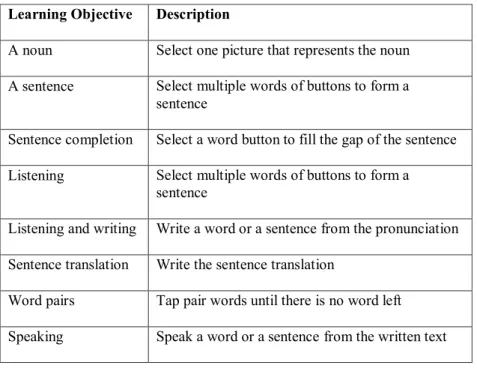
Each topic increases the skills of listening, reading, writing, and speaking with many gameplays. Those variations are included in every topic and the difficulty is increasing for every level, for example, after users finished the first level, they can play the second level, which is harder than the previous one. The variations to learn languages in the Duolingo are presented in Table 1:
Table 1. Gameplay Variations in the Duolingo game Learning Objective Description
A noun Select one picture that represents the noun A sentence Select multiple words of buttons to form a
sentence
Sentence completion Select a word button to fill the gap of the sentence Listening Select multiple words of buttons to form a
sentence
Listening and writing Write a word or a sentence from the pronunciation Sentence translation Write the sentence translation
Word pairs Tap pair words until there is no word left Speaking Speak a word or a sentence from the written text
Moreover, Duolingo uses streak counts, progress status and score points to show learning progress (Duolingo, 2018). This application has similar features that are described in the (Deterding, 2012), where simple features and progress status are used to increase the engagement and learning activities. The first non-functional prototype in this research adapted the features of select multiple words of buttons, select one picture that represents the noun and score points (Damiri Burlian et al., 2019).
Furthermore, Garden of Times was used in the first non-functional prototype because it has many players on Facebook with gameplays of cultural learning (Facebook, 2018). Players can play a specific storyline and finding a hidden object from different cultural scenes. However, the gameplays in this game is purely for entertainment, rather than offers a specific learning objective to learn a new culture. Additionally, Mondly as a language learning game has too many 3D gameplays and complex features. Thus, the Garden of Times and Mondly were not used as references in the second functional prototype in this research.
2.4 Laravel PHP Framework and Bootstrap Frontend Framework
Predecessor Hypertext (PHP) is an open source language for web development and it is used as a core language along with other languages such as HTML, CSS, and JavaScript (Olanrewaju, Islam, & Ali, 2015). This language can be used on the Apache web server to process and render web applications. There are many PHP frameworks that make web implementation easier and better performance than developing a new web application from scratch. One of the PHP frameworks that widely used by software developers is Laravel PHP framework (Pop & Altar, 2014).
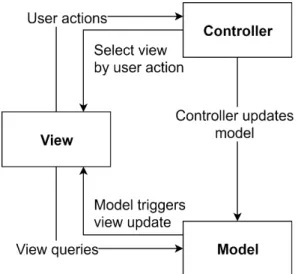
Laravel uses model-view-controller architecture to handle complexities by dividing it into three layers (Olanrewaju et al., 2015). This architecture makes the code to be more structured and organized, increase the performance, and increase the modularity. For example, the code structure is organized by different folders and libraries that represent each functionality of a layer. Moreover, the performance of this framework can be tested by running complex database queries in one-time requests to the server (Das & Saikia, 2016).
Figure 1. Model-view-controller in Laravel PHP Framework (adapted from Verma, 2014)
The architecture of model-view-controller on Laravel PHP Framework is presented in
Figure 1. Model is a layer for database, object-relational mapping, and active records (He, 2015). Object-relational mapping is an encapsulation concept of a raw database query to human-readable syntax, by transforming objects and database in memory (Chen, Ji, Fan, & Zhan, 2017). This feature in Laravel is called Eloquent and it helps the software developer to make the code more structured and readable for long-term development. Moreover, the view is a layer for user interfaces and handle the interface presentations and interactions by manipulating HTML, CSS, and JavaScript languages (Cui, Huang, Liang, & Li, 2009). Additionally, the controller is a layer to handle the logic and data transfer between the model and view layers (Olanrewaju et al., 2015). This layer can be used with standard PHP libraries and mixed together with Laravel pre-defined functions (Nguyen, 2015).
Furthermore, a frontend framework is used to make the user interface looks more attractive, lightweight, and responsive (Shenoy & Prabhu, 2018). Bootstrap is a powerful frontend framework to develop responsive user interfaces and can adjust with a mobile view (Jain, 2015). This framework consists of HTML, CSS, JavaScript languages (Jain, 2015). It supports responsiveness in the desktop, tablet, and smartphone devices. Thus, Bootstrap frontend framework was used in the view layer to make the user interfaces more responsive, more structured, good layouts, and increase the usability.
3.
Research Methodology
This chapter describes the research objective and research method of this research. The first section presents the research objective of exaptation and formulated research questions. In the second section, design science research is described as the research method and the universal game heuristic is explained as the design cycle. Moreover, the reason for choosing the research method, and all phases of the universal game heuristic are included in the second section.
3.1 Research Objective
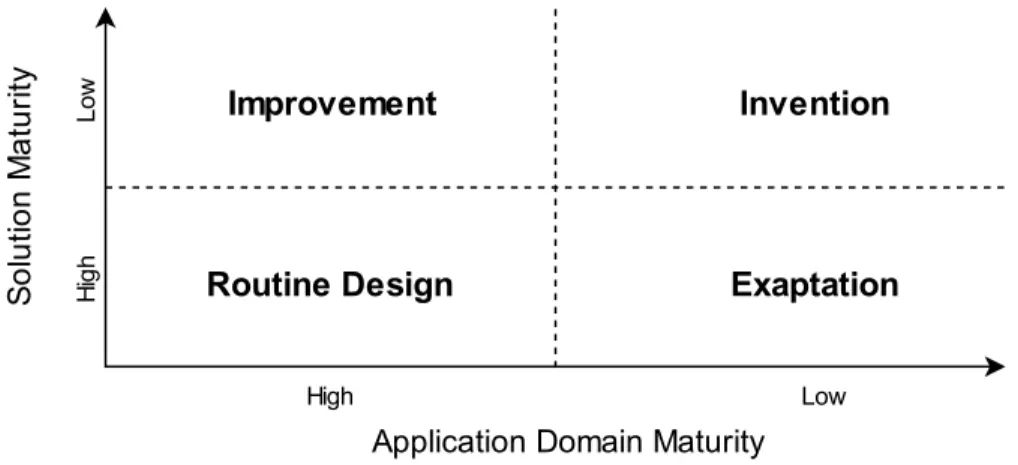
There are four contribution types in the knowledge contribution framework, which are the improvement, invention, routine design, and exaptation as presented in Figure 2 (Anderson, Donnellan, & Hevner, 2011; Gregor & Hevner, 2011). Improvement type is the development of new solutions for existing problems. Furthermore, invention type is the development of new solutions for new problems. Additionally, exaptation type is the development of similar solutions for new problems. Lastly, routine design type is the development of existing solutions for existing problems. (Gregor & Hevner, 2013).
Figure 2. Knowledge Contribution Framework (adapted from Gregor & Hevner, 2013)
In this research, the research objective is exaptation, where gamification approach and a similar game to learn language and culture were adapted for new problems in Viena Karelian game development project. Those new problems were addressed by using design science research as the research method. The research objective was formulated into two research questions:
• RQ1: How the universal game heuristic can be used to develop a game from non-gaming contexts to learn Viena Karelian dialect and culture?
• RQ2: What are the advantages and disadvantages of using the universal game heuristic in the language learning and culture game of Viena Karelian?
The first research question (RQ1) was about to find a way to gamify the non-gaming contexts to learn Viena Karelian dialect and culture, by applying the universal game heuristic as the design cycle. The game is available for beginner learners to learn the dialect and culture, ranging from 20 to 50 years old, where the researcher focused on the adult users. The concept of gamification and development phases were applied and conducted to develop a game that is interested to play and learn. Therefore, the educational purposes and knowledge acquisition were achieved in this game artifact.
Moreover, the second research question (RQ2) focused on the evaluation of using the universal game heuristic in Viena Karelian dialect and culture game. The advantages and disadvantages of using this heuristic were defined as the result of the evaluation of this heuristic. The result became an input whether the universal game heuristic was already properly defined as a universal genre and to improve in some aspects of this heuristic. Therefore, the heuristic was validated and improved, so it can be used for another development of games in the future, and other researchers can choose this heuristic based on the advantages and disadvantages that are described in this research.
3.2 Research Method
Design science research is a research method to answer research questions that are related to human problems (Hevner & Chatterjee, 2010). Problems are addressed with the development of innovative artifacts that contributes to scientific knowledge and can be validated by scientific processes (Gregor & Hevner, 2013). The successful artifacts are observed and validated, so the researchers can answer research problems by applying unique solutions in the developed artifact (Peffers, Tuunanen, Rothenberger, & Chatterjee, 2007). Therefore, this research method was used in this research to develop an innovative solution by developing a game artifact to learn Viena Karelian dialect and culture.
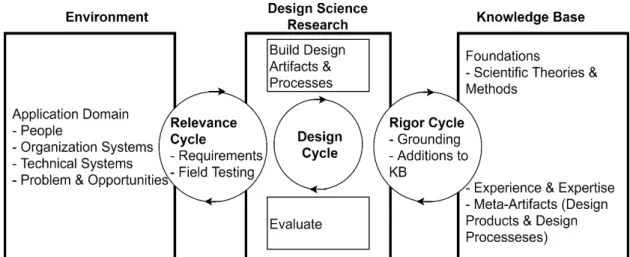
Moreover, design science research is used to provide an opportunity to develop innovative artifact (Edelson, 2002). The developed artifact was used to address the research questions by observing and evaluating the result. An artifact is an innovative solution that is used for the validation of research goals (Offermann, Levina, Schönherr, & Bub, 2009). The result may be achieved by iterative processes of design science research activities and collaboration among researchers to achieve better design principles and developed artifacts (Plomp, 2013). The design science research cycles in Figure 3 is used as the basis of Information System research framework (Hevner, 2007):
Figure 3. Design Science Research Cycles (adapted from Hevner, 2007)
3.2.1 Design Science Research Components and Activities
In the environment scope, there are four components related to the application domain, which are people, organization systems, technical systems, problem and opportunities as presented in Figure 3. The relevance cycle utilizes the iterative inputs from the environment activities. The design cycle focuses on building the artifact and evaluation
activities, which the result is used in the relevance cycle and rigor cycle. The rigor cycle utilizes the iterative inputs from the knowledge base area as foundations in the design science research activities. The requirements and field testing activities from the relevance cycle are related to design science research activities, and the grounding and additions to KB activities from the rigor cycle are related to the design science research activities. (Hevner, 2007).
The processes of design and development are related to a design cycle, where the result can be done iteratively to get the desired result of artifacts. The evaluation activity may include any knowledge from a knowledge base such as scientific theories and methods to support the activities and results in the design science research. Design principles are defined in the early phase of design science research. Previous research and existing knowledge are used to design and develop artifacts. The result of design science research is different from the regular implementation of IT artifacts, where the regular IT artifacts only used well-established knowledge for common problems. (Hevner, 2007).
3.2.2 The Universal Game Heuristic as the Design Cycle
The design cycle is the main activity in the design science research cycles, which are consists of the building of artifacts and evaluation activities through the whole processes (Hevner, 2007). Moreover, the design cycle in design science research is defined to develop artifacts and conduct the research. The universal game heuristic from (Mylly, 2011) was used as the design cycle in this research, as presented in Figure 4:
Figure 4. Phases of Game Heuristic Context Phase
The first phase is the context, which is used to define the main goal and unique values to attract players (Mylly, 2011). The components in the context phase mainly about the concept and as a foundation to conduct all phases. The game was developed with mobile web responsive of Laravel PHP framework and Bootstrap frontend framework. This technology allows the players to play from desktop, tablet, and smartphone devices without a specific operating system. The game provides a challenging learning material and fun activities to keep the players want to learn in the long term. In educational games, it is very important to keep the game interesting, balanced and motivated the users (Carro, Breda, Castillo, & Bajuelos, 2002; Kiili, 2005).
Design Phase
Moreover, the second phase is design, which is used to design game elements that players might want to play (Mylly, 2011). The design elements are very important to finalize before the production phase since the production phase takes more effort to develop a game prototype. The design software that was used in this research was Balsamiq. Balsamiq was used to create wireframes as basic concepts of design elements. Design elements should focus on user engagement, where it attracts users to use the products by providing attractive user interfaces (Sutcliffe, 2009).
Production Phase
Furthermore, the third phase is production, where a game artifact is developed based on the design elements from the previous phase (Mylly, 2011). The developed game artifact should be playable, and the technology depends on the goal from the main context. In this research, the game is available for responsive web platforms, which can be accessed from web browsers of desktop, tablet, and smartphone devices. The mobile web responsive is supported by HTML5 as the better version than HTML to develop mobile web applications (Serrano, Hernantes, & Gallardo, 2013). Moreover, Laravel PHP framework can be used to develop a dynamic website with the localization feature (Awale, 2018). This localization feature allows the game to be playable for English and Finnish speakers, as there is only need one game to be developed with two different languages localization. Testing Phase
Additionally, the fourth phase is testing, where test participants are gathered to conduct the game testing. A test evaluation focuses on the gameplays and user experience of the game. (Mylly, 2011). In this research, test participants were from participants of the 3rd international GamiFIN conference with ages from 20 to 50 years old. The participants played the game and filled a survey form based on user experience aspects, whether the desired user experience aspects were met. Moreover, some participants gave a comment about game improvement in the future.
Release and Support Phase
Lastly, the fifth phase is release and support, which is used to prepare the game to be released and ready to play. Moreover, the game is maintained by providing a contact form to players in the game, so they can contact the respective contact person to handle problems and answer questions. (Mylly, 2011). In this research, the game information is available online at LearnVienaKarelian.tk. Learners can find any information about the game and submit any feedback for the future development of the game. Moreover, the questions can be developed further as frequently asked questions (FAQ), where players can find an answer easily and increase user experiences (Burke et al., 1997).
4.
Implementation
This chapter explains how the universal game heuristic as the design cycle had been used in this research. This chapter consists of context phase, design phase, production phase, testing phase, and release and support phase. The universal game heuristic was adapted from (Mylly, 2011), which was very helpful to conduct a practical game implementation from the planning of context to the preparing of game release based on the structured heuristic processes.
4.1 Context Phase
The target learners for this game artifact are English and Finnish speakers, range from 20 to 50 years old. The game was made with simple features and easy gameplays, thus people from any age groups can play it without any difficulties and can give any feedback with a feedback form in the game. The game was developed with a widely-used and user-friendly Bootstrap CSS framework. This framework supports the development of unique user interface and can be used to provide a responsive interaction to learners.
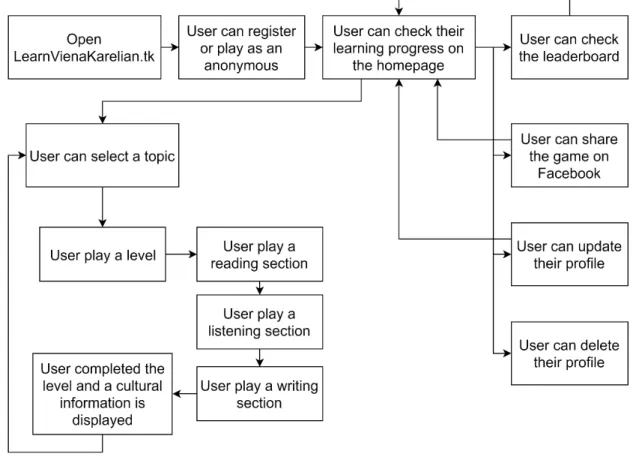
The game flow consists of dialect and cultural learning with several topics and levels. For example, topics are food and drink, clothing, and furniture. Each topic consists of three levels, which are easy, medium, and hard. The game flow is presented in Figure 5.
Figure 5. Game Flow
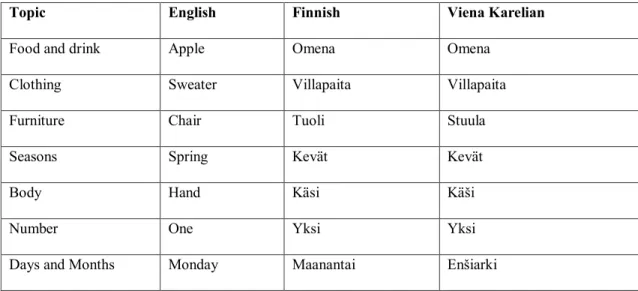
The goal of this game is to learn Viena Karelian dialect and culture in a fun and effective way. Language is learned by playing different topics and levels, and culture is provided as information on every completed level. The topics are food and drink, clothing,
furniture, seasons, body, number, days and months. The examples of every topic in level easy are presented in Table 2. More details of game contents can be found in the game repository2.
Table 2. Examples of Level Easy
Topic English Finnish Viena Karelian
Food and drink Apple Omena Omena Clothing Sweater Villapaita Villapaita Furniture Chair Tuoli Stuula Seasons Spring Kevät Kevät
Body Hand Käsi Käši
Number One Yksi Yksi
Days and Months Monday Maanantai Enšiarki
Learners can learn the dialect and culture with a single player mode. Moreover, learners can play the game every day to achieve a better understanding of Viena Karelian dialect and culture, where the progressive achievement of topics can be found on the home page. The in-game time is based on real-life time, so learners can see their weekly score and they can track their learning progress. The game platforms are desktop, tablet, and smartphone devices with minimum width 320px to 1281px (portrait). The game can be accessed with web browsers such as Google Chrome, Firefox, and Opera. Different topics and levels provide multiple possibilities to be completed that can be seen in Table 3.
Table 3. Skills and Levels
Skill Level Learning
Objective Description
Reading Easy A word Select a picture that represents a Viena Karelian word Reading Medium A simple
sentence Select a sentence that represents a simple Viena Karelian sentence Reading Hard A complex
sentence Select a sentence that represents a complex Viena Karelian sentence Listening Easy A word Select a picture that represents a pronunciation of Viena
Karelian word Listening Medium A simple
sentence
Select a sentence that represents a pronunciation of simple Viena Karelian sentence
2
https://github.com/triandotriando/learnvienakarelian/blob/master/database/seeds/LearningObjectivesTable Seeder.php
Skill Level Learning
Objective Description
Listening Hard A complex sentence
Select a sentence that represents a pronunciation of complex Viena Karelian sentence
Writing Easy A word Write a word translation from a Viena Karelian word Writing Medium A simple
sentence Write a sentence translation from a simple Viena Karelian sentence Writing Hard A complex
sentence
Write a sentence translation from a complex Viena Karelian sentence
Furthermore, cultural information is displayed after a level completion. Several examples of cultural information are:
• (English) The most known version of the Kalevala (New Kalevala) was first translated to Swedish in 1841. Finally, in 2015 The Kalevala was published in its originating Karelian language (Viena Karelian).
• (Finnish) Tunnetuin Kalevalan versio (Uusi Kalevala) käännettiin ensimmäiseksi ruotsiksi vuonna 1841. Viimein vuonna 2015 Kalevala käännettiin sen alkuperäiselle Karjalan kielelle vienankarjalaksi.
• (English) The Kalevala, the Finnish national epic, has been translated into over sixty languages and it is Finland's most translated work of literature. Raisa Remšujeva translated the Kalevala in Viena Karelian.
• (Finnish) Kalevala, Suomen kansalliseepos, on käännetty yli 60 kielelle ja se on Suomen kirjallisuuden käännetyin teos. Raisa Remšujeva käänsi Kalevalan
vienankarjalaksi.
• (English) The most commonly known version of the Kalevala (New Kalevala) was published in 1849. It includes 22,795 verses and is divided into 50 folk stories.
• (Finnish) Kalevalan tunnetuin versio ilmestyi vuonna 1849 ja se sisältää 22,795 säkeistöä jaettuna 50 kansantarinaan.
More details of cultural information can be found in the game repository3. The language
contents and cultural information were provided by the first supervisor, Dr. Leena Arhippainen, as she has a project of the VIENA-PELI with Karjalan Sivistysseura, Karelia Cultural Society in Finland, and she is currently learning Viena Karelian dialect as her focus.
4.2 Design Phase
The game elements and settings are based on Viena Karelian dialect and culture to keep the interest of learners. The figure assets of cultural information in-game were adapted
3
https://github.com/triandotriando/learnvienakarelian/blob/master/database/seeds/CulturalInformationTabl eSeeder.php
from Viena Karelian books4,5, newspaper6, books by Olga Karlova (Karlova, 2011) and
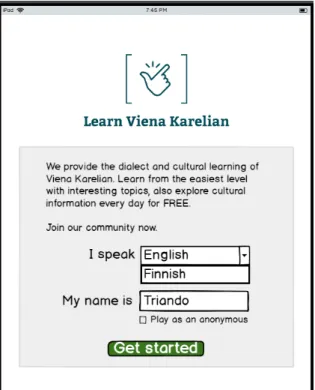
Pekka Zaikov (Zaikov, 2013), The Dictionary of Karelian (Dictionary of Karelian, 2009), and some pictures such as mittens and Heimopäivät were from Dr. Leena Arhippainen. Mock-up of user interfaces were developed with a cloud service, https://balsamiq.cloud, that can be used to design wireframes with very minimum effort that focuses on the low-fidelity design. This application offers 30 days trial for free and can be used together synchronously with other people. The landing page of this game is presented in Figure 6.
Figure 6. Landing Page Wireframe
Moreover, the game was provided with different topics and levels, where the game difficulty is gradually increasing from easy to hard level. The home pages in English and Finnish is presented in Figure 7. Each star represents the completion of each level from easy, medium, and hard. Moreover, learning progress can be viewed as a weekly rank and weekly score. Learners can share this game with several social media, so their friends can learn together and compete in the leaderboard.
4 Ruppijeva, J. (2017) Šanalipaš. PERIODIKA. Petroskoi, 2017.
5Lönnrot, E. Kal'evala vienankarjalakši. Karjalan Šivissyššeura ry. Helsinki, 2015. 6http://omamua.ru/
Figure 7. Home Page Wireframe in English and Finnish
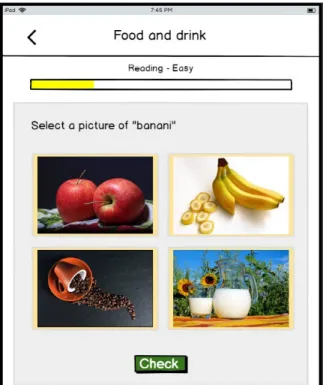
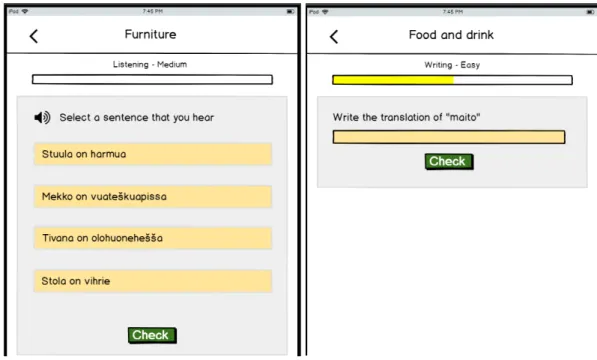
The gameplay of reading section of level easy in Figure 8 is to select a picture that represents a Viena Karelian word. Furthermore, the same question is repeated with the same clue, so learners can guess the answer based on the same clue. Status of completion and total score are displayed without overlapping any contents. Learners can see the status and score easily, so they can track their learning progress. The game is provided with a very common topic (e.g. food) and an easy level at the beginning, so learners can play it without a tutorial. The first level is very important to attract learners to play the game for a long time.
Figure 9. Listening - Medium and Writing - Easy
The elements and settings are voices for the listening section and general contents to learn with different topics and levels, as presented in Figure 9. The game is available for desktop, tablet, and smartphone devices, so only one controller that was needed to be designed. The game interfaces were built with the widely-used Bootstrap CSS framework to ensure simplicity and conveniently. Images were download from several websites which provide open source and free images, such as:
• https://pixabay.com • https://www.pexels.com • https://unsplash.com • https://www.freeimages.com • http://www.i2symbol.com/text2image • https://hatchful.shopify.com/
The design was evaluated and revised by an independent UI/UX researcher from Indonesia, Febyola Tiara Putri. She revised the design elements and positions, so learners can find it easy to use the game and interesting to play for a long time. For example, she suggested changing the menu in Figure 9 with only one back button, where learners can focus on the current gameplays, rather than put all menu on the top of the pages. Moreover, the user interfaces were revised to be simpler and reduce unnecessary elements such as remove several unnecessary buttons and links on a page.
4.3 Production Phase
The game design was used in this phase to make working user interfaces, based on Bootstrap CSS framework and Laravel PHP framework. The language contents consist of words, sentences, images, and audios. Words and sentences were derived mostly from Leena Arhippainen, then the audios were generated automatically from
https://soundoftext.com. The game repository at
https://github.com/triandotriando/learnvienakarelian can be accessed public and everyone can suggest future updates in the repository. Moreover, the game was deployed
http://LearnVienaKarelian.tk to make learners easy to play the game with only using web browsers without a specific requirement of an operating system.
The desktop view is presented in Figure 10 and the tablet and smartphone views are presented in Figure 11. The game automatically adapts the screen resolution and shown as a responsive mobile web with a base template from
https://startbootstrap.com/themes/sb-admin-2. This responsiveness is supported by Bootstrap CSS framework. Moreover, the game can be used in English and Finnish language, where learners can play it with their language backgrounds. This feature is supported by the localization of Laravel PHP framework.
Figure 10. Home Page on a Desktop Device
There are two language backgrounds in this game, which are English and Finnish. Those languages were implemented in the localization feature of the Laravel PHP framework. The comparison between English and Finnish localization is presented in the code snippets below:
(English) learnvienakarelian/resources/lang/en/default.php
<?php return [
'weeklyRankAndScore' => 'Weekly Rank and Score', 'selectATopic' => 'Select a Topic',
'achievements' => 'Achievements', 'help' => 'Help',
(Finnish) learnvienakarelian/resources/lang/fi/default.php
<?php return [
'weeklyRankAndScore' => 'Viikkosija ja pisteet', 'selectATopic' => 'Valitse aihe',
'achievements' => 'Saavutukset', 'help' => 'Auta',
Furthermore, learners can leave the game in the middle of gameplay without losing a score, so they can continue the gameplay later with a progress bar to track their progress. This game supports multiple platforms of desktop, tablet, and smartphone devices. Learners can only use web browsers without any specific operating system and without installing the game. User interfaces are responsive, so the game will adapt to its current platform.
The technology frameworks that were used were the Laravel PHP framework and the Bootstrap CSS framework. Those frameworks are the latest web technologies and widely used by many developers. Therefore, the game system can be ensured with those latest frameworks, where many updates are made to fix any possible bugs. Learners can choose to play as an anonymous, where some learners think that they want to share their information and can play securely. However, learners can put their name when they register the game and update their profile, so they can compete with other learners in the weekly leaderboard.
In the listening section, learners can play the audio to answer the correct option. Volume control can be changed while listening to the audio and audio can be played several times before learners can pick a correct answer. Gameplays were developed based on the game reference of Duolingo, where many user interactions were made as simple as the game reference. Learners can play the game easily without a tutorial because the gameplays are very intuitive to be played and it can increase the user experience of the game. Gameplays were made same for multiple platforms, which are desktop, tablet, and smartphone devices.
4.4 Testing Phase
Learners can open the game URL, then register or play as an anonymous. After that, they can check the homepage to play a topic. The gameplay will be played automatically when learners pick a topic. Three different skills of reading, listening, and writing are presented at every level, so learners do not need to perform a specific decision to continue the next
step. Control in every gameplay is easy to use, where learners can choose one topic, and then play all skill sets of reading, listening, and writing with only a next button.
It is very important to make the game layout that is consistent across the whole user interfaces. This game utilizes a consistent layout, where there are several main components that are reused in every user interface, and other pages only need to utilize a specific component without a need to reimplement from scratch. Moreover, the game difficulty makes the beginner learners of Viena Karelian can easily play the game, also people who have a background of Viena Karelian or Finnish language can play the game with a minimum effort than other language backgrounds, yet the difficulty is made to be still challenging for all levels of learners.
There were 38 players and 12 received feedback from the testing phase. Test participants were from conference participants of the 3rd international GamiFIN conference. The leaderboard after the testing phase (April 10th, 2019) can be seen in Figure 12.
Figure 12. Weekly Rank on the Leaderboard (April 10th, 2019)
The online questionnaires can be accessed at http://learnvienakarelian.tk/feedback, which is directed to the URL of https://forms.gle/o8JuCdXWwFerueMy7 to make learners easy to open the questionnaires. The questionnaires consisted of two sections, which were background in Table 4 and user experience study in Table 5. The adjectives were adapted from (Sunnari, Arhippainen, Pakanen, & Hickey, 2012) and applied in this study for the mobile game context.
Table 4. Background Section
Name Type Description
Birth year Number The birth year field was used to determine the age of learners.
Gender Options: Female, Male,
Prefer not to say The gender field was used to determine the gender distribution. Nationality Text The nationality field was used to determine the
distribution of nationality.
Native Finnish Options: Yes, No The native Finnish field was used to check if the learner was a Finnish or not, thus it can be determined whether the Finnish learners can easily to play the game rather than non-Finnish speakers.
Education Text The education field was used to determine the distribution of education.
Occupation Text The occupation field was used to determine the distribution of occupation.
Table 5. User Experience Section
Name Type Description
Difficult to use – easy to use 5-point scale These scales were used to determine the adjective selections from (Sunnari et al., 2012) that represent how learners felt about the game.
Useless – useful 5-point scale Visually unpleasant – visually pleasant 5-point scale Too technical – creative 5-point scale Businesslike – playful 5-point scale Dull – entertaining 5-point scale Frustrating – inspiring 5-point scale Unapproachable – approachable 5-point scale Restrictive – empowering 5-point scale Inconsistent – consistent 5-point scale Serious – fun 5-point scale Dated – novel 5-point scale
Is the game engaging? Options: Yes, No This question was used to determine positive and negative engagement at general level. Any comments? Text Learners can suggest any update
Name Type Description
How much do you play mobile games? Options: Not at all, Just tried, not really use, 1-4 times a month, 1-2 times a week, Daily
This question was used to determine the frequency of mobile games familiarity.
How much do you use language learning games?
Options: Not at all, Just tried, not really use, 1-4 times a month, 1-2 times a week, Daily
This question was used to determine the frequency of language learning games familiarity.
4.5 Release and Support Phase
After several development iterations, I played the game, so I can feel the real situation and can learn Viena Karelian dialect and culture by myself. Moreover, I asked my supervisors and a UI/UX researcher from Indonesia to play the game, so they can notice if there was any critical issue that must be solved before the testing and final release of this game. Furthermore, FAQ can be made later after several questions and feedback in the game are received. There is one feedback form in the game that can be used for learners to give questions and feedback for future development.
While preparing the game for the testing phase, there were several critical bugs that need to be fixed. The bugs were fixed before the testing phase and it was required a lot of effort to make sure that the new updates did not break other features. Moreover, there is a need to connect the game with Viena Karelian community. For example, Viena Karelian community can create a Facebook page, so learners can share their thoughts about the game and the game community will grow larger.
After several months of deployment, the game can be analyzed to get the most played topic and the feedback that can be improved in the next future releases. The updates of language contents should balance between one topic to each other. Therefore, the difficulty is still reasonable to be played. There is a need to put information every major release, therefore learners can easily notice and adapt with new changes that have been made.
The game is accessible with web browsers for desktop, tablet, and smartphone devices. There is only one requirement that must be applied in every device, which is JavaScript to make an interaction between learners and the game. Making a mobile web game can utilize an instant update without any approval from learners to update the game. Developers can easily update through the server, then the game will be updated in any second and ready to be played online. The game updates are applied automatically without interfere learners to do a manual update. Thus, this issue can make easy for learners to play without any annoying notification to update the game. The game is available to access at http://LearnVienaKarelian.tk and any future updates are synchronous with a repository at https://github.com/triandotriando/learnvienakarelian.
5.
Evaluation
This chapter explains the evaluation of testing phase that was conducted in the 3rd international GamiFIN conference at Levi, Finland between 8 to 10 April 2019. This chapter consists of target users, game engagement, and gameplays evaluation. The first section explains the initial target user and the test participants relationship, and how they perceived this dialect and culture learning game. The second section explains positive engagement from the test participants based on several user experience adjectives. The third section explains the suggestion and feedback from the test participants about the current game artifact.
5.1 Target User
The test participants were given two URL to play the game and fill the questionnaire form. From 38 players, there were 12 received feedback from the testing phase. The game and feedback URL were:
• Game URL: http://LearnVienaKarelian.tk
• Feedback URL: http://LearnVienaKarelian.tk/feedback
Some of the test participants conducted the game evaluation with the researcher and other test participants conducted the game evaluation online. Most of the test participants were expert, for example, game design specialists and researchers. Therefore, the evaluation result was more reflect the situation of people who know the game applications rather than people who have fewer experience of game applications and technology. The background of test participants was:
• Age: 20 to 47 years old
• Gender: 9 males and 3 females
• Native Finnish: 2 people
• Education: 3 bachelors, 1 master, 8 PhDs
Table 6. Nationality Name Total Brazilian 1 Finnish 4 Greek 1 Indonesian 1 Italian 1 Russian 2 Taiwan 1 Ukraine 1
Table 7. Occupation Name Total Game Design Specialist 2 Professor 2 Researcher 6 Student 1 UI/UX Designer 1
Figure 13. How much do you play mobile games?
Figure 14. How much do you use language learning games?
The target age groups range from 20 to 50 years old, therefore the test evaluation can cover the initial target of this game artifact. The number of male and female participants were nine and three respectively, thus the result may not reflect the real result between male and female participants. There were only two native speakers of Finnish in this testing phase, so the result was not representative enough to be assessed whether the native Finnish participants perform better than other participants. The education,
nationality, and occupation between participants were quite varied, therefore the received feedback was quite good and representative as an initial result to gather how the test participants felt about the game, especially for the positive engagement. The familiarity of test participants about mobile games and language learning games were adequate to represent the result of this evaluation, where the participants at least have experience with mobile games and only one participant who never play a language learning game.
5.2 Game Engagement
There were 12 five-point scales to identify the user experience adjectives and one binary question to identify the engagement of this game artifact. The five-point scales were given a weight of each point:
• 1st scale: -2
• 2nd scale: -1
• 3rd scale: 0
• 4th scale: 1
• 5th scale: 2
The engagement of this game was 91.7% positive and 8.3% negative. Moreover, the 12 five-point scales are presented in the Table 8.
Table 8. Result of 12 Five-point Scales
Name Selected Adjective Total Percentage to
Adjective Target (total/ 12 x 2)
Difficult to use – easy to use Easy to use 16 66.67% Useless – useful Useful 12 50.00% Visually unpleasant – visually pleasant Visually pleasant 8 33.33% Too technical – creative Creative 6 25.00% Businesslike – playful Playful 7 29.17% Dull – entertaining Entertaining 7 29.17% Frustrating – inspiring Inspiring 3 8.33% Unapproachable – approachable Approachable 12 50.00% Restrictive – empowering Empowering 2 8.33% Inconsistent – consistent Consistent 12 50.00% Serious – fun Serious -1 -4.17% Dated – novel - 0 0.00%
Based on the result of 12 five-point scales in Table 8, the game was easy to use, useful, approachable, and consistent with more than 50% result in selected adjectives. Moreover, the game was quite visually pleasant, creative, playful, and entertaining with more than 25% result in selected adjectives. Furthermore, the game was very few inspiring and empowering with more than 8.33% result in selected adjectives. The game was neither dated and novel with 0% result to selected adjective target. However, the game was experienced by the test participants as a serious game rather than a fun game with -4.17% result in the selected adjective.
5.3 Gameplays
The gameplays consist of seven topics, which are food and drink, clothing, furniture, seasons, body, number, days and months. Each topic consists of three levels of easy, medium, and hard. Each level has three different skills, which are reading, listening, and writing. The levels and skills are presented in Figure 15, where the knowledge of learners gradually increase when they complete every skill on every level. Every level completion will be presented cultural information to attract learners to learn about Viena Karelian culture. There were several feedback and suggestions from the test participants to improve the gameplays in the future.
Figure 15. Language Learning Model
The first feedback was to improve the information about the correct answer. For example, after learners answer the correct option, they will receive an explanation and comparison in Viena Karelian, English, and Finnish. Another aspect can be improved with more fun gameplay such as in reading and listening in easy level, where learners can play just pick a card. This gameplay can be adapted from https://tinycards.duolingo.com, where many learners learn with fun gameplay and pick interesting cards based on the selected topic. The second feedback was to improve the language contents, where there are three levels of easy, medium, and hard. The medium and hard levels were too hard. Therefore, the language contents need to be validated before the game release to the public. The third
feature can help non-native speakers to answer the correct option without feeling so confused with a misspelled answer.
Moreover, there were some typos such as "He eat soup" and "What is your favorite cloth?". There is a need to validate the grammar of language contents to prevent small grammar mistakes in the gameplays. The fourth feedback was to validate the listening section gameplay. Learners will be presented audio that is the same s the previous section (reading). The test participants thought that it was too easy to guess the audio even without listening to it. Therefore, the test participants can easily to cheat on this listening section without listening to the audio.
The fifth feedback was to validate the images that have a similarity with each other. For
example, “porridge” and “soup” images have a similar visual appearance. Some of the test participants got a wrong answer because they thought they already choose the correct image. This problem can be solved with some hints such as why learners got a wrong answer on a similar image and the similar images can be removed to prevent a confusion of learners.
The sixth feedback was to change the stars icon on the home page. Some of the test participants thought it was only performance information, but they realized that it was a progress status of each topic. For example, if the test participants already completed easy and medium levels, they got two full stars and one empty star. This problem can be solved by applying the most common icon to display the progress status of levels.
The seventh feedback was about the phrase exercise of writing sections. Some of the test participants thought the exercises were hard. They need to remember the exact answer in the English phrase, where it was quite hard for non-native English to answer it in English. If the test participants forgot the answer, they cannot go back to the previous section such as reading and listening sections. There is a need to add functionality that make learners able to access the previous sections. The last feedback was about to improve the writing section. Currently, there is no hint in this section, therefore the test participants have no possibility to learn in a correct way. This problem can be solved by providing a hint, and a functionality to go back to previous sections.