MODEL ON STUDENTS’ ACHIEVEMENT IN WRITING DESCRIPTIVE
PARAGRAPH AT TENTH GRADE STUDENTS’ OF MAS AL-WASHLIYAH 30 BINJAI THESIS
Submitted to Faculty of Tarbiyah and Teachers Training UIN-SU Medan as a Partial Fulfillment of the Requirement for the (Degree of Sarjana Pendidikan) S-1 Program
By: AMELIA NIM. 34143039
ADVISOR I ADVISOR II
Dr. Derliana Marbun, M.Pd Dr. Sholihatul Hamidah Daulay, S.Ag, M.Hum NIP. 19540203 198203 2 001 NIP. 19750622 200312 2 002
DEPARTEMENT OF ENGLISH EDUCATION
FACULTY OF TARBIYAH AND TEACHERS TRAINING
STATE ISLAMIC UNIVERSITY NORTH SUMATERA MEDAN
ABSTRACT
AMELIA. THE EFFECT OF VAK (VISUALIZATION, AUDITORY, KINESTETHIC) LEARNING MODEL ON STUDENTS’ ACHIEVEMENT IN WRITING DESCRIPTIVE PARAGRAPH AT TENTH GRADE STUDENTS’ OF MAS AL-WASHLIYAH 30 BINJAI IN 2017/2018 ACADEMIC YEAR.
Skripsi, Medan: Department of English Education, Faculty of Tarbiyah Science and Teachers Training, State Islamic University of North Sumatera, Medan, 2018.
Keywords: Students’ Achievement, Descriptive Paragraph, VAK Learning Model
This study deals with the applications of Visual, Auditory, and Kinesthetic (VAK) Learning Model on Students‟ Achievement in Writing Descriptive Paragraph. The purposes of the study are to know the process of the VAK (Visualization, Auditory, Kinesthetic) learning model of the students‟ achievement in writing descriptive paragraph and to find out the significant effect of the students‟ achievement is writing descriptive paragraph taught by VAK (Visualization, Auditory, Kinesthetic) learning model in the tenth grade at MAS Al-Washliyah 30 Binjai.
This population of this research was all students of class X of MAS Al-Washliyah 30 Binjai. The samples of these research was 29 students of experimental group (class X-1) and 28 students of control group (class X-2)
The researcher was conducted by using experimental model significantly affected the students‟ achievement in writing descriptive paragraph. The instrument for collecting data was writing a test. The formula that using in this research was using by t-test formula.
The data was found that the scores of the students in the experimental group were significantly higher than the scores of the students in the control group at the level of significance ɑ is 0.05 with the degree of freedom (df) 55, t-observed value 2.913 > t-table value 2.009. It means that Visual, Auditory, Kinesthetic (VAK) Learning Model has a significant effect on students‟ achievement in writing descriptive paragraph.
ACKNOWLEDGMENT
In the name of Allah, the Beneficent, the Merciful, Praise and Gratitude to Allah for giving the strength and guidance to the writer, so that this skripsi can be finished accordingly. Peace and blessing be upon the Prophet Muhammad Shallallaahu „alaihi wa saalam, his family, his relatives, and all his followers.
The writing of this skripsi entitled “The Effect of VAK (Visualization, Auditory, Kinesthetic) Learning Model on Students‟ Achievement in Writing Descriptive Paragraph at Tenth Grade Students‟ of MAS Al-Washliyah 30 Binjai 2017/1018 Academic Year”. This skripsi written to fulfill on the requirements to obtain the Sarjana Pendidikan degree at Department of English Education, Faculty of Tarbiyah and Teachers Training, State Islamic University of North Sumatera.
The writing this skripsi is actually a miracle for me since it was firstly regarded as a task would be very hard to do. However, it has now been denied since this skripsi has finally been written. Then, it would be like to thank Allah Subhanaahu Wa Ta’ala for His Blessing given to me so that the writing of this skripsi has been finished without any meaningful problem. Additionally, the writer is grateful to the following for their support and helps.
1. Dr. Amirruddin Siahaan, M.Pd as the Dean of Faculty of Tarbiyah and Teacher Training State Islamic University of North Sumatera.
2. Dr. Sholihatul Hamidah Daulay, S.Ag, M.Hum the Head of English Educational Department and my second advisor who has given suggestion, correction, beneficial opinion and encouragement in process of writing this skripsi.
3. Dr. Derliana Marbun, M.Pd my first advisor who has also given suggestion, correction, beneficial opinion and encouragement in process of writing this skripsi.
4. All lectures in the English Department for teaching precious knowledge, sharing philosophy of life, and giving wonderful study experience.
5. The principal of MAS Al-Washliyah 30 Binjai, English teacher and all students of X-1 and X-2 class who helped the writer during the research.
6. My beloved parents Mr. Riadi and Ms. Sukarsih who always give me pray, support, advice, financial and love, goodness, care and all things that I need to finish my study. My sister, she is Dea ananda thank you so much for your goodness for me.
7. My family Sudarwadi S.Pd, thank you so much for helped my college tuition and thank you for your support and motivation.
8. My Calon Istri Soleha, they are Afriani Devi, Aida Sahputri Nst, Ayu Fizannah, Danty Fitria, Dea Finanda Harefa who also give me support, sharing information and happiness during learning in English Department.
9. My Best friends since Senior High School, they are Yuliza Welvina, Arnisah Silvia, Fani Feranda, and Rizky Aswita Tarigan, and my dearest friend Pratama Imanda Purtra who always give me support, pray, happiness to finished my study.
10.My Fantastics Seven, they are Intan Melati, Kiki Lestari, Sekar Mayang, Susi Suaidah, Ulfa Sari Sipahutar and Tika Dwi Sari thank you for your best time and loyalty during this time. For my Wahdina, Roudhatul Zannah Hsb, and Sucy Hermayani Nasution who always give me support to finished my study.
11.All of my family in PBI-5 T.A 2014. Thanks for your support and sharing the happiness and sorrow during finishing this skripsi. I‟ll never forget them all.
I would be pleasure to accept some critics and correction to this skripsi. Because I believe this is still far from perfect. Finally I hope this skripsi become beneficial for those who read and experience and in educational field.
Medan, June 2018 The Writer
Amelia 34.14.3.039
TABLE OF CONTENT
ABSTRACT ... i
ACKNOWLEDGMENT ... ii
TABLE OF CONTENTS ... v
LIST OF TABLES ... vii
LIST OF APPENDICES ... viii
CHAPTER I INTRODUCTION ... 1
A. Background of Study ... 1
B. Statement of Problem ... 3
C. Research Question ... 3
D. Purposes of Study ... 4
E. The Significant of Study ... 4
F. Limitation of Study ... 5
CHAPTER II LITERATURE REVIEW ... 6
A. Review Literature... 6
B. Theoretical Framework ... 6
1. Achievement ... 6
2. Writing ... 7
3. Descriptive Paragraph ... 12
4. VAK (Visualization Auditory, Kinestethic) Learning Model ... 17
C. Related Study ... 21
D. Conceptual Framework ... 23
E. Hypothesis... 25
CHAPTER III RESEARCH METHODOLOGY ... 26
B. Research Design... 26
C. Population and Sample ... 27
D. Data Collection ... 29
E. Data Analysis ... 30
F. Research Procedure ... 35
CHAPTER IV FINDING AND DISCUSSION ... 40
A. Findings... 40
1. The Data analysis ... 43
B. Discussion ... 60 CHAPTER V CLOSING ... 62 A. Conclusion ... 64 B. Recommendation ... 63 C. Implication ... 63 REFERENCES ... 65
LIST OF TABLES
Table Title Pages
I The Generic Structure and Textual Elements 15
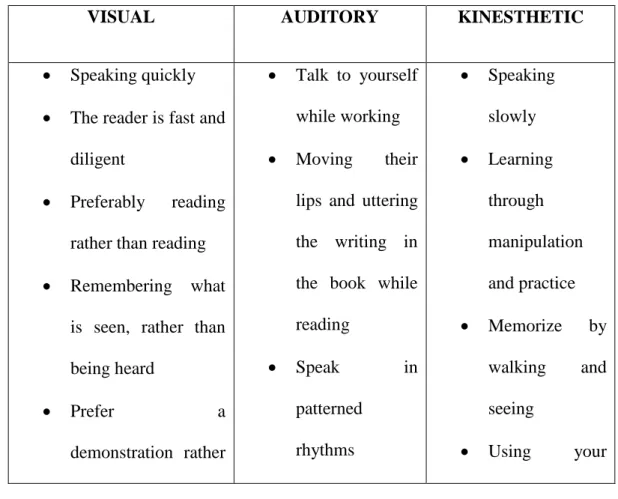
II The Characteristic of Visual, Auditory, Kinesthetic 20
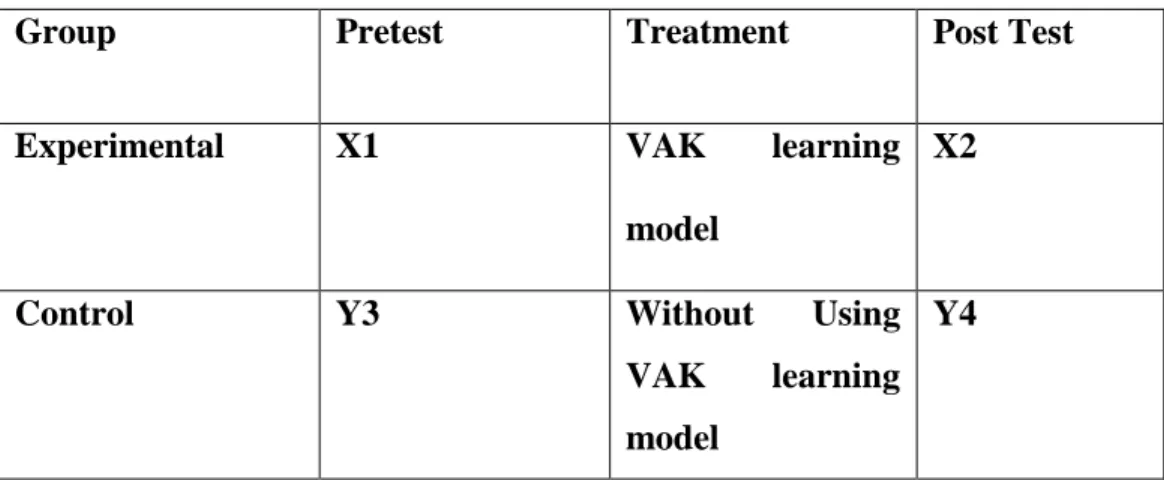
III Research Design 27
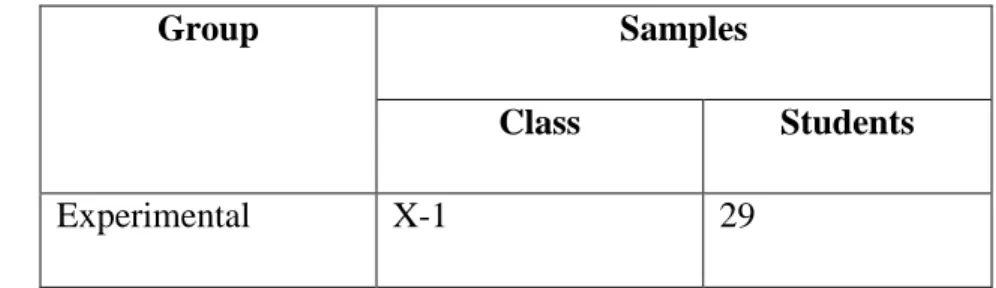
IV Sample 28
V Analytical Scoring Rubric Adapted from Weigle 32
VI Classification of Scoring Data 35
VII The Treatment of Experimental Class 36
VIII The Treatment of Control Class 38
IX The Score of Pre Test and Post Test of Experimental Group 40 X The Score of Pre Test and Post Test of Control Group 42 XI Frequency Distribution of Pre Test in Experimental Group 44 XII Normality Testing of Pre Test in Experimental Group 46 XIII Frequency Distribution of Post Test in Experimental Group 48 XIV Normality Testing of Post Test in Experimental Group 50 XV Frequency Distribution of Pre Test in Control Group 53 XVI Normality Testing of Pre Test in Control Group 54 XVII Frequency Distribution of Post Test in Control Group 57 XVIII Normality Testing of Post Test in Control Group 59
LIST OF APPENDIX
Appendix Title Pages
1 Students Worksheet (Pre-test) 80
2 Students Worksheet (Post Test ) 81
3 Key Answer Pre Test and Post test 82
4 Key Answer Post test II 83
5 Lesson Plan I and II (Experiment Class) 84
6 Lesson Plan (Control Class) 104
7 The Students‟ Initial and Real Name of Experimental Group (X-1) 122 8 The Students‟ Initial and Real Name of Control Group (X-2) 124
9 The Critical Value Liliefors Test 126
10 Table of F Distribution 128
11 Percentage Point of T Distribution 130
CHAPTER I
INTRODUCTION
A. Background of the Study
Language is succinctly defined in our Glossary as a “human system of communication that uses arbitrary signals, such as a voice sounds, gestures, or written symbols”1 And English is part of language that must to be learned by peoples in this world.
English, as an International language, has played its role as a medium of communication for aspects of life such as in commerce, sport, science, education, and technology. English itself is taught as a foreign language in Indonesia and has been taught to every level education. There are four skills in learning English namely listening, speaking, reading and writing. Writing is important of English skills that is should be mastered in language learning. Peoples need to learn writing in English, for occupational or academics purposes.2
In fact, writing is not easy for students because in writing students have to comprehend the vocabulary, grammar, appropriate contents, word selections, topic and occasion. There are many types of writing that must learned by students of high school level but the easiest one for the students to learn.
1Sholihatul Hamidah Daulay, (2011), Introduction to General Linguistics, Medan: La Tansa
Press, p 12
2
Even though descriptive paragraph is the easiest types of writing, many students still face problem in writing descriptive paragraph. In reality, most of the students have difficulties when they asked to write English and it seems the students cannot write even a simple writing. The students frequently confused of what to write and how to start. As a result, they always get bad scores in their writing. They did not know what and how to write. It was proven when the researcher asked for the list of students‟ scores for writing test, many students could not pas KKM (Kriteria Ketuntasan Mninimum) applied by the school MAS Al-Washliyah 30 Binjai in English Subject. It happens because the teacher of English language was using a method that does not fit anymore in this day because it reduced the interest and existence of the students in the learning process so that the students were bored and did not want to continue to learning, as they should. Absolutely, in this school have a good laboratory, a good projector that can increasing the achievement of students‟ writing descriptive paragraph.
In reality, there are differences of students‟ characteristics such as aptitude, good learner styles, language levels and individual variations. In the context of language learning, understanding the way students‟ learn, especially in their leaning style, is the key to educational improvement, it will lead to the improvement in the lesson planning, the learning process, and the outcomes of language learning itself. In relation to that, teachers are suggested to know how his or her students learn to find teaching method that create fun learning activity and suitable for the students. To get effective classrooms the
teaching strategies are needs to them. Then, to solve students‟ problem in writing, the writer tries to improve students‟ achievement in writing paragraph through VAK learning model. VAK learning model is an approach and development from Quantum Learning. This VAK learning model consist of a combination of motivation, engagement, and cognitive processing habits, which then influence the use of metacognitive skill such as situation analysis, self-pacing, and self evaluation to produce a learning outcome based on the difference of students‟ learning style.
So, the researcher had hoped in this research that the VAK (Visualization, Auditory Kinestethic) learning model that can be effectiveness to get the higher achievement in writing descriptive paragraph.
Based on the reason above, that‟s way I conduct a research with the title: “THE EFFECT OF VAK (Visualization, Auditory, Kinesthetic) LEARNING MODEL ON STUDENTS’ ACHIEVEMENT IN WRITING DESCRIPTIVE PARAGRAPH AT TEN GRADE STUDENTS’ OF MAS AL-WASHLIYAH 30 BINJAI”
B. Identification of the Problem
Based on the background previously stated, following aspects related to this study:
1. The students‟ have studied writing descriptive paragraph, but they still have low achievement to build up writing descriptive paragraph.
2. The students‟ don‟t have an interest in learning process, especially in learning writing descriptive paragraph.
3. The teachers use a method in learning process, but the teacher use the same method in teaching process especially in writing descriptive paragraph, so the students feel bored.
C. Research Questions
Based on identification problem of the study and limitation of the study the formulation of problems in this research as follow as:
1. How is the process of using VAK (Visualization, Auditory, Kinesthetic) learning model in writing descriptive paragraph in the ten grade at MAS Al-Washliyah 30 Binjai?
2. Is there any significant effect of the students‟ achievement is writing descriptive paragraph taught by VAK (Visualization, Auditory, Kinesthetic) learning model in the tenth grade at MAS Al-Washliyah 30 Binjai?
D. Purposes of the Study
The objectives of the research are as follows:
1. To know the process of the VAK (Visualization, Auditory, Kinesthetic) learning model of the students‟ achievement in writing descriptive paragraph in the ten grade at MAS Al-Washliyah 30 Binjai.
2. To find out the significant effect of the students‟ achievement is writing descriptive paragraph taught by VAK (Visualization, Auditory, Kinesthetic) learning model in the tenth grade at MAS Al-Washliyah 30 Binjai.
E. The Significances Of The Study
The finding of the study are expected to be useful for :
1. The teacher :
Every teacher may apply VAK (Visualization, Auditory, Kinesthetic) learning model to improve students‟ achievement to build up writing descriptive paragraph.
2. The students :
The result of this study may help the students to improve their achievement in writing descriptive paragraph. Besides that, it may help them to disappear their bored in learning. Every teacher may apply VAK (Visualization, Auditory, Kinesthetic) learning model to get the students‟ achievement to build up writing descriptive paragraph.
3. The next researcher :
They will get new knowledge and experience in teaching writing descriptive paragraph using VAK (Visualization, Auditory, and Kinesthetic) learning model.
CHAPTER II
LITERATURE REVIEW
A. Review Literature
In conducting a research, theories were needs to explain some concepts in the research concerned. The concepts, which are must using be clarified in order to have the same perspective of the implementation in the field. In other words, the following considered important to be discussed for clarifying the concept used or being discussed for clarifying the concept used or being discussed, so that the reader will get the point clearly.
B. Theoretical Framework 1. Achievement
1.1Definition of Achievement
The word Achievement may have the same meaning with skill, practice, effort gain a goal or people‟s mastery on something. Hornby states that achievements is a thing done successfully especially with afford and skill. Based on Taxonomy Bloom, there are three aspects of learning achievement such as affective, cognitive and psychomotor. From these three aspects, the students‟ achievement is concerned with what someone has actually learnt from the learning process. To get maximal achievement is not easy. It depends in how students gave their effort to get the knowledge from their environment.
Based on Learner Oxford Advance Dictionary, Achievement that originally derived from “Achieve: means as:
a. To succeed in reaching the particular goal, status, or standard, especially by effort, skill, courage, etc.
b. The action or process of achieving something
Based on the quotation above, it can be concluded that students‟ achievement is the result, the successfulness, the action or process, the progress in learning educational experiences that students indicate in the relation with his/her educational learning.3
In conclusion, the achievement of a learner shows the progress of a learner gains during the process of learning. It also can say that achievement is not only measuring the progress of a learner, but it also measures the success of a teacher in the teaching process.
2. Writing
2.1Definition Writing
Writing is the expression of language in the form of letters, symbols, or words. People have used many tools for writing including
3Hornby, A.S. (2000), Oxford Advanced Learner’s Dictionary of Current English, UK:
paint, pencils, pens, typewriters, and computers. The writing can form on the wall of a cave, a piece of paper, or computer screen.4
According Leo Sutanto states that writing as process of expressing ideas or thoughts in words should done at our leisure.5
According to expert above writing is originate from thought and brain. Therefore, writing is part of knowledge value, without writing the people can deliver; they are opinion, information etc.
Writing is never a one-step action; it is an ongoing creative act. When you first write something, you have already been thinking about what to say and how to say it. Then after you have finished writing, you read over what you have written and make changes and corrections.6
In fact, in Islamic writing is also one of the important skills that should learner. It can see in Holy Al-Quran in Surah Al-Kahfi 109 verse.
4 Utami Dewi, (2011). How to Writ,Medan: La- Tansa Press, p. 2
5
Leo Sutanto, dkk, (2007), English for Academic Purpose: Essay Writing, Yogyakarta: CV Andi Offset, p. 1
6
Alice Oshima & Ann Hogue, (2007), Introduction to Academic Writing Third Edition, USA: Longman, p. 15
Meaning: Say: “If the ocean were ink (wherewith to write out) the words of my Lord sooner would the ocean be exhausted than would the words of my Lord even if we added another ocean like it for its aid."7
In the other hand, writing is the process of arranging letters, words, sentence, and paragraph on the ideas on bases of structure and some other related to one another. Then, in writing the author can gives some information, to persuade, or to entertain the reader through the results of paper.
2.2The Genre in Writing
The genre perspective covers two distinctive dimensions in teaching and learning writing. First, genre is a kind of text or writing work itself.
It views that the language (writing form) must relate to social function. Second, genre as a process or strategy of how the writing work is developed, taught, and learned. In this case, there is a certain process of production and reproduction.
Teaching and learning writing through genre-based approach is a matter of mixture among the process, the text of writing, and social practice. Genre writing as a new approach to teaching and learning
7
http://www.alim.org/library/quran/ayah/compare/18/109/words-of-allah-are-countless-and-can-not-be-recorded, Accessed on Tuesday, 27 February at 19.45 pm
truly combines two things-the product of the writing and the way or technique or strategy of how the product is produce.
According to I Wy. Dirgeyasa, there are some genre of text in writing, they are:
1. Descriptive text
Description or descriptive is a text that describe or illustrate the object, person or idea by his/her eyes physically.
2. Recount text
Recount is a text that retelling or recounting of an event or an experience or recount is a text that retells events or experiences in the past.
3. Narrative text
Narrative is a text that amuse, entertain and to deal with actual or vicarious experience in different ways. Narratives deal with problematic events that lead to a crisis or turning point of some kind, which in turn find a resolution.
4. Procedure text
Procedure is a text that discusses and explains how something works or how something is done. Procedure text is a text that designed to describe how something to achieved through a sequence of actions or steps.
Report is a text to describe the way things in around of our environment to describe. Usually tells the natural or non-natural phenomena or even social phenomena.8
2.3The Process of Writing
There are many models of writing process. The writing process is a systematic approach to writing that includes prewriting, drafting, revising, editing, and publishing.
1. Prewriting
Prewriting is a way to get ideas. In this step, you choose a topic and collect ideas to explain the topic.
Listing there are several techniques you can use to get ideas. Listing is a prewriting technique in which you write the topic at the top of a piece of paper and then quickly make a list of the words or phrases that come into your mind. Don't stop to wonder if an idea is good or not. Write it down! Keep on writing until the flow of ideas stops. In the following example, the assignment was to write a paragraph about a person who has made a difference in the world, in the community, or in the writer's life. First, the writer made a list of people who have made a difference. Then he decided which person to write about and circled his choice.
2. Organizing 8
I Wy. Dirgeyasa, (2014.), College Academic Writing: A Genre-Based Perspective, Medan: Unimed Press, p. 3
The next step in the writing process is to organize the ideas into a simple outline. The writer of our models wrote a sentence that named the topic (his grandfather) and told the main idea (his grandfather helped his community). Below the first sentence, he listed the two main ideas and any other words and phrases from the list that gave more information about them.
3. Writing
The next step is to write a rough draft, using your outline as a guide. Write your rough draft as quickly as you can without stopping to think about grammar, spelling, or punctuation. Just get your ideas down on paper. You will probably see many errors in your rough draft. This is perfectly usual and acceptable- after all, this is just a rough draft. You will fix the errors later.
Notice that the writer added some ideas that were not in his outline. Notice also that he added a concluding sentence at the end. 4. Polishing: Revising and Editing
In this step, you polish what you have written. This is steps called by revising and editing. Polishing is most successful if you do it in two steps. First, attack the big issues of content and organization (revising). Then work on the smaller issues of grammar, punctuation, and mechanics (editing).9
5. Publishing
The final step of the writing process is publishing. This means different things depending on the piece you are working on.
Bloggers need to upload, format and post their piece of completed work.
Students need to produce a final copy of their work, in the correct format. This often means adding a bibliography, ensuring that citations are correct, and adding detail such as your student reference number. Journalists need to submit their piece (usually called
“copy “to an editor. Again, there will be a certain format for this.
Fiction writers may be sending their story to a magazine or competition. Check guidelines carefully, and make sure you follow them. If you‟ve written a novel, look for an agent who represents your genre.10 Figure 2.1 Steps of Writing
3. Descriptive Paragraph
3.1Definition of Descriptive
10Utami Dewi, (2011), How to Write, op,cit, p 23
Pre Writing Organizing Writing Editing :
Polishing and Revising Publishing
Description is a written English text in which the writer describes an object. In this text, the object can be a concrete or abstract object. It can be a person, or an animal, or a tree, or camping. It can be about any topic.11
Description or descriptive etymologically is derived from the word describe. Describe means to draw, to illustrate or to picture object, place, person in order to have visual appearance of the object described. However, descriptive genre can also describe idea or point of view in order to have visual appearance of it. In other words, it can say that descriptive genre is the way to describe or illustrate the object, person or idea so that the reader can see the object, or person, or idea by his/her eyes physically. Then, in particular, way, it can say that descriptive writing brings the abstract thing into a concrete. On the other hand, descriptive writing is a type of written text, which has the specific function to give description about an object (human and nonhuman or idea) vividly so that the reader can visualize the object described.
Descriptive writing appeals to the senses, so it tells how something looks, feels, smells, tastes, and/or sounds. A good description is a word picture; the reader can imagine the object, place, or person in his or her mind.
11
Sanggam Siahaan & Shinoda Kisno, (2008), Generic Structure, Yogyakarta: Graha Ilmu. p 89
Descriptive genre may used to describe more than the outward appearance of the people, but also then traits of character of personality.
In addition, the descriptive writing is a genre that asks the student to describe experience, emotion, situation, qualities, characteristics and etc. This genre encourages the students‟ ability to create a written account of a particular experience.12
3.2The Social Function
The social function of writing is primarily to describe a person, place, or thing in such a way that a picture was formed in the reader‟s mind. The capturing an event though descriptive writing involves paying close attention to the details by using all of five senses. In addition, the purpose of writing is to give communication, to make reader see, fell, and hear what we have seen, felt, and heard. Whether we‟re describing a person, place, or thing, our aim is to reveal a subject through vivid and carefully selected details.
This means that there are three things, which can describe into descriptive writing. The three are object or place, human or person, and idea.
As a typical writing text, descriptive has some characteristics such as:
12
Dr. I Wy Dirgeyasa, (2014), College Academic Writing: A Genre Based Perspective, op.cit, p.56
a. It elaborates the usages of sensory language b. It is rich, vivid, and lively detail
c. It tends to use figurative language such as simile, hyperbole, metaphor, symbolism and personification
d. It show, rather than tells through the use of active verbs and precise modifiers
e. It uses clear and concise language
f. It leave the reader with a clear impression13
3.3The Generic Structure and Textual Elements
Actually, every genre has its own characteristic in term the rhetorical structure or generic structure and text elements. The genre based descriptive writing also has its own rhetorical structure or generic structure and textual elements. Then, each element has its own function and purpose. Here, the generic structure and textual elements of descriptive writing
Table I. The Generic Structure and Textual Elements14 Textual Elements Functions
Identification It is a statement describing and illustrating
13
Op.cit, p.57
about the topic/theme to described.
Statement must be interesting and is able to attract and to provoke the reader so that the reader becomes interested in reading the complete description.
The use of adjective and degree of comparison of adjective is advisable
Description It is a complete description about the topic/theme proposed in identification text Description is the detail description or
elaboration of the topic or theme as described in the identification.
The above element is a standard and common generic or rhetorical structure of descriptive writing. It consists of two main elements that are the identification and description. In descriptive writing, the first thing to do is to start writing identification text or elements. The identification text commonly consists of one or two sentences. It was use as an introductory to attract the readers‟ attention and interest. Then, it also shows the topic/theme being discuss or described. To make the identification text
more interesting and can attract the reader‟s interest, the use of adjective is advisable.15
3.4Paragraph
Paragraph is a unit of text that develops one idea or topic in specific detail. A paragraph has a beginning, middle, and an end. The beginning, or the topic sentence, forecasts what the paragraph is going to be about. The middle develops the idea in detail by giving specific support for it. The last, the conclusion emphasizes the insight you have arrived at.16
Paragraph is a group of sentences about a single topic. Together, the sentences of the paragraph explain the writer‟s main idea (most important idea) about the topic. In academic writing, a paragraph is often between five and ten sentences long, but it can be longer or shorter, depending on the topic. The first sentence of a paragraph is usually indented (moved in) a few spaces.17
Paragraph is a group of related statements that a writer develops about a subject. The first sentence states the specific point, or idea, of the topic. The rest of the sentences in the paragraph support that point, or idea.
15
Op.cit, p.58-59
16
Utami Dewi, (2011), How to Write, op,cit, p 29 17
Doroty E Zemach & Lisa A Rumisek, (2006), Academic Writing Paragraph to Essay, London: Macmilan. p 11
Therefore, descriptive paragraph is the writing that information that more specific rather than writing descriptive text. In writing descriptive paragraph, the reader can give the information more briefly because that writing get the specific point, idea about the topic.
Example of Descriptive Paragraph “Bukit Lawang”
Text Elements Functions
Identification Bukit lawang is the most popular destination in North Sumatera, the location in Langkat Regency. Bukit lawang referred to as the gateway to Sumatera Forest because this place is protection forest from Gunung Leuseur. In the jungle, that will be felling a truly amazing experience. It is a hill that has a slippery field and muddy slopes. The journey through the Bukit Lawang will be thrilling and unforgettable. In the Bukit Lawang that can find domestic tourist and foreign tourist.
Description Orangutan is a species that is able to magnet for tourists. In this place is easily to see orangutan swinging in the forest, and there at least 5000
4. VAK (Visualization, Auditory, Kinestethic) Learning Model 4.1Definition of VAK
VAK is three modalities of learning that first developed by Neil Fleming to show individual preference in the learning process by seeing (visual) listening (auditory) and touching (kinesthetic). According to Miftahul Huda stated that VAK learning model is multisensory learning style that engages three learning styles namely seeing, listening and moving. Teacher should encourage students not species which belongs to the biggest orangutan conservation in Indonesia. The conservation has been operated since 1973 and until now, it has attracted a lot of tourist around the world. Nevertheless, the number of orangutan in the wild continues to decline over time due to the hunting done by people who do not have a responsibility.
only use one modality but also combine three modalities to increase their achievement and cover up their weakness in the study.18
Visual learning is learning in which ideas, concepts and other information is associated with images and techniques. Those who have visual learning patterns are usually able to understand the information by describing it clearly.
Auditory learning is learning in which a person learns by hearing. Auditory learning is heavily dependent on hearing and speaking of others during the learning process. Auditory learning has to hear what it says to understand, and conversely they often have difficulty confronting written instructions.
These individuals discover information through listening and interpreting information by the means of pitch, emphasis and speed. These individuals gain knowledge from reading out loud in the classroom and may not have a full understanding of information that by written.
Kinesthetic learning is learning in which students performing physical activity, rather than listening to lectures or seeing performances carry out the learning process. Those with kinesthetic abilities usually learn by practicing them.19
18
Mifathul Huda, (2014), Model-Model Pengajaran dan Pembelajaran, Yogyakarta: Pustaka Belajar, p.289
19
Based on definition above, it can be concluded that VAK learning model is learning style that combine the sensory modalities to absorb information and the students can get free what the skill that they are have to engaged and easy going to understand about the material that they are have learned.
Table II. The Characteristic of Visual, Auditory, Kinesthetic20
VISUAL AUDITORY KINESTHETIC
Speaking quickly The reader is fast and
diligent
Preferably reading rather than reading Remembering what
is seen, rather than being heard Prefer a demonstration rather Talk to yourself while working Moving their
lips and uttering the writing in the book while reading Speak in patterned rhythms Speaking slowly Learning through manipulation and practice Memorize by walking and seeing Using your
20Bobbi De Porter, at all, (2015), Quantum Learning Membiasakan Belajar Nyaman dan Menyenangkan, Bandung: Mizan Pustaka, p. 116-118
than a speech Learn by listening and remembering what is being discussed rather than being seeing Easily distracted by commotion finger as a guide when reading
Can‟t stay still for long
4.2The Steps Using VAK (Visualization, Auditory, Kinesthetic) Learning Styles
Steps in using the VAK model (visualization, auditory, kinesthethic) are as follows:
a. Preparatory stage (preliminary activities)
In the introductory activities the teacher provides motivation for arousing student interest in learning, giving positive feelings about future learning experiences to students, and putting them in optimal situations to make students more ready to receive lessons. b. Stage of Submission (core activity on exploration)
In the core activities the teacher directs students to find new subject matter independently, fun, relevant, involving the senses,
which correspond to the learning style of VAK. This stage commonly called exploration.
c. Training Stage (core activity on elaboration)
The teacher training phase it helps students to integrate and absorb new knowledge and skills in various ways tailored to the VAK learning style.
d. Performance result stage (core activity on confirmation)
The performance stage of the results is the stage a teacher helps students in applying and extending knowledge as well new skills they get, on learning activities so learning outcomes have increased.21
4.3Advantages and Disadvantages of VAK Learning Model 1. Advantages of VAK Learning Model
There are some the advantages of VAK learning model includes: a. Students can learn in different ways.
b. The attention and focus of students will more easily to engaged by diverse decreasing disruption in the classroom.
c. Learning will be more effective, because it combine three learning styles.
d. The students become active.
2. Disadvantages of VAK Learning Model
21
Aris. Shoimin, (2016), 68 Model Pembelajaran Inovatif dalam Kurikulum 2013, Yogyakarta: Ar-Ruzz Media, p. 227
The disadvantage of VAK learning is students who have strong preferences for one sense modalities will not excluded. They can use only one learning style to understand the lesson Moreover teacher find hard thing to teach students, because they have different learning style in the study. Thus, teacher needs more energy in the teaching and learning process.22
C. Related Study
1. A research by Halimatun Husna Rambe. Faculty of Literature and Language of UNIMED, 2014/2015 Academic Years. The Title is: “The Effect of Visual, Auditory, Kinestethic (VAK) Learning Model on Students‟ Achievement in Writing Recount Text”. The objective of the study is effectiveness the applications of Visual, Auditory, Kinesthetic (VAK) Learning Model on Students‟ Achievement in Writing Recount Text. This study was conducted to 2013/2014 the eighth grade of SMP N. 1 Tg.Morawa. The population in this research is 324 students in nine classes. The sample was divided into two groups: experimental and control groups. The instrument used to collect the data was writing test. It was found that the scores of the students in the experimental group were significantly higher than the scores of the students in the control group at the level of significance μ = 0.05 with the degree of freedom (df) 70,
22
(http://www.antiessays.com/free-essays/Advantage-And-Disadvantages-Of-Vak-Learning-501041.html , Accessed on Tuesday, 27 February 2018 at 10.11pm).
observed value 2.39 > t-table value 1.994. It means that Visual, Auditory, Kinesthetic (VAK) Learning Model has a significant effect on students‟ achievement in Writing Recount Text.
2. A research by Putri Ayumi. Faculty of Tarbiyah and Teachers Training Academic Years 2015/2016. The title is: The Implementation of Generative Learning to the Students Ability in Writing Descriptive Text at Class X Senior High School of Al-Husna Boarding School. The objective of this research is to find out the improving of the students ability in writing descriptive text through generative learning model. This study was conducted 2015/2016 the Tenth Senior High School of Al-Husna boarding school. The population in this research is 23 students as respondents and it was consisted of one class. This research of this study was conducted by using classroom action research. That used qualitative and quantitative data. The result of the analyzing the data showed had there was an improving on the student ability in writing descriptive text from each cycles. It was showed from the mean of pre-test was 11.05 where there was 4 students got point up to 65 or it was only 17.3 % and 19 students got point under 65 after doing cycle 1 by the generative learning model improving of the result of the students mean was 15.07 where, 15 student got point up 65 or it was only 65.2 % and 8 students got score under 65 and the post-test II of cycle II where 20 students got up point on 65 or it was 86.9% and 3 students got point under 65. In other words, the student ability in writing descriptive text was improved.
So, the innovation in this research that the students get the increasing in my learning model because in my treatment I‟m using film to make the students will to write and can describe about the object that I will instruction.
D. Conceptual Framework
Writing is the process of arranging letters, words, sentence, and paragraph on the ideas on bases of structure and some other related to one another. Then, in writing the author can gives some information, to persuade, or to entertain the reader through the results of paper.
Descriptive writing is a genre that asks the student to describe experience, emotion, situation, qualities, characteristics, etc. This genre encourages the students‟ ability to create a written account of a particular experience. In making good descriptive paragraph, students still have difficulties to write the descriptive paragraph because teacher always using conventionally learning model in taught descriptive paragraph/text lesson. On the other hand, they are needs the new learning model that can help them to solve the problem and they are can write the descriptive paragraph is easily.
So, to solving in this problem on students achievement in writing descriptive paragraph, VAK (Visualization, Auditory, Kinesthetic) learning model is learning style that combine the sensory modalities to absorb information and the students can get free what the skill that they are have to engaged and easy going to understand about the material that they are have learned. This method is important to the students learn in this area. This
learning model is not boring because in that learning model that combine the three modalities that can make the students get the spirit to write descriptive paragraph. Then, in using this learning model can improve the achievement students‟ in writing descriptive paragraph.
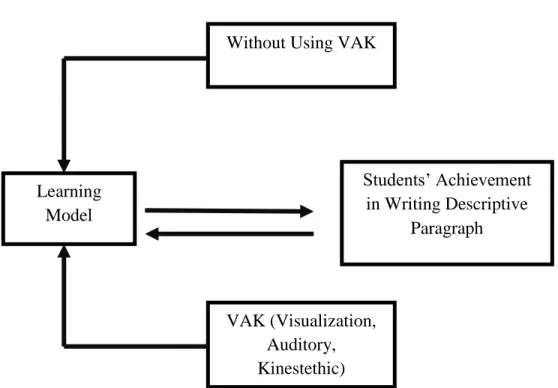
To make this conceptual clearer, so it can be following the draft bellow:
Figure 2.2 Conceptual Framework
E. Hypotheses
Based on the title is “ The Effect of VAK (Visualization, Auditory, Kinesthetic) Learning Model on Students‟ Achievement in Writing Descriptive Paragraph at Ten Grade in MAN Binjai”, the researcher has hypothesis that:
Without Using VAK
Students‟ Achievement in Writing Descriptive Paragraph Learning Model VAK (Visualization, Auditory, Kinestethic)
Ha : There is a significant effectiveness in VAK (Visualization, Auditory, Kinesthetic) Learning model students achievement in writing descriptive paragraph.
Ho : There is no significant effectiveness in VAK (Visualization, Auditory, Kinesthetic) Learning model students achievement in writing descriptive paragraph.
CHAPTER III
RESEARCH METHODOLOGY
A. Research Design
The researcher will conduct at MAS Al-Washliyah 30 Binjai which was located at Jl, Perintis Kemerdekaan, Kota Binjai. In this research, the writer will conduct an experimental method. An Experimental method is an approach to educational research in which an idea or hypothesis of causal effect is tested or verified by setting up situation then comparing a group which was treated. An Experimental research method purposes to know the effect of VAK in writing descriptive paragraph in class X.
The researcher will conduct in two groups. They are experimental and control group. The experimental group is the group will receive the treatment that is the use of peer groups study as an approach on teaching writing, while the control group is a group who will not exposed to the experimental treatment. In this most basic of experimental designs, the group receiving the treatment is call by the experimental group and the other group the control group.
Two groups to employ in this design: one group, the experimental group, receives a treatment (X) while the second group, the control group does not. Both groups to given a pretest and posttest. Firstly, the test was will done in both groups, experimental and control group. In experimental group taught by using VAK learning model and control group taught by without using VAK
learning model. Secondly, the result of the test will scored by using analytic scale. Thirdly, the means score of two groups were determined.
Finally, the two means will compared by applying t-test formula. T-test was using to determine if the students‟ result of the T-test, which taught by using the VAK learning model, was significant or not
The pretest-post test of control group design can diagrammed as shown below:
Table III. Research Design
Group Pretest Treatment Post Test
Experimental X1 VAK learning
model
X2
Control Y3 Without Using
VAK learning model
Y4
B. Population and Sample 1. Population
The population is a generalization region consisting of objects / subjects that have a certain quantity and characteristics set by the researcher to be studied and then drawn conclusions. In short, the population defined by as
a generalization of the results of research. Generalization can done on the object of research and can be done on the subject of research.23
The population of this research is all of the X grade in MAS Al-Wasliyah 30 Binjai that consist of two parallel classes. Each Class consists of 29 students. In this research, the writer chooses the X grade of MAS Al-Washliyah 30 Binjai.
2. Sample
The sample is part of the number and characteristics possessed by that population. Sampling occurs when large populations and researchers are unlikely to learn all that is in the population.24
Technique to choose the sample is random sampling. Random sampling is take the sample with random. The ways to use in random sampling is with lottery, with ordinate, or random from the table of bilangan random.25
Table IV. Sample
Group Samples
Class Students
Experimental X-1 29
23
Indra Jaya and Ardat, (2013), Penerapan Statistik Untuk Pendidikan, Bandung: Ciptapustaka Media Perintis, p. 20
24Ibid, p 32 25
Syahrum and Salim, (2016), Metodologi Penelitian Kuantitatif, Bandung: Ciptapustaka Media , p. 115
Control X-2 28
Total 57 Students
C. Data Collection
To obtain valid data for the appropriate analysis, the researcher used the following instrument:
1. Test
Test is a method of measuring a person‟s ability, knowledge, or performance in a given domain.26 Test is asset of question that answered by the students to measure the students‟ achievement in writing descriptive paragraph. Writing test items given each meeting after the action to know the achievement in writing descriptive paragraph. The writer uses pre- test and post-test. Pre-test test is give for students before the teacher uses VAK leaning model in teaching learning process. Post test is conducted after the VAK learning model is implemented. Pre-test and post test are to know the differences of the students‟ writing descriptive paragraph before and after the writer uses her learning model. It can seen in appendix 1.
D. Data Analysis
In this research, the data obtained from the experiment and control class. So, the data will analyzed by using descriptive analysis and inferential
26 H. Douglas Brown, (2003), Language Assessment Principles and Classroom Practices,
analysis. Descriptive analysis was used to know the mean, median, and standard deviation of the scores of the test. While inferential analysis that will used is t-test (student’s t).
1. Normality Test
Normality test will held to determine whether normal or abnormal researcher data or research variable.
a. The observation X1, X2, X3, …, …, Xn are served raw numbers Z1, Z2,Z3, … ,Zn using the formula. To count of raw numbers with the formulas:
=
̅X = Average sample S = Standard deviation
b. For each of these raw numbers using standard normal distribution is calculated odds F ( = P (Z ≤ )
c. Furthermore, in calculating the proportion that expressed by S ) then:
S ( ) =
d. Calculate F ) – S ) and define the absolute price determine the largest of difference F ( ) – S ( ) as Lo.
Homogeneity Test used to determine whether the sample variance has the same or homogeneous variance, test of homogeneity is using with the following formula:
F =
Criteria for testing Ho rejected if F ≥ F0,05 (v1, v2 ) where F0,05 (v1,v2)
obtained from the F distribution list with a chance of ɑ = 0,05 and ɑ = 0,01, whereas the v and v2 degrees of freedom each corresponding to df numerator and denominator of the formula above.
3. T-test
The data analyzed by using t-test formula. The parametric procedure for testing differences of group means is the t-test (sometimes student‟s t). The t-test can be used when there are two independent groups (e.g. experimental versus control, male versus female), and when the sample is paired or dependent (e.g. when pre-treatment scores are compared for a single group).
The formula of t-test (student‟s-t) was:
t =
̅
̅
√
T-test = the effect
X1 = Mean of post-test – Pre test in experimental group
X2 = Mean of Post-test – Pre-test in control group
= Variant of Pre-test – Post-test in experimental group = Variant of Pre-test – Post test in control group N1 = Sample in experimental group
N2 = Sample in control group
4. Scoring of Data
Scoring the students‟ work is a step to obtain quantitative information from each student. One of the ways to score or to evaluate the students‟ achievement in writing is rating scale. In using the rating scale, the scorer could make a rank order of the results of the students had the highest scores and which had the lowest scores.
The following scheme of rating scale is use to measure the students‟ achievement in their written product.
Table V. Analytical Scoring Rubric Adapted from Weigle27
Aspect Score Level/ Criteria
Content 30-27
26 - 22
21 - 17
16 - 13
Excellent to Very Good : knowledgeable – substantive – thorough development of thesis – relevant to assigned topic Good to Average : some knowledge of subject – adequate range – limited development of thesis – mostly relevant to the topic, but lacks detail
Fair to Poor : limited knowledge of subject – little substance – inadequate development of topic
Very Poor : does not show knowledge of subject – non-substantive – not pertinent – or not enough to evaluate.
Organization 20 – 18
17 – 14
13 – 10
9 – 7
Excellent to Very Good : fluent expression – ideas clearly stated/supported – succinct – well-organized – logical sequencing – cohesive
Good to Average : somewhat choppy – loosely organized but main ideas stand out – limited support – logical but incomplete sequencing
Fair to Poor : non-fluent – ideas confused or disconnected – lacks logical sequencing and development
Very Poor : does not communicate – no organization – or not enough to evaluate
Vocabulary 20 – 18 Excellent to Very Good : sophisticated range – effective word/ idiom choice and usage – word form mastery – appropriate
17 -14
13 - 10
9 – 7
register
Good to Average : adequate range – occasional errors of word/ idiom choice and usage but meaning not obscured
Fair to Poor : limited range – frequent errors of word/ idiom form, choice, usage – meaning confused or obscured
Very Poor : essential translation – little knowledge of English vocabulary, idioms, word form – or not enough to evaluate.
Language use 25 – 22
21 – 18
17 -11
10 – 5
Excellent to Very Good : effective complex constructions – few errors of agreement, tense, number, word order/function, articles, pronouns, prepositions
Good to Average : effective but simple constructions – minor problems in complex construction – several errors of agreement, tense, number, word order/ function, articles, pronouns prepositions but meaning seldom obscured
Fair to Poor : major problems in simple/ complex constructions – frequent errors of negation, agreement, tense, number, word order/ function, articles, pronouns prepositions and/ or fragments, run-ons, deletions – meaning confused or obscured Very Poor : virtually no mastery sentence construction rules – dominated by errors – does not communicate - or not enough to evaluate.
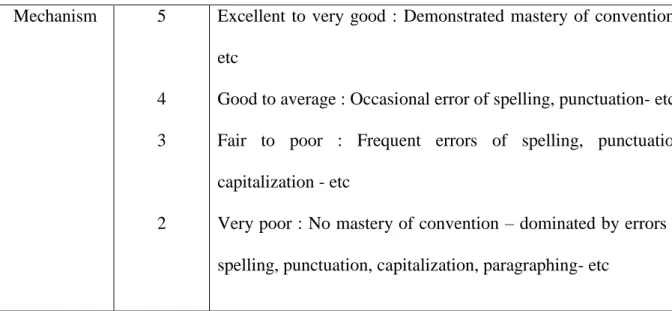
Mechanism 5
4 3
2
Excellent to very good : Demonstrated mastery of convention - etc
Good to average : Occasional error of spelling, punctuation- etc Fair to poor : Frequent errors of spelling, punctuation, capitalization - etc
Very poor : No mastery of convention – dominated by errors of spelling, punctuation, capitalization, paragraphing- etc
Score Instrument: - Content : 30 - Organization : 20 - Vocabulary : 20 - Language Use : 25 - Mechanism : 5 Total : 100 Final score = x 100
To classifying the score became numerical data, they should convert to numerical data, which had been processed of the scale of 0 to 100.
Criteria of Mastery Grade 91 – 100 Excellent 81 – 90 Very Good 71 – 80 Good 61 – 70 Fair 51 – 60 Poor
Less than 50 Very Poor
E. Research Procedure
The procedure of this research consist of two phase tests, they are: Pre-test and Post-Pre-test (treatment).
1. Pre-test
Pre-test is the first test that given to the students the both of sample classes there are experimental class and control class. In Pre-test, there is no certain treatment, because in teaching learning activity like usually that teacher teaching descriptive text with the students. The teacher sometimes give the explanation directly then give the exercise about descriptive text and then the students that analyzed they are paragraph itself. On the other hand, I
can give they are some paper and then students will write about descriptive text about „Lake Toba” without explanation before. Therefore, this tests that I will to do in pre-test.
2. Post- Test (Treatment)
The post-test will give after carrying out the pre-test phase. The aim of the post-test was to find out the effect of teaching presentation in both classes. The treatment will be given to the experimental class (X-1) treated by using Visualization, Auditory, Kinestethic learning model, while control class will be served by without using Visualization, Auditory, Kinestethic learning model.
The procedure of giving post-test or treatment can see in the following tables as below:
a. Treatment in Experimental Class
Table VII. The Treatment of Experimental Class
Activity Learning Activity
Teacher’s Activity Students’ Activity Pre-liminary activity
Motivation Greetings
Check the attendance
Greetings
list and motivate the students
Conveying objectives learning
Giving positive feelings about future learning experiences to students
teachers
Core activity on exploration Teams Dividing students into
some groups consists of 4-5 students (making group formation) based on clues from teachers
Joining the groups that divided by teacher
Teaching Groups
Giving the example paragraph of descriptive paragraph
Explain briefly about descriptive paragraph Reading and understanding about paragraph of descriptive paragraph Listening to teacher‟s explanation
nature “Bukit Lawang” that short film by projector
that film
Team Study Giving the instructions to students to make descriptive paragraph based on the theme in that film
Ask students to presentation they are descriptive paragraph in front of class
Teacher collected all the papers that students write together
Giving the motivation to students that have the mistakes of they are make based on the film
Students write or describe the descriptive paragraph based on theme that in the film “Bukit Lawang”
The students present the descriptive paragraph in front of class, and activate they are body to describe about the paragraph. Students give the paper
Students listening the instructions of teacher and analyze they are mistaken
Core activity on confirmation
Conclusion Teacher and students concluded the lesson about descriptive paragraph and teacher giving the reflection to students
b. Treatment in Control Class
Table VIII. The Treatment of Control Class
Activity Learning Activity
Teacher’s Activity Students’ Activity Pre-liminary activity
Motivation Greetings
Check the
attendance list and motivate the students
Explain the objectives learning
Greetings
Get the responds from teachers
Whilst-teaching activity 1. Exploration Explaining the students about the material of descriptive
paragraph and how to make the paragraph
Listening to the teacher‟s
explanation
2. Elaboration Giving the test to the students
Doing the test that given by teacher Post-teaching activities
Evaluation Evaluating the
students‟ error in the test
Listening to the teacher
CHAPTER IV
FINDING AND DISCUSSIONS
A. Findings
This study was conducted by applying an experimental research. There were two groups in this research, namely experimental and control group. This research applied a writing test that the total score is 100. The pre test was given before the treatment and the post test was given after the treatment. The researcher gave the treatment to students in the experimental group by applying visualization, auditory, kinestethic learning model while control group taught by conventionally.
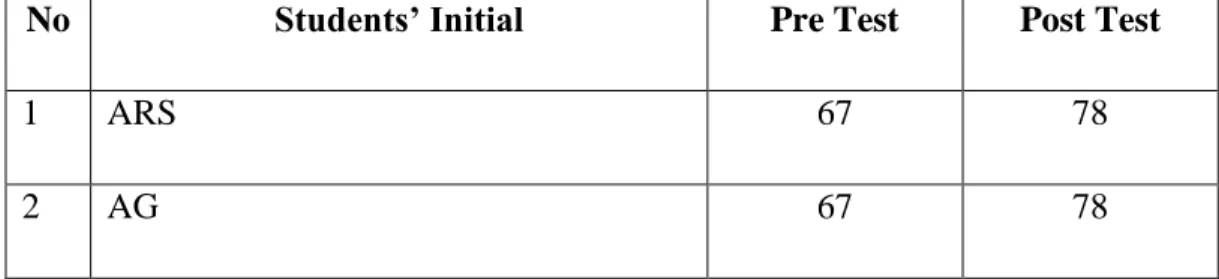
The students‟ writing test was scored by calculating the five components scale such as content, organization, vocabulary, language use, and mechanics. After conducting the research, the researcher got the data of the students‟ scores in pre-test and post-test from both experimental and control group. For more detail, it can be seen in the following table.
Table IX
The Score of Pre Test and Post Test of Experimental Group
No Students’ Initial Pre Test Post Test
1 ARS 67 78
3 ANP 36 66 4 AAS 65 75 5 AAP 65 78 6 ARP 65 78 7 AAR 56 75 8 DAP 67 78 9 DEP 65 78 10 DIP 67 78 11 ES 40 66 12 FA 56 88 13 FR 65 78 14 IM 56 66 15 IFA 65 75 16 LK 67 80 17 MFR 40 66 18 MHB 40 75 19 M 56 78 20 NAK 56 88 21 NA 36 88
22 PS 40 80 23 PF 40 75 24 RU 67 75 25 RA 65 80 26 SA 56 88 27 TUS 65 80 28 WYN 40 75 29 YP 40 66 Total ∑ = 1610 ∑ = 2232 Mean 55.51 76.96
Based on the data above, the result of total of decrease in Pre-test is 1610, and the mean is 55.51, and in Post-test I is 1891 and the mean is 65.20. Meanwhile the total of decrease of Post-test II is 2232, and the mean is 76.96
Table X
The Score of Pre Test and Post Test of Control Group
No Students’ Initial Pre Test Post Test
1 AA 44 56
3 AH 50 60 4 BP 50 66 5 DABS 56 68 6 DFYP 56 66 7 DRA 44 60 8 DP 44 60 9 DD 50 60 10 HT 56 66 11 ISR 56 68 12 MRST 44 56 13 MSA 44 60 14 MA 50 66 15 MCI 50 60 16 MR 56 66 17 NFA 50 68 18 NN 60 66 19 NA 67 75 20 PI 67 75 21 R 67 75
22 SM 56 66 23 SC 50 66 24 SZ 44 56 25 SIM 48 66 26 SPR 67 75 27 SS 48 66 28 VR 60 75 Total ∑ = 1482 ∑ = 1838 Mean 52.92 65.64
Based on the data above, the result of total of decrease in Pre-test is 1482 and the mean is 52.92. Meanwhile the decrease of Post-test is 1838 and the mean is 65.64
1. Data Analysis
a. Normality Testing of Experimental Group Table XI
Frequency Distribution of Pre Test in Experimental Group
NO Xi Fi FiXi Xi2 FiXi2
1 36 2 72 1296 2592
2 40 7 280 1600 11200
5 65 8 520 4225 33800
6 67 6 402 4489 26934
Total 29 1610 18467 93342
Based on the data above, the result of FiXi2 is 93342, the result of FiXi is 1610.
Then the following is the calculation of mean, variant and standard deviation.
a. Mean
̅
=
Where:
̅ = Mean of variable x ∑FiXi = Total number of score
∑Fi = Number of sample So,
̅
=
=
= 55.51 b. Variant Where: S2 = Variant N = Number of sampleSo, S2 =
=
=
=
= 141.40
c. Standard Deviation S = √=
√= 11.89
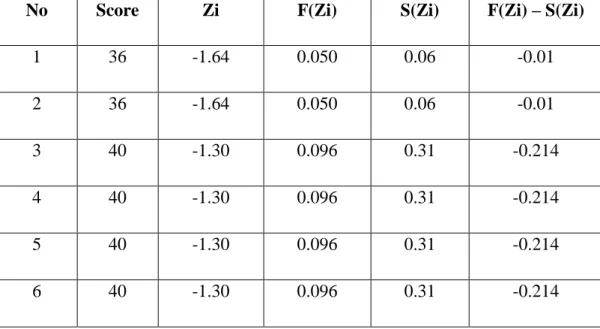
After getting the calculation of mean, variant and standard deviation, then the next step is to found out the normality of the test. It means that the test was given to the students is observed by Liliefors test. The calculation of normality writing descriptive text can see in the following table:
Table XII. Normality Testing of Pre Test in Experimental Group
No Score Zi F(Zi) S(Zi) F(Zi) – S(Zi)
1 36 -1.64 0.050 0.06 -0.01 2 36 -1.64 0.050 0.06 -0.01 3 40 -1.30 0.096 0.31 -0.214 4 40 -1.30 0.096 0.31 -0.214 5 40 -1.30 0.096 0.31 -0.214 6 40 -1.30 0.096 0.31 -0.214
7 40 -1.30 0.096 0.31 -0.214 8 40 -1.30 0.096 0.31 -0.214 9 40 -1.30 0.096 0.31 -0.214 10 56 0.04 0.515 0.51 0.005 11 56 0.04 0.515 0.51 0.005 12 56 0.04 0.515 0.51 0.005 13 56 0.04 0.515 0.51 0.005 14 56 0.04 0.515 0.51 0.005 15 56 0.04 0.515 0.51 0.005 16 65 0.79 0.785 0.79 -0.005 17 65 0.79 0.785 0.79 -0.005 18 65 0.79 0.785 0.79 -0.005 19 65 0.79 0.785 0.79 -0.005 20 65 0.79 0.785 0.79 -0.005 21 65 0.79 0.785 0.79 -0.005 22 65 0.79 0.785 0.79 -0.005 23 65 0.79 0.785 0.79 -0.005 24 67 0.96 0.831 1.00 -0.169 25 67 0.96 0.831 1.00 -0.169
26 67 0.96 0.831 1.00 -0.169 27 67 0.96 0.831 1.00 -0.169 28 67 0.96 0.831 1.00 -0.169 29 67 0.96 0.831 1.00 -0.169 Total 1610 Lo = 0.005 Mean 55.51 Lt = 0.032 a. Finding Z score Formula: Zi 1 = ̅ Zi 1 = Zi 2 = = -1.30 Zi 3 = 0.04 Zi 4 = Zi 5 = b. Finding S (Zi) S (Zi) = = 0.06 = 0.31 = 0.51