Accepted Manuscript
Link-Based Multi-Class Hazmat Routing-Scheduling Problem: A Multiple Demon Approach
W.Y. Szeto , R.Z. Farahani , Agachai Sumalee
PII: S0377-2217(17)30083-8
DOI: 10.1016/j.ejor.2017.01.048
Reference: EOR 14229
To appear in: European Journal of Operational Research Received date: 25 May 2016
Revised date: 25 January 2017 Accepted date: 29 January 2017
Please cite this article as: W.Y. Szeto , R.Z. Farahani , Agachai Sumalee , Link-Based Multi-Class Hazmat Routing-Scheduling Problem: A Multiple Demon Approach,European Journal of Operational Research(2017), doi:10.1016/j.ejor.2017.01.048
This is a PDF file of an unedited manuscript that has been accepted for publication. As a service to our customers we are providing this early version of the manuscript. The manuscript will undergo copyediting, typesetting, and review of the resulting proof before it is published in its final form. Please note that during the production process errors may be discovered which could affect the content, and all legal disclaimers that apply to the journal pertain.
ACCEPTED MANUSCRIPT
ACCEPTED MANUSCRIPT
Highlights
a hazmat routing and scheduling problem for a general transportation network is addressed; a multiple hazmat classes when incident probabilities are unknown or inaccurate are investigated; a multi-demon formulation is proposed to model the problem;
the proposed formulation is transformed into other forms which are proved to be equivalent; a solution procedure, numerical examples, properties, a caste study and insights are presented.
ACCEPTED MANUSCRIPT
ACCEPTED MANUSCRIPT
Link-Based Multi-Class Hazmat Routing-Scheduling Problem:
A Multiple Demon Approach
W. Y. Szeto 1, R. Z. Farahani 2*, Agachai Sumalee 3
(1) Department of Civil Engineering, The University of Hong Kong, Hong Kong (2) Department of Management, Kingston Business School, Kingston University, UK
(3) Department of Civil and Environmental Engineering, The Hong Kong Polytechnic University, Hong Kong
ABSTRACT
This paper addresses a hazmat routing and scheduling problem for a general transportation network with multiple hazmat classes when incident probabilities are unknown or inaccurate. A multi-demon formulation is proposed for this purpose. This formulation is link-based (i.e., the decision variables are link flows) and can be transformed into other forms so that a wide range of solution methods can be used to obtain solutions. This paper also proposes a solution strategy to obtain route flow solutions without relying on exhaustive route enumeration and route generation heuristics. Examples are set up to illustrate the problem properties, the method of obtaining route flows from link flows, and the computational efficiency of the solution strategy. Moreover, a case study is used to illustrate our methodology for real-life hazmat shipment problems. From this case study, we obtain four key insights. First, to have the safest shipment of one type of hazmat, different trucks carrying the same type of hazmat need to take different routes and links. Second, in case of multiple-hazmat transportation, it is recommended to use different routes and links for the shipment of different hazmat types. This may increase travel time but can result in safer shipment. Third, if the degree of connectivity in a transportation network is high, the shipment company may have multiple solutions. Fourth, the hazmat flows on critical links (whose removal would make the network disconnected) must be distributed or scheduled over different periods to have safer shipment.
Keywords: transportation;vehicle routing; non-cooperative game; hazardous materials; scheduling.
ACCEPTED MANUSCRIPT
ACCEPTED MANUSCRIPT
1. INTRODUCTION
According to US Department of Transportation (DOT), a hazardous material (or hazmat in short) is defined as any substance or material capable of causing harm to people, property, and the environment. Hazmats are classified into 9 classes according to their physical, chemical, and nuclear properties (Keller and Associates, 2001). They are transported daily in many countries because the demand and supply locations are always different. The shipments of hazmats can be substantial. In some countries such as the USA, the volume and weight of hazmat shipments even increase over time. In 1998, 800,000 domestic daily shipments of hazmats were estimated to be transported in the USA whereas in 2009, the estimate increased to almost 1 million (US DOT, 2014).
Given substantial shipments of hazmats, the related accidents do happen. Moreover, the accidents can occur anywhere along the trips, but these accidents only correspond to a small proportion of traffic accidents. The annual number of transportation accidents in the USA was about 6 million in 2008 (US DOT, 2008) in contrast to the approximately 20,340 hazmat transportation incidents in the same year (US DOT, 2009). According to the recent report of PHMSA (2014), between 2009 and 2013, the number of hazmat incidents increased by 3.8 percent. The number of hazmat incidents in a country is still miniscule compared to the number of road accidents currently. To get some ideas regarding the number of hazmat incidents in the US, interested readers may refer to (http://www.phmsa.dot.gov/hazmat/library/data-stats/incidents). However, the total number of injuries and fatalities from each hazmat accident is drastically higher than that from a normal accident. Moreover, the release of these materials during transportation can be extremely undesirable as this can cause environmental pollution in addition to economic damage, injuries, and fatalities (Smith, 2009). Meanwhile, many transportation companies in a country are in charge of hazmat shipments. These transportation companies need to consider safety and environmental issues and legal limitations to choose the best routes for their fleets but the regulations and constraints do not often apply to many non-hazmat trips with possible accidents. This is probably why the shipment of these hazardous materials has drawn considerable attention over the last few decades.
The traditional approach to modeling the routing and/or scheduling decisions assume that incident probabilities are known (e.g., Meng et al., 2005). The alternative approach is that these probabilities are unknown. To deal with this assumption, non-cooperative game theory was often used in the literature (e.g., Bell, 2000, 2003, 2004; Bell and Cassir, 2002; Cassir et al., 2003; Szeto et al., 2006; Laporte et al., 2010; Qiao et al., 2014). This theory was also used when attack probabilities in the defender-attacker framework were assumed to be known (e.g., Dadkar et al., 2010a,b; Reilly et al., 2012) or it was assumed that there was some information on link incident probabilities (e.g., Schmöcker, 2010). Here, non-cooperative games are those, in which “players are unable to make enforceable contracts outside of those specifically modeled in the game. Hence, it is not defined as games in which players do not cooperate, but as games in which any cooperation must be self-enforcing”. (Shor, 2005).
This paper addresses the problem of routing and scheduling hazardous materials in a general transportation network with multiple origin-destination (OD) pairs, multiple classes of hazmats, and unknown link incident probabilities: Multiple dispatchers are responsible for sending out their vehicles to transport various classes of hazmats in a network with multiple OD pairs and have both route and departure time choices on a given day. Moreover, during the journey, the dispatchers can decide their hazmat vehicles to stop at some locations and their stop duration before continuing the journey. However, the probability of an incident to occur for each combination of route choice, departure time choice, intermediate stopping location choice, and duration choice is unknown. If an incident occurs, the impact of the incident depends on the type and volume of hazmat involved. We consider
ACCEPTED MANUSCRIPT
ACCEPTED MANUSCRIPT
multiple hazmat vehicles, in which each individual vehicle may encounter an incident. This does not mean that the incident must be between two or more than two hazmat vehicles. Any incident in which a hazmat vehicle is involved is related to this research. This research also looks at the problem from the company’s perspective while observing the country-wide restrictions and approved routes.
The problem is considered to be a non-cooperative game between multiple dispatchers and multiple demons on a space-time expanded network. A demon is an imaginary evil entity that intentionally attacks a link to cause explosion or an incident on the link when a hazmat vehicle is on the link. Each demon has enough knowledge on all links, leading to the most number of fatalities and injuries when a particular link is selected. Each demon must cause an incident on one and only one link. Each demon aims at seeking its link selection strategy to maximize the impacts of the incident. The game is non-cooperative between dispatchers and demons because the dispatchers and the demons make decisions independently. We assume that the shipment between an OD pair is responsible by just one private company, and a company cannot handle the shipment between more than one OD pair. Therefore, the game among dispatchers is also non-cooperative. However, this game can be easily extended to consider cooperation between dispatchers, which will be mentioned in the conclusion.
The problem is formulated by both route- and link-based approaches. The route-based approach develops the formulation with route flows as decision variables whereas the link-based approach develops the formulation with link flows as decision variables. The equivalence of the route- and link-based problems, in terms of the maximum expected payoff to each demon, is proved. Both problems are formulated as a mixed system of equations and inequalities. The link-based problem is also reformulated into a variational inequality problem (VIP), a nonlinear complementary problem (NCP), an unconstrained minimization problem (UMP), and a fixed point problem (FPP) to allow a wider range of solution methods developed for VIPs, NCPs, UMPs, and FPPs to solve the proposed link-based problem.
Unlike solving the route-based problem, solving the link-based VIP, NCP, UMP, FPP, and mixed system of equations and inequalities do not require exhaustive route enumeration or route generation heuristics. However, the solutions to these formulations are link flows and link selection probabilities, which cannot tell the decision makers (or dispatchers) how to randomly select routes, departure times, intermediate stopping locations, and the corresponding stopping durations. This paper proposes a solution strategy, which is to firstly solve one of the link-based formulations by existing solution methods and then deduce route flows from link flows by our proposed route flow extraction algorithm. The route flow extraction algorithm is proved to be convergent. An example is given to illustrate the algorithm. Numerical examples are also provided to illustrate the problem properties. Problem insights and computational performance of the solution strategy are presented. Finally, a case study of Singapore is used to illustrate our proposed methodology for real-life hazmat shipment problems. The contribution of this paper includes the following: (i) This paper proposes link-based models to determine the routes and schedules of hazmat shipment under the situation of unknown incident probabilities, (ii) it introduces a solution strategy to obtain solutions on exhaustive route enumeration and route generation heuristics, and (iii) it presents the problem properties and problem insights.
The remainder of this paper is organized as follows: Section 2 reviews the literature of the subject. Section 3 presents the models and discusses their properties. Section 4 depicts the proposed solution strategy. Section 5 presents a numerical study. Section 6 focuses on algorithm complexity and computational results. Section 7 highlights the practical aspects of the formulated problem using a case study. Section 8 concludes the paper and
ACCEPTED MANUSCRIPT
ACCEPTED MANUSCRIPT
provides some future research directions.
2. LITERATURE REVIEW
Several streams of research are related to our work. Therefore, the literature is organized in terms of these streams as follows:
Hazmat routing and scheduling with known incident probabilities:To mitigate the level of the risk involved in hazmat transportation, a lot of research was done in the past. Comprehensive review papers on this research area can be found in List et al. (1991), Erkut and Verter (1995), Erkut and Verter (1998), and Verter and Kara (2008). As appropriate hazmat routing and scheduling decisions can reduce the level of the risk involved, most previous hazmat shipment studies focus on the planning of (1) routes (e.g., Batta and Chiu, 1988; Gopalan et al., 1990; Jin et al., 1996; Chang et al., 2005; Akgün et al., 2007; Carotenuto et al., 2007; Kang et al., 2014), (2) schedules (e.g., Cox and Turnquist, 1986), and (3) both routes and schedules simultaneously (e.g., Zografos and Androutsopoulos, 2004; Meng et al., 2005). These studies assumed that link incident probabilities were known. For the low-probability events like incidents involving hazardous materials, these probabilities are usually unknown, because these events are rare and there is often insufficient data to estimate these probabilities (Bell, 2006). Over the time that it would take to accumulate adequate data to estimate the probabilities, circumstances may have changed (say, accident black spots may have been treated), making the calculated probabilities obsolete (Bell, 2006). Moreover, most dispatchers, when dealing with high-consequence events, exhibit risk aversion (Bell, 2006). This leads to one line of research given in the next subsection.
Hazmat transportation with unknown incident probabilities:To deal with unknown incident probabilities and risk aversion behaviors of dispatchers, the non-cooperative game approach was used in modeling hazmat routing (e.g., Bell, 2006, 2007). In particular, Bell (2006) proposed a minimax formulation to determine the safest set of routes and the safest share of traffic among these routes for hazmat shipment. This formulation has a game theory interpretation and can be considered a non-cooperative, zero-sum game between a dispatcher seeking the set of routes that minimize the expected population affected and a demon seeking to maximize the expected population affected by causing an incident on one link. Bell (2007) further considered the travel cost in the minimax formulation. Bell (2006, 2007) only considered route planning. In fact, incorporating scheduling decisions for hazmat shipment can further reduce the level of the risk involved (Nozick et al., 1997). Szeto (2013) further considered scheduling decisions. However, Bell (2006, 2007) and Szeto (2013) considered each origin-destination (OD) separately. In reality, there is interaction of hazmat shipment between OD pairs. Two or more hazmat shipments of the same class or different classes can use the same road section and have an incident at the same time. The impact of the incident can affect more people around the incident location compared with the incident due to only single class of hazmats because of the reaction between different classes of hazmats or a higher volume of hazmats involved. It is therefore important to model multiple OD pairs and multiple classes of hazmats. In this paper, we potentially “allow” several hazmat shipments of the same class or different classes using the same road section and having an incident simultaneously. However, this does not mean that several hazmat shipments must use the same road section. On the contrary, usually the model chooses different routes for different hazmat classes to avoid having large flows and consequently large possible accidents, injuries, and fatalities. In practice, the approved hazmat routes (inputs of our model and also shipping companies) in various countries are always the
ACCEPTED MANUSCRIPT
ACCEPTED MANUSCRIPT
same for different classes of hazmat shipments. However, for any reason, if a specific hazmat shipment cannot use a link, we can implement this constraint to our model by setting the flow on the forbidden link equal to zero. Of course, this can reduce our solution search space, which is a positive point for models that contain integer variables (because it usually reduces computational efforts).
Time-dependent hazmat routing and scheduling: Another line of research is time-dependent hazmat routing and scheduling, in which link travel times are time-varying. In this context, Haghani and Chen (2003) assumed that travel times over links could vary by time of day; they considered risks on routes, risks at nodes, and travel times and mathematically formulated the problem. In our research, we also consider that travel times can vary by time of day but our focus is more on reducing the number of affected people in case of emergency rather than explicitly minimizing travel time. Meanwhile, spreading risks in both time and space for time-dependent networks was suggested by Bersani et al. (2010). Toumazis (2012) and Toumazis and Kwon (2013) used the concept of conditional value-at-risk (CVaR) for mitigating hazmat transportation risks in a time-dependent network and tested the idea on the road network of Buffalo's, NY. Androutsopoulos and Zografos (2010) addressed a hazmat routing-scheduling problem, in which the two criteria, cost and risk, are time-dependent. Androutsopoulos and Zografos (2012) also considered dynamic travel times in a city network for their hazmat routing and scheduling problem and formulated it as a bi-objective problem. Similarly, we also consider that hazmat incident risk changes over time. Unlike the abovementioned research studies, we do not exploit a bi-criteria method to include both criteria. On the contrary, similar to the concept of lexicographic method, we apply travel time (not travel cost) and risk sequentially. To be more specific, we implicitly consider travel time to create the transportation network; after that we inject the element of time/scheduling to the network to spread potential hazmat explosion risk over time. Although we are also interested in shortest travel distance/time, the most important criterion in our hazmat routing problem is to use the safest set of routes. Therefore, instead of considering the only shortest route between any OD pair, we are interested in considering several (i.e., more than one) routes that are short/fast enough to allow us split the hazmat incident risk among them.
Security considerations in hazmat routing and scheduling: Huang et al. (2003) believed that routing hazmat vehicles should not only ensure the safety of travellers but also consider the risk of the hazmat being used as a mass destruction weapon. They evaluated the risk of hazmat transportation by integrating geographic information systems (GIS) and the analytic hierarchy process (AHP) to determine the weights of various criteria of the alternative routes. Huang et al. (2004) used a set of evaluation criteria in hazmat routing with the special focus on criteria related to security. Both of these methods were tested on a case study in Singapore. DeLorenzo et al. (2005) described a real-life project related to the benefits of wireless communications systems with GPS technology in enhancing the safety, security, and efficiency of hazmat transportation. Security and safety in hazmat routing is not only limited to road transportation mode. For example, Gordon and Young (2015) focused on hazmat trains to address the rules regulating the movement and handling of hazmats and explore the security of how the train hazmat routing information can be safeguarded while ensuring that first responders and affected communities have what is needed to address the risks and be able to effectively respond to incidents. In our research, we also consider a risk-averse strategy with the special focus on spreading risks in both space and time. Unlike Huang et al. (2003) who used a multi-attribute technique, we exploit a non-cooperative game theoretic approach. Moreover, Huang et al. (2004) used a meta-heuristic technique to solve their problem while we analytically model and solve our
ACCEPTED MANUSCRIPT
ACCEPTED MANUSCRIPT
problem.
Demon, covert attacks, and hazmat transportation: In this research, our game theoretic approach is based on imaginary demons playing the role of attackers. In game theory, there is a big difference between games between intelligent opponents and games against nature. The latter does not exclude win-win solutions but the former excludes these solutions. Imaginary demons in our game theoretic approach are responsible for implementing covert attacks, which is based on the worst-case situation in high-consequence-low-probability events in case of lack of sufficient historical data. In the literature, few scholars exploit such concept to connect hazmat and covert attacks. For instance, Yates (2008) introduced mathematical models based on the hypercube spatial queuing model for locating sensors within a large geographic region to detect covert attacks using hazmat vehicles; the models were tested on a case study within the region of Los Angeles County, California. Yates et al. (2011) considered two aspects in the protection of infrastructures from covert attacks: i) the optimal location of sensors to detect vehicles posing potential threats and ii) the sizing of the interception team and the placement of these resources on the network. Yates and Casas (2012) investigated how GIS can assist in a critical infrastructure protection problem. They considered a region, in which an attacker plans to attack multiple targets; the model helps the defender analyse the resource allocation strategy in the network. Yates et al. (2012) examined this resource allocation problem in an urban environment using a bi-level mixed integer and hypercube queuing model. In our paper, some imaginary demons may be considered to be those exploding the hazmat consignments or causing accidents; the number of demons is considered a known input. The more risk averse the model user is, the more number of demons are used in modeling. The model is developed based on a zero-sum game to exclude win-win situations.
Acyclic networks in hazmat routing: The hazmat routing scheduling problem in this research is based on acyclic networks. The requirement of acyclic network may seem restrictive. In the literature, many scholars including Klein (1991), Nozick et al. (1997), Meng et al. (2005), Bell (2006), and Szeto (2013) explicitly considered acyclic networks to model and solve such problems. While considering acyclic networks is one of our basic assumptions, our solution procedure proposed in the later part of this paper (which is used to deduce route flows from link flows) is not started with an acyclic network but we convert it to acyclic using a conversion that was originally designed for the connectivity test in the graph theory context. This conversion implicitly and partially applies the shortest travel distance criterion not allowing a hazmat vehicle to travel on a cycle going back to a node that has already been visited. To sum up, we can use a cyclic diagraph as an input to the solution procedure but convert it to an acyclic network.
3. FORMULATIONS
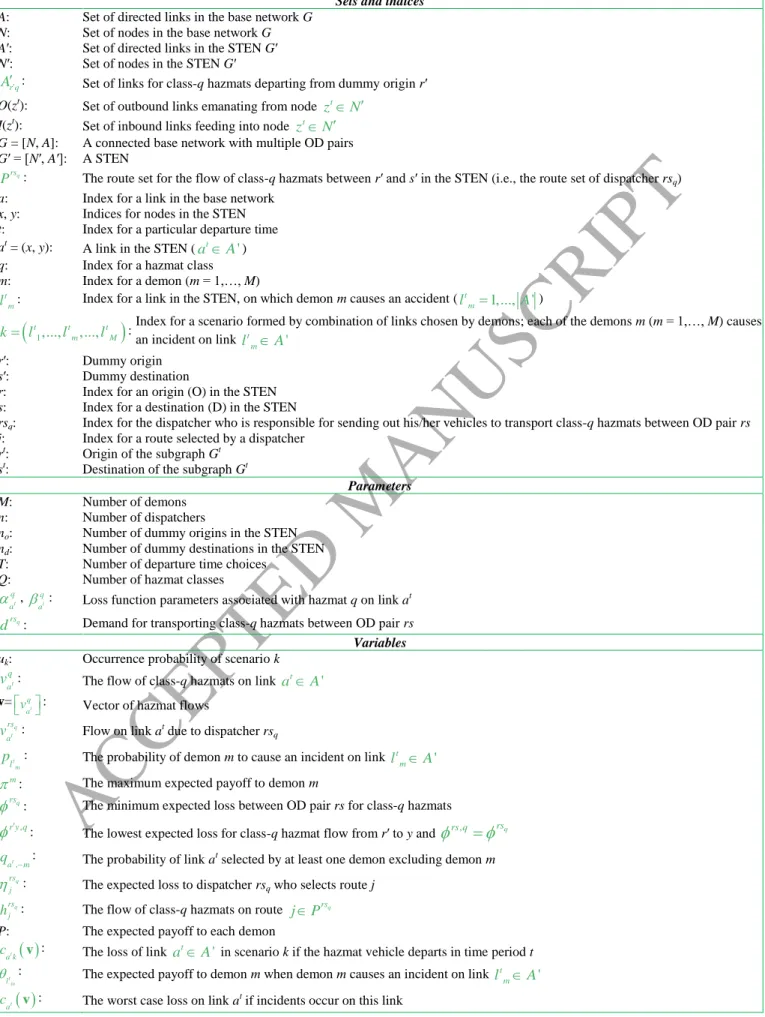
In the section, we first define the concept of Space-Time Expanded Network (STEN) that helps us to formulate the study problem as a mixed system of equations and inequalities using route- and link-based approaches. We then prove the equivalent between route- and link-based problem, followed by the reformulation of the link-based mixed system of equations and inequalities into a VIP, an NCP, a UMP, and a FPP, and the discussion on their problem properties. The notations for the formulations are given in Table A in the appendix.
3.1. Space-Time Expanded Network Representation
ACCEPTED MANUSCRIPT
ACCEPTED MANUSCRIPT
set of directed links. The links represent road segments whereas the nodes represent intersections, the origins, or the destinations of hazmat shipments. These links and nodes may only be opened for certain time periods due to
transportation policies. Based on this network, a space-time expanded network (STEN)
G
N A
,
is constructed to capture T departure time choices as well as waiting choices of the problem, where N andA
are respectively the set of nodes and directed links of the STEN. The STEN comprisesn
o dummy origins,n
d dummy destinations, (n
o+n
d)T dummy links, and T connected subgraphsG
t. Each connected subgraph represents the transportation network for any shipment of hazmats departing at a particular timet
with each travel link in a subgraph corresponding to one link in the base network at that time. If the base network modeled does not changeover time, each subgraph is the same as each other. Except
G
T, each subgraph Gt is connected to Gt1 throughwaiting links,each of which represents a share of traffic for hazmat shipment waiting/stopping at a particular node
for one period. Each origin
r
t (destinations
t) in subgraph Gt is connected from (to) the corresponding dummy origin r (destination s) by one dummy link. The dummy links are used for modeling departure time choice. The special case is that the STEN has only subgraph (i.e.,T
1
) with one origin and destination, which represents the pure routing problem with single OD pair as discussed in Bell (2006). In this case, the two dummy links can be removed.The expanded network in this paper differs from the classical space-time network like the one in Yang and Meng (1998) as follows:
1. Travel links in this paper are horizontal whereas they are inclined in the classical space-time expanded network, because unlike the classical space-time expanded network, travel time is not explicitly considered in our network. In the later sections, using the concept of minimum spanning tree, we consider travel time in the expanded network prior to solving the hazmat routing-scheduling problem. However, we can easily modify the expanded network to incorporate travel time by assuming all travel links having the same travel time and by adding more nodes and travel links in the resulting network.
2. There is no queuing link in the expanded network. Waiting links can be considered to be queuing links but we do not use queuing theory techniques because the number of shipments/trucks dispatched by the shipment company compared with all other types of vehicles on a road transportation network is very small. Additionally, the problem is solved at the tactical level but queue length can be considered an operational issue.
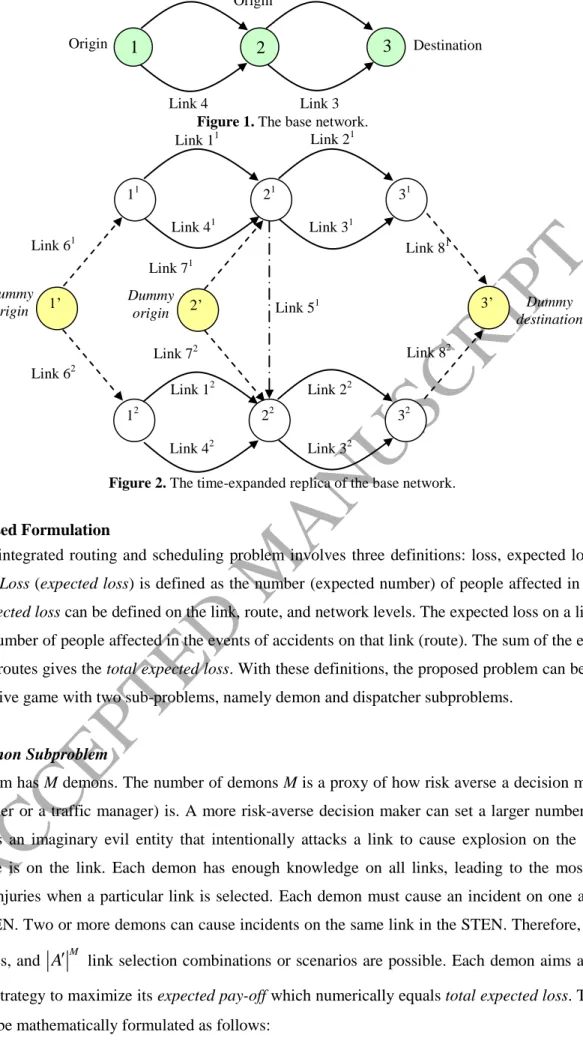
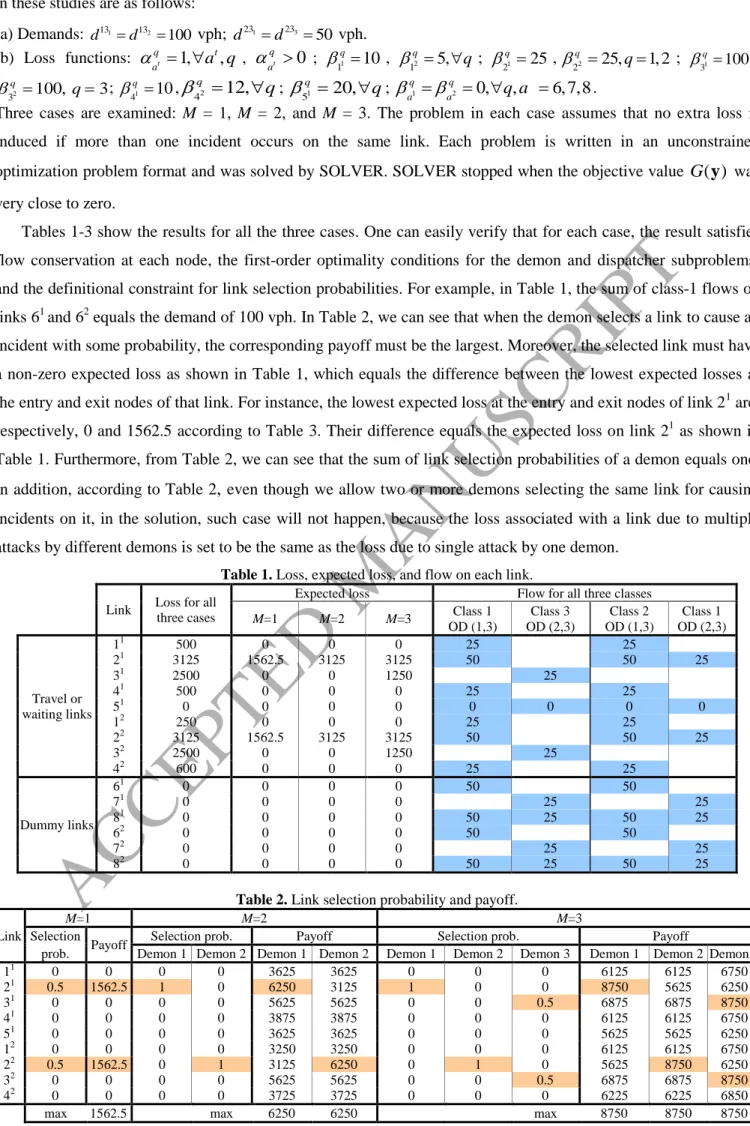
An example of a base network with two OD pairs is given in Figure 1. The corresponding STEN considering two departure time choices (one for the daytime, one for the night time) is given in Figure 2, where the solid, dashed, and dash-dotted arrows represent travel, dummy, and waiting links, respectively. For the ease of reference,
t
a
is used to denote a link in the STEN. Ifa
is not greater than the number of links in the base networkA
,atA' is a travel link and corresponds to linka
in the base network. Ifa
is greater than the sum of the numbers of travel and waiting links, then atA' is a dummy link. Otherwise, atA' is a waiting link.ACCEPTED MANUSCRIPT
ACCEPTED MANUSCRIPT
Figure 1. The base network.
Figure 2. The time-expanded replica of the base network.
3.2. Route-based Formulation
The proposed integrated routing and scheduling problem involves three definitions: loss, expected loss, and total expected loss. Loss (expected loss) is defined as the number (expected number) of people affected in the event of accidents. Expected loss can be defined on the link, route, and network levels. The expected loss on a link (route) is the expected number of people affected in the events of accidents on that link (route). The sum of the expected loss on all links or routes gives the total expected loss. With these definitions, the proposed problem can be modeled as a non-cooperative game with two sub-problems, namely demon and dispatcher subproblems.
3.2.1. The Demon Subproblem
This subproblem has M demons. The number of demons M is a proxy of how risk averse a decision maker (e.g., a transport planner or a traffic manager) is. A more risk-averse decision maker can set a larger number of demons. Each demon is an imaginary evil entity that intentionally attacks a link to cause explosion on the link when a hazmat vehicle is on the link. Each demon has enough knowledge on all links, leading to the most number of fatalities and injuries when a particular link is selected. Each demon must cause an incident on one and only one link in the STEN. Two or more demons can cause incidents on the same link in the STEN. Therefore, each demon
has
A
choices, andA
M link selection combinations or scenarios are possible. Each demon aims at seeking its link selection strategy to maximize its expected pay-off which numerically equals total expected loss. The expected payoff P can be mathematically formulated as follows:
t t k k a ka
P
u c
v
, (1) whereu
k is the probability of scenariok
.3’ 11 Link 21 31 21 Link 31 Link 81 1’ Dummy origin Link 51 Link 61 Link 62 Link 82 2’ Link 71 Link 72 Dummy origin Dummy destination 12 22 32 Link 12 Link 22 Link 32 Link 41 Link 42 Link 11
3
1
2
Link 3 Destination Origin Origin Link 4 Link 1 Link 2ACCEPTED MANUSCRIPT
ACCEPTED MANUSCRIPT
The scenario probability
u
k is determined by the link selection strategy. Let t ml
p
be the probability of demonm
to cause an incident on link ltmA' , and let
lt1,...,ltm,...,ltM
be the scenario where each demon
1,...,
m m
M
causes an incident on a particular link ltmA'. By assuming that all demons select their links independently, the probability of scenariok
l
t1,...,
l
tm,...,
l
tM
in (1) can be expressed in terms of tm l
p
as 1 t m M k l mu
p
. (2) In (1),c
a kt
v
is the loss of link 't
a A in scenario
k
if the hazmat vehicle departs in time period t. The loss
t a kc
v
is a function ofv
= t q av
, where t q av
is the flow of class-q
hazmats on link atA', because the impact to the people highly depends on the flow magnitude and class of hazmats passing through atA'. The loss
ta k
c
v
also depends on departure time period t as the human activity pattern is time-dependent. The loss is defined as
1 ,( ..., ,..., ) 0 , 1,...., , otherwise, t t t t t m M t t t i a k a l l l a a l i M c c c v v v (3) where t
ac v is the worst case loss on link
a
t if incidents occur on this link. The worst case loss t
a
c v is the population inside a circle of a given impact radius, centered at any point on link aA, and the impact radius depends on hazmat class and its volume. Note that if atA' is a dummy link, we have t
a
c v =
c
a kt
v
= 0 bydefinition because no population is around the link. If atA' is a waiting link, the worst case loss cat
v is thetime average loss at node a AN between periods
t
and t1 in scenariok
. The population density of a node may be different from period t to t + 1. That is why we consider the time average loss at the node between periods tand t + 1. The time average concept should also be applied to a travel link when the change in population density is relatively large over the time spent on that link. We can set the damage equal to zero if the vehicle is waiting in a safe location where it is sufficiently far away from residential areas. Alternatively, without loss of generality, we can consider the loss on the waiting link as the maximum loss at the node between periods t and t + 1.
By substituting (2) into (1), the payoff to each demon can then be written as follows:
1 1 , ( ,..., ) 1 ... ... t t t t t t b M t t t t t M M k a k k a k l a l l k k b a a l l a P u c u c p c
v
v
v .Based on the above condition, we can derive the derivative
t m l dP dp and let it be
ltm . Then,
1 1 ,( ..., ,..., ) 1, 1 1, 1 t t t t t t m t t t b t m M b M n n n M l l a l l l b b m l l b m l a p c
v , (4) which can be interpreted as the expected payoff to demonm
when demonm
causes an incident on linkl
tm
A
'
. Let alsomax
t t m m m l l
(5)ACCEPTED MANUSCRIPT
ACCEPTED MANUSCRIPT
non-cooperative, link selection strategy game for the demon subproblem can then be written as the following nonlinear complementarity conditions:
0, 1,..., , 1,..., ' , t t m m m t m l l p m M l A (6) 0, 1,..., , 1,..., ' t m m t m l m M l A , and (7) 0, 1,..., , 1,..., ' t m t m l p m M l A . (8) According to (8), the link selection probability tm
l
p
can be positive or zero, depending on whether demonm
causes an incident on a particular link
l
tm
A
'
. If demonm
causes an incident on a particular linkl
tm with some probability ( t0
m
l
p
), then the term inside the braces in (6) must be zero and the maximum expected pay-off
m to that demon must be equal to the expected payoff tm
l
. If demonm
does not cause an incident on linkl
tm( t
0
m
l
p
), then according to (7), the expected payoff to that demon must be not be greater than
m. The worst case loss cat
v is proposed to have the following form:
q t a t t t q q a a a q c v
v , (9) where t 0 q a and t 0 q a are parameters associated with t
q a
v in the loss function. When t '
a A is not used, the loss is zero. Moreover, the larger the value of t
q a
v
, the greater the loss. Then, based on (1) and (3), condition (4) can be simplified as
, t t t t m m t t m l l a m a a l c q c v
v , where
, 1, 1 1 t t i M a m l i i m q p
is the probability ofa
t selected by at least one demon excluding demon m.By the definition that each demon must cause an incident on one and only one link in the STEN, the link
selection probability t m l
p
must satisfy 1 0, 1,..., t m t m l l p m M
. (10)3.2.2. The Dispatcher Subproblem
The dispatcher problem can be viewed as a non-cooperative game between n dispatchers in which each dispatcher is responsible for sending vehicles to transport one class of hazmats between an OD pair. Each dispatcher aims to select a route selection strategy in the STEN (which incorporates departure time choice, waiting time, and location choice in addition to route choice) to minimize his or herexpected loss. The expected loss to each dispatcher can be expressed as
, 1,..., , q q t t t rs rs j a j k a k q k a u c rs n j P
v , (11) where rsq j
is the expected loss to dispatcherrs
q who selects routej
. The notationq
rs
P
is the route set for the flow of class-q
hazmats between r and s in the STEN and is also the route set of dispatcherrs
q. The parametert
a j
is the link-route incidence indicator for the STEN. It equals 1 when link atA' is on routej
between OD pair rs in the STEN and zero otherwise. Equation (11) states that the expected loss on a route is the sum of theACCEPTED MANUSCRIPT
ACCEPTED MANUSCRIPT
expected losses of each link on that route, t
k a k k
u c
v . Again, we assume no extra loss is induced if more thanone incident occurs on the same link. Then, based on (3), we get k a kt
t t
a a k u c q c
v v , where
1 1 1 t t m M a l m q p
is the probability ofa
t selected by at least one demon. Let rsqj
h be the flow of class-
q
hazmats on route rsqjP , and min q q rs rs j j (12) be the minimum expected loss between OD pair rs for class-q hazmats, which is also the minimum expected loss to dispatcher
rs
q. The necessary and sufficient conditions of the non-cooperative route selection strategy game for the dispatcher subproblem can then be formulated as
0, 1,..., , q q q q rs rs rs rs j j q h
rs n j P , (13)0,
1,..., ,
q q q rs rs rs jrs
qn
j
P
, and (14) 0, 1,..., , q q rs rs j q h rs n j P . (15) These conditions imply that if dispatcherrs
q selectsj
for shipment, the expected loss to the dispatcher must equal its minimum expected loss, and not be greater than the expected loss when the dispatcher selects any other routes.In conditions (13)-(15), the route flow rsq
j
h
must satisfy the following flow conservation condition: , , q q rs rs j q j h d rs
(16) where rsqd
is the demand for transporting class-q
hazmats between OD pair rs. In addition, the route flow rsqj
h
relates to the flows of class-
q
hazmats on linka
t by , , q q t t rs rs t j q a a j j v h rs a
, and (17),
,
q t t rs q t a a rsv
v
q a
, (18) where q t rs av
denotes the flows on linka
t due to dispatcherrs
q.3.2.3. The Proposed Integrated Routing and Scheduling Problem
The proposed integrated routing and scheduling problem is to find t m
l
p
and
h
rsjq
to simultaneously satisfy(1)-(18). This route-based problem has two properties as stated below:
Proposition 1: All the demons must have the same maximum expected payoff for any solution to the problem (1)-(18).
Proposition 2: If the allowable route sets for all classes of hazmat shipment between the same OD pair are the same, the lowest expected loss routes for these classes are the same and the corresponding dispatchers receive the same expected loss.
Their proofs are given in the Appendix.
ACCEPTED MANUSCRIPT
ACCEPTED MANUSCRIPT
The route selection probabilities obtained from the route-based formulation can also give useful information to dispatchers such as how to choose routes, departure times, intermediate stopping locations, and the stopping duration to transport hazmats. However, the route-based formulation explicitly requires a complete route set for each dispatcher in the dispatcher subproblem. This requirement is not attractive for large networks because it requires either 1) exhaustive and time-consuming route enumeration to generate a complete route set during solution process in order to ensure convergence but the route set can be very large even for a medium network or 2) a column generation heuristic to determine a smaller route set to solve the route-based problem but the convergence is not guaranteed. Therefore, the dispatcher problem is reformulated via the link-based approach.
We reformulate equations (16)-(17) as
0, , q q q t t t t t t t rs rs rs t q a b z a O z b I z v v Q rs z
, (19) where , if , 0, otherwise, q q t rs t rs z d z s Q the notation
tO z denotes the set of outbound links emanating from node
t
z N; the notation
tI z denotes the set of inbound links feeding into node
z
t . Note that the flow conservation equations at dummy origins are not required as they are redundant.We also let
, ,
, , , , t t r q r y q r x q t k r q a a k k c u a x y A r N q
v , (20) where xN and yN are the entry and exit nodes of link ta A, respectively, and
A
r q
is the link set for class-q hazmats from dummy origin r. The notation
r y q, represents the lowest expected loss for class-q hazmat flow from r to y and
r qs,
rsq. The first term in (20) is the expected loss in the event of incidents on link
a
tand the square bracket term is the lowest expected loss for class-q hazmat flow from
r
through x to y. The variable'
t
r q a
can then be interpreted as the difference between the expected loss on linka
t (directly connectingx
and y) and the minimal expected loss for class-q hazmat flow fromr
throughx
toy
.With (20), we can express the dispatcher choice conditions as follows:
0,
, , ,
q t t rs r q t q a av
rs q r a
, (21)0,
, ,
t r q t ar q a
, and (22)0,
,
q t rs t q av
rs a
. (23) Conditions (21)-(23) mean that when linka
t is used by class-q hazmat flow from r, linka
t must be on the minimal expected loss route from r to the exit node of linka
t. These conditions are equivalent to conditions (13)-(15) as stated below.Proposition 3: The link-based dispatcher choice conditions (21)-(23) are equivalent to the route-based dispatcher choice conditions (13)-(15)in terms of the maximum expected payoff to each demon.
Proof: See the Appendix.
The proposed link-based integrated routing and scheduling problem is to determine t m l
p
and tq rs av
to simultaneously satisfy conditions (1)-(10), (18)-(23) that form a mixed system of equations and inequalities. This link-based problem is equivalent to the route-based problem (1)-(18):ACCEPTED MANUSCRIPT
ACCEPTED MANUSCRIPT
Proposition 4: The basic link-based problem (1)-(10), (18)-(23) is equivalent to the route-based problem (1)-(18).
Proof: See the Appendix.
3.4. Alternative Link-Based Formulations and Solution Properties
The link-based problem (1)-(10), (18)-(23) is reformulated into a nonlinear complementarity problem (NCP), an unconstrained minimization problem (UMP), a variational inequality problem (VIP), and a fixed point problem (FPP) to allow examining the properties of the proposed problem (18) and solving the link-based problem (1)-(10), (18)-(23) via existing efficient solution methods for NCPs, UMPs, VIPs, and FPPs. In all these reformulations,
both
r z q, and
m are treated as additional decision variables, but in the basic formulation (1)-(10), (18)-(23), both,
r z q
and
m are functions of decision variables t m l p and tq rs av
.3.4.1. Nonlinear Complementarity Problem Formulation
The link-based problem can be reformulated as an NCP to determine a solution
y
* such that
* * * *
, , and 0
T
y 0 H y 0 y Η y , (24) where
y
and H y
are defined by, , , , ˆ , , / , q t t m q rs t q a t m l rs z q m v rs a p m l rs z r m y ,
' , , , , , , / 1, q t t m q q q t t t t t t t t m t m rs t q a m t m l rs rs rs t q a b z a O z b I z l l rs a m l v v Q rs z r p m
H y , (25) , ˆrs zq r z q, , q rs z N
, and (26) q , , , t t rs r q t q a a rs a
, (27) where t m l
and t, r q a
are defined by (4) and (20), respectively.
Proposition 5: The NCP (24)-(27) is equivalent to the link-based problem (1)-(10), (18)-(23).
The proof is given in the Appendix. The above proposition implies that solving the NCP (24)-(27) is equivalent to solving the link-based problem (1)-(10), (18)-(23). Hence, the existing solution methods for NCPs can be used for obtaining solutions to the link-based problem.
3.4.2. Unconstrained Minimization Problem Formulation
The NCP (24)-(27) can also be transformed to a UMP:
2 2
2 1 min ( ) 2 i i i i i G y H y H
y y y y , (28)where
y
iand
H
i
y
are respectively the i-th element ofy
and H y
defined by conditions (25)-(27). The properties of the UMP are stated in Propositions 6-8.Proposition 6:The global minimum of the UMP (25)-(28) is zero.
ACCEPTED MANUSCRIPT
ACCEPTED MANUSCRIPT
Proposition 7: The UMP (25)-(28) is equivalent to the NCP (24)-(27) and hence the link-based problem (1)-(10), (18)-(23).
Proof: See the Appendix.
Proposition 8:If
c
a kt
v
is smooth, then the UMP (25)-(28) is smooth.Proof: If
c
a kt
v
is smooth,then G
y is smooth because the sum of smooth functions is smooth. The implication of the above propositions is that if t
a k
c v is smooth, derivative-based methods can be used for
solving the optimization problem (25)-(28) and hence the link-based problem (1)-(10), (18)-(23). Furthermore, if a local optimization method is used, we need to ensure whether the objective value is zero. If not, another initial solution should be used until a zero objective value is achieved.
3.4.3. Variational Inequality Problem Formulation
The NCP (24)-(27) is equivalent to the following VIP. Find
y
* such that
T
* *
(y - y ) H y 0, y R, (29)
where
y
andH y
are defined by conditions (25)-(27);
n M A
'n N no M .Proposition 9: The VIP (25)-(27), (29) is equivalent to the NCP (24)-(27) and the link-based problem (1)-(10), (18)-(23).
Proof: This follows directly from Proposition 1.4 in Nagurney (1999) and Proposition 5.
Proposition 10: A solution exists to the VIP (25)-(27), (29) and the link-based problem (1)-(10), (18)-(23).
Proof: See the Appendix.
The above two propositions imply that a solution exists to the proposed route-based problem (1)-(18)and the NCP
(24)-(27). The solution is a Nash equilibrium one. Because the mapping function
H y
is not strictly monotone in general, solution uniqueness is not guaranteed.3.4.4 Fixed Point Formulation
The VIP (25)-(27), (29)can be rewritten as following fixed point problem (FPP): Find
y
* such that
* *
y Y y , (30) where
Y y
represents a general vector function.Proposition 11: If
Ru
Y y P f H y , where the projection operator u
arg minu
R zR
P y y - z ,
0
, then the FPP (30) and the VIP (25)-(27),(29) have the same set of solutions.Proof: This follows directly from Proposition 1.3 in Nagurney (1999) and Proposition 9.
4. SOLUTION APPROACHES TO LINK-BASED FORMULATIONS
ACCEPTED MANUSCRIPT
ACCEPTED MANUSCRIPT
deduce route flows from link flows by our proposed route flow extraction algorithm. This leads to two approaches:
1) One method is to solve one of the alterative link-based formulations in section 3.4 to firstly obtain q*
t rs a v , * t m l p
,
r z q,
, and
m
by existing solution methods and then deduce route flows hrsjq* from linkflows q* t rs a v
by the route-flow extraction algorithm.
2) Another method is to directly solve the basic link-based mixed system of equations and inequalities to
obtain q* t rs a v and t * m l p
by a nonlinear optimization algorithm with an embedded recursive dynamic
algorithm for calculating
r y q, , and then deduce route flows rsq*j h
from link flows q* t rs a v by the
route-flow extraction algorithm.
Both solution approaches are very attractive especially when the final route set selected by each dispatcher is very small compared with its complete route set. Note that in the NCP and other alterative formulations, the
minimal expected loss
ˆrs zqis treated as a decision variable and is not obtained from the recursive dynamic
algorithm; in the basic link-based mixed system of equations and inequalities, the minimal expected loss
ˆrs zq is afunction of q* t rs a v and t * m l p
, and is obtained from the recursive dynamic algorithm.
4.1. Route-Flow Extraction Algorithm
The route-flow extraction algorithm can be used in any acyclic STENs. The method first decomposes the problem of the determination of route flows by OD pair and hazmat class. For each class in each OD pair, the method first
finds out a route comprising the links with non-zero link flows q t
rs a
v
in the STEN, and set the route flow to be equal to the minimum of all link flows qt
rs a
v
of the links on this route. The algorithm then updates all link flows q trs a
v
on this route by deducting the route flow from each of these link flows, records the order of links to be visited, anddeduces the departure time. Based on the updated link flows q t
rs a
v
, this algorithm seeks another positive flow route for class-q hazmats between the subject OD pair in the STEN. This procedure is repeated until all qt
rs a
v
on the dummy links are zero.The detailed algorithmic procedure is as follows: Step 0: Select an OD pair and a hazmat class. Step 1: Set j = 0 and t t*
,
rs rs t a a
v
v
a
. Step 2: If q t rs av
on all dummy links emanating from r equal zero, go to Step 9. Step 3: Set the current node to be r.Step 4: Set j = j + 1, rsq rsq
j
h
d
, and the list Rj containing the links composing the current route j to be empty.Step 5: If the current node is s, set q q q,
t t
rs rs rs t
j j
a a
v v h a R and go to Step 2.
Step 6: Select any link atA emanating out from the current node with a non-zero link flow q t
rs a
v
. Put linkt
ACCEPTED MANUSCRIPT
ACCEPTED MANUSCRIPT
Step 7: If q q t rs rs j a v h , set q q t rs rs j a h v .Step 8: Set the current node to be the exit node of link
a
t. Go to Step 5.Step 9: Repeat Steps 0-8 until all classes of hazmats for all OD pairs are selected.
In Steps 4 and 6 of the developed algorithm, the link selection rule determines the final used route set for a given class of hazmats’ route flows between the subject OD pair. If the link selection rule is random, for each execution, the procedure can generate different used route sets and also different route flows from the same set of initial link flows. However, if the selection rule is deterministic and according to a specific principle, there is a one-to-one relationship between the given link flows and the resultant route flows. The selection rule can be based on the largest link flows, the alphabetical order of links, or a combination of them.
The time complexity is (O nT N| |), where (|O N|) is the time complexity of one route building iteration. One route-building iteration is defined by Steps 5-8, the steps for building a route from dummy origin r to dummy destination s . During a route-building iteration, the following two cases cannot be happened: 1) At an intermediate node, no link is available for selection, and 2) the same node is visited more than one. As vertex conservation is ensured throughout the algorithm (by Step 5 and the initial link flows), once a link except the dummy link connected to s is selected, at least one link with non-zero flow is available for selection during a route-building iteration. Moreover, acyclic graphs rule out the case of visiting a node more than once within one iteration. Hence, a route must be able to be built within each route-building iteration.
According to time complexity (O nT N| |), it is clear that more time periods in the time span (i.e., larger T
value), more nodes in the STEN, and more number of dispatchers lead to longer computation time.
4.2.Recursive dynamic algorithm
One of the issues in solving the mixed system of equations and inequalities is the calculation of
r y q, whose value is a function of t m l p and tq rs av
. To tackle this issue, we suggest exploiting the concept of dynamic programming using the following recursive equations:Initiation:
r y q, 0
r y,
Ar q, r N , q
. (31) This is for the arcs directly outgoing from r (the only dummy origin). Naturally, the lowest expected losses for the arcs coming out of the dummy origin (which are actually dummy links) is zero. Then, the following recursive equations can be utilized:
Recursive equation: , { , t
};
,
, , r y q r x q t k r q a k x k Min c u a x y A r N q
v (32) It is similar to Dijkstra's Algorithm and takes O(|N2|) time. The equations (31)-(32) will be used in section 6.1 to solve our real-life case problem.5. NUMERICAL STUDY
To illustrate the route-flow extraction algorithm and properties of the problem, numerical studies are carried out. In these studies, the network adopted is the one described in section 2 (see Figure 2). Four classes of hazmat flows are considered: Class-1 and -2 hazmat flows between OD pair (1,3), and Class-1 and -3 hazmat flows between OD pair (2,3). They are allowed to use any link with the following exceptions: Class-3 hazmat flow is not allowed to pass through link 2 whereas class- 1 and -2 hazmat flows are not allowed to pass through link 3. The parameters adopted
ACCEPTED MANUSCRIPT
ACCEPTED MANUSCRIPT
in these studies are as follows:
(a) Demands: d131 d132 100 vph; d231 d233 50 vph. (b) Loss functions: t 1, , q t a a q
, t0
q a
; 11 10 q
, 12 5, q q
; 21 25 q , 22 25, 1, 2 q q ; 31 100 q , 2 3 100, 3 q q ; 41 10 q , 42 12, q q
; 51 20, q q
; 1 2 0, , 6, 7,8 q q a a q a
.Three cases are examined: M = 1, M = 2, and M = 3. The problem in each case assumes that no extra loss is induced if more than one incident occurs on the same link. Each problem is written in an unconstrained optimization problem format and was solved by SOLVER. SOLVER stopped when the objective value
G
( )
y
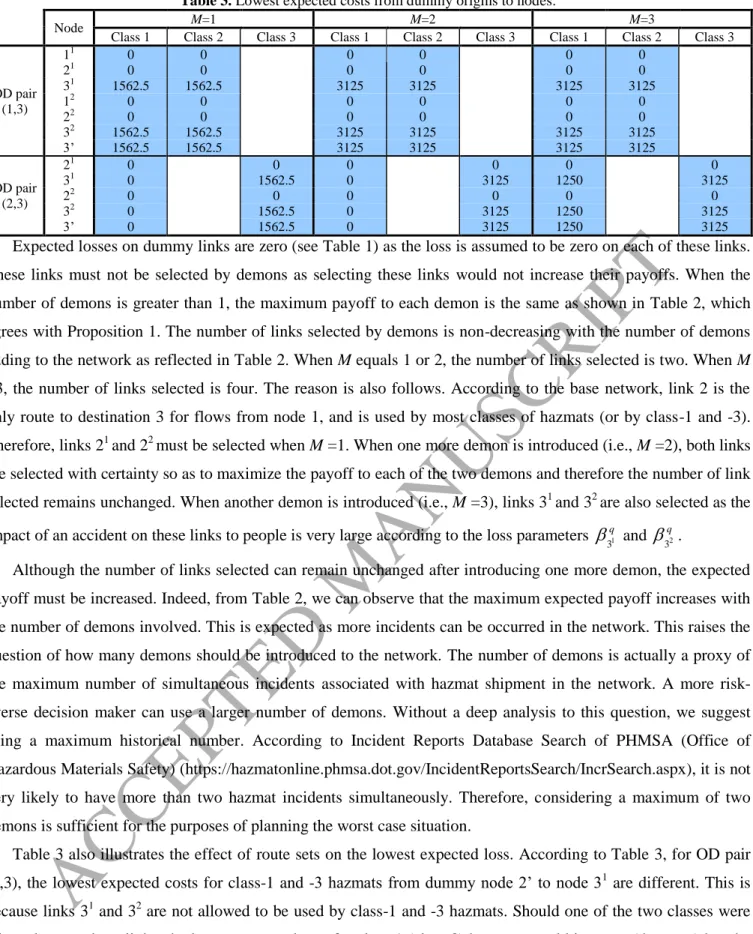
was very close to zero.Tables 1-3 show the results for all the three cases. One can easily verify that for each case, the result satisfies flow conservation at each node, the first-order optimality conditions for the demon and dispatcher subproblems, and the definitional constraint for link selection probabilities. For example, in Table 1, the sum of class-1 flows on links 61 and 62 equals the demand of 100 vph. In Table 2, we can see that when the demon selects a link to cause an incident with some probability, the corresponding payoff must be the largest. Moreover, the selected link must have a non-zero expected loss as shown in Table 1, which equals the difference between the lowest expected losses at the entry and exit nodes of that link. For instance, the lowest expected loss at the entry and exit nodes of link 21 are, respectively, 0 and 1562.5 according to Table 3. Their difference equals the expected loss on link 21 as shown in Table 1. Furthermore, from Table 2, we can see that the sum of link selection probabilities of a demon equals one. In addition, according to Table 2
,
even though we allow two or more demons selecting the same link for causing incidents on it, in the solution, such case will not happen, because the loss associated with a link due to multiple attacks by different demons is set to be the same as the loss due to single attack by one demon.Table 1. Loss, expected loss, and flow on each link.
Link Loss for all three cases
Expected loss Flow for all three classes
M=1 M=2 M=3 Class 1 OD (1,3) Class 3 OD (2,3) Class 2 OD (1,3) Class 1 OD (2,3) Travel or waiting links 11 500 0 0 0 25 25 21 3125 1562.5 3125 3125 50 50 25 31 2500 0 0 1250 25 41 500 0 0 0 25 25 51 0 0 0 0 0 0 0 0 12 250 0 0 0 25 25 22 3125 1562.5 3125 3125 50 50 25 32 2500 0 0 1250 25 42 600 0 0 0 25 25 Dummy links 61 0 0 0 0 50 50 71 0 0 0 0 25 25 81 0 0 0 0 50 25 50 25 62 0 0 0 0 50 50 72 0 0 0 0 25 25 82 0 0 0 0 50 25 50 25
Table 2. Link selection probability and payoff.
Link
M=1 M=2 M=3
Selection
Payoff Selection prob. Payoff Selection prob. Payoff
prob. Demon 1 Demon 2 Demon 1 Demon 2 Demon 1 Demon 2 Demon 3 Demon 1 Demon 2 Demon 3 11 0 0 0 0 3625 3625 0 0 0 6125 6125 6750 21 0.5 1562.5 1 0 6250 3125 1 0 0 8750 5625 6250 31 0 0 0 0 5625 5625 0 0 0.5 6875 6875 8750 41 0 0 0 0 3875 3875 0 0 0 6125 6125 6750 51 0 0 0 0 3625 3625 0 0 0 5625 5625 6250 12 0 0 0 0 3250 3250 0 0 0 6125 6125 6750 22 0.5 1562.5 0 1 3125 6250 0 1 0 5625 8750 6250 32 0 0 0 0 5625 5625 0 0 0.5 6875 6875 8750 42 0 0 0 0 3725 3725 0 0 0 6225 6225 6850 max 1562.5 max 6250 6250 max 8750 8750 8750