University of Cape Town
A Practical Key Management and
Distribution System
for
IPTV Conditional Access
A Dissertation
Submitted to the Department of Computer Science Faculty of Science
at the University of Cape Town in partial fulfilment of the requirements
for the degree of
Master of Philosophy in Computer Science by Coursework and Dissertation
Prepared by Gregory L. Harding (HRDGRE001) 16 September 2013 Supervised by Dr. Anne Kayem
The copyright of this thesis vests in the author. No
quotation from it or information derived from it is to be
published without full acknowledgement of the source.
The thesis is to be used for private study or
non-commercial research purposes only.
Published by the University of Cape Town (UCT) in terms
of the non-exclusive license granted to UCT by the author.
University of Cape Town
Abstract
Conditional Access (CA) is widely used by pay-television operators to restrict ac-cess to content to authorised subscribers. Commercial CA solutions are available for structured broadcast and Internet Protocol Television (IPTV) environments, as well as Internet-based video-on-demand services, however these solutions are mostly proprietary, often inefficient for use on IP networks, and frequently depend on smart-cards for maintaining security.
An efficient, flexible, and open conditional access system that can be implemented practically by operators with large numbers of subscribers would be beneficial to those operators and Set-Top-Box manufacturers in terms of cost savings for royalties and production costs. Furthermore, organisations such as the South African Broad-casting Corporation that are transitioning to Digital-Terrestrial-Television could use an open Conditional Access System (CAS) to restrict content to viewing within na-tional borders and to ensure that only valid TV licence holders are able to access content.
To this end, a system was developed that draws from the area of group key manage-ment. Users are grouped according to their subscription selections and these groups are authorised for each selection’s constituent services. Group keys are updated with a key-tree based approach that includes a novel method for growing full trees that outperforms the standard method. The relations that are created between key trees are used to establish a hierarchy of keys which allows flexible selection of services whilst maintaining their cryptographic protection. Conditions for security without dependence on smartcards are defined, and the system is expandable to multi-home viewing scenarios.
A prototype implementation was used to assess the proposed system. Total memory consumption of the key-server, bandwidth usage for transmission of key updates, and client processing and storage of keys were all demonstrated to be highly scalable with number of subscribers and number of services.
University of Cape Town
Contents
1 Introduction 1
1.1 Thesis Statement . . . 1
1.2 Motivation and Objectives . . . 2
1.3 Contributions . . . 3
1.4 Notation and Terminology . . . 4
1.5 Outline . . . 6
2 Background 7 2.1 Television Distribution . . . 7
2.2 Internet Protocol Television . . . 7
2.2.1 Multicast Networking . . . 8 2.2.2 Return Path . . . 10 2.3 Pay Television . . . 11 2.3.1 Subscription . . . 11 2.3.2 Pay-per-view . . . 11 2.3.3 Video-on-demand . . . 12 2.4 Content Protection . . . 12 2.4.1 Conditional Access . . . 13
2.4.2 Digital Rights Management . . . 14
2.5 Digital Video Broadcasting . . . 14
2.6 Secure Network Communications . . . 16
2.6.1 Attacks and Vulnerabilities . . . 16
2.6.2 Security Objectives and Services . . . 18
2.7 Cryptography . . . 19
2.7.1 Symmetric Cryptography . . . 19
2.7.2 Asymmetric Cryptography . . . 20
2.7.3 Trusted Third Party to Establish Authentication . . . 21
University of Cape Town
3 Group Key Management 22
3.1 Conditional Access Requirements . . . 22
3.2 Secure Broadcasting . . . 23
3.2.1 Hierarchy of Keys . . . 24
3.2.2 DVB Key Hierarchy . . . 25
3.3 Group Rekeying . . . 25
3.3.1 Stateful and Stateless . . . 26
3.3.2 Logical Key Hierarchy (LKH) . . . 26
3.3.3 One-Way Function Trees (OFT) . . . 31
3.3.4 Subset-Difference Rekeying (SDR) . . . 34
3.3.5 MARKS . . . 35
3.3.6 F-PPC Key Refreshment Scheme . . . 36
3.3.7 Comparison of Rekey Techniques . . . 37
3.4 Multiple Service Architecture . . . 39
3.4.1 Na¨ıve Approach . . . 39
3.4.2 Flexible Pay-per-Channel . . . 40
3.5 Reliable Key Delivery . . . 41
3.6 Batched Updates . . . 43
3.7 Secure Key Storage . . . 44
3.8 Summary . . . 46
4 Proposed Conditional Access System 47 4.1 Overview of Proposed System . . . 47
4.2 Key Hierarchy . . . 48
4.3 Group Key Refreshment . . . 49
4.3.1 Splitting Leaf Nodes . . . 50
4.3.2 Subtree Insertion Approach . . . 51
4.4 Subscriber and Service Groupings . . . 51
4.4.1 Simulating Flexible Service Selection . . . 52
4.4.2 Example . . . 53
4.4.3 Multi-Device Subscriptions . . . 54
4.5 Initial Key Establishment . . . 55
4.5.1 Preshared Keys . . . 55
4.5.2 Protocol for Dynamic Key Establishment . . . 55
4.6 Key Server Operations . . . 56
University of Cape Town
4.6.4 Unsubscribe . . . 58
4.7 Multicast Rekey Message . . . 58
4.8 Client Processing of Key Updates . . . 61
4.9 Key Recovery Fallback . . . 61
4.10 Optional Batched Updates . . . 62
4.11 Multicast Group Security . . . 63
4.12 Secure Storage with Application Vaults . . . 64
4.13 Summary . . . 65
5 Results and Evaluation 66 5.1 Testing Methodology . . . 66
5.2 Implementation . . . 67
5.3 Server Memory Consumption . . . 68
5.4 Effect of Service Groupings . . . 70
5.5 Comparison of Tree Growth Operations . . . 72
5.6 Bandwidth . . . 75
5.7 Client Operations . . . 76
5.8 Effect of Batched Updates . . . 77
5.9 Results Analysis and Summary . . . 77
6 Conclusions and Future Work 81 6.1 Conclusion . . . 81
6.2 Summary of Contribution . . . 82
6.3 Directions for Future Work . . . 83
6.3.1 Software . . . 83 6.3.2 Green Technology . . . 83 6.3.3 Network Simulation . . . 85 6.4 Final Remarks . . . 85 Glossary 86 References 88
University of Cape Town
List of Figures
2.1 Packet routing strategies . . . 9
2.2 Security Attacks . . . 17
3.1 Protocol for the distribution of a message encrypted with a group key 24 3.2 Illustration of a 2-level key structure . . . 25
3.3 Logical Key Hierarchy . . . 28
3.4 LKH user-oriented rekeying strategy . . . 29
3.5 LKH key-oriented rekeying strategy . . . 29
3.6 LKH group-oriented rekeying strategy . . . 30
3.7 LKH rekeying strategy for member leave . . . 30
3.8 One-Way Function Tree . . . 32
3.9 OFT: Member join and leave operations . . . 33
3.10 Subset-Difference Rekeying . . . 35
3.11 MARKS . . . 36
3.12 Multiple Services: Na¨ıve Approach . . . 39
3.13 Multiple Services: F-PPC . . . 42
4.1 Key Hierarchy . . . 48
4.2 One approach to growing a full LKH tree . . . 50
4.3 “Subtree insertion approach” to growing a full LKH tree . . . 52
4.4 Multiple Service Architecture: New subscriber joins . . . 53
4.5 Extended Key Hierarchy . . . 54
4.6 Subscription Difference . . . 59
4.7 Batched Updates . . . 63
4.8 Secure Storage . . . 64
5.1 Server Memory Consumption: Users . . . 69
University of Cape Town
5.5 Server Memory Consumption: Services . . . 73
5.6 Subtree Insertion vs Node Splitting: Total Key Updates . . . 74
5.7 Subtree Insertion vs Node Splitting: Total Weight . . . 74
5.8 Average Keys Held and Updates Processed by a Client . . . 78
5.9 Effect of Batches on Bandwidth . . . 79
University of Cape Town
List of Tables
2.1 Comparison of Television Transmission Methods . . . 9
3.1 Comparison of group rekey techniques . . . 38
3.2 Example subscriptions . . . 42
4.1 Legend: Dynamic Key Establishment Protocol . . . 56
4.2 Rekey Message Format . . . 60
5.1 Subtree Insertion vs Node Splitting: Time . . . 75
University of Cape Town
Chapter 1
Introduction
1.1
Thesis Statement
In the television industry, Conditional Access (CA) [8] is the application of cryp-tography for controlling access to content. The term CA is most commonly used in reference to the traditional scheduled programming that is distributed over digital broadcast mediums such as satellite, terrestrial, and cable.
Pay-television (or premium television) content, which consists primarily of high quality video and audio streams, is by its nature a high-bandwidth application. Traditional television broadcast networks have limited bandwidth and typically it is infeasible to encrypt the data stream with a different key for each valid subscriber. In recent years, increasing availability of fast home broadband connections has al-lowed the advent of Internet Video-On-Demand (VOD) services such as Netflix1
which do establish individual network connections (unicast) to clients. This type of application is reportedly responsible for a large percentage of global bandwidth usage, placing a strain on distribution networks. Unicast distribution of “live televi-sion” (including scheduled programming) to a large number of receivers is extremely inefficient. Multicast facilitates efficient distribution of this type of content over IP networks [9].
Pay-TV operators are heavily reliant on conditional access systems to support their business model. Conditional Access Systems (CASs) are also used for Free-To-View (FTV) television broadcasts. FTV is distinct from Free-To-Air (FTA) systems in which the broadcast content is not encrypted at all. Encryption of FTV content
University of Cape Town
can be for reasons such as restricting access to content by physical region. National borders, for example — to prevent viewers in nearby countries from accessing content that is ultimately paid for by tax-payers. Within a country, regional boundaries might also be defined on the basis of broadcast licenses and advertising.
In the near future, the South African Broadcasting Corporation (SABC) will be following in the footsteps of its counterparts around the world (including the United States of America, United Kingdom, and Australia) in switching over2 to Digital Terrestrial Television (DTT). The benefits of digital television include greater effi-ciency in usage of the radio spectrum, and better picture quality. The SABC could use a CA system to limit access to within South Africa, or for ensuring that only valid TV-licence holders are able to watch TV.
1.2
Motivation and Objectives
This research was inspired in part by the need of a South African Set-Top-Box (STB) manufacturer for an open, royalty-free conditional access mechanism for In-ternet Protocol Television (IPTV) [16] that is based on results from research in cryptographic key management. The objective of this research therefore is to study existing research in key management systems and design and implement an end-to-end framework for conditional access that is both theoretically robust and practically implementable.
Existing commercial CA systems are closed, and proprietary. To the best of our knowledge, while there is much research in the area of group key management, there is little available research that specifically addresses the design of a complete conditional access system for IPTV.
Furthermore, some existing conditional access systems rely on “security by obscu-rity”. That is, the strength of their security is dependant on an attacker not having knowledge of the workings of the system. For example, a subscriber’s viewing se-lection might be enforced by software disallowing certain services. A restriction enforced in this way can be bypassed by an attacker who implements their own receiver system. Kerckhoffs’ principle [23] should be applied so that an attacker having knowledge of the algorithms used should not compromise the security of the system. Therefore there is arguably room for improvement in terms of security of
University of Cape Town
CA systems used in some IPTV deployments are based on Digital Rights Manage-ment (DRM) mechanisms [4], use a simple key distribution centre (SKDC) approach, or encapsulate broadcast CA systems in IP packets. There is room for improvement in terms of efficiency relative to these approaches by specifically tailoring a solution to the IP multicast distribution mechanism.
1.3
Contributions
The core achievement of this research is the design of a framework that can be used as the basis for a conditional access system. In order to address this larger objective of how to build a conditional access system, the following research questions were posed.
How best can existing research in key management techniques be com-bined to provide a flexible and practical conditional access system for IPTV?
This research considers the scalability and efficiency problems that are encountered when attempting to securely deliver content to a large group of authorised sub-scribers. A survey and assessment is made of techniques in group key refreshment and distribution, reliable key delivery, and secure storage of keys.
The proposed conditional access system uses an efficient key-tree based method for sharing a group key and associated updates with a large group of subscribers. This method attempts to minimize overhead related to key management in terms of pro-cessing, memory usage, and bandwidth. The CA system includes a fast technique, which we believe to be novel in this application, for growing full key trees that reduces the amount of data to be sent for a key update.
Multiple services are supported by using a hierarchical key structure for grouping subscribers according to their viewing selections. This structure defines a relation-ship between key trees that enables flexible viewing selections to be cryptographi-cally enforced. In order to improve upon the poor scalability of existing techniques, service groupings known as bouquets are incorporated to accommodate a large num-ber of services.
University of Cape Town
Can an adaptable conditional access solution be found that is secure without the need for smartcards?
Most existing television delivery environments rely on a smartcard being held by each subscriber. The smartcard is used as an identity module and as a tamper-resistant device for storing cryptographic keys. This dependence restricts the type of devices to which content can be delivered. To support devices such as mobile phones and tablets, it is necessary to negotiate and store keys securely without the need for a smartcard.
The proposed system specifies a protocol for sharing a secret key between a key-server and a receiver device. Furthermore, requirements for the secure storage of keys in the non-volatile memory of the receiver device are defined. These requirements assume the availability of a trusted platform.
Can the solution be extended to allow sharing of media content in an authorised domain?
Increasingly, users want the flexibility to view content on multiple devices through-out their households. We propose an extension to the aforementioned service group-ing structure that supports multiple viewgroup-ing devices attached to a sgroup-ingle subscription without compromising cryptographic strength of the system.
1.4
Notation and Terminology
The following notation indicates transmission of a messagem by server sto user u, encrypted with key k:
s →u:hmik
The notation is extended to indicate transmission to multiple users and a message with multiple components. The message might be broadcast or multicast. The list of users is those for whom it is intended, although due to the nature of these routing mechanisms, there is no guarantee that they receive it, or that others do not. Security is therefore ensured by the use of encryption:
University of Cape Town
Throughout this thesis, the termsubscriber will be used interchangeably withuser,
client, and receiver. Unless otherwise specified this indicates a receiver of content that is transmitted by a server and is not intended to imply any specific business relationship (eg. paid subscription) unless otherwise indicated. Client is used in the context of a client/server relationship.
The term server will primarily refer to a key management and distribution server as part of the complete head-end. Head-end refers to the operator’s equipment that is used for processing and delivering a television broadcast. This includes encrypting elementary audio and video streams, multiplexing them and including other necessary data, and uplinking to satellite.
In digital television, service is used to refer to a particular stream of content pro-gramming. In common usage this is referred to as a television “channel”. Channel more properly refers to the particular means of transmission – for example a radio frequency.
Operators often define bouquets which are logical groupings of services. These are most often used as atomic subscription units — that is, groupings such as “Movies”, “Sport”, or “Documentaries”. These groupings are not necessarily non-overlapping: a service might be in multiple bouquets, thus allows groupings such as “Compact” and “Premium”.
Where set notation is used, A∩B means the intersection of sets A and B. An element is contained in A∩B if and only if it is contained in set A and set B.
A ⊆ B means that A is a possibly-equal subset of B. A \ B means the set of elements that are present in set A but not in set B.
University of Cape Town
1.5
Outline
This section provides a brief outline of the remainder of this thesis.
Chapter 2 covers general background information on television distribution, and digital pay television in particular. An overview of networking, cryptography, and secure communications is provided.
In Chapter 3 a detailed assessment of cryptographic group key management and ac-cess control techniques is undertaken with consideration for the specific requirements of a conditional access system for IPTV.
Chapter 4 outlines the design of the proposed conditional access system for this research. The results obtained with a prototype implementation of the system are presented and evaluated in Chapter 5, and finally the conclusion in Chapter 6 dis-cusses the outcomes of this research and highlights areas for further work.
University of Cape Town
Chapter 2
Background
2.1
Television Distribution
Television is an integral part of the fabric of modern society. It has been widely available for the better part of a century, and has become established as a primary medium for the distribution of news and entertainment. It provides a means for or-ganisations such as governments and corporations to reach large audiences efficiently and effectively. The role television has played in forming public opinion since the mid-twentieth century cannot be understated. It is a technology that has truly made the world a smaller place.
Historically, television has been broadcast to viewers by means of terrestrial radio transmissions and cable networks. The advent of telecommunications satellites in the 1960s and 70s saw the introduction of “direct-to-home” satellite television broad-casts. Satellite television is highly scalable as it does not require the installation and maintenance of complex infrastructure to support additional viewers. Satellite broadcasts can cover vast areas that would be impractical or uneconomical to service with cable or terrestrial broadcasts. Viewers only need to be supplied with low-cost receiving equipment: a STB attached to a parabolic satellite dish.
2.2
Internet Protocol Television
Internet Protocol Television (IPTV) refers to the delivery of television content over an IP network. It is distinct from video content provided by Internet services such
University of Cape Town
as Youtube, Netflix, and Hulu (although the security principles described in this thesis could be applied to some of these services). Montpetit et al. [27] provide a comprehensive overview of the current technologies, practices, and trends involved in the delivery of IPTV content. Their overview includes a discussion of IP multicast and related transport protocols.
2.2.1
Multicast Networking
An IP network is packet-switched. This means that messages are broken up into
packets and routed from a source to a destination either directly on a local network segment, or via intermediate routers. The three primary schemes for routing these packets areunicast,broadcast, andmulticast. Unicast refers to a packet being sent to a single destination. Figure 2.1a shows an example where senderStransmits a single packet that is intended for the single destination (highlighted). The packet is routed across network segments to reach the destination. Broadcast involves simultaneous delivery to all destinations on a local network segment. The example in Figure 2.1b shows S sending a single packet that is delivered to all destinations on the same network segment asS, whether they want it or not. Multicast involves simultaneous delivery of the packet to a particular set of destinations who have registered an interest in receiving them by joining a particular multicast group. In Figure 2.1c the single packet that is transmitted bySis received by those destinations that have told their closest router about their interest in it.
The important factor is that broadcast, and particularly multicast, are features im-plemented by the network infrastructure. The source host transmits a single packet that is delivered to multiple destinations by the network switching and routing equip-ment. This significantly reduces the load on the source host and the network that would otherwise be required to transmit the packet separately to each destination by the successive or simultaneous establishment of multiple unicast connections [34]. Broadcast is a feature implemented in IPv4 but not available in IPv6 [11], and is primarily restricted to local networks and associated technologies. It makes use of a specific broadcast address. Packets sent to this address will be received by all hosts on a particular network segment. Broadcast traffic is not routed outside of Local Area Network (LAN) segments because it causes tremendous load on receiving hosts and the network, even if they are not interested in receiving the packets.
University of Cape Town
S S Source Host Dest Router (a)Unicast S (b) Broadcast S (c) MulticastFigure 2.1: Packet routing strategies. With unicast, a packet is routed from a source to a single destination. With broadcast, a packet is simultaneously delivered to all hosts on the same network segment. With multicast, a packet is simultaneously delivered to all interested hosts.
Broadcast Unicast Multicast Return Channel
Satellite X 7
Terrestrial X 7
Cable X X(some)
IPTV X X X
Table 2.1: Comparison of Television Transmission Methods. This table highlights the in-band features of common transmission methods. Specifically, out-of-band
return channels via Internet connections, for example, are not considered as they require completely separate transmission systems.
University of Cape Town
We distinguish between IP broadcast/multicast and television broadcasting by satel-lite or terrestrial radio signals. Conceptually, broadcast of information by radio sig-nals to all listening receivers is similar. However it is a highly efficient and scalable use of radio technologies to distribute from a single transmitting source to multi-ple receivers, all of which are interested in receiving the signal (assuming they are powered-on and tuned to the correct frequency).
An IP network has broader, more general applications than over-the-air television networks. Typically it is not dedicated to television delivery and the assumption cannot be made that all hosts want to receive all packets. IP multicast facilitates efficient use of the network infrastructure.
Clients indicate the groups they are interested in by communicating with their near-est router using the Internet Group Management Protocol (IGMP) [9] on IPv4 net-works and Multicast Listener Discovery (MLD) [10] on IPv6 netnet-works. This router in turn communicates with other routers, and so they build up routing tables that ensure only relevant traffic passes through them. Groups are identified by specific IP addresses. The range of IPv4 addresses that is allocated to multicast is from
224.0.0.0to 239.255.255.255. In IPv6 the ff00::/8 address block is used.
Data is usually sent to a multicast group using User Datagram Protocol (UDP) datagrams. Transmission Control Protocol (TCP) is not applicable to multicast traffic as it only supports two-way, one-to-one connections as opposed to UDP which allows for point to multipoint transmission.
The Real-time Transport Protocol (RTP) is commonly used [27], encapsulated in UDP datagrams, for delivering streaming media content. It defines variousprofiles
for different types of content. RTP Control Protocol (RTCP) is a complementary protocol primarily used by receiving clients to communicate statistics back to the server that it can use to tune its output (such as quality-of-service and rate limiting parameters). Secure RTP (SRTP) [5] is a particular profile defined by RTP for encryption, integrity verification, and message authentication. It uses Advanced Encryption Standard (AES) with a counter stream cipher mode of operation.
2.2.2
Return Path
University of Cape Town
A return-path (or return-channel) is a communications channel that the receiver may use to transmit data to the head-end. The lack of a return path places certain limitations on the type of services that can be offered on these networks (for example, proper video-on-demand, which is described further in Section 2.3.3). The routing strategies and return path features offered by the various television transmission methods are summarised in Table 2.1.
As the scope of this research is directed at IPTV, it primarily considers the situation where a permanent return-path is available. This allows for the assumption to be made that a reliable unicast fallback mechanism is available for a client to request keys. Apart from IPTV, modern cable television deployments include two-way com-munications, and satellite and terrestrial broadcast systems can be augmented with separate return channels (for example, a satellite-IPhybrid set-top-box). Such a hy-brid system is useful for countries such as South Africa, where broadband Internet access is currently limited in terms of bandwidth and data usage caps.
2.3
Pay Television
The primary application of conditional access is to protect the delivery networks of pay-television operators. An operator may offer content and services to customers in various ways including subscriptions, “pay-per-view”, and video-on-demand. The Conditional Access system that they use must be able to accommodate these differ-ent options.
2.3.1
Subscription
The pay television industry operates a predominantly subscription based business model. They are funded partly or fully by paying subscribers, as opposed to adver-tising revenue, or public-funding. This allows a broader selection of service content types to cater to viewers’ interests. Subscriptions allow access to scheduled pro-gramming that is available from a selection of services.
2.3.2
Pay-per-view
University of Cape Town
to receive the transmission. All viewers tune-in at a scheduled time to receive the broadcast, which is typically of a special event or sports match. PPV can be thought of as a very short-term subscription.
2.3.3
Video-on-demand
Video-on-demand (VOD) is a service that allows viewers to individually choose con-tent from a selection and watch it at their leisure. This is achieved in different ways, depending on the transmission mechanism being used. In a pure broadcast environ-ment, Push-Video-On-Demand (PVOD) requires a subscriber to have a device with a local storage capability such as a Digital Video Recorder (DVR) with a hard disk. A selection of content is background downloaded from a dedicated broadcast channel and saved to the disk. Once some content is available on the disk, the subscriber is able to view it at their convenience. With “true” VOD, content is streamed directly from a server via a unicast connection.
2.4
Content Protection
In many forms of communications all parties share at least some interest in maintain-ing the security of said communications. Content protection, however, is primarily aimed at protecting the interests of service operators and media copyright holders. Thus there is little incentive for customers to take steps to maintain security, and when these steps are enforced on legitimate customers they are seen as an unwel-come hindrance (particularly in the case of DRM applied to media such as music and books — i.e. outside the confines of a controlled distribution network). Addi-tionally, the trend is towards consumers being able to access media across a variety of devices at any time — for example, a consumer might wish to watch a show on a television in the comfort of their lounge, or on a mobile device when travelling. Content protection mechanisms should avoid preventing consumers from having the convenient access to media that they desire, or the consumers might resort to ille-gitimate methods of obtaining the media that enable to them consume it freely. It is both pragmatic and prudent for operators and vendors of content protection systems to work on the assumption that the system can never be completely secure.
University of Cape Town
The goal therefore is to ensure that the cost of breaking the system is more expen-sive than using it legitimately would be. It should be more costly and/or onerous for potential customers to attempt to avoid paying for a subscription than to simply pay. Particularly, it should not be possible for illegitimate efforts to piggyback on the legitimate network. For example, an operation that attempts a pirate redistri-bution of the service for commercial gain should not be able to make use of the operator’s distribution network. This is a problem with over-the-air transmissions via terrestrial and satellite where cloning smartcards or sharing decryption keys ob-tained from legitimate subscriptions are often the only steps necessary to set up an illegal commercial operation [28, 47].
If some part of the content distribution network is vulnerable, the strength of other areas is irrelevant. The primary weakness in any such system is at the point where, by necessity, the content must be decrypted in order for customers to view it. This is addressed by employing an end-to-end chain of trust. The data is transmitted se-curely by the CA schemes discussed in this thesis. The receiving device (STB) then sends it to a television via an encrypted signal using the HDCP (High-bandwidth Digital Content Protection) protocol, where the source device cryptographically authenticates the destination device before sending the data. The destination (tele-vision) displays the content. In theory the only way to extract the content would be to record a lower quality version via analogue device outputs. The high quality digital data is encrypted from its source at the operator all the way to the TV.
2.4.1
Conditional Access
In order to enforce their business model, pay TV operators need some way of re-stricting access to their content to only paid-up subscribers. In early cable TV systems, access could be restricted by using signal filters at the cable taps for each subscribers’ premises to remove certain channels from their signal. This method was not scalable with an increase in the number of channels and subscribers (due to the large number of signal filters and locations involved) and it was relatively easy to work around the filters illegitimately. Alternative methods such as distort-ing or scrambldistort-ing the signal with interference signals were used, but these could also be bypassed. The advent of digital television allowed solutions using encryp-tion and associated key management schemes to be applied to the problem. These cryptographic approaches are at the core of current conditional access solutions.
University of Cape Town
2.4.2
Digital Rights Management
Digital rights management (DRM) and conditional access aim to achieve similar goals: namely the protection of content that is ultimately distributed to untrusted users. DRM is a widely applicable term that refers to any mechanism for restricting the use of content or hardware.
Azad et al. [4] provide an overview of research in DRM. Broadly, DRM associates content with a set of usage rights and protects both the content and the rights, usually by cryptographic means. It attempts to associate a unique copy of some content with a specific authorised user. Each authorised user would receive their own copy of the content. This is done in such a way that a user should only be able to access his/her own copy of the content, and then only in the manner defined by the provider of the content. For DRM to be effective, only trusted hardware or software should be able to decrypt and interpret the rights, and provide a user with access to the content only if the rights and additional authorisation information permit doing so.
DRM aims to restrict the use of content that is distributed or distributable outside the confines of a controlled system (i.e. an untrusted distribution channel). Condi-tional access is part of a more tightly controllable system and aims to protect the distribution network itself. It is distinct from DRM in that it attempts to protect a single copy of content that is shared by all users [27].
2.5
Digital Video Broadcasting
The Digital Video Broadcasting (DVB) Project1 defines a comprehensive set of open
standards that are widely used in Europe, Australia, Africa and other parts of the world for the broadcast of digital television2. They specify most aspects of digital
television to allow interoperability and compatibility between networks and equip-ment. For example, the DVB-S standard [14] specifies modulation, encoding and transmission characteristics, and data formats and protocols for satellite television. The newer DVB-IPTV [16] includes specifications for the use of protocols such as RTSP and RTP, and multicast networking.
1
University of Cape Town
The standards also define the DVB Conditional Access framework (DVB-CA) [7, 8] that allows operators to use various commercial conditional access solutions. Major vendors of such solutions include Irdeto3, NDS4 and Nagravision5. These systems are typically closed, and proprietary, with almost no information publicly available on the exact mechanisms that are used to achieve the required objectives.
In DVB-CA video is scrambled with a control word (CW) which is used as a seed to a pseudorandom number generator. Either the common scrambling algorithm (DVB-CSA [17]) or optionally some variant of it is used, as decided by the vendor of the particular conditional access system. The subscribers’ receiving equipment needs a compatible descrambler.
The CW is common for all subscribers of the system and is changed often (every few seconds) to minimize the impact of key discovery. A relatively small key size is used to allow real-time descrambling on relatively constrained embedded systems. This key is potentially vulnerable to brute force and side-channel attacks [24, 44]. Newer versions of DVB-CSA which take faster hardware into account provide stronger AES-based encryption.
The DVB-CA standard specifies the existence of Entitlement Control Messages
(ECMs), which contain CW updates, andEntitlement Management Messages(EMMs) which contain other instructions and key updates for the CA system. These mes-sages are opaque, and usually encrypted, with their format and content specific to the particular conditional access system in use. They are decrypted and pro-cessed by the CA system, which must ensure that it provides a control word to the descrambler in a timely fashion.
Any mechanism that fits into this specification can be used to securely deliver the CWs. In the most simplistic system, the CA system might store a static, globally shared master key in smartcards (which are tamper resistant). This key would use symmetric cryptography to decrypt the control words. The impact of this single key being compromised is severe because it could be widely distributed, thereby resulting in a complete break of the system.
More complex systems will encrypt the CW with an intermediate key-encryption-key (KEK). The intermediate KEK is usually stored on authorised smartcards and peri-odically updated using a message encrypted with a smartcard’s public key. One such
3Irdeto B.V.http://www.irdeto.com/ 4NDS Limited. http://www.nds.com/
University of Cape Town
message would need to be delivered per smartcard in circulation. The performance and bandwidth requirements scale linearly O(n) with this approach, sometimes re-ferred to as as Simple Key Distribution Centre. Even more advanced systems employ hierarchies of keys that allow securely delivering these keys in a more efficient man-ner.
It should be noted that the use of a control word allows flexibility in the system: it can be updated very frequently without incurring further rekey operations; it facilitates the “modular” interchange of CA systems; and in fact it allows multiple CA systems to be used simultaneously, with an ECM for each system containing the same control word (this is known as SimulCrypt [15]).
2.6
Secure Network Communications
This section provides a general overview of the principles of secure network commu-nications between a sender and a receiver. The same principles can be applied to multicast communications and specifically for the pay-TV scenario where there is a single sender but multiple receivers.
2.6.1
Attacks and Vulnerabilities
Before attempting to secure a system, it is necessary to have an understanding of the types of threats to which the system could possibly be subjected. The International Telecommunication Union (ITU) X.800 Recommendation [21] defines a security ar-chitecture that specifies categories of security services and classification of attacks
on the security of a system.
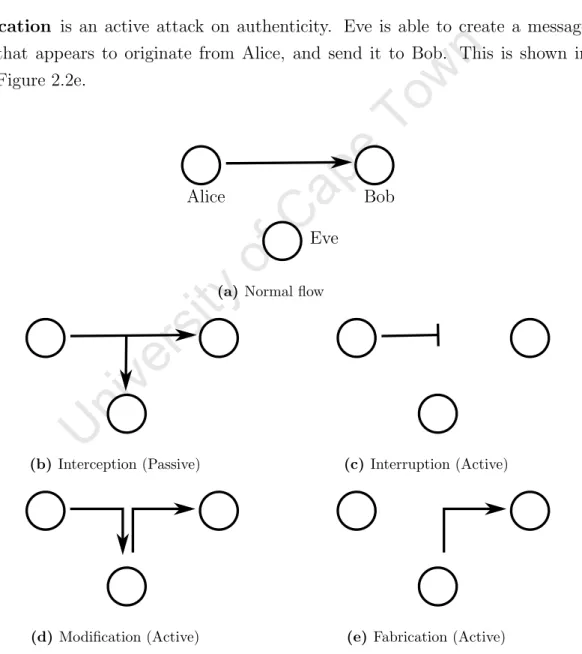
In normal communications, a message is passed from a sender to a receiver. This is illustrated in Figure 2.2a where Alice sends a message to Bob. It may pass through multiple intermediaries (network routers) along the way. Attacks by a third party, Eve, on this data flow can be classified as either active or passive. In a passive attack, the message arrives at the receiver unmodified from the form in which it left the sender. In an active attack the message that is received is altered, fabricated, or not received at all.
University of Cape Town
Interception is a passive attack on data confidentiality. Figure 2.2b shows Eve is able to read a copy of the message that is intended only for Bob. This is done without affecting Bob’s receipt of the message.
Interruption is an active attack on availability. Figure 2.2c shows that some action taken by Eve prevents Bob from ever receiving the message sent by Alice.
Modification is an active attack on data integrity. In Figure 2.2d, Eve is able to receive the message that is sent by Alice and modify it before sending it on to Bob. Bob is unaware that the message he receives is changed from the one sent by Alice.
Fabrication is an active attack on authenticity. Eve is able to create a message that appears to originate from Alice, and send it to Bob. This is shown in Figure 2.2e.
Alice Bob
Eve
(a)Normal flow
(b) Interception (Passive) (c)Interruption (Active)
(d) Modification (Active) (e) Fabrication (Active)
Figure 2.2: Possible forms of attack on a message sent from Alice to Bob. Eve is the attacker.
University of Cape Town
2.6.2
Security Objectives and Services
Information security has certain objectives that need to be met dependant on the requirements of the particular application. These desirable properties known as secu-rity services are implemented by various underlying mechanisms and protocols [40].
Confidentiality
Confidentiality ensures that information is only disclosed to authorised recipients. An attacker eavesdropping on a network will not be able to read the information. It is protection against interception attacks.
In the context of pay-TV, confidentiality is required to ensure that only authorised subscribers are able to access content.
Integrity
Integrity is the ability to ensure that the data received is unchanged from what was sent. It provides protection against modification attacks and against accidental corruption of data that might occur in transit.
Availability
A system must remain available to those for whom it is intended. Denial-of-service and interruption are attacks against availability.
Authentication
Authentication is the process of one entity verifying the identity of another — check-ing they are who they claim to be. Authentication might be conducted mutually or in one direction only. It protects against fabrication attacks.
For example, the pay-TV operator needs to authenticate subscribers (specifically their receiving device) to associate them with a valid subscription.
University of Cape Town
Access Control
Access control restricts who can join a network or make use of a service. Once a user is authenticated, it grants them access in accordance with their associated authorisations.
Non-Repudiation
Non-repudiation is the ability of a system to ensure that a user cannot deny involve-ment in communications that have been sent or received and acknowledged.
In the context of business systems, such a service would be required to prove that a customer placed an order, for example.
2.7
Cryptography
Provision of the aforementioned security services is primarily accomplished by per-forming certain transformations to the data before sending it, and again once it has been received. These transformations make use ofcryptography and are usually achieved with the use of keys. The security of a system depends on the restricted availability and careful distribution of these keys. For example, a message is en-crypted with a secret key to provide confidentiality and only parties who hold the appropriate secret key for decryption will be able to understand the message. This management and distribution of cryptographic keys is a core function of a condi-tional access system.
2.7.1
Symmetric Cryptography
With symmetric cryptography, the same secret key is used to decrypt the data as was used to encrypt it [36]. Block ciphers such as DES (Data Encryption Stan-dard) [1] and AES (Advanced Encryption StanStan-dard) [2] are examples of symmetric cryptography.
The primary issue with symmetric cryptography is finding a way to securely dis-tribute the secret key to all concerned parties. If the secret key is intercepted, the encryption is worthless.
University of Cape Town
Various methods of secure key distribution exist. A key might be pre-shared between a group of users (for example, by physically entering the same password into multiple computers, or loaded onto a STB during production in the factory). Alternatively some key exchange protocol might be used. For example, the Diffie-Hellman key establishment protocol [12] allows two parties to securely negotiate a symmetric key over an insecure channel. Even if all of the communication is intercepted, an eavesdropper will not be able to determine the negotiated key.
2.7.2
Asymmetric Cryptography
Asymmetric cryptography (also known as public/private key cryptography) uses a separate key for the encryption and decryption steps [20]. Encryption is typically performed with a public key which can be widely distributed without concern for security. Only the holder of the private key is able to decrypt the message. RSA [35] is a widely used example of an asymmetric cryptographic algorithm.
Asymmetric cryptography is significantly slower than symmetric and is only suitable for encrypting small amounts of data. Often communications protocols might start with asymmetric cryptography to share a symmetric “session key” which is then used for the remainder of the communications. An initial exchange of public keys allows the parties to encrypt messages that can only be read by the other.
Assume E is an encryption function, and D a decryption function. In practice these functions might be the same, depending on the encryption algorithm. Given a keypair{Kr, Ku}whereKr is the private key andKu is the associated public key, a
messagem can be encrypted to produce ciphertextc=E(Ku, m). Decryption with
the public key is as followsm=D(Kr, c).
Asymmetric cryptography can also be used to sign messages to achieve authentica-tion. A messagemis signed by generating a hash or checksumhwith a hash-function
H (eg. MD5, SHA). h is then encrypted with the private keyKr to produce a
sig-nature s= E(Kr, s). Anyone holding the public key Ku can decrypt the signature
to obtain h and then apply H to the message m1 that they received to obtain h1.
Ifh=h1 then the receiver is assured that the message has not been altered since it
was created by the sender. Only the sender who holds the private key can generate signatures that will authenticate in this way.
University of Cape Town
2.7.3
Trusted Third Party to Establish Authentication
Unless two parties have communicated in some way and shared some secret infor-mation known only to each of them, it is usually necessary to make use of a trusted third-party for authentication (that is, for one or both of the parties to verify that the other is who it claims to be).
This service is normally provided by a certification authority [22]. Such an authority will cryptographically sign a certificate containing the public key of a party whose identity they can verify in some way. That certificate can then be used in future exchanges with unknown entities, who are able to verify it using the public key of the certification authority.
Authorities can verify other authorities, who in turn verify users. If a user trusts a particular authority, then he implicitly trusts another authority trusted by the first, and so on. A Public-Key Infrastructure (PKI), which comprises the mechanisms and systems necessary to enable the use of digital certificates, provides this chain-of-trust.
2.8
Summary
In this chapter, we have presented an overview of the technologies involved in digital television transmission and introduced the need by operators to protect this digital content. In Section 2.1 we discussed traditional television distribution via terres-trial, cable, and satellite broadcasting. In Section 2.2, IPTV was introduced as a versatile medium for distributing media content to a variety of devices. Multicast, the networking routing mechanism that enable scalable IPTV implementations, was discussed in Section 2.2.1 and compared to the traditional methods of broadcast-ing. In Sections 2.3 and 2.4, the particular use cases of pay-television and the need for content protection were outlined. The Digital Video Broadcasting (DVB) Stan-dards and the structure they define for supporting Conditional Access schemes was described in Section 2.5. Finally, in Sections 2.6 and 2.7, the principles for secure communications over an untrusted network were introduced as a set of distinct se-curity services that protect against particular categories of threats. These services can be implemented by the application of cryptography.
University of Cape Town
Chapter 3
Group Key Management
3.1
Conditional Access Requirements
Primarily, a conditional access system needs to ensure that only legitimate users are able to access content, and that they are only able to access the content they are authorised to receive. That is, it must protect content from outsiders who have no subscription, and it must protect against subscribers being able to illegitimately elevate their access privileges. A conditional access system must reasonably support an operator with tens to hundreds of services, and millions of subscribers. The system needs to scale well in these ranges.
We might assume1 that a single high-definition (HD) television service requires an average 12 Mbit/s for a suitable quality video stream. An associated 6-channel surround sound audio stream might have a bitrate of 320 kbit/s. A satellite television transponder with a maximum effective bandwidth of 64 Mbit/s would therefore be able to transmit a maximum of 5 such HD television services. Transponders are costly and steps are taken to maximise the number of services that can be delivered on one. Although other transmission mediums such as cable or IP networks have higher available bandwidth, it is not unlimited. In IP networks, bandwidth usage costs are often the burden of the end-user. A CA system should therefore attempt to minimise the data transfer overhead that it imposes.
With these requirements in mind, and to provide the security services that were outlined in Section 2.6.2, a method of sharing keys amongst a large group of users is
University of Cape Town
required. Group key management is the area of research that addresses the problems of key management and secure distribution that were highlighted in Section 2.7 with respect to a group of users.
The goal is to securely share appropriate keys amongst the authorised subscribers so that they are able to decrypt the content. The mechanism by which the keys are shared needs to be secure against collusion between users, and it must provide forward and backward secrecy. Forward secrecy means that when a subscriber is removed, they are not able to access content that is transmitted in future [33]. Backward secrecy means a new subscriber will not be able to access content that was transmitted prior to their joining. For example, an unauthorised user might capture encrypted transmissions for some period of time (without holding a subscription). He could then take out a subscription with the sole intention of obtaining decryption keys and then cancel the subscription immediately. Without backward secrecy, he could then decrypt all the previously captured content, without having paid for it. In Section 3.2, the concept of a hierarchy of keys is introduced as the basis for encryption of video content. Various different methods for efficiently updating a shared group key are surveyed and assessed in Section 3.3. The problem of securing multiple services so that subscribers only have access to what they have paid for is addressed in Section 3.4. Reliable delivery of key update messages, and fallback mechanisms for clients to recover from missed keys are discussed in Section 3.5. Significant reductions in bandwidth usage can be had from updating keys in batches. An overview is given in Section 3.6. Finally, solutions to the problem of secure key storage without a smartcard are considered in Section 3.7.
3.2
Secure Broadcasting
In the pay-television scenario, a single source (the head-end server) needs to trans-mit a large amount of data simultaneously to a large number of receivers (the sub-scribers). The data transmission is continuous, which is known as streaming, and consists of video and audio streams, and other supporting information such as an
electronic program guide (EPG). It is measured in terms of bandwidth requirements (transfer rate), rather than total data size.
In a typical over-the-air (OTA) broadcast network (such as satellite and terrestrial television), it is necessary to encrypt this data because it is otherwise impossible to control access to it. Anyone who can acquire or fabricate the necessary reception
University of Cape Town
equipment could intercept the transmission [28, 47]. On a cable or IP network, although the subscriber’s connection and access is controllable by the network op-erator, encryption is also highly desirable to protect against interception attacks. Such attacks are very possible over large public networks such as the Internet or by means of illegal taps into private cable networks. Such taps are difficult to detect due to the networks’ size.
It should be clear that attempting to secure this data transmission using the previ-ously discussed mechanisms for two-party communications would require a separate encrypted video stream for each individual subscriber. So while that would meet the security requirements for controlling subscriber access, it is an extremely inefficient use of limited and costly bandwidth.
3.2.1
Hierarchy of Keys
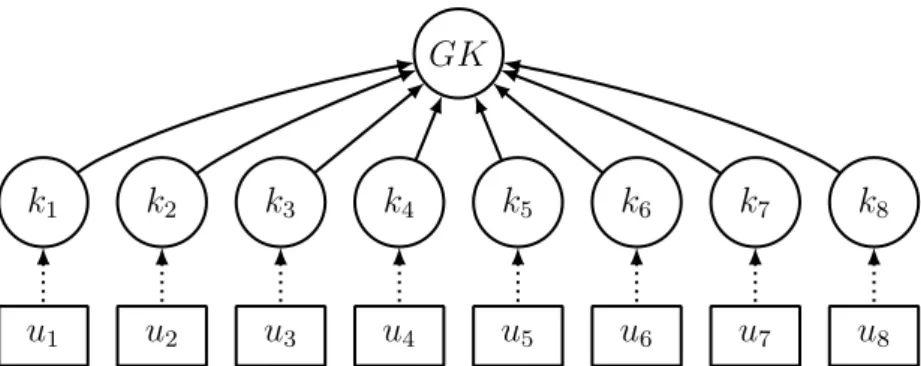
An efficient solution to securely transmitting the video data stream is to encrypt it only once and then send it to all subscribers. It is necessary to securely share the key used to encrypt the video stream with all subscribers. The data encryption key can itself be encrypted with a private “key-encryption-key” (KEK). If a keyki,
is associated with each subscriber ui, and known only to that subscriber and the
server, then the data encryption key can be securely transmitted to all subscribers. The data encryption key that is shared amongst the entire group of subscribers is called agroup key (GK). The messages that the key server would send to distribute a message and the associated group key are shown in Figure 3.1. This 2-level key hierarchy is shown in Figure 3.2.
s→u1, u2, . . . , un:hmiGK s →u1 :hGKik1
.. .
s→un:hGKikn
Figure 3.1: Basic protocol for distribution of a message m, encrypted with group key GK to users u1. . . un. For each i such that 1 ≤ i ≤ n, GK is encrypted with
University of Cape Town
u6 u8 u5 u4 u7 GK u1 u2 u3 k3 k2 k1 k4 k5 k6 k7 k8Figure 3.2: Illustration of a 2-level key structure
3.2.2
DVB Key Hierarchy
In the DVB-CA system, the actual key used to encrypt the streamed data is known as a Control Word (CW) (see Section 2.5 for more details about the DVB standards). The group key could be used as the CW directly, provided that it meets the standard format for DVB descrambler equipment. However, in the interests of flexibility it makes sense to introduce a third level in the key hierarchy. The CA mechanism is therefore not limited by descrambler hardware specifications that use a small key size. Therefore the control word is encrypted with the group key. For the purpose of this thesis, it is assumed that the actual data to be encrypted by a conditional access system is a continuous series of control words.
3.3
Group Rekeying
The group key needs to be changed every time a new subscriber is added (to prevent them being able to decrypt any transmissions made prior to their joining) or an old subscriber is removed (to prevent them being able to decrypt any future transmis-sions). This process is referred to asrekeying. In a network with a large number of users, and frequent join and remove operations taking place, the overhead in terms of bandwidth and server load for these key distributions can be significant if the simple protocol described above is used.
For example, assume a network has 10 million users and the size of a rekey message is 54 bytes (see Section 4.7 for the format of a suitable rekey message). Then for every join or leave operation the server needs to perform 10 million encryption operations, and needs to transmit approximately 515 MB of incompressible data. If the data is broadcast or multicast, then every client needs to receive all the data to find the
University of Cape Town
one key message applicable to them. If the data is unicast then the load on a client is negligible, however the server needs to make 10 million outgoing connections — which places high demands on a system that can multicast all other data (video and audio).
This section discusses a number of alternative methods for performing these group rekey operations. The methods are compared and assessed with regards to their applicability to a conditional access system. The comparison is given in Section 3.3.7.
3.3.1
Stateful and Stateless
Zhu and Jajodia [48] classify methods for group rekey operations as either stateful
or stateless. This state refers to the information a client needs to hold in order to receive and interpret a new key update message.
In a stateful system, a client needs to have successfully interpreted key update messages that were previously distributed and must hold the keys contained in them in order for it to be able to decrypt new update messages. As an example, consider the situation in which each new group key is encrypted by the previous group key. If a client misses any single key update, it will not be able to interpret subsequent updates.
In a stateless system, a client does not need to have received previous key updates and can immediately interpret any new key update message. A trivial example is a system in which all clients share a symmetric master key. That key never changes and is used to encrypt and decrypt group key update messages.
A stateful system requires a reliable key distribution mechanism so that clients receive all key updates. It is therefore best suited to applications which are are able to maintain semi-permanent network connections, for example. Stateless systems are useful for applications in which no such connection is available and clients will not be able to receive all update messages. Distribution of encrypted content on DVDs is an example of a system where statelessness might be required.
University of Cape Town
is associated with an intermediate key-encryption-key known to its members. This intermediate key can be used to encrypt the group key, and is itself encrypted with each of the users’ private encryption keys. When a group rekey operation takes place, only half of the users need to receive a new intermediate key — those belonging to the subgroup to which the new member is added (or from which an existing member is removed, respectively). Those users also receive a new group key encrypted with their new intermediate key. The other half of the users only need to receive the new group key encrypted with their existing intermediate key. Thus the required bandwidth and number of encryption operations is nearly halved.
This approach can be extended by halving each subgroup again and adding a new layer of intermediate keys. In that case approximately only a quarter of the original bandwidth and encryption operations is required.
If this process is repeated at each layer until each subgroup has only two users, the number of keys involved in a rekey operation is equal to the number of layers of intermediate keys between the affected user and the group key. This tree structure is known as Logical Key Hierarchy (LKH) [43]. If the tree is full and balanced, the complexity of a rekey operation isO(logN).
In fact it is not necessary that the tree tree structure be binary as described above. It can have any degree. Wong et al. [45] experimentally determined that the optimal degree is 4 with respect to number of key update messages and processing time. Assume that Figure 3.3a represents some initial state of an LKH tree containing 8 members, U1. . . U8. Each member Ui holds a key Ki known only to that member
and the key server. GK is the group key shared by all members. K123 is known
only to the members of the subtree containing users U1, U2 and U3. Likewise, the
keyK456 is known to U4,U5 and U6, and K78 to U7 and U8.
Given this tree structure, the following procedures are followed to update keys when a new member joins or an existing member has its access revoked.
LKH Join Operation
To add a new member,U9, the key server locates2 an intermediate node in the tree
that is not full and attaches a new child node there containing K9. In Figure 3.3a K78 is this joining point. The key at that node and the group key GK need to be
University of Cape Town
U6 U8 K2 U4 U1 U5 GK K456 U3 U2 K3 K123 K1 K4 K5 K6 K7 K78 K8 U7 (a)Initial U9 U8 U5 U4 U6 U7 U1 U2 U3 K789 GK0 K3 K2 K1 K4 K5 K6 K7 K8 K9 K456 K123 (b) Join U9 U8 U5 U4 U6 U7 U1 U2 U3 K789 GK00 K3 K2 K1 K4 K5 K6 K7 K8 K9 K46 K123University of Cape Town
updated. The key server generates new random keysK789andGK0 to replace them,
respectively. These are shown marked with double circles in Figure 3.3b. These new keys then need to be securely delivered toU9 and to the existing members that need
them. Note that initially U9 only holds its secret key K9.
Wong et al. [45] distinguish between three mechanisms for distributing these keys to users. These differ in how to determine the grouping of new keys and which existing keys to use to encrypt the update messages. The selection of existing keys used to encrypt new keys needs to be done in such a way as to avoid revealing new keys to users who should not hold them.
With user-oriented rekeying, the server creates a message containing exactly the keys needed by a particular user and encrypts it with a key held by that user (and other users with the same requirements). Figure 3.4 shows the key messages that would be sent to update the group key for the example given above ofU9 joining.
s →U9 :hK789, GK0iK9
s →U7, U8 :hK789, GK0iK78
s→U1,· · · , U6 :hGK0iGK
Figure 3.4: User-oriented rekeying strategy when member U9 joins
With key-oriented rekeying, each new key is encrypted separately, perhaps multiple times with different existing keys. Figure 3.5 shows the key messages that would be sent to perform the same group rekeying as above with the key-oriented strategy.
s →U9 :hGK0iK9
s →U9 :hK789iK9
s →U7, U8 :hK789iK78
s→U1,· · · , U8 :hGK0iGK
Figure 3.5: Key-oriented rekeying strategy when member U9 joins
In practice, implementing user or key oriented rekeying involves establishing mul-tiple unicast connections or having mulmul-tiple multicast subgroups. Group-oriented rekeying is the most straightforward to implement and results in the fewest rekey messages.
University of Cape Town
Group-oriented rekeying creates a single message containing all new keys encrypted as necessary. Members U7 and U8 need K789. All the users need GK0. Since U7
and U8 already hold the previous key K78 and U9 does not, K78 can be used to
encryptK789. Likewise all existing members hold GK which can be used to encrypt
its replacementGK0. These update messages are shown in Figure 3.6.
s→U1, U2,· · · , U8 :hGK0iGK,hK789iK78 (multicast)
s→U9 :hK789, GK0iK9 (unicast)
Figure 3.6: Group-oriented rekeying strategy when member U9 joins
LKH Leave Operation
In Figure 3.3c, member U5 is removed. Key K456 needs to be replaced with a new
key K46 and GK0 is replaced with GK00. However since U5 holds both of these
existing keys (K456 and GK0), they cannot be used to encrypt their replacements. GK00 is therefore encrypted separately with K123 and K789. K46 is encrypted with K4 and K6. Finally, GK00 is encrypted with the new K46 which members U4 and U6 will obtain after decrypting the previous message. These update messages are
shown in Figure 3.7. s→U1, U2,· · · , U9 :hGK00iK123,hGK 00i K789,hK46iK4,hK46iK6,hGK 00i K46
Figure 3.7: Group-oriented rekeying strategy for member U5 leaving
LKH+
Perlman [32] suggests an improvement to LKH which he calls “LKH+”. In the case of a join operation, existing members apply a one-way hash function to the updated keys. This means that it is not necessary to transmit the actual key data when performing such an update. Only a message indicating the key has changed is required, thus saving significantly on bandwidth.
University of Cape Town
3.3.3
One-Way Function Trees (OFT)
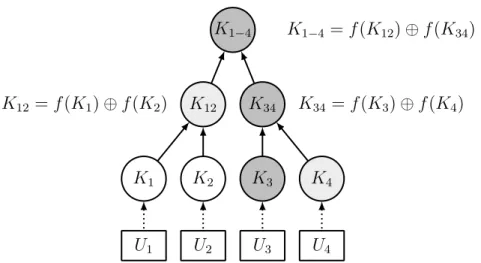
McGrew and Sherman [26] propose a technique based on one-way functions applied bottom-up in a key tree. The key server maintains a binary tree. Unlike LKH, interior nodes of the tree are computed based on their children. Associated with each node i of the tree are two keys: the node key Ki and the blinded key Kbi. Kbi = f(Ki) where f(x) is a one-way function. Kbi is blinded in the sense that
it cannot be used to determine Ki due to the one-wayness of f (without incurring
great computational expense). The use of blinded keys allows a particular member to calculate the intermediate keys on its path to the root without being able to determine the node keys of its siblings.
Each leaf node is associated with a group member and the node key Ki of a leaf
node is known only to that member and the key server. The node key Kj of an
interior node is derived from the blinded keys of its left and right children: Kj = f(KL)⊕f(KR), where ⊕ represents a mixing function such as bitwise exclusive-or
(XOR).
Each member knows only its own node key and the blinded keys of the sibling nodes on the path from its leaf node to the root. It can use these to derive the node keys on its path to the root. The node key of the root node is the group key. See Figure 3.8 for an example of how keys are derived within the tree. OFT requires less bandwidth for key update messages than an equivalent binary LKH tree. This is because updating any key only requires distribution of its blinded key to the half of the members rooted at either the key’s left or right child node.
OFT Join Operation
When a new member joins the group, an existing leaf node is split into two. The existing member is placed as the left child and the new member becomes the right child. For example in Figure 3.9a memberU5has joined the group originally shown in
Figure 3.8. Some existing leaf node is chosen, in this case the one that was associated with U3. U3 now becomes the left child and receives a new key K30. Likewise the
right child for the new member becomes a new key, K5. Then the original K3 is
replaced with K35 = f(K30)⊕f(K5), K34 with K345 = f(K35)⊕f(K4), and K1−4
University of Cape Town
K1−4 =f(K12)⊕f(K34) K34 K34=f(K3)⊕f(K4) K12 U4 K12=f(K1)⊕f(K2) U1 U2 U3 K3 K1−4 K1 K2 K4Figure 3.8: One-Way Function Tree: In this example, member U3 holds node
key K3 and blinded keys Kb4 = f(K4) and Kb12 = f(K12). It can thus derive K34 =f(K3)⊕Kb4 and K1−4 =f(K34)⊕Kb12. K1−4 is the root key.
In general, if the keyKxfor nodexis updated, its blinded key needs to be distributed
to the members in the subtree rooted at its sibling node s. These members already hold the node keyKs which can be used for encryption.
ThereforeKb35 =f(K35) will be encrypted withK4 andKb345 =f(K345) withK12.
K30 can be encrypted withK3 as only the security of its blinded key is compromised
for further use. It is assumed that K5 and other blinded keys required by U5 are
transmitted as part of some separate secure communication. The updated keys would be distributed as follows (Ks5 is some arbitrary key known only to the server
and memberU5):
s→U5 :hK5, Kb30, Kb4, Kb12iKs5 (unicast)
s→U1,· · · , U4 :hK30iK3,hKb35iK4,hKb345iK12
OFT Leave Operation
When a member leaves, the update process is similar. It is necessary to differentiate between two cases. In the first case, the sibling of the leaf node associated with the removed node is also a leaf node. In this case, the member associated with the sibling is reassigned to the parent node and given a new key. For example, Figure
University of Cape Town
K1−5 =f(K12)⊕f(K345) K345 K35=f(K30)⊕f(K5) K345 =f(K35)⊕f(K4) K2 U5 U4 U1 U3 U2 K35 K1−5 K1 K5 K30 K4 K12 (a)Join K345 K20 U5 U4 U1 U3 U2 K35 K2−5 K1 K5 K30 K4 (b)U1leaves K20 U5 U4 U3 U2 K350 K235 K5 K300 K4 (c) U4 leavesFigure 3.9: OFT: Member join and leave operations. In (a) U5 joins. Then U1
is removed in (b) and finally U4 removed in (c). Nodes marked with double circles
have changed. Their respective blinded keys need to be distributed to the subtrees rooted at their siblings.
University of Cape Town
new keyK20. The key update message is multicast as follows:
s→U2,· · · , U5 :hK20iK2,hKb
0
2iK345
In the second case, the sibling is an intermediate node — the root of a subtree. The parent node is then replaced by the sibling and one of the leaf nodes in the subtree needs to be changed so the node key (and therefore the blinded key that was known to the removed member) is updated. Figure 3.9c illustrates this by removing U4
from the group. K30 is the leaf node in the sibling subtree that is arbitrarily selected to be changed (in order to change the blinded key ofK35that was know toU4). The
update message would be as follows:
s→U2, U3, U5 :hK300iK0 3,hKb 00 3iK5,hKb 0 35iK0 2
3.3.4
Subset-Difference Rekeying (SDR)
Subset-Difference Rekeying is a stateless protocol for group rekeying proposed by Naor et al. [29]. A stateless protocol is attractive because it allows for members to obtain the current group key even after having missed previous key updates due to being offline for a period of time. It works on the basis of users possessing information about other users in such a way that when a user is removed, the remaining users can recalculate the group key without the removed user being able to.
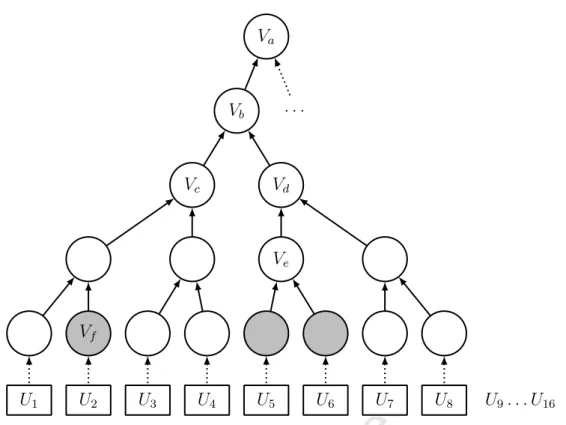
The key server maintains a binary tree, and as with the other techniques, the leaf nodes represent subscribers. Consider the two subtrees rooted at the internal nodes, or vertices, Vx and Vy, where Vy is a descendant node of Vx. Sx and Sy are sets of
users (leaf nodes) in each of these subtrees respectively andSy ⊂Sx. ThenSxy is the
subset of users contained inSx but notSy, that is Sxy =Sx\Sy. A key is associated
with each subset such that if a subset describes a selection of members, less the revoked members, it can be used to encrypt the new group key for distribution to valid members. This is illustrated in Figure 3.10.
The challenge is to partition the valid members into a minimal number of subsets and encrypt the group key with each associated key. Clearly a member will be included in many possible subsets and it is necessary to determine a way to minimize the number of keys that the member must store.