AN EVALUATION OF A MATHEMATICS PROFESSIONAL TEACHER
DEVELOPMENT PROGRAMME
by
BENITA PORTIA NEL
submitted in accordance with the requirements for
the degree of
DOCTOR OF PHILOSOPHY IN MATHEMATICS, SCIENCE AND
TECHNOLOGY EDUCATION
in the subject
MATHEMATICS EDUCATION
at the
UNIVERSITY OF SOUTH AFRICA
SUPERVISOR: DR K LUNETA
i
DECLARATION
I declare that AN EVALUATION OF A MATHEMATICS PROFESSIONAL TEACHER DEVELOPMENT PROGRAMME is my own work and that all the sources that I have used or quoted have been indicated and acknowledged by means of complete references.
________________________ _____________________
SIGNATURE DATE
ii DEDICATION
I dedicate this work to my parents, Percy and Joy Williams, for putting me on a path of lifelong learning, allowing me so many opportunities in life which you yourselves were not afforded. Through your lives and sacrifices I was able to reach this point in my life. I would also not be able to do this without the love and support of my
husband, Reginald Nel. Your achievements, constant motivation, support and talks got me though very tough times. Last, but surely not least, I dedicate this work to our beautiful and hardworking daughters, Ranique and Melayna, who understood the sacrifices made, who supported me, but also whose achievements pushed me to give more.
iii ACKNOWLEDGEMENTS
To everyone below I thank you for the support and encouragement during the process of doing this research:
• The teachers involved in the PD programme under investigation. Thank you for allowing me into your “space” and sharing your experiences so
enthusiastically.
• My supervisor, Dr K Luneta: My gratitude for you believing in me, your encouragement and support.
• My language editor and colleague, Herve Mitoumba, for significantly improving the final product with your expertise.
• My many colleagues, especially my SANTRUST family, for your support and motivation.
• Mr Namadzavho B Kone for your unconditional sacrifices made that allowed me to have the time to focus on completing this work.
• The University of Johannesburg for the financial support as well as allowing me to be part of the SANTRUST programme.
• The University of South Africa for the financial support in the form of a bursary granted to me.
iv ABSTRACT
Although South African teachers have ample opportunities for professional development (PD), weak results of learners show that these opportunities have had a limited effect on the development of the Mathematics teachers’ instructional skills. The improvement of the teaching of Mathematics is regarded as a solution to learners’ poor performance, because teachers play a key role in the improvement of pupils’ learning. In the light of this, a Mathematics PD programme implemented in a province of South Africa was evaluated and served as a case study. The aim of this evaluation was to probe the quality of the programme since it had been suggested that improving the quality of teaching can be achieved by offering effective PD programmes. Thus, the evaluation was done in an attempt to establish the academic value of the intervention. The investigated programme – which was implemented in a rural and under-resourced setting – focused on FET Mathematics teachers and used mentoring and workshops as its key intervention implementers. Five teachers were involved in this programme. Data collection methods included semi-structured interviews, lesson observations, mentoring and workshop reports, the results of learners, and pre- and post-test results of the participants. The evaluation of the PD programme revealed the following: that the workshops addressed the participants’ content knowledge gap to a limited degree; that mentoring was able to assist with the individual classroom-related needs of the participants, and that the community of practice formed in the workshops helped the participants to develop by means of working together on lesson preparation, micro-teaching, and content knowledge exercises. Other findings revealed that the duration of the workshops were adequate, however their intensity was insufficient to effectively address the participants’ needs, and that the workshops were carefully planned, given that the same topics were repeated. The mentor teachers and other facilitators encountered challenges relating to the long intervals between the mentoring sessions, the limited post-lesson-observation discussion time, the significant distances between the involved schools and the heavy teaching load of the participants. Nevertheless, recommendations on improving the effectiveness of future PD programmes included careful selection of the dosage of interventions, site-based mentoring, to incentivise participants of PD programmes, alleviating the teaching load of overburdened participants and the creation of conducive environments in rural areas for the formation of communities of practice.
v ABBREVIATIONS
ABET - Adult Basic Education and Training ANA - Annual National Assessment
CAPS - Curriculum Assessment Policy Statement
CENESA - Cooperation in Education between the Netherlands and South Africa
CEO - Chief Executive Officer
CIPP - Context, Input, Process, and Product evaluation model CPD - Continuous Professional Development
DBE - Department of Basic Education
DIPIP - Data Informed Practice Improvement Project DoE - Department of Education
ECD - Early Childhood Development FET - Further Education and Training GDE - Gauteng Department of Education GET - General Education and Training
GPLMSP - Gauteng Province Language and Mathematics Strategy Project
HOD - Head of Department
HSRC - Human Sciences Research Council IEB - Independent Examination Board INSET - In-service Education and Training JET - Joint Education Trust
ML - Mathematical Literacy
MOU - Memorandum Of Understanding MSDF - Michael and Susan Dell Foundation
NAPTOSA - National Professional Teachers’ Organisation of South Africa NCS - National Curriculum Statement
NGO - Non-Government Organisation NSES - National School Effectiveness Study OPR - Output to Purpose Review
PCK - Pedagogical Content Knowledge PD - Professional Development
vi
PEM - Programme Executive Manager
PLESME - Programme for Leader Educators in Senior Phase Mathematics Education
PS - Physical Sciences QLP - Quality Learning Project
SADTU - South African Democratic Teachers’ Union SPSS - Statistical Package for Social Sciences SSIM - Systematic School Improvement Model
TIMSS - Trends in International Mathematics and Science Study UNISA - University of South Africa
vii
Table of Contents
CHAPTER 1 ... 1 INTRODUCTION ... 1 1.1.1 Background ... 1 1.1.2 Problem statement ... 21.1.3 The Mathematics teacher development programme under investigation ... 3
1.1.4 Research question ... 6
1.1.5 Significance of the study ... 6
1.1.6 Rationale for the Study ... 6
1.1.7. Definition of key terms ... 8
1.2 LITERATURE REVIEW ... 9
1.2.1 Evaluation of an educational programme ... 10
1.2.2 The challenges encountered in the Mathematics teacher development ... 11
context ... 11
1.2.3 Mentoring as a teacher development intervention ... 16
1.3 CONCEPTUAL FRAMEWORK ... 18
1.4 RESEARCH METHODOLOGY... 19
1.4.1 Research design ... 19
1.4.2 Participants selection ... 20
1.4.3 Data Sources ... 21
1.4.4 Data collection and analysis... 24
1.4.5 Trustworthiness of the research ... 24
1.4.6 Ethical considerations ... 26 1.5 CHAPTER OUTLINE ... 26 1.6 DISSEMINATION PLAN ... 27 CHAPTER 2 ... 28 LITERATURE REVIEW ... 28 2.1. INTRODUCTION ... 28
2.2 EVALUATION OF AN EDUCATIONAL PROGRAMME ... 29
2.3 EFFECTIVENESS OF A PROFESSIONAL DEVELOPMENT ... 32
PROGRAMME ... 32
2.4 MENTORING AS A TEACHER DEVELOPMENT METHOD ... 39
2.5 THE CHALLENGES ENCOUNTERED IN THE MATHEMATICS ... 44
TEACHER DEVELOPMENT CONTEXT ... 44
2.6 WHAT TO KEEP IN MIND WHEN AIMING TO IMPLEMENT ... 50
viii
2.7 CONCLUSION ... 53
CHAPTER 3 ... 55
DESCRIPTION OF THE PROFESSIONAL DEVELOPMENT PROGRAMME UNDER INVESTIGATION ... 55
3.1 INTRODUCTION ... 55
3.2 WHO WAS THE PROJECT’S SERVICE PROVIDER? ... 56
3.3 WHERE WAS THIS PROJECT SITUATED AND WHAT WAS THE ... 59
CONTEXT OF THE PARTICIPATING SCHOOLS? ... 59
3.4 AN OUTLINE OF THIS PROJECT... 62
3.4.1 Overall goal and strategic interventions ... 62
3.4.2 The different components of the project ... 64
3.5 THE DIFFERENT INTERVENTIONS OF THE TEACHER ... 72
PROFESSIONAL DEVELOPMENT PROGRAMME ... 72
3.5.1 Content training workshops ... 72
3.5.2 School support and monitoring visits, and on-site mentoring ... 73
3.5.3 Professional development through professional learning clusters, self- ... 73
directed learning, community of practice, and teacher seminars ... 73
3.6 PROJECT LOG FRAME ... 74
3.7 EMPHASIS OF THIS RESEARCH ... 82
CHAPTER 4 ... 84
RESEARCH METHODOLOGY... 84
4.1 INTRODUCTION ... 84
4.2 RESEARCH APPROACH ... 85
4.2.1 THE RESEARCH METHODS... 86
4.2.2 DATA MATRIX ... 88
4.2.3 DATA COLLECTION INSTRUMENTS ... 92
4.2.4 QUALITATIVE DATA ANALYSIS ... 101
4.2.5 QUANTITATIVE DATA ANALYSIS ... 103
4.3 RESEARCH PARTICIPANTS ... 105
4.4 TRUSTWORTHINESS OF THE RESEARCH ... 107
4.5 ETHICS AND THE RESEARCH PROCESS ... 109
CHAPTER 5 ... 113
ANALYSIS OF SECONDARY DATA ... 113
5.1 INTRODUCTION ... 113
5.2 ANALYSIS OF MENTOR’S LESSON OBSERVATIONS AND REPORTS ... 115
5.2.1 Completion of syllabus ... 117
ix
5.2.3 Lesson plan ... 120
5.2.4 Support to learners and learner participation in class ... 123
5.2.5 Homework given ... 126
5.2.6 Critique ... 128
5.2.7 Observations that did not fit in any headings... 131
5.3 WORKSHOPS ... 136
5.3.1 Content selection ... 139
5.3.2 Lesson preparation ... 140
5.3.3 Teaching strategies... 142
5.3.4 Work schedule ... 145
5.3.5 Attendance of workshops by participants ... 146
5.3.6 Topics covered ... 146
5.3.7 Challenges faced ... 148
5.4 PROFESSIONAL LEARNING CLUSTERS ... 156
5.5 RESULTS OF THE PRE- AND POST-TESTS WRITTEN BY THE PARTICIPANTS ... 158
5.6 ANALYSIS OF THE FOUR SCHOOLS’ GRADE 12 LEARNERS’ EXAMINATION RESULTS FOR THE PERIOD 2010-2013 AND ONE SCHOOL’S GRADE 9 LEARNERS’ EXAMINATION RESULTS FOR THE PERIOD 2011-2013 ... 163
CHAPTER 6 ... 173
ANALYSIS OF PRIMARY DOCUMENTS... 173
6.1 INTRODUCTION ... 173
6.2 INTERVIEWS WITH THE PARTICIPANTS, THE FIRST MENTOR, AND THE PROGRAMME EXECUTIVE MANAGER ... 173
6.2.1 Analysis of interviews with the participants ... 173
6.2.2 Interview with first mentor ... 206
6.2.3 Interview with the programme executive manager ... 214
6.3 LESSON OBSERVATIONS DONE BY THE RESEARCHER ... 220
6.3.1 TEACHER MK ... 222 6.3.2 TEACHER NK ... 223 6.3.3 TEACHER RB ... 228 6.3.4 TEACHER SB ... 234 6.3.5 TEACHER SR ... 238 CHAPTER 7 ... 245
FINDINGS, CONCLUSIONS, AND RECOMMENDATIONS... 245
7.1 FINDINGS ... 245
7.1.1 Competence in content knowledge ... 245
x
7.1.3 Progress with the year work schedule ... 252
7.1.4 Development in terms of the setting of assessments ... 254
7.1.5 The role played by the workshops ... 254
7.1.6 The role played by the mentor ... 256
7.1.7 Pre- and post-test results of participants ... 259
7.1.8 Learners’ results ... 259
7.1.9 Other findings ... 260
7.1.10 Summary of findings on the effectiveness of the PD programme under ... 261
Investigation ... 261 7.2 CONCLUSION ... 263 7.3 RECOMMENDATIONS ... 266 BIBLIOGRAPHY ... 269 APPENDICES ... 285 Appendix 1 ... 287
Letter of consent by North West Department of Education to conduct the research ... 287
Appendix 2 ... 288
Letter to teachers seeking permission from participants to partake in research ... 288
Appendix 3 ... 289
Ethical clearance letter from UNISA ... 289
Appendix 4 ... 290
Consent form for Mentor & Programme Executive Manager ... 290
Appendix 5 ... 291
Interview schedule with the Teachers ... 291
Appendix 6 ... 292
Lesson observation schedule... 292
Appendix 7 ... 297
Turn-it-in Report ... 297
Appendix 8 ... 298
xi
List of Tables
1.1 Chapter Outline 26
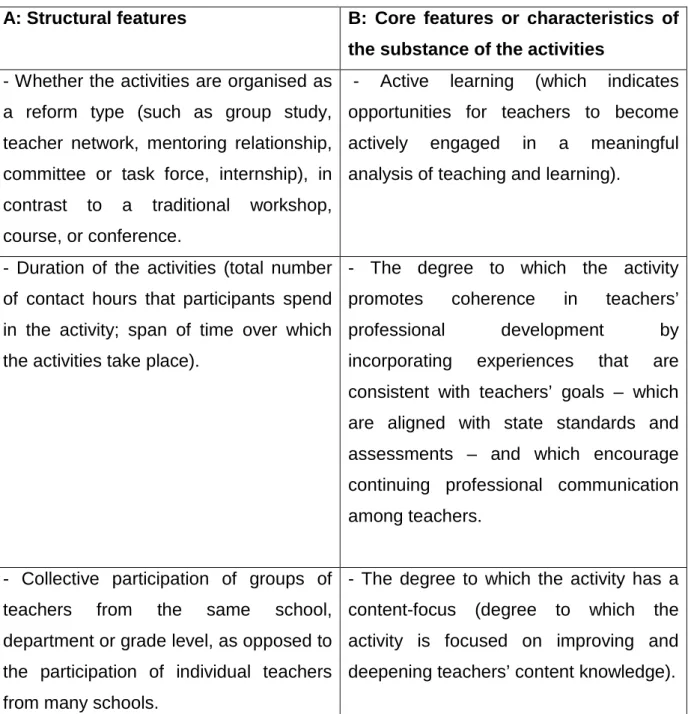
2.1 Six key features of professional development 37
3.1 Number of participants for the duration of the programme………. 72
3.2 Project log frame 81 4.1 Data Matrix for research question 1……… 89
4.2 Data Matrix for research question 2……… 91
4.3 Data Matrix for research question 3……… 91
4.4 Biographical data of participants………. 107
5.1 Workshop reports……… 137
5.2 Pre- & Post Test statistics of teachers ……… 160
5.3 Pre- & Post test scores of statistics of teachers……… 160
5.4 Examples of headings in Pre- and Post-Tests……… 161
5.5 Overall Pre- & Post-Test marks of teachers in %... 162
5.6 School A’s Mathematics results 2011 – 2013 ……….. 164
5.7 School B’s Mathematics results 2010 – 2013 ……….. 166
5.8 School C’s Mathematics results 2010 – 2013 ……….. 167
5.9 School D’s Mathematics results 2010 – 2013 ……….. 169
5.10 Significance levels of learners’ results per school 171
List of Figures
5.1 Graph of School A’s Mathematics results 2011 – 2013….………. 1655.2 Graph of School B’s Mathematics results 2010 – 2013….………. 166
5.3 Graph of School C’s Mathematics results 2010 – 2013….………. 168
1
CHAPTER 1
INTRODUCTION
1.1.1 Background
Considerable resources have been invested in the development of the Mathematics teacher in South Africa, with the aim of improving the quality of Mathematics teaching (Government Gazette, 2007: 24). The Mathematics teacher development initiative is primarily supported by provincial education departments, universities, NGOs, community-based organisations, teachers’ unions, and faith-based organisations (Government Gazette, 2007: 24). The private sector also funds some of the in-service Mathematics teacher development programmes as part of its social responsibility. However, despite these efforts, poor learner performance in Mathematics prevails. This observation is supported by data supplied by the Department of Education (DOE) at a symposium organised in February 2011. This symposium focused on grade 12 Mathematics and Physical Science results for 2010. According to the data provided by the DOE, grade 12 Mathematics pass rates were respectively 45.7% in 2008, 46% in 2009, and 47.4% in 2010 (DOE, 2010: 26). These figures indicate a minor improvement over the three years. It is important to emphasise that a 47.4 % pass rate implies a 52.6% failure rate.
Consequently, Adler (2002: 2) questioned the effectiveness of the INSET professional development programmes implemented in South Africa in the mid-1980s with the aim of fostering educational improvement in Mathematics. The Human Science Research Council (HSRC) (2006: 118) attributes learners’ poor results to, among other reasons, poor preparation on the part of teachers. This is supported by the Trends in International Mathematics and Science Study (TIMSS) report which reveals the non-inclusion of Mathematics in the initial training of one third of Mathematics teachers (HSRC, 2006: 116). However in the TIMMS Report of 2012 in South Africa 89% of the Mathematics teachers have either Mathematics or Mathematics Education included in their training (Mullis, Martin, Foy & Arora; 2012:
2
291). The HSRC 2006 report further indicates that, although South African teachers have ample opportunities for professional development, learners’ poor performance shows that these opportunities have had a limited impact on teacher development. It is also claimed that the “quality control measures (of PD programmes) are frequently inadequate or absent” (Government Gazette, 2007: 24). In the light of the above observations, it becomes essential to elaborate mechanisms for an external evaluation of professional development (PD) programmes and make appropriate recommendations. This is because donors’ continued investment of considerable resources in Mathematics teacher PD programmes depends on their ability to yield positive results.
Thus, this study suggests that one possible way of redressing the low Mathematics pass rates in South African schools is to improve the quality of teaching by offering effective PD programmes to teachers. The envisaged in-service programmes should, among other things, provide Mathematics teachers with further skills and knowledge, as well as update and upgrade their existing skills and knowledge.
1.1.2 Problem statement
Although the TIMSS report reveals that one third of Mathematics teachers did not have Mathematics as a subject in their initial training (HSRC, 2006: 116), the need for in-service training for teachers in South Africa has resulted in a plethora of Mathematics PD programmes. Examples of such programmes include the Quality Learning Project (QLP), the Programme for Leader Educators in Senior Phase Mathematics Education (PLESME), and the Gauteng Province Language and Mathematics Strategy Project (GPLMSP). Despite the availability of these Mathematics teacher development programmes in South Africa – where a vast amount of funds and resources are invested and bursaries made available to practicing teachers to enable them to further their studies, there is not a significant increase in the grade 12 Mathematics pass rate in schools. It must be emphasised that an increase in grade 12 Mathematics pass rate is desperately needed to address the shortage of highly-needed skills in Mathematics. It is therefore not surprising that there remains a question over the effectiveness of these programmes insofar as Mathematics teachers’ performance and competence are concerned.
3
Thus, this study aims to investigate this problem, through an in-depth evaluation of one PD programme, in order to gain strategic insight that would inform the design of future teacher development programmes.
1.1.3 The Mathematics teacher development programme under investigation For ethical reasons, the name of the teacher development programme being investigated in the current study is not disclosed. Nevertheless, it is worth noting that the programme was designed and piloted by the Joint Education Trust (JET), which is also the service provider of the programme. Furthermore, the programme was implemented in the Eastern Cape and the North West Province. However, this assessment focussed solely on the North West Province where only five high schools were considered out of the 26 schools that participated in the broader programme. The reason for only focussing on these five schools is that they were the only schools which fell in the Mathematics Further Education and Training (FET) section of the programme, which is the focus of this study. The aim was not only to gain new insights in order to make an original contribution to the discipline of Mathematics Education, but also – and ultimately – to improve the practice of teacher development. In other words, the aim of the study was not to (again) highlight the failures and challenges, but rather to creatively contribute to the development of effective Mathematics PD programmes. The selected PD programme, because it was based in one of South Africa’s provinces that face serious challenges, met the criteria of a programme implemented in a rural under-resourced area that strives to improve its Mathematics results. Here, it becomes important to provide an overview of the broader project.
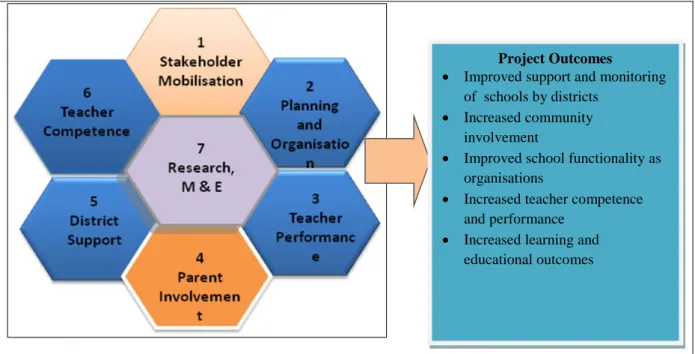
The broader Mathematics Teacher Development School Improvement Project had six main components (JET, 2010: 1):
1. Stakeholders mobilisation 2. Planning and organisation 3. Teacher performance 4. Parent involvement 5. District support 6. Teacher competence
4
The outcomes of the broader project include:
1. Improved support and mentoring of schools by districts 2. Increased parent and community involvement
3. Enhanced functionality of schools as organisations 4. Boosted teachers’ competence and performance 5. Better-quality learning and educational outcomes
The model used in this programme is based on the belief that optimal school improvement is dependent on partnerships between key stakeholders, namely, district and circuit officials, school managers, teachers and their unions, parents, and funders. The broader project started in 2009 as a 5-year project that was implemented in a district of the North West Province, in a cluster where the grade 12 results were the lowest. Although this project extends from grade 1 to grade 12 and includes subjects such as Mathematical Literacy, Physical Science and English, this research only focused on the Mathematics teacher development in the FET section. This included grades 10, 11 and 12. The Mathematics teacher development component was sponsored by one donor, and was planned and implemented for three years, namely, 2010, 2011 and 2012.
Given that there were five schools in the Mathematics cluster which offered the FET phase, all five FET Mathematics teachers from each of these schools were involved in this study. Given that this research centred on the development of Mathematics teachers, in terms of outcomes 4 and 5 above, the components that were focused on were the improvement of teachers’ performance, the enhancement of teachers’ competence, and the improvement of the quality of learning and educational outcomes. The related intervention strategies included are:
• Content-and-classroom-based workshops (4 per year).
• Mentoring of teachers
• Self-directed learning
• Teacher book club
• Professional learning cluster involvement
5
Ultimately, the programme aimed at bringing about improved learner results. It started with a baseline assessment of teachers in Mathematics, Physical Science, and English. The topics and issues that surfaced in the analysis of the pre-tests were discussed in the content-and-classroom-based workshops, with the intention of filling the gap in the content knowledge of the participating teachers. A facilitator was assigned to mentor these teachers inside and outside the classroom. This was an appropriate way of supporting the teachers, by virtue of its potential to address the unique needs of individual teachers. Furthermore, the self-directed learning intended to assist teachers with the enrichment and actualisation of their knowledge. As for the teacher book club, it sought to foster a culture of reading which is conducive to professional development. For this development to occur, teachers were expected to engage with articles that add professional value. As far as professional learning clusters were concerned, they were expected to provide opportunities for the establishment of an effective community of practice in which teachers could share their experiences, particularly the challenging ones.
One key characteristic of the studied PD programme was the involvement of the various stakeholders. Indeed, this programme involved the provincial Department of Education, through district and circuit officials, the South African Democratic Teachers’ Union (SADTU), the National Professional Teachers’ Organisation of South Africa (NAPTOSA), the communities surrounding the selected schools, and the learners’ parents. All these stakeholders were represented on the steering committee of the programme. The latter met once a term to discuss the programme’s progress, its challenges, and their possible solutions. This broad involvement sought to ensure buy-in from all stakeholders, as well as sustainability on completion of the programme. Furthermore, given that a school is not an island, a collective effort was necessary to ensure multi-pronged support to teaching and learning. Interestingly, the teachers who were employees of the Department of Education viewed this programme as an extension of their employer’s mandate, instead of a duplication of work.
In this study the focus was on investigating the effect of the workshops and mentoring as interventions. The self-directed learning, the teacher book clubs, the
6
professional learning clusters and the common work plans and assessments were not investigated. The reason for not focusing on the mentioned interventions was the fact that either these interventions did not get off the ground or the interventions were not sustained throughout the span of the programme.
1.1.4 Research question
This study addressed the following research question:
What was the effect of the identified Mathematics professional teacher development programme on the teachers’ competence and performance and learners’ success? In addressing this question, I focused on the following sub-questions:
1.1.4.1 How did the workshops affect teachers’ development in terms of their competence and performance?
1.1.4.2 How did the mentoring affect teachers’ development insofar as their competence and performance?
1.1.4.3 How did the participating teachers’ competence and performance affect their learners’ performance?
1.1.5 Significance of the study
The effect of a Mathematics professional teacher development programme was evaluated in an attempt to establish the worth of this intervention. In the process, the results and discussions (at least for this region) could shed light on why the Mathematics results in South Africa are not improving at a significant rate, despite the fact that a reasonable amount of resources and time is invested in these kinds of endeavours. Possible recommendations emanating from this research could be of value to professional developers, in their broader endeavour to redress and improve education in South Africa at large.
1.1.6 Rationale for the Study
Since the advent of the new dispensation in South Africa in 1994, the status of Mathematics as a gateway-subject to careers such as engineering and science – in which the previously disadvantaged sector of the South African population is
7
underrepresented – has been re-emphasised. Consequently, more value has been attached to Mathematics education in previously disadvantaged communities. There is an effort by both the public and private sectors of South Africa to build the nation by improving Mathematics Education in different ways. Different interventions have been initiated to equip Mathematics teachers with the necessary knowledge and skills that would enable them to address the challenges faced in the South African context (Adler & Reed, 2002: 32). The improvement of the teaching of Mathematics is regarded as a solution to learners’ poor performance in this subject (Loucks-Horseley et al., 2010: 86). In other words, one way of improving learners’ (Mathematics) pass rates is to up-skill teachers involved in the current system. However, the up-skilling of teachers is dependent on the quality of and effective implementation of programmes such as the Mathematics teacher professional development.
As it becomes evident, South Africa’s Mathematics teacher development programmes need to be evaluated to assess their worth. An evaluation “distinguishes what works from what doesn’t, and helps separate effective change makers from resource wasters …” (Patton, 2008: xviii). Sparks (2002: 11-6), for instance, has questioned the contentment of some, in the field of staff development, who tolerate programmes and activities of low standard. In other words, very few people have endeavoured to critique these ineffective programmes which waste the time of the teachers participating in them. Thus, the researcher argues that there is a need for an in-depth evaluation of the Mathematics PD programmes offered to teachers in South Africa. This study aimed specifically to investigate the effectiveness of a Mathematics teacher development programme implemented in the North West Province of South Africa.
The selection of this programme was based on the fact that it was a pilot programme aimed at achieving sustainable transformation in the South African Mathematics Education context, over a long period (five years for the broader programme). This is a key strategic objective. Should this programme engender significant improvement in the performance of teachers and learners, the model could be duplicated and used widely.
8 1.1.7. Definition of key terms
1.1.7.1 In-service education and training (INSET)
In-service education and training is defined in some countries as the preparation teachers receive on-the-job, without having a qualified teacher status (Villegas-Reimers, 2003: 55). However, in the context of this study, INSET programmes are defined as professional education and training activities which primary and secondary school teachers and principals engage in, after their initial professional qualification. The intention of these activities is to improve the participants’ professional knowledge, skills, and attitude (Villegas-Reimers, 2003: 55). The ultimate aim of these programmes is to improve teaching and learning.
The investigated programme is an in-service professional development programme. It uses training and mentoring to develop teachers in underperforming schools.
1.1.7.2 Professional development (PD)
Different definitions of professional development are provided in various research reports (Villegas-Reimers, 2003). However, this study follows the definition provided by Shaw (1995: 17) who states that:
‘It encompasses the first-hand experience learned at the chalk-face, courses and in-service training attended by the individual, professional reading, good practice in teaching and management learnt from other colleagues both consciously and unconsciously, as well as individual and team staff development gained in meetings with other teachers to discuss matters of common concern.’
1.1.7.3 Teacher competence
Teacher competence, in the context of the investigated PD programme, refers to the knowledge and skills that teachers use to facilitate learning.
9 1.1.7.4 Teacher performance
Teacher performance, in the investigated PD programme, relates to the ability or inability of teachers to fully implement annual work schedules, to effectively use different teaching strategies, and to actively involve and support learners in the classroom, in an attempt to enhance teaching and learning.
1.2 LITERATURE REVIEW
The following is only a preliminary review of the literature that will be developed further in Chapter 2. It suffices to note that there is a growing consensus that competent teachers and leaders play a key role in the improvement of students’ learning. This accounts for the significant investment in teacher development in nations with the best academic achievement scores (Darling-Hammond, 2010: 198). Indeed, current knowledge-based and information-driven economies require teachers with expertise and the ability to keep up with the rapid explosion of information. Thus, professional development must be geared towards helping teachers cope in situations characterised by, among others, limited resources. In other words, it is essential to establish effective professional development programmes which will enable teachers to keep abreast of ever-increasing educational needs, and the challenges associated with the teaching and learning of Mathematics. But, most importantly, it is essential that these programmes be evaluated so that the necessary improvements can be made.
Evaluating existing PD programmes could help to assess their value. This might assist in ascertaining which programmes add value to the teacher development landscape and which ones need to be discontinued because of their ineffectiveness. Furthermore, well-designed evaluations can be valuable tools in establishing whether current professional practices are worth investing in, or whether they must be adjusted or even replaced by other endeavours (Guskey, 2000: 1). Thus, this preliminary literature review section introduces the following aspects, which will be discussed in detail in Chapter 2:
• Evaluation of an educational programme;
10 • Mentoring as an teacher development method;
• The challenges encountered in the South African Mathematics teacher development context; and
• What to keep in mind when striving to implement successful professional development programmes.
1.2.1 Evaluation of an educational programme
Evaluation can be defined as “the systematic investigation of merit or worth” (Guskey, 2000: 41). The evaluation of programmes distinguishes those that are effective from those that are ineffective. In other words, evaluation helps to determine whether it is worth investing further resources in a specific programme (Patton, 2008: 4). Adler (2002: 2) stresses that “we need to identify, and then describe and explain the kinds of programmes that are beneficial, or in the language of finance, add value…”. Even though I concur with this view, my concern is on how to identify PD programmes that are also “beneficial” to teachers, in South Africa’s specific context of transformation.
Another definition of evaluation is provided by Weiss (1998: 4) who construes it as a “systematic assessment of the operation and/or the outcomes of a program or policy, compared to a set of explicit or implicit standards, as a means of contributing to the improvement of the program or policy”. In my view, this definition highlights five important aspects. The first aspect, systematic, implies that the evaluation procedures are of a scientific nature. The next two aspects that need to be focused on are the operations and outcomes of the programme. These are referred to as process-based and outcomes-based evaluations. Process-based evaluations are done when one wants to fully understand how a process works. These evaluations are usually used for long-standing programmes about which complaints have been received, or for programmes which seem ineffective (Weiss, 1998: 5). Outcomes-based evaluations seek to establish whether a programme is using the appropriate activities to achieve its outcomes. The fourth aspect of the definition refers to comparison standards. This is where the merit of a programme is measured against some set of expectations, after the evidence on its process and outcomes have been collected (Weiss, 1998: 5). The fifth and last aspect of the definition is concerned
11
with whether or not the evaluation contributes to the improvement of the programme. In essence, an evaluation is undertaken to improve a programme/policy. However, it remains to be established if evaluations are always carried out for this purpose. Thus, this study used the outcomes-based evaluation to assess whether the investigated programme reached its expected outcomes in terms of teacher development, and whether the workshops and mentoring were appropriate activities in trying to reach these intended outcomes.
Furthermore, it is important to distinguish between formative, summative, and planning evaluations. Formative evaluation occurs while the programme is in operation. The purpose of formative evaluation is to continually provide information on whether the implementation is happening as planned. It is undertaken for improvement purposes. Summative evaluation occurs at the end of the programme. Its aim is to judge the programme’s overall worth. Planning evaluation takes place before the commencement of a programme. Its goal is to provide a clear understanding of the procedure to follow, what needs to be accomplished, and how success will be determined/measured (Guskey, 2000: 56-58). The current study uses summative evaluation to investigate the merit/worth of the PD programme after its completion. The reason for evaluating the programme after its completion was that the researcher was busy collecting data on another teacher professional development programme, in Gauteng, so as to evaluate it. Unfortunately, this programme was cancelled due to very poor attendance by the target group. When consent was obtained to do research on the substitute programme, it was already coming to an end.
1.2.2 The challenges encountered in the Mathematics teacher development context
The lack of a teacher education policy framework, the absence of a coherent strategy aimed at effectively upgrading under-qualified teachers, the ineffectiveness of endeavours geared towards the development of teachers’ ability to teach reading and numeracy, and the scarcity of evidence-based research that could inform policy and practice on teacher education in South Africa are some of the challenges relating to teacher education identified by both the Department of Education and the
12
Council for Higher Education (GDE, 2010: 14). Therefore, there is a need to increase evidence-based research that could account for the work done in terms of teacher education. For example, a study can be conducted to establish whether a PD programme has achieved its objectives and, if so, to what extent?
The Gauteng Mathematics, Science, and Technology (MST) Strategy indicated that the South African government had a vision regarding support to professional development initiatives aimed at Mathematics teachers (GDE, 2010: 20). Yet, Metcalfe (2011) observes that “the state (and NGOs) continue to invest resources in education without achieving any improvements in quality” (Sunday Times Review, 20 Nov. 2011:5). The question remains whether the plans/programmes designed and implemented in order to achieve the aforementioned vision are appropriate. Garaway (2003: 705) stresses the need to design context-appropriate teacher development programmes. Therefore, I argue that in order to design an appropriate PD programme the needs of the teachers should be taken into consideration. Put differently, the implementation of a professional teacher development that is informed by the needs of the beneficiary teachers is central to the accomplishment of the aims of the programme (Luneta, 2012: 11; Joyce & Showers, 1988).
Hence, Metcalfe (2011) suggests that the desired impact of teacher PD programmes is imperceptible “because efforts have been fragmented; learning has not been shared; and innovations have been isolated from system change” (Sunday Times Review, 20 Nov. 2011: 5). In the light of this explanation, the researcher established a pressing need to share with other practitioners and stakeholders the lessons learnt and the innovations implemented, regardless of whether or not these innovations were successful. One way of doing this would be to undertake a comprehensive evaluation of all PD initiatives and then share the findings with other practitioners and stakeholders.
The current South African educational landscape predominantly uses the off-site model in its continuous professional development programmes, during school holidays and after school (Luneta, 2012:12). However, effective PD interventions require teacher training to be moved to the classroom (McKinsey et al., 2007: 26; De Clercq & Phiri, 2013: 78), where it would be most relevant and applicable (ibid:
13
27). The inability to run effective professional development programmes results in a disconnection between practice and theory, and a disjunction within the school as a whole (Luneta, 2012:12). The effects of school-based professional development programmes which involve mentorship, and are linked to the needs of the school, are more sustainable.
Another important factor that can impact on the effectiveness of PD programmes is teachers’ qualifications. Indeed, research conducted by Scholtz et al. (2004) shows that experienced and better-qualified teachers are more inclined to participating in PD programmes. This finding is alarming since it has been established that many South African Mathematics teachers are inadequately equipped to teach this subject (Makgato & Mji, 2006: 254). Therefore, PD practitioners should be innovative, when planning and implementing PD programmes, to ensure that under-qualified teachers become actively involved in these programmes and that they actually implement what they would have learnt.
It is important to note that teacher training is not the panacea to all education problems. The South African education sector is negatively affected by a myriad of factors such as poverty, unemployment, lack of parent support to learners after school, illiterate and innumerate parents (De Kadt, 2010: 6), as well as by reading challenges resulting from learners being taught in mother tongues (Setati & Barwell, 2008: 2). A study conducted by Howie (2003: 1) in South Africa identified proficiency in English as a strong predictor of success in Mathematics. In other words, the low level of Mathematics skills among a considerable number of teachers is but one of many factors that affect learners’ performance. In this regard, teacher training should not be viewed as the solution to all the challenges faced in the broader South African educational landscape.
Thus, it becomes important to establish whether the content of teacher development programmes should be geared towards fostering the implementation of effective or best practices, or rather towards sustainable long-term changes (Franke, 2001: 654). Franke (2001: 658) suggests that “the interest (of professional development) is in having teachers come to see themselves as on-going learners, seeking classroom practices that are responsive to the needs of the students and continually evaluating
14
and adapting classroom practice”. What this means is that professional development must help teachers to develop reflective teaching skills and life-long learning. The lessons learnt by teachers from their exposure to reflective practice in their teaching should result in their engagement in new practices. According to Onwu and Mogari (2004), the results of the UNIVEMALASHI programme (a Mathematics professional teacher development programme) stressed the positive effect of its built-in supportive component. This supportive component contributed to its success and sustainability. Indeed, evidence shows that after workshops on the theory, teachers implemented the learnt skills in cluster meetings in which reflections took place, and real classroom experiences were discussed and analysed. In another PD programme implemented in South Africa, the success of theData Informed Practice Improvement Project (DIPIP) programme in changing classroom practice and learners’ behaviour is attributed to the combined effect of teachers’ active participation in discussions in a professional learning community, and support received from principals and district officials, even after the programme (Brodie, 2013: 15).
Wenger (1998) also stresses the importance of a community of practice in which people can learn through their collective involvement. Previous work done by the researcher on an ACE reskilling programme showed that teachers learnt a great deal through collaborations with colleagues (Nel, 2012). By exchanging knowledge/information and by sharing experiences/skills, teachers developed in terms of their confidence and classroom practice, as well as their assessment practices and facilitation skills. The abovementioned observations need to be taken into account when elaborating professional development programmes. Franke (2001: 685) also emphasises that “teachers need time to develop relationships with others that they can talk with in ways that meet their needs and push their thinking”.
The preliminary results of the UNIVEMALASHI research project, a three-year professional development programme for outcomes-based education implemented in the Limpopo Province of South Africa, “demonstrates that an appropriate teacher development programme results in changes in teacher classroom practice and learner behaviour” (Onwu & Mogari, 2004: 176). This is in line with Garet et al.’s (2001: 935) claims that “sustained and intensive professional development is more
15
likely to have an impact … than a shorter professional development”. It remains to be established whether the studied programme is “intense” enough to have an impact on the professional development of the participants, and whether this impact can be sustained.
However, Garet, Porter, Desimone, Birman, and Yoon (2001: 917) claim that, although there is a significant amount of literature on professional development, relatively little systematic research has been conducted to assess the effects of professional development on the improvement of teaching or students’ outcomes. Thus, I agree with Penuel, Fishman, Yamaguchi, and Gallagher (2007) that, in the past, insufficient attention was paid to the outcomes of professional development, although it is key when evaluating a programme (Luneta, 2013: 106). This is because the emphasis was on the evaluation of teachers’ opinion on their professional development experiences rather than the actual change in their practice and skills (Joyce & Calhoun, 2010: 116). This is evident in evaluation reports on professional development programmes run in South Africa. One of the major initiatives designed to improve Mathematics and Science education, through a PD component, is the Dinaledi Programme. It is run by government in an attempt to improve Mathematics and Science results in schools. After 10 years of existence, this programme has revealed major gaps through its evaluation. For instance, the absence of a process evaluation limits the ability to adequately measure the effectiveness/impact of this programme (Narsee, 2011).
Hence, some studies (e.g. Graven, 2002) have directed their attention towards both the complex link between the design of professional development programmes and teachers’ learning as a result of their exposure to these programmes, as well as the subsequent changes made in classrooms (Penuel et al, 2007:923). This study aimed to investigate this link in the context of the studied programme. Countries like Finland, Korea, and Singapore – which have recorded a significant improvement in their students’ achievements – attribute exploit to their investment in teacher preparation and development (Darling-Hammond, 2010: 194). This clearly suggests that teacher development initiatives have the potential to change South Africa’s current situation for the better.
16 1.2.3 Mentoring as a teacher development intervention
The programme under investigation used a mentoring component as a means to achieve the professional development of the participants. This mentoring component supported the workshops and consisted of classroom visits, one-on-one sessions with the participants, as well as checking the progress of the participants with regards to the work schedule, lesson plan, and so forth, at their respective schools. Therefore, discussions on mentoring as a component of the PD programme were incorporated in the evaluation of the programme, because mentoring was crucial to the development of the participants.
Mentoring has various definitions (see, for example, Allen, Finkelstein & Poteet, 2009; Shulman & Sato, 2006). In the context of this research, mentoring was defined as an intentional strategy aimed at developing a person, based on individual and institutional support. Mentoring aims to create a learning partnership that fosters professional development (Fischer, 2002: 3). Generally, mentoring involves a relationship between a more experienced person (the mentor) and a less experienced individual (the mentee) (Shulman & Sato, 2006:2). The primary focus of this relationship is the growth and development of the mentee, although the mentor may also benefit (Allen, Finkelstein, & Poteet, 2009: 2). One of the major modes of developing teachers who participate in this specific PD programme was the use of facilitators for a one-on-one mentoring of teachers inside and outside their classrooms (Project Proposal, 2009). The constructive criticism (Guskey, 2000: 28) and experience that the mentor provided the mentee with – through co-teaching – was meant to assist with two of the intended outcomes of the identified programme, namely, the improvement of the mentee’s competence and the enhancement of his/her performance as a teacher. Darling-Hammond (2010: 206) supports the inclusion of content knowledge and active learning in a teacher development programme and adds such components as assessment, learning, and performance assessment to the list. Her aim in doing so is to develop the participating teachers’ skill of reflective teaching in relation to learning.
The TIMSS report revealed that, despite the above-average attendance of professional development activities internationally, only a small percentage of South
17
African teachers have indicated their involvement in professional development activities which included Mathematics and Science pedagogy and instruction (HSRC, 2006: 116). This implies that South African teachers either do not attend PD programmes offered to them, or that there are limited opportunities for PD in South Africa, compared to the international arena. Whatever the case may be, South African Mathematics teachers need to attend more professional development programmes to better equip themselves so as to improve the dismal Mathematics results of school learners. The inclusion of mentoring, pedagogy, and instruction in a PD programme has the potential to yield better-equipped teachers (Guskey, 2000: 28). The report on the evaluation of the Quality Learning Project (Taylor & Prinsloo; 2005), a 5-year teacher development programme which ran in all the provinces of South Africa, contained a recommendation on the inclusion of mentoring in teacher development in order to increase the impact of PD programmes. This confirms the valuable role that the inclusion of mentoring can play in a teacher education PD programme.
Mentoring can provide both a career function and a psychosocial function to the mentee (Ragins & Kram, 2007: 5). The career function involves helping the mentees to “learn the ropes” and preparing them to perform better and efficiently. This can be achieved by increasing positive exposure and visibility, giving the mentees challenging assignments, and recommending them for possible advancements. With the psychosocial function, trust, intimacy, and interpersonal bonding are built. These can enhance the mentees’ professional and personal growth, and both their self-worth and self-efficacy (Ragin & Kram, 2007: 5). In the education context, effective mentoring is associated with the improvement of classroom performance, an involvement in a context created by change initiatives, and the sharing of good practices (Rhodes, Stokes & Hampton, 2004: 2). This can create an environment where the effectiveness of the school organisation increases and, by implication, the performance of learners.
The possible organisational constraints in a mentoring process include the lack of a supportive environment which encourages collaboration between colleagues, the ineffectiveness of the implementation process, the non-inclusion of the mentee in the selection of the mentor, staff’s lack of commitment to the process, inappropriate
18
needs analysis, and time constraints (Rhodes et al., 2004: 23-24). So, when mentoring is evaluated, the above constraints must be considered.
1.3 CONCEPTUAL FRAMEWORK
The current study is conceptualised around one of the four types of evaluation, the CIPP model for evaluation, which was developed by Daniel Stufflebeam (2003). CIPP stands for Context, Input, Process, and Product evaluation. It is a utilitarian model (management model) which counteracts the production factor of evaluation, where the output for educational programmes is test scores (Stufflebeam, 2003: 15). This implies that if all schools are given adequate resources and are provided with the necessary support, the learners’ performance in tests, among others, can improve. However, it is important to note that test scores are not always the best predictors of the effectiveness of a PD programme. This is because they do not take into account the uniqueness of situations. Indeed, different groups apply different standards to a PD programme and, therefore, select different indicators of effectiveness for the same programme (Stufflebeam, 2003: 15).
CIPP refers to the following four types of evaluation: 1. Context evaluation
2. Input evaluation 3. Process evaluation 4. Product evaluation
These four types of evaluation serve several but also different functions (Stufflebeam, 2003: 31). The context evaluations assess the “needs, problems, and opportunities within a defined environment; they aid evaluation users to define and assess goals and later reference assessed needs of targeted beneficiaries to judge a school programme…” (Stufflebeam, 2003: 31). The input evaluations assess the “competing strategies and the work plans and budgets of approaches chosen for implementation; they aid evaluation users to design improvement efforts, develop defensible funding proposals, details action plans, record the alternative plans that were considered, and record the basis for choosing one approach over the others.”
19
Process evaluations monitor, document, and assess activities; they help evaluation users to carry out improvement efforts and maintain accountability records of their execution of action plans. Product evaluations, which this study focused on, identify and assess the short-term, long-term, intended, and unintended outcomes of PD programmes (Stufflebeam, 2003: 31-32).
The researcher had the challenge that after the permission was granted to evaluate the programme, it was realised that the implementation thereof was very close to completion. Thereafter permission had to be granted from the Department of Education as well as the schools, including the participants. So when the research finally got underway, the workshops and mentoring already came to an end. This lead to the researcher not being able to assess the needs of the teachers and schools prior to the commencement of the programme as the interventions were already done. So the Context evaluation was not possible. The chosen strategies and work plans as well as budget chosen could also not be altered at that stage as the implementation was already done. Therefore the inability to do the Input evaluation. The Process evaluation also could not be conducted as the assessments of activities and improving efforts pertaining to the programme could only be assessed in retrospect, though nothing could be altered at the time. Therefore, the researcher could only do the Product evaluation pertaining to the CIPP model regarding evaluating the PD programme.
1.4 RESEARCH METHODOLOGY
1.4.1 Research design
Given that this study sought to evaluate whether a Mathematics PD programme addresses the participating teachers’ competence and performance, this research used rich descriptive data. As such, it lent itself to a qualitative study insofar as the first and second research questions. Qualitative research could scientifically describe persons and events pertaining to this PD programme without using numerical data (Best & Kahn, 1998:73). It suffices to note that the world we live in is complex and multifaceted. For this reason, social science research needs to match its methodology and methods with the multidimensionality of lived experiences (Mason,
20
2006: 11-12). With regards to answering the third research question, a quantitative approach was followed in the analysis of the participants’ pre- and post-tests as well as the learners’ results. In quantitative research, the type of information that the researcher obtains from the participants is expressed in numerical form (Cumberbatch, 2004: 2) and the analysis thereof is largely statistical and reports on the size of the effects and the significance of the statistical relationships (Weiss, 1998: 82). It must be noted that the quantitative component of the study was small, compared to the qualitative one. Hence, the study can be regarded as a qualitative study with a quantitative component.
The qualitative research methods used in this study were the interviews with the participants and both the programme executive manager and the mentor, mentor reports, and documented studies of the different workshops. The quantitative research method came into play when learners’ Mathematics results and the participants’ pre- and post-tests were analysed. These analyses were done in order to establish possible trends in terms of the participants’ content knowledge competence and learners’ performance after their teachers’ involvement in the activities of the PD programme under investigation.
1.4.2 Participants selection
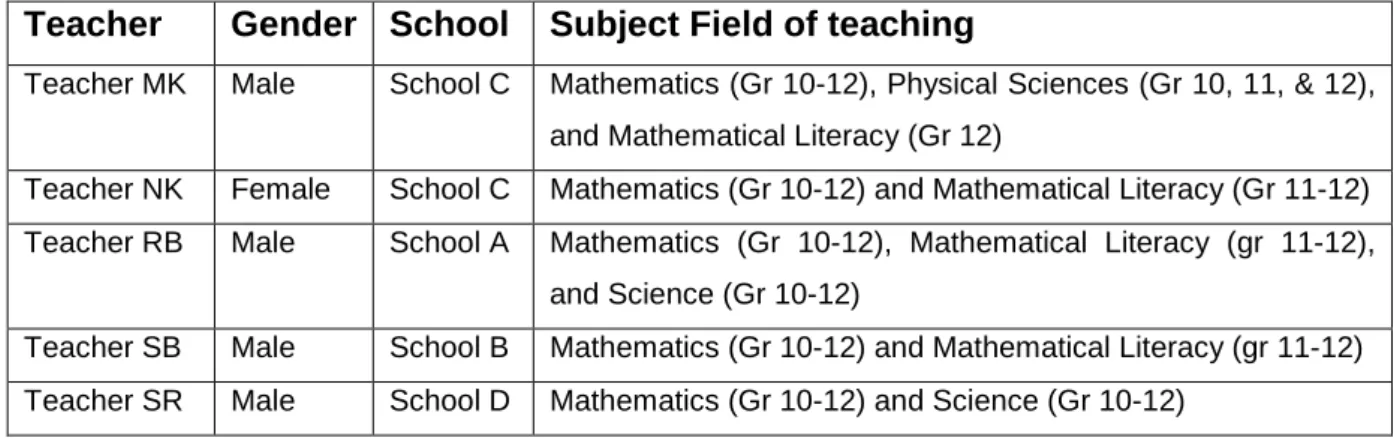
The target population for this study was constituted by the five schools involved in the identified PD programme. In one of the schools, two Mathematics teachers participated in the Mathematics component of the broader programme, taking the number of participants in the Mathematics PD programme to six. However, later on, one teacher who stopped attending the programme was excluded, reducing the number of participants to five. These participants were given pseudonyms, for anonymity purposes. The teacher who taught at the school that experienced a decrease in the number of grade 12 learners was moved to a nearby school. This latter and its Mathematics teachers were not part of the study. The remaining five teachers were willing to participate in the study and were thus included. The four remaining schools were called School A, School B, School C, and School D, respectively, for the sake of anonymity. Sampling was then done at the stage of choosing the schools. Weiss (1998) stresses that although the sample for qualitative
21
evaluation is a small subset of the population, it would generate a large amount of data about each teacher considered (Weiss, 1998: 284). The sampling of the specific schools was based on their involvement in the PD programme and their willingness to participate in the research. In other words, the selection of schools was motivated by their involvement in the PD programme.
1.4.3 Data Sources
Primary as well as secondary data sources were used in this study. The primary data sources were the interviews with the participants the mentor, and the programme executive manager, as well as lesson observations done by the researcher. The secondary data sources were the document analysis of written materials pertaining to the PD programme, documents relating to the professional learning community, mentor reports on school visits, workshop reports by the facilitator, reports written by the programme executive manager, lesson observations done by the mentor, learners’ results, and the participants’ pre- and post-test results.
Primary sources
1. The lesson observations done by the researcher were used and analysed to evaluate whether knowledge and skills acquired through the PD programme were implemented in the classroom.
2. The researcher conducted semi-structured interviews with all the participants in the PD programme. Where possible, these interviews took place on the same day that the researcher had to observe lessons conducted by the interviewed participants. The aim of these semi-structured interviews was to do an in-depth exploration of the issues pertaining to the implementation of the investigated PD programme, what the participants picked up from the programme, the teachers’ ability to implement what they may have learnt in the programme, the strengths and weaknesses of the programme, and the challenges experienced. The objective of this exploration is to make possible recommendations for the improvement of future PD programmes. The semi-structured interviews conducted in this study helped to address the lack of valuable information on the assessment of the success of PD programmes. A thematic analysis was undertaken based on the themes that the researcher had identified through the
22
literature review. More or less the same themes were used for the analysis of the mentoring and workshop reports, the interviews with the mentor, and those with the programme executive manager.
3. The researcher also conducted a semi-structured interview with the first mentor, after the interview with the teachers, in order to triangulate the data, especially those pertaining to the development of the participants. An interview with the second mentor (appointed in 2012 when the first mentor left) was not possible, because she had passed on.
4. A semi-structured interview with the execute programme manager was also conducted, to elicit data pertaining to the achievement of the programme’s goals, the roles of the stakeholders, challenges, and recommendations on the improvement of the programme.
Secondary sources:
5. The secondary documents pertaining to the investigated PD programme included the history of the programme, information about the service provider, the aims and objectives of the programme, definitions of the terminology used, and the different interventions used to reach the aims and objectives of the programme. These documents had valuable information which was used to establish the aims and objectives of the programme and to derive how they would be accomplished. Gathering this information would enable the researcher to get an understanding of the roll-out of the programme. Vos, Strydom, Fouche and Delport (2005: 323) referred to this way of data collection as the document study method; and, they classified these documents as official documents.
6. The document analysis of the different mentor and workshop reports for 2010 and 2012, for every participating teacher and every workshop, was done, to triangulate the data in conjunction with the lesson observations and interviews done with the participants, as well as the interviews with the programme executive manager and the first mentor. The purpose of the document analysis of the mentor reports was to ascertain the individual participants’ possible development. The purpose of the document analysis of the workshop reports was to determine what was covered in the workshops, how the participants responded to the workshops, and who selected the content of the workshops. These mentor and workshop reports were written by the mentor and workshop facilitator who
23
was the same person, for the better part of the programme’s roll-out. These reports were written from this person’s perspective; as such, they could be perceived as one-sided. However, the triangulation of the data obtained from these reports with those gathered through the interviews with participants, the mentor and the programme executive manager would help to counterbalance this possible one-sidedness. This would help to eliminate the mentor/workshop facilitator’s possible bias, as different peoples’ views and voices were infused to ensure a more comprehensive perspective on what transpired in the programme. 7. The lesson observations done by the mentor were used and analysed to evaluate
whether the knowledge and skills that may have been acquired through the PD programme were implemented in the classroom.
8. The analyses of the grade 9 learners’ Mathematics results of School A as well as the grade 12 learners’ Mathematics results of Schools B, C and D were done to identify general trends for the period ranging from 2010 to 2013. The motivation for examining the grade 9 and grade 12 Mathematics results stems from the fact that, in South Africa, these results are used as indicators of success in schools. Grade 9 and grade 12 signify the end of a phase in public schools. Indeed, grade 9 marks the end of the Senior Phase, whereas grade 12 signals that the end of the FET Phase. Through the analysis of the learners’ Mathematics results, the researcher was able to verify if the results of the learners whose schools/teachers were involved in the investigated Mathematics teacher professional development programme had improved or not. The Statistical Package for Social Sciences (SPSS) – especially the Friedman Test – was used to analyse the data. This test was decided upon because the data comprised of the same sample of cases, which were measured at three points in time (in the case of School A) and at four moments (in the case of the other schools) (Pallant, 2007: 228). Given that the grade 12 learners of School A had been moved to another school, the grade 9 learners’ results for the period 2011-2013 were used.
9. Pre- and post-tests were administered by the service provider, to investigate whether the participants’ content knowledge changed. Because the pre- and post-test results were interval data, the SPSS was used to analyse the results, using The Wilcoxon Signed Rank Test. This test has been designed to be used when “your subjects are measured on two occasions, or under two
24
different conditions” (Pallant, 2007: 223). The scores were then converted to ranks and the two different occasions’ scores were compared.
1.4.4 Data collection and analysis
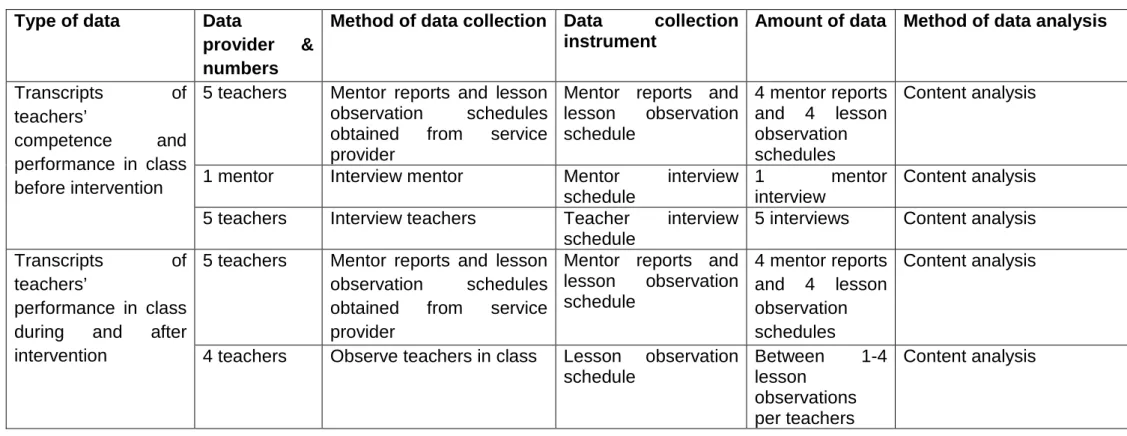
The primary data were collected by means of at least two lesson observations per participant, one or two semi-structured face-to-face interviews with each of the participants, as well as a semi-structured face-to-face interview with the programme executive manager and the first mentor of the programme. The lesson observations were done and recorded according to the lesson observation schedule compiled by the researcher. Semi-structured interviews – which were audio-recorded and transcribed – were conducted on the same day as the lesson observation. Thematic analysis was then done using themes that emerged from the literature review on effective PD programmes.
The secondary data included the mentor reports on the different participants, workshop reports, learner results, and teachers’ pre- and post-test results. The reports and pre- and post-test results were acquired from the service provider. The learner results were obtained from the District Office and the schools, respectively. The reports were analysed to ascertain the aims, objectives, and modes of training delivery used in the development of the participants. The learner results of the different schools were also analysed in an attempt to establish a pattern in these results, from the time that the teachers began to attend the PD activities of the programme. The interviews with the participants provided the researcher with the opportunity to further probe into certain aspects of the observed lessons that needed clarity.
The results generated by the analysis of the data were thematically-organised, discussed, and interpreted to make appropriate recommendations.
1.4.5 Trustworthiness of the research
The trustworthiness of this study was ensured by, among other things, the researcher’s choice of appropriate methods of data collection, to suit the qualitative
25
approach adopted. In other words, the trustworthiness of this study is strongly linked to its adoption of an interpretive approach which uses a combination of observation schedules, document studies, semi-structured interviews, learners’ results, and the pre- and post-test results of the participants.
Thus, in conducting this research, particular attention was given to the reliability and validity of the work. Validity refers to the accuracy with which the instruments used measure the concept in question (De Vos, Strydom, Fouche & Delport, 2002: 166). A research instrument is considered reliable if the results of a study can be reproduced under similar methodology (Joppe, 2000: 1). This highlights the idea of repeatability and replicability of observations or results (Golafshani, 2003:598). However, Lincoln and Guba (2000), and Graven (2002) question the applicability of reliability and validity in qualitative studies. In qualitative research, the assumption is that in the natural setting, there exist multiple realities constructed by individuals who are constantly in an interactive relationship with the social world (Graven, 2002). The use of the term reliability, which implies a test aimed at establishing consistency in measuring (Best & Kahn, 1998: 283), is also contested. When it comes to qualitative research, the investigation is based on a range of experiences rather than the average experience (Krefting, 1991: 216). This suggests that realities not be replicated; as such, similar results cannot be expected. Hence, the term trustworthiness is now used instead of reliability and validity. Trustworthiness relates to the need to ensure that the data are truthful and dependable in terms of the context under which data collection was done. Trustworthiness was ensured in this study (Krefting, 1991: 215) by accommodating the multiple realities of the teachers, the mentors, and the programme executive manager by means of triangulation.
Triangulation was done by collecting data from different sources in order to answer the research questions. Patton (2002: 247) claims that “triangulation strengthens a study by combining methods. This can mean using several kinds of methods or data, including using both quantitative and qualitative approaches”. Hence interviews with the five participating teachers, the project manager, and one mentor, as well as lesson observations and the analysis of mentor reports were done. The analysis of learners’ results was also done as a mode of data collection. This elicited similarities and differences in describing the different realities that exist.
26 1.4.6 Ethical considerations
Before, during, and after the collection of data, the researcher strove to ensure that the rights of the participants were respected. She formally applied for and received written permission – to conduct research in the investigated PD programme – from both the management of the service provider, JET, and the North West Department of Education. Furthermore, formal permission to conduct this research was also obtained from the University of South Africa (UNISA) (see Appendix 3). What is more, written consent was also obtained from the participants who declared that their involvement in the study was voluntary, after the researcher had informed them of the aims and objectives of the study, as well as their right to withdraw from the research at any time, without any consequences. The researcher ensured that the participants’ identities were protected through the use of pseudonyms, both for them and the schools that they were teaching at. The researcher also assured the participants of the confidential treatment of the collected information.
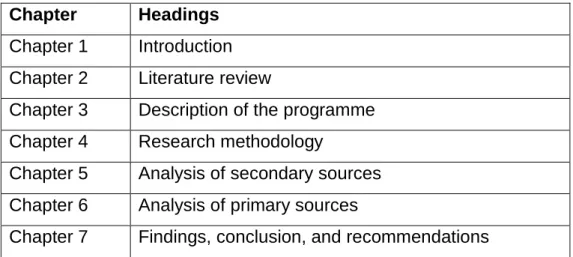
1.5 CHAPTER OUTLINE Chapter Headings Chapter 1 Introduction Chapter 2 Literature review
Chapter 3 Description of the programme Chapter 4 Research methodology
Chapter 5 Analysis of secondary sources Chapter 6 Analysis of primary sources
Chapter 7 Findings, conclusion, and recommendations