r ese A r ch A nd M ethodolo g Ies /r Icer che e M etodolo g
Ie reseArchfroMAnIMAltestIngtoclInIcAl
experIence
INTRODUCTION
Given the complexity of the nucleic acid amplifica-tion technology (NAT) assays and their only partial level of automation, that means several manual steps still to be carried out by the operator, it is critically important to have available reference preparations at known concentrations calibrated against their re-spective international standards. In fact, when used as run control at appropriate dilutions, these prepa-rations allow the operator to monitor the analytic process and to ensure reliability of the results [1].
The Biologicals Unit of the Istituto Superiore di Sanità (ISS), as the Italian official medicine control lab-oratory involved in the batch release of immunoglobu-lins and in plasma pool testing, developed several refer-ence materials for NAT assays and distributed them to blood product manufacturers and transfusion centres to be used for NAT validation studies in place of the re-spective World Health Organization (WHO) standards, considered golden standards [2-4].
As we were running short of our ISS HCV, HIV and HBV preparations, we decided to prepare new
na-Collaborative study for the calibration
of HCV RNA, HBV DNA and HIV RNA
reference preparations against the relative
international standards
Giulio Pisani, Francesco Marino, Karen Cristiano, Guillermo Mario Bisso,Claudio Mele, Francesca Luciani, Maria Wirz, Giuliano Gentili and the National Collaborative Study Group(*)
Dipartimento di Malattie Infettive, Parassitarie ed Immunomediate, Istituto Superiore di Sanità, Rome, Italy Summary. We organised a collaborative study to calibrate three new ISS reference preparations (ISS: Istituto Superiore di Sanità), one for HCV RNA, one for HIV RNA and one for HBV DNA, to be used for nucleic acid amplification techniques (NAT) in blood testing. Serial dilution of the ISS reference preparations and the respective international standards were tested in different days by each participating laboratory using two commercial NAT assays. Data were collected by the ISS for statistical analysis. Based on the mean potency of the HCV RNA and HIV RNA preparations, calculated from the results provided by the 12 participating laboratories, a definitive concentrations of 5700 IU/mL and 4000 IU/mL, respectively, were assigned to the reference materials. On the con-trary, it was not possible to obtain a consensus titre for the HBV DNA reference material. These new Italian reference preparations (HCV RNA ISS/1005 and HIV RNA ISS/1005) calibrated against the respective international standards are available free of charge to any laboratory upon request.
Key words: collaborative study, HCV RNA, HIV RNA, HBV DNA, reference preparations.
Riassunto (Studio collaborativo per la calibrazione di preparazioni di riferimento per HCV RNA, HBV DNA ed HIV RNA contro i rispettivi standard internazionali). È stato organizzato uno studio collaborativo per calibrare tre nuove preparazioni di riferimento ISS (Istituto Superiore di Sanità) per HCV RNA, HIV RNA ed HBV DNA per le tecniche di amplificazione genica impiegate nello screening del sangue. Ciascun laboratorio partecipante ha saggiato in giorni diversi diluizioni seriali delle preparazioni di riferimento ISS e dei rispettivi standard utilizzando una delle due metodiche NAT commerciali. I risultati sono stati raccolti dall’ISS per l’analisi statistica. Dall’analisi dei ri-sultati forniti dai 12 laboratori partecipanti è stato ottenuto un valore medio di potency delle pre-parazioni di HCV RNA ed HIV RNA alle quali sono state assegnate rispettivamente concentrazioni di 5700 UI/mL e 4000 UI/mL. Non è stato invece ottenuto un titolo di consenso per la preparazione di HBV DNA. Queste due nuove preparazioni italiane (HCV RNA ISS/1005 e HIV RNA ISS/1005) calibrate contro i rispettivi standard internazionali sono gratuite e a disposizione dei laboratori che ne facciano richiesta.
Parole chiave: studio collaborativo, HCV RNA, HIV RNA, HBV DNA, preparazioni di riferimento.
(*)The members of the National Collaborative Study Group are listed before the References.
Indirizzo per la corrispondenza (Address for correspondence): Giuliano Gentili, Dipartimento di Malattie Infettive, Parassitarie
tional reference preparations for these three viruses. In the present study, we report the results of a collabora-tive study for the calibration of the these preparations against the respective international standards.
MATERIALS AND METHODS ISS reference preparations
The 3 ISS reference preparations were obtained by appropriately diluting donations respectively positive for anti-HCV, anti-HIV and HBsAg, kindly provided by the Serology and Molecular Biology laboratory of the San Camillo-Forlanini Hospital (Rome, Italy). These donations also tested positive by NAT for the respective viruses, as assessed by our laboratory. From the diluted samples of each positive donation, 1000 vi-als were prepared and immediately frozen at -80°C.
In order to define the dilution protocol to be sent to each participant, a provisional titer was obtained for each diluted samples by using the limiting dilu-tion assay method.
HCV RNA batch ISS/1005
This preparation was obtained by diluting an HCV RNA-positive donation (genotype 1). The provisional titer was 3.65 log10 IU/mL.
HBV DNA batch ISS/0905
This preparation was obtained by diluting an HBV DNA-positive donation (genotype D). The provisional titer was 3.00 log10 IU/mL.
HIV RNA batch ISS/1005
This preparation was obtained by diluting an HIV RNA-positive donation (genotype B). The provi-sional titer was 3.65 log10 IU/mL.
International standard for NAT assays
In order to calibrate the ISS reference preparations, the following international standards (IS), approved by the WHO, were used:
1) the 2nd HCV RNA WHO IS, WHO 96/798, gen-otype 1 [5];
2) the 1st HBV DNA WHO IS, WHO 97/746, geno-type A-adw-2 [6];
3) the 1st HIV 1 RNA WHO IS, WHO 97/656, also positive for HBV DNA [7, 8], and the replacement HIV 1 RNA, WHO IS 97/650, both of genotype B [9].
These WHO IS were purchased from the National Institute for Biological Standards and Control (NIBSC), Hertfordshire, UK. All lyophilised standards were re-constituted according to the instructions of the suppli-er. To dilute the standards, normal human plasma non reactive for HCV, HIV1/2, and HBV both by serology and by NAT was used. Diluted samples were stored at -80°C until testing.
NAT assay for HCV RNA, HIV RNA and HBV DNA
In this study, the following commercial assays were used:
- COBAS Ampliscreen HCV Test (Roche); - COBAS Ampliscreen HIV Test (Roche); - COBAS Ampliscreen HBV Test (Roche); - ULTRIO TMA Assay for the simultaneously
de-tection of HCV, HIV and HBV (Chiron).
These assays are routinely used in the Italian blood centers.
Design of the study
The design of this study was similar to the one used in the studies for calibration of equivalent reference preparations against the respective WHO IS [2-4]. Briefly, participants were sent 4 vials of each reference material and 4 vials of each diluted WHO IS along with a working protocol and data sheets. Shipment was carried out on dry ice and delivery occurred within 48 hours. All participants subscribed a responsibility sheet to acknowledge that the samples were potentially infectious.
For each viral marker, the samples were to be tested in 4 independent NAT assays on different days. A fresh vial of the reference preparation and of the respective WHO IS was to be used in each of the independent assays. Each participant performed 4 independent series of dilutions in the sample diluent normally used in their assay system: two-fold dilu-tion series for the HCV RNA ISS preparadilu-tion and HCV WHO IS, half-log dilution series for the HIV RNA ISS and HBV DNA ISS preparations and the respective WHO IS. The choice of the dilution range for the standards was based on the level of NAT sensitivity of participating laboratories while the dilutions of the ISS preparations were made according to the respective provisional content re-ported above.
Statistical methods
Results were elaborated by Probit analysis which makes use of the method of maximum likelihood for a “dilution assay”. A statistical package, SAS System, version 8.01 (Cary, NC, USA), was used. Assuming that for each dilution the probability of having a positive result follows a Poisson dis-tribution and that a single copy of a viral nucleic acid gives a positive result, the percentage of posi-tive results will depend only on the dilution of the sample. According to this model, the probability of obtaining a negative result testing an appropri-ate number of samples containing a single copy is 37%. Therefore, the dilution containing a single detectable copy, defined as the end-point dilution, is the one at which 63% of the samples tested are positive.
NAT detectable units/mL
For each laboratory and for each virus, data from the 4 series of dilutions were pooled to give the number of positive results out of the total number of samples tested at each dilution step and conse-quently calculate the end-point dilution for the IS and the ISS preparations. Without considering the
retro-transcription efficiency and after correction for the equivalent volume of the amplified sample, the estimated number of copies/mL was obtained. As this does not necessarily correspond to the actual number of copies in the sample, it seems appropriate to replace the word “copies” with “NAT detectable units”.
Relative potency and potency of the ISS preparations
The relative potency was calculated as the difference in the estimated log10 PCR detectable units/mL be-tween the international standard and the ISS reagent.
On the basis of the relative potency and the titer of the respective WHO IS, the estimated potency (log10 IU/mL) for each ISS preparation was calculated for each laboratory.
The mean of these values represents the potency of the ISS reagent expressed in log10 IU/mL.
RESULTS
All the 11 laboratories followed the proposed work-ing protocol and sent the results accordwork-ing to the timetable of the study. Results from ISS laboratory were also included.
Seven laboratories used the Chiron test kit. In par-ticular, 4 of them (laboratories 1, 4, 6 and 7) used the manual procedure (Procleix) while 3 of them (labo-ratories 9, 11 and 12) used the automated procedure supported by the Tigris instrumentation. The re-maining laboratories, ISS included, used Roche test kits. For each participating laboratory, the potency
of the candidate ISS preparations in reference to the WHO IS was calculated according to the statistical method described above.
HCV RNA batch ISS/1005
In this study, the HCV ISS/1005 preparation was calibrated against the 2nd HCV RNA WHO IS by testing in parallel both samples.
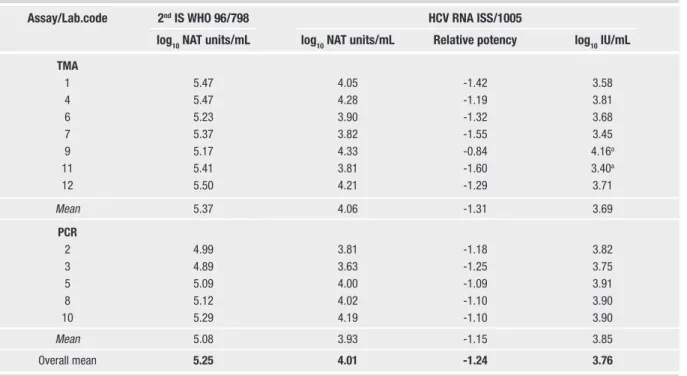
The respective estimated log10 NAT detectable units/ mL for the WHO IS and the ISS/1005 preparation are reported in Table 1. The overall mean estimate for the NAT detectable units/mL was 5.25 log10 for the WHO IS and 4.01 log10 for the ISS/1005 preparation. The overall mean potency (-1.24 log10 ) of the sample with respect to the WHO IS is also reported. As the concentration of the 2nd HCV RNA WHO IS had been assigned a value of 5.0 log10 IU/mL, the result-ing estimate for the ISS/1005 reference preparation is 3.76 log10 IU/mL.
The estimated log10 NAT detectable units/mL for the WHO IS and the ISS/1005 preparation grouped by NAT methods (Chiron vs Roche), are also shown in Table 1. The differences between the mean value obtained for the WHO IS (5.37 vs 5.08) and for the ISS/1005 (4.06 vs 3.93) fall within 0.5 log10 .
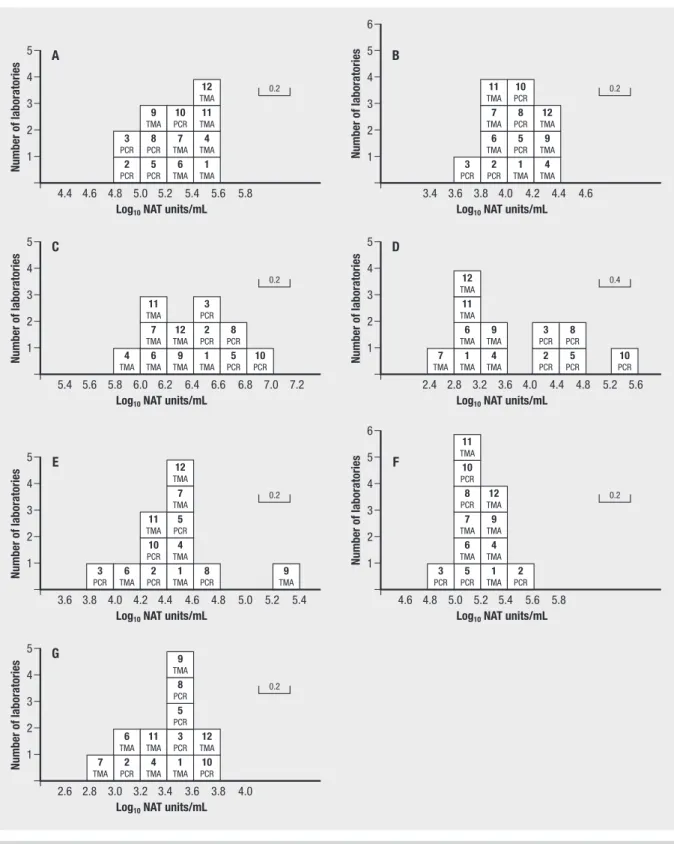
The respective laboratory estimates of log10 NAT detectable units/mL are shown in Figures 1A and 1B
for the WHO IS and for the HCV reference prepara-tion in histogram form.
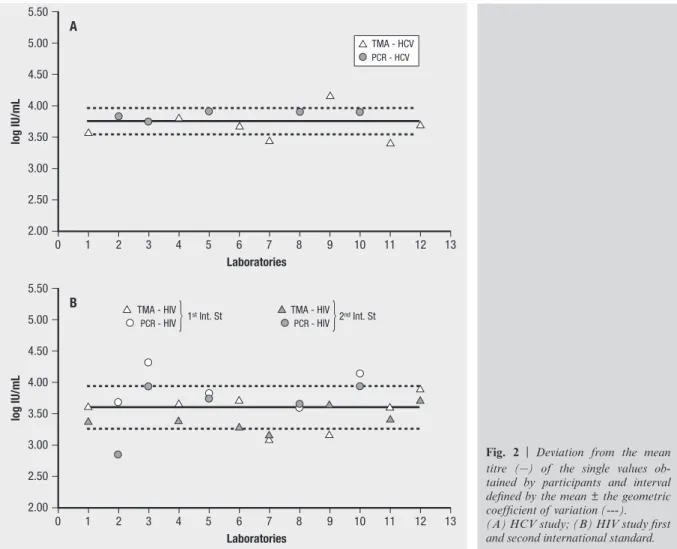
In Figure 2A, the deviation from the mean potency of the ISS/1005 of the single values obtained by the participants along with the interval defined by the
Table 1 | NAT detectable units/mL for HCV RNA
Assay/Lab.code 2nd IS WHO 96/798 HCV RNA ISS/1005
log10 NAT units/mL log10 NAT units/mL Relative potency log10 IU/mL TMA 1 5.47 4.05 -1.42 3.58 4 5.47 4.28 -1.19 3.81 6 5.23 3.90 -1.32 3.68 7 5.37 3.82 -1.55 3.45 9 5.17 4.33 -0.84 4.16a 11 5.41 3.81 -1.60 3.40a 12 5.50 4.21 -1.29 3.71 Mean 5.37 4.06 -1.31 3.69 PCR 2 4.99 3.81 -1.18 3.82 3 4.89 3.63 -1.25 3.75 5 5.09 4.00 -1.09 3.91 8 5.12 4.02 -1.10 3.90 10 5.29 4.19 -1.10 3.90 Mean 5.08 3.93 -1.15 3.85 Overall mean 5.25 4.01 -1.24 3.76
mean ± the geometric coefficient of variation are shown. The exclusion of the results from laborato-ries 7, 9 and 11 had little effect on the overall mean estimates.
HBV DNA batch ISS/0905
In this study, the HBV ISS/0905 reference prepara-tion was calibrated against the 1st HBV DNA WHO IS by testing in parallel both samples.
5 4 3 2 1 4.4 4.6 4.8 5.0 5.2 5.4 5.6 5.8 Log10 NAT units/mL A Number of laboratories 2 PCR 5 PCR 6 TMA 1 TMA 3 PCR 8 PCR 7 TMA 4 TMA 9 TMA 10 PCR 11 TMA 12 TMA 0.2 5 4 3 2 1 5.4 5.6 5.8 6.0 6.2 6.4 6.6 6.8 7.0 7.2 Log10 NAT units/mL
C Number of laboratories 4 TMA 6 TMA 9 TMA 1 TMA 7 TMA 12 TMA 2 PCR 11 TMA 3 PCR 0.2 5 4 3 2 1 3.6 3.8 4.0 4.2 4.4 4.6 4.8 5.0 5.2 5.4 Log10 NAT units/mL
E Number of laboratories 6 TMA 2 PCR 1 TMA 8 PCR 10 PCR 4 TMA 11 TMA 5 PCR 7 TMA 0.2 5 4 3 2 1 2.6 2.8 3.0 3.2 3.4 3.6 3.8 4.0 Log10 NAT units/mL G Number of laboratories 2 PCR 4 TMA 1 TMA 10 PCR 6 TMA 11 TMA 3 PCR 12 TMA 5 PCR 8 PCR 0.2 6 5 4 3 2 1 3.4 3.6 3.8 4.0 4.2 4.4 4.6 Log10 NAT units/mL B Number of laboratories 3 PCR 2 PCR 1 TMA 4 TMA 6 TMA 5 PCR 9 TMA 7 TMA 8 PCR 12 TMA 11 TMA 10 PCR 0.2 5 4 3 2 1 2.4 2.8 3.2 3.6 4.0 4.4 4.8 5.2 5.6 Log10 NAT units/mL
D Number of laboratories 1 TMA 4 TMA 2 PCR 6 TMA 9 TMA 3 PCR 11 TMA 12 TMA 0.4 6 5 4 3 2 1 4.6 4.8 5.0 5.2 5.4 5.6 5.8 Log10 NAT units/mL F Number of laboratories 5 PCR 1 TMA 2 PCR 6 TMA 4 TMA 7 TMA 9 TMA 8 PCR 12 TMA 0.2 5 PCR 10 PCR 8 PCR 7 TMA 5 PCR 8 PCR 10 PCR 9 TMA 3 PCR 12 TMA 10 PCR 3 PCR 11 TMA 9 TMA 7 TMA
Fig. 1 | Histogram of laboratory estimates in log10 NAT detectable units/mL (horizontal axis) against the number of laboratories
(ver-tical axis). The laboratory code number is indicated in each box. (A) HCV IS; (B) HCV ISS/1005 preparation; (C) HBV IS; (D) HBV ISS/0905 preparation; (E) HIV first IS; (F) HIV second IS; (G) HIV ISS/1005 preparation.
The respective estimated log10 NAT detectable units/ mL for the WHO IS and the ISS/0905 preparation are reported in Table 2. The overall mean estimate for the NAT detectable units/mL was 6.32 log10 for the WHO IS and 3.54 log10 for the ISS/0905 preparation. The
overall mean potency (-2.78 log10 ) of the sample with respect to the WHO IS is also reported. As the concen-tration of the 1st HBV WHO IS had been assigned a value of 6.0 log10 IU/mL, the resulting estimate for the ISS/0905 reference preparation is 3.22 log10 IU/mL.
Table 2 | NAT detectable units/mL for HBV DNA
Assay/Lab.code 1st IS WHO 97/746 HBV DNA ISS/0905
log10 NAT units/mL log10 NAT units/mL Relative potency log10 IU/mL TMA 1 6.54 3.13 -3.41 2.59 4 5.95 3.31 -2.63 3.37 6 6.07 2.90 -3.17 2.83 7 6.04 2.52 -3.53 2.47a 9 6.27 3.54 -2.73 3.27 11 6.04 3.04 -3.01 2.99 12 6.26 3.18 -3.08 2.92 Mean 6.17 3.09 -3.08 2.92 PCR 2 6.51 4.04 -2.47 3.53 3 6.46 4.17 -2.29 3.71 5 6.75 4.63 -2.12 3.88 8 6.62 4.50 -2.12 3.88a 10 6.96 5.54 -1.42 4.58 Meanb 6.59 4.34 -2.25 3.75 Overall meanb 6.32 3.54 -2.78 3.22
aMinimum and maximum values; range of variation 1.41 (excluding lab 10).
bExcluding lab 10.
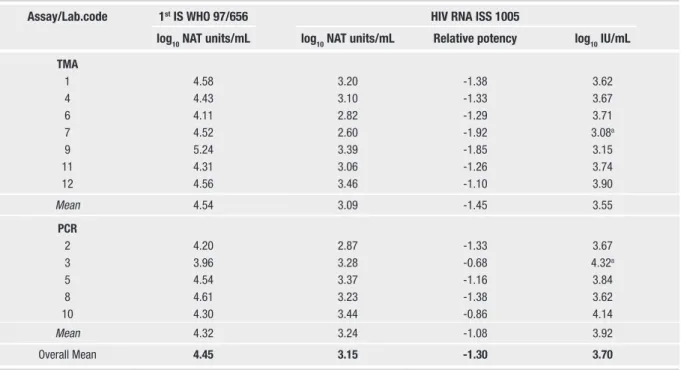
Table 3 | NAT detectable units/mL for HIV RNA - 1st IS WHO
Assay/Lab.code 1st IS WHO 97/656 HIV RNA ISS 1005
log10 NAT units/mL log10 NAT units/mL Relative potency log10 IU/mL TMA 1 4.58 3.20 -1.38 3.62 4 4.43 3.10 -1.33 3.67 6 4.11 2.82 -1.29 3.71 7 4.52 2.60 -1.92 3.08a 9 5.24 3.39 -1.85 3.15 11 4.31 3.06 -1.26 3.74 12 4.56 3.46 -1.10 3.90 Mean 4.54 3.09 -1.45 3.55 PCR 2 4.20 2.87 -1.33 3.67 3 3.96 3.28 -0.68 4.32a 5 4.54 3.37 -1.16 3.84 8 4.61 3.23 -1.38 3.62 10 4.30 3.44 -0.86 4.14 Mean 4.32 3.24 -1.08 3.92 Overall Mean 4.45 3.15 -1.30 3.70
The estimated log10 NAT detectable units/mL for the WHO IS and the ISS/0905 preparation grouped by NAT methods (Chiron vs Roche), are also re-ported in Table 2.
The difference between the mean value for the WHO IS (6.17 vs 6.59) falls within 0.5 log10 . On the contrary, in the case of the ISS/0905 preparation this difference is more than 1 log10 (3.09 vs 4.34). This means that calibrating the ISS against the WHO IS with the Ampliscreen test, a titre 6-fold higher than that obtained with the Ultrio test is obtained.
This difference in detecting HBV DNA in ISS preparation is clearly showed in Figures 1C and 1D
where the laboratory estimates of log10 NAT detect-able units/mL are shown in histogram form.
HIV RNA batch ISS/1005
In this study, the HIV ISS/1005 preparation was calibrated against 2 WHO ISs for HIV RNA: the 1st HIV RNA WHO IS 97/656, also positive for HBV DNA, and the 2nd HIV RNA WHO IS 97/650, re-cently approved by the WHO. In the first case, to avoid false positive results due to HBV contamina-tion, the laboratories using TMA assay adopted the “discriminatory assay” for HIV RNA.
With respect to the 1st WHO IS, the overall mean estimate for the NAT detectable units/mL was 4.45 log10 for the WHO IS and 3.15 log10 for the ISS prep-aration (Table 3). The overall mean potency (-1.30 log10 ) of the ISS/1005 with respect to the WHO IS is also reported. As the concentration of the 1st WHO IS had been assigned a value of 5.0 log10 IU/mL, the resulting estimate for the ISS/1005 reference prepa-ration is 3.70 log10 IU/mL.
The estimated log10 NAT detectable units/mL for the WHO IS and the ISS/1005 preparation grouped by NAT methods (Chiron vs Roche), are also re-ported in Table 3. The differences between the mean value for the Standard (4.54 vs 4.32) and for the ISS/1005 (3.09 vs 3.24) fall within 0.5 log10 .
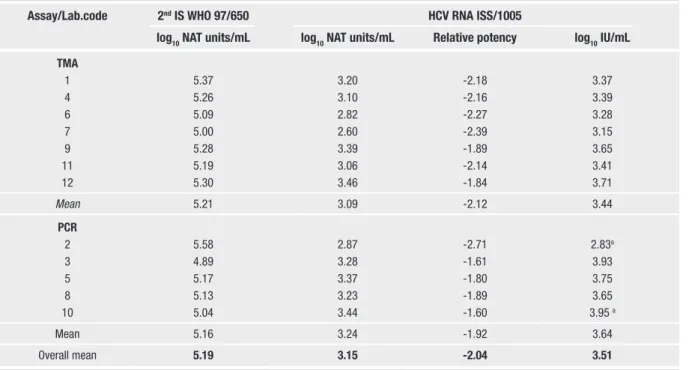
With respect to the 2nd WHO IS (Table 4), the overall mean estimate for the NAT detectable units/ mL for the standard was 5.19 log10 giving a mean potency for ISS/1005 of -2.04 log10 . As the concen-tration of the 2nd WHO IS had been assigned a value of 5.56 log10 IU/mL, the resulting estimate for the ISS/1005 reference preparation is 3.51 log10 IU/mL.
The estimated log10 NAT detectable units /mL for the 2nd WHO IS grouped by NAT methods (Chiron vs Roche), are also reported in Table 4.
Fig. 2 | Deviation from the mean
titre (–) of the single values
ob-tained by participants and interval defined by the mean ± the geometric coefficient of variation (---). (A) HCV study; (B) HIV study first and second international standard. 5.50 5.00 4.50 4.00 3.50 3.00 2.50 2.00 0 1 2 3 4 5 6 7 8 9 10 11 12 13 Laboratories A log IU/mL TMA - HCV PCR - HCV 5.50 5.00 4.50 4.00 3.50 3.00 2.50 2.00 0 1 2 3 4 5 6 7 8 9 10 11 12 13 Laboratories B log IU/mL TMA - HIV PCR - HIV 2nd Int. St TMA - HIV PCR - HIV 1st Int. St
The differences between the mean value for the standard (5.21 vs 5.16) fall within 0.5 log10 .
The respective laboratory estimates of log10 NAT detectable units/mL for the WHO IS and for the HIV reference preparation are shown in histogram form in Figures 1E, 1F and 1G.
In Figure 2B, the dispersion of the single values of the mean potency obtained by each participant around the consensus mean is shown. The confiden-tial interval defined by the mean ± the geometric co-efficient of variation is also shown. The exclusion of results from laboratories 2, 3, 7, 9 and 10 had little effect on the overall mean estimates.
CONCLUSION
This work reports the results of a collabora-tive study for the calibration of three reference preparations for NAT assays developed by the Biologicals Unit of the ISS for HCV RNA, HIV RNA and HBV DNA.
According to the design of the study, each partici-pant had to carry out a NAT analysis of a series of dilutions of samples for each reference preparation and for the respective international standard.
The choice of these dilutions was based on the sen-sitivity of the NAT methods and on the viral con-tent of the international standard and the candidate preparations.
With respect to the HCV preparation, the mean log10 NAT detectable units/mL for WHO IS was 5.25
(Table 1), a value closed to the one (5.08) found in the study for the establishment of the 2nd IS for
HCV RNA organised by NIBSC, in which the par-ticipants used only quantitative assays. The mean of the log10 NAT detectable units/mL was 4.01 for the HCV preparation, which corresponded to a mean potency of 3.76 log10 IU/mL, equal to 5,700 IU/mL, with an acceptable variation interval of 0.76.
In the case of the HIV preparation, the mean log10 NAT detectable units/mL for the 1st and the 2nd IS used was 4.45 and 5.19 respectively (Tables 3 and
4), a value closed to the ones (4.24 and 5.39) ob-tained by laboratories using qualitative assays in the collaborative studies for the establishment of the 1st and 2nd IS for HIV-1 RNA organised by the NIBSC. A wider range of the variation interval was however observed (1.12 and 1.24). The mean of the log10 NAT detectable units/mL was 3.27 for the HIV prepara-tion, which corresponded to a mean potency of 3.70 and 3.81 log10 IU/mL depending on the IS used. Taking both figures into consideration, we have a mean value of 3.60 equal to 4,000 IU/mL.
With respect to the HBV preparation, the mean log10 NAT detectable units/mL for the WHO 1st HBV IS was 6.32 (Table 2), a value closed to the one (6.42) found in the study for the establishment of the 1st IS preparation. The mean of the log
10 NAT detectable units/mL was 3.54 for the HBV prepara-tion, which corresponded to a mean potency of 3.22 log10 IU/mL with a wide interval observed (1.41).
In these studies, the differences observed between the single values reported by the participants reflect both the normal inter-laboratory variability and the degree of uncertainty of the estimate, as each par-ticipant tested each dilution only 4 times.
Table 4 | NAT detectable units/mL for HIV RNA - 2nd IS WHO
Assay/Lab.code 2nd IS WHO 97/650 HCV RNA ISS/1005
log10 NAT units/mL log10 NAT units/mL Relative potency log10 IU/mL TMA 1 5.37 3.20 -2.18 3.37 4 5.26 3.10 -2.16 3.39 6 5.09 2.82 -2.27 3.28 7 5.00 2.60 -2.39 3.15 9 5.28 3.39 -1.89 3.65 11 5.19 3.06 -2.14 3.41 12 5.30 3.46 -1.84 3.71 Mean 5.21 3.09 -2.12 3.44 PCR 2 5.58 2.87 -2.71 2.83a 3 4.89 3.28 -1.61 3.93 5 5.17 3.37 -1.80 3.75 8 5.13 3.23 -1.89 3.65 10 5.04 3.44 -1.60 3.95 a Mean 5.16 3.24 -1.92 3.64 Overall mean 5.19 3.15 -2.04 3.51
With respect to the two NAT methods used in the study, the means of the log10 NAT detectable units/ mL for the IS and ISS preparations, calculated sepa-rately for the COBAS Ampliscreen assay and for the Ultrio TMA Assay, were comparable for HCV and HIV proving the high level of standardization of both assays for both viral markers. On the contrary, in the case of the HBV preparation, a marked dif-ference in log10 NAT detectable units/mL for the IS and ISS preparations was observed. In fact, the dif-ference in analytical sensitivity between Ultrio and Ampliscreen is 1.4 fold when testing the WHO IS, while the Ultrio assay is 8.3 fold less sensitive than the Ampliscreen assay when testing the HBV prepa-ration. Consequently, a 6-fold difference in the titre of the HBV preparation tested with the two methods is observed.
To explain this lower sensitivity of Ultrio with the ISS preparation, one can hypothesize a difference in genotype detection efficiency between TMA and PCR or the presence of point mutations in the S gene of HBV in the ISS standard affecting the target sequences of TMA. More studies at molecular level are necessary to confirm these hypothesis.
In conclusion, based on the results obtained, titres of 5700 IU/mL and 4000 IU/mL were assigned to
the HCV RNA ISS/1005 and HIV RNA ISS/1005 preparations respectively. This material, whose sta-bility will be checked by the ISS every 12 months, is available upon request from now on. With respect to the HBV preparation, due the big differences ob-served using the two NAT assays, it was not possible to assign a IU titre.
Acknowledgments
The authors wish to thank Maria Grazia Bellotti from Roche Diagnostics and Donatella Benucci from Chiron Corporation for their collaboration in organising the study and to their respective companies for supporting the participating laboratories.
Members of the National Collaborative Study Group
F. Bressan, San Bonifacio Hospital, Verona; S. Calabrese, A.O. Civile M. Paternò Arezzo, Ragusa; A. Eiras and J. Cabrera, Centro de Transfusion de Galicia, Santiago de Compostela (Spain); G. Gessoni and P. Barin, ULS 12, Chioggia Venice; P. Ghiazza, S. Anna Hospital, Turin; P. Iudicone and M. Miceli, San Camillo Forlanini CAPE, Rome; P. Manzini and C. Valpreda, A.O. San Giovanni Battista, Turin; C. Peduzzi, A.O. Careggi, Florence; G. Salvoni, Umberto I Hospital, Ancona; L. Vacri and P. Palla, A.O. Pisana, Pisa; C. Vecchi and M. De Maria, Policlinico, Modena.
Received on 20 September 2006.
Accepted on 16 January 2007.
References
1. Nucleic Acid Amplification Techniques. Parag. 20621. In:
European Pharmacopeia 5.0:174-5.
2. Saldanha J, Heath A, Lelie N, Pisani G, Nübling M, Yu M and the Collaborative Study Group. Calibration of HCV working reagents for NAT assays against the HCV interna-tional standard. Vox Sang 2000;78:217-24.
3. Gentili G, Cristiano K, Pisani G, Bisso GM, Miceli M, Wirz M, and the National Collaborative Study Group. Collaborative study for the calibration of a new Italian HCV RNA reference preparation against the international stand-ard. Ann Ist Super Sanità 2003;39:183-7.
4. Gentili G, Pisani G, Bisso GM, Cristiano K, Wirz M, Miceli M, Iudicone P, Velati C, Baruffi L, Romanò L, Zanetti AR and the National Collaborative Study Group. Collaborative study for the calibration of an Italian HIV RNA reference preparation against the international standard. Blood Transf
2003:2:166-75.
5. Saldanha J, Heath A, Aberham A, Albrecht J, Gentili G, Gessner M and Pisani G. World Health Organisation collab-orative study to establish a replacement WHO international
standard for hepatitis C virus RNA nucleic acid amplifica-tion technology assay. Vox Sang 2005:88:202-4.
6. Saldanha J, Gerlich W, Lelie N, Davson P, Heermann K, Heath A and WHO Collaborative Study Group. An inter-national collaborative study to establish a World Health Organization international standard for hepatitis B vi-rus DNA nucleic acid amplification techniques. Vox Sang
2001:80:63-71.
7. Holmes H, Davis C, Heath A, Hewlett I and Lelie N. An international collaborative study to establish the 1st interna-tional standard for HIV-1 RNA for use in nucleic acid-based techniques. J Virol Methods 2001:92:141-50.
8. Shyamala V, Cottrell J, Arcangel P, Madriaga D, Linnen J, Phelps B and Chien D. Detection and quantitation of HBV DNA in the WHO international standard for HIV-1 RNA (NIBSC code: 97/656). J Virol Methods 2004:118:69-72. 9. Holmes HC, Davis CL, Heath AB and The Collaborative Study
Group. Report on an international collaborative study to establish a replacement WHO international standard for HIV-1 RNA NAT