Investigation Guidance
Supported by the
Accident Investigation
Training Programme
PART 2 Development of policy and
Contents
Section
number Section title Key issues covered
1 Principles and use of guidance Purpose, audience and status of guidance
Scope and use Guiding principles Terminology
2 Before the event Reasons to investigate
Roles of the various investigation bodies
Safety Management System – policies, resources, safety representatives
Training Competences Cooperation
3 Initial response to event Initial response and start of investigation
Early reporting
4 Investigation Early review and proportionate investigation
The remit
Gathering of information and evidence Witness evidence
Causes – immediate and underlying Human factors and analysis
5 Investigation report The report and date protection issues
Managing recommendations Final reporting
6 Learning from investigations Learning lessons
Failure to learn
Sources of accident information and lessons Management review of accidents and trends Measuring improvement of loss due to accidents
Appendix A - Safety Culture
Appendix B - Roles of various investigation bodies Glossary
Accident investigation is at the heart of the industry’s learning from operational experience and the commitment to continuous improvement in its safety performance.
This three-part guide on accident investigation gives valuable guidance on the investigation process from start to finish and beyond, into the important area of learning and applying the lessons learned.
By following this guidance transport operators should improve the quality and consistency of investigations and the resulting reports. Improved accident investigation by transport operators, followed by the
implementation of the associated recommendations, will assist in improving safety management across the industry.
The industry consultation in the production of this RSSB facilitated guidance is a welcome example of cross industry cooperation.
We support this guidance and encourage the industry to apply its content through its procedures, the management of investigations and the training of staff who conduct these investigations.
Ian Prosser ORR
Foreword
from the Director of Rail Safety, Office of Rail Regulation
Competent investigation of both accidents and incidents that is sufficiently searching to establish not only the immediate cause but also the underlying causes is absolutely fundamental to improving safety. Those conducting the investigation must have the ‘sponsorship’ and authority of those at the top of their organisations to avoid potential conflict in the way the investigation is conducted, the scope of their findings and the implementation of the recommendations. I commend industry initiatives that further these aims.
Carolyn Griffiths RAIB
Foreword
from the Chief Inspector, Rail Accident Investigation Branch
The development of this updated guidance document and the supporting training package was approved by the System Safety Risk Group and was steered and assisted by a group of nominated industry representatives:
This three part guidance covers the key aspects of investigation, but also other important related issues of accident management, including the provision of necessary systems and resources, response management, reporting, recommendation management and the learning of lessons, leading to continuous improvement. The key elements of an investigation are described in detail: remit, evidence gathering, interviewing techniques, analysis of immediate and underlying causes and recommendations
The process for managing accidents is illustrated below, including cross-reference to the relevant module number in the digital training programme and the section (S) of the guidance.
Introduction
Good accident investigation consistently and accurately identifies immediate
and underlying causes after thorough analysis and produces objective and
appropriate recommendations.
Mod
No. Management of Accidents Part 2 Investigating Part 3
1 The importance of a good investigation
(S 1)
2 Having arrangements in place
(S 2)
3 Actions on site
(S 3)
4 Reviewing the event
(S 4)
5 Writing the remit
(S 4)
6 Gathering information and evidence
(S 4)
7 Conducting interviews
(S 4)
8 Determining causes
(S 4)
9 Writing the report and recommendations
(S 5)
10 Learning and applying the
recommendations (S 6)
The guidance is built on an understanding of risk management and the integration of both human factors principles and a positive safety culture, with the aim of continuous improvement in the application and performance of safety management. It emphasises the need for cooperation in the achievement of good accident investigation and improved safety management.
Good accident investigation consistently and accurately identifies immediate and underlying causes after thorough analysis and produces objective and appropriate recommendations. These should then be effectively implemented and the necessary lessons learned, leading to fewer accidents and continuous improvement, both within each transport operator’s activities and across the industry.
This update of the guidance expands on the principle of proportionality when deciding on the scale of the investigation. Section 4.2. in Part 2 describes this new approach in detail. This update is also supported by a new digital training programme as described below.
Signposts - Digital training programme
This free training programme is available via the RSSB website or by contacting the Safety
management Systems team at [email protected]. It can be used in a classroom
environment with a tutor or individually on a computer. It is split into 10 modules lasting a total of 4 hours. This programme is closely based on the guidance and widespread use of it should raise the quality of accident investigations and so reduce future loss as a result of accidents.
1.1 Background
The benefits of good accident investigation and the commitment to continuous improvement in safety are understood by the railway industry. This suite of documents has been produced in response to the industry’s request for practical support to assist in the achievement of better accident investigation.
1.2 Purpose, audience and status of this guidance
This document, Part 2 of the suite of three, aims to provide user friendly guidance to help organisations
develop and apply effective policies on conducting good investigations and learn lessons from these
investigations. It is aimed principally at safety managers and those directly responsible for writing accident investigation policies / procedures, but will also be of interest to those in related management roles, eg those who:
• Appoint investigators
• Agree the investigation scale, remit and the report • Manage reporting such as SMIS inputs
1 Principles and use of guidance
This document aims to provide user friendly guidance to help organisations
develop and
apply effective policies
on conducting good investigations and
learn lessons from these investigations.
The associated two documents are aimed at senior managers and investigators respectively, as follows: • Part 1, The role of the senior manager provides senior managers with a high level overview of the
need for good accident investigation and the important role they play in ensuring effective processes are in place
• Part 3, Practical support for accident investigators provides investigators with guidance, including examples of good practices checklists
The contents of this guidance are not mandatory though references are made to legal and Railway Group Standard (RGS) requirements. Transport operators (railway undertakings and infrastructure managers) and other railway industry Safety Management System (SMS) holders should, however, demonstrate their commitment to good accident and incident investigation either by adoption of this guide or by stating in their SMS the methods used to ensure good quality investigations are undertaken.
The three documents provide guidance well beyond the scope of Railway Group Standards but it is not intended to supersede or conflict with any parts of these standards.
1.3 Scope and use
This guidance is intended to apply to a wide range of undesired events and extends beyond the
requirements of Railway Group Standard (RGS) GO/RT3119 Accident and Incident Investigation and its
associated Guidance Note GO/GN3519, (both dated March 2013) which are largely focussed on train
operations. The following undesired events are not mandated for investigation in GO/RT3119 but this guidance could be applied to them:
• Non-train related accidents
• Accidents involving only minor injuries
• Accidents off the main line, eg in depots, sidings and offices
• Construction related accidents including within engineering possessions • Accidents only involving one duty holder
• Incidents* involving equipment and assets
• Near misses* (sometimes known as close calls or near hits – possibly reported via CIRAS) • Other undesired events, eg train delayed in a tunnel but with no injuries
• Health exposures (eg noise and asbestos) • Accidents during travel while on duty
• Accidental release of substances causing harm and/or environmental impact
The scale of the required investigation should be based on the potential consequences, and
therefore risk, should circumstances have been slightly different. This could apply to incidents where the result is no injury or damage. (see 4.2 for more detail)
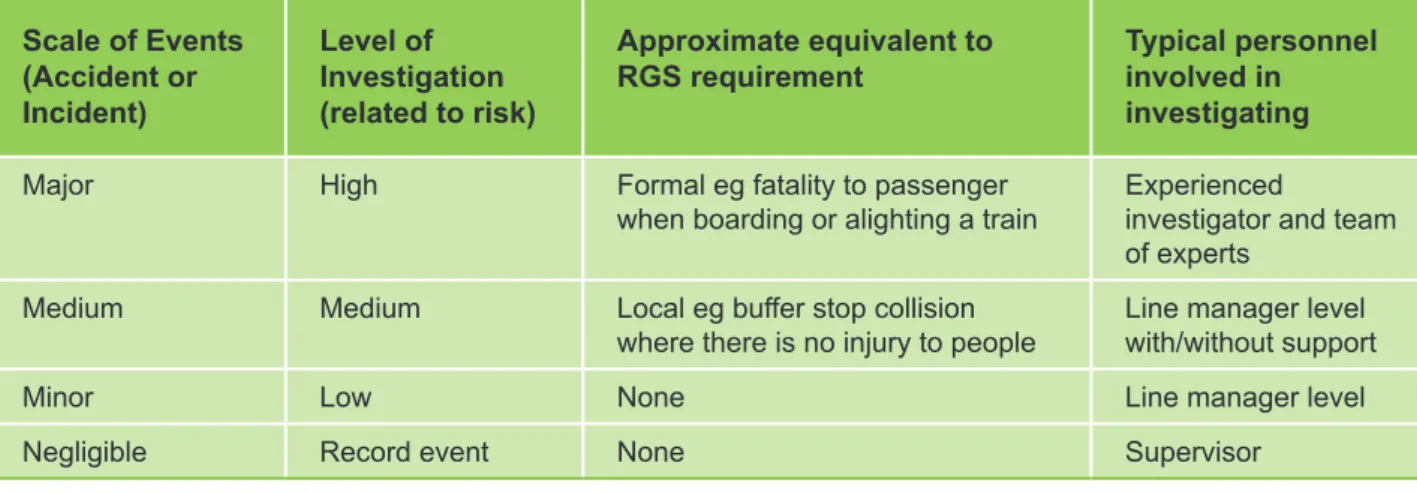
Undesired events can vary in scale, from those requiring a Formal Investigation down to a lesser level than Local Investigation. This guidance document, rather than making repeated references to Formal and Local uses three levels of scale of event and consequent investigation, plus the recording of a negligible scale event. The following terms are used:
Scale of Events (Accident or Incident) Level of Investigation (related to risk) Approximate equivalent to
RGS requirement Typical personnel involved in investigating
Major High Formal eg fatality to passenger
when boarding or alighting a train Experienced investigator and team of experts
Medium Medium Local eg buffer stop collision
where there is no injury to people Line manager level with/without support Minor Low None Line manager level Negligible Record event None Supervisor
The risk based approach taken by this guidance can also be applied to accidents related to trespass and suicide, which are outside the remit of the above mentioned RGSs. This could range from a report to SMIS up to a high level of investigation where a trend is identified that may relate to significant costs in terms of life, minutes lost, risks or lessons that could be learned.
To assist the processes of research, policy development, investigating and reporting this document contains signposts to other documents:
This document is available on the RSSB website and it is intended that good practice examples will be
added and updated regularly. Transport operators are encouraged to send examples that they consider
good practice to [email protected] so that these can be shared.
1.4 Guiding principles integrated into this document
1.4.1 Risk management
Good safety management depends on understanding safety risks and controlling them in an active and systematic way. When done effectively risk management should result in fewer accidents. However, when an undesired event does occur, the underlying causes should be thoroughly investigated to ensure that appropriate recommendations and actions are taken. High level reviews of investigation findings should then ensure that lessons are learned and acted upon so as to make a similar event less likely and of lower consequence if it were to be repeated.
Signposts - Contents
These are hyperlinked where possible to other documents which may contain further useful information or details, such as large checklists, that are too large to repeat in these documents. It also contains a few examples of good practice in addition to the many examples in Part 3.
Good Practice includes:
• Examples of processes used by transport operators that are examples of good practice (these are not subject to extensive comparison with others but nonetheless should be useful to most readers)
• Useful lists of points extracted from more than one source
1.4.2 Human factors
Integration of human factors principles is essential to successful safety management and good investigation practices (including investigation techniques, interviewing, making recommendations and learning lessons). This guidance therefore incorporates an up-to-date understanding of human factors, rather than referring to these as an ‘add on’.
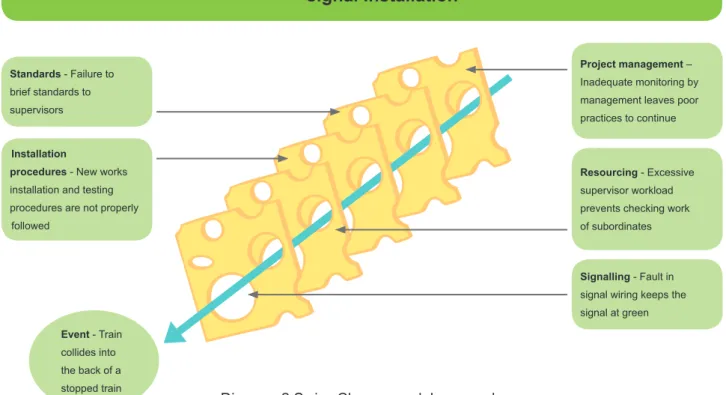
Human factors assist us in understanding why things go wrong, from the unsafe actions and conditions at the time of the undesired event back to the earlier underlying causes. The Swiss Cheese model, which is based on James Reason’s theory of accident causation is a clear illustration of this and is the root of many modern applications of human factors to accident investigation processes. This model illustrates the fact that accidents are usually the result of a complex chain of contributory events some of which are present in normal working conditions. The layers of defences against hazards may each have failures and it is when these line up that the accident occurs, as illustrated in diagram 1 below.
Signposts - HSG245 Investigating Accidents and
Incidents
This HSE publication contains the following text which matches the approach taken within this guidance document:
‘Carrying out your own health and safety investigations will provide you with a deeper understanding of the risks associated with your work activities. Blaming individuals is ultimately fruitless and sustains the myth that accidents and cases of ill health are unavoidable when the opposite is true. Well thought-out risk control measures, combined with adequate supervision, monitoring and effective management (ie your risk management system) will ensure that your work activities are safe. Health and safety investigations are an important tool in developing and refining your risk management system.’
Diagram 1 Swiss Cheese model
(from the website of the Disaster Management Institute, Bhopal) Some holes due to active failures
(unsafe acts)
Hazards
Some holes due to unsafe conditions
line management factors organisational factors individual/team factors
The following rail industry example further illustrates the lining up of system failures:
The term ‘human factors’ should not be misunderstood to suggest that the sole focus is on finding fault with an individual whose actions may be immediately perceived to be the direct cause of an accident. It should, on the contrary, lead to a wider analysis of underlying causes, giving consideration to unsafe conditions and identification of system breaches.
The application of human factors is particularly relevant to the identification of causes and Part 3 section 4 and Appendix A contains details on:
• Human error types and violations
• Individual, job and organisational factors related to underlying causes • Techniques for structuring underlying causes
1.4.3 Safety culture
Signposts - Human Factors
RSSB’s Good Practice Guide on Cognitive and Individual Risk Factors , 2008 contains more in depth
material on human factors with examples of good practice relating to the railway industry.
Network Rail’s Why People make Mistakes – Investigating the Human Factors is due for release in
2014
Diagram 2 Swiss Cheese model - example
Clapham Junction collision 1988 - Barriers and failures in
signal installation
Standards - Failure to brief standards to supervisors
Signalling - Fault in signal wiring keeps the signal at green
Project management – Inadequate monitoring by management leaves poor practices to continue
Resourcing - Excessive supervisor workload prevents checking work of subordinates
Installation
procedures - New works installation and testing procedures are not properly followed
Event - Train collides into the back of a stopped train
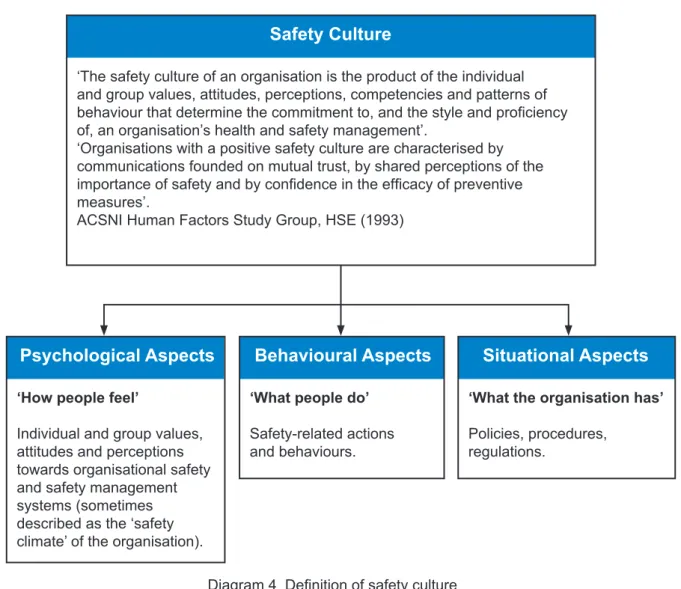
Organisations with strong safety cultures use a variety of sources, such as employee feedback and management reviews, to actively manage risk. When accidents and incidents do occur, these are seen as opportunities to improve and learn lessons. Based on an understanding of human factors and accident causation, appropriate remedial action is then able to be taken to remove barriers to safe working practices and to reduce the risk of a recurrence. Where the safety culture is poor, near misses may not be reported due to lack of understanding of the importance of reporting, a lack of trust or fear of punishment.
Further explanation on the importance of positive safety culture to all stages of accident management, and some related terminology, is included in Appendix A.
1.5 Terminology for accidents, incidents and near misses
Rail industry literature relating to investigations is inconsistent in its use of many of the central terms used,
namely those associated with accidents, as well as incident, near miss and close call.
These words may have different uses ranging from formal use in standards, to regular written and verbal use in technical and management meetings, to the daily front line use by rail managers and staff. The meanings also have different origins, from long term rail industry understanding, through to the more recent common usage by safety professionals, and to different terminology from the construction industry and now used by Network Rail.
This guidance does not mandate definitions but uses the terminology in a way that should suggest common understandings while allowing flexibility.
Transport operators and contractors may wish to continue to use their own terminology and, as it is unlikely to be used in safety critical situations, any ongoing confusion over interpretation should not be critical. However, it is important that the shared data via SMIS input is based on consistent use of terminology and classification/ categorisation of causes. Company SMIS data entry personnel therefore have the vital job of translating company terminology into that used by SMIS. The diagram below should help clarify this.
Diagram 3
Terminology Undesired Event
Accident (injury/damage/loss)
Note HSG65:
Includes any undesired circumstances which give rise to ill-health or injury; damage to property, plant, products or the environment; production losses or increased liabilities.
No injury or damage Trains
Near Miss
(SMIS)
Note GE/RT8047 (to be updated in late 2013*)
– the use of near miss is in relation to trains
with people or road vehicles etc but some organisations use ‘near miss’ to mean in relation
to people and not trains
Close Call
(stand alone reporting system in parallel with SMIS, used by Network
Rail and its contractors)
An event that had the potential to cause injury or damage
People
Operational Incident
(included in Close Call System) Note GO/RT3119 (March 2012)
Incidents affecting, or with the potential to affect, the safe operation of the mainline railway, in accordance with Table A of GE/RT8047. It may also be applied to yards, depots and sidings
2.1 Why investigate?
Good quality accident investigation will assist in reducing the number of accidents and their consequences, should they occur. Fewer injuries to employees, passengers and the public and damage to equipment, infrastructure or the environment will bring moral and economic benefits. Good accident investigation will also protect organisations against subsequent litigation if an accident does recur. As a consequence of these loss will be reduced.
There are also legal requirements relating to accident investigation and the most obvious for the railway industry are listed here, but this list is not exhaustive:
• The Railways and Other Guided Transport Systems (Safety) Regulations 2006 (as amended) [ROGS], in particular Schedule 1 which requires of a Safety Management System: ‘procedures to ensure that accidents, incidents, near misses and other dangerous occurrences are reported, investigated and analysed and that necessary preventative measures are taken’
• The Railways (Accident Investigation and Reporting) Regulations 2005
• Reporting of Injuries, Diseases and Dangerous Occurrences Regulations 2013 (RIDDOR) • The Safety Representatives and Safety Committees Regulations 1977
• Health and Safety at Work etc Act 1974
If a serious accident occurs and it is found that previous warnings, eg from previous investigations into similar circumstances, have been ignored, then regulatory authorities are likely to take a firm line. Transport operators must also comply with the requirements of RGS and some of these are signposted
throughout this guidance document. The most obviously connected ones (available via RSSB website) are:
• GE/RT8047 Reporting of Safety Related Information (June 2011)
• GO/RT3119 Accident and Incident Investigation (March 2013)
• GO/RT3118 Incident Response Planning & Management
Guidance Note GO/GN3519 Guidance on Accident and Incident Investigation, also gives specific guidance
related to GO/RT3119.
In addition to the identification of underlying causes (described in section 4.7), the investigation should provide a true snapshot of what really happened and how work activities are undertaken and so expose any
2 Before the event
In order to achieve good accident investigation, the policy, resources, training
and other issues related to investigation should be in place, as specified
within the company’s SMS and its own procedures and processes.
Signposts - Key investigation requirements
The Background and Principles in section 1.2 of GO/RT3119 describe the key requirements on the
2.2 Cost of accidents
Much has been written about the cost of accidents, particularly by the HSE, both in the rail industry and the wider UK economy. Some important principles and observations are worthy of reference for senior and safety managers and others who may be required to act on recommendations, and these are listed below:
• Good application of the SMS and its components such as risk assessment and control, accident management, competence systems, outcome and activity indicators, acting on recommendations, high level review and learning lessons, will lead to a reduction in accidents and therefore costs.
• The HSE’s HSG245 states: ‘As well as being a legal duty, it has been found that where there is full cooperation and consultation with union representatives and employees, the number of accidents is half that of workplaces where there is no such employee involvement.’
• Claims are sometimes an element of the total cost and those that are made constitute a larger percentage of costs for the lower level occupational health and safety (eg slips, trips and falls) or passenger accidents, compared with the higher consequence accidents. Again, good accident investigation should lead to fewer accidents and so fewer claims. A close relationship between the company claims manager and investigators should bring benefits in both investigations and reducing claims.
• Accidents are expensive, with many factors contributing to the costs. In addition to the more obvious ones are the loss of reputation and morale, distraction from main tasks and resources involved in investigating. For major accidents these costs can be extreme to the level of business collapse. Costs
of legal fees can also be significant, sometimes several times the more obvious costs. RSSB’s Taking
Safe Decisions describes the industry consensus view on how decisions that affect safety are made, and sets out the different costs that should be taken into account both when assessing compliance
with the legal duty to ensure safety so far as is reasonably practicable, and whether a decision makes
sense from the wider business perspective.
• The HSE website also publicises an accident costs overview for British industry. For example, each
year over one million injuries and 2.3 million cases of ill-health are experienced by workers and many organisations will not be aware of the full cost of their own accidents and ill-health.
• The HSE website provides basic tools to assist in identifying approximate annual accident costs
and those for specific accidents. The Annual Accident Calculator includes insurance premiums and uninsured costs such as lost time, production delays, extra wages, legal costs and loss of contracts. HSE studies have shown the ratio of insurance premium paid to uninsured losses to be between 1:8 and 1:36.
2.3 Roles of the various investigation bodies
Various bodies, the main ones being RAIB, BTP and ORR, have legally specified roles relating to railway investigations. These are described in a Memorandum of Understanding (MoU), dated April 2006. The MoU content is likely to be of interest to investigators and is summarised, including a significant amount of useful detail, in Appendix B.
In relation to environmental damage the Environmental Agency and Scottish Environmental Protection Agency may be involved and further details are included in section 3.
2.4 Safety Management System – key elements and resources
Policy, resources, training and other issues related to investigation will be specified within a company’s SMS and its own procedures and processes. These should be in place to meet the legal and RGS requirements and, where appropriate, complement the Network Rail National Emergency Plan and its supporting documents.
Transport operators should, where the risks indicate it appropriate, have joint arrangements for response management and investigation in place with other transport operators and contractors.
The sub-sections below supply guidance on key subject areas that should be included within SMSs and/ or company procedures. SMSs should also refer to training provision but, as the guidance has significant content on this issue, it is in the following sub-section 2.5, Training.
2.4.1 Response management procedures
ROGS requires the inclusion of the following amongst the basic elements of a SMS:
provision of plans for action, alerts and information in the case of an emergency which are to be agreed with any public body, including the emergency services, that may be involved in such an emergency
All relevant stakeholders are consulted on the content of this plan and it outlines the responsibilities of railway undertakings and other interfacing organisations. It includes a section (5) on investigation, which is referred to elsewhere in this guidance.
Railway Group Standard GO/RT3118 Incident Response Planning & Management mandates requirements
for interface issues concerning the planning and management of co-ordinated responses to incidents, including using the current edition of the Network Rail National Emergency Plan as an overview to aid the creation of all coordinated incident response plans.
The Rule Book, module M5 Managing Accidents, mandates requirements for managing the site of the accident, including early aspects of the investigation such as the protection of evidence.
Each company will have its own procedures and processes to meet the legal and RGS requirements and to complement the Network Rail National Emergency Plan and its supporting documents.
2.4.2 Investigation procedures
ROGS requires the inclusion of the following amongst the basic elements of a SMS:
procedures to ensure that accidents, incidents, near misses and other dangerous occurrences are reported, investigated and analysed and that necessary preventative measures are taken
Signposts - The Network Rail National Emergency Plan
The Network Rail National Emergency Plan (September 2011) is the primary industry document for emergency planning. It describes the arrangements in place to provide an effective response to accidents, incidents and emergencies on the Network Rail controlled infrastructure, and is intended to implement the requirements of RGSs.
Railway Group Standard GO/RT3119 Accident and Incident Investigation also mandates requirements for reducing the likelihood and consequence of accidents and incidents. Legislation and RGSs therefore require procedures and systems for accident investigation to be in place and these would normally be contained within the SMS. Good systems for safety management will aim for continuous improvement and learning from operational experience and both of these processes are developed throughout Parts 2 and 3 of this guidance.
Each company will have its own procedures and processes and some may use external commercial systems which are referred to in section 4.
2.4.3 Reporting arrangements
Companies should be aware of, and have procedures in place for, reporting to RAIB, ORR and BTP and to meet the requirements of RIDDOR. These are described in more detail in section 3 under Early Reporting.
GE/RT8047 Reporting of Safety Related Information mandates requirements for accident reporting on duty
holders. For accidents involving non-duty holders reporting should be made via the contracting duty holder organisation.
Safety Management Information System (SMIS) development is controlled and monitored by the SMIS Programme Board (a rail industry group with representation from across the industry) and new versions of the system are released every year to ensure industry requirements are met. SMIS utilises modern reporting software including an easy to use query tool and new ‘dashboard’ functionality. RSSB’s SMIS team
([email protected]) are available to assist with any SMIS related query.
2.4.4 Confidential reporting
Transport operators should make their staff aware of CIRAS (the Confidential Incident Reporting and Analysis System), which provides employees of any company in the railway industry with a confidential and independent way to report safety-related concerns without fear of recrimination, or where they feel unable to report through normal company channels. CIRAS supplements internal reporting systems rather than seeking to replace them.
2.4.5 Investigation Resources
In addition to the procedures, appropriate resources are required.
The most obvious of these is trained and competent investigators and accident managers and these requirements are covered later in this section. Companies should also be aware of the possible need for specialist support to investigation teams and should know where to obtain such support.
Managers and staff should be made aware of the importance of good investigation and reporting. Briefings on the policies and after specific relevant accidents will assist in maintaining a workforce that understands the benefits of investigations and continuous improvement.
In addition to the above, adequate time and physical resources should be available for the use of investigators and the latter might include the following (this is not an exhaustive list):
• Local/route maps • Facilities to manage all data
• Cameras • Torch
• Voice recorder • Laptop computer
• Measuring equipment (including • Secure containers/locations for perishable
non-metallic) evidence
Companies should consider preparing a more extensive list in case of major accident response and investigation.
2.4.6 Designation of responsible persons
Each transport operator must have one or more persons to manage the processes for leading and
contributing to investigations. The senior of these persons is usually known as the Designated Competent Person (DCP).
These roles cover the overall management of the investigation process and specifically the management of recording and signalling data, management of the interface with other parties and the establishment of a remit.
The overall risks and the size of the company will determine the accident investigator resource and how it is structured.
Various options are employed, including:
• Designated accident investigation professional/s who undertake/s all investigations • Trained line managers who undertake investigations in their area of responsibility • Line managers supported by accident investigators
• Variations on these
Companies should keep this balance under review to ensure adequate resources.
2.4.7 Safety representatives
The involvement of safety representatives in the improvement of safety is an example of a positive safety culture and it can bring many benefits. When accidents occur safety representatives can assist directly and can also help to generate a more constructive response from the workforce. Benefits to the company can be gained if safety representatives are:
• Invited to visit the site
• Consulted on the investigation
• Invited to accompany witnesses in interviews • Consulted on the formulation of recommendations
Under The Safety Representatives and Safety Committees Regulations 1977 safety representatives have the right of access to safety records and to carry out inspections and examinations of reportable accidents. The HSE also advises that there should be an agreed system for informing the relevant representative if an accident occurs and that they should then be involved as soon as possible.
2.4.8 Legal support
Good investigation processes and implementation of recommendations should assist in the reduction of liability claims. However it may be useful to have access to legal expertise to review investigation procedures with a view to identifying areas of weakness thus lowering the possible losses due to liability claims.
Signposts - Role of designated persons
GO/GN3519 Appendix C: in C.1.1.1 lists the activities undertaken by the designated persons and supplies some guidance.
2.5 Training and human factors
Rail industry stakeholders and RSSB have been working together to develop a strategy to increase the industry’s capability to learn from operational experience, including incidents and accidents. As part of this strategy, a review was undertaken of a cross section of incident investigation reports and classifications in the national SMIS database. This review highlighted that current incident investigation processes could be improved by better integrating human factors. Industry stakeholders commissioned RSSB to develop a training course for rail incident investigators to promote human factors understanding. This course provides an opportunity to maximise the accuracy and validity of the data captured in the national safety database which will enable the industry to proactively monitor and manage trends.
Network Rail has also developed a new e-learning programme on incident and human factors investigation.
2.5.1 RSSB’s human factors awareness course for incident investigators
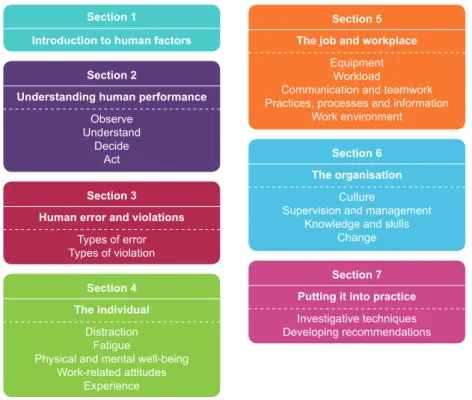
The Human Factors Awareness course has been developed for incident investigators and those with an incident investigation role. It has been recognised that the course would also be beneficial to safety managers, operations managers, safety advisors and safety specialists, hazard analysts, regulators, inspectors and human factors advisors.The course is run over two days and focuses on the analysis of incidents and accidents from a human factors perspective. It clarifies the process of identifying underlying causes using practical examples and case studies from a range of safety critical industries. It provides an introduction to human factors analysis techniques and the application of these to the incident investigation process. The expected learning outcomes are:
• To raise awareness of the human factors issues that can contribute to the likelihood of accidents and incidents
• To provide incident investigators with practical skills in classifying human error and violations • To raise awareness of the issues that can influence safety performance at the individual, job and
organisational levels
• To enable investigators to identify underlying system weaknesses and to make effective recommendations in investigation reports to reduce the likelihood of future incidents. The course content is:
Diagram 4 RSSB Human Factors course Observe
Understand Decide
Act
Understanding human performance Section 2
Distraction Fatigue
Physical and mental well-being Work-related attitudes Experience The individual Section 4 Equipment Workload
Communication and teamwork Practices, processes and information
Work environment The job and workplace
Section 5
Culture
Supervision and management Knowledge and skills
Change The organisation
Section 6
Investigative techniques Developing recommendations
Putting it into practice Section 7 Types of error
Types of violation Human error and violations
Section 3
Introduction to human factors Section 1
The industry has reported that the course has made a positive impact to the way companies investigate incidents and has helped them to understand human factors and to use this knowledge to develop more effective recommendations. Investigators have also reported an observed change in the way their companies investigate and manage human factors issues, which underpins a positive safety culture.
The above Human Factors training aligns with the new RSSB digital training programme and so these should be considered together buy organisations when designing their strategy for accident investigation training.
2.5.2 Network Rail’s human factors investigation e-learning programme
The Network Rail e-learning programme Why People Make Mistakes: Investigating the Human Factor was
designed to help investigators understand people make mistakes with the aim of improving the way in which immediate and underlying causes are identified. The programme describes the importance of human factors to investigation and the things that can influence people’s behaviour and their decisions and the factors that can increase people’s potential for error.
This programme is currently being updated and will be available in early 2014.
2.5.3 Non-technical skills training
Non-technical skills (NTS) are generic skills that underpin and enhance technical tasks, improving safety by helping people to anticipate, identify and mitigate against errors. RSSB reviews of incidents and accidents in the industry have shown consistently that NTS such as situational awareness, decision making and workload management are key contributors to these events. This is supported by other research across safety-critical industries highlighting how important NTS are to safety. RSSB has identified a full list of NTS that are
relevant to the driver role, and developed behavioural markers (examples of good and poor behaviour) which help clarify what is meant by each NTS.
In response to a lack of anything formal within the industry, RSSB has worked with industry to develop NTS training programmes for drivers to raise their awareness of the importance of these skills in their role, and how they can be developed. A course has also been developed by RSSB for managers to enhance their understanding of NTS, how it can be used to mitigate errors, and to enable them to provide objective measurements and feedback on NTS in order to support the ongoing development of their staff. These programmes are also applicable to other front-line roles within the industry. Network Rail have also conducted some work in this area – for more information on both work streams see the ‘signpost’ box below. The development of NTS training programmes is part of a general strategy to integrate NTS into the
complete competence management cycle, from selection through to competence measurement. In line with this, NTS can also be included within the accident investigation and some companies now incorporate a list of NTS and behavioural markers into a checklist of things to consider during investigations. By considering NTS, it becomes easier to identify the required interventions following the investigation. For example, if the individual failed to notice some information and this led to the accident, this suggests that situational awareness and prioritisation could have been a factor and that further training in these areas is required. Network Rail has followed a similar approach to NTS and has developed behavioural markers into a number of competencies, particularly those related to Controllers of Site Safety (COSS) and signallers. Network Rail states that its ‘training programmes incorporate the most up to date practice and thinking on both Technical and Leadership learning interventions as well as the key behavioural elements of the Life Saving Rules, cultural safety themes and non-technical skills’. It also screens learning interventions to ensure that Diversity and Inclusion principles are applied.
2.5.4 Training – courses and providers
Beyond the supporting digital training programme this guidance does not specify training courses or their content. However, training providers who wish to assist the industry in meeting the quality of accident investigation aspired to in this guidance are likely to want to review any course content that pre-dates it. Having determined the overall resource required, rail companies should undertake a thorough training needs analysis to determine what additional resources and training are required across the different departments. Rail companies should ensure good training suppliers with a knowledge of the industry and its interfaces. Training of their staff should be pitched at an appropriate level and should cover the essentials of accident investigation in this guidance, eg: investigation techniques, report writing, managing recommendation from writing them to implementation. Training that is specifically linked to the activities and risks faced by the company is likely to provide better outcomes. ‘Off the shelf’ systems alone are unlikely to provide this. The training that is provided will have a more lasting impact if it is integrated into the competence system and, as such, is measured and monitored.
2.6 Competences
The application of competence management systems for those whose responsibilities include conducting investigations will bring benefits in the form of better investigations and reports and consequently fewer accidents. Whether designated competent persons, other trained investigators, or those who carry out only occasional investigations that relate to their area of management, a training needs analysis should be applied and the agreed appropriate training and competence regime will then bring benefits. The following could be included for a basic level of competence:
Both RSSB documents above are available on the RSSB website:
Signposts - Non-technical skills
Non-technical skills for rail: A list of skills and behavioural markers for drivers, with guidance notes (2012) v2
Non-technical skills for rail: Developing an integrated approach to NTS training and development (2012)
R Flin, P O’Connor & M Crichton (2008) Safety at the Sharp End: A guide to non-technical skills.
Hampshire Ashgate Publishing Limited
Good Practice – Basic investigator competence
suggestions
Competence Management System processes:
• Basic training to suit level and type of investigations – the digital training programme should be a very good starting point for most investigators
• Refresher training as appropriate in recognition of the impact of non-use of skills (possibly as a result of fewer accidents due to improved learning – this should be kept under review)
• Keeping a record of all related training
Competence requirements:
• Knowledge of the relevant command structures
• Useful qualifications may include the NEBOSH certificate
Competence Management System processes, beyond the most basic:
• Logging of the review of all reports and feedback to writer
Organisations should ensure that investigators maintain their initial competence especially as in some cases this may be difficult as the opportunity to put this competence into practice may be limited. In fact, the result of improved investigation can lead to fewer accidents and this success will mean there are fewer accidents to be investigated. The competence management systems outlined above should be able to facilitate the maintenance of the required competence via refresher training, exercises and regular reviews. The national and route based programme of exercises organised by Network Rail are a good source of experience for investigators, as should be those organised by other transport operators.
In addition to issues of competence, investigators should have good interpersonal skills and they should be able to resist pressures to accept the ‘obvious’ causes without consideration of all the evidence (and have management support for this). Investigators who lead teams should have good leadership skills.
Good Practice – Competence suggestions for
investigators above the basic level
• Independent review of reports
• Involvement in table top exercises and assessment during these
• Programme of training and refresher training to suit level and type of investigations, based on training needs analysis
• Useful qualifications may include formal accident investigation course certification and NEBOSH diploma
For the higher levels of investigation, training and competence regimes should be of a higher level because:
• The risks to be addressed and the costs are likely to be higher • The breadth of experience required is likely to be greater • It may involve managing a team of investigators
The competence management system could include, in addition to the above basic factors in sub-section 2.6, the following:
As an alternative to a formal competence system, transport operators could apply a process of recorded peer reviews. Templates (possibly based on the contents of this guidance) could be used to raise standards and gain consistency.
Railway undertakings and infrastructure managers will require content variations in their training and competence systems for different levels of investigators. When designing a competence system for investigators above the basic level then GO/RT3119 should be referred to:
Signposts - Designated person competence
RAIB uses Accredited Agents, who are employees of transport operators, to assist with RAIB investigations, usually in remote locations, before a RAIB inspector is able to arrive on site.
They have three essential tasks:
• Identify and record perishable and vulnerable evidence for RAIB use. This should include photographs, where photographic equipment is available
• Provide an assessment of the accident to the RAIB Duty Co-ordinator • Ensure as far as reasonably practical that technical evidence is preserved for RAIB, pending the arrival of an Inspector on site
These Accredited Agents receive training from RAIB and such training would be useful to record in competence records.
2.7 Cooperation
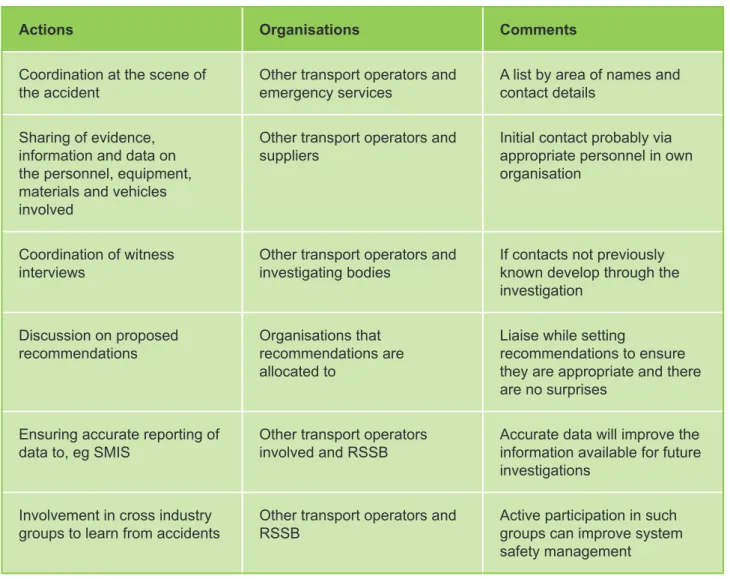
Good accident management and investigation is reliant on cooperation between those involved: transport operators, contractors, emergency services, public bodies and other relevant agencies. Organisations should have in place robust arrangements for knowing who they need to cooperate with and also, where possible, build a good relationship with them to enable effective two way communication and cooperation. The following, Table 2, is a non-exhaustive list of the stages of investigation where cooperation is essential: Table 2 Cooperation
Actions Organisations Comments
Coordination at the scene of
the accident Other transport operators and emergency services A list by area of names and contact details
Sharing of evidence, information and data on the personnel, equipment, materials and vehicles involved
Other transport operators and
suppliers Initial contact probably via appropriate personnel in own
organisation
Coordination of witness
interviews Other transport operators and investigating bodies If contacts not previously known develop through the
investigation Discussion on proposed
recommendations Organisations that recommendations are
allocated to
Liaise while setting
recommendations to ensure they are appropriate and there are no surprises
Ensuring accurate reporting of
data to, eg SMIS Other transport operators involved and RSSB Accurate data will improve the information available for future
investigations Involvement in cross industry
groups to learn from accidents Other transport operators and RSSB Active participation in such groups can improve system
3.1 Initial response to event
RGSs, in particular GO/RT3118, Incident Response Planning & Management and the Network Rail National
Emergency Plan (NRNEP) specify requirements for operational accidents and incidents, as should company procedures for other and smaller scale events.
Employers should make staff aware of the importance of accident reporting via line management or the
safety team and on being alerted to an accident the organisation’s response should be timely and of
an appropriate scale to the risks – from the major undesired event to the minor injury.
The need to restore normal working is extremely important and will be transport operators’ priority, but amongst these early response actions will be the start of the investigation process, eg recording times and what has happened.
Where a responsible company has staff at the scene of the accident at an early stage, the first actions should be to establish individual safety and arrange protection of the site. Part 3 contains a useful checklist that could be included in company procedures and used by staff in such a situation.
In the event of an occupational health exposure such as fumes or disturbance of asbestos, an early accurate record of the exposure is important for the management of possible future liabilities. Similar records should be made for contractors and agency staff.
Early contact may need to be made with the relevant environmental agency and in the case of water and land pollution, the respective water and local authority. Early actions may also be required to stop or limit accidental release especially when substances are dangerous and where water courses may be polluted.
3.2 Early reporting
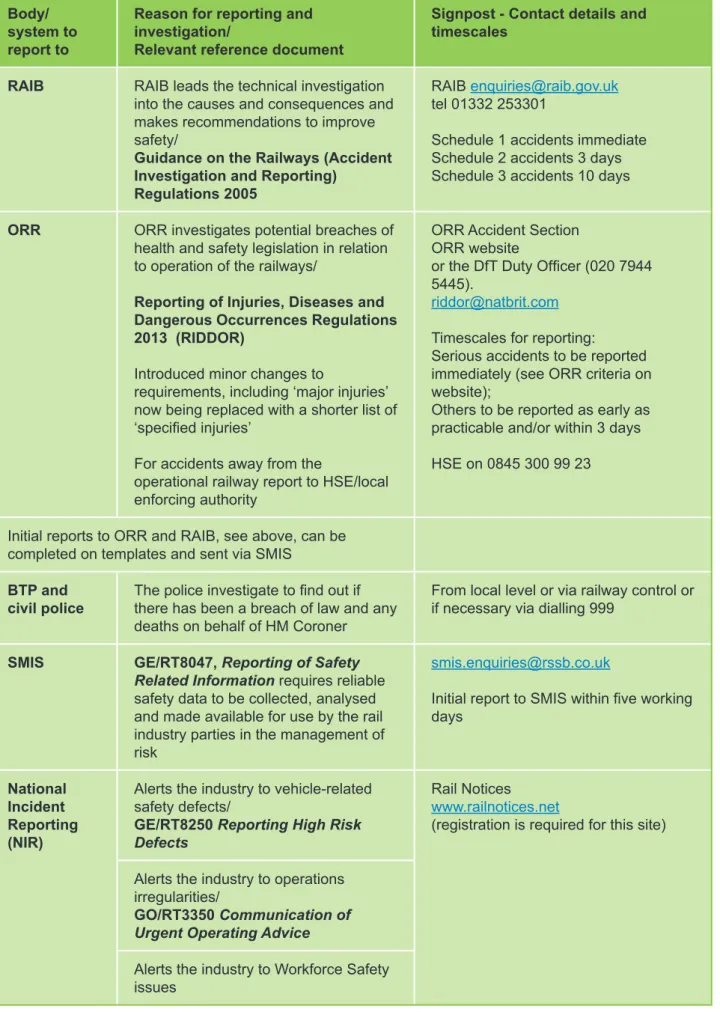
Rail industry accident and incident information should be sent to a number of bodies and systems and table 3 contains a very brief summary of initial reporting requirements. Later reference is made in this guidance Part 2 to the requirements for final reports of information.
Cooperation between IM, RU and contractors is necessary to ensure details are reported as required,
3 Initial response to event
On being alerted to an accident the responsible organisation’s response
should be timely and of an appropriate scale – from the major undesired
event to the minor injury. Included in this early response should be elements
of the investigation.
Signposts - Initial response
GO/RT3118 Incident Response Planning & Management mandates requirements for interface issues concerning planning and management of co-ordinated responses to undesired events on the mainline railway
Table 3 Early reporting
Body/ system to report to
Reason for reporting and investigation/
Relevant reference document
Signpost - Contact details and timescales
RAIB RAIB leads the technical investigation
into the causes and consequences and makes recommendations to improve safety/
Guidance on the Railways (Accident Investigation and Reporting)
Regulations 2005
RAIB [email protected]
tel 01332 253301
Schedule 1 accidents immediate Schedule 2 accidents 3 days Schedule 3 accidents 10 days
ORR ORR investigates potential breaches of
health and safety legislation in relation to operation of the railways/
Reporting of Injuries, Diseases and Dangerous Occurrences Regulations 2013 (RIDDOR)
Introduced minor changes to
requirements, including ‘major injuries’ now being replaced with a shorter list of ‘specified injuries’
For accidents away from the
operational railway report to HSE/local enforcing authority
ORR Accident Section ORR website
or the DfT Duty Officer (020 7944 5445).
Timescales for reporting:
Serious accidents to be reported immediately (see ORR criteria on website);
Others to be reported as early as practicable and/or within 3 days HSE on 0845 300 99 23
Initial reports to ORR and RAIB, see above, can be completed on templates and sent via SMIS
BTP and
civil police The police investigate to find out if there has been a breach of law and any deaths on behalf of HM Coroner
From local level or via railway control or if necessary via dialling 999
SMIS GE/RT8047, Reporting of Safety
Related Information requires reliable safety data to be collected, analysed and made available for use by the rail industry parties in the management of risk
Initial report to SMIS within five working days
National Incident Reporting (NIR)
Alerts the industry to vehicle-related safety defects/
GE/RT8250 Reporting High Risk
Defects
Rail Notices
www.railnotices.net
(registration is required for this site) Alerts the industry to operations
irregularities/
GO/RT3350 Communication of
Urgent Operating Advice
Alerts the industry to Workforce Safety issues
Network Rail’s National Operations Centre (NOC)
Records details of events occurring on the national rail network (as reported by Network Rail’s route operations controls) – mainly on Network Rail managed infrastructure. NOC issues NIRs (see above) on behalf of the rail industry
Allows Network Rail’s contractors to report accidents and incidents to a Network Rail control centre. Details of safety related events submitted to SMIS
The IGC reports safety of line events to the NOC
Environment
Agencies To alert environmental agencies and other authorities with environmental
responsibilities. For risk to water environment:
For risk to protected species/habitats:
Environmental Agency and Scottish Environmental Protection Agency Emergency number 0800 80 70 60. Natural England (NE) (0845 600 3078) Scottish Natural Heritage (SNH) (local office)
Some companies have templates for investigation, including early reporting. It is important that required timescales are made clear to assist with prioritising of resources.
In the case of accidents with an environmental impact, such as spillages of pollutants of over 20 litres, infrastructure managers and railway undertakings should have arrangements in place for reporting to the
relevant agencies. In addition GE/RT8047 Reporting of Safety Related Information includes reporting
requirements for ‘dangerous goods incidents and irregularities’ (page 13) and ‘environmental events’ (page 15).
All environmental incidents on Network Rail property shall be reported to the appropriate Route Control or Infrastructure Group Control. The Network Rail control office will organise spill response and notify the regulatory authority.
3.3 Urgent safety reports
There are various ways of sharing information on urgent safety problems, including Rail Notices www.
railnotices.net (registration is required for this site) which was launched by RSSB in January 2010. It is a secure website which is the gateway to a range of notices and alerts including vehicle related safety defects
as required by GE/RT8250 Reporting High Risk Defects and operational irregularities covered under Railway
Group Standard GO/RT3350 Communication of Urgent Operating Advice. In addition there is the new
Workforce Safety Alerts sub-system which will allow companies to share details of workforce safety incidents and actions taken to prevent reoccurrence. If a specific safety event is identified and it warrants the industry being notified then the information is recorded by the user and automatically disseminated to subscribers.
Signposts - Early reporting of urgent safety problems
Those that are made aware of such problems should identify any need for an immediate response as4.1 Who investigates?
Railway companies have their own arrangements for carrying out internal investigations. Where the event involves other parties transport operators should cooperate with each other in the investigation process and it is useful to have a dedicated contact in other involved organisations.
For the more significant accidents transport operators should have procedures in place to make investigators aware of whether it is RAIB’s intention to investigate and, if so, they should liaise over RAIB’s requirements and timescales. This will include the remits and the arrangements to ensure cooperation, effectiveness of investigations and to optimise resources, eg the sharing of non-confidential evidence such as photographs.
Joint investigations with other transport operators or contractors can be of benefit where close
communications during the investigation are particularly important. Consideration should also be given to independently chaired investigations.
4.2 Early review and a proportionate level of investigation
This section introduces the Proportionate Response Model which employs a simple three stage filtering process. This is clearly demonstrated in the videos within the digital training programme.
An early review of the event by competent person/s is necessary in order to assess the level of the investigation. The selection of the reviewer/s will depend on the organisations resources, policy and structure and the scale of the event. The level of competence of the person, or team, that decides on the scale of investigation and its remit must be adequate, and some companies may specify that this will be the Designated Competent Person or a senior member of the safety team for higher level investigations. During the decision on the competence of those involved consideration should be given to suitable education, skills, experience and level of authority.
The timing of this review will also depend to some extent on the scale of the undesired event and the ease of gathering the information necessary to make an early decision on the appropriate level of investigation. A rough guide may be that for a low level event (eg slip, trip or fall) the decision on the remit could be made immediately the circumstances of the event are known, eg on the same day. The remit may then be recorded in an e-mail or written instruction. Whereas, for a high level event, (eg train movement accident) 24-72 hours may be reasonable, and both these limits are already common targets in the industry.
4 Investigation
The principal investigation of any undesired safety event, including near
misses, is conducted by the organisation immediately responsible for the
activity related to the event. An early review of the event is necessary to
capture the circumstances while still recent and to decide the resources
required for the investigation. Evidence gathering is crucial to a good
investigation and early action and planning will be required to ensure
perishable and other physical and witness evidence can be obtained.
Signposts - RAIB and Formal Investigations
GO/GN3519, Guidance on Accident and Incident Investigation, Appendix A, paragraphs 1.1.3-5 address the issue of RAIB and/or Formal Investigations.
The review can involve representatives from different organisations and some early joint understandings, arrangements and decisions may need to be made.
A template (see below for an example of content) for the early review is useful and could be used to encourage an open minded approach to the identification of underlying causes. Where report forms cover the investigation process from beginning to end, including the early requirements, it is advisable to make timescales clear on the form.
Good Practice – Early internal investigation and
reporting
One train operator uses a template, headed Injury Prevention, for an early review plus the later report, which includes:
• A checklist on reporting the accident, evidence (interviews and data downloads) • Sections to gather details on:
• description of the accident • evidence
• re-enactment of the accident • sub-standard acts and conditions • causes – immediate and underlying • review of related risk assessments • actions – taken and to be taken • recommendations
The decision on the level of investigation will be based on consideration of the information available at the time.
The following Proportionate Response Model, a three stage filtering process, provides a systematic method which, although dealing with several influencing factors, should bring consistent levels of response, and after first use should be quick and easy to apply.
The Proportionate Response Model text, tables and diagrams below take the reviewer through the three stages of filtering. These include notes and additional explanation of the process to assist the user. For lower level accidents it may be appropriate that the reviewer (who may later be the investigator) conducts the three stage process described below. In such cases the reviewer should be a manager who is familiar with accident investigation and understands the need for proportionality and the criteria used in stage three. Companies may wish to specify that for medium and high level investigations stage 3 will be undertaken, or at least checked, by the DCP (or similar).
Pr
opor
tionate Response Model
St
age 1
Cr
edible worst outcome
Effectiveness of barriers
Wider factors
St
age 2
St
age 3
Level of Investigation
W orse W orse W orse W orse Yes Ye s Ye s Ye s Ye sSoon after the undesired event, when enough information has been gathered, Stages 1 and 2 should be undertaken by competent staff
This stage aims to determine
the credible
worst outcome, should
the circumstances
around the accident have been slightly dif
ferent.
The following are three examples
of scenarios of dif
ferent scales
Note 1
Use the currently available information, eg from initial witness
statements, early evidence, identifiable causes, human factors observations and risk assessments Note 2
In answering the question start at the least outcome and follow the
options below Note 3
See on the next page the descriptions of the levels of consequence
linked to the decision points 1-5 in green boxes below
Stage 1 Determine the credible potential outcome Examples of three accident scenarios: 1 Slip, trip and fall in an engineering depot, resulting in sore ribs but no breakage 2 Passenger fall after alighting from train, then trying to get on it again, resulting in minor cuts and bruises 3 Near miss at a level crossing involving a car being stuck in traffic due to road works and moving of
f just in time
The following are possible conclusions on Stage 1 for each of the three accidents: In the
location where
the
accident happened a more serious injury such as a broken leg would have been unlikely If the person had fallen towards the train they could have fallen between train and platform resulting in a fatal accident If the car had not managed to move of
f
the crossing multiple fatalities could have been expected
Select credible potential outcome:
LOW MAJOR HIGH Examples
Undesir
ed Event
Question 1 What is the credible worst outcome?
The potential consequence of the undesired event is:
2
Minor injuries and/or damage?
Low
3
Major injuries and/ or moderate damage Medium
1
No injury or damage? Negligible
4
Single fatality
,
multiple major injuries, major damage?
Major
5
Multiple fatalities, significant damage?
High
St
age 1 - Cr
edible worst outcome
Note: T
tionate Response Model
St
age 1
Effectiveness of barriers
Wider factors
St
age 2
St
age 3
Level of Investigation
Level 1 Level 2 Level 3 Level 4 Level 5There is no actual or potential for injury or damage; no real financial loss other than reporting and recording of the desired event. Minor injuries and/or minor damage; financial loss up to £5k Major injuries* (see RIDDOR below) and/or moderate damage; financial loss up to £50k Single fatality; multiple major injuries* (see RIDDOR below); major damage; financial loss between £50k and £250k Multiple fatalities; significant damage; financial loss over £250k
Issue is resolved promptly by day to day management process Issue is resolved promptly by day to day management process Stakeholder and community concerns; local media coverage Major stakeholder and community concerns; major embarrassment for the company; adverse media coverage Significant adverse impact on the reputation of the company nationally or internationally
No actual or potential regulatory or claims issue No actual or potential regulatory or claims issue Possible breach of legislation; fines or claims up to £50k Possible breach of legislation; fines or claims between £50k and £250k Breach of legislation; possible criminal convictions; fines or claims above £250k
No actual or potential damage to the environment No actual or potential damage to the environment Minimal harm; clean up expenses up to £50k Medium tern harm; clean up expense between £50k and £250k Long term harm; clean up expenses over £250k
, thumb, leg, foot or toe
Pr
opor
tionate Response Model
St
age 1
Cr
edible worst outcome
Effectiveness of barriers
Wider factors
St
age 2
St
age 3
Level of Investigation
Stage 2 can be completed immediately following Stage 1 if the necessary information on barriers/controls, eg from CCTVs and OMTRs, is available.
St
age 2 - Effectiveness of Safety Barriers
The barriers in place to prevent or lessen the credible worst outcome should now be considered. If the ef
fectiveness of barriers is judged to be high, eg several remained to prevent escalation, then
a lower level of investigation than that for the credible worst outcome may be appropriate. When considering the range of barriers where an interface organisation is involved it may be useful to search for controls in the Industry Shared Risk Database.
The focus at this stage should be on the
more immediate or local barriers and not, for example, the company recruitment policy
.
Examples
The level should not change to higher than that for the credible worst outcome. To use the matrix below first note the outcome from Stage 1 then answer Question 2 on the effectiveness of barriers. From the identified box then move down to get the initial level of investigation. Question 2 What is the overall level of ef
fectiveness of the safety barriers preventing the
undesired event reaching the credible worst outcome? (When considering the remaining barriers at this stage investigators should focus on those which are more immediate or local, rather than those at a higher management system level)
Stage 1 Outcomes:
LOW
MAJOR
HIGH
Stage 2 Determine the effectiveness of barriers against a worse outcome to the event (example uses one barrier only) 1 The individual was not fatigued, was wearing safety shoes and helmet, lighting was OK and there was a spillage policy in place.
2
The driver checked
the platform monitors, which were working, and did not see the fallen passenger probably because she fell behind the shelter 3 Liaison with the highway authority over proposed road works, although undertaken, had resulted in weak control of potential traffic congestion
MEDIUM ef fectiveness MEDIUM ef fectiveness LOW ef fectiveness
Select the initial level of investigation based on the risk level after considering the barrier ef
fectiveness
LOW risk so
LOW initial level of investigation
MEDIUM risk so
MEDIUM initial level of
investigation
MAJOR risk so
HIGH initial level of
investigation
Stage 2: Answer to Question 2
From Stage 1: The credible worst outcome Negligible
Low Medium Major High High Negligible risk Negligible risk Low risk Low risk Medium risk Medium Negligible risk Low risk Medium risk Medium risk Medium risk Low Negligible risk Low risk Medium risk Medium risk Major risk Negligible Negligible risk Low risk Medium risk Major risk Major risk
Initial level of investigation Record the event
Low level
Medium level
High level
Note: T
ypical issues to consider when making decisions at Stage 1 and 2 are shown after Stage 3.
Note: Negligible effectiveness of barriers would suggest that only pure chance or exceptional skill, which is not trained for