CISCO NETWORKING ACADEMY LEARNING TECHNOLOGIES
INTEGRATION INTO THE NATIONAL ACADEMIC
STANDARDISED STUDY PROGRAMME
Jelena Revzina
1, Alexander Grakovski
2Transport and Telecommunication Institute Lomonosova Str. 1, Riga, LV-1019, Latvia
Ph +371 67100-654, Fax: +371 67100660. E-mail: 1 [email protected], 2 [email protected]
Cisco Networking Academy study technologies integration into the national academic standardised study programme is considered through the prism of the academic programme "Telecommunication Systems and Computer Networks" (Bachelor of Engineering Sciences in Electronics) of the Transport and Telecommunication Institute in Latvia. The main objective of the programme is to train future professionals possessing good knowledge and skills in telecommunications, electronics, computer science and network technologies. After the second year a student has the opportunity to receive the Cisco CCNA Certificate that is the final stage of fulfilling this programme.
Keywords: study programme, Cisco Networking Academy
1. Introduction
Now in Latvia there exists a tendency to the growth of the professional component in the academic programmes. This tendency is connected with the high interest to professional specialists on the labour market. 254 305 339 950 1000 1000 999 952 912 944 863 536 772 542 1000 1000 850 700 0 200 400 600 800 1000 1200 1997 1998 1999 2000 2001 2002 2003 2004 2005 2006 2007 Real Forecast
Fig.1. Number of the prepared and predicted IT-specialists in Latvia
Last years the requirement for the workers involved in the sphere of computer networks was essentially increased [1]. It is closely connected with the expansion of the telecommunication services area. The real and predicted number of the prepared specialists in IT-technologies can be estimated by means of Fig.1.
In this connection, the need for such experts is linked with the problem of their vocational training in the educational establishments. In Latvia the number of students in the higher educational institutions constantly grows (Fig.2). The attention of students to computer networks training constantly increases also due to employers’ activity [2].
1000 1100 1200 1300 1400 1500 0 200 400 600 800 1000 1200 1400 1600 2002 2003 2004 2005 2006 2007
At present the technical specialities curricula do not practically provide the elements of the vocational training. The basic principles of the classical fundamental education consider theoretical approach to be the primary one, but under the contemporary conditions it is not the best way of constructing the professionally-guided curriculum.
This approach includes the following disadvantages:
• Motivation and interest decrease because of the school programme learning materials revision and the absence of elements declared in the study programme, and, as a result, the big losses of the first and second year students.
• The facilitated study policy at the junior courses, connected with the abundance of the humanities, the comprehension of which does not demand great efforts..
• A big loading of the 3-rd and 4-th year students, especially, in mastering special subjects takes place under the conditions of the severe time deficiency (the majority of undergraduates combine studies with intensive work).
To correct the above-mentioned disadvantages, it is necessary:
• To shift the block of the humanities to the senior study courses where motivation to their studying and skills of self-training have reached the appropriate level.
• The first semester could include the specialized professional disciplines covering all sides of the future speciality and having the outcome expressed in practical skills and obtaining the certificate of professional competence.
Certainly, the offered approach envisages: the verified structure of the study course, 100 % provision with the methodical materials and laboratory (demonstration) base. We can probably lose in some educational process fundamentality, but, we will win in the long-term motivation to study, the competitiveness of the student as the future specialist and more complete representation of the student about the chosen programme.
As an example, the introduction to the professional programme “Computer Networks”, based on the Cisco Networking Academy programme, in the new academic curriculum TTI “Telecommunication Systems and Computer Networks” could be considered.
2. Information about the Transport and Telecommunication Institute
Transport and Telecommunication Institute (TTI or TSI in Latvian) is the largest university-type accredited non-state technical higher educational establishment in Latvia. The main academic activities: higher education, training courses, vocational training. The main directions of the academic activities: Electronics and Telecommunications, Information Technologies and Computer Science, Management and Business Administration, Economics, Transport and Logistics. The total Amount of Students is about 4700. The total amount of Academic Staff is about 220, including those with Doctoral Degree - 60%. Study Languages: Latvian, Russian, English.
The main research activities: optimization and modelling of transport systems, logistics, navigation satellite systems, air traffic control systems, telecommunication, transport telematics, applications of information technologies, business re-engineering.
The Transport and Telecommunication Institute carries out research and scientific projects. The Institute participates in the projects of the European Research Framework Programmes, in the programmes within the frame of COST, TEMPUS, COPERNICUS etc. During the last four years TTI was involved in 9 European projects, 4 National research programmes, 8 Municipal research projects and more than 20 bilateral projects with local and foreign companies.
Licences of the Ministry of Education and Science of Latvia for the realization of all the TTI study programmes are as follows:
• "Bachelor of Engineering Sciences in Electronics" (445232) – Licence Nr. 04038-8, 28.11.2003. • "Master of Engineering Sciences in Electronics" (465232) – Licence Nr. 04038-9, 28.11.2002 • Higher Professional Study Programme "Electronics" (455232) – Licence Nr. 04038-16,
28.11.2003
• "Natural Sciences Bachelor in Computer Science" (44482) – Licence Nr. 04038-6, 28.11.2003. • "Master of Natural Sciences in Computer Science" (46482) – Licence Nr 04038-7, 28.11.2003 • "Bachelor of Social Sciences in Economics" (44311) – Licence Nr. 04038-10, 28.11.2003 • "Master of Social Sciences in Economics" (46311) – Licence Nr.04038-11, 28.11.2003 • "Bachelor of Social Sciences in Management" (443412) – Licence Nr. 04038-12, 28.11.2003
• "Master of Social Sciences in Management Science" (463412) – Licence Nr. 04038-13, 28.11.2003
• Higher Professional Study Programme "Transport and Business Logistics" (453412 01) – Licence Nr. 04038-14, 28.11.2003
• Higher Professional Study Programme "Transport Management" (453412 02) – Licence Nr. 04038-15, 28.11.2003
• "Bachelor of Engineering Sciences in Electronics" (43523) – Licence Nr. 04038-17, 11.06.2007. • Bachelor of Engineering Sciences in Theoretical Engineering (Transport Commercial Operation).
– Licence Nr. 04038-18, 06.09.2007
• Higher Professional Study Programme (I level) Technical Maintenance of Aviation Transport – Licence Nr. 04038-19, 16.07.2008.
• Doctoral Degree Programme "Telematics and Logistics" (5152) – Licence Nr. 04038-5, 04.12.2002.
The Transport and Telecommunication Institute takes the important place in the number of school graduates entering it annually (Fig.3).
Fig.3. University entrants in Latvia (TTI -16%)
3. Cisco Networking Academy curriculum integration into the study programme of the Transport and Telecommunication Institute
Cisco Networking Academy curriculum has been chosen after the detailed analysis and investigation of the professional certificates market in Latvia. We see that the most part of certificates is occupied by Microsoft (Fig.4) [3]. But training for being certified for Microsoft in our institute is offered within the framework of IT-academy. The IT-academy is a special institute department which suggests various curricula for the certificates reception. It is a separate structure within institute which is focused on the certification.
Our main purpose is connected with obtaining professional skills in computer networks with the help of the new study programme. Cisco NetAcademy curriculum (CCNA) has been chosen for this reason.
The new programme has been developed on the base of the Bachelor’s study programme (43523.03): Telecommunication Systems and Computer Networks. The name of the awarded grade is the Bachelor of Engineering Sciences in Electrical Engineering (Electronics and Telecommunications).
The obligatory entrance requirements are the secondary or the professional secondary education. Duration of the programme:
- Full-time – 4 years. - Part-time – 5 years.
Volume of the programme in credit points: - LV credit points – 160.
- ECTS – 240.
The programme has two possible specializations: Telecommunication Systems (4352303 01) and Computer Networks (4352303 02).
The aims of the Bachelor’s study programme are as follows:
• To prepare highly professional specialists, being ready to conduct research works connected with the exploitation of modern technologies as well as to carry out and to manage the modern manufacturing processes by means of maintaining the telecommunicational, electronic and software equipment;
• To prepare competitive specialists for both the domestic and the international market, who would be able, upon graduating, to conduct project – construction, scientific – research, organisation – management and maintenance activities;
• To give the specialists the proper knowledge level sufficient for their further education as post-graduates or for obtaining higher professional education.
The tasks of the Bachelor’s study programme are as follows:
• To give the students theoretical and practical knowledge necessary for the field of telecommunications and computer networking;
• To develop the skills of independent mastering the new knowledge and its creative implementing as well as the necessity of independent re-assessment of the accumulated experience;
• To give the perception and understanding of the most important issues of humanitarian and socio-economic sciences;
• To provide the education process with modern informational technologies.
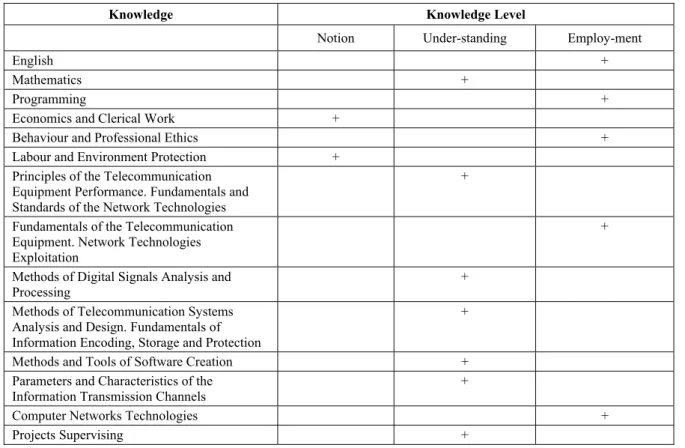
Table 1. Learning Outcome
Knowledge Knowledge Level
Notion Under-standing Employ-ment
English +
Mathematics +
Programming +
Economics and Clerical Work +
Behaviour and Professional Ethics +
Labour and Environment Protection +
Principles of the Telecommunication Equipment Performance. Fundamentals and Standards of the Network Technologies
+
Fundamentals of the Telecommunication Equipment. Network Technologies Exploitation
+
Methods of Digital Signals Analysis and Processing
+ Methods of Telecommunication Systems
Analysis and Design. Fundamentals of Information Encoding, Storage and Protection
+
Methods and Tools of Software Creation +
Parameters and Characteristics of the
Information Transmission Channels +
Computer Networks Technologies +
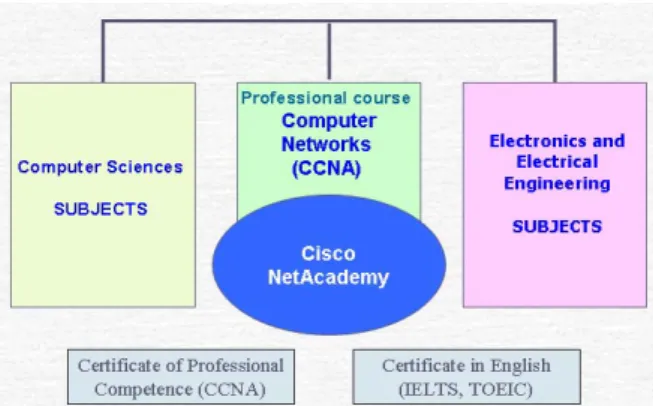
Taking into account the given learning outcome the Cisco Networking Academy curriculum widely uses the main idea of the developed programme. This curriculum has just brought the missing element, i.e. the professional component to the academic educational programme (Fig.5.).
Fig.5. Main idea of Cisco Networking academy integration to the educational programme
Structure of the programme can be seen in Table 2.
Table 2. Structure of the programme in credit points
Programmes sections ECTS credit points %
Obligatory (A) 180 75
Obligatory choice (B) 33 14
Free choice 12 5
Bachelor’s thesis (Graduation Paper) (A) 15 6
Total 140 100
It is necessary to notice that the programme of Cisco NetAcademy is included into the block A (obligatory). As a subject it is included into “Computer Networks”(1, 2, 3 and 4 semesters).
1 Semester: Introduction to Speciality (A), Computer Systems Structure (A), Physics (A), Programming (A), Higher Mathematics (A), Computer Networks (A), Labour Safety (A), Civil Defence and Environment Protection (A).
2 Semester: Computer Networks (A), Electrical Circuits Theory (A), Programming (A), Higher Mathematics (A), Physics (A), Computer Systems Structure (A).
3 Semester: Numerical Methods and Applied Programming (A), Electrical Circuits Theory (A), Discrete Mathematics (A), Computer Networks (A).
4 Semester: Signals and Circuits (A), Computer Networks (A), Electronics and Microelectronics (A), Database and Data Banks (A), Probability Theory and Mathematical Statistics (A)
5 Semester: Philosophy (A), Theory of Automatic Control (A), Theory of Information Coding and Transference (A), Electronics and Microelectronics (A), Introduction to Stochastic Processes Theory (B), Computer Networks Analysis and Design (B), Foreign Language (C), Principles of Law (C)
6 Semester: Operating Systems (A), Software Engineering (A), English for Engineers (A), Digital Telecommunication Systems Technologies(A), Queueing Theory (B), Modelling of Systems (B), Politology (C), Social Psychology (C)
7 Semester: Telecommunication Systems Theory (A), Group Project (A), Project Management (A), Network Programming (A), English for Engineers (A), Computer Networks Applied Technologies (B), Enterprise Basics (C), Management Economics Fundamentals (C).
8 Semester: Information Protection (A), Mobile and Satellite Telecommunication Systems(A), Bachelor's Thesis and its Defence (A), Computer Network Security (B), Office Work and Business Correspondence (C), Business Latvian (C).
The new programme was introduced in 2007. Two instructors have been prepared with the help of the Regional Academy of the University of Latvia. The modern laboratory has been well equipped. Now 142 students are studying according to this programme. We consider this experiment to be enough successful, lecturers pointing out a rather high motivation and interest of students to this programme. Instructors and
students highly evaluate on-line material given by Cisco NetAcademy. The studying process is being conducted in 3 languages (Latvian, Russian, English), but the basic material given by Cisco Academy is published in English. The internal e-learning system of Transport and Telecommunication Institute is actively used.
4. Conclusion
The peculiarities of the Bachelor’s study programme with the integrated Cisco Networking Academy Curriculum are as follows:
• The programme integrates the basic elements of the Bachelor’s study programmes “Electronics” and “Computer Science” (in part of the Computer Networks specialization).
• The major focus of the programme is directed to the Engineering Science (according to the modern policy of the Latvian Republic in the sphere of higher education).
• The professional orientation of this programme is strengthened due to the course of “Computer Networks” included into the programme from the 1st semester and the opportunity for students to pass the examination in obtaining the Professional Certificate of Cisco NetAcademy after the 2nd academic year of their studies.
• Some basic engineering disciplines (including CCNA Exploration curriculum) of the programme start from the 1st year but several humanitarian disciplines are transferred to the 3rd or the 4th year with the aim of further improvement and reinforcement of students’ motivation.
References
1. Grakovski, A., Berezhnoy, A. Growth of the Professional Component in the Academic Programmes at the Junior Courses, MIP Proceeding, TSI, Riga, 2007.
2. Ministry of Education and Science, “Statistika par augstāko izglītību -2007”, http://izm.izm.gov.lv/registri-statistika/statistika-augstaka/2007.html
3. Baltijas Datoru Akademija Ltd, “Statistika”, http://www.bda.lv/bda/courses.aspx?wl=en&cp=a
Revzina, J., Grakovskis, A. CISCO NETWORKING ACADEMY MĀCĪBU TEHNOLOĢIJU
IEVIEŠANA NACIONĀLAJĀ STANDARTIZĒTAJĀ AKADĒMISKAJĀ STUDIJU PROGRAMMĀ
Cisco Networking Academy mācību tehnoloģiju ieviešana tiek aplūkota saistībā ar „Telekomunikāciju sistēmu un datortīklu” (Inženierzinātņu bakalaurs elektronikā) mācību programmu Transporta un sakaru institūtā Latvijā. Šīs programmas galvenais mērķis – ar dziļām zināšanām un profesionālām iemaņām apveltītu telekomunikāciju, elektronikas, datorzinātņu un tīklu tehnoloģiju speciālistu sagatavošana. Pēc otrā studiju gada studentam ir iespēja saņemt Cisco CCNA profesionālo sertifikātu.
Atslēgvārdi: mācību programma, Cisco Networking Academy
Ревзина, Е., Граковский, А. ВНЕДРЕНИЕОБУЧАЮЩИХТЕХНОЛОГИЙ CISCO
NETWORKING ACADEMY ВНАЦИОНАЛЬНУЮСТАНДАРТИЗОВАННУЮ
АКАДЕМИЧЕСКУЮУЧЕБНУЮПРОГРАММУ
Внедрение обучающих технологий Cisco Networking Academy рассматривается на примере учебной программы
«Телекоммуникационные системы и компьютерные сети» (Бакалавр инженерных наук в области электроники) в Институте Транспорта и Связи в Латвии. Главная цель данной программы- подготовка специалистов с глубокими знаниямиипрофессиональныминавыкамиработывтелекоммуникациях, электронике, компьютерныхнаукахисетевых технологиях. Послевторогогодаобучениястудентполучаетвозможностьполучитьпрофессиональныйсертификат Cisco CCNA.