DOCTORAL (PhD) THESES
KAPOSVÁR UNIVERSITY
FACULTY OF ECONOMICS Department of Marketing and TradeHead of Doctoral School: DR. GÁBOR UDOVECZ
Doctor of the Hungarian Academy of Sciences
Consultant:
DR. PÉTER ÁKOS BIACS
Doctor of the Hungarian Academy of Sciences Co-consultant:
DR. VIKTÓRIA SZENTE, PhD
MARKETING POSSIBILITIES OF FUNCTIONAL FOODS
PRODUCED BY CANNED FOOD INDUSTRY
Written by:
ÁGOSTON TEMESI
KAPOSVÁR 2010
1. BACKGROUND AND AIM OF THE RESEARCH
Hungarian canned food industry has been manufacturing and selling its products for a hundred years. Its importance can be seen from its several decades long presence and results on export markets. The glorious past offers opportunities to present enterprises, but at the same time the responsibility is also big. Is it able to keep or even to increase the domestic and export market positions that have been gained by its predecessors?
In the past few years (and nowadays too) the Hungarian canned food industry had to face several difficulties. Several problems have to be solved from raw material production through processing to selling. Probably in recent market competition the biggest challenge is to keep up consumers’ interest in these products. It looks as if canned foods have lost their attraction in this competition.
The canned food industry is a very innovative sector of food industry. It offers new products for consumers year by year. This openness for developing new products offers renewed hope for the industrial sector. The success of innovation particularly depends on meeting consumers’ needs. An important base of this is to survey needs and preferences. However, intensive consumer surveys have been made very rarely in the past years because of the relatively low profitability of canned food industry and its several problems.
In the food industry, in food development several innovation trends have been introduced. One of these is the functional food theory that tries to impress its consumers by giving favourable effects on health to their products. As a new interpretation of health in the line of social trends the new goal is not defeating illnesses but keeping up health. More and more new market and market niches open for this aim (TÖRŐCSIK, 2006). Health-conscious consumers form only a minority in Hungary, but it is expected that their proportion is going to increase in the future. The market of functional (healthy) products is the most dynamically developing sector in the whole food industry. However, canned food industry participates only with few products in this product innovation tendency.
Moreover, the proportion of products that fail is very high in the market of functional foods (MEHLER, 1998); so it is particularly important to develop each product with uppermost care and with strict preparations in such an underfinanced sector like canned food industry that is struggling with several problems.
The first aim of my research was to answer which products consumers consider to be canned foods. It is fundamentally necessary to carry out the
to cover completely the question group. That is why it is justified to get acquainted with consumers’ points of view in favour of better product determination in spite of the fact that without doubt consumer side is not able to give professionally exact definition.
In this research it has been examined to what extent the most important product-attributes (among them the product’s effect on health) influence consumers’ purchasing decisions. I was looking for the answer whether there was a consumer need for developing health-protecting canned food industrial products. I was also interested whether the probably higher prices of these kinds of products were realizable.
Finally, it was also an aim of my research to collect general and product specific information for extension of marketing opportunities of canned food industrial products from product development through price calculation to finding the proper distribution place and the best suitable communication channel. Moreover, I wanted to find new points of view in segmentation of consumers, in targeting and in product positioning.
I wanted to work out a possible marketing-strategy with consideration of marketing-mix elements as well as by using “STP-marketing” that are used in industrial enterprises.
2. MATERIALS AND METHODS
Both secondary and primary data collection have been judged to be necessary from the character of the research topic. The survey begins with studying domestic and international secondary type of information then primary type of information is collected by using focus groups, using the “means-end” theory and the “laddering” method as well within the frame of a nation-wide in-hall test (KOTLER and KELLER, 2006).
2.1. Secondary research
During secondary data collection domestic and international special literature was examined: special books, scientific journals as well as information of World Wide Web.
2.2. Primary research
Independent data collection was made during primary marketing research. Both qualitative and quantitative researches were used.
2.2.1. Qualitative research
2.2.1.1. Focus groups
Focus groups were used 4-times during qualitative research. Two focus groups were assembled to determine canned food industrial products in order to determine the definition of “canned food industrial product” and “canned food”.
Focus groups were used in research of consumers’ judgement of canned foods and in research of industrial innovation opportunities. Our goal was to get acquainted with points of view of health-conscious consumers.
According to moderator guide of focus groups concrete researcher questions and association games were applied. Moreover, we have used several creative tasks in order to keep up consumers’ interest and for getting more information. (MALHOTRA, 2005)
2.2.1.2. The „means-end” theory and the „laddering” method
The „means-end” theory and the „laddering” method is a borderline between quantitative and qualitative research methods (in our research this is mentioned among qualitative researches because of the low number of
deep interviews. However, after data analysis results appear in quantitative form in numbers (KOVÁCS, KOMÁROMI és HORVÁTH, 2006).
During the research of baby foods and sournesses 10-10 young mothers and “average-consumers” with different economic situation and with different qualifications were followed.
During processing interviews we wanted to determine – as exactly as it is possible – the most important product-attributes, benefits and values that influence respondents’ purchase of baby-foods and sournesses.
2.2.2. Quantitative research
2.2.2.1. Nationwide in-hall test
Quantitative researcher method has been used in the research of canned food consumers’ judgement as well as in the research of possibilities in industrial innovation. A country-wide consumer survey was carried out in six Hungarian cities with 500 consumers. The questionnaires were filled in by consumers who do the shopping (primary and secondary food-purchasers) in the visited families; and what is more the questionnaires were filled in only by consumers who purchase canned food industrial products at any time. The method of the sampling is “systematic random”. However, the research can not perform conditions of representativity.
The filled questionnaires were evaluated with the help of the SPSS for Windows 13.0 programme. In the case of several questions average, standard deviation and median were calculated.
Significant correlations were counted (Pearson Chi2 test) with background information (level of significance: p<0,05) by using “Crosstabs” as well as in the case of scale-type questions with the help of “ANOVA” tables.
In case of 15 questions chosen from the questionnaire, factor- and cluster-analyses were made. The obtained clusters were compared with the main question-groups of the questionnaire, and significant correspondences have been calculated with 95% reliability level.
3. RESULTS
3.1. Determination of canned food industrial products
3.1.1. Examination of definitions of “canned food industrial products” and “canned foods”
Focus groups’ participants were asked to specify foods that are ranged “canned food industrial products” by them. In cases of judgement of several products serious debates have been occurred. So, it was asked by consumers of both focus groups to try to determine definitions at first.
Consumers were requested to share their ideas with each other about what makes a food to be canned food according to their judgement and what they consider to be canned food. After that they were encouraged to give a definition.
Consumers gave the following definitions: “long-lasting foods that are produced by preserving and heat-treatment of canned food industry and that we can get in metal-boxes, glasses or tubes”. This group has added to the definition in a later period of conversation that “these products generally contain preservatives”. The other group gave the following definition: “Foods (vegetables, fruits or meats) that are made by canned food industry and are supplied for consumers in metal-boxes, glasses or tubes”. This group gave an other abundant definition: “long-lasting foods that are produced by canned food industry and are supplied in metal-boxes, glasses or tubes as well and are made from vegetable, fruit and meat basic materials”. The definition of “canned food” which differs from the definition of “canned food industrial product” according to the judgement of one of the two groups of consumers: “food that is preserved in metal box and is long-lasting”.
After determining the definition we have returned to product categories in focus groups to decide – by using the definition – whether those products can be judged as “canned food industrial products” or not. Results are introduced summarized in table 1.
Table 1 Consumers’ determination of “canned food industrial products”
Clearly canned food industrial products according to consumers’ judgement These products belong to the product category only loosely according to consumers’ judgement; however, according to the definition these products are “ canned food industrial products”
These products belong to the product category even more loosely according to consumers’ judgement;
however, according to the definition these products are “ canned food industrial products” According to consumers’ judgement, these products hardly belong to the product category Canned meat products
Syrups Fruit juices Dehydrated stocks ** Canned fish Jams* Dehydrated
stocks* Liver pastes Canned fruits*
Canned ready made dishes
Mustard** Sournesses Mayonnaise** Canned vegetables Ketchup** Condensed tomato Baby foods Mustard* Mayonnaise* Jams** Canned fruits**
* According to the judgement of focus group in Szentendre. ** According to the judgement of focus group in Kaposvár.
Our results show that consumers usually judged product categories as canned food industrial products in strict sense that contain “canned” word. So, consumers have agreed that “canned food industrial products” are the following: canned meat products, canned fish, liver pastes (canned liver), canned ready made dishes and canned vegetables. Furthermore, consumers agreed unanimously that condensed tomato products are “canned food industrial products” and their opinion was almost the same in case of baby foods and sournesses belonging also to these kinds of products.
Consumers needed the former definition to range ketchup, mustard, mayonnaise, canned fruits (preserved fruits) and jams as “canned food industrial products”.
3.2. Consumers’ judgement of canned food industrial products’ effect on health
During the research (focus groups) it was examined whether consumers would accept that canned foods could also be particularly beneficial to their health. It was also considered what kinds of products should be developed by the sector first of all. We also wanted to know how much technology and packaging influence the health-conscious purchasers’ choice in case of canned foods. Finally, it was examined what kind of development is needed or what kind of development is regarded acceptable in the course of functional development of canned food industrial products by consumers who put particularly big emphasis on healthy nutrition.
During the research it was also examined how health-conscious consumers judge each canned food industrial product categories. This question is very important from the point of view of product innovation, because market introduction of a functional canned food industrial product can be more successful if a canned food industrial enterprise develops onward a product category that is judged as beneficial to health. Our results are introduced in table 2.
Table 2 Judgement of the effects of canned food products on health among
“health-conscious” consumers
Judgement Product-categories
Beneficial to health Baby Foods Canned fish
Sournesses Canned vegetables Condensed tomato
Neutral to health Canned fruit
Mayonnaise Mustard Jams Hazardous to
health
Canned ready
made dishes Liver pastes Canned meat products
Our results show that the most accepted products are baby foods and canned fish. However, sournesses, canned vegetables and condensed tomato products are also judged as favourable.
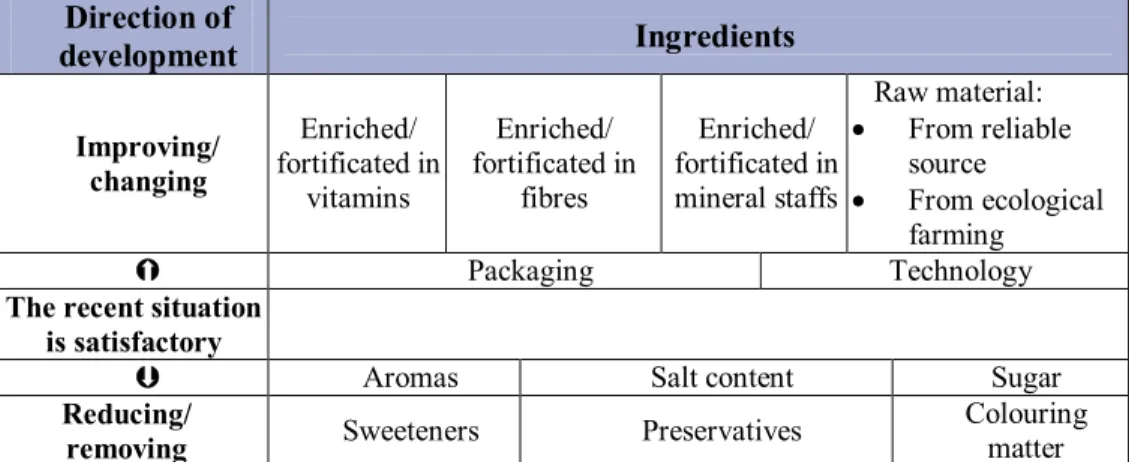
In the other important parts of focus groups participant consumers were requested to sort out mentioned product innovation opportunities. They had to unfold their opinion as to whether products should be enriched or reduced in the given ingredients or not and they were asked whether they would prefer modification or would prefer keeping up the present situation. Received results are shown in table 3.
Table 3 Judgement of canned food industrial development among
health-conscious consumers Direction of development Ingredients Improving/ changing Enriched/ fortificated in vitamins Enriched/ fortificated in fibres Enriched/ fortificated in mineral staffs Raw material: From reliable source From ecological farming Packaging Technology The recent situation
is satisfactory
Aromas Salt content Sugar Reducing/
removing Sweeteners Preservatives
Colouring matter
Our results show that health-conscious consumers regard acceptable and necessary enrichment/fortification of products in vitamins, fibres and mineral staffs. The prefer products that are made from raw materials and come first of all from reliable source or if it is possible from ecological source. It is also important to mention that their opinion about sweeteners is worse than it is about sugar.
3.3. Examination of consumers’ points of view in buying baby foods and sournesses
3.3.1. Baby foods
The market of baby foods has got strategic important in recent years. So it is worth dealing with the question: what is the cause that induces a young mother to buy baby food instead of buying some alternative product? Moreover, what are the values that young mothers think buying baby foods?
In our research glass packaged baby foods that are classical canned food industrial products were examined.
3.3.1.1. The respondents’ summarized hierarchical value map of baby foods Each point of view given by respondents was covered with expressions in several ways after data collection. All of the respondents’ own hierarchical value maps were drawn up by the help of created definitions. The value map contains product attributes (at the bottom of the figure), benefits (in the middle of the figure) and values (at the top of the figure) that are considered as important.
Summarizing the received answers from 10 respondents a hierarchical value map of baby foods has been created that contains points of view and relationships that were mentioned at least three times. The summarized hierarchical value map is shown in figure 1.
Several respondent young mothers mentioned among favourable product-attributes that baby foods are fast to prepare, are long-lasting, contain fruit and vegetable as well and they help mothers to give cooked meal for their babies. Several of the products are made in Hungary, are from organic source and particularly popular among babies.
With the help of their benefits these product-attributes give baby food buying young mothers the following values: the expression of mother’s love, the baby’s healthy development, the mother feels safe with them, purchasers help protecting Hungarian jobs as well and these products help avoiding the child becoming choosy.
Product-attributes, benefits and values as well as all the connections among them were mentioned during interviews by a higher than the limit number of young mothers as shown in figure 1. Two further points of view were mentioned three times at least; these were important for young mothers because of different benefits, and that is why they did not appear on the hierarchical value map. A higher than the limit number of respondents mentioned the wide assortment and special nutritive feature as characteristically important attribute of product category.
3.3.2. Sournesses
3.3.2.1. The respondents’ summarized hierarchical value map of sournesses Each aspect that was formulated by respondents in several ways was covered with expressions in case of sournesses as well. For example the appetizing meaning, the “it gives satisfaction to eat it” form and the “consuming is a good feeling” opinion were marked with “the pleasure of the meal” form. It was possible to draw up all of the respondents’ own hierarchical value maps by the help of created expressions. Summarizing the received answers from 10 respondents the hierarchical value map of sournesses was created as shown in figure 2.
Great amount of respondent customers mentioned among favourable product-attributes during interviews that sournesses have good taste, are easily available and (most of) these products are made from vegetables (among them from table beet) that they consume with pleasure and that they can get in this form for lower price in winter. They have also mentioned among favourable product-attributes that sournesses suit to several main dishes.
These important product-attributes lead through various kinds of benefits to some common values that are: health, the pleasure of dining and that the consumer can spend more money for something else.
Several more product-attributes and values were mentioned again during interviews as these were important for consumers because of different reasons. That is why they did not appear on the value map. A higher than the limit number of respondents mentioned among product-attributes that these products are long-lasting and of universal value. Meals can be varied by consuming sournesses and as it was mentioned people can eat a lot of them. What is more, a higher than the limit number of respondents has mentioned among values safety and convenience.
3.4. Examination of innovation opportunities of canned food industry
3.4.1. Examination of canned food purchasing
A country-wide inhall test has been carried out in the course of quantitative research. It was purchasing of canned food industrial products that are judged as favourable or neutral from the point of view of “effect on health” by health-conscious consumers that was examined in this survey.
Respondents were put a question how often and how much a time they buy from these products. Our results are shown in table 4.
Table 4 Canned food industrial products’ purchasing amounts
Respondents Purchased average amounts Product categories n head % n unit/year 1. Baby foods 492 35 7.1 492 173.2 2. Canned fish 500 380 76.0 499 34.9 3. Sournesses 500 415 83.0 498 48.7 4. Condensed tomato 497 368 74.0 496 42.8 5. Canned vegetables 498 367 73.7 498 49.6
According to our results the most popular products bought by respondents are sournesses. Almost the same number of consumers purchase canned fish, condensed tomato and canned vegetables. Canned fish are a little bit less popular, because 17% fewer respondents purchase them compared to sournesses. Only 7.1% of respondents purchase baby food; probably those who have a baby in their family. However, it came to light from the examination of yearly purchased products that respondents purchase the biggest amount of (glass packaged) baby food among examined product categories, while they buy the fewest amount from canned fish per annum.
Summarizing our significant results it can be stated that baby foods are the most popular among consumers between 30 and 39 and who are on child benefit. The most important purchasers of canned fish are between 50 and 59. Moreover, condensed tomato and canned vegetables are bought mostly by women which means that it is an attractive product category for young people between 30 and 39. Finally, canned fruits are mostly purchased by men between 30 and 39.
3.4.2. Examination of consumers’ judgement of product attributes
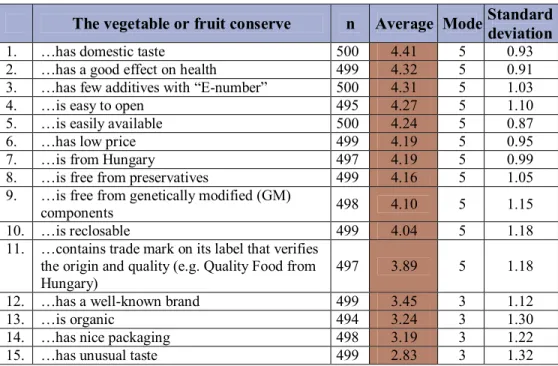
In the second question group of the questionnaire only vegetable and fruit conserves were examined. Respondents were asked to consider each product attribute in a 5-grade Likert-scale where “1” means not important, “5” means very important. Our results are shown in table 5 in decreased order according to answers’ averages.
Table 5 Consumer judgement of product attributes in case of vegetable and
fruit conserves
The vegetable or fruit conserve n Average Mode Standard deviation
1. …has domestic taste 500 4.41 5 0.93 2. …has a good effect on health 499 4.32 5 0.91 3. …has few additives with “E-number” 500 4.31 5 1.03 4. …is easy to open 495 4.27 5 1.10 5. …is easily available 500 4.24 5 0.87 6. …has low price 499 4.19 5 0.95 7. …is from Hungary 497 4.19 5 0.99 8. …is free from preservatives 499 4.16 5 1.05 9. …is free from genetically modified (GM)
components 498 4.10 5 1.15 10. …is reclosable 499 4.04 5 1.18 11. …contains trade mark on its label that verifies
the origin and quality (e.g. Quality Food from Hungary)
497 3.89 5 1.18 12. …has a well-known brand 499 3.45 3 1.12 13. …is organic 494 3.24 3 1.30 14. …has nice packaging 498 3.19 3 1.22 15. …has unusual taste 499 2.83 3 1.32
Our results show that the most important feature of the product is the taste of it in case of vegetable and fruit conserves. It came to light from the answers that respondents do not want new tastes. They would like canned food to have good taste, pleasant taste; moreover, they want these products to have some kind of a domestic, well known taste that can hardly be determined. This can be seen from the fact that the unusual taste of the product is the least important feature for respondents among attributes listed.
Particularly important information from the point of view of our research is that the second most important product attribute in the case of vegetable and fruit conserves is the products’ good effect on health.
Summarizing our most significant results it can be stated that “good effect on health” of vegetable and fruit conserves is important first of all for big families and for people with a little bit less than average income. The low preservative content is also a valuable product attribute for big families as well as for people who are between 50 and 59 and for women who are on child benefit. It is first of all for women for whom the product’s low content of “E-numbers” is also important.
3.4.3. Examining of product innovation opportunities
According to our former expectations consumers demand canned food industrial products with beneficial effects on health. However, the product’s beneficial effect on health can be reached by several ways. Developing functional foods is an opportunity for the industry.
The scientific judgement in case of each ingredient’s effects on health is dealt with in the European Union nowadays. However, the Union have not produced an officially accepted list now. That is why we used the list given by OÉTI (National Institute for Food and Nutrition Science) as a proper source to be the basis of possible canned food industrial products that have beneficial effect on health.
We are quite sure that enrichment/fortification (in due proportion) with ingredients that have particularly beneficial effects on health gives an opportunity for canned food industry producing healthy canned food industrial products. If the enterprises provide these products with health claims then we can say these products are certainly functional canned food industrial products. With regard to the above mentioned considerations, we believe that canned food industry should develop products that are judged to be good to your health or at least not bad to it.
Before the beginning of the research the greatest challenge was to find possible ingredients that can be found on the mentioned OÉTI list and with which the enrichment/fortification of former mentioned canned food industrial products is possible. After checking up them with experts the following ingredients have been chosen: vitamins, garlic, garden thyme, mint-leaf, camomile-flower and horseradish-root. These ingredients possess several – scientifically justified – favourable effects on health that – without doubt – are going to be accepted by EFSA’s competent board.
It should be noted that these effects are going to be reached only in case these enriched/fortificated products contain the ingredients mentioned in due proportion. Furthermore, it is a particularly important aspect in case of canned food industrial products that ingredients beneficial to health should stay in due proportion and adequate form after processing. However, carrying out this aim is the task of technology side. We have tried to choose ingredients that are – according to experts – not unusable in canned food industrial products.
The second question group of questionnaire shows clearly that a functional (health-protecting) caned food industrial product can not be successful in Hungary if it is not able to perform the most important product-attribute mentioned by consumers which is excellent taste. This is why in the third question group of questionnaire it was examined with which ingredients
consumers would try or would consume canned food industrial products with pleasure.
Our results show that the most popular possible product groups are in order the following: vitamin added canned fruits, sournesses with horseradish-root or with garlic, canned fish with garlic as well as vitamin added canned vegetables.
3.4.4. Opportunities to sell products at a higher price
Innovation of canned food industrial products that are enriched/fortificated with some kind of ingredients obviously means additional charges. Respondents have been asked in our questionnaire to mark the three products for which they would pay 10% higher price at least.
Our results show that consumers would pay more for the first 5 most popular products that were received in the third question group. However, the order has been changed among products. Vitamin added canned fruits stand first and canned fish with garlic stand second. Sournesses with garlic precede sournesses with horseradish-root.
3.4.5. Consumers’ reception of functional canned food industrial products’ health claims
Vegetable and fruit conserves as well as canned fish that were examined in the questionnaire possess several beneficial effects on our health even at this time. However, enrichment/fortification with ingredients that have independently several beneficial effects on our health were examined. We consider those product categories to be the most successful that have favoured taste on the one hand and – on the other hand – possess such beneficial effects that are considered by consumers important to receive from each canned food industrial product. Statements have been examined in a 5-grade Likert-scale where “1” means not important, “5” means very important. Results of the question group are shown in table 6.
Table 6 Consumers’ judgement on health claims of canned food industrial
products (n=500)
Effect n Average Mode Standard deviation
1. Strengthens the immune system 492 4.35 5 0.96 2. Has good effect on defending abilities
of the body
486
4.34 5 0.94 3. Has good effect on digestion 491 4.33 5 0.96 4. Helps keeping cholesterol level low 491 4.13 5 1.12 5. Effective in curing respiratory illnesses 467 4.04 5 1.14 6. Protects upper respiratory tracts 472 4.00 5 1.15
According to our results, the most important health effect for respondents that can be offered by canned food industrial products is that the product strengthens the immune system. Next comes that the product has good effect on defending ability of the body and that the product has good effect on digestion. The first three effects are almost equally important for respondents. The attribute that the product helps keeping cholesterol level low is a little bit backward from these effects, but it is still important.
Summarizing our main significant results, it can be stated that the first four effects of canned food products are particularly important for elderly, retired respondents as well as for young mothers who are on child benefit, while the first three effects are valuable aspects for women. The effect that the canned food industrial product strengthens the immune system is particularly important for people with lower qualification and for people with less than average income. The effect that the product has good effect on the defending ability of the body is also very important for the latter group. Finally, the effect that the product helps keeping cholesterol level low is particularly valuable for people with lower qualification and for people with overweight.
3.4.6. General points of view in canned food industrial product innovation
In the sixth question group of questionnaire statements have been formulated in connection with canned food industrial products. Agreement with statements was given by respondents in a 5-grade Likert-scale where “1” means not important, “5” means very important. Our results are shown in table 7.
Table 7 Respondents’ agreement with statements of canned food industrial
products (n=499)
Statements n Average Mode Standard
deviation 1. I would like to consume canned food
products that are particularly beneficial to my health.
10 4.41 5 0.84 2. Glass packaged canned vegetable and fruit
products are more safe than those that are packaged in metal boxes.
29 3.98 5 1.17 3. Canned vegetables and fruits contain too
much preservatives. 30 3.88 5 1.07 4. I prefer canned fruits and jams with added
sugar than those that contain sweeteners. 26 3.55 5 1.44 5. Canned vegetables contain too much salt. 57 3.53 3 1.24
Most of the respondents agreed with the question group’s statement that they would like to consume canned food industrial products that are particularly beneficial to their health. So it can be seen that consumers need functional canned food industrial products.
The analysis of agreement with statements shows that respondents trust metal cans less than glass packaging. Several of them are afraid from the fact that metallic compounds could melt in food.
It is slightly surprising that the statement that canned vegetables and fruits contain too much preservatives takes only the third place. However, the average number (3,88) is still very high, because these products contain preservatives only rarely.
3.4.7. Possible purchasing places of health protecting canned food industrial products
The possible purchasing places of functional canned food industrial products were examined in the questionnaire separately. Respondents were asked to choose three of the listed kinds of shops that are – according to their judgement – the most successful selling places of these products.
Consumers characteristically purchase canned food industrial products during shopping bigger amounts of products. Respondents also judged hyper- and supermarkets the most successful selling places of functional canned food industrial products.
3.4.8. Authentic information sources in communication of functional canned food industrial products
Respondents were asked in the last question group of questionnaire to mark information sources that could be – according to their belief – the most authentic from the points of view of canned food industrial products with beneficial effects on health.
Respondents judged doctors – that precedes members of family and friends/acquaintances – as the most authentic possible information sources.
3.4.9. Segmentation of consumers by using factor- and cluster-analysis in connection with canned foods and health
3.4.9.1. Factor-analysis
15 variables, examining the connection between canned food and health were chosen from the questions of the questionnaire. These variables were used for factor- and cluster-analysis, and as a result of that three factors have been defined.
First factor includes health claims, in this way the name of the factor is: “looking for beneficial effects on health”. Second factor can be named as “looking for exemption of harmful ingredients”. Finally the third factor can get the name of “demand on decreasing ingredients that are dangerous on health”.
3.4.9.2. Cluster-analysis
Factors received on the basis of the research can determine the direction of marketing-strategy. However, we need to know the profile of most important segments for this. So, in the next step – by using the 3 factors – cluster-analysis has been used. Four clusters were found on the basis of the cluster-analysis that cover 100% of the sample.
By analysing our results, it has been proved that one of the most important target groups of functional foods is the group of “women who put big emphasis on health”, and within this group those who are able to pay the higher price of products. As retired people generally have lower income, enterprises that target this group should put bigger emphasis on the other consumer group of this cluster: young mothers who are on child benefit. It is also important to note that this group is very small.
According to our results the group of “better-off workers who want to have a strong organism” can also be reached with products that have good effect on defence system of organism, with products that strengthen the
immune system and with products that have good effect on digestion. They might be able to pay higher prices of functional canned food industrial products.
It is important that innovators keep in mind in case of both groups that only those health-protecting canned food industrial products can be successful which are able to assure excellent, domestic taste beside beneficial effect on health. However, enterprises that are targeting women who put big emphasis on health should also consider that this consumer group has several other needs as well.
4. CONSLUSIONS
Hungarian canned food industry that has a great past has to cope with several problems nowadays. According to our secondary type of information these are the following:
The main problems are crop fluctuation and the situation of gardening producers which is getting worse row material production. The processing of import row material has grown in considerable amount in the past few years.
The sector has to use out-of-date equipments during processing that leads to underdevelopment in efficient competition. These equipments were left in this sector from a former industry that produced to a huge market with lower quality requirements.
Selling also put Hungarian canned food industry to the test. Mentioning only a few points: low profitability, increased competition caused by import products, defencelessness to export markets as well as the fluctuation of the Hungarian national currency. However, the future solution of the industry depends mostly on the fact how successfully the sector can be made suitable for solvent consumer needs, and how fast it will be able to perform marketing-activity that follows consumers’ expectations from product-innovation based on consumer needs through right choice of distribution channels to marketable and profitable price calculation and successful communication.
The first important question is the following: which products were the subjects of our research. We have worked up the new definition of “canned food industrial product” with the help of several kinds of definitions (among them the definitions of consumers): “food that is long lasting as a result of processing, that is in closed package for trade and that is made from vegetables, fruits or meat ingredients”.
Consumers have been asked to range possible product categories in the course of our research. According to consumers “canned food industrial products” are the following: canned meat products, canned fish, liver pastes, canned ready made dishes, sournesses, canned vegetables, condensed tomato, baby food, mustard, mayonnaise, jams, canned fruits.
According to our secondary type of information, functional food has better consumer acceptance its effect on health is judged favourable or at least not unfavourable among consumers. Our results show that consumers do not reject canned food industrial products unanimously. Several of them are judged as particularly beneficial to health. In later periods of research, increased attention was applied for products that are judged by consumers
(from the point of view of effect on health) particularly beneficial: baby foods and canned fish; beneficial: canned vegetables, sournesses, condensed tomato; neutral: canned fruits.
According to results of our further researches the effect on health of canned food industrial product is the second most important product-attribute during shopping after domestic taste. Consumers do need canned food industrial products that have particularly beneficial effect on health.
It came to light among focus groups that consumers are open to enrichment/fortification of products and it has got evidence in quantitative research, too. According to our results respondents would consume or would try canned food industrial products that are enriched/fortificated with certain – beneficial to health – ingredients with pleasure. Big proportion of consumers – according to their statement – would ready to pay more for these products.
A possible marketing-strategy of functional canned food industrial products has been worked out by using results of the research. The short presentation of this strategy includes segmenting, targeting, positioning as well as marketing-mix elements. All of these are introduced in the chapter of “Proposals”.
5. NEW SCIENTIFIC RESULTS OF RESEARCH
1. I determined that out of consumer definitions of „canned food industrial product” and „canned food” I would make the new definition of „canned food industrial product”: “food that is long lasting as a result of processing, that is in closed package for trade and that is made from vegetables, fruits or meat ingredients.”. Furthermore, I have defined products that are judged as canned food industrial products by consumers. These are the following: canned meat products, canned fish, liver pastes, canned ready made dishes, sournesses, canned vegetables, condensed tomato, baby foods, mustard, mayonnaise, jams and canned fruits.
2. I have revealed that consumers do not think uniformly about canned food industrial products’ effect on health:
Consumers think baby foods and canned fish particularly beneficial to health.
Sournesses, canned vegetables and condensed tomato are judged beneficial to health.
Canned fruits are judged neutral to health they are between beneficial and unbeneficial.
Mayonnaise, mustard and jams are judged rather unbeneficial.
Consumers think canned ready made dishes, liver pastes and canned meat products particularly unbeneficial on health. 3. I have proved that the most important product-attribute of canned
food industrial products for consumers is the beneficial effect on health, after the products’ taste (domestic taste).
4. I have examined the possibility of enrichment/fortification of canned food industrial products that are judged as favourable, with ingredients that possess satisfying scientific evidences and that means they might be a real opportunity if used in canned foods.
5. I have developed a basis of a possible marketing-strategy for functional canned food industrial producers. My main statements are the following:
A real consumer need can be seen for functional canned food industrial products. These foods can be successful if they will be produced by using good basic products that are considered to be basically beneficial to health.
Functional canned food industrial products can be sold at higher price than basic products if the consumer is satisfied with the taste of the product.
The most important distribution places are: hyper- and supermarkets, discounts and bio-shops.
The most authentic information source of functional canned food industrial products is doctors. That is why involving them should be an important part of communication strategy. 6. I have shown that the possible target groups of functional canned food
industrial producers are women who put big emphasis on health and better-off workers who want to have a strong organism.
7. I have managed to draw the so-called “hierarchical value maps” of two canned food industrial product categories that are considered beneficial to customers’ health; these are baby food and sournesses. I have revealed the most important product-attributes, benefits and values that influence respondents’ purchase of baby-foods and sournesses by using the “means-end” theory and the “laddering” method.
6. PROPOSALS
Segmenting, targeting, positioning
Canned food consumer food-purchasers, our respondents may be segments in several ways. Our consumer groups have been divided during the course into two-types of research work: by using demographic characters as well as – in case of two products – by using values and benefits that are considered important.
Clusters have been formed by using demographic characters of respondents and 15 variables that are examining the connection between beneficial effects on health and canned food consumption. This information came from results of the country-wide in-hall test that was made during the research. According to this analysis it has been stated that the possible target markets of functional canned food industrial products are the following: women who put big emphasis on health to be important and better-off workers who want to have a strong organism. The former target group can be characterized with price sensitiveness, so they offer limited possibilities. Though the latter group of consumers can be reached only with products that have certain effects; they are ready to pay more for these kinds of products.
A test-like research has been made on the basis of the „means-end” theory and hierarchical value maps have been created in the case of two canned food industrial product categories: baby foods and sournesses. According to literature the results of “means-end” theory can be used in segmentation. Five main values have been revealed during the research of baby foods that induce young mothers to buy them. They are the following: the healthy development of the kid, the mother feels safe, the expression of mother’s love, to help avoiding the child becoming choosy as well as to protect Hungarian jobs in the case of national products. Also five values have been revealed in the case of the research of sournesses that induce consumers to buy them. These are the following: the pleasure of dining and the aspect of health as well as to save money for other things by sparing with these products. Further aims are safety and comfort. Characteristics of each group have not been examined because of barriers of our possibilities. However, the revealed values can give a very good basis for a market segmentation that is different from what was formerly mentioned, that is to say if the development of segments does not go on the basis of demographic characters but on the basis of noticed values. It is more likely that more useful market segments can be developed in this way.
Product strategy
Consumer acceptance has been examined in case of canned food industrial products that contain health claims. By analysing our results all possible products (36 product opportunities in number) were examined how many consumers would try or would consume them with pleasure and how all these is related to the products’ supposed taste.
According to our secondary type of information psychological benefits are less important for consumers than physiological benefits. That is why enrichment/fortification with such ingredients have been offered for respondents that whish stronger immunity of their body. Our results show that the most important effect on health from canned foods is that the product strengthens the immune system; this is followed by the effect that the product has good effect on the defending system of the body, has good effect on digestion and helps keeping cholesterol level low. In this way it can be stated that from the five better judged products the following products are welcome with consumers: vitamin added canned fruits and canned vegetables as products that strengthens the immune system and sournesses and canned fish with garlic as products that have good effect on the defending system of the organism and help keeping cholesterol level low.
Price strategy
Producers of functional foods typically offer their products to consumers at high prices. This can be explained with the particularly high product innovation prices as well as with the prestige price strategy of producers. We should also know that consumers have become accustomed that canned food industrial products are usually relatively cheap.
Our results show that consumers in big proportion would be ready to pay higher prices for examined products that have beneficial effects on health, just because of the new, favoured taste by consumers. We believe that the beneficial effect on health makes further price increases possible.
Distribution strategy
Canned food industrial products are typically purchased in bigger amount in case shopping. Consumers think that hyper- and supermarkets can be the most important distributional places for functional canned food industrial products.
Communication strategy
Canned foods that can be purchased in shops are regarded by consumers as products that are not good to health. However, these products still possess several beneficial effects on health at present. It is justified to inform consumers about these effects as it means good possibilities for the producer.
The sector can influence consumers’ negative opinions that are developed about their products with innovation of functional canned food industrial products. Our results show that doctors are the most authentic source of information about health-protecting canned foods. So it is essential to involve doctors in the marketing process. Functional canned food industrial product innovators should consider building up a doctor visiting system.
The use of “hierarchical value maps” that are created on the basis of the “means-end” theory may be very helpful during communication in the cases of baby foods and sournesses. If you know which values are considered important by customers while buying your products it will help you in forming effective and successful messages in advertising them.
PUBLISHED PAPERS FROM THE THESES
Foreign language article in a Hungarian scientific journal:
Temesi Á., Szente V., Biacs P.: Hungarian consumers’ opinion about products of canned food industry. Hungarian Agricultural Research 19 (2) 25-27 (2010)
Articles in Hungarian in scientific journals:
Temesi Á., Biacs P., Szente V.: Innovációs lehetőségek a konzerviparban – kulcsszerepben az egészség. Élelmiszer, Táplálkozás és Marketing 5 (2-3) 67-72 (2008)
Temesi Á.: Bébiételek vizsgálata a „means-end chain” elmélet és a létrázás módszerének alkalmazásával. Élelmiszer, Táplálkozás és Marketing 6 (1-2) 65-69 (2009)
Temesi Á., Biacs P., Szente V.: A konzervipari termékek és a konzervek fogyasztói értelmezése. Élelmiszervizsgálati Közlemények 56 (1) 24-34 (2010)
Full extent proceedings that have been published in conference publications in Hungary:
Temesi Á.: A fogyasztók zöldség- és gyümölcskonzerv választási szempontjai. XIV. Ifjúsági Tudományos Fórum, Keszthely, 2008, 1-5 (CD kiadvány, ISBN 978-963-9639-24-9).
Temesi Á.: Megújulási lehetőségek a konzervipar számára. 50. Jubileumi Georgikon Napok, Keszthely, 2008, 1-6
(CD kiadvány, ISBN 978-963-9639-32-4).
Temesi Á.: Konzervek egészségre gyakorolt hatásának fogyasztói és tudományos megítélése – lehetőségek a vállalatok előtt.
Marketing Oktatók Klubja Jubileumi 15. Konferencia, Kaposvár, 2009, 395-404 (CD kiadvány, ISBN 978-963-9821-12-5).
Presentation in a professional program in a foreign language:
Temesi Á., Szakály Z., Szente V., Biacs P.: Innovation of functional canned food industrial products: Consumers' expectations, preferences and attitudes. Small and Medium Sized Enterprises: Management - Marketing - Economic Aspects. ATINER 7th Annual International Conference. Athén, Görögország, 2010.08.02.
Presentations in professional programs in Hungarian:
Temesi Á., Szente V., Biacs P.: Fogyasztói magatartás elemzése a zöldség-és gyümölcskonzervek piacán. XL. Konzervipari napok tudományos
tanácskozás, Nagykőrös, 2008.05.05.
Temesi Á., Biacs P., Szente V.: Innovációs lehetőségek a konzerviparban – kulcsszerepben az egészség. IV. Táplálkozásmarketing konferencia,
Kaposvár, 2008.06.05.
Temesi Á.: Fogyasztói szemlélet a konzervek piacán: van-e igény az innovatív termékekre? V. Táplálkozásmarketing konferencia, Kaposvár, 2009.06.04.
Professional articles in other journals and publication:
Temesi Á., Szente V., Biacs P.: Fogyasztói magatartás elemzése a zöldség-és gyümölcskonzervek piacán. Konzervújság 56 (1-2) 12-16 (2008)
Temesi Á.: A konzervipari termékek fogyasztói megítélése. Élelmiszer 17
(10) 46-47 (2009)
Temesi Á.: A „means-end chain” elmélet és a létrázás módszerének bemutatása a savanyúságok példáján. Konzervújság 57 (1-2) 12-16 (2009)