Fine-Grained Classification via Mixture of Deep Convolutional Neural Networks
ZongYuan Ge
†‡, Alex Bewley
‡, Christopher McCool
‡, Peter Corke
†‡, Ben Upcroft
†‡, Conrad Sanderson
∗ †Australian Centre for Robotic Vision, Brisbane, Australia
‡
Queensland University of Technology (QUT), Brisbane, Australia
∗University of Queensland, Brisbane, Australia
Data61 / NICTA, Australia
[email protected] [email protected]
Abstract
We present a novel deep convolutional neural network (DCNN) system for fine-grained image classification, called a mixture of DCNNs (MixDCNN). The fine-grained im-age classification problem is characterised by large intra-class variations and small inter-intra-class variations. To over-come these problems our proposed MixDCNN system par-titions images intoKsubsets of similar images and learns an expert DCNN for each subset. The output from each of the KDCNNs is combined to form a single classifica-tion decision. In contrast to previous techniques, we pro-vide a formulation to perform joint end-to-end training of the KDCNNs simultaneously. Extensive experiments, on three datasets using two network structures (AlexNet and GoogLeNet), show that the proposed MixDCNN sys-tem consistently outperforms other methods. It provides a relative improvement of 12.7% and achieves state-of-the-art results on two datasets.
1. Introduction
Fine-grained image classification consists of discrimi-nating between classes in a sub-category of objects, for in-stance the particular species of bird or dog [2,5,8,9,23]. This is a very challenging problem due to large intra-class variations (due to pose and appearance changes), as well as small inter-class variation (due to only subtle differences in the overall appearance between classes). See Fig.1for examples.
To cope with the above problems, many fine-grained classification methods have performed parts detection [2,5, 20,24] in order to decrease the intra-class variation. Re-cently, an alternative approach was introduced by Ge et al. [13] where the images were first partitioned intoK non-overlapping sets andK expert systems were learned. By grouping similar images, the input space is being parti-tioned so that an expert network can better learn the subtle differences between similar samples. Expert selection was performed by training a dedicated gating network which
as-(a)
(b) (c)
Figure 1. Example images from the Birdsnap dataset [3] which exhibits large intra-class variations and low inter-class variations. Each column represents a unique class.
signs samples to the most appropriate expert network. This approach has two downsides. Firstly, a separate gating net-work (subset selector) needs to be trained. Secondly, the expert networks are trained only to extract features, leaving the final classification to be performed by a linear support vector machine (SVM).
We propose a novel system based on a mixture of deep convolutional neural networks (DCNNs) that pro-vides state-of-the-art performance along with several im-portant properties. Similar to Ge et al. [13], we partition the data into K non-overlapping sets to learn K expert DCNNs. However, unlike [13], the classification decision from the each expert is weighted proportional to the confi-dence of its decision. This allows us to define a single net-work (MixDCNN), comprised of K sub-networks (expert DCNNs), that can be trained to perform classification. This is in contrast to [13], where each expert is used just for fea-ture extraction. Our system has similarities to the gated net-work approach proposed by Jacobs et al. [16], which utilises a separately trained network to select the most appropriate expert network.
The proposed MixDCNN system allows us to jointly train the network, which has two advantages: (i)it obvi-ates the need for a separate gating network, and(ii)samples can be re-assigned to the most appropriate expert network
during the training process. Empirical evaluations show that this approach outperforms related approaches such as sub-set feature learning [13], a gated DCNN approach similar to [16], and an ensemble of classifiers.
The paper is continued as follows. In Section 2 we briefly review recent advances in fine-grained classification and overview approaches to learn multiple expert classi-fiers, particularly within the field of neural networks. In Section3we present our proposed MixDCNN approach in detail. Section 4 is devoted to a comparative evaluation against several recent methods on the task of fine-grained classification. Conclusions and possible future avenues of research are given in Section5.
2. Prior Work
Prior work for fine-grained image classification has con-centrated on performing parts detection [2, 5, 20, 24] in order to decrease the intra-class variation. The part-based one-vs-one feature system [2] is an example of this, where parts-based features are progressively selected to improve classification. An alternative is the deformable parts-model which obtains a combined feature from a set of pre-defined parts [24]. Chai et al. [6] proposed a symbiotic model where part localisation is helped by segmentation and, conversely, the segmentation is helped by parts detection. Zhang et al. [24] extract pose-normalised features based on weak semantic annotations to learn cross-component correspon-dences of various parts.
Recent work has shown the effectiveness of DCNNs for fine-grained image classification, but again, predominantly to perform parts detection. Region proposal methods com-bined with a DCNN were shown to more accurately localise object parts [23]. Lin et al. [19] showed that a DCNN can be trained to perform both parts localisation and visibil-ity prediction, achieving state-of-the-art results on the CUB dataset [22]. Although the above parts-based approaches are fully automatic at test time, they require a large num-ber of images to be manually annotated in order to train the model.
To remove the need for time-consuming manual anno-tations, recent work has explored ways to perform fine-grained classification without using part annotations. Zhang et al. [23] and Ge et al. [12] showed that, even without part annotations, DCNNs can provide impressive performance for fine-grained classification tasks. Of particular interest is the approach of Ge et al. [10] which showed that the data can be partitioned intoKnon-overlapping sets and an ex-pert feature extraction algorithm, utilising DCNNs, can be trained for each of theKsets.
Learning algorithms which construct a set ofK classi-fiers and make decisions by taking a weighted or average of their predictions are often referred to as ensemble methods. A simple ensemble approach calledbagginghas been used
to improve the overall performance of a system [4]. Bag-ging manipulates the training examples to generate multi-ple hypotheses. In this case, a set ofKclassifiers is learned using a randomly selected subset of the training data. We use this bagging approach on a set of DCNNs for a baseline method and refer to it as an Ensemble approach (Section4). Ensemble approaches, or learning K expert classifiers, has been explored by several researchers within the context of neural networks. In 1991 Jacobs et al. [16] described a gated network structure to learnKexpert neural networks and applied it to multi-speaker vowel recognition. The un-derlying idea is to only allocate a small region of the in-put space to a particular expert system. This was achieved by havingKexpert systems (neural networks) which were allocated samples selected by a separate gating network. In [16], the gating network determines the probability that a sample is associated to one of theKexpert systems.
More recently, Ge et al. [13] outlined a subset feature learning (Subset FL) approach usingKexpert DCNNs. The data is partitioned intoKnon-overlapping sets and for each set an expert DCNN is learned to extract set-specific fea-tures. A gating network is then used to extract only the most relevant features from these K DCNNs. Classification is then performed by training an SVM on these features, yield-ing impressive performance for fine-grained bird and plant classification [11]. An issue with this work is the reliance of an independent gating network Gand the fact that fea-ture extraction and classification are treated as independent steps.
3. Proposed Approach
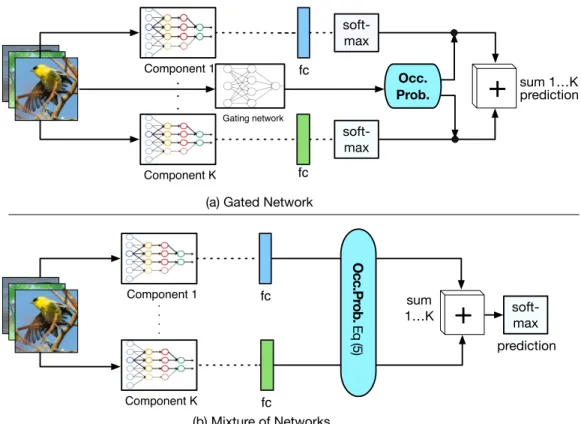
We propose a novel mixture of DCNNs (MixDCNN) to improve fine-grained image classification by partitioning the data intoK non-overlapping sets and learning an ex-pert classifier for each set. This approach has similarities to the gated neural network proposed by Jacobs et al. [16], which has never been applied to DCNNs nor to the fine-grained classification problem. As such, we also outline a gated DCNN (GatedDCNN). An overview of these two ap-proaches is given in Figure2.
The main idea behind the MixDCNN and GatedDCNN approaches is to learn K expert networks, [S1, . . . ,SK], which make decisions about a subset of the data. This sim-plifies the space that is being modelled by each component. Key to both approaches is being able to assign a sample to the appropriate network.
A GatedDCNN assigns samples by learning a separate gating neural network which produces the probability,αk, that the sample belongs to thek-th network. Learning this gating neural network requires ground truth labels about which sample should be assigned to a particular network, which for our work is an open question. In contrast, a MixDCNN assigns samples based on the confidence of the
fc sum 1…K Component 1 Component K fc fc Gating network soft-max soft-max sum 1…K prediction prediction
+
Occ. Prob. . . . (b) Mixture of Networks (a) Gated NetworkComponent 1 Component K fc
+
Occ.Pr ob. Eq (5) soft-max . . . .Figure 2. GatedDCNN structure (top) and MixDCNN structure (bottom). The termOcc. Prob. refers to occupation probability (re-sponsibility)α. In GatedDCNN, the gating network uses the image, the same input as each component (subset networks), to estimateα. In contrast, MixDCNN estimatesαwithout the need for an external network.
prediction from each network, which leads us to consider
αk to be the occupation probability of the sample for the k-th network.
Before we describe these two approaches in more detail we define some notation. The output of a DCNN, trained for classification, is anN-dimensional vectorzof class predic-tions, whereN indicates the number of classes. These pre-dictions then are normalised by a softmax [18,21] to give the probability that the sample belongs to then-th class:
cn =
exp{zn} PN
j=1exp{zj}
(1) In the approaches described below, we are most interested in the vector of predictionszprior to applying the softmax.
3.1. GatedDCNN
Inspired by [15,16], we define a GatedDCNN that con-sists ofK components (DCNNs) and an additional gating network. The overall structure of this network is shown in Fig.2a. In this arrangement, the k-th DCNNSk is given greater responsibility for learning to discriminate subtle dif-ferences of thek-th subset of images, while the gating net-workGis responsible for associating the imageIwith the most appropriate component. The gating network G is a
fine-tuned DCNN that is learned using the cross-entropy loss to produce aK-dimensional vector of probabilitiesα. Thek-th value denotes the probability that the input image
Iis associated with thek-th component. We refer to this as an occupation probability.
A fundamental difficulty with training the GatedDCNN is how to provide theT training labelsy. This label vector is aK-dimensional label vector which indicates which of theKsubsets the sample belongs to. To deal with this issue we consider two ways of estimating these labels. The first approach is to initialise the labelsy using the partitioning of the training images intoKsubsets. The gated networkG is then trained using these labels and theKDCNNs (com-ponents) are then trained independently so thatSkis trained exclusively with data from thek-th subset. The second ap-proach is to use the above gated network (andK compo-nents) as an initialisation and to iteratively retrain by:
1. FixingG, and then updating[S1, . . . ,SK]using the as-signments fromG.
2. Fixing the K components [S1, . . . ,SK] and using these to estimate new labelsy. The networkGis then updated using these new labels.
the network which is most confident about its decision. For-mally,ytfor thet-th training sample is given by:
yt= arg max k=1...K
Ck,t (2)
whereCk,tis the best classification result forSk using the t-th sample:
Ck,t= max
n=1...Nzk,n,t (3) Classification with the GatedDCNN is performed using a weighted summation of the classification results from the
Kcomponents:
cn = XK
k=1ck,nαk (4) whereck,nis the probability of the sample belonging to the n-th class for thek-th component, andαkis the probability that the sample is assigned to thek-th componentSk.
An issue with the GatedDCNN system is that a separate gating network has to be trained to assign a sample to a particular componentSk. This provides the further compli-cation of having to estimate the labelsyin order to train the gating networkG. In this paper the first GatedDCNN train-ing approaches provides marginally better performance. In the experiment section, we will report results based on the first approach.
3.2. Mixture of DCNNs (MixDCNN)
We propose a mixture of DCNNs approach where the oc-cupation probabilitiesαare based on the classification con-fidence from each component. An advantage of this struc-ture is that we can jointly train theKDCNNs (components) without having to estimate a separate label vectoryor train a separate gating networkG.
For MixDCNN, the occupation probability for thek-th component is: αk= exp{Ck} PK c=1exp{Cc} (5)
whereCk is given by Eq. (3). This occupation probability gives higher weight to components that are confident about their prediction. The overall structure of this network is shown in Fig.2b.
Classification is performed by multiplying the output of the final layer from each component by the occupation prob-ability and then summing over theKcomponents:
zn = XK
k=1zk,nαk (6) This mixes the network outputs together and the probabil-ity for each class is then produced by applying the softmax function in Eq. (1). As a consequence our MixDCNN is optimised using the cross-entropy loss1.
1Optimised in a mini-batch Stochastic Gradient Descent framework.
3.3. Differences Between MixDCNN and Ensembles
The aim of the MixDCNN approach is that each compo-nent takes greater responsibility for a portion of the data allowing each component to concentrate on samples (or classes) that are more difficult to differentiate. This will allow the MixDCNN to learn subtle differences for similar classes. This is in contrast to an Ensemble approach which randomly excludes a portion of the training data for each DCNN. Therefore, the key difference between the proposed MixDCNN approach and an ensemble of DCNNs (Ensem-ble) is the use of the occupation probability. For training, this means the MixDCNN approach does not randomly se-lect the data. Instead, each sample is weighted proportional to its relevance to each DCNN S1,...,K. For testing, the MixDCNN approach is able to adaptively calculate the oc-cupation probability for each sample, whereas an Ensemble approach will use pre-defined weights or, more commonly, equal weights.
4. Experiments
4.1. Datasets
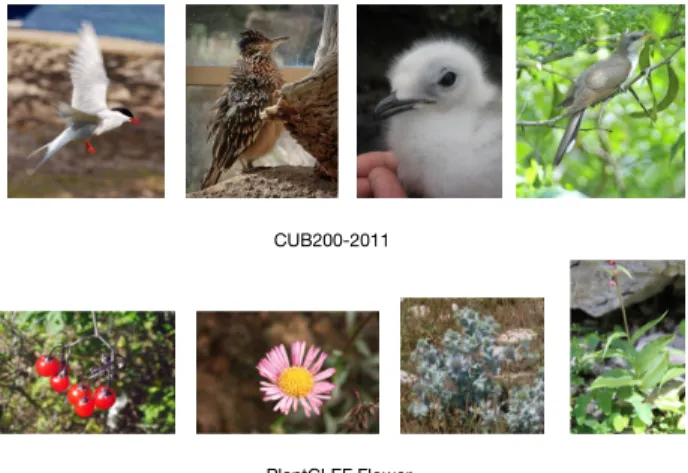
We present results on three fine-grained image classi-fication datasets using two network structures. The three datasets are the Caltech-UCSD-2011 (CUB200-2011) [22], Birdsnap [3], and PlantCLEF 2015 [14]. Example images are shown in Figures1and3.
CUB200-2011 is a fine-grained bird classification task with 11,788 images from 200 bird species in North Amer-ica. This dataset has become a de factostandard for the bird classification task. Each species has approximately 30 images for training and 30 for testing. Birdsnap is a much larger bird dataset consisting of 49,829 images from 500 bird species with 47,386 images used for training and 2,443 images used for testing. PlantCLEF 2015 is a large plant classification dataset that has seven content types. To demonstrate the capabilities of the proposed MixDCNN
ap-CUB200-2011
PlantCLEF Flower
proach for the task of fine-grained classification, we analyse its effectiveness on one content type, Flower. This portion of the dataset consists of 28,705 images from 967 species. We split this data into training and test sets. The training set consists of 25,025 images from 967 species, while the test set has 3,200 images from 801 species.
Both CUB200-2011 and Birdsnap have bounding box annotations around the object of interest. We use this in-formation to extract just the object of interest from the im-age. PlantCLEF 2015 does not come with bounding box information making it a more challenging dataset.
Prior work [13,23] has shown the importance of transfer learning for the fine-grained image classification problem. Results have shown that training a DCNN from scratch for either the fine-grained CUB200-2011 or Birdsnap dataset leads to overfitting on the training samples. As such, for all the of our experiments we use pre-trained networks from ImageNet [7] to provide a good initialisation for each DCNN and then perform transfer learning. We consider this to be our baseline and refer to it asDCNN-tl. All of our networks are trained using Caffe [17] and partitioning was performed using the Bob toolkit [1].
4.2. Comparative Evaluation
We compare the proposed MixDCNN approach against four other related methods:(1)the baseline DCNN-tl,(2)an ensemble ofK DCNNs, (3)an implementation of Gated-DCNN, and (4) Subset FL [13]. Two network structures considered are the well known AlexNet [18] and the Large Scale Visual Recognition Challenge (ILSVRC) 2014 win-ner GoogLeNet [21]. AlexNet is a deep network consisting of 8 layers, while ILSVRC has 22 layers2. We follow the
same procedure as Ge et. al [13] to cluster the data. For the AlexNet structure we use the output of the first fully connected layer as features for clustering. For GoogLeNet we use the output of the last layer, prior to classification, as features. In both cases linear discriminant analysis (LDA) is applied to reduce the dimensionality to D = 128. In our initial experiments, we variedDand results showed no impact of that.
The results in Table1show that the proposed MixDCNN approach provides consistent improvement regardless of network structure or dataset. MixDCNN provides the best performance for all of the network and dataset combina-tions, with the exception of the MixDCNN model using the GoogLeNet structure on CUB. It provides an average rela-tive performance improvement of 12.7% over the baseline DCNN-tl approach, excluding CUB.
For the CUB dataset, using multiple expert networks provides limited performance improvement. This is true for all of the methods examined. We attribute this to the
2To prevent GoogLeNet from over-fitting we use a higher dropout rate
equal to 0.5 for the final loss layer, as opposed to the original setting of 0.4.
fact that CUB200-2011 is a small dataset consisting of just 5,994 training images. This is an order of magnitude fewer samples than other datasets such as Birdsnap. Fur-thermore, applying transfer learning to GoogLeNet already provides exceptional performance and so minimises the im-provement introduced by the MixDCNN framework, or any multi-expert approach.
The proposed MixDCNN method achieves state-of-the-art results on the challenging Birdsnap and PlantCLEF-Flower datasets. For Birdsnap the previous state-of-the-art performance was 48.8% [3]. Applying transfer learning to GoogLeNet already outperforms this prior art with an ac-curacy of 67.4%. MixDCNN provides a further relative performance improvement of 9.9%. For the PlantCLEF-Flower dataset the baseline performance of DCNN-tl (using GoogLeNet) is 48.7%. MixDCNN provides state-of-the-art performance with a relative performance improvement of 7.0%.
The MixDCNN approach consistently outperforms the Ensemble, GatedDCNN and Subset FL approaches. Inter-estingly, it provides a considerable improvement over the closely related GatedDCNN approach, with an average rel-ative performance improvement of 9.1%. We attribute this to the ability of the MixDCNN approach to adaptively re-assign samples to the most appropriate expert network, in spite of the original partitioning.
In our experiments, component sizes greater thanK= 6 were not considered as we could not store these in mem-ory on a single GPU3. This highlights one of the limitations with this technique as it currently requires all of the net-works to be stored on a single GPU; future work should con-sider how to extend the architecture across multiple GPUs.
5. Conclusion
We have proposed a novel mixture of deep neural net-works, termed MixDCNN, which achieves state-of-the-art performance for fine-grained classification. It provides an average relative performance improvement of 12.7% and has been shown to consistently outperform several related methods: subset feature learning, GatedDCNN, and an en-semble of classifiers.
The key advantage of our proposed approach is the use of an occupation probability that weights each sample pro-portional to its relevance to each DCNNS1,...,K. This ap-proach obviates the need for a separate gating function and highlights the importance of being able to adaptively weight samples based on their relevance to a component (DCNN). Future work will explore alternative methods for initial-ising the clustering and its impact upon performance. For instance, the impact of grouping images together in terms
3The GPU used in all our experiments was an Nvidia K40 Tesla with
Table 1.Comparison of the proposed MixDCNN approach against DCNN-tl, Ensemble, GatedDCNN and Subset FL on three datasets: CUB, BirdSnap and PlantCLEF-Flower. Two network structures are used: AlexNet and GoogLeNet.
DCNN-tl Ensemble GatedDCNN Subset FL MixDCNN AlexNet CUB 68.3% 71.2% 69.2% 72.0% 73.4% BirdSnap 55.7% 57.2% 57.4% 59.3% 63.2% PlantCLEF-Flower 29.1% 30.2% 30.2% 31.1% 35.0% GoogLeNet CUB 80.0% 80.9% 81.0% 81.2% 81.1% BirdSnap 67.4% 71.4% 70.1% 72.8% 74.1% PlantCLEF-Flower 48.7% 50.2% 49.7% 51.7% 52.1%
of their pose rather than similar visual appearance. Further-more, we will examine the role of the occupation probabil-ity in two ways:(i)whether the responsibility for a sample is shared between components, and(ii)deeper analysis of how this occupation probability changes during the train-ing process. Additionally, we intend on explortrain-ing different methods for computing the occupational probability via al-ternative aggregation techniques.
Acknowledgements. The Australian Centre for Robotic Vision is sup-ported by the Australian Research Council via the Centre of Excellence program. NICTA is funded by the Australian Government through the De-partment of Communications, as well as the Australian Research Council through the ICT Centre of Excellence program.
References
[1] A. Anjos, L. E. Shafey, R. Wallace, M. G¨unther, C. McCool, and S. Marcel. Bob: a free signal processing and machine learning toolbox for researchers. InACM International Con-ference on Multimedia, pages 1449–1452, 2012.
[2] T. Berg and P. N. Belhumeur. POOF: Part-based one-vs.-one features for fine-grained categorization, face verification, and attribute estimation. InCVPR, 2013.
[3] T. Berg, J. Liu, S. W. Lee, M. L. Alexander, D. W. Jacobs, and P. N. Belhumeur. Birdsnap: Large-scale fine-grained visual categorization of birds. InCVPR, pages 2019–2026, 2014.
[4] L. Breiman. Bagging predictors. Machine Learning, 24(2):123–140, 1996.
[5] Y. Chai, V. Lempitsky, and A. Zisserman. Symbiotic seg-mentation and part localization for fine-grained categoriza-tion. InICCV, 2013.
[6] Y. Chai, V. Lempitsky, and A. Zisserman. Symbiotic seg-mentation and part localization for fine-grained categoriza-tion. InICCV, 2013.
[7] J. Deng, W. Dong, R. Socher, L.-J. Li, K. Li, and L. Fei-Fei. Imagenet: A large-scale hierarchical image database. In
CVPR, 2009.
[8] R. Farrell, O. Oza, N. Zhang, V. I. Morariu, T. Darrell, and L. S. Davis. Birdlets: Subordinate categorization using volu-metric primitives and pose-normalized appearance. InICCV, 2011.
[9] E. Gavves, B. Fernando, C. G. Snoek, A. W. Smeulders, and T. Tuytelaars. Fine-grained categorization by alignments. In
ICCV, 2013.
[10] Z. Ge, C. McCool, C. Sanderson, A. Bewley, Z. Chen, and P. Corke. Fine-grained bird species recognition via hierar-chical subset learning. InIEEE International Conference on Image Processing (ICIP), pages 561–565, 2015.
[11] Z. Ge, C. McCool, C. Sanderson, and P. Corke. Content specific feature learning for fine-grained plant classification. InWorking Notes of the CLEF 2015 Conference, 2015. [12] Z. Ge, C. McCool, C. Sanderson, and P. Corke. Modelling
local deep convolutional neural network features to improve fine-grained image classification. InIEEE Int. Conference on Image Processing (ICIP), pages 4112–4116, 2015. [13] Z. Ge, C. McCool, C. Sanderson, and P. Corke. Subset
fea-ture learning for fine-grained classification. InDeepVision Workshop, Computer Vision and Pattern Recognition Work-shops (CVPRW), pages 46–52, 2015.
[14] H. Go¨eau, A. Joly, P. Bonnet, S. Selmi, J.-F. Molino, D. Barth´el´emy, and N. Boujemaa. Lifeclef plant identifica-tion task 2014. InWorking Notes for CLEF 2014 Conference, pages 598–615. CEUR-WS, 2014.
[15] J. B. Hampshire II and A. Waibel. The meta-pi net-work: Building distributed knowledge representations for ro-bust multisource pattern recognition. PAMI, 14(7):751–769, 1992.
[16] R. A. Jacobs, M. I. Jordan, S. J. Nowlan, and G. E. Hin-ton. Adaptive mixtures of local experts. Neural Computa-tion, 3(1):79–87, 1991.
[17] Y. Jia, E. Shelhamer, J. Donahue, S. Karayev, J. Long, R. Gir-shick, S. Guadarrama, and T. Darrell. Caffe: Convolutional architecture for fast feature embedding. InACM Interna-tional Conference on Multimedia, pages 675–678, 2014. [18] A. Krizhevsky, I. Sutskever, and G. E. Hinton. Imagenet
classification with deep convolutional neural networks. In
NIPS, pages 1097–1105, 2012.
[19] D. Lin, X. Shen, C. Lu, and J. Jia. Deep LAC: Deep local-ization, alignment and classification for fine-grained recog-nition. InCVPR, pages 1666–1674, 2015.
[20] J. Liu, A. Kanazawa, D. Jacobs, and P. Belhumeur. Dog breed classification using part localization. InECCV. 2012. [21] C. Szegedy, W. Liu, Y. Jia, P. Sermanet, S. Reed,
D. Anguelov, D. Erhan, V. Vanhoucke, and A. Rabinovich. Going deeper with convolutions.CVPR, 2014.
[22] C. Wah, S. Branson, P. Welinder, P. Perona, and S. Belongie. The Caltech-UCSD Birds-200-2011 Dataset. In Computa-tion & Neural Systems Technical Report, California Institute of Technology, number CNS-TR-2011-001, 2011.
[23] N. Zhang, J. Donahue, R. Girshick, and T. Darrell. Part-based R-CNNs for fine-grained category detection. In
ECCV, pages 834–849. 2014.
[24] N. Zhang, R. Farrell, F. Iandola, and T. Darrell. Deformable part descriptors for fine-grained recognition and attribute prediction. InICCV, 2013.
![Figure 1. Example images from the Birdsnap dataset [3] which exhibits large intra-class variations and low inter-class variations.](https://thumb-us.123doks.com/thumbv2/123dok_us/9709505.2852473/1.918.494.779.337.545/figure-example-images-birdsnap-dataset-exhibits-variations-variations.webp)