G00233198
Magic Quadrant for Master Data Management
of Customer Data Solutions
Published: 18 October 2012Analyst(s): John Radcliffe, Bill O'Kane
Organizations selecting a solution for master data management of customer
data still face challenges. Overall, functionality continues to mature, but
some of the well-established vendors' messages are getting more complex.
Meanwhile, less-established vendors continue to build up their credentials.
Market Definition/Description
Master data management (MDM) of customer data solutions are software products that:
■ Support the global identification, linking and synchronization of customer information across
heterogeneous data sources through semantic reconciliation of master data.
■ Create and manage a central, database-based system of record or index of record for master
data.
■ Enable the delivery of a single customer view (for all stakeholders) in support of various
business benefits.
■ Support ongoing master data stewardship and governance requirements through
workflow-based monitoring and corrective action techniques.
■ MDM (see Note 1 for a definition) implementations and their requirements vary in terms of: ■ Instantiation of the customer master data — varying from the maintenance of a physical
"golden record" to a more virtual, metadata-based, "indexing" structure.
■ The usage and focus of the customer master data — ranging across use cases for design
(information architecture), construction (building the business), operations (running the business), and analytics (reporting the business).
■ Different organizations' structures spanning small, centralized teams through to global,
distributed organizations.
■ The latency and accessibility of the customer master data — varying from real-time,
synchronous reading and writing of the master data in a transactional scenario between systems, to message-based, workflow-oriented scenarios of distributed tasks across the organization and legacy style batch interfaces moving master data in bulk file format.
Organizations use MDM of customer data solutions as part of an MDM strategy, which in itself should be part of a wider enterprise information management (EIM) strategy. An MDM strategy potentially encompasses the management of multiple master data domains, such as customer, product, asset, person or party, supplier and financial masters. As the name suggests, MDM of customer data solutions focus on managing customer data — a form of "party" data, whereas MDM of product data focuses on managing product data — a form of "thing" data. There are no other discrete Magic Quadrants for other master data domains, due to the relatively low level of discrete market interest to govern those data domains in comparison to customer and product data.
We are routinely asked whether we have an overall MDM Magic Quadrant but, while we continue to keep this under review, we still believe that it is premature, because MDM needs are very diverse (see "The Five Vectors of Complexity That Define Your MDM Strategy"), leading to different market segments and the majority of the buying activity and evaluations still focused on initiatives for specific master data domains. In addition, although many MDM solutions are marketed as multidomain MDM, they don't always conform to our definition of multidomain MDM technology (see Note 2) and we find that they have many gaps in their capabilities and experience in handing every data domain (see "A View of Master Data Management Vendors' Experience In Handling Multiple Master Data Domains" and "A View of Master Data Management Vendors' Experience in Handling Multiple Master Data Domains, Part 2").
Magic Quadrant
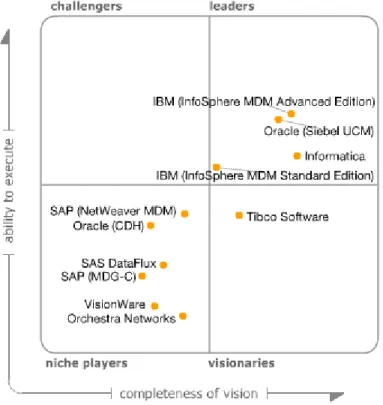
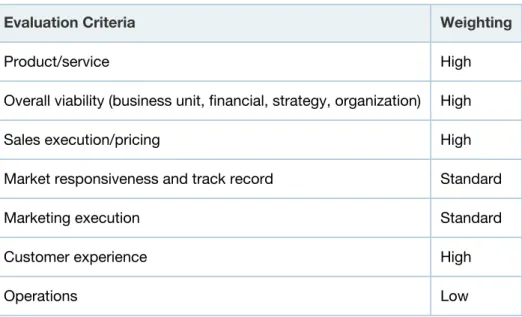
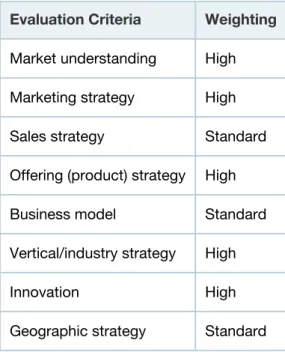
Gartner's Magic Quadrant for Master Data Management of Customer Data Solutions provides insight into the portion of the constantly evolving packaged MDM systems market that focuses on managing customer data to support CRM and other customer-related strategies. It positions relevant technology providers on the basis of their Completeness of Vision relative to the market, and their Ability to Execute on that vision.
Figure 1. Magic Quadrant for Master Data Management of Customer Data Solutions
Source: Gartner (October 2012)
Vendor Strengths and Cautions
IBM (InfoSphere MDM Advanced Edition)
Website: www.ibm.comHeadquarters: Armonk, New York, U.S.
In the MDM market IBM offers InfoSphere Master Data Management v.10.0, generally available since October 2011 (with a July 2012 release adding Reference Data Management capabilities) that comprises four options: Standard, Collaborative, Advanced and Enterprise Editions. Version 10.0 is the first step in a multiyear convergence road map that unifies and integrates IBM's three prior MDM products — InfoSphere MDM Server, InfoSphere MDM Server for Product Information Management (PIM) and Initiate Master Data Service (MDS) — and IBM is working on further integration to create a single software stack that includes the key capabilities of each product, together with common UIs, workflow, services, data stores, and metadata. Price points for InfoSphere MDM vary by industry, by data domain (individual, organization, account, product, custom) and by the number of managed records per data domain type.
In this Magic Quadrant we are evaluating IBM's InfoSphere MDM Standard Edition and Advanced Edition separately. While IBM is progressively building a single stack, end-user organizations are faced with a choice between multiple offerings that are positioned differently. Standard Edition is derived from the prior product Initiate MDS, and focuses specifically on registry style "system of reference" implementations, whereas Advanced Edition is derived from a combination of the prior products Initiate MDS and InfoSphere MDM Server and provides support for all MDM
implementation styles. Collaborative Edition does not meet the inclusion criteria for MDM of customer data solutions and Enterprise Edition is a bundling of the whole portfolio.
Customer Base (licensed to manage customer data): Estimated at 210 for InfoSphere MDM Advanced Edition
Strengths
■ Broad information management strategy includes strong MDM portfolio: InfoSphere MDM
Advanced Edition is part of IBM's Information Management portfolio that includes business intelligence (BI), performance management, information integration, warehousing and
management, content management, and data management. This is an attractive proposition for organizations looking for a wide range of information management functionality from a single, highly viable vendor, and InfoSphere MDM leverages other products from within the Information Management group — such as InfoSphere Information Server and the InfoSphere BigInsights and InfoSphere Streams "big data"-related products. IBM positions InfoSphere MDM as the enabler of trusted information across the organization and is rationalizing its multiple MDM offerings into a single increasingly consistent product set with upgrade opportunities, making its capabilities more logical and more leveragable. We estimate that IBM's total MDM revenue in 2011 was $301 million.
■ Strong market momentum: IBM's MDM customer base continues to grow, benefiting from the
vendor's large sales and marketing organization, and its large customer base. We estimate that at the end of 1Q12 IBM had a total of over 700 licensed MDM customers with over 510
customers managing customer data and 210 of those running Advanced Edition. We estimate that IBM's 2011 revenue related to MDM of customer data was $196 million, including $127 million for Advanced Edition. Gartner estimates that Advanced Edition is the clear market leader in terms of revenue in the market for MDM of customer data solutions. Advanced Edition is particularly strong in financial services and IBM maintains a strong global balance of clients.
■ The convergence of two very capable MDM offerings: InfoSphere MDM Advanced Edition
provides a powerful combination of IBM's two prior MDM products for managing customer data (Initiate MDS and InfoSphere MDM Server) which represented, respectively, strong solutions for lighter, registry-focused implementations and high-end, transaction-driven, centralized
implementations that create and maintain a physical system of record in service-oriented architecture (SOA) environments. Advanced Edition provides support for all MDM
implementation styles and the MDM workbench gives the ability to create and manage custom data domains. This capability is leveraged in the latest release to provide reference data
management capability. In v.10 IBM is starting to show its ability to leverage key functionality across prior products and to introduce common capabilities for the long term. For example, it has ported the Initiate MDS probabilistic matching engine across to the InfoSphere MDM Server
engine and has created the InfoSphere MDM Application Toolkit, which can generate MDM applets for integration into new or existing applications. IBM is also increasingly leveraging IBM BPM Express to create and consume customer master data.
■ Good prepackaged data model and services: The InfoSphere MDM Server engine within
Advanced Edition contains a very capable and extensible prepackaged party data model (with accompanying capabilities to store light product and account data) and provides the capability to model new data domains as required. The Advanced Edition has good support for hierarchy management and location data and has rich prebuilt functionality in a multilevel business service library. The new Adaptive Services Interface (ASI) provides easy graphical mapping tools to allow customers to expose tailored Web services that meet their needs for the content and terminology of the service. Advanced Edition has steadily improving data stewardship facilities which include task management capabilities to assist data stewards and data steward managers with the workflow and allocation of tasks. Role-based UIs have capabilities such as graphical data visualization and hierarchy management, and customers can leverage the UI Generator to extend the existing UIs and to generate new ones.
Cautions
■ Complexity and inconsistencies within the new InfoSphere MDM product: At first sight, the
IBM InfoSphere MDM go-to-market story is simple; there is one product with multiple editions. But as you look beneath the surface it gets more complex and the inconsistencies — in terms of underlying technologies, UIs and workflows that result from three separate MDM acquisitions — become more obvious. These inconsistencies will continue to confuse and create complexity for prospects and current customers until the different editions are fully integrated from an external perspective and share common underlying services. In the meantime, organizations will need to carefully think through the implications of starting to manage customer data with a lightweight registry style and then moving to a prepackaged physical data model with out-of-the-box business services. This is likely to be a more complicated journey than it seems at first, with the need to either run the instances side by side and or to make a migration.
■ Challenging future product convergence road map: IBM has shared a road map with its
clients for how it will integrate the three prior MDM products into a single stack with three embedded MDM engines. IBM plans to provide a single database instance for all master data and metadata; a single application instance (within an application server container); a single services layer; a single installation, configuration and maintenance layer, and a single UI layer for governance. This will be a multiyear journey as IBM provides increasing integration between the different "engines" and creates common shared services. Version 10.0 is a good first step, though it still requires multiple instances and the tooling around the different prior products remains inconsistent, and there is a risk that IBM could devote too much of its energies to the convergence road map — as opposed to innovation in domain-specific areas.
■ Prepackaged approach is not for everyone and functionality is behind in some areas:
Although Advanced Edition is a very capable product with a prepackaged out-of-the-box data model and services library, some organizations are looking for a more client-driven data modeling approach. IBM does offer a "platform" version of Advanced Edition called Custom
Domain Hub Stand-Alone, but not many customers are leveraging it yet. Also, IBM has more work to do in areas such as embedded analytics, master data stewardship, business rules governance and business process management (BPM)/workflow integration. Although some of this may be available in one of the other editions, it is not yet available to all in a consistent fashion. On the multidomain front, all editions can support multiple domains to a degree but there are different limitations in each. The beginnings of the InfoSphere MDM and big data story are promising, but there is no out-of-the-box integration to social CRM applications. There is no multitenant software as a service (SaaS) strategy with Advanced Edition, although partners have launched cloud-based infrastructure as a service (IaaS) offerings with IBM, and Advanced Edition currently lacks out-of-the-box integration with SaaS applications.
■ Customer references scored relatively low in several areas: IBM provided a full set of
references for both InfoSphere MDM Standard Edition (the former Initiate MDS) and InfoSphere MDM Advanced Edition (which includes the former InfoSphere MDM Server as well as
InfoSphere MDM Standard Edition). Advanced Edition gained average to above average customer satisfaction scores for most product categories, with high marks for its support for multiple architectural styles as well as performance and scalability. Conversely, it scored lower with respect to its support for internal workflow and data stewardship, and its support for data quality facilities. Advanced Edition also scored relatively low on the transparency of its pricing structure. IBM earned relatively average marks for its support of Advanced Edition, performing better on post-sales than pre-sales, and the most positive references continue to mention the direct involvement of IBM Labs resources during the initial implementation as a critical success factor.
IBM (InfoSphere MDM Standard Edition)
Website: www.ibm.comHeadquarters: Armonk, New York, U.S.
In the MDM market IBM offers InfoSphere Master Data Management v.10.0, generally available since October 2011 (with a July 2012 release adding Reference Data Management capabilities), that comprises four options: Standard, Collaborative, Advanced and Enterprise Editions. Version 10.0 is the first step in a multiyear convergence road map that unifies and integrates IBM's three prior MDM products: InfoSphere MDM Server, InfoSphere MDM Server for PIM and Initiate MDS. IBM is working on further integration to create a single software stack that includes the best capabilities of each product, together with common UIs, workflow, services, data stores and metadata. Price points for InfoSphere MDM vary by industry, by data domain (individual, organization, account, product, custom) and by the number of managed records per data domain type.
In this Magic Quadrant we are evaluating IBM's InfoSphere MDM Standard Edition and Advanced Edition separately. While IBM is progressively building a single stack, end-user organizations are faced with a choice between multiple offerings that are positioned differently. Standard Edition is derived from the prior product Initiate MDS and focuses specifically on registry style "system of reference" implementations, whereas Advanced Edition is derived from a combination of the prior products Initiate MDS and InfoSphere MDM Server and provides support for all MDM
implementation styles. Collaborative Edition does not meet the inclusion criteria for MDM of customer data solutions and Enterprise Edition is a bundling of the whole portfolio.
Customer Base (licensed to manage customer data): Estimated at 300 for InfoSphere MDM Standard Edition
Strengths
■ Broad information management strategy includes strong MDM portfolio: InfoSphere MDM
Standard Edition is part of IBM's Information Management portfolio that includes BI,
performance management, information integration, warehousing and management, content management and data management. This is an attractive proposition for organizations looking for a wide range of information management functionality from a single, highly viable vendor and InfoSphere MDM leverages other products from within the Information Management group — such as InfoSphere Information Server for Data Integration and the InfoSphere BigInsights and InfoSphere Streams big data-related products. IBM positions InfoSphere MDM as the enabler of trusted information across the organization and is rationalizing its multiple MDM offerings into a single, increasingly consistent product set with clear upgrade opportunities — making its capabilities more logical and more leverageable. We estimate that IBM's total MDM revenue in 2011 was $301 million.
■ Registry style, fast time to value and strong market momentum: InfoSphere MDM Standard
Edition provides a registry-style "system of reference" implementation approach. In this distributed authoring implementation style, ownership stays with the authoring application; however, Standard Edition can match and link, storing the original source records in the hub and generating virtual golden records on the fly. Standard Edition has a reputation for fast time to value and a relatively low service-to-software cost ratio, because it is less invasive than other implementation styles and requires less governance agreement within the organization. It is also more suitable for multi-organizational data sharing, such as in government and healthcare. We estimate that at the end of 1Q12 IBM had a total of over 700 licensed MDM customers with over 510 customers managing customer data and 300 of those running Standard Edition. We estimate that IBM's 2011 revenue related to MDM of customer data was $196 million, and that included $68 million for Standard Edition.
■ Excellent scalability and steadily gaining common functionality: Standard Edition has strong
references with proof points for extremely high volumes of business-to-consumer (B2C) data, with subsecond latency and high transaction rates. It has data model and Web services
flexibility, a highly rated probabilistic matching capability (selected by IBM as the default option across all of its MDM editions), integration with a range of data quality tools, and good
measurement and monitoring facilities. Standard Edition provides basic workflow, partially based on IBM BPM Express (which is bundled with the product), for data stewards to visualize and manage consumer and organizational data. It leverages the InfoSphere MDM Application Toolkit capability, for building composite applications and MDM applets that can be embedded in existing applications — such as salesforce.com.
■ Strong vertical industry focus, especially in healthcare and government: Standard Edition is
very strong in the healthcare provider enterprise master patient index (EMPI) and healthcare information exchange markets, and has a strong partner ecosystem. It also continues to do well in government (at national and local levels), particularly in meeting entity resolution
requirements. IBM sells Standard Edition into a range of industries beyond healthcare and government, where it is suitable for distributed authoring requirements requiring a lightweight registry-style solution. Increasingly, IBM positions Standard Edition in the context of a later upgrade to Advanced Edition if and when a physical system of record is required. IBM provided a good set of references for Standard Edition and they were generally very positive. Standard Edition achieved slightly above average customer satisfaction scores for performance,
scalability and availability, and average scores for its understanding of the business application of its technology, understanding of the industry vertical and providing a stream of new
technology innovation. Cautions
■ Complexity and inconsistencies within the new InfoSphere MDM portfolio: At first sight, the
IBM InfoSphere MDM go-to-market story is simple, there is one product with multiple editions. But as you look beneath the surface it gets more complex and the inconsistencies — in terms of underlying technologies, UIs and workflows — that result from three separate acquisitions become more obvious. These inconsistencies will continue to confuse and create complexity for prospects and current customers until the different editions are fully integrated from an external perspective and share common underlying services. In the meantime, organizations will need to carefully think through the implications of starting to manage customer data with a lightweight registry style if they want to move to a prepackaged data model with out-of-the-box business services at a later stage. This complexity also requires that prospects and clients work closely with IBM staff to ensure that the appropriate MDM editions are identified and acquired.
■ Challenging future product convergence road map: IBM has shared a road map with its
clients for how it will integrate the three prior MDM products into a single stack with three embedded MDM engines. IBM plans to provide a single database instance for all master data and metadata; a single application instance (within an application server container); a single services layer; a single installation, configuration, and maintenance layer, and a single UI layer for governance. This will be a multiyear journey as IBM provides increasing integration between the different "engines" and creates common shared services. Version 10.0 is a good first step, though it will probably take another couple of releases before it delivers a consistent user experience with seamless integration behind the scenes; in the interim, integration and standardization work is likely to consume significant development resources.
■ Standard Edition is not positioned for transactional centralized style: Prior to its acquisition
by IBM, Initiate Systems was steadily improving facilities for customers to build up a data model and implement a more physical system of record form of MDM. However, there was a change of strategy after the IBM acquisition. The result has been that although Standard Edition is a very good product, it is limited in scope and ambition and only targets a segment of the overall market. If an organization's vision is to evolve its MDM capabilities over time — from a registry to a more physical golden record approach — it would need to upgrade to Advanced Edition; IBM currently provides two options:
1. To run Standard Edition side-by-side with the InfoSphere MDM Server engine, and have Standard Edition act as an identity hub generating composite records for physical storage in the other instance.
2. To "migrate" to the InfoSphere MDM Server engine, data model and services library. For Initiate MDS customers that hoped to leverage a single MDM product the future has become more complex and many are closely watching the road map.
■ Multidomain implementations are limited and pricing clarity and resource availability are
issues: Standard Edition's core competency is with party data, including customer data. It can potentially model other domains but, so far, has only done this opportunistically — typically in the context of specific industry requirements. Also, Standard Edition is targeted mainly at operational use cases and doesn't tend to be seen in analytical MDM use cases which typically require a physical system of record. IBM provided a full set of references for InfoSphere MDM Standard Edition. References scored Standard Edition's product capabilities at an average to above average level across the majority of categories, but gave below average marks for manageability and security facilities, as well as IBM's responsiveness to requests for new features. Several references reported substantial expense and scheduling issues in obtaining skilled consulting resources from IBM (with some attributing this to lack of a local presence with these skills), and a lack of transparency around IBM's pricing structure. While multiple
references expressed a basic understanding of an interest in the newer product road map to Advanced Edition, they also voiced relief that Standard Edition is still being offered as a stand-alone product because they have no plans to upgrade in the near future.
Informatica
Website: www.informatica.com
Headquarters: Redwood City, California, U.S.
Informatica positions Informatica MDM (based on technology derived from the Siperian acquisition in 2010) under the moniker of Universal MDM, and claims the ability to handle all multidomain, multistyle, multideployment and multiuse requirements on a single platform. However, in September 2012 Informatica acquired Data Scout to provide Informatica Cloud MDM, a multitenant SaaS offering, based upon Force.com and specifically for salesforce.com users, and then on 1 October 2012 Informatica announced the voluntary public takeover offer for Heiler Software, a vendor of product information management (PIM) software. Informatica MDM together with Informatica's data integration and data quality tools offerings, make up the Informatica 9.5 Platform. Informatica MDM v.9.5 became generally available in June 2012. Pricing is by data domain, then the number of records per data domain. Informatica Data Controls Optoin costs extra and is licensed on the basis of the number of users.
Strengths
■ Informatica has good vendor viability and good MDM momentum: Informatica has good
vendor viability and global reach. It had total company revenue of $783 million in 2011. It sees MDM as key to its growth strategy, is strongly promoting MDM and has been growing its MDM business with great success. It is increasingly able to cross-sell its MDM, data integration and data quality products and to sell multidomain MDM deals. We estimate that Informatica's 2011 MDM revenue was $79 million (a 32% growth rate), with revenue related to MDM of customer data of $65 million (a 26% growth rate). We also estimate that at the end of 1Q12 Informatica had a total of 204 licensed MDM customers, with 195 of them managing customer data, and that it had 147 customers licensed to master multiple data domains.
■ Multiple industries and strong partner ecosystem: Informatica MDM has customers spread
across many industries including financial services, retail and manufacturing, and has a particular strength in life sciences. Informatica is attractive to potential MDM service provider partners and it has several partners, such as Accenture, Capgemini, Cognizant and Wipro, developing both horizontal and vertical industry assets on top of Informatica MDM. Informatica is also a leader in supporting the packaging of design assets (for example, data models, data and integration services and UIs), from successful implementations by their clients and
partners, for reuse as starting points in new implementations. The Informatica Marketplace, an online application store, is increasingly serving as a delivery vehicle for this collateral.
■ Flexible MDM product capable of supporting multiple domains: Informatica MDM is a
client-driven MDM solution with strength in flexible data modeling and hierarchy management. It supports multiple data domains, including party, product and location data, plus reference data, in a single product, but its core strength is managing party data. It has good proof points with B2C and B2B customers, and has several sites running very large volumes of customer records, indicating good performance and scalability. Informatica MDM supports both the registry
implementation style (that is, match and link creating an index) and the implementation styles that instantiate a physical "golden record" in a single product. Most customers use coexistence style in a distributed authoring scenario.
■ Continuing innovation: Informatica continues to innovate. For example, Informatica Data
Controls provides a framework for developing MDM-based applets that can be embedded in existing applications. Informatica MDM is available in the cloud through partners in an IaaS deployment, and a multitenant SaaS deployment option in the public cloud is planned for 2013 — although for salesforce.com users the strategy now is to offer Informatica Cloud MDM based on the Data Scout acquisition. In the social networking area Informatica MDM 9.5 provides a prebuilt connector to Facebook which invokes a Facebook application, allowing the enrichment of internal master data with social data. Additionally, Informatica 9.5 provides location-based master data access functions on tablets and other mobile devices, and in the big data area there are plans to release a matching capability for Hadoop within the Informatica MDM product at end 2012. The longer term road map includes a facility called Semantic Master that creates a best version of the truth across structured and unstructured data.
Cautions
■ Behind the megavendors in terms of overall MDM revenue, customer base size and
business process knowledge: Informatica is still significantly behind the megavendors — IBM, Oracle and SAP — in terms of overall MDM revenue and numbers of MDM customers. It cannot leverage the extensive customer bases or direct sales operations that the megavendors have, or their degree of account control. Nor can it leverage their breadth of solution set, or their depth of industry-specific business process knowledge, and it can't provide potential one-stop-shop integrated solutions across business applications (as in the case of Oracle and SAP), BI, middleware and database technologies. There are also concerns about Informatica's overall license revenue shortfalls in 2Q12 and 3Q12.
■ The client-driven data model MDM story doesn't suit everyone: Although Informatica MDM
provides a high degree of flexibility, it doesn't offer the same degree of industry-specific prepackaged data model, business services or internal workflow facilities that some other products provide. This could mean that organizations using Informatica MDM may expend more effort in building up functionality, rather than in configuring prepackaged facilities; it depends on how well the prepackaged facilities fit the requirements. Informatica does provide some
horizontal and vertical industry templates, for example insurance and pharmaceuticals, as a way to start in the party data model area. The use of these templates is expanding and there is a plan to include preconfigured business rules and services, but there is still a way to go. Informatica Marketplace would be used to distribute these assets.
■ Not universal MDM yet and product gaps need filling: Although Informatica MDM is a strong
product and has made a lot of progress in the customer domain, it still has some way to go in meeting all the MDM requirements of every industry, every data domain, every use case, every implementation style and every organizational structure (that is, what Gartner calls multivector MDM). Although it has an increasing number of customers licensed for multiple domains, Informatica MDM's core competency is still in managing party data and its revenue and experience is heavily skewed toward that. It also needs to fix some basic MDM functionality issues. For example, although Informatica OEMs and embeds Fujitsu's Interstage BPM
technology within Informatica Data Director it needs to go further in providing the preconfigured UIs and sophisticated collaborative workflow that business users need to author and manage many data domains, types of data and usage scenarios. It also needs to continue to evolve its data stewardship application capabilities.
■ Customer references score well for company issues, but less well for some product
issues: Informatica provided a full set of references and we had a good response rate. Overall (in the online survey), compared to last year, there was an improvement in customer satisfaction with its capabilities as a vendor — in areas such as understanding of the business application of the MDM solution and understanding of vertical industries — but there was a decline in some product-related issues. In particular, it was clear that the references are looking for a better UI application for data stewards, business users and IT users, for improved workflow facilities and for better monitoring, measurement and reporting on the status of master data quality. There was also feedback that real-time response times need improving.
Oracle (CDH)
Website: www.oracle.com
Headquarters: Redwood Shores, California, U.S.
Oracle has a strong, though complex, portfolio of domain-specific MDM products that include prepackaged data models. Gartner estimates that Oracle now has over 1,500 licensed MDM customers, including 650 customers managing customer data. The MDM portfolio includes three products that address MDM of customer data solution needs: Oracle Fusion Customer Hub (FCH), Oracle CDH and Oracle Siebel UCM. These three MDM products are positioned for different
segments of the market and Oracle is progressively moving all three products onto a common MDM technology platform, although the data models and other aspects of the solutions will remain
different. Oracle CDH Release 12.1.3 became generally available in October 2011. We expect the next major release to become available in late 2012/early 2013. Pricing is available on Oracle's website and is shown as Oracle Customer Hub. For B2C, CDH is priced per person record; for B2B, per organization record. When CDH is co-deployed in an existing E-Business Suite (EBS) instance, the per-record pricing is reduced by 50%. Licensing any of the MDM of customer data solutions also gives organizations the rights to the others. Unlike in previous years, Oracle choose not to provide customer references for Oracle CDH this year.
In this Magic Quadrant we are evaluating Oracle CDH and Siebel UCM separately, because end-user organizations are faced with a choice between multiple Oracle MDM offerings that are positioned differently. Oracle CDH is targeted at existing Oracle EBS customers, whereas Siebel UCM is targeted at a much wider set of market segments and industries. Oracle FCH (which has been available since 1Q11) still doesn't meet our inclusion criteria (we estimate that its 2011 revenue was only $3 million) and is therefore not evaluated.
Customer Base (licensed to manage customer data): Estimated at 345 Strengths
■ Oracle has a strong MDM portfolio covering multiple data domains and use cases: Oracle
has a broad range of MDM assets which organizations can leverage to manage multiple
domains and use cases. MDM is strategic for Oracle and it had total estimated MDM revenue of $221 million in 2011. This represents a growth of 34% from 2010. We estimate that Oracle's 2011 revenue related to MDM of customer data was $103 million (versus $87 million in 2010), with Oracle CDH accounting for $25 million.
■ Oracle CDH can be a good fit for EBS customers and can form part of a multidomain
solution: Oracle CDH is specifically targeted at organizations with investments in Oracle's EBS applications, and particularly appeals to B2B product-oriented organizations. It can form part of a multidomain MDM solution, because CDH can be deployed with Oracle Product Hub,
Supplier Hub and Site Hub in a single instance since it shares a common data model. Oracle is continuing the long-term development of Oracle CDH under the Oracle Applications Unlimited program and Gartner estimates that Oracle had 345 CDH customers at the end of 1Q12.
■ Good packaged data model and improving functionality: Oracle CDH has a rich
prepackaged party data model, derived from EBS. CDH is increasingly leveraging more components of Oracle Fusion Middleware (OFM) and the evolving standard MDM technology platform. The net effect is that the functionality continues to improve. For example, Oracle CDH r.12.1.3 leverages OFM 11g as the native applications server, GoldenGate real-time replication, and is starting to leverage Oracle Enterprise Data Quality (based on the Datanomics
technology). Future versions plan to leverage MDM Analytics and the Data Governance Manager. Most implementations tend to be in the consolidation or coexistence styles.
■ Customer references are generally happy: While no new information on references was
submitted by Oracle for 2012, the status of the CDH product appears — based on our knowledge of the customer base and client inquiries — relatively consistent with what was reported by references in 2011. In the 2011 online survey, Oracle's references gave above-average customer satisfaction scores for sales and product support, understanding the business application of CDH, and meeting its clients' vertical industry MDM needs. Also in 2011, customers gave it a below average score when asked if the pricing structure made it easy to understand, predict and manage the future costs of usage. Oracle's references gave high marks to the CDH product for its integration and synchronization capabilities; manageability and security facilities; and performance and scalability. Multiple references reported
performance issues when mastering over 100,000 customer records in the hub. Cautions
■ Not the top selling product: From Gartner's viewpoint, Oracle CDH has taken second place to
Siebel UCM for several years in terms of investment and sales and marketing focus. Now that Fusion Customer Hub is getting established in the market, we believe that it will also overtake CDH in terms of focus. Oracle CDH still has a large customer base, but growth in customer numbers had slowed significantly and maintenance revenue is increasingly important. In the short term, Oracle CDH remains a viable product for EBS customers, but in the long term CDH customers should plan for a migration to Fusion Customer Hub when it has gained greater maturity.
■ Only sold to EBS users and low level of investment by third parties: Oracle CDH is only sold
to EBS customers and therefore only addresses a segment of the market, so we seldom hear about Oracle CDH in open evaluations. Oracle tends to sell Oracle CDH in the manufacturing, hi-tech and retail industries, often with other MDM hubs and as part of a multidomain deal. It doesn't have a great deal of experience in industries like financial services, communications, life sciences and government. As a result, there is little investment by third-party external service providers (ESPs) in building vertical industry solutions on top of Oracle CDH.
■ Functionality is behind best in class in several areas: Oracle CDH has fallen behind Siebel
UCM and best-in-class vendors in a number of areas, including data quality technology, data governance facilities and support for hierarchy visualization and management. We haven't seen Oracle CDH win business in large transactional, centralized-style or registry-style environments and it needs a better collaborative workflow facility for centrally authoring data. There are no
plans for multitenant SaaS deployment in the cloud or integration with social CRM and other aspects of Oracle's Customer Experience (CX) strategy.
■ Investment is mainly focused on leveraging the standard MDM technology platform:
Overall we aren't seeing innovation and Oracle's investments in Oracle CDH are mainly directed toward leveraging Oracle Fusion Middleware and Oracle's standard MDM technology platform. This will modernize the underlying technology and will add a degree of new functionality, such as better data quality tooling, where Oracle is increasingly leveraging and tightly integrating enterprise data quality. Although there is a increasing degree of convergence with Oracle's other solutions for MDM of customer data, Oracle CDH will remain based on the Trading Community Architecture (TCA) party data model and the EBS-era Oracle Applications
Framework, as opposed to the newer Oracle Application Development Framework (ADF) that Oracle Fusion Applications and Oracle Fusion MDM uses.
Oracle (Siebel UCM)
Website: www.oracle.comHeadquarters: Redwood Shores, California, U.S.
Oracle has a strong, though complex, portfolio of domain-specific MDM products that include prepackaged data models. Gartner estimates that Oracle now has over 1,500 licensed MDM customers, including 650 customers managing customer data. The MDM portfolio includes three products that address MDM of customer data solution needs: Oracle FCH, Oracle CDH and Oracle Siebel UCM. These three MDM products are positioned for different segments of the market and Oracle is progressively moving all three products onto a common MDM technology platform, although the data models and other aspects of the solutions will remain different. Licensing any of the solutions for MDM of customer data also gives organizations the rights to the others. Siebel UCM is Oracle's lead solution for MDM of customer data and UCM v.8.2 r.4 became generally available in February 2012. We expect the next major release to become available in late 2012/early 2013. UCM pricing is available on Oracle's website, where it is shown as Oracle Customer Hub. For B2C, UCM is priced per person record; for B2B, per organization record. There are also a number of options with UCM. When UCM is co-deployed in an existing Siebel CRM instance, the per-record pricing is reduced by 50%.
In this Magic Quadrant we are evaluating Oracle CDH and Siebel UCM separately because end-user organizations are faced with a choice between multiple Oracle MDM offerings that are positioned differently. Oracle CDH is targeted at existing Oracle EBS customers, whereas Siebel UCM is targeted at a much wider set of market segments and industries. Fusion Customer Hub (which has been available since 1Q11) still doesn't meet our inclusion criteria (we estimate that its 2011 revenue was only $3 million), so is not evaluated.
Strengths
■ Oracle has a strong MDM portfolio covering multiple data domains and use cases: Oracle
has a broad range of MDM assets which organizations can leverage to manage multiple
domains and use cases. MDM is strategic for Oracle and it had a total estimated MDM revenue of $221 million in 2011. This represents a growth of 34% from 2010. We estimate that Oracle's 2011 revenue related to MDM of customer data was $103 million (versus $87 million in 2010), with Siebel UCM accounting for $76 million. Siebel UCM can be complemented by other Oracle MDM products, such as Oracle Product Hub, Oracle Supplier Hub, Oracle Site Hub and Oracle Hyperion DRM to enable management of multiple master data domains and use cases.
■ Siebel UCM is still the best selling product in the MDM portfolio: Siebel UCM is still Oracle's
best selling solution for MDM of customer data and is the most important offering in Oracle's entire MDM portfolio on the basis of product revenue. It has continuing market momentum and benefits from significant R&D investment. UCM supports Oracle's CX strategy and the industry solution product lines for financial services, telecommunications, media, utilities, large-scale retail and government. UCM appeals to organizations, especially B2C organizations, with long-term strategic commitments to Oracle applications and technology — especially if they have Siebel CRM.
■ Strong momentum, verticalization and proven scalability: Oracle continues its success in
selling Siebel UCM, and we estimate that Oracle had 285 UCM customers at the end of 1Q12. Siebel UCM has an impressive number of commitments from blue-chip names across
geographies and industries, with particular strength in telecommunications, hi-tech and the public sector, and increasing strength in financial services. Oracle can provide a good number of references and UCM has impressive performance and scalability — including live
transactional workloads managing more than 100 million consumers. Oracle has vertical industry variants of Siebel UCM, such as airlines, public sector social services, life sciences, healthcare, higher education and wealth management, either through its own developments or with partners.
■ Comprehensive functionality with increasing support for social CRM: Siebel UCM is a
capable product with a comprehensive, prepackaged, verticalized and extensible data model. UCM has good data quality tooling, with Informatica's Data Quality technology as the lead offering. Siebel UCM supports SOAP-based Web services and GoldenGate real-time replication. It leverages the Hyperion DRM technology for hierarchy visualization and management and has embedded rule engine and privacy management functionality. For workflow, Siebel UCM leverages Siebel BPM and can also play a role in business processes built on Oracle BPEL Process Manager. Oracle's Data Governance Manager runs against Siebel UCM, as does MDM Analytics which provides dashboards and reports. As part of Oracle's CX strategy there is increasing integration with social CRM applications, including the companies recently acquired by Oracle (Vitrue and Collective Intellect). We expect the next major release to support the new Siebel UI based on HTML and JavaScript, allowing greater device portability.
Cautions
■ Multiple solutions for MDM of customer data, including Oracle Fusion MDM: Oracle has
three offerings in the market for MDM of customer data; Oracle Fusion MDM, Oracle CDH and Siebel UCM. Oracle is careful to position these differently, but it is a complex situation that can be confusing for prospects and sometimes Oracle makes general claims — such as
multidomain and SaaS capability — that don't apply to all products. Although Siebel UCM is currently the lead product, by 2014 Oracle Fusion MDM is likely to have become Oracle's premier MDM product for customer data. Gartner believes that many Siebel UCM customers will never migrate to Oracle Fusion MDM, but those new and existing customers who do want to eventually migrate should mitigate the disruption by leveraging the latest UCM releases which increasingly build on the standard MDM platform and OFM. Oracle's stated strategy is one of coexistence between Siebel UCM and Oracle Fusion MDM.
■ Good party model for customer data, but not designed for multidomain: Siebel UCM is
based on a good party model, although Oracle claims that Fusion Customer Hub's party model is better and Siebel UCM does not support "thing" or "place" data to an extent that would allow it to be the basis of a broad multidomain MDM strategy. The Oracle strategy is to provide packaged MDM hubs on a data domain basis, so to achieve support for multiple data domains organizations would have to purchase MDM products based on different technologies and residing in different instances. Also, Siebel UCM is behind the best-in-class products in providing out-of-the box collaborative workflows for authoring data, potentially required for managing business customer data, although Oracle BPM Suite is preintegrated with Siebel UCM for SOA-based business processes. Finally, UCM supports a range of architectural styles, but it lacks sufficient proof points for "virtual" registry-style implementations — where only an index is created and managed.
■ Packaged data model doesn't appeal to everyone and still has some gaps: Siebel UCM
comes with a rich prepackaged data model and set of business services. For many
organizations, especially those that have Siebel CRM, it is a good fit for their requirements. However, other organizations want a client-driven data model approach and don't feel that UCM provides the level of flexibility that they want. Data Governance Manager provides monitoring and profiling facilities, but like other MDM vendors Oracle still has more work to do in governing master data throughout the life cycle. On the data quality technology front, Oracle will continue to depend on one of its closest MDM competitors, Informatica, until the data quality tooling based on the Datanomic technology matures further. Finally, UCM is not available in a multitenant version for SaaS in the cloud and, although there is increasing convergence with Oracle Fusion MDM, UCM will always be based on a different data model and a range of different technologies including the Siebel Application Server, Siebel Tools and the new Siebel UI.
■ Customer references scored below average in several non-product-related areas: Oracle
provided a full set of references for UCM. Oracle's references appear generally happy with UCM's product capabilities. In the online survey, Oracle earned average customer satisfaction scores for understanding the business application of UCM and its clients' vertical industries, for road map visibility and for continuous technology innovation. However, Oracle scored below average for responsiveness to new feature requests and understanding of master data
governance. Oracle's references also gave it below-average marks when asked if the pricing structure made it easy to understand, predict and manage the future costs of usage. The product also scored below average for reporting of master data quality metrics. Oracle scored in line with the average for sales support and after-sales care, but below average for
organization and process change management support.
Orchestra Networks
Website: www.orchestranetworks.com,www.smartdatagovernance.com
Headquarters: Paris, France; U.S. Office: Boston, Massachusetts, U.S.
Orchestra Networks' EBX platform provides multidomain data-modeling facilities, based on a semantic approach, including the ability to create and manage complex hierarchies in a workflow usage pattern. EBX v.5.2 can also support relational schemas for higher volume transactional usage patterns. The product has been more widely used for product and internal organization data, but now the number of organizations using it to manage B2B customer master data is growing and it has an innovative hybrid architecture for tackling both workflow and transaction-oriented
requirements. Pricing is based upon the number of MDM instances, for example one instance for production and another for development.
Customer Base (licensed to manage customer data): Estimated at 28 Strengths
■ Flexible data model with multischema support: Orchestra Networks' EBX platform provides
flexible, browser-based and very accessible data modeling facilities for both creation and maintenance functions — based on XML schemas. The latest release of EBX5 can also support relational schemas for higher-volume, transactional usage patterns which are typical with MDM of B2C customer data use cases. The two schema modes may also be used in combination in a single hub instance. EBX contains native support for data versioning to support "as of" data access, as well as robust version management for the data model itself.
■ Good workflow, multidomain and hierarchy management capabilities: Orchestra Networks'
MDM business was initially based mainly on managing product and employee data, but now an increasing number of customers are managing customer master data (particularly in the B2B space), mainly in a workflow-oriented operational MDM use case with central authoring. EBX's powerful hierarchy management and workflow capabilities have led to its use as the B2B customer MDM tool of choice in several organizations, even in cases where a different vendor has been selected as the B2C customer MDM tool. The ability to support both the semantic (XML) and relational schemas in a single instance is directly applicable to multidomain scenarios, where the appropriate schema type could be used for each domain: for example, using the XML schema to manage product data and the relational schema to manage B2C customer data.
■ Strong in France and growing customer base in North America: Orchestra Networks has a
— particularly in the financial services vertical. Gartner estimates that at the end of 2011 Orchestra Networks had a total of 75 licensed MDM customers. We estimate that it has 28 customers managing customer data, four managing supplier data, 24 managing human capital data, 12 managing location data, 47 licensed to manage product data, eight managing asset data and 22 managing financial data. We estimate that Orchestra Networks has 60 customers licensed for multiple data domains. We estimate that Orchestra Networks' total 2011 MDM revenue was $10.7 million, with $4.2 million for MDM of customer data.
■ Attractive pricing model and cloud-based deployment option: Unlike many MDM software
vendors, Orchestra Networks does not charge for its software based on the number of source data records being mastered in an on-premises deployment. EBX is generally licensed on a per-instance basis (with graduated charges based on whether per-instances are production or
development), with per-project licenses being sold for smaller initial implementations focused on particular initiatives. This typically has the effect of bringing EBX's average initial cost to the client to a point lower than the market average. Orchestra also offers a cloud deployment option, smartdatagovernance.com, which starts at a reasonable subscription price (although there is a per-source record component that should be considered) and is based on the same EBX software used for premises implementations — making it easier to move to on-premises should the client desire to do so.
Cautions
■ Still a small player in the MDM of customer data market: Even with some significant recent
gains, Orchestra Networks remains a relatively small vendor in the MDM marketplace, and particularly in the market for MDM of customer data. This means that there is a higher viability risk and, due to its functional capabilities, it could become an acquisition target for some of the larger vendors if they perceive some of EBX's technology as filling functional gaps in their own products. Also, Orchestra Networks does not have a global presence, being mainly present in France, the U.K. and the U.S., or in-depth resources and a partner network.
■ Needs more experience with B2B and is relatively unproven in large-scale B2C: Although
clearly gaining traction in verticals with robust B2B customer data MDM requirements, Orchestra Networks has only recently started to directly address the needs of the B2C
customer data market: which often has high data volumes, and less complex data models and transactional usage patterns. The dual-mode object cache and relational capability in EBX5 are designed to meet these needs. Orchestra Networks needs to build up experience with this new facility and this new market segment, including concentrating more on B2C-centric data
services requirements (such as robust matching and merging) either natively or via best-of-breed vendor partners, as well as the emerging adjacent areas of integration with social data and mobile access to master data.
■ Behind best in class in some aspects of MDM of customer data solution functionality: EBX
can leverage third-party data quality tools, but for matching it uses its own algorithms. These are less capable than the matching provided by leading data quality tools. Although Orchestra Networks can provide some references with high data volumes, these are generally not for B2C customer data and do not require many of the native functions and use-case fulfillment of a true
B2C implementation — such as robust matching algorithms and merge management in a high volume environment.
■ Weak references for mastering customer data: Orchestra Networks was able to provide
several references mastering party data, but on further interaction with these contacts it became apparent that several of these were not conventional customer data. Moreover, it is clear that EBX installations for customer data are still firmly planted in the B2B arena (and in hierarchy management within that), although the potential for growth in the B2C market is evident. The few references that responded to the online survey gave Orchestra Networks average scores for its understanding of the business application of EBX and vertical industry requirements, and above-average marks for transparency of pricing structure and support for data governance — as well as for its sales and support processes. They gave EBX above-average customer satisfaction scores for data modeling and hierarchy management, its data stewardship use interface, and for manageability, security and availability. These same references scored EBX as below average for monitoring, measurement and reporting on the status of master data quality.
SAP (MDG-C)
Website: www.sap.com
Headquarters: Walldorf, Germany
SAP's Enterprise MDM portfolio includes Master Data Governance (MDG) and NetWeaver MDM and it plans to introduce a third product, called Master Data Services (MDS), into ramp up in 4Q12. The products are typically purchased as part of an Enterprise MDM bundle, and SAP Data Services and SAP Information Steward complement both NetWeaver MDM and MDG. MDG has been developed in-house within SAP and it has finance, material, vendor and customer variants, with SAP MDG EhP6 — including MDG-Customer (MDG-C) — becoming generally available in May 2012. Pricing metrics for MDG include data domain type, number of records and usage scenario.
In this Magic Quadrant we are evaluating MDG and NetWeaver MDM separately because end-user organizations are faced with a choice between multiple SAP offerings that are positioned differently. Initially, MDG was positioned as an application-specific data stewardship application for managing application data in SAP's Enterprise Resource Planning (ERP) application, and was seen as
complementing NetWeaver MDM. However, now the majority of MDG deployments also use it as a stand-alone MDM hub to create and maintain master data and other ERP data centrally. It provides an alternative to NetWeaver MDM, which is now positioned as a multidomain MDM solution capable of consolidating and harmonizing master data where there is distributed authoring.
Customer Base (licensed to manage customer data): Estimated at 150 Strengths
■ Large and loyal user base looking for one stop shopping: SAP has a large and loyal user
single vendor to supply them with core business applications and application infrastructure. Unlike NetWeaver MDM, MDG is a homegrown MDM solution from SAP based on Web AS ABAP and is more immediately familiar to the long term SAP user. Although new, MDG-C has made a fast entry into the market and has gained rapid acceptance from SAP users. We estimate that SAP has already licensed MDG-C to approximately 150 customers and already has approximately 10 live implementations. We estimate that MDG-C in stand-alone hub form generated revenue of $6 million in 2011 and this revenue is growing rapidly.
■ Excellent integration with SAP's ERP application and technologies: MDG provides native
integration with SAP ERP and leverages the SAP ERP Business Partner data model, the ERP UI, and the existing ERP business logic and configuration for creation and validation of ERP data — including master data. It also leverages SAP Data Services for data quality and data enrichment, and SAP's Business Rules Framework (BRF+), and organizations can use Business Add-Ins (BAdIs) to include custom ABAP code in MDG's processes. Organizations can use SAP's Data Replication Framework (DRF) to distribute the master data, life cycle support is provided by SAP Solution Manager and there is integration via Application Link Enabling (ALE) and NetWeaver Process Integration (PI) — but not with SAP NetWeaver BPM.
■ Multidomain MDM capability with extensibility, focused on central authoring: SAP
leverages the MDG Application Framework to create its own data-domain-specific MDG offerings, but it is also available to customers for them to extend the predelivered data models and to build their own MDG applications based on their own master data models. Unlike NetWeaver MDM, MDG is based on a relational model and can leverage relational facilities better. SAP also plans to port it to its Hana database (in addition to making MDS available on Hana). It is designed to support centralized authoring, either through its own internal workflow (with versioning and staging areas) or, potentially, in a transactional manner through Web services.
■ Good data quality and data stewardship capabilities, plus UI choice: MDG leverages other
SAP technologies and standards. For example, integration with SAP Information Steward provides data profiling and dashboarding facilities and there is tight integration with the SAP Data Services matching engine. There is a choice of UI between the SAP Enterprise Portal and the SAP NetWeaver Business Client. SAP MDG uses its native workflow capability to route approvals for master data changes within the master data process itself, and can also be part of cross-enterprise business process workflow managed by SAP NetWeaver BPM.
Cautions
■ Confusing MDM portfolio and MDG-C is still young in the market: SAP now positions the
two products, NetWeaver MDM and MDG-C (based on different core technologies) for different parts of the MDM market, and MDS will be positioned for yet another part of the MDM market. MDG-C is positioned not just as an application-specific data stewardship tool for SAP ERP, but can also function as a stand-alone MDM hub suitable for workflow-based central authoring of ERP or master data, or both. The result is some confusion within the SAP customer base as organizations try to work out which SAP product, or which combination of products, will best meet their needs and, if they choose MDG, whether to implement as a stand-alone hub or co-deploy it with SAP ERP. SAP has been steadily extending the scope of MDG since it first
appeared in 2010 to manage financial master data, but MGC-C, the prepackaged variant that manages customer data, only became generally available in 1Q12.
■ Mainly appeals to SAP customers, but still immature: MDG-C will only appeal to SAP-centric
organizations with investment in SAP's Business Suite. The degree of integration with SAP ERP and associated technologies is positive for committed SAP customers, but it is unlikely to be a contender in non-SAP-centric heterogeneous environments because it would need to be agnostic with respect to application data models and integration technologies. MDG-C can integrate indirectly (via SAP ERP) or directly with SAP CRM, although neither is the classic MDM hub-and-spoke architecture due to the dependency on SAP ERP. Due to its newness, it has not yet been leveraged to provide industry variants and there isn't a strong partner ecosystem building assets on top of it.
■ Not designed for distributed authoring and functionality gaps: MDG-C is not designed to
support distributed authoring situations that require consolidation and harmonization of the data (unlike NetWeaver MDM and MDS). It is also not designed for transaction-oriented, centralized implementation style requirements in high-volume B2C use cases: as are often seen in financial services, communications and government. Although cloud, social and mobile are present in SAP's overall vision, SAP MDG-C is not available in a multitenant form for MDM SaaS and there is no prepackaged leveraging of social data yet. Finally, it needs to continue to improve the prepackaged facilities for data stewards to manage the life cycle of master data.
■ Needs more in-depth customer references: SAP didn't provide a full set of references for
MDG-C because it is still relatively new. There are live customers, but we didn't have the opportunity to talk with them. While there appears to be a significant degree of interest in MDG on the part of the current SAP ERP customer base (including those clients already using NetWeaver MDM), we also hear concerns from current NetWeaver MDM clients that have
significant investments in process orchestration with NetWeaver BPM and now see much of this master data life cycle maintenance functionality provided by MDG's native workflow.
SAP (NetWeaver MDM)
Website: www.sap.comHeadquarters: Walldorf, Germany
SAP's Enterprise MDM portfolio includes MDG and NetWeaver MDM and it plans to introduce a third product, MDS into ramp up in 4Q12. The products are typically purchased as part of an Enterprise MDM bundle and SAP Data Services and SAP Information Steward complement both NetWeaver MDM and MDG. Historically, NetWeaver MDM (which is based upon technology from the A2i acquisition in 2004) has been SAP's lead MDM offering and used to be positioned as a multidomain MDM solution that met all MDM requirements. The latest version of NetWeaver MDM, v.7.1 SP08, has been generally available since October 2011. However, since MDG-C became generally available in 1Q12, SAP has changed the positioning of NetWeaver MDM and MDG
appears to have become the lead offering. Pricing metrics for NetWeaver MDM include data domain type, number of records and usage scenario.
In this Magic Quadrant we are evaluating MDG and NetWeaver MDM separately because end-user organizations are faced with a choice between multiple offerings that are positioned differently. Initially, MDG was positioned as an application-specific data stewardship application for managing application data in SAP's ERP application, and was seen as complementing NetWeaver MDM. However, the majority of MDG deployments now also use it as a stand-alone MDM hub to create and maintain master data and other ERP data centrally. It provides an alternative to NetWeaver MDM, which is now positioned as a multidomain MDM solution capable of consolidating and harmonizing master data where there is distributed authoring.
Customer Base (licensed to manage customer data): Estimated at 770 Strengths
■ Large and loyal user base looking for one-stop shopping: SAP has a large and loyal user
base, particularly in product-oriented industries. Many of these organizations are looking for a single vendor to supply them with core business applications and application infrastructure. SAP estimates that it has licensed NetWeaver MDM to over 1,700 customers, up from over 1,400 in mid-2011. It also claims that approximately 770 of those MDM customers are licensed to manage customer data and that there are 290 live implementations managing customer data. We estimate that SAP had revenue related to MDM of customer data of $37 million (out of a total MDM software revenue of $187 million) in 2011.
■ Leverages other SAP technologies: SAP has brought its various information management
assets together under the EIM banner, and it sees NetWeaver MDM as a key part of that strategy. NetWeaver MDM is also one of the key Orchestration technologies that enable both the mainstream, on-premises Business Suite applications and the newer, on-demand
applications, such as Business ByDesign. NetWeaver MDM leverages other parts of the EIM portfolio, such as SAP Information Steward which is designed to help organizations understand and analyze the trustworthiness of their information and SAP Data Services — a strong data quality tool.
■ Flexible, multidomain MDM capability with mainly B2B experience: NetWeaver MDM has a
flexible, customizable, domain-neutral data model and a large number of multidomain
references. It provides a prepackaged version of the Business Partner data model — as found in Business Suite, and the older Customer data model from SAP ERP, and includes its Rapid Deployment Solution for customer data integration (CDI) which is composed of a set of bundled software and services. Most of NetWeaver MDM's experience is with managing B2B business partner data in consolidation and coexistence styles with distributed authoring, or in workflow-oriented, centralized-authoring situations.
■ Good data quality, UIs, workflow and custom data stewardship: SAP has leveraged other
SAP technologies and standards. For example, NetWeaver BPM, which includes the business rule engine, is leveraged to provide a sophisticated workflow capability for collaborative authoring and data stewardship. Also, NetWeaver MDM can now generate Web-based data stewardship UIs for business users that are based on Web Dynpro and do not require the SAP Portal. There is tight integration with BusinessObjects' Data Services matching engine and leverage of other BusinessObjects' technologies for dashboarding and reporting, and data
quality. In the online survey, SAP and NetWeaver MDM received above average scores for SAP's understanding of the business application of NetWeaver MDM.
Cautions
■ Momentum slowing as MDG-C enters the market: Where once SAP positioned NetWeaver
MDM as meeting all needs for MDM of customer data, it now positions the two products (NetWeaver MDM and MDG-C) based on different core technologies for different parts of the market, and it will soon introduce a third product (MDS) for high-volume consolidation
implementation-style requirements. NetWeaver MDM is now positioned for distributed authoring situations requiring data consolidation and harmonization; MDG-C is now positioned not just as an application-specific data stewardship tool for ERP Central Component 6.0 (ECC6), but also a stand-alone MDM hub suitable for workflow-based central authoring. The result is some
confusion within the SAP customer base as organizations try to work out which product or which combination of products will best meet their needs, and what to do about their existing investments in NetWeaver MDM and associated workflow assets. Another result is that SAP's sales momentum around NetWeaver MDM has slowed and we estimate that revenue related to MDM of customer data for NetWeaver MDM in 2011 was $30 million, versus $38 million in 2010.
■ Mainly appeals to SAP customers and has restricted B2C support: NetWeaver MDM mainly
appeals to SAP-centric organizations that have bought into the company's application and application infrastructure vision. SAP makes few shortlists in non-SAP-centric heterogeneous environments. In addition, NetWeaver MDM isn't currently suitable for supporting high-volume, transaction-oriented B2C use cases (with centralized authoring or registry style) in financial services, communications and government. To meet this requirement, SAP was planning to introduce a port of NetWeaver MDM on its Hana in-memory database management system (DBMS), but has now decided to create a totally new product, MDS, for that purpose instead.
■ Functionality continues to improve, but is still not best in class: SAP has significantly
improved NetWeaver MDM over the past few years, though some customers say that it has made the product too complex and heavy in infrastructure terms and that the nature of the in-memory object model makes it difficult to build out complex hierarchies and difficult to leverage the data externally. SAP needs to continue to improve the prepackaged facilities for data
stewards to manage the life cycle of master data, by integrating Information Steward. Although cloud, social and mobile are present in SAP's overall vision, NetWeaver MDM is not available in a multitenant form for MDM SaaS and there is no prepackaged leveraging of social data yet. Finally, although SAP is now offering initiative-specific QuickStart packages, such as for
physician marketing spend analysis, it doesn't have a strong partner ecosystem building assets on top of NetWeaver MDM.
■ Customer references scored below average in several areas: In the online survey, its
references gave above-average customer satisfaction scores for sales process support, data quality facilities and UI functionality, although SAP received below-average marks for new user training and onboarding. SAP received above-average marks for its understanding of the business application of MDM for customer data (including governance) and road map visibility, and average scores for understanding its references' vertical industry MDM needs, providing a