Nurturing Capacity
Synthesis Report
CEO
Message
GREETINGS,
From its inception in 2013, to its conclusion in 2019, the Nurturing Capacity: Documenting Com-munity Success program was a key component of Indspire’s K-12 Institute. These comCom-munity-led education projects ranged from alternative education initiatives, extracurricular programs, and administrative-level program shifts. Through Nurturing Capacity, Indspire matched an Indigenous researcher or evaluator with the community program. Nurturing Capacity offered evaluation support to community-led education projects by tracking and documenting project evaluation outcomes. From the evaluation, communities were able to determine if their program worked and how it worked, allowing other communities to learn from their own innovations.
This Synthesis Report incorporates both Indigenous and Western approaches as a way to doc-ument and evaluate programs. This report looks back at the lifespan of the Nurturing Capacity program and its individual projects and outlines the collective knowledge on process, outcomes, best practices, and the lessons learned. With researchers and communities working together, this report synthesizes these findings to understand broadly what the 50+ community-led projects have in common and to shed light on what works for other Indigenous communities. Working in tandem with this report will be an Implementation Guidebook that will inform educators on how to conduct program evaluations and will be helpful in supporting and sustaining initiatives focused on advancing educational outcomes for First Nation, Inuit and Metis youth across Canada.
Indspire is grateful to the Founding Supporter of Indspire’s Research Knowledge Nest, Suncor Energy Foundation for its leadership in providing communities with the capacity to positively impact the education experience for their Indigenous youth.
Nia:wen,
ROBERTA JAMIESON PRESIDENT AND CEO INDSPIRE
CEO MESSAGE PROJECT PURPOSE
NURTURING CAPACITY PROGRAM DATA COLLECTION
EVALUATION OUTCOMES
SYNTHESIS OF NURTURING CAPACITY PROGRAM PROJECTS’ FINDINGS BEST PRACTICES
CONTINUED FAMILIAL INVOLVEMENT
BUILDING CAPACITY FOR INDIGENOUS EDUCATORS ACTIVE ENGAGEMENT WITH COMMUNITY PARTNERS ACCESS TO CULTURAL RESOURCES
LESSONS LEARNED
BE AMENABLE TO CHANGE
DATA COLLECTION TOOLS MATTER FOR YOUR STUDENT POPULATION INDIGENIZING PROGRAMS INCREASES STUDENT ENGAGEMENT BUILDING INFRASTRUCTURE BUILDS YOUR PROGRAM
LIMITATIONS
CONCLUSION
APPENDIX A: SYNTHESIS FINDINGS
APPENDIX B: NURTURING CAPACITY PROGRAM SUPPORTED PROJECTS
Table of
Contents
01 02 03 04 05 06 07 07 08 11 FOUNDING SUPPORTER 1. ceo message. 2. Project Purpose.3. Nurturing Capacity Program. - Data Collection.
- Evaluation Outcomes.
4. Synthesis of Nurturing Capacity Program Projects’ Findings. 5. Best Practices.
- Continued Familial Involvement.
- Building Capacity for Indigenous Educators. - Active Engagement with Community Partners. - Access to Cultural Resources.
6. Lessons Learned. - Be Amenable to Change.
- Data Collection Tools Matter for Your Student Population. - Indigenizing Programs Increases Student Engagement. - Building Infrastructure Builds Your Program.
7. Limitations and Conclusion.
8. Appendix A: Synthesis Findings.
11. Appendix B: Nurturing Capacity Program Supported Proj-ects.
Between 2012 and 2018, the Nurturing Capacity Program supported communities to improve educational outcomes through the documentation and evaluation of innovative K–12 practices for Indigenous learners. With research support from the program, com-munities were able to leverage a standard approach to measure initiatives in Indige-nous education.
The Nurturing Capacity Program helped docu-ment the types of methods and data involved in the project evaluation, as well as the ac-tivities and outcomes accomplished, which, in turn, aided in providing a summary of best practices and lessons learned throughout the process. Through the program, commu-nities were able to define trends associated with educational programs and track stu-dent progress both inside and outside the education system.
Ultimately, the program provided communi-ties with the capacity to identify facilitators and barriers to Indigenous education out-comes, and these communities were able to leverage project data in order to positively impact the education experience for Indige-nous youth.
DATA COLLECTION
Data guides our decisions in many aspects of
our lives, and data collection is a critical factor to the success of any education initiative. Proj-ects utilized a variety of data collection tools in order to document evaluation outcomes, best practices and lessons learned (for example: interviews, focus groups, surveys and ques-tionnaires, and administrative data).
EVALUATION OUTCOMES
A key component of the Nurturing Capacity Program was the tracking and documentation of project evaluation outcomes. Each project defined its short-term (change in knowledge, awareness or skills), medium-term (change in behaviour or practice) and long-term (change in condition) outcomes.
Beginning in 2013, Indspire’s K–12 Institute set a direction that established a range of initiatives to support the improvement of educational outcomes for First Nations, Inuit and Métis students across the country. And for the last five years, Indspire has mobilized collaborations and partnerships to support organizations and educational bodies engaged in reconciliation and innovation initiatives within Indigenous education. Changes to federal funding priorities in 2019 resulted in a review and transformation of both the K–12 Institute and our educational programming and also saw the conclusion of the Nurturing Capacity: Documenting Community Success Program (Nurturing Capacity Program). The Nurturing Capacity Program: Synthesis
Re-port was created to document the outcomes,
best practices and lessons learned from Kindergarten to Grade 12 (K – 12) programs participating in the program. The report will serve as a community resource and touchpoint for accessing key findings and lessons learned from participants.
The report will also support the development of a guidebook on how to implement and evaluate a K–12 program. Working in tandem, the report and guidebook will help support and sustain initiatives focused on advancing ed-ucational outcomes for Indigenous youth across Canada and build capacity for our communities to develop innovative educational programming.
Project
Purpose
Nurturing
Capacity
Program
This report includes findings from 59 proj-ects across Canada initiated and completed between 2014 and 2019. Indspire reviewed and synthesized these reports to determine what was held in common and to document these findings.
The Nurturing Capacity Program focused on education initiatives that supported the needs of First Nations, Inuit and Métis students across Canada. Many of the projects focused on more than one student population. Nurtur-ing Capacity Program projects were imple-mented within elementary schools (kinder-garten to Grade 4), middle schools (Grades 5–8) and high schools (Grades 9–12). As seen in our student populations, many of the projects focused on more than one edu-cation level.
Projects implemented throughout the country were evaluated, from the interior forests of British Columbia to the sandy shores of Nova Scotia. When we consider the size of student populations within each province, it is no surprise that we see the bulk of the projects hailing from Alberta, Saskatchewan, Manitoba and Ontario.
Initiatives evaluated and supported by the Nurturing Capacity Program fell into four dis-tinct categories, each with their own unique approaches and supports:
1. COMMUNITY PROGRAMS
Community programs were typically associated with off-campus locations, and they were im-plemented and operated by an external partner and/or organization. They also focused heavily on providing cultural and social supports.
2. EDUCATION ADMINISTRATION PROGRAMS
Education administration programs concen-trated on capacity building and resource allo-cation for school administrators, as well as on implementing education policy.
3. HIGHSCHOOL PROGRAMS
Highschool programs addressed academic and career planning, with the primary stakeholders being students in Grades 9–12.
4. ELEMENTARY AND MIDDLE SCHOOL PROGRAMS
The delivery of elementary and middle school programs was focused on students in kin-dergarten through to Grade 8. The programs concentrated on intrapersonal and familial supports.
Please see Appendix A and Appendix B for a more detailed description of the synthesis findings and the projects evaluated through the Nurturing Capacity Program.
CONTINUED FAMILIAL INVOLVEMENT
Project findings reported that Indigenous students who had strong familial relationships were more actively engaged with the educa-tion system. This positively affected students’ academic performance and contributed to their increased retention and graduation rates. Family members also served as an access point for cultural supports and teachings, benefit-ing students’ connections to their history and cultural identity.
Synthesis of
Nurturing Capacity
Program Projects’
Findings
Along with an overview of evaluation out-comes, project findings also included details on the best practices from their education initiative. Best practices are methods that help guide communities in developing their program and identifying specific resources needed. The key best practices that support communities during the development stage of their own unique project are as follows:
Best
Practices
BUILDING CAPACITY FOR INDIGENOUS EDUCATORS
Hiring and integrating Indigenous educators within the education system allowed for the increased representation of Indigenous Peoples in this sector. Projects findings cited that the visi-bility of Indigenous Peoples in educator positions positively affected students’ engagement within the classroom and served as buffers for academic
resilience. In addition, capacity building for Indige-nous educators allowed for the expansion of curric-ulum programming within schools. This included opportunities for formal education in Indigenous languages, culture and history.
ACTIVE ENGAGEMENT WITH COMMUNITY PARTNERS
Community partners and organizations served as additional resources to enhance the learn-ing experience of students. These agencies provided students with additional spaces and programming opportunities to improve their academic performance and cultural connec-tions. This included tutoring and academic support for numeracy, literacy and language skills, exposure to academic and career-plan-ning knowledge and engagement in Indige-nous community events.
ACCESS TO CULTURAL RESOURCES
Connection to culture has always been critical to the success of Indigenous students. Project findings identified access to cultural resources as an enhancer of students’ academic success, positively affecting their physical, mental, emotional and spiritual well-being. Engaging in cultural activities within and outside the edu-cation system and accessing Elders inside the classroom supported students in navigating their academic journey.
Lessons
Learned
When positioning the report in the larger con-text of Indigenous education, several limita-tions must be acknowledged.
The majority of projects were implemented within urban settings, with very few occurring in rural or remote areas. The urban landscape provides projects with a larger participant pool, existing infrastructure and processes, and a high degree of accessibility for partici-pants. The report was limited in capturing the unique experiences that accompany rural and remote program delivery. These may include the availability of funding and infrastructure, a lack of human resources, and geographic and transportation barriers.
This report also had a limited scope of pro-gram delivery for Inuit populations. Although the program was aimed at supporting Indig-enous education initiatives across Canada,
contributing projects largely targeted First Nations and Métis populations. This highlights the need for future evaluation endeavours to support ongoing education programs engaging with Inuit communities.
Limitations
In summary, the Nurturing Capacity Program supported communities in developing, imple-menting and evaluating education initiatives that directly supported the needs of Indigenous youth across Canada. Through the process of documenting project best practices and lessons learned, more communities will be able to build capacity, supporting the rollout of their own unique projects.
Conclusion
Along with documenting best practices,communities detailed their lessons learned throughout the duration of the projects. Lessons learned are considerations that help support decisions during the development and delivery of the program. Here are the key lessons learned across the projects that will help support communities in avoiding common problems that occur during program development:
BE OPEN TO CHANGE
During the development and delivery of any project, there will be times when changes to this process are necessary. Communities noted that moving from theory to practice saw many adjustments to key aspects of their respective projects. Changes to how the program was delivered, adjustments to the data collection process and adapting to how communities will communicate and engage with students were all found to be areas that may fluctuate. Being adaptable and recognizing the need to adjust how their programs were delivered were im-portant features that project teams credited to their success.
DATA COLLECTION TOOLS MATTER FOR YOUR STUDENT POPULATION
Choosing the right data collection tool for your project is affected by the types of students you
are trying to reach. Communities noted that knowing the audience was key when planning a project, and using a particular collection tool with some student populations may not work for all student populations. For example, using surveys or questionnaires with middle school students was found to be less effective than using interviews.
INDIGENIZING PROGRAMS IN-CREASES STUDENT ENGAGEMENT Centring the experiences of Indigenous stu-dents throughout their projects allowed communities to increase their level of stu-dent engagement. Using inclusive Indigenous language and ways of knowing, training and hiring Indigenous staff, as well as incorporating traditional practices and culture, all contribut-ed to the active engagement of students.
BUILDING INFRASTRUCTURE BUILDS YOUR PROGRAM
At the outset of the projects, many commu-nities identified a need to understand their current resources and a capacity to support their implementations. These aspects al-lowed each project team to focus on key areas, which were critical to a successful program. Some of these key areas included funding and staffing capacity, buy-in from external and internal stakeholders and existing project infrastructure.
Appendix A: Synthesis Findings
Year Count Proportion
2018–2019 08 14% 2017–2018 18 31% 2016–2017 12 20% 2015–2016 14 24% 2014–2015 07 11% Grand Total 59 100%
Short-Term Medium-Term Long-Term
Increased knowledge and acquisition of numeracy, literacy and language skills Increased knowledge and awareness of academic and career opportunities
Increased acquisition of peer leadership skills
Increased knowledge of Indigenous culture
Increased sense of cultural identity and connection Increased sense of belonging and safety
Strengthened capacity and resources of Indigenous educators
Increased engagement with the school system
Increased access to and
engagement with cultural supports Increased engagement with peer and familial supports
Enhanced application of peer leadership skills
Enhanced application of numeracy, literacy and language skills
Increased integration of Indigenous community stakeholders within the school system
Increased access to post-secondary institutions
Increased attendance rates of students
Increased retention rates of students
Increased academic performance of students Increased graduation rates of students
Increased retention rates of Indigenous educators Increased integration of Indigenous curriculum within the school system
Target
Population Count Proportion
First Nations 52 88% Métis 38 64% Inuit 17 29% 2015–2016 14 24% 2014–2015 07 11% Grand Total 59 100%
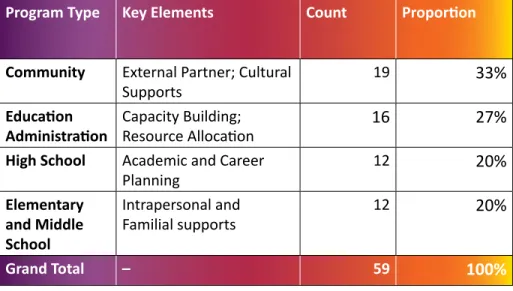
Program Type Key Elements Count Proportion
Community External Partner; Cultural
Supports 19 33%
Education
Administration Capacity Building; Resource Allocation 16 27%
High School Academic and Career
Planning 12 20% Elementary and Middle School Intrapersonal and Familial supports 12 20% Grand Total – 59 100%
Table 1: Counts and Proportions of
Projects Stratified by Year (n = 59) Table 2: Counts and Proportions of Projects Stratified by Population (n = 59)
Table 3: Elements, Counts, Proportions of Projects Stratified by Program Type (n = 59)
Table 4: Summary of Short-Term, Medium-Term and Long-Term Project Outcomes
Figure 1: Display of the Synthesis Report Process for Documenting Project Findings
Process document created Scan for project reports conducted Project indicators selected Salient data extracted Trends and outcomes summarized Desciptive analysis conducted Synthesis process documented Project best practices documented
Collation Extraction Distillation Dissemination
Year: 2018–2019. Count: 8. Proportion: 14% Year: 2017–2018. Count: 18. Proportion: 31% Year: 2016–2017. Count: 12. Proportion: 20% Year: 2015–2016. Count: 14. Proportion: 24% Year: 2014–2015. Count: 7. Proportion: 11% Grand Total: Count: 59. Proportion: 100%
Target Population: First Nations. Count: 52. Proportion: 88% Target Population: Métis. Count: 38. Proportion: 64%
Target Population: Inuit. Count: 17. Proportion: 29% Target Population: 2015–2016. Count: 14. Proportion: 24% Target Population: 2014–2015. Count: 7. Proportion: 11% Grand Total: Count: 59. Proportion: 100%
Program Type: Community. Key Elements: External Part-ner; Cultural Supports. Count: 19. Proportion: 33% Program Type: Education Administration. Key Elements: Capacity Building; Resource Allocation. Count: 16. Pro-portion: 27%
Program Type: High School. Key Elements: Academic and Career Planning. Count: 12. Proportion: 20%
Program Type: Elementary and Middle School. Key El-ements: Intrapersonal and Familial supports. Count: 12. Proportion: 20%
Grand Total: Count: 59. Proportion: 100%
Short-Term:
• Increased knowledge and acquisition of numeracy, literacy and language skills
• Increased knowledge and awareness of academic and career opportunities • Increased acquisition of peer leadership skills
• Increased knowledge of Indigenous culture
• Increased sense of cultural identity and connection • Increased sense of belonging and safety
• Strengthened capacity and resources of Indigenous educators
Medium-Term:
• Increased engagement with the school system
• Increased access to and engagement with cultural supports • Increased engagement with peer and familial supports • Enhanced application of peer leadership skills
• Enhanced application of numeracy, literacy and language skills
• Increased integration of Indigenous community stakeholders within the school system
• Increased access to post-secondary institutions Long-Term:
• Increased attendance rates of students • Increased retention rates of students
• Increased academic performance of students • Increased graduation rates of students
• Increased retention rates of Indigenous educators
• Increased integration of Indigenous curriculum within the school system Collation:
• Process document created
• Scan for project reports conducted Extraction:
• Project indicators selected • Salient data extracted Distillation:
• Desciptive analysis conducted • Trends and outcomes summarized Dissemination:
• Synthesis process documented • Project bestpractices documented
Figure 2: Display of the Proportion of Projects Stratified by Province/Territory (n = 59) Figure 4: Display of the Various Types of Data Collection Tools Implemented Within Projects (n = 59)
Figure 3: Display of the Proportion of Projects Stratified by Education Level (n = 59)
Appendix B: Nurturing Capacity
Program Supported Projects
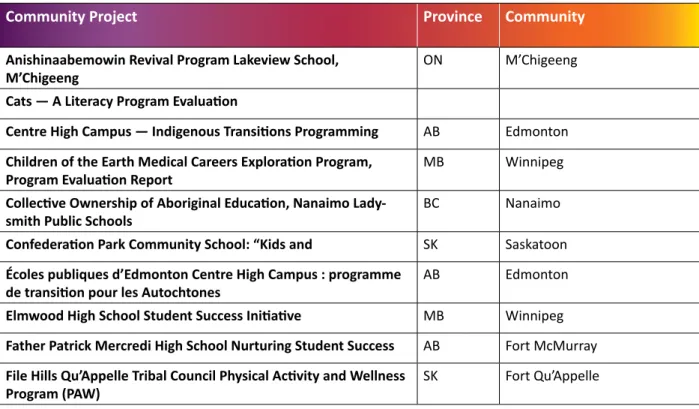
Community Project Province Community
Anishinaabemowin Revival Program Lakeview School,
M’Chigeeng ON M’Chigeeng
Cats — A Literacy Program Evaluation
Centre High Campus — Indigenous Transitions Programming AB Edmonton Children of the Earth Medical Careers Exploration Program,
Program Evaluation Report MB Winnipeg
Collective Ownership of Aboriginal Education, Nanaimo
Lady-smith Public Schools BC Nanaimo
Confederation Park Community School: “Kids and SK Saskatoon Écoles publiques d’Edmonton Centre High Campus : programme
de transition pour les Autochtones AB Edmonton Elmwood High School Student Success Initiative MB Winnipeg Father Patrick Mercredi High School Nurturing Student Success AB Fort McMurray File Hills Qu’Appelle Tribal Council Physical Activity and Wellness
Program (PAW) SK Fort Qu’Appelle
Table 1: Community K–12 Projects Funded Through the Nurturing Capacity Program (n = 59)
2% 7%
20%
22% 24%
19%
KEY INFORMANT INTERVIEWS
Qualitative in-depth interviews with project stakeholders. Con-ducted primarily for community and education administration programs with staff.
FOCUS GROUPS
Facilitated group discussions with six to twelve project stake-holders. Conducted primarily for community, middle school and high-school programs with stu-dent participants.
SURVEYS AND QUESTIONNAIRES
Set of standard questions admin-istered to project stakeholders. Conducted across all programs, typically in a pre-/post- format.
ADMINISTRATIVE DATA
Data collected by organizations on operations and functions. Conducted across all programs, typically including participant demographics and student graduation rates. Northwest Territories: 2%. British Columbia: 7%. Alberta: 20%. Saskatchewan: 22%. Manitoba: 24%. Ontario: 19%.
Community Project: Anishinaabemowin Revival Program Lakeview School, M’Chigeeng. Province: ON. Community: M’Chigeeng.
Community Project: Cats — A Literacy Program Evaluation.
Community Project: Centre High Campus — Indigenous Transitions Programming. Prov-ince: AB. Community: Edmonton.
Community Project: Children of the Earth Medical Careers Exploration Program, Program Evaluation Report. Province: MB. Community: Winnipeg.
Community Project: Collective Ownership of Aboriginal Education, Nanaimo Ladysmith Public Schools. Province: BC. Community: Nanaimo.
Community Project: Confederation Park Community School: “Kids and. Province: SK. Com-munity: Saskatoon.
Community Project: Écoles publiques d’Edmonton Centre High Campus : programme de transition pour les Autochtones. Province: AB. Community: Edmonton.
Community Project: Elmwood High School Student Success Initiative. Province: MB. Com-munity: Winnipeg.
Community Project: Father Patrick Mercredi High School Nurturing Student Success. Prov-ince: AB. Community: Fort McMurray.
Community Project: FFile Hills Qu’Appelle Tribal Council Physical Activity and Wellness Program (PAW). Province: SK. Community: Fort Qu’Appelle.
Community Project Province Community
First Nations Provincial Spelling Bee SK Provincial Four Directions First Nations, Métis and Inuit Graduation Coach
Approach, Dryden High School ON Dryden
Francophone Indigenous Resources Conseil scolaire catholique
Providence ON London
Geering Up: UBC Engineering and Science for Kids, University of
British Columbia BC Vancouver
Greater Saskatoon Catholic Schools Indigenous Education Initia-tive: A Partnership Between Education and Wellness, St. Mary’s Wellness & Education Centre
SK Saskatoon Greater Saskatoon Catholic Schools Indigenous Education
Initia-tive: Oskāyak “Young People” High School SK Saskatoon Greater Saskatoon Catholic Schools Indigenous Education
Initia-tive: The Development of a Cree Language School and Curricu-lum, St. Frances School
SK Saskatoon Help Me Tell My Story, Riverside Community School SK Prince Albert High-School Graduation Coach Program Evaluation AB Edmonton InBusiness: A National Mentorship Program for Indigenous Youth NS Membertou Kainai High School Student Success Program: Evaluating “The
Quarter System” AB Cardston
L’Nu Sipuk Kina’muokuom: A Successful Mi’kmaw School NS Membertou Lakedell School Wahkotiwin Project: Wetaskiwin Regional Public
Schools AB Westerose
Leading for Social Justice in Our Schools and Communities: One Story Anti-Racism Education Professional Development, Saska-toon Public Schools
SK Saskatoon
Learning Academy Program, Kingsway Park Public School ON Thunder Bay Little Red Spirit, Aboriginal Head Start Program MB Winnipeg Ma Mawi Wi Chi Itata Centre Yellow Shawl Housing Program MB Winnipeg Margaret Park School, Building Student Success with Aboriginal
Parents MB Winnipeg
Meadow Lake Early Literacy Project, Meadow Lake Tribal Council SK Flying Dust Reserve Mi’kmaw Kina’matnewey Eskasoni Mi’kmaw Immersion School NS Eskasoni, Cape Breton Mi’kmaw Kina’matnewey Supporting Student Success NS Membertou
Miyo Wahkohtowin Education — école alternative Ehpewapahk AB Maskwacis Miyo Wahkohtowin Education (MWE) Restorative Practices AB Maskwacis Miyo Wahkohtowin Education Ehpewapahk Alternate School AB Maskwacis Mother Earth’s Children’s Charter School AB Leduc County
Community Project Province Community
Northern Youth Abroad: Evaluating The Canadian Placement
Program ON Ottawa
Nurturing Circle — Enhancing Graduation: A Secondary School Support Program for Indigenous Youth, Curve Lake First Nation Education Department
ON Curve Lake Ojibwe Bilingual Program, Riverbend Community School Seven
Oaks School Division MB Winnipeg
On the Land Education, Deh GáhElementary and Secondary
School NT Fort Providence
Onebillion Math Software David Livingstone Community School MB Winnipeg Programme de culture métisse de l’école communautaire
West-mount SK Saskatoon
Qeq College Transition Year Project: Tillicum Lelum Aboriginal
Friendship Centre and the Nanaimo-Ladysmith Public Schools BC Nanaimo RB Russell Vocational High School Morningstar Program MB Winnipeg Ressources en matière autochtone en français Conseil scolaire
catholique Providence ON London
Sacred Seven Healthy Relationships Program, Wii Chiiwaakanak
Learning Centre MB Winnipeg
Saskatoon Public School Division Leadership for Learning
Frame-work SK Saskatoon
Seven Oaks Co-operative Vocational Education Program MB Winnipeg
Seven Oaks Met School MB Winnipeg
Streetfront Alternative Program, Vancouver School Board BC Vancouver The Everlasting Tree School: A Waldorf Education and
Kanyen’ke-ha Rotinonhsonni Culture Based Model of Learning ON Six Nations of the Grand River The Lightning Trail — Indigenous Youth Summer Retreat ON South Porcupine
The Mother Teresa Middle School: Supporting Regina’s
Vulnera-ble Youth SK Regina
The Outland Youth Employment Program: A Narrative Study ON Thunder Bay
The Pen Pal Project: Children Coming Together in Friendship ON Six Nations of the Grand River The Royal Conservatory, Learning Through the Arts Youth
Em-powerment Program in the Wood Buffalo Region — After-School Program with the Fort McMurray Catholic School District
AB Fort McMurray The Royal Conservatory, Learning Through the Arts Youth
Empowerment Program in the Wood Buffalo Region — In-class Program with the Fort McMurray Catholic School District
AB Fort McMurray University of Manitoba Verna J. Kirkness Science and Engineering
Education Program MB Winnipeg
Wayfinders Seven Oaks School Division MB Winnipeg Westmount Community School’s Métis Cultural Program SK Saskatoon
Community Project: First Nations Provincial Spelling Bee. Province: SK. Community: Provincial.
Community Project: Four Directions First Nations, Métis and Inuit Graduation Coach Approach, Dryden High School. Province: ON. Community: Dryden.
Community Project: Francophone Indigenous Resources Conseil scolaire catholique Providence. Province: ON. Community: London.
Community Project: Geering Up: UBC Engineering and Science for Kids, University of British Columbia. Prov-ince: BC. Community: Vancouver.
Community Project: Greater Saskatoon Catholic Schools Indigenous Education Initiative: A Partnership Between Education and Wellness, St. Mary’s Wellness & Education Centre. Province: SK. Community: Saskatoon.
Community Project: Greater Saskatoon Catholic Schools Indigenous Education Initiative: Oskāyak “Young People” High School. Province: SK. Community: Saskatoon.
Community Project: Greater Saskatoon Catholic Schools Indigenous Education Initiative: The Development of a Cree Language School and Curriculum, St. Frances School. Province: SK. Community: Saskatoon.
Community Project: Help Me Tell My Story, Riverside Community School. Province: SK. Community: Prince Albert,
Community Project: High-School Graduation Coach Program Evaluation. Province: AB. Community: Edmonton. Community Project: InBusiness: A National Mentorship Program for Indigenous Youth. Province: NS. Communi-ty: Membertou.
Community Project: Lakedell School Wahkotiwin Project: Wetaskiwin Regional Public Schools. Province: AB. Community: Westerose.
Community Project: Leading for Social Justice in Our Schools and Communities: One Story Anti-Racism Educa-tion Professional Development, Saskatoon Public Schools. Province: SK. Community: Saskatoon.
Community Project: Learning Academy Program, Kingsway Park Public School. Province: ON. Community: Thunder Bay.
Community Project: Little Red Spirit, Aboriginal Head Start Program. Province: MB. Community: Winnipeg. Community Project: Ma Mawi Wi Chi Itata Centre Yellow Shawl Housing Program. Province: MB. Community: Winnipeg.
Community Project: Margaret Park School, Building Student Success with Aboriginal Parents. Province: MB. Community: Winnipeg.
Community Project: Meadow Lake Early Literacy Project, Meadow Lake Tribal Council. Province: SK. Communi-ty: Flying Dust Reserve.
Community Project: Mi’kmaw Kina’matnewey Eskasoni Mi’kmaw Immersion School. Province: NS. Community: Eskasoni, Cape Breton.
Community Project: Mi’kmaw Kina’matnewey Supporting Student Success. Province: NS. Community: Member-tou.
Community Project: Miyo Wahkohtowin Education — école alternative Ehpewapahk. Province: AB. Community: Maskwacis.
Community Project: Miyo Wahkohtowin Education (MWE) Restorative Practices. Province: AB. Community: Maskwacis.
Community Project: Miyo Wahkohtowin Education Ehpewapahk Alternate School. Province: AB. Community: Maskwacis.
Community Project: Mother Earth’s Children’s Charter School. Province: AB. Community: Leduc County.
Community Project: Northern Youth Abroad: Evaluating The Canadian Placement Program. Province: ON. Commu-nity: Ottawa.
Community Project: Nurturing Circle — Enhancing Graduation: A Secondary School Support Program for Indige-nous Youth, Curve Lake First Nation Education Department. Province: ON. Community: Curve Lake.
Community Project: Ojibwe Bilingual Program, Riverbend Community School Seven Oaks School Division. Province: MB. Community: Winnipeg.
Community Project: On the Land Education, Deh GáhElementary and Secondary School. Province: NT. Community: Fort Providence.
Community Project: Onebillion Math Software David Livingstone Community School. Province: MB. Community: Winnipeg.
Community Project: Programme de culture métisse de l’école communautaire Westmount. Province: SK. Community: Saskatoon.
Community Project: Qeq College Transition Year Project: Tillicum Lelum Aboriginal Friendship Centre and the Nanaimo-Ladysmith Public Schools. Province: BC. Community: Nanaimo.
Community Project: RB Russell Vocational High School Morningstar Program. Province: MB. Community: Winnipeg. Community Project: Ressources en matière autochtone en français Conseil scolaire catholique Providence. Province: ON. Community: London.
Community Project: Sacred Seven Healthy Relationships Program, Wii Chiiwaakanak Learning Centre. Province: MB. Community: Winnipeg.
Community Project: Saskatoon Public School Division Leadership for Learning Framework. Province: SK. Communi-ty: Saskatoon.
Community Project: Seven Oaks Co-operative Vocational Education Program. Province: MB. Community: Winnipeg. Community Project: Seven Oaks Met School. Province: MB. Community: Winnipeg.
Community Project: Streetfront Alternative Program, Vancouver School Board. Province: BC. Community: Vancou-ver.
Community Project: The Everlasting Tree School: A Waldorf Education and Kanyen’keha Rotinonhsonni Culture Based Model of Learning. Province: ON. Community: Six Nations of the Grand River.
Community Project: The Lightning Trail — Indigenous Youth Summer Retreat. Province: ON. Community: South Porcupine.
Community Project: The Mother Teresa Middle School: Supporting Regina’s Vulnerable Youth. Province: SK. Commu-nity: Regina.
Community Project: The Outland Youth Employment Program: A Narrative Study. Province: ON. Community: Thun-der Bay.
Community Project: The Pen Pal Project: Children Coming Together in Friendship. Province: ON. Community: Six Nations of the Grand River.
Community Project: The Royal Conservatory, Learning Through the Arts Youth Empowerment Program in the Wood Buffalo Region — After-School Program with the Fort McMurray Catholic School District. Province: AB. Community: Fort McMurray.
Community Project: The Royal Conservatory, Learning Through the Arts Youth Empowerment Program in the Wood Buffalo Region — In-class Program with the Fort McMurray Catholic School District. Province: AB. Community: Fort McMurray.
Community Project: University of Manitoba Verna J. Kirkness Science and Engineering Education Program. Province: MB. Community: Winnipeg.
Community Project: Wayfinders Seven Oaks School Division. Province: MB. Community: Winnipeg.