A MODEL FOR TRUST IN THE NURSING EDUCATION ENVIRONMENT
by
ELLIE CATHARINA VAN DYK
submitted in accordance with the requirements
for the degree of
DOCTOR OF LITERATURE AND PHILOSOPHY
in the subject
HEALTH STUDIES
at the
UNIVERSITY OF SOUTH AFRICA
SUPERVISOR: PROF GH VAN RENSBURG
CO-SUPERVISOR: DR ES JANSE VAN RENSBURG
Student Number: 483-130-6
DECLARATION
I declare that A MODEL FOR TRUST IN THE NURSING EDUCATION
ENVIRONMENT is my own work and that all the sources that I have used or quoted have been indicated and acknowledged by means of complete references and that this work has not been submitted before for any other degree at any other institution.
30 November 2016 ... ...
SIGNATURE Date
A MODEL FOR TRUST IN THE NURSING EDUCATION ENVIRONMENT
STUDENT NUMBER: 483-130-6
STUDENT: ELLIE CATHARINA VAN DYK
DEGREE: DOCTOR OF LITERATURE AND PHILOSOPHY
DEPARTMENT: HEALTH STUDIES
SUPERVISOR: PROF GH VAN RENSBURG
CO-SUPERVISOR: DR ES JANSE VAN RENSBURG
ABSTRACT
Trust is an important concept in nursing. Nursing is frequently described as a profession which is built on trusting relationships; hence, to produce competent professional nurses the building of trust and trusting relationships in nursing education is of utmost importance. The purpose of the study was to understand trust and trusting relationships between and among educators and students in the teaching and learning environment.
A qualitative approach with a grounded theory design was used to discover the value of trust and trusting relationships and to develop a model for trust in the nursing education environment. All the nursing education institutions offering the R425 nursing programme in the selected province were included. Two nursing education institutions offered the R425 nursing programme in this province, a university and one public multi-campus nursing education institution with three campuses. The target population consisted of educators and students complying with the sampling criteria. Sampling of educators and students was purposive and convenient. The sample size consisted of fourteen educators and sixty students. In-depth face-to-face interviews were conducted with educators and fourteen focus group interviews were conducted with students.
The three stages of Charmaz (2014) were used for the analysis of data, namely initial, focused and theoretical coding until data saturation was evident. Data collection and analysis and the literature review were done concurrently. Three role players were identified to be important in trust in nursing education. The role players are the educator, student and professional nurse. In the study two sets of data, namely the educators’ views and students’ views on trust in nursing education were synthesised. Four themes emerged, namely: namely professional relations, expectations of the role players in nursing education, creating a conducive teaching and learning environment
and, finally, outcomes of trust or lack of trust. Ensuing from the findings of the current study, a model for trust in nursing education was developed – an important contribution to the body of knowledge of nursing education.
The study throws light on self-trust, trusting relationships among role players, and trust in the teaching and learning environment. Awareness of trust and trusting relationships among the role players results in positive learning experiences, increased self-trust, self-confidence, motivation and better performance in nursing education. Recommendations made have a bearing on developing self-trust and trusting relationships among role players, the implementation of the model for trust in nursing education, and future studies in trust in nursing education.
Key terms
Trust and trusting relationships; educator; learning; nursing education environment; nursing education institution; professional nurse; student; teaching; teaching and learning environment; view; work-integrated learning.
ACKNOWLEDGEMENTS
I am immensely grateful to God for giving me the ability to complete this study, and give Him thanks and praise.
I wish to express my sincere gratitude to the following persons for their invaluable support and unending encouragement:
Prof GH van Rensburg, for her professional advice, guidance and time during my study.
Dr ES van Rensburg, for her positive support, professional guidance and inputs. The model expert reviewers who evaluated the model and positive feedback and
suggestions to refine the model.
All the participants in the face-to-face and focus group interviews that made this study and model possible.
Dr L van Rhyn, for the co-coding of the data obtained during the interviews. Dr H Bezuidenhout, for the professional language editing.
Mrs T Erasmus, the UNISA librarian, for the literature searches.
The Department of Health of the Free State, Dr M Mofokeng, Ms S van Niekerk, Ms N Msayi and Ms MM MokoenaMvandaba, for allowing me to conduct interviews at the three campuses of the Free State School of Nursing.
The University of the Free State, for allowing me to conduct interviews at the School of Nursing.
Ms S van Niekerk for your continuous encouragement and support.
Ms M Reyneke at MR design, for assistance with the graphic design of the model.
Ms R Coetzer, for the technical editing and preparation of the thesis for final printing.
My family, friends and colleagues, for their encouragement, motivation and support to complete the study.
Dedication
This thesis is dedicated to my husband Gerrie whose love, encouragement and support made this possible.
My children Jaco and Hymne for your understanding, it kept me going. My mother Nelie Volschenk, I shall never forget your constant believing in me. My late father Izak Volschenk whom I lost in November 2015 and
could not celebrate the end product with me.
Lastly to all my colleagues at FSSoN: this is a model especially dedicated to you for understanding and implementation with the aim of producing
i
TABLE OF CONTENTS
CHAPTER 1 ... 1
ORIENTATION TO THE STUDY ... 1
1.1 INTRODUCTION ... 1
1.2 BACKGROUND INFORMATION ABOUT THE RESEARCH PROBLEM ... 2
1.3 RESEARCH PROBLEM ... 6
1.4 PURPOSE AND OBJECTIVES OF THE STUDY ... 9
1.5 SIGNIFICANCE OF THE STUDY ... 9
1.6 DEFINITIONS OF TERMS ... 10
1.6.1 Trust ... 11
1.6.2 Nursing education institution ... 11
1.6.3 Educator... 11
1.6.4 Student ... 12
1.6.5 Professional nurse ... 12
1.6.6 Teaching ... 12
1.6.7 Learning ... 13
1.6.8 Teaching and learning environment ... 13
1.6.9 Nursing education environment ... 13
1.6.10 Work-integrated learning ... 14
1.6.11 View ... 14
1.7 THEORETICAL GROUNDING OF THE RESEARCH ... 14
1.8 THE PHENOMENON OF TRUST ... 15
1.8.1 Self-trust... 15 1.8.2 Relationship trust ... 16 1.8.3 Organisational trust ... 16 1.8.4 Market trust ... 17 1.8.5 Societal trust ... 17 1.9 RESEARCH METHODOLOGY ... 18
1.9.1 Research approach and design ... 18
1.9.2 Research setting, population and sampling ... 18
1.9.3 Data generation ... 19
1.9.4 Data analysis ... 19
1.10 TRUSTWORTHINESS ... 19
1.11 ETHICAL CONSIDERATIONS ... 20
1.12 SCOPE OF THE STUDY ... 20
1.13 STRUCTURE OF THE THESIS ... 21
ii
CHAPTER 2 ... 23
RESEARCH DESIGN AND RESEARCH METHODOLOGY ... 23
2.1 INTRODUCTION ... 23
2.2 PHILOSOPHICAL UNDERPINNING OF THE STUDY ... 23
2.2.1 Ontology... 24
2.2.2 Epistemology ... 24
2.2.3 Methodology ... 25
2.2.4 Symbolic interactionism ... 26
2.3 QUALITATIVE RESEARCH APPROACH ... 27
2.4 THE RESEARCH DESIGN − GROUNDED THEORY ... 28
2.5 PRELIMINARY LITERATURE REVIEW ... 32
2.6 PURPOSE AND OBJECTIVES OF THE STUDY ... 34
2.7 POPULATION, SAMPLING AND CONTEXT ... 35
2.7.1 Research setting ... 35 2.7.2 Population ... 35 2.7.3 Sampling criteria ... 36 2.7.4 Sample ... 37 2.7.5 Sampling size ... 37 2.7.6 Sampling ... 37 2.8 DATA COLLECTION ... 38
2.8.1 Researcher’s experiences and refinement of interviewing skills ... 39
2.8.2 Conducting the interviews ... 40
2.8.2.1 Organising the interview venue and obtaining consent ... 40
2.8.2.2 Conducting face-to-face interviews ... 41
2.8.2.3 Conducting focus group interviews ... 42
2.8.3 Implementing quality processes during data generation ... 43
2.8.3.1 Communication skills... 43
2.8.3.2 Procedural precision ... 44
2.8.3.2.1 Maintaining an audit trail ... 45
2.8.3.2.2 Managing data and resources ... 45
2.8.3.2.3 Demonstrating procedural logic ... 45
2.8.3.3 Memoing and field notes – the cornerstone of quality ... 45
2.8.3.4 Reflexivity ... 46
2.8.3.5 The process of bracketing ... 47
2.8.3.6 Intuiting ... 47
2.9 DATA ANALYSIS ... 48
2.9.1 Initial coding ... 49
iii
2.9.1.2 Writing memos ... 51
2.9.1.3 Constant comparative analysis ... 51
2.9.1.4 Data saturation ... 52
2.9.1.5 Theoretical sensitivity ... 52
2.9.2 Focused coding ... 53
2.9.3 Theoretical coding ... 54
2.9.4 Methodology of the model development ... 55
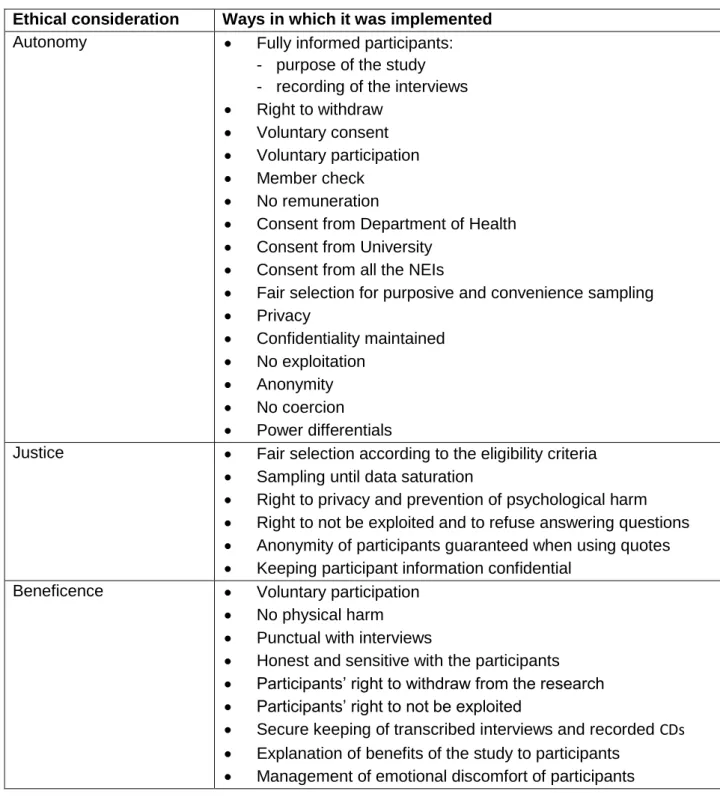
2.10 TRUSTWORTHINESS ... 56 2.10.1 Credibility ... 57 2.10.2 Transferability ... 58 2.10.3 Dependability ... 59 2.10.4 Confirmability ... 60 2.10.5 Authenticity ... 61 2.11 ETHICAL CONSIDERATIONS ... 63 2.11.1 Autonomy ... 64 2.11.2 Justice ... 65 2.11.3 Beneficence ... 66 2.12 CONCLUSION ... 67 CHAPTER 3 ... 69
FINDINGS RELATED TO THE EDUCATORS’ VIEWS ON TRUST IN NURSING EDUCATION ... 69
3.1 INTRODUCTION ... 69
3.2 BACKGROUND TO THE VIEWS OF EDUCATORS ... 69
3.3 THEME 1: PROFESSIONAL RELATIONS ... 70
3.3.1 The role of self-trust ... 70
3.3.2 Initial professional interactions ... 72
3.4 THEME 2: THE EDUCATOR AS FACILITATOR OF TRUST ... 73
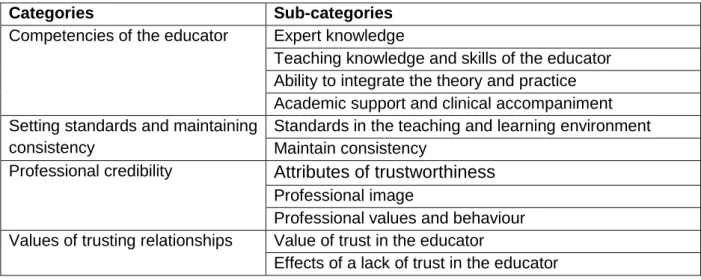
3.4.1 Competencies of the educator ... 74
3.4.1.1 Expert knowledge ... 74
3.4.1.2 Teaching knowledge and skills of the educator ... 76
3.4.1.3 Ability to integrate the theory and practice ... 78
3.4.1.4 Academic support and clinical accompaniment ... 79
3.4.2 Setting standards and maintaining consistency ... 81
3.4.2.1 Standards in the teaching and learning environment ... 82
3.4.2.2 Maintain consistency ... 83
3.4.3 Professional credibility ... 86
3.4.3.1 Attributes of trustworthiness ... 86
iv
3.4.3.1.2 Openness ... 87
3.4.3.1.3 Honesty ... 88
3.4.3.1.4 Reliability ... 90
3.4.3.1.5 Caring and support ... 91
3.4.3.2 Professional Image ... 92
3.4.3.3 Professional values and behaviour ... 93
3.4.4 Values of trusting relationships ... 95
3.4.4.1 Value of trust in the educator ... 96
3.4.4.2 Effects of a lack of trust in the educator ... 97
3.5 THEME 3: THE STUDENTS’ ROLE IN TRUST IN NURSING EDUCATION ... 98
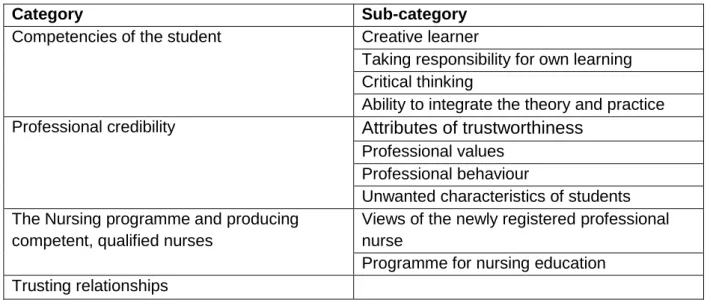
3.5.1 Competencies of the student ... 98
3.5.1.1 Creative learner ... 99
3.5.1.2 Taking responsibility for own learning ... 99
3.5.1.3 Critical thinking ... 101
3.5.1.4 Ability to integrate the theory and practice ... 102
3.5.2 Professional credibility ... 102
3.5.2.1 Attributes of trustworthiness ... 103
3.5.2.1.1 Openness ... 103
3.5.2.1.2 Respect and reliability ... 105
3.5.2.1.3 Honesty ... 106
3.5.2.1.4 Caring helping character ... 106
3.5.2.2 Professional values ... 107
3.5.2.3 Professional behaviour ... 108
3.5.2.4 Unwanted characteristics of students ... 109
3.5.3 The Nursing programme and producing competent, qualified nurses ... 110
3.5.3.1 Views of the newly registered professional nurse ... 110
3.5.3.2 Confidence in the nursing education ... 113
3.5.4 Trusting relationships ... 114
3.6 THEME 4: THE PROFESSIONAL NURSE’S ROLE IN TRUST IN NURSING EDUCATION ... 115
3.6.1 Competencies of the professional nurses ... 116
3.6.1.1 Knowledge and clinical skills ... 116
3.6.1.2 Teaching role of professional nurses ... 117
3.6.2 Creating clinical learning opportunities ... 119
3.6.2.1 Integration of theory and practice in clinical learning ... 120
3.6.2.2 Standards in the clinical learning environment ... 120
3.6.3 Professional credibility ... 121
v 3.6.3.1.1 Integrity ... 121 3.6.3.1.2 Openness ... 122 3.6.3.1.3 Honesty ... 123 3.6.3.1.4 Reliability ... 124 3.6.3.2 Professional values ... 124 3.6.3.3 Professional behaviour ... 126
3.7 THEME 5: TEACHING AND LEARNING ENVIRONMENT ... 128
3.7.1 Resources in the theoretical learning environment ... 129
3.7.1.1 Availability of human resources ... 129
3.7.1.2 Technology available to support theoretical teaching ... 131
3.7.1.3 Technology to support simulation teaching and learning ... 133
3.7.2 Resources in the clinical learning environment ... 134
3.7.2.1 Human resources in the clinical learning environments ... 134
3.7.2.2 Equipment available to support work-integrated learning ... 136
3.8 CONCLUSION ... 137
CHAPTER 4 ... 138
FINDINGS ON THE VIEWS OF STUDENTS REGARDING TRUST IN NURSING EDUCATION ... 138
4.1 INTRODUCTION ... 138
4.2 BACKGROUND TO THE FINDINGS ... 138
4.3 THEME 1: SELF-TRUST AND TRUSTING RELATIONSHIPS ... 139
4.3.1 Students entering nursing education with self-trust ... 139
4.3.2 Building relationships with educators and professional nurses ... 141
4.4 THEME 2: EXPECTATIONS OF ROLE PLAYERS ... 143
4.4.1 Competencies of the educator ... 144
4.4.1.1 Subject knowledge ... 145
4.4.1.2 Theoretical teaching skills ... 146
4.4.1.3 Clinical skills and teaching skills ... 148
4.4.2 Competencies of professional nurses ... 149
4.4.2.1 Clinical and theoretical knowledge of the professional nurse ... 150
4.4.2.2 Teaching skills and creating learning opportunities ... 152
4.4.3 Learning responsibilities and abilities of the students ... 154
4.5 THEME 3: PROFESSIONALISM AND ROLE MODELLING ... 157
4.5.1 Professional behaviour and role modelling ... 157
4.5.2 Attributes of trustworthiness ... 160
4.5.2.1 Openness ... 161
4.5.2.2 Honesty ... 164
vi
4.5.2.4 Caring and goodwill ... 168
4.6 THEME 4: EXPECTATIONS REGARDING QUALITY TEACHING AND LEARNING ... 172
4.6.1 Learning opportunities ... 172
4.6.1.1 Academic support from educators ... 173
4.6.1.2 Clinical support from professional nurses ... 174
4.6.1.3 Integration of theory and practice ... 176
4.6.2 Standards and consistency in the teaching and learning environment ... 178
4.6.3 Expectations regarding the teaching and learning environment ... 182
4.6.3.1 Theoretical teaching and learning environment ... 183
4.6.3.2 Clinical teaching and learning environment ... 184
4.6.4 Trust in the programme and trust to exit as a competent professional nurse ... 187
4.7 THEME 5: VALUES OF TRUST IN NURSING EDUCATION ... 188
4.7.1 Value of students’ self-trust ... 189
4.7.2 Value of trust in the educator ... 191
4.7.3 Value of trust from the educators ... 193
4.7.4 Value of trust from the professional nurse ... 194
4.7.5 Effects of a lack of trust in students ... 197
4.8 CONCLUSION ... 200
CHAPTER 5 ... 202
INTEGRATION AND DISCUSSION OF FINDINGS ... 202
5.1 INTRODUCTION ... 202
5.2 BACKGROUND OF TRUST IN NURSING EDUCATION ... 202
5.3 THEME 1: PROFESSIONAL RELATIONS ... 204
5.3.1 Self-trust... 204
5.3.2 Interpersonal relations ... 205
5.4 THEME 2: EXPECTATIONS OF THE ROLE PLAYERS IN NURSING EDUCATION ... 207
5.4.1 Competencies of role players ... 207
5.4.1.1 Cognitive abilities ... 208 5.4.1.2 Psychomotor skills ... 209 5.4.1.3 Teaching skills... 211 5.4.2 Professional credibility ... 213 5.4.2.1 Professional virtues ... 213 5.4.2.2 Attributes of trustworthiness ... 214 5.4.2.2.1 Benevolence ... 215 5.4.2.2.2 Reliability ... 217
vii
5.4.2.2.4 Openness ... 219
5.4.2.3 Professional conduct ... 220
5.4.2.4 Congruency ... 221
5.5 THEME 3: CREATING A CONDUCIVE TEACHING AND LEARNING ENVIRONMENT ... 222 5.5.1 Theoretical environment ... 223 5.5.1.1 Academic support ... 223 5.5.1.2 Learning opportunities ... 225 5.5.2 Clinical environment ... 225 5.5.2.1 Clinical support... 226 5.5.2.2 Learning opportunities ... 228 5.5.3 Resources ... 229 5.5.3.1 Human resources ... 230
5.5.3.2 Technology and equipment ... 230
5.5.4 Maintain standards ... 231
5.6 THEME 4: OUTCOMES OF TRUST OR LACK OF TRUST ... 233
5.6.1 Values of trust ... 234
5.6.1.1 Self-trust and self-confidence ... 234
5.6.1.2 Educators’ efficacy influence students success ... 235
5.6.1.3 Motivation and performances ... 236
5.6.2 Programme and student product trust ... 237
5.6.3 A lack of trust and betrayal ... 238
5.7 CONCLUSION ... 240
CHAPTER 6 ... 241
DEVELOPMENT OF THE MODEL ... 241
6.1 INTRODUCTION ... 241
6.2 METHODOLOGY OF MODEL DEVELOPMENT ... 241
6.2.1 Process of model development ... 242
6.2.2 Components of the model ... 243
6.2.3 Relational statements ... 243
6.3.1 Model presentation ... 245
6.3.1.1 The meaning of the shapes ... 245
6.3.1.2 The meaning of colours ... 246
6.3.2 Nursing education environment ... 248
6.3.3 Professional relations ... 250
6.3.3.1 Self-trust... 252
6.3.3.2 Relationship trust ... 253
viii 6.3.4.1 Professional credibility ... 255 6.3.4.1.1 Attributes of trustworthiness ... 255 6.3.4.1.2 Professional conduct ... 256 6.3.4.2 Competencies ... 257 6.3.4.2.1 Cognitive abilities ... 258 6.3.4.2.2 Skills ... 258 6.3.4.3 Professional virtues ... 260 6.3.4.4 Congruency ... 260
6.3.5 Creating a conducive teaching and learning environment ... 261
6.3.5.1 Theoretical environment ... 263 6.3.5.1.1 Resources ... 263 6.3.5.1.2 Academic support ... 264 6.3.5.2 Clinical environment ... 265 6.3.5.2.1 Resources ... 265 6.3.5.2.2 Clinical support... 266 6.3.5.3 Learning opportunities ... 267 6.3.5.4 Maintain standards ... 268
6.3.6 Trusting relationships and trust in quality teaching and learning ... 269
6.3.7 Combination of the five components ... 272
6.4 EVALUATION OF THE MODEL ... 275
6.4.1 Demographic data of expert reviewers ... 276
6.4.2 Field or interest of the expert reviewers ... 276
6.4.3 Evaluation and refinement of the model ... 276
6.4.3.1 Clarity, simplicity and consistency ... 277
6.4.3.2 Appropriateness and relevance ... 277
6.4.3.3 Comprehensiveness ... 277
6.4.3.4 Adaptability and generalisability ... 278
6.4.3.5 Practicality and usefulness ... 278
6.4.3.6 Accessibility ... 278
6.4.3.7 Importance for education, practice and research ... 278
6.4.3.8 Transferability ... 279
6.4.3.9 General comments ... 279
6.5 CONCLUSION ... 279
CHAPTER 7 ... 280
CONCLUSIONS, RECOMMENDATIONS AND LIMITATIONS ... 280
7.1 INTRODUCTION ... 280
7.2 CONCLUSIONS OF THE FINDINGS ... 280
ix
7.2.1.1 Conclusions regarding the educators’ views ... 281
7.2.1.2 Conclusions regarding the students’ views ... 283
7.2.1.3 Conclusions after the synthesis of the educators’ and students’ views ... 284
7.2.2 Conclusions regarding the model development ... 286
7.3 RECOMMENDATIONS ... 288
7.3.1 Recommendations for the role players ... 289
7.3.1.1 Developing self-trust of the role players... 289
7.3.1.2 Fostering relationship trust among role players ... 290
7.3.2 Recommendations for the implementation of the model ... 292
7.3.2.1 The nursing education institution ... 292
7.3.2.2 Theoretical teaching and learning environment ... 293
7.3.2.3 Clinical teaching and learning environment ... 295
7.3.3 Recommendations for future studies ... 296
7.4 LIMITATIONS OF THE STUDY ... 297
7.5 CONCLUSION ... 297
x
LIST OF TABLES
Table 2.1 Trustworthiness ... 61
Table 2.2 Ethical considerations ... 67
Table 3.1 Themes on the educators’ views on trust in nursing education ... 70
Table 3.2 Professional relations ... 70
Table 3.3 The educator as facilitator of trust ... 74
Table 3.4 The students’ role in trust in nursing education ... 98
Table 3.5 The professional nurse’s role of trust in nursing education ... 116
Table 3.6 Teaching and learning environment ... 129
Table 4.1 Themes of students’ views on trust in nursing education ... 139
Table 4.2 Self-trust and trusting relationships ... 139
Table 4.3 Expectations of role players ... 144
Table 4.4 Professional image and role modelling ... 157
Table 4.5 Expectations regarding quality teaching and learning ... 172
Table 4.6 Values of trust in nursing education ... 188
Table 5.1 Themes derived from integrated findings ... 203
Table 5.2 Professional relations ... 204
Table 5.3 Expectations of the role players in nursing education ... 207
Table 5.4 Creating a conducive teaching and learning environment ... 222
xi
LIST OF FIGURES
Figure 1.1 Covey’s Five waves of Trust Model ... 15
Figure 2.1 Components of a research design ... 29
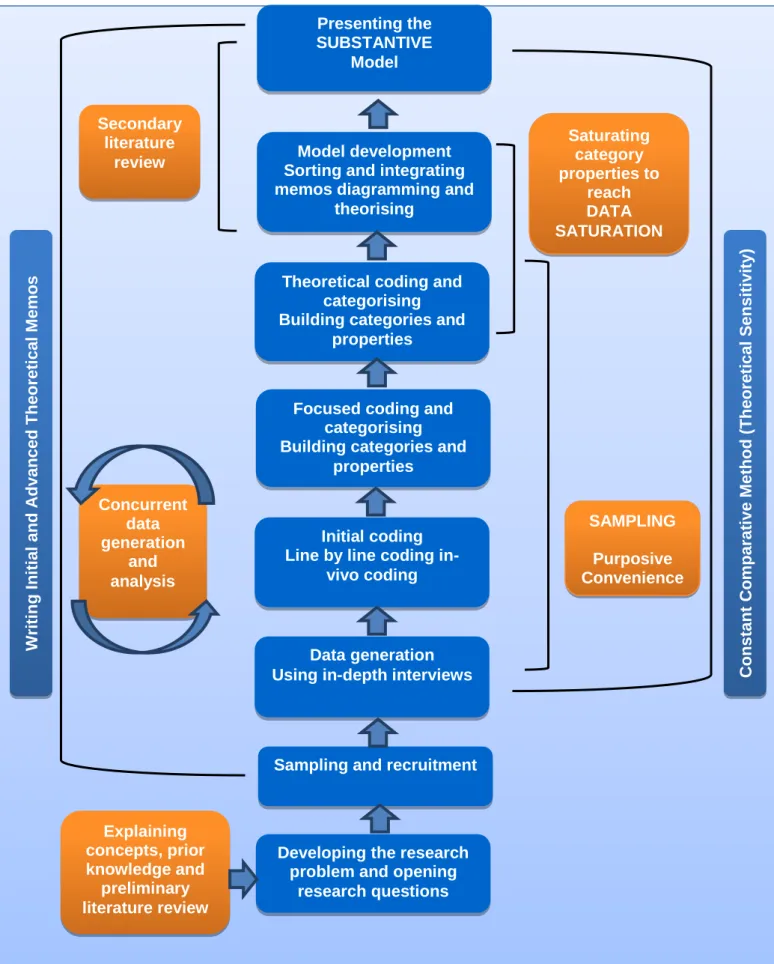
Figure 2.2 Grounded theory processes and methods used to guide the current study ... 31
Figure 2.3 Stages of coding ... 49
Figure 6.1 Nursing education environment ... 248
Figure 6.2 Professional relations ... 250
Figure 6.3 Expectations of the role players in nursing education ... 253
Figure 6.4 Creating a conducive teaching and learning environment ... 261
Figure 6.5 Trusting relationships and trust in quality teaching and learning ... 270
xii
LIST OF ABREVIATIONS
CLE Clinical learning environment FSSoN Free State School of Nursing
FSSoNEC Free State School of Nursing Eastern Campus FSSoNNC Free State School of Nursing Northern Campus FSSoNSC Free State School of Nursing Southern Campus NEI Nursing Education Institution
UFS University of the Free State SANC South African Nursing Council WIL Work-integrated learning
xiii
LIST OF ANNEXURES
Annexure A Ethical Clearance Certificate, Unisa ... 331-332 Annexure B University of the Free State: Permission letter ... 333-337 Annexure C Department of Health, Free State Province: Permission letter ... 338-340 Annexure D Department of Health, Free State Province, Free State School of
Nursing: Permission letter ... 341-342 Annexure E Department of Health, Free State School of Nursing, Southern
Campus: Permission letter ... 343-344 Annexure F Department of Health, Free State School of Nursing, Northern
Campus: Permission letter ... 345-346 Annexure G Department of Health, Free State School of Nursing, Eastern
Campus: Permission letter ... 347-348 Annexure H Information letter (Educator) and Information letter (Student) ... 349-354 Annexure I Agreement with the participants ... 355-363 Annexure J Initial coding ... 364-365 Annexure K Memoing and field notes ... 366-371 Annexure L Mapping to identify categories and sub-categories ... 372-374 Annexure M Relation mapping ... 375-377 Annexure N Relations of categories and sub-categories ... 378-379 Annexure O Request to evaluate the model and Evaluation form of the model ... 380-385 Annexure P Original developed model ... 386-387
CHAPTER 1
ORIENTATION TO THE STUDY
“Trust opens our work and dreams to each other, and makes possible continuous
improvement of how we teach and what our students learn”
Glickman (2002) in Tschannen-Moran and Tschannen-Moran (2010:36).
1.1 INTRODUCTION
Trust is described as the cornerstone of any human relationship and is important throughout a person’s life. Basic trust is formed from birth. Erik Erikson (1959) in Van Vuren (2012:81) describes trust as the first psycho-social development phase of a human being. A trusting attitude develops and with the synthesis of basic trust and mistrust hope develops; this is of great importance throughout life (Weiten 2008:313-314).The interactional self of Mead (1934) in Weber (2011:425) describes the development and formulation of the self. If the self is based on the perspectives of and interaction with others, self-trust will emerge. Uslaner (2016:71) indicates that trust has become an issue of concern in different academic disciplines globally.
Trust makes social life possible and without it the daily complexities of social interaction and living would be impossible. Trust is built in the everyday interaction among people and it is seen as the foundation for interpersonal relationships that may become enduring for a particular kind of global transformation (Weber 2011:414-415). In organisations, trust affects the ability to collaborate and engage with people, the ability to be innovative and achieve success to the benefit of people and the organisation (Covey & Link 2012:13). Globally there is a concern about a lack of trust in different contexts; therefore, Bencsik and Machova (2016:43) construe that trust is an important topic in the work of many researchers. Tschannen-Moran (2014:8-9) explains that due to the changing expectations of society, trust in schools has become more noticeable and has an impact on education. In education, trust is essential for the progress of individuals, interpersonal relationships and the atmosphere of educational institutions. Therefore, trust is crucial for a positive, trusting culture in a teaching and learning environment (Erdogan 2016:153-154).
1.2 BACKGROUND INFORMATION ABOUT THE RESEARCH PROBLEM
Castelfranci and Falcone (2010:9) summarise the trust concept in five aspects. First, trust is associated with an expectation, belief, willingness and an attitude. Second, the trustees are the individuals with characteristics, competencies and capacities for the propensity to trust. In the third aspect actions and behaviours are important for trusting relationships. Fourth, there should be results and outputs that are predictable and favourable for the situation. Finally, risks and uncertainties exist where people put themselves in a vulnerable position. According to Forsyth, Adams and Hoy (2011:17), most scholars agree on the attributes of trust. These attributes could be on multiple levels such as individual, group and organisational levels. Different roles are involved in trust, for example, amongst educators, between educators and students, and among institutions, educators or students. Tschannen-Moran (2014:21) emphasises that benevolence, reliability, competence, honesty, and openness are important for trusting relationship in schools. Vulnerability and confident expectations are crucial aspects of trust. A person is vulnerable and experiences risks which will influence the trust, but with positive expectations trust is strengthened. Finally, trust relations are rooted in interdependence among people, groups and organisations.
In the context of the healthcare delivering system, studies focus on the trust between a medical practitioner and the healthcare user. Sellman (2007:29) remarks that in the health context people may know that a lack of goodwill might exist among medical personnel, but still they trust the personnel. In a report on a study conducted into dental education Shaw (2009:62) emphasises that greater professionalism is required in the education of students studying for a profession. The emphasis is based on the importance of professionals’ trustworthiness, virtues and behaviours according to ethical principles to meet the professional standards of the profession (Shaw 2009:60-61). The study of Chiovitti (2015:62) concludes that professionalism as an educational aid supports development, education and practice for nursing students. Trust is a key feature in contact between healthcare users and healthcare professionals and it is the duty of the professionals to regain public trust to ensure that healthcare users are willing to place their trust in the professionals (Bachinger, Kolk & Smets 2009:126; Collier 2012:1455; Sellman 2007:35).
Caring is integral to and weaved through the profession of nursing, hence Adams (2016:1-2) states that caring reflects trust which is essential to professional relationships. Trust is therefore vital in nursing. Luhman (1979) and Pask (1995), quoted in Bell and Duffy (2009:47), agree that in a complex world trust is essential to living and an important component of nursing. Nursing is frequently described as a profession which is built on trusting relationships. Jean Watson’s caring theory (Watson 1979) initially purports that nursing is based on ten carative factors and as her work evolved renamed it as clinical caritas processes (Watson 2015:323). Developing and sustaining a helping-trusting, an authentic caring relationship is one of the caritas processes (Watson 2015:324). Watson’s philosophy and theory of transpersonal caring emphasise the philosophical foundations of the science of caring. A human-altruistic system of values starts at an early age in life and becomes established through life experiences, and manifests according to nurses ‘maturation and ability to promote altruistic behaviour in others. Faith and hope are essential in the caring process and in cultivating self-sensitivity and self-sensitivity to others. Caritas is required to establish a helping-trust relationship characterised by congruence, empathy and warmth. Another carative factor and caritas process refers to the engagement of a transpersonal teaching-learning experience within a caring relationship to understand the persons’ perception and subjective meaning (Watson 2015:324-325).
Hendersons’ view of the function of the nurse is to assist the sick or healthy individual, contributing to health and recovery, and becoming independent as soon as possible (Masters 2012:41-42). The unique function of a nurse is to be a problem solver, knowledgeable and to provide individualised and humane care. Nursing is a practical occupation and needs core virtues such as honesty, justice and courage to be trustworthy (Sellman 2011:105). Sellman (2011:131) emphasises the need for trust and trustworthiness in nursing to establish professional trust between a patient and nurse in the practical environment. The need for professionalism in nursing is important, not only for the professional nurse, but also for the nurse educator to create a helping-trust relationship in a genuine teaching and learning environment.
The majority of studies into trust in education examine a lack of trust as a collective issue in schools. Several studies focus on the trust parents put in educators, the principal and trust among educators and how the trust influences achievements of students (Angell, Stoner & Shelden 2009:160; Forsyth et al 2011:4). Studies into trust
conducted at Rutgers University (Forsyth et al 2011:14) describe the importance of trust in schools and universities. Trust is related to concepts such as authenticity, openness, leadership, morale and healthy interpersonal dynamics among educators and students. Many of these concepts are interrelated and mutually dependent. According to Tschannen-Moran (2014:21), schools and educators require much trust because if the school performs poorly it reflects negatively on the educators and students. Findings of a study of Tschannen-Moran and Gareis (2015:82) emphasise professionalism and trustworthy behaviour of educators as important for the fostering of a trusting culture in the learning environment. The results of research conducted by Osterman (2010) as cited in Lovat, Dally, Clement and Toomey (2011:34) indicate that high quality teaching has a positive impact on effective learning. A value-rich relationship has a positive impact on achievements of the students. Strong, trusting relationships between educators and students improve the quality of the learning environment. Students have a responsibility to develop their own competence and need to take charge of their own development of cognitive, affective and working skills.
Education is goal-directed in the preparation of a whole person. In a study of Ng (2015:312) a theme that emerged from participant responses indicated that quality education should emphasise holistic development of students, which includes values, attitudes, social aspects and skills, including academic and non-academic achievements. Dreyer (2008:106-107) maintains that the purposes of education are aimed at the personal intellectual growth of a student; development of knowledge to benefit the economy and society; and to serve the local, regional and national needs of society. Forsyth et al (2011:89) construe that strong educators’ trust in students leads to improved performances and stimulates educators to set challenging goals for students to work harder, persist longer, be resilient when confronting difficulties and to seek and use constructive feedback. Forsyth et al (2011:142) also maintain that educators care about students’ achievements and the quality of educator and student relationships is central to teaching and learning.
In nursing education, trust is about the mentoring and qualities of stakeholders. According to Eifler and Veltri (2010:623), successful mentoring in nursing is based on trust, open communication and clear goal-setting. In a study of Peltz and Raymond (2016:246), students report that the role modelling of a mentor enhances the belief in their own abilities to succeed in the nursing programme. The need for student
accompaniment by educators for effective and sufficient support should continue during their professional development. It is emphasised that trustworthiness and the ability to guide are perceived as important tasks of an educator in nursing education (Huybrecht, Loeckx, Quaeyheagens, De Tobel & Mistiaen 2011:274). Sandvik, Eriksson and Hilli (2014:286) elucidate that in nursing education learning is not only aimed at skills acquisition, but also at holistic transformation of the student and at students becoming competent nurses.
Nurse educators should enable students to cultivate professional virtues in their practice. Russell (2014:315-316) contends that educators should not assume that students automatically will develop ethics in the class or practice. Hence, educators should deliberately shape the values of nursing students to be aligned with what the nursing profession will expect of them. Nursing educators should develop a professional phronesis in students, that is, the development of practical wisdom in the nursing practice. The educator should demonstrate a special characteristic, namely professional phronimos, meaning that he/she is practically wise (Sellman 2011:187-188). Characteristics such as to be honest, courageous, trustworthy and open-minded are added, because these offer the student a glimpse of what moral practice in nursing requires (Sellman 2011:193).
A situation analysis in South Africa conducted by the National Department of Health (South Africa 2012:42) for a strategic plan in nursing education, training and practice, anecdotal evidence suggests that the standards of nursing have dropped. Furthermore, the Department of Health (South Africa 2012:21-22) is concerned about a lack of good clinical role models, insufficient supervision and management of students. It is speculated that there is a disjuncture between the competencies of nurse educators and the clinical nursing practice. According to the Department of Health (South Africa 2012:22), newly qualified professional nurses are dissatisfied with the accompaniment and facilitation during their training. A lack of integration of theory and practice, as well as of positive role models contributes to their experience that they are not prepared to fulfil their role as a professional nurse. The analysis of the strategic plan for nursing education, training and practice found that there were insufficient numbers of nurse educators and inadequate continuing professional development opportunities available to these educators. This situation influences their quality of teaching, supervision and clinical accompaniment of students (South Africa 2012:23). Furthermore, the
Department of Health (South Africa 2012:24) is concerned about the declining image and status of the nursing profession, due to what is perceived as a lack of professionalism and an increase in unethical misconduct. Reinstatement of professional ethos is a strategic priority to enhance the image and status of the profession and the selection of students with established values (South Africa 2012:24).
The above-mentioned views of the Department of Health and students’ experiences of a lack of role models, dissatisfaction due to a lack of effective accompaniment and a lack of professionalism in the clinical services may have an influence on newly registered nurses’ trust in nursing education and trust in themselves to practise as a professional nurse. Covey’s (2006:41) ‘Five Waves of Trust’ model is described in 1.7 triggered the researcher’s interest in the construct of trust in nursing education. Although the model was not utilised, it provided the researcher with a background to the phenomenon of trust. The research problem ensued from this background information.
1.3 RESEARCH PROBLEM
The education and training of professional nurses entail a comprehensive higher education programme with the expectation of delivering registered professional nurses (Uys 2011:7). The education and training of nurses are the core business in the nursing education environment. Nurse educators and students are interacting in the teaching and learning environment daily. Educators’ contact is geared to teach the required knowledge and skills to students. For the students the contact with the educators is aimed at acquiring knowledge and preparing themselves to become professional nurses. To achieve the core business of nursing education, trust and trusting relationships are imperative for both educators and students. A lack of trust may create a gap in the teaching-learning connection between educators and students. Distrust causes feelings of vulnerability in educators and students. Experiences of distrust create stress to educators’ self-esteem and affect students’ learning achievements.
In an investigation into the causes of the high failure rate of nursing students (Investigation … [s.a.]:13), various concerns were raised that related to trust. In this investigation conducted at one campus of a public nursing education institution (NEI) of the causes of the high failure rates among nursing students, students reported that they viewed their educators as unapproachable, and with negative attitudes to supporting
students academically. Reasons given for the poor academic progress of students included impatience, negative attitude and lack of academic support from the educator. It was also mentioned that some educators did not know the subject content well and that educators felt threatened when students asked questions. Students maintained that educators did not answer such questions properly and then referred the students to their textbooks and self-study. Factors mentioned that interfere with students’ learning were lack of clinical accompaniment, as well as the unavailability of proper support in the clinical environment (Investigation … [s.a.]:15-16). A sense of distrust in educators was identified as students indicated that educators ‘gossiped’ about students, favoured certain students, were unfair, and did not treat all students equally (Investigation … [s.a.]:30-31).
According to the minutes of a Senate meeting of a public NEI (Senate meeting 2013:8), students verbalised that they doubted the way in which test and examination papers were marked; they often were unhappy about poor results in examinations, as well as with the assessments of practical procedures. This lack of trust was due to several mistakes educators made during marking of tests and incorrect calculations of test marks. Students frequently demand to view their examination scripts after the publication of examination results. Having viewed their scripts satisfied them when no marking or calculation errors were found. The pass rate in subjects for the first- and second-year students tends to be low but the pass rate for the third- and fourth-year students is higher. However, the final throughput rate of students who complete the programme is low (Senate meeting 2013:10). In turn, educators felt that their assessments were fair according to the set standards and that students were not motivated to perform better. Some educators raised concerns about the lack of consistency among the campuses and educators’ assessment procedures. Educators verbalised their concerns of the type of student who entered the programme. They were of the opinion that some students were not motivated to take on the nursing role because they entered the programme for incorrect reasons, and students simply were not motivated to study. Educators were concerned about nursing values and real patient care no longer being top priority for some students who completed the programme. Academic support sessions, scheduled for students, were poorly attended (Investigation ... [s.a.]:24). Educators maintained that the professional nurses in clinical areas where students are placed for work-integrated learning (WIL) neglected their teaching responsibilities. Such negligence of teaching in the clinical areas put extra demands on
the educators and they were concerned about the type of students who exited the institutions.
The research problem thus was that a lack of trust in nursing education may be one of the reasons for the poor performance of student nurses. Unmotivated students and students who perform academically poor, hold a risk for nursing and the nursing profession. In addition, the poor support students get in clinical services means that role modelling is inappropriate. Nursing is a reputable profession and any lack of trust in students’ academic performances, behaviour and skills harms the professional image. These opinions and concerns about mistrust reflect directly on nursing education. To produce competent nurses, education and training should be of a high standard. A lack of a safe learning environment decreases trust in the teaching and learning of students.
Against this backdrop, the researcher realised that trust ought to play a major role in the nursing education environment. Studies into trust, trusting relationships and literature about trust in the context of nursing education are limited. These limitations are applicable to both the theoretical and clinical environments where students are offered learning opportunities to become competent professional nurses. ProQuest, EBSCO, UNISA library online catalogue, Google Scholar, and Yahoo search engines were utilised to identify relevant literature for a preliminary literature review. From the preliminary literature review on the role of trust and trusting relationships in the nursing education environment, the researcher also identified a need for a study to explore and describe the trust and trusting relationships in the nursing education environment. The information in nursing education about trusting relationships and trust in teaching and learning brought the researcher to research questions to which she would endeavour to find answers. Therefore, three research questions guided the study:
How do trust and trusting relationships affect teaching and learning in nursing education?
How can trust and trusting relationships be developed in the nursing education environment?
Under which conditions do trust and trusting relationships develop in the theoretical and clinical environment?
From the research problem and research questions the purpose and objectives for the study emanated.
1.4 PURPOSE AND OBJECTIVES OF THE STUDY
The purpose of the study was to understand trust and trusting relationships between and among educators and students in the teaching and learning environment. The study aimed to explore and describe the educators’ and students’ views regarding trust and trusting relationships in the teaching and learning environment of nursing education and to develop a model for trust in the nursing education environment that will promote trust and trusting relationships during teaching and learning. The research was guided by the following objectives (each objective below is comprehensively described in Chapter 2, Section 2.6).
Explore and describe educators’ views on trust and trusting relationships in the nursing education environment.
Explore and describe students’ views on trust and trusting relationships in the nursing education environment.
Develop a model for trust that will foster trust and trusting relationships in the nursing education environment.
Make recommendations for the implementation of the model to improve trust in the nursing education environment.
The purpose and objectives elucidate the importance of trust and trusting relationships which adds to the significance of the study.
1.5 SIGNIFICANCE OF THE STUDY
Nursing is an essential career, the backbone of primary health in the society; therefore, trust in the education and training of professional nurses is imperative. This study contributes unique information and significant knowledge to nursing education. Trust and trusting relationships in the nursing education environment are important for educators and students. They are relying reciprocally on each other in the teaching and learning processes for the production of competent professional nurses. The current changes in nursing education programmes in South Africa will benefit from the findings
of the study. A need for research in this context was identified to contribute to the literature on and knowledge of nursing education in South Africa. It is believed that the findings will contribute to a better understanding of the role of trust and trusting relationships in nursing education. It is hoped that the findings and recommendations will enhance an understanding of educators’ and students’ views about their expectations of education and training in a teaching and learning environment. Knowledge about the building blocks of trust and how these may be used in a nursing education environment may lead to new approaches in teaching and learning to enhance performances of students.
Raider-Roth (2005:28-29) considers trust in the self and one’s own knowledge as important for students in order to build new ideas and understanding of knowledge. This research was aimed at making recommendations on how to build trust to ensure a better nursing education environment. Lovat et al (2011:36) found that in a learning environment where values were constantly shaping the learning process, student learning improved and educators experienced increased job satisfaction. Better academic performance of students and trust in their knowledge, professional competence and skills may enhance their professional image as providers of quality nursing care in society. The fostering of trust and trusting relationships in nursing education will improve a trusting culture in nursing and nursing care. Knowledge generated and produced from this study and the ensuing recommendations may transform teaching and learning in the nursing education environment, and contribute to the improvement of nursing education and nursing. The trustworthiness of the study ensures that the newly developed model might be transferred to other nursing education environments.
1.6 DEFINITIONS OF TERMS
The conceptual definitions are the key concepts which are embedded in the title and theoretical background of the research reported here. The concepts were identified in the problem statement and form the backdrop for model development.
1.6.1 Trust
Trust is the belief that one can depend and rely on someone else. It includes being good, honest and sincere to someone and to do the right thing that is expected (Oxford Dictionary of English 2010v, sv “trust”). Trusting is a tendency to belief in the honesty and sincerity of a person (Oxford Dictionary of English 2010w, sv “trusting”). Fulmer and Gelfand (2012:1174) regard trust as a psychological state in which individuals and groups are making themselves vulnerable to each other by taking risks with confidence, having benevolence, reliability, competence, honesty and openness. The nature of trust is predominantly explained in psychological and sociological literature. Psychology claims that trust is an attitude of mind and a feature of the psyche, whereas sociology emphasises it as a form of social contract. In both disciplines, it is seen as the construction of individual or social relationships and respect (Sellman 2011:111). In this research, trust is viewed as a vulnerable situation between the educator or student, with reciprocal expectations and beliefs to rely on each other during the teaching and learning process of education and training.
1.6.2 Nursing education institution
Nursing is a profession that requires specific skills to practise and provide care to people who are in poor health (Oxford Dictionary of English 2010i, sv “nursing”). Education is the systematic process and instruction of theory and practice in universities and colleges to improve knowledge and the development of skills (Oxford Dictionary of English 2010e, sv “education”). An institution is an organisation that is established for education, for example a university (Oxford Dictionary of English 2010g, sv “institution”). A NEI is a department at a university or a public nursing school with the mission and aim to educate and train students to acquire professional nursing skills. In South Africa nursing schools or departments are accredited with the South African Nursing Council (SANC) in terms of the Nursing Act in South Africa (South Africa 2005:s. 1).
1.6.3 Educator
An educator is a person who especially provides instruction or education to adults at a university or college, with the purpose of paying special attention to the studies and
professional development of a group of students (Oxford Dictionary of English 2010b, sv “educator”). For the purpose of this research the educator is a professional nurse who is a specialised person registered with the SANC, and who has obtained an additional post-basic education qualification to educate and train students in nursing. The terms educator and nurse educator will be used synonymously.
1.6.4 Student
A student is a person who is studying at a higher education institution for a particular qualification. A student is any person registered for a study programme at a higher education institution (South Africa 1997:s 1xiii). The South African Government Gazette (South Africa 2013:5) defines a student as a person registered in terms of the Nursing Act 33 of 2015, for a certain programme. In this context the student is registered at a nursing education institution and with the SANC as a nursing student in a programme which leads to the registration as a professional nurse and acquiring a higher education qualification.
1.6.5 Professional nurse
A profession is a vocation or a calling that requires advanced learning or involves learning in advanced science (Oxford Dictionary of English 2010o, sv “profession”). A nurse is a trained person who takes special care of the sick to enhance peoples’ well-being (Oxford Dictionary of English 2010k, sv “nurse”). The professional nurse is a qualified person who is competent to practise comprehensively and independently according to a prescribed level, taking responsibility and accountability for his/her practice (South Africa 2005:s 30 & 31). In this study the professional nurse refers to a registered nurse in the clinical teaching and learning environment where students acquire WIL.
1.6.6 Teaching
To teach is to instruct someone in important knowledge and skills (Oxford Dictionary of English 2010t, sv “teach”). Teaching is to provide specific information, knowledge and skills to students (Oxford Dictionary of English 2010u, sv “teaching”). In this study teaching is the comprehensive transfer of cognitive, affective, psychomotor and ethical
information of nursing, to guide students to master and apply the knowledge and skills to bring about change in the students’ behaviour. The focus is on facilitation of learning.
1.6.7 Learning
Learning refers to acquiring knowledge or skills through experiences, the transfer of information and exposure to practical experiences (Oxford Dictionary of English 2010j, sv “learning”). Dreyer (2008:107) defines learning as “changes in knowledge, understanding, skills and attitudes brought by experience and reflection upon that experience”. Learning is knowledge acquired through study, instructions and scholarship. Learning in this study refers to the process where students acquire knowledge and skills through facilitation by educators to achieve the required competence of nursing scholarship, to modify thinking, feelings and behaviour of the students, thus a student-centered approach.
1.6.8 Teaching and learning environment
An environment is the surroundings or conditions in which people operate (Oxford Dictionary of English 2010c, sv “environment”). The teaching and learning environment refers to the physical infrastructure, supporting human resources and technology to transfer and internalise the required knowledge, skills and ethical development of students.
1.6.9 Nursing education environment
According to the Nursing Education Stakeholders Group (NES) (2012:50), students are assisted to integrate the theoretical knowledge obtained in structured teaching in classrooms with practice to enable them to implement scientific nursing care to patients in clinical areas. The student masters clinical practice for WIL to achieve specific learning outcomes. This requires a positive practice environment to acquire clinical practice for role-taking and enables the student to form part of a multi-professional team to learn an authentic nursing role. For the purpose of this study the nursing education environment refers to the conditions and physical areas where teaching and learning of knowledge and skills regarding nursing can be acquired. Nursing education environments are theoretical or clinical teaching and learning environments where
students are exposed to learning opportunities to integrate theoretical with practical knowledge. In the teaching and learning environment socio-psychological processes such as interaction, trust and trusting relationships influence teaching and learning. The educator, student and professional nurse are interacting with each other, which affects the behaviour and development of each other.
1.6.10 Work-integrated learning
Work is the activity that involves mental and physical efforts or tasks to achieve a result (Oxford Dictionary of English 2010z, sv “work”). Integration refers to combining or linking various aspects to promote coordination (Oxford Dictionary of English 2010h, sv “integrated”). In this study, WIL happens when cognitive abilities obtained in the theoretical environment are integrated with the psychomotor/affective skills in the clinical working environment.
1.6.11 View
View is the ability to consider something in a particular way or to regard something in a particular way (Oxford Dictionary of English 2010y, sv “view”). Views in this study refer to the particular way educators and students consider or regard trust and trusting relationships in the nursing education environment. Views include the perspectives of what makes sense of, and holds meaning to the educators and students about trust and trusting relationships in nursing education.
Having elucidated the main concepts applicable, the theoretical grounding of the research into nursing education will be discussed below.
1.7 THEORETICAL GROUNDING OF THE RESEARCH
The type of study (approach and design) usually is determined by the questions the researcher wants to answer and the objectives to be attained. The research questions (Section 1.3) and the research objectives (Section 1.4) therefore determined the researcher’s decision to utilise a qualitative approach and grounded theory design. Jolley (2010:79) explains that grounded theory does not use existing theoretical frameworks but aims to generate a new theory. However, Fain (2004:210-211)
mentioned that a theory can guide a qualitative study or be utilised to develop a theory and refine it. Therefore, in this study Covey’s (2006) “Five Waves of Trust Model” was rather used as grounding the phenomenon of trust and not to predetermine a theory or model.
1.8 THE PHENOMENON OF TRUST
In the preliminary review of the literature on trust, Covey’s (2006) “Five Waves of Trust Model” was found to provide a comprehensive understanding of the different aspects of trust that are underpinned in the definition provided in Section 1.6. Figure 1.1 demonstrates the five-waves. The building of trust lays in the first and second waves, which will be important for the third, fourth and fifth wave. Covey (2006:35) emphasises that all issues in trust can be traced to the first and second waves. The model derives from a ripple effect, which graphically illustrates the interdependent nature of trust and it flows as a wave from the centre to the outside (Covey 2006:33).
Figure 1.1: Covey’s Five waves of Trust Model (Covey 2006:41)
1.8.1 Self-trust
The first wave in this model deals with self-trust and the confidence people have in their own abilities. It is the credibility a person acquires through the belief that one is competent with regard to competence, character and intent (Covey & Link 2012:110-111), and the key principle in this wave is credibility with in cores (Covey 2006:34). These four cores are integrity, intent, capabilities and results (Covey 2006:57). Integrity
deals with congruence, which is the root of trust that ensures humility, courage, commitment and honesty (Covey 2006:59-72). Intent is the motive and the reason for the behaviour of a person. It is stated that “the motive that inspires the greatest trust is genuine caring” (Covey 2006:78-81). The capabilities are the abilities and skills of the person in the specific job or situation. These are the talents, attitudes, skills, knowledge and style of a person (Covey 2006:94). The last core is results. It is the performance of the person which will establish the first wave of credibility. Thus, the four cores for personal credibility form the basis for the establishment of trust (Covey 2006:110-112). In this study self-trust refers to the self-trust of educators, students and professional nurses in the nursing education environment.
1.8.2 Relationship trust
The second wave is about ‘relationship trust’, with consistent behaviour as the key principle (Covey 2006:34). Consistent behaviour is described in thirteen types of behaviour. They are: talk straight; demonstrate respect; create transparency; right the wrongs; show loyalty; deliver results; get better; confront reality; clarify expectation; practise accountability; listen first; keep commitment; and extend trust. These behaviours are powerful because they are based on principles that govern trusting relationships. They grow out of self-trust and are based on personal credibility (Covey 2006:126). A relationship is the way in which two or more persons are connected with each other (Oxford Dictionary of English 2010q, sv “relation”). Von der Ohe (2014:15) explains that a trust relationship reflects in terms of openness, honesty, fairness and the intention to motivate one another. Relationship trust is the belief that one can rely on another one for goodwill. In the context of nursing education, relationship trust refers to the trust between and among the educator, student and professional nurse.
1.8.3 Organisational trust
‘Organisational trust’ is the third wave, which refers to leaders generating trust in organisations. An organisation is a group of people who are together in order to achieve a particular aim (Oxford Dictionary of English 2010m, sv “organisation”). The key principle in organisational trust is to have alignment with regard to structures, systems and symbols in the organisation (Covey 2006:34). According to Covey (2006:235), organisation does not only refer to the institution, but also may be applied to the context
in which a person finds him-/herself, such as the classroom context in which students and educators come together. Pokrovskaia, Snisarenko and Golohvastov (2016:258) claim that trust levels in an organisation are determined by peoples’ contributions and activities to identify and reach the purpose of the organisation. In the previous two waves of Covey’s ‘Five waves of Trust Model’ (2006), a person may be effective with regard to self-trust and relationship trust, but in the third wave would need effective organisational trust which is built on powerful symbols, systems and structures; these may be either positive or negative (Covey 2006:239-240). Organisation trust refers to the theoretical and clinical teaching and learning environment, such as the NEIs’ classrooms, simulation rooms and the clinical facilities where students attain teaching and learning opportunities.
1.8.4 Market trust
The fourth wave, the ‘market trust’ and the principle behind this wave, has a bearing on the reputation of the product. The reputation of the product will determine the effort stakeholders will put into the product to increase trust and loyalty in customers towards the product (Covey 2006:35). Market refers to a demand for a particular service that produces a certain product or brand (Oxford Dictionary of English 2010j, sv “market”). A product refers to the result of an action or a process (Oxford Dictionary of English 2010n, sv “product”). Covey and Link (2012:193) refer to the brand as the end product and reputation of the final ‘product’. Alfred and Weissman (1989:104-105) construe that the occupational market receives the end product from the universities or colleges. This expectation may affect the stature of the higher education institution in the society. The end product in this study will refer to competent and well trained professional nurse.
1.8.5 Societal trust
‘Societal trust’ is the final and fifth wave, with the key principle of contribution. At this level a value should be created for society at large (Covey 2006:35). Contribution is described to be the intent and responsibility to give and create value to society. The importance of social trust is found in the contribution it makes to build a healthy society (Covey 2006:275). In this study, societal trust refers to the knowledge and skills of professional nurses and trust in their caring practices.
Covey’s ‘Five waves of Trust Model’ (Covey 2006) was found suitable for use in this study because it gives a perspective of trust in different situations of stakeholders in nursing education.
1.9 RESEARCH METHODOLOGY
The background, purpose and objectives led the researcher to use a qualitative research approach and a grounded theory design. In Chapter 2 a detailed explanation of the conceptual foundation, research approach and design is given, therefore, only a brief overview of the research methodology is provided.
1.9.1 Research approach and design
A qualitative research approach offers a naturalistic paradigm, suitable for exploring the social processes within human interactions. Glaser and Strauss (1967) originally developed the grounded theory design (Charmaz 2014:7; Gelling 2015:44). The main aim of using this design is to explore the views of participants in the phenomenon under study (Morse, Stern, Corbin, Bowers, Charmaz & Clarke 2009:68). A qualitative approach and grounded theory design were regarded as suitable, because the researcher wanted to explore and describe the views of participants regarding trust and trusting relationships in nursing education. Finally, a model for trust was developed using the steps of Walker and Avant (1995:58).
1.9.2 Research setting, population and sampling
The research setting was in one of the nine provinces in South Africa. The NEIs offering the R425 nursing programme in this province are a university and one public multi-campus NEI with three multi-campuses in urban, semi-rural and rural areas. All the NEIs offering the R425 nursing programme (South Africa 1984 Regulation 425) leading to the registration of a professional nurse in the selected province were included in this study.
The target population consisted of educators and students complying with the sampling criteria as discussed in Chapter 2 Section 2.7.3. Sampling is the process of selecting a portion of the accessible population (Botma, Greeff, Mulaudzi, & Wright 2010:258-259; Brink, Van der Walt & Van Rensburg 2012:131-132). Purposive and convenience
sampling was used to select the educators and students who met the sampling criteria to participate in this study.
1.9.3 Data generation
Data were collected by means of interviews. Two types of interviews were used, namely face-to-face interviews with the educators and focus group interviews with the students. A pre-determined, broad, open-ended question was used to initiate and open the interviews (Chapter 2, Sections 2.8.2.2 & 2.8.2.3). This was followed with probing questions to explore and unveil an in-depth discussion regarding the topic. Interviews were recorded digitally with participants’ permission, and transcribed for data analysis purposes (Henning 2004:76; Nieswiadomy 2012:136).
1.9.4 Data analysis
Data collection and data analysis were implemented concurrently (Johnson & Christensen 2012:402) following an inductive approach, that is, one thing led to another (Lichtman 2014:42). The inductive data analysis started after the first interview and continued until data saturation was evident. The three stages of Charmaz (2014) were used for the analysis of data namely initial-, focused- and theoretical coding. Constant comparison led to the initial generation of codes during the study. Through focused coding, categories and sub-categories were identified and relationships were mapped. Finally, through theoretical coding and the steps of model development, a model for trust in the nursing education environment was developed (Walker & Avant 1995:85; Birks & Mills 2011:94; Charmaz 2014:342). Experienced researchers monitored and supervised the study closely for trustworthiness.
1.10 TRUSTWORTHINESS
Trustworthiness ensures that qualitative research is credible and defensible (Johnson & Christensen 2012:264). The term ‘qualitative rigor’ is to ensure validity and reliability in qualitative research (Thomas & Magilvy 2011:151). According to Kenealy (2012:417) the trustworthy criteria of Lincoln and Guba’s (1985) are a realistic model when conducting grounded theory research. The first criterion, credibility, refers to the truth of the participants’ views and this was verified by the participants. Credibility was