• No results found

Perceptions of self-competence in theatre nurses and operating department practitioners

N/A
N/A
Protected

Academic year: 2021

Share "Perceptions of self-competence in theatre nurses and operating department practitioners"

Copied!
6
0
0

Loading.... (view fulltext now)

Full text

(1)

research cOrner

abstract

Perceptions of self-competence in theatre nurses and operating department practitioners

Over the last 25 years, shortfalls in health care funding and a growing shortage of nurses entering the operating theatre (OT) has driven the development of roles for qualified, non-nursing personnel. Yet, historical differences in training and scope of practice of nurses and non-nursing personnel have influenced the convergence of these roles in providing competent patient care in the OT. This paper compares operating department practitioners (ODPs) and OT nurses’ levels of perceived perioperative self-competence. A consecutive sample of 428 perioperative practitioners (ODPs and nurses) across three NHS trusts in Scotland was surveyed in 2011. Perioperative competence was assessed using a 40-item instrument comprising six subscales: foundational knowledge and skills, leadership, collaboration, proficiency, empathy, and professional development. The survey response rate was 50%. Internal consistency for the scale and its six competence domains was high, with Cronbach’s alpha ranging from .73 to .95. Both groups reported their competence as high across all subscales. There were significant differences between the two groups in foundational knowledge and skills (p=.002), and empathy (p<.0001). These results suggest that there are more similarities than differences between ODPs and nurses. However, a defining difference lies in nurses’ capacity to demonstrate “caring” skills that extend beyond those with a technical orientation.

Keywords: Scotland, survey, operating room, patient safety, nurses.

introduction

The operating theatre (OT) department is unique in that various members of interdisciplinary teams present at the same time and work interdependently to ensure the delivery of safe patient

care throughout the perioperative journey1. Over the past 25

years there has been a steady rise in the number of non-nursing personnel practising in instrument and anaesthetic roles within the perioperative settings in countries such as the United Kingdom (UK) and the United States (US). Economic constraints and underfunding, and an apparent shortage of qualified nurses has provided the impetus for a shift in the model of care from a traditional nursing profile to a profile that includes operating department practitioners (ODPs)1,2.

In the UK, the generic term of “theatre practitioner” is commonly used to describe staff that have undergone ODP or nurse training1. Yet, despite the convergence in ODP and nursing staff roles, there

Perceptions of self-competence in theatre nurses and

operating department practitioners

Brigid M gillespie

• PhD, RN, Senior Research Fellow, NHMRC Centre for Excellence in Nursing Interventions (NCREN), Research Centre for Clinical & Community Practice

Innovation (RCCCPI) & Griffith Health Institute, Griffith University, QLD, Australia

eloise Pearson

• PhD, RGN, Lecturer, School of Nursing and Midwifery, University of Dundee, Scotland

remains some residual reluctance on the part of both groups to achieve professional alignment2,3. Such reluctance has been attributed to the inherent differences in educational frameworks that underpin each group’s professional practice. The essence of nursing education is to create opportunities which enable students to engage in deep, meaningful learning through solving real-world problems, rather than prepare students who are merely “fit for purpose” or limited to technical competence.

Some researchers suggest that differences in these two approaches to education are manifest in variations in scope of practice and competence among theatre practitioners2. Differences also exist in how each group perceives its role. Historically, ODPs were considered as non-regulated technicians for whom the registered nurse (RN) was ultimately legally responsible2. Their lack of professional and legal accountability and threat of role erosion

of the RN have led to resentment from some theatre nurses1.

While professional registration in the UK has given some clarity and uniformity to the role of ODPs, tensions regarding the focus and execution of patient care activities (that is, technical versus caring roles) have influenced the ways in which these distinct, yet complementary, interdisciplinary roles merge to provide competent care1.

clinical competence

Competence in health care has been described using opposing viewpoints: from a reductionist perspective based on a checklist of technical behaviours, to a more holistic understanding of the essentials that underpin competence in relation to knowledge, skills and attitudes4,5. Across many health care professions, generic competency statements are used to benchmark minimum standards of clinical performance. However, they do not capture the essence of specialist contexts such as the OT and their application is problematic because they do not specify the additional knowledge, skills and attitudes required to practise safely in this environment6. Accordingly, the need to define perioperative competence has led to the development of context-specific competencies that articulate practices in this environment. In the UK, the competencies

articulated by the NHS Education for Scotland are considered

applicable across professional groups practising in anaesthetic and instrument roles, including ODPs and nurses3.

These specialist competencies represent an attempt to standardise the roles of ODPs and nurses; nevertheless, there are limited structured educational opportunities for perioperative practitioners to develop the requisite skills and expertise, underpinned by a broad theoretical knowledge base2,7. In many instances, following a

(2)

brief orientation where basic skills are taught, novice perioperative practitioners are expected to perform their clinical roles competently7. As such, there may be wide variability in clinical practices among perioperative practitioners. Therefore, measuring competence levels of perioperative practitioners can be a tool to monitor and evaluate performance to ensure consistency and patient safety. Competency self-assessment is becoming widely accepted as a strategy for ensuring consistency of practice across the European Union since the Bologna Declaration and the Lisbon agreement8. However, despite the fact that there have been studies measuring competency in theatre staff9, this is one of the few studies conducted that has used competency self-assessment.

Methods

Aim and design

The aim of this study was to compare ODPs and OT nurses’ perceptions of their perioperative competence across six context-specific domains using a previously validated perioperative competence scale10,11. A cross-sectional survey was used and data were collected during 2011.

Setting and participants

This multisite study was conducted in the OT departments of three NHS regional trusts in east Scotland, spanning from Aberdeen to Larbert. A consecutive convenience sample of perioperative practitioners employed as ODPs, RNs and enrolled nurses (ENs) in the OT departments of these three regional NHS trusts was invited to participate. Perioperative practitioners eligible for inclusion were staff who worked in direct patient contact (that is, circulating, instrument, anaesthetic, educator roles), and employed either on a full-time or part-time basis. Agency staff were excluded.

An a priori power analysis revealed that a minimum per-group sample size of 86 was required to achieve a power of .80 (alpha=.05) for students’ t-test using two independent samples12.

Data collection

Ethics approval to conduct the multisite survey was given by the Human Research Ethics Committees of the three participating NHS trusts and the university. Informed consent was implied by the return of the completed survey.

Following approval, access to perioperative staff was given by the nurse manager at each of the four study sites. Following a presentation about the study, volunteers were recruited from all staff streams. A survey package containing a cover letter, demographic questions, the Perceived Perioperative Competence Scale–Revised (PPCS–R), and reply-paid envelope was distributed by the practice educator or senior nurse within the departments to all clinical staff named on the roster.

Reliability and validity

The 40-item PPCS–R was developed over several iterations

which involved item generation, Delphi panel assessment, pilot testing, a national survey, and item reduction through exploratory factor analysis6,10,11,13,14. The revised scale has been used in the Australian and Canadian contexts, and the internal consistency

using Cronbach’s alpha (α) for the PPCS–R was .96 and .97

respectively10,15.

Prior to the current study, the PPCS–R was assessed by three expert UK perioperative experts (with master’s or doctoral degrees) to ensure that it was contextually appropriate. Minor word changes to three items were made based on the feedback. The 40-item PPCS–R uses a five-point Likert response scale ranging with (1) indicating “never” through to (5) indicating “always”. Scale scores range from 40 to 200 with higher scores indicating greater levels of perioperative competence. The PPCS–R is comprised of six subscales that indicate different dimensions of perioperative competence. Table 1 details the six domains of perioperative competence, their conceptual definitions, and scale item examples.

competence domain conceptual definition scale item examples

Foundational knowledge Behaviours that reflect beginning technical skills, such as knowledge of • I am familiar with the technological equipment used in the OT instruments and procedures14,28. I am familiar with most of the instrumentation in different specialties

Leadership Behaviours focused on mentoring staff, delegating tasks and conflict management29. I encourage team members to use innovative solutions to solve

traditional problems

• I encourage active involvement in clinical decision-making processes

Collaboration Behaviours that characterise seeking and rendering assistance, tailoring • I tailor my communication based on the mix of personalities in the team communications to the situation, and respect for other team members14,30. When communicating with other team members, I use language that is

appropriate to the situation

Proficiency Behaviours that typify skills built on clinical exposure necessary to gain • Based on experience, I am able to identify actual or potential emergency

experience11,31. situations and respond appropriately

I troubleshoot and take appropriate action in the event of machine/ equipment failures

Empathy Behaviours that characterise providing reassurance to perioperative patients, • I establish rapport with patients that enhances their ability to express actively listening, and establishing rapport21,30. feelings and concerns

I provide appropriate reassurance and explanation for OT patients

Professional Behaviours centred on maintaining practice standards based on current • I read current journals and literature that relate to clinical practice development knowledge, reading journals and awareness of organisational policies28,32,33. I keep up with the technical changes in procedures and equipment

(3)

Demographic data such as age, gender, years of OT experience, professional stream (ODP/nurse), specialty qualification (that is, certificate/diploma/degree), primary clinical role and professional association membership were also collected.

Data analysis

Survey data were analysed using the statistical program Predictive Analysis Software (PASW Statistics® Version 20.0; Inc., Chicago, IL) for Windows and statistics were checked for accuracy. Both descriptive and inferential analyses were used. Descriptive statistics were used to measure variable dispersion across the sample. The types of analyses used were determined by the level of the data (that is, categorical or continuous) and its distribution. Respondents’ age, years of OT experience, and composite PPCS–R and subscale scores (for the six domains) were measured as continuous variables while gender, stream, primary role, specialty qualifications, were analysed as categorical variables. Cronbach’s alpha (α) was used to determine the internal consistency of the PPCS–R and its six subscales. A value of > .70 is considered acceptable internal consistency for newly developed instruments16.

Inferential statistics included parametric and non-parametric tests, depending on the level of data. The Chi-squared test was used to compare ODPs and OT nurses in relation to gender, stream, specialty

qualifications and professional association membership. Students’ t-tests were used for group comparisons in relation to age, years of OT experience and competence scores using the PPCS–R and its six subscales. For inferential analyses, a p value of <0.05 was considered significant.

results

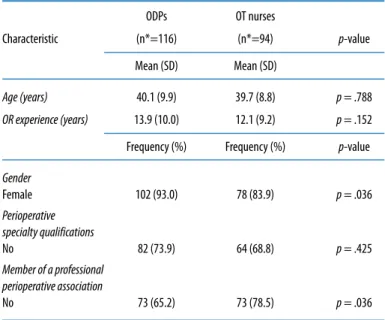
A total of 428 surveys were distributed, with a return of 214 (116 ODPs and 94 nurses), yielding an overall response rate of 50%. Table 2 presents results of the Chi-squared tests used to describe group differences in relation to demography. Both ODPs and OT nurses were similar in age, experience and specialty qualifications. However, there were significant group differences related to gender and professional membership (p<.05). Notably, the majority of perioperative practitioners across both groups did not have specialty qualifications, nor were they members of a professional association.

Table 3 details results for the six subscales and total scale in relation to possible and actual scores, mean and standard deviation, and internal consistency. Comparison of actual scores with theoretically possible score ranges indicates that scores were positively skewed – that is, perioperative practitioners generally perceived themselves

Surgical Glue

Ready when you are!

GLUBRAN2®

Synthetic Surgical Glue

for further information contact your matrix product specialist or customer service :: 1300 616 366 :: [email protected]

Order Code : GEM-GLUBRAN2

no mixing • no thawing • no waiting

GLUBRAN

®

2 is a synthetic glue for use in open and

(4)

as having high levels of competence. Internal consistency as measured by α for the six subscales ranged from .73 to .91, while for the total PPCS–R scores, internal consistency reliability was a high .95.

Group differences

Table 4 displays the means, standard deviations and t-test results comparing differences across each competence domain for the six subscales and total scale scores for ODPs and OT nurses. Mean item scores for each subscale ranged from 3.4 (±.89) to 4.6 (±.42). In spite of this positive skew, there was some variability across groups in each subscale. Between groups there were significant differences in only two of the six subscales; foundational knowledge and skills (p = .002), and empathy (p < .0001).

Discussion

To the best of our knowledge, this is the first study of its kind to compare ODPs and OT nurses’ perceptions of their perioperative competence. Our study results indicate that both ODPs and nurses scored similarly across the domains of leadership, collaboration, proficiency, professional development and the total PPSC–R and may reflect the impact of “role drift” on nursing17. ODPs are indeed undertaking roles within the perioperative environment previously

performed by RNs. Currently in the UK, the nursing education program consists of a three-year diploma or degree with a common foundation year, while the ODP training program is a 12-month diploma level course1. University education for nurses would seem to be distinct from the technical training approach to skills development. Learning in a comprehensive curriculum focuses not only on skills but reflective practice and analytical discussion, which prepares the nurse to undertake a multidimensional role that includes all aspects of caring including advocacy and empathy, and an approach to practice that is embedded in, and informed by professional socialisation18.

However, professional convergence is promoted and reinforced by the well-publicised overlap in the roles of ODPs and nurses1,2,19. Some assert that role overlap is possible because both are capable of performing each other’s roles after specialised training1. As such, nurses practising in perioperative settings within the NHS are increasingly being challenged to identify, clarify19and justify their roles and responsibilities well beyond their traditional boundaries. Clarification and justification is more applicable than ever, as health care services continue to tighten their budgets and reduce staffing costs. Saliently, it is incumbent on nurses to articulate and capitalise on their professional identity in terms of the unique qualities they bring, and the value they add to patient care in the perioperative context.

The nurses in our study reported higher scores than their ODP

counterparts on the empathy subscale, and although these

differences were small, they were statistically significant. These results support previous research describing nurses as carers and nurturers that provide the conduit between the patient and the machine6,20,21. Conceivably, the unique quality and value-adding strength nurses offer is their ability to demonstrate “caring” skills that transcend well beyond the technical focus of the OT milieu2,6,21. In contrast, ODPs have traditionally been described as “technicians” – solely relegated to perform the procedurally focused tasks within the OT environment as opposed to providing direct patient care in other clinical settings1,2. Their different orientations have an implication for patient safety. The escalation in adverse events in hospitals and the vital role nurses play as patient advocates, especially in the perioperative context cannot be understated6. OT nurses assume the responsibility for patient care once they enter the theatre suite; confirm the patient’s identity and the operative procedure, discuss the operation with the patient to identify anxiety concerns, and liaise with other members of the team22. OT nurses

PPcs-r domain Possible actual

(1=”never”; 5=”always”) range range Mean (sD) cronbach’s α

Foundational knowledge & skills (9) 9 – 45 20-45 37.5 (4.9) .81

Leadership (8) 8 – 40 10-40 28.8 (7.0) .91

Collaboration (6) 6 – 30 16-30 27.0 (2.8) .73

Proficiency (6) 6 – 30 13-30 25.6 (3.6) .82

Empathy (5) 5 – 25 10-25 22.2 (3.4) .87

Professional development (6) 6 – 30 13-30 24.7 (3.7) .85

Total scale score and α 40 – 200 90-200 166.2 (21.5) .95

Table 3: summary statistics for the combined group (n=214) ODPs OT nurses

Characteristic (n*=116) (n*=94) p-value Mean (SD) Mean (SD)

Age (years) 40.1 (9.9) 39.7 (8.8) p = .788

OR experience (years) 13.9 (10.0) 12.1 (9.2) p = .152

Frequency (%) Frequency (%) p-value Gender Female 102 (93.0) 78 (83.9) p = .036 Perioperative specialty qualifications No 82 (73.9) 64 (68.8) p = .425 Member of a professional perioperative association No 73 (65.2) 73 (78.5) p = .036

*Missing values not replaced

(5)

ODPs OT nurses

PPcs-r domain (n*=116) (n*=94) p-value

(1=”never”; 5=”always”) Mean (sD) Mean (sD)

Foundational

Knowledge & skills 4.2 (.48) 4.0 (.60) p = .002** Leadership 3.7 (.86) 3.4 (.89) p = .068 Collaboration 4.5 (.48) 4.5 (.45) p = .697 Proficiency 4.2 (.64) 4.3 (.57) p = .603 Empathy 4.2 (.80) 4.6 (.42) p < .0001** Professional development 4.1 (.61) 4.0 (.60) p = .249 Total PPCS-R 4.1 (.54) 4.1 (.52) p = .357

*Missing values not replaced **Statistically significant p<.05

Table 4: comparative data: six competence domains for the ODPs and OT nurses

make important clinical judgements, as opposed to being merely task-focused. Undoubtedly, patients are at their most vulnerable when they enter the cloistered confines of the OT, and are completely reliant on the skills and expertise of the perioperative practitioners assigned to their care23.

The notable differences between ODPs and nurses’ scores on the foundational knowledge and skills subscale, while small, were

significant. That ODPs posted higher scores on this competence domain may be reflective of their orientation to the more task-focused activities. The items within this subscale indicate specialised skills and abilities such as knowledge about the technical aspects and steps of a surgical procedure, knowledge of instrumentation

and the location of equipment10. ODPs are trained to pass

instruments to the surgeon, thus the technical function of the performing the task is covered with limited requirement to provide care22.

Limitations

We acknowledge that this study has some limitations. Firstly, an overall response rate of around 50% is less than ideal24, and may diminish the ability to generalise results beyond the samples

from which they were drawn because of non-response bias16.

Despite this limitation, our study included four hospital sites, and captured a wide cross-section of respondents. Secondly, although self-assessment of competence is the most common form of assessment, criticism has been given to the inherent subjectivity of self-report measures25-27. Notwithstanding, regular self-assessment is imperative as it allows practitioners to reflect on their practice during the course of their professional career. Finally, although the aim of this cross-sectional study was to compare ODPs and OT nurses’ competence; differences in the hospital context

ADVANCED

ALLERGY

PROTECTION

& SENSITIVITY

Ansell’s

Sensoprene

®

latex-free and

accelerator-free formulation delivers

advanced allergy protection and is

up to 30% thinner than standard

surgical gloves for unprecedented

sensitivity and comfort.

Ansell, ® and ™ are trademarks owned

by Ansell Limited or one of its affiliates. © 2013 Ansell Limited. All rights reserved.

For more information, or to request a sample

contact us on

1800 337 041

or visit

(6)

and variances in processes and protocols may have influenced respondents’ perceptions. Thus disparities in work environment, scope of practice and educational preparation may confound the comparability of findings.

conclusions

Measuring self-perceived competence levels of perioperative practitioners is a useful tool to monitor and evaluate performance to ensure consistency and patient safety. Competency self-assessment also enables self-reflection. In this study, there were differences in only two of the six competence scale domains, suggesting convergence in role performance between nurses and ODPs within the NHS trusts surveyed in this study. As nursing shortages persist and health care budgets continue to dwindle, employment of non-nursing personnel may serve as a cheaper and more viable option. To ensure the future of a sustained nursing presence in the perioperative milieu, nurses need to capitalise on their unique contribution to this environment: nurses’ ability to demonstrate “caring” skills encompasses a holistic model of care, and extends beyond the predominant technical and task-oriented focus that ostensibly characterises the OT milieu.

acknowledgements

The researchers are grateful to the staff working in the OT departments of the study sites for their willingness to participate. The authors also wish to acknowledge funding from the Ethicon/ AfPP Nurse & Practitioner Educational Fund Award. The authors are also indebted to Emeritus Professor Anne McMurray for providing an insightful critique of an earlier version of this manuscript.

references

1. Steevenson G (2006). Inter-professional education: Registered nurses + ODPs = theatre practitioners. The Journal of Perioperative Practice, Vol.16, No.11, pp.549–55.

2. Hind M, Jackson K & Platt-Mellor S (2011). Interprofessional working and learning in a UK operating department. The Journal of Perioperative Practice, Vol.11, No.2, pp.74–83.

3. Smith B & Rawling P (2008). Anaesthetic assistant competencies: Our experience. The Journal of Perioperative Practice, Vol.18, No.5, pp.190– 92.

4. Benner P (1984). From novice to expert: Excellence and power in clinical nursing practice. Menlo-Park: Addison-Wesley.

5. Girot EA (1993). Assessment of competence in clinical practice: a phenomenological approach. Journal of Advanced Nursing, Vol.18, No.1, pp.114–119.

6. Gillespie B, Chaboyer W, Wallis M, Chang A & Werder H (2009). Operating theatre nurses’ perceptions of competence: a focus group study. Journal of Advanced Nursing, Vol.65, No.5, pp.1019–28.

7. Corbett S (2009). Teamwork: How does this relate to the operating room practitioner? The Journal of Perioperative Practice, Vol.19, No.9, pp.278– 82.

8. Cowan D, Wilson-Barrett & Norman I (2007). A European survey of general nurses’ self assessment of competence. Nurse Education Today, Vol.27, pp.452–58.

9. Nicholson P, Griffin P, Gillis S, Wu M & Dunning T (2012). Measuring nursing competencies in the operating theatre: Instrument development and psychometric analysis using Item Response Theory. Nurse Education Today. In press.

10. Gillespie B, Polit D, Hamlin L & Chaboyer W (2012). Developing a model of competence in the OR: Psychometric validation of the Perceived

Perioperative Competence Scale-Revised. International Journal of Nursing Studies, Vol.49, No.1, pp.90–101.

11. Gillespie B, Chaboyer W, Wallis M & Werder H (2011). Education and experience make a difference: Results of a predictor study. AORN Journal, Vol.94, No.1, pp.78–90.

12. Soper D (2012). Free Online Statistics Calculator. http://www. danielsoper.com/statcalc3/calc.aspx?id=47 Accessed 11 June 2012. 13. Gillespie B, Chaboyer W, Wallis M & Grimbeek P (2007). Resilience in the

operating room: Developing and testing of a resilience model. Journal of Advanced Nursing, Vol.59, No.4, pp.428–438.

14. Gillespie B, Wallis M & Chaboyer W (2008). Operating room culture – implications for nurse retention. Western Journal of Nursing Research, Vol.30, No.2, pp.259–77.

15. Gillespie B, Chaboyer W, Lingard S & Ball S (2012). Perioperative nurses’ perceptions of competence: Implications for migration. ORNAC Journal, Vol.30, No.3, pp.16–28.

16. Polit D & Beck C (2010). Nursing research: Generating and assessing the evidence. 9th ed. Philadelphia: Lippincott.

17. McKenna H, Thompson D & Watson R (2007). Health care assistants-An oxymoron? International Journal of Nursing Studies, Vol.44, pp.1283–84. 18. Benner P, Sutphen M, Leonard V & Day L (2010). Educating nurses: A

call for radical transformation. San Francisco: Jossey-Bass and Carnegie Foundation for the Advancement of Teaching.

19. Nicholas M (2010). The surgical care practitioner: A critical analysis. The Journal of Perioperative Practice, Vol.20, No.3, pp.94–100.

20. Bull R & FitzGerald M (2006). Nursing in a technological environment: Nursing care in the operating room. International Journal of Nursing Practice, Vol.12, pp.3–7.

21. Richardson-Tench M (2007). Technician or nurturer: Discourses within the operating room. ACORN Journal, Vol.20, No.3, pp.12–15.

22. Shields L & Watson R (2007). The demise of nursing in the United Kingdom: a warning for medicine. Journal of the Royal Society of Medicine, Vol.100, pp.70–74.

23. Gillespie B & Richardson-Tench M (2009). Perioperative nursing. In: Hamlin L, Davies M & Richardson-Tench M, eds. Perioperative nursing. Sydney: Elsevier.

24. Dillman D (1991). The design and administration of mail surveys. Annual Review of Sociology, Vol.17, pp.225–249.

25. Eva K & Regehr G (2005). Self-assessment in the health professions: A reformation and research agenda. Academic Medicine, Vol.80, No.10, S46–54.

26. Watson R, Stimpson A, Topping A & Porcock D (2002). Clinical competence assessment in nursing: A systematic review. Journal of Advanced Nursing, Vol.39, No.5, pp.421–31.

27. Brazen L (2008). Competence, nursing practice and safe patient care. Perioperative Nursing Clinics, Vol.3, pp.297–303.

28. Riley R & Peters G (2000). The current scope and future direction of perioperative nursing practice in Victoria, Australia. Journal of Advanced Nursing, Vol.32, No.3, pp.544–53.

29. Coe R & Gould D (2007). Disagreement and aggression in the operating theatre. Journal of Advanced Nursing, Vol.61, No.6, pp.609–18.

30. Sigurdsson H (2001). The meaning of being a perioperative nurse. AORN Journal, Vol.74, No.2, pp.202–17.

31. Prowse M & Lyne P (2000). Clinical effectiveness in the post-anaesthesia care unit: How nursing knowledge contributes to achieving intended patient outcomes. Journal of Advanced Nursing, Vol.31, No.5, pp.1115– 1124.

32. Safadi R, Jaradeh M, Bandak A & Froelicher E (2010). Competence assessment of nursing graduates of Jordanian universities. Nursing and Health Sciences, Vol.12, pp.147–54.

33. Lofmark A, Smide B & Wikblad K (2006). Competence of newly-graduated nurses – a comparison of the perceptions of qualified nurses and students. Journal of Advanced Nursing, Vol.53, No.6, pp.721–28.

Figure

Table 3 details results for the six subscales and total scale in relation  to possible and actual scores, mean and standard deviation, and  internal consistency
Table 3: summary statistics for the combined group (n=214)ODPs OT nurses
Table 4: comparative data: six competence domains for the ODPs and OT nurses

References

Related documents

Strategy is focused on creating customer value based on a sustainable, flexible business model.  MCC country portfolio covers a wide range of customers, regions and

The rate of credit card frauds is increasing at a very higher rate because attackers are becoming more and more sophisticated and are well equipped. This paper

Within 4-year private for-profit institutions, black students make up 29% of the student population which is more than double the percentages at private nonprofit (13%) and

We conclude that although MDCT tends to be able to exclude advanced tumour stages (T3, T4) with a higher likelihood, the diagnostic accuracy of high resolution MDCT for

Pitney Bowes Group 1 Software, with its long heritage of customer data quality and data integration, can provide key solutions that provide and tie together CDI programs,

to the Web of Data allows for new types of access to the text as well as re-use. The NIOD thesaurus to which both indexes are linked can be used provide enriched access through the

109 Securities and Derivatives Markets Quarterly Report (1st Quarter 2016).. Equity Turnover

For distributions in which T ( X ) = X , which include the the Bernoulli distribution, the Poisson distribution, and the the multinomial distribution, our result shows that the